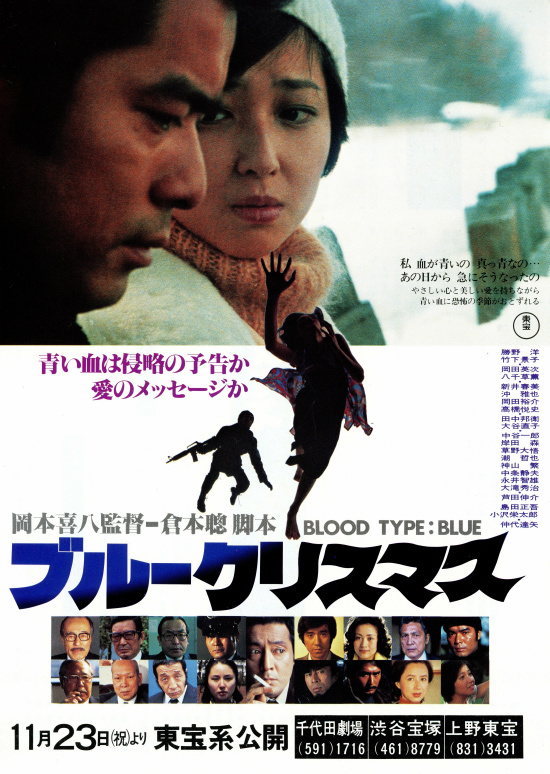
Blue Christmas (ブルークリスマス , Kihachi Okamoto, 1978)

blue-christmasThe Christmas movie has fallen out of fashion of late as genial seasonally themed romantic comedies have given way to sci-fi or fantasy blockbusters. Perhaps surprisingly seeing as Christmas in Japan is more akin to Valentine’s Day, the phenomenon has never really taken hold meaning there are a shortage of date worthy movies designed for the festive season. If you were hoping Blue Christmas (ブルークリスマス) might plug this gap with some romantic melodrama, be prepared to find your heart breaking in an entirely different way because this Kichachi Okamoto adaptation of a So Kuramoto novel is a bleak ‘70s conspiracy thriller guaranteed to kill that festive spirit stone dead.
A Japanese scientist disgraces himself and his country at an international conference by affirming his belief in aliens only to mysteriously “disappear” on the way back to his hotel. Intrepid reporter Minami (Tatsuya Nakadai) gets onto the case after meeting with a friend to cover the upcoming release of the next big hit – Blue Christmas by The Humanoids. His friend has been having an affair with the network’s big star but something strange happened recently – she cut her finger and her blood was blue. Apparently, hers is not an isolated case and some are linking the appearance of these “Blue Bloods” to the recent spate of UFO sightings. Though there is nothing to suggest there is anything particularly dangerous about the blue blood phenomenon, international tensions are rising and “solutions” are being sought.

A second strand emerges in the person of government agent, Oki (Hiroshi Katsuno), who has fallen in love with the assistant at his local barbers, Saeko (Keiko Takeshita). Responsible for carrying out assassinations and other nefarious deeds for the bad guys, Oki’s loyalty is shaken when a fellow officer and later the woman he loves are also discovered to be carriers of the dreaded blue blood.

Okamoto lays the parallels on a little thick at times with stock footage of the rise of Nazism and its desire to rid the world of “bad blood”. Sadly, times have not changed all that much and the Blue Bloods incite nothing but fear within political circles, some believing they’re sleeper agents for an alien invasion or somehow intended to overthrow the global world order. Before long special measures have been enforced requiring all citizens to submit to mandatory blood testing. The general population is kept in the dark regarding the extent of the “threat” as well as what “procedures” are in place to counter it, but anti Blue Blood sentiment is on the rise even if the students are on hand to launch the counter protest in protection of their blue blooded brethren, unfairly demonised by the state.

The “procedures” involve mass deportations to concentration camps in Siberia in which those with blue blood are interrogated, tortured, experimented on and finally lobotomised. This is an international operation with people from all over the world delivered by their own governments in full cognisance of the treatment they will be receiving and all with no concrete evidence of any kind of threat posed by the simple colouring of their blood (not that “genuine threat” would ever be enough to excuse such vile and inhuman treatment). In the end, the facts do not matter. The government has a big plan in motion for the holiday season in which they will stage and defeat a coup laid at the feet of the Blue Blood “resistance”, ending public opposition to their anti-Blue Blood agenda once and for all.

Aside from the peaceful protest against the mandatory blood testing and subsequent discrimination, the main opposition to the anti-Blue Blood rhetoric comes from the ironically titled The Humanoids with the ever present Blue Christmas theme song, and the best efforts of Minami as he attempts to track down the missing scientist and uncover the conspiracy. This takes him around the world – firstly to America where he employs the somewhat inefficient technique of simply asking random people in the street if they’ve seen him. Laughed out of government buildings after trying to make serious enquires, Minami’s last hope lies in a dodgy part of town where no one would even try to look, but he does at least get some answers. Unfortunately, the information he receives is inconvenient to everyone, gets him fired from the investigation, and eventually earns him a transfer to Paris.

In keeping with many a ‘70s political thriller, Blue Christmas is bleaker than bleak, displaying little of Okamoto’s trademark wit in its sorry tale of irrational fear manipulated by the unscrupulous. In the end, blue blood mingles with red in the Christmas snow as the bad guys win and the world looks set to continue on a course of hate and violence with a large fleet of UFOs apparently also on the way bearing uncertain intentions. Legend has it Okamoto was reluctant to take on Blue Christmas with its excessive dialogue and multiple locations. He had a point, the heavy exposition and less successful foreign excursions overshadow the major themes but even so Blue Christmas has, unfortunately, become topical once again. Imperfect and cynical if gleefully ironic in its frequent juxtapositions of Jingle Bells and genocide, Blue Christmas’ time has come as its central message is no less needed than it was in 1978 – those bleak political conspiracy thrillers you like are about to come back in style.


Original trailer (No subtitles)

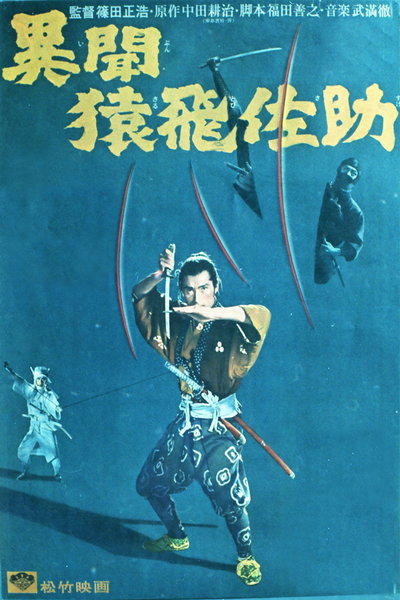
Samurai Spy (異聞猿飛佐助, Masahiro Shinoda, 1965)

samurai-spyNothing is certain these days, so say the protagonists at the centre of Masahiro Shinoda’s whirlwind of intrigue, Samurai Spy (異聞猿飛佐助, Ibun Sarutobi Sasuke). Set 14 years after the battle of Sekigahara which ushered in a long period of peace under the banner of the Tokugawa Shogunate, Samurai Spy effectively imports its contemporary cold war atmosphere to feudal Japan in which warring states continue to vie for power through the use of covert spy networks run from Edo and Osaka respectively. Sides are switched, friends are betrayed, innocents are murdered. The peace is fragile, but is it worth preserving even at such mounting cost?
Our “hero” Sasuke (Koji Takahashi) is a wandering spy for the Sanada clan, nominally part of the Tokugawa though with no strong allegiance to either side. Everywhere he goes he feels hunted, watched by shadowy forces and unseen motivators. After bumping into Mitsuaki (Mutsuhiro Toura), an old comrade who fought alongside him at the Battle of Sekigahara, Sasuke is pulled into the ongoing intrigue as his friend is murdered and he assumed to be the culprit. Things are further complicated when a mysterious woman to whom he had become attached, Okiwa (Misako Watanabe),  is killed in a similar fashion. A political shift is taking place as a high ranking Tokugawa official, Tatewaki (Eiji Okada), is in the process of defecting to the Toyotomi with white cloaked ninja master Takatani (Tetsuro Tanba) (presumably) working against him. Sasuke is charged with trying to sort all of this out but constantly finds himself on shaky ground as everything around him is constantly changing and the air is filled with conspiracy.

Shinoda aims to disorientate. After beginning with a brief historical narration to set the scene including a bloody excerpt from the horrific Battle of Sekigahara (the historical context presumably much more apparent to a Japanese viewer than an overseas one), he jumps forward 14 years and proceeds to give a rundown of the current situation. Quick fire naming and a lack of external context intentionally make it difficult to pin down who is who and which side is which. The opening sequence takes place in darkness with only moonlight and lanterns to light the way, so our players are always cast in shadows, only half visible and unidentifiable. Nothing is as it seems, the world is murky and the people in shadier still.

Sasuke fought at Sekigahara when he was just 15. His true coming of age has been in an era of peace and he is committed to sustaining that peace at all costs rather than return to the bloody, internecine warfare of the past. This stands in contrast to his double dealing friend, Mitsuaki, whose own coming of age was forged by war and so now finds himself at a loose end as warriors are obsolete in an age without war. Nevertheless, Sasuke feels the peace is threatened – all conversations are eventually about conflict, no one thinks about the meaning of death or what it is to be alive. Men like Mitsuaki have decided to live purely for pleasure, wanting nothing more than women and sake, thinking of nothing beyond satisfying their needs, and rarely consider the moral or political dimension of their actions. Mitsuaki’s unexpected degree of self interest accidentally threatens to completely destabilise the status quo, setting off a series of betrayals and counter betrayals in its wake, but all Mitsuaki was thinking about was a how to get paid twice for doing one job.

Navigating this complex network of allegiances and betrayals, Sasuke comes to discover what it is he really wants out of life and what he needs to do to get it. No longer a neutral observer, he has to pick a side and the one he picks that of the wronged. Coming to the aid of the threatened and oppressed, Sasuke adds himself to the list of enemies of the state yet he sees it as his duty to fight against the forces of darkness for a better, fairer world. Of course, he has his personal reasons for revenge but even these are partly born out of a sense of outrage for the injustice done to people who mattered to him.

Yet for all of the real world intrigue and political allegory Samurai Spy is also imbued with an unsettling sense of the absurd. Sasuke is plagued, yet at times assisted, by the almost supernatural Takatani who, incongruously, dresses in a bright white outfit with the fabric of his hood tied up into horns on the front. Appearing as needed along with his more conventionally dressed ninja minions, Takatani seems to float through the air performing strange acts of ninjadom and acting with no firm course of action. Shinoda shoots the battle scenes from odd angles using slow motion to give them a strange kind of power, even in one instance allowing a severed limb to float to the ground. In a nod to the circularity of violence, he even allows the climactic fight to be interrupted and witnessed by a small boy, shocked by what he has seen. The fact that the situation is laid to rest by a forgotten deus ex machina is yet more evidence for the world’s essential leaning towards constructed narrative.

Filled with the fog of war (literally so in places), Samurai Spy dramatises the uncertainties of its environment through the extreme lack of visual clarity. The audience is as disorientated as Sasuke, continually wrong footed and left at a loss as to the true motivations of each of the major players. The atmosphere is palpably intense, as if sitting on a powder keg ready to explode at any spark of conflict. From this viewpoint, it’s impossible to see who is in the right and who the wrong or even if those two ideas are even appropriate ways of thinking about things. Peace stands on a knife edge and, ironically, only survives if robustly defended. Violence is shown up for all of its essential cruelty and senselessness yet it is the only thing which is certain. Sasuke, at least, seems to have made his own peace in one way or another but the world he leaves behind him is far from ready to do the same.


At This Late Date, the Charleston (近頃なぜかチャールストン, Kihachi Okamoto, 1981)

At this late date, the charlestonKihachi Okamoto first made his name with his samurai movies but his output was in fact far more varied in tone than the work most often screened outside of Japan might suggest. Marked by heavy irony and close to the bone social commentary, Okamoto’s movies are nothing if not playful even in the bleakest of circumstances. He first teamed up with Japan’s indie power the Art Theatre Guild for The Human Bullet in 1968 which recounted the absurd final days of the war in true Okamoto fashion and then bounced back to the Edo era for Battle Cry before deciding on the very contemporary satire At This Late Date, the Charleston (近頃なぜかチャールストン, Chikagoro Nazeka Charleston) in 1981.
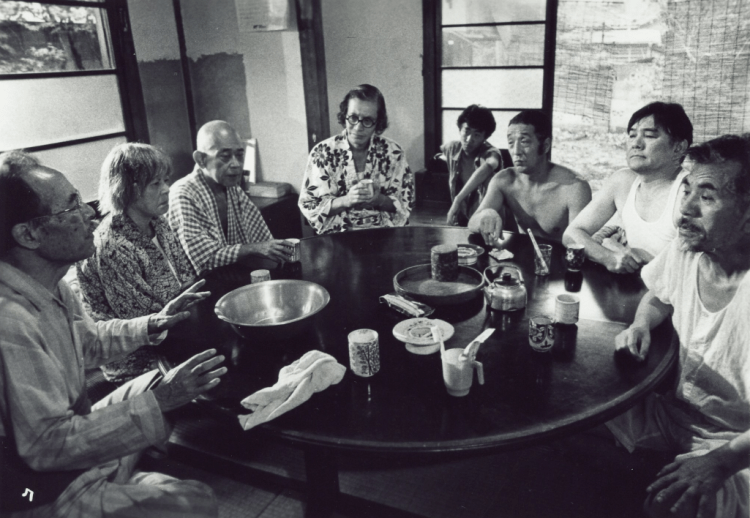
Shot in 4:3 and a stately looking black and white, At This Late Date, the Charleston begins when Jiro – a slightly strange younger son of a wealthy family, punches out a girl’s boyfriend whilst the pair are sitting on a bench and subsequently chases her through the park util he eventually gets himself arrested on a charge of “attempted rape”. He then gets thrown into a cell with a gang of crazy old guys who took the decision sometime ago to secede from the state of Japan and create their own independent nation known as the land of Yamatai. Consequently, they all refer to each other by their “cabinet titles” such as Foreign Minister and Army Minister etc each inspired by their former lives which is why they have a minister for mail (he used to be a postman). They’re in jail because they tried to make a “state visit” to the Diet building and whilst there enjoyed some of the canteen food but as this was an official event they didn’t see why they should pay for any of it (and their Finance Minister was busy at the races).

Soon enough everyone gets released – the old guys when the Finance Minister turns up to pay their bill and Jiro when he’s bailed out by his older brother and the family housemaid (who quickly realises the “victims” aren’t quite what they seem). However, in a fantastically weird coincidence it turns out that the government of Yamatai have commandeered a house on the estate of Jiro’s father for their sovereign territory. Jiro’s brother is desperate to evict them but there’s also the problem that their multimillionaire dad has been missing for months and no one’s quite sure what might have happened to him…

Crazy old guys (and gal) who’ve become so disillusioned with their nation that they’ve started a new one on their own, missing industrialists, a Lupin III-like policeman who’s so obsessed with looking cool that the suspects always run away while he’s left striking a pose – Okamoto really knows how to pile on the strangeness, but somehow it all seems to make perfect sense. Madcap doesn’t even begin to do justice to crazy cartoon world Okamoto has created but it’s all so effortlessly funny that it hardly matters what you’d call it.

After initially being captured and branded a spy when he marches on over to Yamatai to ask them about his father, Jiro finds himself defecting to become “Minister of Labour” (this seems to involve doing all of the old guys’ menial tasks). As the youngest member of the group, he becomes the repository for their stories which mostly date back to the days of their youth from the fun loving Charleston era to the rise of militarism and eventually the war itself. This comes to the fore even more as the events take place in August, meaning that there’s both the anniversary of the atomic bomb and of the end of the war raising painful memories for this group of older folks, even if not quite so relevant to the younger contingent. The gang are planning a special trip to a hot spring on the 15th, but first they have to defend their micro-country against the onslaught of gangsters and bailiffs who are trying to “invade” their sovereign territory.

The old folks are pacifists, more or less (they didn’t really want an “Army Minister” but it was argued that no one would take them seriously without means of defence) but are still determined to protect their ideal state of Yamatai all the while clamouring for a silent kind of diplomatic immunity. They have some very unusual ideas but they know what’s what and having made an unlikely ally in the form of an unhappily married and soon to be retired policeman, have even managed to expose a little corruption and evil corporate shenanigans in the process of defending their own freedom. A vote for dancing cheerfully over a military march, At This Late Date, The Charleston is a warm and funny tale of eccentric oldsters who’ve seen it all before and finally decided it’s all kind of ridiculous anyway which can’t help but get your own toes tapping, whatever age you are.


Several unsubtitled trailers for the price of one:

Black Rose Mansion (黒薔薇の館, Kinji Fukasaku, 1969)

3187_largeThose who only know Kinji Fukasaku for his gangster epics are in for quite a shock when they sit down to watch Black Rose Mansion (黒薔薇の館, Kuro Bara no Yakata). A European inflected, camp noir gothic melodrama, Black Rose Mansion couldn’t be further from the director’s later worlds of lowlife crime and post-war inequality. This time the basis for the story is provided by Yukio Mishima, a conflicted Japanese novelist, artist and activist who may now be remembered more for the way he died than the work he created, which goes someway to explaining the film’s Art Nouveau decadence. Strange, camp and oddly fascinating Black Rose Mansion proves an enjoyably unpredictable effort from its versatile director.

The sense of foreboding sets in right from the beginning as Kyohei, club owner and family patriarch, narrates a scene draped in a harsh red filter in which the lynchpin of the entire film, Ryuko, disembarks from a boat onto a jetty to meet him. He warns us that the sight of her was the “calm before the storm”, already anticipating the tumultuous events which are to follow. Having spotted her in a club in Yokohama, Kyohei poached Ryuko to work at his private members bar as a cabaret artist where she duly fascinates the customers seemingly knowing how to appeal to each of their own particular tastes in turn. A short time later, other suitors from the other bars begin to turn up but Ryuko refuses to recognise any of them. She is waiting for true love and believes the black rose she carries will turn red once she meets her prince charming. After a while she decides to move on but Kyohei convinces her to stay and maintain her “illusion” of perfect love rather than continually bursting its bubble, and so the two become a couple. However, when Kyohei’s wayward son Wataru returns and also becomes infatuated with Ryuko, a new chain of tragic events ensues…

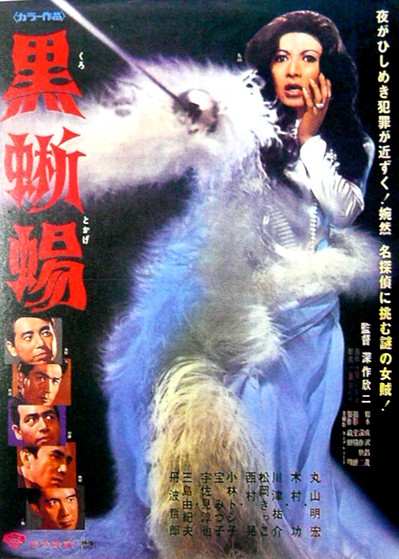
Just to add fuel to the fire, the role of Ryuko is played by female impersonator Akihiro Miwa (formerly Akihiro Maruyama) who had also worked with Fukasaku on the notorious Black Lizard. Ryuko is mysterious, exotic maybe, etherial – certainly. She seems to shed identities only to pick up new ones perfectly tailored to whichever man she’s courting hoping each is the one who will turn her black rose red. Each of the previous suitors has failed to make her flower bloom and has so been discounted – erased from her memory whether willingly or unconsciously. When one of them is killed in front of her and her rose splashed with blood turning temporarily red, only then does she look on him lovingly. She loves them as they die but not before or after. Has each of these lonely, “different” men fallen for a siren call from the angel of death, or is Ryuko just another unlucky femme fatale who always ends up with the crazies?

Camp to the max and full of that rich gothic melodrama that you usually only find in a late Victorian novel, Black Rose Mansion is undoubtedly too much of a stretch for viewers who prefer their thrills on the more conventional side. However, there is something genuine underlying all the artifice in the story of obsessive, all encompassing love which develops into a dangerous sickness akin to madness. Ryuko is an unsolvable mystery which drives men out of their minds though they never seem to probe very far into her soul preferring to conquer her body. Only Kyohei who, at the end, is cured of his obsession with her, recognises that Ryuko is a woman who only exists in men’s minds and what you think of as love is really only lust like an unquenchable thirst.

Fukasaku attempts to invert classic gothic tropes by shooting the whole thing in lurid, brightly coloured decadence. Every time Kyohei thinks back on Ryuko he sees her bathed in red, like a beautiful sunset before a morning storm. Like Kyohei and pretty much everyone else in the picture, we too become enthralled by Ryuko and her uncanny mystery, seduced by her strangeness and etherial quality. Yes, it’s camp to the max and drenched in gothic melodrama but Black Rose Mansion also succeeds in being both fascinatingly intriguing and a whole lot of strange fun at the same time.


Black Rose Mansion is available with English subtitles on R1 US DVD from Chimera and was previously released as part of the Fukasaku Trilogy (alongside Blackmail is My Life and If You Were Young: Rage) by Tartan in the UK.


Kisses (くちづけ, Yasuzo Masumura, 1957)

tumblr_nwj79ycwjz1tvmqcgo1_500The debut film from Yasuzo Masumura, Kisses (くちづけ, Kuchizuke) takes your typical teen love story but strips it of the nihilism and desperation typical of its era. Much more hopeful in terms of tone than its precursor and genre setter Crazed Fruit, or the even grimmer The Warped Ones, Kisses harks back to the more to wistful French New Wave romance (though predating it ever so slightly) as the two youngsters bond through their mutual misfortunes.

The film begins as Kinichi and Akiko experience a meet cute whilst visiting their respective fathers who’ve both landed up in gaol. Kinichi’s dad is a politician who’s been accused of “electoral fraud” which he swears is some kind of plot (even though this is the third time he’s been accused of it) whereas Akiko’s father is a government official who’s embezzled a large sum of money in an act of desperation to pay for her mother’s medical treatment. Just as Kinichi is leaving the prison, Akiko is getting into a situation with the rather rude receptionist because she owes something for her father’s room and board. Kinichi becomes offended on Akiko’s behalf and plonks down more than enough money alongside a few choice words for the lady on the counter before flouncing out. Akiko chases after him with his change even though he tells her to get lost in no uncertain terms. Eventually the two end up spending the day together though things turn a little sour towards the end. In this unlucky world, can two crazy kids ever make it work?

In essence, Kisses is an innocent film. Though there may be a few hints of darkness lurking around the edges, its tone is more or less cheerful and fuelled by the idealism of youth. Both Kinichi and Akiko are realists, they’re both older than their years, put-upon and a little desperate but also a little naive. Kinichi’s grumpy and sullen, perhaps nursing a wound from his mother walking out on him. Even when he asks her for the money to bail his father out of gaol she tells him to grow up before treating him like a child by declaring that he himself is collateral on the loan. Akiko’s mother is hospitalised with TB – the misfortune that’s had her father reduced to this shaming state of affairs. To make matters worse it’s not as if she can even tell her mother why her father hasn’t visited for a couple of weeks or explain why the nurse was complaining that their insurance has expired. Her father is also in poor health and likely will not cope very well with remaining in prison hence why she (briefly) considers becoming someone’s mistress or going on a date with a dangerous and unpleasant man to get the money to bail him out.

In any other seishun eiga this situation would be a recipe for a disaster, but somehow it rescues itself from the brink of despair and becomes almost more of salty rom-com than anything else. After the initial cute sea-side and roller skating date, there are crossed wires, mislaid messages and a last minute dash to work out a forgotten address but the film never loses its youthful energy and guileless wit. The world outside might be cruel, but in here it’s just normal, and if a boy and a girl want to blow some time at the races or the beach, who can blame them. They’re young, they’re kind of unhappy but they’ll figure it out and probably be OK which is a lot more than you can say for the usual protagonists of these kinds of film.

Kisses doesn’t have the searing, angry eyes of Masumura’s later work. Yes there is dissatisfaction with the world as it is, but also hope and acceptance, rather than an attempt at rebellion. Neither of the two young lovers is trying to change the world. Forced to be older than they are, both are savvy and realistic but not quite old enough to be fearful or self-centred. Full of youthful nonchalance, Kisses is a tale of innocent romance which is only improved by its layer of ironic whimsy.


Kisses is available with English subtitles on R2 UK DVD from Yume Pictures.

The only (short) clip I could find only has Russian subs…but it’s of a song which is very pretty.

The Crucified Lovers (近松物語, Chikamatsu Monogatari, Kenji Mizoguchi, 1954)

E8BF91E69DBEE789A9E8AA9EB2Bunraku playwright Chikamatsu Monzaemon had a bit of a thing about double suicides which feature in a number of his plays. Though these legends of lovers driven into the arms of death by a cruel and unforgiving society are common across the world, they seem to have taken a particularly romantic route in Japanese drama. Brought to the screen by the great (if sometimes conflicted) champion of women’s cinema Kenji Mizoguchi, The Crucified Lovers (近松物語, Chikamatsu Monogatari) takes its queue from  one such bunraku play and tells the sorry tale of Osan and Mohei who find themselves thrown together by a set of huge misunderstandings and subsequently falling headlong into a forbidden romance.

Set in 17th century Kyoto, the story begins with a reminder that adultery is currently illegal and that the penalty is crucifixion of both parties. A samurai woman and a man servant are being paraded through the streets for having committed the double transgression of an extra-martial affair which also crosses class borders. We set our tale at the top printing house in the city where the most promising employee, Mohei, is being pulled from his sickbed to complete a particularly important order. At the same time, mistress of the house Osan receives an unwelcome visit from her brother who is once again in pecuniary difficulty. He wants her to ask her wealthy husband, Ishun, to lend him some more money to meet the latest mortgage payment on their family home. However, Ishun is a stingy old man and outright refuses. Mohei overhears the brother’s visit and offers to help but his idea to temporarily embezzle some of the money backfires when he’s caught.

To make matters worse, Ishun now has it in for Mohei as Ishun has been after the servant girl Otama who has been refusing his advances and finally lied to him by claiming that she and Mohei are secretly engaged. After Otama reveals Ishun’s true nature to Osan, they hatch a plan to confront him by swapping rooms so that when Ishun makes his nightly visit to Otama he’ll find his wife waiting for him instead and have to backdown for awhile. This backfires too when Mohei decides to escape and stops by Otama’s room to say goodbye only for another servant to find Mohei and Osan together there. Mohei flees but a rumour starts about his friendship with Osan and it’s not long before she’s stormed out too. Accidentally running in to each other the pair find themselves on the run and eventually falling in love, but this isn’t the sort of place where two people can just move to another town and disappear. The police and Ishun’s men are hot on their tail determined to try and prevent the impending scandal…

Life was pretty harsh in feudal Japan. In some ways Osan might be thought lucky – married off at a young age to a well connected and prosperous husband. Indeed, at the beginning of the film she doesn’t seem too unhappy though is obviously nervous to talk to her husband about her brother’s predicament. Ishun is not a good man though he is perhaps sadly typical of his petty samurai merchant class. He swaggers around complaining about having to pay for everything and won’t even lend any of his vast wealth to his own sister let alone his wife’s family. Though outwardly miserly he’s no problem promising fancy kimonos and even a house to Otama if she’d only consent to becoming his mistress. Something of a double standard then when his wife is accused of having affair with a servant merely by having been found in a compromising position alone in a room with another man.

Mohei, by contrast, is the archetypal loyal retainer. When ever a problem comes up he reminds himself that one needs to be a “good servant” – a sentiment he utters to Otama when she asks for his help to fend off Ishun. He doesn’t approve of the idea of her simply giving in, but thinks she ought to grin and bear it. Similarly when some of the female members of staff are sympathising with the samurai lady about to be crucified for love, Mohei agrees that he feels sorry for her but also that she’s broken a law and what is happening is simply a natural consequence. He’s the last sort of person you would expect this sort of thing to happen to, and yet, it does.

The irony is that nothing existed between the pair other than the loose friendship and loyalty of a mistress and a member of staff before this whole thing started. Their union is quite literally unthinkable, not only a relationship between a married woman and another man, but love across the class divides. Even if Osan were free, a marriage with Mohei would be considered a disgrace. When the pair face the hopelessness of their situation and decide on suicide, Mohei confesses his love which immediately changes Osan’s mind about dying. She’s fallen in love with him too, and now she wants to live. For her now there can be no life without Mohei. Though Mohei entertains the noble idea of handing himself in to the police and sending Osan back to Ishun who would doubtless be glad to cover up the affair and avoid a bigger scandal, he later finds himself unable to give her up. The pair cannot, and will not, deny their love even if it costs their lives. In this unforgiving world of harsh social justice, the only freedom left to Osan and Mohei is to ride proudly to their agonising deaths hand in hand and with beatific smiles on their faces.

In the end, two grand houses fall because of a series of coincidental misunderstandings and lapses of protocol. Envious of his position, another petty samurai is perfectly happy to manipulate the situation to take down Ishun fully knowing that it will mean the deaths of two people. In ordinary circumstances this passionate, romantic love would never be permitted to exist (or at least among this social class). Its blossoming is an impossible miracle that threatens the very foundation of the extraordinarily regimented society of the two people at its centre. Parents betray their children to protect these archaic laws and preserve their family “honour” but what honour could their possibly be in the denial of love and society that places standing above basic compassion?

Though not perhaps Mizoguchi’s most impressive effort, The Crucified Lovers is an impassioned attack on needlessly repressive social systems and the self centred shenanigans which perpetuate them. Unashamedly melodramatic and filled with a melancholy though passionate resilience, The Crucified Lovers is a tragic tale of true love torn asunder by a cruel and unforgiving world. It would be so easy to say this would never happen today, and yet…


The Crucified Lovers is available on blu-ray in the UK as part of Eureka’s Late Mizoguchi box set.

No trailer but here is a particularly beautiful scene from the film

http://www.youtube.com/watch?v=rG59RIaz3VM

And an introduction from Tony Rayns

Morning for the Osone Family 大曾根家の朝 (Keisuke Kinoshita, 1946)

81avzyD41gL._SL1500_So, after making the subtly subversive Army, Kinoshita found himself persona non grata but all that changed with Japan’s final surrender and the coming of the Americans. You might think that means an end to the system of censorship and a greater freedom of expression but the truth is one master had simply been swapped for another. The Americans now imposed their own censor’s office and banned the depiction of various dangerous or inconvenient ideas including anything xenophobic, militaristic or anti-democratic. In short, the complete reverse of before but perhaps no less restrictive. However, the new requirements were undeniably closer to Kinoshita’s true feelings so there were fewer problems when it came to getting a film made. Accordingly Kinoshita began working on Morning for the Osone Family soon after the surrender and the film was released in 1946. Extremely raw and probing, the film deals with the effects of the war on a well to do, liberal intellectual family but turns their plight into a metaphor for the country as a whole.

The film begins in the Christmas of 1943 as the Osones gather together around the piano for a rendition of Silent Night as they prepare to say goodbye to the daughter’s fiancé who’s been drafted and will shortly be leaving for the war. The celebration is short lived as their peace is shattered by an ominous knock at the door. Oldest son Ichiro is carted off by military police for having written a mildly subversive essay in a newspaper. Whilst all this is going on Yuko’s fiancé, Akira, takes his leave handing her a letter to say she needn’t wait for him with the future so uncertain. It’s at this point that meddling fascist uncle first appears to reveal he has written to Akira’s family to break off the engagement because they are of a high status and with Yuko’s brother’s arrest he feels it’s inappropriate to bring them shame. As the war drags on, Uncle Issei comes to have more and more control over their lives but will the progressive atmosphere of the Osone household ever be able to withstand the bluster of Uncle Issei’s militaristic fervour?

Made immediately after the war, Morning for the Osone Family is filled with the bitterness and anger of disillusionment. Coloured by the knowledge of Japan’s impending defeat, the events can’t help but take on a portentous air and it’s pretty obvious the Osone family will never be able to return to that final Christmas in 1943 before everything was taken away from them. The obnoxious Uncle Issei becomes a metaphor for Japanese fascism as a whole with his heartless militarism and personal corruption. During one telling episode, Yuko remarks that the more they simply obey him the worse he’ll get and that they should stand up to him every now and then. The mother, Fusako, agrees but thinks it’s impossible. Later, in a last impassioned speech, she laments that she should have done more, said no earlier, but she tried to do what was expected of her. Fusako voices the rage and disappointment of the masses of ordinary people who went along with things they didn’t agree with because they felt it was the proper thing to do. Now she sees no need for the pretence, in this brave new world it’s time for the younger generation to do as they see fit without feeling beholden to these corrupt ideas peddled by those who claim to speak for everyone but have only ever been speaking for themselves.

Oddly, Morning for the Osone Family may have the most overtly propagandistic feeling of any of the films in Criterion’s Kinoshita and World War II boxset. Though it ends on an undeniably powerful declaration of hope for renewal and rebirth, its epilogue feels like a step too far – both hollow and needlessly over the top. Apparently this final scene was added at the behest of the Americans who wanted more deliberately democratic sentiments which may explain its on the nose tone though it isn’t entirely out of keeping with the rest of the film and most likely represents Kinoshita’s real feelings. Morning has arrived after a long night filled with pain and sorrow, all that remains now is to banish the darkness and welcome in the light.

Port of Flowers 花咲く港 (Keisuke Kinoshita, 1943)

film_syosai_img_01_04-thumb-730x480-1642Keisuke Kinoshita is far better known in his native Japan than outside it despite his long and prolific career in filmmaking. Equally adept at comedy and tragedy and tackling all genres from musicals to crime dramas, Kinoshita began his career in the relatively turbulent war years where every last detail was at the censor’s mercy.  Port of Flowers is his very first foray into the director’s chair and began a long association with the comedy genre. Though, yes, it has it’s obligatory moments of bare faced propaganda, the film is refreshingly light on heavy handed political statements and prefers to focus on a humorous take on small town life.

Life in a sleepy little port town is about to get significantly more exciting after the local inn has received two rare telegrams purporting to be from the same man but sent from different locations one day apart. The man in question claims to be the son of a businessman who lived in the town some years previously but has since died and the bereaved child has a hankering to see the little shipping village that the father apparently loved so much. After picking up their new guest at the station the mini delegation of inn keepers and officials are shocked to discover another disgruntled customer also claiming to be the sender of the letter. Sufficed to say neither of the two in question is what he claims to be but has come to town with the intention of fleecing some gullible country bumpkins out of grandma’s silver. The two decide to work together but eventually the goodnatured enthusiasm of the villagers (and the rising war effort) begin to make them rethink their nefarious ways!

Given the time period and strict censorship, it would be ridiculous not to expect some degree of pro-war sentiment in the film but Kinoshita has managed to more or less leave the conflict as merely a background setting. Life in this little fishing village seems fairly tranquil and the war has barely encroached on its idyllic settings. There are youngish men about, the people aren’t rich but they aren’t afraid and the only mention of turbulence seems to be a young woman who’s recently returned from Manchuria not entirely at her own volition. There are some fairly excited mentions of various victories but these are fairly minor events, almost like something happening far away to other people to whom you feel connected but not quite involved with. The most important thing is the building of the ship – not only is it a source of pride for the villagers, a way of fulfilling the dream of a respected visitor they all remember fondly but it will also be for their country. Everyone must contribute as they can because it’s for the entire community of citizens, not just the village but for everyone in the country and it’s important. Their sacrifice and hard work will matter because it will be for the greater good.

Here endeth the lesson, for the most part. What of our two bumbling crooks? It’s never really explained how they came to know so much about this poor, unsuspecting community and simultaneously hatched on the same scheme at the same time but they must have been pretty well out of options to think these poor villagers were going to be worth this much effort. They came to commit a fraud but ended up having to actually do the impossible and make their improbable scheme work solely because the villagers’ kindness was too much to bear. The addendum to the lesson being that pure hearts can shame the devil and innocence becomes infectious after a while (in the best possible way).

Very much of its time and with an air of disposability, Port of Flowers is an enjoyable, surprisingly warm film but not without its faults. Eschewing heavy handed propaganda for a subtle enforcement of traditional, communal values it reflects Kinoshita’s subsequent humanistic concerns and even manages to do so without giving in to the censor’s red pen. A nice take on an old story, Kinoshita once again proves that nothing matters so much as people and goodness will always win through in the end.