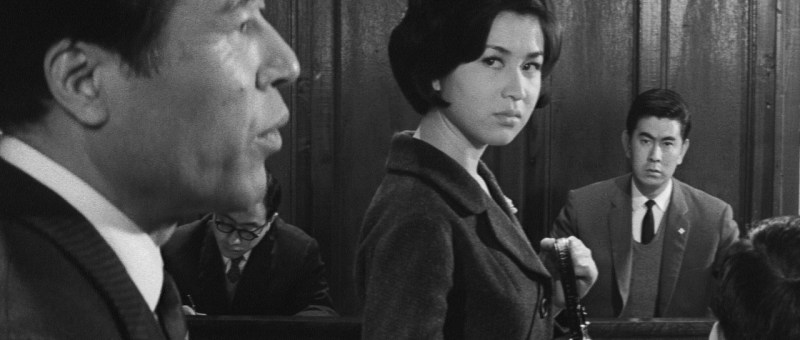
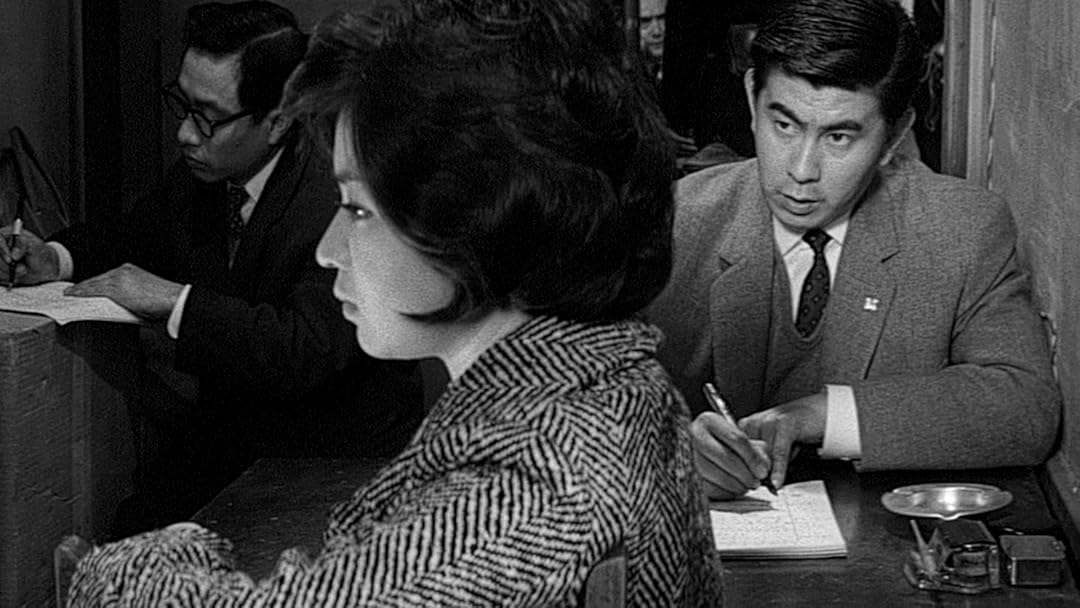
When an overworked prosecutor is handed a murder case, his colleagues tell him he’s lucked out. Election fraud and bribery are dead ends, one says. They hire fancy lawyers, public prosecutors don’t stand a chance. But with a murder, it ought to be fairly straightforward to get a conviction. They are however fateful words, as Kido (Ken Utsui) finds himself squaring off against a ruthless opponent willing to subvert the law in all ways possible in order to get his client off the hook,
Part of Daiei’s “Black” series, Yasuzo Masumura’s Black Report (黒の報告書, Kuro no Hokokusho) is another in a line of films from the 1960s expressing a lack of confidence in a justice system that is increasingly compromised by social inequality. Kido has 200 cases on his docket. They’ve received seven new ones just this morning, and he’s under pressure to get through them quickly. His boss has told him that a successful conclusion of the murder case will get him a promotion and a transfer to Tokyo. They’ve recently failed to secure convictions in two previous cases, which means the boss’ reputation is on the line and they urgently need to correct the record. Make no mistake, these are the good guys from the film’s perspective, but it’s also true that there’s 99.9% conviction rate in Japan. Losing cases is something that isn’t meant to happen and an embarrassment for law enforcement.
As his colleague said, however, there is an inequality when it comes to accessing justice given that wealthy people can afford to hire fancy lawyers, while poorer ones can’t and are at a disadvantage. After pinpointing their suspect, Kido is dismayed to find himself up against corrupt lawyer Yamamuro (Eitaro Ozawa) who is willing to use every dirty trick in the book, even buying off witnesses to lie on the stand. Meanwhile, one of Kido’s central arguments relies on leveraging a conventional view of morality in claiming that the suspect, Hitomi (Shigeru Koyama), committed the crime in part because he was having an affair with victim’s wife, Miyuki (Mieko Kondo). The dead man, Kakimoto, had been a womaniser himself, while Miyuki was his second wife and a former bar hostess. In the judgemental atmosphere of the times she is perceived as a woman of low moral character.
But as Kido’s friend points out, proving things like affairs isn’t particularly easy and even if Miyuki and Hitomi are morally flawed people, that doesn’t make them murderers. Kido is essentially trying them for the wrong “crime” while leveraging salacious gossip and hearsay to bolster his case. His other main argument is that Hitomi killed Kakimoto in order to be able to keep money he had placed with him to earn high interest through illegal loans. Kakimoto had embezzled the money from his company and at some point needed to replace it. This again signals the corrupting influence of money in the post-war society as men like Hitomi take advantage of of people’s desperation through issuing high interest loans, while others like Kakimoto game the system in order to satisfy their greed. Kakimoto does after all seem to have been given to excess with his womanising lifestyle.
Miyuki seems to have taken against Kakimoto’s secretary Ayako (Junko Kano), believing she and Kakimoto were having an affair. Though Ayako declares herself outraged and says that she intends to avenge Kakimoto’s death, even she is eventually corrupted by the possibility of inheriting money from his will along with hush money from Miyuki. Similarly, Kakimoto’s resentful son seems to have come into money recently, having his bought the building where his theatre troupe rehearses. Pretty much everyone else seems to have loathed Kakimoto, so there’s little sympathy for his death and tremendous interest in what’s going to happen to his riches.
It never really occurs to Kido that his case could fall apart if everyone suddenly changed their story on the stand, which is what proceeds to happen. Yet, Kido maintains his faith in the justice system, certain the judges will find their way to the truth without fully considering the fact he’s built an incomplete case and left openings for Yamamuro to undermine it through bribing and intimidating witnesses. Kido seems to think he’ll win just because he’s on the side of righteousness, but the world doesn’t work like that. The film ends on a note of anxiety in which it appears the guilty parties are going to get off scot-free while Kido is exiled from the city, transferred to the provinces in Aomori rather to Tokyo with his career in ruins. Nevertheless, his faith in the justice system to right itself remains absolute as he declares himself ready to trust people again having been reassured by his prosecutor friend and police mentor that they will ensure justice is served so that he can once again return to a world less morally corrupt.
Trailer (English subtitles)

 The debut film from Yasuzo Masumura, Kisses (くちづけ, Kuchizuke) takes your typical teen love story but strips it of the nihilism and desperation typical of its era. Much more hopeful in terms of tone than its precursor and genre setter Crazed Fruit, or the even grimmer The Warped Ones, Kisses harks back to the more to wistful French New Wave romance (though predating it ever so slightly) as the two youngsters bond through their mutual misfortunes.
