The Love Eterne (梁山伯與祝英台, Li Han-Hsiang, 1963)

“We two have chosen ourselves. Others don’t recognise it.” “Even though others don’t recognise it, I still want to live and die with you.” This exchange occurs fairly late into Li Han-Hsiang’s retelling of the classic legend of the butterfly lovers, The Love Eterne (梁山伯與祝英台, Liáng Shānbóyǔ Zhù Yīngtái). One of several Huangmei opera films Li made at Shaw Brothers, where he was regarded as a pioneer and master of the genre, the film is despite its seeming traditionalism defiantly progressive not just in the undeniably queer undertones of its central love story but in its all but total rejection of patriarchal Confucianist thinking. 

Nowhere does Li make this more clear than in a brief cutaway in which birdcage hangs on a wall next to a tattered orange poster bearing the “double happiness” Chinese character synonymous with marriage. Marriage is the cage the heroine cannot escape. Her father tells her that she must marry and the choice not to do so does not belong to her, but neither does she have the right to choose a husband for herself for to do so would be to contravene the codes of filiality. Finally she is unable to go against her father’s wishes and agrees to sacrifice her pure love for a poor scholar to save her father’s reputation by marrying the son of a wealthy and influential family who is otherwise known to be a “playboy” unlikely to treat her well. 

The forces that separate noblewomen Ying-tai (Betty Loh Ti) and lowly student Shan-bo (Ivy Ling Po) are those of class and patriarchy, but the film invites another reading in their yearning to have their impossible love accepted by the world around them. In contrast to other tellings of the tragedy of the butterfly lovers, Li casts actresses in each of the leading roles one playing a woman who dresses as a man to acquire knowledge otherwise denied her because of her gender, and the other simply a woman playing a man. The romance between them is played with ironic coyness and good humour that deepens the tragedy that is to come in the incredible denseness of Shan-bo who takes none of the hints Ying-tai attempts to give him that she is really a woman but otherwise develops what occurs to him to be a deep yet platonic and brotherly love he only later comes to recognise as romantic on learning the truth. 

Nevertheless, it is impossible not to read their doomed romance as an attack on social conservatism and an advocation for romantic freedom. Though the final symbolism of flowers blossoming under a rainbow bridge is not one which would have occurred to a contemporary audience, the love between Ying-tai and Shan-bo is most transgressive because they have dared to choose it for themselves in the face of social hostility and if they cannot have it they will have death because to live without it is all but the same. Ying-tai’s response is to turn her wedding into a funeral and to marry in death, but the film does not present this as an inevitable tragedy of a love that cannot be but its reverse. The Heavens open and take pity on the lovers, condemning the world that would not allow them happiness in life by granting it in eternity. 

Rather than “women” as he would have it, the film places the blame firmly and directly on Confucianist thinking with the disguised Ying-tai directly challenging the teachings of the university where she is asked to recite the tenets that women are “insolent and ungrateful” while “charming girls make good companions”. It is Ying-tai’s father (Ching Miao) who is the true villain in caring little for his daughter’s feelings, firstly nearly letting her die in a hunger strike over not being allowed to go to school, and then refusing to listen to her rejection of his chosen suitor preferring to trade her for the social kudos of having married his daughter off to the most eligible of bachelors content to use her as a tool for his own advancement while indifferent to her prospects for future happiness. Li begins with his heroine “worried and confused” and captures something of the sense of constraint even within the sumptuous environment of her gilded cage before granting her freedom in the expanse of the natural world which thinks nothing of the “absurd rules of man”. 


The Love Eterne screens at the Barbican 25th April as part of this year’s Queer East in collaboration with Hong Kong Film Festival UK.

Trailer (no subtitles)

The Bride with White Hair (白髮魔女傳, Ronny Yu, 1993)

“This is the so-called underworld rule. You have no choice.” the hero of Ronny Yu’s gothic fairytale The Bride White Hair (白髮魔女傳) is told, only to reflect “Yes, I do.” though the world will eventually prove him wrong. Tinged with handover anxiety, the film finds its star-crossed lovers longing to exercise their choice of exile, to be allowed to live quietly outside of the political turbulence that surrounds them. But in the end their love is not strong enough to overcome their difference and doubt becomes the ultimate act of emotional betrayal. 

This is a tale that signals its tragedy from its inception. The Ching emperor is deathly ill and only a flower growing on a distant mountain that blossoms only once every 20 years can save him. “This flower is not for you” the emissaries are told by man who appears to be frozen in more ways than one, relating that he has waited 10 years for a woman who may have forgotten him. As a young man, Yi-hang (Leslie Cheung) was the roguish heir to the Wu Tang clan whose recklessness sometimes caused him to behave in unorthodox ways in the name of justice. The eight clans of Chung Yuan are beset on both sides, caught between the conflict of Ching and Ming while fearful of an “Evil Cult” that otherwise destabilises their icy grip over the local area. 

It’s becoming clear to Yi-hang that he may not be on the right side. The people are oppressed and starving but their attempt to procure a little sustenance for themselves leads to a bloody raid with clan soldiers cutting down peasants until a mysterious woman in white (Brigitte Lin) arrives wielding a whip that can cut people in half. Interrupted by a tragic scene while napping in the forest, Yi-hang is immediately smitten with the female assassin whom he later realises is the same girl he saw as a child who saved him from wolves with the song of her flute. 

The woman is an orphan taken in by the cult and trained up as an assassin. She has only a surname, Lien, and is then symbolically “reborn” when Yi-hang gives her her name, Ni-chang. Having fallen in love, the pair vow to leave the underworld together and live in the pastoral paradise of the watering hole where they first made love. “This underworld doesn’t belong to us, let them fight for it” Yi-hang insists, attempting to exercise his choice to escape a system he sees as corrupt before it strains his integrity but as he’ll discover he’s not as much choice as he thought. 

In the shadow of the Handover, it might be tempting to read Lien and Yi-hang as ordinary people who just want to live quietly and resent the intrusion of politics into their lives, though they remain caught between two opposing powers with no neutral space for them to occupy. The same could be said of the cult’s leaders, a pair of crazed conjoined twins, one male one female, who are fused at the back in a potent symbol of duality. The twins were once members of the Wu Tang clan but were betrayed and exiled, driven mad by their banishment. At the film’s conclusion, Yi-hang symbolically frees the twins by splitting them apart but their separation leads only to their deaths. In the end, Yi-hang betrays his love because the underworld does not permit it to exist. He doubts Lien’s word and his rejection of her sparks her metamorphosis into the title’s Bride with White Hair, a vengeful spirit of hurt and rage now condemned to eternal wandering just as Yi-hang is condemned to life a waiting only to watch a flower wither and die knowing that he has damned himself. 

Yu’s world of melancholy romanticism is typical of that of early ‘90s wuxia though carries a touch of the gothic not least in the Bride’s cobweb-like hair which eventually becomes her finest weapon. The pervading sense of longing seems to hint at a future act of imperfect union, tinged with volatile ambivalence but perhaps finally suggesting that this romance is doomed to failure because the corruption of the world into which Yi-hang, the authority, was born is simply too great to be conquered by the innocence of his love. 


The Bride with White Hair screens screens at UltraStar Cinemas Mission Valley April 23 as part of this year’s San Diego Asian Film Festival Spring Showcase.

Trailer (English subtitles)
Say I Do to Me (1人婚禮, Kiwi Chow, 2023)

A struggling influencer’s bid for internet fame through marrying herself soon goes dangerously awry in Kiwi Chow’s anarchic take on contemporary social media mores and the need for authenticity, Say I Do to Me (人婚禮). Ping (real life YouTuber Sabrina Ng Ping) swears that she’s done with changing herself for others and is determined to enjoy life on her own terms, but the irony is she’s anything but honest with herself as she attempts to bury her abandonment issues and ambivalence towards marriage beneath her friendly clown persona. 

Despite telling all her followers that she sees no need to wait around for someone else to make her happy so she’s going to marry herself, Ping is in a longterm relationship with middle-school sweetheart Dickson (Hand Rolled Cigarette director Chan Kin-long) who handles the tech side of their YouTube channel. When their clown-themed videos failed to win an audience or pay the bills they started looking for something edgier, shifting their focus to their own relationship. When that too failed to set netizen’s hearts aflame, they started engineering fake romantic drama including a “real fake” wedding and Dickson cheating scandal. To get themselves out of the hole they’d dug, Ping comes up with the idea of “sologamy” in which she’ll get back at “cheating” Dickson with a solo wedding on the day they would have got married, while Dickson mounts a counter campaign wearing a giant monkey head to promote his “solo funeral” movement railing against fake affirmation of Ping’s embrace of “authenticity”.

Of course, authenticity is the one thing Ping isn’t selling. She’s telling everyone else they should be true to themselves, but has based the whole thing on a lie in still being in a relationship with Dickson while adopting a fake influencer persona of a woman who has herself together and is fully ready for commitment. The duplicity begins to eat away at her as she witnesses its effects on others including a middle-aged woman (Candy Lo Hau-Yam) she’d assumed to be in a perfect marriage who suddenly reveals she’s been unhappy for decades because she couldn’t accept her sexuality. Thanks to Ping, she’s decided to divorce her husband and live a more authentic life all of which leaves Ping with very mixed feelings. Meanwhile, she’s relentlessly pursued by a devoutly religious man who seems to be in love with her on spiritual level, and also comes to the attention of “Hong Kong’s last Prince Charming” who has hidden anxieties of his own. 

The film seems to ask if it really matters if Ping was “lying” when her example has made a “positive” difference in people’s lives in enabling to them to accept themselves and find true happiness even if in doing so they might necessarily hurt someone close to them. Dickson seems certain that the internet isn’t really real and you really don’t need to be “authentic” in your online persona, but is all too quickly addicted to the false affirmation of likes and shares and willing to compromise himself morally to get them, all while justifying his actions in insisting he’s only doing it to make Ping’s dreams come true. In the end, he is also playing a role for Ping but as she says coopting her dreams as his own just as her other suitors do. “No one here cares how I feel” she declares, realising her “fake” persona has become a kind of prop for others to hang their unfulfilled desires on. 

The problem is only compounded by the reckless actions of the solo funeral crew who quickly escape from Dickson’s control demonstrating the dark side of internet tribalism and accidental radicalisation. But Ping’s own worst enemy is herself, afraid to really look in the mirror and face her insecurity while simultaneously peddling the message that everyone’s lives will improve as long as they make a superficial gesture of self-love. What she discovers during a surprisingly violent cake fight, is that she’s not the only one battling internal insecurity to become her authentic self and there might be something in “sologamy” after all if it forces to you to confront the parts of yourself you don’t like and accept them too. Part absurdist treatise on the corrupting qualities of online validation and part surreal rom-com, Chow’s quirky comedy nevertheless comes around to its heartwarming message in allowing its heroine to make peace with herself and the world around her.


Say I Do to Me is in UK cinemas now courtesy of Haven Productions.

Original trailer (Traditional Chinese / English subtitles)

Over My Dead Body (死屍死時四十四, Ho Cheuk-Tin, 2023)

As the opening voiceover of Ho Cheuk-Tin’s darkly comic farce Over My Dead Body (死屍死時四十四) points out, the world is already quite an absurd place. A lot of us know that it’s absurd, but somehow we just roll with it without really asking why. If you stop to think about it, it really is absurd to spend every waking minute scrabbling for money to pay a mortgage on a flat you barely occupy because you’re always at work, but at least it’s less absurd than living with the constant uncertainly of arbitrary rent rises and sudden eviction. 

At least that’s the way it’s always seemed to the residents of 14A Seaside Heights, a swanky apartment block with all the mod cons and a touch of European sophistication. Technically the flat is owned by Ms. So (Teresa Mo Sun-Kwan), though home to daughter and son-in-law Yana (Jennifer Yu Heung-Ying) and Ming (Wong Yau-Nam) plus their small daughter Yoyo and Yana’s paranoid brother Kingston (Alan Yeung Wai-Leun) who is in the process of launching a “brand” selling a special “stealth suit” that can make you invisible to surveillance cameras. The obvious fact is, the flat is far too small for all these people and Ming and Yana want to move out not least so they stop having to sneak around like teenagers to get a little personal time. 

They have each, however, suffered amid the precarities of the post-pandemic economy with Yana losing her job as an air hostess when the airline she worked for went bust, while Ming’s removals business has taken a serious hit and is unlikely to recover as Mrs So points out with so many people leaving Hong Kong due to the ongoing political uncertainty. The young couple propose mortgaging Mrs. So’s flat for the downpayment on their own which they’d be paying a second mortgage on, which is why it’s incredibly bad news when they discover the naked corpse of a random man propped up against their door. 

The film plays with a minor pun in which the word for male corpse sounds like that for “Blue Ribbon”, a name for pro-government supporters during in the protests, the implication being you wouldn’t want one of those turning up on your doorstep either. In any case, any idea of calling the police or an ambulance is quickly abandoned on realising the flat would become known as a “murder house” and dramatically drop in value. The only thing to do is drag the unfortunate man to a neighbour’s door instead and let them deal with it. This goes about as well as could be expected with the whole floor eventually involved in the plan to move the body until they eventually hit on the idea of dumping it on a rundown social housing estate where people often go to commit suicide because no one’s going to notice one more corpse and no one owns those flats anyway so it doesn’t really matter if they ruin their property value. 

It is an incredibly dark and cynical sense of humour, but in its own cheerfully absurd in all the farcical shenanigans trying to remove the body from the building with no one really stopping to ask how it got there in the first place beyond connecting it with the mad streaker the security guard has been desperately trying to catch. Ho’s previous film, stylish true crime drama The Sparring Partner, had similarly had an absurdist vein of dark comedy running underneath it but Over My Dead Body does eventually rediscover a sense of hope if only in irony as it leans in to a New Year comedy-style celebration of family and community as the neighbours find themselves having to work together to protect their property investments. Even the materialistic Mrs So is forced to reflect that actually she’s lucky to be able to feel tired and frustrated, giving her blessing to her daughter and son-in-law to move out, while they in turn reflect that maybe it’s not that bad if they have to stay a little longer. It might seem like an overly saccharine conclusion for a biting satire about the rabid capitalism of a status obsessed, consumerist society but then again as an equally cynical ironic twist reveals maybe the residents are the ones who haven’t quite woken up despite their newfound solidarity. 


Over My Dead Body opens in UK cinemas on April 21 courtesy of CineAsia.

UK trailer (Traditional Chinese / English subtitles)

Flowing Stories (河上變村, Jessey Tsang Tsui-shan, 2014)

Shooting in her own home village, documentarian Jessey Tsang Tsui-shan spins a meandering tale of diaspora and dislocation in her 2014 documentary Flowing Stories (河上變村). Beginning in the small village of Ho Chung in which almost all of the residents have gone abroad to find work, the film charts the paths of migration along with the hardships discovered both at home and away while centring the village festival held every 10 years as a point of reunion as sons and daughters return in celebration of an idealised village life the modern world has denied them. 

Tsang begins her tale with Granny Lau, an elderly lady who lived next-door to her when she was a child whose relatives often brought her souvenirs from Europe. As Granny Lau explains, her life was always hard. She married Grandpa Lau at 19 in an arranged marriage but he left to find work abroad soon after, returning only a handful of times in 20 years during which they had several children Granny Lau had to raise alone. She describes her familial relationships as without affection, her husband a virtual stranger to her while she also had to work in the fields leaving her disconnected from her sons and daughters. Later, many of them traveled to Calais to work in the restaurant Grandpa Lau had set up with the intention of reuniting his family in France. 

The children who went also talk of hardship, being unable to speak the language and mixing only with other migrants from Hong Kong many from the same the village. Fourth daughter Mei Yong remarks that only the thought of the village festival kept her going when she came to Calais at 17 leaving all her friends behind and having nothing much to do other than work in the restaurant. Her sister-in-law says something similar, that when she arrived she was immediately put to washing dishes and only reprieved when the children were born but that wasn’t much better because the only source of entertainment available to them was to have dinner together. The second of the sisters Mei Lan moved to London with her husband and still doesn’t know the language, having regular mahjong parties with with her neighbours who are also from Hong Kong and many of them nearby villages. 

Most of the others say they don’t think they’ll ever move back, as Grandpa Lau eventually did, because they’ve spent more than half their lives abroad and have had sons and daughters who have grown up and made lives in other countries. But for Mei Lan it’s different because she has no children. She and her husband regret the decision to go abroad, suggesting they did so because their parents encouraged it thinking it would be easier for them to find work but really there were opportunities to be had in Hong Kong and they might have been happier living in a place where they spoke the language. 

But life is hard in every place, and equally for those who leave and those who are left behind. Some reflect on the changing nature of Ho Chung with its new settlement across the river dominated by detached houses which has, a daughter who moved to Edinburgh suggests, disrupted the sense of community. Where people once rarely closed their doors and neighbours wandered through each others homes helping each other out where needed, now everyone is scattered in disparate settlements. Then again, Granny Lau seems to think that sense of community is largely a myth explaining that in her day you had to do everything yourself, no one was going to feed your cow or plough your field if you couldn’t do yourself.

In her own way strangely cheerful in her stoicism, Granny Lau is a tough woman who asks why she would cry for a husband who was over 80 years old when he died, insisting that she had “nothing to be nostalgic about” and counting herself lucky as long as she has two meals a day. Now only around 900 people remain in the village, while it is said that the Shaolin Temple may be looking to build a new complex in the area as the natural vistas are disrupted once again by diggers further eroding the traditional qualities the village festival celebrates. The stories of migration flow in and out of Ho Chung taking pieces of the of the village with them as they go but equally leaving behind a melancholy sense of loss for a disappearing way of life.


Flowing Stories screened as part of this year’s Hong Kong Film Festival UK.

Original trailer (Traditional Chinese / English subtitles)

Lost Love (流水落花, Ka Sing Fung, 2022)

A grieving mother attempts to redefine her life by caring for the children of others in Ka Sing Fung’s poignant maternal drama, Lost Love (流水落花). Filled with boundless compassion, the film in part explores the sense of otherness felt by lonely children often rejected by the society around them, while allowing the wounded heroine to find a way to love again in the midst of her heartbreak, even if what she’s signed up for amounts to a cycle of perpetual loss. 

Mei (Sammi Cheng Sau-Man) lives an ordinary life working a series of unsatisfying and poorly paid jobs while her husband Bun works as a driver. Gazing at an empty room that might once have belonged to a child, we can feel a sense of loss and absence in the couple’s apartment while another young woman, Miss Mok (Hedwig Tam Sin-Yin), takes a cursory look around and seems to find everything in order pausing only to advise they give up smoking, at least in front of the children. Mei has decided that she wants to become a foster mother, but Bun does not seem entirely onboard complaining that he’s only really been “advised” of her decision rather than actively asked for his opinion. 

As is later revealed, Bun and Mei lost their three year-old son to illness and though Bun would have preferred to continue trying to have another child of their own, Mei is afraid to in case the same thing happens again. Yet the irony is that in becoming a foster mother she has signed herself up for repeated loss. The children who come to her do so temporarily and only until such time as they can be returned to their guardians or adopted by other families. After bonding with one little girl, Mei considers adoption but is told that it is not really permitted within the fostering system and she will have to resign herself to letting the child the go. 

Meanwhile, many of the children have specific needs and are often struggling to deal with the circumstances which led to them needing foster care. The first little boy Mei takes in, Sam, barely says a word and wets himself in stressful situations. When he stands up to a bully in school, he’s the one who gets into trouble with the teacher who makes prejudicial statements about “these kinds of kids” as if he’s already written him off. Sam poignantly reveals that the other kids were making fun of him for not having any parents leaving him additionally isolated and further damaging his already disrupted education. Another little girl, Hana, says something similar unwilling to go to school as the other children reject her because she has cleft palate. Ching, by contrast, is rejected by her own mother who seems to have remarried and had other children, palming her off on a grandmother who is unable to care for her while hospitalised. Two other children stay with Mei while their father is in prison, later describing Bun as the kindest man they’ve ever met while explaining that they were previously pushed from pillar to post bounced around between relatives who grew tired of caring for them. 

Even so, the foster care arrangement places a further strain on the couple’s marriage. Bun is at times resentful of the attention Mei gives to the children while still on the fence about fostering even at one point suggesting they simply get a dog instead. Yet despite everything Mei remains committed to caring for the children who come her way some of whom have no one else to care for them, helping them to gain the strength to keep living in the world and to feel less alone even in the face of unfair social prejudice. Ka tells her tale in elliptical fashion, pushing forward over a number of summers as different children occupy Mei’s spare room while she herself grows old but still determined to continue looking after kids in need. A repeated motif of falling petals hints at the temporality of all things, but also as they fall into the river a poignant sense of generational flow as Mei gently supports the children until they can support themselves and she can give no more leaving love behind her even in her absence.


Lost Love screens in Chicago April 1 as part of the 16th season of Asian Pop-Up Cinema.

Original trailer (Traditional Chinese / English subtitles)

The Grass is Greener on the Other Side (野草不盡, Crystal Wong, 2022)

Following the crackdown on the protest movement, many Hong Kongers began to think about seeking freer futures abroad, but what was it that those who decided to leave found there? Crystal Wong’s documentary the Grass is Greener on the Other Side (野草不盡) follows a collection of Hong Kongers who moved to the UK and explores the emotional complexity of life in exile as they attempt to hang on to their cultural identity in a society largely ignorant of their struggle. 

Wong mainly follows two protagonists, one a graphic designer about to become a father and the other a young student still fearing repercussions from his role in the protests whose friend is currently awaiting trial in Hong Kong. Both are clear that they reject a “Chinese” identity and defiantly describe themselves as Hong Kongers. Yet in the UK they are repeatedly asked to fill in forms asking for their ethnicity which generally offer only the choice of “Chinese” or a nebulous “other”, each time they write in Hong Kong as an alternative answer. One of the reasons the expectant father chose to leave is that he didn’t want his child growing up speaking Mandarin (both men are also ironically greeted with “ni hao” before explaining that they speak Cantonese in Hong Kong) but others ask him if he won’t end up losing his language to English instead, a removals man bringing up the case of his Australian niece who now refuses to answer her grandparents in Cantonese even when she understands what they’re saying. He and his wife insist they won’t let that happen, but even in job interviews they seem more interested in his ability to speak Mandarin than his design skills.  

Before he left, he attended a housewarming party for another friend who decided to stay and was able to buy a home thanks to a motivated seller emigrating in a hurry. Everyone seems to be leaving, even a shop attendant guesses that the student she’s serving is probably leaving soon when he mentions that he’s not sure if his card’s topped up enough. Yet another of the older men had said that it’s mainly those of their age who are planning to go abroad, the student protestors are deciding to stay and fight some of them resentful that the previous generation is dropping the ball by abandoning ship. The student, however, has taken the opportunity to study abroad to protect himself from repercussions from participating in the protests in Hong Kong heading to the UK while his friend prepares to leave for Germany vowing only to return should a war break out. 

Yet the designer asks himself if he’s really satisfied while a friend of his who’s been in the UK for a while cautions that he may get bored moving to a town like his which he says is better suited to retirees. He struggles to secure employment and considers moving out of London to save money but describes leaving Hong Kong as akin to an acrimonious divorce. He’s offended when someone asks him what he misses because what he misses is a disappeared Hong Kong to which he can never return. Some of his friends had described Hong Kong as like Goose Town in the 2010 Mainland comedy Let the Bullets Fly, a place completely oppressed by a corrupt authority. “You need to whole heartedly hate a place to decide to leave it permanently” he explains. 

Both he and the student attend the central London protests attempting to raise awareness of Hong Kong’s plight while carrying on the fight even in exile. One encounters a man who asks him what the protest is about and if he really “hates” China while stating that it reminds him of the situation in Sri Lanka and expressing solidarity with his struggle. The student meanwhile makes his way towards Trafalgar Square where the protest merges with another one hosted by Nigerians protesting political oppression in Nigeria. He regrets that he won’t be able to return to Hong Kong in time for his friend’s trial (especially considering the quarantine procedures during the pandemic) while trying to get on with his studies. Each of them struggle with their decision, wondering if they’ve done the right thing and if they will ever return to a free Hong Kong while trying to hang on to their cultural identity as they forge new lives in an unfamiliar society.


The Grass is Greener on the Other Side screens in London 31st March as part of this year’s Hong Kong Film Festival UK.

Original trailer (Traditional Chinese / English subtitles)

If We Burn (血在燒, James Leong & Lynn Lee, 2023)

Clocking in at over four hours James Leong & Lynn Lee’s If We Burn (血在燒) provides the most comprehensive overview of the Anti-Extradition Law Amendment Bill Movement of any of the recent documentaries focussing on the events leading up to the passing of the Security Law in June 2020. Utilising professionally shot footage of the protests along with that captured by protestors via mobile phone, the film presents a tale of gradually escalating tensions provoked by increasing police violence and an expanding sense of hopeless desperation. 

Focussing largely on a series of climactic events such as the storming of the Legislature, the Yuen Long and Prince Edward Station attacks, and the sieges of the Chinese University and Hong Kong Polytechnic University, the film posits police brutality as a deliberate tactic that developed into state terrorism designed to intimidate society into submission. In the talking heads segments which occupy the first half of the film, the filmmakers interview a journalist who was present at the Yuen Long attack and was herself beaten by the mysterious vigilantes who raided the station. In this and the attack at the Prince Edward station which followed, it was clear that the target was not solely protestors but the people of Hong Kong who were simply attempting to catch a train in order to go about their ordinary business and became victims of, in the case of the Prince Edward MTR passengers, state violence in an unwarranted police intervention. As the journalist explains, given such a threat to their safety it is not surprising that many were radicalised and that some who had previously been committed to peaceful protest resolved to fight fire with fire. 

Some also regard the police action as a deliberate tactic, that in escalating violence the authorities attempt to provoke those protesting in order to justify even harder crackdowns. It’s also later revealed that police officers infiltrated the movement, dressing as protestors but suddenly attacking those around them giving rise to mistrust and paranoia. A lengthy sequence in which a mob at the airport protest catch a man they believe to be a Mainland police spy hints at the moral ambiguity of the protest movement as they argue with each other what to do with him while the man himself becomes a stand-in for the entirety of the violence inflicted so far. As tensions rise and duplicitous actions of the authorities increase, protestors begin to lose their sense of righteousness agreeing that there no longer is any line they will not cross to secure the freedom of Hong Kong. 

It’s clear that this period of instability has greatly affected the mental health particularly of younger protestors with many thrown into despondency and despair. During the university sieges, many state their intention to die and become martyrs while others talk of suicide and the toll the deaths of friends have already taken on them. During a rally in which older people offer thanks and support to the student protestors a young musician tearfully talks of how the the protest movement’s lack of success has exacerbated his depression and left him feeling hopeless with the only the solidarity of the people around him keeping him going. 

What had begun as a simple request to reject the Extradition Law Amendment Bill soon turns into a series of five demands and finally towards a desire for independence among the more hardline of the protestors who are now so mistrustful of Mainland authoritarianism that they can never consent to living under it. The documentary ends with alarm bells still ringing and a post-apocalyptic vision of battlefield destruction in the quad of the Polytechnic University peppered with small fires and piles of rubble while police drag protestors away from the scene. Talking heads who still appear in masks and goggles with disguised voices look back on the effects of the protests and the various ways they are changing Hong Kong while a piece of onscreen text coldly explains that the Security Law was passed and many have since been arrested or fled into exile. Still, as the alarm bells ring over the closing scene featuring the graffiti that gives the film its title, the documentary seems to suggest that all not yet lost while flame of resistance continues unextinguished.


If We Burn screens at London’s Genesis Cinema 18th March as the Opening Gala of this year’s Hong Kong Film Festival UK.

Where the Wind Blows (風再起時, Philip Yung, 2022)

Philip Yung’s first film since the acclaimed Port of Call was scheduled for release all the way back in 2018 only to be repeatedly held up by troubles with the censors later compounded by the coronavirus pandemic. For many reasons, it isn’t surprising that Where the Wind Blows (風再起時) would run into trouble with the current censorship regime dealing as it does with the touchy subject of police corruption albeit it in the colonial era, but the most surprising thing may be that it was passed at all given the subversive undertones of a late speech delivered by the voice of reason, ICAC chief George Lee (Michael Hui Koon-man), whose attack on the corrupt practices of the British authorities has obvious parallels with the modern day. 

The film is however set firmly in the past ranging from the 1920s to the 1980s and inspired by the “Four Great Sergeants” of post-war Hong Kong who amassed great personal wealth while working as police officers. Once again, the police is just the biggest gang, or perhaps the second biggest given that the great racket in town is the colonial rule. It is indeed the British authorities who have enabled this society founded largely on systemised corruption, something which as Lee points out they are unwilling to deal with because it suits them just fine and they have no real interest in the good of Hong Kong. 

In any case, flashy cop Lok (Aaron Kwok Fu-shing) started out as an earnest bobby before the war who was shocked by the institutionalised corruption all around him and refused to participate in it. But his law abiding nature only made him a threat to other officers who needed him to be complicit in their crimes to keep them safe. After several beatings, he ended up accepting the culture of bribery just to fit in. In the present day, he and likeminded detective Nam (Tony Leung Chiu-wai) justify their dubious methods under the rationale that they’re helping to “manage” triad society by effectively licensing the gangs in taking protection money to leave the chosen few alone while enriching themselves in the process. 

Then again, the balance of triad society is disrupted by the arrival of a bigger Mainland outfit which later ends up backing Lok, with the assistance of his Shanghainese wife (Du Juan), to place him in a position which is the most beneficial to themselves. To quell riots by supporters of the KMT in 1956, Nam lies to the protestors that he secretly supports their cause and that if they do not disperse there is a chance the British Army will forcibly disperse them which he also describes as an inappropriate outcome because this is a matter that should be settled among the Chinese people not by foreigners. In the final confrontation with ICAC chief Lee, the British authorities rule out military or police action, though the rioters in that case are in fact policeman angry about increasing anti-corruption legislation. Ironically enough, Lee’s speech advocates for something similar to that which Nam had suggested, essentially saying that the Hong Kong people should decide their own future and that society in general should be more mindful as to the kind of Hong Kong their children and grandchildren will eventually inherit. 

In any case, the four sergeants are soon eclipsed by changing times while Lok and Nam are mired in romantic heartbreak in having fallen for the same woman who brands Nam an over thinker and implies she may have married Lok less out of love than in the knowledge he’d be easy to manipulate. For his part, Lok is damaged by wartime trauma which has left him cynical and nihilistic while filled with regret and longing for a woman he lost during the war in part because he did not have the money to pay for medical treatment which might have saved her. In this sense, it’s money that is the true corrupting force in a capitalist society in which, as Lee suggests, it might eventually become necessary that you’d have to bribe a fireman to save your house or an ambulance driver to get your ailing mother to a hospital. Then again, as Nam says power lies in knowing there are those weaker than yourself. Yung’s sprawling epic apparently rant to over five hours in its original cut before being reduced to three hours forty-five and then finally to the present 144 minutes leaving it a little hard to follow but nevertheless filled with a woozy sense of place and an aching longing for another Hong Kong along with a melancholy romanticism as a lonely Nam dances alone to a ringing telephone bearing unwelcome news. 


Where the Wind Blows screens in Chicago on March 14 as part of the 16th season of Asian Pop-Up Cinema.

Original trailer (Traditional Chinese / English subtitles)

The Sunny Side of the Street (白日青春, Lau Kok-rui, 2022)

Dualities abound in the stories of two frustrated fathers and the sons who vow to be nothing like them in Malaysian director Lau Kok-rui’s paternal drama, The Sunny Side of the Street (白日青春). The fathers are in their way looking for a place in the sun but struggle to find it, while the sons want nothing but their affection and approval but remain resentful for their repeated failures. Each affected by the legacies of geographical displacement, they remain free floating if looking for safe harbour though perhaps in all the wrong places. 

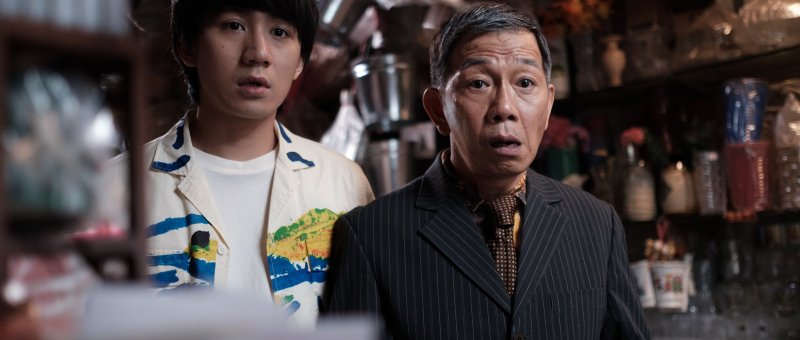
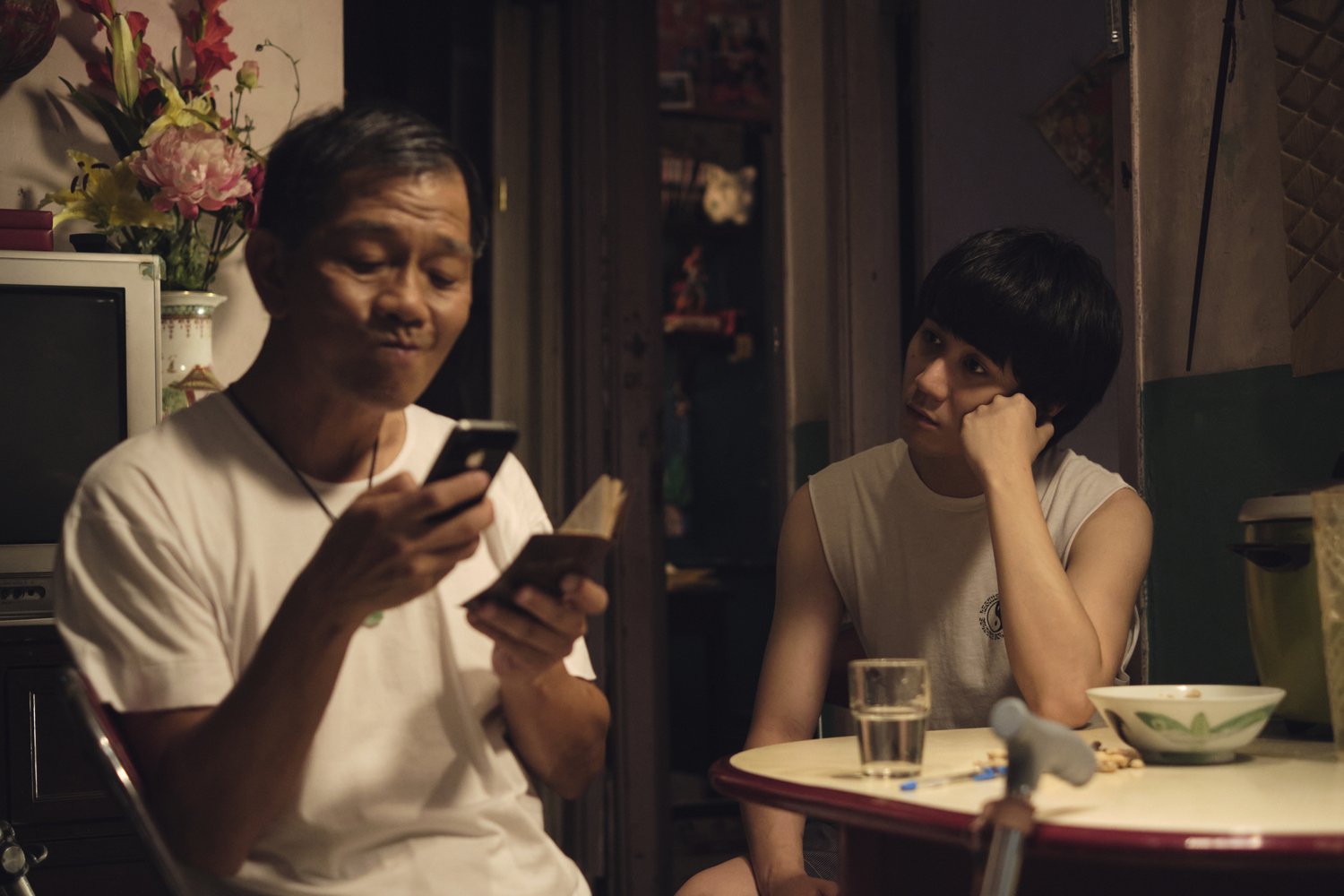
The parallels between embittered taxi driver Yat (Anthony Wong Chau-sang) and former lawyer turned refugee Ahmed (Inderjeet Singh) are amply demonstrated by the opening sequence in which each is late for a wedding after Yat rams into the van Ahmed had borrowed from store owner Ali to transport a secondhand fridge. Yat arrives just in time to see his son, Hong (Endy Chow Kwok-yin), make the toast at his wedding but thank his father-in-law, a senior policeman at his precinct, while looking daggers at Yat whom he only invited a few days before out of a sense of obligation. Ahmed meanwhile was supposed to be a witness at a wedding between a Pakistani man and an Indonesian woman at the refugee camp not far from where Yat lives which the officiant is keen to remind them is binding in the eyes of Allah but not so much the government of Hong Kong. 

As a somewhat prejudicial radio show playing in Yat’s car explains, Hong Kong is a point of transit. If their claims are upheld, the refugees will not settle there but be moved on to other countries such as Canada where a family at the wedding are about to travel taking the best friend of Ahmed’s son Hassan (Sahal Zaman) with them. The radio show talks about “fake refugees” describing them as a drain on resources depriving local people of services they should otherwise be entitled to while it’s clear that many don’t seem to see the refugees as equals and think of them as lazy shirkers with criminal proclivities. Yat repeatedly uses a racial slur to refer to Ahmed and immediately tries to pin the accident on him assuming the policeman will also jump to the conclusion that it must be Ahmed’s fault for being a bad driver only the policeman doesn’t quite play along even when pulling Ahmed aside for an ID check. 

The irony is that Yat is also a refugee who swam to Hong Kong from the Mainland and is still carrying trauma from his flight in the same way many like Ahmed are yet cannot find it within himself to empathise with him, only to act with entitlement and absolve himself of blame through manipulating his connections with the police. He has quite clearly lost his moral compass as the repeated motif of him looking the one which led him to Hong Kong but now appears to be broken makes plain. Hong pointedly refuses to help his father and is clear they should go by the book, but his less rigorous friend is only too keen to help. In any case the petty vendetta between the two men, Ahmed sticking to his principles and refusing to lie to make the situation go away and Yat insisting on enforcing his privilege by forcing him to back down, escalates with tragic results eventually forcing Yat to wrestle with the consequences of his actions and not least the causes of his estrangement with his son. 

Hong tells him that he doesn’t want to be a man like him who is unable to protect his family, while Hassan snaps at Ahmed that his acts of petty thievery are better than being poor like his father. Yet while Hong has swung in the opposite direction, raising himself to be a man who is compassionate and dedicated to justice, Hassan is in danger of going off the rails not least because he has bad eyesight and is falling behind at school because even as something as simple as glasses for their son is not in the family’s reach. Ahmed’s dodgy friend Numen is forever trying to get him into crime, knowing that refugees are not permitted to work or even accept monetary gifts, but he refuses while Hassan begins to see a way of taking control of his situation though thievery and rebels against his father as he does so. 

When Yat begins to take an interest in Hassan it’s mainly to assuage his guilt in knowing that he ruined Ahmed’s life and has left a boy without a father for whom he is now responsible. Yet it’s also in a way an attempt to repair the relationship he could not rebuild with his son while addressing the latent trauma from his own escape from Mainland China which he has otherwise buried through heavy drinking that finally resulted in a liver transplant from Hong that only seemed to deepen the sense of debt and obligation between them. Perhaps Hong Kong is a transitory place after all, each of them in some way displaced and not least from each other while continuing to hope for a better place in the future only to discover nothing more than loneliness and uncertainty if tempered by love and the shades of a frustrated hope.


The Sunny Side of the Street screens March 12/17 as part of this year’s Osaka Asian Film Festival.

Original trailer (Traditional Chinese / English subtitles)

Images: (C) Petra Films Pte Ltd