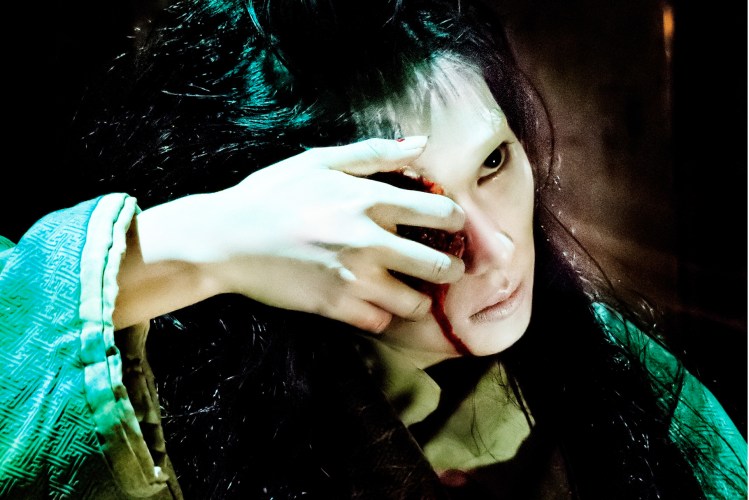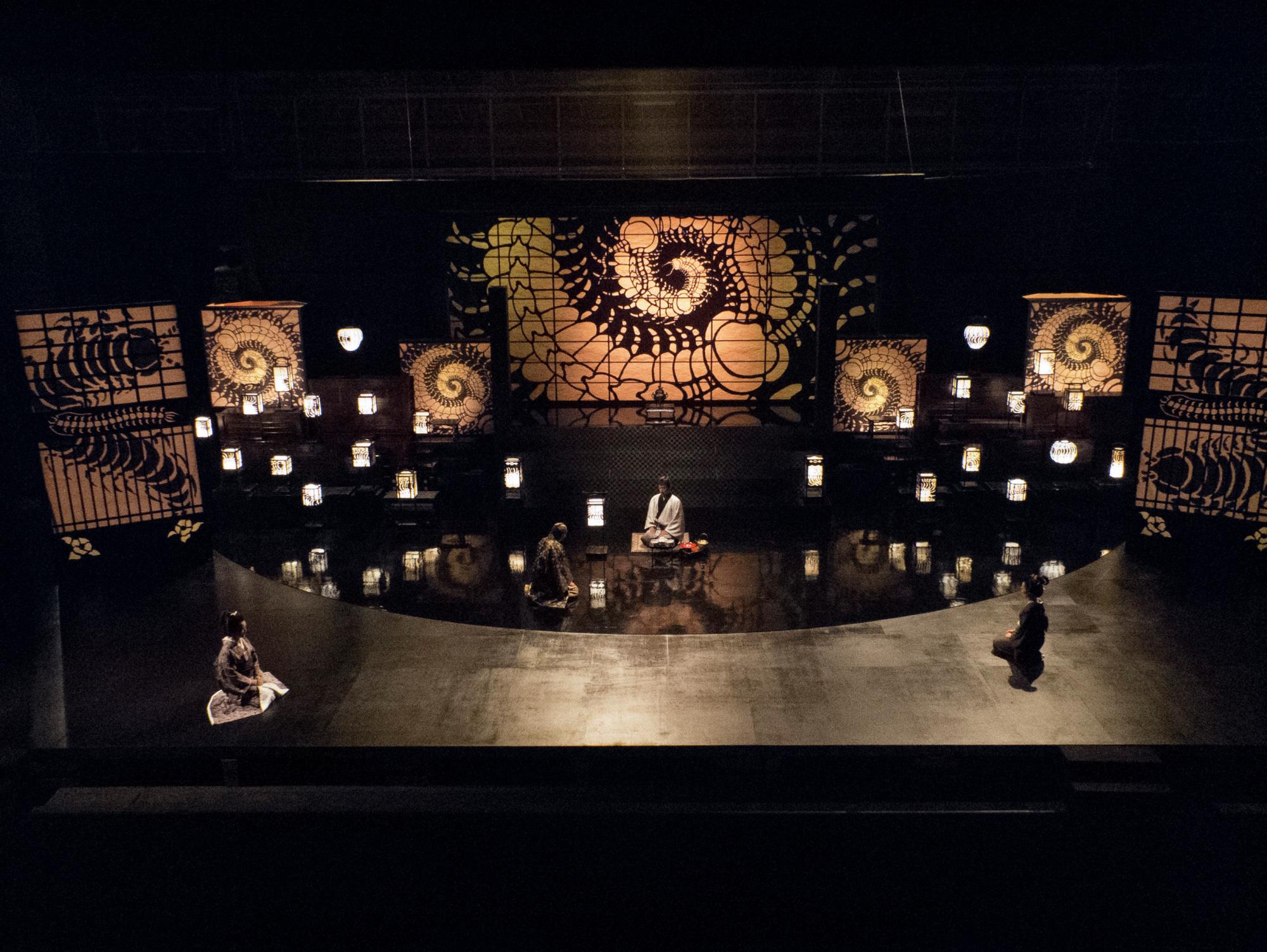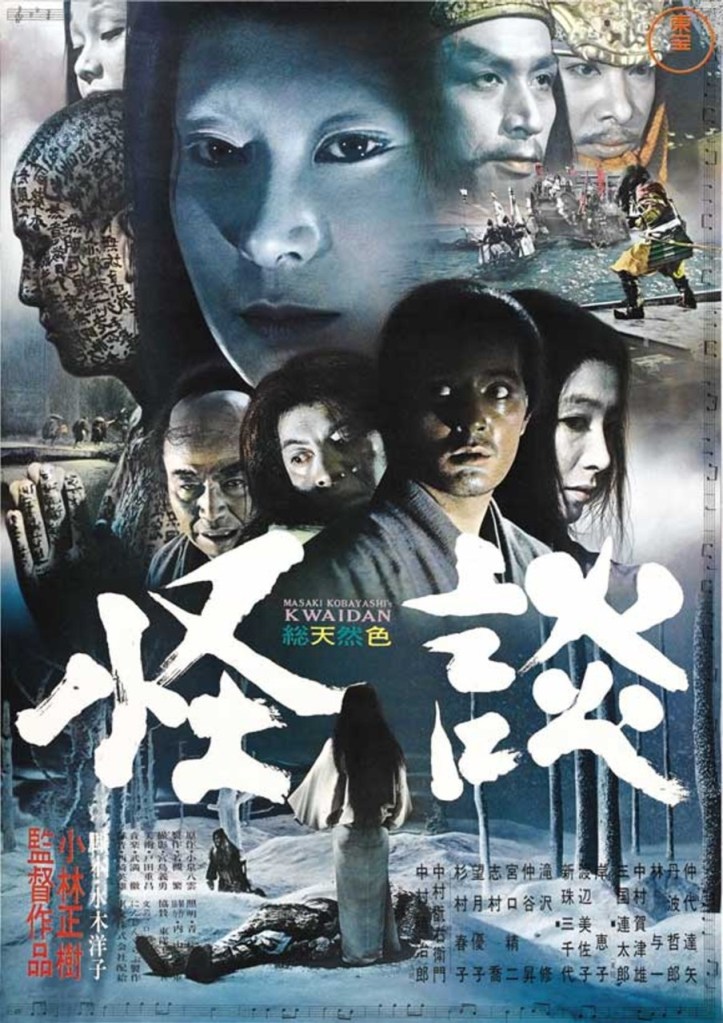
Over Your Dead Body (喰女 クイメ, Takashi Miike, 2014)

003_b
Oh! I think there’s something in your eye…

Review of Miike’s latest (well, not really latest…maybe recent? Does recent still work? This is Miike after all) classy horror shocker Over Your Dead Body up at UK Anime Network. It’s OK but it’s not very scary, gets a bit too clever for its own good and shows you a film you’d much rather be watching than the one that you came for. It’s fine though, really. And quite pretty to look at.

over-your-dead-body-(2014)-large-picture 4
see what I mean?

Nobody could ever accuse Takashi Miike of being a slouch and his breakneck pace of film production continues here with a more classically subdued take on the horror genre than his casual fans may expect. It’s not the first time the director has dipped a toe into the world of kabuki theatre – indeed he’s no stranger to the stage and his most recent outing made sure to inject a little of his characteristic craziness including space aliens and references to Star Wars. Over Your Dead Body is much more in the vein of Harakiri than of Audition or Ichi the Killer and despite its often grotesque overtones and suggestions of supernatural machinations its chief merit is in the beauty of its stagecraft rather than in its infrequent thrills.

Miyuki (Ko Shibasaki) is a successful kabuki actress and has landed a plum leading role in the classic play Yotsuya Kaidan. Using her status and connections, she’s been able to wangle the central male role in the piece for her boyfriend, Kosuke (real life kabuki superstar and previous Miike collaborator in Harakiri Ichikawa Ebizou XI), with whom she’d like to settle down and have a family. Kosuke, however, has a wandering eye and may not be quite as committed to the relationship as Miyuki. Before long, onstage and offstage events begin to blur as supernatural forces, mental illness and distorted realities begin to take their toll on this unlucky troupe of actors.

Yotsuya Kaidan is a true classic of kabuki theatre. Filmed countless times, it’s the story of down on his luck samurai Iemon who’s in love with a young woman but denied by her father thanks to his lowly status. Eventually, Iemon murders him and hides the body so he can marry his one true love after an appropriate amount of time has passed. However, Iemon’s crimes begin to weigh heavily on his conscience and having got what he wanted he finds himself haunted and unable to live the happy life he’d dreamed of. His dreams of becoming a high ranking, respected samurai consume him and when he’s offered the opportunity to marry into a more impressive family he makes a shocking and bloody decision.

The darkness of this stygian tale doesn’t take long to seep into the “real” world and it quickly becomes near impossible to distinguish between several different layers of reality. Wronged heroine Miyuki’s behaviour becomes increasing erratic as her rather cold and calculating boyfriend Kosuke gradually takes on the cruel persona inherited from Yotsuya Kaidan’s Iemon. Her elaborate revenge plot seems to go around in circles, culminating in an extremely bloody and completely insane set piece before heading off into the realms of the supernatural.

However, the real success of the film lies in the kabuki scenes themselves and some viewers may even windup wishing they were watching Yotsuya Kaidan instead. Built with an unfeasibly beautiful theatrical set utilising a modern, fully revolving stage Miike blurs us seamlessly from the theatricality of the stage set into the world of the play. Always beautifully filmed, the world of Yotsuya Kaidan comes to life before our eyes whereas the regular “reality”, our world with its everyday demands, feels cold, sterile and emotionless. One actor even remarks that he wishes the world of the play were real – quite an odd thing to say considering it’s a morality play about the wages of sin which is soaked in blood including that of a young infant.

Despite the committed performances of the cast, the off stage antics which ought to be the focus of the film end up feeling superfluous. Ultimately, despite its relatively short running time Over Your Dead Body feels like a short story unwisely expanded into a novella which might have benefitted from stronger editorial control. The overall tone is one of unexplained mystery but its refusal to explain itself is more likely to frustrate rather than delight and something about its plot machinations just never manages to come together in a satisfying way.

Something of a mixed bag, Over Your Dead Body is not without its merits – it looks beautiful for one thing, yet never manages to engage. It lives and breathes in its kabuki scenes and perhaps a filmed kabuki production of Yotsuya Kaidan may ultimately have proved more satisfying. Gore fans and lovers of the bizarre who stay with the slow burn approach will find a lot to like in Over Your Dead Body but die hard horror aficionados  maybe advised to look elsewhere for their supernatural thrills.


Here be a trailer:

If you’re a Miike fan don’t forget that another of his more “recent” efforts will also be screening at the London Film Festival before being released on DVD & blu-ray by Manga in November – Yakuza Apocalypse, which sounds like a very boring film about a weird frog or something? Yeah, you probably wouldn’t like it anyway. *buys all the tickets*

Wanna read more about Miike?

Phew – that was actually a lot of work. Someone remind me I’ve already done it so I don’t have to do it next time. Takashi Miike probably made ten more movies while I was writing that list!

Greatful Dead (グレイトフルデッド, Eiji Uchida, 2013)

OEO9ONpIf there’s one thing Third Window Films have proved themselves adept at, it’s finding those smaller, off kilter and cultish films that often fall through the cracks. Greatful Dead, the deliberate misspelling the title of which is only the first sign of its oddness, is the latest find in what might be thought of as “weird cinema”. Evoking comparisons with Sion Sono’s Love Exposure thanks to its christianising themes, wry tone and sheer craziness, Greatful Dead is not all together as successful but is likely to find its own fans through its undeniably cultish appeal.

Nami, like many movie heroines, starts by recounting her childhood as a lonely, neglected child. The younger of two sisters, she desperately tries to get the attention of her mother who is only interested in saving disadvantaged children in other countries whilst ignoring the needs of her own two daughters, or her father who is so entirely wrapped up in their mother that he’s barely noticed the two girls either. Eventually after her mother leaves and her father slowly disintegrates, Nami becomes increasingly isolated. After inheriting a sizeable fortune, grown-up Nami wastes her time in idle pursuits before hitting on her favourite hobby – an amateur anthropological study of the “Solitarian” or those who have driven themselves completely mad through loneliness. Her favourite kind of Solitarian is randy old men whom she likes to watch as they spiral deeper into depravity before eventually reaching their end game. Old Mr. Shiomi, who was once something of a big shot but is now an embittered old man, is her perfect specimen but after he receives a visit from a pretty Korean Christian missionary and becomes “reborn” her observational project is ruined! Mr Shiomi’s been stolen by God, what lengths will Nami go to to get him back?

Of course, the irony is Nami is the biggest Solitarian of them all and the one she’ll never be able to identify. In the accompanying DVD interviews, the director states his intention to highlight the increasing numbers of lonely, older people in Japan thanks to the declining birth rate and fracturing of traditional community bonds but in actual fact many of the Solitarians Nami identifies are younger people and some of them even appear to have quite serious mental issues which require more serious intervention. Taking frequent field trips and noting down rare specimens in a little notebook like some deranged “twitcher”, Nami joyfully enjoys the darker side of her hobby as her favourite part seems to be watching lonely people die at the zenith of their craziness. Though in fact both she and Mr. Shiomi have both in some senses chosen their lonely lives as both have rejected the interest of family members – Nami the insistences of her sister that the normal is best and to be strived for and Mr Shiomi those of his son (who may or may not be mainly interested in his money).

There is then, obviously, a veneer of social commentary, though it feels fairly thin at best. The main appeal is in the degree of tonal shifts that occur throughout the film. Starting out in a similar way to many a quirky comedy as young Nami goes to extreme lengths just to get some kind of attention from her indifferent parents, to her carefree adult life the film plunges off a cliff face about two thirds of the way through thanks to Mr. Shiomi’s “betrayal”. Where another film would end with Nami meeting another lonely person and becoming slightly less unhinged, Greatful Dead veers into some seriously dark alleyways filled with blood, murder and pensioner rape among other perversions. The wildest thing is the resurgence of Mr. Shiomi as he decides he’s mad as hell and isn’t going to take this anymore! Fighting back in an equally strange way (why does no one ever just call the police? No, sharpening a mop into a spear seems like a more rational solution), the furious battle between subject and observer is quite literally in the lap of the gods.

Greatful Dead is an undeniably enjoyable, wild ride that escalates in a gently expert manner from its black comedy beginnings to exploitation ending but never quite coalesces into something more. Its views on the place of religion in this lonely world seem a little ambiguous – would Mr. Shiomi have opened his door to the male missionary quite as readily as he opened it to a pretty Korean girl and how long would his quite radical conversion really have lasted? Is the church actually helping some of these elderly people who might just want company or exploiting them? The film doesn’t seem sure, not that it’s that much of a problem. In the end, Grateful Dead is a wild ride through crazy town and destined to become another cult classic entry in to the world of wacky Japanese horror.


Review of Greatful Dead up at UK Anime Network – released courtesy of Third Window Films this coming Monday 26th January 2015.

Tod Browning’s Freaks

SPOILER WARNING!!!

Tod Browning’s Freaks is notoriously the film that fell so foul with the studio and audiences of the time that even after cutting around a third of its running time the degree of revulsion it produced pretty much ended the director’s career. Having run away to join the circus as a teenager, Browning had spent spent much of his life around circus performers and felt them much maligned by society. Although he’d touched on similar themes before, Browning had always used professional actors made up to appear as if they were in someway different but this time he was determined to use genuine sideshow performers – a decision that would prove too radical for the society of the time.

Although it’s often placed into the horror genre, Freaks is really a tale of revenge and poetic mob justice in which the surrogate family of the carnival people punish the ‘normal’ couple who have tried to harm one of their own by the only method of justice that’s open to them – absorbing the miscreants into their own group. Hans is engaged to Frieda who like him is a midget but has become infatuated with the beautiful trapeze artist Cleopatra. Cleopatra, however, has recently stolen the boyfriend of another performer, the strongman Hercules, and together they mock Hans’ courteous courting whilst accepting his generous gifts and loans of money. When Frieda confronts Cleopatra about her treatment of Hans and lets slip that Hans has recently come into an inheritance, Cleopatra and Herman decide to trick Hans into a marriage and then do away with him for the money.

Hans is overjoyed to have married the most beautiful woman he’s ever seen but things turn sour at the wedding banquet when, in show of friendliness and inclusivity, the the carnival folk each drink from a large glass whilst chanting before offering it to Cleopatra who recoils in horror and screams ‘Freaks’ repeatedly. Prior to this she’s already been seen in an embrace with Hercules and has been drugging Hans’ champagne with some sort of poison. In a final humiliation, she makes several allusions to Hans’ childlike stature and manhood (or lack thereof) before putting him on her back as if he were a toddler.

Cleopatra then continues to slow poison Hans but unbeknownst to her he knows what’s up and he and the others plan their revenge. An opportune storm hits the convoy in which Hercules attempts to rape or kill his former girlfriend whilst Cleopatra runs off intro the storm pursued by the mob with knives in their teeth. In the extant version of the film this is all we see – we cut back to the sideshow proprietor who provided the opening of a framing sequence who shows us Cleopatra now disfigured and stuffed into some kind of chicken suit – a freak, like those she despised. In the full version we would have seen her legs be hit by a falling tree and her lover Hercules castrated – now emasculated he also joins their group as a member of the deformed.

We are told in the lengthy prose prologue about the code of the carnival freaks (a title they embrace for themselves), of how they stick together and a wrong done against one is done against all. Looked down upon by society and often cast out by their natural families, or even sold on to goodness knows what kind of horror in virtualised slavery who else do they have to turn to other than each other? Lacking any other recourse to justice or protection isn’t their turning on Cleopatra and Hercules who have, after all, attempted to murder and rob their friend, just natural manifest justice?

Some will argue that Freaks is exploitative, aren’t we being expected to flock toward this title to gawp at the oddities? Yes, and then again no. Browning knows we will do this, it’s part of the point of his film after all. We come as voyeurs – allured by the title and the film’s reputation but our expectations are subverted. The carnival folk are good, honest people who are kind and fiercely loyal to their friends. They are willing to welcome Cleopatra into their group yet she cruelly rejects their friendship and pays them back with scorn. The real freaks are the two ‘normal’ people who are prepared to dupe an unsuspecting man in love, exploiting his emotions for their own personal gain before dispatching him completely without a second thought.

In this way Freaks does what all horror should do, it reflects the part of yourself that is ugly, that you’d rather keep hidden. It isn’t ‘otherness’ that’s frightening, it’s your own greed and hate and prejudice. It’s just a shame that it took us so long to be able to face what we so loathe in ourselves that we can finally see Tod Browning’s Freaks for what we are.

Seen at the Prince Charles Cinema, 9th October 2012. 35mm

The Skin I Live In – Summer Screen at Somerset House

Wednesday night saw the opening of the Film4 Summer Screen at Somerset House which launched with the UK premiere of Pedro Almodóvar’s latest film The Skin I Live In (La piel que habito). This marks the first reunion of Almodóvar and Banderas since 1990’s Tie Me Up, Tie Me Down!. It’s also the first time Almodóvar has stepped into the horror genre, so expectations were running fairly high.

They were not disappointed.  This is quite simply a brilliant film, dark, disturbing, but also displaying that trademark Almodóvar humour. Unfortunately it’s almost impossible to review as it’s best to know absolutely nothing at all about the plot before going in. It’s a real return to form for Almodóvar after the slightly disappointing Broken Embraces, this is a film with plenty to say that’s also wickedly entertaining. Highly recommended, do not miss this!

On Psycho and Star Power

I often wonder, how much of its impact does Psycho lose given that a modern audience, even if they somehow have managed to avoid knowing anything about the plot, does not relate to Janet Leigh in the same way the audience of 1960 would have. If you don’t know Janet Leigh is supposed to be the ‘star’ of the movie, is her early exit all that shocking? and if it’s not all that shocking, does the film feel unbalanced? does the viewer feel they’ve missed something, are they confused they’ve spent so long with this character that’s just disappeared and the focus has moved on entirely?

I feel as if I should be able to answer some of these questions, after all it’s not as if I saw this in a cinema myself in 1960, but I honestly don’t remember the first time I saw it. I must have been quite young, probably too young and like most other people I must have seen it on the television. I’m almost certain I would have watched it with my mother, who probably explained to me who Janet Leigh was and that she was the ‘star’ of the film and that it was odd, therefore, that she was only in the first third or so. I think I probably did think Marion was going to reappear at some point, or be not really dead, just because this started out as her story so it didn’t really make sense that it quickly became someone else’s. I wonder if everyone else felt this way too, or if ‘this’ followed by ‘that’ just felt a natural progression to them?

Les Diaboliques

This article will discuss the plot of Les Diaboliques in full and therefore contain major plot spoilers


Now that Les Diaboliques has been been released on Blu Ray, twice, once by Criterion (Region A) and once by Arrow (Region Free, UK) it seems like an appropriate time to revisit one of cinema’s most enduring thrillers. It might be thought that the film would seem dated or that the constant imitations and ought right theft of the central plot twist in every prime time mystery show of the last fifty years would leave a modern audience unimpressed, feeling they’ve seen all of this before. However, on seeing the recently restored print at the BFI a few months ago, it was most reassuring (and completely wonderful) to hear several disbelieving gasps as Nicole and Michel congratulate themselves on the successful completion of their plot, followed by amused discussion of the young boy’s curious reacquisition of his slingshot at the very end. Les Diaboliques remains a perfectly plotted crime thriller, complete with some of the most disturbing imagery ever captured on celluloid.

So then, the plot. As the film opens, we meet Christina (Vera Clouzot) – The Wife, and Nicole (Simone Signoret) – The Mistress, who is wearing dark glasses after, it seems,  receiving a black eye from the film’s apparent villain, Michel (Paul Meurisse) – The Husband. Oddly, Christina seems very concerned about Nicole’s injury and seeks to comfort her, and this strange camaraderie between wife and mistress is remarked upon by two of the other teachers of the boarding school at which the central trio live and work. Later on we see the women discussing a plan to get rid of Michel, who has obviously been causing both of them not a little pain. The plan goes off without too much trouble, but then, the body disappears and Michel’s presence begins to make itself felt in unexpected ways….

of course this is only the beginning of the plot we think we see throughout the film (and you might want to look away now if you ignored the spoiler warning and blatant mention in the first paragraph) as it transpires that Michel really is the villain of this piece and along with Nicole has concocted a diabolical plot involving his wife’s fragile heart, her religious mentality, and his own faked death. The scene where he rises out of the bath tub, with those strange (and painful looking) dead man contact lenses is one of the most iconic in cinema history – truly chilling. However, Michel and Nicole have not counted on the perspicacity of the retired policeman Fichet who is there to rob them of their final triumph. Not content with this masterful plot twist, Clouzot seeks to tease us again, although we see Christina die, we are presented with the mystery of the small boy and his slingshot, which he says was just returned to him by the headmistress, who we know to be dead. This is the same small boy who was accused of lying about seeing the ‘deceased’ Michel earlier in the film, whom we now know to have been telling the truth. So, is Christine really dead? is her ghostly presence inhabiting the school? or did Fichet manage to save her life after all? or is the boy lying this time? We’ll never know, Clouzot just wanted to leave us with that one last note of uncertainty to completely mess with our heads once and for all.

It is Christina, whose apparent death we finally witness, that we’ve sympathised with all the way through. We can see right from the beginning that she’s terrorised by her cruel husband Michel – carrying on with another woman right in front of her, forcing her to eat rotten fish, forcing her off screen where it’s implied he will beat and rape her. We are right behind her desire to kill Michel, we can see that this is the only way out of an unbearable situation for her, and we are eager to release from that torment. She can’t divorce him as she’s a strict Catholic, and he likely wouldn’t consent to a divorce because he’s dependent on her money. She owns the school but he controls it. We also sympathise with Nicole who it seems is under some sort thrall to Michel although he also beats her and she isn’t tied to him in any way, perhaps we buy into her desire to eliminate Michel in revenge for the humiliation she has suffered. Nicole is the driving force behind the initial plan convincing Christina to go through with it, forcing her hand when she wavers. However, it is Nicole who ‘appears’ to crumble as things start to go wrong, for a brief period Christina becomes the dominant woman and Nicole ‘panics’ as the relationship between the two women becomes fraught and they both goad each other to go the police. Though of course Nicole’s actions here are completely calculated to place further stress on Christina, she obviously is fully aware of what’s really going on. In fact the character of Nicole is one of the most intriguing aspects of the film, she must be the most diabolical of all the characters – appearing to comfort and console Christina whilst leading her to her death so that she can have the loathsome Michel and all of Christina’s money. Why she thinks Michel will be any more well disposed to her than he’s been to Christina is anyone’s guess, but then perhaps she really is in that much thrall to him.

Indeed the relationship between the two women both one of the most central aspects of the film and one of the most ambiguous. In the novel which served as the source material for the screenplay (Celle Qui N’Etait Plus by Boileau & Narcejac who also wrote the inspiration for Hitchcock’s Vertigo) the plot twist is reversed. A man and his mistress plot to kill his wife, but haunted by the crime he eventually kills himself and it turns out that the two women are lovers and have plotted together to get rid of the husband, and in the novel they get away with it. Clouzot, probably rightly, assuming such a scandalous affair would never get through the censors, and probably wouldn’t be accepted by the audience even if it did altered the original plot to a slightly more conventional situation. However, throughout the film, the two women appear very close, they’re very tactile and are often posed like a couple, see the way Nicole holds Christina’s arms when persuading her to call Michel in Niort and at several other points in the film. They are seen to share a bed on more than one occasion and at least once they get back to the school there’s no logistical reason for them to do so. The scene where Nicole decides to leave also resembles a typical thwarted lovers parting scene, Nicole’s ‘Do You Hate Me?’ is particularly potent. Is Christina telling her to go because she’s going to confess, or because she doesn’t trust her anymore? Were the two women lovers, is this another motive for the murder of Michel? and of course, this is looking even worse for the already pretty awful looking Nicole, was she sleeping with both of them? Did she like Christina at all, did she have some remorse for what was about to happen? Who can say, but she does seem fairly ecstatic afterwards.

Clouzot’s typically bleak world view is very much in evidence here. Christina aside (and even she’s a murderess, albeit an unwilling one) no one comes out of this film looking particularly good. Does the policeman really let Christina die as punishment for her part in the hypothetical crime? Perhaps he has a plan in place to save her afterwards and whip her out as a sensational witness at the trial but even so it’s quite an ordeal he leaves her to suffer. You also have to wonder why no one is investigating standards at this school, did none of the children complain about the rotten fish, how much are their parents paying for this sort of thing? but I digress. Clouzot succeeds in piling up the tension until it becomes almost unbearable by the end, this has to be one of the most successful suspense films ever made. Even if the twist appears obvious to the modern viewer the final scenes still succeed in being genuinely thrilling!

As for the Blu Rays, as far as picture quality goes Criterion is the winner as the Arrow is slightly cropped and although both releases look occasionally soft the higher bit rate on the Criterion really pays off. As for extras both offer very interesting supplements, I would probably advocate the Arrow as the video introduction from Ginette Vincendeau is indispensable (and much longer than expected!) and the full length commentary by Susan Heywood more informative than the selected scene commentary provided by Criterion. Though the introduction provided by Criterion is also very good and the short piece by Kim Newman is very interesting as well. Fans of the film who have the ability to play A coded discs would benefit from double dipping on both editions, but as always your choice is pretty much decided for you by your region of residence and both have their merits. Les Diaboliques remains a prime example of the thriller genre and a must see for anyone interested in psychological horror.