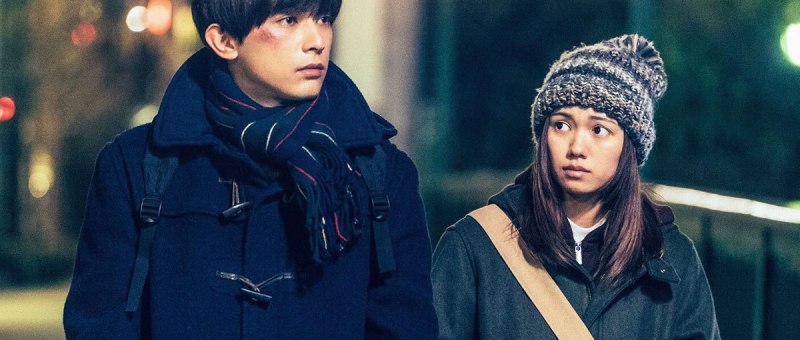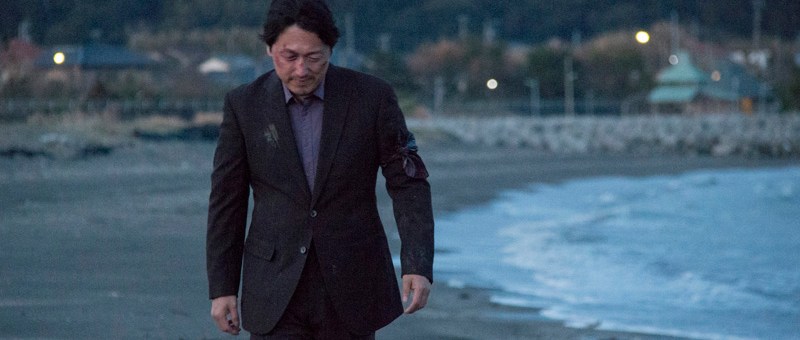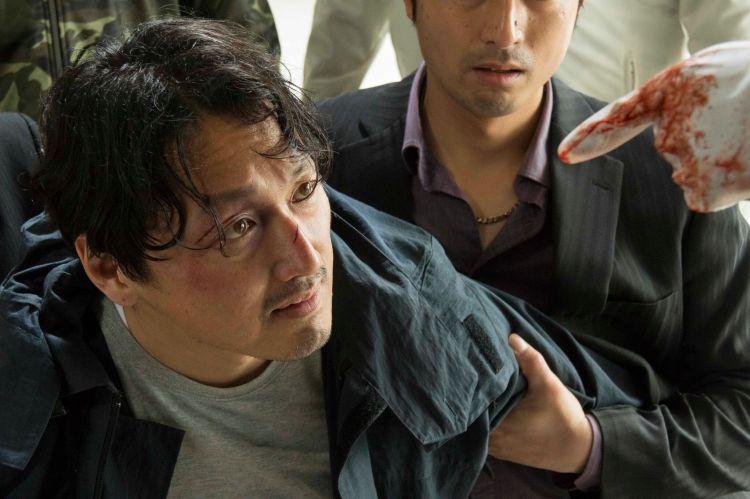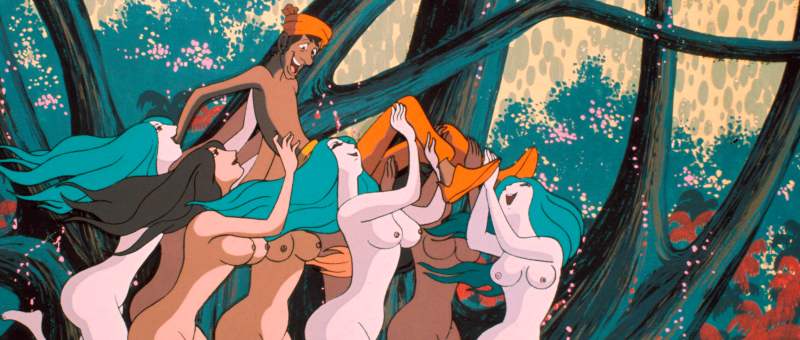

The Sea and Poison (海と毒薬, Kei Kumai, 1986)

the sea and poison posterWhen thinking of wartime atrocity, it’s easy enough to ascribe the actions of the perpetrators to a kind of madness, to think that they have in some way moved away from us to become some kind of “other”. In thinking of those who transgress our notions of humanity as inhuman or “evil” we can absolve ourselves of their crimes, believing that they are not like us and we are not like them. The truth is never so simple and as long as we continue to other these dark parts of ourselves, we will not be able to overcome them. The Sea and Poison (海と毒薬, Umi to Dokuyaku), adapted from the novel by Shusaku Endo, shows this delusion of inhumanity for what it is in taking as its central concern the real life case of the doctors at a Kyushu university who committed heinous acts of experimentation on eight American prisoners of war in late 1945. Rather than focus of on those who took the decision that the experiments should take place, Endo and Kumai examine the motives of those on the fringes who merely went along with them finding that they did so for petty, essentially human motives.

Shot in a crisp black and white, the film opens in a caged cell where an American officer is interrogating a young man still in a student’s uniform. Suguro (Eiji Okuda) is the first of several witnesses to the deaths of eight American servicemen during alleged vivisection at the hospital at which Suguro had worked. Young and naive, Suguro is the most sympathetic of three witnesses we will encounter but his essentially compassionate nature puts him at odds with his colleagues who abhor “sentimentality” and regard his emotionality as a childish weakness. It is through Suguro that we discover that the hardness that has apparently led to these horrific betrayals of the physicians’ code are not born of the war, or of militarism, or of adherence to some ideal like god or country but are a natural extension of the hyper-rational attitude of the medical profession.

Suguro’s colleague, Toda (Ken Watanabe), is his polar opposite, viewing Suguro’s sense of compassion as a ridiculous but somewhat endearing character trait. A textbook nihilist, Toda takes the view that as death comes to us all, the when and why are essentially unimportant. When so many are dying in air raids or on the battlefields, what does it matter that some also die in hospitals. Yet Toda is, in someways, the most ruminative among the hospital staff. In the diary he keeps, Toda attempts to dissect himself and his ongoing lack of feeling. Telling the interrogators that he began the diary because he had begun to find himself “creepy”, Toda asks why it is he feels nothing in relation to his fellow men. Surely it must be right that one should feel some degree of empathy? Toda volunteers for the experiments in part to test his own hypothesis but discovering that he still feels no pity for these men, he wonders if these ideas of morality are a kind of affectation seeing as others too can commit such acts of extreme cruelty and think nothing of it.

In this, Toda earns our sympathy, seeming at least to want to feel something even if he does not. Nurse Ueda (Toshie Negishi), by contrast, is the most human and also the most repugnant of our three witnesses. Her concerns are petty and ordinary, born of jealousy and resentment. Returning again to the scene of a botched surgery, Kumai shows us Ueda calling the operating theatre and being told to give a patient a dose of morphine by a harried doctor still panicked by the ongoing OR drama. Following her instructions, Ueda fills a syringe but the vial is knocked out of her hand by the German wife of the head doctor, Hilda, who was once a nurse herself and likes to help out on the wards. Hilda is a severe woman but not a cold one, she cares for the patients but perhaps with a more rigorous adherence to the nurses’ code than the less experienced team at the hospital. Hilda tries to get Ueda fired for her “mistake”, scolding her by asking (in German) if she is not afraid of God, and expressing concern that she thought so little of giving a fatal dose of morphine to a suffering patient.

Ueda’s decision to attend the experiments is a form of backhanded revenge – Hilda, whom everyone regards as some kind of annoyingly saintly figure, has no idea her husband would be involved in something so against her deeply held ideals, but Ueda also offers another reason when she says that the doctors exist in another, more rarefied world to the rank and file ward staff. This idea is echoed again by the head nurse, Ohba (Kyoko Kishida), who states that nurses must do as the doctors tell them without asking questions. Ohba rounds out the just following orders contingent but the first half of the film has already shown us that the medical profession is corrupt and cannot be trusted.

The old Dean has had a stroke and there is a mini war of succession in play between the heads of surgery divisions one and two. Dr. Hashimoto (Takahiro Tamura) had been the favourite but his star is fading. In an effort to improve his chances, he decides to move up an operation on a friend of the Dean – a young woman with advanced TB. Meanwhile, Suguro’s patient, an old woman who also has TB has been earmarked for “experimental surgery”. The old woman has not been properly briefed on the risks of the operation in which she has only a five percent chance of survival and has only agreed to it because the doctor, whom she trusts implicitly, has told her it’s her only chance. The Dean’s friend is “Mrs. Tabe”, and she is “important”. The old woman is only “the welfare patient” and therefore not important at all.

Suguro, anxious to save the old woman to whom he has developed an attachment, wants the operation to be postponed, at least until she’s potentially strong enough to survive but Dr. Shibata (Mikio Narita) is only interested in using her as a potential candidate for experimentation which he claims will help future treatment of TB but also, of course, improve his career prospects. Mrs. Tabe’s mother asks the doctor if her operation carries any risk but the assistant laughs in her face, claiming the operation is so simple even a monkey could do it and pretending to be insulted that she has so little faith in her physicians. The operation goes wrong and Mrs. Tabe dies which is bad news for Dr. Hashimoto but rather than offer his apologies to the relatives, he tries to cover it up. So that it won’t look like she died on the table, they take the body back to her room and hook it up to a drip, insisting to Mrs. Tabe’s mother and sister that all is well while planning to announce that Mrs. Tabe died of complications from the operation early the following morning.

This level of callousness and self interest is echoed in Dr. Shibata’s justification that the old woman is going to die anyway and therefore the operation is worth a shot even though he believes it will kill her and is not in any way attempting to save her life (though it would be a nice bonus). Unlike Toda’s nihilism, Shibata’s practicality has no human dimension, he thinks in numbers and statistics, deciding who is a “real patient” and who is not. This same justification is used when recruiting doctors for the experiments. The US servicemen are downed aircrew from the bombers which have been making raids overhead for months. A court in Tokyo has ruled the random bombing contravenes international law and has sentenced the airmen to death. Seeing as the airmen will die anyway, might it not be “better” for their deaths to “benefit” medical science? The operations will be conducted under anaesthetic and so the men will not be in pain or know their fates which might, perhaps, be better than a firing squad.

The reality is not so convenient. Asked if his agreement was partly revenge, Suguro replies that, no, he felt no hate, he was just too mentally and physically exhausted to resist. Threatened by soldiers with guns he capitulates but refuses to assist in the room on the day, remaining a passive witness cowering at the edges. Before the operation, Dr. Gondo (Shigeru Koyama) makes small talk with the subject in English, asking about his hometown to which the airman, poignantly, says he’d like to return. The surgery is not like that conducted on Mrs. Tabe. The airman gets only ether and he struggles as the cloth is placed over his mouth, requiring four people – two doctors and two nurses, to hold him down until he stops kicking. This is no gentle death, this is murder.

A possible “justification” lies in the fact that the operating room is also filled with soldiers who laugh and jeer, snapping away on their brand new German-made camera. Tanaka, the officer in charge, asks for the airman’s liver after the operation, joking that he’d like to feed it to his men. The liver is indeed delivered to the horrified faces of the soldiers waiting for the party they’ve organised to begin, though it is not clear whether Tanaka really intends to feast on it or keep it as some sort of grim souvenir. Gondo, looking at the liver, remarks that they’ve all grown used to corpses but that “sentimentality” is never far away. Nevertheless, he appears to feel no real remorse for the heinous act of killing in which he has just been involved.

Adopting Endo’s Christianising viewpoint, the interrogations take place in a ruined church, a statue of the Virgin Mary directly above Ueda as she gives vent to her impure thoughts. The trio are being judged, not only by God but by us – or “society” as Suguro later puts it. The central proposition is that prolonged exposure to death on a mass scale – firstly as members of the medical profession, and later as victims of war, has led to an inhuman, nihilistic viewpoint in which we are all already dead and that, therefore, nothing really matters anymore. It isn’t clear who suggested this be done or why, but it is clear that Hashimoto collaborated in an effort to save his career by allying himself with the military – something he misses out on anyway when Shibata steals his thunder. Suguro is powerless to resist, Toda a melancholy sociopath, Ueda a vengeful woman, and Ohba a willing disciple of a beloved doctor, but none is a zealot to a regime or true believer in militarism. This is the dark heart of humanity – selfishness and cowardice, petty jealousies and ambitions. Kumai paints this scene of desolation with intense beauty, which only makes it all the more painful.


Original trailer (no subtitles)

Toilet (トイレット, Naoko Ogigami, 2010)

toilet posterBy accident or design, Naoko Ogigami’s career has existed to one side of Japan’s most representative genre, the family drama, in making a clear choice to embrace unusual or self defined family units. In Kamome Diner, a disparate group of runaway Japanese people became a kind of makeshift family and forged a mini-community with the friendly local Finns. Following the brief holiday sojourn of Megane, Ogigami returns abroad but this time to North America for her first English language feature. Once again it’s a tale of misfits learning how to fit, but it’s also a tale of the true nature of family which extends far further than mere blood relation.

30-something Ray (Alex House) is a hyper rational scientist who rejects all forms of emotion and attachments. Thus, he’s doing pretty OK even though his mother died just over a week ago. His siblings, neurotic poetess Lisa (Tatiana Maslany), and agoraphobic former pianist Maury (David Rendall) are not taking it quite as well. The other problem is that shortly before she died, Ray’s mother spent a lot of money tracking down her own long lost Japanese mother who is still living with them but speaks no English and and is still very affected by the death of the daughter she’d only just reconnected with. Ray resents having to look after “baa-chan” (Masako Motai) – a woman he’s hardly spoken to and has no connection with, but cannot exactly throw her out.

Ray, a rare male protagonist in an Ogigami film, is an emotionally repressed geek who pours all of his love and affection into collecting plastic Gundam models. Ironically enough, Ray, or”Rei” actually means “cold” in Japanese which is what his siblings often brand him. More “adult” than the others, he’d long left the family home and was barely present during his mother’s final days leaving Lisa and Maury to deal with everything alone. A sudden accident forces him to return and reassume his big brother role in trying to take care of the floundering Lisa and the fragile Maury.

After suffering a breakdown during a concert some years previously, Maury has been unable to leave the house. Discovering his mother’s old-fashioned sewing machine, he finds a new lease on life with an additional form of expression on top of his musicality. With Baa-chan’s help, he figures out how to use the machine and begins making skirts just like the ones his mother wears in the family photos, which he later wears for no particular reason other than it pleased him to do so.

Lisa, by contrast, seems set to walk a darker path after falling for a snarky, nihilistic poet from her creative writing class. His violent negativity seems to gel with her ongoing malaise, but all he really offers her is his own insecurities and embittered rigidity. Rediscovering the capacity to choose something else, Lisa finally finds the will to do something real and then asks baa-chan to help her triumph by doing something that’s sort of fake but will take her on the kind of journey she’s been looking for.

Having started out cold, distant, and resentful, Ray is brought back into the familial fold by accidentally bonding with his siblings in trying to understand Baa-chan. Played by Ogigami regular Masako Motai, Baa-chan never speaks but seems to understand what’s going on with her grandchildren on an instinctual level. Ray, half-hoping Baa-chan isn’t their real grandma, weighs up paying for a DNA test but ends up finding out more about himself than his other family members. Baa-chan maybe a kind of unknowable deity, hovering around the edges of the family with a giant wallet and wise smile, but she does seem to know what it is the orphaned siblings need and determines to gently nudge each of them in the right direction.

Deliberately moving away from Ogigami’s trademark style, Toilet adopts an even more heightened, detached approach than that seen in Megane but possibly suffers from hovering on the edges of on an established American-style of ironic comedy rather than striking a unique tone of its own. The toilet of the title refers to the well known Japanese “washlet” which becomes an unlikely point of connection between Ray and Baa-chan as he becomes increasingly intrigued by the strange sigh of disappointment she lets out each time she leaves their bathroom. Where take-away sushi failed, homemade gyoza and patience win out as Baa-chan imparts her silent wisdom in allowing the family to find themselves and each other in an atmosphere of unconditional love and support.


Original trailer (English with Japanese subtitles)

Death at an Old Mansion (本陣殺人事件, Yoichi Takabayashi, 1975)

death at an old mansion posterKousuke Kindaichi is one of the best known detectives of Japanese literature. There are 77 books in the Kindaichi series which has spawned numerous cinematic adaptations as well as a popular manga and anime spin-off starring the grandson of the original sleuth. Sadly only one of Seishi Yokomizo’s novels has been translated into English (The Inugami Clan which has the distinction of having been filmed not once but twice by Kon Ichikawa), but many Japanese mystery lovers have ranked his debut, The Murder in the Honjin, as one of the best locked room mysteries ever written. Starring Akira Nakao as the eccentric detective, Yoichi Takabayashi’s Death at an Old Mansion (本陣殺人事件, Honjin Satsujin Jiken) was the first of three films he’d make for The Art Theatre Guild of Japan and updates the 1937 setting of Yokomizu’s novel to the contemporary 1970s.

Beginning at the end, Kindaichi (Akira Nakao) arrives at a country mansion with a sense of foreboding which borne out when he realises that the young lady he’s come to see, Suzu (Junko Takazawa), has died and he’s arrived just in time to witness her funeral. It’s been a year since he first met her, though he did so under less than ideal circumstances. As it happened, Suzu’s older brother, Kenzo (Takahiro Tamura), was married to a young woman of his own choosing, Katsuko (Yuki Mizuhara), despite strong familial opposition. On the night of their wedding, the couple were brutally murdered inside a private annex to the main building. The doors were firmly locked from the inside and there was no murder weapon on site. The only clue was bloody three fingered handprint made by someone wearing the “tsume” or picks used for playing the koto. Kindaichi, already a well known private detective, was summoned to investigate because of a personal connection to Katsuko’s uncle, Ginzo (Kunio Kaga).

The original novel was published in 1946 and it has to be said, some of its themes make more sense in the pre-war 1937 setting than they do for the comparatively more liberal one of 1975 though such small minded attitudes are hardly uncommon even in the world today. The Ichiyanagi family live on a large family estate (apparently not the “Honjin” – a resting place for imperial retinues in the Edo era, of the title but the ancestral association remains) and enjoy a degree of social standing as well as the privilege of wealth in the small rural town. Katsuko, by contrast, is from a “lowly” family of well-to-do farmers – mere peasantry to the Ichiyanagis, many of whom believe Kenzo is making a huge and embarrassing mistake in his choice of wife. Kenzo, a middle-aged scholar, has shocked them all with his sudden determination to marry, not to mention his determination to break with family protocol and marry beneath him.

Japanese mysteries are much less concerned with motive than their Western counterparts, but class conflict is definitely offered as a possible reason for murder. Other clues have more menacing dimensions such as the repeated mentions of a scary looking three fingered man who apparently delivered a threatening letter to the mansion on the night of the murder, and Suzu’s constant questions about her recently deceased cat who liked to listen to her play the koto. Suzu is 17 but has some kind of learning difficulties and is arrested in a childlike state of innocence which leads her to utter simple yet profound words of wisdom whilst also believing that her recently deceased cat, Tama, is some kind of god. Suzu’s “innocence” is contrasted with her brother’s coldhearted rigidity in which he’s described as a sanctimonious snob who believes himself above regular folk and treats his servants with contempt. This same rigidity in fact aligns him with his sister as both share an “atypical” way of thought and behaviour. Kenzo’s unexpected romance turns out not to be middle-aged lust for domination but an innocent first love arriving at 40 with all the pain and complication of adolescence.

Kindaichi arrives to solve the crime and makes an instant partner of the police inspector in charge who’s glad to have such esteemed help on such a difficult case. Putting two and two together, Kindaichi soon comes up with a few ideas after rubbing up against a mystery novel obsessed suspect and numerous red herrings. Once again coincidence plays a huge role, but the business of the murder is certainly elaborate given the pettiness of the reasoning behind it. Takabayashi never plays down the typically generic elements of this classic mystery, but adds to them with eerie, occasionally psychedelic camera work, shifting to sepia for imagined reconstructions and making use of repeated motifs from the fire-like imagery of the water wheel to a shattered photo of Kenzo shot through the eye. Strangely framed in red and gold the murder takes on a theatrical association that’s perfectly in keeping with its well choreographed genesis, and all the more chilling because of it. A satisfying locked room mystery,  Death at an Old Mansion is also a tragedy of out dated ideals equated with a kind of innocence and purity, of those who couldn’t allow their dreams to be sullied or their name besmirched. Perhaps not so different from the world of 1937 after all.


Original trailer (no subtitles)

The Laughing Frog (笑う蛙, Hideyuki Hirayama, 2002)

laughing frog posterEver have a day (or perhaps a lifetime) where you feel so stupid that even the frogs are laughing at you? That’s pretty much how it is for disgraced former bank manager Ippei when he turns up one day at a family holiday home he assumed would be empty but turns out not to be. In Laughing Frog (笑う蛙, Warau Kaeru) director Hideyuki Hirayama deftly dissects the modern family, the gradual redundancy of the middle-aged man, and the way society seems to have of anointing the lucky and the unlucky, in a darkly humorous satire in which even mother nature seems to be mocking our petty human concerns.

33 year old Ryoko (Nene Otsuka) is attending the third memorial service for her late father at which her greedy sister-in-law (Kumija Kim) asks for various things in an attempt to get some of the inheritance in advance while Ryoko’s brother (Shuzo Mitamura) wanders off to chat about silkworms in Chinese on his mobile phone. The event ends with Ryoko’s sprightly mother (Izumi Yukimura) and the sister-in-law urging her to sort out some kind of marital difficulties in order to ease the awkwardness surrounding her lack of external connections.

Meanwhile, Ryoko’s missing husband, Ippei (Kyozo Nagatsuka), rocks up at a rural station and climbs into a familiar house through an open window. Wandering around in his pants, he hears a noise and realises someone lives there after all. Ryoko has moved into her father’s old house in the country and started a whole new life for herself. After a brief discussion, Ryoko agrees to let him stay for a while on the condition that he finally sign the divorce papers but Ippei soon finds himself confined to an especial kind of irrelevance as he starts his new life in the hall cupboard observing his wife’s new freedoms by means of a tiny hole in the wall.

No one seems to have much of a good word to say about Ippei, which is fair enough seeing as he apparently became obsessed with a bar hostess and embezzled money from his bank to pay for a lavish affair before running away and leaving his wife to deal with the fallout. He is, however, paying for it now as his own irrelevance is once and truly brought home to him as he lives out his days like an impotent ghost trapped in a storage cupboard undergoing his wife’s strange mix of kindness and revenge.

Ryoko, the goodly wife, is not quite all she seems. Ippei’s mistress makes a surprise appearance to try a spot of extortion on the wealthy wife but she’s no match for Ryoko’s perfectly practiced poise. One of the oddly cruel accusations the mistress has to offer is that Ippei once referred to a kind of boredom with his wife’s properness, branding her a “fancy pet cat” whilst apparently avowing the mistress’ bedroom superiority. If Ippei’s sheepish behind the wall expression is anything to go by he is guilty as charged but then perhaps the uncomfortable statement leads right back to his uncomfortable place within Ryoko’s upperclass family who seem to look down on a mere bank manager, affecting politeness while secretly bemoaning the fact that their daughter has married beneath herself.

The model upperclass family is a simulacrum. Feigning politeness, elegance and dignity they attempt to disguise their otherwise distasteful affectations. Ryoko’s sister-in-law is at least honest in her constant harping on about the inheritance, plan to steal grandma’s house out from under her to knock it down and build a new one, and constant asides to her apparently hopeless (and unseen) son away at a (not great) university. Meanwhile her husband, Ryoko’s brother, pretends to chat silkworms in Chinese on his phone but is really talking to a Chinese mistress and Ryoko’s mum is planning to get married again to a (possibly dodgy) antiques dealer (Mickey Curtis) who is so deeply in debt there won’t even be any inheritance anyway.

Ryoko too has moved on. Ippei is forced to watch as she entertains her new boyfriend (Jun Kunimura), a stonemason whose main line is headstones, while the frogs outside work themselves into some kind of frenzy. Little by little all his manly affectations are worn away – he’s forced to realise how foolish he’s been, how irrelevant he is in Ryoko’s life, and how perfectly pointless his fugitive existence really is. Ryoko meanwhile remains calm and calculating. She “lies” and she wins in a bloodless victory, allowing her opponents to sentence themselves to the punishments they feel themselves to deserve. Ippei, it seems, is just a weak, unlucky man doomed to ruin himself through a series of poetic failures and petty self involved mistakes. Meanwhile the frogs look on and laugh at our human follies. Makes you feel small doesn’t it….


Third Base (サード, Yoichi Higashi, 1978)

third posterJapanese cinema of the 1970s is a highly charged affair. Stories of alienated youth and nihilistic denials of future possibility predominate as the (usually) male protagonist assesses his place within a rigid and conformist society and often comes to the conclusion that there is none for him. While political turmoil continues to undermine these deeply held values of social conformity and passive acceptance, young men suffer individually and in private until, that is, they find themselves punished by society for the transgressions it causes them to commit. Scripted by Shuji Terayama and adapted from a novel by Haku Kenjo, Yoichi Higashi’s Third Base (サード, Third) is the story of one such young man who has found himself confined to a reformatory with no hope for the future and no direction in which to run.

Seno (Toshiyuki Nagashima), known as “Third”, is an inmate at Kanto – Asahi Reform School. Like most of the other boys, Third is in for violent crime – in his case, murder, and is not exactly a model pupil. In fact, he’s currently in solitary after fighting with another boy who spat in his soup. Though the atmosphere of the school is severe with an emphasis on slightly militarised discipline, it is also progressive and geared towards finding out why these young men came to exhibit such unwelcome behaviours and how they might be able to overcome them. Hence, the fight is not only punished with solitary confinement but a group discussion among all present during which both Seno and the other boy are encouraged to recognise the various ways in which they are both at fault.

A strange thought experiment in Seno’s diary causes mild alarm to one of the staff at the school. “The connection between a car and a spring – which goes around more?” – the doctor is confused by this unusual sentence but on being asked to elaborate Seno makes clear he’s talking about a wind up car. When you wind it up the wheels go round but if you hold the spring the car will turn, and if you hold the car the spring will turn. This is the relationship Seno was puzzled by – which one is turning the other. The doctor draws the conclusion that the “spring” is juvenile delinquency and the car is society, but Seno insists he’s just talking about a toy car.

Yet there is something in it. Some of the boys are inside because of economic oppression, entering lives of crime through lack of other options but there are also upperclass boys in here too who have never been hungry and have no reason to steal. Another of the staff tells a disinterested Third about a relative of his who ended up in a reform school despite coming from an “elite” home. The boy claims he rebelled because “there is no such thing as equality – it is simply a word to make people feel better”. His crimes were intended to expose a societal lie. Likewise, the boy turned the same logic on murder claiming that wars and genocide were abhorrent, but individualist murders were “beautiful”. A short while later the young man took his own life – presumably something the reform school staff are eager Third does not do.

Suicide is a choice which is presented to Third – when one of the other boys runs off during outdoor labour, he hangs himself in the woods rather than try to escape. Third’s nickname is inspired by his position on the baseball field – third base, which he says he played neither well or badly. It is also an ironic comment on his existence in which he is neither one thing nor another, at odds in the free world and among those other outsiders imprisoned in the reformatory. Yet suicide is an idea Third rejects. Considering the other boy’s fate, Third feels himself to be running in “another direction”, wanting to live but not knowing how. A recurrent dream finds him on the baseball field, running the bases only to find there is no home plate. What Third wants is to locate his home base, to finally find his place in the world where he can belong and be accepted, but until he knows where it is he’ll just be running without aim or purpose.

Running in his mind, Third is imprisoned but only through his confinement does he learn to find the world “beautiful”. His cellmate has a similar thought but confesses he’s begun to find his hope “boring”, that freedom only inspires hopelessness. It’s this sense of ennui and apathy which pushes these young men towards violence and frustration, unable to find a more productive way to propel themselves forward and getting stuck at the bottom of the pile in a society which tries to straightjacket them into lives which are both undesirable and unattainable. Running still, Third does seem to have found a potential solution in instructing his breathless running mate to move at his own pace – embracing individualism over social conformity. Nevertheless, home base seems an elusive destination and Third will be a longtime running if ever he really does find his place in an essentially uncaring society.


Original trailer (no subtitles)

Chin-yu-ki: The Journey to the West with Farts (珍遊記, Yudai Yamaguchi, 2016)

Chin-yu-ki posterWhen a film tells you what it is, you should believe it the first time. Many fine films are undone by unwise titles, but if you were expecting anything more than what is promised by the title of Chin-yu-ki: Journey to the West with Farts (珍遊記), you have only yourself to blame. Director Yudai Yamaguchi is known for his distinctly lowbrow, zany humour and it seems he’s met his match in adapting the much loved Journey to the West parody manga, Chin-yu-ki – Taro to Yukaina Nakamatachi. Set in Japan in an indistinct period possibly somewhere around the Meiji restoration, Chin-yu-ki is a bawdy story of penis power, fantastic farts, romantic disappointments, and the ongoing path to enlightenment of its slightly more than cheeky hero.

Beginning as it means to go on, the film opens with a Buddhist nun, Genzo (Kana Kurashina – renamed “Shenzang” in the subtitles on this HK blu-ray to match the original Journey to the West), talking to an older couple referred to as “Old Fart” (Ryosei Tayama) and “Old Bag” (Takashi Sasano). The couple were never blessed with children of their own and so when they notice a great flash and something falling to Earth, they are delighted to find a lovely baby boy lying in the crater. Unfortunately, Taro Yamada (Kenichi Matsuyama), as the baby is called, is a wrong ‘un. Now 16 years old, Taro is a fiery demon who has robbed the entire area to build himself a giant mansion where he lives on his own and has provided his adoptive parents with a small hovel on the outskirts of town. Old Fart and Old Bag try to warn Genzo that Taro is not your average sinner – he controls people with his giant penis and stinky farts.

Genzo is undeterred and demonstrates her various skills which, strangely, centre around the ability to unping a bra at 20 paces (yes, apparently in this version of the Meiji era, people wear bras). Her other trick is magically hurling buns into people’s mouths which does at least shut them up for a bit. Against the odds she manages to tame Taro, reducing him to his basic, naked state in which she manages to shove a magic crown on his head which allows her to control him and stop him doing naughty things. Genzo determines to take Taro to Tianzhu to purify his soul and so the pair walk off together towards their joint destiny.

The road trip format provides plenty of scope for set piece gags as Genzo and Taro encounter various strange characters along the way who often make surprising returns. This is no character drama, but Taro does indeed learn a few things even as he remains as wilfully naughty as in his unreformed state. As it turns out, the major narrative event revolves around a grudge held by a man who previously encountered Taro at his most cruel. Ryusho (Junpei Mizobata), now a famous pretty boy actor, is still nursing a broken heart after Taro ruined his true love dream which had proved so difficult for him to win as a shy young schoolboy. Now backed by a series of strange companions including a dominatrix-type assistant who dresses in shiny leather and carries a whip, a woman in Cheongsam, and a man in anachronistic Chinese PLA uniform, Ryusho is still a hopeless romantic and develops an unlikely crush on Genzo, which she returns but is unable to act on because of her vows and her mission to reform Taro.

Misunderstandings abound and it has to be said, the crosstalk between Ryusho who has been abandoned by his buddies and has hired a series of Vietnam-era American mercenaries, Genzo, and Taro as they argue about an unclear subject is genuinely quite funny as is the reaction when Taro unmasks himself in a local bar full of bounty hunters who don’t believe he is who he says he is because he’s wearing a shirt with the name of a guy he just robbed on it. The rest of the humour is, however, of a lower order even if the penis and fart jokes fade out in the middle section of the film which does have a few amusing jokes of its own. Matsuyama delivers a surprisingly energetic performance which is in strong contrast with the distant, inscrutable characters he often plays but as cheerful as his Monkey King stand in is, he can’t compensate for the film’s otherwise disposable quality which seems primed to appeal to those seeking zany, lowbrow humour but offers very little else.


Original trailer (no subtitles)

Christmas on July 24th Avenue (7月24日通りのクリスマス, Shosuke Murakami, 2006)

Christmas July 24th AvenueThey do Christmas a little differently in Japan. Rather than a celebration of family and commercial excess, Christmas is an occasion for romance much like the Western Valentine’s Day. Strangely, Japanese cinema has been slow to warm to the idea of the Christmas date movie though Christmas on July 24th Avenue (7月24日通りのクリスマス, 7 gatsu 24 ka dori no Kurisumasu) tries its best to plug the gap. Starring the ever reliable Miki Nakatani, Christmas on July 24 Avenue is a grown-up romance filtered through the innocence of the shojo manga its heroine has come to love.

Sayuri Honda (Miki Nakatani) is a 24 year old office lady who dreams of romance but has come to believe that she just isn’t destined for a great love of her own. Obsessed with a manga she’s loved since childhood which is set in Lisbon, Sayuri has begun to notice the various similarities between her hometown of Nagasaki and the Portuguese capital, living part-time in a kind of sunbaked European fantasyland. When her long lost high school crush, Satoshi (Takao Osawa), resurfaces as a famous architect with a bestselling book out, Sayuri’s dreams of romantic fulfilment are suddenly reawakened.

Constructed with obvious projected wish fulfilment, Sayuri’s arc is the rom-com classic of shy girl gets handsome boy after a series of coincidences and misunderstandings. Bespectacled and reserved, Sayuri’s major selling point is her propensity to suddenly fall over and make a spectacle of herself which she does in spectacular fashion during one of the amateur dramatic plays she helps out with. Embracing an unwelcome genre norm, Sayuri’s journey towards true love begins with prettying herself up – swapping her glasses for contacts, getting a more sophisticated haircut, and dressing in more typically elegant girlish outfits over her practical, dowdy tastes.

Rather than allow Sayuri to realise she’s fine as she is and doesn’t need to change herself for a man, the arc is Sayuri abandoning her anxieties to become the kind of person she thinks Satoshi would like. While all of this is going on there’s another potential suitor hanging around in the form of Yoshio (Ryuta Sato) – a geeky guy who works in a bookstore and has been nursing a crush on the oblivious Sayuri for years. Several times Yoshio confesses his love, and several times Sayuri fails to understand him. His being a pure love, Yoshio decides to help Sayuri find happiness no matter who with.

Sayuri sees her own situation mirrored in that of her brother. Where Sayuri sees herself as plain and undesirable, her brother is handsome and popular with the ladies – the kind of “prince” she herself dreams of. Despite having a long history of dating remarkable girls, Koji’s new girlfriend (Juri Ueno) is a virtual clone of Sayuri – mousy with glasses and a talent for mumbling. Oddly, Sayuri is not worried by this development in the way that might be expected, but only outraged at her brother’s breaking of romantic protocol in taking up with someone who is nowhere near his league. Resenting that a girl just like her has improbably managed to bag a prince, Sayuri treats her potential new sister-in-law with scorn and contempt whilst continuing to blame her own failure to do the same on her plainness and reserve.

Truth be told, Satoshi is a predictably dull love interest – a cardboard cutout prince of the kind familiar to shojo romance. Additional spice is added in an extra-marital affair between Satoshi and an old flame with whom he apparently has some unfinished business but even this hint of impropriety does not seem to put Sayuri off. Her final revelations tend towards realising that there’s nothing wrong with plain dowdy girls hooking handsome guys, even though she is no longer a plain and dowdy girl herself and her prince is also responsible for a crisis in the marriage of a friend. She has this revelation through a lengthy speech at someone else’s wedding which she has nearly derailed by provoking a crisis of confidence in the bride.

Based on a short story by Shuichi Yoshida – best known for socially conscious crime thrillers such as Villain, Rage, and Parade, Christmas on July 24th Avenue is a consciously cute affair filled with quirky details which attempt to recreate the world of shojo manga but cannot make up for the soulless quality of its romance. A lack of chemistry between Nakatani and Ozawa prevents the love story from taking off while the second lead is kept hovering the background but more sweet joke than credible option. Reaching an improbably neat conclusion in which everything is forgiven and everyone lives happily ever after, Christmas on July 24th Avenue fulfils its promise of magical romance filled with cheerful Christmas carols and twinkling lights but proves disappointing after all the fancy wrapping.


30 second trailer (no subtitles)

Ghost Soup (Shunji Iwai, 1992)

Christmas is a little different in Japan. Fried chicken takes the place of turkey with all the trimmings and even if Santa still makes his rounds for excited children, it’s couples who invest the most in the big day. That doesn’t mean however that you can’t still take time out for a spooky tale or two in the best European tradition though Ghost Soup turns out to have a more melancholy if ultimately heartwarming intention than your average round of Christmas ghost stories. Shunji Iwai, later a giant of ‘90s Japanese cinema, got an early start with this seasonal tale which runs just under an hour and was made for television as part of a series of food themed dramas but even if the production values are minimal and the camera work unremarkable, Ghost Soup exists firmly within Iwai’s wider cinematic universe.

The tale begins on Christmas Eve. Families are eagerly walking home with treats and Christmas trees, but poor old Ichiro (Hiroyuki Watari) is in the process of trying to move apartments. He was supposed to be moving in mid-January, but he’s been bumped from his current accommodation after the person who was supposed to be taking over his lease was forced out of their current apartment because the person they were renting from has come back from abroad and needs his house back. Luckily, the apartment Ichiro is moving into is already empty so he’s moving in early, but there’s a hitch. It’s not just that it’s very inconvenient to move house on Christmas Eve, Ichiro’s new apartment has already been earmarked for an annual Christmas party hosted by a bunch of ghosts and they don’t take kindly to having their venue so rudely invaded.

The first half of the film revolves around the comical actions of the ghosts as they try to keep Ichiro out of their party though it also provides the opportunity to introduce other vaguely ghoulish elements of the business of moving including a visit from the NHK man and a tenacious newspaper salesman not to mention a Jehovah’s Witness. Despite the fact that Ichiro has apparently landed himself in this situation by being “too nice” he manages to get rid of most of his unwelcome visitors by forcing himself to close the door on them even if he seems to feel bad about doing it. The ghosts are a slightly different matter.

Nana (Ranran Suzuki), a feisty teenage girl, and Mel (Dave Spector) – an American with excellent Japanese and a very strange speaking voice who seems to be dressed like world war two bomber crew, are having a Christmas Party for the area’s local ghosts of which there seem to be a few including Private Sakata (Ken Mitsuishi) who has been patiently standing guard ever since he passed away during the war. Nana’s “Ghost Soup” has become a Christmas fixture and is filled with warmth and happiness designed to help vengeful spirits move past their various grudges so that they can finally “move on”.

When the ghosts dress up like Santa and put Ichiro in their sack to dump him in an unfamiliar part of town in the hope he won’t make it back before their party, he ends up wandering through sections of his memory, remembering paths and houses from some forgotten time and noticing other “ghostly” presences he might not normally pay much attention to. As it turns out, Ichiro has tasted Ghost Soup before, long ago in childhood when he himself had a conversation with one recently deceased on a melancholy Christmas Eve.

Little Ichiro seemed very puzzled that so many people were lining up for just a cup of soup when they don’t even get any toys, but was somehow moved by the curious warmth of the small gathering. Despite his protestations of being “too nice” in agreeing to move early, Ichiro has not been a very good neighbour so far – despatching each of his visitors and trying to evict the ghostly presence intent on colonising his new flat, but eventually gets into the Christmas Spirit and agrees to help the ghosts make sure the soup gets those who need it. Tokyo it seems is a city of lonely souls, both living and dead, in which a bowl of hot soup might be the only highlight in a cold and unforgiving (after)life.

Made for television on a low budget and with a poor quality video camera, Ghost Soup is of its time but also bears out Iwai’s cheerfully surreal world view in which the city is peopled with the melancholy but protected by friendly guardians fostering a community spirit which might help to exorcise some of that existential loneliness. Ghost Soup is in many ways the perfect Christmas confection – a little bit sad, but sweet if strange and ultimately heartwarming in its embracing of the true Christmas spirit of compassion togetherness.


Closing scene (no subtitles)

It All Began When I Met You (すべては君に逢えたから, Katsuhide Motoki, 2013)

It All Began When I Met You posterChristmas, in Japan, is an occasion for romance. Strangely, the Christmas date movie has never quite taken off though there are a fair few examples of this oft maligned genre even if they don’t generally help to ameliorate the contempt in which it is held. Truth be told, It All Began When I Met You (すべては君に逢えたから, Subete wa Kimi ni Aeta kara) won’t help to do that either but then it isn’t really intended to so much as provide a little warmth combat the to Christmas cold whilst celebrating the centenary of Tokyo Station (a destination surely as romantic as meeting under the clock at Waterloo).

Spinning out from Tokyo Station, the film splits into six interconnected stories of love ranging from dealing with long distance romance to an orphaned little girl who has projected her need to believe in the existence of her parents onto a faith in Santa Claus. Counting down to Christmas Day, the protagonists each progress towards some kind of crisis point which will allow them to deal with their various problems whilst getting into the holiday spirit.

Couple one are a pair of youngsters, one a fashion designer, Setsuna (Fumino Kimura), and the other an engineer, Takumi (Masahiro Higashide), who are separated because of differing work commitments. She’s in Tokyo, he’s up North, but they chat on the phone all the time and seem close despite the distance between them. The truth is revealed when Takumi comes to Tokyo and is supposed to meet up with Setsuna but stays out all night drinking with a (female) colleague instead.

Meanwhile, a college student (Tsubasa Honda) is invited to a karaoke party but isn’t sure whether to go because her crush is going and she can’t pluck up the courage to confess to him. Her boss at the pastry shop (Chieko Baisho) where she works tells her to go get him rather than allow her true love to slip away as, we later find out, happened to her when her boyfriend failed to appear at Tokyo Station 49 years earlier when they had arranged to elope. One of their regular customers, a Shinkansen driver (Saburo Tokito), has just retired early and, it turns out, may not have long to live but wants to make the most of his last Christmas with his son (Ryutaro Yamasaki) who is preoccupied about a “half-coming of age” ceremony they’re having at school.

Across down, the train driver’s brother-in-law, an arrogant CEO (Hiroshi Tamaki), runs into an aspiring actress (Rin Takanashi) who is currently in rehearsals for a play she puts on every year at a local orphanage. This year might be her last, however, because she’s begun to accept that her acting career will never take off and it’s time to go home. One of the little girls at the orphanage, Akane (Emiri Kai), is particularly looking forward to the festivities because she’s invested in the unseen figure of Santa as a substitute for believing in the unseen figures of the parents she never knew.

Each of the stories is intended to capture something of the complicated business of modern city living – a long distance relationship is, perhaps, something that many will be familiar with, relating to the pain and confusion of being not quite sure where each party currently is in terms of commitment. The pace of contemporary life frustrates romance, but the station is there to connect people and bring them back together. The conclusion is perhaps a little optimistic in its sudden cementing of a romantic bond but broadly in keeping with the Christmas theme.

The CEO and the actress, by contrast, are a much more conventional rom-com couple. Serendipitously meeting each other at various upscale joints, the CEO immediately tags the actress as a gold digger after she (accidentally) catches him flashing his premium credit card. Offended she spins him a yarn about a dead boyfriend as payback but finds it backfiring when he is unexpectedly moved and tries to make it up to her. Warmer in tone, this strand sets the station up as a symbol of the interconnectedness of city life where such mini miracles are indeed possible even if the perfectly rational reason for all the coincidental meetings is later explained to us.

However, where there’s joy there’s also heartbreak. The train driver’s tale seems out of place here, but plays into other themes of coming to terms with reality and committing to enjoying the now rather than worrying about the past or future. Similarly, the little girl begins to work out her faith in Santa maybe misplaced because the letter he’s written her is in Japanese, which is weird because isn’t Santa Swedish? Learning to accept that not having parents is not due to a lack of faith and that she has good people looking after her helps Akane move past her loneliness while the baker gets a surprise visitor who helps fill in a few details about her failed romance which in turn helps her offer advice to her young assistant faced with her own typically adolescent love worries.

Miracles really do take place at Tokyo Station, which, it has to be said, is quite picturesque. Saccharin and superficial, It All Began When I Met You is nevertheless a heartwarming tribute to the strange serendipity of city life, throwing in a good amount of Christmas cheer with hope for the future and presumably a happy new year.


Original trailer (no subtitles)

March Comes in Like a Lion (3月のライオン, Keishi Ohtomo, 2017)

march comes in like a lion posterShogi seems to have entered the spotlight of late. Not only is there a new teenage challenger hitting the headlines in Japan, but 2017 has even seen two tentpole Japanese pictures dedicated to the cerebral sport. Following the real life biopic Satoshi: A Move for Tomorrow, March Comes in Like a Lion (3月のライオン, Sangatsu no Lion) adapts the popular manga by Chica Umino in which an orphaned boy attempts to block out his emotional pain through the taxing strategising becoming a top player entails. Shogi, however, turns out to be a dangerous addiction, ruining lives and hearts left, right and centre but, then again, it’s not so much “shogi” which causes problems but the emotional volatility its intense rigidity is often masking.

Rei Kiriyama (Ryunosuke Kamiki) lost his family at a young age when both parents and his little sister were tragically killed in a car accident. Taken in by a family friend, Rei takes up shogi (a game also apparently beloved by his late father) in the hope of being accepted in his new home. A few year’s later, Rei’s plan has worked too well. Better than either of his foster-siblings, Kyoko (Kasumi Arimura) and Ayumu, Rei has become his foster-father’s favourite child causing resentment and disconnection in the family home. Believing himself to be a disruptive influence among those he loves (even if he suspects they still do not love him), Rei removes himself by deciding to live independently, shunning all personal relationships and dedicating his life to the art of shogi.

Everything changes when Rei is taken for a night out by some senior colleagues and is encouraged to drink alcohol for the first time despite being underage. A kindly young woman who lives nearby finds Rei collapsed in the street and takes him home to sleep things off. The oldest of three sisters, Akari (Kana Kurashina) has a habit of picking up strays and determines to welcome the lonely high schooler into her happy home. Suddenly experiencing a positive familial environment, Rei’s views on interpersonal connection begin to shift but people are not like shogi and you can’t you can’t expect them to just fall into place like a well played tile. 

Like Satoshi, the real life subject of which is also echoed in March through the performance of an unrecognisable Shota Sometani who piles on the pounds to play the sickly yet intense shogi enthusiast and Rei supporter Harunobu Nikaido, March dares to suggest that shogi is not an altogether healthy obsession. Koda (Etsushi Toyokawa), Rei’s foster-father, is a shogi master who trained both his children to follow in his footsteps only to pull the rug from under them by ordering the pair to give up the game because they’ll never be as good as Rei. Thinking only of shogi, he thinks nothing of the effect this complete rejection will have on his family, seeming surprised when neither of his children want much more to do with him and have been unable to move forward with their own lives because of the crushing blow to their self confidence and emotional well being that he has dealt them.

Kyoko, Rei’s big sister figure, remains resentful and hurt, embarking on an unwise affair with a married shogi master (Hideaki Ito) who is also emotionally closed off to her because he too is using shogi as a kind of drug to numb the pain of having a wife in a longterm coma. Believing himself to be a disruptive influence who brings ruin to everything he touches, Rei has decided that shogi is his safe place in which he can do no harm to others whilst protecting himself through intense forethought. He is, however, very affected by the results of his victories and failures, feeling guilty about the negative effects of defeat on losing challengers whilst knowing that loss is a part of the game.

Drawing closer to the three Kawamoto sisters, Rei rediscovers the joy of connection but he’s slow to follow that thread to its natural conclusion. His shogi game struggles to progress precisely because of his rigid tunnel vision. Time and again he either fails to see or misreads his opponents, only belatedly coming to realise that strategy and psychology are inextricably linked. Yet in his quest to become more open, he eventually overplays his hand in failing to realise that his viewpoint is essentially self-centred – he learned shogi to fit in with the Kodas, now he’s learning warmth to be a Kawamoto but applying the rules of shogi to interpersonal relationships provokes only more hurt and shame sending Rei right back into the self imposed black hole he’d created for himself immersed in the superficial safety of the shogi world.

As Koda explains to Kyoko (somewhat insensitively) it’s not shogi which ruins lives, but the lack of confidence in oneself that it often exposes. Rei’s problem is less one of intellectual self belief than a continuing refusal to deal with the emotional trauma of losing his birth family followed by the lingering suspicion that he is a toxic presence to everyone he loves. Only in his final battle does the realisation that his relationships with his new found friends are a strength and not a weakness finally allow him to move forward, both personally and in terms of his game. Rei may have come in like a lion, all superficial roar and bluster, but he’s going out like a lamb – softer and happier but also stronger and more secure. Only now is he ready to face his greatest rival, with his various families waiting in his corner silently cheering him on as finally learns to accept that even in shogi one is never truly alone.


Released in two parts – 3月のライオン 前編 (Sangatsu no Lion Zenpen, March Comes in Like a Lion) / 3月のライオン 後編 (Sangatsu no Lion Kouhen, March Goes Out Like a Lamb).

Original trailer (no subtitles)