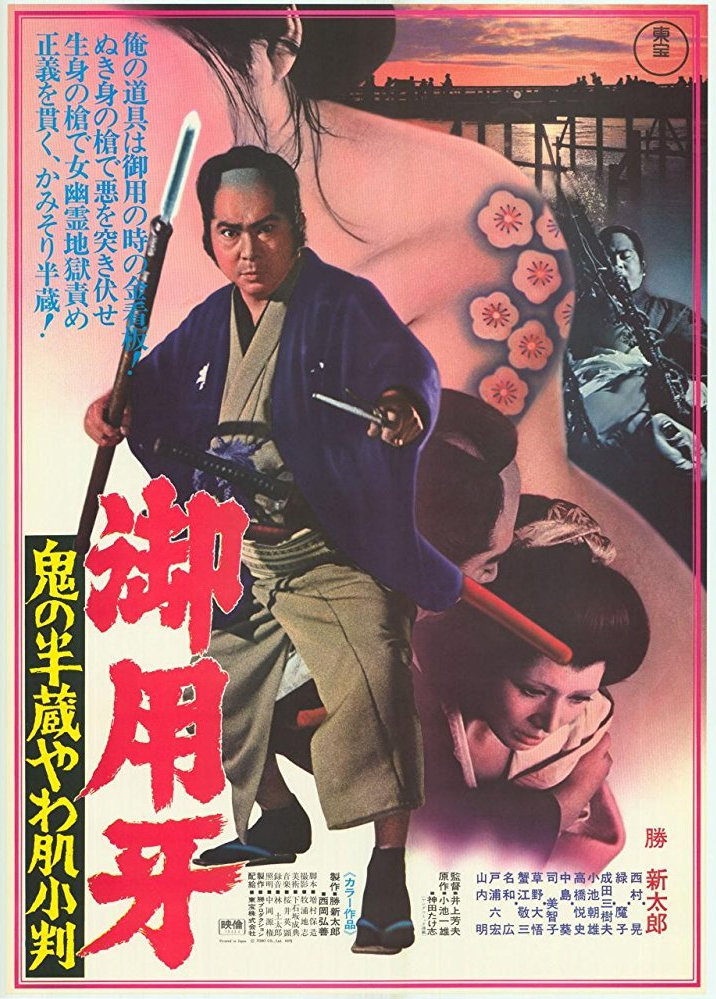
Hanzo the Razor: Who’s Got the Gold? (御用牙 鬼の半蔵やわ肌小判, Yoshio Inoue, 1974)

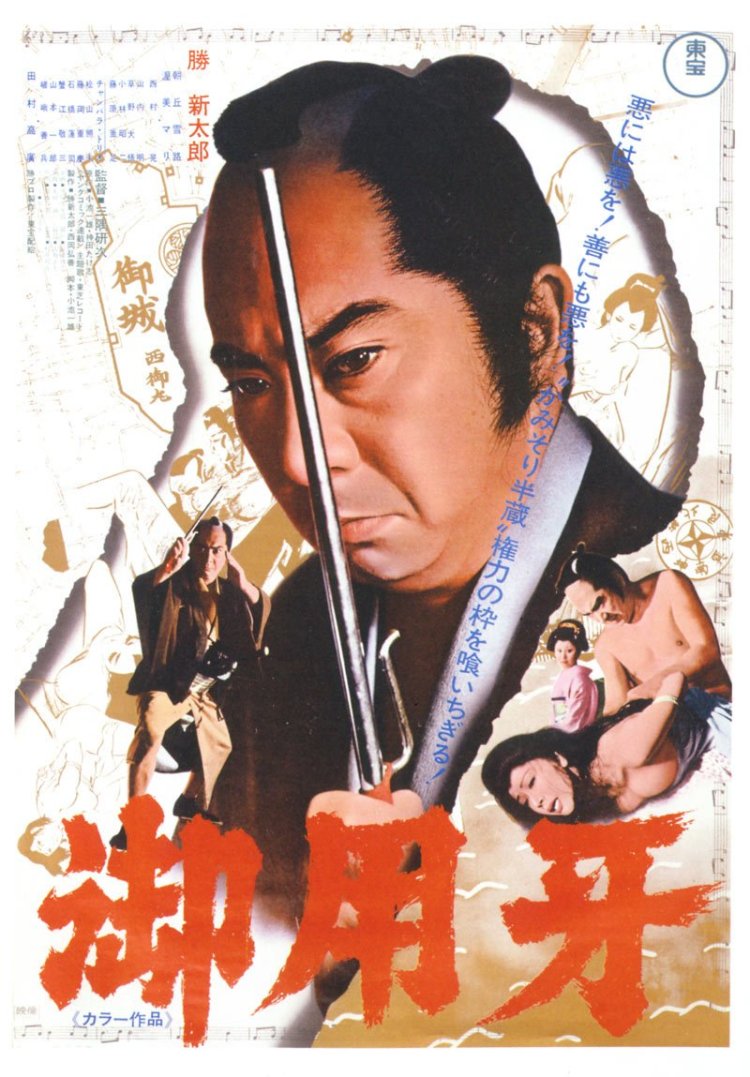
Hanzo the razor who's got the gold posterAll things must come to an end, and so the third instalment in the Hanzo the Razor series, Who’s Got the Gold? (御用牙 鬼の半蔵やわ肌小判, Goyokiba: Oni no Hanzo yawahada koban) is the last. To be frank the central tenet is wearing a bit thin (not least because Hanzo’s been bashing away at it with a mallet for the last two movies), and though scripted by the previous film’s director, Yasuzo Masumura, direction has been handed to the less experienced studio director Yoshio Inoue. Consequently, Who’s Got the Gold? is the most obviously parodic entry in the series, camping it up in grand style as Hanzo (Shintaro Katsu) goes after a more obvious kind of vice in the form of greedy, entitled lords, corrupt priesthood, and a nation too obsessed with its past to survive in a rapidly modernising era.

Inoue opts for a purely theatrical opening as Hanzo’s two ex-con underlings, Devil and Viper, enjoy a spot of night fishing whilst dreaming about having enough money to head to the red light district. They get the fright of their lives when they think they see a creepy ghost woman emerging from the lake. Being Devil and Viper they panic and run home screaming to report this terrifying incident to their brave protector Hanzo. Hanzo is in the middle of his usual “tool polishing” routine but fancies paying a visit this mysterious lake because, well, it might be fun to try having sex with a ghost for once. Devil and Viper are very confused by this idea, but it’s par for the course with Hanzo and so off they go.

Of course, the ghost lady is not a real ghost so only part of Hanzo’s lusts are satisfied as he performs his normal sort of “special torture” on her and finds out that she’s part of an ongoing scam in which treasury officials have been skimming off some of the gold they’re supposed to be protecting. Sadly, Hanzo’s investigations hit a snag when the woman’s husband turns up and kills her for having been raped by Hanzo before promptly getting killed himself.

Hanzo does not approve of any of these goings on and fully intended to arrest the treasury officers if only they hadn’t gone and died first. Accordingly he reports all of this to his superiors but advises against prosecutions because he sympathises with the difficult position these men found themselves in. Being a samurai is not cheap and these lowly jobs are very badly paid – how are you supposed to maintain your house to the manner required without resorting to extreme measures when your lord is snaffling all the money and not paying his retainers what they’re owed. It will not come as a surprise that the lord didn’t want to hear this, and so Hanzo marks his card. It didn’t really help that Hanzo’s walk into the castle involved running a gauntlet of unfortunate samurai forced to kneel along the path all day just hoping that the lord would show them some favour. Among them was a old friend of Hanzo’s who receives a tactless offer of fixed employment if only he will give up a family heirloom that the lord has been admiring.

The gold smuggling subplot runs in parallel with another problem – a doctor whom the lord has ordered Hanzo to arrest because he was advocating the adoption of Western technologies, fearing that the nation was leaving itself dangerously vulnerable if it refused to modernise. The doctor, like the girl’s father in the first film, is dying of a terminal illness and so Hanzo thinks the sentence can wait. Hiding the doctor in his house he listens to his ideas and then comes to the same conclusion, allowing him to finish building a cannon to prove to the lord just how destructive these new weapons really are and just how dangerous it would be to fight them with only katanas and samurai spirit. Hanzo lives in interesting times, but this dilemma says something both about the precarious position of the samurai order in the face of increasing modernisation and about the 1970s background in which a small war was currently being waged against American imperialism.

As usual Hanzo refuses to bow. He will not give in to bullies or those who abuse their authority to add additional oppression onto an already oppressed populace which he has pledged his life to protecting. The contradiction of being a rapist so well endowed that afterwards no one seems to mind has still not been solved, but by this third instalment in the series the “joke” is so well worn as to receive little attention. Who’s Got the Gold? is weakest of the three adventures for Hanzo and his well conditioned razor but it has its charms, if only in the troublingly easy way that its central conceit has become so essentially normalised as to be barely noticed.


Original trailer (no subtitles)
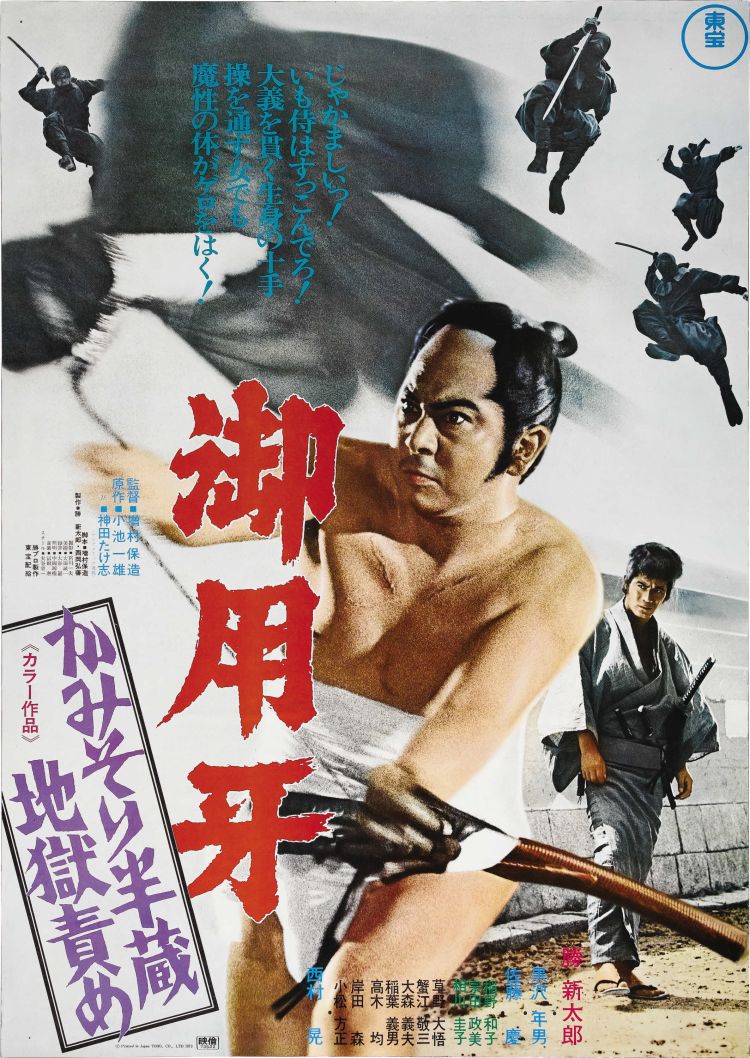
Hanzo the Razor: The Snare (御用牙 かみそり半蔵地獄責め, Yasuzo Masumura, 1973)

Hanzo the Razor the Snare posterYasuzo Masumura had spent the majority of his career at Daiei, but following the studio’s bankruptcy, he found himself out on his own as a freelance director for hire. That is perhaps how he came to direct this improbable entry in his filmography on the second of a trilogy of exploitation leading jidaigeki films for Toho. Essentially a vanity project for former Zatoichi star Shintaro Katsu who both produces and stars in the series, Hanzo the Razor: The Snare (御用牙 かみそり半蔵地獄責め , Goyokiba: Kamisori Hanzo Jigoku Zeme) is another tale of the well endowed hero of the Edo era protecting ordinary people from elite corruption, but Masumura, providing the script himself, bends it to his own will whilst maintaining the essential house style.

Hanzo (Shintaro Katsu) chases a pair of crooks right into the path of treasury officer Okubo. As expected, the lord and his retainers kick off but Hanzo won’t back down, shouting loudly about honour and justice much to his lord’s displeasure. Eventually Hanzo takes the two crooks into custody and they tell him exactly what’s happened to them this evening – they snuck over from the next village to steal some rice from the watermill but they found a dead girl in there and so they were running away in terror. Hanzo investigates and finds the partially clothed body still lying in the mill untouched but when he takes a closer look it seems the girl wasn’t exactly murdered but has died all alone after a botched abortion. Realising she smells of the incense from a local temple, Hanzo gets on the case but once again ends up uncovering a large scale government conspiracy.

Though it might not immediately seem so, Masumura’s key themes are a perfect fit for the world of Hanzo. In his early contemporary films such as Giants & Toys and Black Test Car, Masumura had painted a grim view of post-war society in which systemic corruption, personal greed, and selfishness had destroyed any possibility of well functioning human relationships. It was Masumura’s belief that true freedom and individuality was not possible within a conformist society such as Japan’s but this need for personal expression was possible through sexuality. Sex is both a need and a trap as Masumura’s (often) heroines chase their freedom through what essentially amounts to an illicit secret, using and manipulating the men around them in order to improve their otherwise dire lack of agency.

Hanzo’s investigation takes him into an oddly female world of intrigue in which a buddhist nun has been duped into becoming a middle-woman in a government backed scheme pimping innocent local girls to the highest bidder among a gang of wealthy local merchants. Hanzo berates the parents of the murdered girl for not having kept a better eye on her, but these misused women are left with no other recourse than the shady protection of others inhabiting the same world of corrupt transactions such as the local shamaness who has developed a “new method of abortion” just as Hanzo has developed a “new method of torture” which involves a bizarrely sexualised ritual in which both parties must be fully naked before she enacts penetration with her various instruments. Hanzo first tries more usual torture methods on the nun before indulging in his trademark tactic of trapping her in a net to be raised and lowered onto his oversize penis which he keeps in top notch by beating it with a stick and ramming it into a bag of rough uncooked rice.

Unlike the first film, the women are less ready to fall for Hanzo’s giant member. The nun complains loudly that her Buddhist vows of chastity are being violated while Hanzo’s later rape of the woman who runs the local mint is a much more violent affair. Hanzo grapples with her legs as she struggles, gasping as he opens his loincloth and reveals his surprisingly large appendage, once again playing into the fallacy that all women harbour some kind of rape fantasy. Hanzo has done this, he claims, to “calm her down”, because he could sense her sexual frustration and desperate need for male contact. To be fair to Hanzo, he does appear to be correct in his reading of the woman’s behaviour as she sheds her anxiety and becomes a firm devotee of the cult of Hanzo.

Meanwhile, political concerns bubble in the background as the main conspiracy revolves around consistent currency devaluations which are placing a stranglehold on the fortunes of the poor while their overlords, who are supposed to be protecting them, spend vast sums on claiming the virginity of innocent young girls. Hanzo may be a rapist himself (though he makes it clear that he derives no pleasure from his actions and only gives pleasure to the women involved), but he draws the line at the misuse of innocents, saving a little girl about to be violated by the master criminal Hamajima (Kei Sato) in a daring confrontation in which he boldly brings his own coffin, just in case.

Masumura broadly sticks to the Toho house style, but gone is the camp comedy of the first instalment with its giggly gossipers and humorous shots of Hanzo’s permanently erect penis. Instead he opts for an increase in sleazy voyeurism, filling the screen with female nudity whilst neatly implicating the male audience who enjoy such objectification by shooting from secretive angles as his collection of dirty old men crowd round a two way mirror to watch the lucky winner torture and abuse the soft young flesh they’ve just been bidding on. Like Sword of Justice, The Snare also ends with a slightly extraneous coda in which Hanzo settles a dispute with another official by means of a duel he would rather not have fought. Walking off bravely into the darkness, Hanzo utters only the word “idiot” for a man who wasted his life on petty samurai pride. Hanzo has better things to do, protecting the common man from just such men who place hypocritical ideas of pride and honour above general human decency in their need for domination through fear and violence over his own tenet of unrestrained pleasure.


Original trailer (no subtitles)

Hanzo the Razor: Sword of Justice (御用牙, Kenji Misumi, 1972)

Hanzo sword of Justice posterJapanese cinema was in a state of flux in the early ‘70s. Audiences were dwindling. Daiei, a once popular studio known for polished, lavish productions folded while Nikkatsu took the proactive measure to rebrand itself as a purveyor of soft core pornography. Toho did not go so far, but in its first foray into a new kind of jidaigeki, exploitation was the name of the game. Hanzo the Razor: Sword of Justice (御用牙, Goyokiba) was released in 1972 – the same year as the beginning of another seminal series, Lone Wolf and Cub, which was produced by Hanzo’s star, former Zatoichi actor Shintaro Katsu, who also happens to the be brother of the franchise’s lead Tomisaburo Wakayama. Like Lone Wolf and Cub, Hanzo the Razor is based on a manga by Kazuo Koike whose work later provided inspiration for the Lady Snowblood films, and is directed by Lone Wolf and Cub’s Kenji Misumi. It is then of a certain pedigree but its intentions are different. More obviously comedic in its exaggerated, unpleasant sexualised “humour”, Hanzo the Razor is also a tale of the systemic corruption of the feudal order but one which casts its “hero” as a noble rapist.

Honest and steadfast police officer Hanzo (Shintaro Katsu) usually skips the annual swearing in ceremony but this year he’s decided to make an appearance. He appears to have done so to make a personal stand by refusing to sign the policeman’s oath because he knows everyone else is breaking it. Officers may not be doing something so obvious as accepting cash for preferential treatment, but they gladly accept free drinks, gifts from lords, and entertainment in the local geisha houses. Hanzo’s actions, honest as they are, do not go down well with his fellow officers and if he can’t figure something out on time, Hanzo faces the possibility that his career in law enforcement may come to an abrupt end when contracts are up for renewal at the end of the year.

Whatever else Hanzo is, he doesn’t like bullies or those who abuse their authority and the trust placed in them by those they are supposed to be protecting. More than just saving his own skin, Hanzo is determined to unmask the hypocrisy and corruption of his boss, Onishi (Ko Nishimura), who he discovers shares a mistress with a notorious killer still on the run. Chasing this early thread, Hanzo walks straight into a chain of corruption which leads all the way to the top.

At his best, Hanzo is a steadfast champion of the people who remain oppressed by the corrupt and venal samurai order. Far from the a by the books operative, Hanzo is prepared to do what’s best over what’s right as in his decision to help a pair of siblings who are faced with a terrible dilemma trying to care for a terminally ill father. He’s also extremely well prepared, having installed a host of booby traps and hidden weapons caches throughout his home to deal with any conceivable threat. Dedicated in the extreme, Hanzo has also spent long hours testing his torture techniques on himself to find out the exact point of maximum efficiency for each of them.

Here’s where things get a little more unusual. As Hanzo climbs down from a bout of torture, a huge erection is visible inside his loincloth, prompting him to reveal that it’s pain which really turns him on. Later we see Hanzo doing some maintenance on his “tool” which involves placing it on a wooden board bearing a huge penis shaped indent, and hitting it repeatedly with a hammer before ramming it back and forth into a bag of uncooked rice. Each to their own, but Hanzo derives no pleasure from these acts – they are simply to make sure his “special interrogation method” runs at maximum efficiency. Which is to say, Hanzo’s preferred technique for getting women to talk amounts to rape but as each of them fall victim to his oversize member they cry out in pleasure, willing to spill the beans just to get Hanzo to finish what he started. Playing into the fallacy that all women long to be raped, Hanzo’s inappropriate misuse of his own authority is played for laughs – after all, the women eventually enjoy themselves so it’s no harm done, right? Troubling, but par for the course in the world of Hanzo.

This essential contradiction in Hanzo’s character – the last honourable man who nevertheless abuses his authority in the course his duty (though he apparently takes no personal pleasure in the act), is reduced to a roguish foible as he goes about the otherwise serious business of taking down corrupt authority and ensuring the law protects the people it’s supposed to protect. Odd as it is, Hanzo’s world is an strangely sexualised one in which sexually liberated women wield surprising amounts of power. Hanzo is assured one of his targets has “no lesbian tendencies” as other older court ladies are said to, while a gaggle of camp young men gossip about the size of Hanzo’s world beating penis. In an odd move, Misumi even includes a penis eye view of Hanzo’s techniques, superimposed over the face of a woman writhing in pleasure. Surreal and broadly humorous if offensive, Hanzo the Razor: Sword of Justice is very much of its time though strangely lighthearted in its obviously bizarre worldview.


Original trailer (English subtitles)

Big Man Japan (大日本人, Hitoshi Matsumoto, 2007)

big man Japan posterBeing a superhero is not all it’s cracked up to be. After all, with great power comes great responsibility and responsibility, well, it’s kind of a drag. The debut feature from comedian Hitoshi Matsumoto, Big Man Japan (大日本人, Dai Nipponjin) is the story of a modern day gladiator – a slave and a prisoner, forced into an arena to fight “monsters” intent on causing widespread destruction, but usually being the cause of that destruction himself. Poor old Daisato (Hitoshi Matsumoto) is not much of anything at all, but bears all of his respective burdens with stoic resignation.

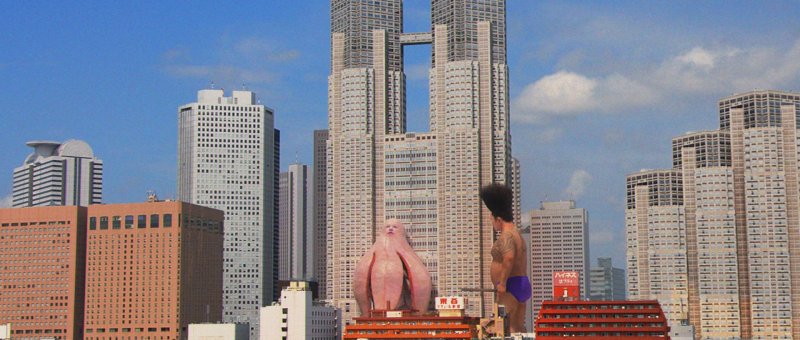
Shot in mock-documentary style, the film keys us in to Daisato’s predicament slowly as he lovingly looks at an umbrella or a packet of dried seaweed before adding that he likes them because they “only get big when you want them to”. The fact is, Daisato is the sixth in a line of superheroes known as Big Man Japan. Every time disaster strikes and there’s a scary looking monster about to pound Tokyo, Daisato has to hightail it to the nearest power station, undergo a lengthy, bizarre, and completely pointless ritual before jumping into a giant pair of purple pants and being pumped full of electricity which eventually causes him to grow to colossal size.

Yet unlike Batman, or even the obvious point of inspiration, Ultraman, Daisato is not particularly public minded and submits himself to this unpleasant treatment out of a sense of duty and tradition. Daisato’s grandfather, the Fourth, was the kind of superhero everybody loves – strong, clever, dependable, but more than that he was a fun guy to be around. Under the Fourth, superheroing was a laugh and a mini industry all at once. Asked why they bother with the strange ritual before Daisato transforms (given that they’re pushed for time), the old timer looks wistful and remarks that everything was much better when Four ran the show.

These days Four (Taichi Yazaki) is a doddery old man with dementia whom Daisato leaves in an old people’s home whilst feeling guilty about not being able to look after him. Occasionally Four goes rogue and causes havoc by beating up innocent buildings and generally destroying things that don’t need to be destroyed. Daisato maybe a monster fighting superhero but he’s no match for Japan’s ageing population and the increasing demands of elderly care.

Daisato bears his responsibilities with resignation rather enthusiasm. His father, unlike Four, had a lust for fame, repeatedly zapping himself to try and be bigger and stronger but eventually just zapping himself to death. Yet even whilst unhappy about being forced into his life of mercenary monster hunting, Daisato still wanted his kid to take over the Big Man Japan name – only his kid’s a girl who doesn’t actually like her dad very much and gets picked on at school for being the daughter of Japan’s most rubbish reality TV star. Daisato’s superpowers have led to the breakdown of his marriage as his wife has left him, unwilling to allow her child to be zapped with electricity and sucked into Daisato’s abnormal world. She’s moving on, going with the mainstream and looking to hook up with a decent, reliable sort of guy.

Even the documentary maker occasionally seems exasperated at Daisato’s passivity and general malaise. The monster hunting battles are not just in service of protecting the people of Japan but also a major TV event, though it has to be said that Daisato is not very popular and the few people who like him do so precisely because of his perseverance in the face of constant failure. Daisato has a manager of sorts, who drives expensive looking cars, has two expensive looking dogs named “simplicity” and “delicacy”, and is intent on selling each and every spot in Daisato’s giant torso to advertising sponsors landing him with tattoos advertising fresh goods right on his chest and back. Eventually Daisato ends up angering the public still further when he kills an incredibly cute, apparently harmless monster in a moment of panic.

Daisato is, in many ways, a victim of his culture as he feels compelled to put up with constant mistreatment in service of duty and tradition, seeing himself as the last in a long chain of ancestors he’s never been able to live up to and whose powers he will probably not be able to pass down to a successor of his own. In one particularly worrying episode, the mysterious forces which control Daisato do not even bother to contact him but break into his house for a spot of non-consensual zapping which destroys Daisato’s entire home leaving him with nothing. Being big in Japan is actually being very, very small. Poor old Daisato can’t seem to catch a break, but maybe there is one just waiting to catch him.


Original trailer (English subtitles)

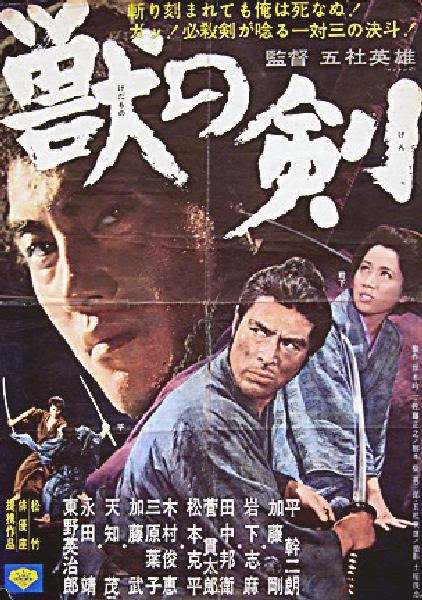
Sword of the Beast (獣の剣, Hideo Gosha, 1965)

sword of the beast posterHideo Gosha’s later career increasingly focussed on men at odds with their times – ageing gangsters who couldn’t see their eras were ending. His second feature, Sword of the Beast (獣の剣 Kedamono no Ken), is much the same in this regard but its youthful hero knows perfectly that change is on the horizon. Gennosuke (Mikijiro Hira) tries to ride that change into a better, more equal future but the forces of order will not allow him. The cinematic samurai world of the post-war era is no longer that of honourable men, manfully living out the samurai code even when it pains them to do so. It is one of men broken by oppressive feudal rule, denied their futures, and forced to betray themselves in service to systemic hypocrisy. Yet even if men think of reforming the system, they rarely think to escape it unless it actively spits them out.

When we first meet Gennosuke, he’s crawling around in a muddy grass field, dishevelled and hungry. A lone woman spots him and plies her trade leading Gennosuke to embrace his baser instincts and give vent to his lust, but the pair are interrupted by the sound of approaching horses. Gennosuke is on the run from his clan for his part in the murder of a lord. His pursuers scream at him, “have you no pride?”, lamenting his lack of stoical resignation to one’s fate so central to the samurai ideal. “To hell with name and pride” Gensosuke throws back, “I’ll run and never stop.”

Gennosuke’s odyssey leads him into the path of petty bandits who’ve been swiping gold out of the local river. Unbeknownst to them, a couple from another clan have been living an isolated life in a small cottage where they too have been skimming the Emperor’s gold, only they’ve been doing it for their lord. The man, Jurota (Go Kato), is excited about this work because he thinks when it is completed he’ll finally be accepted as a true samurai and the future for himself and his wife, Taka (Shima Iwashita), will be much brighter. He is quite wrong in this assumption.

Gennosuke, it is later revealed, committed his fateful act of murder upon the assumption that he was part of a revolutionary vanguard, removing cruel and corrupt lords from their positions so fairer minded, decent men could rule in their stead. Instead he realises he’s been rendered a disposable pawn in a political game and that the new master he believed would usher in a brighter future only envisaged one for himself. Jurota has been duped in much the same way, asked to do something illicit, immoral, and against the samurai code under the assumption that he will finally be accepted as “one of us”. He has not considered the corruption of those he wants to join, and does not see that his crime likely means he cannot be allowed to live.

Gennosuke and Jurota are cynical men who nevertheless possess true faith in the way of the samurai. Exiled from his clan, Gennosuke is a wandering beast who pretends not to care about the people he meets, but ends up saving them anyway. Yet if Gennosuke has been “freed” from his illusions, Jurota’s devotion to them makes him a less heroic figure. When Taka is captured by bandits who threaten her life, Jurota has a difficult decision to make – surrender the gold or his wife. Jurota chooses poorly and abandons his wife to a fate worse than death at the hands of uncivilised ruffians. Taka finds this hard to forgive. No longer wishing to stay with a man who values her so lightly she turns to Gennosuke – her accidental saviour, and reveals to him that she longs to become “a beast” like him. Now “freed” of her own illusions as regards her husband’s love, their shared mission, and the fallacy of their future together as noble samurai, Taka is prepared to exile herself from the samurai world as Gennosuke has, but, as he tells her, the wife of a retainer cannot choose the life of a beast.

This world of samurai is facing its own eclipse. The Black Ships have arrived, the spell has been broken, and the modern world awaits. Gennosuke can see this future, he tried to grasp it in the murder of his lord, but it is not here yet. Gennosuke’s friend, Daizaburo (Kantaro Suga), is duty bound to take his revenge as the fiancé of the murdered lord’s daughter though he’d rather not do it, and does so only to give Gennosuke an “honourable” death. The daughter, Misa (Toshie Kimura), is understandably angry and filled with hate but she pays dearly for her vengeance. Following their ordeal, neither Daizaburo or Misa can return to their clan. They are also “freed”, their illusions broken, their debts forgiven. Breaking with the burden of their past, they would now follow Gennosuke into his new world, even if none of them know exactly where they’re going.

These private revolutions amount to a kind of deprogramming, reawakening a sense of individual agency but one which is unselfish and carries with it the best of samurai honour. Gennosuke may be a “beast” on the run, reduced to a creature of needs rather than thoughts, but there’s honesty in this uncivilised quest for satisfaction which leaves no room for artifice or hypocrisy. It may be a rough world and lonely with it, but it is not unkind. To hell with name and pride, Gennosuke will have his honour, even as a nameless beast, a self-exile from a world of cruelty, greed, and inhumanity.


Original trailer (no subtitles)
The Night I Swam (La Nuit où j’ai nagé / 泳ぎすぎた夜, Damien Manivel & Kohei Igarashi, 2017)

The Night I SwamCinema, at its most innocent, is a place where children can have fantastic adventures while the adults watching them from the other side of the screen worry though somehow or other it always manages to turn out OK. From the anxious whimsy of the The Little Fugitive, to the melancholy dreaminess of Palle all Alone in the World, and on to the anarchy of Home Alone, children in movies are much more resourceful than we give then credit for. The Night I Swam (La Nuit où j’ai nagé / 泳ぎすぎた夜, Oyogisugita Yoru), a Japanese/French co-production co-directed by A Young Poet’s Damien Manivel and Hold Your Breath Like a Lover’s Kohei Igarashi, is testament to this as its central little hero sets off on a perilous journey to show his dad, who has to leave very early for work at the fish market in town, a drawing he made of a fish.

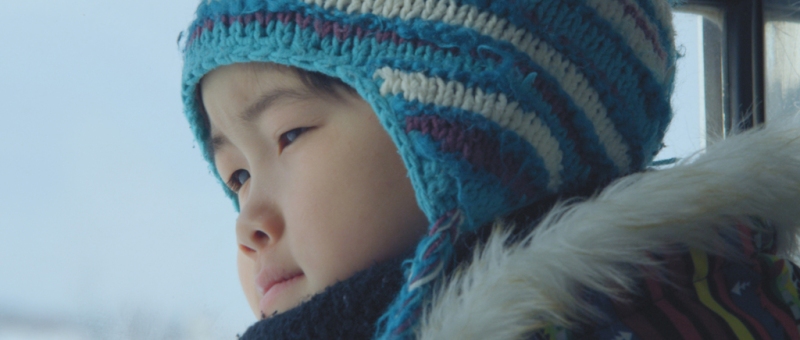
One fateful morning, while it’s still dark outside, a little boy wakes up and hears his father smoking a cigarette in the kitchen before going to work. The boy can’t get back to sleep. He tries to wake his mum but she’s deep asleep so he plays with the family dog, has a game with his toy animals, watches some TV and then draws a picture of a fish before trying to get a little more shuteye before he has to get up for school. The consequence of this is he’s very sleepy when it comes to getting ready in the morning as his mum helps him into the ski pants, jacket, and pretty blue hat that will keep him warm in the thick snow which is currently piled higher than his head on the way out of their home.

The little boy puts the drawing in his backpack and then sets off, but when he reaches the school gates he makes a surprising decision. He turns around, climbs over a fence and escapes! Playing in the snow for a while it seems as if the boy just didn’t fancy a day cooped up indoors but he has a plan and it requires getting on a train into the city…

The little boy’s journey is occasionally perilous. It’s certainly freezing cold out there, surrounded by snow and and ice, and the little tyke is so tired that at one point he just collapses and falls asleep in the snow. Somehow or other he seems to rally himself and continue on his journey even if he sheds some of his tools as he goes including a precious glove which he takes off to peel the oranges he’s brought along for sustenance. Once in the city he makes a dangerous dash across an icy road, wanders around a department store, and spends a while sitting in a food court, observing the busy lives around him like a visitor from a dream. When he gets to the fish market, it’s already closed, the place is eerily empty and deserted, waiting for the next day’s activity to begin.

Disheartened and completely exhausted, the boy starts testing doors on the cars in the carpark before crawling into a open van to keep warm and falls asleep. Luckily, the boy’s story has a happy ending as he meets some nice people who help him get back to his family safe and sound where he finally gets some proper sleep after his long adventure. The film’s most touching moments occur at the end as the boy’s dad hangs up his wet clothes to dry before looking at the drawing which the boy’s sister has pinned on the fridge before falling asleep next to his son, sharing this small amount of time they have together, while the boy’s mother watches TV downstairs with her little girl.

Shot in academy ratio and entirely dialogue free, The Night I Swam has an innocent, dreamlike quality as the little boy wanders through the snow, wide eyed and curious but set on reaching his destination even though he is clearly very tired, not to mention cold. Broken into three chapters with picture book font titles, The Night I Swam is a beautifully elliptical tale filled with whimsy and melancholy as the boy and his father are kept apart by practical concerns but united, perhaps, in dreams.


Currently available to view via Festival Scope (€4) until 19th September.

Original trailer

The Trio’s Engagements (婚約三羽烏, Yasujiro Shimazu, 1937)

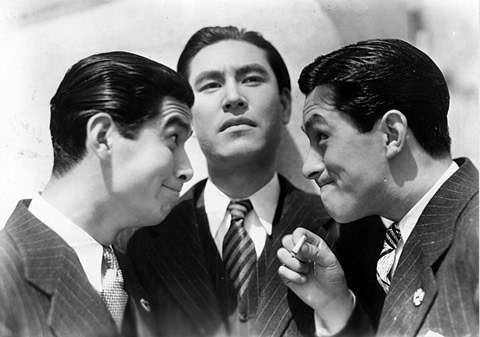
vlcsnap-2017-09-08-02h54m10s546Yasujiro Shimazu may not be as well known as some of his contemporaries such as the similarly named Yasujiro Ozu and Hiroshi Shimizu, but during in his brief yet prolific career which was cut short by his early death just before the end of the war, Shimazu became the father of one of the most prominent genres in Japanese cinema –  the “shomingeki”, which focussed on the lives ordinary lower middle-class people. Shimazu’s early films were noted for their unusual naturalism but 1937’s The Trio’s Engagements (婚約三羽烏, Konyaku Sanbagarasu) is pure Hollywood in its screwball tale of three silly young men and their respective romantic difficulties which are sorted out with the amusing kind of neatness you can only find in a 1930s cinematic farce.

Shuji Kamura (Shuji Sano) has been looking for a job in Japan’s depression hit Tokyo for some time and his long suffering girlfriend, Junko (Kuniko Miyake), has finally gotten fed up with his listlessness and decided it might be better if she left him on his own for a while to sort himself out. Slightly panicked, Shuji heads off to see about a job at a department store specialising in rayon fabrics. Undergoing a rather odd interview, he meets two other men in the same position – well to do Ken Taniyama (Ken Uehara), and down on his luck chancer Shin Miki (Shin Saburi). Luckily all three are employed that day and start working in the store but trouble brews when they each fall for the charms of the boss’ daughter, Reiko (Mieko Takamine).

Despite the contemporary setting and the difficulty of finding work for even educated young men providing a starting point for the drama, Shimazu creates a truly “modern” world full of neon lights and Westernised fashions. The trio work in a department store which sells rayon – a cheap substitute for silk being sold as the latest sophisticated import from overseas, and the store itself is designed in a modernist, art deco style which wouldn’t look out of place in any Hollywood film of the same period. Likewise, though the store is largely staffed by men catering to a largely female clientele, it maintains a sophisticated atmosphere with staff members expected to provide solicitous care and attention to each and every customer.

The guys do this with varying degrees of commitment as Shin and Ken pull faces at each other across the floor and Shuji wastes time on the roof. Shimazu packs in as many quick fire gags as possible beginning the the bizarre job interviews in which Shuji ends up doing some very in-depth role play while Shin expounds on the virtues of rayon as if he were some kind of fabrics genius. Shin Miki is your typical chancer, turning up to his job interview with a thick beard which he later shaves making him all but unrecognisable, and even cheating Ken out of a few coins he’s been using to show off his magic tricks before bamboozling his way into Shuji’s flat.

The central, slapstick conceit is that each of the guys is about to jettison their previous partners for a false infatuation with the beautiful Reiko. Shuji is mostly on the rebound from Junko who may or may not come back to see if he’s sorted himself out, while Ken is uncertain about an arranged marriage, and Shin has a secret country bumpkin girlfriend he doesn’t want anyone to know about. Their respective crushes nearly spell the end for their friendship but then Reiko has her own ideas about marriage which don’t involve shop boys or a future in the rayon business. Eventually the guys realise they’ve all been a little silly and run back into the arms of the women they almost threw over, finding happiness at last in their otherwise ordinary choices.

Shimazu makes brief use of location shoots as Shin and Reiko walk along the harbour but mostly sticks to stage sets including the noticeably fake cityscape backdrop on the shop’s roof. The major draw is the “trio” at the centre which includes some of Shochiku’s most promising young leading men who would all go on to become huge stars including 30s matinee idol Ken Uehara, Shuji Sano, and Shin Saburi. Light and filled with silly, studenty humour The Trio’s Engagements is a deliberately fluffy piece designed to blow the blues away in increasingly difficult times, but even if somewhat lacking in substance it does provide a window onto an idealised 1930s world of Westernised flappers, cheap synthetic products, and frivolous romance.


Lost Chapter of Snow: Passion (雪の断章 情熱, Shinji Somai, 1985)

Lost-Chapter-of-Snow-Passion dvd coverShinji Somai’s work is most closely identified with depictions of contemporary young people who meet their approaching adulthood with an almost nostalgic melancholy but in Lost Chapter of Snow: Passion (雪の断章 情熱, Yuki no Dansho: Jonetsu), he takes things one step further as his orphaned heroine moves through dependence to independence and finally assumes her own identity. Based on a novel by Marumi Sasaki, Lost Chapter also fits neatly into the idol movie subgenre, starring the then popular singer and actress Yuki Saito who sings frequently throughout the film and provides the end titles theme Jonetsu (Passion).

As the film opens, seven year old orphan Iori (Mami Nakazato) has been adopted by the wealthy but cruel Naba family who regard her as a slave, to be beaten, humiliated and pressed into service. One day, an employee of Naba’s, Yuichi (Takaaki Enoki), visits and witnesses Iori’s cruel treatment at the hands of oldest sister Sachiko (Kyoko Fujimoto), immediately taking her home to live with him. The situation is difficult, especially as Iori’s past has led her to be wary of new connections, and her sudden arrival has also placed a strain on Yuichi’s engagement to a girl still living in Tokyo far away from snowy Sapporo. Ten years pass and Iori (Yuki Saito) has become a happy, healthy high school girl but the resurfacing of the Naba sisters in her life is to have profound consequences when one of them is murdered and Iori finds herself regarded as a prime suspect.

Embracing its almost Dickensian roots, Lost Chapter’s most obvious theme is the place, or displacement, of the orphaned within Japanese society which places the family above all else. Iori’s origins are never mentioned beyond her early life in an orphanage, but even when Yuichi brings her home the first words the housekeeper offers are that a discarded child like Iori maybe trouble, assuming that she is the result of a “loose woman’s” weakness and irresponsibility. The Nabas, who are a thoroughly unpleasant bunch ruled over by older sister Sachiko, have adopted her despite being an already large family but raising a lonely child in love was not their aim so much as getting a kitchen maid they wouldn’t have to pay. Iori is sent out on pointless errands through the snow and freezing air only to fear she will be beaten for having drunk the juice she was sent to buy on Sachiko’s behalf. This fate is not unique to Iori as she discovers when Daisuke (Kiminori Sera), a friend of Yuichi’s who has become like a second father to her, reveals his orphan past as a poor relation sheltered by family members but not quite embraced by them.

Iori’s poor treatment at the Naba’s is offered as a possible motive for the murder of Hiroko (Mai Okamoto) – younger sister to Sachiko and a student in the same class as Iori. Hiroko is fairly depressed and a flighty girl, still cruel and eager to show off in front of her former step-sister with a lengthy dance sequence offered in front of the hottest boys at school. When she dies suddenly, all evidence points to a cup of coffee Iori tried to take her in kindness but even if it wasn’t Iori who plotted to kill her, Hiroko’s death is still firmly linked to her family’s cruel superiority.

The strain of the investigation plays on Iori’s mind, forcing her into a deeper consideration of her place within Yuichi’s household especially as she’ll soon be approaching the crossroads of adulthood and will need to decide whether to go on to university or leave Yuichi’s house to be independent. In the housekeeper’s mind, staying at “home” is not an option once she could, theoretically, support herself but Yuichi and Daisuke may feel quite differently about this damaged little girl they once took in and are still in the process to turning into a fine young woman. Yuichi’s housekeeper has a choice metaphor regarding Yuichi’s intentions in rescuing Iori – pointing to a withered flower, she suggests that Iori was a thirsty seed that Yuichi has been patiently watering in order to see the flowers bloom, but this way of viewing the situation places a further wedge between Iori and Yuichi who is still seeing his fiancée in Tokyo while Iori’s feelings about the father figure who raised her but is also still a handsome, kind, and youngish man have begun to become confused.

Falling into shojo romance territory, Lost Chapter does indeed become a slightly uncomfortable romantic tale in which a young woman falls in love with her “father” and he with her though, as they aren’t blood related, it can still be depicted as sweet and innocent rather than a tale of long term grooming and inappropriate power structures. Yuichi, though obviously a kind and socially minded young man, is nevertheless as “irresponsible” as he’s branded in his neglect of his longterm fiancée (who later makes an embarrassing first visit in nine years to Yuichi’s home to ask Iori to back off and finally declare herself grown up so she and Yuichi can marry), and later positing of Iori as some kind of pet project in his determination to have her graduate university – a feather in his cap rather than a stepping stone to a middle-class life for his precious daughter.

Known for his long, roaming, handheld takes Somai opens with a 14 minute seemingly unbroken, dreamlike sequence recounting Iori’s life with the Nabas and her eventual rescue. Somai’s camera pans around a series of snow trenches, placing a phone call from Tokyo right inside the icy space alongside a hidden violin player scoring the action. Shot with the random, etherial quality of memory mixed with dream, this first sequence gives way to a more conventional main body even if Somai maintains his preference for long takes filled with surprising pans and unexpected entrances into the frame. There are great moments of tenderness and warmth in Iori’s story, brought to life by Somai’s noticeably expressionist techniques, but there’s pain and darkness too as death and suicide lurk in the background, ready to strike at any moment. A beautifully surreal, theatrical exploration of a standard coming of age tale Lost Chapter is both shojo romance at its most controversial and a fine showcase for a popular idol shining in a leading role.


Originally released as a double header with Nobuhiko Obayashi’s Four Sisters.

14 minute long take intro (no subtitles)

Yuki Saito singing Jonetsu on a Japanese TV show presumably around the time of the film’s release.

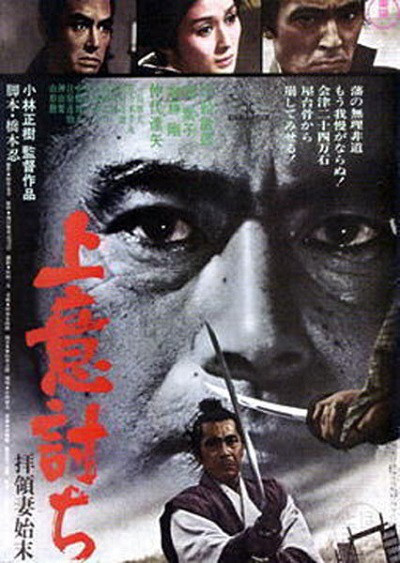
Samurai Rebellion (上意討ち 拝領妻始末, Masaki Kobayashi, 1967)

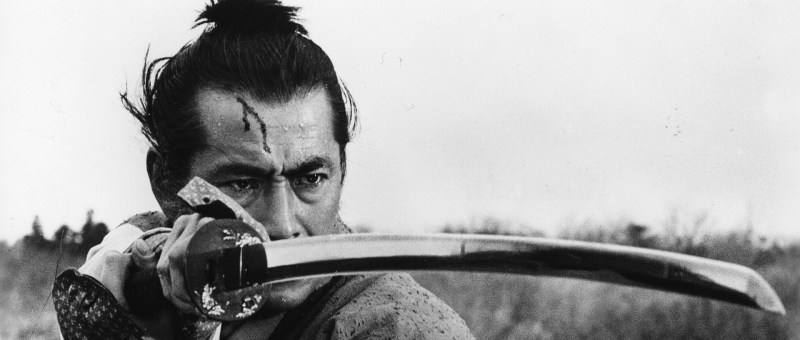
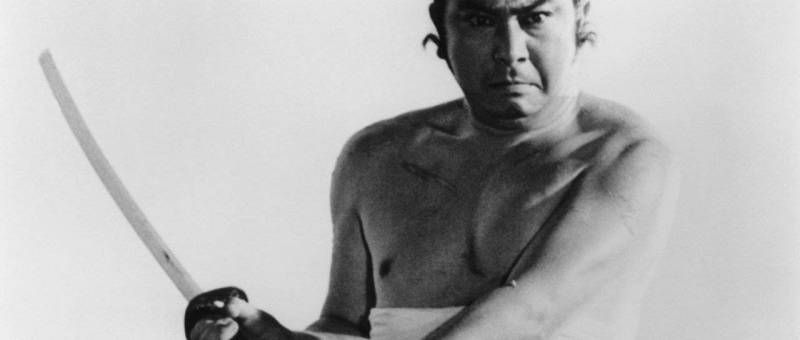
samurai rebellion posterIf Masaki Kobayashi had one overriding concern throughout his relatively short career, it was the place of the individual with an oppressive society. Samurai Rebellion (上意討ち 拝領妻始末, Joi-uchi: Hairyo Tsuma Shimatsu), not quite the crashing chanbara action the title promises, returns to many of the same themes presented in Kobayashi’s earlier Harakiri in its tale of corrupt lords and a vassal who can no longer submit himself to their hypocritical demands. On the film’s original release, distributor Toho added a subtitle to the otherwise stark “Rebellion”, “Hairyo Tsuma Shimatsu”, which means something like “sad story of a bestowed wife” and was intended to help boost attendance among female filmgoers who might be put off by the overly male samurai overtones. The central conflict is that of the ageing samurai Isaburo (Toshiro Mifune), but Kobayashi saves his sympathy for a powerless woman, twice betrayed, and given no means by which to defend herself in a world which values female life cheaply and a woman’s feelings not at all.

Having the misfortune to live in a time of peace, expert swordsman Isaburo has only the one duty of testing out the lord’s new sword (which he will never draw) on a straw dummy. He and his friend Tatewaki (Tatsuya Nakadai) are of a piece – two men whose skills are wasted daily and who find themselves at odds with the often cruel and arbitrary samurai world, refusing to fight each other because the outcome would only cause pain to one or both of their families. Isaburo has two grownup sons and dreams of becoming a grandpa but needs to find a wife for his eldest, Yogoro (Go Kato). He wants to find a woman who is loyal, loving, and kind. As a young man Isaburo was “forced” into marriage and adopted into his wife’s family but has been miserable ever since as his wife, Suga (Michiko Otsuka), is a sharp tongued, unpleasant woman whose only redeeming features are her stoicism and dedication to propriety.

It is then not particularly good news when the local steward turns up one day and informs Isaburo that the lord is getting rid of his mistress and has decided to marry her off to Yogoro. News travels fast and though others may appear jealous of such an “honour”, Isaburo is quietly angry – not only is he being expected to take on “damaged goods” in a woman who’s already born a son to another man, but they won’t even tell him why she’s being sent away, and the one thing he wanted for his son was not to end up in the same miserable position as he did. Nevertheless when Isaburo repeatedly tries to decline the “kind offer”, he is prevented. A suggestion quickly becomes an order, and Yogoro consents to prevent further conflict.

Against the odds, Ichi (Yoko Tsukasa) is everything Isaburo had wanted in a daughter-in-law and even puts up with Suga’s constant unkindness with patience and humility. Eventually she and Yogoro fall deeply in love and have a baby daughter, Tomi, but when the lord’s oldest heir dies and Ichi’s son becomes the next in line, it’s thought inappropriate for her to remain the wife of a mere vassal. Summoned to the castle, Ichi is once again robbed of her child but also of her happiness.

Ichi’s tale truly is a sad one and emblematic of the fates and positions of upperclass women in the feudal world. Having had the misfortune to catch the lord’s eye, Ichi tries to decline when the steward shows up to take her to the castle, reminding him that she is already betrothed. Sure that her fiancé will protect her, Ichi says she’ll go if he agrees never thinking that he would. Betrayed in love, Ichi is sold to the castle to be raped by the elderly Daimyo who views her as little more than a baby making machine and faceless body to do with as he wishes. When she returns from a post-natal trip to the spa and discovers the lord has already taken a new mistress, her anger is not born of jealously but resentment and disgust. This other woman is proud of her “position” at the lord’s side when she should be raging as Ichi is now, at her powerlessness, at the male society which reduces her to an object traded between men, and at the rapacious assault upon her body by a man older than her father.

Isaburo is also raging, but at the cruel and heartless obsession with order and protocol which has defined his short, unhappy life. Having been a model vassal, Isaburo has lived a life hemmed in by these rules but can bear them no longer in their disregard for human feeling or simple integrity. Isaburo says no, and then refuses to budge. Having retired and surrendered control of the household to Yogoro, Isaburo leaves the decision to his son who refuses to surrender his wife and swears to protect her from being subjected to the same cruel treatment as before. The samurai order is not set up for hearing the word “no”, and the actions of Isaburo, Yogoro, and Ichi threaten to bring the entire system crashing down. Love is the dangerous, destabilising, manifestation of personal desire which the system is in place to crush.

Isaburo’s rebellion, as he later says, is not for himself, or for his son and daughter-in-law whose deep love for each other has reawakened the young man in him, but for all whose personal freedom has been constrained by those who misuse their power to foster fear and oppression. Having picked up his sword, Isaburo will not stand down until his voice is heard, fairly, under these same rules that the authority is so keen on enforcing. He does not want revenge, or even to destroy the system, he just wants it to respect him and his right to refuse requests he feels are unjust or improper. Like many of Kobayashi’s heroes, Isaburo’s fate will be an unhappy one but even so he is alive again at last as the fire of rebellion rekindles his youthful heart. Those caught within the system from the venal stewards and greedy vassals to the selfish lords suddenly terrified the Shogun will discover their mass misconduct are dead men walking, sublimating their better natures in favour of creating the facade of obedience and conformity whilst manipulating those same rules for their own ends, yet the central trio, meeting their ends with defiance, are finally free.


Available with English subtitles on R1 DVD from Criterion Collection.

Original trailer (English subtitles – poor quality)

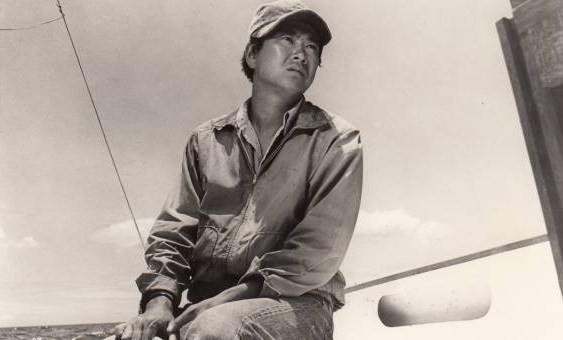
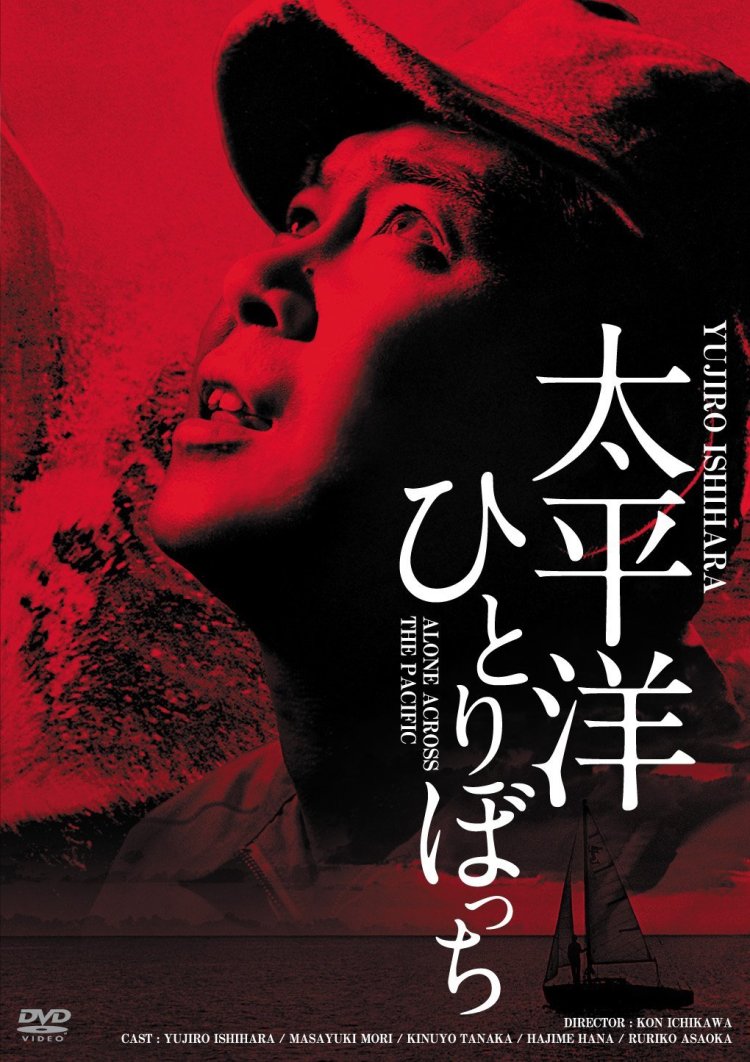
Alone Across the Pacific (太平洋ひとりぼっち, Kon Ichikawa, 1963)

Alone Across the PacficKon Ichikawa made two sorts of movies – the funny ones and the not so funny ones. Despite the seriousness of the title, Alone Across the Pacific (太平洋ひとりぼっち, Taiheiyo hitori-botchi) is one of the funny ones. Like many of Ichikawa’s heroes, Horie is a man who defies convention and longs for escape from the constraining forces of his society yet is unable to fully detach himself from its cultural norms. Based on the real life travelogue of solo sailor Kenichi Horie, Alone Across the Pacific is less the story of a man battling the elements, than a cheerful tale of a man battling himself in a floating isolation tank bound for the “land of the free”.

Kenichi (Yujiro Ishihara) is a strange man. He has few friends (aside from the family dog, Pearl) and is obsessed with the idea of running away to sea. Inspired by the tales of other intrepid sailors, his dream is to sail all alone across the Pacific Ocean from Osaka to San Fransisco. Despite the fact that it is illegal for small boats to leave Japanese waters (and that he is too impatient to wait for his passport to come through), Kenichi has custom made his own yacht, one without an engine, and has set off on his longed for voyage under the cover of darkness.

Rather than filming Kenichi’s journey naturalistically, Ichikawa opts for an adventurer’s tale as Kenichi provides an ironic voice over detailing some of his naive failings as a rookie sailor undertaking such a daunting mission. Each of Kenichi’s crises links back to a memory from his shore life, reminding us why he’s on this journey in the first place. Kenichi’s struggles are the same as many a young man in post-war Japan and, in fact, many of those previously played by the poster boy for youthful rebellion, Yujiro Ishihara.  Unwilling to live a life hemmed in by the predetermined path of a job for life, wife, children and total social conformity, Kenichi longs to be free of his cultural baggage by abandoning his civility during a long process of isolation therapy free of overbearing fathers, fretting mothers, indifferent sisters and a generally noisy world.

Kenichi’s father (Masayuki Mori) is the very personification of authority, berating his son for his fecklessness and pointless obsession with sailing – a sport a working class boy like Kenichi can barely afford. Kenichi’s determination to achieve his goal sees him leave school early, take a job in his father’s workshop only to quit suddenly for a more lucrative one delivering luggage for a travel agents, and quitting that too to work full time on his boat. While his father huffs and puffs his mother (Kinuyo Tanaka) worries, hoping her mad son won’t really go through with it but knowing that he will.

When Kenichi finally reaches San Fransisco, he’s assaulted by congratulatory voices from all directions. Towed into harbour by a motor boat, Kenichi first has to deal with mundane problems like the customs patrol wanting to know if he’s got any fruit left on the boat before a crowd gathers to shake his hand asking where he’s come from and why, what he wants to do now, and praising him for his daring feat of solo sailing glory. In Japan however, things are different. Dragged out for an interview by the press, Kenichi’s worried mother avows that she’s just happy to know her son is safe while his father bows deeply and reassures everyone that he will absolutely put a stop to any such random acts of individualism his wayward son may attempt in the future. 

Kenichi evades the twin pulls of his mother’s apron strings and his father’s handcuffs by taking off alone but even at sea he’s never free of his cultural programming, checking the wide empty ocean before removing his clothes and then stepping back down into the cabin to finish the job. Kenichi’s failure to acquire a passport is an ironic one seeing as part of what he’s running from is being Japanese but even as his quest is one for self determination it is also intensely selfish and self involved. In this Kenichi commits the ultimate act of individualism, caring nothing for the thoughts and feelings of others in the all encompassing need to achieve his goal. Kenichi may have found a home at sea, but on land he’s caged once again, a prisoner both of social conformity and his own need to defy it.


Available on R2 DVD from Eureka Masters of Cinema.

Original trailer (no subtitles)