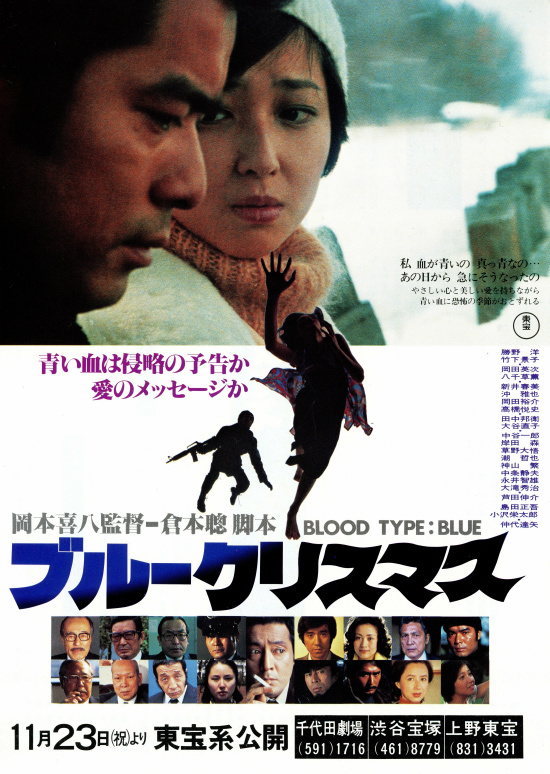
Blue Christmas (ブルークリスマス , Kihachi Okamoto, 1978)

blue-christmasThe Christmas movie has fallen out of fashion of late as genial seasonally themed romantic comedies have given way to sci-fi or fantasy blockbusters. Perhaps surprisingly seeing as Christmas in Japan is more akin to Valentine’s Day, the phenomenon has never really taken hold meaning there are a shortage of date worthy movies designed for the festive season. If you were hoping Blue Christmas (ブルークリスマス) might plug this gap with some romantic melodrama, be prepared to find your heart breaking in an entirely different way because this Kichachi Okamoto adaptation of a So Kuramoto novel is a bleak ‘70s conspiracy thriller guaranteed to kill that festive spirit stone dead.

A Japanese scientist disgraces himself and his country at an international conference by affirming his belief in aliens only to mysteriously “disappear” on the way back to his hotel. Intrepid reporter Minami (Tatsuya Nakadai) gets onto the case after meeting with a friend to cover the upcoming release of the next big hit – Blue Christmas by The Humanoids. His friend has been having an affair with the network’s big star but something strange happened recently – she cut her finger and her blood was blue. Apparently, hers is not an isolated case and some are linking the appearance of these “Blue Bloods” to the recent spate of UFO sightings. Though there is nothing to suggest there is anything particularly dangerous about the blue blood phenomenon, international tensions are rising and “solutions” are being sought.

A second strand emerges in the person of government agent, Oki (Hiroshi Katsuno), who has fallen in love with the assistant at his local barbers, Saeko (Keiko Takeshita). Responsible for carrying out assassinations and other nefarious deeds for the bad guys, Oki’s loyalty is shaken when a fellow officer and later the woman he loves are also discovered to be carriers of the dreaded blue blood.

Okamoto lays the parallels on a little thick at times with stock footage of the rise of Nazism and its desire to rid the world of “bad blood”. Sadly, times have not changed all that much and the Blue Bloods incite nothing but fear within political circles, some believing they’re sleeper agents for an alien invasion or somehow intended to overthrow the global world order. Before long special measures have been enforced requiring all citizens to submit to mandatory blood testing. The general population is kept in the dark regarding the extent of the “threat” as well as what “procedures” are in place to counter it, but anti Blue Blood sentiment is on the rise even if the students are on hand to launch the counter protest in protection of their blue blooded brethren, unfairly demonised by the state.

The “procedures” involve mass deportations to concentration camps in Siberia in which those with blue blood are interrogated, tortured, experimented on and finally lobotomised. This is an international operation with people from all over the world delivered by their own governments in full cognisance of the treatment they will be receiving and all with no concrete evidence of any kind of threat posed by the simple colouring of their blood (not that “genuine threat” would ever be enough to excuse such vile and inhuman treatment). In the end, the facts do not matter. The government has a big plan in motion for the holiday season in which they will stage and defeat a coup laid at the feet of the Blue Blood “resistance”, ending public opposition to their anti-Blue Blood agenda once and for all.

Aside from the peaceful protest against the mandatory blood testing and subsequent discrimination, the main opposition to the anti-Blue Blood rhetoric comes from the ironically titled The Humanoids with the ever present Blue Christmas theme song, and the best efforts of Minami as he attempts to track down the missing scientist and uncover the conspiracy. This takes him around the world – firstly to America where he employs the somewhat inefficient technique of simply asking random people in the street if they’ve seen him. Laughed out of government buildings after trying to make serious enquires, Minami’s last hope lies in a dodgy part of town where no one would even try to look, but he does at least get some answers. Unfortunately, the information he receives is inconvenient to everyone, gets him fired from the investigation, and eventually earns him a transfer to Paris.

In keeping with many a ‘70s political thriller, Blue Christmas is bleaker than bleak, displaying little of Okamoto’s trademark wit in its sorry tale of irrational fear manipulated by the unscrupulous. In the end, blue blood mingles with red in the Christmas snow as the bad guys win and the world looks set to continue on a course of hate and violence with a large fleet of UFOs apparently also on the way bearing uncertain intentions. Legend has it Okamoto was reluctant to take on Blue Christmas with its excessive dialogue and multiple locations. He had a point, the heavy exposition and less successful foreign excursions overshadow the major themes but even so Blue Christmas has, unfortunately, become topical once again. Imperfect and cynical if gleefully ironic in its frequent juxtapositions of Jingle Bells and genocide, Blue Christmas’ time has come as its central message is no less needed than it was in 1978 – those bleak political conspiracy thrillers you like are about to come back in style.


Original trailer (No subtitles)

Future Memories: Last Christmas (未来の想い出 Last Christmas, Yoshimitsu Morita, 1992)

b27a8478bde0a2deBased on the contemporary manga by the legendary Fujiko F. Fujio (Doraemon), Future Memories: Last Christmas (未来の想い出 Last Christmas, Mirai no Omoide: Last Christmas) is neither quiet as science fiction or romantically focussed as the title suggests yet perhaps reflects the mood of its 1992 release in which a generation of young people most probably would also have liked to travel back in time ten years just like the film’s heroines. Another up to the minute effort from the prolific Yoshimitsu Morita, Future Memories: Last Christmas is among his most inconsequential works, displaying much less of his experimental tinkering or stylistic variations, but is, perhaps a guide its traumatic, post-bubble era.

After a short segment set in 1971 in which one of our two heroines, Yuko Nando (Misa Shimizu), tells her classmates of her dream to become a best selling children’s author, we flash forward to 1981 where Yuko is a struggling artist unable to find success with her publishing company. A decade later, Christmas 1991, Yuko seems to have made little progress and despondently finds herself bonding with a mysterious woman offering a fortune telling service at the side of the road.

Ginko Kanae’s (Shizuka Kudo) life also seems to have spiralled downwards since 1981. A career as an office lady led to a fateful party after which another girl ended up going home with the guy she liked, and then she ended up being rebound married to the second choice salaryman she wound up with. Hence she’s reading fortunes on a less than busy side street at Christmas. The two women bond and swap phone numbers, but tragedy is about to befall them both as Yuko has a heart attack and dies at an office golf outing and Ginko has an accident on the way back from attending Yuko’s funeral. Never fear, the two women are soon cast back to 1981 with the next ten years of memories intact to help them make “better” choices and hopefully save their futures from ruin.

1992 was the start of a difficult era for Japan, the collapse of the bubble economy left behind it not just financial instability and social uncertainty, but a lingering feeling of foolishness and betrayal among those who’d been promised so much during the bubble years only to have the rug cruelly pulled from under them. It’s not surprising that many people of around Yuko and Ginko’s ages may have liked to travel back to 1981 and either relive the boom years or try and prevent the resultant tragedies from occurring. Unsurprisingly, the pair’s first pass at a do over sees them striving for conventional success, using their future knowledge to their advantage – Yuko by appropriating the idea of a popular 1991 manga to become an award winning artist, and Ginko becoming a financial guru. Both women come to feel conflicted about their “dishonest” choices which see them prosper unfairly, ironically robbing them of the chance to succeed as individuals in their own right and fulfil their own potential in the way they had always wanted to.

After each die at the same point and in the same way once again despite their financial successes, they get a second go, now with twenty years of hindsight to help them work out what’s really important. This time each chooses a path filled with more individual expression and the expectation of happiness. Romance is the name of the game as both women vow to spend more time with the men they love. However, having been through this once before Yuko and Ginko also have an expectation that their time will end once again in December 1991, meaning they feel conflicted about making a life with lovers they’ll be leaving behind. Gradually each starts to wonder if their fates are really as sealed as they fear them to be, or if they’ve been given this chance to start again precisely so that they can change their futures for the better.

In 1992, the idea that everything doesn’t have to be as gloomy as it seems might have been an important one, even more so than it is now. In the original timeline, Yuko and Ginko were, like many in the post-bubble world, victims of circumstance rather than people who’d actively made poor choices and the lessons which they learn are also those of their generation. Financial success is not everything, particularly if it’s gained in a “dishonest” way. More than changing their fates, Yuko and Ginko must first learn how to be happy which lies in self realisation, fulfilled potential, and, ironically, that their fate doesn’t matter so long as they live happily in the now.

Morita’s approach is again a timely one, filled with the music of the era (including a cover version of the title song from previous Morita hit, Main Theme), stock footage, and a curiously retro, nostalgia filled approach for a period that was only a decade earlier. Dissolves, slow motion and double exposures are his concessions to the sci-fi themes, but what he’s really interested in is capturing the essence of the era more so than crafting an emotionally affecting piece. Necessarily of its time, Future Memories: Last Christmas is among Morita’s weaker efforts but does serve to shine a light on early ‘90s pop culture as it found itself in a moment of profound self reflection.


Original trailer (no subtitles but lots of Christmas Cheer…and…Wham)

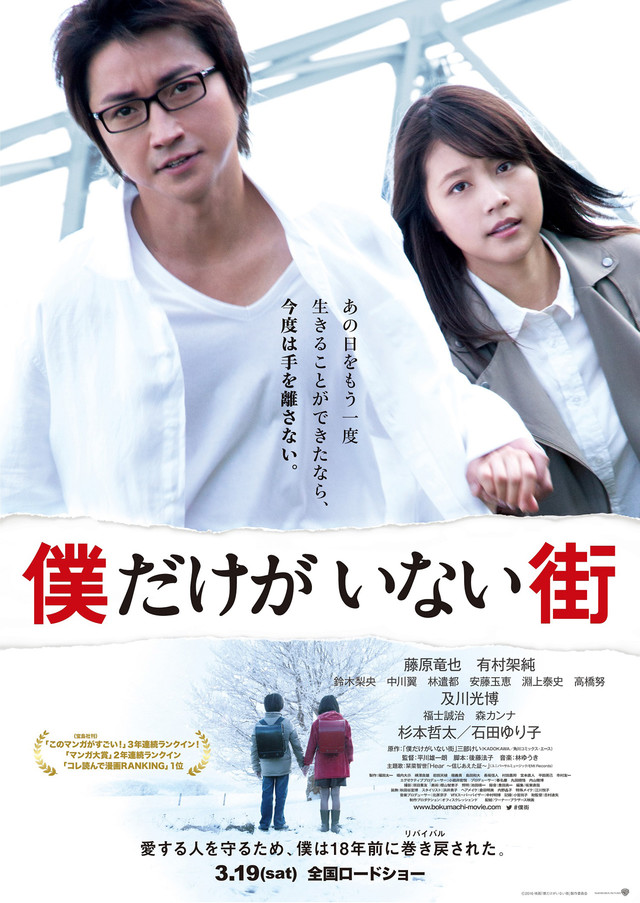
Erased (僕だけがいない街, Yuichiro Hirakawa, 2016)

erasedErased (僕だけがいない街, Boku Dake ga Inai Machi), a best selling manga by Kai Sanbe, has become this year’s big media spectacle with a 12 episode TV anime adaptation and spin-off novel series all preceding the release of this big budget blockbuster movie. Directed by TV drama stalwart Yuichiro Hirakawa, the live action iteration of the admittedly complicated yet ultimately affecting story of a man who decides to sacrifice himself to ensure his friends’ happiness, acquits itself well enough for the most part but changes two crucial details in its concluding section which unwisely undermine its internal logic and make for an unsatisfying conclusion to the ongoing puzzle.
Beginning in the “present” of 2006, Satoru Fujinuma (Tatsuya Fujiwara) is an aspiring mangaka making ends meet with a part-time job as a pizza delivery guy (a kind of “Hiro Protagonist”, if you will). Aloof and sullen, Satoru has no real friends but does possess an unusual supernatural ability – if a tragedy is about to occur in his general vicinity, he will enter a “Revival” loop in which he temporarily rewinds time, allowing him to figure out the problem and save everyone’s lives. Rescuing a child about to be hit by an out of control lorry, Satoru rides his pizza delivery bike into an oncoming car and winds up in hospital.

When he comes to he finds cheerful co-worker Airi (Kasumi Arimura), who witnessed the accident, waiting for him as well as his mother (Yuriko Ishida) coming in for visit. Reconnecting with his mother and getting closer to Airi (albeit reluctantly) Satoru’s life appears to be brightening up but the good times are short lived as Satoru’s mother is brutally murdered in his apartment leaving him looking like the prime suspect. This time when Revival kicks in it doesn’t just rewind a few minutes but 18 years, back to the winter of 1988 when Satoru’s small town was rocked by a series of child murders and abductions which resulted in the arrest of a local boy (Kento Hayashi) whom Satoru had always believed to be innocent.

Repossessing his childhood body but with a grown man’s mind, the “younger” Satoru is considerably less jaded than his 2006 counterpart, determined to change the future and save his mother’s life. The root causes of her death, he is sure, rest in this unresolved and traumatic period of his childhood. Swapping back and forth between 2006 and 1988 as Satoru makes the best of his opportunity to investigate from both sides, Erased is a tightly controlled time travel puzzle of trial and error in which Satoru must use all of the evidence he can gather to unmask the criminal in order to save both the lives of his friends in 1988 and that of his mother in 2006.

As in many similarly themed franchises, the plot turns on the bonds formed in childhood as the connections between Satoru and his friends become the binding glue in an otherwise fluid time travel dilemma. Older Satoru is better equipped to recognise the trouble one of his friends is in – Kayo, a sad and lonely girl who, in the original timeline, eventually became one of the victims attributed to the serial murders plaguing the town. Trapped in an abusive home environment, Kayo isolates herself for reasons of self preservation, both too afraid and too ashamed to let anyone know what’s going on at home. Managing to befriend her, Satoru does indeed help to change something for the better but only finds himself becoming more deeply entrenched in the central mystery.

It’s at this point that the film begins to diverge from its source material as Satoru is attacked by the murderer and “wakes up” back in 2006 but rather than having been in a coma for 18 years has apparently been leading a much more successful life than his previous incarnation. Within the peculiar laws of the franchise which don’t always match standard time travel logic, Satoru’s central timeline does not change – only his mind moves between bodies, he retains full knowledge of his original timeline as well as the changes he brings about. However, he now seems to magically receive memories of the life he never lived whilst also retaining his previous ones. Now knowing the identity of the real murderer and the probability that they are still out there, Satoru decides to re-team with his old friends but his showdown with the psychotic killer is entirely contrived to engineer a “tragic” ending, oddly more like something that might have befallen the 11yr old Satoru than his older counterpart, further undermining the already shaken sense of internal consistency.

The film’s Japanese title, Boku Dake ga Inai Machi (the town where only I am missing), takes inspiration from the short story which Kayo writes in school. Wishing that she alone could be transported to another life free of abuse and loneliness, Kayo writes herself into a better place. Satoru reimagines a similar scenario with himself in the lead as he makes the decision to sacrifice himself to save his friends. The ending of the original source material both undercuts and reinforces this idea as Satoru’s friends are both extremely proud and grateful for his efforts, but are also keen to point out that the world is a much better place with him in it than without. In removing the opportunity for Satoru’s friends to come to his rescue, the live action version of Erased also removes its most crucial message – that heroes are never “alone”, and Satoru’s salvation lies in that of his friends and family.

Yuichiro Hirakawa mostly opts for a lighter tone than the children investigating a serial killer whilst also trying to rescue their friend from her abusive mother narrative might indicate. There are some nice visual ideas including a switch to POV during the first time skip to 1988, the repeated hero of justice hand gestures, and thoughtful use of manga, but given the obvious problems with internal consistency, the high quality of the performances and cinematography can’t reconcile the various cracks within the film’s structure. Uneven, but strong until its contrived and illogical end point, Erased is a slightly disappointing live action adaptation of its source material in which it might have been (ironically enough) better to have more faith rather than pushing for the predictably melodramatic conclusion.


Original trailer (no subtitles)

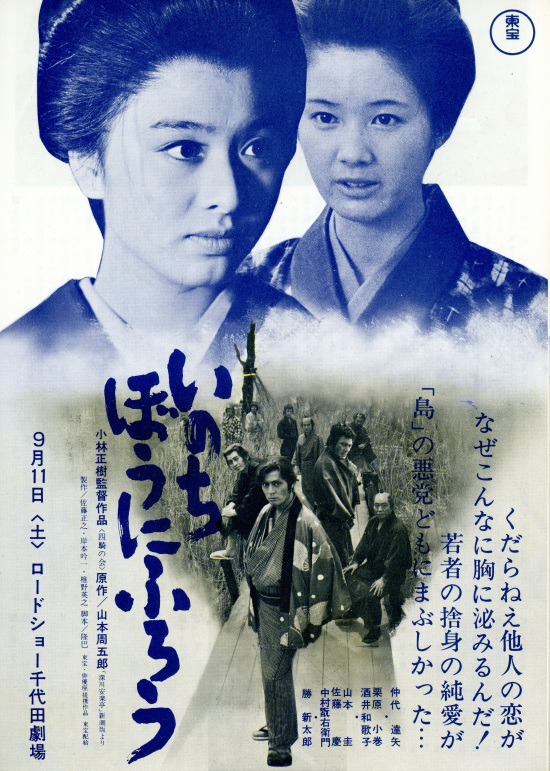
Inn of Evil (いのちぼうにふろう, Masaki Kobayashi, 1971)

inn-of-evil“Sometimes it feels good to risk your life for something other people think is stupid”, says one of the leading players of Masaki Kobayashi’s strangely retitled Inn of Evil (いのちぼうにふろう, Inochi Bonifuro), neatly summing up the director’s key philosophy in a few simple words. The original Japanese title “Inochi Bonifuro” means something more like “To Throw One’s Life Away”, which more directly signals the tragic character drama that’s about to unfold. Though it most obviously relates to the decision that this gang of hardened criminals is about to make, the criticism is a wider one as the film stops to ask why it is this group of unusual characters have found themselves living under the roof of the Easy Tavern engaged in benign acts of smuggling during Japan’s isolationist period.
Led by the innkeeper Ikuzo (Kan’emon Nakamura), the Easy Tavern is, effectively, the hideout of a smuggling gang conveniently located on a small island in the middle of a river where they can unload goods from the Dutch boats before shipping them on to Edo. Everything had been running smoothly, but the friendly policeman has been moved on and the new guy seems very straight laced. The gang’s routine existence changes one night when they receive two unexpected visitors – a young man they save from a beating in the street, and a drunk who wanders in looking for sake. The younger man, Tomijiro (Kei Yamamoto), brings a sad story with him in that all of his troubles have been caused by trying to save the woman he loves from being sold to a brothel. Moved by Tomijiro’s innocent ardour, even the most hardhearted residents of the Easy Tavern become determined to help him. Accepting a job everyone had a bad feeling about in order to get the money for Tomijiro to buy back his lady love before it’s too late, the gang’s unusual decision to risk their lives for someone else’s happiness may be the first and last time they ever do so.

The residents of the Easy Tavern have various different backstories, but the thing they all have in common is having been rejected by mainstream society at some point in their lives. The most high profile, Sadashichi (Tatsuya Nakadai), is known as “The Indifferent” which is both apt and slightly ironic. Sullen and cynical, he puts on a show about caring for nothing and no one but, as inn keeper’s daughter Omitsu (Komaki Kurihara) has figured out, it’s more that the opposite it true – he cares too much about everything. Abandoned as a child, Sadashichi’s sad story is that he once thought his saw his mother long after they were separated but killed her because she’d fallen into prostitution. Then again, perhaps it was just a woman who looked like her, or perhaps he made he whole thing up. Coming across a lost baby bird shortly after killing a man, Sadashichi is determined to look after it but is later distressed by the words of the drunk who reminds him that the bird’s mother is probably going crazy with worry. Sadashichi may identify with this lost little bird, but his empathy also extends to Tomijiro’s plight as his plaintive looks and gloomy face prompt him into action, if only to make them go away.

Similarly, the other members including “The Living Buddha” – a rabidly bisexual former monk thrown out of his temple for his lascivious ways, an effeminate homeless man, a stutterer, and an invalid all have reasons for living outside the law. As the sympathetic inn keeper later tries to explain to a policeman, most of these men are people who’ve faced rejection in one way or another. Craving sympathy, they’ve turned violent and suspicious, pushed away from the very things they wanted most. Far from an Inn of Evil, the Easy Tavern is the only place where these people have been able to find acceptance, building a community of lost souls from those cast out from society at large.

The decision to try and help Tomijiro to rescue his childhood sweetheart, cruelly sold by her selfish and uncaring father, is, in once sense, a selfless one but perhaps also reminds them of all the times they were also betrayed or abandoned and no one came to help. Even knowing the plan is unlikely to end well, the inn keeper is proud of his men’s decision, if they didn’t try to help the girl no one else would. They may be throwing their lives away in a pointless endeavour, but if they don’t at least try then what’s the point in living at all. This more than anything expresses Kobayashi’s constant preoccupation throughout his career in pointing to the essential goodness of those who refuse to simply accept acts of injustice as normal and stand up to oppose them, even if their resistance will produce little or no actual change.

Filming in a crisp black and white, Kobayashi creates an eerie atmosphere aided by Toru Takemitsu’s strangely ethereal score. The world of the The Easy Tavern is a dark one in which cruelty and betrayal lie at every turn and men ruin themselves through thoughtless and reckless decisions, but the best of humanity is to be found among this gang of outlaws who collectively decide it’s world risking their lives for someone else’s love story. Filled with impressive visual imagery including the strange sight of the looming bright white police lanterns and the impressively staged last stand as Sadashichi holds off the troops for Tomijiro to escape, Inn of Evil is a tightly controlled, minutely detailed character drama in which men who’d throw their lives away for nothing find that their sacrifice has not been in vain.


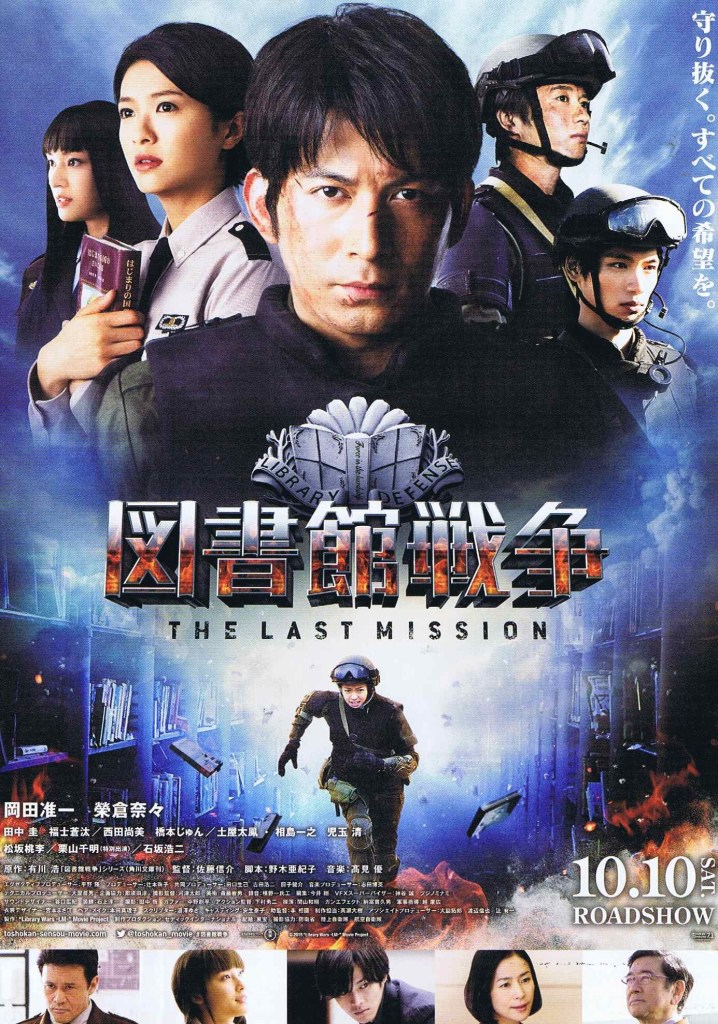
Library Wars: The Last Mission (図書館戦争-THE LAST MISSION-, Shinsuke Sato, 2015)

library-wars-last-missionWhen Library Wars, the original live action adaptation of Hiro Arikawa’s light novel series, hit cinema screens back in 2013 it did so with a degree of commercial, rather than critical, success. Though critics were quick to point out the great gaping plot holes in the franchise’s world building and a slight imbalance in its split romantic comedy/sci-fi political thriller genre mix, the film was in many ways a finely crafted mainstream blockbuster supported by committed performances from its cast and impressive cinematography from its creative team. Library Wars: The Last Mission (図書館戦争-THE LAST MISSION-, Toshokan Senso -The Last Mission-) is the sequel that those who enjoyed the first film have been waiting for given the very obvious plot developments left unresolved at the previous instalment’s conclusion.

18 months later, Kasahara (Nana Eikura) is a fully fledged member of the Library Defence Force, but still hasn’t found the courage to confess her love to her long term crush and embittered commanding officer, Dojo (Junichi Okada). As in the first film, The Media Betterment Force maintains a strict censorship system intended to prevent “harmful” literature reaching “vulnerable” people through burning all suspect books before they can cause any damage. Luckily, the libraries system is there to rescue books before they meet such an unfortunate fate and operates the LDF to defend the right to read, by force if necessary.

Kasahara is an idealist, fully committed to the defence of literature. It is, therefore, a surprise when she is accused of being an accomplice to a spate of book burning within the library in which books criticising the libraries system are destroyed. Needless to say, Kasahara has been framed as part of a villainous plan orchestrated by fellow LDF officer Tezuka’s (Sota Fukushi) rogue older brother, Satoshi (Tori Matsuzaka). There is a conspiracy at foot, but it’s not quite the one everyone had assumed it to be.

In comparison with the first film, The Last Mission is much more action orientated with military matters taking up the vast majority of the run time. A large scale battle in which the LDF is tasked with guarding an extremely important book containing their own charter (i.e. a symbol of everything they stand for) but quickly discovers the Media Betterment Force is not going to pass up this opportunity to humiliate their rival, forms the action packed centrepiece of the film.

The theme this time round leans less towards combating censorship in itself, but stops to ask whether it’s worth continuing to fight even if you feel little progress is being made. The traitorous officer who helps to frame Kasahara does so because he’s disillusioned with the LDF and its constant water treading. The LDF is doing what it can, but it’s fighting to protect books – not change the system. This is a weakness Satoshi Tezuka is often able to exploit as the constant warfare and tit for tat exchanges have begun to wear heavy on many LDF officers who are half way to giving up and switching sides. Even a zealot like Kasahara is thrown into a moment of existential despair when prodded by Satoshi’s convincing arguments about her own obsolescence.

Satoshi rails against a world filled with evil words, but as the head of the LDF points out in quoting Heinrich Heine, the society that burns books will one day burn men. The LDF may not be able to break the system, but in providing access to information it can spread enlightenment and create a thirst for knowledge among the young which will one day produce the kind of social change that will lead to a better, fairer world.

As in Library Wars all of these ideas are background rather than the focus of the film which is, in essence, the ongoing non-romance between Kasahara and Dojo. Remaining firmly within the innocent shojo realm, the romantic resolution may seem overly subtle to some given the extended build up over both films but is ultimately satisfying in its cuteness. Library Wars: The Last Mission masks its absurd premise with a degree of silliness, always entirely self aware, but gets away with it through sincerity and good humour. Shinsuke Sato once again proves himself among the best directors of mainstream blockbusters in Japan improving on some of the faults of the first film whilst bringing the franchise to a suitably just conclusion.


Original trailer (No subtitles)

Lone Wolf and Cub: White Heaven in Hell (子連れ狼 地獄へ行くぞ!大五郎, Yoshiyuki Kuroda, 1974)

lone-wolf-and-cub-white-heaven-in-hell-japanese Ogami (Tomisaburo Wakayama) and his son Daigoro (Akihiro Tomikawa) have been following the Demon Way for five films, chasing the elusive Lord Retsudo (Minoru Oki) of the villainous Yagyu clan who was responsible for the murder of Ogami’s wife and his subsequent framing for treason. The Demon Way is never easy, and Ogami has committed himself to following it to its conclusion, but recent encounters have broadened a conflict in his heart as innocents and seekers of justice have died alongside guilty men and cowards. Lone Wolf and Cub: White Heaven in Hell (子連れ狼 地獄へ行くぞ!大五郎, Kozure Okami: Jigoku e Ikuzo! Daigoro) moves him closer to his target but also further deepens his descent into the underworld as he’s forced to confront the wake of his ongoing quest for vengeance.
Ogami and Daigoro have made it to Snow Country, meanwhile Lord Retsudo is receiving a dressing down from a superior over his total failure to eliminate the Lone Wolf or his Cub. It seems Ogami has already despatched all three of Retsudo’s sons, and so now Retsudo pledges his daughter, Kaori (Junko Hitomi), skilled in the use of daggers and every bit as fine a warrior as her defeated brothers, in the mission to end the Ogami threat.

Things do not go to plan and Retsudo is forced to approach his one remaining son. An illegitimate child born to a concubine, disavowed, and hidden away in the mountains, Hyoe (Isao Kimura) is not well disposed to his estranged father’s request to save the Yagyu clan to which he feels only rage and resentment. Sending his father away, Hyoe nevertheless decides to take on Ogami in the hope of embarrassing the Yagyu by taking him out first. Possibly having spent too much time alone, Hyoe’s plan involves a number of strange rituals beginning with resurrecting three of his men as emotionless (yet intelligent) zombies meant to terrify Ogami and his son into submission.

Throughout the series, we’ve seen Ogami’s world darken as the straightforward missions of eliminating corrupt lords eventually gave way to more morally dubious assignments with the tragic story of Oyuki and later the assassination of an entire family in order to preserve the legitimate arm of a historical clan. Along the way, Ogami has met “true samurai” and villainous cowards, but his encounters with honest men and women have only served to shake his heart as he guides his young son onwards bound for hell by way of death or violence.

The pair have never been afraid before, but Hyoe’s plan hinges on pushing Ogami’s mind into those dark places, preventing him from fighting back against his supernatural soldiers. Death has always surrounded them, but the price of Ogami’s vengeance is brought home to him when Hyoe’s forces unceremoniously wipe out the entire population of an inn where Ogami and Daigoro are staying whilst hovering in some nearby trees to remind them that this is all really their fault and the longer they keep on down this path, the more the innocent will suffer. The zombie trio threaten to destroy Ogami’s human emotions – joy, sorrow, pleasure, and anger, leaving him only with fear. Unbowed, Ogami faces Hyoe but the pair have more in common than they thought and so round one ends in a stalemate.

White Heaven in Hell, though not intended as a conclusion to the series, neatly brings things full circle as Ogami visits his wife’s grave, recalling his familial tragedy and reinforcing his bond with Daigoro. All of the films have, in some way, dealt with functional and dysfunctional family, each commenting on the unusual relationship between Ogami and his son. Finally meeting face to face, Retsudo takes Ogami to task for the loss of his children which Ogami throws right back at him – after all, all he did was defend himself against a threat Retsudo himself instigated. Ogami eventually tells him that he hopes Retsudo becomes so lonely that he goes completely mad. Retsudo’s pointless manoeuvring has cost him dearly in the loss of each of his legitimate children, eventually forcing the acknowledgement of his illegitimate son and daughter whose hatred of him also leads to their undoing. So great is Hyoe’s loathing of the Yagyu, that his last ditch attempt at revenge is in trying to convince his own sister, Azuma, to bear his child and create a new line to finish them off once and for all.

Kenji Misumi declined to return for this instalment, claiming the series had become too much like a Western which is a little ironic as White Heaven in Hell leaves the arid deserts behind for the frozen ice plains of the north. Yoshiyuki Kuroda, making his first and only contribution to the series, had a strong background in horror cinema which might explain the sudden appearance of the supernatural elements in what has been, up to now, a fairly grounded exercise even if somewhat outlandish. This is also the only script with which original creator Kazuo Koike was not not involved and bears the least relation to the then ongoing manga. Still, the action is undoubtedly innovative as the baby cart’s wheels are swapped for skis and Ogami faces off against an entire army of enemies on a snow covered hillside. Kuroda sticks more closely to Misumi’s aesthetic than Saito had done though steers away from the painterly cinematics in favour of showcasing the snow covered terrain, driving Ogami deeper into hell as his heart freezes over but denying him the vengeance that has become his life’s work. White Heaven in Hell is the last outing for Ogami yet refuses to close the circle, his quest may be a never ending one, plunging both himself and his son into an inescapable cycle of violence and regret as the Demon’s Way stretches on endlessly towards an uncertain destination.


Original trailer (subtitles in German for captions only)

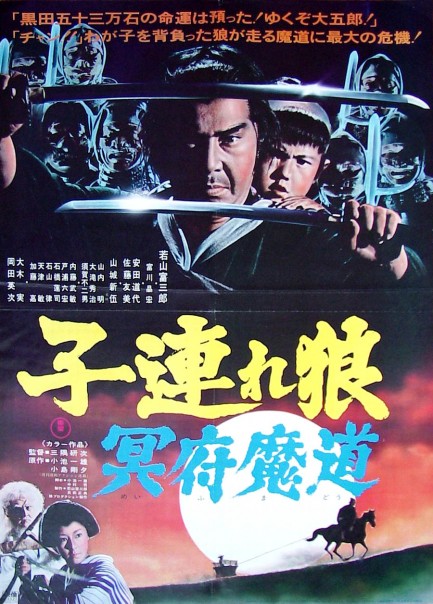
Lone Wolf and Cub: Baby Cart in the Land of Demons (子連れ狼 冥府魔道, Kenji Misumi, 1973)

baby-cart-land-demonsOgami (Tomisaburo Wakayama), former Shogun executioner now a fugitive in search of justice after being framed for treason by the villainous Yagyu clan who are also responsible for the death of his wife, is still on the Demon’s Way with his young son Daigoro (Akihiro Tomikawa). Five films into this six film cycle, the pair are edging closer to their goal as the evil Lord Retsudo continues to make shadowy appearances at the corners of their world. However, the Demon’s Way carries a heavy toll, littered with corpses of unlucky challengers, the road has, of late, begun to claim the lives of the virtuous along with the venal. Conflicted as he was in his execution of a contract to assassinate the tragic Oyuki in the previous instalment, Baby Cart in Peril, whose story was perhaps even sadder than his own, Ogami is about to descend further still as a commission to kill a living Buddha proves even more sordid than expected.
Baby Cart in the Land of Demons (子連れ狼 冥府魔道,  Kozure Okami: Meifumado) starts as it means to go on as Ogami finds yet another coded way of touting for business when he notices the strange demonic drawing on the face mask of a resting man and correctly reads it as a message for the Lone Wolf and Cub. The Kuroda clan have despatched five of their best men wearing just such masks in order to test his skills and find out if he’s worthy of their job. Each time he defeats one, he’ll receive 100 ryou (a fifth of his fee) and part of the reasons and explanations he requires in deciding whether to take the job.

This time the assignment is to do with a mislaid yet incriminating letter from the Kuroda lord, Naritaka (Shingo Yamashiro), who has unwisely been deceiving the Shogun as to the identity of his children. Very much in love with his mistress, Naritaka has been passing off their daughter, Hamachiyo (Sumida Kazuyo), as his son Matsumaru. Meanwhile the real Matsumaru, his legitimate heir through his legal wife, has been imprisoned in the compound and kept away from prying eyes. A particularly stupid and pointless ruse, yet the lord has created even more problems for himself by allowing a letter outlining all of this to fall into the hands of a treacherous priest, Jikei (Hideji Otaki), who turns out to be the head of a ninja spy network. Ogami’s job is to kill Jikei and get the letter back but it comes with some additional spice – Jikei plans to hand the letter to Lord Retsudo, Ogami’s arch nemesis.

Ogami’s world is a feudal one where allegiance to one’s lord trumps almost everything. The lords are, however, often dishonest, selfish, and cruel. The hypocrisy of the samurai world is a phenomenon well known to all, and most particularly to Ogami who has found himself at the mercy of the ambitious Yagyu clan. Whatever else he may have become, Ogami is a man of honour to whom the way of samurai maintains a deep spiritual importance. Jikei’s attempt to unsettle Ogami by asking him what he thinks he’s going to achieve on the Demon’s Way and if killing a living Buddha is a fitting use of his talents, further pushes Ogami into a spiritual crisis regarding his quest for vengeance and ongoing career as a sword for hire.

Naritaka has, indeed, broken his code in lying to the Shogun but also in rejecting his position and creating an alternative family of his choosing by favouring the female child of his mistress over his legitimate male heir. In addition to his contract to kill Jikei and retake the letter, Ogami also receives a request to assassinate the lord himself alongside his concubine and even their daughter. This illegitimate line cannot be allowed to continue, the illicit family born of personal choice must be cut off before it begins to corrupt the future of the Kuroda clan. Actively plotting the death of one’s lord is an unthinkable concept, yet a retainer also has a responsibility to guard the honour of their house and so the lord must go, even if the retainer is bound to follow him.

The decision to execute the entire family recalls the series’ origins in which Ogami was seen to act as a second in the “harakiri” of a toddler shortly before seeing his own family fall under the sword of a Yagyu plot. Daigoro is growing older at an unnatural rate but shows a little more willingness to engage in acts of altruistic heroism than his father, such as in an episode where he decides to refuse to identify a local pickpocket even if it means he himself will be flogged in her place. Ogami looks on in inaction, yet there is the faintest flicker of pride in his otherwise impassive face as his fearless son opts to undergo a harsh punishment rather than allow someone else to suffer even as she tries to save him in turn. Daigoro also has an awkward moment of connection with the similarly aged unlucky princess but remains apparently unmoved by her fate at the end of their mission. The legitimate prince may have been liberated and the official line restored, but there has been a heavy price for all concerned and the Kuroda clan is far from saved.

Baby Cart in the Land of Demons marks the return, albeit for the last time, of the series’ original director Kenji Misumi who gets rid of the heavily exploitation leaning approach brought by Buichi Saito in the previous film, Baby Cart in Peril. No voiceovers, no musical sequences, and an overall return to quiet contemplation mixed with impressively balletic fight sequences rather than the frenetic action and sudden trickery which defined Baby Cart in Peril send the series back to its spiritual roots after a brief foray into the contemporary jidaigeki. Baby Cart in the Land of Demons is also the first in the series which contains no female nudity though it does make room for another skilled female warrior and also repeats the motif of Ogami leaving a melancholy woman behind him as he sets off into the sunset, yet this time it’s a woman who has chosen her own path in keeping with her own code and earned Ogami’s respect, and perhaps sorrow, in the process. Ogami is drawing closer to Retsudo, though his path leads him through a land of demons each more villainous than the last and justice seems like an unrealistic ideal where only men like Ogami stand at the gates of man and beast.


Original trailer (subtitles in German for captions only)

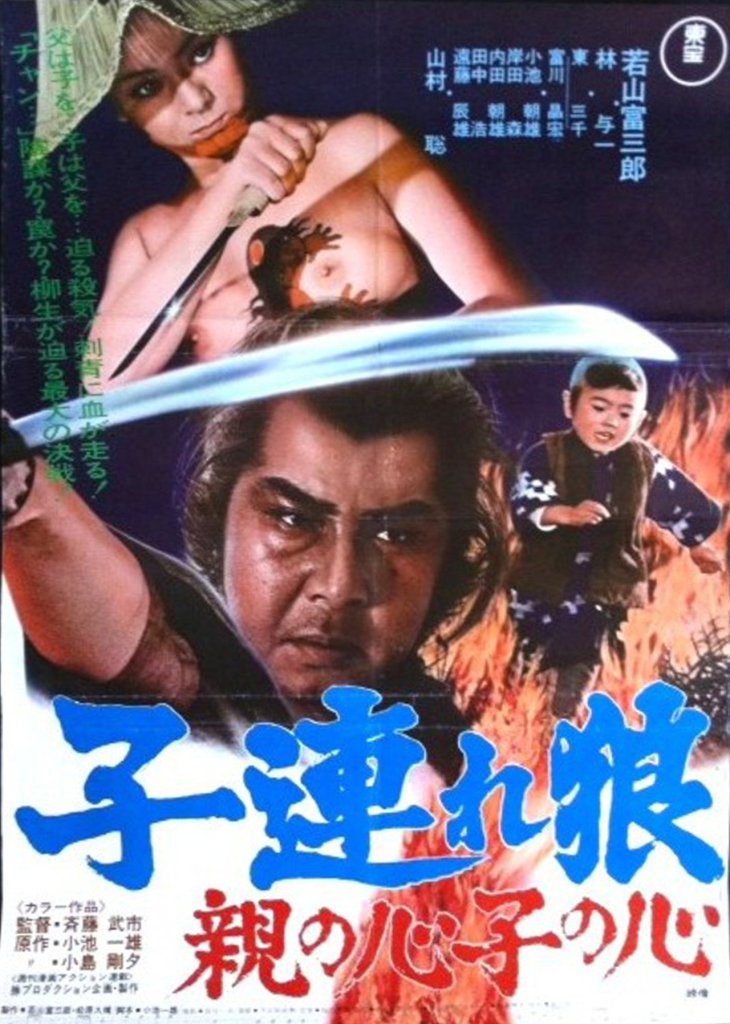
Lone Wolf and Cub: Baby Cart in Peril (子連れ狼 親の心子の心, Buichi Saito, 1972)

baby-cart-in-perilNow four instalments into the Lone Wolf and Cub series, Ogami (Tomisaburo Wakayama) and Daigoro (Akihiro Tomikawa) have been on the road for quite some time, seeking vengeance against the Yagyu clan who framed Ogami for treason, murdered his wife, and stole his prized position as the official Shogun executioner. Lone Wolf and Cub: Baby Cart in Peril (子連れ狼 親の心子の心, Kozure Okami: Oya no Kokoro Ko no Kokoro) is the first in the series not to be directed by Kenji Misumi (though he would return for the following chapter) and the change in approach is very much in evidence as veteran Nikkatsu director Buichi Saito picks up the reins and takes things in a much more active, full on ‘70s exploitation direction. Where Baby Cart to Hades was content to take a break for contemplation of Ogami’s quest, Baby Cart in Peril is a post-thought spring into action. It is, however, among the most melancholic episodes in the series as it continues to explore the often precarious position of women and the disenfranchised poor in Ogami’s often cruel world.
Opening with a thrilling action sequence in which a topless and heavily tattooed female warrior elegantly despatches a series of enemies, Saito makes the most of the genre’s tendency for economy to jump straight to a scene of Ogami receiving the request to assassinate her. As they travel onward, father and son become accidentally separated after Daigoro wanders off to follow a pair of street performers. Looking for his dad in all the familiar places he can think of, Daigoro unwittingly comes into contact with an old foe, Gunbei (Yoichi Hayashi) – son of Ogami’s arch enemy, Lord Retsudo, who is immediately alarmed by the steely look in Daigoro’s eyes which he claims is only born of mass killing. Daigoro gets himself into trouble when he’s accidentally caught in a field of long grass which the local peasants are set to clear by burning, but gets himself out of it by cleverly digging himself into the mud. Gunbei, impressed, is poised to execute Daigoro on the spot but luckily Ogami turns up to save the day.

Once Ogami has accepted a contract he will see it through but this one brings him no pleasure as his target, Oyuki (Michi Azuma), has a sad story to rival his own. A skilled swordswoman, she finds employment with a local clan but is deceived and then raped by one of their retainers leading her to escape and seek her vengeance. Oyuki’s origins lie in an underclass of street performers, loosely grouped into a clan of their own but with communities spanning the entire country. On meeting Oyuki’s father, Ogami’s sorrow in his task deepens as he finds him to be an honest, decent and kind man who accepts his forthcoming suffering with a weary resignation. Further torn between his contract and his personal judgement, Ogami steps back to allow his target to avenge her honour but then must obey his own.

Baby Cart in Peril, even more so than the other chapters, dives into the parent and bond between Ogami and Daigoro as Ogami is once again forced to consider if he made the right choice for his son in bringing him into the “Demon’s Way” of death dealing vengeance. Oyuki, thoroughly and heartbreakingly alone, is distressed to learn that her own father also consents to her death but in Ogami’s view, it’s sometimes lucky to have a parent who wishes for the death of their child. This uncomfortable idea leads him back into that first fateful decision when he allowed Daigoro to choose the sword or the ball and then consented to his choice of the sword. Oyuki also chose the sword as a child and has paid heavily for it, yet more so than Daigoro will ever be she is a victim of her class and gender, subject to a second set of rules of which Daigoro and his father live on the opposing side.

Betrayed, scarred and in the view of the world she lives in defiled, Oyuki has every right as much to seek her vengeance as Ogami has, yet Ogami has already agreed to carry out her sentence for breaking the rules of that same world. He does, however sympathise and feel sorry her plight which is not so different from his own though hers is a heavier burden. Treating Oyuki with far more respect than his previous targets which have all been in some way guilty of crimes against samurai honour, Ogami also tries to help her father whose adherence to that same code (with a sincerity absent from the countless “true samurai” he’s encountered so far despite being a member of an underclass) has sparked his admiration but Ogami is unable to salvage anything at all from the rapacious hands of the uncaring lords.

Baby Cart in Peril marks the return of evil antagonist Lord Retsudo (Tatsuo Endo), not seen since the first instalment, which hints at Ogami finally getting closer to his goal even as Retsudo and his (disgraced) son Gunbei amp up their plotting. This climaxes during one of the large scale brawl scenes the films are famous for as Ogami faces off against hordes of grey clad ninja and basket heads in white. Though badly injured, Ogami makes his way onward even whilst Gunbei celebrates his survival in order that he might face him on equal footing and end his own cycle of vengeance in person.

From the exciting action packed opening, the fight scenes are once again innovative in design including a surprising sequence in which Ogami is attacked by ninjas masquerading as statues in a temple. Saito’s approach is much more contemporary than Misumi’s artful aesthetic, prioritising speed over beauty though that’s not to say the film lacks for impressive visuals. Baby Cart in Peril breaks from the series pattern in adding in other narrative devices from film cycles of the time as in the narrative voice over and greater use of non-diegetic music most obviously when Daigoro’s forlorn wandering turns into a kind of sad music video. Nevertheless, even if Baby Cart in Peril sinks a little from the artistic highs of the first three instalments, it does at least embrace some of its more outlandish elements with a degree of self aware witticism that plays to its exploitation roots. The baby cart and its master have escaped the peril for now, but Ogami and his son are still bound on the Demon Way leaving the sad story of Oyuki behind them. Lord Retsudo may be coming into vision but the road stretches on promising nothing other than death and suffering for all who travel it.


Original trailer (subtitles in German for captions only, NSFW)

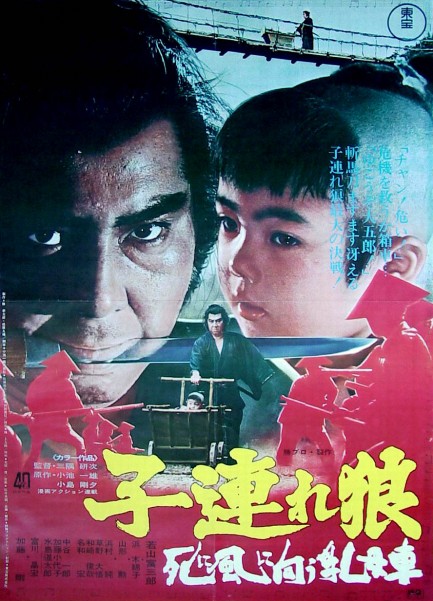
Lone Wolf and Cub: Baby Cart to Hades (子連れ狼 死に風に向う乳母車, Kenji Misumi, 1972)

lone-wolf-and-cub-baby-cart-to-hadesOgami Itto (Tomisaburo Wakayama) and his (slightly less) young son Daigoro (Akihiro Tomikawa) are going to hell in a baby cart in this third instalment of the six film series, Lone Wolf and Cub: Baby Cart to Hades (子連れ狼 死に風に向う乳母車, Kozure Okami: Shinikazeni Mukau Ubaguruma). The former shogun executioner, framed for treason by the villainous Yagyu clan intent on assuming his position, is still on the “Demon’s Way”, seeking vengeance and the restoration of his clan’s honour with his toddler son safely ensconced within a bamboo cart which also holds its fair share of secrets. In the previous chapter, Baby Cart at the River Styx, Ogami’s stoic personality came to the fore as he showed that sometimes there is more strategic value to be found in avoiding a fight rather than charging into one where it isn’t necessary. Baby Cart to Hades will further test this element of his life philosophy as he finds himself bound onwards, seeking his redemption.
Neatly attaching Daigoro’s cart for towing, Ogami boards a boat which appears to be being followed by underwater ninjas, if the reeds he notices whilst using his sword as a mirror are anything to go by. Also on the boat is a distressed young woman, apparently on her way to be sold to a brothel. Diagoro takes pity on the girl and catches her tiny bundle of belongings when the loquacious middle man knocks them overboard. Later they all end up at the same inn where the unfortunate woman kills her procurer when he attempts to rape her (bad business decision as that would be). Daigoro takes pity on the woman once again and Ogami decides to help her, especially after he notices the wooden memorial tablet among her belongings. Rather than fight off the brothel running samurai who come to find her, Ogami agrees to undergo the torture which is the alternative to entering a brothel on the girl’s behalf.

In addition to saving a life from fear and suffering, Ogami’s forbearance also earns him the respect of the madam in question, Torizo (Yuko Hama), who has another job for him. Her older sister was raped at the court of their lord and subsequently committed suicide, she and her father would like him dead and are willing to pay for it. Amusingly enough, the corrupt lord in question also tries to hire Ogami for another assassination for which he will pay double, but Ogami is an honest man. This latest mission brings him closer to his fated battle with the Yagyu but the Demon’s Way is long and Ogami is not yet approaching its end.

Directed once again by Kenji Misumi, this third instalment is much less psychedelic and action packed than the preceding film but seems keener to explore more of Ogami’s world which is often cruel and unforgiving. An early scene in the film features a discussion between four mercenaries, one a fine samurai who refuses to associate too much with the other three who are of a much more earthy character. Caring only for women and sake, the three men live a life of banditry by another name, fleeting from one clan to another participating in parades to bulk out an otherwise lacking show of force. Kanbei (Go Kato), by contrast, at least has a consciousness of the “true samurai” and a conflicted heart when it comes to his way of life. Having been a loyal retainer and later betrayed by the very lord he was seeking to protect over a matter of protocol, he has lost sight of his place in the world but knows himself to be superior to these venal, dishonest, empty scabbards for hire.

These same three men then attempt to have some sport with a well to do mother and daughter unwisely travelling with a single attendant. After despatching their escort, the three rape the two women before turning to Kanbei for help to clear up the giant mess they’ve just made. Kanbei does indeed clear it up by killing the two women in the gentlest and most elegant way he can before instructing the three culprits to draw lots – one of them will have to die and take the blame for everything to avoid getting entangled with the local police. Neither Kanbei or Ogami arrive in time to save the two women, whose deaths are both a solution to their “defilement” and the means to coverup a crime, leaving two thirds of the perpetrators free to commit the same crime again further along the road. Female life is both cheap and worth a lot of money to the right people, though there are precious few willing to defend it as a matter of honour – even Ogami’s decision to help the young woman about to be sold against her will has more to do with the cosmic coincidence of her memorial tablet than a desire to defend a vulnerable girl in trouble.

Where the dying monologue in Baby Cart at the River Styx was about the elegance and nobility of killing, Baby Cart to Hades focuses on the nature of the “true samurai” as the similarly disenfranchised Kanbei and Ogami discuss the “proper” way of life and death. Kanbei, like Ogami, is a brave man who served his lord in his own way, only to accomplish his mission and be cast out by those who disagreed with his methods. Is it really wrong to fight to live, rather than prepare to die? Both men say no, but the conclusion that is reached is that a samurai can only live by death. Meeting for the first time, Kanbei requests a dual from Ogami, promising to care for his son if only he survives. Ogami agrees but later sheaths his sword and declares the fight a draw. He would rather not fight a man who appears to be his equal in every way and has no quarrel with him, though the two will meet again for an unavoidable showdown.

Misumi is more straightforward his direction save for a few expressionist scenes of the bright sunset and a dramatic switch to POV as a head is severed from its body and rolls away. Nevertheless the ninja antics become ever more impressive, as do Ogami’s methods of detecting them. Once again Ogami attracts the attention of a grateful woman in the person of Torizo who, in keeping with the previous two chapters, watches him push his baby cart away with tears in her eyes (all accompanied by the first appearance of a closing ballad in the series). There are a lot more bodies behind him now as Ogami strides away from a battlefield littered with corpses, yet he’s seemingly no closer to achieving his goal despite his brush with the Yagyu. The price of vengeance is increasing, but the Demon Way is long, and Ogami must follow it to its end, no matter where it leads.


Original trailer (German subtitles for captions only, NSFW)

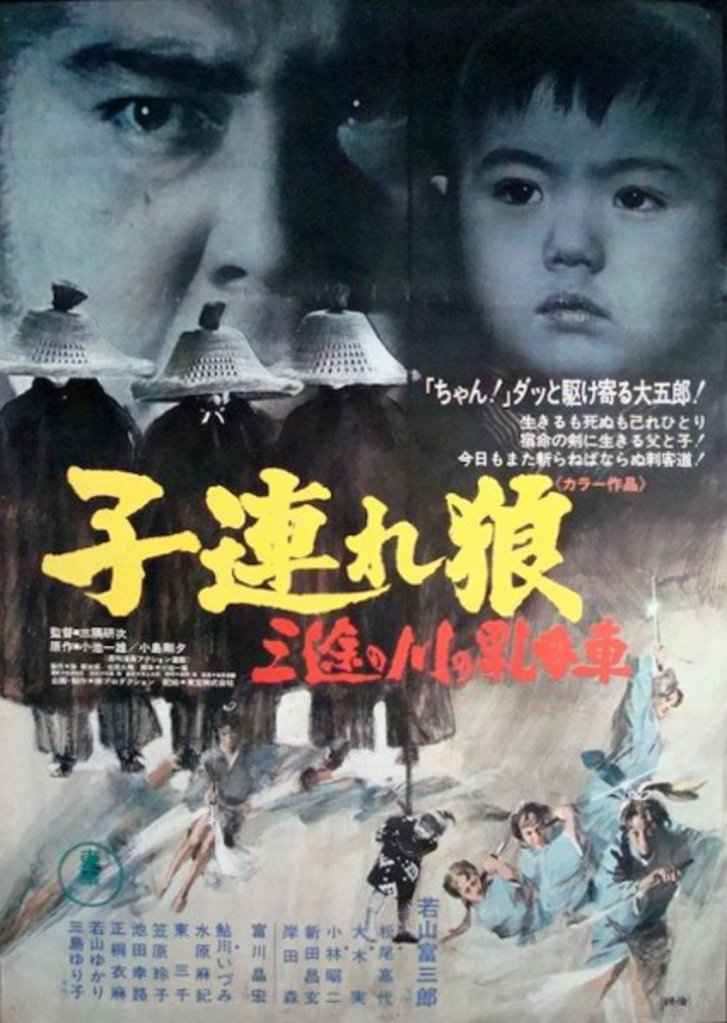
Lone Wolf and Cub: Baby Cart at the River Styx (子連れ狼 三途の川の乳母車, Kenji Misumi, 1972)

baby-cart-at-river-styxThe first instalment of the Lone Wolf and Cub series saw the former Shogun executioner framed for treason and cast down from his elite samurai world onto the “Demon’s Way” on a quest to clear his name and avenge the murder of his wife whilst caring for his young son, nominally also on the path of vengeance alongside his father. As far as progress goes, Ogami (Tomisaburo Wakayama) has made little other than dispatching a few of his enemy Yagyu foot soldiers and earning himself 500 ryou by ridding a spring town of some pesky gangsters. Well trained genre fans will correctly have guessed that chapter two in this six part series, Lone Wolf and Cub: Baby Cart at the River Styx (子連れ狼 三途の川の乳母車, Kozure Okami: Sanzu no Kawa no Ubaguruma), contains more of the same as Ogami trudges onward pushing his son Daigoro (Akihiro Tomikawa) in a bamboo cart earning a living by way of the sword with his sights set on the Yagyu stronghold.

After swiftly despatching a series of Yagyu agressors, Ogami and Daigoro procede along the Demon’s Way, jointly earning their living as hitmen for hire. The procedures for hiring the Lone Wolf and his Cub are complicated – talismans are positioned on the road calling for their services, and if the pair are interested, they’ll build a trail of rocks to indicate a meeting. Their mission this time is in the name of a put-upon clan whose income stems from a unique dyeing technique, only they’ve been “underestimating” their takings to avoid unfair taxation by the Shogun. Another clan found out about their practices and sent in undercover agents to agitate among the workforce who were already feeling oppressed and misused. The elite samurai took out most of the ringleaders, but their foreman has run off and taken refuge with a neighbouring clan who claim to know nothing about him. Ogami’s job is to kill the manager before he reaches the Shogun and blows the whistle on everything and everyone.

In addition to the Hidari brothers – a trio of skilled ronin acting as bodyguards to Ogami’s target, Ogami also has to contend with the Yagyu currently still angry over the foot soldiers he dispatched in the first film. Now that they know Ogami is not a man to be taken lightly, they’ve handed over the assignment to their crack troop of female ninja led by the expert swordswoman, Sayaka (Kayo Matsuo).

As in the first film the action scenes are impressively choreographed if filmed with a degree of absurd whimsy. Sayaka attempts to ambush Ogami by having her women hanging out in the country performing normal tasks such as washing daikon at the riverside, only the daikon are filled with knives and these are no ordinary housewives. Ogami is not fooled and quickly despatches the full complement of female warriors with ease (and a little help from Daigoro and his well equipped cart), leaving him to face Sayaka one-to-one. Their battle ends in a stalemate in which Sayaka effects a daring ninja escape (from her kimono no less) to retreat to fight another day.

As much as Ogami is on the road to hell, he maintains his honour – as do his opponents, the Hidaris, who take the time even whilst trapped on a burning boat to explain to him that they have no particular grudge towards Ogami and mean him no ill will. They will though respond without mercy if attacked. Unfortunately, Ogami will have to do battle with them as they stand between himself and his target but his philosophy is broadly the same. He will be ruthless in the execution of his mission but is not a ruthless man and will attempt to leave bystanders out of his quarrels.

This oddly stoical quality of his threatens to turn Ogami into something of a wandering heartbreaker as once again he attracts the admiration of a woman, this time his closely matched rival Sayaka, just as he had the prostitute in the first film. Though determined to gain revenge for her fallen clan members, Sayaka is uncomfortable with her clansmen’s plan to kidnap Daigoro and use him as bait to trap Ogami. As the plan offends her honour, she frustrates it at a crucial moment, allowing Ogami to escape with Daigoro in hand. Later following him and trying again to assassinate Ogami during his flight from the aforementioned burning boat, Sayaka finds herself rescued by the very man she was trying to kill. Though misunderstanding Ogami’s rough tearing off of her wet clothes – ever uncommunicative, Ogami is simply trying to prevent her dying of hypothermia and borrow some of her body heat to help himself and Daigoro do the same, Sayaka eventually finds herself literally and figuratively “disarmed” by her target.

Heading back into the world of the spaghetti western, the final fight takes place in the desert with enemies buried in the sand itself. Misumi’s approach is even more psychedelic this time round in which he has Ogami fighting shadows and even more elaborate blood sprays striking the camera as heads, limbs, ears and fingers are severed with glee abandon. The mood shifts slightly as one fallen warrior is allowed a long dying monologue about the sad wail emanating from his fatal wound and his lingering feelings of jealously that he was never able to inflict the kind of elegant kill which Ogami so effortlessly effected on him. Still, the road is long. Ogami remains on the Demon’s Way seemingly no closer to achieving his goal and with a trail of fallen enemies and broken hearts stretching out behind him, but continue he must, pushing his baby cart onwards towards hell in search of both redemption and revenge but with no guarantee of finding either.


Original trailer (intermittent German subtitles only)