The Trap (罠 THE TRAP, Kaizo Hayashi, 1996)

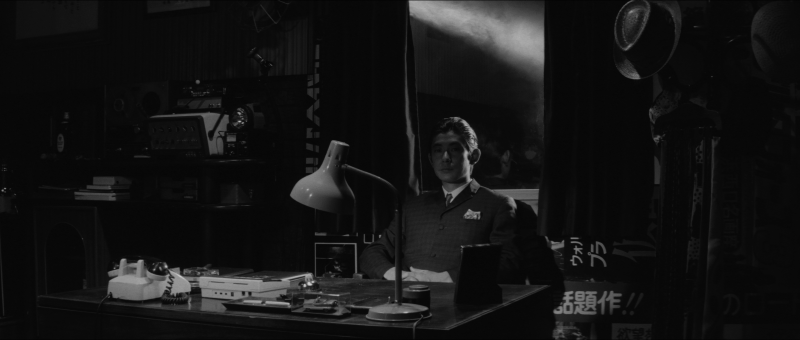
At the beginning of the final instalment of the Maiku Hama trilogy The Trap (罠, Wana), a strange-looking man dressed in a long overcoat and wearing a mask to hide a facial deformity tries to hire Maiku (Masatoshi Nagase) to look for himself. It’s a decidedly odd moment, and it seems that Maiku, who takes every job that comes, turns the man down because it’s just too weird though in a way his refusal to grant his request may contribute to the unfolding tragedy. If previous instalments saw Hayashi in Nikkatsu Noir and Fukasaku territory, this time around he seems to be channeling Seijun Suzuki in his intensifying surrealism and bold use of colour.

Indeed, in one sense, this is a tale of doppelgängers. We first see the strange man lurking outside the cinema standing so still that until he slowly turns his head we assume he is a statue. What we later realise is that he wanted Maiku to look for someone who was making use of his identity along with perhaps returning to him his own. Nagase too is playing a double role and Maiku is also searching for himself eventually confronted by the fact the man he’s been looking for has his own face. 

Nevertheless, as the film opens Maiku is riding high. He’s doing very well financially after making a name for himself saving a child from a burning building. His sister Akane has got into a prestigious college, and he’s fallen in love with a woman from the post office, Yuriko (Yui Natsukawa), who is mute but can hear. By contrast, box office lady Asa remarks that nothing good’s happened since Maiku got his police commendation for saving the child adding to the sense that things are going far too well for Maiku and probably quite likely to plunge the other way. There’s currently a serial killer on the loose who’s abducting young women, drugging them, and posing their bodies in public places. Unfortunately, Yuriko becomes a target for the killer(s) after a moment of kindness to someone who was being bullied in a park. 

An orphan raised in the church, Yuriko seems to be the embodiment of an otherwise absent purity. She tells Maiku off for gambling and generally tries to improve him as a person while he later acknowledges her willingness to sacrifice herself for others perhaps even at the cost of her own life. Her forgiving nature might help her overcome the fact that Maiku and the detectives effectively use her as bait on two separate occasions swooping in to save her only in the nick of time. This moral dichotomy reinforces a sense of tension in the city in which good and evil co-exist on different planes just as past and present had in the previous film and further transforms Yokohama into a mystical, haunted place of ever present dangers. 

The sense of surreality is further heightened by the casting of actor Tetta Sugimoto who starred in Stairway to the Distant Past as the man in red but here seems to be playing an idealistic rookie cop, again countering the cynicism of detective Nakayama (Akaji Maro) who just wants to cut corners and get the job done rather than get it done right. Thus when Maiku is framed as the killer, Nakayama indulges in his long standing grudge against him and is determined to nail Maiku despite rookie Kozu’s insistence that he couldn’t have done it because they were together at the time. When even fingerprints can be faked, there is no such thing as reliable evidence.

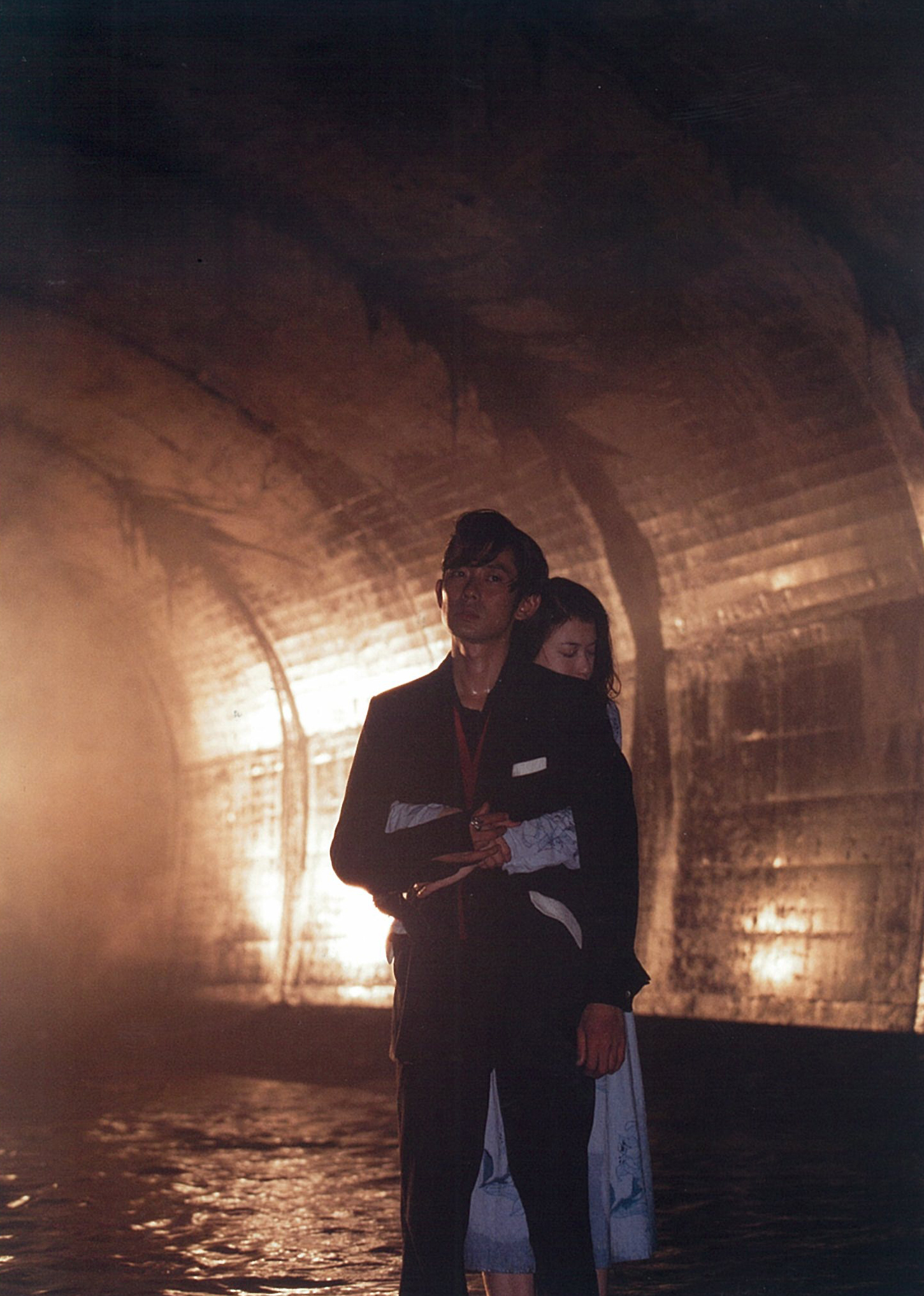
Hayashi once again makes fantastic use of colour from the expressionistic storm to the eerie, dreamlike closing sequence in which Maiku must face himself and battle his demons before being saved by the angelic Yuriko. Taking place in an atmospheric sewer tunnel, the climax has an oneiric atmosphere and surrealist edge as Miku confronts this man who has his own face only to lose the image of him at the critical moment and thereafter seemingly disappear himself. The moments after also have an unreal quality, a poster for the film we’re watching, The Trap, positioned behind Asa at the counter and Hai-Ping’s letter from the first film seemingly playing as part of the film screening in the cinema causing us to wonder if this too is a dream or fabricated future for one who will not return. Dark and disturbing in its implications, coloured by the real terror of living of Japan in the mid-90s which had just experienced a devastating earthquake and unprecedented terror attack, the film nevertheless displays the warmth of the Yokohama we’ve come to love with its cast of charming characters and cheerful atmosphere despite the eerie emanations at its centre.


The Trap screens 19th October at Japan Society New York.

Original trailer (no subtitles)
The Stairway to the Distant Past (遙かな時代の階段を, Kaizo Hayashi, 1995)

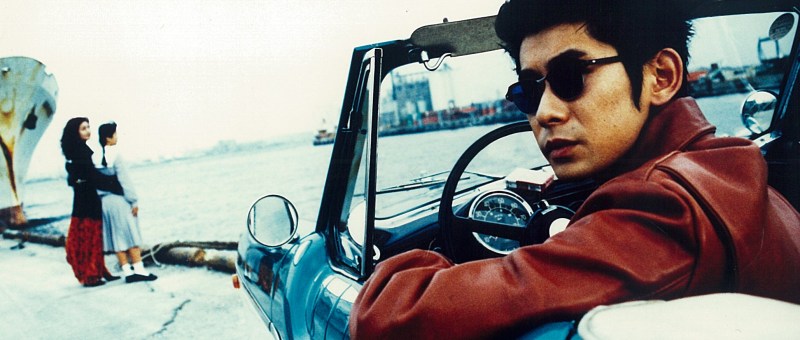
If The Most Terrible Time in My Life was channeling Nikkatsu Noir, Stairway to the Distant Past (遙かな時代の階段を, Harukana Jidai no Kaidan wo) sees Hayashi channel Fukasaku for a full-on confrontation with the legacies of the post-war era just as PI Maiku (Masatoshi Nagase) is forced to confront and attempt to cure the corrupted legacies of his own origins all while trying to save the city of Yokohama from drifting off to “another hell.” This time shooting in colour, Hayashi conjures a sense of mythic dread in the purple haze that hangs over a hidden city and the eerie blue of the path to get there.

But before all that, Maiku has fallen on such hard times his beloved car’s been repossessed and he’s stuck finding lost dogs for wealthy yet eccentric clients. Meanwhile, leader of New Japs gang Kanno (Shiro Sano) is running for political office while two of his underlings decide to freelance in order to take over the lucrative river trade which no one, not even the Taiwanese gang otherwise apparently in the ascendent, has ever dared to touch in fear of the mythic “White Man” who’s controlled the area since the post-war era with a ruthless efficiency that has seen any man challenge him not live to tell the tale. In the midst of it all is bigoted, and apparently pretty corrupt, policeman Nakayama (Akaji Maro) who first blackmails Maiku into helping him investigate a theft and smuggling ring on the river then apparently makes a deal with the White Man’s underlings who in turn blackmail him over his gambling debts but also claim they can make him chief of police if he chooses to play along.

Nakayama is a symbol of the rot in the contemporary city though he is in fact merely spineless, greedy, unpleasant and prejudiced. He asks Maiku for help because he’s hamstrung by the rules of policing which prevent him from doing the nefarious things he asks Maiku to do all of which leads to some pretty tragic consequences and a pair of orphaned children. The New Japs are perhaps a sign of further corruption still to come as Kanno tries to go legit as a politician but only as a means of increasing his influence and earnings. 

The river becomes a kind of nexus, the shore line between contemporary Japan and the “distant past” of the post-war era. Nakayama discovers that no one is technically policing it because it’s outside of everyone’s jurisdiction, while the White Man seems to have been in a position of unassailed power for half a century. As he later says, he’s the only one “living in the past” and perhaps quite literally so as Maiku has to transcend a literal stairway while guided by some kind of local prophet in order to travel to his world and finally risk his life to confront him. At the same time, Maiku is threatened by his own point of origin in the unexpected return of his mother, a now middle-aged stripper known as Dynamite Sexy Lily (Haruko Wanibuchi), who abandoned him and his sister and when he was just a child. 

Her name, along Maiku’s own, are perhaps hangovers from the Occupation era now even more out of place in a changed Japan. Making full use of the colour palate, Hayashi repeatedly flashes back to a pair of Lily’s red shoes as if signalling the unreality of the hidden city and the superimposition of past and present. His flashbacks to the late 1940s echo the cinematography of Fukasaku’s jitsuroku epics with their frenetic chases through black markets, but towards the conclusion the canted angles make it through to our era too and most particularly in the White Man’s lair, a blue-tinged industrial labyrinth that recalls the post-apocalyptic visions of a city still in ruins.

“Yokohama’s changed a lot,” Lily is told on her return and in fact several times after that. She likes it a little better now, the White Man no so much complaining that this city no longer has a place for him as if foreseeing his own eclipse and the oncoming end of an era. But then again, perhaps only the names have changed. All we’re left with is new gangsters with no code, and the White Man did at least stick to the rules even if he did so with ruthless authority. As for Maiku, his passage to the underworld seems to have brought him new clarity. His outfit now a little more sophisticated and mature, less an affectation borne of watching too many movies than an expression of himself. Nevertheless, Yokohama remains a small-town city, a cosy place with a generally friendly and easy going population albeit one with darkness hovering around the edges.


The Stairway to the Distant Past screens 18th/19th October at Japan Society New York.

Original trailer (no subtitles)

The Most Terrible Time in My Life (我が人生最悪の時, Kaizo Hayashi, 1994)

A Yokohama PI finds himself investigating a case of tragic brotherhood against the backdrop of a burgeoning gang war in Kaizo’s Hayashi’s retro crime movie The Most Terrible Time in my Life (我が人生最悪の時, Waga Jinsei Saiaku no Toki). In the first of three films featuring detective / cinema projectionist Maiku Hama (yes, that is his real name), Hayashi harks back to the Nikkatsu borderless action films of the 1960s along with classic noir while also exploring contemporary attitudes towards those not born in Japan. 

The force destabilising the local equilibrium is a gang that calls itself the “New Japs” and was founded by Zainichi Koreans who had acquired Japanese citizenship and now accepts members from other nations colonised by Japan who’ve also naturalised. The implication is that they’re agitating because the society still doesn’t fully accept them, something echoed by Maiku’s (Masatoshi Nagase) first client, a mister Kim, who says the police aren’t interested in his case because he’s a foreigner while when he actually encounters him Lieutenant Nakayama (Akaji Maro) does indeed make some quite prejudiced remarks. Hanging out in a mahjong parlour, Maiku comes to the aid of the waiter, Hai Ping (Yang Hai-Ping), newly arrived from Taiwan when he’s hassled by a racist customer noticing that the waiter’s actually carrying a knife under his shirt and might be about to ruin his life. 

Maiku loses a finger in the process (they sew it back on later), leaving Hai Ping to show up at his office with an improbably large amount of money Maiku refuses and then agrees to take when he hires him to find his brother De Jian (Hou Te-Chien) who came to Japan two years previously and has been missing ever since. Hai Ping’s relationship with De Jian speaks to Maiku because he’s also caring for his 16-year-old sister, their parents being absent from their lives just as Hai Ping and his brother were abandoned and then drifted into gang crime as a means of survival. He discovers that De Jian has married a Japanese woman of Chinese descent who like them was separated from her family which explains why she doesn’t speak any Chinese but was trotted out in a cheongsam as an exotic beauty when she was a sex worker which is how De Jian met her and got himself into trouble with gang when they ran away together. 

They are all in their way displaced people trying to get a foothold in Yokohama but finding varying degrees of success. A turf war is apparently about to break out between the Taiwanese and Hong Kong gangs, though we never actually see the one from Hong Kong only the New Japs and the Taiwanese who don’t actually fight but engage in vendettas with Hai Ping who is actually ordered to kill his own brother to prove his loyalty and atone for his crime. Maiku figures this out quite quickly and again tries to stop new his friend from making a huge mistake but not even he can prevent the fatalistic inevitability of the collision of all these competing honour codes and the implosion of a more literal kind of brotherhood in the face of that represented by the gang. 

Despite the film’s title, which in a meta touch flips around on the marquee of the cinema where Maiku has his office which is currently screening The Best Years of Our Lives, Maiku will have some far worse times in his life in subsequent films but the Yokohama we encounter here is a lived-in neighbourhood with its collection of quirky characters and strange goings on. The tone is humorous and ironic as Maiku’s friends have to chase a dog to get his finger back or Maiku’s taxi driver friend reads magazines while driving and changes hats in line with his role, but it has an underlying noirish sense of sadness for the world’s cruelty in the unfolding tragedies Maiku is powerless to prevent. Shooting in a crisp black and white, Hayashi pays tribute to Borderless action with a cameo from Jo Shishido as Maiku’s father figure while allowing Maiku to inhabit a world slightly out of time or existing only in the movies in which detectives are always hardboiled and the only way to be happy is to abandon all your hopes and dreams before the world can destroy them.


The Most Terrible Time in My Life screens 12th/18th October at Japan Society New York.

Original trailer (No subtitles)

Circus Boys (二十世紀少年読本, Kaizo Hayashi, 1989)

“There’s bad cheating and good cheating,” according to a little boy who will later become “a magician of words and juggler of lies,” in Kaizo Hayashi’s ethereal fable, Circus Boys (二十世紀少年読本, Nijisseiki shonen Dokuhon). Set in early showa, though the early showa of memory in which many other times intertwine, the film positions the transient site of a circus tent as a roving home for all who need it or are seeking escape from the increasingly heightened atmosphere of the early 1930s. Yet where one of the titular boys chooses to stay and earnestly protect this embattled utopia, his brother chooses to leave and seek his fortune in the outside world.

In fact, it’s Jinta (Hiroshi Mikami) who first becomes preoccupied with their precarious position realising that they’ve been hired to look cute riding the elephant, Hanako, but will soon age out of their allotted role and if they can’t master some other kind of circus trick there may no be a place for them in the big tent. For this reason he’s been training in secret with the idea that he can pass off the skills he’s perfected as innate “talent” so the circus will want to keep him on. Wataru (Jian Xiu), his brother, doesn’t quite approve of his plan. After all, aren’t they essentially tricking the people at the circus into thinking they’re something they’re not? But Jinta assures him it’s like “magic,” the kind that will allow them to stay in their circus home which later comes to seem a place of mysticism or perhaps make-believe on its own.

Thus Wataru walks a fine line. His name means “to cross over,” but he never does. He tries to walk the tightrope before he’s ready and is unbalanced by a storm. Jinta breaks his fall, but also in the process his own ankle. Along with it go his dreams. His foot never heals, and he’ll never fly the trapeze with Wataru like he planned though he keeps his injury a secret from his brother. While Wataru flies with new girl Maria (Michiru Akiyoshi), Jinta becomes a clown, a position he’d previously looked down on and later leaves the circus altogether using his talent for magic and performance to become a snake oil salesman tricking what appear largely to be poor farming communities into buying things like miracle soap and coal that burns for a whole month. This is clearly bad cheating, though he tries to convince himself it’s not while essentially remaking the world around him through his lies. 

But he retains his integrity in other ways. After being press-ganged into a yakuza-like guild of street pedlars, he gently excuses himself when invited to dine with a boss and confronted by an odd situation in which his wife has purchased another young woman to be his “plaything.” In a comment on contemporary patriarchal norms, the young woman is referred to as “Omocha,” which literally means “toy,” but also sounds a like a woman’s name because it begins with the character “O” which was used as a polite prefix for female names until the practice faded out after the war. The boss of course treats her like a doll, and even the wife refers to her as an “erotic instrument” she got as a way of managing her husband’s sexual appetites fearing he’d otherwise be seeing sex workers and bring a sexually transmitted disease into their home (and also possibly because she simply doesn’t want to sleep with herself any more than she has to). Referred to only as Omocha the woman has almost no agency and finds a kindred spirit in Jinta (whose name contains the character for “humanity”) because like him she also escapes the hardships of the world through lies and fantasy. “Can two lies make one big truth?” Jinta muses, breaking the codes of Guild as he prepares to rescue another man’s plaything, only it may be more like she rescues him. 

Meanwhile, Wataru tries to save the circus even after their ringmaster dies with visions of Jinta on his mind. They plan a wall of death to bring back the crowds, but Wataru’s plan backfires with tragic consequences and it becomes clear he can’t protect their circus family even if it brings back veteran trapeze artists Koji (Yukio Yamato) and Yoshiko (Maki Ishikawa) who agree there’s no other place for them out in the big wide world. The sense of the circus as a safe space was echoed on Maria’s arrival when Jinta had cruelly said she looked a little foreign with the ringmaster assuring her that in here they’re all artists and do not classify people in terms of their race, appearance or nationality. Its unreality, however, is reinforced by the constant backing of Wataru’s shadowplay which sometimes shows things the way people wish they were rather than the way they are. Omocha is later seen holding one of these puppets just as she and Jinta decide to die to free themselves of this hellish existence before Jinta’s surrogate brother figure Hiroshi (Shiro Sano) is forced to kill them for breaking the rules of the guild.

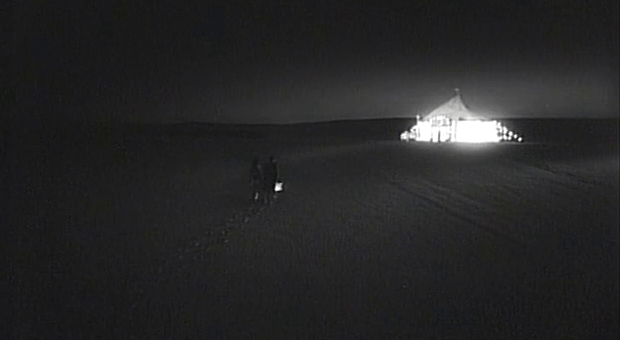
In the ambiguities of the final sequence, we might ask ourselves if they are actually dead and the glowing circus tent they see on the horizon is a path to the afterlife or a kind of heaven represented by the utopia to be found inside it. Then again, perhaps Jinta is merely rediscovering the way home, a prodigal son who now understands he already had a place to belong and there is a place to which he can return. The Great Crescent Circus is now the Sun & Crescent Circus, reflecting the way the two boys inhabit the world like and dark, idealism and cynicism, but comprise two parts of one complete whole. Hayashi waxes self-referential, playfully including a reference to his first film in that the movie playing at the cinema Jinta passes is The Eternal Mystery with Black Mask on his way to rescue Bellflower while indulging in an intense nostalgia for a lost world of travelling shows and hidden magic. Shooting in a beautifully balanced monochrome, he lights on scenes of heart-stopping beauty that are somehow poignant and filled with melancholy but ends with a moment of resolution in which, one way or another, Jinta reaches the promised land as he said with magic.


Circus Boys screens 12th October at Japan Society New York.

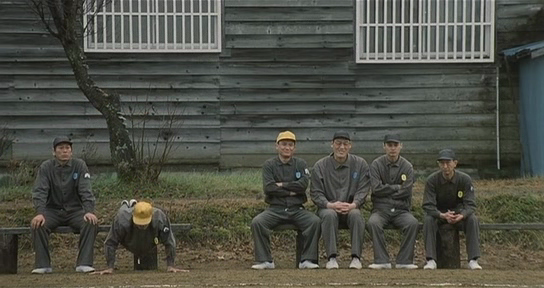
Doing Time (刑務所の中, Yoichi Sai, 2002)

Who ever thought that life in prison could be so…peaceful? Adapted from the autobiographical manga by Kazuichi Hanawa, Yoichi Sai’s 2002 drama Doing Time (刑務所の中, Keimusho no Naka) is a slice of life dramedy somewhat typical of the early 2000s save its unexpected setting in a state penitentiary. Unlike the average prison movie, the main thing that Hanawa discovers is that life inside is incredibly dull, yet he approaches his brief sojourn in this other world with anthropological precision observing and mimicking the behaviour of his fellow prisoners while making the most of this hopefully once in a lifetime experience reflecting that he’ll likely never have the opportunity to wear such worn out undergarments ever again. 

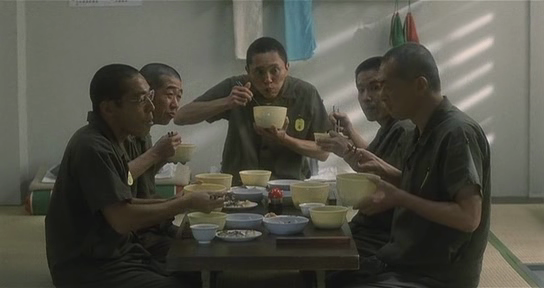
A quiet man already in middle age, Hanawa (Tsutomu Yamazaki) is no dangerous criminal merely a firearms enthusiast who liked to fire modified pistols into bottles of water. He’s got three years for illegal possession of weaponry and explosives, which seems to be quite a harsh penalty considering another man is doing seven for murder after shooting a man he says waved an axe at him when he went to collect a debt. There are clearly men who have committed violent crimes in Hanawa’s immediate vicinity, yet this is not a traditional tale of prison gangs and factional infighting, the only violence we witness concerns one prisoner who appears to have broken the rules accidentally in thoughtlessness or ignorance rather than direct rebellion. Rather it is, ironically enough, almost like a summer camp in which Hanawa and his four cellmates attempt to amuse themselves during the little free time they are offered for contemplation and relaxation. 

Even so, every inch of the prisoners’ lives is micromanaged by the guards from the way they walk to when they are allowed to move or speak. So entirely stripped of their dignity are they, that they must ask for permission even to use the toilet in their own cell while in solitary confinement and dutifully report back once they’ve finished. The communal squat toilets at the back of the workshop where Hanawa works crafting wooden tissue boxes are entirely open with only knee-height doors on each stall for privacy. The prisoners’ days are tightly ordered, early to bed and early to rise with work in-between and only the promise of rest to look forward to on weekends and holidays. 

Ostensibly a shy man, Hanawa dislikes having to ask permission all the time though not so much as an affront to his autonomy as simply bothersome. Surprisingly he begins to warm to the rhythms and routines of prison life discovering in them a kind of liberation, finding his time in solitary for “unauthorised communication” the most enjoyable of his sentence free as it is of the necessity of interacting with other people. Like the bug collector in Woman of the Dunes, he finds freedom in simplicity appreciating the mindlessness of his absurd new job folding paper bags for medical prescriptions. He can abandon any sense of responsibility for his life, submitting himself entirely to the guards’ authority and surrendering the need for control, happy to allow his existence to be managed for him without needing to decide on anything for himself. 

That aside, it’s difficult to see what other purpose prison could serve for a man like Hanawa who merely had an unusual if potentially dangerous hobby save providing him with a unique life experience he seems to be treating as a kind of adventure. He may at times look down on his cellmates who have their own routines, but otherwise appears grateful for their input and advice regarding prison life often listening to their explanations for behaviour he regards as strange such as removing one’s trousers before entering the bathroom and then deciding to do as they do. With so little stimulation the mundane becomes exciting, each meal a culinary adventure listening to a cellmate recount his group treat of a film screening (Takeshi Kitano’s Kid’s Return) as if he had returned from exotic land relishing his description of the chocolate biscuits and cola he was given to snack on. Time is what Hanawa is doing, but he does at least gain the opportunity of experiencing life in slow motion learning to appreciate the beauty of a single dandelion while observing the absurdity of the world all around him which is perhaps no more absurd than that which exists outside. 


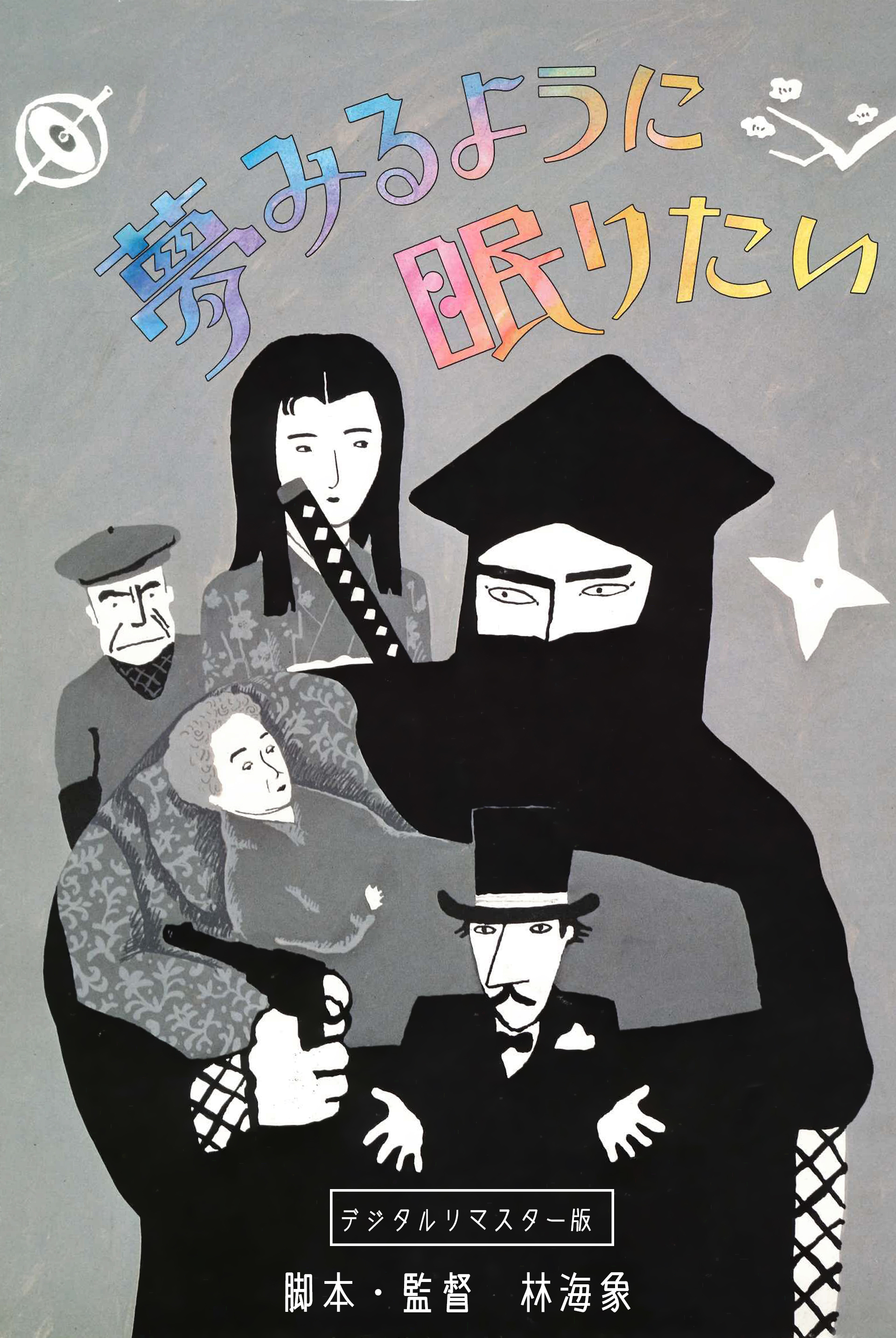
To Sleep So as to Dream (夢みるように眠りたい, Kaizo Hayashi, 1986)

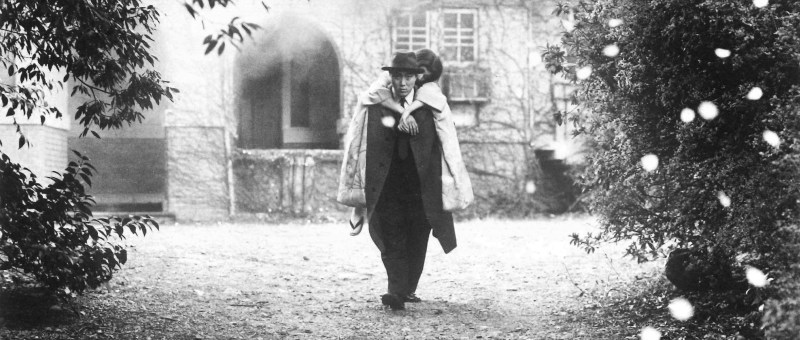
“I feel so well, as though I am dreaming” a ghostly old woman exclaims, having dealt with her unfinished business or perhaps merely becoming one with the silver screen. Released in 1986 but set ostensibly sometime in the 1950s and recalling the golden age of the silent movie, Kaizo Hayashi’s postmodern odyssey To Sleep So as to Dream (夢みるように眠りたい, Yumemiru Yoni Nemuritai) sends a pair of detectives on the hunt for a missing reel, voyaging through an ethereal dreamscape of mysterious magicians, kidnap and conspiracy, in search of the solution to the “Eternal Mystery”. 

Opening in total darkness, Hayashi pans across to a gas lamp and then to the figure of a woman watching a silent film projected on a screen in her living room. We see only her gloved hands, one wearing an ostentatious ring, somewhere between Miss Havisham and Norma Desmond, while the movie seems to be part of an early serial revolving around the Black Mask ninja who is trying to rescue the kidnapped Bellflower (Moe Kamura) only the princess always seems to be in another castle, as detectives Uotsuka (Shiro Sano) and his sidekick Kobayashi (Koji Otake) will discover. In any case, the film bursts into flames and dissolves at the moment of climax just as Black Mask confronts the kidnappers and declares the mystery “solved”. The old lady, Madame Cherry-blossom (Fujiko Fukamizu), then telephones the Uotsuka Detective Agency and requests their help with a kidnapping, sending her manservant Matsunosuke (Yoshio Yoshida) to the office with a tape recording of the kidnappers’ message which includes the clues to a scavenger hunt the pair must solve if they are to arrive at the drop off point with the money in order to retrieve Bellflower. 

Filming in black and white and in academy ratio, Hayashi maintains a silent film aesthetic adding selected sound effects but rendering all dialogue other than recordings as intertitles. We hear the phone ring and the radio playing, but “live” human speech is presented only as text save for that of the Benshi who appears at the film’s conclusion though even he may also be “on tape”. Meanwhile, he adds in random gags at the guys’ expense such as the “hardboiled” detective’s obsession with hard boiled eggs, while his sidekick Kobayashi is forever riding a rocking horse in the corner of their office while wielding a lasso and wearing a cowboy hat. A live chicken completes the home on the range feel while a series of horse shoes decorate the wall. The two men feel as if they emerged from a 20s noir farce, their slapstick antics eventually leading to a confrontation in which Kobayashi proves himself an unexpectedly skilled martial artist.  

Their world is already absurd even as they head into the abstract in order to chase Bellflower while, just like Black Mask, the kidnappers leave them irritating messages at each checkpoint revealing another clue and that the ransom has now doubled. They are plagued by a series of magicians who turn up in different guises from a man performing a kamishibai version of the Black Mask story for children to some guys running a shell game and posing as a trio of “scientists” led by Prof. Jerowski “of the British Empire” showing off their new gyroscope technology. Yet it’s no coincidence that the kidnappers go by the name Pathé & co, having essentially trapped Bellflower inside the celluloid realm and refusing to set her free. 

While Uotsuka falls for the beautiful, elusive image of Bellflower who begs to be released from “this endless story”, fantasy and reality begin to merge as he finds himself cast in the role of Black Mask. The ironically named “Endless Mystery” is a film with no end, the apparently incomplete debut of a faded star not so much ready for her closeup but desperate for closure and the release of her younger self from 50 years of torment in the reassurance that Bellflower will certainly be rescued by Black Mask at the film’s conclusion which is, after all, how such serials are supposed to end. While others slip ghostlike into the darkness, Uotsuka is left behind another prisoner of cinema chasing the romance of the silver screen yet finally saving his princess by extracting her from it. Operating on several levels, Hayashi expertly recreates both the grainy serials of the early silent era and crafts an absurdist, postmodern homage to its more recognisable evolution as his detective becomes wilfully lost in the labyrinths of cinema. 


To Sleep So as to Dream streamed as part of this year’s Japan Cuts.

Restoration trailer (no subtitles)

BOLT (Kaizo Hayashi, 2019)

“We have to trust the bonds that tie us” intones a voice from the control room, “if you can’t tighten that bolt the water will pollute the future”. A series of post-Fukushima tales, Kaizo Hayashi’s tripartite portmanteau movie BOLT is less about the radiating effects of a nuclear disaster than their legacy, insisting that if you can’t pull together you can’t move forward but then in the end the bolt cannot be tightened or the deluge stemmed. It is perhaps too late, but still you have to live. 

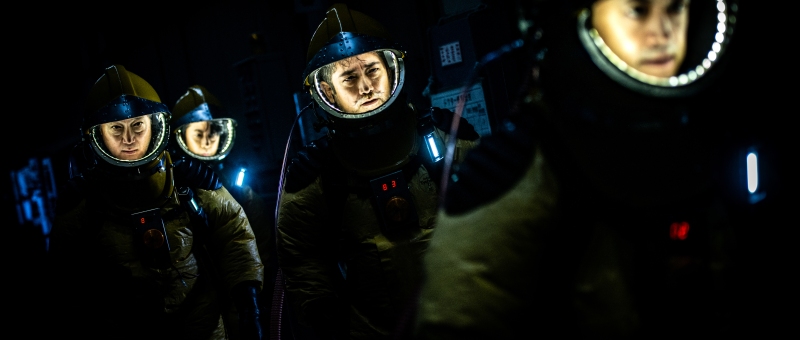
Set in the immediate aftermath of the tsunami, the first of the three tales follows a series of selfless engineers sent in to tighten a bolt on a leaking tank. They are informed their suits will protect them but not completely, they have only half an hour of oxygen, and should work in pairs for no longer than a minute before changing over. The older men tell the younger to wait behind, hoping to spare them from harm while the young men bristle wanting to do their bit. In any case, one of the young men later freezes, his feet rooted to the spot as if under some kind of spell while his friend begins to go quietly mad when a second bolt works it way out seconds after he’s fixed the first. The unnamed chief (Masatoshi Nagase) refuses to return with his team, staying to ensure he’s done all that can be done but in the end they cannot stop what is already in motion. 

A few years later the chief has apparently moved on, now working as a house clearer in the exclusion zone. His job is to tidy up and sanitise the home of a man who refused the evacuation order and has since passed away alone. As he’s been told, he carefully saves important documents and personal items such as photo albums for the family only to be told there is no family to take them, they were all taken by the tsunami. His cynical partner asks him why he got into this kind of work. He doesn’t have much of an answer for him save that someone’s got to do it and can offer only the declaration that he has to go on living for further direction of his life. 

On Christmas Eve 2014 however he’s still alone, living in an auto garage making some kind of metal device while a pair of children outside set the scene for a ghost story claiming there’s a mermaid living in the tank inside. Like the deceased man, the chief also seems to have lost someone, a black and white photograph sitting on the desk behind him, while apparently attempting to return to his former life as a nuclear technician only to be told he’s taken too much radiation already though the plant is short staffed seeing as many prefer to work on the Olympics, forging the future while neglecting the past. His Christmas gets off to a strange start when a beautiful woman in a red convertible bedecked with festive lights literally crashes into his life. An echo of someone else her arrival and subsequent departure hint at the strange and ethereal impermanence of post-disaster life in the continuing impossibility of moving on from irresolvable trauma. 

Beginning in science fiction with the high concept opener and its cyber punk design, Hayashi posits the nuclear threat as a kind of supernatural curse which can perhaps never be undone. Crackles of electricity take on a spiritual air while the permanent pinking of the sky seems to hint at a world forever changed as if something has been unleashed and can never again be caged. Tormented by cosmological unease, the chief chooses action, trying to his best to live even when action fails. The bolt can’t be tightened, the water pollutes the future, and all he can do is continue to stem the tide, tightening the bolts wherever they fray. With occasional flashes of psychedelic surrealism, Hayashi’s three tales offer a bleak and melancholy vision of life in the shadow of an almost supernatural disaster, but find finally a determination to live no matter how futile it may turn out to be. 


BOLT streamed as part of this year’s Nippon Connection.

Original trailer (no subtitles)
Images: ©L’espace Vision, Dream Kid, Kaizo Production