
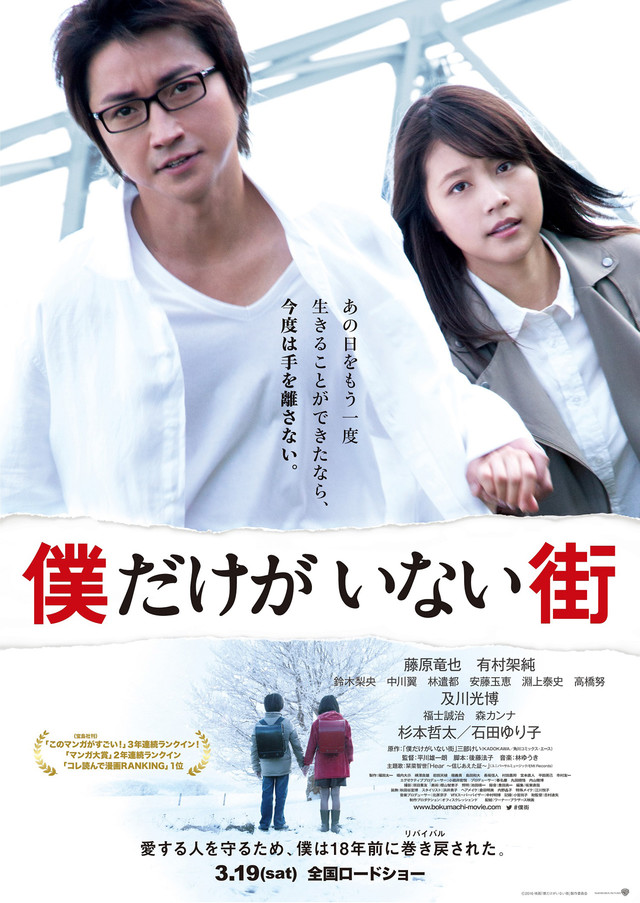
 Erased (僕だけがいない街, Boku Dake ga Inai Machi), a best selling manga by Kai Sanbe, has become this year’s big media spectacle with a 12 episode TV anime adaptation and spin-off novel series all preceding the release of this big budget blockbuster movie. Directed by TV drama stalwart Yuichiro Hirakawa, the live action iteration of the admittedly complicated yet ultimately affecting story of a man who decides to sacrifice himself to ensure his friends’ happiness, acquits itself well enough for the most part but changes two crucial details in its concluding section which unwisely undermine its internal logic and make for an unsatisfying conclusion to the ongoing puzzle.
Beginning in the “present” of 2006, Satoru Fujinuma (Tatsuya Fujiwara) is an aspiring mangaka making ends meet with a part-time job as a pizza delivery guy (a kind of “Hiro Protagonist”, if you will). Aloof and sullen, Satoru has no real friends but does possess an unusual supernatural ability – if a tragedy is about to occur in his general vicinity, he will enter a “Revival” loop in which he temporarily rewinds time, allowing him to figure out the problem and save everyone’s lives. Rescuing a child about to be hit by an out of control lorry, Satoru rides his pizza delivery bike into an oncoming car and winds up in hospital.
When he comes to he finds cheerful co-worker Airi (Kasumi Arimura), who witnessed the accident, waiting for him as well as his mother (Yuriko Ishida) coming in for visit. Reconnecting with his mother and getting closer to Airi (albeit reluctantly) Satoru’s life appears to be brightening up but the good times are short lived as Satoru’s mother is brutally murdered in his apartment leaving him looking like the prime suspect. This time when Revival kicks in it doesn’t just rewind a few minutes but 18 years, back to the winter of 1988 when Satoru’s small town was rocked by a series of child murders and abductions which resulted in the arrest of a local boy (Kento Hayashi) whom Satoru had always believed to be innocent.
Repossessing his childhood body but with a grown man’s mind, the “younger” Satoru is considerably less jaded than his 2006 counterpart, determined to change the future and save his mother’s life. The root causes of her death, he is sure, rest in this unresolved and traumatic period of his childhood. Swapping back and forth between 2006 and 1988 as Satoru makes the best of his opportunity to investigate from both sides, Erased is a tightly controlled time travel puzzle of trial and error in which Satoru must use all of the evidence he can gather to unmask the criminal in order to save both the lives of his friends in 1988 and that of his mother in 2006.
As in many similarly themed franchises, the plot turns on the bonds formed in childhood as the connections between Satoru and his friends become the binding glue in an otherwise fluid time travel dilemma. Older Satoru is better equipped to recognise the trouble one of his friends is in – Kayo, a sad and lonely girl who, in the original timeline, eventually became one of the victims attributed to the serial murders plaguing the town. Trapped in an abusive home environment, Kayo isolates herself for reasons of self preservation, both too afraid and too ashamed to let anyone know what’s going on at home. Managing to befriend her, Satoru does indeed help to change something for the better but only finds himself becoming more deeply entrenched in the central mystery.
It’s at this point that the film begins to diverge from its source material as Satoru is attacked by the murderer and “wakes up” back in 2006 but rather than having been in a coma for 18 years has apparently been leading a much more successful life than his previous incarnation. Within the peculiar laws of the franchise which don’t always match standard time travel logic, Satoru’s central timeline does not change – only his mind moves between bodies, he retains full knowledge of his original timeline as well as the changes he brings about. However, he now seems to magically receive memories of the life he never lived whilst also retaining his previous ones. Now knowing the identity of the real murderer and the probability that they are still out there, Satoru decides to re-team with his old friends but his showdown with the psychotic killer is entirely contrived to engineer a “tragic” ending, oddly more like something that might have befallen the 11yr old Satoru than his older counterpart, further undermining the already shaken sense of internal consistency.
The film’s Japanese title, Boku Dake ga Inai Machi (the town where only I am missing), takes inspiration from the short story which Kayo writes in school. Wishing that she alone could be transported to another life free of abuse and loneliness, Kayo writes herself into a better place. Satoru reimagines a similar scenario with himself in the lead as he makes the decision to sacrifice himself to save his friends. The ending of the original source material both undercuts and reinforces this idea as Satoru’s friends are both extremely proud and grateful for his efforts, but are also keen to point out that the world is a much better place with him in it than without. In removing the opportunity for Satoru’s friends to come to his rescue, the live action version of Erased also removes its most crucial message – that heroes are never “alone”, and Satoru’s salvation lies in that of his friends and family.
Yuichiro Hirakawa mostly opts for a lighter tone than the children investigating a serial killer whilst also trying to rescue their friend from her abusive mother narrative might indicate. There are some nice visual ideas including a switch to POV during the first time skip to 1988, the repeated hero of justice hand gestures, and thoughtful use of manga, but given the obvious problems with internal consistency, the high quality of the performances and cinematography can’t reconcile the various cracks within the film’s structure. Uneven, but strong until its contrived and illogical end point, Erased is a slightly disappointing live action adaptation of its source material in which it might have been (ironically enough) better to have more faith rather than pushing for the predictably melodramatic conclusion.
Original trailer (no subtitles)

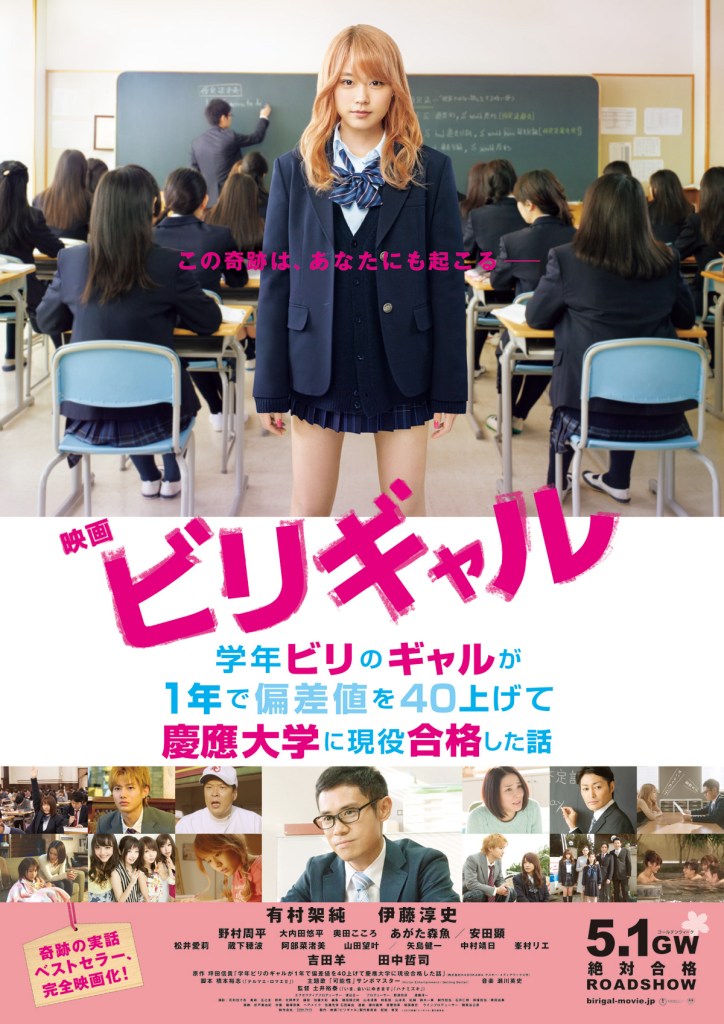 Below average student buckles down and makes it into a top university? You’ve heard this story before and Nobuhiro Doi’s Flying Colors (ビリギャル, Biri Gyaru) doesn’t offer a new spin on the idea or additional angles on educational policy but it does have heart. Heart, it argues is what you need to get ahead (if you’ll forgive the multilevel punning) as the highest barriers to academic success are the ones which are self imposed. Arguing for a more inclusive, tailor made approach to education which doesn’t instil false hope but does help young people develop self confidence alongside standardised skills, Flying Colors is the story of one popular girl’s journey from anti-intellectual teenage snobbery to the very top of the academic tree whilst healing her divided family in the process.
 Windows on Worlds