The Sea of Genkai (任侠外伝 玄海灘, Juro Kara, 1976)

Juro Kara was an avant-garde playwright and theatre practitioner whose work was a part of the Little Theatre Movement which rejected conventional naturalism and prioritised the physicality of the actor over text and dialogue. Though he performed as an actor in films by other avant-garde filmmakers such as Shuji Terayama and Nagisa Oshima, he directed only one film. By these standards, the The Sea of Genkai (任侠外伝 玄海灘, Ninkyo Gaiden: Genkai Nada), a co-production with the Art Theatre Guild, may seem surprisingly conventional, but is also highly unusual not only in ATG’s filmography but also in its subversions of the yakuza film. 

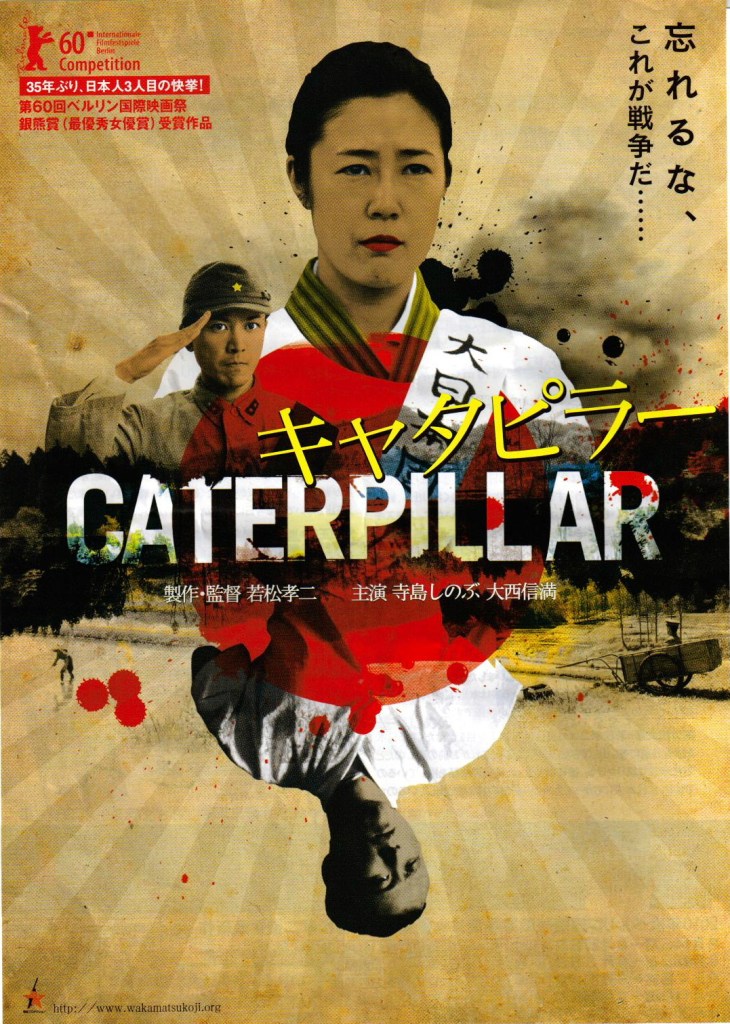
The Japanese title is prefaced by “ninkyo gaiden” which makes it sound like a spin-off to a ninkyo eiga or chivalrous gangster movie, which turns out to be incredibly ironic because there is no chivalry or honour here only cruelty and exploitation. Set in the port of Shimonoseki where boats leave for Korea, the film follows dejected petty yakuza Kondo (Noboru Ando) as fate finally catches up with him. He and his boss Sawaki (Jo Shishido) were once students together and took a job in Busan dealing with the corpses of American soldiers killed in the Korean War. Sent to deliver dog tags to widows, Sawaki spits in a distraught woman’s face and then attempts to rape her, only there is another couple in her home and the man soon wakes to challenge him. Kondo and Sawaki are then drawn into a brutal and ugly fight during which Kondo knocks out the man while Sawaki rapes the widow. The other woman then threatens them with a knife, taking back the dog tag only for Sawaki to pounce and strangle her. Sawaki then flees the scene confused by what he’s done, but Kondo stays behind and rapes the second woman’s corpse before leaving her for dead. 

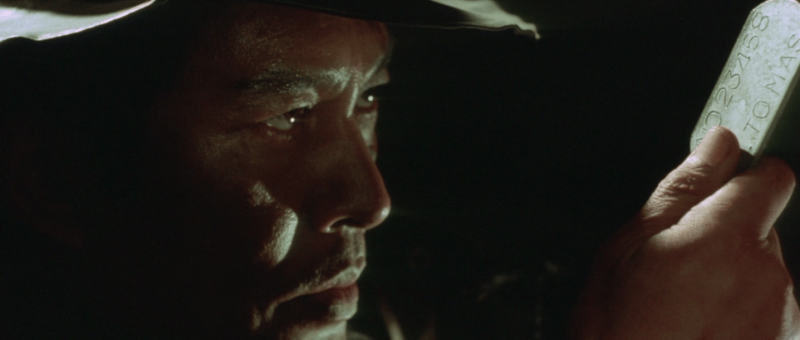
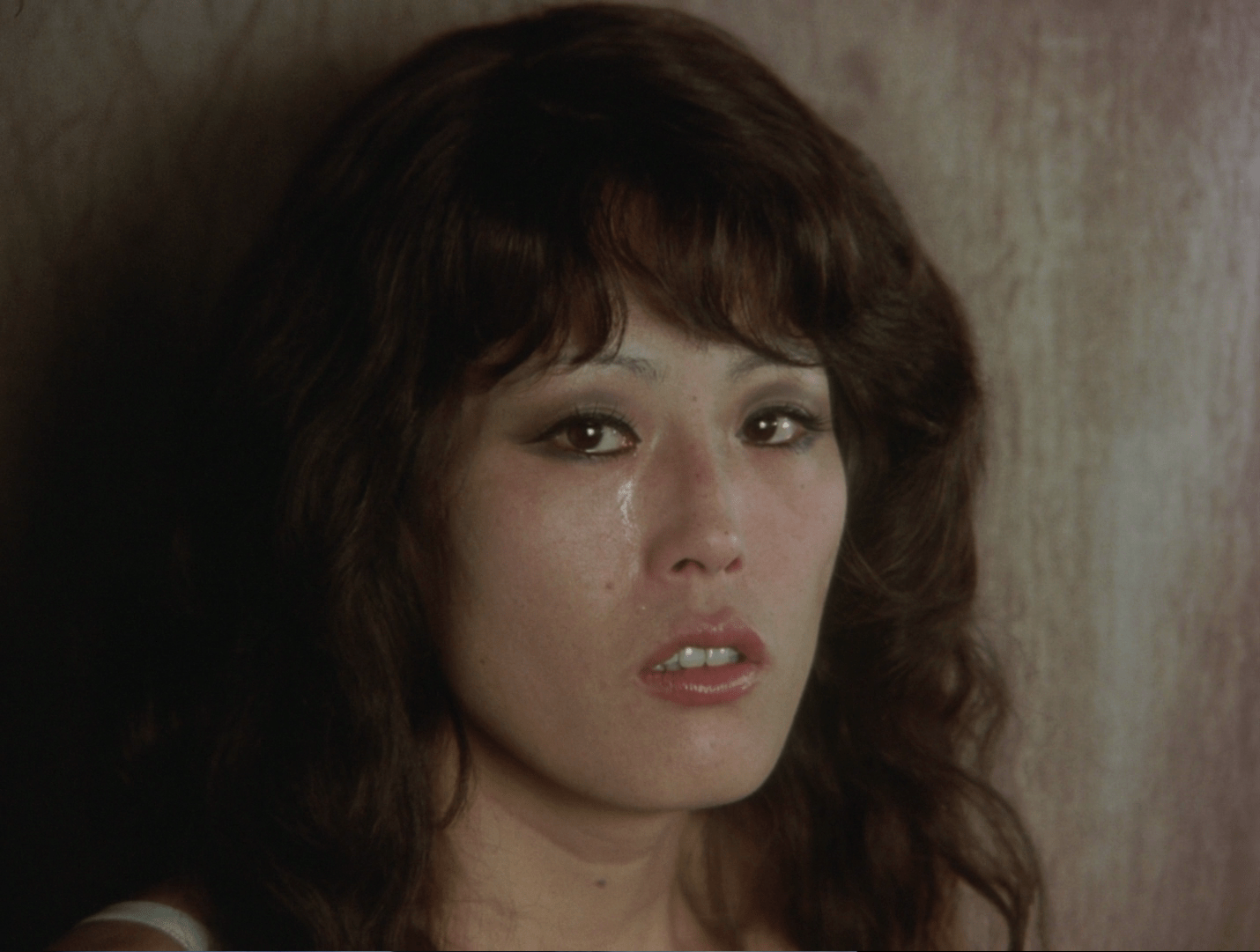
Kondo later relates that he’s been unable to sleep with women ever since his experience of necrophilia in Korea in 1951. Kura often cuts back to the bundle of dog tags Kondo has been keeping all this time which hang by his window like a wind chime. He watches them sway and hears them jingle with the violent motion of Sawaki’s raping the woman, hanging that of, presumably, a random man around the second woman’s neck as he in turn rapes her body. He later finds a woman who reminds him of the one he raped while dead among a cohort of those he’s in the process of sex trafficking who has unwittingly put on one of the dog tags like an ironic necklace while taking a bath in his apartment on the invitation of his more sensitive associate Taguchi (Jinpachi Nezu). On catching sight of Kojun (Reisen Ri), he’s struck by a literal flashback that is a clear homage to Henri-Georges Clouzot’s Les Diaboliques as he watches a “dead” woman rise from a bath. Later he rapes her too, presumably the first (though not the last) “living” woman he’s had sexual contact with in 25 years. 

The dog tags take on a still more ironic relevance in the Korean song which plays over the opening titles and is sung frequently by the trafficked women. The song is sweet and innocent, narrated by a woman who is preparing a “flower garland” for someone that she loves, but its imagery is subverted in Kondo’s grim necklace of dog tags taken from fallen men. Even Sawaki describes him as someone who has been dead for 20 years while preparing to sacrifice him to curry favour with their creepy Tokyo boss Tahara (Taka Ohkubo) who permanently wears black gloves on both hands even while shirtless, while Kondo later sings a song characterising himself as a “black dog” who never stood a chance in this broken world of ruined dreams. Penned by Kura himself and performed by Ando, this song more clearly reflects his absurdist dialogue style in its deeply melancholy imagery as Kondo fully succumbs to his image of death. 

Kondo’s actions come to emblematise the continued violence inflicted on the bodies of Korean women by Japanese men from the colonial era onwards. The woman from the bath, Kojun, suffers continually throughout the film and is later forced to perform in strip shows by the Sawaki gang. She is clever, and fierce, but the world is all against her and the only answers that she ever gets as to why her “uncle” forced her to stowaway on a smuggling boat to Japan only further deepen the wounds inflicted by a deeply corrupted, imperialistic patriarchy. Kojun develops a fondess for Taguchi because he is the only man who doesn’t try to rape her and in fact saves her from being raped though later said to be impotent and rejected by the other gang members for his refusal to participate in their despoiling of the Korean women. Bloodstained underwear becomes a symbol of sexualised violence countered only by the plain white pairs Kojun later buys for Taguchi after replacing her own ruined clothing.  

She and Taguchi attempt to protect themselves by bringing the receipts, threatening to release the smuggling account books and expose a host of dodgy dealings if the Sawaki gang come for them, but in the end there is no escape. Taguchi finds himself wading through oil-soaked waters with his dreams in ruins before finally breaking the chain though it’s unclear if it will really free him. Bleak beyond measure in its deeply tragic denouement, Kara’s intense drama offers no respite from its nihilistic world of violence and exploitation and leaves us quite literally floundering in a dark sea of inevitable corruption. 


Trailer (no subtitles)

꽃목걸이 – 이영숙 (1972)

(꽃목걸이 = “flower necklace”. There doesn’t seem to be an official romanisation of singer 이영숙 (李英淑)’s name, but it does appear in a few places as “‘Iyeongsuk”, or “Lee Young Sook”. A contemporary romanisation would render it as “Lee Yeong-suk”)
Love Letter (ラブレター, Shunji Iwai, 1995)

“People are forgotten so easily” a widow laments after an insensitive comment from a family friend, yet there is perhaps a difference between forgetting and letting go as exemplified in the distance between two accidental pen pals in Shunji Iwai’s profoundly moving romantic melodrama, Love Letter (ラブレター). A huge hit and pop culture phenomenon throughout Asia on its 1995 release, Iwai’s first theatrical feature bears many of the hallmarks of his enduring style in its soft focus, ethereal lighting and emphasis on nostalgia as the two women at the film’s centre each restore something to the other through their serendipitous correspondence. 

Iwai opens with a memorial service for Itsuki, the late fiancé of the heroine, Hiroko (Miho Nakayama), who passed away two years previously in a mountain climbing accident. Hiroko has since started a relationship with his friend Akiba (Etsushi Toyokawa) who avoided attending the memorial out of misplaced guilt and gave up mountaineering soon after Itsuki’s death. Akiba is keen to move their relationship forward, but fears that Hiroko is still stuck in the past unable to let go of her love for Itsuki. On a visit to Itsuki’s mother (Mariko Kaga), she finds an old address in his middle school year book for a home that apparently no longer exists and decides to mail him a letter saying nothing more than “How are you? I’m fine” of course expecting no reply. What she didn’t know, however, is that there were two Itsuki Fujiis in her Itsuki’s class, the other being a woman still living at the same address to whom Hiroko has accidentally mailed her correspondence. Confused, the other Itsuki (also played by Miho Nakayama) mails back and eventually finds herself recalling memories of the male Itsuki as an awkward, diffident teen she may have entirely misunderstood. 

Played by the same actress the two women are each in a sense trapped in an eternal present, unable to move forward with their lives. While Hiroko is consumed by grief and fearful of committing to her new relationship with Akiba lest she betray the memory of Itsuki, Itsuki is still struggling to come to terms with the traumatic death of her father 10 years previously who passed away from pneumonia after contracting the common cold leaving her with persistent health anxiety. Meanwhile, she is also struggling to move on from her family home which is in an increasingly perilous state of disrepair. She and her mother (Bunjaku Han) want to move into a modern apartment, while her grandfather (Katsuyuki Shinohara) prefers to stay even though it seems that the house will soon have to be demolished. 

Through their accidental correspondence, both women are forced to deal with recent and not so recent loss, Itsuki in some senses having forgotten the boy who shared her name while Hiroko remains unable to forget. Through his trademark ethereal lighting and frequent use of dissolves, Iwai hints at a sense of perpetual longing for the nostalgic past. The letters may not have been from the late Itsuki in a literal sense but were perhaps a message from him, connecting the two women and eventually freeing each of them as the love letter of the title is finally delivered ironically enough hidden inside a copy of Remembrance of Things Past. 

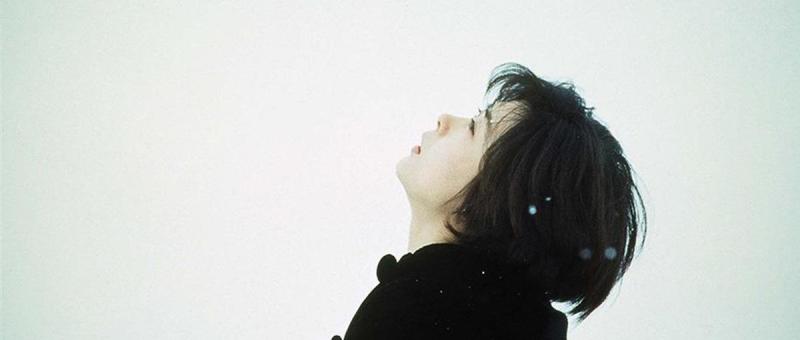
This sense of grief-stricken inertia is perfectly reflected in the snowy vistas of the lonely northern town of Otaru, thrown into stark contrast with the intense heat of the furnace in Akiba’s glassblowing workshop, or the gentle warmth of the old-fashioned stove in Itsuki’s room as she types replies to Hiroko’s handwritten letters. As Hiroko eventually reflects, they each knew a different Itsuki and have each in a sense both lost him if restoring something one to the other through the exchange of memories that grants Hiroko the understanding she needs to let go and Itsuki the poignant realisation of a youthful missed connection. A bittersweet meditation on love, loss, grief, and memory, Iwai’s epistolary drama has its own sense of magic and mystery in the strange power of this serendipitous connection leading to a tremendous sense of catharsis as a long delayed message finally makes its way home bringing with it a shade of melancholy regret but also possibility in the new hope of forward motion.


Love Letter screens at the BFI on 22/28 December as part of BFI Japan.

Original trailer (no subtitles)

Caterpillar (キャタピラー, Koji Wakamatsu, 2010)

Koji Wakamatsu made his name in the pink genre where artistic flair and political messages mingled with softcore pornography and the rigorous formula of the genre. Wakamatsu rarely abandoned this aspect of his work but in adapting a well known story by Japan’s master of the grotesque Edogawa Rampo, Wakamatsu redefines his key concern as sex becomes currency, a kind of trade and power game between husband and wife. Caterpillar (キャタピラー), aside from its psychological questioning of marital relations, is a clear anti-war rallying call as a small Japanese village finds itself brainwashed into sacrificing its sons for the Emperor, never suspecting all their sacrifices will have been in vain when the war is lost and wounded men only a painful reminder of wartime folly.
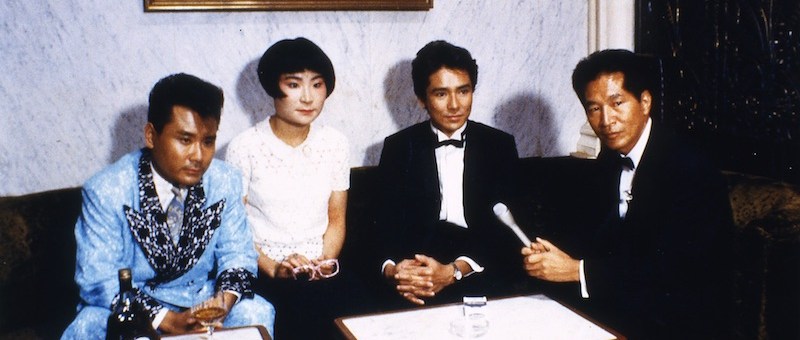
Kyuzo Kurokawa (Shima Onishi) has returned from the war. This makes him luckier than many of the other young men who disappeared from the village over the last few years. His return, however, provokes howls of fear and disbelief from his long suffering wife, Shigeko (Shinobu Terajima), who refuses to believe the creature they’ve brought back from the battlefield is really her husband. Kyuzo has lost all of his limbs, has facial disfigurement from burns, and has also lost his voice and hearing. Sitting across from the remnants of her brother, Shigeko’s sister-in-law remarks that she’s glad they didn’t “send Shigeko back to her family” because she is obviously the one who will have to look after this entirely helpless though apparently conscious battle scarred man.

This being early in the war, the village is in a fury of patriotic zealotry, determined to make Japan glorious again in the name of the Emperor. Far from letting the case of Kyuzo dissuade them from their warlike fervour, his sacrifice becomes a totem. He’s not a man destroyed by war but a “war god” and the pride of the village, a testament to their love and devotion that they would send a son of theirs to war who would return to them even in such a ruined form. Shigeko, quickly getting over her initial revulsion, comes to realise that her husband’s new-found status is also her own. As the wife of the war god, she becomes his voice and mistress in a way she had never been permitted before.

Truth be told, the war did not ruin Kyuzo’s character. The marriage of Kyuzo and Shigeko was never a happy one and perhaps her initial reeling, wailing flight on learning of her husband’s return was more out of fear than disbelief and compassion. Despite a lengthy marriage the couple had no children (perhaps an explanation for that early “sent back” comment), and Kyuzo regularly beat his wife for her failure to bear him a male heir. Now his carer, the roles are reversed as Shigeko babies her defeated husband, lamenting that all he is is urge – sleep, eat, sex. Kyuzo’s needs are animal and definite despite the signs of intelligent communication in his eyes. Shigeko, constrained to satisfy them, bends his need to her own advantage.

Emasculated in a deeper way by Shigeko’s increasing dominance, Kyuzo first attempts to assert himself in resentment at being trotted out to sell the virtues of war in his pristine uniform even as a man destroyed by nationalised violence. Spitting in Shigeko’s face as she dresses him, he attempts to refuse but is powerless to reject her authority. As time wears on and Kyuzo submits to female authority, memories of his atrocities haunt him as the fire which marked his face mingles with the faces of the Chinese women he raped and killed as a brave son of Japan on Manchurian soil.

For Wakamatsu war and sexualised violence are synonymous as the local women train for defending their village by repeatedly penetrating hey bales with long spears crying out patriotic slogans as they go. The flag waving and furore never waver despite the evidence of Kyuzo’s suffering and the numerous young men who will never come home or have done so in square boxes wrapped with white cloth. Only nearing the end is Shigeko left wondering what will become of her war god husband when no one needs a talisman. What will the nation do with these men who’ve sacrificed so much and received nothing in return?

Wakamatsu’s message is an unmistakably anti-war one though the curious inclusion of the executions of the lower class war criminals “hanged by the country they fought to protect” almost undercuts it even if his sympathy lies with those who succumbed to a national madness and have been made to pay a personal price. Kyuzo becomes the literal caterpillar of the title, taunted by Shigeko as he writhes and crawls around, condemned to eternal undulation, but it’s Shigeko who has been in a chrysalis all this time waiting to emerge from the fear and tyranny which has marred her married life into something with more freedom and autonomy – much like a nation waking up and realising that its Emperor is just a man and the long years of suffering nothing more than brainwashed madness.


Original trailer (English subtitles)

No More Comics! (コミック雑誌なんかいらない!, Yojiro Takita, 1986)

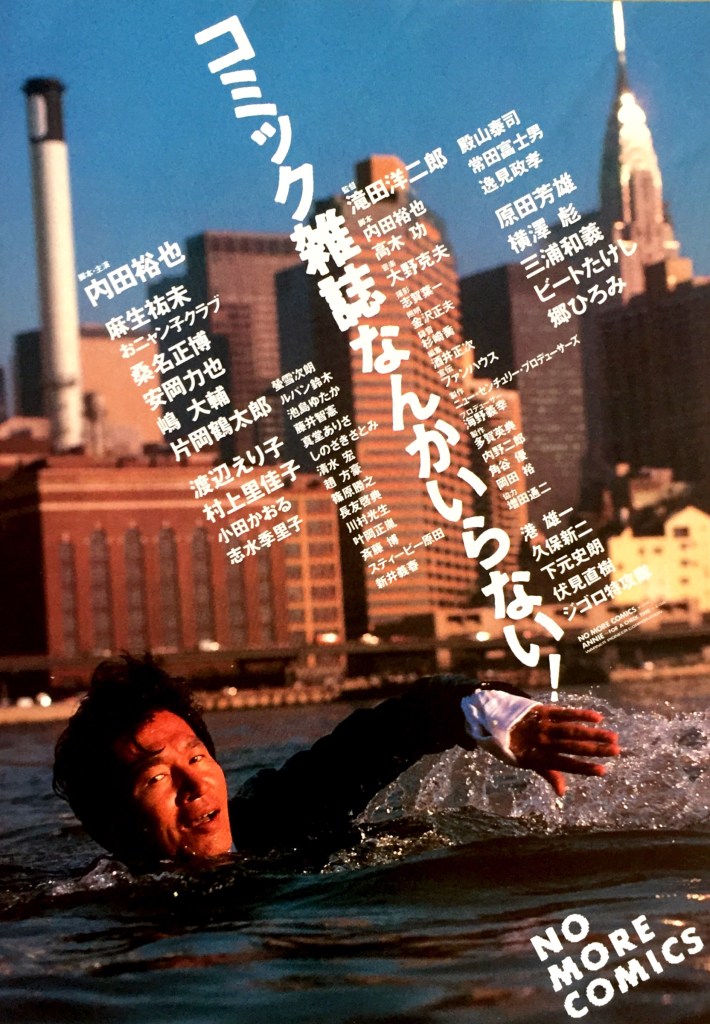
No More ComicsThe word “paparazzo” might have been born with La Dolce Vita but the gossip hungry newshound has been with us since long before the invention of the camera. Yojiro Takita’s 1986 film No More Comics! (コミック雑誌なんかいらない, Komikku zasshi nanka iranai AKA Comic Magazine) proves that the media’s obsession with celebrity and “first on the scene” coverage is not a new phenomenon nor one which is likely to change any time soon.

Kinameri (Yuya Uchida) is a hack reporter on a gossipy news magazine programme which reports on all the sordid personal details of the private lives of celebrities. In a bit of neat meta commentary, we first meet him when he’s doggedly following real life top actress of the time Kaori Momoi (making a brief self cameo) as she tries to board a plane at the airport. Kinameri keeps on asking his inappropriate questions about her alleged relationship with a screenwriter whilst Momoi successfully ignores him before finally reaching the relative sanctuary of the security cordon preventing Kinameri from actually boarding the plane with her. Of course, his interview attempt has failed but he plays the footage on the programme anyway justifying her silence as a lack of denial and that he has therefore “proved” that the rumours are true.

Kinameri is both respected and ridiculed by his colleagues who praise his probing journalistic techniques which see him doggedly refusing to give up on a story but also find his intensity amusing seeing as he’s mostly chasing cheating spouses rather than uncovering the next great political scandal like his heroes who exposed Watergate. Having graduated from a top Japanese university in political sciences, this is far from the line of work Kinameri would want to be doing and its vacuity coupled with his own failed ambitions push him further and further into a spiral of self loathing and depression.

It’s not only celebrities either. Even if you could make a case that those in the entertainment industry have entered into a pact with the media and are, therefore, fair game, civilians and particularly victims of crime should be off limits. Kinameri will literally stop at nothing to scratch a up a story including attending the funeral of a murdered 14 year old girl and quizzing her mother over the rumours that the girl had been engaging in prostitution to try and elicit some kind of social commentary about the youth of today. After his programming starts to decline in popularity he’s relegated to the late night slot which involves visiting various shady places such as strip clubs, snack bars that are actually yakuza hang outs, and even the set of a porn film where he gets a cameo feeling up the lead actress in the front of a convertible.

While all of this is going on, Kinameri is also receiving some bothersome cold calls offering to sell him gold as an investment proposal. His elderly neighbour is visited by a woman from the company and does actually buy some but Kinameri smells a rat and his journalistic instincts kick back in. His bosses at the network aren’t convinced though – dodgy gold dealers doesn’t sound like a ratings winner after all and even when Kinameri agrees to even shadier assignments so he can pursue his leads, they still aren’t really behind him. Eventually they catch up but it’s almost too late.

Kinameri keeps doing what he’s paid to do, even if he clearly despises everything about it. Asking trivial and ridiculous questions and being ignored anyway, conducting a vacuous meet and greet with a gang of up and coming idol stars, even posing as a gigolo – there are no lengths to which he will not sink in pursuit of his story. By the film’s finale he’s still the frontline reporter, looking on while a vicious yakuza (played by a young Takeshi Kitano) commits a brutal murder right in front of the cameras. No one is moving, no one is trying to stop this, everyone is manoeuvring to get the best coverage. Kinameri has had enough and, with a look of rage and contempt on his face, he launches himself through the widow in a last minute attempt to make a difference but once again, lands up flat on his face and, finally, excluded from the action.

Years ahead of its time, No More Comics! takes an ironic look at invasive media coverage of celebrity gossip which clogs the airwaves while the real story is wilfully ignored. Ironically, Kinameri even becomes something of a celebrity himself, well known for his dogged interviewing style. He receives countless answerphone messages from “fans” (somehow ringing his personal phone number) either praising his efforts or berating him for not pushing his targets harder. When a young aspiring journalist stops him in the street and asks for advice, Kinameri doesn’t even answer but just walks away with a look of contempt and sadness on his face. Finally, after his mad dash into a crime scene in the final reel, he becomes the news himself. All of his fellow reporters suddenly want to know “what happened”, “what was it like”, “did you go in to save him or for the story?” etc. Still stunned and probably in need of medical attention, Kinameri looks directly into the camera, puts his hand across the lens and states “I can’t speak fucking Japanese”.

Filled with rage and shame, No More Comics! is a Network-esque satire on the world of live broadcast reporting exposing the seedier sides of journalistic desperation. Ahead of its time and sadly still timely in the age of 24hr coverage which mainly consists of the same trivial stories repeated ad nauseum, its messages are needed more than ever.


Unsubtitled trailer: