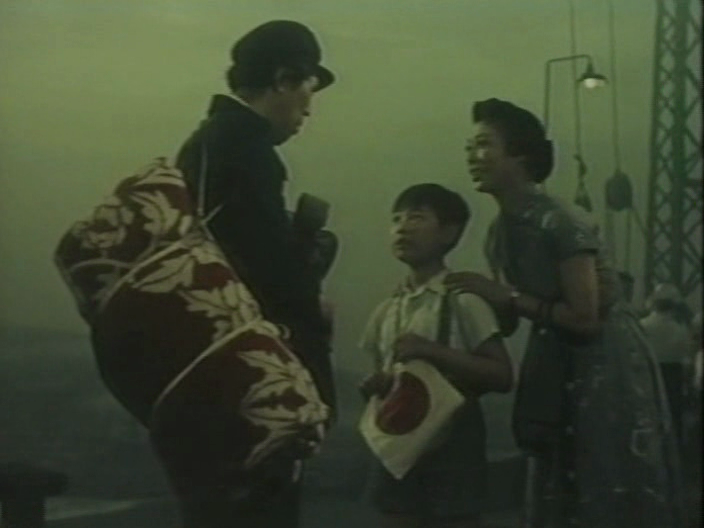
The Wolves (狼, Kaneto Shindo, 1955)

Post-war desperation drives a collection of otherwise honest men and women towards a criminal act that for all its politeness they are ill-equipped to live with in Kaneto Shindo’s biting social drama The Wolves (狼, Okami). “Wolves” is what the criminals are branded, but the title hints more at the wolfish society which threatens to swallow them whole. After all, it’s eat or be eaten in this dog eat dog world, at least according to a cynical insurance salesman hellbent on exploiting those without means. 

Each of the five “criminals” is an employee at Toyo Insurance where they’re immediately pitted against each other, reminded that in order to qualify for a full-time position they need to meet their quotas for six months. The orientation meeting is cultilke in its intensity, the boss insisting that only in insurance can you become a self-made man while recounting his own epiphany as to the worthiness of his profession. They are told that the only two things they need are “faith and honesty”, and then “faith and pursuasion”, while encouraged to think of their work as an act of “worship”, “for the salvation of everyone”. 

Yet they’re also told to exploit their friends and family by pressuring them into taking out life insurance policies in order to help them meet their quotas. As one man points out, friends and relatives of the poor are likely to be poor themselves, but these are exactly the kind of people they’re expected to target. They’re told there’s no point going after the weathly because they’re already insured, but there’s something doubly insidious in trying to coax desperate people who can’t quite afford to feed themselves into paying out money they don’t have on the promise of protecting their families from ruin. One man even asks if the policy covers suicide and is told it does if you pay in for a year, sighing that he doesn’t want to wait that long.

“Suicide or robbery, choose one,” one of the salespeople reflects after failing to make their quota once again. They each have reasons to be desperate, all of them already excluded from the mainstream society and uncertain how they will find work if the job falls through. Akiko (Nobuko Otowa) is a war widow with a young son who is being bullied at school because of his cleft palate for which he needs an expensive operation. She’s already tried working as a bar hostess but is quiet by nature and found little success with it. Fujibayashi (Sanae Takasugi) is widowed too with two children and five months behind rent for a dingy flat in a bomb damaged slum where the landlord is about to turn off her electric. Harajima (Jun Hamamura) used to work in a bank but was fired for joining a union and is trapped in a toxic marriage to woman looking for material comfort he can’t offer. Mikawa (Taiji Tonoyama) too is resented by his wife, a former dancer, having lost his factory job to a workplace injury while the ageing Yoshikawa (Ichiro Sugai) was once a famous screenwriter but as he explains people in the film industry turn cold when you’re not hot stuff any more. 

Their unlikely descent into crime has its own kind of inevitability in the crushing impossibility of their lives. They may rationalise that what they’re doing is no different from the insurance company that exploits the vulnerable for its own gain, thinking that if they can just get a little ahead they’d be alright while feeling as if robbery and suicide are the only choices left to them and at the end of the day they want to survive. Perhaps you could call them “wolves” for that, but they’re the kind of wolves that give the guards from the cash van they robbed their train fare home after bowing profusely in apology. The real wolves are those like Toyo who think nothing of devouring the weakness of others, promising the poor the future they can’t afford while draining what little they have left out of them. As the film opens, Akiko looks down at a bug writhing in the dirt attacked by ants from all sides and perhaps recognises herself in that image as the sun beats down oppressively on both of them. Breaking into expressionistic storms and unsubtly driving past a US airbase to make clear the source of the decline, Shindo paints a bleak picture of the post-war world as a land of venal wolves which makes criminals of us all. 
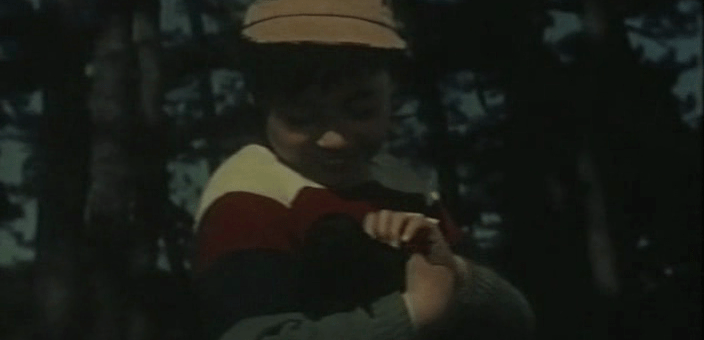

Yellow Crow (黄色いからす, Heinosuke Gosho, 1957)

A small family struggles to repair itself after eight years of wartime separation in Heinosuke Gosho’s post-war melodrama, The Yellow Crow (黄色いからす, Kiiroi Karasu). Rather than focus directly on the legacy of the traumatic past, Gosho takes aim at war itself in making plain that the family’s problem is the time that was stolen from them each in a way forced to address the gulf between the idealised family life they may otherwise have had and the post-war reality. 

As the film opens, nine-year-old Kiyoshi (Koji Shitara) is sketching with his class at a temple. His teacher Miss Ashiwara (Yoshiko Kuga) is a little worried about the strange picture he’s drawing, noting that where once he had been a happy child painting cheerful pictures in vibrant colours now he only uses black and yellow and there’s unsettling quality in his composition. Still, trying to comfort him she tells Kiyoshi not to worry and that he’s free to draw whatever he likes, only later showing the paintings to a child psychologist who advises that these colours are often used by children who are anxious and lonely usually because they’ve lost a parent in the war. Only, Kiyoshi is lucky because he has both a mother and a father, his dad having been recently repatriated from China after being interned as a prisoner of war. 

In a sense it’s Miss Ashiwara’s misconception that the family must be happy because they’ve been so fortunate that lies at the centre of the conflict. Mother Machiko (Chikage Awashima) and father Ichiro (Yunosuke Ito) are so keen to get back to “normal” that no one really tries to address the obvious problems of their situation merely to reassume the lives they led before the war. For little Kiyoshi who wasn’t even born when his father left that sense of normality is very different and necessarily disrupted by his father’s return in what can only seem like an intrusion into closeness he had previously shared with his mother. 

Where another director or screenwriter may have told the entirety of the story from Kiyoshi’s point of view, Gosho pulls back to show us the way the adults struggle and suffer in their confusion and disappointment. On the surface, it does not seem that Ichiro has been particularly affected by his wartime service, rather the problem is in his frustrated attempts to reintegrate into a society which is entirely different from the one he left. He himself is older, and is perhaps acutely aware that he is a stranger to his son at first hurt by his shyness and reluctance to acknowledge him but then consumed by a sense of failure in a working life that leaves him little time to bond with his son leaving Kiyoshi with yet another sense of rejection. Meanwhile though his job was kept open for him, the nature of the business has changed. His boss is much younger than he is and has no interest in training an old timer he thinks is only really there as a goodwill gesture. As his friend points out, had it not been for the war he’d be a manager by now but as the boss puts it he’s returned to Japan “too late”. 

All of this adds to his sense of displacement and contributes to his increasingly harsh treatment of Kiyoshi, constantly discouraging all of his interests such as his fascination with animals and talent for drawing telling him only that he should be studying useful things like maths and science. His parenting style is evidently much more authoritarian than Machiko’s had been, often taking the view that Kiyoshi has been spoiled and needs some discipline instilling in him. But Kiyoshi reads his father’s treatment of him only as rejection, that must think he’s a bad boy and not want him. The resentment he feels only grows when the parents have another child, Mitsuko. It’s obviously much easier for Ichiro to bond with her than the already grown Kiyoshi while Machiko is both weak from the birth and mindful of a new responsibility all of which leaves Kiyoshi feeling pushed out and unwanted. He often takes refuge at the home of the kindly woman next-door, Yukiko (Kinuyo Tanaka), and her adopted daughter Haruko with whom he rescues animals, including a wounded crow, much to his father’s consternation. 

Always the wise observer, it’s Yukiko who finally tries to coax Machiko towards a resolution to challenge her husband’s authoritarianism. After his father accuses him of being a threat to Mitsuko and tries to shut him in the shed overnight, finally releasing his pet crow, Kiyoshi tries to run away and later returns to Yukiko’s house where he asks her to adopt him. Listening in secret, Machiko is heartbroken realising that they’ve been going about this all wrong, too busy trying blindly reassume the lives they had before when they should have met each other with more compassion and understanding trying to listen to Kiyoshi, who can admittedly at times be difficult and unreasonable unwilling to recognise when he is in the wrong, rather than instantly scolding him. Machiko’s story perhaps fades into the background, but she too is struggling having realised that her hopes that everything would finally be alright now that Ichiro has returned were misplaced while caught between her husband and her son with a baby daughter to care for trying to keep the peace if nothing else.   

Gosho apparently chose yellow after consulting with child psychologists* and filmed in full colour to make the most of Kiyoshi’s attempts at artistic expression while capturing his youthful sense of loneliness and displacement, but equally treats his parents with a degree of sympathy for their own confusion and disappointment. Ichiro is not a bad man and often trying his best but frustrated, admitting that he would have liked to simply forgive Kiyoshi and get closer to him as his father but for whatever reason found himself lashing out in misplaced anger. The message for the post-war society is then one of generalised compassion, that there’s no point blindly trying to reassume one’s life as if nothing had happened and patience and mutual understanding will be necessary to repair the bonds that war has corrupted. Thus it is Ichiro who has to change, dropping his authoritarian distance in deciding to be kinder to his son finally going out to look for him when he tries to run away in the middle of a storm returning the colours to Kiyoshi’s world as he begins to feel more secure in his familial connections in the knowledge that he is loved and wanted as a child of the new post-war generation. 


*Arthur Nolletti Jr., The Cinema of Heinosuke Gosho: Laughter Through Tears, pg. 185

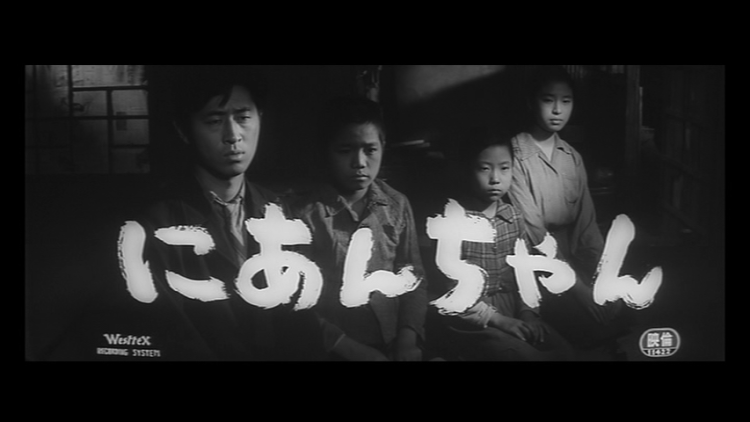
My Second Brother (にあんちゃん, Shohei Imamura, 1959)

vlcsnap-2017-01-07-22h53m01s073Like most directors of his era, Shohei Imamura began his career in the studio system as a trainee with Shochiku where he also worked as an AD to Yasujiro Ozu on some of his most well known pictures. Ozu’s approach, however, could not be further from Imamura’s in its insistence on order and precision. Finding much more in common with another Shochiku director, Yuzo Kawashima, well known for working class satires, Imamura jumped ship to the newly reformed Nikkatsu where he continued his training until helming his first three pictures in 1958 (Stolen Desire, Nishiginza Station, and Endless Desire). My Second Brother (にあんちゃん, Nianchan), which he directed in 1959, was, like the previous three films, a studio assignment rather than a personal project but is nevertheless an interesting one as it united many of Imamura’s subsequent ongoing concerns.

Set in the early 1950s, the film focuses on four children who find themselves adrift when their father dies leaving them with no means of support. The father had worked at the local mine but the mining industry is itself in crisis. Many of the local mines have already closed, and even this one finds itself in financial straits. Despite the foreman’s promise that he will find a job for the oldest son, Kiichi (Hiroyuki Nagato), there is no work to be had as workers are being paid in food vouchers rather than money and strike action frustrates what little production there is. After receiving the unwelcome suggestion of work in a “restaurant” in another town, Yoshiko (Kayo Matsuo) manages to find a less degrading job caring for another family’s children (though she receives only room and board, no pay for doing so). With younger brother Koichi (Takeshi Okimura) and little sister Sueko (Akiko Maeda) still in school, it seems as if the four siblings’ days of being able to live together as a family may be over for good.

Based on a bestselling autobiographical novel by a ten year old girl, My Second Brother is one of the first films to broach the Zainichi (ethnic Koreans living in Japan) issue, even if it does so in a fairly subtle way. The four children have been raised in Japan, speak only Japanese and do not seem particularly engaged with their Korean culture but we are constantly reminded of their non-native status by the comments of other locals, mostly older women and housewives, who are apt to exclaim things along the lines of “Koreans are so shiftless” or other derogatory aphorisms. Though there are other Koreans in the area, including one friend who reassures Kiichi that “We’re Korean – lose one job, we find another”, the biggest effect of the children’s ethnicity is in their status as second generation migrants which leaves them without the traditional safety net of the extended family. Though they do have contact with an uncle, the children are unable to bond with him – his Japanese is bad, and the children are unused to spicy Korean food. They have to rely first on each other and then on the kindness of strangers, of which there is some, but precious little in these admittedly difficult times.

In this, which is Imamura’s primary concern, the children’s poverty is no different from that of the general population during this second depression at the beginning of the post-war period. The film does not seek to engage with the reasons why the Zainichi population may find itself disproportionately affected by the downturn but prefers to focus on the generalised economic desperation and the resilience of working people. The environment is, indeed, dire with the ancient problem of a single water source being used by everyone for everything at the same time with all the resultant health risks that poses. A young middle class woman is trying to get something done in terms of sanitation, but her presence is not altogether welcome in the town as the residents have become weary of city based do-gooders who rarely stay long enough to carry through their promises. The more pressing problem is the lack of real wages as salaries are increasingly substituted for vouchers. The labour movement is ever present in the background with the Red Flag drifting from the mass protests in which the workers voice their dissatisfaction with the company though the spectre of mine closure and large scale layoffs has others running scared.

One of the most moving sequences occurs as Koichi and another young boy ride a mine cart up the mountain and talk about their hopes for the future. They both want to get out of this one horse town – Koichi as a doctor and his friend as an engineer, but their hopes seem so far off and untouchable that it’s almost heartbreaking. Sueko skipped school for four days claiming she had a headache because her brother didn’t have the money for her school books – how could a boy like Koichi, no matter how bright he is, possibly come from here and get to medical school? Nevertheless, he is determined. His father couldn’t save the family from poverty, and neither could his brother but Koichi vows he will and as he leads his sister by the hand climbing the high mountain together, it almost seems like he might.