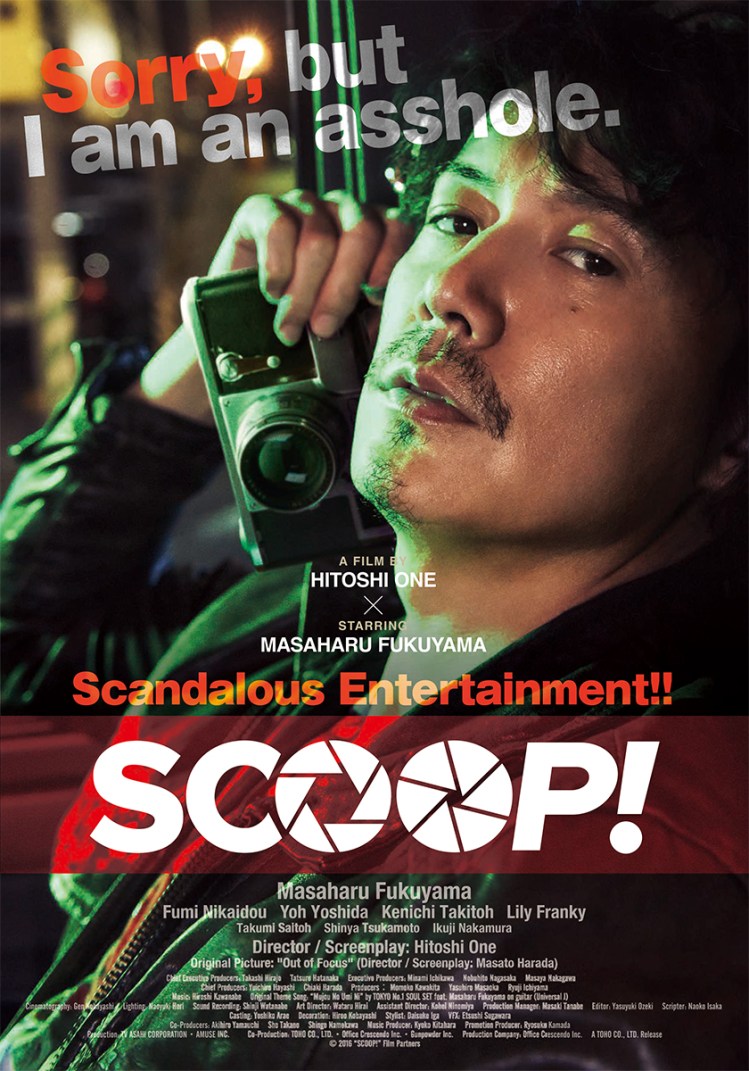
Scoop! (Hitoshi One, 2016)

scoop!Hitoshi One has a history of trying to find the humour in an old fashioned sleazy guy but the hero of his latest film, Scoop!, is an appropriately ‘80s throwback complete with loud shirt, leather jacket, and a mop of curly hair. Inspired by a 1985 TV movie written and directed by Masato Harada, Scoop! is equal parts satire, exposé and tragic character study as it attempts to capture the image of a photographer desperately trying to pretend he cares about nothing whilst caring too much about everything.

Shizuka (Masaharu Fukuyama) is a man out of time. Once the best photojournalist on his paper, he’s ridden the waves of a changing industry and become a high earning freelance paparazzo. Shizuka’s nights are spent in all of the fashionable if occasionally squalid drinking holes of the city in which the elites of the entertainment world attempt to disappear. Sadako (Yo Yoshida), the editor of Scoop! – a once proud publication now a seedy scandal rag, worries about her old friend, his debts, and his legacy. Offering to pay him well above the going rate for anything useable, she saddles him with the latest new recruit – Nobi (Fumi Nikaido), a naive young woman dressing in the bold childhood nostalgia inspired fashion trends of Harajuku. As might be assumed the pair do not hit it off but gradually a kind of closeness develops as Nobi gets into the thrill of the paparazzo chase.

In keeping with his inspiration, One shoots with a very ‘80s aesthetic of a city bathed in neon and moving to the beat of electropop and synth strings. Grainy and grungy, the images are seedy as is the world they capture though this is the Tokyo of the present day, not the bubble era underground. Shizuka claims his major inspiration came from the famous war photographer Robert Capa though now he can’t even remember if he really meant to become a photographer at all. Chasing cheating celebrities and exposing the odd politician for the kind of scandal that sells newspapers is all Shizuka thinks he’s good for, any pretence of journalistic integrity or the “people have a right to know” justification was dropped long ago.

Sadako, however, has more of a business head than her colleagues and is starting to think that Scoop! could be both a serious news outlet and nasty tabloid full of gravure shots and shocking tales of the rich and famous. Getting Shizuka to mentor Nobi is an attempt at killing to two birds with one stone – unite the plucky rookie with the down on his luck veteran for a new kind of reporting, and help Shizuka return to his better days by paying off those massive debts and getting his self esteem back.

Unfortunately Shizuka is his own worst enemy, hanging around with his strange friend Chara-Gen (Lily Franky) who is intermittently helpful but a definite liability. The world of the newspaper is certainly a sexist one – Sadako and Nobi seem to be the only two women around and the banter is distinctly laddish. An ongoing newsroom war leaves Sadako lamenting that the men only think about their careers and promotions rather than the bigger picture while the suggestion that she may win the position of editor has other colleagues bemusedly asking if a woman has ever helmed such a high office. The men ask each other for brothel recommendations and pass sexist comments back and fore amongst themselves with Shizuka trying to out do them all even going so far as to put down the new girl by describing her as “probably a virgin”.

Sadako’s plan begins to work as Shizuka and Nobi become closer, she becoming the kind of reporter who files the story no matter what and he finally agreeing to work on a more serious case. Having spent so long believing everything’s pointless, Shizuka’s reawakening maybe his undoing as a noble desire to help a friend who is so obviously beyond help leads to unexpected tragedy. Nevertheless, the presses keep rolling. A throwback in more ways than one, One’s 80s inspired tale of disillusioned reporters and mass media’s circulation numbers obsessed race to the bottom is all too modern. Unexpectedly melancholy yet often raucously funny, Scoop! is an old fashioned media satire but one with genuine affection for the embattled newsroom as it tries to clean up its act.


Scoop! was screened as part of the Udine Far East Film Festival 2017

Original trailer (no subtitles)

April Fools (エイプリルフールズ, Junichi Ishikawa, 2015)

april-foolsIn this brand new, post truth world where spin rules all, it’s important to look on the bright side and recognise the enormous positive power of the lie. 2015’s April Fools (エイプリルフールズ) is suddenly seeming just as prophetic as the machinations of the weird old woman buried at its centre seeing as its central message is “who cares about the truth so long as everyone (pretends) to be happy in the end?”. A dangerous message to be sure though perhaps there is something to be said about forgiving those who’ve misled you after understanding their reasoning. Or, then again, maybe not.

Juggling seven stories April Fools is never as successful at weaving them into a coherent whole as other similarly structured efforts but begins with an intriguing Star Wars style scroll regarding alien sleeper agents who can apparently go home now because they’ve accomplished everything they came for. Changing track, pregnant snack addict Ayumi (Erika Toda) decides to ring the still unknowing father of her child after witnessing an improbable reunion on TV only he’s in bed with someone else and assumes her call is a weird practical joke. Overhearing that he’s just arrived at a restaurant for a lunch date, Ayumi takes matters into her own hands and marches over there, eventually taking the entire place hostage. Meanwhile an older couple are having a harmless holiday pretending to be royalty and a grizzled gangster has “kidnapped” a teenage girl only to give her a nice day out at the fun fair. Oh, and the hikkikomori from the beginning who’s fallen for the whole alien thing has made a total fool of himself at school by taking out his bully, kissing his crush goodbye and racing up to the roof to try and hitch a lift from the mothership.

Importing this weird European tradition to Japan, the creative team have only incorporated parts of it in that they don’t call time on jokes at noon and it’s less about practical shenanigans and elaborate set ups than it is about wholesale lying which is frustrated by this famous non-holiday apparently created in celebration of it. All of the protagonists are lying about something quite fundamental and usually to themselves more than anyone else but at least their April Fools adventures will help them to realise these basic inner truths.

Then again some of these revelations backfire, such as in the slightly misjudged minor segment concerning two college friends who are repeatedly kicked out of restaurants before they can get anything to eat. One decides to “prank” his friend with an April Fools confession of love, only to find that his friend really is gay and is in love with him. Awkward is not the word, but then an April Fools declaration of love is about the worst kind of cruel there is and is never funny anyway, nor is the casual homophobia involved in this entire skit but that’s another story.

In fact, most of the other people are aware they’re being lied to, but are going along with it for various reasons, some hoping that the liars will spontaneously reform and apologise or explain their actions. Ayumi, who is shy and isolated by nature, always knew her handsome doctor suitor was probably not all he seemed to be but is still disappointed to be proved right, only be perhaps be proved wrong again in the end. Convinced to take a chance on an unwise romance by an older colleague who explains to her that many miracles begin with lies, Ayumi is angry with herself as much as with her lying Casanova of a baby daddy, and also feels guilty about an incredibly sight deception of her own. As in many of the other stories, now that everyone has figured out the real, important, truths about themselves and about the situation, they can excuse all of the lying. Sensible or not? The choice is yours.

Despite coming from the team who created some very funny TV dramas including Legal High, the comedy of April Fools never quite hits its stride. Weak jokes backed up with slapstick humour giving way to sentimentality as the “good reasons” for the avoidance of truth are revealed don’t exactly whip up the farcical frenzy which the premiss implies. The point may very well be that we’re the April Fools going along with this, but even so its difficult to admire a film which pushes the “lying is good” mantra right to the end rather than neatly undercutting it. Still, there is enough zany humour to make April Fools not a complete waste of time, even if it doesn’t make as much of its original inspiration as might be hoped.


Original trailer (English subtitles)

Terra Formars (テラフォーマーズ, Takashi Miike, 2016)

terra-formarsTerra Formars – Terror for Mars? It’s all about terror in the quest for terra and reform in Takashi Miike’s bug hunt extravaganza adaptation of Yu Sasuga and Kenichi Tachibana’s manga. In fact, much of the plot is more or less the same as Aliens, but our motley crew is not a crack team of space marines headed by a recently awoken from stasis super survivor who proves unexpectedly dextrous in a robotic forklift exoskeleton, but a collection of human “bugs”, parasitical criminals who’ve each been made an offer they can’t refuse. High budget and boasting a starry cast, Terra Formars (テラフォーマーズ) definitely falls into the throwaway Miike category and proves curiously dull despite its ridiculous set up, but then if you happen to be into bugs there’s really a lot to like here.
Running through the Tokyo of 2597 which seems to be some kind of Blade Runner theme park, Shokichi (Hideaki Ito) and Nanao (Emi Takei) are trying to escape the oddly bug-like police only to be captured and taken to the lair of mad scientist and all round fabulous guy, Honda (Shun Oguri). He has a proposal – join his mission to Mars and get a large amount of money instead of getting a death sentence for the murder they were on the run for. Reluctantly, they agree but there are several things Honda forgot to tell them – they’ve been given alien bug DNA which gives them super powers, and the “cockroaches” they’re supposed to be exterminating have mutated into giant humanoid creatures capable of planning and tool use. Oh, and everyone on the first mission died horribly.

By 2597, the world has become massively overpopulated but luckily enterprising scientists had come up with a plan for terraforming Mars through the use of various kinds of moss distributed by millions of cockroaches. The terraforming process is now complete and it’s time for colonisation to begin but no one really thought about what to do with all their insectile helpers. No longer “mere” bugs, the highly evolved Roaches are now the (not quite) indigenous peoples of Mars. Miike does not push the colonisation narrative (and nobly attempts to mitigate the elements which have seen the original source material decried as racist) but you can’t get away from the fact that the Roaches have every right to fight back and defend their homeland from an invading force wielding superior technology and hellbent on mass extermination.

Honda’s big idea (well, one of his big ideas as it turns out) was to send a bug to catch a bug. In some senses, all of the assembled bait could be regarded as human pests – petty criminals and reprobates offering nothing of value to society. Given the pace of the film and the subsequent carnage, none of them is given much time to shine so we mostly remember them by their epithets – creepy serial killer, hikkokomori hacker, teenage prostitution ringleader, illegal immigrant, former yakuza and dodgy ex-police officer – in other words, people with no options that no one will miss. They’ve each been more or less forced into this position by their peculiar circumstances as exploited by Honda and his team who have given them a “risky” operation involving alien DNA which has given them bug-like powers from super sharp pincers to venomous stings.

Bug hunt is an apt way to describe the subsequent action as the crew activate their inner insects and prepare to squash some Roaches only to die in various painful looking ways, usually by losing their heads. There’s a distinctly Aliens undertone to the entire enterprise, even borrowing a key plot revelation from the film’s ‘80s anti-corporate message but it’s all so unimportant next to the bug killing that it most likely gets missed. Repetitious in the extreme, the two hour runtime is stretched to breaking point with battle after battle of mostly losses as the Roaches effortlessly swat our puny human heroes.

Production design is the most impressive element but even this borrows heavily from such similarly themed genre landmarks as Blade Runner, Aliens, Total Recall, and to a lesser extent Starship Troopers. Ultra camp from Honda’s obsession with his fashionable outfits to the Ultraman style practical effects of the bug suits, Terra Formars later fails to capitalise on its surreal and ridiculous premise, remaining disappointingly straightforward in terms of tone for much of the running time. Keen entomologists will perhaps enjoy the animated info sequences introducing the various beetles, flies, and other assorted creatures as well as those same traits being acted out by our heroes but for everyone else Terra Formars may prove a rather dull expedition to the previously red planet, now a green and pleasant land but very definitely inhabited and defended. Plenty of bug splatting action with only minimally disquieting overtones but a sorry lack of excitement, Terra Formars is a disappointingly by the numbers sci-fi effort from the usually exuberant Miike but does at least look good.


Original trailer (No subtitles – massive spoilers)

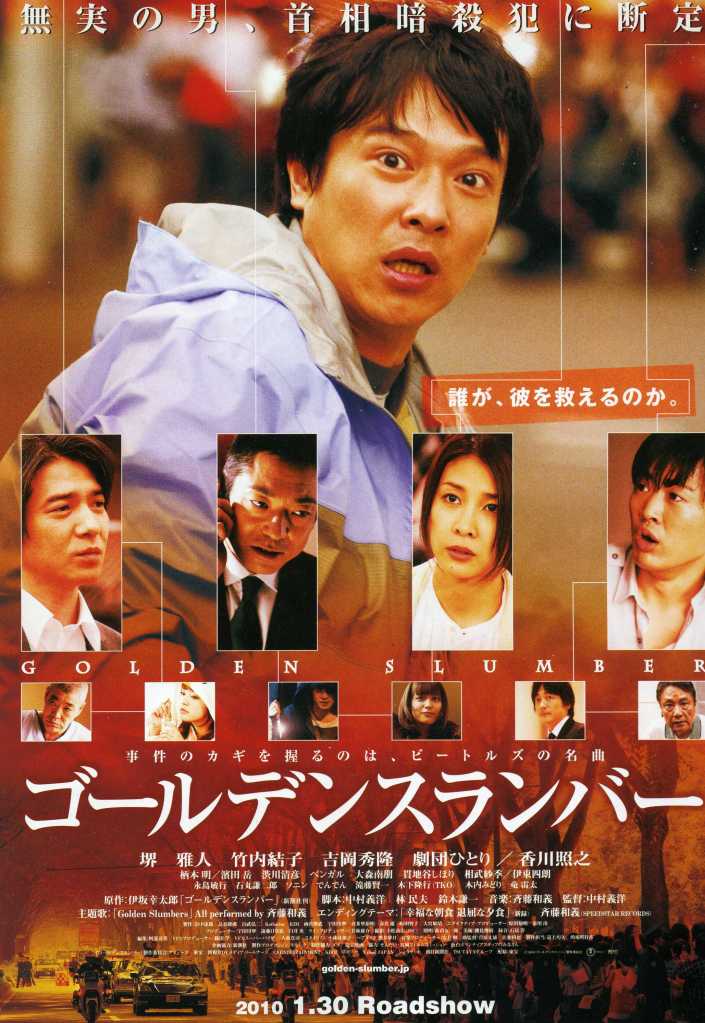
Golden Slumber (ゴールデンスランバー, Yoshihiro Nakamura, 2010)

golden-slumberYoshihiro Nakamura has made a name for himself as a master of fiendishly intricate, warm and quirky mysteries in which seemingly random events each radiate out from a single interconnected focus point. Golden Slumber (ゴールデンスランバー), like The Foreign Duck, the Native Duck and God in a Coin Locker, and Fish Story, is based on a novel by Kotaro Isaka and shares something of the same structure but is far less interested in the mystery itself rather than the man who finds himself caught up in it.

30 year old delivery driver Aoyagi (Masato Sakai) is all set for a nice day out fishing with an old college buddy, Morita (Hidetaka Yoshioka), but he’s about to discover that it’s he’s been hooked and reeled in as the patsy in someone else’s elaborate assassination plot. After grabbing some fast food, Morita takes Aoyagi to a parked car near the closed off area through which the Prime Minster is due to be paraded in an open topped car. Waking up after a brief period of drug induced sedation, Aoyagi is made aware that this has all been a trick – badly in debt thanks to his wife’s pachinko addiction, Morita has betrayed him to a set of undisclosed bad guys with unclear motives and is taking this brief opportunity to give him as much warning as he can. Sure enough, a bomb goes off at the parade and Aoyagi just manages to escape before Morita too is the victim of an explosion.

Aoyagi is now very confused and on the run. Inexplicably, the police seem to have CCTV footage of him in places he’s never been and doing things he’s never done. If he’s going to survive any of this, he’s going to need some help but caught between old friends and new, trust has just become his most valuable commodity.

At heart, Golden Slumber is a classic Wrong Man narrative yet it refuses to follow the well trodden formula in that it isn’t so much interested in restoring the protagonist to his former life unblemished as it is in giving him a new one. The well known Beatles song Golden Slumber which runs throughout the film plays into its neatly nostalgic atmosphere as each of the now 30 year old college friends find themselves looking back into those care free, joyous days before of the enormity of their adult responsibilities took hold. That is to say, aside from Aoyagi himself who seems to have been muddling along amiably before all of this happened to him, unmarried and working a dead end delivery job.

As Morita tells him in the car, it’s all about image. The nature of the conspiracy and the identity of the perpetrators is not the main the main thrust of the film, but the only possible motive suggested for why Aoyagi has been chosen stems back to his unexpected fifteen minutes of fame two years previously when he saved a pop idol from an intruder with a nifty judo move (taught to him by Morita in uni) after fortuitously arriving with a delivery. Those behind the conspiracy intend to harness his still vaguely current profile to grab even more media attention with a local hero turned national villain spin. The Prime Minister, it seems, was a constantly controversial, extreme right wing demagogue with a tendency for making off the cuff offensive statements so there are those who’d rather congratulate Aoyagi than bring him to justice, but anyone who’s ever met him knows none of this can really be true despite the overwhelming video evidence.

Throughout his long odyssey looking for “the way back home” as the song puts it, Aoyagi begins to remember relevant episodes from his life which may feed back into his current circumstances. Although it seems as if Aoyagi had not seen Morita in some time (he knew nothing of his family circumstances, for example) his college friends with whom he wasted time “reviewing” junk food restaurants and chatting about conspiracy theories are still the most important people in his life. Not least among them is former girlfriend Haruko (Yuko Takeuchi), now married and the mother of a little daughter, who seems to still be carrying a torch for her old flame and is willing to go to great lengths to help him in his current predicament.

The film seems mixed on whether these hazy college days are the “golden slumber”, a beautiful dream time enhanced by memory to which it is not possible to return, or whether it refers to Aoyagi’s post college life which impinges on the narrative only slightly when he asks an unreliable colleague for help, aside from an accidental moment of heroic celebrity. It could even refer to the film’s conclusion which, departing from the genre norms, resolves almost nothing save for the hero’s neat evasion of the trap (aided by the vexed conspirators who eventually opt for a plan B). Once there might have been a road home – a way back to the past and the renewing of old friendships, but this road seems closed now, severed by the new beginning promised to Aoyagi who has been robbed of his entire identity and all but the memory of his past. Whether this means that the golden slumber has ended and Aoyagi, along with each of the other nostalgia bound protagonists, must now wake up and start living the life he’s been given, or that the old Aoyagi has been consigned to the realm of golden slumbers, may be a matter for debate.

Though the resolution may appear ultimately unsatisfying, the preceding events provide just enough interconnected absurdity to guide it through. During his long journey, Aoyagi is aided not just by his old friends but new ones too including a very strange young serial killer (Gaku Hamada) and a hospital malingerer with one foot in the “underworld” (Akira Emoto). It speaks to Aoyagi’s character that all of those who know him trust him implicitly and are ready to help without even being asked (even if they occasionally waver under pressure), and even those who are meeting him for the first time are compelled to come to his defence.  An elliptical, roundabout tale of the weight of nostalgia and inescapability of regret, Golden Slumber is the story of a man on the run from his future which eventually becomes a net he cannot escape.


Original trailer (English subtitles – select via menu)

Fish on Land (セイジ -陸の魚-, Yusuke Iseya, 2012)

fish on landYusuke Iseya is a rather unusual presence in the Japanese movie scene. After studying filmmaking in New York and finishing a Master’s in Fine Arts in Tokyo, he first worked as model before breaking into the acting world with several high profile roles for internationally renowned auteur Hirokazu Koreeda. Since then he’s gone on to work with many of Japan’s most prominent directors before making his own directorial debut with 2002’s Kakuto. Fish on Land (セイジ -陸の魚-, Seiji – Riku no Sakana), his second feature, is a more wistful effort which belongs to the cinema of memory as an older man looks back on a youthful summer which he claimed to have forgotten yet obviously left quite a deep mark on his still adolescent soul.

The unnamed narrator begins his tale as a disheartened salary man who tells us that his days simply pass monotonously. He no longer feels contentment but neither does he feel discomfort. Making an awkward phone call to a woman we assume is his wife, he reveals that a project has come up that he simply cannot ignore – one which takes him back to a particular summer he passed as a young man in which he encountered a lost soul and perhaps lost some of his own, too.

In the summer of 1990, the narrator was just about to graduate university and had already secured a job. Taking the final opportunity to indulge some wanderlust, he takes off riding his pedal bike across the country. However, after he gets knocked over and is taken to a local bar for some first aid treatment by its classically sad mama-san, he decides to stay and is given the nickname of “traveller” by the regulars at House 475. It’s here that he meets the titular Seiji – a cynical man with unusual presence which seems to inspire both admiration and exasperation in the small group of people who’ve come to regard the bar as a home from home.

Despite its genial, summery quality, the bar is home to several kinds of sorrow. Shoko, it turns out has her own reasons for her sadness and her relationship with Seiji is often a complicated one. It’s she who describes Seiji as a fish on land – completely at odds with his environment and entirely unable to live in the world or get along with his fellow humans. Carrying deep seated scars from his past, Seiji, she claims, is unable to feel joy so long he knows someone (anyone, anywhere) is suffering. Or, more to the point, he feels so intensely guilty that he will not allow himself to be happy and has, in some senses, given up living in this world in favour of his own filled with melancholy loneliness.

Indeed, the friendly grandfather from next-door remarks that Seiji sees things far too clearly and that’s why he’s given in to despair. According to him, our human defence against the powerlessness and fear inherent in being alive is simply becoming inured. Our insensitivity saves us, but men like Seiji feel too much and are unable to bear it. On the rare occasion Seiji smiles, it’s often to do with the little girl who lives next-door, Ritsuko, but tragedy is about to come crashing in, changing lives forever and shattering grandpa’s faith in the god he previously said granted us our lack of clarity to help us cope with life’s harshness. Seiji’s reaction is an extreme one, filled with a poetic weight that is difficult for those around him to understand but at the same time perfectly in keeping with his world view.

Framing sequence aside, Iseya opts for an interesting, slightly non-linear structure in which scenes jostle like memories, slightly disordered, sometimes repeated from a different angle and with greater insight. The framing sequence itself proves the least successful aspect of the film as it fails to marry itself to the implications of the central narrative and anchor its final scene to provide the necessary weight.

Mirai Moriayama imbues the unnamed narrator with an appropriate level of passivity whilst Hideyoshi Nishijima mirrors him with an equal and opposing force of presence which is by turns mysterious, intriguing, and occasionally threatening yet filled with vulnerability. Supporting roles are also well drawn notably by Hirofumi Arai’s local boy left behind and Kiyohiko Shibukawa’s up and coming businessman about to blow out of the small town for bubble era Tokyo, as well as the damaged bar owner Shoko played by Nae Yuki whose disintegration is slowed by Seiji’s presence but still very much in evidence.

If Fish on Land has a weakness, it’s that the invading dark forces it presents feel like a cruel, absurd, visitation on this otherwise idyllic place yet perhaps that’s entirely the point. Life is full of unpredictable cruelties which have to be accommodated no matter how difficult they may be to bear. Men like Seiji are carrying a heavy burden, one which was given to them when their arms were too weak to hold it, but still, you keep on living. Beautifully photographed, intricately plotted and rich with both character and philosophical detail Seiji: Fish on Land proves another interesting effort from Iseya who doubtless has even more to offer in the future.


Unsubtitled trailer:

Love’s Whirlpool (愛の渦, Daisuke Miura, 2014)

Love's WhirpoolNo names, no strings. That’s the idea at the centre of Daisuke Miura’s adaptation of his own stage play, Love’s Whirlpool (愛の渦, Koi no Uzu). Love is an odd word here as it’s the one thing that isn’t allowed to exist in this purpose built safe space where like minded people can come together to experience the one thing they all crave – anonymous sex. From midnight to 5am this group of four guys and four girls have total freedom to indulge themselves with total discretion guaranteed.
The four couples are a disparate group which includes a primary school teacher, office lady, shy college student, and a brusque regular who apparently comes to the club five times a week. The male side consists of a slick salaryman, a freeter, a factory worker and an anxious NEET who’s cleaned out his bank account just to be here in this extremely expensive, upscale sex club. After receiving the instructions from the owner (shower first, after sex, after going to the toilet, always use a condom, and respect the women’s right to say no), the group sit awkwardly wearing only their towels waiting for someone else to kick things off.

Everyone is being extremely polite to one another, the women beginning to talk amongst themselves whilst the men do the same. Everyone has come here for the same reason but it’s not as quite as straightforward as they thought it would be. Soon enough, people start to pair up an head downstairs but after the initial ice is broken the edges sharpen, relationships change, and a kind of Bacchanalian harshness begins to take over.

Once inside the split level, trendy club style environment, the guests spend the entirety of the evening naked save for their white bath towels but this is about as far from intimacy as it’s possible to get. They may have all come for one reason, but they each had various different motives for doing so. The office lady and the school teacher are both attractive young women, confident in what they do and don’t want, and would prove a hit in any club or bar (though this is a safer option). The freeter and the salaryman could say the same though the salaryman spends half the evening phoning his wife to explain that he’s been kept out drinking with a boring colleague. College girl and Neet are both too shy to get it on independently, leaving the cynical regular and the overweight factory worker as the odd ones out. It’s not long before they’ve begun to dissect each other, ticking off the check list like remembering to buy washing powder and then discussing the merits of “Ariel” vs “Persil” with your fellow “shoppers” in the checkout line. Utilitarian as it is, as the night goes on the barriers fall away leaving both wild abandon and cruelty lying behind them.

Things are reinvigorated half way through when another couple join, a husband and wife duo who each claim to be 100% OK with how this is going to work but, as it turns out, one of them was more serious than the other. By this point, relationships have begun to solidify themselves and shy Neet has grown attached to the unexpectedly raucous, repressed college girl. Such attachments are unwise in an environment like this, and can become dangerous if everyone does not remain on the same page as to what’s going on. At the end of the evening, the guys are asked to wait so the girls can leave first – to help prevent stalking. This is no strings, remember. No names, no phone numbers, none of this ever happened.

This intense need for secrecy is understandable yet speaks something to the oddly specific conflict between repression and the open expression of erotic desire that is permitted inside the club but only if you follow its rather strict (if very sensible) rules, not to mention the arcane, underground directions needed to find it at all. For some the reason for coming here was loneliness but what they’ll find is only likely to exacerbate the aching lack of connection they already feel. The case of the college student becomes the most interesting as she fights both her own shyness and the intense shame she feels in regards to her own sexual desires. After the fact, she feels as if she’s betrayed herself, as if the “other self” that emerged during the previous night’s proceedings is a shameful doppleganger that must now go back into hiding. She wants to forget this happened, go back to being a lonely college girl but for the NEET, it’s the opposite, he feels unreal now – as if he left his “real” self behind in that unreal space.

A sophisticated take on modern human relationships, Love’s Whirlpool occasionally pulls its punches in opting for a satirical tone and only really skims the surface of why places such as these still need to exist. Stylishly shot and explicit without becoming exploitative or sleazy, Miura’s film proves a refreshingly nuanced, mature take on modern sexual behaviour even if it stops short of probing into some of the darker aspects that flicker around its edges. If Love is a whirlpool, desire is a tornado, but where a whirlpool may drag you under you’ll eventually float to the surface gasping for air. After a tornado burns through, all you’re left with is ashes and emptiness. Modern love, indeed.


English subtitled trailer (NSFW)

Kanikosen (蟹工船, SABU, 2009)

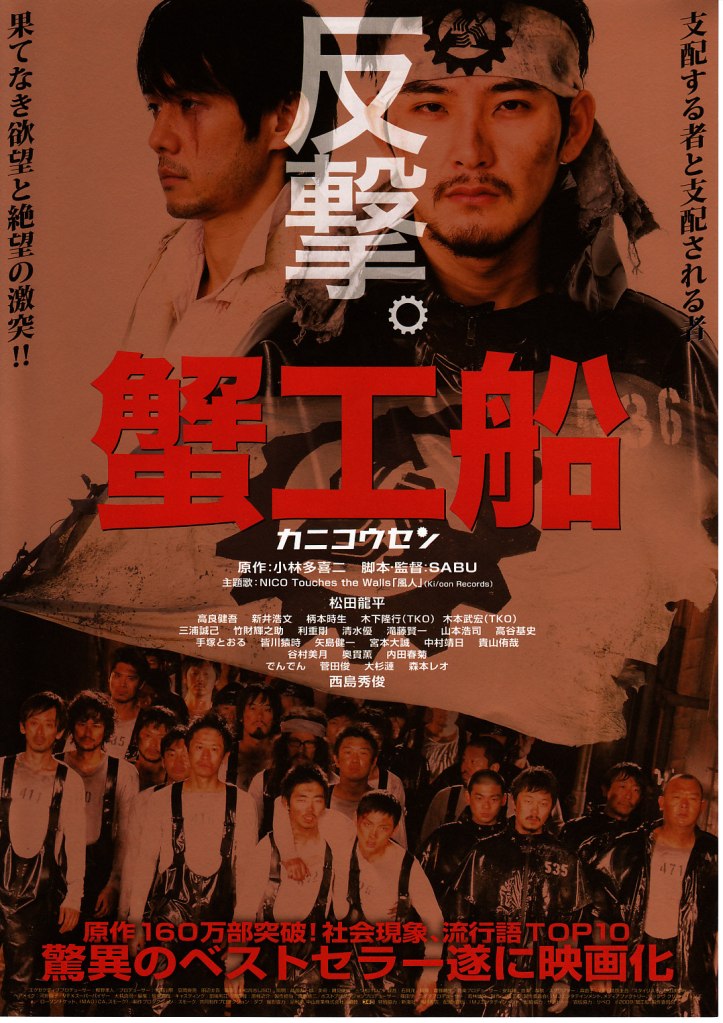
kanikosenBack in 2008 as the financial crisis took hold, a left leaning early Showa novel from Takiji Kobayashi, Kanikosen (蟹工船), became a surprise best seller following an advertising campaign which linked the struggles of its historical proletarian workers with the put upon working classes of the day. The book had previously been adapted for the screen in 1953 in a version directed by So Yamamura but bolstered by its unexpected resurgence, another adaptation directed by SABU arrived in 2009.
As in the book the film follows the lives of a group of men virtually imprisoned on a crab canning ship anchored near Russian seas in the 1920s. The men on the boat are of various ages and come from various different backgrounds but each is here out of necessity – nothing other than extreme poverty and lack of other options would ever persuade anyone to take on this arduous and often unpleasant line of work. Technically speaking the boat has a captain but it’s the foreman who’s in charge – dressed like a European officer in a white frock coat and riding boots and with a vicious looking scar across his left eye, Asakawa rules the waves, barking out orders and backing them up with a walking stick.

SABU films the workers’ struggles through the filter of absurdist theatre beginning with a darkly comic segment in which each of the men recount their poverty riddled circumstances and dreams for social advancement before one, Shoji, emerges and posits another idea. They will make a bid for everlasting freedom by committing mass suicide in protest to poor working conditions and consistent exploitation of their class by those above. Predictably, this fails when everyone realises they didn’t actually want to die in the first place. Later Shoji and another man are picked up by a Russian boat after being stranded at sea and after seeing how happy the Russian sailors seem to be, they return determined to enact the revolution at home.

Conveying the workers’ plight through production design, SABU opts for a packing room which is both oversized yet claustrophobic, filled with giant cogs and gears of the capitalist system in motion. The men are little more than fleshy gears themselves, just another piece of the production line to be thrown out and replaced once worn through. Gradually the workers start to realise that this system is only sustainable because of their own complicity. The foreman is, after all, only one man and the workers have made a decision to obey him – they also have the ability to decide not to. That said, the spanner in the works is that the foreman also represents the larger mechanism at play which is the imperial state itself and can call on its resources to defend himself against a potential mutiny.

Having decided to rebel and seen their revolution fail, the workers come to another realisation – that the only true path to social change is a movement for the people lead by the people as one, i.e. with no leaders and therefore no head which can be cut off to disrupt all their efforts. Hand in hand and with the bloody flag raised high do they march into battle to put an end to unfair exploitation of those without means by those that have. Ever since they’ve been on this boat, they’ve been told that they’re at war, that their services are necessary for the survival of the Imperialist state – and now so they are, engaged in the class war to end the imperialist hegemony.

In the end, SABU’s message is a little confused – he advocates collective action, but not the collective, as his revolution is born of individual choice rather than the workers linking hands behind a faceless banner. It works as a semi-effective call to arms, but more often than not undermines itself and has a tendency to pull its punches when it really counts. That said, even if it wasn’t perhaps quite what Kobayashi meant, the more general message that the revolution begins in the heart of the individual and that one has the possibility to choose to live in hell (as a slave of the state) or create a heaven for one’s self (as a free person) is one that has universal merit and appeal.


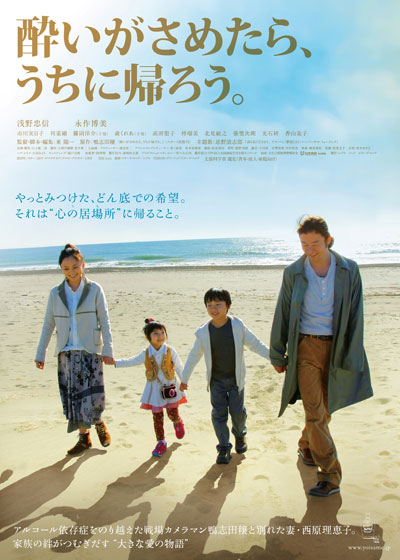
Wandering Home (酔いがさめたら、うちに帰ろう, Yoichi Higashi, 2010)

wandering homeAlcoholism is not a theme which has exactly been absent from the history of cinema. From the booze drenched regret of Days of Wine and Roses to the melancholic inevitability of Leaving Las Vegas and the disdaining irony of Barfly, there has been no shortage of unsympathetic portrayals of drunkenness when it comes to the silver screen. Yoichi Higashi’s Wandering Home (酔いがさめたら、うちに帰ろう, Yoi Ga Sametara, Uchi Ni Kaerou) walks something of a middle road here as it embraces the classic “issue drama” mould but also aims for a naturalistic character study in adapting the true life memoirs of photojournalist Yutaka Kamoshida (husband of well known mangaka Reiko Saibara).

The film begins with a touch of magical realism as Tsukahara (Tadanobu Asano) literally falls off his barstool and has a vision of his wife and two children urging him to get up. Of course, they aren’t “real”. Tsukara lives with his mother after his marriage to a successful mangaka broke down due to his alcoholism. Returning home and ignoring his mother’s advice to get something to eat, Tsukarahara has another drink whilst swearing that this time he’ll be sober when he sees his kids but shortly after retreats to the bathroom to vomit where he experiences a massive haemorrhage and is taken to hospital. Things have already gone too far, he’s told he’s lucky to be alive and the next time this happens he will die.

Swearing to finally come off the booze, Tsukahara goes home but is immediately tempted by a side dish in a restaurant which contains alcohol. He makes the wise choice not to buy the vodka in the off-licence but eventually talks himself into buying beer which he drinks right away and then falls over and hits his head on the way home. His ex-wife, Yuki (Hiromi Nagasaku), and his long suffering mother have gone through this too many times before to even be disappointed. Eventually, they ship Tsukahara off to a residential facility in the hope that they can finally help him beat the booze for good.

Wandering Home is inspired by the real life story of a photojournalist which has also inspired a few other films including the following year’s Kaasan which told the same story from the point of view of Kamoshida’s mangaka wife. Therefore, the ending of this story might perhaps be known to you already but needless to say it isn’t an altogether happy one. The film doesn’t go into the reasons Tsukahara started drinking save for emphasising that it’s rarely one root cause that starts someone on the road to alcohol addiction. Tsukahara’s father had been an alcoholic and had also behaved violently in the home – something which Tsukahara despised and yet he ultimately became exactly like his dad. Having started to drink as a young teenager he drifted into an aimless life and then witnessed a number of traumatic events in his career as a photojournalist which also left their mark on him.

Though the film is never shy about the disruption Tsukahara’s drunkeness causes to his family, it mitigates the effects by casting them as surreal episodes such as the only scene in the film where Tsukahara is shown to be violent towards his wife in which another soot covered version of himself emerges from a zipper in his back to shout abuse and trash the place as his children retreat in horror to their bedroom. It’s not Tsukahara, it’s the alcohol, the film tries to say but actually lays the message on a little thick and often neglects the trauma that his behaviour is, in turn, causing to his own son and daughter.

That said, there is remarkably little animosity between Yuki and her ex-husband despite the way that he has behaved. Yes, the pair are divorced but Yuki is called right away when Tsukahara is taken to hospital and when she brings the children to visit him the couple talk warmly with no bitterness or recrimination. The children too are happy to see their father and do not seem afraid of him in any way at all.

Higashi does, however, fall into standard “issue drama” tropes and perhaps spends too much time exploring the rehab facility where Tsukahara is sent for treatment. Though hearing something of the other characters’ paths to alcohol dependency is enlightening, it can’t help but feel more like a public information film at times than the affecting character drama it should be. Small touches like Tsukahara’s longing for something a simple as being able to enjoy curry again like everyone else on the ward or his more frequent difficulties of being able to distinguish a hallucination from something he’s doing for real lend weight to the central story but they can’t quite save it.

Higashi’s tone is generally straightforward and mostly avoids melodrama or sentimentality except during the film’s ending. This sounds like a strength but turns out to be a weakness as something about Tsukahara’s plight never quite grabs the heartstrings in the way it seems to want to. The film’s unsentimental depiction of alcohol dependency and one man’s struggle to try and regain his place within his own family is an admirable one, but Wandering Home ultimately falls far short of its intended destination.


The Japanese dvd/blu-ray release of Wandering Home includes English subtitles!

Unsubtitled trailer: