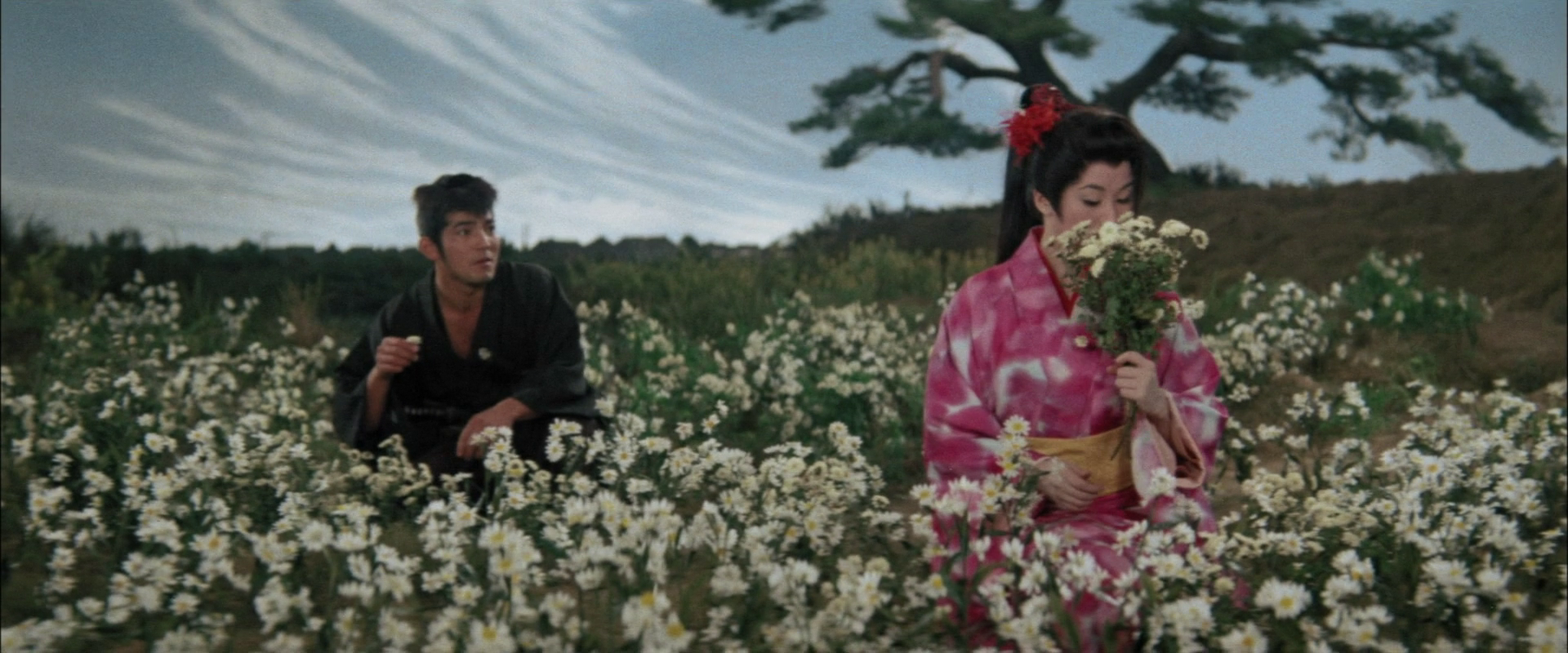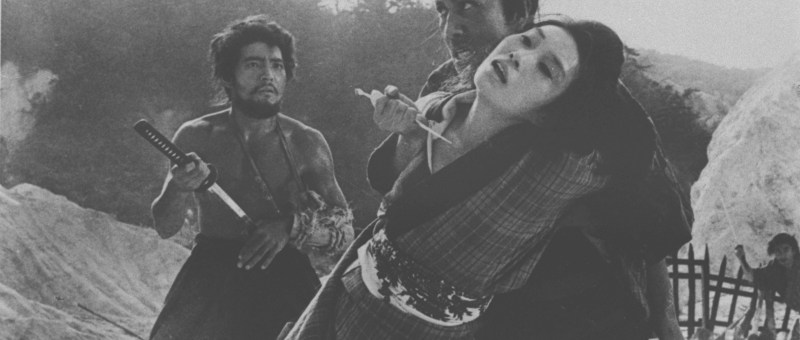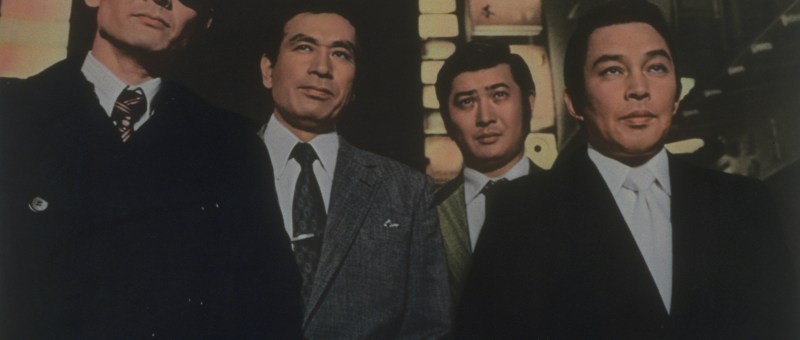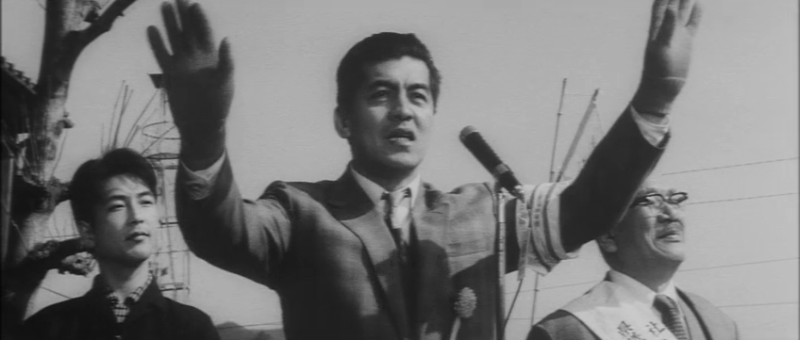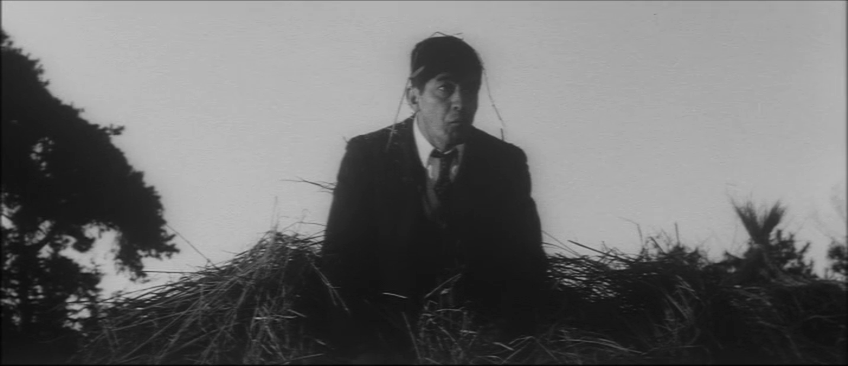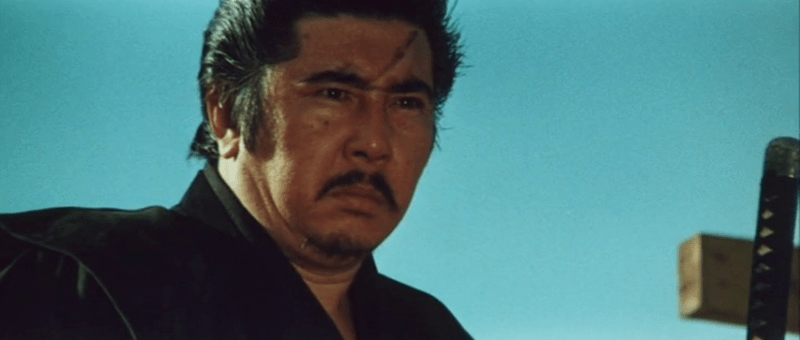
The Fort of Death (五人の賞金稼ぎ, Eiichi Kudo, 1969)

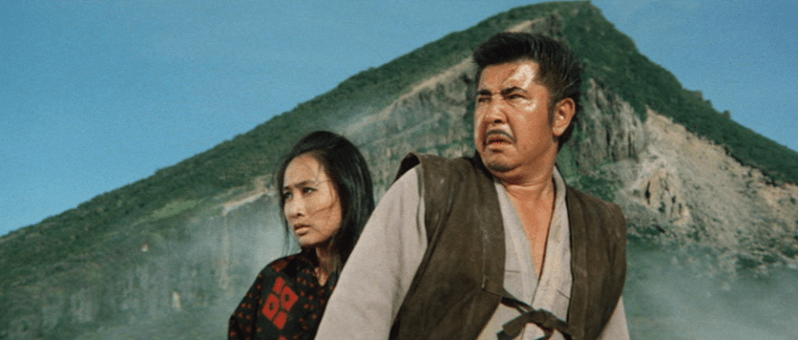
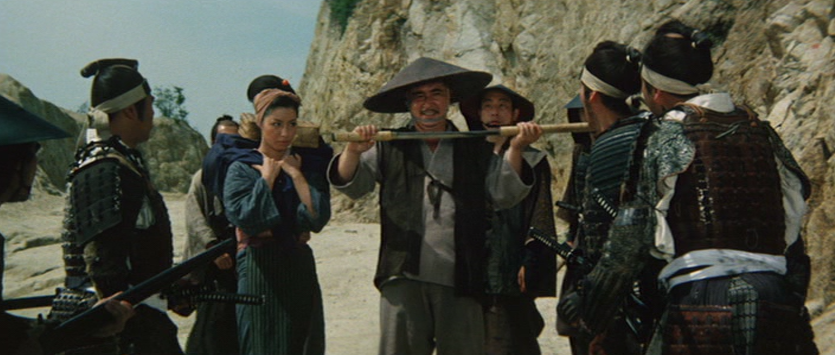
Shikoro Ichibei (Tomisaburo Wakayama) returns yet this time seemingly on the opposite side in the second in the Bounty Hunter series, The Fort of Death (五人の賞金稼ぎ, Gonin no Shokin Kasegi) this time directed by Eiichi Kudo. If the first film had been an Edo-era take on James Bond, the second is very much Spaghetti Western and feudal tragedy as Ichibei finds himself coming to, if not quite the rescue of the oppressed farmers, then at least moral support in taking stand against corrupt and self-interested lords.

This might be surprising in that in the first film Ichibei had been a shogunate spy and seemingly close friend of the man himself, yet this time around he’s working as a doctor while taking bounty hunter jobs to earn extra money to support the poor people who come to him for help. Like a true western hero, he has a small posse which includes the ninja lady, Kagero (Tomoko Mayama), from the first film only she’s being played by the actress who previously starred as his other love interest. In any case, he’s approached by a young man from a small village which is making a last-ditch appeal to the local lord to lower their tax burdens so they don’t all starve, though so far the lord’s response has been to add additional taxes and kill people for not paying them. 

On his arrival, Ichibei soon realises that the man who recommended him was actually the leader of the government forces during a previous peasant uprising at which Ichibei had also tried to help the farmers. In that case, Bessho (Shin Tokudaiji) had won, but it didn’t do him any good. His clan was dissolved and he became a wanderer, taken in by the village and now indebted to them, hoping Ichibei can help but fully aware of the brutality with which such challenges to the feudal order are put down. 

The lord later suggests it’s not really his fault. He has to curry favour with Edo to protect the domain, which is why he agreed to participate in a construction project that led him to confiscate all of his farmers’ rice and wheat. But then it’s also true that he is vain, and cruel. On realising the village has hired a man like Ichibei, some of the retainers suggest reopening negotiations but others complain that they must now crush the farmers or face ruin themselves while trying to ensure the strife in their domain does not come to the attention of the government in Edo. 

Part of their problem is that Ichibei simply has better technology in the form of gatling guns. Tying into the western themes, Ichibei is well versed in the use of firearms, while the samurai are mostly reliant on traditional weaponry such as arrows and swords. The lord later insists on using some canons, but is oblivious to the risk as the shogun has banned the use of gunpowder and using them may end up bringing him to his attention and thereby landing him in a lot of possible fatal trouble. 

In any case, it’s the villagers who suffer. Ichibei encounters a woman who has lost her mind, refusing to give up her baby who has died of malnutrition while her husband was executed for non payment of taxes. Meanwhile, some of the other ronin they hired attempt to rape a villager, and a young couple are prevented from marrying because the headman is worried that it would send the wrong message in a time so much strife. Then again, a woman basically attempts to rape Ichibei, descending on him while he’s still asleep which otherwise leads into a fairly comic sequence in which Ichibei must fight of a bunch of ninjas intent on stealing the gatling gun while dressed only his underwear.

Darkly comic it may be, but also surprisingly violent with a ninja at one point using a dead body as a Molotov cocktail not to mention the severed heads and limbs of the battle scenes. Ichibei is fully aware that the battle is a forlorn hope, but also that the villagers have no choice and perhaps this is better for them than simply accepting their fate and starving to death. Even so, he reserves his final words for the Edo inspector who arrives only when the battle is done to survey the scene, berating him that he ought to know what happened here from looking at the battlefield and deducing that this domain has not been run particularly well. It’s a tragedy of feudalism that provokes a tearful rage from the compassionate bounty hunter trying his best to heal the sickness in his society, though perhaps like the patient who visits him with a venereal complaint concluding the best solution is to cut it right off.
Killer’s Mission (賞金稼ぎ, Shigehiro Ozawa, 1969)

According to the title card at the beginning of Shigehiro Ozawa’s Killer’s Mission (賞金稼ぎ, Shokin Kasegi), none of the events it depicts have been recorded in history because the shogunate decided to erase them all in fear of the effect they may have on the nation’s geopolitical stability. Nevertheless, it gives some very concrete dates for its historical action, even if they may not make complete sense while foreshadowing the political turbulence of the following century. 

What it essentially attempts to do is tell a James Bond-style tale of political intrigue in a feudal Japan in which perpetual peace has begun to create its own problems. Here played in a cameo appearance from Koji Tsuruta, the Shogun Ieshige was weak in part because he was in poor health and had a speech impediment which led him to be rejected by his retainers. The problem here, however, is with Satsuma which has been on bad terms with the Tokugawa shogunate since the Battle of Sekigahara after which they took power. Satsuma will in fact be at the centre of the conspiracy to overthrow the government in the following century, but for the purposes of the film have fallen foul of a rumour that the plan to do an arms deal with some Dutch sailors who sailed South to Kyushu after being rebuffed in Edo. 

A civil war is feared and in the interests of maintaining peace, Ieshige sends his trusted spy Ichibei (Tomisaburo Wakayama) to protect Satsuma official Ijuin Ukiyo (Chiezo Kataoka) in the hope that he will be able to talk his young and naive lord out of doing the deal. Ostensibly a doctor by trade, Ichibei has a series of spy gadgets such as hidden blades and collapsible guns stored in a secret room at his surgery which he then carries in a black leather utility belt. He keeps the nature of his mission close to his chest, but often double bluffs by simply telling people he is a shogunate spy or otherwise adopting a disguise as he does in a moment of meta comedy impersonating the signature role of his brother Shintaro Katsu by posing as a Zatoichi-style blind masseur. 

As if to signal the cruelty of the feudal world, Ichibei comes across the corpses of suspected spies abandoned outside Satsuma territory while his enemies meditate on their ancient slight and consider taking the deal in the hope of avenging their defeat and overthrowing the Tokugawa. They are warned that creating unrest and sowing division may be exactly what foreign powers like the Dutch crave, but aren’t particularly bothered, preferring to take their chances with them rather than curry favour with the Shogun and possibly destabilising the entire society along with it. 

Of course, much of this is anachronistic with the Dutch sailors appearing in a distinctly 19th century fashion carrying weapons which are also too advanced for the era as are Ichibei’s folding pistols. Through his travels, he runs into a female Iga spy who too can do some nifty ninja tricks and has a gadget of her own in a comb which can shoot poison darts, though luckily it’s one of the poisons Ichibei has already developed an immunity to. Ichibei is fond of crying that you kill him he’ll simply come back to life, barrelling through the air with feats of improbable human agility and generally behaving like some kind of supernatural entity with a secondary talent for violent seduction. 

Though ironic and often darkly comic, there is an unavoidable poignancy in the inner conflict of Ijuin who knows his clan is about to do something very foolish but is torn between his duty to obey them and that to act in their best interests, eventually backed into a corner and left with no real way out of his predicament. As Ichibei points out, it’s difficult to keep the peace, especially when restless young samurai spot opportunities to cause chaos and the outside world knocks on the door of a closed community. Even so, Ozawa ends on a romantic image of a beach at sunset somehow undercutting the violence and tragedy with the restoration of an order that might itself be imperfect in its peacefulness.


Ninja’s Mark (忍びの卍, Norifumi Suzuki, 1968)

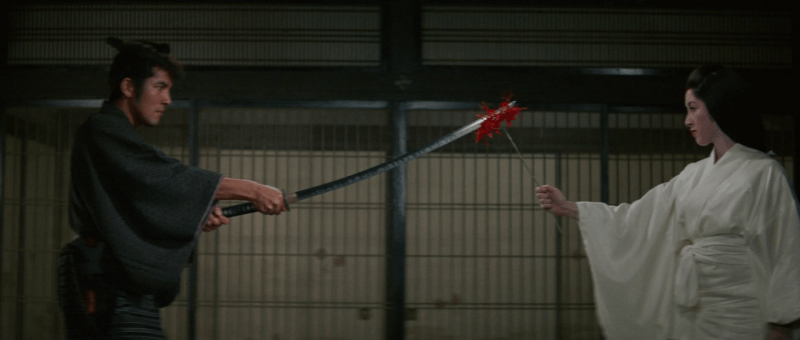
Many have tried to end the Tokugawa line. Few have done so by covering a courtesan’s legs in fish scales to put the Shogun off his stride. Based on a book by Futaro Yamada, Norifumi Suzuki’s Ninja’s Mark (忍びの卍, Shinobi no Manji) is at heart a romantic tale in which love is “part of the game” but also apparently the one trick a ninja can’t escape. Perhaps that’s why Shogun Iemitsu at the comparatively late age of 30 has failed to produce an heir with any of the beautiful yet emotionally distant courtesans of the inner palace many of whom also seem to be ninjas, therefore provoking a constitutional crisis.

Aside from that, it seems the ninja plot is a kind of revenge against the Tokugawa carried out by the last remnants of a house that was dissolved by the Toyotomi. There are in fact three ninja clans all clustering around the palace, Iga, Koga, and Negoro, each of whom have different kinds of skills. Technically, some of them are in the employ of the Shogun’s disinherited younger brother Tadanaga (Shingo Yamashiro), but others of them are working strictly for themselves and their revenge. In any case, their plan is to prevent Iemitsu from fathering an heir by putting him off sex essentially by making it freaky (in a bad way). Thus one of the ninjas uses his ability to transform objects so that the courtesan’s legs are covered in fish scales. Another plan sees a ninja body swap with one of the women so that Iemitsu’s sperm ends up inside him where it obviously has nowhere to go. Meanwhile others hatch a plan to steal some of Tadanaga’s seed to use on the women in the inner palace to cover up Iemitsu’s potential infertility seeing as it is after just as good being of the Tokugawa line. 

This particular ruse is suggested by Toma (Isao Natsuyagi), the disenfranchised former member of the Yagyu school turned ninja ronin they bring in to solve the problem. He quickly homes in on Kageroi (Hiroko Sakuramachi), a female ninja, as the villainess whose special power is poisoning men with love and desire by means of the spider lily plant. But as Toma points out to her, she is also a prisoner of her skill in that if she were to fall in love she would inevitably kill her lover. Of course, he survives her first attempt to kill him, leading her to fall in love with Toma and become conflicted in her mission while he plays on her emotions to escape but eventually realises they may be more genuine than he first realised. 

In this, Suzuki brings some of his trademark romanticism particularly in the colourful art nouveau aesthetics and frequent use of rose imagery. Though the film is clearly designed to lean into the erotic with frequent use of nudity and salacious scenes including a brief moment of lesbian seduction, it eventually heads towards romantic tragedy in which the debauched and nihilistic Toma and the wronged Kageroi discover a love made impossible by their ninja code and the times in which they live. Having been ordered to kill her, Toma declares that he will marry Kageroi in the next life and returns to her the Buddhist Manji that is the “ninja mark” of the title. 

Nevertheless, the dialogue is often suggestive as in Kageroi’s curse that Toma’s “sword” will rot, while it’s also Toma’s “sword” that alerts him to the danger she presents. Toma too claims to derive his ninja powers from his “sword” having apparently concentrated them by repressing his sexual desire and swearing off women. He says that he seals all his “distracting” thoughts into a virgin, closing off all her senses and placing her into a coma until he breaks the spell. Even so, he admits that without his “sword” he is just a man, and as a man claims to love Kageroi, but as long as he has his “sword”, and she her “lily”, their love is impossible. 

But this repressed love seems to pose less threat to the social order than the lack of it in Iemitsu who is bored with his courtesans and cannot conceive an heir. Constitutional crisis is averted only through a little ninja trickery and a convenient ruse to overcome Iemitsu’s infertility so that in time he produces five sons and a daughter, which honestly seems like it might just present another set of problems in about 30 years’ time. Like similarly themed ninja pictures, Suzuki makes good use of surrealist imagery and colour play alongside the kind of onscreen text later used in jitsuroku yakuza films to name each of the ninja’s key skills and which clan they belong to. What he always returns to, however, is the sense of romantic tragedy in a world seemingly poisoned by ambition in which love itself is rendered an impossibility. 


*Norifumi Suzuki’s name is actually “Noribumi” but he has become known as “Norifumi” to English-speaking audiences.

Yakuza Hooligans (893 愚連隊, Sadao Nakajima, 1966)

“The world has changed,” an old school street thug is repeatedly reminded after his release from prison into a new Japan amid the tides of rising prosperity. An early effort from Sadao Nakajima, Yakuza Hooligans (893 愚連隊, 893 Gurentai) situates itself in cultural and generational abyss among those who find themselves locked out of the new society and unable to escape the immediate post-war era in part perhaps because they may not really want to.

At least it seems that way for the central trio of “hooligans” who later explain to their sometime mentor that they aren’t doing petty crime because of a lack of other options but out of devilment and a childish rebellion against a world they feel doesn’t accept them. As the film opens, they’re running a petty scam luring queuing passengers into unlicensed cabs for which they are almost arrested, stiffing the cabbie that helps them escape and then conning a takoyaki vendor out of a free lunch. Several times they’re criticised for “bullying the weak,” most obviously in their sideline seducing women and forcing them into sex work or blackmailing men who sleep with them. 

They are, however, fairly weak themselves. They like to describe themselves as a “democratic” institution in which everyone is equal and everything is shared fairly but despite supposedly having no boss they’re bossed around by almost everyone and when challenged by actual yakuza quickly back down. A generation older, failed kamikaze Sugi is released from prison after spending 15 years behind bars for killing a Chinese man as part of a petty crime gang formed in the immediate chaos after the war. Unlike his former associate Kurokawa, Sugi too claims that he doesn’t see the point in having a boss but like the younger men flounders unable to see a place for himself in the new society.

Sugi doesn’t approve of the more immoral sides of their business, particularly the rape and trafficking of women but proves just how out of touch he is when he asks the guys why they can’t just swipe some rice or clothing. In the immediate post-war period, rice and kimono were the only things which held their value but in a newly consumerist Japan they’re in plentiful supply and in fact worth relatively little. While he was inside, his former girlfriend married someone else and had a child, burning the tattoo she once had of his name on her arm clean away. She tells him that she’s sorry, but she’s happy and she doesn’t want anything to disrupt the life she has now. Falling for a middle-aged woman unhappy in her marriage and subsequently forced into sex work by the gang, he dreams of a happy family life and ultimately risks all on a confrontation with his old yakuza pal Kurokawa.

The film seems to suggest that the writing’s on the wall for men like Kurokawa too. His old school world of regimented, authoritarian gangsterdom doesn’t fit in the new Japan anymore than Sugi’s corrupted post-war idealism. A subplot revolving around Ken, a mixed-race member of the gang who hates the way they treat women because his mother was raped by a US serviceman positions the Occupation as another source of corruption leaving nothing behind itself other than moral decline and lasting trauma. But as Nobuko later says as long as you’re alive you have to go on searching for something and if one place is the same as another then you might as well move. 

The hooligans, however, seem stuck in the past. They can’t stand up for themselves or mount any real resistance to their circumstances, continuing to “bully the weak” in an attempt to mask their own weakness until racing headlong towards a confrontation with the yakuza along a bridge which quite literally hasn’t been finished yet symbolising their mutual inability to progress into the new society. Shooting with a heavy dose of irony enhanced by the whimsical jazz score, Nakajima captures a sense of contemporary Kyoto as an alienating environment caught between the ancient and the modern in which men like Sugi and the hooligans are permanently displaced yet lack the desire to escape because the newly consumerist society has little to offer them. 


Original trailer (no subtitles)

The Pledge (博奕打ち外伝, Kosaku Yamashita, 1972)

The gangster code slowly consumes series of men each trying to do the right thing but hamstrung by the actions of others in Kosaku Yamashita’s yakuza tragedy, The Pledge (博奕打ち外伝, Bakuchiuchi Gaiden). It is indeed a promise between brothers which damns them all, but the roots of it lie in repressed emotion and a desire to protect other people’s feelings by keeping a destructive secret while trying to satisfy oneself that one has behaved properly even if no one else understands. 

The battleground is Wakamatsu, Kyushu, where outsider Egawa (Koji Tsuruta) has united the local boatmen and is undercutting the prices of a rival gang led by Omuro (Tomisaburo Wakayama). While Omuro is out of town, his right-hand man Taki (Hiroki Matsukata) has decided to take advantage of a minor squabble between some of his guys and Egawa’s to initiate a small scale turf war hoping to take the river back under their control. He does this by kidnapping Egawa’s younger brother Masakazu (Goro Ibuki) to lure him to their headquarters alone, something of which Omuro does not approve on his return but decides to go with as an excuse to bring his rivalry with Egawa to a head. Just as the pair are squaring off, a mutual friend, Hanai (Ken Takakura), arrives and intervenes convincing the two men to lay down their arms for the moment at least.

It could be argued that it is this interrupted fight that is resolved in the film’s conclusion if only by inexorable fate. In a repeated motif, Omuro keeps to the code and is exasperated and disapproving of Taki’s underhanded tactics but accepts the responsibility for them himself knowing that Taki acted only on his behalf and his recklessness is only an expression of his love for him. There is indeed something homoerotic in the relationship between the two men as Omuro cradles a wounded Taki and attempts to comfort him that the fault is all his own, while resolving to accept Taki’s actions and build on them rather than try to deescalate or try to apologise. 

The real crisis occurs when the boss, approaching 60 which represents the full circle of a life, decides to name Omuro as a successor rather than the anticipated Hanai. Hanai stoically accepts though intending to leave the gang and travel to another part of Japan but other members of the clan are perplexed, little understanding the boss’ decision in feeling that Omuro is not of good character whereas Hanai is easily the better choice. As it transpires, the boss has made his decision deliberately in order to mitigate the fact that Hanai is secretly his illegitimate son whose origins he has kept secret in deference to his legal wife. He chooses not to name him as a successor in order to avoid causing him problems in his later life while justifying himself that he has not made the decision for dynastic reasons or out of simple favouritism. Yet the relationship between the two men, father and son, is raw and painful if founded on a deep understanding that leaves them unable to meet each other directly with emotional honesty. 

Because of his father’s decision, Hanai forces Egawa to promise that he will not antagonise Omuro which leads to problems in his own gang with his men angry and confused, unable to understand why Egawa is letting Omuro walk all over him. Compounding the problem, Egawa’s errant brother Tetsu (Bunta Sugawara) returns unexpectedly and as Egawa cannot tell him about the pledge without disclosing Hanai’s secret, thinks his brother is being messed around and raids Omuro’s offices to reclaim money he had extorted from Egawa. He learns the truth from devoted geisha Hideko (Yuko Hama) who is deeply in love with Egawa yet largely unable to act on it again because of the gangster code while pledging that she’d sooner die and prove her devotion to him than summit herself to Taki, who is also in love with her, even when he threatens her with a knife. 

The yakuza code dictates that Omuro must die though he is little more than a passive antagonist all too willing to accept the evil deeds that Taki did on his behalf because of the code of loyalty though he would not have dared to do them himself. Secrecy and repressed emotion drag all into a dark web of self-destructive violence until reaching their inevitable conclusion and perhaps bringing one cycle to a close if only in the birth of another. 


Original trailer (no subtitles)

Samurai Wolf 2: Hell Cut (牙狼之介 地獄斬り, Hideo Gosha, 1967)

“We ronin must live without mercy” insists a fugitive on a quest for vengeance and riches only to meet his match in the justice-loving wanderer Kiba (Isao Natsuyagi) making his return for Samurai Wolf II: Hell Cut (牙狼之介 地獄斬り, Kiba Okaminosuke: Jigoku Giri). Like the second instalment in many series, Gosha’s avant-garde chambara largely follows the same formula picking up several familiar elements from the first film if giving them a new spin as Kiba once again finds himself caught up in intrigue provoked by the amoral venality of late Meiji society. 

In this case, he makes a rod for his own back by humiliating some swordsmen after catching them harassing a young woman, mocking them when they try to claim that their treatment of her is part of their “training”. Kiba saves the girl, Oteru (Rumiko Fuji), who has some kind of etherial quality and doesn’t quite seem to know what’s going on immediately throwing herself at Kiba who turns her down in gentlemanly fashion. Sometime later, he runs into a convoy of officials transporting criminals to the nearest judicial centre and stops to give the prisoners some of his own water explaining that that from the stream is polluted thanks to leaks from a nearby goldmine. In any case, Kiba is struck by the appearance of one of the men, Magobei (Ko Nishimura), who reminds him of the father who was killed by swordsmen he’d humiliated with his skill. 

Magobei is in chains for murdering the manager of the mine which previously belonged to the shogun but has now been shut down, its seam apparently exhausted. But like the toxins that poured into the river, the mine is a poison to society and in more ways than one. Magobei tells Kiba that he’s been set up. He was hired to kill the manager by a duplicitous gang leader named Jinroku (Bin Amatsu) who has found a new seam and has been operating the mine illegally taking all the gold for himself so obviously Magobei wants revenge. After seeing off an ambush, Kiba agrees to act as a bodyguard delivering both Magobei and the other prisoner, Kihachi (Out Yokoyama) who claims to be a big time bandit in trouble for robbing a samurai family, to the nearest city but secretly seems to sympathise with the injustice dealt to Magobei and the female prisoner who later joins them, Oren the Thistle (Yuko Kusunoki), who murdered a judge who killed her lover. 

Yet Kiba’s memories of his father cloud his judgment about Magobei who is definitely not a man worthy of his faith in him. “What good would pity do?’ Magobei asks, certain that compassion is a weakness and that if he were to give in to human feeling he would immediately be betrayed. The men misunderstand each other, assuming they are alike when in reality they are opposites. Kiba bets on Magobei’s humanity and loses, while Magobei assumes that Kiba will easily be won over by the riches to be found in the goldmine and help to wipe out Jinroku’s gang which is also a family of which Oteru is a member. “Life’s tough that’s how it is” he justifies, but Kiba cannot forgive him not least for his callous murder of a man who was only a frightened braggart and could not have harmed him and a woman who was otherwise blameless. Just as Sanai had in the first film, Magobei tells him that “one day you will be like me” a future that Kiba once again violently rejects. 

But then again he can never escape the world where goldmines pollute the rivers and money can buy anything, even the hearts of men. Just like his father, he’s pursued by the swordsmen he’s unwittingly insulted while discovering his desire to serve justice backfiring, eventually robbing him of the only thing he actually wanted just as it had at the end of the previous film. Even so, Kiba retains his sense of humanity and unlike so many jidaigeki (anti-)heroes refuses to give in to nihilism or despair. A little less avantgarde than the previous instalment, Gosha nevertheless conjures a world of dazzling violence in freeze-frame and silence while once again leaving Kiba the furious wolf to wander, a lonely figure in an unforgiving landscape.


Samurai Wolf 2: Hell Cut opens at New York’s Metrograph on Dec. 26 as part of Hideo Gosha x 3

Original trailer (English subtitles)

Violent Streets (暴力街, Hideo Gosha, 1974)

“Nothing’s like it used to be anymore” sighs a woman who’s had to betray herself but has tried to make break for it only to discover there is no way back. Hideo Gosha’s Violent Streets (暴力街, Boryoku Gai) is like many films of its era about the changing nature of the yakuza in an age of corporatised gangsterdom. Now “legitimate businessmen” who claim to no longer deal in thuggery, their crimes are of a more organised kind though a turf war’s still a turf war even if you’re fighting from the boardroom rather than simply getting petty street punks to fight it for you in the streets. 

In a touch of irony, former yakuza Noboru Ando stars as a man who’s tried to leave the life behind but is pulled back into underworld intrigue when his former foot soldiers mount an ill-advised bid for revenge against the clan they feel betrayed them. After serving eight years in prison for participating in the last turf war, Egawa was given flamenco bar Madrid on the condition that he dissolve his family and attempt to go straight as a legitimate businessman. The Togiku gang has since gone legit and distanced itself from most of its old school yakuza like Egawa. But now a yakuza conglomerate from Osaka is moving in on their old turf and the Togiku want the Madrid back as a bulwark against incursion from the west which is why they’ve been sending the boys round to cause trouble in the bar. 

Egawa is the classic ex-gangster who wants to turn himself around but is largely unable to adapt to life in a changing society. He is technically in a relationship with a bar hostess who has a severe drinking problem in part exacerbated by his inability to get over his former girlfriend who left him and married the boss, Gohara, while he was in prison. His former foot soldiers attempt to convince him to get the gang back together and take revenge, resentful of having been used and discarded, but he tells them to let it go, that they’ve all got “honest jobs” and that they should try to live as best they can. Like him, the guys are ill-equipped to make new lives in the consumerist society and cannot move on from the post-war past. Hoping to engineer a turf war between the Osaka guys and Togiku, they kidnap a popular TV personality/pop singer (Minami Nakatsugawa) attached to a station which Togiku controls and frame a rival affiliated with the Osakans for taking her. 

This just goes to show the various ways in which newly corporatised yakuza have expanded their business portfolio, heavily participating in the entertainment industry moving beyond bars, clubs, and the sex trade into mainstream television and idol stars. Egawa’s old friend Yazaki (Akira Kobayashi) is his opposing number, just as caged but trapped within the confines of the new gangsterdom, reprimanded by his boss for raiding the rival studio’s offices and undoing the gang’s attempt to rebrand themselves as legitimate businessmen rather than violent street thugs. “I can’t stand being humiliated” he explains as Gohara points out he’s stepped right into their trap now giving the Osakans an excuse for retaliation. “The Togiku group is a defanged, domesticated dog” Yazaki barks, “I can’t pretend to be an obedient company employee forever and do nothing”. 

Neither man is able to progress into the new era of rising prosperity, both little more than caged animals thrashing around trying to break free but continually crashing into the bars. Just as Egawa’s old guys had tried to engineer a turf war hoping that the two gangs would take each other out and leave a vacuum they could fill, arch boss Shimamura (Tetsuro Tanba) flies above the city in a helicopter as the “worms fight among themselves” and observes the chaos below as he completes his silent conquest of the contemporary economy like some modern day Nobunaga of corporatised gangsterdom. 

Taking over the Togiku through a process of corporate infiltration and gradually ridding themselves of all the old school yakuza ill-suited to the shady salaryman life, the contrast between the world of cabaret bars and back street dives and Shimamura’s smart suits and helicopters couldn’t be more stark. A slightly sour note is struck by the use of a transgender assassin (Madame Joy) who performs a lesbian floorshow by day and kills by night while working with a bald sidekick who carries a parrot on his shoulder, her coldness bearing out the tendency of yakuza movies to associate queerness with sadistic savagery. Gosha rams his point home with the otherwise surreal scene of a pile of abandoned mannequins by a swamp that becomes a popular yakuza kill site homing in on the emptiness of their eyes and the uncanniness of dismembered bodies, mere empty shells just like the men who die in this literal wasteland. Egawa perhaps feels himself to be a man already dead long before being pushed towards his act of futile rebellion, somewhere between sitting duck and caged dog fighting for his life between the chicken coops of a moribund small-town Japan. Marching to a frenetic flamenco beat of rising passions and barely contained rage, Violent Streets leaves its former foot soldiers with nowhere to go but down while their duplicitous masters continue to prosper riding the consumerist wave into a new and prosperous future.


Violent Streets opens at New York’s Metrograph on Dec. 16 as part of Hideo Gosha x 3

Trailer (English subtitles)

Tale of Japanese Burglars (にっぽん泥棒物語, Satsuo Yamamoto, 1965)

“Even the cops wouldn’t keep innocent people in prison” a prisoner ironically exclaims in Satsuo Yamamoto’s farcical crime drama Tale of Japanese Burglars (にっぽん泥棒物語, Nippon Dorobo Monogatari), displaying a strange sense of faith in the system for one who’s already been caught out by it. It is in many ways the system at which Yamamoto takes aim, refusing to blame even the guilty for their crimes while condemning the society that forever tars not only them but their entire families with the criminal brush, similarly defaming the innocent while the mechanisms of the State actively abuse their power to ensure they continue to maintain it. 

Set in 1948, the action takes place as the opening voiceover explains in an exaggerated accent which at times lends itself to lowkey comedy, at a moment of societal collapse in which cash has become almost worthless and the only items of value are clothing and rice. Yet Gisuke (Rentaro Mikuni) it seems was living a life of crime even before the war, the youngest of five brothers left to look after his mother and sister after his father’s death. While operating as an amateur unlicensed dentist having picked up the basics from his dad, Gisuke makes his living peddling black market kimonos stolen from local warehouses. After bungling one particular job he finds himself spotting a strange site on the railway tracks, overwhelmed by shadowy figures of nine men he first fears have come to tackle him but in the end simply pass by even calmly returning his call of good evening as they discuss among themselves the best way to the local hot spring. Taking refuge in a haystack, it’s not until the next morning that Gisuke learns of a train derailment that took the lives of the engineer and two crew members. He realises that the men he saw must have been the ones who sabotaged the track but he’s not a snitch and it’s none of his business so he decides to keep quiet. 

That is until he gets arrested for the botched burglary and ends up incarcerated alongside a member of the accused, Kimura (Mizuho Suzuki), who quickly befriends him and in fact becomes something of a labour activist even inside the prison negotiating better conditions for prisoners. Indebted, Gisuke maintains his silence strangely certain that Kimura and the others will soon be released because they are innocent despite already knowing that the judicial system is infinitely corrupt. The case at hand takes inspiration from the Matsukawa Derailment, a real life incident which Yamamoto had already dramatised in 1961’s Matsukawa Incident, in which suspicion had fallen on the Railway Union who, in the film, are seen leading a protest agitating for better working conditions. Kimura, a prominent unioniser, is picked up along with other members of the rail workers union and left-wing activists on largely spurious grounds solely to discredit their movement at the behest of an overly authoritarian police force. 

The irony is that Gisuke ends up in prison for a crime that he technically is not quite guilty of in that he’s arrested after his wife, a geisha he redeemed with his ill-gotten gains, unwittingly sells some stolen kimonos which he was storing for a friend on the run. Kimura by contrast is in prison for something of which he is entirely innocent, in effect a political prisoner. Yet the force that imprisons both of them is not so much the law as social censure in the stigmatisation of crime. Gisuke feels acutely guilty knowing that his family members continue to suffer because of his criminality, his sister unable to marry as each of her engagements is eventually broken off when they find out her brother’s been in jail. After getting out and vowing to go straight, Gisuke marries again and has a child but is perpetually worried that someone will find out about his past and that his son will forever be stigmatised as a “burglar’s kid”. It’s for this reason that he finds himself torn, refusing to help Kimura by testifying as to what he saw that night even after hearing that he’s been sentenced to death, unwilling to risk his newfound happiness even at the expense of another man’s life. 

Strangely, it’s the injustice of the situation which later changes his mind though in an unexpected way when he realises that his own son has escaped being tainted with his father’s criminal legacy while Kimura’s is bullied at school because his dad’s in jail even though he’s innocent. Pursued by authoritarian police officer Ando (Yunosuke Ito) who attempts to blackmail him into changing his story to incriminate Kimura he eventually decides to free himself by telling the truth despite realising that another witness was most likely murdered for signalling an intention to do the same. “But how is it that the police who are charged to catch us are even bigger liars than the thieves?” Gisuke asks the judge during his improbably humorous testimony, earning rapturous applause from the court in a touch of the absurd with even his wife, hitherto stoney faced despite the laughter all around her, cracking a smile seemingly warming up to his decision to play the hero even if it has taken him rather a long time to decide to do the right thing. 

Yamamoto doesn’t hang around to hear the verdict, perhaps because it’s Gisuke who’s really on trial and the judge appears to be his wife whose forgiveness is the only acquittal necessary. His crimes are in a sense not really his fault, Yamamoto seems to argue, but the fault of an indifferent society which left him with no other choice in order to support himself, the same society which then frustrates his attempts to live an “honest” life by forever tainting him as a “burglar” and tarring his entire extended family with the same brush. Only by owning his stigmatisation can he free himself of it, rejecting the illusionary power corrupt authority has over him while refusing to be complicit in their constant battle to hang on to it by levelling his marginalisation against him. Extremely ironic in terms of tone, often employing archaic screen wipes for comic effect, Yamamoto’s strangely hopeful tale implies that justice can in fact prevail but only when imperfect men commit to it even at the expense of their personal happiness. 


Prison Boss (獄中の顔役, Yasuo Furuhata, 1968)

“Both you and I must do what a man must do and live this life to the very end” according to the melancholy theme song of Yasuo Furuhata’s fatalistic tale of gangster nobility, Prison Boss (獄中の顔役, Gokuchu no Kaoyaku). Another vehicle for tough guy star Ken Takakura, this post-war drama despite the name spends less time in a cell than one might imagine but casts its melancholy hero as a man imprisoned by the times in which he lives, too good to survive in an ignoble society and eventually brought down by his self-destructive need for retributive justice. 

As the film opens, Hayami (Ken Takakura) is goaded into a knife fight with a foot soldier from the evil Honma gang, Tetsu the Viper, and eventually kills him. Stumbling into a nearby bar, his only intention is to do the right thing and turn himself in filled with remorse as he is that he’s offed Tetsu in territory which belongs to “good” mob boss Tajima (Ichiro Ryuzaki). Tajima lives up to his name when some of his guys rescue Hayami and take him to their HQ where the old man insists that he rest and recover from his wounds. Whilst there, Hayami is cared for by Tajima’s teenage daughter Toshiko (Junko Fuji) who falls in love with him and vows to wait while he honours his word and spends seven years in jail for the killing of Tetsu. 

Meanwhile, awkward small-town politics is destabilising the precarious post-war environment as the Honma, embodiments of the new, venal and violent yakuza who care nothing for honour or humanity, are intent on squeezing Tajima’s influence mostly through muscling in on the running of the local bike races for which Tajima currently runs security. Though the Tajima gang is presented as an unambiguous good, the old style noble yakuza who live by a code and care about protecting the little guy, you can’t deny the levels of nepotistic corruption on display at the local council meetings given that the mayor and Tajima are apparently childhood friends while his rival shouts about allowing yakuza too much sway in politics while in the pay of Honma. 

Nevertheless, the central drama exists solely in the soul of Hayami who emerges from seven years in prison into this already destabilised environment owing a debt of honour to Tajima. Not quite a yakuza, he feels himself a perpetual other forever tainted by his crime having lost the right to live as other men live. Thus he struggles with discovering that Toshiko has also remained true to her word, having waited for him all this time running a small coffee bar rather than getting married. Even so, he finds himself dragged back into yakuza drama avenging the death of a Tajima man gunned down by Honma and thereby ending up back inside where he’s reunited with another childhood friend, Kurosaki (Ryo Ikebe), who’s been far less fortunate and is now affiliated with Honma.  

Kurosaki and veteran prisoner Pops (Shogo Shimada) are perhaps both mirrors of Hayami’s internal conflict, Kurosaki like him bound by a code but forced to act in ways which betray his own sense of honour and humanity and eventually paying a heavy price for doing so. Pops meanwhile as a man nearing the end of his life tries to talk him down from the road of destructive nobility, reminding him that he has a choice and ought to choose himself rather continuing to suffer for an outdated ideal. Hayami’s selflessness, his oft remarked tendency to disregard his own interest to protect others (the true mark of the noble gangster), is his weakness and fatal flaw. A yakuza’s daughter, Toshiko understands the code of manliness well enough and even she eventually tells him to run, to abandon his revenge and live free rather than becoming just another sacrifice on the altar of yakuza honour, but of course a man has to do what a man has to do. 

Though Hayami himself becomes a big man in prison, it’s Honma to whom the film’s title primarily refers hinting at the corruption involved in a society in which it is perfectly possible (and in some ways advantageous) to continue running a yakuza gang from behind bars, while the central crisis also turns on post-war desperation in betting all on controlling the lucrative bicycle races. In such a world as this, there’s precious little room for the noble gangster who must in the end damn himself if only to redeem it. 


Feisty Edo Girl Nakanori-san (ひばり民謡の旅シリーズ べらんめえ中乗りさん, Masamitsu Igayama, 1961)

Nakanori-san posterThe voice of the post-war era, Hibari Misora also had a long and phenomenally popular run as a tentpole movie star which began at the very beginning of her career and eventually totalled 166 films. Working mostly (though not exclusively) at Toei, she starred in a series of contemporary and period comedies all of which afforded her at least a small opportunity to showcase her musical talents. Directed by Masamitsu Igayama, Feisty Edo Girl Nakanori-san (ひばり民謡の旅シリーズ べらんめえ中乗りさん, Hibari Minyo no Tabi: Beranme Nakanori-san, AKA Travelsongs: Sharp-Tongued Acquaintance) once again stars Hibari Misora as a strong-willed, independent post-war woman who stands up to corruption and looks after the little guy while falling in love with regular co-star Ken Takakura. 

Nobuko (Hibari Misora) is the daughter of a formerly successful lumber merchant whose business is being threatened by an unscrupulous competitor. With her father ill in bed, Nobuko has taken over the family firm but is dismayed to find that a contract she assumed signed has been reneged on by a corrupt underling at a construction company who has been bribed by the thuggish Tajikyo (Takashi Kanda). Unlike Nobuko’s father Sado (Isao Yamagata), Tajikyo is unafraid to embrace the new, completely amoral business landscape of the post-war world and will do whatever it takes to become top dog in the small lumber-centric world of Kibo.

Tajikyo has teamed up with the similarly minded, though nowhere near as unscrupulous, Oka (Yoshi Kato) whose son Kenichi (Ken Takakura) has recently returned from America. Kenichi, having come back to Japan with with clear ideas about the importance of fair practice in business, is not happy with his father’s capitulation to Tajikyo’s bullying. Of course, it also helps that he had a charming meet cute with the spiky Nobuko and became instantly smitten so he is unlikely to be in favour of anything which damages her father’s business even if they are technically competitors.

As in the majority of her films, Misora plays the “feisty” girl of the title, a no nonsense sort of woman thoroughly fed up with the misogynistic micro aggressions she often encounters when trying to participate fully in the running of her family business. Though her father seems happy enough, even if casually reminding her that aspects of the job are more difficult for women – particularly the ones which involve literal heavy lifting and being alone with a large number of men in the middle of a forest, he too remarks on her seeming masculinity in joking that her mother made a mistake in giving birth to her as a girl. Likewise, Tajikyo’s ridiculous plan to have Nobuko marry his idiot son is laughed off not only because Tajikyo is their enemy, but because most people seem to think that Nobuko’s feistiness makes her unsuitable for marriage – something she later puts to Kenichi as their courtship begins to become more serious. Kenichi, of course, is attracted to her precisely because of these qualities even if she eventually stops to wonder if she might need to become more “feminine” in order to become his wife.

To this extent, Feisty Edo Girl is the story of its heroine’s gradual softening as she finally writes home to her father that she is happy to have been born a girl while fantasising about weddings and dreaming of Kenichi’s handsome face. Meanwhile, she also attracts the attentions of an improbable motorcycle champion who just happens to also be the son of a logging family and therefore also able to help in the grand finale even if he never becomes a credible love rival despite Nobuko’s frequent admiration for his fiery, rebellious character which more than matches her own.

Nevertheless, the central concern (aside from the romance) is a preoccupation with corruption in the wartime generation. Where Nobuko’s father Sado is “old fashioned” in that he wants to do business legitimately while keeping local traditions alive, the Tajikyos of the world are content to wield his scruples against him, destroying his business through underhanded methods running from staff poaching to bribery and violence. Kenichi’s father has gone along with Tajikoyo’s plans out of greed and weakness, irritated by his son’s moral purity on one level but also mildly horrified by what he might have gotten himself into by not standing up to Tajikyo in the beginning.

As expected, Nobuko and Kenichi eventually triumph through nothing more than a fierce determination to treat others with respect. Working together cheerfully achieves results, while the corrupt forces of Tajikyo eventually find themselves blocked by those who either cannot be bought or find the strength to refuse to be. Nobuko’s big job is finding prime lumber to be used to build a traditional pagoda in America as part of a cultural celebration. She wants to do her best not only because she takes pride in her work but because she knows this project will represent Japan overseas. Tajikyo, however, would cut corners, believing that the Americans wouldn’t notice even if he sent them rotten logs riddled with woodworm as long as the paperwork tallies. Filled with music and song, Nakanori-san is an action packed outing for Misora in which she once again succeeds in setting the world to rights while falling in love with a likeminded soul as they prepare to sail off into kinder post-war future.


Some of Hibari’s songs from the film (no subtitles):

https://www.youtube.com/watch?v=gCeE4lCTpW4