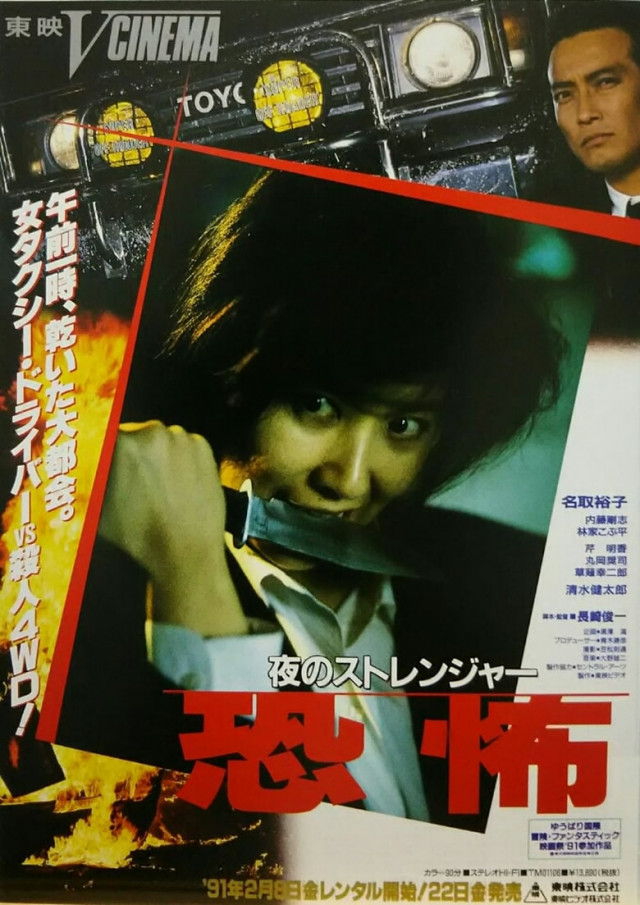
Stranger (夜のストレンジャー 恐怖, Shunichi Nagasaki, 1991)

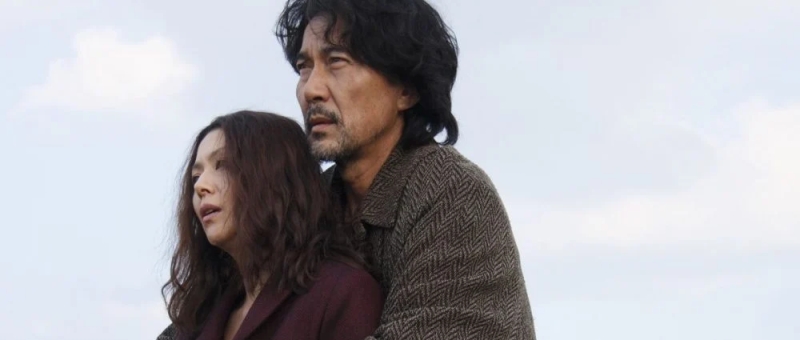
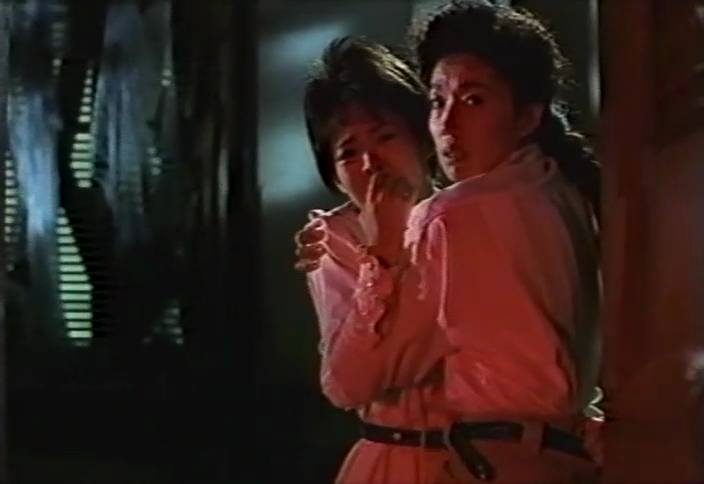
Driving through the city by night, a young woman finds herself plagued by a mysterious force while struggling to break out of her self-imposed inertia in Shunichi Nagasaki’s moody thriller, Stranger (夜のストレンジャー 恐怖). The film’s Japanese title, “night stranger terror”, perhaps more clearly hints at a sense of urban threat while surrounded by so many unfamiliar people, yet it is in many ways Kiriko’s (Yuko Natori) mistrust and suspicion that isolates her from the surrounding society and keeps her trapped in a kind of limbo unable to escape her past.

It might be tempting to read her aloofness as a direct consequence of her experiences, but in an early scene when she was still a bank employee we hear a colleague criticise her for being “anti-social” while Kiriko’s rejection of her seems born more of contempt than shyness or a preference for solitude. Working as a cashier at the bank at the tail end of the bubble is a pretty good job, especially given the still prevailing sexism of the working environment, that positions Kiriko firmly within an aspirant middle-class. She still lives at home surrounded by her family, but is in a relationship with a man who pressures her for money to invest in the stock market. She begins embezzling and lives as if there’s no tomorrow, splashing out on fancy sunglasses before meeting her boyfriend having left work early feigning illness. Unfortunately for her, she gets caught and her boyfriend predictably abandons her.

Just like the asset bubble, her life implodes and plunges her into a lower social stratum as a woman with a criminal conviction for financial impropriety and a hefty debt in needing to pay back the money she stole from the bank for her ex’s harebrained stock speculation schemes. All in all, you could say she’s been betrayed by economic forces, but also as she later admits, but her own uncertain desires in being wilfully deceived by Akiyama (Takashi Naito) and making a clear choice to defraud the bank. She realises that it might not have been a desire to please Akiyama that led her to do it, but the illicit thrill she felt in tapping away on her keyboard stealing the money and otherwise being in a position of economic power over a man, buying him things and taking him out for fancy food. Her sense of malaise is only deepened when she meets Akiyama by chance and tries to tell him all this, but he isn’t really interested. He seems to have moved on and planning to marry another woman. 

Kiriko tries to look at his hands to see if he has burn scars like the man who attacked her in her taxi, but he doesn’t. Perhaps there was a small part of her that wanted it to be him. At least if it was, it would mean he still felt something for her, which would also prove that he ever did. And it would make sense, which is less frightening than her stalker just being a nutty fare, another irate man with a nondescript grudge wandering the city. Taxi driver is one of the few jobs open to her with a criminal record, but it’s also an unusual profession for a woman which further isolates her in her working environment. Her boss keeps calling her “little lady,” while patronisingly offering to put her on the day shift because it’s less dangerous. Kijima (Kentaro Shimizu), an obnoxious colleague, picks at Kiriko for thinking everyone who strikes up a conversation must be sexually interested in her. But the truth is that they are and like Kijima demand her attention. When they don’t get it they’re pissed off. The cab is perhaps the place she feels the most safe, though she faces her fair share of weird fares from drunk men trying to flirt to religious maniacs proselytising from the back seat. 

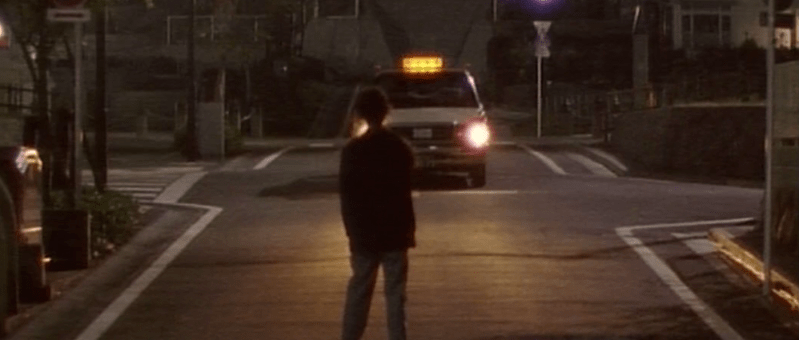
Now living alone in an apartment, her aloofness is both a personal preference and means of punishing herself. When her brother calls, he encourages her to come home but she says she can’t even though she wants to because she hasn’t yet dealt with her past or taken steps towards being able to forgive herself. She tells Kijima, who in truth behaves in an incredibly creepy way that suggests she’s right to avoid him, that she wonders if she isn’t the only one who can see the mysterious Land Cruiser, as if she were really imagining it. The Land Cruiser does indeed come to stand in for the buried past by which Kiriko is haunted and her eventual besting of it is a symbolic act that suggests she’s finally managed to overcome her guilt and shame to be able to leave the past behind.

As she told Kijima, this was something only she could do by her own hand or none. Akiyama’s dismissiveness of her reflects the fact that he couldn’t give her this absolution either, she needed to find it for herself. Kijima accused her of still being hung up on the guy that scammed her, but that wasn’t quite it. The resolution might hint at his being right when he told her that she needed to learn to trust people more in that it seems to lead to a greater willingness to open herself up to the world. Once again, her sunglasses get broken as a new truth becomes visible to her. A lonely little boy she meets who, like her, enjoys driving in circles and going nowhere, probes her lack of human connection by suggesting that she doesn’t know what it’s like to love someone which is why she can’t understand his obviously inappropriate love for her, though it’s a fact that Kiriko has to acknowledge is truth in interrogating the reality of her relationship with Akiyama.

Nevertheless, in the end, she saves herself and embraces her solitude and independence looking out at the peaceful bay in a city that no longer seems so threatening even if the unseen threat in this case did turn out to be random and have no rational explanation. Nagasaki never again worked in the realms of V-Cinema and his entry is fairly atypical in starring an older, established actress as an action lead while requiring no nudity or sexual content, instead quite literally allowing her to grab the wheel and take control of her life to claim freedom and independence rather than solely romantic fulfilment.
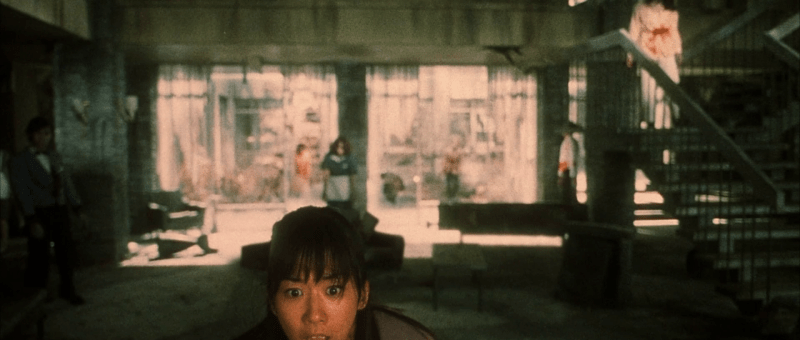
Reincarnation (輪廻, Takashi Shimizu, 2005)

Do our memories just vanish when we die? The murderous professor at the centre of Takashi Shimizu’s Reincarnation (輪廻, Rinne) was apparently obsessed with just this question, along with that of where we come from when we’re born and where we go when our corporeal lives have ended. But there’s a curious irony at the film’s centre in the ways in which we consciously or otherwise seek to recreate the past that suggests we are locked into a karmic cycle even while within the mortal realm.

The most obvious sign of that is the director Matsumoto’s (Kippei Shina) obsession with the grisly murder case that took place 35 years previously. He means to recreate it literally by building an exact replica of the hotel where it took place, only he intends to refocus the tale on the victims, leaving the killer a mysterious force in the shadows. It’s clear that this traumatic incident has left a mark on the wider world, not only in its lingering mystery but the darkness with which it is enveloped, while Matsumoto seeks to exploit it either for commercial gain or reasons of his art. We’re told that, perhaps like Shimizu himself, Matsumoto is known for a particular kind of filmmaking, in his case one involving copious levels of blood and gore. 

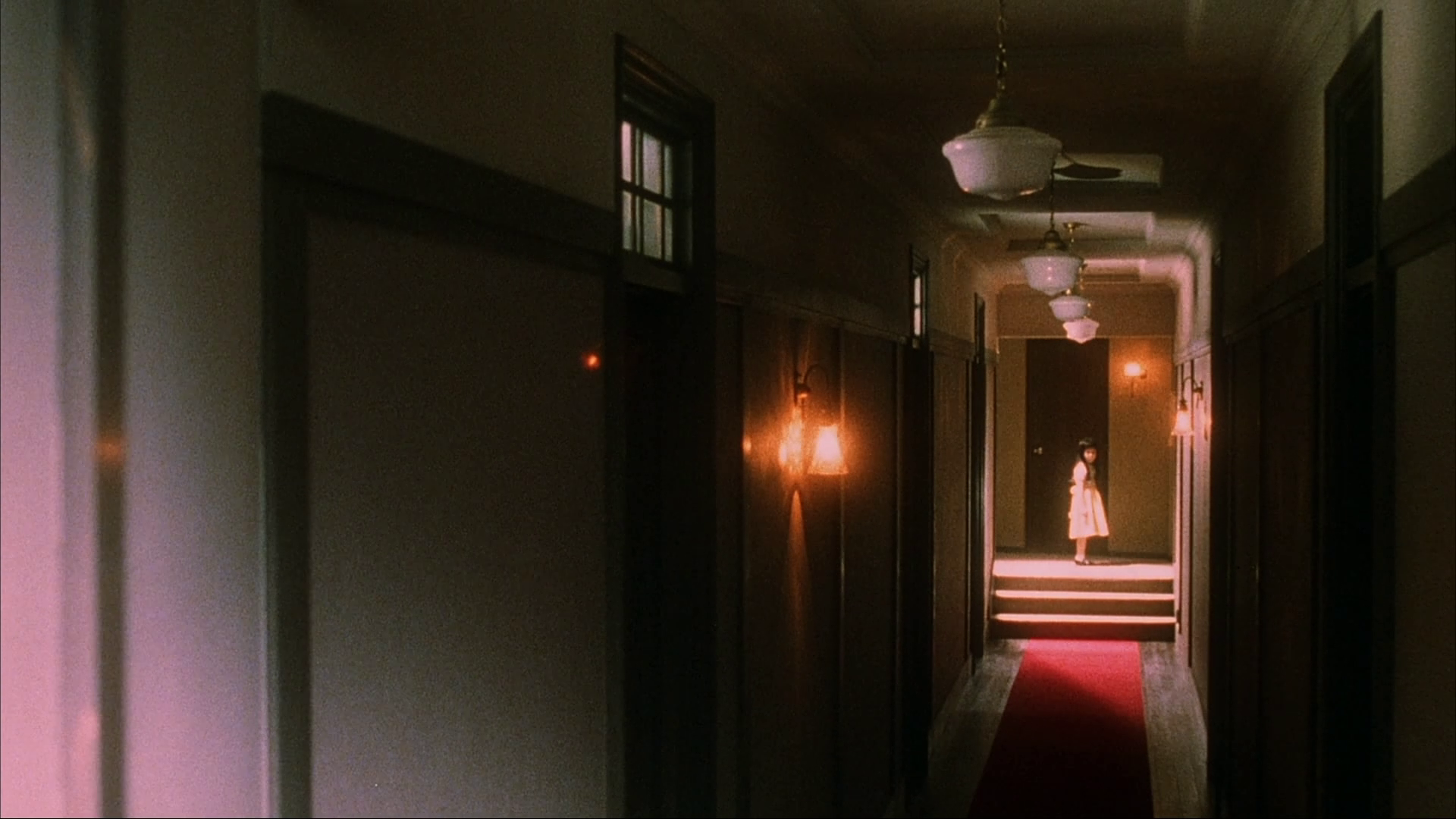
He’s drawn to aspiring actress Nagisa (Yuka) for unclear reasons, though her affinity for the material connects her intensely with this story as she too finds herself haunted by the figure of a little girl in a yellow dress carrying a huge and actually quite creepy doll. There is a sense that everyone is being drawn back here into the nexus of this trauma to play it out again, ostensibly for entertainment. Another actress at the audition, Yuka (Marika Matsumoto), seemingly kills her chances by bringing up that she has memories of being murdered in a past life and thinks that she might be able to put them to rest by acting them out. She too is connected to the hotel and possibly a reincarnation of a woman who was hanged during the incident, which is why she bears an eerie noose mark around her neck. 

Yuka is more literally scarred by a traumatic legacy, while those around her are merely curious or confused. Yayoi (Karina) has recurring dreams of the hotel which her parents can’t explain, leading to the suspicion that she too is a reincarnation of someone who died there, though all of the women were born long after the incident took place. Her professor at university (Kiyoshi Kurosawa) is cautious when it comes to the idea of the authenticity of memory. He teaches them about the concept of “cryptomnesia”, when a forgotten memory is recalled but not recognised as such, leading to accidental incidents of plagiarism in which the subject assumes their idea is original rather than a regurgitation of something they saw or heard long before but no longer “remember”. There is also, of course, the reality that many of our “memories” are effectively constructed from things others have told us of our childhoods that we don’t actually recall but are a result of our brain trying to fill in the blanks. Perhaps this might explain Yayoi’s dreams, that she came across the famous case at some point when she was too young to understand it and it’s implanted herself in her subconscious as an unanswered question.

Which is to say that perhaps it’s the memories that are being reincarnated in someone else’s head as much as it’s the disused hotel that’s become a place of trauma haunted by past violence and now inhabited by the pale-faced ghosts of those who died unjustly. The events themselves are constantly repeating just as the moments exist contemporaneously rather than in a linear cycle. Indeed, they are eventually preserved both through the film shot by the killer, witnessed as a document, and the film that Matsumoto was making, enjoyed as entertainment, but ultimately in Nagisa’s head where all concerned can indeed be “together forever” if now confined to eternal rest in the space of memory.


Trailer (no subtitles)

Cloud (Cloud クラウド, Kiyoshi Kurosawa, 2024)

“We wanted to make easy money,” a down-on-his luck reseller admits, “is life easy now?” Factory worker Ryosuke (Masaki Suda) rebels against capitalism by subverting it through buying low and selling high while repeatedly refusing promotions at his job in a textiles factory. Though it might seem that reselling is just a way to earn an income that seems almost passive but is actually fairly labour-intensive, it’s clear that Ryosuke is a young man dissatisfied with capitalistic realities and lacking direction in his life. 

Reselling has become a kind of game to him and like a gambler who plays to lose he’s hooked on the thrill of making a killing exploiting other people’s misery. He’s at once filled with pride and smugness over his apparent triumph over his society and consumed by self-loathing. His friend and fellow reseller Muraoka (Masataka Kubota) tells him that another acquaintance has been arrested for scalping concert tickets with both of them lamenting his foolishness in getting involved with something so risky. The implication is that their friend, Goto, must have been in real desperation to lower himself to such levels and they each fear they may someday end up in the same position. Muraoka laments that that kind of selling is a young man’s game and neither of them have the time or energy to spend all day queuing to buy stuff just to sell it on cheap. They are each, it seems, beginning to feel the increasing desperation of their age that they are running out of time and have little to show for their efforts nor any prospects for the future. 

But on the other hand, neither of them want to be locked into the grind or join the oppressive but secure world of the salaryman. In many ways, Ryosuke’s factory boss Takimoto (Yoshiyoshi Arakawa) represents the “correct” path of hard and honest work, though his own paternalistic conviction in meritocracy seems outdated in a man of his age whose formative years occurred during an era of economic stagnation. He talks to Ryosuke as if he’s a young man who wants to get on but lacks confidence, telling him that he has leadership potential and is wasted on the shop floor, but his language also has an edge of the uncanny as if he were trying to recruit Ryosuke into his own worker drone revolution. In any case, even if it might be true that Ryosuke lacks confidence and ambition, that isn’t the reason he refuses promotions, which seems to be another way of rebelling against capitalism. When he eventually quits, he suggests it’s because he’s sick of being told what to do and wants more autonomy over his life and finances.

He tells his girlfriend Akiko (Kotone Furukawa) that she should quit her job too, which she’s only too happy to do because, unlike him, she actively doesn’t want to work and only wants to spend money. When she said she was thinking of giving up her apartment, Ryosuke naturally asked her to officially move in but she refused because his place is too small and she has too much stuff. Akiko has already been corrupted by the same consumerist bug that’s driving Ryosuke’s reselling business, but neither of them can really afford this lifestyle in the city. Ryosuke’s bright idea is to move to the remote countryside where he’s able to rent a huge, though ominous-looking, property for a fraction of the price with the idea of also economically supporting Akiko who will revert to traditional gender roles as a housewife in charge of the domestic space and most especially the kitchen.

But freedom cannot be found simply by retreating from urbanity and the couple soon find themselves plagued by a pervasive sense of resentment. The locals are not particularly accepting of people from Tokyo and are also needled by their success which is something they feel they’ve been unfairly denied. When Ryosuke tries to report a smashed window, even the policeman hassles him and says he’s received a tip-off that Ryosuke is breaking trading standards regulations by selling counterfeit goods as the real thing. Reselling in itself is not illegal, if definitely dubious morally and incredibly cynical. Ryosuke doesn’t seem to like to think about that and tells his new assistant, Sano (Daiken Okudaira), that he tries to sell all the items as quickly as possible so he doesn’t have to worry too much about their authenticity. If they’re wanted they’ll sell, Ryosuke justifies but he might as well be talking about himself.

“Being real or fake doesn’t matter?” Sano asks him, just as Ryosuke’s online and offline personas start to blur. He’s unaware that there are people actively hunting him for selling them substandard goods and is later pursued by real life vigilantes acting like online trolls and planning to torture him to death during a livestream. Like many of Kurosawa’s heroes, Ryosuke is completely convinced that he’s the benchmark for normal and it’s everything around him that’s strange or unfair. As the internet once again invades the “real” world, or perhaps it’s more that Ryosuke’s living his online life offline, the increasing unreality of the situation makes us wonder if any of this is “really” happening or product of Ryosuke’s fractured identity as it finally collapses under the twin corruptions of capitalism and social media. “Please keep focusing only on making money,” his new guardian angel Sano tells him, “everything will be obtainable. Whatever you want. Even things that can end the world.” Flying through ironically heavenly clouds, Ryosuke reflects that the path to hell really is paved with gold and his Mephistophelian pact with hyper-capitalism may have damned him beyond all repair.  


Cloud is in cinemas from 25th April courtesy of Blue Finch Film Releasing 

UK trailer (English subtitles)

Tokyo Sonata (トウキョウソナタ, Kiyoshi Kurosawa, 2008)

Orphaned salarymen are the soulless ghosts haunting an increasingly empty city in Kiyoshi Kurosawa’s eerie tale of urban anxiety Tokyo Sonata (トウキョウソナタ). Undermining the certainty of the traditional family, Kurosawa paints it as a simulacrum dependent on each member playing their respective role blindly or otherwise, though in this case the integrity of the family unit is shaken by an economic intervention in which the accepted rules of the society have been upended with a vindictiveness that seems inexplicably unfair. 

This is the bargain of the salaryman dream. A man like Sasaki (Teruyuki Kagawa) now aged 46 came of age at the tail end of an era of economic prosperity. He was brought up in an atmosphere of jobs for life in which the corporate family was almost more “real” than the emotional which is one reason why it comes as such a shock when his boss effectively divorces him. He’s found someone new, planning to outsource Sasaki’s entire department to China while less than kindly explaining that as he has no other skills he of no more use to the company. Sasaki immediately clears his desk in anger, walking home early with a pair of carrier bags then, after meeting his son in the street, attempting to climb in through an upstairs window to avoid alerting his wife, Megumi (Kyoko Koizumi), to the fact he’s home early.

Sasaki is unable to tell her that he’s lost his job in part because of the acute embarrassment it would cause him. Somewhat dazed and confused, he’s become one of many disenfranchised salarymen who survived the 15 years of economic stagnation only to have the rug pulled out from under them. Being a salaryman was in a way his whole identity and without it he doesn’t know who he is, which is one reason he puts on a suit every day and goes to sit in the park surrounded by other similarly dressed men with briefcases who now seem to haunt the city like crows ominously dotting the horizon. In a repeated motif, Kurosawa shows us people trapped in kafkaesque queuing situations shuffling around buildings while prevented from moving forward but forced to keep pace with the increasingly glacial environment. At the moment an old school friend he runs into, Kurosu (Kanji Tsuda), seems to give up he is swept into a great parade of the suited and hopeless while Sasaki hovers on its edges. 

It’s this threat to Sasaki’s masculine pride which is largely founded on his economic ability to support a family that kickstarts a chain reaction in his home even he becoming increasingly violent and authoritarian in an effort to overcome the sense of humiliation and powerlessness he feels after being made “redundant”. His younger son, Kenji (Kai Inowaki), tells him he wants to learn the piano but Sasaki irritably shuts him down either because he’s now worried about the money or simply sees it as a frivolous waste of time. Later when Megumi asks him why he won’t he change his mind he insists that he has to stick to his original decision otherwise it would undermine his patriarchal authority as a father. 

But this “authority” was perhaps already largely illusionary given that an intense work schedule meant he was rarely home to do much parenting. After finding out Kenji spent his lunch money on piano lessons behind his back he ironically shouts at him for lying and keeping secrets even though this is obviously what he himself has been doing in keeping up the illusion of his identity as a conventional salaryman. His older son, Takashi (Yu Koyanagi), was keeping secrets too his being his desire to join the US military believing that Japan no longer has a future for him in an atmosphere of stagnation not only economic but emotional and spiritual. Takashi tells his mother she should leave Sasaki, but to her question of who would play the role of mother replies that it makes no difference simultaneously encouraging her to reclaim an individual identity and perhaps robbing her of one just as Sasaki lost his in being shorn of his salaryman credentials. 

Lying on the sofa one evening she raises her arms and poignantly asks someone to lift her up but Sasaki has already gone to bed without even looking at her. Her life as a housewife is thankless and emotionally unfulfilling. Donuts she spent ages making go uneaten while her husband and sons brood on their own problems alone. At a car dealership, the salesman shows her a people carrier explaining that it’s perfect for family camping trips while she gravitates towards a red convertible, mesmerised by the way the roof can just disappear as if it were literally freeing her of her stultifying existence. On showing Takashi the shiny new driving license she’s just got as a symbol of her desire for independence, he scoffs that she’ll never use it but she counters him that it’s for “ID” which it is in more ways than one.

The family is imploded, the illusions of a conventional middle-class life upturned as Sasaki and Megumi each ask themselves if there’s a way to start again and escape their sense of middle-aged futility and disappointment. Cracking under the weight of conventionality, the foundations begin to fracture but the family nevertheless finds itself returning if with greater degrees of clarity and perhaps with less inclination to play the play the roles assigned to them rather than those they might wish to play as embodied by Kenji’s moving performance at the piano capturing all of the chaos and confusion of the world around him but finding in it also harmony and a gentle breeze that feels almost as if the city itself were breathing once again.


Tokyo Sonata screens Feb. 18 as part of Family Portrait: Japanese Family in Flux

International trailer (English subtitles)

The Guard From Underground (地獄の警備員, Kiyoshi Kurosawa, 1992)

Ever feel like your job is trying to kill you? Released at the tail end of the Bubble era, Kiyoshi Kurosawa’s The Guard from Underground (地獄の警備員, Jigoku no Keibin) positions an office building as an industrial hell complete with a demon living in the basement but grimly suggests it’s just one of many hazards to be aware of for a woman in the corporate environment. Then again, the hellish guard himself has a sorrowful look in his eyes that speaks of true loneliness and might evoke pity if only in the fatalistic inevitability of his office-bound killing spree. 

It has to be said, Akebono Trading should have another look at its hiring procedures through in any case there’s something odd about this building which feels more like an abandoned hospital than a place of business while we might also wonder why we’re seeing signs for cargo depots and engine rooms and staff getting locked in the filing room is apparently not an uncommon occurrence. The new security guard has the same name as a former sumo wrester acquitted of the murders of his stablemate and lover on the grounds of temporary insanity, Fujimaru (Yutaka Matsushige), and is himself a hulking presence, tall but of medium build so who knows if it’s really the same guy or just the office rumour mill going into overdrive.  

Meanwhile, the other new recruit is a refined young woman, Akiko (Makiko Kuno), who’s been brought on as an art expert to help a new division recently diverted into prospecting with art sales to assess what is and isn’t a fair market price for a priceless piece of art. As Akiko admits, she’s not well placed to give that information because her background is in curation so she’s not particularly well versed in the collector market but presumably the job pays a bit better than the museums sector so she’s trying to do her best. Her new boss, Kurume (Ren Osugi), is a bit of a weirdo (like all the other men in the building) and crassly remarks that paintings like women have no value if there’s no buyer while she struggles to understand what the point of her job is. Meanwhile we’re left to wonder if Section 12 is actually a real department at all or a shady enterprise set up to help the enigmatic boss, Hyodo (Hatsunori Hasegawa), improve his investment portfolio which will probably serve him well when the bubble finally bursts. 

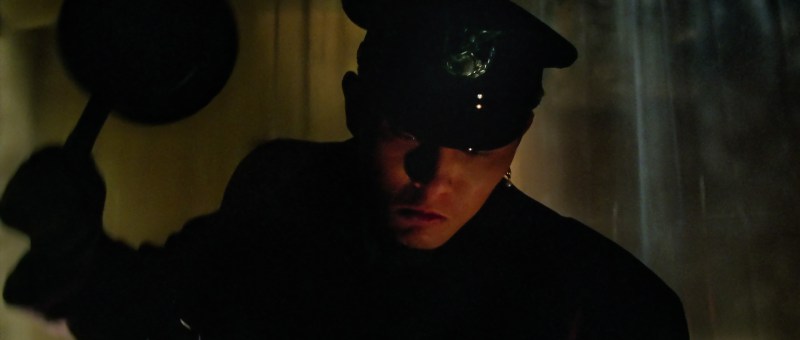
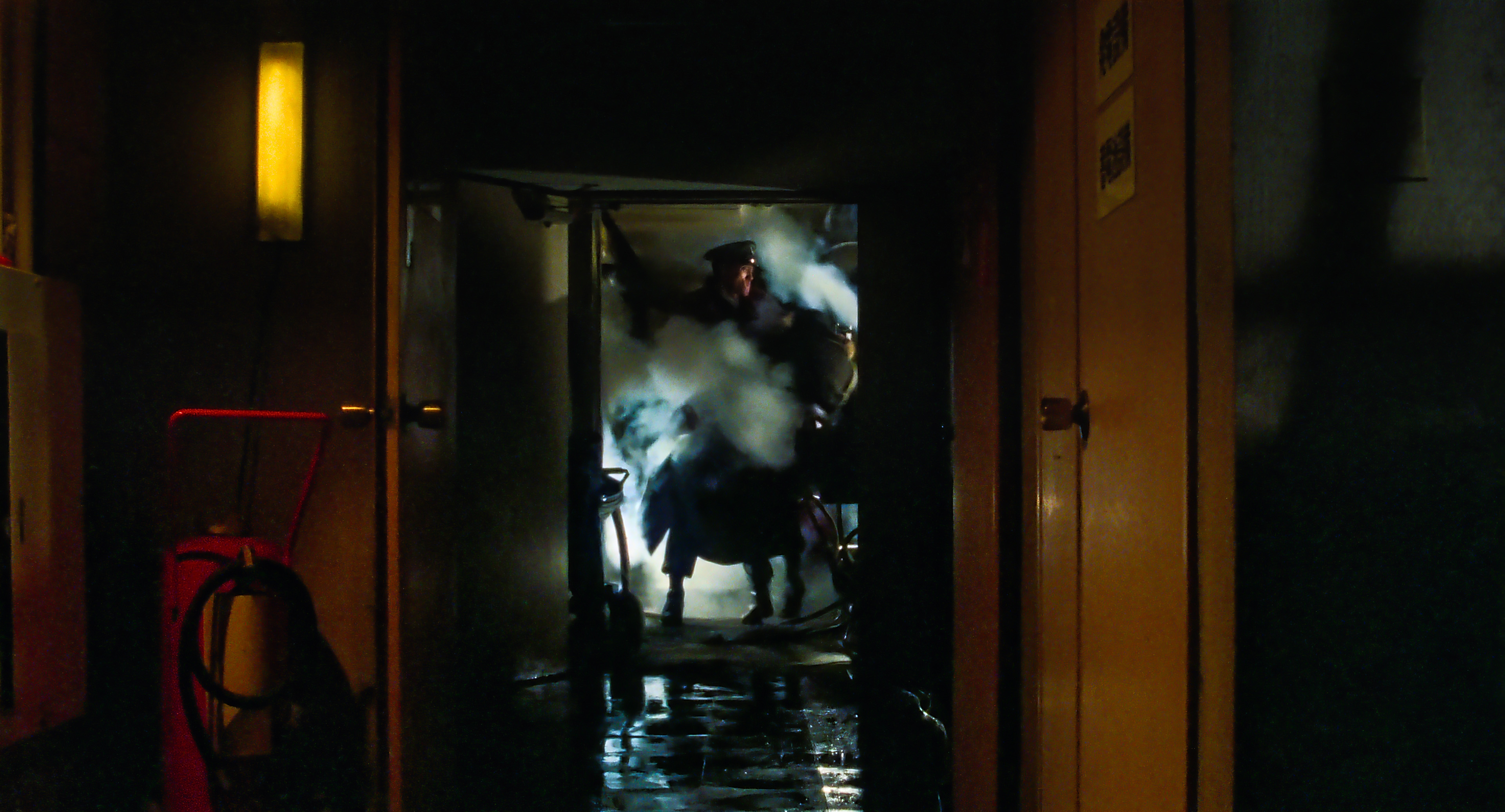
It’s tempting to read Fujimaru as a personification of corporate culture slowly picking off the employees and largely doing so by means of the building itself, electrocuting them by forcing their hand on the circuit breaker, bashing one inside a locker, or otherwise using his security guard’s truncheon to bludgeon them to death. To begin with, it seems as if he’s developed a fondness for Akiko and while that may be true in the same way King Kong develops a fondness for Fay Wray, it soon becomes clear that he isn’t in fact trying to protect her by taking out all the skeevy guys but seemingly killing for no reason. He looks a painting of Goya’s Saturn Devouring His Son with fascination, again hinting at his nature as the personification of capitalistic corporatism devouring the employees who might one day overthrow him, yet also lends the guard an eerie, mystical quality suggesting he merely enjoys the act of carnage though he does not actually eat anyone (that we see). More than that he seems almost like Frankenstein’s Monster, somehow lonely in identifying his otherness as he eventually confesses to Akiko remarking that “desolate time” flows through him unlike her “kind”. As he leaves, he pleads not to be forgotten. 

Akiko defeats him by refusing to believe his story and declaring herself disinterested in his truth possibly stood in good stead by the constant necessity of evading the attentions of the men around her such as those of Kurume who starts off giving paternalistic advice about looking after her parents and the preferential savings rates on post office accounts before randomly taking off his trousers. Anticipating his later career, Kurosawa makes the office a place of lurking dread and anxious eeriness only deepened by its industrial aesthetics along with the tiny windows leaking apocalyptic lighting from the oblivious outside world now cut off except for the new/old teletype text and ironic benefits of international time zones. “Traffic’s hell this time of day” a taxi driver chirpily advises, ironically delivering his passenger straight into its fiery depths. 


The Guard From Underground is released in the UK on blu-ray on 25th September courtesy of Third Window Films.

Trailer (English subtitles)

Sweet Home (スウィートホーム, Kiyoshi Kurosawa, 1989)

A documentary film crew hoping to discover long-hidden frescos by an artist with a tragic history find themselves on a quest to resurrect the traditional family in unlikely horror comedy Sweet Home (スウィートホーム). Written and directed by Kiyoshi Kurosawa, the film shares many of the hallmarks of his later career in his preoccupation with what lurks in the shadows, yet produced by Juzo Itami who also stars and apparently reshot some scenes himself it also mines a deep seam of ironic humour harking back to classic serials and contemporary kids adventures in the same way as Hiruko the Goblin among others would do just a few years later. 

This strain of irony is perceptible in the opening scenes in which producer Akiko (Nobuko Miyamoto) appears in an elegant ’40s-style outfit more in keeping with an archeological dig than a haunted house adventure, her later attire strongly recalling that seen in Indiana Jones. The gang are waiting by their military-style jeep seemingly in the middle of a sandstorm while chief producer Kazuo (Shingo Yamashiro) is busy at the municipal office trying to get permission to enter the Mamiya Mansion which has been shut up for the last 30 years since the death of legendary artist Ichiro Mamiya who is the subject of their documentary. A diffident man as his daughter jokes, Kazuo finds it difficult to make headway until a slightly more cynical employee takes over the negotiations and hands over the key with the rationale that they’ll either find out the house isn’t haunted after all in which case they can turn it into a museum, or that they’ll get some tidy publicity out of the horrifying deaths of all concerned. 

A western-style gothic mansion, the house is itself as imposing as it is ominous even without swirling mists or hovering gloom. Once inside the crew find what they’re looking for, a beautiful fresco with the title “home sweet home” painted in a corner. All we’re told about Ichiro is that he died in the house, but when all is said and done he, like Kazuo, is not terribly important and it is not his death which has cursed the mansion but that of his wife. The sweet home the couple had dreamed of was coming to fruition with the long-awaited birth of a child whose life was to inspire frescos on the remaining walls only tragedy struck. As a toddler the child somehow climbed into the furnace and was burnt alive when his unknowing mother ignited it. She then went mad, kidnapping other children and apparently burning them so her child would not be lonely before eventually throwing herself in too.

Perhaps uncomfortably, Sweet Home leans in to the kind of maternal questioning common to the genre as it considers the formation of a new family in the awkward romance between the shy widower Kazuo who has brought his teenage daughter Emi (Nokko) along on the job, and capable producer Akiko who is repeatedly questioned about marriage, children, and the reasons she currently has neither of them. Keying in to the terror of the house, Emi reveals that as she grows older the memories of her birth mother begin to fade to the extent that she can barely make out her outline, envisioning her merely as an indistinct light. She is prepared to accept Akiko as second mother, offering her the dress which her own mother used to wear only for Akiko to diffidently refuse on the grounds that the dress should be worn by Emi as her mother would have wanted perhaps hinting at the way Emi often treats her father as a clueless child in need of mothering himself. 

Nevertheless, it’s the dress of maternity that Akiko must finally put on in order to claim the maternal space in venturing back into the haunted house in order to save Emi from becoming another playmate for Mrs Mamiya’s child. Rather than Kazuo, who proves rather ineffectual, she is guided by a weird old man, Yamamura (Juzo Itami), from the petrol station who apparently knows all about fighting ghosts but bluntly tells her she has no chance of success because she is not a mother herself and cannot understand the pain of a mother who has lost a child nor the magnetic pull between a childless mother and motherless child. In order to defeat the vengeful spirit, Akiko must fully embrace the role of the mother, easing the spirit’s pain with maternal compassion in returning to her what was lost. Her child restored to her, the spirit takes on the appearance of the Holy Mother ascending to Heaven bathed in golden light lifting the shadowy gloom that cursed the house. 

Even so there is something insidious in the fact that as Yamamura says if you attempt to fight shadow with light all you get is more of the same, the crew trapped in the house with no means of defence against the encroaching darkness. This unknown, shadowy sense of threat, of being swallowed by darkness, is a key harbinger of a Kurosawa’s signature style as well as a clear evocation of the gothic dread focused on the house with the ironic failure of the “sweet home” dream which is in essence what Akiko, Kazuo, and an Emi are chasing as they try to escape the haunted mansion. Ironically enough, Sweet Home has become best remembered for fathering a video game which eventually led to the Resident Evil series while Kurosawa himself has all but rejected the film claiming Itami’s later interventions undercut his directorial vision. Featuring effects work by Dick Smith, the horror is visceral and disturbing at one point a man’s face melting, his skin slipping from his bones, while the score is cheerfully whimsical in keeping with the absurd lightness of tone that recalls classic teen adventures before heading into the fable-like conclusion in which Akiko must wrest her surrogate child from a vengeful spirit through maternal exchange. Having served its purpose the mansion implodes, freeing not only the spirits trapped inside but the new family now freed of the weight of traditional mores to embrace their new connection founded on love and empathy rather than duty or convention.


Original trailer (no subtitles)

Wife of a Spy (スパイの妻, Kiyoshi Kurosawa, 2020)

“If the times have changed you, couldn’t you have changed the times?” the spy’s wife not unreasonably asks of a man she knew to be good and kind yet has done terrible things, perhaps, as has she, out of a misplaced love. Travelling from death is eternal loneliness to love is our salvation, Kiyoshi Kurosawa’s Wife of a Spy (スパイの妻, Spy no Tsuma), co-scripted by Ryusuke Hamaguchi and Tadashi Nohara, picks up a thread from Before We Vanish TV companion Yocho (Foreboding) to suggest that love can in fact be as destructive as hate in its all encompassing single-mindedness as an ordinary housewife uninterested in politics is caught between her progressive, compassionate and aristocratic husband and a childhood friend with an unrequited crush who has since become an ardent militarist. 

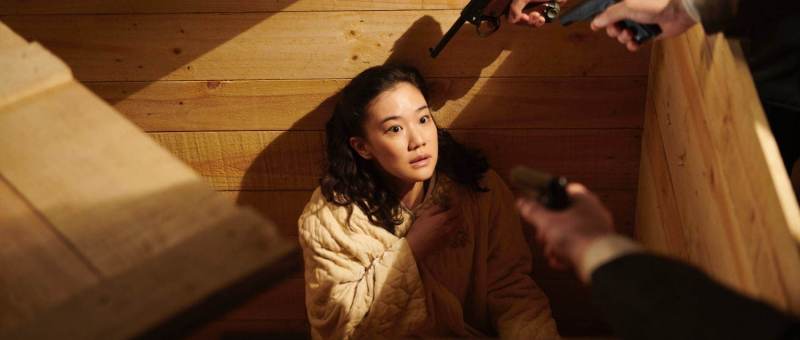
Set in Kobe in 1940, the film opens with a portly British textile merchant, Drummond, dragged from a silk inspection centre by the military police on the suspicion of being a foreign spy. This is appears not to be the case, but as in much of the narrative little is as it seems. The British merchant is a friend and associate of Yusaku Fukuhara (Issey Takahashi), the chairman of a family-owned textile company whose main objection to the idea that Drummond is a spy seems to be that a man of such copious proportions hardly fits his mental image of the word. Yusaku is nevertheless questioned by the local squad leader, Taiji (Masahiro Higashide), who happens to be a childhood friend of his wife Satoko (Yu Aoi), and later risks implication by paying Drummond’s bail. Satoko approves of this decision even if it may be politically unwise, confessing that she thought it “heartless” that Yusaku was messing about making a silent movie in which she starred as a femme fatale spy eventually killed by her lover/rival while his friend was in custody. “You’re always looking so far ahead of me, I feel like a fool” she reflects though as we’ll see she’ll soon be taking him on at his own game, the couple dancing around each other in a deadly waltz of love and betrayal. 

When Yusaku declares that he’s planning to visit Manchuria, partly for adventure and partly on behalf of a doctor friend, Satoko’s main concern is his impending absence though his return brings her little peace. After a woman he and his nephew Fumio (Ryota Bando) had apparently befriended and then brought home is found dead, Satoko makes a dark discovery driven at once by jealousy in Taiji’s vague hints that Yusaku may have been romantically involved with the dead woman, and resentment in realising he is keeping something from her. That something turns out to be his intention to expose the atrocities he witnessed in Manchuria committed by doctors connected to the Kwantung Army. 

Yusaku’s motives for this are rather naive, believing that it will bring the Americans into the war and hasten a Japanese defeat bringing an end to the militarist folly. Nevertheless, the discovery forces the couple into an ideological confrontation, Yusaku insisting that he is a “cosmopolitan” whose allegiance lies in “universal justice” rather to than any nation. To him happiness founded on injustice is an impossibility, while Satoko declares herself able to unsee the inconvenient truth in order to preserve the status quo reasonably pointing out that Yusaku’s “justice” will necessarily result in the deaths of thousands of innocent people. It’s at this point, however, that the tables turn, Satoko setting in motion a series of machinations which at first appear naive and counterproductive but are in fact infinitely ruthless. 

“I’m not afraid of capture or death, I’m only afraid of being separated from you” Satoko insists, willing to burn the world to save her love if also later moved on “seeing” for herself the reality of Japanese abuses in Manchuria. Taking on the role she had played in their silent movie, Satoko becomes the spy revelling in her ruthlessness yet this spy game revolves around the ability to correctly read the emotional lives of others. Having been “warned” by the austere Taiji that she and her husband were too Westernised for the times with their expensive foreign whiskey and international fashions, Satoko puts on kimono in order to curry favour with him hoping to leverage his unrequited love for her. Yusaku meanwhile perhaps banks on something similar, each of them ironically manipulating the apparently conflicted militarist in the conviction that his love is pure and he will therefore continue to protect Satoko, and by extension her husband, as a means of protecting himself. 

Early on, Taiji had confessed to Yusaku that he disliked arresting people which may have been a thinly veiled threat, but also bears out Satoko’s conviction that he is at heart a gentle person though we’ve not long seen him rip out one man’s fingernails in order to present them to another as a warning. Unrequited love has perhaps thrown him into the arms of militarist austerity, hardening his heart while his ardour is sublimated into a misplaced love of country that allows him to justify such heinous acts of inhumanity.  “Hard choices must be made to achieve greet deeds” Satoko herself had said in order to excuse her own act of injustice in sacrificing another man on Yusaku’s behalf, only to later face the same fate in an ironic turn of events either vengeful betrayal or protective act of love depending on how you read the emotional intentions behind them. 

Just as in the silent movie, incongruously scored with a poignant Japanese cover of Jerome Kern & Oscar Hammerstein II’s Make Believe, everyone is playing a role, engaging in an act of deception if only self-directed, yet their act perhaps exposes the truth they were attempting to hide, the spy’s wife becoming the spy but beaten at her own game unable to see the entirety of the board. Commissioned as an 8K feature for a Japanese TV channel, the incongruity of the hyperreal digital photography deepens the sense of the uncanny in the unexpected naturalism of the period setting, a world of constant anxiety with soldiers on the streets and the feeling of being forever watched in the oppressive atmosphere of authoritarian militarism, while standing in strong contrast with the unreality presented by the films within the film both that made by the couple and the brief yet ironic inclusion of Sadao Yamanaka’s Priest of Darkness, another tale of infinite duplicities, given that the director had himself become a casualty of war on the Manchurian front two years previously. Ironically titled, Wife of a Spy situates itself in a state of permanent paranoia in which nothing and no-one is as it seems and love may in its own way be the most destructive force of all while containing within itself the only possible source of salvation no matter its veracity.  


Wife of a Spy  screens on Aug. 27 as part of this year’s Japan Cuts.

International trailer (English subtitles)

Karisome no Koi (“fleeting love”) – Chiyoko Kobayashi (1936)

To the Ends of the Earth (旅のおわり、世界のはじまり, Kiyoshi Kurosawa, 2019)

To the Ends of the Earth poster 2“It’s like a little journey you can take without going too far from home” a bubbly variety TV presenter announces partway through To the Ends of the Earth (旅のおわり、世界のはじまり, Tabi no Owari Sekai no Hajimari), reporting from a rundown theme park the like of which she claims you hardly ever see in Japan anymore. It might as well encapsulate her life as the host of a TV travel programme directly aimed at people who prefer to take their pleasures vicariously. Kiyoshi Kurosawa’s long career has been, in an odd sense, moving into the light. Where death was once eternal loneliness, he now tells us love is what will save us in the end, if only we overcome our fear of each other.

Yoko (Atsuko Maeda), a 20-something TV “reporter” for a variety show, is an intensely anxious young woman. In her postcards home to her firefighter boyfriend, she tells him that she feels “safe” now that they’ve arrived in a big, modern city, but, somewhat ironically, asks him to try and stay away from dangerous places. Currently shooting in Uzbekistan, she finds herself doubly isolated – both because she is a lone woman travelling with an all male crew, and because she is the star and therefore not included as a part of their team. Though they call her a “reporter”, it’s clear that the temperamental, insensitive director Yoshioka (Shota Sometani) does not value her editorial opinion and sees Yoko more or less as a kind of prop.

When we first meet her, Yoko is being forced to deliver a direct to camera speech from the middle of a “fake lake” which, as she explains, is more like a big puddle created by accident during a Soviet-era irrigation project that didn’t quite go to plan. During the course of the filming, we watch her effortlessly switch between the super “kawaii’ presenter who has to pretend the undercooked food she’s just been handed (that will probably make her ill) is the best meal she’s ever tasted, and the dejected young woman growing ever more resentful about her corrupted authenticity. Nervous and under-confident, she finds herself bullied by the demanding director, feeling as if she’s obliged to put up with whatever he asks her to do even if it compromises her safety.

Later, at the theme park, the owner of the ride Yoko is supposed to “enjoy” expresses concern, firstly claiming that it’s not suitable for women, and then apparently mistaking Yoko for a child. He doesn’t clarify if there’s actually a safety issue, that the ride is calibrated for a certain size and weight and might be dangerous for a slight woman as opposed to a beefy man, but in any case Yoko is made to ride it three times in quick succession. Akin to something they put astronauts and fighter pilots in to prepare them for coping with G-force fluctuation, it is not particularly fun but still Yoko is obliged to giggle like a giddy school girl every time before finally collapsing as if she’s about to go into nervous shock. A few moments later, however, she stands in front of the camera to give another cheerful speech about just how much fun she’s having.

Yet we also see her attempt to fight back against her sense of anxious powerlessness by actively asserting her independence. She leaves her hotel and takes a bus, a complicated affair when she doesn’t speak the language or understand where she’s going, visiting a local bazaar where she attracts not a little attention, some of the saleswomen even attempting to physically grab her in order to sell their wares. She feels the male gaze constantly upon her and though you’ll rarely find a woman who says that skirting round groups of men in darkened alleyways doesn’t make her nervous, there is something about the unfamiliarity of the environment which has Yoko on edge. Men peek in through the windows of the van where she changes costumes to make it look like they were in Uzbekistan longer than they were, and like the ride owner, a fisherman they’d enlisted to help them catch a giant fish grows progressively more irritated, claiming that the fish aren’t coming because they don’t like a woman’s smell.

Exploring the town, Yoko’s mind quietens only when she begins to hear music pouring out of a local opera house. She wanders inside and sits down, envisioning herself on stage performing Ai no Sanka, a Japanese rendering of Edith Piaf’s Hymne à l’amour, but her reverie is cruelly interrupted by a security guard who sends her anxiously reeling away. Another encounter with authority provokes a similar reaction when she’s stopped for filming in a prohibited area but instead of calmly presenting the camera, she panics and runs away. As a sympathetic detective later tells her, if you run from the police they have to chase you, it’s the law. The detective is a little offended. Why was she so afraid of Uzbek policemen? Did they seem excessively mean, what does she know about Uzbeks anyway? If only she’d tried to listen to what they were saying, all of this could have been avoided.

The detective, echoed through sympathetic translator Temur (Adiz Rajabov), avows that if we don’t talk then we’ll never understand each other. Temur became a translator after hearing about the Japanese prisoners of war who built the theatre in which Yoko heard the music, painstakingly crafting rooms dedicated to six areas of a country which had been their enemy. Moved by their generosity, he learned Japanese to give something back. Identifying herself with a captive goat she longed to free from constraint and isolation, Yoko gains confidence from his words. She confesses that she’s preparing to follow her dream of becoming a singer, but worries that she lacks the emotional authenticity required to make the song resonate. Through her cross-cultural adventure, brush with the law, and a personal crisis back home, Yoko begins to realise that the world isn’t such a scary place after all. Yoko sings the song of love, less for the uncommunicative boyfriend she unconvincingly claimed it was her hope to marry, than for herself and for the world, now as open as her heart in the limitless vistas of the Uzbek mountains.


To the Ends of the Earth was screened as part of the 2019 BFI London Film Festival.

Original trailer (English subtitles)

Ai no Sanka as performed by Hibari Misora

https://www.youtube.com/watch?v=0zYBULKBEKc

The Enchantment (誘惑者, Shunichi Nagasaki, 1989)

“A broken romance affects everybody” a sympathetic psychiatrist tries to reassure a patient suffering a dangerous romantic obsession with a possibly imaginary woman. Like so much of his work, they’re soft words offered casually as a path towards something deeper but in this case it’s not the patient we need to worry about but the doctor. The aptly named The Enchantment (誘惑者, Yuwakusha), somewhat less subtly titled “Temptress” in Japanese, takes its “hero” on a dark journey into fascination, the male need for domination, and the self delusions of irresolvable disappointment.   

The film opens with genial psychiatrist talking to a patient, Hirayama (Tsutomu Isobe), who proclaims himself more or less cured from a nervous breakdown born of a broken heart. Hirayama’s love affair may be largely imaginary, and he seems far from “cured”, but Doctor Sotomura’s (Masao Kusakari) failure to challenge him on his new affirmation that he’s over her because he’s realised she was “just a bitch” who treated him “like trash” might be a worrying oversight. Hirayama was supposed to be his last patient of the day, but a last minute walk-in, Miyako (Kumiko Akiyoshi), piques his interest enough to keep him in the office rather than on a planned date with his receptionist fiancée and surgeon best friend.

Miyako, nervous and reticent, tells him the appointment is “about a friend” and takes some coaxing before beginning to explain that she has been physically assaulted by her female roommate apparently jealous over the unwanted attentions of a man who developed an attraction for her at her job as a tour guide. Miyako does not spell it out, but somewhat implies that her relationship with her roommate Kimie is romantic while Sotomura has the good sense not to push the issue, only to urge her that perhaps she should think about staying with a friend a while if she doesn’t feel safe at home. Miyako, however, doesn’t want to do that and is only worried about what might have provoked this sudden and unexpected change, fearing most of all that she herself will fall out of love with Kimie if her moodiness continues to intensify.

Overstepping the mark, Sotomura is fascinated with his mysterious new patient, particularly after he becomes a kind of white night rescuing Miyako from a dangerous encounter with Hirayama who is under the delusion that she is the embodiment of his romantic obsession “Junko”. The fascination only intensifies after he makes a surprising discovery – Kimie is not “real” but a secondary personality inside Miyako. Infuriated by Sotomura’s romantic overtures, Kimie takes control and stabs him in the leg while Miyako continues to visit him in the hospital, unable to remember what exactly happened between them.

Sotomura’s obsession is both sexual and professional, after all how many sufferers of MPD is he going to meet in the course of his career? He is indeed ambitious, casually dating his receptionist Harumi (Kiwako Harada) mostly because she’s the daughter of his former professor. Though the couple live together, Harumi is constantly frustrated by his indifference to their relationship and foot dragging over making it official. Sotomura’s best friend, Shinbori (Takashi Naito), is facing much the same dilemma but has resigned himself to an arranged marriage to further his career and keep his family happy. Sotomura instinctively thinks he ought to do the same and tells Harumi that he’ll sort things out with her father, but remains fixated on the mysterious Miyako and her unconventional love life. 

A more cynical friend warns him that sex is the only thing that matters and it’s essential to avoid emotional entanglements. Nevertheless, Sotomura finds himself desperate to unlock the mystery of Miyako, but it remains open to debate which part of her he wants to “fix” – her MPD, or her sexual orientation. As we find out, Sotomura might assume that Miyako’s love for another woman has driven her “mad”, but in reality it’s more that a sense of impossibility led her to believe that there was no solution to her suffering other than death. Faced with unreconcilable loss, she internalised the figure of her fixation, literally becoming one with her lost lover in order to avoid facing that she was alone once again. Uninterested in Sotomura, Miyako/Kimie becomes fascinated with Harumi who eventually becomes so intensely obsessed with Miyako that she is willing to erase her own identity and become “Kimie” for her in order to support her sense of reality and protect the integrity of the Miyako personality.

Again, Sotomura has a few issues. The first is multi-layered sexual jealousy. Now that Harumi has moved on, found someone who “needs” her, and seems to be happier he is instantly irritated that she left him (for a woman) and desperate to win her back (along with the career boost he romanced her for in the first place). He resents Harumi’s differing vision of medical care, that she is willing to embrace Miyako’s delusion in order to keep her stable while wilfully abnegating her sense of self in a profound act of love. Sotomura the clinician wants to “cure” Miyako of her delusion, but his intervention is brutal, intruding on the mental space of her traumatic memory with physical violence designed to rip her from her safety of her artificial reality. He tries to insert himself between the two women, asserting his masculine “right” to dominate, but is eventually ejected by another knife blow to the thigh as the women assert their right to their own reality in the absence of men.

A strange psychosexual odyssey, The Enchantment spins a dark tale of obsession, delusion, and jealousy but ends on a broadly positive, if perhaps uncomfortable, note, in which the dominant psychiatrist is forced to recognise his irrelevance and the legitimacy of realities outside of his own. Broken romance affects everyone, as Sotomura said, but perhaps he doesn’t have the right to intrude on the broken hearts of others or judge the various ways in which they attempt to patch them back together again. A chronicle of bubble era Tokyo bathed in garish neon and a sense of infinite possibility, Shunichi Nagasaki’s heady feature is a surprisingly subversive affair in which trauma cannot be overcome but can perhaps become integrated in a mutually beneficial whole.


Bright Future (アカルイミライ, Kiyoshi Kurosawa, 2003)

Bright future posterThe cinema of the late ‘90s and early 2000s is one defined by alienated youth kicking back against a stagnant society in which they see no place for themselves now that the dull and conventional salaryman world of their parents can no longer offer security in place of fulfilment. Kiyoshi Kurosawa’s early masterpieces had edged towards the nihilistic, embracing this sense of generational hopelessness but finding perhaps glimmers of possibility in the longing for escape no matter how far off. Bright Future (アカルイミライ, Akarui Mirai), shifting away from the genre fare which had made his name, does something much the same but perhaps even bleaker in its melancholy acceptance of intergenerational disconnection.

Our two heroes, Yuji (Joe Odagiri) and Mamoru (Tadanobu Asano), have workaday jobs at a factory which they find fulfilling only in their emptiness. The guys have found a fan in the factory’s ageing boss, Fujiwara (Takashi Sasano), who begins giving them special jobs and trying to hang out with them while promising a special signing bonus should they agree to become regularised employees. Bonding in their resentment towards men of Fujiwara’s age who romanticise their youth while exercising paternal authority and entitlement, the two hatch their revenge on an unforgiving society through the strange plan to acclimatise their pet jellyfish to life in modern Tokyo.

The jellyfish, closely associated with the ethereal Yuji, becomes a kind of symbol of the “bright future” the two young men fear will elude them. They, like the jellyfish, have tried to acclimatise themselves to living in the otherwise hostile environment of contemporary Tokyo but also accept that the ability to survive may not be enough and it may eventually be necessary to remove oneself from an unforgiving society until such time as it is possible to return.

This or something like it seems to be Mamoru’s key philosophy as the owner of the jellyfish and the chief architect of the “bright future” both men dream of – literally in the case of Yuji who is the idea’s unwilling prophet. Mamoru has, for reasons unknown, decided to take the strangely melancholic Yuji under his wing, eventually entrusting sole custody of the jellyfish to him in an attempt to force him to look after “himself”. In service of this ideal and perhaps of Yuji’s unwilling visions, Mamoru takes more immediate revenge against the literal Fujiwara – murdering his boss and his wife (Marumi Shiraishi) in their well appointed middle-class home (only their small daughter is spared). Yuji interprets this gesture as protective seeing as he himself had found the bodies after wandering into the Fujiwara home with violence on his mind, but misinterprets Mamoru’s intentions for him in disappointing his mentor by insisting that he is prepared to “wait” for him rather than take this cue to step up and take control of his own life’s direction. 

Yuji is indeed, like the majority of heroes in turn of the century Japanese cinema, entirely directionless. He appears to have no surviving family in the older generation, only an exasperated sister who does her best to help but doesn’t know how, attempting to straightjacket him into a salaryman world of conventional success with an office boy job at her understanding company. A strange young man, Yuji has has vivid dreams and a need for control and routine – it’s the closure of the local bowling lanes which sends him round to the Fujiwara’s in a calm yet violent rage while repeatedly losing in a video arcade to his sister’s boyfriend also sends his insecurity into overdrive. He once dreamt of a “bright future” but now sees only darkness. Stepping up onto the roof of a building in which he is learning to find a home, he is forced to admit that despite attempting to look far into the distance he can’t see much of anything at all from where he is right now.

Yet for all his resentment towards men like Fujiwara, it’s a father figure which eventually begins to push him in a more positive direction. Mamoru’s father Shinichiro (Tatsuya Fuji) takes his son’s vulnerable best friend under his wing, giving him a home and a purpose as he begins to teach him how to repair things that might ordinarily be thrown away. Shinichiro’s previous assistant quit because he saw no future in this line of work, but Yuji seems to delight in the repurposing of the previously useless for arcane ends even if his chief contribution is a continuation of his jellyfish experiments. Shinichiro, superficially supportive, cannot understand the obsession with the jellyfish. Attempting to reassure a thwarted Yuji, he asks him what exactly the jellyfish could achieve in a world so resistant to real change yet he also berates him with the impassioned impotence of age in decrying his contemptuous dismissal of the reality which, after all, belongs to men like Shinichiro who will demand respect while offering very little in return.

The jellyfish find they can’t live in Tokyo, but youth adopts a different solution as it runs rampant with out purpose or direction but seemingly delighting in meaningless anarchy. A group of teens Yuji runs into wear identical Che Guevara T-shirts while sporting light-up microphone headsets as they wander round the city kicking cardboard boxes and laughing as they go, like overgrown children with no clear forward path before them. Age and youth seem primed to exist in differing realities, perpetually unable to understand each other while youth struggles to find direction in the absence of parental guidance. Ironic in the extreme, the “bright future” here seems to exist only as a vague hope but, perhaps, the only guiding light in an ever darkening world.


Original trailer (English subtitles)