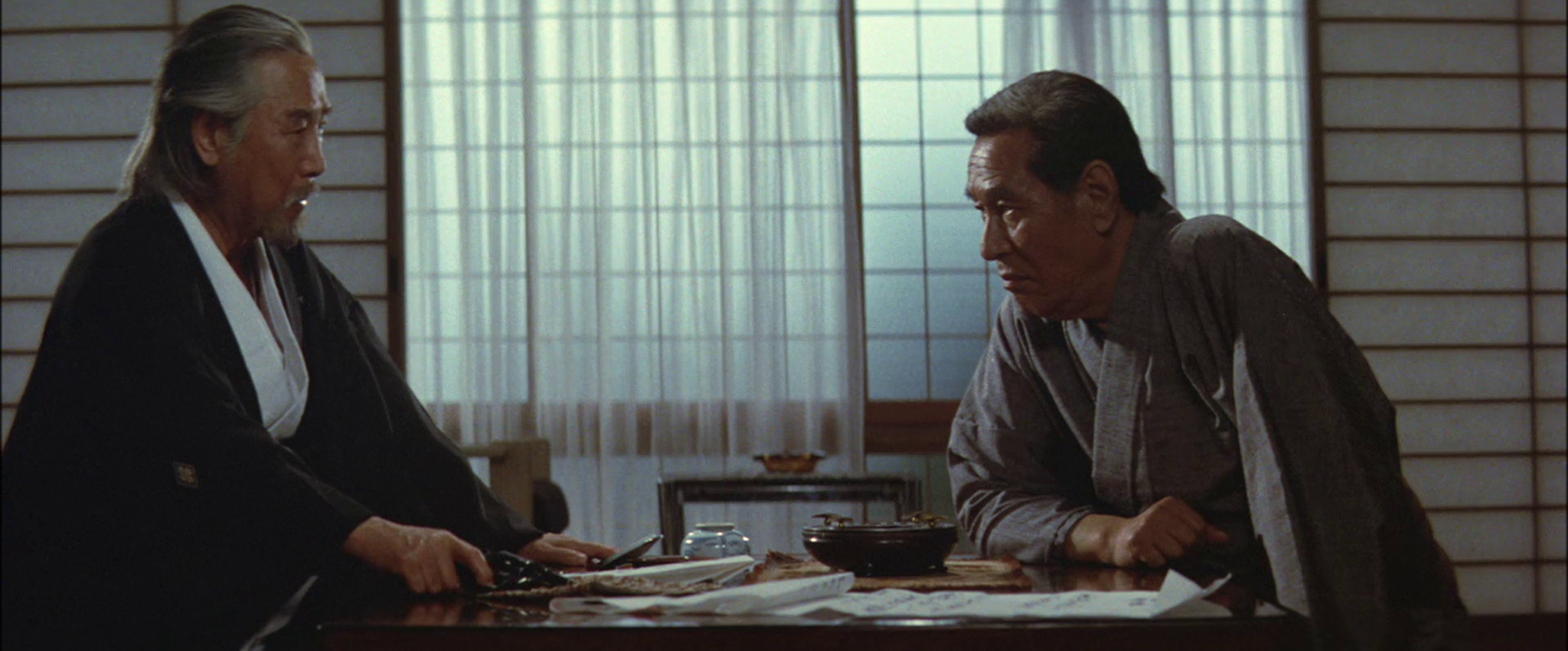
The Fort of Death (五人の賞金稼ぎ, Eiichi Kudo, 1969)

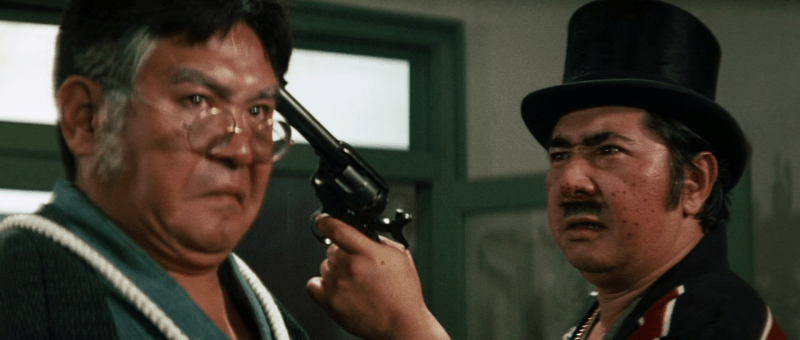
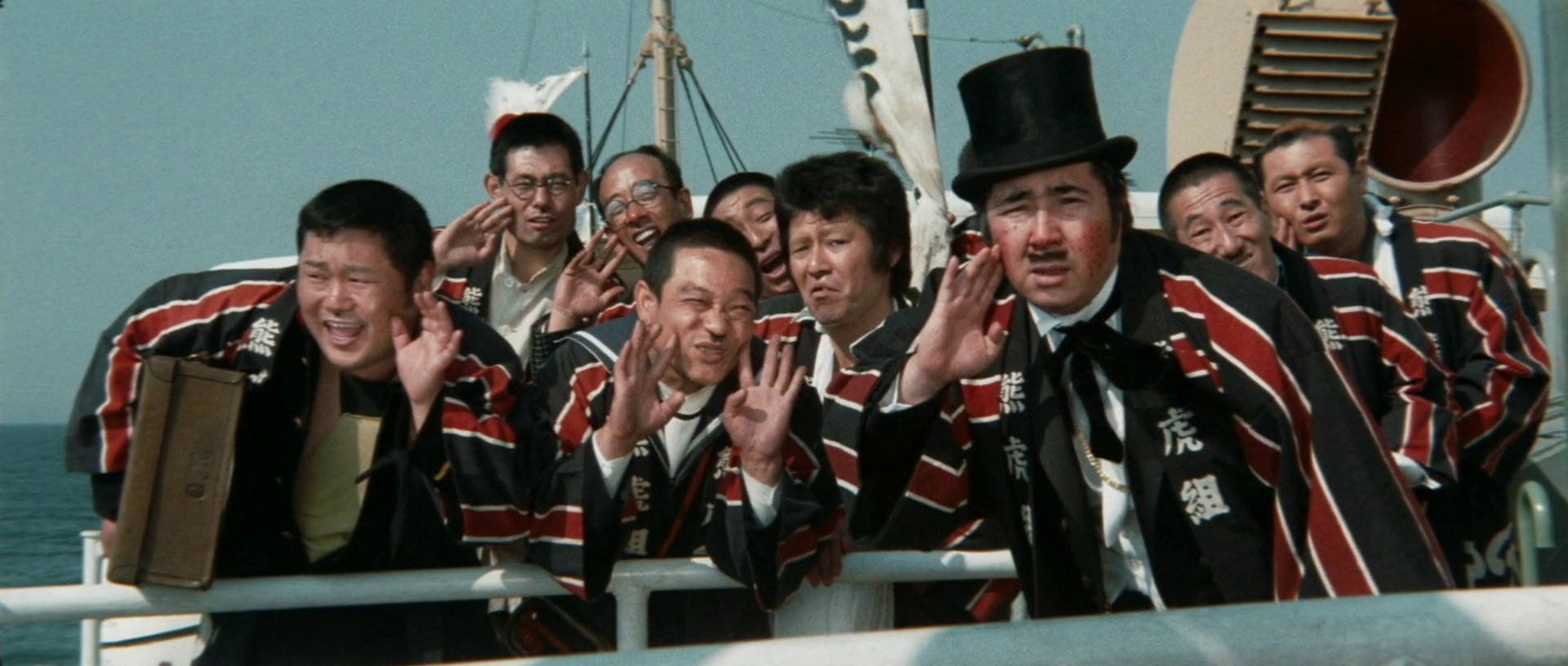
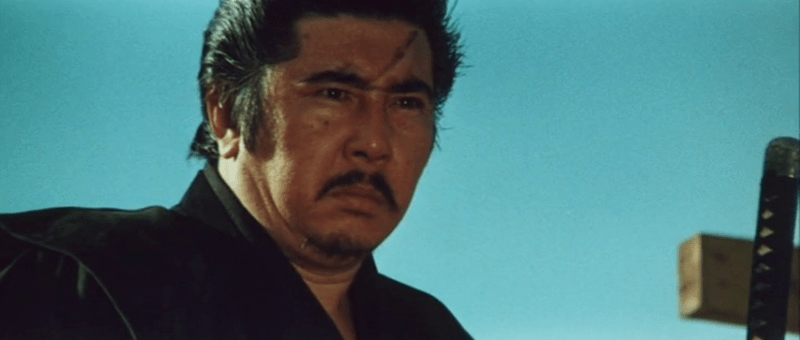
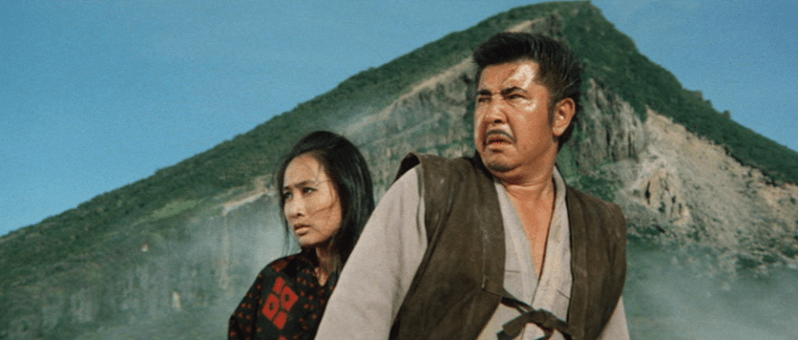
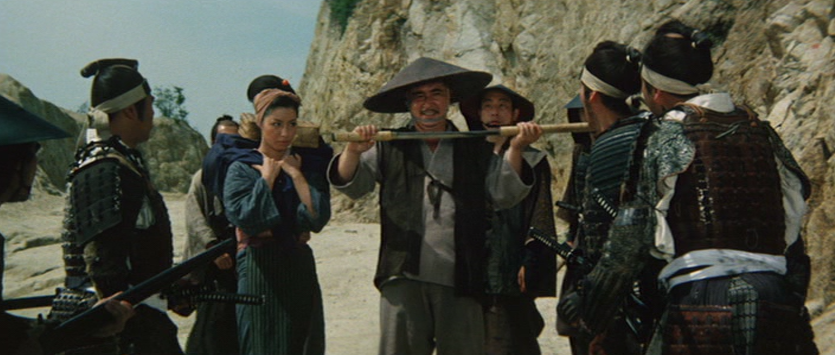
Shikoro Ichibei (Tomisaburo Wakayama) returns yet this time seemingly on the opposite side in the second in the Bounty Hunter series, The Fort of Death (五人の賞金稼ぎ, Gonin no Shokin Kasegi) this time directed by Eiichi Kudo. If the first film had been an Edo-era take on James Bond, the second is very much Spaghetti Western and feudal tragedy as Ichibei finds himself coming to, if not quite the rescue of the oppressed farmers, then at least moral support in taking stand against corrupt and self-interested lords.

This might be surprising in that in the first film Ichibei had been a shogunate spy and seemingly close friend of the man himself, yet this time around he’s working as a doctor while taking bounty hunter jobs to earn extra money to support the poor people who come to him for help. Like a true western hero, he has a small posse which includes the ninja lady, Kagero (Tomoko Mayama), from the first film only she’s being played by the actress who previously starred as his other love interest. In any case, he’s approached by a young man from a small village which is making a last-ditch appeal to the local lord to lower their tax burdens so they don’t all starve, though so far the lord’s response has been to add additional taxes and kill people for not paying them. 

On his arrival, Ichibei soon realises that the man who recommended him was actually the leader of the government forces during a previous peasant uprising at which Ichibei had also tried to help the farmers. In that case, Bessho (Shin Tokudaiji) had won, but it didn’t do him any good. His clan was dissolved and he became a wanderer, taken in by the village and now indebted to them, hoping Ichibei can help but fully aware of the brutality with which such challenges to the feudal order are put down. 

The lord later suggests it’s not really his fault. He has to curry favour with Edo to protect the domain, which is why he agreed to participate in a construction project that led him to confiscate all of his farmers’ rice and wheat. But then it’s also true that he is vain, and cruel. On realising the village has hired a man like Ichibei, some of the retainers suggest reopening negotiations but others complain that they must now crush the farmers or face ruin themselves while trying to ensure the strife in their domain does not come to the attention of the government in Edo. 

Part of their problem is that Ichibei simply has better technology in the form of gatling guns. Tying into the western themes, Ichibei is well versed in the use of firearms, while the samurai are mostly reliant on traditional weaponry such as arrows and swords. The lord later insists on using some canons, but is oblivious to the risk as the shogun has banned the use of gunpowder and using them may end up bringing him to his attention and thereby landing him in a lot of possible fatal trouble. 

In any case, it’s the villagers who suffer. Ichibei encounters a woman who has lost her mind, refusing to give up her baby who has died of malnutrition while her husband was executed for non payment of taxes. Meanwhile, some of the other ronin they hired attempt to rape a villager, and a young couple are prevented from marrying because the headman is worried that it would send the wrong message in a time so much strife. Then again, a woman basically attempts to rape Ichibei, descending on him while he’s still asleep which otherwise leads into a fairly comic sequence in which Ichibei must fight of a bunch of ninjas intent on stealing the gatling gun while dressed only his underwear.

Darkly comic it may be, but also surprisingly violent with a ninja at one point using a dead body as a Molotov cocktail not to mention the severed heads and limbs of the battle scenes. Ichibei is fully aware that the battle is a forlorn hope, but also that the villagers have no choice and perhaps this is better for them than simply accepting their fate and starving to death. Even so, he reserves his final words for the Edo inspector who arrives only when the battle is done to survey the scene, berating him that he ought to know what happened here from looking at the battlefield and deducing that this domain has not been run particularly well. It’s a tragedy of feudalism that provokes a tearful rage from the compassionate bounty hunter trying his best to heal the sickness in his society, though perhaps like the patient who visits him with a venereal complaint concluding the best solution is to cut it right off.


Killer’s Mission (賞金稼ぎ, Shigehiro Ozawa, 1969)

According to the title card at the beginning of Shigehiro Ozawa’s Killer’s Mission (賞金稼ぎ, Shokin Kasegi), none of the events it depicts have been recorded in history because the shogunate decided to erase them all in fear of the effect they may have on the nation’s geopolitical stability. Nevertheless, it gives some very concrete dates for its historical action, even if they may not make complete sense while foreshadowing the political turbulence of the following century. 

What it essentially attempts to do is tell a James Bond-style tale of political intrigue in a feudal Japan in which perpetual peace has begun to create its own problems. Here played in a cameo appearance from Koji Tsuruta, the Shogun Ieshige was weak in part because he was in poor health and had a speech impediment which led him to be rejected by his retainers. The problem here, however, is with Satsuma which has been on bad terms with the Tokugawa shogunate since the Battle of Sekigahara after which they took power. Satsuma will in fact be at the centre of the conspiracy to overthrow the government in the following century, but for the purposes of the film have fallen foul of a rumour that the plan to do an arms deal with some Dutch sailors who sailed South to Kyushu after being rebuffed in Edo. 

A civil war is feared and in the interests of maintaining peace, Ieshige sends his trusted spy Ichibei (Tomisaburo Wakayama) to protect Satsuma official Ijuin Ukiyo (Chiezo Kataoka) in the hope that he will be able to talk his young and naive lord out of doing the deal. Ostensibly a doctor by trade, Ichibei has a series of spy gadgets such as hidden blades and collapsible guns stored in a secret room at his surgery which he then carries in a black leather utility belt. He keeps the nature of his mission close to his chest, but often double bluffs by simply telling people he is a shogunate spy or otherwise adopting a disguise as he does in a moment of meta comedy impersonating the signature role of his brother Shintaro Katsu by posing as a Zatoichi-style blind masseur. 

As if to signal the cruelty of the feudal world, Ichibei comes across the corpses of suspected spies abandoned outside Satsuma territory while his enemies meditate on their ancient slight and consider taking the deal in the hope of avenging their defeat and overthrowing the Tokugawa. They are warned that creating unrest and sowing division may be exactly what foreign powers like the Dutch crave, but aren’t particularly bothered, preferring to take their chances with them rather than curry favour with the Shogun and possibly destabilising the entire society along with it. 

Of course, much of this is anachronistic with the Dutch sailors appearing in a distinctly 19th century fashion carrying weapons which are also too advanced for the era as are Ichibei’s folding pistols. Through his travels, he runs into a female Iga spy who too can do some nifty ninja tricks and has a gadget of her own in a comb which can shoot poison darts, though luckily it’s one of the poisons Ichibei has already developed an immunity to. Ichibei is fond of crying that you kill him he’ll simply come back to life, barrelling through the air with feats of improbable human agility and generally behaving like some kind of supernatural entity with a secondary talent for violent seduction. 

Though ironic and often darkly comic, there is an unavoidable poignancy in the inner conflict of Ijuin who knows his clan is about to do something very foolish but is torn between his duty to obey them and that to act in their best interests, eventually backed into a corner and left with no real way out of his predicament. As Ichibei points out, it’s difficult to keep the peace, especially when restless young samurai spot opportunities to cause chaos and the outside world knocks on the door of a closed community. Even so, Ozawa ends on a romantic image of a beach at sunset somehow undercutting the violence and tragedy with the restoration of an order that might itself be imperfect in its peacefulness.


The Tattooed Hitman (山口組外伝 九州進攻作戦, Kosaku Yamashita, 1974)

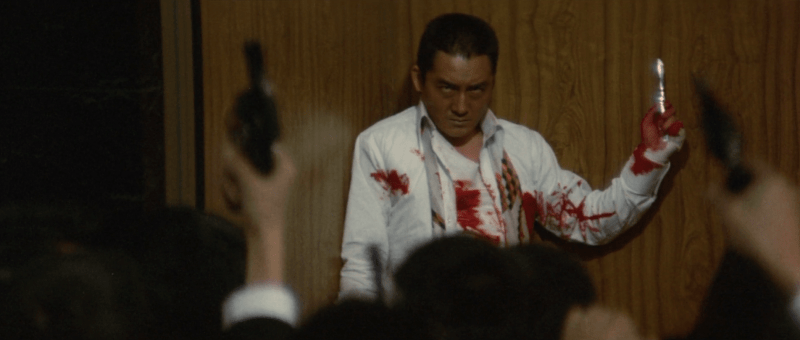
The close brotherhood between two men is disrupted by changing times in a more contemporary gangster drama from Kosaku Yamashita, Tattooed Hitman (山口組外伝 九州進攻作戦, Yamaguchi-gumi gaiden: Kyushu shinko-sakusen). As many are fond of saying, times have changed and the yakuza must try to change with them or else meet a melancholy end. But as the hero admits, change is something he has no intention of doing even as his old school gangsterism leaves him increasingly at odds with the corporatising ways of the contemporary yakuza. 

The change in the times is obvious from the film’s opening sequence set in 1957 in which an attempt is made on the life of petty boss Ishino (Tatsuo Umemiya) by a gunman who shouts “die, for the good of the world” before firing a pistol and running away. Ishino has been targeted in a dispute over construction rights connected with the regeneration of hot springs resort, Beppu. The hit seems to have been ordered by rival gang, Sakaguchi (Eizo Kitamura), the leader of which is also a prominent local politician who is content to abuse his power for his own financial gain. So confident is he in his safety, that Sakaguchi even gets the police involved rather than deal with it himself. 

Ginji (Bunta Sugawara) has been Ishino’s sworn brother since their teenage delinquent days and determines to get revenge by raiding the Sakaguchi offices and killing one of their high ranking officers. Seeing as he’s already wanted by the police for a previous murder, Ishino sends Ginji to Osaka to lay low while working for an associate, Daito, mainly as a debt collector. It’s this act of separation which introduces a rift between the two men. While Ginji waits patiently to be recalled, Ishino climbs the ranks of corporatised gangsterism by learning to play by the new rules. 

To fill the void, Ginji takes on a new “brother” or perhaps surrogate son in the wayward Ken (Tsunehiko Watase) whom he first meets cheating at pachinko at a parlour where his pregnant wife Fusako (Mayumi Nagisa) is working. It’s Ken who first drags him into a brewing turf war as Korean gang Soryu threaten to disrupt the local equilibrium not least by selling drugs of which Ginji does not approve. Ginji “saves” Ken from joining Soryu by essentially making him his one of his guys though he doesn’t really have much of a position in Daito’s gang, offering him a sense of grown-up responsibility by handing him a pistol with the only the instruction to make sure he shoots with two hands. Unfortunately, Ken will follow his advice but otherwise ends up almost causing an incident with another gang by shooting a man who disrespected him in the street. Ginji marches straight down there to sort things out, but on arrival discovers an arrangement has already been made with his boss which further strains his sense of pride and confidence in his position as a yakuza.

Ginji feels something similar on being invited to a party to celebrate Ishino’s promotion only to be seated with the lowly footsoldiers and ignored by Ishino all night. Ishino rejects him still further in agreeing to plan to send him back to Kyushu out of the way hoping that his old school hotheadedness can finally be tempered. Others meanwhile voice concern that Ginji may have forged a relationship with rival Kobe gangs during the 18 months he abruptly disappeared from Osaka and has only come back to cause trouble. Ginji perhaps knows that he has no more future in the contemporary society, others remarking that seems like someone who is in a sense already dead for having accepted that he will die and most likely in Hakata, the town he had wanted to conquer with Ishino who had crushed his dreams in his newfound pragmatism by calmly explaining that they would never have the power to take it. 

Koji Takada’s screenplay positions Ginji’s gradual decline as an allegory for the yakuza himself while citing the new legislation that this particular series of incidents made necessary creating the new offence of assembly with dangerous weapons as a decisive moment in weakening the yakuza as an institution. Ginji remains a man displaced by his times unable to move forward into a new society in the way that Ishino has but stuck in a permanently post-war mentality despite the constant reminders that “times have changed”. Yamashita adopts the trappings of the jisturoku drama with frequent references to real life events and narrative voiceover but otherwise maintains his classicist formalism while ending on a note of ambivalence that tells us a certain kind of justice may have been served but the cycle of violence may not yet be completed.


Original trailer (no subtitles)

The Geisha (陽暉楼, Hideo Gosha, 1983)

The coming of the railroad spells doom for one of the most prestigious geisha houses in Japan in Hideo Gosha’s adaptation of the Tomiko Miyao novel, The Geisha (陽暉楼, Yokiro). Miyao’s novels had often provided the inspiration for Gosha’s films and she had herself been the daughter of a “flesh broker” in pre-war Kochi though later escaping to another town to be a substitute teacher. Though the English title may focus more on plight of the the individual geisha at its centre, the Japanese hints more at the destructive cycle of the Yokiro itself in the persistent legacy of exploitation.

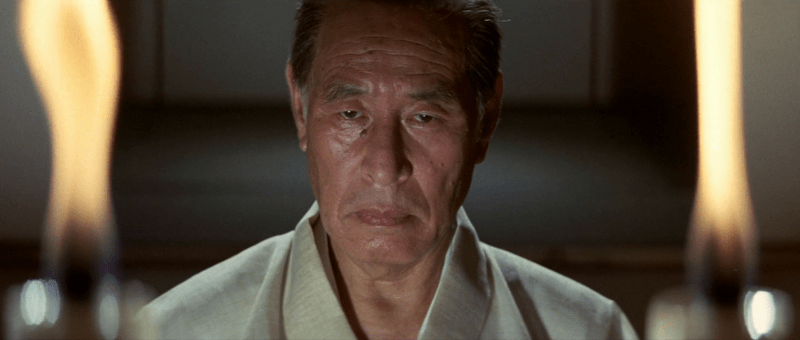
Then again as he later points out, if you’re looking for a villain in this story then the responsibility lies largely with Daikatsu (Ken Ogata) himself. In a prologue set in 1913, Daikatsu has eloped with geisha Otsuru but the pair are discovered by gangsters sent after them by the Yokiro. Daikatsu kills all of their assailants and assures Otsuru that they are finally “free” but it appears to be too late. Holding their baby daughter in one arm, Otsuru collapses into his other and presumably dies either then or shortly after while Daikatsu is later sent to prison for 10 years. 20 years later in 1933, the daughter, Fusako (Kimiko Ikegami), has become the number one geisha at the Yokiro under the name Momowaka though her career flounders because she is regarded as too emotionally distant to keep a patron. 

Daikatsu is also himself in Kochi at this point and working as a procurer brokering the sale of young women to the Yokiro and other geisha houses and brothels. When a school teacher comes to him to sell his wife, he taps her teeth to check for malnutrition much as one would examine a horse before running a hand underneath her kimono to check everything is at is should be before offering a valuation. Her husband only looks at him anxiously enquiring if a body such as hers which has as he later reveals born three children will fetch a good price. Daikatsu lets them go so the woman, Masae, can spend a final night with her family explaining that he cannot force someone to work if they do not want to do so and is well aware they will likely take his money and never be seen again which is what almost what happens. As it turns out the husband is killed in a fight and the woman ends up becoming a geisha anyway, only in the pay of prominent Osaka yakuza led by Inaso. 

Inaso (Mikio Narita) and buddies want in on the construction of the railroad that will shortly be coming to Kochi, but need to take over the town first which means getting around the mistress of the Yokiro, Osode (Mitsuko Baisho), who is apparently running every game town. The entire local economy is underpinned by female exploitation and facilitated by a woman, a former geisha, seizing the only power that is available to her. Isano later uses Masae as a kind of spy, getting her to initiate a relationship with Osode’s weak willed husband in an attempt to humiliate her which largely backfires as Osode boldly reclaims her man through a violent brawl in a hot spring though it does not appear that she is especially fond of him so much as he serves a particular purpose.

The brawl emphases the way in which women are pitted against each other by the nature of a patriarchal society along with the ways in which they are forced to mediate their power through men. Fusako also gets into an intense physical fight with Tamako (Atsuko Asano), a surrogate daughter of Daikatsu’s and emblem of a coming modernity, who insists on becoming a sex worker at the area’s most prominent brothel. In a strange moment of confrontation, both the geishas of the Yokiro dressed in their traditional regalia, and the sex workers of Tamamizu, arrive at a modern club where the heir to a banking empire courted by the Yokiro, Saganoi, dances the Charleston he learned while studying abroad in America. The geisha who dances with him struggles to pick up the moves, Saganoi lamenting that the dance is just not suited to a woman wearing a heavy kimono, elaborate wig, and clumsy geta. Tamako immediately gets up from her table and kicks off her shoes, gathering the hem of her own kimono to free her legs for the high level kicks of the modern dance. 

Fusako reclaims her authority by interrupting the dance immediately before its conclusion and insisting on retrieving their guest. Tamako appears to resent Fusako, perhaps frustrated in her relationship with Daisuke who does not appear to have had much contact with the daughter he sold at 12 years old. They too end up in an elaborate brawl in which Tamako rips off Fusako’s wig and splits her lip, symbolically freeing her to transcend the constraints of her “geisha” persona. Meeting Saganoi at Western-style bar, she boldly dances on the counter and sleeps with him of her own volition. But in doing so she conceives a child and leaves herself in a difficult position. She has betrayed her patron, and though she could simply have kept the fact from him and allowed him to think the baby was his, Fusako does not want to bring her child up in lies while simultaneously hanging on to a naive dream that Saganoi will one day return to her despite being made aware he has left for Europe. 

“All men are enemies of women,” she writhes in childbirth while swearing that no one will take her child from her, but she is still an indentured woman and her daughter is by rights the property of Osode. Her illness, presumably consumption, began long before her pregnancy and seems to an echo of the suffering she has been forced to endure as a geisha. As her health weakens, so the Yokiro declines. First it is ravaged by a literal storm, but also under threat from the Osaka gangsters desperate to take over Kochi to gain access to the lucrative construction contracts extending in its direction. Even so, as Daikatsu admits much of the fault lies with him. He chose to elope with Otsuru and was unable to protect either her or their daughter whom he allowed meet the same fate by entering the geisha world. He continued to earn his money by selling women into what is essentially slavery, and cannot escape his part in their continued exploitation while his entanglement with gangsters later disrupts the more settled life Tamako has begun to build for herself. 

“Wait all you want, the train’s not coming,” Tamako is later told, as if signalling that there really is no way out of this destructive and disappointing existence. Truly epic in scope, Gosha’s pre-war drama draws together patriarchal exploitation and societal corruption to critique a burgeoning modernity, but ends exactly as it started among the vibrant cherry blossoms only this time undercutting the melancholy of the oft repeated song with a more cheerful scene hinting at least symbolically at a long-awaited reunion. 


Original trailer (English subtitles)

Operation Plazma in Osaka (実録外伝 大阪電撃作戦, Sadao Nakajima, 1976)

The precarious balance of the post-war yakuza society begins to crumble in Sadao Nakajima’s jitsuroku eiga, Operation Plazma in Osaka (実録外伝 大阪電撃作戦, Jitsuroku gaiden: Osaka dengeki sakusen). The Japanese title might more accurately be translated as “shock tactics in Osaka” which is a neat encapsulation of the turf war which arises when a larger gang from Kobe decides to muscle in and take over the city while a small upstart continues to agitate contemplating taking the whole prize for themselves. 

Inspired by a real life turf war which took place in Osaka in 1960, the film opens with classic jitsuroku voiceover revealing that a precarious balance had been held in the local underworld since the Meiji era in part because the city is simply too big to be ruled by any one gang. But times are changing, yakuza conglomerates are in style, and so it is that the Kawada gang mounts a largely political campaign to claim the city without bloodshed, as boss Yamaji (Akira Kobayashi) puts it, by convincing the smaller gangs to join up with them. According to the voiceover, however, it wasn’t Kawada that upset the balance but a small upstart group that came out of nowhere, Soryu. 

The screen then cuts to a map of Osaka, while the stills behind the credits feature the Tsuruhashi Market in Korea town. The thing about the Soryu group is that many of its leading members are ethnically Korean which sets them apart from most of the other mobsters in town. Even so, it’s hotheaded Yasuda (Hiroki Matsukata) that first gets them in trouble by getting into a fight with Takayama (Tsunehiko Watase) at a boxing match after climbing into the ring himself when the guy he bet on looks like he’s about to lose. This sets up a conflict between the Soryu and the Nanbara gang who run the boxing hall, but it never takes off because the recently released Daito suddenly announces that he’s bought the “Dance Hall” the ring is being run from and wants to turn it into a cabaret bar. It seems clear that someone’s backing Daito, but no one quite knows who. 

As Yamaji had said it would be, it starts of as a very modern silent war in which he slowly seduces various yakuza gangs convincing them that they’re stronger together with a slight note of join us or die. Yasuda and Takayama are two men who don’t like being told what to do and each end up exiled from their gangs thanks to their opposition to Kawada. Having failed to assassinate Yamaji, boss Nanbara pathetically rolls over and decides to join him instead while the Soryu gang is sent on the run leaving Yasuda and and Takayama to form an unlikely brotherhood brokered by Yasuda’s odd decision to gift his nightclub singer girlfriend to his sometime rival leaving Takayama permanently in his debt and touched by his selfless gesture.

Even by the standards of the jitsuroku, Operation Plazma in Osaka is rabidly misogynistic and often sleazy with an early scene seeing the Soryu gang cause trouble by stripping a hostess naked as one pours alcohol over her body and another drinks it from between her legs. Naked women are repeatedly fondled by fully clothed men, while nightclub singer Yoshiko (Yuko Katagiri) is treated largely as a pawn, a tool used to mediate the latent homoerotic desire between Yasuda and Takayama. Then again, everything in this world is extreme. The conflicted Miyatake (Tatsuo Umemiya) who had once tried to protect Takayama eventually tries to boil a man alive to get him to reveal Takayama’s location while Nakajima’s anarchic handheld camera desperately tries to keep up with the increasingly nihilistic violence. 

The resolution arrives not with death but total defeat, the traditional yakuza forced into submission by the corporatising giant with the survivors realising they will live the rest of their lives in subjugation making an “unconditional surrender” to changing times. Yasuda had claimed that the Soryu gang was a “free democracy” standing in opposition to the latent fascism of traditional gangsterdom which then finds its way into the corporate and the extreme hostile takeover Yamaji has just performed on the city of Osaka. Suddenly all that’s left of traditional yakuza is a pinkie in a jar, a grim a reminder of what happens when those in a position to resist back down in the face of an authoritarian power.


Terror of Yakuza (沖縄やくざ戦争, AKA Okinawa Yakuza War, Sadao Nakajima, 1976)

An old-school yakuza finds himself cornered on every side while caught in the confusion of Okinawa’s reversion to Japan in Sadao Nakajima’s jitsuroku gangster movie Terror of the Yakuza (沖縄やくざ戦争, Okinawa Yakuza Senso, AKA Okinawa Yakuza War). Where similarly themed Okinawa-set gangster pictures such as Sympathy for the Underdog had largely presented the islands as an appealing place for mainland gangsters because the conditions of the occupation which had allowed them to prosper were still in place, Sadao reframes the debate in terms colonisation and conquest as the hero finds himself increasingly marginalised as an island boy contending with amoral city elitists. 

Nakazato (Hiroki Matsukata) has just been released from prison after serving seven years for the murders of two rival gang bosses that allowed his boss, Kunigami (Shinichi Chiba), to rule the roost in Koza. But now that Okinawa has reverted to Japan, everything has changed. Kunigami has formed a loose alliance with another regional gang to oppose the incursion of mainland yakuza but behind the scenes the higher-ups are intent on a mutually beneficial alliance with the Japanese perhaps seeing the writing on the wall and assuming that it’s better to work with the new regime that against it. For his part, Nakazato is more loyal to the clan than he is opposed to Japan but he’s also resentful towards to Kunigami for failing to live up to his side of the bargain now that he’s been released while fearing the influence of his new sidekick Ishikawa (Takeo Chii) whom he suspects of murdering one of his former associates while he was inside. 

As such, much of the drama unfolds as in any other yakuza picture with Nakazato, regarded by some of the other bosses as a loose cannon and potential liability, reluctant to move against Kunigami for reasons of loyalty even while Kunigami becomes increasing unhinged and dangerous, deliberately running over an Osakan foot soldier who was apparently just on holiday with no particular business in town. Kunigami’s recklessness in his hatred of the Japanese threatens to start a turf war the Okinawan gangs fear they couldn’t win, sending snivelling yakuza middleman Onaga (Mikio Narita) along with Nakazato to negotiate in Osaka only to be told the price of peace is Kunigami’s head. Inspired by the Fourth Okinawa War which was still going on at the time of the film’s completion (in fact, the release was blocked in Okinawa in fear that it would prove simply too incendiary), the conflict takes on political overtones as the mainland gangsters assume their conquest of Okinawa is a fait accompli while those like Onaga are only too quick to capitulate leaving Kunigami and Nakazato as two very different examples of resistance. 

Yet Nakazato finds himself doubly marginalised because he is from one of the smaller islands with most of his men also hailing from smaller rural communities (one uncomfortably wearing extensive makeup to ram the point home that he is from the southern reaches) with the result that they are often pushed around by the city gangsters who view them as idiot country bumpkins. On his trip to Osaka, Nakazato even describes himself as such in an attempt to curry favour apologising in advance should he make a mistake with proper gangster etiquette. Like a good platoon leader, Nakazato’s primary responsibilities are to his men which is one reason why he takes so strongly against Ishikawa, one of the new breed of entirely amoral yakuza who care nothing at all for the code and think nothing of knocking off his guys for no reason. Consequently he finds himself caught between the invading mainlanders, the unhinged chaos of Kunigami, the coldhearted greed of Ishikawa, and the spineless venality of turncoats like Onaga. 

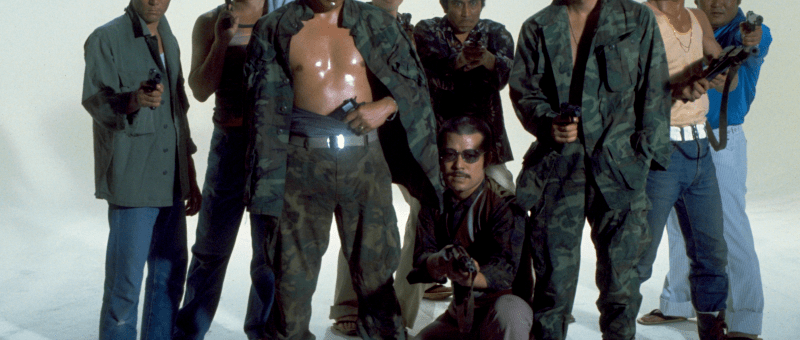
It’s no wonder that he eventually loses his cool, going all out war and like Kunigami dressing in vests and combats in an internecine quest for vengeance precipitated in part by Kunigami’s attempt to discipline one of his men for encroaching on his territory by removing his manhood with a pair of pliers. “Someone will get to you someday too” Nakazato is reminded though having lost everything including his loyal wife who insisted on selling herself to a brothel to get the money to fund his war of revenge he may no longer care so long as he cleans house in Okinawa to the extent that he is really able to do so. “Okinawa is such a scary place” one of the Japanese guys admits, though showing no signs of backing off in this maddeningly chaotic world which turns stoic veterans and hotheaded farm boys alike into enraged killers fighting on a point of principle in a world which no longer has any. 


Terror of Yakuza screens at Japan Society New York May 20 at 7pm as part of Visions of Okinawa: Cinematic Reflections

Original trailer (no subtitles)

Images: Terror of Yakuza © 1976 Toei

Doberman Cop (ドーベルマン刑事, Kinji Fukasaku, 1977)

Doberman cop J DVD coverAll things considered, a live pig is a rather insensitive gift to present to your local police station, though any gift at all might be considered in appropriate even if offered by a well meaning colleague keen to help out when a horrific murder may be connected to his missing person case. By 1977 Kinji Fukasaku had made a name for himself through the wildly successful “jitsuroku” or “true record” genre of yakuza movies kickstarted by his own Battles Without Honour and Humanity. Doberman Cop (ドーベルマン刑事, Doberman Deka) is then quite an odd move as its brings him back to the looser, exploitation leaning B-movie action which featured heavily in the earlier part of his career and which the “jitsuroku” movement was set on displacing. Fittingly enough, Doberman Cop also sees Fukasaku reuniting with the frequent star of those early films – Sonny Chiba, now considerably older but still an impressive action star willing to put himself in danger to achieve the heart stopping stunts his fans had come to expect.
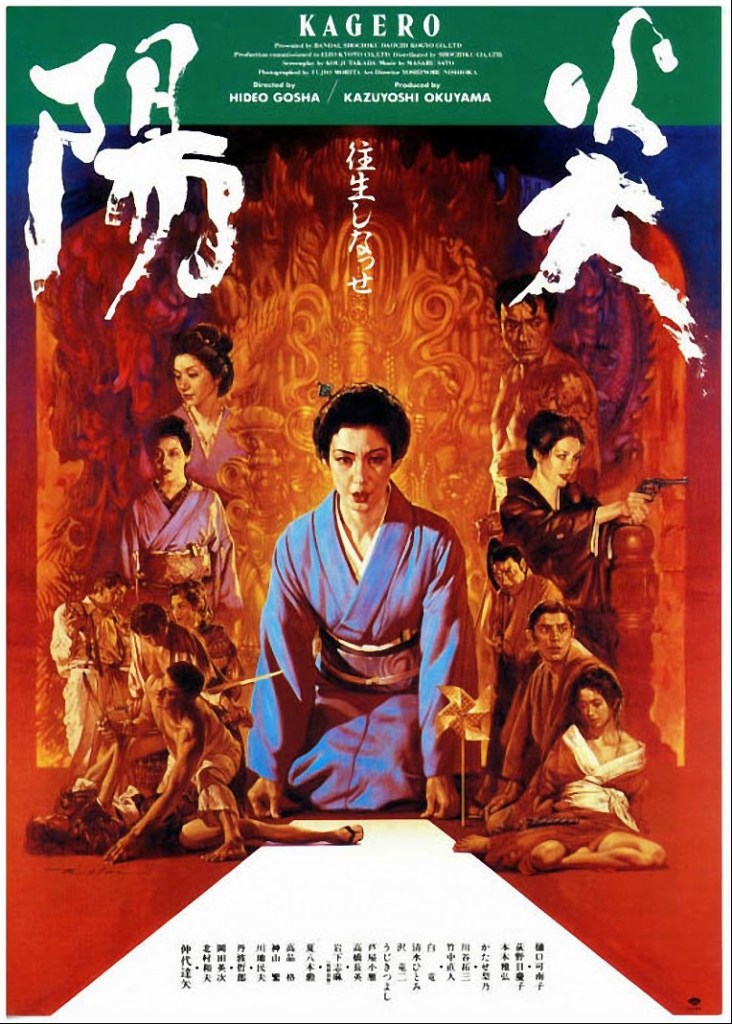
Chiba plays Okinawan “crazy cop” Kano, the stranger in town currently on a mission to find a childhood friend at the request of her sickly priestess mother. A body has been discovered, so horribly charred that visual identification is not possible but based on the clues found in the room the police are convinced the woman is Kano’s missing person, Yuna, who had been living as a prostitute under another name. Kano is not convinced, the priestess has conducted rituals which suggest her daughter is alive and there’s something not quite right about this case which the police have attributed to a spate of serial killings targeting prostitutes in the Tokyo area. An encounter with a shady yakuza turned music promoter brings Kano into contact with Miki (Janet Hatta) – an aspiring singer who bears a striking resemblance to the missing Yuna.

Doberman Cop is, loosely, based on the manga by Buronson. Part of the “gekiga” movement which prided itself on gritty, adult stories, Doberman Cop owed much to Dirty Harry with its sarcastic, tough as nails policeman armed with a .44 Magnum and a rock hard desire for justice. Fukasaku’s Kano is reimagined as a genial country bumpkin, a toughened farm boy in a straw hat displaced in the Tokyo jungle. Turning up like a strange relative, Kano has brought along a local delicacy in the form of a live pig he offers to the Tokyo police precinct with the promise that all they need to do is snap its neck and light the barbecue. Unsurprisingly, the city policemen decline his polite offer leaving him trailing the squealing piggy around with him like a burdensome sidekick.

Kano’s Yuna is not the only young woman of Okinawa fetching up in the mainland capital in search of a “better” life, but finding only failure and despair. The country detective alienates the city police with his arcane divinatory ritual which involves tipping out a large bag of small seashells and counting them to ascertain the answer to a binary question, but his methods convince him than Yuna is still alive while another Okinawan woman is dead. That a woman from his island has met such a grim end is of no small regret to Kano, be she Yuna or not, and his quest is one of vengeance for both women ruined by the false promise of city life, tempted from simple village existence by bright lights and urban sophistication.

Miki’s path has followed this pattern to the letter. City life turned her into a prostitute and drug addict, eventually running all the way to New York but failing to escape her ongoing despair. Running into a similarly depressed former yakuza, Hidemori (Hiroki Matsukata), who falls in love with her, reawakens her desire for life, and becomes determined to rescue both of their futures by turning her into a singing star, Miki is at a turning point as she prepares for TV stardom as the winner of a signing competition while Hidemori backtracks to his gangster days to make it happen.

Kano begins to piece things together and comes to realise his worst fears are true. Nevertheless, if he could he’d take Yuna home with him to the village to forget her city ordeal rather than hand her over to the Tokyo police to face justice whatever she might have done. Though the tone is largely a comic one, laced with Fukasaku’s characteristically bleak sense of humour, the conclusion is just as melancholy as any of his other sad stories of broken men as Kano is forced to conclude that whatever the facts, the Yuna who left the village is no longer in this world. Putting a lead on his piggy friend, he resigns himself to leaving the city to take care of itself while he returns home, his mission a failure.

Necessarily less serious than Fukasaku’s other work of the ‘70s, Doberman Cop is a return to the nonsensical B-movie action fests of the past which leaves ample room for Chiba to show off his still potent skills including the famous scene of him abseiling down a tall building to bust into a hotel room where Miki is being held captive by a crazed yakuza. The country bumpkin adapts to this part of city life well enough, karate kicking bad guys and loudly disapproving of drug peddling misogynists (not to mention “righteous” serial killers hellbent on “cleansing” the city of sleaziness). Bonding with the “salt of the earth” residents of the lower class neighbourhoods, including a stripper who takes a fancy to the pig during her routine, and a member a biker gang unfairly hauled in as a suspect, Kano concludes that city life is not all it’s cracked up to be much as he comes to admire these basically “good” people who have gone out of their way to help him for mostly altruistic reasons. Still, the world is a darker place for Kano following his city adventure, and all he can do in the end is return to the relative safety of a sunny Okinawan village, pig in tow.


Available now from Arrow Video!

Original trailer (no subtitles)

Heat Wave (陽炎, Hideo Gosha, 1991)

heat-waveHideo Gosha had something of a turbulent career, beginning with a series of films about male chivalry and the way that men work out all their personal issues through violence, but owing to the changing nature of cinematic tastes, he found himself at a loose end towards the end of the ‘70s. Things picked up for him in the ‘80s but the altered times brought with them a slightly different approach as Gosha’s films took on an increasingly female focus in which he reflected on how the themes he explored so fully with his male characters might also affect women. In part prompted by his divorce which apparently gave him the view that women were just as capable of deviousness as men are, and by a renewed relationship with his daughter, Gosha overcame the problem of his chanbara stars ageing beyond his demands of them by allowing his actresses to lead.

Heat Wave (陽炎, Kagero), which was to be the director’s penultimate feature, is a homage to late ‘70s gangster movies with a significant nod to Toei’s Red Peony Gangster series. Set in 1928, the action follows cool as ice professional itinerant gambler Rin Jojima (Kanako Higuchi) whose high stakes life becomes even more complicated when she accidentally runs into her adopted little brother, apparently on the hook to some petty gangsters. Dropping her commitments to help him out of his sticky situation and recover the family restaurant, Rin comes face to face with the yakuza who killed her father in a gambling dispute more than twenty years previously but vengeance is just one of many items on her to do list.

The title Heat Wave was apparently selected for the film to imply that Gosha was back on top form and ready to burn the screen with thrilling action but when producers saw his rushes they knew that their hopes were a little misplaced. Gosha was already seriously ill and was not able to direct with the fire of his youth. Heat Wave is undoubtedly a slow burn as Rin figures out the terrain and designs her campaign with the opposing side coming up with a counter plan, but the gradual acceleration begins to pay off in the film’s elaborate smoke and flames finale as Rin takes a bundle of dynamite to the disputed territory and then fights her way out with sword and pistol aided by an unlikely ally. Downbeat but leaving room for the hoped for sequels, Heat Wave is very much in the mindset of Gosha’s heyday in which, as Rin laments, the good die young and the bad guys win.

In keeping with many gambling films much of the action is taken up with tense games of hanafuda which may prove confusing to the uninitiated and are not particularly engaging in any case, though Gosha does not overly rely on the game to fill the screen. This may be early Showa, but save for the trains the action could almost be taking place a hundred years previously. Rin may have an unusual degree of autonomy as an unmarried woman travelling alone and earning her money through back alley gambling but her world is still a traditional one in which the honour of the game is supposed to matter, even if it is ignored by the unscrupulous who would be prepared to undercut their rivals away from the gaming table by attacking their friends and allies. Rin gains and then loses, reduced to an endgame she never wanted to play and which she fully intends to win by destroying herself only to be saved by her greatest rival.

Gosha’s reputation for vulgarity was not quite unjustified, even if perhaps overstated. Rin apparently inhabits the male world of her profession in a full way as an odd scene in which she’s taken to an inn to watch a live lesbian sex show seems to demonstrate though there is no dramatic purpose to its inclusion save to emphasise Rin’s impassive poise. Though nudity is otherwise kept to a minimum, Rin’s yakuza tattoos are on full show as a clear indication of her position in the underworld. The appearance of such extensive tattooing on female gangsters is a rare sight and Gosha does his best to make the most of its transgressive qualities.

When the producers realised Gosha was not as filled with intensity as they’d hoped, they hatched on the idea of attaching a hard rock song to the end to give the film more edge (apparently much to the consternation of the composer). This might explain the strange entry to the credits sequence which is accompanied by a very up to the minute burst of synthesiser music accompanied by computer graphics loading the faces of the stars across the screen in strips. Perhaps meant to bring the ‘70s inspired action into the present day the sudden entry of the modern world is jarring to say the least though perhaps it kept viewers in their seats long enough to enjoy the post credits sting of Rin giving it her best “you shall perish”, presumably to whet appetites for a sequel. Even if not quite as impressive as some of Gosha’s previous work, Heat Wave makes up for its flaws in its exciting finale which brings all of his choreographical and aesthetic abilities to their zenith as Rin basks in both victory and defeat with the legacy of the good people who took her in burning all around her.


Selection of scenes from the the film (no subtitles)

https://www.youtube.com/watch?v=EEEtvmJ03Ao&t=73s

The Yakuza Papers Vol. 5: Final Episode ( 仁義なき戦い: 完結篇, Kinji Fukasaku, 1974)

800x1200srAnd so, the saga finally reaches its conclusion. Final Episode (仁義なき戦い: 完結篇, Jingi Naki Tatakai: Kanketsu-hen) brings us ever closer to the contemporary era and picks up in the mid ‘60s where Hirono is still in prison and Takeda, released on a technicality, has decided to move the yakuza into the legit arena. The surviving gangs have united and rebranded themselves as a political group known as the Tensei Coalition. However, not everyone has joined the new gangsters’ union and the enterprise is fragile at best.

Hirono’s sworn brother, Ichioka, is one such antagonist and after the Coalition’s accountant is clumsily gunned down in the street, tempers start to flair. Though the Coalition is nominally headed by Takeda, an up and coming youngster, Matsumura, is winning a lot of respect for his level headed judgement and ability to form long term plans. He wants to move away from the image of the traditional yakuza with their missing fingers and bad attitudes to something a little more media friendly. However, the old guard including the veteran, Otomo (now played by Jo Shishido), aren’t willing to see the bigger picture and continue to behave in the old ways requiring swift and bloody justice for their fallen comrade. The older generation maybe on their way out, but that doesn’t mean they can’t cause a little trouble on their way. Despite the best efforts of the younger guys the cycle of violence seems set to continue, will anything ever change at all?

According to Fukasaku, almost certainly not. Though Matsumura is accounted to be a good guy by both of our “heroes” Hirono and Takeda, his yakuza revolution seems doomed to fail. This kind of coalition is completely pointless if not everybody joins and obviously not everybody is going to. Following the public outcry and subsequent police crackdown in the previous film, the yakuza feel the need to reform their image, keep the violence off the streets and appear generally less scary than the image they’ve hitherto cultivated. Now it suits them to conduct themselves in a more dignified manner, more like regular businessmen than thugs in flashy suits.

Meeting at the prison in the end of Police Tactics, Hirono and Takeda both agree that their era has passed. They still aren’t quite old men, but they aren’t young and this violent world isn’t for them anymore. Their resolutions are both that the general environment has changed making the way they’ve lived so far untenable, but also that if they attempted to live that way again they simply wouldn’t survive any longer (perhaps they are “better off” in jail). Hirono spends most of the movie off screen again, in prison, writing his memoirs. Before coming out he seems set on “retirement” but once released he decides to return to the yakuza world. It’s not until the end of the film when once again confronted by the senseless violence of gang warfare that he finally decides to retire. Matsumura may have been trying to change things, but more young guys are dying so fast there’s barely any point learning their names and what really does it get you in the end? Can you live freely, has the world really changed at all? From Hirono’s late middle age viewpoint, the answer is no.

Final Episode follows the same basic formula as the other films in the series with the narrative voice over, frenetic handheld camera work, captions and freeze frames. The violence may be a little less frequent but appears bolder in its execution. These youngsters are messier than their forebears – the gunning down of the Tensei accountant is a clumsy affair carried out by two amateurs in the middle of a crowded street. Random weapons are constructed with pretty much anything that’s lying around during a street fight. These young guys are a different kind of desperate and have no idea how to conduct themselves in a subdued way.

We’re almost up to the the contemporary era of the film. It’s getting on for 25 years since Hirono came home from the war and joined a different kind of battlefront. Japan’s development has been startlingly rapid – from post-war rubble to hosting the olympic games and a newly burgeoning prosperity. Hirono and those like him have found themselves riding the wrong wave as their fortunes continue to dwindle just as the legitimate world is coming into its own. When Hirono and Takeda were talking at the prison at the end of part four they knew something had come to an end. They had no place in this world anymore – unless you become a ruthless boss like the hated Yamamori (still harbouring dreams of domination well into his dotage), the yakuza life is a young man’s game. Once again we finish on a shot of the ruined dome and a reminder that the strong will always prey on the weak. Fukasaku’s prognosis for the future is grim but, it has to be said, accurate.


Final Episode is available on blu-ray in the UK as part of Arrow Video’s Battles Without Honour and Humanity: The Complete Collection box set.