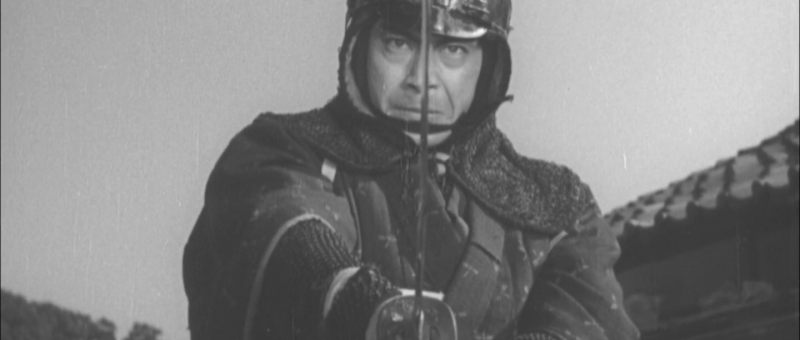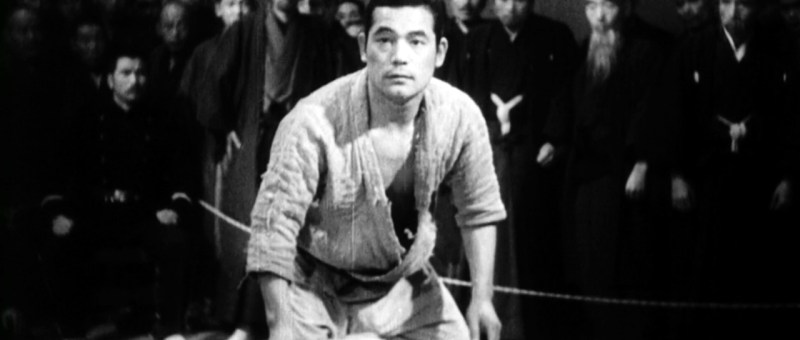
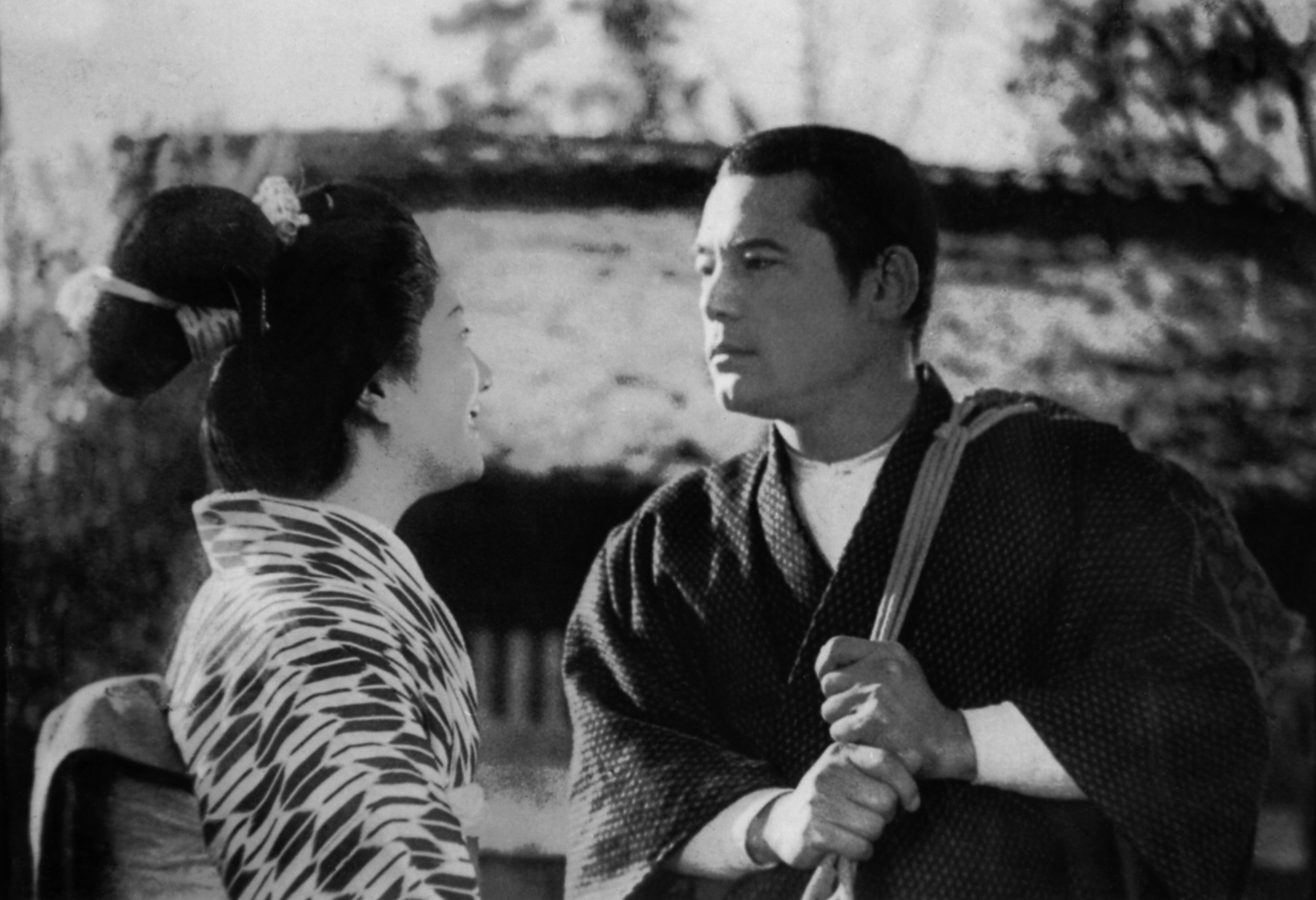
Sanshiro Sugata Part Two (續 姿三四郎, Akira Kurosawa, 1945)

Sanshiro Sugata had not especially pleased the censors who took a scalpel to it, excising a few elements they found problematic, but the film proved popular enough with audiences for the government to commission a sequel. Apparently somewhat reluctantly, Akira Kurosawa returned to the world of Sanshiro Sugata picking up almost in real time two years later with a conflicted Sanshiro (Susumu Fujita) still wandering around Yokohama avoiding the woman he loves whose father may have died due to injuries inflicted on him during his fight with Sanshiro. Yet where the first film had essentially presented a spiritual odyssey through the medium of judo, part two is a much more nakedly propagandistic affair. 

It some ways it’s a little ironic that Sanshiro has almost become a folk hero who stands up for the oppressed Japanese against the looming threat of Western imperialism as mediated through the contest between Japanese martial arts and American boxing. The film opens with a drunken American sailor berating the teenage boy pulling his rickshaw and eventually attacking him only to run into Sanshiro and get a swift hiding. The thankful boy recognises his name and decides that he wants to learn judo too so he can defend himself against external threat, but Sanshiro isn’t sure he should be teaching anyone because he still has a lot to learn and is otherwise unable to escape his guilt over having contributed to the deaths of others through the practice of his art. His internalised shame is only deepened when he’s asked to participate in a spectacle match against a top American boxer and declines only to be told off by the guy who decided to accept. He used to be a jiujitsu champ, but ever since Sanshiro brought about the judo revolution no one cares about jiujitsu anymore and it’s ruined his livelihood. 

There is it seems a degree of shame in fighting for money, but more so in fighting for the entertainment of others. When Sanshiro visits the boxing ring, the sport is depicted as vulgar and primitive. The baying crowd are there largely for blood, riled up by the violent spectacle and eager to see a man in the extremities of a bodily struggle. For Sanshiro, it’s a depressing and offensive sight and to participate in it is to bring shame on Japanese martial arts. Meanwhile, the judo school is also threatened by two thuggish brothers keen to prove the superiority of karate over judo by defeating Sanshiro. They are also brothers of the first film’s villain Higaki who was reformed after his fight with Sanshiro but has since apparently fallen into ill health and listlessness, but so certain that Sanshiro is the only man who can save Japanese martial arts that he gives him the secrets of his brothers’ techniques. 

The final battle mimics that of the first film save taking place amid heavy snow and howling wind. Sanshiro once wins over his opponents through his kindness, taking them into the warm and looking after them until they begin to recover. One of the brothers briefly picks up a meat cleaver before thinking better of it as the two of them grin and admit defeat. Yet Sanshiro’s real battle is indeed against the American imperialists, wilfully breaking Yano’s cardinal rules by deciding to agree to the spectacle fight and easily defeating the American boxer who ends up just passing out from the force of Sanshiro’s aura. The jiujitsu practitioner who seemed to resent him before breaks down in tears and offers his sincere thanks to Sanshiro for standing up for Japan against the Americans.

The contemporary context is clear, this time around judo is much less about spirituality than it is about victory as much as Sanshiro likes to say that it isn’t winning and losing that’s important. Sanshiro becomes the saviour of Japanese martial arts, now endangered by the rising popularity of Western boxing, but also indirectly of the Japanese people in standing up against an encroaching external threat in direct contrast to the slimy Fubiki (Ichiro Sugai), a dandyish interpreter to the Americans forever dressed in foppish suits and seemingly content to do their bidding. “You haven’t changed at all,” Yano scoffs of Sanshiro’s two years of fruitless travelling and it’s clear he still has a lot to learn, putting his romance with the long-suffering Sayo once again “on the back burner”, while remaining true to himself even if not quite the monster the children sing of, a relentlessly honest man and seemingly the lone defender giving hope to an increasingly anxious Japan.
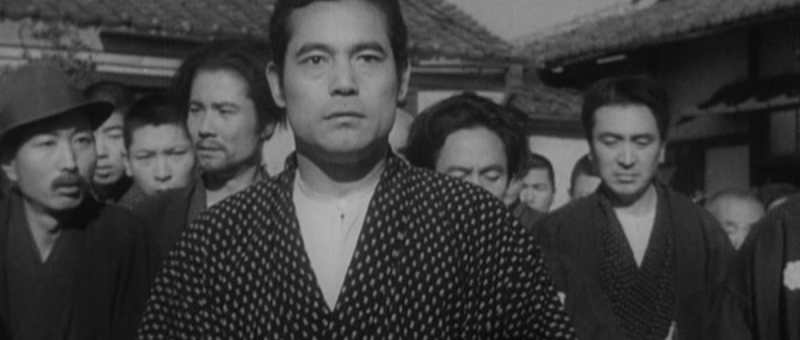
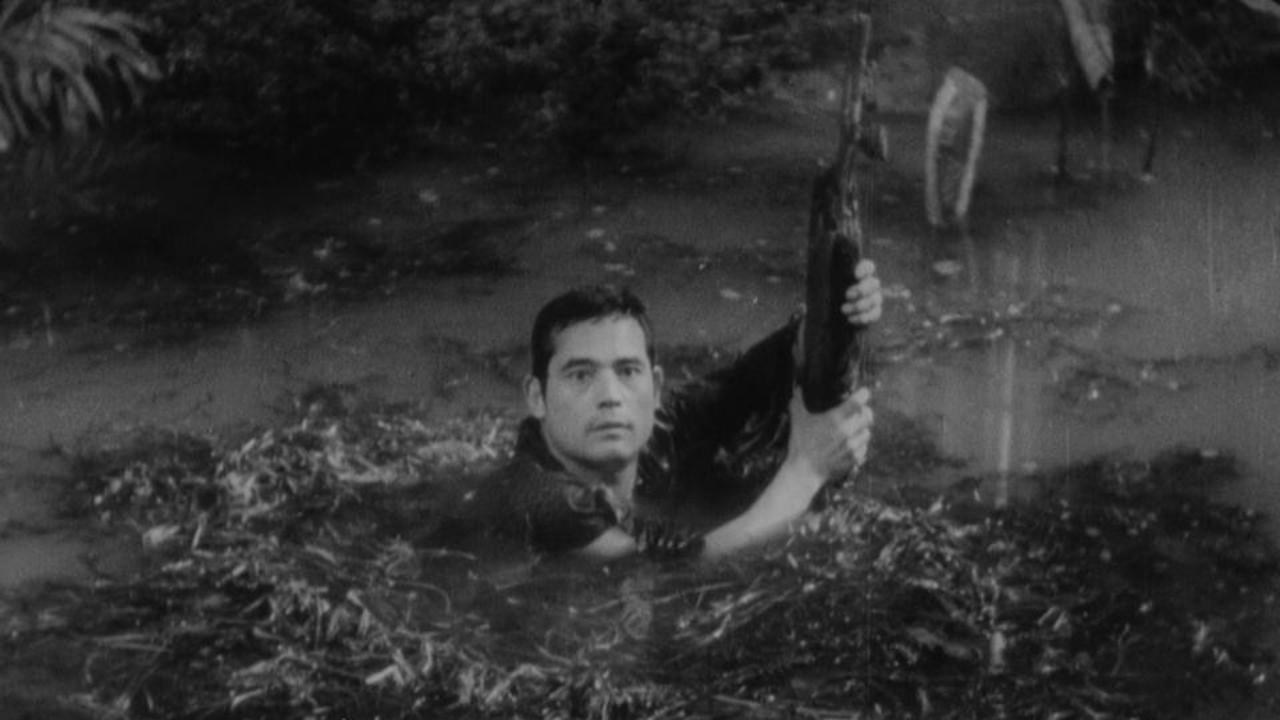
Sanshiro Sugata (姿三四郎, Akira Kurosawa, 1943)

It might seem curious in some ways to make a film about the importance of humanity in martial arts during a time of war, but Akira Kurosawa’s debut feature Sanshiro Sugata (姿三四郎, Sugata Sanshiro) does just this in depicting the hero’s coming of age as a gradual progress towards awakening as he learns to attain control over body and mind through the modern discipline of judo. Based on a novel by Tsuneo Tomita, the film is in many ways a typical martial arts drama in which a young hopeful seeks a master and must eventually face a rival, but lends a note of poetry to the tale which is in other ways perhaps out of keeping with its times. 

The times of the film, however, are late Meiji as demonstrated in the lively opening sequence which ventures into a town in transition where policemen in Western-style uniforms walk the streets alongside townspeople dressed largely in kimono as is the hero, Sanshiro Sugata (Susumu Fujita), who’s come looking for a famous jiujitsu master. Taken on as a pupil, he overhears the master, Momma (Yoshio Kosugi), disparaging a rival, Yano (Denjiro Okochi), who has come up with a new martial art he calls judo which is fast gaining both respect and popularity. Momma thinks it’s all just a branding exercise and Yano’s “judo” is just repackaged jiujitsu, irritated that he seems primed to take a prestigious position as a trainer to the police force which runs its own martial arts contest. Sanshiro goes with them when they attempt to ambush Yano and teach him a lesson only to be easily defeated and humiliatingly thrown in the local river. Sanshiro immediately switches his allegiance, discarding his geta to give Yano a ride home in his rickshaw.

As Yano repeatedly tries to teach Sanshiro, judo is more than a martial arts discipline and places humanity at the centre of everything. This is a difficult lesson for the hot-headed Sanshiro to learn, quickly falling foul of his new master after brawling in the red light district and dramatically throwing himself into the pond. Clinging to a pole, he refuses to get out until Yano forgives him, but in true master fashion Yano merely says that getting out of the pond or not is entirely up to him. It’s while he’s in there, and after a few words from a Buddhist monk, that he witnesses a lotus flower slowing unfolding and achieves a kind of enlightenment that allows him to realise he’s been childish and petulant, finally getting out of the water to submit himself to the rigorous discipline of the martial arts life. 

The flower motif recurs several times, not least being its subversion when antagonist Higaki (Ryunosuke Tsukigata) sprinkles the ash of his cigarette over it. Making his first appearance in dandyish Western dress, Higaki is described as a snake-like villain, his evilness emphasised by his non-Japanese attire in contrast to pretty much everyone else who continues to dress in kimono. Higaki vows that his fight with Sanshiro must be to the death, in part a fight between the nascent art of judo originating in the post-feudal society and the traditional art of jiujitsu, but echoing Sanshiro’s first fight with former master Momma which resulted in his death and plunged the hero into spiritual conflict. He then experiences something similar when realising that he has inadvertently fallen in love with Sayo (Yukiko Todoroki) the pure-hearted daughter of another rival, Murai (Takashi Shimura), who also desires to fight him but as it turns out only in his desire to face a worthy opponent. Sanshiro wants to back away, afraid that he may humiliate or even kill the father of the woman he loves but is brought back to himself by more words from the monk who tells him that he must be as innocent as she is and engage in the fight in a sportsmanlike fashion as a spiritual as well as physical contest. 

This is also to some degree true of his final confrontation with Higaki which too is a confrontation with the evils of the age if less comfortably also satisfying the censors by allowing Higaki to stand in for foreignness in general. Higaki is indeed often accompanied by the sound of the wind which echoes his modernity, the fight taking place in a large windswept field below roiling clouds as the two men grapple despite the advice of their intermediary to call it off before one of them really dies. Higaki does in a sense die a sort of death in that we’re told after the fight he reformed and also managed to find a similar kind of enlightenment to Sanshiro who is then bashful and romantic while heading off on another journey from which he assures Sayo he will soon return. It’s true enough that there doesn’t seem to be much that would appeal to the censors of 1943 save the implied defeat of Western powers and celebration of Japanese martial arts given that humanity is repeatedly emphasised as the core component of judo and that Sanshiro achieves an individual enlightenment rather than finding peace as a member of a team or community, but they did otherwise decide to cut a substantial amount of the film said to contain a love scene and references to alcoholism that they deemed improper. Nevertheless, there are shades of Kurosawa’s later greatness even here in his dramatic composition and expressionistic use of nature to detail one boy’s journey into manhood through the spiritual rather than physical gymnastics of the philosophy of judo. 


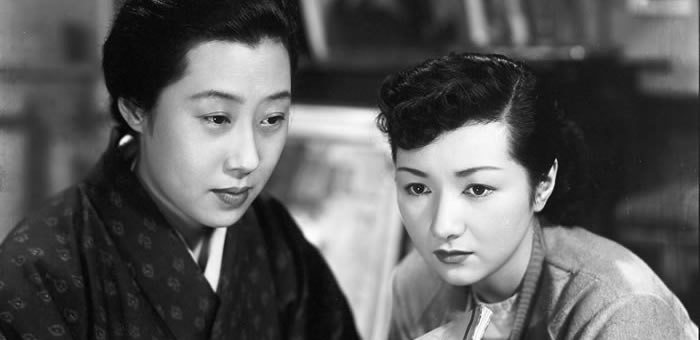
Husband and Wife (夫婦, Mikio Naruse, 1953)

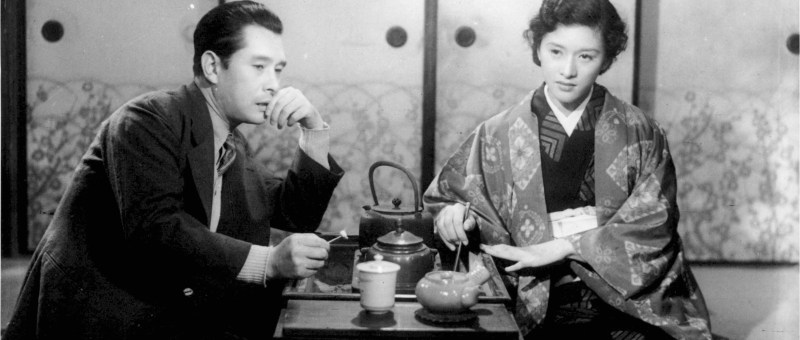
Kikuko (Yoko Sugi) climbs the stairs to the roof of a department store and pauses at the top looking down on her friends below, but they appear to be looking down on her. They’re disappointed. She looks so “provincial”, even though she has no children and therefore more time to spend on herself. They’re envious of her “freedom” to return home late while they have to get back to their husbands or in-laws, but Kikuno isn’t really free at all while trapped in a stifling marriage to the incredibly dull and petulant Isaku (Ken Uehara). 

One of a series of films about marriage and originally envisaged as a sequel to Repast until Setsuko Hara fell ill, Husband and Wife (夫婦, Fufu) paints a rather bleak picture of married life even by Naruse’s standards. The couple are quite literally but also spiritually “homeless” in that they cannot find a home to share, while the absence of a domestic space to call their own prevents them from solidifying their marriage. They’re pushed out of Kikuko’s parents’ home because her brother’s getting married and they need the space, but Isaku drags his feet over finding somewhere else and leaves much of the legwork to Kikuko alone. The main problem seems to be that Isaku can’t afford anything decent, which places a strain on his male pride, but in a repeated motif, rather than confront the situation, he ignores it completely and then crassly presses his recently widowed colleague to let them rent a room in his now much emptier house. 

It’s a mystery why Isaku has so many financial problems when he and Takemura (Rentaro Mikuni) work for the same company, save that Isaku had evidently spent some time working in the provinces, and his colleague had already bought a home with no apparent money worries, but it further sets the two men apart and fuels Isaku’s sense of inadequacy. Having returned from a leave of absence following his wife’s death, Takemura is grief-stricken and apparently uxorious. He complains that he’ll never find another woman like his late wife, all while Isaku won’t shut up about the house and others relentlessly encourage him to remarry. Nevertheless, after the couple move in with him, a natural connection arises between Kikuko and Takemura who is Isaku’s total opposite, both in his treatment of Kikuko and general personality. Where Isaku is sullen and resentful, Takemura is cheerful despite his grief and generous of spirit. Kikuko effectively becomes a wife to both men, taking care of each of them by cooking and cleaning, but while Takemura goes out of his way to thank her, all Isaku does is run her down and humiliate her in front of company.

Then again, having fallen in love with Kikuko precisely because she is a “proper wife,” Takemura then runs his own late wife down by complaining that she wasn’t very pretty and couldn’t cook. The only thing she had going for her was her health, and then she died. He says got a bum deal, and that Kikuko has shown him a different side of womanhood. When two colleagues come to the house and compliment Kikuko’s cooking but are surprised when she eats nothing herself (because they have no money), Isaku responds to their assertion that it’s difficult to be a housewife by replying that men work hard all day while women “only” have to look after the house. For her part, Kikuko says that she was happier when she was working. Men can fall in love several times, but once a woman’s married her romantic life is over. As her friend tells her, men soon get bored of their wives and hers has already taken a mistress at work. 

At several points and with the women in earshot, the men warn each other about the pitfalls of marriage. Irritated that Kikuko has returned to their home on New Year’s Eve after becoming fed up with Isaku, her father advises her brother that women show their true faces after six or seven years and it’s going to horrify him. Isaku tells him not to be too nice or obedient during the early days because his wife will get used to it, while Kikuko counters that men are overgrown children and as long as you make sure to cradle them like babies everything will be fine. Neither of them seem to have a very positive idea of what marriage should be and frame it almost in terms of a war in which they are continually at odds with each other. Isaku describes a husband and wife as a pair of scissors, intending it as a positive metaphor about how one half can’t cut alone, before reframing it as two knives coming together. He becomes unpleasant and chauvinistic, blaming Kikuko for everything by complaining that it’s her fault that he wears a torn up old coat that causes him some embarrassment in front of his boss and a tactless geisha, while criticising her for not having the bath ready when he comes home tired from working all day. Kikuko points out that men seem to assume they’re the only ones who get tired while her loved up brother swears he’ll be different and even if they’re in the honeymoon phase, they do seem much happier and more suited than the already resentful Kikuko and Isaku.

It’s the sister-in-law who throws them a lifeline by introducing them to a relative looking to rent a vacant room, allowing them a means to save their marriage by leaving Takemura’s house. Increasingly resentful of the growing attachment between Kikuko and Takemura, Isaku starts avoiding coming home and hanging out with a young woman at the office with, at least, the danger of a burgeoning affair for which he’s taken to task by Takemura. As Takemura says, it’s not much of a marriage if Isaku can’t trust his wife while Kikuko is eventually so sick of the cold shoulder and constant denigration that she considers leaving him. The new apartment finally gives them a domestic space they can call their own, but it comes with the caveat. The landlady doesn’t allow children because the tenant next door is an ikebana teacher who demands peace and quiet, but Kikuko is in fact already pregnant which might present another means of saving their marriage by becoming a family but Isaku immediately rejects it. He complains he doesn’t have any more money to move again and tells Kikuko to get an abortion, strong-arming her when she refuses. Kikuko can’t go through with it and the nicest thing Isaku says to her in the entire picture is that they can go home, he’s giving in and will raise the child even if it’s difficult. But even this bittersweet moment seems more like condemning them to marriage rather than repairing their relationship with Isaku only grudgingly accepting, most likely because he realises that his marriage is dead anyway if he forces Kikuko to give up their child against her wishes. Despite the changing season, the air between them remains frosty, and marriage is exposed for the prison that it is trapping each of them in loneliness and resentment rather than bringing them together in joy as they prepare to become a family rather than just husband and wife.


Husband and Wife  screened at Japan Society New York as part of Mikio Naruse: The World Betrays Us – Part I.

Vendetta of a Samurai (荒木又右衛門 決闘鍵屋の辻, Kazuo Mori, 1952)

During the American Occupation, period dramas were frowned upon, the occupation forces apparently fearing that they might encourage the latent feudalism in Japanese society. Released immediately before the Occupation’s end, Kazuo Mori’s Vendetta of a Samurai (荒木又右衛門 決闘鍵屋の辻, Araki Mataemon: Ketto Kagiya no Tsuji), not to be confused with the director’s similarly titled Samurai Vendetta from a few years later, is a suitably revisionist piece interrogating the legacy not only of the samurai but the samurai movie in demonstrating, quite poignantly for the contemporary audience, that the rigid and austere codes of a warrior class did nothing but create sadness which forced good men to sacrifice true friendship in service not even of an ideal but simply an agreement. 

To signal his intent, Mori opens with a bombastic sequence shot in the fashion of pre-war jidaigeki, all booming speeches and clashing swords before a voiceover cuts in to tell us everything we know of the events in play is wrong. The legends surrounding the battle at Kagiya Corner tell us that Jinza (Takashi Shimura) was a bad man, and that Mataemon (Toshiro Mifune) killed 36 that day, but in reality Jinza was kind and noble and in fact the two men were good friends while Mataemon in reality struck down only two enemies which is in any case much more plausible if perhaps less exciting. As the classic chanbara scene fades, we return to the modern city of Ueno in Iga which in some respects remains unchanged further emphasising the “reality” of the brief 17th century conflict. As we learn, a man called Matagoro (Minoru Chiaki) has poked a hole through the samurai order in killing the brother of a young man called Kazuma (Akihiko Katayama), and so a lot of people have to die to eradicate the corruption of his transgression.

Boasting a script by Akira Kurosawa, the action flips between Mataemon, brother-in-law of Kazuma, and his men waiting for the arrival of Jinza and Matagoro inside a small inn, and the circumstances which brought them to this point. Mataemon is duty bound to support Kazuma who is really just a boy forced to seek revenge because they are family though there does not seem to be much heat in his desire for justice against Matagoro. Jinza, by contrast, is positioned on the opposite side solely because he is affiliated with a high ranking Hatamoto who is protecting Matagoro. Yet the two men are good friends each resigned to their fates and in full knowledge of how the samurai world works. The have no quarrel with each other, but are forced into mortal combat because of a complex network of loyalties and obligations that can only be satisfied with blood. 

“What is the meaning of this violence?” an imperious official asks, receiving no answer only a mild plea for a little more time. “Being a samurai, what a funny thing,” Mataemon laments to himself reflecting on the fact he must now kill or be killed by his friend for no real reason but simply because things are the way they are. Jinza meanwhile agrees, “Being warriors, what a misfortune,” as the pair calmly discuss the inherent hypocrisies which define their lives wherein all that really matters is one’s proximity to the shogun. That’s one reason the nervous Mago (Daisuke Kato) has joined the mission for revenge, his loyalist father a former tutor to the lord and keen to show their fealty but also hoping to advance their fortunes through a successful vendetta. 

Mago isn’t the only one who’s scared. The inn keeper is visibly shaking. He didn’t really want to be ground zero for a samurai duel today and is presumably worried not just for his safety but for the repercussions of offending his guests and damage to his property. A crowd gathering around the fighting, which includes the wealthy merchant brother-in-law of Matagoro who declared himself unafraid of a few rural bumpkin samurai, remarks on the smell of blood in the air seemingly both horrified and excited by the spectacle though even that is thin on the ground. No grand duel, Mataemon merely strikes his friend down before the battle begins, thereafter coaching the young Kazuma to overcome his fear and claim his revenge despite the bloody ugliness of the task. Yet in the end all there is is fear and futility, along with still more duty and the promise of more blood to come.  


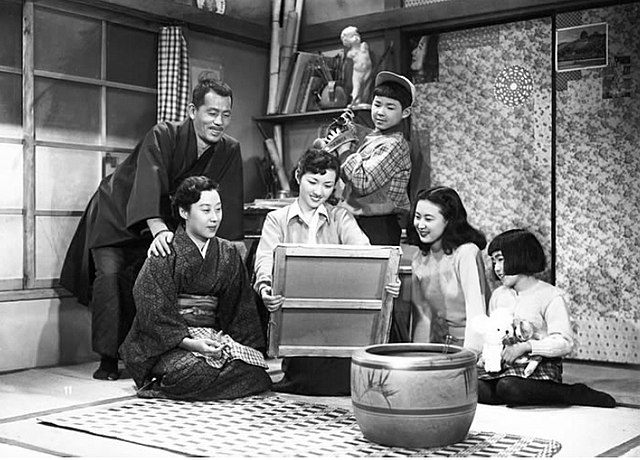
Home Sweet Home (我が家は樂し, Noboru Nakamura, 1951)

There must have been a lot of families like the Uemuras in the Japan of 1951. As film’s title implies, their home is a happy one and though they may not have much they make the most what they have and are cheerful and loving towards each other. Still, the world stores up trouble for them perhaps because they are so very defiant of their circumstances. In many ways a classic shomingeki, Home Sweet Home (我が家は樂し, Waga Ya wa Tanoshi) was the film that put Noboru Nakamura on the map and finds Japan at a kind of crossroads edging past post-war privation towards a broadly consumerist society.

We can get a sense of that in the constant needs of four children in the Uemura family, patriarch Kosaku (Chishu Ryu) picking up his young son Kazuo (Katsumasa Okamoto) after baseball on his way home and noticing that his mitt is almost worn through only to get there and spot his daughter’s boots are getting pretty thin too. It’s clear they struggle for money despite Kosaku’s steady job for which he is about to receive a 25-year good service commendation as wife Namiko (Isuzu Yamada) supplements the family income by taking in sewing at home while we later find out that she’s already sold most of her kimono to help make ends meet and is considering selling her wedding ring to pay for middle daughter Nobuko’s (Keiko Kishi) school trip to Kyoto.

But her hard-nosed sister Kayo (Mutsuko Sakura) tells her that secondhand kimono have lost their value with so many new ones now available. In the immediate post-war era, rice and kimono were the only things that had held their value and so selling one could bring in a lot of money quickly. Conversely, after receiving a sizeable bonus along with his commendation, Kosaku and Namiko visit a department store which has a large range of affordable clothing for sale though the kimono fabric Kosaku picks out for Namiko is still fairly expensive so she instinctively puts it back insisting that they buy the presents they promised the children first. 

That was probably a good move, seeing as the rest of the money is stolen from them on their way home to a congratulations party the children are busy setting up. Kosaku asks why someone would rob people like them, honest, hardworking types who don’t have much to begin with but as Namiko sensibly points out pickpockets don’t really think like that and how would they know anyway. The subtext is that times are still hard for a lot of people even if there are now more exciting, definitely non-essential things appearing on shelves for people with disposable income to buy and a new kimono, though out of fashion, is no longer so out of reach for the ordinary housewife. 

The loss of the money might seem as if it should place a wedge between husband and wife, but bar a moment of disappointment cured by the realisation that oldest daughter Tomoko (Hideko Takamine) has been considerate enough to place hot water bottles in their futons, they resolve to muddle through together and in any case they’re no worse off than they were before. Tomoko herself is conflicted, feeling as if as a young woman in her early 20s she should give up her dreams of becoming a painter and get a job to support the family but Namiko always tells her not to. She encourages each of her children to follow their dreams, perhaps a sign of a new post-war liberation, telling her sister that she’d happily sell all her kimono so that Tomoko could go on painting. Later we discover that she also dreamed of becoming an artist and that though Kosaku had encouraged her to keep it up, a housewife’s day is never done and there was simply no time left for herself. Painting is just another thing she sacrificed for her family and Namiko seems to be determined that Tomoko won’t have to do the same not that she particularly regrets her decision.

Tomoko only really comes to understand her mother’s sacrifices on noticing that the cupboards really are bare, she’s sold everything that could be sold and pawned her ring though the colleague that owned the house they were renting has encountered some financial difficulties of his own and going to to sell to the grumpy old man who bought the house across the way. The Uemuras are such obviously good people that it feels so unfair that so much bad luck has come their way all at once though it is their goodness that eventually saves them when the old man is touched by seeing youngest daughter Mitsuko (Kazuko Fukui) playing with his dog. He later comes to admire Tomoko’s painting of his garden though he’d put a fence up to stop her peering in. The scars of the post-war era are visible in the damage to Uemura’s front wall which would have blocked the way but now perhaps enables them to become good neighbours after all. Though the film may lack some of the visual flair present in Nakamura’s later work, it more than makes up for it with genuine sentiment and the implication that in the end the world is basically good and rewards those who are the same even if it sometimes tests their resilience.


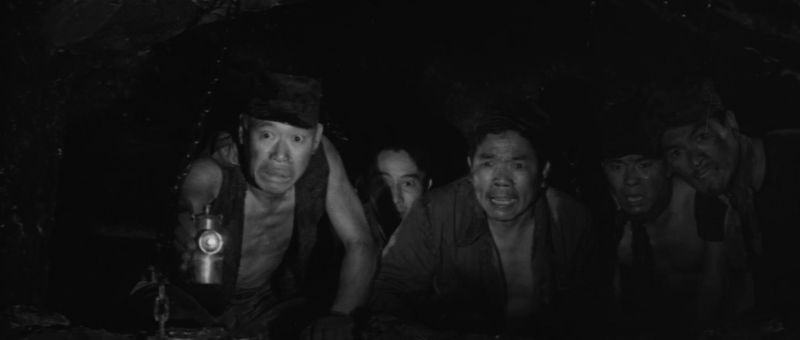
The Eleventh Hour (どたんば, Tomu Uchida, 1957)

The problematic working practices of a post-war coal mine are thrown into stark relief when five men are trapped underground during a collapse in Tomu Uchida’s tense rescue drama, The Eleventh Hour (どたんば, Dotanba). Based on a TV play which was itself inspired by real events, the title alone tells us that we can expect a happy ending even if it’s somewhat undercut by the cynical quality of the fanfare with which it is greeted. Nevertheless, it’s clear that the mine itself reflects a dark side of the contemporary society even as it rocketed towards an economic miracle at least on one level fuelled by coal. 

The Towa mine is a small concern run by the owner, Sunaga (Yoshi Kato), who was a miner himself in his younger days, and the chief engineer Kusaka (Shin Tonomura). In the opening scenes it becomes apparent that they are having difficulty running the business effectively while chasing lucrative large-scale contracts. Kusaka pulls Sunaga aside and attempts to warn him that recent attempts to fit a replacement support beam have caused the structure to shift with the effect that it has begun leaking water. The implication is that Sunaga has attempted to cut corners and endangered the miners’ safety. He barely listens to Kusaka’s complaint before barking at him that it’s his responsibility to take care of, and he must be aware of the cost implications involved seeing as he more than anyone knows how hard it is to run this kind of business. 

Unfortunately for him, a sudden rainstorm spells disaster when the mine begins to flood. Some workers still underground are able to escape thorough a support tunnel that connects to another mine, but five are trapped at the other end having managed to climb to a higher shelf above the water. In the rain-soaked soil, some of the above ground structure also begins to collapse, while to his credit a distraught Sunaga calls in the police and miners’ union as soon as possible rather than trying to cover up the disaster to hide his mismanagement. 

For all that, Sunaga is not a stereotypically exploitative mine owner so much as a bad businessman possibly in over his head though as a former miner he should have known better. On the one hand, he had only just found out about the unstable support arch and could not have fixed it before the disaster but as he himself agrees he bears the ultimately responsibility for the way the mine was run which includes skimping on repairs and inspections. More than anyone else, he wants the men to be rescued alive and later tearfully tells his wife that he has considered suicide but is now resolved to sell the mine and his own home to compensate the families should the worst happen. Kusaka later does try to take his own life after witnessing the rescue effort flounder, a Buddhist priest later suggesting that his act may have been intended as a kind of human sacrifice as if he could save the men’s lives by offering up his own. 

Then again, the way some of the men put it it seems like some mine owners view the compensation money for workers killed on the job as a kind of fine they’re prepared to pay to maximise profits. The film briefly introduces the circumstances of the some of the men and their families, one a husband and father who asks for an advance on his pay because his wife and daughter are ill with something that could turn out to be measles. The amount of the compensation money isn’t clear, but may not be enough for a widow to raise a five-year-old daughter to adulthood. If these men die, their families may die with them. Other relatives waiting for news include an elderly man anxious for his only son, and a grandmother waiting for her grandson who only went to the mine to have a look around before potentially starting to work there. 

In the case of the young Yamaguchi (Shinjiro Ebara), the film hints at the way the industrialisation presented by the mine has disrupted local communities as farmers’ sons leave the land for the promise of better pay for working underground. Yamaguchi is taking the job because his father is ill with some kind of neurological complaint, possibly caused by industrial pollution, and he has argued with his brother presumably about money and the responsibility of earning his keep. While underground, he runs into a friend of his father’s, Banno (Takashi Shimura), who tells him that mining is not a job you can do for life and he himself seems far too old to be doing such physically strenuous work though he is the only one almost able to stand when the men are eventually lifted from the mine. 

A veteran miner, Banno too is perhaps complacent. He smokes underground and blows the cigarette out after every puff but only to avoid carbon monoxide rather than a potential explosion. Trapped underground twice before, he does his best to comfort the other men while reassuring them that their colleagues are working to rescue them as they speak. Most of the mine workers from the surrounding area have indeed come to help, along with a specialist rescue team from Tokyo, though they make little progress with the tools available to them. As a journalist puts it, small enterprises don’t have access to the same resources as large corporations and cannot simply order in larger pumps or better diggers. Many of the workers want want to give up with the main support coming from the korean miners from a neighbouring town though they get little thanks for the efforts. After overhearing a frustrated member of the rescue team employ a racist stereotype to describe them as lazy drunks only after money, they withdraw their labour. 

Sunaga is later forced to go back to the Koreans cap in hand with a personal apology, but though some of them are personally sympathetic they remark on the level of discrimination they’ve faced for the entirety of their careers and aren’t sure why they should help Sunaga now considering the way they’ve been treated. On a side note, standard workers protections would not apply if they were killed or injured during a rescue attempt meaning they’d be risking their families’ lives as well as their own for men who are almost certainly already dead. It’s not surprising that they overwhelmingly vote not to help leaving a dejected Sunaga devoid of all hope. 

Nevertheless, they eventually reconsider reflecting that if they were trapped underground they’d want to believe someone was coming and if they don’t come now then they won’t have any right to expect them to. It is workers’ solidarity that eventually saves the miners, from winch operator Michi (Masako Nakamura) who refuses to leave her post so that the men won’t feel “abandoned” to those who arrive to rejoin the rescue effort just when it seems the most hopeless. The solution to cracking the mine is found only by listening to a former employee who hints at its dark history in reminding them of a secret support tunnel sealed up after the war once military equipment had removed.

It might be tempting to read an allegorical message into the solution being the need to blast through the buried wartime past to rescue the men trapped on the other side though it may be a bit of a stretch. In any case the action outside is also somewhat ironic. As the mine collapse becomes national news and attracts rubbernecking crowds, a man turns up to sell ice cream, while journalists also report on the event from the close by. They seem broadly hopeful, but are also looking for a good story and all too quick to report on Kusaka’s suicide attempt. When the men are eventually rescued, they order a helicopter to drop confetti over the surrounding area (possibly unhelpful to local farmers) along with a bouquet for each of the men. Uchida had some experience of working in a mine during his time in Manchuria which had permanently ruined his health and had first hand knowledge of how a mine works and what happens when something goes wrong which explains the otherwise naturalistic opening sequence laying out the conveyor belt design of the complex as the coal is picked and transferred into pick up trucks that will take it to its new owners. It is however “dark and wet like hell” underground, a place that ideally no one should have to go and that all should eventually be rescued from. 


Throne of Blood (蜘蛛巣城, Akira Kurosawa, 1957)

In many ways, the underlying theme in Akira Kurosawa’s films of the 1950s is that we are incapable of knowing ourselves and are, as a forest spirit remarks in Throne of Blood (蜘蛛巣城, Kumonosu-jo), afraid to look into our own hearts and admit our darkest desires. In adapting Shakespeare’s Macbeth, Kurosawa is less interested in the pull of ambition than the insecurity that drives it along with the inability to transcend himself that precipitates the hero’s decline. 

Indeed, after Washizu (Toshiro Mifune) and his best friend Miki (Minoru Chiaki) ride into the misty forest domain of the witch-like seer who ominously turns her spinning while offering a moral lesson that neither of them heed, they sit on the ground and laugh about what they’ve heard. Yet as Washizu partly admits the old woman revealed something of himself to him in that she echoed a dream of which he was unwilling to speak. Miki asks what warrior would not want to be placed in charge of a castle, but for Washizu it’s almost a primal need to prove himself in surpassing other men. Miki, by contrast, is not so nakedly ambitious but he doesn’t really need to be because he has a son. Washizu has no heir, his line will end with him and so he has only this life to make something of his name. 

Having no heir also undermines his sense of masculinity, just as it undermines the femininity of his wife, Lady Asaji (Isuzu Yamada), who as a woman now likely too old to bear a child may fear for her position. Kurosawa styles Yamada’s face as a perfect noh mask while she delivers her lines with the intonation of noh theatre all of which lends her a fairly eerie presence which only deepens as she descends into the darkness and back out again hovering like a ghost. She is in a sense perhaps already dead if not otherwise possessed by some malignant spirit as she urges her husband on in their dark deeds like a demon on his shoulder even going so far as to present him with the spear he will use to murder his lord, the ultimate act of samurai transgression. 

Yet as Lady Asaji points out, the present lord killed the lord before him for the right to sit on the dais. When the lord comes to stay with them on a pretext of hunting while preparing to launch an attack on a potential rival, the couple are moved into a room previously inhabited by a retainer who’d tried to mount a rebellion but was defeated. He took his own life and the room is still stained with his blood which covers both walls and floor. Washizu ought to realise that this is his fate too, but deep down he wants the prophecy to be true, which it is if more in the letter than the spirit. Would he have done it if he had not met the forest spirit, or would he only idly have thought of it but never followed through? It’s not something that can be known, but his eventual failure is born more of his inability to accept this side of himself than it is the price of ambition in itself. “If you’re going to choose ambition choose it honestly with cruelty” the forest spirit later advises, and Washizu might have been more successful if had he done so earlier. 

Then again, the world he lives in is as Lady Asaji describes it a wicked one in which betrayal is an all but inevitable certainty. Washizu insists that Miki is his friend, and that making Miki’s son his heir satisfies the prophecy while binding him to him so that he cannot rebel even if he were minded to. But Lady Asaji assumes that Miki is ambitious too, suggesting that he may strike first or report his treachery in the hope of personal advancement. For the prophecy to come true, someone has to betray the lord though it need not have been either of them but there can be no trust or friendship in this world of fierce hierarchy and internecine violence. 

Both men should perhaps have realised that when they were trapped riding around the eerie lair of the forest spirit with its mists and cobwebs not to mention heaps of piled skeletons still in their armour all victims of ambition and the spirit’s false promises if also echoing the legacy of wartime folly. “Look upon the ruins of the castle of delusion” the noh chant that opens and closes the film intones, warning of illusionary riches and the price of deluding oneself along with the destruction wrought by those unable to break free of the spider’s web of human desire. 


Throne of Blood screens at the BFI Southbank, London on 21st February 2023 as part of the Kurosawa season.

Original trailer (no subtitles)

I Live in Fear (生きものの記録, Akira Kurosawa, 1955)

Which of us is “crazy”, the man who lives in fear or the rest of us who live in its denial? By 1955, a decade had passed since the bombs fell on Hiroshima and Nagasaki, but even if the world seemed “peaceful” it was only superficial. The Korean War had “ended” in an uneasy truce only two years earlier and the world was already mired in a cold war which daily threatened to turn hot with both sides in possession of a nuclear deterrent. Akira Kurosawa’s I Live in Fear (生きものの記録, Ikimono no Kiroku) asks us if we can really say a man is “insane” if his life is ruled by a rational anxiety and if it is our refusal to accept the threat he sees which eventually drives him out of his mind. 

Our guide is gentle dentist Harada (Takashi Shimura) who has a sideline as a mediator at the family court. The case he has been called in on one particular afternoon is that of the Nakajima family which is attempting to have the ageing patriarch, Kiichi (a near unrecognisable Toshiro Mifune), declared legally incompetent on account of his increasing paranoia about nuclear attack and latent radioactivity. A wealthy self-made man and foundry owner, Kiichi has frittered away vast sums on harebrained schemes to keep himself and his family safe but after a plan to build a bunker in a remote area had to be abandoned, he’s set his heart on moving everyone to Brazil where he believes they will be safer. 

The problem is partly one of changing times as Kiichi, “despotic and selfish” as his son describes him, attempts to railroad his family into a safety they do not want or need. His two legitimate sons now operate the foundry and their lives are dependent on it, which is not to say that they are dependent on Kiichi, but if he goes through with selling the the foundry to finance his new life it will leave them all high and dry. It would be, to a certain way of thinking, the ultimate paternal betrayal but in Kiichi’s mind all he’s trying to do is “save” his family from an invisible threat. 

That family, meanwhile, is one he’s already undermined through patriarchal selfishness in fathering a series of illegitimate children he is also supporting financially but has never legally acknowledged. The parents of the illegitimate kids are worried that if the family succeeds in having Kiichi declared legally incompetent, his wife will get her hands on the purse strings and they’ll be left out in the cold. Kiichi, meanwhile, has an old-fashioned view of filial relations and never considers that the other kids might not want to come with him either even if it’s unexpectedly nice of him to include them, or that inviting your two mistresses to live in the same house as your legal wife might be awkward for all concerned. 

On the face of it, the case is open and shut. If a man causes his family to suffer through frittering money away on drink or pachinko, they would approve the motion to give another family member legal control over his finances. So why is it taking them so long to decide if Kiichi is a liability to his family or not? The problem is, his fear is entirely rational. It’s only its extent which is the problem. It’s perfectly understandable to be afraid of the ebola virus or brain-eating amoeba, but we can’t afford to spend every minute of every day consumed by fear and so they retreat into the background anxiety of our lives while we try to go on living. Yet, could it be that Kiichi has it right and we’re merely living in denial, sleepwalking into a preventable disaster while he alone has a plan for survival? 

“No place is safe” Kiichi’s son-in-law exasperatedly explains to him after he has taken drastic and somewhat ironic action, a kind of scorched earth policy designed to force his sons to follow him into a new world of safety. Pushed over the edge, Kiichi gets a rude awakening, realising that it was perhaps selfish of him only to think of salvation for his immediate family when his actions will essentially throw his workforce under the bus. Belatedly, he promises to find a way to take them to Brazil too, never realising that people have their own lives that aren’t so easily uprooted. He thinks Brazil is safer because the currents of the world seem to blow ill winds over Japan, but there are already more than enough nuclear bombs lying in warehouses to destroy the planet several times over. 

In any case, Kiichi has already destroyed his family through his various transgressions. They don’t want to go in part because they don’t particularly like him, are sick of his gruff authoritarianism, and resent his tendency to make unilateral decisions on their behalf. Strapped for cash he tries asking the illegitimate kids to return some of the money he gave them, but they too are insecure in their positions and cannot trust that they will continue to be provided for if Kiichi is deposed. Meanwhile, when Kiichi falls ill the legitimate children are only too quick to start discussing the inheritance in the absence of a will. Perhaps Kiichi isn’t much more to them than a walking wallet, all of which lends a rather poignant quality to his continual attempts to protect his family from the nuclear apocalypse in fulfilment of his fatherly duty even as he wagers their economic security to do so. 

If Kiichi is a Cassandra prophesying the end of the world, we won’t be here to be sorry we didn’t listen, but Harada and other more rational minds are shaken by the intensity of his vision. They cannot say that he is “mad” even if his anxiety has consumed his life, but nor can they allow him free rein to pursue his plans because they do not concern only himself but greatly affect the lives of others. They are forced to wonder if it isn’t we who are “insane”, quietly living our lives while all these preventable threats hover in the background, ignored. Kiichi’s mistake was perhaps that he wanted only to be “safe” in an unsafe world, not to cure it of its dangers. Few us are actively trying to eliminate ebola or brain-eating amoebas, just as few actively opposed an increasingly nuclear society, powerless as we are and were in the face of a greater threat. Perhaps Kiichi was the sanest one of all, retreating into a world of madness and infinite safety in a delusional bubble of survival in an otherwise crazy world.


I Live in Fear screens at the BFI Southbank, London on 6th & 13th February 2023 as part of the Kurosawa season.

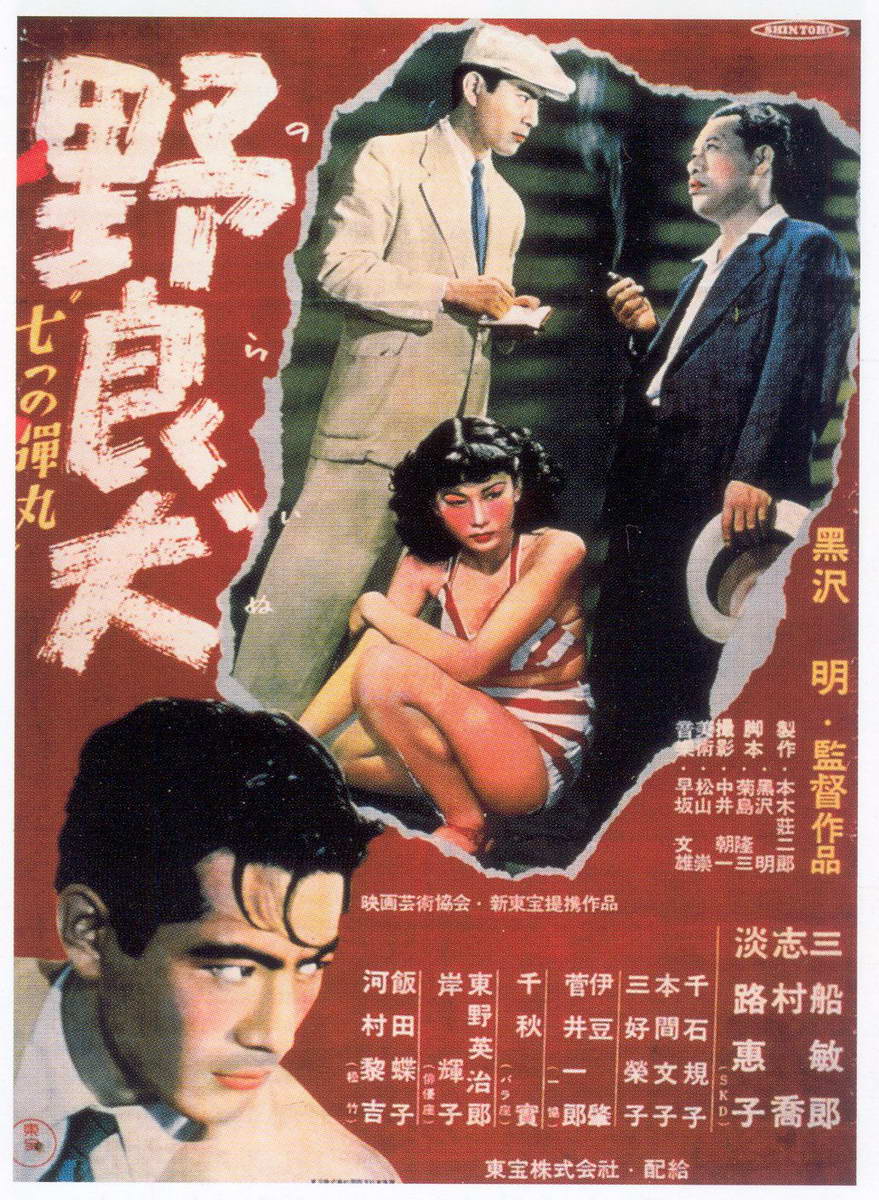
Stray Dog (野良犬, Akira Kurosawa, 1949)

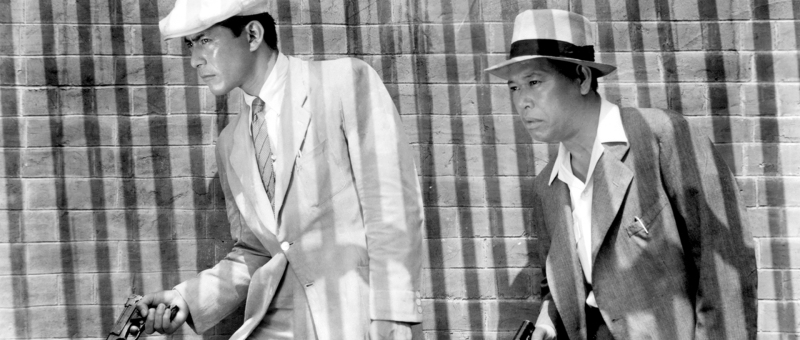
“And, yes, I think the world’s not right. But it’s worse to take it out on the world” the conflicted policeman at the centre of Akira Kurosawa’s Stray Dog (野良犬, Nora Inu) explains as he struggles to reacquire his sense of authority while weighing up its limits and his own right to pass judgement on what is right or wrong or merely illegal. He must ask himself how he can enforce the law while faced with the reality that the man he chases is an echo of himself, the him that took another path amid the chaos, confusion, and despair that followed in the wake of defeat and occupation even as his well-meaning mentor insists that some people are good and others bad and he won’t be able to do his job if he gives it much more thought than that.

The policeman, Murakami (Toshiro Mifune), is perhaps the stray dog of the title who can only follow the straight path towards his missing gun taken from him on a sweltering bus in the middle of summer while he was distracted not only by the heat but by exhaustion having been up all night on a stakeout. As we later discover, Murakami is a rookie cop and recently demobbed soldier trying to make a life for himself in the post-war society. In this he is quite lucky. Many men returned home and struggled to find employment leaving them unable to marry or support families, a whole pack of stray dogs lost in an ever changing landscape. This must have weighed quite heavily on his mind as he made the decision to resign from the police force to take responsibility for the laxity that led to the gun possibly ending up in the wrong hands only to discover his superiors don’t regard it as seriously as he does. His boss tears up the letter and tells him to turn his defeat into something more positive by trying to do something about it, which might in its own way be a metaphor for the new post-war society. 

So closely does Murakami identify himself with his gun that on hearing it has been used in a violent robbery it’s almost as if he has committed the crime and is responsible for anything it might do. There is an essential irony in the fact that this weapon that was supposed to prevent crime is being subverted and used in its service as if mirroring the paths of the two men who both returned to a changed Japan and had their knapsacks stolen on their way back home. Murakami has chosen the law, while the thief Yusa (Isao Kimura) is thrown into nihilistic despair unable to make a life for himself. Murakami’s sense of guilt is further compounded on realising that he may have frustrated Yusa’s attempt to turn back, returning the gun to the underground pistol brokers who make their living through selling illegal weapons stolen from police or bought from occupation forces.

As he admits, Murakami could have ended up committing a robbery but realised he was at a dangerous crossroads and made a deliberate choice to join the police instead. He literally finds himself walking the other man’s path when he’s told by a pickpocket, Ogin (Noriko Sengoku), that the underworld pistol dealers will find him if he walks around downtown looking like he’s at the end of his rope. Ogin, the woman reeking of cheap perfume who stood next to him on the bus, was once known for her fancy kimonos but is now in western dress, signalling perhaps a further decline. In this age of privation, only kimonos and rice have held their value and it’s not unreasonable to assume that she’s sold all of hers and joined the modern generation. Ogin doesn’t have anything to do with the theft, but seems to take pity on Murakami seeing him as naive and essentially unable to understand the way things work on the ground. His mentor, Sato (Takashi Shimura), seems to understand too well, on one level looking down on those like Ogin as simply bad but otherwise happy in her company knowing exactly how to get what he wants through their oddly flirtatious conversation as they suck ice lollies and smoke illicit cigarettes in the interview room. 

Dressed in a ragged military uniform, Murakami wanders around the backstreets of contemporary Tokyo past street kids and sex workers and groups of men just hanging around. Kurosawa employs montage and superimposition to reflect the endless drudgery and maddening circularity his of passage under the stifling heat of summer in the city that allows him a better understanding of what it is to live in this world. Even so, the boy who eventually makes contact seems to see through him pointing out that he looks too physically robust to pass for a desperate drifter. Yusa meanwhile is wiry and hollow, a frightened man who uses Murakami’s gun to affect an authority he does not own which might explain why both of his victims are women. Sato emphasises the worthiness of their victimhood, explaining that the first was robbed of the money she’d saved over three years for her wedding meaning she might have to wait even longer at which point there would be no point getting married at all, while the second woman was killed at home alone and defenceless. We’re also told that her body was nude when discovered which raises the question of whether she might have been assaulted before she died which would cast quite a different light on Yusa’s crimes no longer an accidental killer but a crazed rapist well beyond salvation. 

Yet the accidental nature of Yusa’s fall does seem to be key. The trigger seems to have been a childhood friend he’d fallen in love with gazing at a dress he could never afford to buy for her, pushed into a corner by his wounded masculinity and taking drastic action to reclaim it in much the same way Murakami later does in searching for his missing gun. In their final confrontation they grapple violently in existential struggle in a small grove behind some posh houses where a woman plays a charming parlour tune on the piano pausing only for a few moments to peer out of the window on hearing gunshots. Murakami retrieves his gun and the pair fall to the ground side by side to be met by the sound of children singing, provoking a wail of absolute despair from a defeated Yusa suddenly hit by the full weight of his transgressions. He too was a stray dog heading straight in one direction driven out of mainstream society by the unfairness of the post-war world. Sato tells Murakami that he’ll eventually forget all about Yusa, that he’ll become “less sentimental” and accept the world is full of bad guys and those who fall victim to them, but Murakami doesn’t seem too convinced, for the moment at least unable to forget that Yusa was man much like himself only less lucky or perhaps simply less naive.


Stray Dog screens at the BFI Southbank, London on 1st & 13th February 2023 as part of the Kurosawa season.

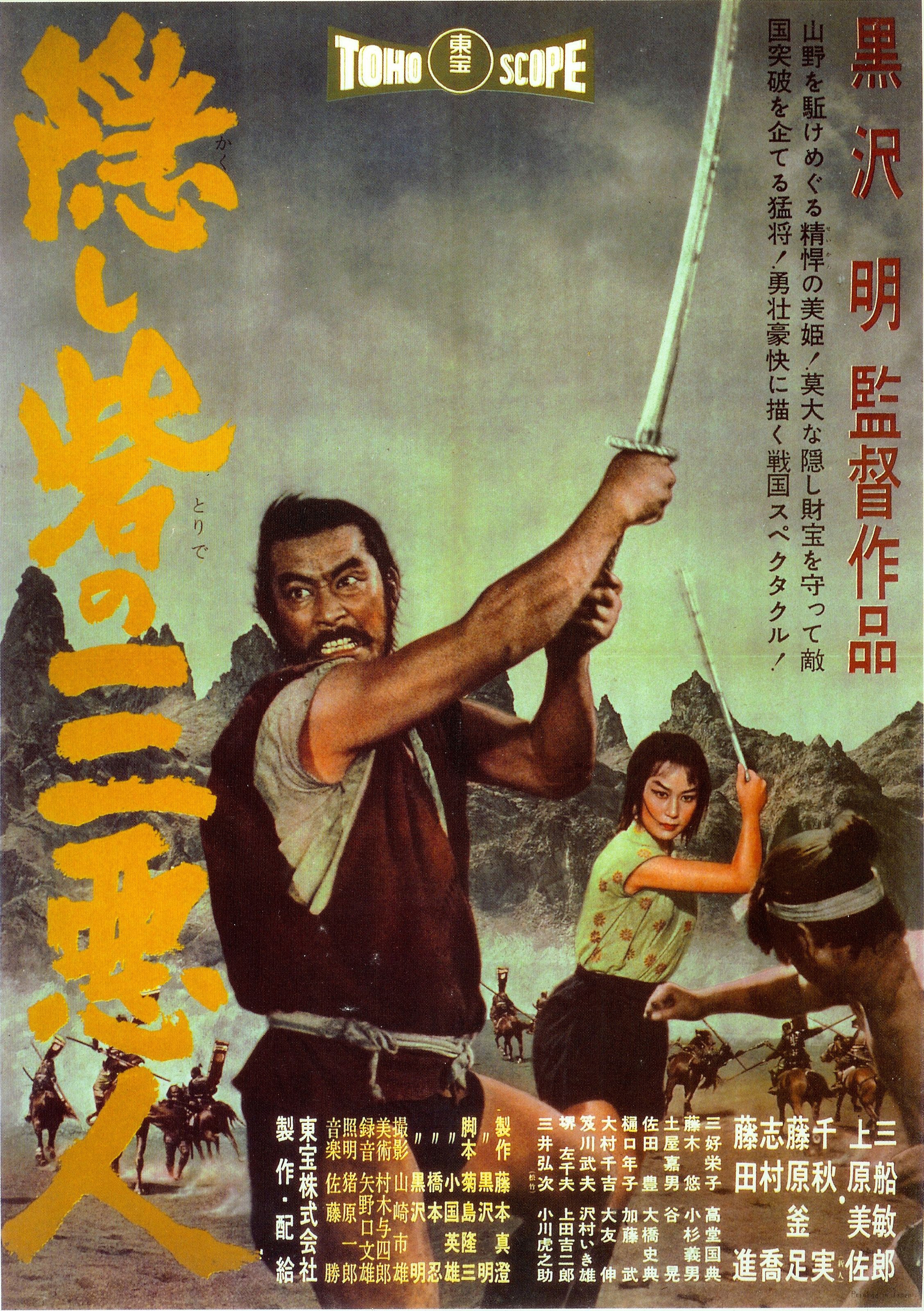
The Hidden Fortress (隠し砦の三悪人, Akira Kurosawa, 1958)

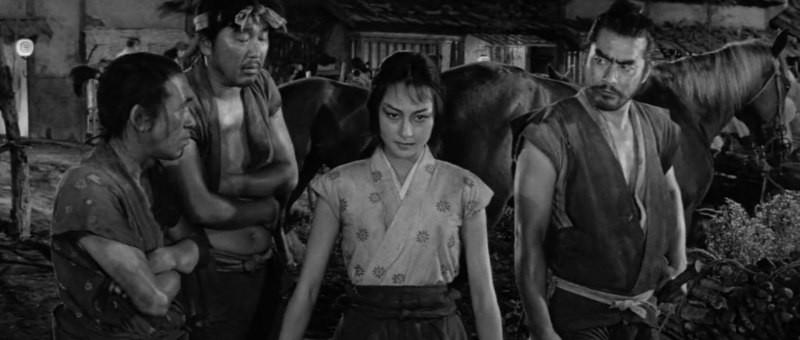
“Your kindness will harm you” a well-meaning retainer advises his charge, but in the end it is her kindness which saves her along with numerous others in Akira Kurosawa’s Sengoku-era epic, The Hidden Fortress (隠し砦の三悪人, Kakushi Toride no San Akunin). Largely told from the point of view of two bumbling peasants trying to get rich quick by exploiting the hierarchal fluidity of a time of war, the film nevertheless cuts against the grain of the democratic era in advocating not so much the destruction of the class-bound feudal order as benevolent authority. 

This can quite clearly be seen in the dynamic figure of displaced princess Yuki (Misa Uehara), the successor of her routed clan protected by a hidden fortress in the mountains which she must eventually leave. Her female servant laments that her father raised her as a boy which has given her a haughty and dominant manner at odds with the polite submissiveness usually expected of upperclass women. While often exerting her authority, she is otherwise uncomfortable with the uncritical servitude of her retainers, chief among them the talented general Makabe (Toshiro Mifune) who sacrificed the life of his own sister, allowing her to be executed in Yuki’s place buying them some time. “Kofuyu was 16. I am 16. What difference is there in our souls?” she asks, yet even if she believes their souls are equal she is not quite so egalitarian as to forget her position or the power and privilege that comes with it. 

Nevertheless, hers is an authority that is tempered by compassion and in the end chosen. Her salvation comes in speaking her mind to an enemy retainer, Tadokoro (Susumu Fujita), who has been savagely beaten by his own lord for losing a duel with Makabe who, to the mind of some, humiliated him with kindness in refusing to take his life leaving him to live in defeat. Yuki says she doesn’t know who is stupider, Tadokoro or his lord, for never would she punish a man in such a way simply for losing to an enemy. She tells him that there is another way, and that he need not serve a lord who does not serve him leading Tadokoro to defect and choose to follow her instead. 

She also inspires confidence in a young woman she insists on redeeming after discovering that she is a former member of the Akizuka clan sold into sexual slavery after being taken prisoner by the Yamane. Kurosawa presents the girl with a dilemma on realising that the mysterious woman who saved her is the fugitive princess, knowing that she could betray her and pocket the gold, but finds her resolving to serve Yuki all the more. In a moment of irony, we learn that the girl was bought for five silver coins, the same amount of money a wealthy traveller offers for Makabe’s horse, but displeases her master in refusing to speak or serve customers. For Yuki he offers gold, though withdraws on being told that she is mute. Knowing that she would be unable to disguise her speech or accent which would instantly give her away as a haughty princess, Makabe convinces her to stay silent though as she tells him he cannot make her heart mute too. 

Even the peasants, oblivious to her true identity, view Yuki as part of the spoils insisting that they should be entitled to a third of her too and at one point preparing to rape her only to be fought off by the rescued girl. “We can rely on their greed” Makabe had said, knowing that their material desires make them easy to manipulate and that their loyalties are otherwise fickle. Matashichi (Kamatari Fujiwara) and his friend Tahei (Minoru Chiaki) sold their houses in their village to buy armour in the hope of achieving social mobility through distinguishing themselves in war, but have largely been humiliated, robbed of their armour, mistaken for captured members of the enemy, and forced to dig the graves of others. They pledge eternal friendship but their bond is continually disrupted by the promise of monetary gain. They fall out over a moral quandary, one willing to plunder the body of a fallen soldier and the other not, while even on reuniting squabbling about how to divide the money first deciding it should be equal and immediately disagreeing as soon as they get their hands on it. At the film’s conclusion it rests on Yuki to play mother, telling them that they must be good and share the boon she’s given them equally without complaint each then too only quick to be generous insisting that the other can keep it. 

The implication is still, however, that Matashichi and Tahei should return to their village to live as peasants while Yuki assumes her place in a castle no longer hidden as its ruler. Order has returned and the old system remains in place, all that changes is that this is now a compassionate autocracy ruled by a benevolent lord who views her subjects lives as equal to her own yet not perhaps their status. Where it might prompt Tadokoro to conclude that he need serve no lord at all for there should be no leaders only equals, the film concludes that a leader should be just and if they are not they should not be followed. Then again, the disagreement between firm friends Matashichi and Tahei is ended when they each have enough and no longer find themselves fighting for a bigger slice of the pie content in the validation of their equality. As Makabe puts it, heavy is the head that wears the crown. Yuki’s suffering is in the responsibility of rebuilding her clan though she does so with compassion and empathy ruling with respect rather than fear or austerity. Kurosawa utilises the novel scope format to hint at the wide open vistas that extend ahead of the peasants as they make their way towards the castle in search of gold only to leave with something that while more valuable may also shine so brightly as to blind them to the inherent inequalities of the feudal order. 


The Hidden Fortress screens at the BFI Southbank, London on 20th & 27th January 2023 as part of the Kurosawa season.