The Lyricist Wannabe (填詞L, Norris Wong, 2023)

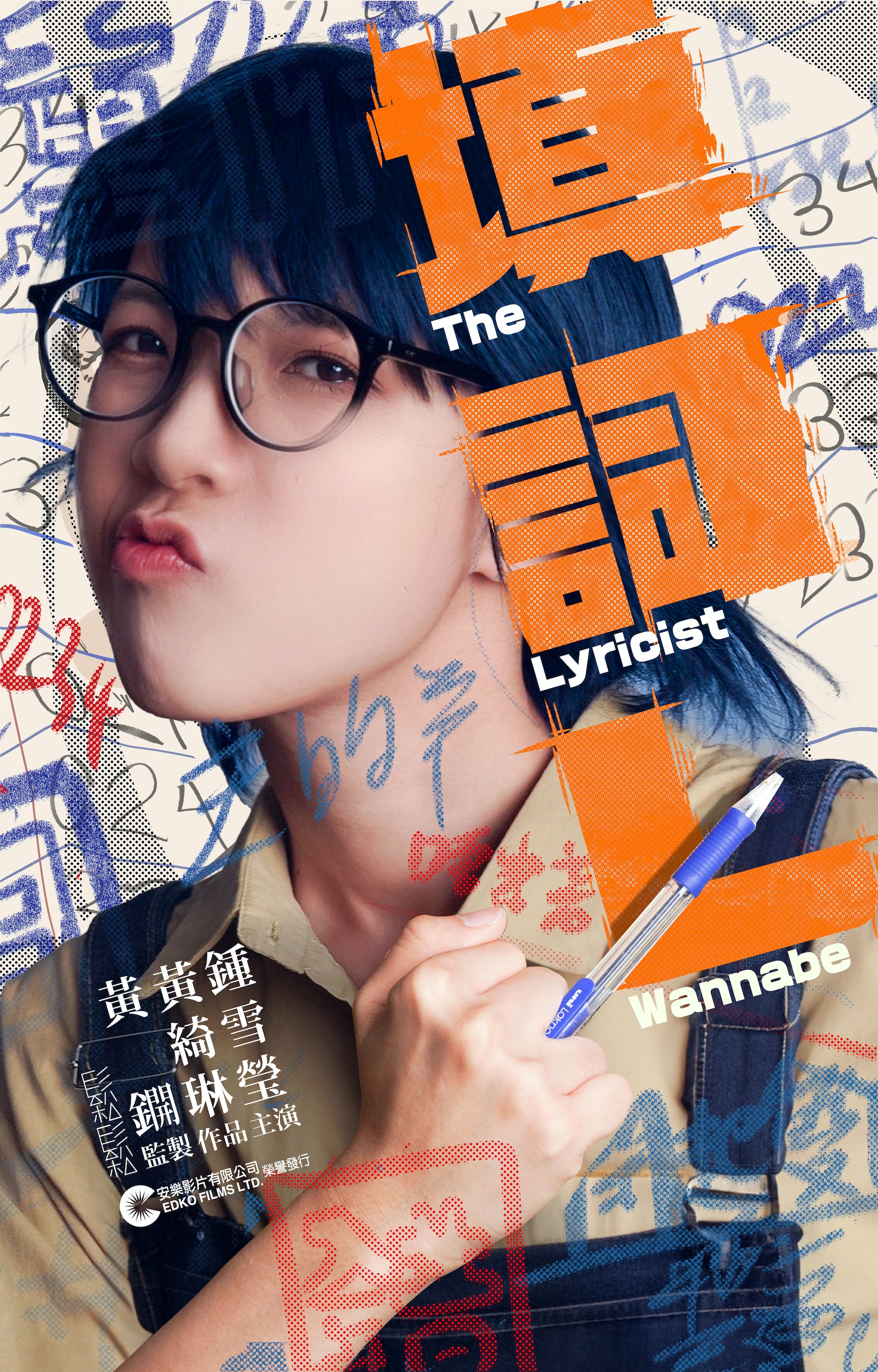
Sometimes a dream might have come true only we never really noticed. In Norris Wong’s autobiographically inspired drama The Wannabe Lyricist (填詞L), a young woman battles her way towards becoming a Cantopop songwriter yet perhaps she already is one by virtue of her constant act of lyric writing. What she craves is the validation of having a song published, yet experiences setbacks at every step of the way that encourage her to doubt her talent or the right to continue chasing her dreams.

At a particularly low point after being taken on by a music producer to work with a spoilt influencer who’s getting studio time as some kind of favour, Sze (Chung Suet Ying) is told that her lyrics are no good and that after struggling so hard for six years perhaps she ought to take the hint and accept she isn’t suited to this line of work. It’s an act of intense cruelty, though one in part motivated by a well-meaning faux pas. In her excitement, she told the influencer she’d write lyrics for her album for free just to be published, but the palpable sense of desperation seems to have put the influencer off unable to have confidence in the work that Sze herself has devalued.

She encounters something similar during a partnership with an aspiring pop star who says he likes her lyrics but then drops the bombshell that he plans to sing in Mandarin because it’s a bigger audience. Ironically, on a trip to Taipei to sell his album she’s told that his accent is no good for the local market and while they like the song she worked on she later realises that they hired another lyricist for “real” release without even telling her. What’s more, tones don’t matter while singing in Mandarin whereas lyric writing in Cantonese is a painstaking process of trying to ensure that the tone of the word fits the melody. Aside from its political implications, not only does the pop star’s arbitrary decision to just sing it Mandarin ruin the lyrical flow she spent so long perfecting but entirely disrespects her work.

After deciding to take a break from trying to make it in music, Sze gets a job working at a ridesharing app startup where she’s roped in to create a jingle but once again her hopes are dashed when the business strays into a legal grey area and several of the drivers are arrested. While the app’s creator silently cries in his office, his female colleague ponders going somewhere else, “anywhere that doesn’t punish dreamers” which seems like a nod not only towards an oppressive capitalism that values only marketability but equally the increasingly oppressive atmosphere of the nation’s political realities. In a way this is what Sze ends up doing too, putting geographical distance between herself and the failure of her dreams by returning to the land which as the farmer says never lies to you, you reap what sow.

Yet for all her drive and perseverance there are others who view Sze’s obsession with her dreams as selfish and self-involved complaining that she rarely considers the feelings of others and neither notices nor cares if she may have hurt or inconvenienced them. She’s told that her lyrics are hollow because she lacks life experience but also is incapable of empathising and cannot see anything outside of her quest to become a lyricist. She watches other people move on, her brother getting married, friends enjoying career success etc while she’s still stuck looking for her big break only for something to go wrong just as everything was about to go right.

Wong signals the playful qualities of her fantasies though use of onscreen illustrations and even a karaoke-style video along with the nostalgic quality of the early 2000s setting of Sze’s schooldays with its MSN messenger and ICQ. Sze may be “dragged along by the melody” in more ways than one as she tries to make peace with her dreams and her future and find some way of living in harmony with the rhythms of the world around her but eventually comes to realise that she was a lyricist all along no matter what anyone else might have tried to convince her she was.


The Lyricist Wannabe screened as part of this year’s Osaka Asian Film Festival and opens in UK cinemas 15th March courtesy of Cine Asia.

Original trailer (Traditional Chinese / English subtitles)
Your Name Engraved Herein (刻在你心底的名字, Liu Kuang-hui, 2020)

Taiwan is often thought to be the most socially liberal of Asian nations and was the first to legalise same sex marriage in 2019, but a little over 30 years ago things were very different. Many thought that the lifting of martial law which had been in place for 38 years would usher in a new era of freedom only to discover that society is slow to change and despite a gradual opening up the old prejudices still remain. So it is for A-han, the hero of Liu Kuang-hui’s Your Name Engraved Herein (刻在你心底的名字, Kè Zài nǐ Xīndǐ de Míngzi) who finds himself struggling to accept his sexuality as young man coming of age in changing times. 

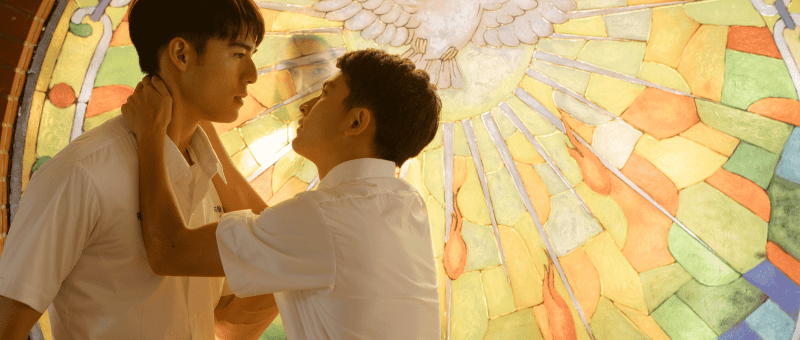
In 1987, as martial law is repealed, A-han (Edward Chen) is a student at a Catholic boys boarding school run along military lines. Many things are changing, but the school is much the same, as the principal Dirty Head (Ta Su) makes plain in conducting an impromptu inspection of the boys’ bunks looking for anything untoward. Nevertheless, A-Han and his friends sneak out at night to play in a band and hang out with girls. A-Han’s reticence is put down to shyness, but the reason he’s not much interested is that he’s taken a liking to a rebellious student, Birdy (Wang Shih-shien), only he’s not quite sure how to interpret his feelings or how to come to terms with them. 

This is in part because the school itself is extremely homophobic with the boys actively policing suspected homosexuality as a means of homosocial bonding. When the gang are caught sneaking out, band leader Horn (Barry Qu) targets an effeminate boy he accuses of dobbing them in, beating him up in the bathroom little knowing that A-han is hiding in a nearby stall after bringing ointment to Birdy who has also been caned. A-han emerges from the stalls after Horn hears a noise and is encouraged to join in the fun, handed a baseball bat and asked to participate in a literal act of queer bashing to prove his manhood. To his shame, A-Han prepares to comply, only to be saved by Birdy who breaks cover to rescue the other boy while casting scornful looks at Horn and the gang but most especially at the hypocritical A-Han. 

Taking his nickname from the Alan Parker film, Birdy may indeed be as “wild” as his namesake, but his rebelliousness has its limits and perhaps masks an internalised sense of shame. Nevertheless, he connects with the conflicted A-Han and the boys generate an intense friendship that of course has tension at its centre. A trip to Taipei to mourn the death of the president brings them closer, but also makes them feel ashamed as they witness a protester holding up a sign to the effect that homosexuality is not a disease and marriage is a human right being carted off by plain clothes police while the uniformed kind lurk in the shadows behind. Martial law may be over, but not everyone is free. As A-Han grows bolder, Birdy finds himself travelling in the opposite direction, dating a rebellious female student, Banban (Mimi Shao), as a kind of beard in the frustrated hope that he may “save” A-Han from his homosexuality by denying their feelings before they can fully develop. 

The central irony is that because of the changes to the educational system the high school is now required to take female pupils and the hardline Catholic, militarist teachers are paranoid about “misbehaviour”, even putting up a chainlink fence to divide the girls from the boys. Romance is forbidden even for heterosexual couples, and homosexuality unthinkable. A-Han finds himself trying to talk to his priest, Father Oliver (Fabio Grangeon), who would like to be more sympathetic but cannot offer him much by the way of advice. Later we discover that Father Oliver left his native Montreal to escape religious oppression and joined the priesthood to mask his own homosexuality, finally leaving the Church to live a more authentic life only many years later when such things were more acceptable. 30 years on A-han travels to a much changed Montreal where he sees lesbians dancing happily in bars and men kissing in the street with no one batting much of an eyelid. He reflects on all that’s changed and all the wasted time he and others like him were forced to endure hiding who they were, living in a world without love. A melancholy lament for the lost opportunities of a repressive society, Your Name Engraved Herein ends on a note of hope in which first love can blossom once again in a less restrictive world where all are free to love without shame.


Your Name Engraved Herein made its World Premiere as part of this year’s Osaka Asian Film Festival.

Original Trailers (English subtitles)

Zone Pro Site: The Moveable Feast (總舖師, Chen Yu-hsun, 2013)

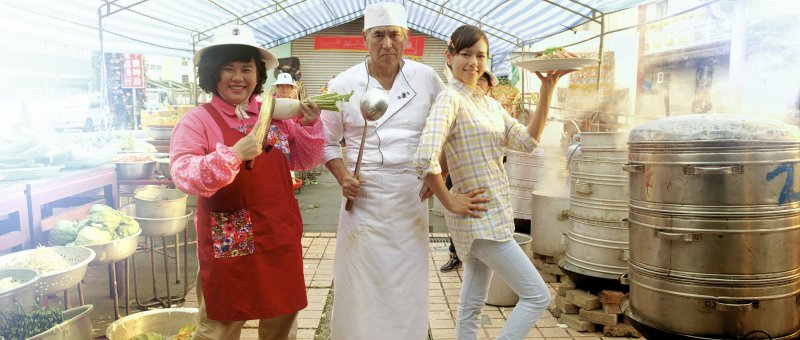
In these high speed days, it’s sometimes difficult to remember that “cooking means something” or at least it should do according to “Doctor Gourmet” Hai (Tony Yang). A warm tribute to the Taiwanese tradition of bandoh outdoor banquets, Zone Pro Site: The Moveable Feast (總舖師, Zǒng Pù Shī) positions the figure of the chef as a kind of conduit bridging the gap between people through the art of well cooked food. Heroine Wan (Kimi Hsia Yu-chiao), however, thoroughly rejected the ambitions of her top chef father and determined on a life in the city with her heart set on becoming a famous model, actress, and celebrity. 

Life in Taipei is however hard. Career success is hard to come by and duplicity lurks round every corner. Wan learns this to her cost when two shady guys turn up on the pretext of delivering a birthday cake only to explain to her that her boyfriend, whose loans she’s unwisely co-signed, has skipped town and left her with the bill. Confused and afraid, Wan decides to skip town herself, planning to head back to her hometown and ask her mother for help. What she discovers however is that her mother is on the run too after losing the family restaurant partly through her subpar cooking skills which could never match those of her late husband, and partly through the betrayal of his apprentice who poached all their best customers and set up on his own. Despite being “in hiding”, the only way Puffy (Lin Mei-hsiu) has been able to make ends meet is by putting on an impromptu dance show in the central square to promote her small noodle stall. Luckily for them both, Wan makes a chance encounter on the train with a nice young man, Hai, who turns out to be a “Doctor Gourmet” specialising in “fixing” failing restaurants.

His arrival comes at just the right moment as Wan and her mother get a visit from potential clients – a sweet older couple who first met 50 years previously at a wedding catered not by Wan’s father Master Fly Spirit, but by his now departed mentor. Wan’s mother was going to turn the request down because neither she nor Wan know how to make the traditional dishes the couple are looking for, but Wan makes an impromptu decision to try and make their wedding dreams come true, warning them that it might take a little extra time and not quite match up to their romantic expectations. 

Wan’s problem is that she always hated her family’s restaurant. She resented the heat and the smell and the grease, often placing an empty box over her head and retreating into a fantasy world to escape the chaos. Her father wanted her to take over, leaving her a notebook filled with his recipes which was unfortunately stolen by a homeless man who mugged her at the station, but she was dead set on escape and becoming a “someone” in the city. Unlike her mother, however, she has real talent for cooking and is equally skilled at using her good looks and sweet nature to get things done. Soon after her arrival at the noodle stand, she’s already got herself a gang of geeky groupies calling themselves “Animals on Call” who are ready to do pretty much anything she asks of them. 

That comes in handy when Puffy persuades her to enter a national cooking competition where her rival is none other than Tsai, the apprentice who betrayed them, backed up another famous ex-chef Master Ghost Head (Hsi Hsiang) who has a fiery temper and spent some time in prison which might be why he still dresses like an ultra cool motorcycle guy from the ‘70s. There were apparently three great masters, the other being the eccentric  Master Silly Mortal (Wu Nien-jen) who is later discovered living in a subway tunnel where he keeps the art of bandoh alive through a literal underground restaurant where his regulars bring him a selection of ingredients before sitting down to enjoy a communal meal. It’s Silly Mortal whose food is said to evoke human feelings who guides Wan towards a series of epiphanies about the nature of “traditional” food. According to him, there are no rules about what goes together, and having a “traditional” heart is really about embracing the true nature of bandoh. Only by having a heart full of joy can you make good food. 

Equally eccentric in some respects, Hai takes a back seat after reminding Wan that cooking is really a way of sending a coded message to its intended target. The two goons eventually join the team, working together earnestly to prepare for the biggest banquet of all which is both the old couple’s wedding celebration and the competition’s finale. Master Ghost Spirit talks about taking the “grief” out of meat through fine cutting, while Master Silly Mortal is all about putting positive emotions in, but the missing piece of the puzzle is Master Fly Spirit who sends his final message to Wan only after death as she rediscovers him through his recipes. Not quite giving up on her celebrity career, Wan embraces her inner chef, happy with the idea of making lunchboxes to sell at the station with her new friends and family rather than chasing money through oddly nihilistic cuisine as Tsai had done. In the end, it’s all about joy and togetherness, sharing tasty food in the open air where anyone and everyone is welcome to bring whatever they have to the table.


Zone Pro Site: The Moveable Feast screens in New York on Feb. 16 as part of this year’s New York Asian Film Festival Winter Showcase.

International trailer (English subtitles)