Brand New Landscape (見はらし世代, Yuiga Danzuka, 2025)

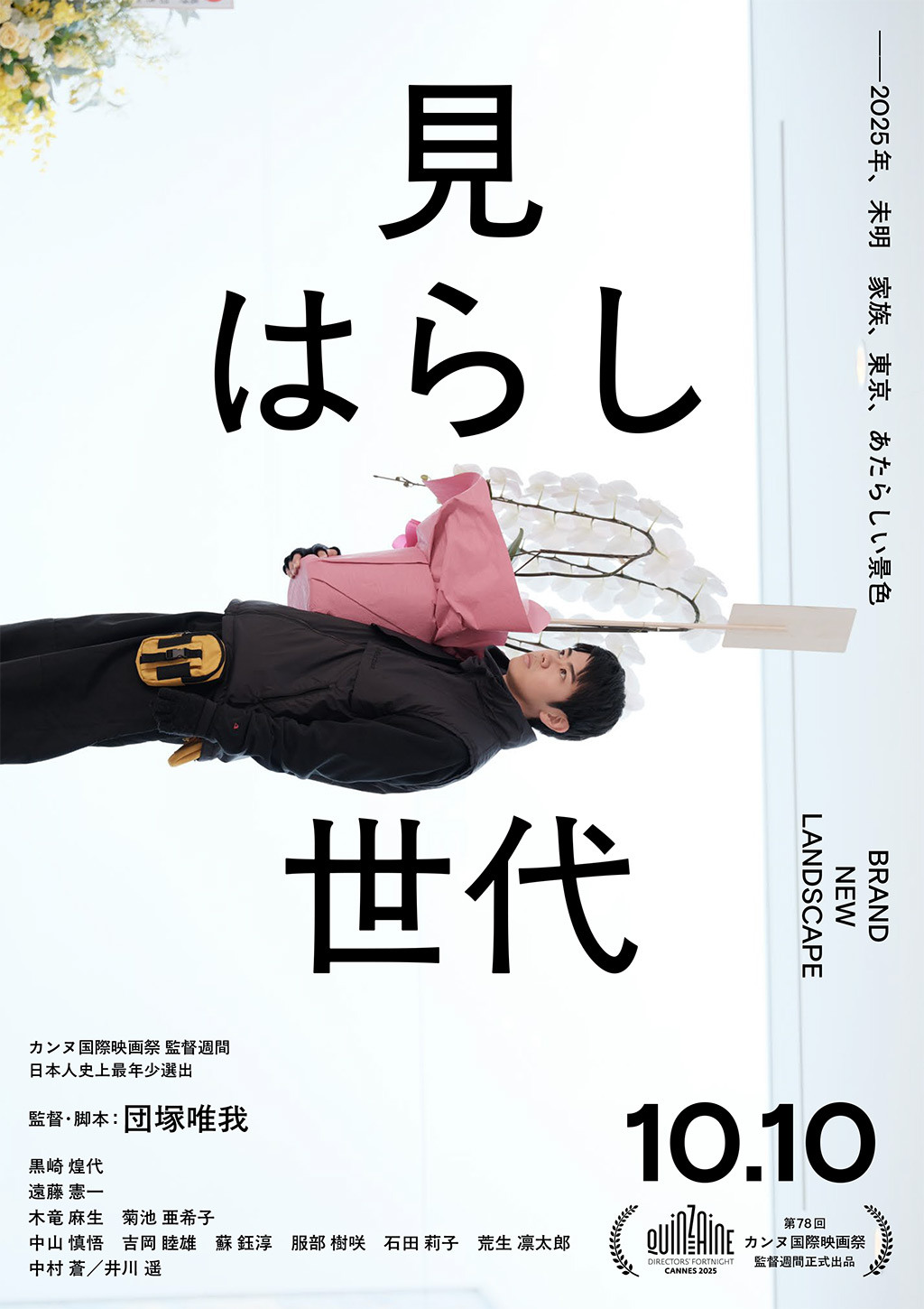
Do we inhabit spaces, or do the spaces inhabit us? Yuiga Danzuka’s autobiographically inspired Brand New Landscape (見はらし世代, Miwarashi Sedai) situates itself in a haunted Tokyo which is forever remaking itself around its inhabitants like a constantly retreating cliff edge that leaves them all rootless and in search of a home that no longer exists. Some long for a return to the past and wander endlessly, while others defiantly refuse to look back and are content to let history eclipse itself in a journey towards an ineffable “new”.

These imprinted spaces come to represent the disintegration of a family torn apart by their shifting foundations. Ten years previously, Ren (Kodai Kurosaki) and Emi’s (Mai Kiryu) mother, Yumi (Haruka Igawa), took her own life during a family holiday after their father Hajime (Kenichi Endo) told her that, despite his promises, he would be returning to Tokyo to pursue a work opportunity. “It’s pointless to go back and forth like this,” he remarks with exasperation, making it clear that he’ll be going no matter what she says. Rather than simply being a workaholic, Hajime is a deeply selfish person who doesn’t much care how other people are affected by the decisions that he makes. He wants this opportunity to prove himself and acts out of a mixture of vanity and a desire for external validation through professional acclaim rather than the love of his family. He claims he’s doing this for them, that the opportunity will provide additional financial security and a better quality of life for his children, but Yumi replies that they don’t need any more money. All she wanted was family time, albeit within this artificial domestic space of a rented holiday villa by the sea.

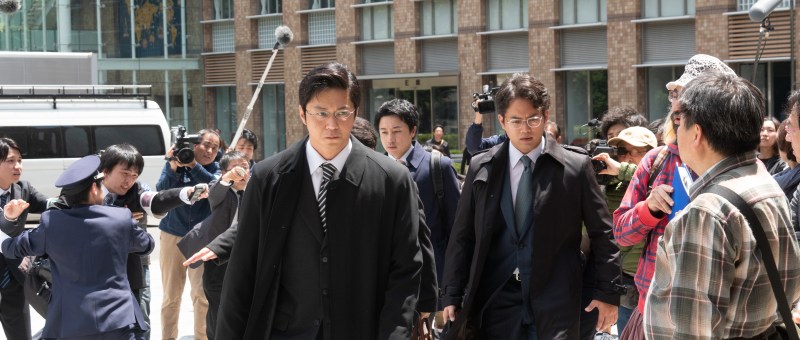
Three years after their mother’s death, Hajime left the children to chase opportunities abroad and they haven’t seen him in years. Younger son Ren is now working as a floral delivery driver for a company selling expensive moth orchids. It’s on a job that he first learns that Hajime has returned and is holding an exbitiion of his work that includes the controversial Miyashita Park redevelopment project designed to fuse the natural space of the park with a commercial centre the exhibition’s copy describes as a symbol of the “new” Tokyo. It also, however, required the displacement of a number of unhoused people who were living in the park in order to provide space for upscale outlets such as Louis Vuitton and Gucci. When Hajime accepts the opportunity to work on another such project, a young woman on his team voices her concern. She asks him where these unhoused people are supposed to go, but Hajime says it’s not his problem. It’s for the authorities to decide. She asks him if he’s considered the effect taking on such a large project will have on their team when the company is already working beyond its limit, but he gives her all the same excuses he gave Yumi that make it clear he’s not interested in the needs and well-being of his employees just as he wasn’t interested in those of his family. “It’s pointless going back and forth,” he tells her while trying to sound sympathetic but really emphasising that his decision is made and nothing she could say would sway him from his course.

Maybe, to that extent, oldest daughter Emi is much the same in that she’s decided she doesn’t want to see her father and resents Ren’s attempts to force her into doing so. She’s about to move in with her boyfriend and looking ahead towards marriage, but also prone to “low energy” days like her mother and anxious in her relationships, fearful that like that of her parents’ they can only end in failure. Ren, meanwhile, struggles with authority figures like his ridiculous boss who tries to assert dominance by giving him a public telling off about the non-standard colour of his hip pack, and then yells at him that he’s fired only to chase him out of the building throwing punches when Ren calmly replies that shouting only makes him look silly. In the midst of the drama, another young woman states her own intention to quit, politely bowing to everyone except one particular man before walking out the other door towards freedom as if to remind us that there are countlessly other stories going on in this city at the same time.

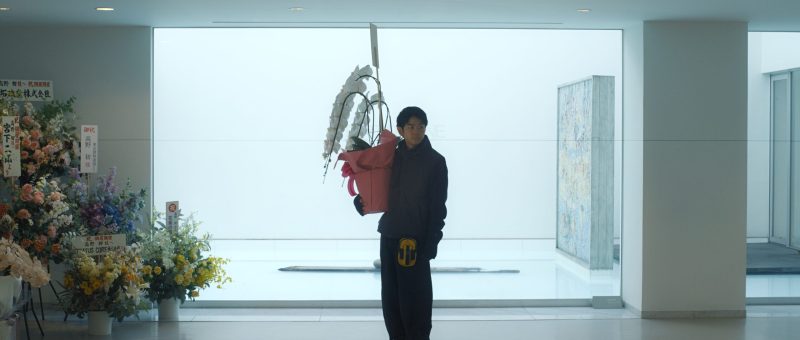
There’s a moment when Ren is delivery the orchids that he just stands there holding them, like he doesn’t know where to go or what to do. He’s lost within this space and is unable to find his way back within a Tokyo that’s always changing. In an attempt to find some sort of resolution, he drives Emi back to the service station where they had their final meal as a family, only their mother’s chair remains painfully empty. A perpetually falling ceiling light hints at the unreliability of these spaces. It isn’t and can’t ever be the same place it was before and has taken on new meanings for all concerned. Ren stares up at the Miyashita Park development as if caught between admiring his father’s achievement, wondering if it was worth it, and mourning the loss of everything it eclipsed in building over the past with a “new” that will quickly become the “old” and then be rebuilt and replaced. Nevertheless, he has perhaps begun a process of moving on even if for him moving forward lies in looking back.


Brand New Landscape screens as part of this year’s San Diego Asian Film Festival.

Original trailer (no subtitles)

Stay Mum (かくしごと, Kosai Sekine, 2024)

Late into Kosai Sekine’s maternal mystery Stay Mum (かくしごと. Kakushigoto), a doctor describes the behaviour of an old man living with dementia as a “convenient delusion” and later remarks forgetting is a kind of salvation that liberates him from what was apparently a very stressful life of repression and properness. Yet to the heroine there’s something very unfair about someone who has hurt her so deeply being allowed to just forget all about it while she has to go on carrying the legacy of his unkindness along with her own grief and pain.

Ironically enough, she finds herself caught in the middle as a mother and a daughter after taking in a little boy her friend accidentally ran over who appears to have extensive scars and bruising that suggest he has been mistreated by his birth family for some time. The boy also claims to have lost his memory, leading Chisako (Anne Watanabe) to fill in the blanks for him. She gives him a name, Takumi, and tells him that he is her son intending to raise the boy covertly while temporarily staying in her rural hometown to care for her estranged father after he was found wandering around in a state of undress.

Even Takumi realises the irony of Chisako’s father Ko (Eiji Okada) falling further into a state of forgetting just as he is learning to “remember” thanks to the memories Chisako imparts to him in their fictional shared history. The film’s English title is a kind pun playing the fact that everyone involved must “stay mum” in order to maintain this delusion of family life while also hinting Chisako’s desire to reclaim her maternity having lost a child of her own. The Japanese title more literally translates as “that which is hidden” while the novel that it’s based on is titled the more direct “lie” though of course it leaves ambiguous to which lie it is referring. But as the doctor had said, it becomes a “convenient delusion” for everyone which grants them a kind of peace and serenity that allows them to reclaim exactly what they wanted out of life but perhaps could not get in any other way.

But of course, it can’t last and at the same time also delays a final confrontation with the reality that would truly allow them to move forward. Someone later accuses Chisako of brainwashing Takumi, essentially kidnapping him while forcing him to play the role of her son as if she were simply mentally disturbed and desperate to overcome her grief rather than genuinely concerned and morally outraged by the idea of allowing a boy who shows clear signs of abuse to return to a home in which he will continue to be mistreated. But at the same time, she struggles to relate to her father and behaves towards him in ways which to Takumi may seem abusive, shouting at and at one point slapping him after a particularly unkind remark. Her inability to control herself further compounds her sense of failure as both mother and daughter, still carrying an internalised sense of inadequacy because of her father’s toxic parenting while in the midst of forgetting he is perhaps still able to perceive the mistakes he made that cost him a functioning relationship with his daughter.

Ko spends his days crafting statues of the goddess of mercy as if begging for atonement all while unable to recall the face he wished to give her. The irony is that as the doctor said, forgetting allows him to drop his guard and to remember the costs of the way he lived his life. As Chisako counters there are also things which shouldn’t be forgotten no matter how painful they may be to remember, along with those which cannot really be forgiven, though the act of wilful forgetfulness does perhaps provide a salve for the wounds of the past. Though at times overly contrived and strikingly predictable, Sekine’s empathetic contemplation of the emotional truths behind the bonds of parents and their children ends in a violent confrontation with corrupted parenthood but equally in a gesture of mutual salvation which ironically depends entirely on the willingness to speak the truth both emotional and literal. 


Stay Mum screened as part of this year’s Toronto Japanese Film Festival

Original trailer (no subtitles)

September 1923 (福田村事件, Tatsuya Mori, 2023)

After the devastating Great Kanto Earthquake struck in 1923, it led to a period of hysteria in which in the natural disaster somehow became equated with the Korean Independence Movement, foreigners, and socialists and who were after all thorns in the side of rising nationalism. Documentarian Tatsuya Mori makes his narrative film debut with September, 1923 (福田村事件, Fukudamura Jiken) released to mark the 100th anniversary of the incident and focussing on a little known episode in which villagers turned on a small group of itinerant medicine pedlars they were convinced were not Japanese. 

In this case, at least, they were Burakumin. An oppressed underclass of their own, they too are divided in their views about Koreans some finding solidarity with them as another minority who is bullied and discriminated against while others are quick assert themselves as at least being above them on the pecking order cheerfully using slur words as they go. Shinsuke (Eita Nagayama), the leader of the troupe, laments that they have to live this way, tricking those worse off than themselves into buying their snake oil cures while explaining that though people will often help each other out when times are good, if survival’s on the line they’ll turn against each other. 

Perhaps that’s difficult to imagine in a small village of genial farmers, but militarism has already corrupted its gentle rhythms. Men from the village are fond of telling war stories from their time as conscripts in China or Russia, though one has a particular bee in his bonnet about wives being left lonely with husbands away overseas and is convinced that his father has slept with his wife. Another local woman was indeed having an affair shortly before her husband was killed in action and is then ostracised by the village for her transgressive behaviour becoming yet another oppressed minority. The village chief is keen on democracy and progressive in his way yet soon finds himself powerless against the local militia mostly comprised of old men with a lust for blood and glory. It’s this militarist hysteria that eventually proves tragedy as they find themselves desperate to identify “spies” and protect the village only to murder children and a pregnant woman who were just passing through. 

The absurdity extends to asking those suspected of being Non-Japanese to repeat a particular phrase difficult for Koreans in particular to pronounce, only those from other areas of Japan also pronounce it in a way that might seem “foreign” in Tokyo. Cornered by the militia, Shinsuke asks if it would be alright to kill him even if he were Korean, taking issue with the militia’s absurdist and racist rationale that decides someone must die because of the way they pronounced a certain word or seemed uncomfortable shouting “banzai” at the point of a sword. But one of the villagers unwittingly uncovers a since of guilt felt even by a man in a village miles away from anything that the Koreans have been bullied for years, this the understandable result of their rage boiling over and a moment of retribution. 

The film seems to suggest that the buck doesn’t really stop, except perhaps with the bystander who merely watches this horrifying violence and does nothing. Tomokazu (Arata Iura) has recently returned to the village after many years living in Korea bringing back with him a Korean wife but his marriage is falling apart due to his own guilt and trauma having been complicit in a Japanese atrocity. Watching the massacre unfold, his wife, Shizuko (Rena Tanaka), asks him if he’s just going to watch this time again but his attempt to intervene makes no difference. An idealistic news reporter meanwhile takes her boss to task for publishing propaganda headlines associating Koreans with crime and terrorism rather than real truth of what’s happening on the ground, asking him what the point of the press is if it won’t speak truth to power. But militarists do not listen to reason, and as the headman points out they will have to keep living with those who’ve committed these heinous acts. Sometimes a little on the nose with its symbolism such as a literal murder of hope in the killing of an unborn child, Mori’s otherwise poignant drama lacks the impact it strives for but nevertheless addresses a shocking moment of mass hysteria that is not quite as historical as we’d like to think.


September 1923 screened as part of this year’s Nippon Connection

Original trailer (English subtitles)

Winny (Yusaku Matsumoto, 2023)

Can a creator be held legally responsible for what other people might decide to do with their creation? For some, that is the essential question of the trial at the centre of Yusaku Matsumoto’s legal drama Winny, but in speaking more to the present day than the early 2000s in which the real life events took place the film is more concerned with freedom of speech in a society in which established authorities may seek to resist the democratisation of information. 

A talking head seen on television at one point suggests that peer-to-peer file sharing programme Winny disrupts the democratic copyright regime, but according to its creator Isamu Kaneko (Masahiro Higashide) the appeal of peer-to-peer is that it is by nature democratic in forging a network of machines on an equal footing. Nevertheless, in November 2003 two people were arrested for using Winny to share copyrighted material and Isamu’s home was searched by the Kyoto police who arrested him for aiding and abetting copyright infringement. He and his lawyers argue that to charge the developer is wrongheaded and irresponsible in that it will necessarily stifle technological advance if developers are worried about prosecution if their work is misused by others while his intention in any case had not been to undermine copyright laws but essentially for technological innovation in and of itself. 

Meanwhile, the film devotes much of its running time to a concurrent police corruption scandal in which a lone honest cop is trying to blow a whistle on a secret slush fund founded on fraudulently produced expense receipts. The implication is that the reason the police decided to go after Isamu is that they feared Winny’s potential to expose their own wrongdoing. A member of the police force had apparently used Winny and introduced a vulnerability to the police computer system that allowed confidential data to be leaked, and Winny is indeed later used to publicly disseminate evidence which proves the claims of the whistleblower, Semba (Hidetaka Yoshioka), are true. Semba had previously tried to take his concerns to the press privately but was ignored, the editor simply printed a police press release without investigation unwilling to rock the boat. But a programme like Winny exists outside of the establishment’s control which is why, the film suggests, the police in particular resent it. 

A younger officer Semba reproaches at his station gives the excuse that everybody does it and refusing to fill in the false receipts would make it difficult for him to operate in an atmosphere in which corruption has become normalised. Even the police use Winny, a prison guard confiding in Isamu that he’s used the programme to download uncensored pornography while prosecution lawyers conversely attempt to embarrass Isamu by leaking pictures of his porn collection to the press and bringing it up on the stand. “Everybody does it” is not a good defence at the best times aside from being a tacit admission of guilt but reinforces a sense that the police operates from a position of being above the law. A particularly smug officer thinks nothing of perjuring himself on the stand, spluttering and becoming defensive when Isamu’s lawyers expose him in a lie. 

Isamu is depicted as a rather naive man whose social awkwardness and childlike innocence leave him vulnerable to manipulation. He’s told to sign documents by the police so he signs them thinking it’s better to be cooperative, taking the advice he’s given when he questions a particular sentence that he can correct it later at face value while assuming that he’ll be able to straighten it all out in court by telling them the truth and that he signed the documents because the police told him to. Meanwhile, he’s almost totally isolated, prevented from talking to friends and family out of a concern that he may use them to conceal evidence. 

The film seems to suggest that the stress of his ordeal which lasted several years may have led to his early death at the age of 42 soon after his eventual acquittal. In any case he finds a kindred spirit in his intellectually curious lawyer (Takahiro Miura) who defends him mostly on the basis that the right to innovate must be protected and a developer can not be responsible for the actions of an end user any more than a man who makes knives can be held accountable for a stabbing. Matsumoto captures the sense of wonder Isamu seems to feel for the digital world and has a great deal of sympathy for him as an innocent caught up in a game he doesn’t quite understand while fiercely defending his right to express himself, along with all of our own, without fear no matter what the implications may be.


Winny screens in New York Aug. 2 as part of this year’s JAPAN CUTS.

Original trailer (no subtitles)

It’s All My Fault (ぜんぶ、ボクのせい, Yusaku Matsumoto, 2022)

A young boy and a homeless drifter attempt to overcome the legacy of parental rejection in Yusaku Matsumoto’s sensitive coming-of-age drama, It’s all My Fault (ぜんぶ、ボクのせい, Zenbu, Boku no Sei). “It’s all my fault” is something many children think about circumstances which are well beyond their control, but it’s also something they’re encouraged to believe by an abusive or neglectful parent who tells them that they are to blame for the treatment they receive. Nevertheless, Yuta (Haruto Shiratori) comes to think that all the bad things happening in the world are in some way his fault, which might on one level be easier to believe than trying to accept that the world is sometimes a relentlessly unkind place. 

A sad and sullen boy, Yuta is viewed with some suspicion by the staff at the care home where lives due to his brooding nature and refusal to speak. The cause of his anger is that he was told by a previous caretaker that he’d be able to see his estranged mother, Rika (Marika Matsumoto), when he entered middle school and is resentful that he has still had no contact with her. The sad fact is, however, that Rika stopped taking their calls a long time ago and seemingly has no further intention of maintaining contact with her son. 

After the orphanage is rocked by a literal earthquake, Yuta sets off to find his mother but though she is moved to see him it quickly becomes clear that she is not really prepared to play a maternal role. When her drunken boyfriend returns home, she tells him that Yuta is a relative’s child she agreed to watch for a short time and appears otherwise conflicted, solicitously making sure he has enough to eat but more or less forgetting he’s even there whenever the boyfriend is around. Eventually she rings the care home to come and take him back, forever ruining Yuta’s faith in genuine human connection. 

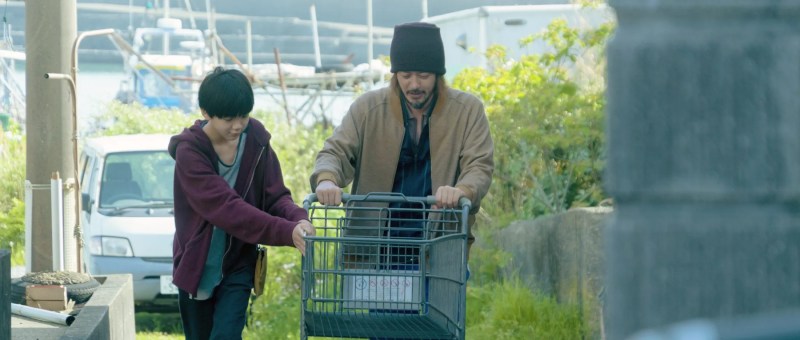
Managing to run away, Yuta is later taken in by eccentric drifter Sakamoto (Joe Odagiri) who strongly identifies with the boy in having grown up with an abusive mother whose legacy he has been unable to escape. Shiori (Ririka Kawashima), a teenage girl with issues of her own who also befriends Sakamoto, is envious of his untethered lifestyle viewing him as free and bound by no one. But in truth he too is trapped as symbolised by the broken van which prevents him from leaving to travel to Nagoya and confront his mother as he often says he intends to do. Sakamoto describes his trauma as a like a rock in the heart that tortures him as he continues to resent his mother for the abuse she dealt him while simultaneously suggesting that she has dementia and may not even remember that she has a son. Yuta by contrast insists that his mother is not a bad woman and continues to yearn for her, treasuring the friendship bracelet she made for him only for it to be broken by thuggish teens who get their kicks bullying those they perceive to be weaker than themselves.

Sakamoto becomes an awkward paternal figure, teaching Yuta how to survive in his way of life by hatching scams on wealthy passers by and fetching junk to sell to a local scrap merchant but is equally arrested, unable to come to terms with the traumatic past and therefore unable to move on. Shiori envies what she sees as his freedom in part because she has little of her own. Secretly blaming her authoritarian father for her mother’s death which she has come to doubt was really from an illness as she was told, Shiori has an internalised sense of shame and inadequacy knowing that she cannot be the person her father wants her to be and longs to escape him. Yuta continues to dream of a family, inviting Shiori to come with them to Nagoya when the truck is fixed, but is met only with despair as the world conspires against his happiness and encourages him to blame himself for his all his misfortune. Shot with an unsentimental if empathetic eye, Matsumoto’s hard-hitting drama examines the legacies of parental abuse, neglect, or absence persisting long into adulthood while his young hero struggles with himself in his conflicting emotions towards the woman who abandoned him with only an impossible future. 


It’s All My Fault screened as part of this year’s Camera Japan.

Original trailer (no subtitles)

Grown-ups (わたし達はおとな, Takuya Kato, 2022)

“You’re a grown-up. If something’s wrong you gotta handle it” the passive aggressively condescending hero of Takuya Kato’s Grown-ups (わたし達はおとな, Watashitachi wa Otona) chastises, but what even really is being “grown-up” when you find yourself in a situation which is emotionally difficult and will define the future course of your life. Shot in a claustrophobic 4:3 and told in a non-linear fashion, Kato’s intense drama lays bare the inequalities of a patriarchal society in which in a sense there are no real grown-ups because no one is ever comfortable enough with anyone else to be able to speak their real feelings honestly. 

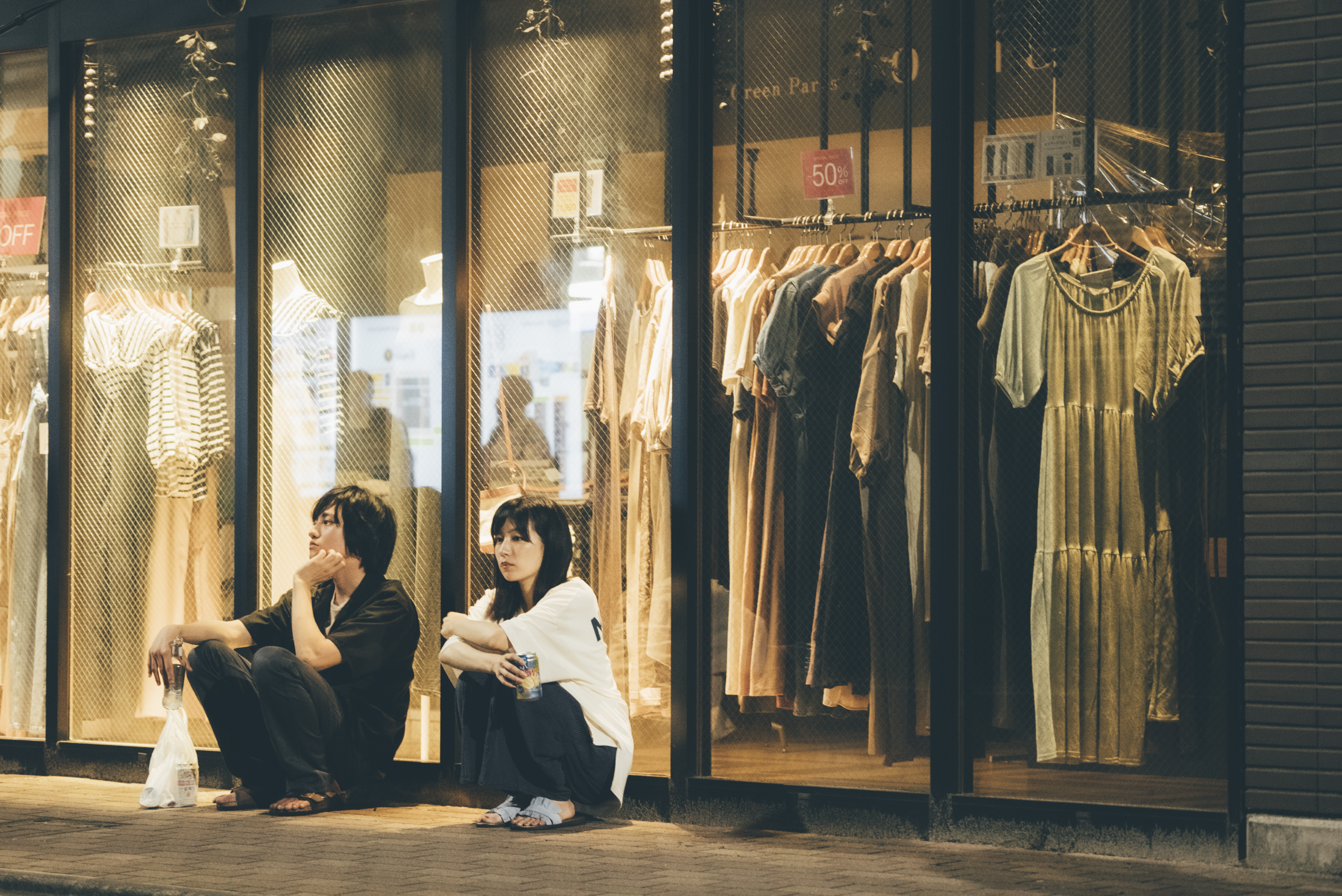
This becomes a particular problem for college student Yumi (Mai Kiryu) who discovers that she is pregnant but is uncertain as to who the father might be having had a one night stand during the time her live-in boyfriend Naoya (Kisetsu Fujiwara) had broken up with her. Yumi immediately tells Naoya that there’s a chance the baby isn’t his, but remains otherwise reticent unwilling to talk about what might have happened while filled with an internal panic. Naoya thinks he’s being grown-up about the situation by deciding to accept responsibility given the probability that he is the father but despite pledging that he would accept the baby even if it turned out he wasn’t can’t stop trying to pressure Yumi into a DNA test for peace of mind. 

The irony is that even Naoya, who was Yumi’s first sexual partner, refused to wear a condom and joked about contraception before making her go on the pill when he moved in with her. Later we learn that the one night stand violated her consent by again refusing to wear a condom and ignoring her objections, later joking about it that the chances of conception are incredibly small while making it clear that men in general don’t consider pregnancy as something that happens to them and because, as one of Yumi’s friends puts it, they only chase “innocent” girls they don’t seem to worry about the possibility of contracting an STI. Meanwhile, Yumi is constantly stalked by a fellow student she briefly dated who presents her with a memory book of their relationship and is always creepily hanging around waiting to give her gifts, but all her friends can seem to talk about is boyfriends implying that a bad boyfriend might be better than none. 

Yet Yumi seems to have intimacy issues that run even deeper, for some reason not even telling Naoya that her mother has passed away leaving him to think she has run away from their problems by returning home just when he’s ready to tell her his decision about their future. When her father asks about boyfriends she brushes the question off though perhaps partly because she’s not quite sure about her relationship status with Naoya or what she’s going to do about the baby. She calls her friend to hear a friendly voice after hearing her mother has died but gets little sympathy, the same friend later abruptly hanging up on her after getting a boyfriend of her own while knowing of Yumi’s romantic troubles. 

Then again, it’s hard to know whether Naoya was really interested in her or in her lovely duplex apartment. When they started dating he was still living with his ex and it’s obvious that Yumi fully conforms to the feminine ideal taking care of all the domestic tasks while it isn’t even clear if Naoya is contributing in any way to the household. The film both begins and ends with Yumi making breakfast, firstly toasting the last slice of bread for Naoya while suffering with what turns out to be morning sickness, and finally making herself something to eat in the early light of dawn. Naoya says he’s give up on his dreams of working in theatre to get a regular job, again conforming to an outdated patriarchal ideal, but of course resents it particularly because he doubts the child is his while Yumi isn’t really sure she wants to go through with it either for some of the same reasons but is swayed by Naoya’s determination to make all their decisions for them unable to say out loud that she might not be ready to become a mother. 

Naoya is always trying to be grown-up about everything, but more often than not his understanding approach is partway towards passive aggressive control in insisting that Yumi is being childish in her anxiety and confusion while simultaneously avoiding having to admit that he isn’t really ready either. Early in their relationship he breaks up with her by simply returning her apartment key and refusing to elaborate, failing to treat her with respect or maturity and once again leaving her to deal with the fallout of their relationship all alone. Then again, Yumi’s determination to convince him that green peas are good may signal that the relationship was always doomed when they couldn’t even reach a grown-up understanding over something as trivial as taste in veg. A raw examination of what it is to be young and faced with a decision that will define the rest of your life, Kato’s naturalistic drama perhaps suggests that it never really gets any easier to say how you really feel when you feel that someone is judging you all the way. 


Grown-ups screens at Lincoln Center 23d July as part of this year’s New York Asian Film Festival.

Original trailer (no subtitles)

Images: ©2022“Grown-ups” Production Committee

Zokki (ゾッキ, Naoto Takenaka, Takayuki Yamada, & Takumi Saitoh, 2020)

“Thanks to secrets carefully kept by people the world keeps turning” according to one of the many heroes of Zokki (ゾッキ), a series of intersecting vignettes adapted from the cult manga by Yoshiharu Tsuge and directed by three of Japan’s most prominent actor-directors, Naoto Takenaka (whose Nowhere Man also adapted Tsuge), Takayuki Yamada and Takumi Saitoh. According to the philosophical grandpa who opens the series of elliptical tales everyone has their secrets and without them you may die though each of the protagonists will in fact share their secrets with us if by accident or design. 

Seamlessly blended, the various segments slide into and around each other each taking place in a small rural town and primarily it seems around 2001 though as we’ll discover the timelines seem curiously out of joint as motifs from one story, a broken school window, an awkward moment in a convenience store, the retirement of a popular gravure model/AV actress etc, randomly appear in another. This is however all part of the overarching thesis that life is an endless cycle of joy and despair in which the intervals between the two gradually shrink as you age before ceasing to exist entirely. 

Or so says our first protagonist, Fujimura (Ryuhei Matsuda), a socially awkward man heading off on a random bicycling road trip in which he has no particular destination other than “south” or maybe “west” as he later tells a potential friend he accidentally alienates. Fujimura’s unspoken secret seems to link back to a moment of high school trauma in which he betrayed one burgeoning friendship in order to forge another by joining in with bullying gossip and eventually got his comeuppance. Meanwhile the reverse is almost true for Makita (Yusaku Mori) who relates another high school tale in which he overcame his loneliness by befriending Ban (Joe Kujo), another odd young man rejected by teachers and the other pupils for his often strange behaviour such as his tendency to shout “I want to die”. Ban claims to have heard a rumour that Makita has a pretty sister and Makita goes along with it, eventually having to fake his sister’s death in order to seal the lie only for Ban to find happiness in his adult life largely thanks to Makita’s act of deception. 

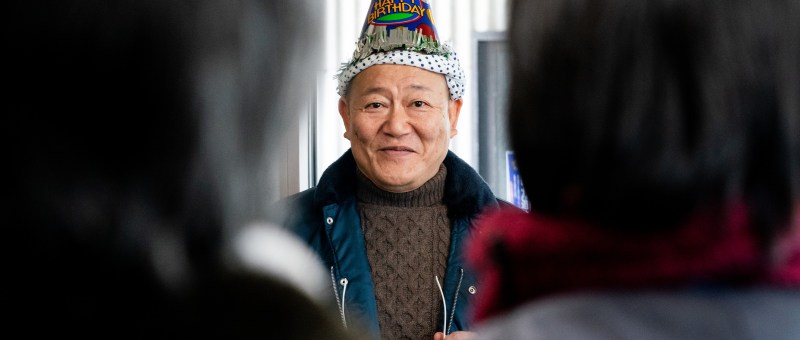
The broken window which brought them together turns up in another tale, that of Masaru (Yunho) whose adulterous father Kouta (Takehara Pistol) took him on a midnight mission to steal a punching bag (and some adult DVDs) from the local high school only to encounter a sentient mannequin/ghost who is later likened to the young woman from Fujimura’s past. Bar some minor embarrassment there’s no real reason the ghost sighting would need to be kept secret, the deception in this case more to do with Kouta’s affair and his subsequent departure from his son’s life only to make an unexpected return a decade later. The affair also makes him a target for fisherman Tsunehiko, the betrayed husband and one of the fisherman celebrating the birthday of a colleague along with an existentially confused Fujimura. Meanwhile, Fujimura’s fed up neighbour secretly writes a rude word on a note to himself instead of the usual “good morning” only to realise it’s been moved when he opens the local video store the next morning. 

Eventually coming full circle, Zokki insists what goes around comes around, everything really is “an endless cycle”, and that in the grand scheme of things secrets aren’t always such a bad thing. They keep the world turning and perhaps give the individual a sense of control in the necessity of keeping them if running with a concurrent sense of anxiety. The criss-crossing of various stories sometimes defying temporal logic hints at the mutability of memory while allowing the creation of a zany Zokki universe set in this infinitely ordinary small town in rural northern Japan. As the various protagonists each look for an escape from their loneliness, unwittingly spilling their secrets to an unseen audience, the endless cycle continues bringing with it both joy and sorrow in equal measure but also a kind of warmth in resignation. Beautifully brought together by its three directors working in tandem towards a single unified aesthetic, Zokki defies definition but rejoices in the strange wonder of the everyday in this “obscure corner of the world”.


Zokki streamed as part of this year’s New York Asian Film Festival. It will also screen in London on 24th October as part of this year’s London East Asia Film Festival.

Original trailer (no subtitles)

NYAFF intro

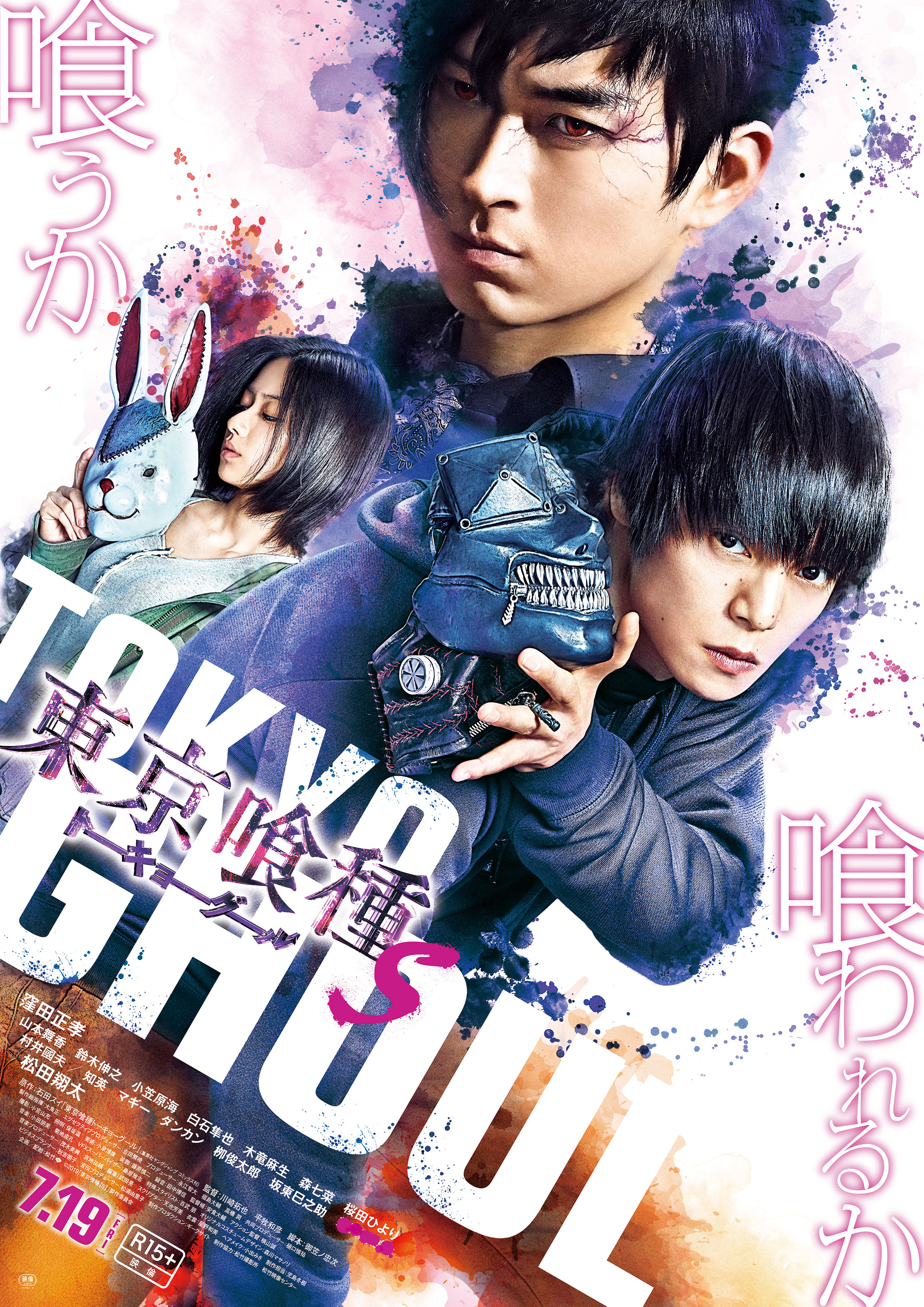
Tokyo Ghoul S (東京喰種 トーキョーグール【S】, Kazuhiko Hiramaki & Takuya Kawasaki, 2019)

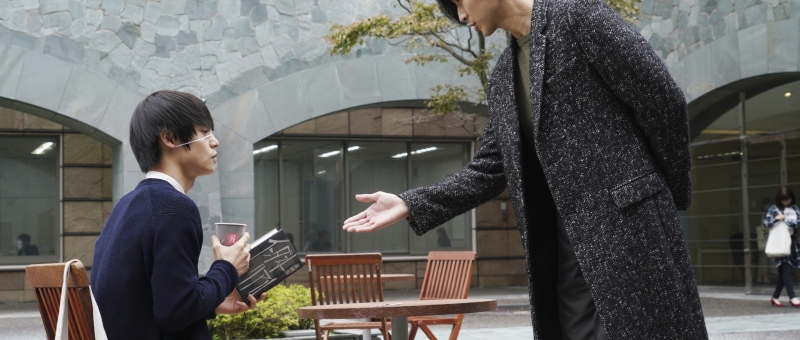
tg2_poster_3校B_ol_6In Tokyo Ghoul, regular university student Ken Kaneki (Masataka Kubota) had to learn to accept the parts of himself he didn’t like in order to become the kind of man he wanted to be. Of course, the situation was more complicated than that faced by most young men because Ken Kaneki’s darkness was born of being seduced by a beautiful woman who turned out to be a “ghoul” – a supernatural being craving human flesh, something he later became himself when they were both injured in a freak accident after which he got some of her organs. The sequel, Tokyo Ghoul S (東京喰種 トーキョーグール【S】) finds him in a more centred place, having accepted his new nature as neither human nor ghoul but a bridge between the two. Now he has a series of different questions to face in trying help others accept themselves in the same way as they too wonder if there are some parts of themselves so dark that if they revealed them they could never be loved.

While Ken goes about his regular student life working part-time at ethical ghoul cafe Anteiku, a ghoul serial killer known as “The Gourmet” (Shota Matsuda) has been making the news after targeting a high profile model (Maggy) whom he stalked and killed simply to taste her heterochromatic eyes. Tsukiyama, as we later learn his name to be, is a dandyish fopp living in a Western-style country house complete with servants who serve him only the finest meals well presented to hide their dark genesis. On catching a whiff of Ken’s unique human/ghoul scent, he knows he must taste him and puts a nefarious plan in motion in order to lure him to a mysterious ghoul-only restaurant where humans are butchered live for show while the clientele salivate over scenes of intense cruelty.

That’s all too much for poor Ken. He can’t understand how anybody could act with so little regard for life. The cafe owner pointedly asks him if he feels pity when looking at the butchered flesh of an animal, which he of course does not. The ghouls feel much the same, humans are their prey – they can’t help what they are, but living under the intense fear of discovery in an obviously hostile world has made them cruel and resentful to the extent that they no longer understand the value of life. The ghouls that Ken knows, the ones which frequent Anteiku, are different. They have resolved to live ethically and respect lives both human and ghoul equally.

Ken’s friend and colleague Touka (Maika Yamamoto), however, is beginning to have her doubts. In the first film we saw her pursue a touching friendship with classmate Yoriko (Nana Mori) whose cooking she made a point of eating solely as a means of connection despite the fact that human food makes her ill. Now she fears she’s doing the wrong thing, that it will only hurt more if her friend finds out her secret and rejects her, or worse that she may put her in danger. Therefore, she counsels Ken to distance himself from his overly cheerful friend Hide (Kai Ogasawara) and the human world in general, threatening that she herself will kill Hide if he discovers that Ken is a ghoul. As expected, Ken ignores her advice but is mildly shaken by it. Deciding to intervene when his sometime enemy Nishiki (Shunya Shiraishi) is being beaten up in the street, he discovers a better future on learning that Nishiki is living with a human woman who knows he is a ghoul, but loves him anyway.

Though Kimi’s (Mai Kiryu) justifications that she can live with the fact her boyfriend kills people and eats them so long as he leaves her friends and family alone is a little worrying, it is a touching example of the film’s positive message that there is no secret so terrible that it means someone can’t be loved. Kimi accepts Nishiki’s nature as a ghoul, aware of the fact he can’t help what he is and that if she had been born a ghoul she would be the same. Touka fears rejection, but on catching sight of her bright red wings Kimi utters the single word “beautiful”, seeing only goodness without fear or hate.

Tsukiyama meanwhile seems to have gone in the opposite direction, pursuing his desires to the point of obsession in a quest for ever greater sensation. He stalks and murders the model to devour her eyes in an especial piece of irony, while his pursuit of Ken takes on an intensely homoerotic quality. Using the same tactics as Tokyo Ghoul‘s Rize, Tsukiyama picks Ken up through bonding over books, invites him to “dinner” and later sends him an invitation accompanied by a single red rose. Despite the romanticism, however, he soon reverts to type in blaming Ken for his actions. “You’re making me this way”, he insists, “take responsibility”, like every abuser ever simultaneously accepting that his behaviour is inappropriate and justifying it as a consequence of someone else’s actions. In the end, Tsukiyama’s illicit desires consume him, while Ken’s act of self-sacrifice once again allows him to be the human/ghoul bridge combatting Tsukiyama’s rapacious cruelty with an open-hearted generosity which pushes Touka to the fore so that she too can learn that peaceful co-existence is possible when there is trust and understanding on both sides.

Nishiki tells Ken his problem is that he’s too nice, but that’s not a bad thing to be because he just might “save somebody someday”. Niceness as a superpower might be an odd message for a movie about flesh eating monsters almost indistinguishable from regular humans, but perhaps that’s what will save us in the end, a generosity of spirit that makes it possible for us each to accept each other’s darkness in acknowledgement of our own. Less stylistically interesting than the first instalment, Tokyo Ghoul S may be a kind of bridge movie in a possible trilogy (a sequel is teased in a brief mid-credits sequence featuring a mysterious character who makes several unexplained appearances throughout the film), but nevertheless does its best to further the Tokyo Ghoul mythology as its hero finds his strength in difference and mutual understanding.


Tokyo Ghoul S screens in the US for three nights only on Sept. 16/18/20 courtesy of Funimation. Check the official website to find out where it’s playing near you!

Original trailer (English subtitles)

The Chrysanthemum and the Guillotine (菊とギロチン 女相撲とアナキスト, Takahisa Zeze, 2018)

Chrysanthemum and the Guillotine poster 1“I see it now, we can’t change anything” a despondent would-be-revolutionary decries in a moment of despair. Almost 100 years later, you might have to concede they have a point when the world finds itself on a tipping point once again and the same old prejudices refuse to disappear. Takahisa Zeze’s The Chrysanthemum and the Guillotine (菊とギロチン 女相撲とアナキスト, Kiku to Guillotine Onna Zumo to Anarchism) casts an unflinching eye back towards the Japan of 1923 caught in the aftermath of a devastating natural disaster which followed on from a chaotic era of rapid social change and bewildering modernisation during which a series of battles were being fought for the future direction of a nation still trying to define itself in world dominated by empires.

When the Great Kanto Earthquake struck claiming mass loss of life and extreme damage to infrastructure, the ensuing chaos gave rise to a vicious rumour that Koreans were taking advantage of the situation to foment the independence movement by poisoning wells and committing arson leading to a pogrom against anyone who failed to prove themselves Japanese enough to satisfy the mob. Meanwhile, the same forces also turned on political opponents whose influence they perceived as destructive to their own aims culminating in the murder of prominent anarchist Sanae Osugi along with his feminist wife Noe Ito and their six-year-old nephew.

We begin, however, with a different band of outsiders in the Tamaiwa itinerant female sumo wrestler troupe many of whom have taken refuge in an isolated world of female solidarity in order to escape abusive relationships. Kiku (Mai Kiryu) is one such woman who found the courage to run away from a violent husband on catching sight of the powerful female wrestlers who made her realise that she too could become strong like them. Having accepted that “weak people can’t change anything”, Kiku has vowed to become “strong” in order to claim her own agency and ensure that she can’t be pushed around ever again.

Meanwhile, an anarchist sect known as the Guillotines are fomenting a more general kind of revolution but have not been very successful and are now on the run from the authorities which is how they end up running into the female wrestlers and more or less bringing them into the struggle. Led by libertine and (as yet) unpublished poet Tetsu Nakahama (Masahiro Higashide), the Guillotines are more romantic bandits with high ideals than serious revolutionaries. They rob the rich to fund their “activism” but spend most of the money on sex and drink while plotting revenge for the murder of Osugi with various schemes which imply that at heart they aren’t so different from that which they hate.

Nevertheless, the forces of darkness are rising and history tells us that, temporally at least, they will win. The vigilante militias which carried out the massacres were largely made-up of farmer soldiers who’d served in Russia and experienced terrible hardship. Unable to bear the idea that their traumatic wartime experiences had been a senseless waste, they doubled down on militarist ideology and insisted on their nationalistic superiority. This led them to hate, to regard anything that lay outside of their code as inferior and dangerous. Though the massacres were condemned by the government and the perpetrators prosecuted for their crimes, the convictions were largely quashed a short time later which is why we see our major villains rewarded by the state and our revolutionary “heroes” imprisoned for their resistance towards state oppression and desire to create a fairer, more equal society.

Ironically enough, Nakahama’s big utopian idea is an overly idealistic vision for a future Manchuria which in hindsight proves extremely uncomfortable but is perhaps an indication of the naivety of the times. Even so, the Guillotines for all their romanticism are essentially progressive in their thinking and in full support of sexual equality, insisting on the necessity of the wrestlers to embrace their physical capabilities in order to defend themselves against an oppressive and patriarchal society fuelled by male violence. Though this in itself might be mildly problematic in implying that in order to become “equal” women must learn to be more like men, it also plays into the film’s subtle sense of irony in which the tools of militarism are being subverted in order to oppose it. The “intellectual” Guillotines find their revolutions failing, while fighting fire with fire may be the only surefire way to win even if it legitimises the problematic act of violence in the process. Then again, as another of the Guillotines puts it, the truly strong are those who have no need of killing. 

In any case, the Tamaiwa stable becomes a tiny enclave of progressive values built on female solidarity though they ultimately discover that solidarity is not quite enough and they cannot protect each other from the ravages of the times without external assistance. Even so, they attempt to hold the line, literally pushing back against the fascist incursion while insisting on their right to resist as human beings with will and agency. The prognosis seems bleak. 100 years later the same battles are still being fought and the same tensions rising in the wake of new disasters yet there are also those who will continue to resist and like the Tamaiwa wrestlers refuse to give in to those who threaten to restrict their freedom.


The Chrysanthemum and the Guillotine was screened as part of the 2019 Nippon Connection Film Festival.

Original trailer (no subtitles)

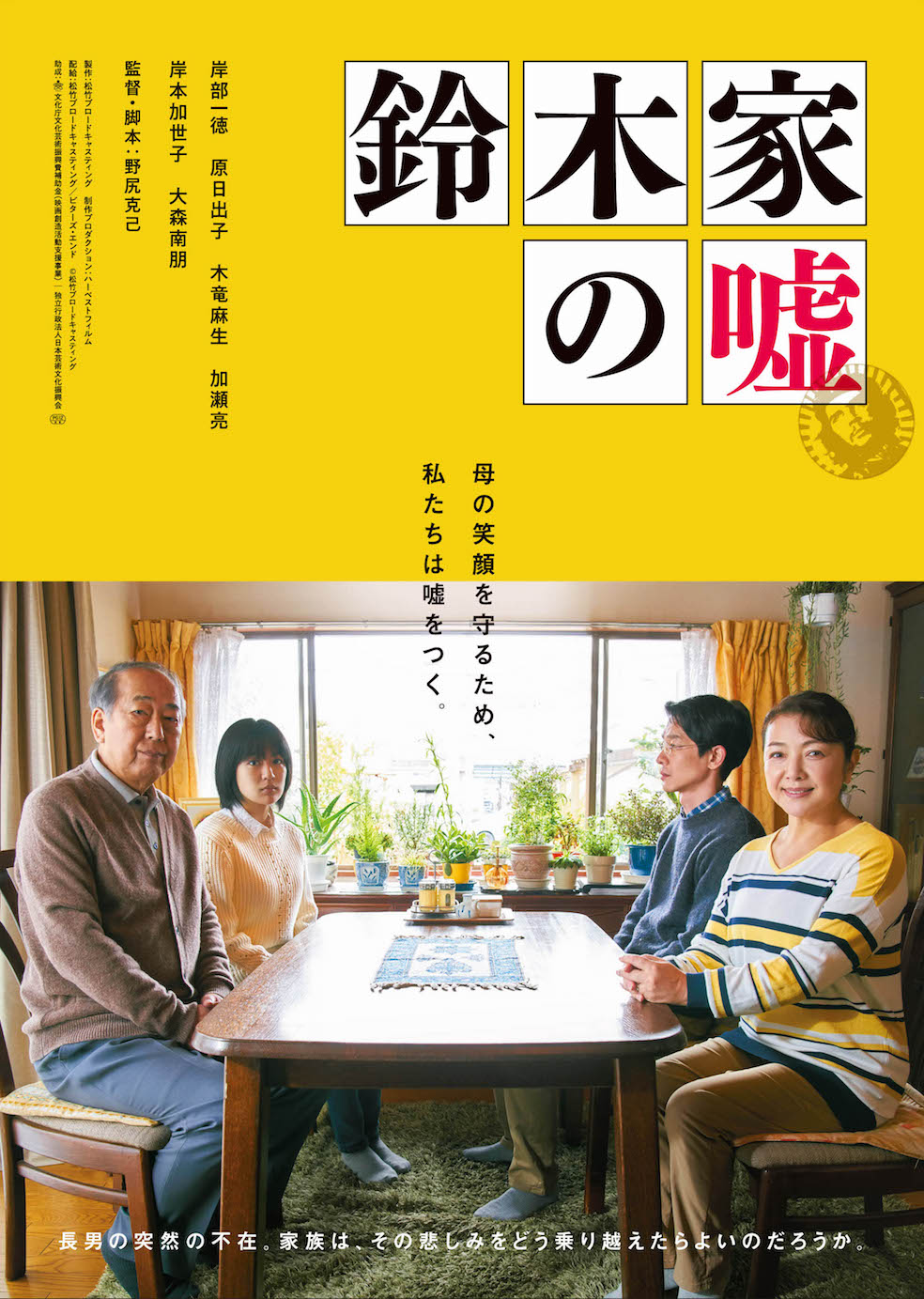
Lying to Mom (鈴木家の嘘, Katsumi Nojiri, 2018)

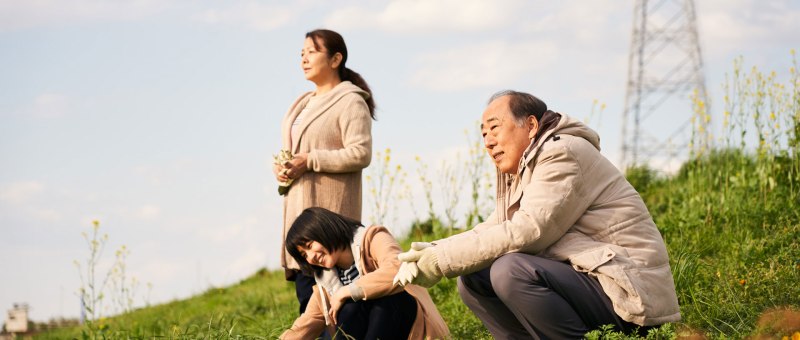
Lying to Mom posterLearning to live with loss is difficult for any family, but when the loss was caused by suicide the pain is even more acute as those left behind try to understand why it is their loved one had to die and if there was anything else they could have done to prevent it. The family at the centre of Lying to Mom (鈴木家の嘘, Suzukike no Uso) choose, initially at least, to avoid dealing with it at all. Each taking their individual paths through grief, they keep the past painfully alive by pretending that oldest son Koichi (Ryo Kase) is only temporarily absent and will eventually return.

Koichi, who has been a hikikomori for many years, takes one last look at the peaceful suburban scene outside his window and hangs himself from a storage closet in his room. His mother Yuko (Hideko Hara), out at the time, only discovers the body when trying to get him to come down to lunch. Panicked, she injures herself and ends up in a coma in hospital while nothing could be done for Koichi. When she wakes up some time later, she’s lost all her memories of the incident and the family don’t have the heart to tell her that her son is gone so they pretend he went to work for his uncle in Argentina.

This is of course very comforting to Yuko who now believes that as a result of her illness Koichi has finally been able to leave his room for a more productive life, but it places a strain on the other family members – father Yukio (Ittoku Kishibe) and daughter Fumi (Mai Kiryu), who remain conflicted about keeping up the pretence while dealing with their own grief in secret. Fumi, whose idea it was to lie in the first place, types out beautiful letters supposedly from Koichi to be handwritten in his handwriting by an associate in Argentina which detail his new life full of freedom and promise overseas.

Meanwhile, Yukio ponders on his relationship with his son with whom he admits he never quite bonded. He sets about trying to find a mysterious woman named on Koichi’s life insurance policy less for practical reasons than to ascertain some sort of evidence that his son lived, even if he lived the last years of his life alone in a room. The reasons for Koichi’s isolation are never exactly explained with Yuko blaming high school bullying and the stagnant economy, but it is clear that he never managed to find himself in Japan and perhaps if he really had gone to Argentina things might have been different.

Wracked with guilt, Fumi finds herself trying out a support group for relatives of those who died by suicide but struggles to put her own thoughts in order. Though people try their best, insensitivity reigns when they try to offer words of condolence. Only love can save people, Fumi’s colleague smugly tells her with a random story about coaxing a shy high school student out their room, little realising he’s tacitly accusing her of not trying hard enough to save her brother. People can’t be saved, Fumi retorts, and she might well have a point. Even the leader of the support group shows himself up when he considers banning a grief-stricken woman with a loud personality because her problems are “smaller” seeing as she’s wealthy. As another attendee tells him, people grieve in different ways and having money or not is unlikely to affect the degree of your emotional pain even if it might in some sense reduce the burden. Besides, his assumptions about her are mostly wrong because he’s not been paying attention to the things that really matter only to his own surface level prejudices.

Despite the prevalence of suicide, the Suzukis still find themselves embarrassed by Koichi’s passing. They tell people it was an illness or avoid mentioning it all. Meanwhile they keep the secret from Yuko and avoid talking about it amongst themselves until finally forced to deal with all of their anger, guilt, pain and confusion. A comforting lie may serve its purpose, but only an emotional reckoning can clear the air. There may be no real answer to why Koichi did what he did, but the Suzukis will have to make their peace with it, finding fresh hope in the process as they begin to repair their emotional wounds together as a family.


Lying to Mom was screened as part of the 2019 Udine Far East Film Festival. It will also be screened at the 2019 Nippon Connection Film Festival on 30th May at 7.30pm.

International trailer (English subtitles)