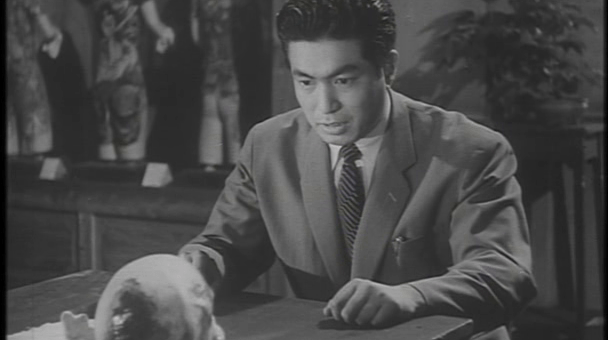
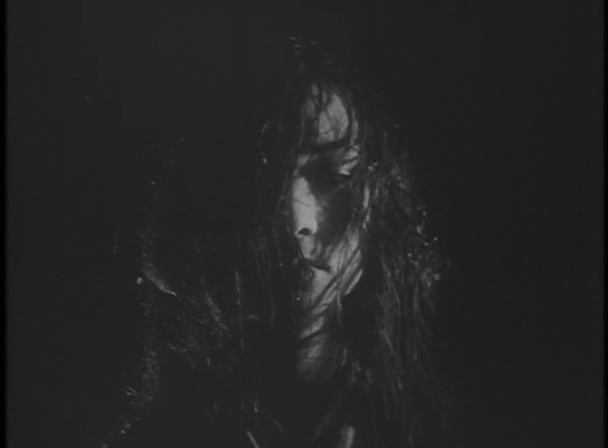
The Military Policeman and the Dismembered Beauty (憲兵とバラバラ死美人, Kyotaro Namiki, 1957)

The Military Policeman and the Dismembered Beauty (憲兵とバラバラ死美人, Kenpei to Barabara Shibijin) was apparently a substantial hit on its release, though to modern eyes at least it doesn’t quite live up to the salaciousness of its title. In fact, it seems a little more interested in reassessing the militarist past while attempting to rehabilitate an authoritarian power and reframing it as good and compassionate unlike the corrupted killer who is selfish and ambitious to the extent that he’s literally poisoning the militarist wells. 

What we’re first introduced to, however, is a rather familiar tale of a soldier who’s gotten a girl pregnant but now won’t marry her mainly because he’s onto a good thing with a pretty girl from a prominent family so his girlfriend’s in the way. Though we see a prelude to the murder, we don’t get good a look at the soldier’s face (though we do hear his voice) which on one level hints at the generalised violent threat of the militarist machine but is also a neat plot device that allows us to into the crime but still maintains the mystery. When we do see the actual killing, it’s surprisingly frank for the time period and disturbing in its sexual charge though there is no gore involved save a grisly discovery in yet another well. 

The killing occurred shortly before the regiment left for Manchuria, which seems to be one way the killer sought to move on and leave his crime behind. The first hint of the corruption is discovered by a gang of new recruits as yet unused to the militarist machine. They notice that the water in the well in the barracks is bad, but are at first bullied and insulted by another soldier who’s been there longer and gives them a rather priggish speech about the sanctity of the regimental water. What they discover is that the water tastes bad because there’s a dismembered torso in there and has been for the last six months. One has to wonder why the culprit would think this a good place to hide a body given the risk of discovery and increasing suspicion but as it turns out no one is all that interested. The Military Police aren’t that keen on investigating themselves, and then we get the familiar conflict between the local cops and the specialists as a top investigator, Kosaka (Shoji Nakayama), is assigned to investigate the crime and insists on doing so thoroughly rather than just beating their favourite subject into a false confession. 

Kosaka is then posited as a nice Military Policeman, an emissary of legitimate authority rather than bumbling provincials who are ridiculous and self-serving not to mention incompetent and resentful. We’re told repeatedly that Kosaka is prepared to work with the civilian police unlike the other military policemen who insist on militarist primacy and refuse to allow the detectives onto the base to investigate. He’s a representative of a less authoritarian age that looks forward to the democratic future, but he is also a part of that organisation himself no matter how different he may seem to be and cannot escape the overarching structures of militarism. Nevertheless, his edges are further softened by a nascent romance with the middle-aged innkeeper at his lodging house while his assistant is after her sister, a childhood friend who can’t stop calling him by his old nickname. 

The two of them investigate scientifically, making frequent trips to the pathologist to discuss theories and evidence though Kosaka is eventually guided towards the solution after seeing the young woman’s ghost. The local military police meanwhile fixate on another soldier who has a reputation for using sex workers, one of whom has recently disappeared, though Kosaka thinks the man is a just a crook with what modern viewers make think of as a sex addition that sees him steal supplies from the kitchen to sell in order to finance his visits to the red light district. The military police whip him in an oddly sexually charged manner to try to get him to confess, but he maintains his innocence. One of the motives for the murder was seemingly that the victim planned to expose the affair, taking her concerns to the killer’s superior officer in an effort to force him to marry her which would have ruined his career prospects in what is supposed to be an organisation of honourable men. Unlike Kosaka who shares his name with the writer of the novel the film is based on which may have been inspired by true events, the other military police are largely like the killer, arrogant, selfish and unfeeling though all Kosaka himself represents is a supposedly more benevolent authority that for his niceness may not actually be all that much nicer.


Snake Princess (新蛇姫様 お島千太郎, Tadashi Sawashima, 1965)

Hibari Misora fights Edo-era corruption once again in another jidaigeki musical adventure from Tadashi Sawashima. Snake Princess (新蛇姫様 お島千太郎, Shin Hebihimesama Oshima Sentaro) sees her doing double duty as a sake-loving stage performer in love with a reluctant revenger, and an austere princess mourning the murder of her confidant and only friend but, as in some of her other films, the resemblance is never remarked upon nor is it any kind of plot point. There isn’t even really a “snake princess”, though snakes and the supernatural do play their part and there is perhaps less space for the derring-do and swashbuckling musical numbers which typically characterise a Hibari picture. 

The film opens with stage performer Oshima (Hibari Misora) waking up from a drunken snooze on a riverbank and realising she’s been left behind by her acting troupe. Running into the mysterious Ittosai (Minoru Oki) on her way, she hurries on to the next town to catch them up while he heads in the opposite direction towards Karasuyama and the Princess Koto (also played by Hibari Misora). Meanwhile, in the town, a rowdy samurai starts a drunken fight in an inn, demanding to drink with the innkeeper’s pretty daughter Suga (Tomoko Ogawa). The innkeeper refuses, offering the excuse that his daughter is at the palace with the princess, but the samurai doesn’t take no for an answer and starts thrashing about with his sword eventually killing the innkeeper for the offence he feels has been caused to him. The innkeeper’s son Sentaro (Yoichi Hayashi), a former pupil of Ittosai, then kills the samurai in revenge and is forced on the run, taken in by the leader of Oshima’s acting troupe, Juzo (Takashi Shimura), who apparently knew his father well. 

What ensues is of course a tale of intrigue and revenge mixed with mild romantic melodrama. Oshima begins to fall for Sentaro, but is warned that he is from a prominent non-samurai family and as such is unlikely to marry a travelling actress, itinerant players then belonging to a kind of underclass which is in part one reason why it is so easy for Sentaro to hide among them. Even so he is also subjugated by the samurai who frequently object to being ordered around by “commoners”, insistent on their privilege the refusal of which is the reason Sentaro’s father had to die. 

Meanwhile,  the Princess Koto is herself oppressed within the feudal system as a female ruling a clan in the absence of her father who has placed her in charge while he remains in the city. While Oshima falls for Sentaro, the relationship between Koto and Suga is perhaps transgressively equally close, Koto describing Suga as the only one she can trust within her own court and plaintively asking her to stay by her side forever. Unfortunately however Suga is murdered by the male court conspirators attempting to wrest power from the princess on her way back with evidence of their smuggling plot after meeting Ittosai on Koto’s behalf. Misled into thinking that Koto had his sister killed, Sentaro plots revenge but on learning the truth asks her why she hasn’t dealt with the wrongdoing among her own retainers, only later realising that even as the leader of the clan she lacks the power to do so and remains in a precarious position. 

Arguably, Oshima has more freedom, fearlessly walking the roads alone, drinking and gambling with the men refusing to abide by traditional social codes though perhaps in some ways permitted to do so precisely because of her position within the entertainer underclass. A further gender reversal sees the fallen Sentaro temporarily resorting to sex work as a host at an inn drinking with a melancholy noblewoman who fully expects to bed him for her five Ryo only for Sentaro to become indignant and throw the money back in her face, much to Oshima’s approval though she later becomes jealous and irritated questioning him if he’s ever done this sort of work before as if it would actually change her feelings for him. While Sentaro is forced into but then rejects the subjugated female role, Oshima chooses the male solution of trying her luck at the gaming tables, occasionally charging into a fight wielding a nearby object such as a handy water bucket. 

The snake theme of the title links back to the supernatural appearances of Suga’s silent ghost, protecting the princess with a wall of serpents when Sentaro plans to attack under the false assumption that she was responsible for his sister’s death. Musical numbers are largely restricted to a lengthy stage performance featuring Oshima and Sentaro’s evolving act utilising several sets and elaborate design while Sawashima ups the game a little from the lower tier Toei norm with varying locations shifting from a set-bound snowscape as Oshima is carted off by local goons, to a shot-on-location set piece as the conspirators take down a spy in the rocky desert. Revenge is eventually taken not only for the murders of Sentaro’s father and sister, but for the samurai transgressions of the Edo era, restoring order by wiping out the bad apples but also allowing Sentaro to free himself from his class-bound destiny and pursue a life, and love, of his choosing regardless of contemporary social codes.


Musical sequences (no subtitles)