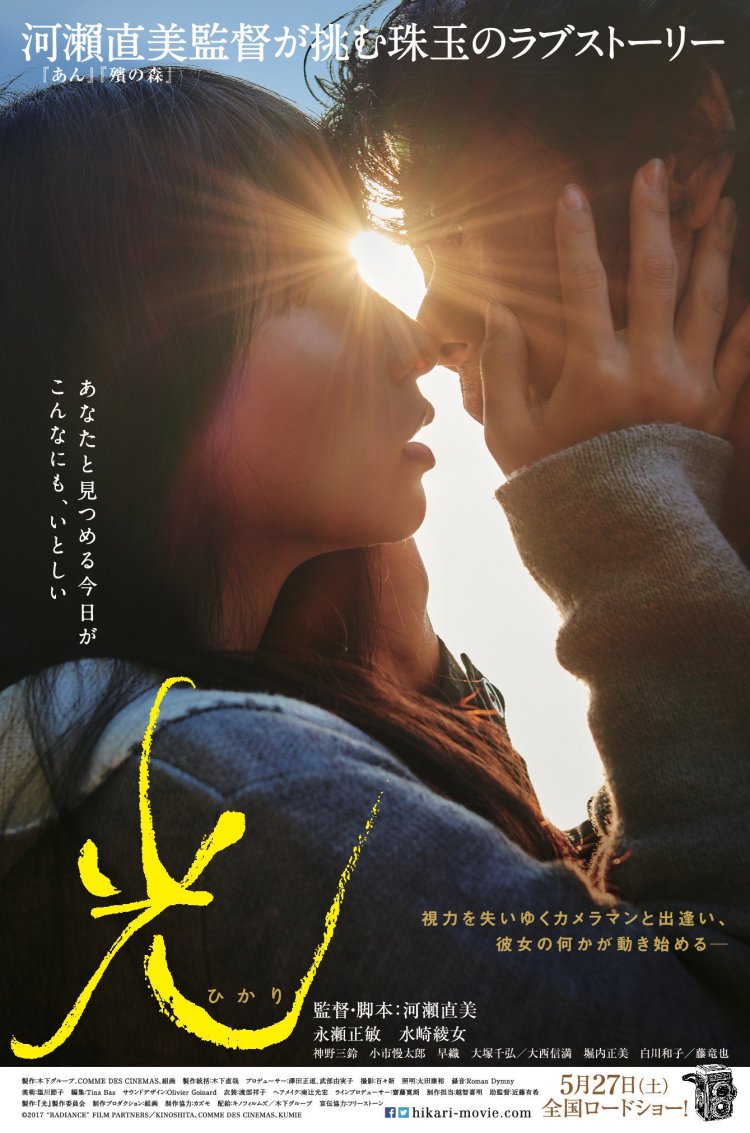
 As a producer claims part way through Naomi Kawase’s Radiance (光, Hikari), the aim of cinema is to connect with other people’s lives. Yet connection is something each of our conflicted protagonists seem to struggle with and something which continues to elude them as they try and fail to find the meaning in the messages of sound and image. Radiance wants to guide us to the light, but its clearest dialogue is with itself or more practically in discussion of translation as an act of intense connection even as its messages flicker in the breeze, caught in a moment of transition from one soul to another. Yet what Kawase finds is that the message is carried, even if it cannot be “translated” into text, or image, or sound, it is felt all the same.
As the film opens a young woman, Misako (Ayame Misaki), observes the world around her and turns her observations into a poetic monologue. Her actions are a kind of rehearsal for her day job which involves creating the script for an audio description that will enable people with visual impairments to enjoy cinema. In order to improve her practice, Misako and her producer hold a number of focus meetings with a group of visually impaired people who can critique her script and point out any potential weak points or moments of confusion. Most of the members of the group are of a mind to be helpful though perhaps overly polite but one, Nakamori (Masatoshi Nagase), is particularly critical of Misako’s approach and unforgiving when voicing his concerns.
Unlike most of the other participants, Nakamori is partially sighted but is suffering from a degenerative condition in which he will eventually lose his sight entirely. This fact is particularly difficult for him to come to terms with as he had previously been an award winning photographer and is losing a key part of his identity in having to face the day when he will have to put his camera down for good.
One of the other ladies at the focus session, pointing out that Misako’s script for the audio description of the film is in effect a subjective commentary, elaborates that what she got from Misako’s narration was a sense of ruined of beauty, of sadness, and the inescapable sense of loss for something that can never be recovered. The film itself is, apparently, the story of a lifelong romance approaching its end as a husband prepares to say goodbye to his wife as she slips away from him. The themes, as we later find out, are ones eerily relevant to Misako who is still mourning the loss of her father while she watches her mother fade away as dementia takes its hold.
The beauty of transience, of the sense of loss before loss, becomes the central message of the film within the film – the message that Misako could not seem to see because she was afraid to look. Fed up with Nakamori’s constant criticisms, she accuses him of lacking imagination but her own act of “seeing” is then exposed as superficial, merely a catalogue of actions without meaning or import but delivered with a subjectivity that, as Nakamori cruelly points out, “gets in the way” of his ability to connect fully with the visual world that Misako is trying to create.
Misako misses the messages because there are things that cannot be directly understood without conscious effort – the elderly film director tells her that her interpretation of the final scenes is too “hopeful”, as a young woman she cannot comprehend the futility of a old man’s desire for life. Age cannot talk to youth, and sound cannot talk to image but still the attempt is made and a message delivered albeit imperfectly. Nakamori, having given his life to the art of photography, is eventually forced to abandon the thing he loves most only to discover something else existing underneath it while Misako is forced to confront the superficiality of her act of “seeing” which makes her attempt to “translate” image into sound a hollow exercise – something which can only be corrected by a willingness to accept that the medium is not the message. Kawase’s messages may be trite, on one level, but there is something beautiful in continuing to chase the light as it dwindles knowing that in the darkness the flame still burns.
International trailer (English subtitles/captions)

 “Memories are what warm you up from the inside. But they’re also what tear you apart” runs the often quoted aphorism from Haruki Murakami. SABU seems to see things the same way and indulges an equally surreal side of himself in the sci-fi tinged Happiness (ハピネス). Memory, as the film would have it, both sustains and ruins – there are terrible things which cannot be forgotten, no matter how hard one tries, while the happiest moments of one’s life get lost among the myriad everyday occurrences. Happiness is the one thing everyone craves even if they don’t quite know what it is, little knowing that they had it once if only for a few seconds, but if the desire to attain “happiness” is itself a reason for living could simply obtaining it by technological means do more harm than good?
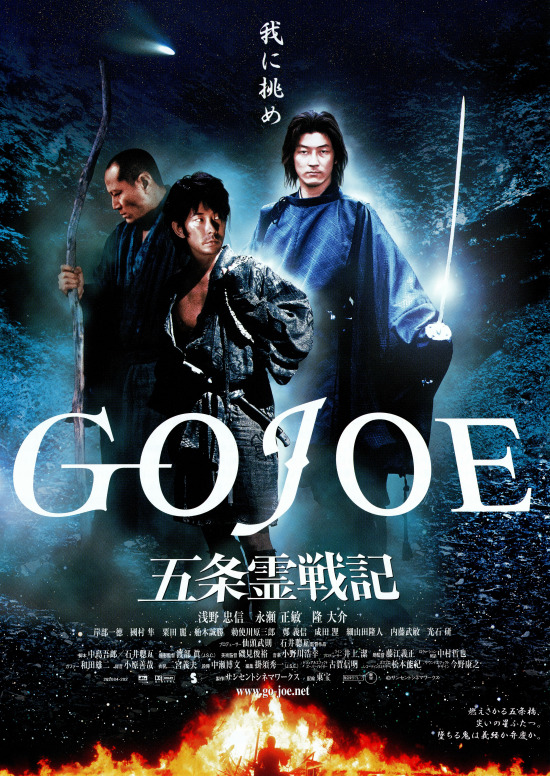 Not your mama’s jidaigeki – the punk messiah who brought us such landmarks of energetic, surreal filmmaking as Crazy Family and Burst City casts himself back to the Middle Ages for an experimental take on the samurai genre. In Gojoe (五条霊戦記, Gojo reisenki), Sogo Ishii remains a radical even within this often most conservative of genres through reinterpreting one of the best loved Japanese historical legends – the battle at Kyoto’s Gojoe Bridge . Far from the firm friends of the legends, this Benkei and this Shanao (Yoshitsune in waiting) are mortal enemies, bound to each other by cosmic fate but locked in combat.
 Akio Jissoji has one of the most diverse filmographies of any director to date. In a career that also encompasses the landmark tokusatsu franchise Ultraman and a large selection of children’s TV, Jissoji made his mark as an avant-garde director through his three Buddhist themed art films for ATG. Summer of Ubume (姑獲鳥の夏, Ubume no Natsu) is a relatively late effort and finds Jissoji adapting a supernatural mystery novel penned by Natsuhiko Kyogoku neatly marrying most of his central concerns into one complex detective story.
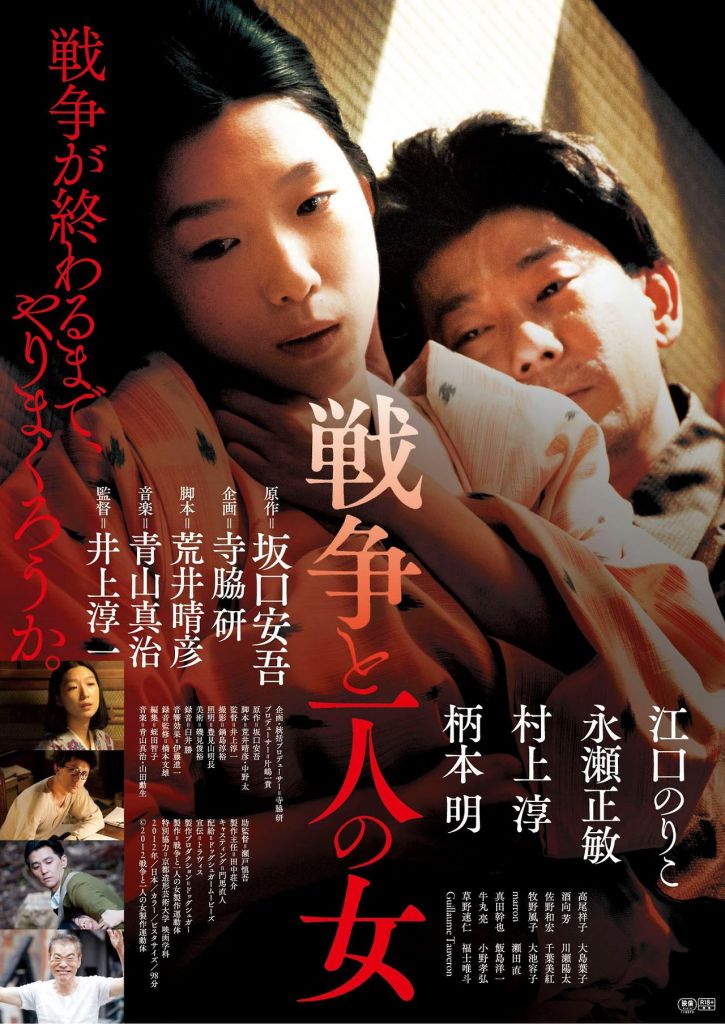 Junichi Inoue is better known as a screenwriter and frequent collaborator of avant-garde/pink film provocateur Koji Wakamatsu. A Woman and a War (戦争と一人の女, Senso to Hitori no Onna) marks his first time in the director’s chair and finds him working with someone else’s script but staying firmly within the pink genre. Adapted from a contemporary novel by Ango Sakaguchi published in 1946, A Woman and a War is an intense look at domestic female suffering during a time generalised chaos.
 Akira Kurosawa’s later career was marred by personal crises related to his inability to obtain the kind of recognition for his films he’d been used to in his heyday during the golden age of Japanese cinema. His greatest dream was to die on the set, but after suffering a nasty accident in 1995 he was no longer able to realise his ambition of directing again. However, shortly after he died, the idea was floated of filming some of the scripts Kurosawa had written but never proceed with to the production stage including The Sea is Watching (海は見ていた, Umi wa Miteita) which he wrote in 1993. Based on a couple of short stories by Shugoro Yamamoto, The Sea is Watching would have been quite an interesting entry in Kurosawa’s back catalogue as it’s a rare female led story focussing on the lives of two geisha in Edo era Japan.
 Windows on Worlds