The Pit of Death (怪談おとし穴, Koji Shima, 1968)

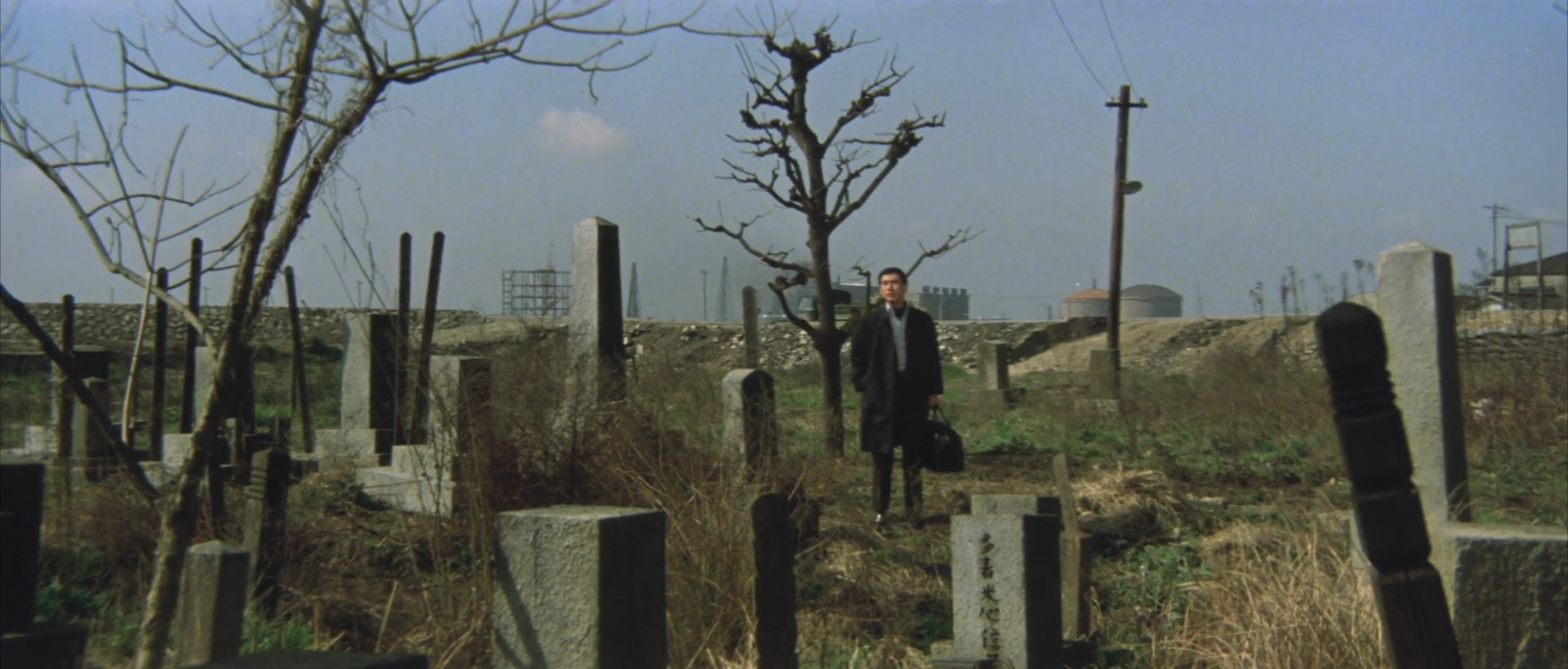
The building at the centre of Koji Shima’s dread-fuelled horror noir Pit of Death (怪談おとし穴, Kaidan Otoshi Ana) is said to be haunted by the spirits of the many people who died during its construction. In his opening voiceover, anti-hero Kuramoto (Mikio Narita) likens the city to a hornet’s nest, the salaryman drones mindlessly buzzing around the business district as if driven by some supernatural force. In that sense, the office building itself becomes an eerie place, the nexus of the salaryman dream which in the end drags all to hell. 

Largely a retelling of Yotsuya Kaidan for the mid-20th century with a little A Place in the Sun thrown in, the film finds Kuramoto an ambitious man deluded by consumerism and resentful of the classism and snobbishness which limit his prospects as a man who has otherwise been able to pull himself out of poverty. His boss pointedly speaks of his talents which include the ability to speak several languages despite only having attended night school rather than university while it’s unusual for a man of his background to hold this kind of position even if he’s only a secretary and not yet an executive. Nevertheless, his boss clearly sees him as a potential successor and plans to marry him to his daughter (Mako Sanjo) who has in some ways inexplicably developed a crush on him.

But Kuramoto is already in a relationship with typist Etsuko (Mayumi Nagisa). In fact, the reason the boss is so pleased with him is largely down to her in that he asked Etsuko to sleep with their foreign client, Mr Hancock, to seal the deal which she duly did. Kuramoto plans to throw her over in order to pursue his dream of taking over the company so he can look down on those who once looked down on him. He tells Etsuko that the marriage will be in name only, that he isn’t attracted to the boss’ daughter Midori, and their relationship will continue as before only to be confused when Etsuko is not totally on board with the plan. She tells him she’s pregnant with his child though he callously points out it could be Hancock’s and insists on an abortion thereafter determining he must kill her so that he can fulfil his destiny by joining the executive class. 

His desires are obvious when he steps into Midori’s home and gazes at a painting crassly asking how much it’s worth, admitting that he’s the kind of poor person who has a fascination with luxury. His forward propulsion is driven by a fear of poverty, the trauma of the hard life he’s had and the futility he felt in his inability to escape it. Yet it’s also a kind of class rebellion motivated by resentment for the prejudice held against him as a man without means in a highly stratified society. Paradoxically, he will do anything and everything to be accepted as a member of the elite class including murdering Etsuko, the symbol of the working class past he fears will drag him down.

Etsuko does indeed drag him down eventually in her own revenge against his callousness and the double standards of a patriarchal society. Her relationship with Kuramoto seems to be a secret in the office while he uses and discards her when no longer useful to him. She too is trapped within this building of a newly corporatised society but can rise no further alone and is in a fairly bleak position without Kuramoto for she has already thrown away her only bargaining chip by entering a sexual relationship with him. Should she attempt to raise his child alone as a never married single mother, her life would be very difficult indeed if not actually impossible. Nevertheless, she does have real power over Kuramoto in her ability to expose the affair and ruin his chances of career advancement through dynastic marriage destroying any possibility of his future success. 

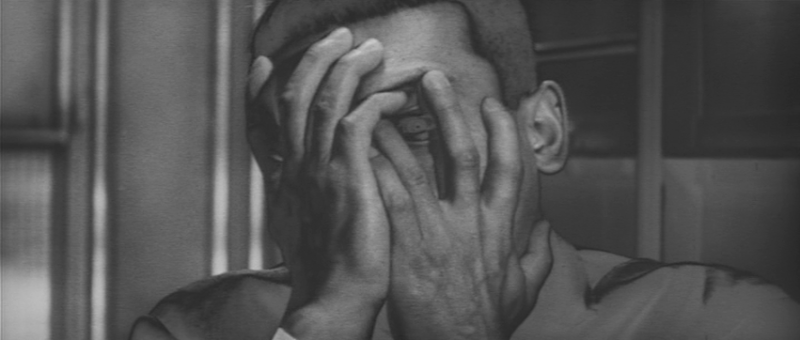
In Kuramoto’s mind, Etsuko cackles like a witch or evil spirit. Her hair billows out into the wind like a vengeful ghost, though the first few times Kuramoto only imagines her death. He sees himself push her off a roof, only to be surprised to see her still standing over him. Etsuko haunts Kuramoto while alive as an image of his destruction all while he silently plots hers. He plans to use the building against her, hiding her body inside it where he assumes no one will see. In the end, it’s as if this building, an edifice of soulless corporatising capitalism, consumes them both, drawing them in with their unfulfilled desires until they fall into the bottomless pit of post-war ambition. Shima makes frequent use of solarisation and film noir lighting to destabilise Kuramoto’s world as his mental state starts to fracture along with innovative use of split screens to lend the space a sense of eerie continuity but ultimately posits the salaryman society as a kind of death trap beckoning greedy souls towards their demise with an inexorable fatalism.


The Tattooed Hitman (山口組外伝 九州進攻作戦, Kosaku Yamashita, 1974)

The close brotherhood between two men is disrupted by changing times in a more contemporary gangster drama from Kosaku Yamashita, Tattooed Hitman (山口組外伝 九州進攻作戦, Yamaguchi-gumi gaiden: Kyushu shinko-sakusen). As many are fond of saying, times have changed and the yakuza must try to change with them or else meet a melancholy end. But as the hero admits, change is something he has no intention of doing even as his old school gangsterism leaves him increasingly at odds with the corporatising ways of the contemporary yakuza. 

The change in the times is obvious from the film’s opening sequence set in 1957 in which an attempt is made on the life of petty boss Ishino (Tatsuo Umemiya) by a gunman who shouts “die, for the good of the world” before firing a pistol and running away. Ishino has been targeted in a dispute over construction rights connected with the regeneration of hot springs resort, Beppu. The hit seems to have been ordered by rival gang, Sakaguchi (Eizo Kitamura), the leader of which is also a prominent local politician who is content to abuse his power for his own financial gain. So confident is he in his safety, that Sakaguchi even gets the police involved rather than deal with it himself. 

Ginji (Bunta Sugawara) has been Ishino’s sworn brother since their teenage delinquent days and determines to get revenge by raiding the Sakaguchi offices and killing one of their high ranking officers. Seeing as he’s already wanted by the police for a previous murder, Ishino sends Ginji to Osaka to lay low while working for an associate, Daito, mainly as a debt collector. It’s this act of separation which introduces a rift between the two men. While Ginji waits patiently to be recalled, Ishino climbs the ranks of corporatised gangsterism by learning to play by the new rules. 

To fill the void, Ginji takes on a new “brother” or perhaps surrogate son in the wayward Ken (Tsunehiko Watase) whom he first meets cheating at pachinko at a parlour where his pregnant wife Fusako (Mayumi Nagisa) is working. It’s Ken who first drags him into a brewing turf war as Korean gang Soryu threaten to disrupt the local equilibrium not least by selling drugs of which Ginji does not approve. Ginji “saves” Ken from joining Soryu by essentially making him his one of his guys though he doesn’t really have much of a position in Daito’s gang, offering him a sense of grown-up responsibility by handing him a pistol with the only the instruction to make sure he shoots with two hands. Unfortunately, Ken will follow his advice but otherwise ends up almost causing an incident with another gang by shooting a man who disrespected him in the street. Ginji marches straight down there to sort things out, but on arrival discovers an arrangement has already been made with his boss which further strains his sense of pride and confidence in his position as a yakuza.

Ginji feels something similar on being invited to a party to celebrate Ishino’s promotion only to be seated with the lowly footsoldiers and ignored by Ishino all night. Ishino rejects him still further in agreeing to plan to send him back to Kyushu out of the way hoping that his old school hotheadedness can finally be tempered. Others meanwhile voice concern that Ginji may have forged a relationship with rival Kobe gangs during the 18 months he abruptly disappeared from Osaka and has only come back to cause trouble. Ginji perhaps knows that he has no more future in the contemporary society, others remarking that seems like someone who is in a sense already dead for having accepted that he will die and most likely in Hakata, the town he had wanted to conquer with Ishino who had crushed his dreams in his newfound pragmatism by calmly explaining that they would never have the power to take it. 

Koji Takada’s screenplay positions Ginji’s gradual decline as an allegory for the yakuza himself while citing the new legislation that this particular series of incidents made necessary creating the new offence of assembly with dangerous weapons as a decisive moment in weakening the yakuza as an institution. Ginji remains a man displaced by his times unable to move forward into a new society in the way that Ishino has but stuck in a permanently post-war mentality despite the constant reminders that “times have changed”. Yamashita adopts the trappings of the jisturoku drama with frequent references to real life events and narrative voiceover but otherwise maintains his classicist formalism while ending on a note of ambivalence that tells us a certain kind of justice may have been served but the cycle of violence may not yet be completed.


Original trailer (no subtitles)

Destiny’s Son (斬る, Kenji Misumi, 1962)

“Sad is his destiny” laments a seemingly omniscient lord in Kenji Misumi’s elliptical tale of death and the samurai, Destiny’s Son (斬る, Kiru). A chanbara specialist, Misumi is most closely associated with his work on long running franchises such as his contributions to the Zatoichi series and Lone Wolf and Cub cycle, and though sometimes dismissed as a “craftsman” as opposed to “auteur” is also known as a visual stylist capable both of the most poetic imagery and breathtaking action. 

Scripted by Kaneto Shindo, Destiny’s Son follows cursed samurai Shingo (Raizo Ichikawa) who finds himself the victim of cruel fate and changing times during the turbulent years of the bakumatsu. His mother, Fujiko (Shiho Fujimura), a maid misused by a plotting courtier and talked into murdering the inconvenient mistress of a wayward lord, was executed for her crime by the man she loved, Shingo’s father who later renounced the world and became a monk. In a sense, it’s Shingo’s sense of displacement which later does for him, allowed the rare freedom of a three year pass from the apparently compassionate lord of the clan which took him in to go travelling during which he learns superior sword style something which came as a surprise to his old friends on his return who’d always thought him gentle and bookish. His talent makes him dangerous to an unexpected rival in his strangely mild-mannered neighbour who happens to have a crush on his sister Yoshio (Mayumi Nagisa) but is quite clearly under the thumb of his finagling father, Ikebe (Yoshio Inaba), who is convinced the family can “do better” as long as he triumphs in a contest of martial prowess with a passing master to whom the clan has given temporary shelter after he was cast out of his own. Of course, nothing goes to plan. The master easily defeats even the clan’s most talented warriors until Shingo is called up as a last resort only to best him with his signature move learned out on the road, a dangerous throat thrust. 

In a theme which will be repeated, Shingo finds himself in the middle of accidental intrigue through no fault of his own though the ill-conceived Ikebe revenge plot does at least allow him to discover the sad truth of his family history even as it deepens his sense of displacement. Slashing right into the mores of the chanbara, Misumi pares Shindo’s screenplay down to its poetic minimum as the hero sets off on his elliptical journey, achieving his revenge as the first stop before walking back into the past and then into an accidental future as a retainer to Lord Matsudaira (Eijiro Yanagi) himself at the centre of bakumatsu intrigue in trying to quell the divisions within the Mito clan some of whom have been involved in anti-shogunate terrorism setting fire to the British Legation shortly after the nation’s exit from centuries of isolation. An eternal wanderer, he resolves to have no wife and wanted no ties, haunted by the trio of women he couldn’t save from the mother who birthed him in part as a bid for mercy, to the sister who died a pointless and stupid death because of samurai pettiness, to another man’s sister whose name he never knew who stripped naked and threw her kimono at her assailants to save her brother’s life while they too were on the run after standing up to samurai corruption. He loses three women, and then three fathers, the first he never knew, the second taken from him in more ways than one, and the third betrayed by the complicated world in which they live. 

“I cannot be forgiven” Shingo exclaims, his end tied to that of his mother as a sword glints gently in the bright sunshine and blood drips, the only blood ever we see, on another woman’s breast. Elegantly composed and often set against the majestic Japanese landscape, Misumi’s ethereal camera with its dynamic tracking shots, controlled dolly movement, and frequent call backs to the setting sun lend Shingo’s journey an elegiac quality even in its evident nihilism as he finds himself consumed by the samurai legacy, discovering only futility in his rootlessness unable to protect himself or others from the vagaries of the times in which he lives. 


Original trailer (no subtitles)

A Certain Killer (ある殺し屋, Kazuo Mori, 1967)

A nihilistic hitman safeguards the post-war future in Kazuo Mori’s chivalrous B-movie noir, A Certain Killer (ある殺し屋, Aru Koroshiya). Set against the backdrop of the Vietnam War with US airplanes flying constantly overhead, Mori’s crime thriller situates itself in the barren wasteland of a rehabilitated city in which betrayal, exploitation and duplicity have become the norm while a former tokkotai pilot turned killer for hire takes his revenge on social hypocrisy as a product of his society, a man who did not die but knows only killing. 

Shiozawa (Raizo Ichikawa) runs a stylish restaurant by day and supplements his income by night as a killer for hire, apparently highly regarded by the local underworld. As such, he’s approached by a yakuza underling, Maeda (Mikio Narita), on behalf of the Kimura gang who want him to off another gangster, Oowada (Tatsuo Matsushita), who double crossed them in contravention of the yakuza codes of honour. Shiozawa is resolutely uninterested in yakuza drama and so turns the job down but changes his mind when he’s paid a visit by boss Kimura (Asao Koike) himself who sells him a different kind of mission. Kimura characterises Oowada as a “bad” yakuza, one has subverted the traditional gangster nobility by dealing in the “dirty” sides of organised crime, corrupting the modern society by trafficking in illegal prostitution, drugs, and extortion, where as he is a “good” yakuza mostly running construction scams and therefore building the post-war future. His crime is, literally, constructive, where Oowada’s is not. 

Shiozawa doesn’t quite buy his justifications, but men like Oowada represent everything he hates. “They’re not worthy of this world. They’re nothing but cockroaches” he laments, recalling the young men who served with him and gave their lives because they believed in a country which betrayed them. He agrees to take the job in rebellion against post-war venality, but only at a price, asking for four times the original fee. Kimura is willing to pay, because his true aim is profit more than revenge. He plans to take over Oowada’s remaining business concerns. 

Fully aware of this, Shiozawa seems almost uninterested in the money despite having asked for so much of it. He runs his shop as a front for his side business and otherwise lives a quiet, unostentatious life keeping mostly to himself. He is not, it would seem, a cold blooded killer, often making a point of leaving those who get in his way incapacitated but alive. Targeted by a street punk for supposedly messing with his girl he cooly disarms him and walks away, only for the girl to follow attracted partly by his icy manliness and partly by the thickness of his wallet as glimpsed when he made the fatal decision to offer to pay for her meal in order to save the chef from embarrassment over her attempts to pay with things other than money. Unable to get by on her own, Keiko (Yumiko Nogawa) attaches herself to various capable men beginning with the pimp, transferring her affections to Shiozawa whom she petitions to marry her, and then to Maeda, eventually vowing to find a new partner and make lots of money. 

Both Maeda and Keiko chase Shiozawa and are rebuffed. Impressed by his cool handling of the Oowada affair, not to mention the amount of money he now realises you can make in his line of business, Maeda asks to become his pupil in order to become a “real man”. Shiozawa doesn’t regard his work as something “real men” do, and in any case prefers to work to alone. Maeda repeatedly asks to be allowed to accompany him even after plotting betrayal, only to be rejected once again as Shiozawa tells him that he doesn’t like people who don’t know the difference between the job and romance, flagging up the homoerotic subtext for those not paying attention. Maeda parrots his words back to Keiko with whom he had begun a halfhearted affair as joint revenge against Shiozawa’s indifference. 

Following the successful offing of the mob boss, Shiozawa finds himself coopted into another job robbing a drug handoff between Oowada’s former associates, the illicit narcotics ironically packaged inside cartons intended for baby powder. Shiozawa apparently doesn’t object to profiting off the drug trade himself, but later abandons the loot in protest while the remainder is lost or squandered during the final battle with the remaining gang members, Shiozawa’s cartons left sitting ironically on top of a gravestone taken by no one. Cool as ice, Shiozawa places himself above petty criminality, always one step ahead, trusting no one and looking out for himself but reacting as a man created by his times, forged by a war he was a not intended to survive while looking on at another cruel and senseless conflict across the sea. Adapting the hardboiled novel by Shunji Fujiwara, Yasuzo Masumura’s jagged, non-linear script (co-written with Yoshihiro Ishimatsu) is imbued with his characteristic irony but also coloured with nihilistic despair for the post-Olympics society and its wholesale descent into soulless capitalistic consumerism.


Update, 13th February 2025: now available to stream via Arrow Player.

Original trailer (no subtitles)

The Yakuza Papers Vol. 4: Police Tactics (仁義なき戦い: 頂上作戦, Kinji Fukasaku, 1974)

b0176154_10205690It’s 1963 now and the chaos in the yakuza world is only increasing. However, with the Tokyo olympics only a year away and the economic conditions considerably improved the outlaw life is much less justifiable. The public are becoming increasingly intolerant of yakuza violence and the government is keen to clean up their image before the tourists arrive and so the police finally decide to do something about the organised crime problem. This is bad news for Hirono and his guys who are already still in the middle of their own yakuza style cold war.
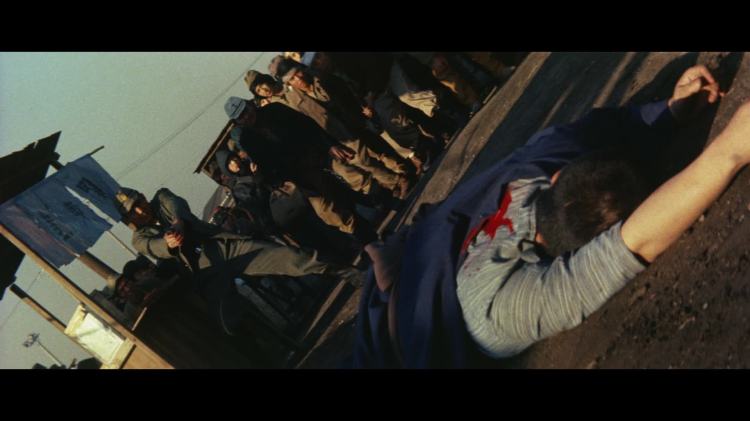
Police Tactics (仁義なき戦い: 頂上作戦, Jingi Naki Tatakai: Chojo Sakusen), the fourth in the Yakuza Papers (or Battles Without Honour and Humanity) series, once again places Hirono at the centre of events for much of the film. The cold war from the end of the last film, Proxy War, is still going on with ambitious boss Takeda hosting additional foot soldiers from other areas of the country. However, all these extra guys are quite a drain on his resources and, simply put, it’s going to ruin him if this situation goes on much longer. Yamamori is currently holed up in a safe place and only steps outside to go to the bath house when he’s surrounded by a huge entourage of bodyguards. Added to the gang rivalry which is only growing now as factions split and new families are formed, not to mention all the guys from outside, is the now constant police pressure. Up to now, the police have been either a minor irritation or a soft ally but this time the guys might have finally met their match.

It’s almost twenty years since Hirono settled into the yakuza life. He’s not an old man, but he’s not a young one either. You can no longer explain or excuse any of his actions with the fire of youth – he’s one of the veterans now. However, young men are always young men and even while the older guys try to scheme and come up with a plan the youngsters are all for action. Hirono has always been the one noble gangster. Committed to yakuza ideals, he’s loyal to his bosses and dedicated to taking care of his guys. Hence, there’s no way he’s going to let one of his men take out Yamamori – firstly, after nursing a grudge for 18 years he wants to handle it himself but even if he didn’t he still wouldn’t be able go after Yamamori in anything other than an honourable way. However, now even Hirono says at one point “I don’t give a fucking shit about honour anymore”. At this point you know it’s all over, the one loyal retainer has finally given up.

With the police pressure mounting, the violence on the streets intensifies with even more feats of desperate backstreets warfare. Hirono himself is absent for a lot of the film while he gets picked up by the police on a flimsy pretext. More gangs are introduced, more guys die before you even begin to remember their names. There’s death everywhere yet still more yakuza keep turning up, offering to die for their bosses who will sell them out without a second thought if it buys them ten seconds more in power. The younger generation may not have the trauma of the war to burn through, but they’ve grown up in this world of street gangs and constant violence so it stands to reason that they come to idolise the tough guys and think joining a gang is their one way ticket out of the slums. As they will discover, there is always a heavy price to be paid for ambition and naivety.

The shooting style is pretty much the same as the first few films in the series. Documentary style voice over, hand held camera and freeze frame death shots are the order of the day. Once again we begin and end with the ruined dome reminding us of the price of violence. Police Tactics could almost be the end of the cycle. With the police finally deciding to act, by the end of the film all of the major players are off the streets in one way or another. In the end, all that death and violence amounted to to nothing. As the film reminds us, public order may have been restored (temporarily) but the systems and conditions which lead to violence are still very much in place.


Police Tactics is available on blu-ray in the UK as part of Arrow Video’s Battles Without Honour and Humanity: The Complete Collection box set.


The Yakuza Papers Vol. 1: Battles Without Honour and Humanity (仁義なき戦い, Kinji Fukasaku, 1973)

Snapshot-2015-12-07 at 11_06_36 PM-930280086When it comes to the history of the yakuza movie, there are few titles as important or as influential both in Japan and the wider world than Kinji Fukasaku’s Battles Without Honour and Humanity (仁義なき戦い, Jingi Naki Tatakai). The first in what would become a series of similarly themed movies later known as The Yakuza Papers, Battles without Honour is a radical rebooting of the Japanese gangster movie. The English title is, infact, a literal translation of the Japanese which accounts for the slightly unnatural “and” rather than “or” where the “honour and humanity” are collected in a single Japanese word, “jingi”. Jingi is the ancient moral code by which old-style yakuza had abided and up to now the big studio gangster pictures had all depicted their yakuza as being honourable criminals. However, in Fukasaku’s reimagining of the gangster world this adherence to any kind of conventional morality was yet another casualty of Japan’s wartime defeat.

The story begins with a black and white image of a mushroom cloud with the film’s bright red title card and now famous theme playing over the top. This is Hiroshima in 1946. Things are pretty desperate, the black market is rife and there are US troops everywhere. Shozo Hirono (Bunta Sugawara) has just returned from the war (in fact he’s still in his uniform). He gets himself into trouble when he intervenes as an American soldier attempts to rape a Japanese woman in broad daylight in the middle of a crowded marketplace. He manages to cause enough of a commotion for the woman to escape but the Japanese cops just tell him not to mess with the GIs. Things don’t get much better as one of Hirono’s friends is assaulted by a yakuza. They get some rival yakuza to help them get revenge and in the commotion Hirono accidentally kills someone and is sent to prison for 12 years. In prison he meets another yakuza who wants to escape by pretending to commit harakiri and promises to get his yakuza buddies to bail Hirono out if he helps. From this point on Hirono has become embroiled in the new and dangerous world of the Hiroshima criminal underground.

Battles Without Honour and Humanity has a famously complicated plot entered around the various power shifts and machinations between different groups of yakuza immediately after the end of World War II. The film begins in 1946 and ends in 1956 though many of its cast of tough guys don’t last anywhere near as long. The picture Fukasaku paints of Japan immediately after the war is a bleak one. Even if some of these guys are happy to have survived and finally reached home, they’ve seen and done terrible things. Not only that, they’ve been defeated and now they’re surrounded by foreign troops everywhere who can pretty much do what they want when they want. They just don’t have a lot of options – if they don’t have connections to help them find work when there’s not enough to go around then it isn’t surprising if they eventually fall into to crime. Also, having spent time in the military, the yakuza brotherhood provides a similar kind of camaraderie and surrogate family that you might also find in an army corps.

It all gets ugly quite fast. Largely the yakuza are making their money profiting from the political instability, resenting the US occupation yet reaching deals with them to support their efforts in the Korean war and then selling new and untested drugs at home (with less than brilliant results). Betrayals, executions, assassinations in previously safe places like a bath house or the barbers – these are a long way from the supposedly honourable gangsters of old. One minute Hirono is offering to cut off his finger as a traditional sign of atonement (though no one knows exactly what you’re supposed to do in this situation and it all ends up seeming a little silly) and taking the rap for everyone else’s mistakes, but his friend faked harakiri to get out of jail and everyone is double crossing everyone else whichever way you look.

The whole thing is filmed in an almost documentary style with captions identifying the various characters and giving the exact time of their demise (if necessary) as well as a voice over giving background information about the historical period. The film is inspired by real life yakuza memoirs and there are parts which feel quite like a bunch of old guys sitting in a drinking establishment and recounting some of their exploits.

This new postwar world of heartless gangsters is a tough one and almost devoid of the old honour-bound nobility, however somehow Fukasaku has managed to make it all look very cool at the same time as being totally unappealing. You wouldn’t want to live this way and you definitely don’t want to get involved with any of these guys but somehow their self determined way of life becomes something to be admired. That said, there’s a sadness too – that even in the criminal underworld there used to be something noble that’s been obliterated by the intense trauma of the war. You can rebuild, you can move on from the destruction left by the war’s wake but there’s no going back to those days of “honour and humanity” – if they ever existed, they’re gone forever now.


Battles without Honour and Humanity is available in blu-ray in the UK as part of Arrow Video’s Battles Without Honour and Humanity: The Complete Collection box set.