The Mother Tree (怪談乳房榎, Goro Kadono, 1958)

An amoral ronin worms his way into the home of a famous painter with the intention of stealing his wife in Goro Kadono’s eerie tale of ghostly revenge, The Mother Tree (怪談乳房榎, Kaidan Chibusa Enoki). As might be expected, it doesn’t go particularly well for him. He is, though, perhaps a symbol of the latent fear of social interlopers and those displaced within the Edo-era class system. Namihei (Asao Matsumoto) claims that he was let go by his master for being too interested in painting, though is otherwise focused on short-term gains and causing destruction.

Shigenobu (Akira Nakamura) is said to be “the greatest artist in Edo”, and is certainly very much in demand. He is father to an infant son, Mayotaro, and husband to devoted wife Kise (Katsuko Wakasugi). He appears to be a good man, if a little scatterbrained and hugely overworked, which is one reason why he was grateful to take on a pupil. The irony is that both Kise and the family’s maid Hana (Keiko Hasegawa) remark on what a nice guy Namihei is and how glad they are to have him in the household. He’s even good with the baby who apparently likes to be held by him. All of which suggests that he might have actually had talent for painting and could probably have succeeded Shigenobu, in time, if hadn’t been such a terrible person. 

Unfortunately, however, Namihei reminds Shigenobu that he promised to paint a freeze for a temple some distance away and had sort of forgotten about it. An impulsive soul, Shigenobu decides he’d better leave right away if only to shake off this sense of unfulfilled obligation that’s been plaguing him. He entrusts the women of the household to Namihei in his absence and has no reason to fear any harm may come to them while he’s away. Namihei, however, attempts to rape Kise as soon as he leaves. Though she resists him, he threatens to kill her son and she is forced to give in to a prolonged period of sexual exploitation.

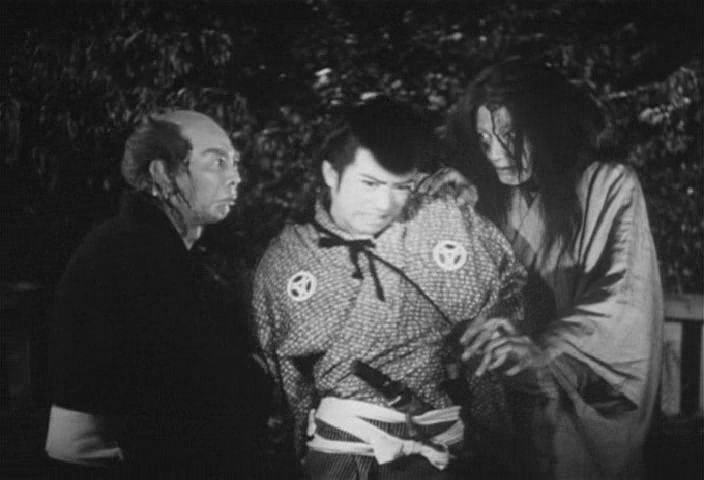
This is actually quite a dangerous move on Namihei’s part considering that the penalty for adultery under Tokugawa law is death, which might be why he finally ends up killing Hana after she witnesses Kise being abused and tries to help her. Namihei evidently doesn’t have a long-term plan for how all this is supposed to pan out and panics on hearing that Shigenobu will be returning much earlier than he expected. The irony may be that Shigenobu intended to paint eyes that might see into the next world and eventually becomes a vengeful ghost after being brutally murdered by Namihei, though was unable to see his treachery. Evidently never having read a ghost story himself, Namihei dumps the body in a pond, which is all but guaranteed to come back and haunt him. “Though you kill me, I will not die,” Shigenobu curses, vowing that he cannot pass on while his dragons lack eyes. 

What might be surprising is that neither of the vengeful ghosts blame Kise for her plight or seek revenge against her. The rage of a vengeful ghost can often be indiscriminate, but both Shigenobu and Hana seem to understand that Kise has been abused by Namihei and only submitted to him out of maternal devotion in the desire to have her son. Namihei’s transgression aims at straight at the concept of motherhood and with it the entire social order. Having displaced Shigenobu, Mayotaro now seems a nuisance to him. He believes he’s conquered Kise by fear and no longer needs this leverage to control her now her husband is dead.

It is mainly fear that causes people to behave in strange ways. Namihei orders their servant Shosuke (Hiroshi Hayashi) to kill Mayotaro, telling Kise that he is to be sent to a noble samurai family that will assist in his social advancement. Kise seems to go along with this, despite having sworn to raise Mayotaro to take revenge. Shosuke is unable to resist after Namihei threatens him with death, but places Mayotoyo by the Mother Tree which had once nourished him. Following her husband’s murder, Kise’s milk had dried up in shock as if echoing this attempt on her maternity which was then restored by the ancient natural authority of the tree. 

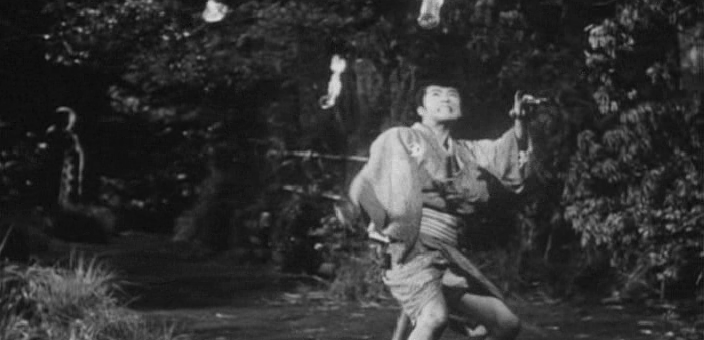
That it’s the Buddhist priest that becomes a figure of moral authority and goodness positions Buddhism as the counter to the amoral nihilism of men like Namihei. Having been struck by Namihei, Kise leaves her son in the priest’s care who will raise him not for revenge but peace and forgiveness. This might run counter to the Shinto-inflected role of the Mother Tree as a symbol of the power of nature, but ultimately suggests that true righteousness is found in Buddhism and its values. Namihei pays for his amoral venality after being tormented by spirits appearing as flaming orbs. Japanese ghosts rarely harm humans directly, but cause them to hurt themselves through fear and madness. That he ultimately kills Kise despite Shigenobu’s telling her to raise their son suggests that she is being punished too, though none of this was her fault and it is really she who puts end to Namihei’s reign of terror. With his death, order is, in a sense, restored as Shigenobu returns to put the eyes on his dragons who can indeed see a better world free of greed or cruelty. 

Flesh Pier (女体桟橋, Teruo Ishii, 1958)

Teruo Ishii may be most closely associated with his exploitation work for Toei in the late ‘60s and ‘70s but in actuality he began his career at Toho, later joining Shintoho where he served as an AD to among others Mikio Naruse whom he regarded as a lifelong mentor. After making his debut with boxing movie King of the Ring: The World of Glory in 1957, he worked mainly in children’s sci-fi tokusatsu serials before sliding into B-movie noir of which 1958’s Flesh Pier (女体桟橋, Nyotai sanbashi) is an early example. 

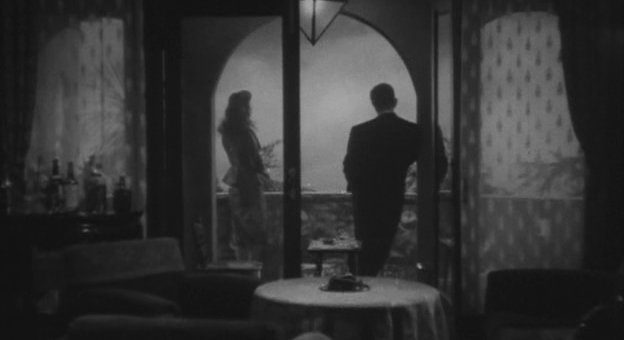
Set firmly in the contemporary era, Ishii opens with a documentary-style voiceover exoticising the seedy underbelly of the city’s entertainment district hidden away in otherwise sparkling Ginza. Shooting in a bold reportage style, he captures a sense of natural spontaneity reminiscent of early American independent cinema transitioning directly into nightclub Arizona where a woman is furiously dancing. Arizona is as we’ll see the nexus of the recent proliferation of “call girl” businesses which have arisen since sex work was criminalised and in this case at least dependent on an international sex trafficking network backed by an American gangster, Thompson (Harold Conway). Salaryman Keizo (Ken Utsui) is a new customer, double checking that the business is “safe” before being reassured that they don’t deal with anyone they don’t know and have already vetted his identity, but when he reaches the hotel room he’s been handed the key for, he discovers the body of a woman lying in the bathtub and is forced on the run. The twist is that Keizo isn’t a bored executive after all but an undercover policeman working on breaking the trafficking ring. 

Co-scripted by Akira Sagawa, Flesh Pier seems to draw frequent inspiration from Casablanca only with the roles slightly reversed as replacement hostess Rumi (Yoko Mihara) finds herself wondering why of all the gin joints in Ginza Keizo had to walk into hers while the bar’s musician, Teruo (Teruo Hata), quite clearly in love with her himself, completes the triangular relationship. The couple even enter a Moroccan-style room while echoing Rick and Ilsa’s painful rehash of their Paris break up as Rumi tries and fails to explain why she left him on some previous occasion, Keizo remembering that she wore a white sweater and a blue coat to mimic Rick’s “the Germans wore grey, you wore blue” while the film’s ending is also hugely reminiscent of Casablanca’s “beginning of a wonderful friendship” only with additional romance. 

Nevertheless, the crime here is bigger and darker than most contemporary noir with awkward echoes of Japan’s prewar sex trafficking industry embodied by the karayuki as it becomes clear the gang’s business model relies on finding young women and luring them abroad with promises of good jobs only to force them into them sex work. Meanwhile one of the regular policemen, Hayami (Hiroshi Asami), gets a shock when he sets up a meeting with one of the call girls and is met by his own fiancée who, unbeknownst to him, has resorted to sex work in order to fund her brother’s tuition. “What else could I do?” she tearfully asks him making plain that in the difficult if improving economic environment of late 50s Japan sex work is still the only viable option for many women needing to support their families in the absence of men given persistent societal sexism which often locks them out of other kinds of well-paying jobs. Hayami perhaps understands this, drowning his sorrows with his veteran partner insisting that he’s sick of being a policeman and plans to quit only for the older man to sympathetically tell him not to give up so easily. 

Then again, Keizo’s secondary love interest Haruko (Akemi Tsukushi) is an intrepid undercover reporter posing as a model in order to bait the trafficking ring. Even so the primary drama revolves around Keizo and Rumi’s unfinished business along with her musician’s jealousy, the implication being more that her feelings for Keizo have clouded her judgement rather than reawakened a sense of moral goodness. Like many femme-fatales in post-war B-movie noir she is made to pay the ultimate price for her transgressive femininity in having firstly climbed the in-gang ladder and then damned herself in her conflicted love for the earnest Keizo even while suspecting he may be an undercover cop despite his acting like an underworld thug. These are indeed a new breed gangster much more like those seen in European and American noir rather than traditional yakuza while the environment of the Arizona is also something of a liminal space as the opening voiceover puts it in but not of Japan. 

While nowhere near as lurid as some of Ishii’s later work, Flesh Pier is certainly daring for the time period in the griminess with which it depicts the successor to the red light districts along with its air of forbidden allure even while its club scenes are in keeping with those found in other contemporary gangster tales if lent a little more realism in the immediacy with which Ishii shoots them making full use of documentary-style handheld. Expressing a degree of anxiety as regards Japan’s increasingly global outlook along with that of increasing social change, Flesh Pier is formally daring from the young Ishii artfully playing with classic noir while fully embracing the transgressive thrills of B-movie crime.