The Mother Tree (怪談乳房榎, Goro Kadono, 1958)

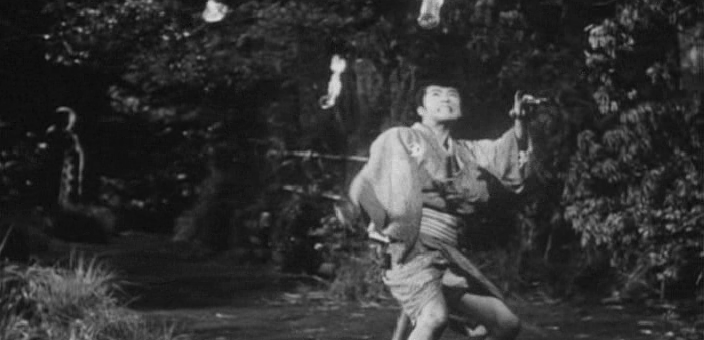
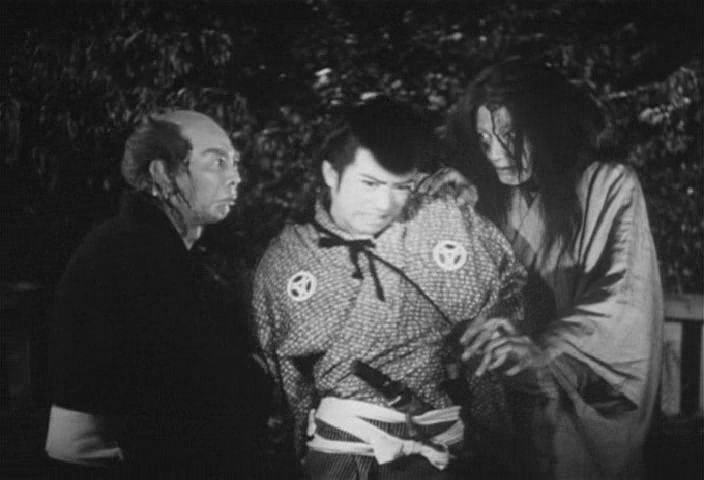
An amoral ronin worms his way into the home of a famous painter with the intention of stealing his wife in Goro Kadono’s eerie tale of ghostly revenge, The Mother Tree (怪談乳房榎, Kaidan Chibusa Enoki). As might be expected, it doesn’t go particularly well for him. He is, though, perhaps a symbol of the latent fear of social interlopers and those displaced within the Edo-era class system. Namihei (Asao Matsumoto) claims that he was let go by his master for being too interested in painting, though is otherwise focused on short-term gains and causing destruction.

Shigenobu (Akira Nakamura) is said to be “the greatest artist in Edo”, and is certainly very much in demand. He is father to an infant son, Mayotaro, and husband to devoted wife Kise (Katsuko Wakasugi). He appears to be a good man, if a little scatterbrained and hugely overworked, which is one reason why he was grateful to take on a pupil. The irony is that both Kise and the family’s maid Hana (Keiko Hasegawa) remark on what a nice guy Namihei is and how glad they are to have him in the household. He’s even good with the baby who apparently likes to be held by him. All of which suggests that he might have actually had talent for painting and could probably have succeeded Shigenobu, in time, if hadn’t been such a terrible person. 

Unfortunately, however, Namihei reminds Shigenobu that he promised to paint a freeze for a temple some distance away and had sort of forgotten about it. An impulsive soul, Shigenobu decides he’d better leave right away if only to shake off this sense of unfulfilled obligation that’s been plaguing him. He entrusts the women of the household to Namihei in his absence and has no reason to fear any harm may come to them while he’s away. Namihei, however, attempts to rape Kise as soon as he leaves. Though she resists him, he threatens to kill her son and she is forced to give in to a prolonged period of sexual exploitation.

This is actually quite a dangerous move on Namihei’s part considering that the penalty for adultery under Tokugawa law is death, which might be why he finally ends up killing Hana after she witnesses Kise being abused and tries to help her. Namihei evidently doesn’t have a long-term plan for how all this is supposed to pan out and panics on hearing that Shigenobu will be returning much earlier than he expected. The irony may be that Shigenobu intended to paint eyes that might see into the next world and eventually becomes a vengeful ghost after being brutally murdered by Namihei, though was unable to see his treachery. Evidently never having read a ghost story himself, Namihei dumps the body in a pond, which is all but guaranteed to come back and haunt him. “Though you kill me, I will not die,” Shigenobu curses, vowing that he cannot pass on while his dragons lack eyes. 

What might be surprising is that neither of the vengeful ghosts blame Kise for her plight or seek revenge against her. The rage of a vengeful ghost can often be indiscriminate, but both Shigenobu and Hana seem to understand that Kise has been abused by Namihei and only submitted to him out of maternal devotion in the desire to have her son. Namihei’s transgression aims at straight at the concept of motherhood and with it the entire social order. Having displaced Shigenobu, Mayotaro now seems a nuisance to him. He believes he’s conquered Kise by fear and no longer needs this leverage to control her now her husband is dead.

It is mainly fear that causes people to behave in strange ways. Namihei orders their servant Shosuke (Hiroshi Hayashi) to kill Mayotaro, telling Kise that he is to be sent to a noble samurai family that will assist in his social advancement. Kise seems to go along with this, despite having sworn to raise Mayotaro to take revenge. Shosuke is unable to resist after Namihei threatens him with death, but places Mayotoyo by the Mother Tree which had once nourished him. Following her husband’s murder, Kise’s milk had dried up in shock as if echoing this attempt on her maternity which was then restored by the ancient natural authority of the tree. 

That it’s the Buddhist priest that becomes a figure of moral authority and goodness positions Buddhism as the counter to the amoral nihilism of men like Namihei. Having been struck by Namihei, Kise leaves her son in the priest’s care who will raise him not for revenge but peace and forgiveness. This might run counter to the Shinto-inflected role of the Mother Tree as a symbol of the power of nature, but ultimately suggests that true righteousness is found in Buddhism and its values. Namihei pays for his amoral venality after being tormented by spirits appearing as flaming orbs. Japanese ghosts rarely harm humans directly, but cause them to hurt themselves through fear and madness. That he ultimately kills Kise despite Shigenobu’s telling her to raise their son suggests that she is being punished too, though none of this was her fault and it is really she who puts end to Namihei’s reign of terror. With his death, order is, in a sense, restored as Shigenobu returns to put the eyes on his dragons who can indeed see a better world free of greed or cruelty. 


Tsukigata Hanpeita (月形半平太, Kokichi Uchide, 1952)

Tusgikata Hanpeita still 1In the midst of post-war confusion, Japanese cinema increasingly looked back to Meiji in all of its chaotic possibility in order to ask what went wrong and what lessons it might have for a second kind of revolution as the nation tried to rebuild itself after decades of militarist folly and chastened wartime defeat. “Tsukigata Hanpeita” (月形半平太) is a “legendary” fictional character first imagined for a kabuki play in 1919 who finds himself swept up in Bakumatsu intrigue as he tries, along with daring revolutionaries Sakamoto Ryoma and Katsura Kogoro, to forge an alliance between the clans of Choshu and Satsuma in order to take on the corrupt shogun in defence of the Emperor and foster a new era of peace in an increasingly uncertain world.

When we first meet him, Tsukigata Hanpeita (Utaemon Ichikawa) is on the run from Kyoto-based special police force the Mimawarigumi but also making time for his mistress, Umematsu (Chizuru Kitagawa) – a geisha. This in particular is a problem which has left him dangerously exposed, even the Mimawarigumi leader Okudaira (Joji Kaieda) seems to be aware of the relationship and is apparently not above using it to his advantage. Meanwhile, he’s not only threatened by shogunate defenders, but by his own side – both by those who remain unconvinced by Sakamoto’s (Jotaro Togami) internationalist philosophy, and by those who simply hold a grudge against Satsuma because of a previous conflict and regard Tsukigata as a traitor for daring to talk to them at all. Despite everything, Tsukigata hides in the shadows and commits himself to living, and if necessary dying, to bring about a better world free of shogunate oppression.

Unlike other revolutionary legends, however, Tsukigata’s fervour has not made him cold or cruel even if he must sometimes act in ways which are mysterious and confuse those around him. Meeting a young man on a bridge, he applauds his studious nature, agreeing that “nothing is more important than to understand advanced civilisation”, and is as polite as he could be when the man tells him he has just joined the Mimawarigumi. Rather than attack or berate him, Tsukigata cheerfully wishes the young man well, allowing him the space to see that his present allegiance to the shogunate is perhaps misguided and out of line with his personal beliefs.

Indeed, his compassion extends even to Okudaira – his mortal enemy. Offering his condolences to a grieving Somehachi (Isuzu Yamada), Tsugikata laments that in a better world he and Okudaira may have been friends, that he had no personal grudge against him despite the fact that they clearly lived on different sides of an ideological divide. He could perhaps even harbour a kind of professional respect for him in his dogged defence of his duty for all he believes it to be misguided. “It’s so unfortunate”, he exclaims, “We have to make the world a better place”.

His desire to change the world is what keeps Tsukigata alive. Several times he faces certain death, but declares but he cannot die now with his great work left unfinished. He is not afraid of death and would gladly give his life in the service of his cause, only not just yet. “Would you please spare my life until I change the world?” he begs of someone he fully believes has a right to kill him, eventually winning their support and unexpected allegiance solely through his guileless goodness.

Yet for all that, his moral austerity does at times perhaps cause him problems in giving rise to emotional confusion. So it is that he winds up in an accidental love triangle with the smitten Somehachi – a former geisha turned madam whose patron is none other than Okudaira, and Umematsu an ageing courtesan with whom he has developed a more or less settled relationship. This is clearly the story of Tsukigata Hanpeita, but more than that it’s the story of the three women who support him without whom the revolution may even be impossible. Somehachi, despite her allegiance to Okudaira, has been a longstanding Tsukigata ally several times helping him escape from the oncoming Mimawarigumi, while Umematsu provides him with safe harbour and occasional message carrying services which is where teenage geisha Hinagiku (Hibari Misora) comes in, acting as a revolutionary go-between with deep-seated political passion.

Speaking strongly of female solidarity, the fallout from the love triangle is eventually minimised by the sisterly geishas who later bond in their shared support of Tsukigata and resolve to put past pettiness behind them. Meanwhile, Tsukigata is deceived by male treachery, only to finally receive the message he’s been waiting for which seems to make everything worthwhile. “I can see the dawn of a new era”, he exclaims, “the new era will be peaceful”. Suddenly he’s not just talking of himself anymore, but directly to the post-war era as he begins to see the way out of a “chaotic society” towards a prosperous future in the faces of his friends united in mutual support and the belief that his better world will soon be a reality.