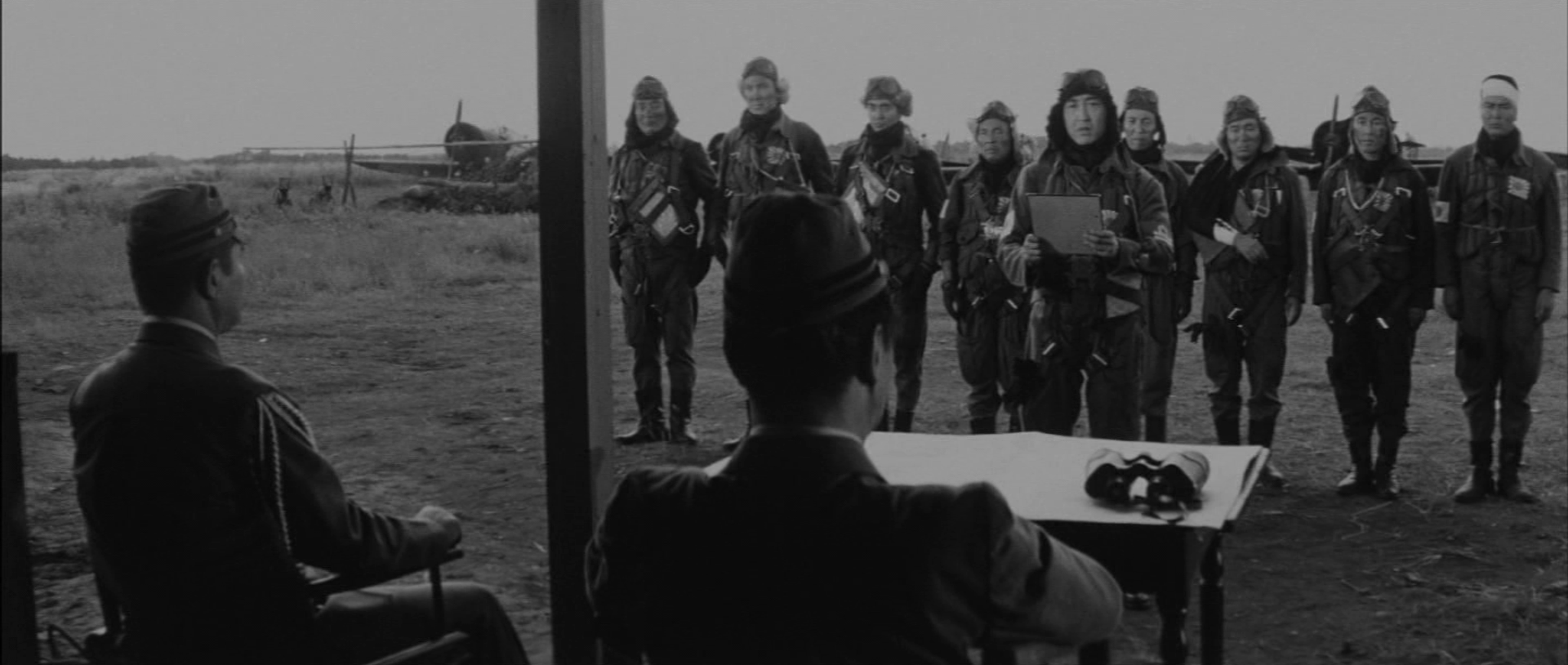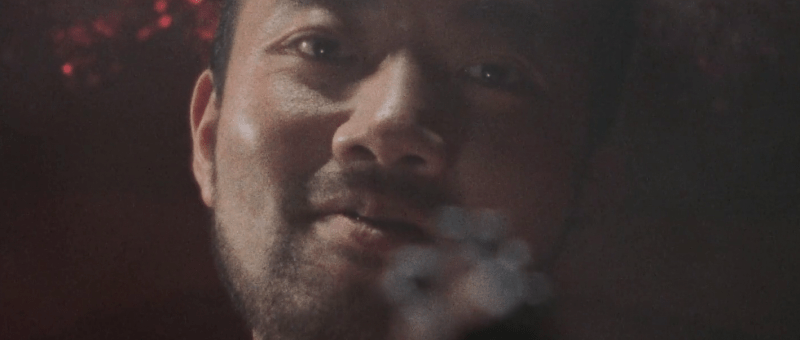
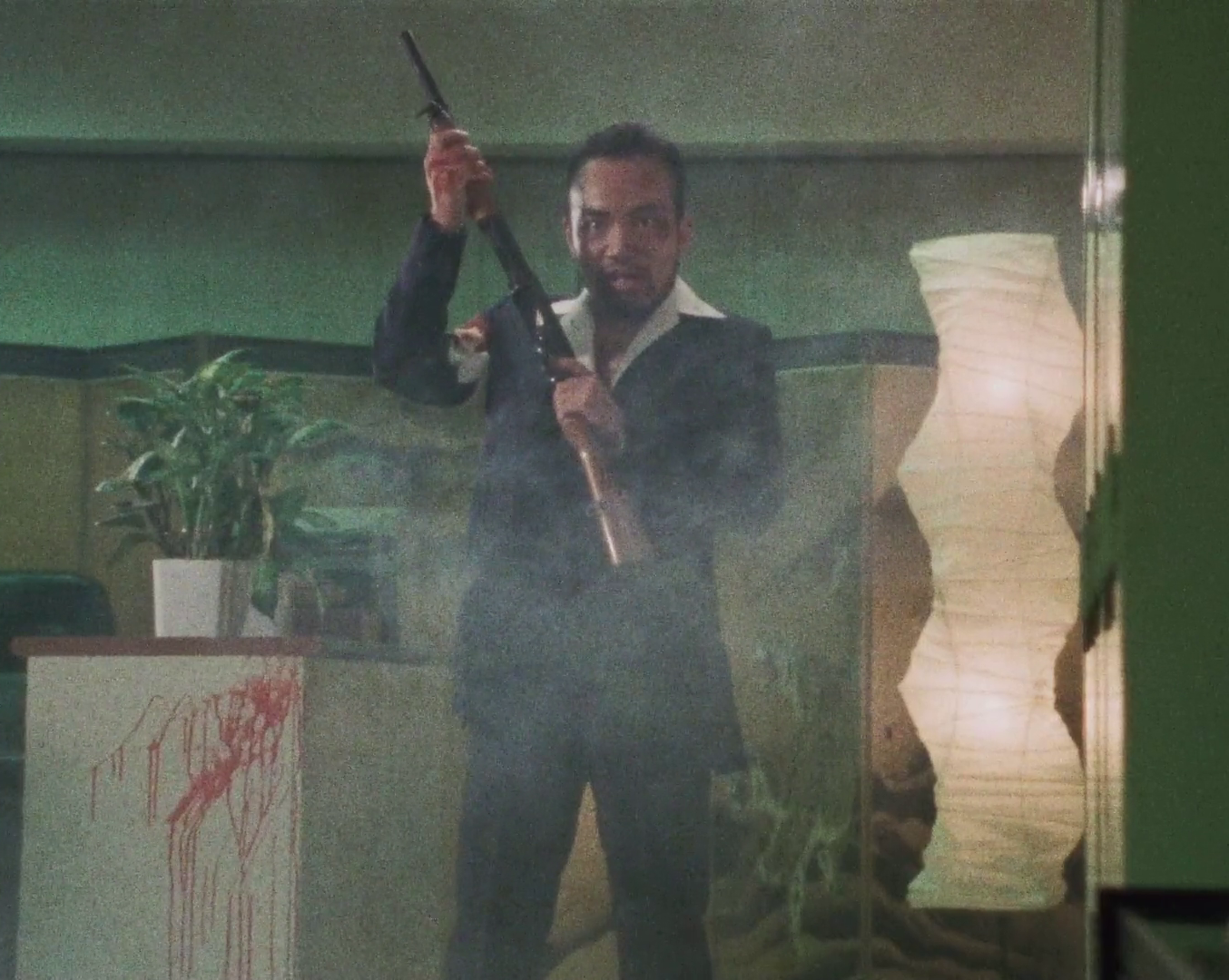
Carlos (カルロス, Kazuhiro Kiuchi, 1991)

Fleeing a gang war with Columbian drug lords, a Brazilian gangster of Japanese descent tries his luck on the mainland but finds himself a perpetual outsider who can’t get himself taken seriously in Kazuhiro Kiuchi’s moody adaptation of his own manga, Carlos (カルロス). Owing a little bit to Brian De Palma’s Scarface, the tale takes place in a Japan mired in hopelessness and despair amid the spectre of economic collapse, while Carlos tries to play one gang off against another to exploit the terminal decline of the old school yakuza.

What we have here is a succession crisis. The Yamashiro boss (Minoru Oki) is planning to step down due to ill health though in the middle of a long-running dispute with the Hayakawa gang. When two of their guys are randomly killed, they assume only Hayakawa could be behind it little knowing that Carlos (Naoto Takenaka), a Brazilian-Japanese gangster on the run in Japan after killing eight policemen in a gang war in Brazil, killed them because they thought they didn’t need to obey the rules of the underworld with a “foreign” gangster. “We don’t need to treat those Brazilians as equals,” one says while already late to their appointed meeting. They haven’t paid Carlos for the guns he sold them, and when challenged, try to intimidate him into giving them away for free. But Carlos is sick of being intimidated and bumps them off himself. 

Carlos faces constant microaggressions about not being Japanese enough, though he speaks the language fluently without an accent. “Your crude taste doesn’t fly in Japan,” a yakuza tells him, criticising his outfit for being too informal when yakuza of this era generally dress in fancy suits and style their hair with military precision. That’s not really something that bothers Carlos, but he’s annoyed to be so easily dismissed and it’s true enough that he’s being used because they think he’s disposable. Not only is he not a “yakuza”, but as they don’t see him as Japanese either, they don’t need to accord him even the dignity they’d grant to a gang member. When Katayama hires Carlos to knock of his rival for the succession, Sato, he’s pissed off when Carlos takes things too far and puts on a show that threatens to blow the whole thing wide open by massacring Sato’s guys at baseball practice. To a man like Katayama, this is total idiocy and attributable to Carlos’ foreignness, both in his capacity for unnecessary violence and his lack of understanding of the rules of Japanese gangsterdom.

But the one place Carlos and his brother Antonio are fully Japanese is in the home of his aunt who also migrated from Brazil and their Japanese-born cousin Tomomi. Carlos’ aunt refers to them both by their Japanese names, Shiro and Goro, and cooks them Japanese food like sukiyaki. This pleasant domestic environment seems to represent a more settled life Carlos could have found outside of a crime family, especially as his brother Antonio grows closer to Tomomi, but there are also hints of darkness in his uncle’s early death from cirrhosis of the liver which suggests he may have had a hard life in Japan and taken to drink. Nevertheless, his aunt seems to have made a nice life for herself and her daughter and is overjoyed to expand her family by welcoming Carlos and Antonio.

Yet this sort of life seems outside of Carlos’ reach while he continues to play the yakuza gangs off against each other while simultaneously longing for some kind of recognition and almost willing them to figure out it was him who killed Sugita and Yano, the obnoxious Yamashiro guys. Meanwhile, the weakened yakuza have also turned to a foreign hitman, a brooding and robotic American who lacks compassion or compunction and unlike Carlos seems to be a mindless killing machine. When Carlos bests him, it’s an eerie moment echoing Blue Velvet as his body rocks and then falls. By contrast, when Carlos fights his way to the head of the Yamashiro gang, Yamashiro gets puffed up and draws his sword swearing he’ll teach Carlos what a mistake it is to underestimate the Japanese mob, only Carlos simply shoots him in a moment of clear victory over this outdated adherence to a traditional code. Nevertheless, it’s clear that Carlos can’t win here either and there is no room in Japan for a man like him. His only option is to go out all guns blazing as a means of validating himself as a force to be reckoned with, someone who was worthy of attention and of being taken seriously. Shot by the legendary Seizo Sengen, Kiuchi’s manga-informed compositions dissolve into visions of loneliness and despair but in its final moments reaches a crescendo of defiance if discovered only in futility.
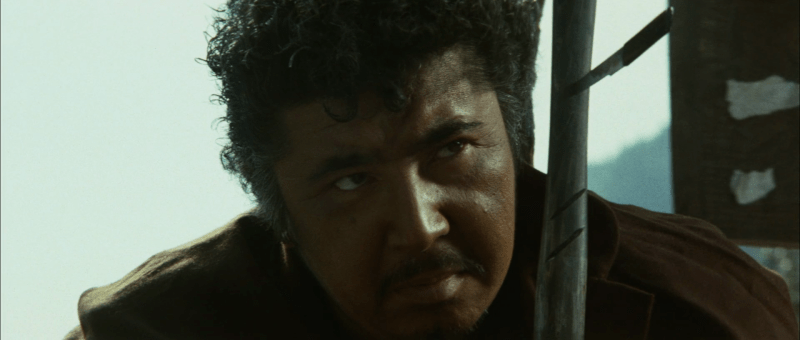
Eight Men to Kill (賞金首 一瞬八人斬り, Shigehiro Ozawa, 1972)

In the first instalment of the Bounty Hunter series, Shikoro Ichibei (Tomisaburo Wakayama) had been a shogunate spy intent on putting down rebellion to their oppression, but by the third, it seems he’s thoroughly fed up with the ills of feudalism and apparently no admirer of the Tokugawa who he feels to have failed in their responsibility to the people along with their personal greed and desire to hold on to their power.

Ichibei’s chief objection is their lack of healthcare provision, seeing as he is a doctor who mainly cares for the poor. That’s one reason he agrees to the job, asking for a large percentage of the gold he’s been asked to retrieve by a worried retainer who explains that the Edo government is relying on it to bridge a gap on their finances. If the gold’s not returned, the entire economy may crash. The government’s heartlessness is further borne out by the retainer’s words that it’s not the time to be concerned about one boy whose importance pales in contrast to that of the Tokugawa Shogunate when a rogue ronin kidnaps the son of the man responsible for the theft of the gold from a local mine. 

In a repeated motif, men attempt to swallow the gold as a means either of stealing or hiding it but it gets stuck in their digestive system and causes them a great deal of pain that could lead to death. The cruel mine owner Kanoke Tatsu (Minoru Oki) forces Ichibei to cut open the man’s stomach to get the gold out, while he insists on sewing him back up again because as a doctor it would be wrong not to. What he’s really performed maybe a kind of gold-ectomy, removing the toxic substance from the men’s stomachs even if he may not be able to save their lives or improve their circumstances.

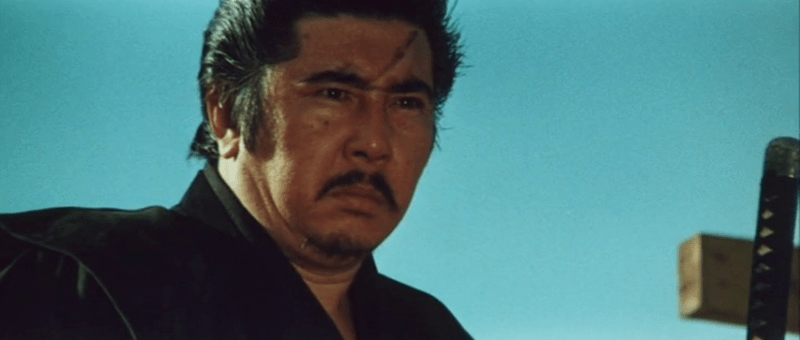
Ichibei tells the bandit, Yasha the Wolf (Kenji Imai), who is held responsible for the theft of the gold, that he is as bad as him and is only looking for a fast way to make money, yet he wants it to use to build better hospitals for the poor, ironically using the government’s cash to make up for their failing. Meanwhile, he finds himself coming up against a man much like himself only inverted in the form of wandering assassin Yajuro (Shigeru Amachi), a former secret policeman in the rebellious Bishu domain who doubt crosses everyone he comes across in an attempt to get his hands on the gold. Ichibei asks the man who hired him why they don’t want to use government spies but he tells him that it’s because they’d run out. The ones they sent to investigate have all been killed, presumably by the treacherous Yajuro.

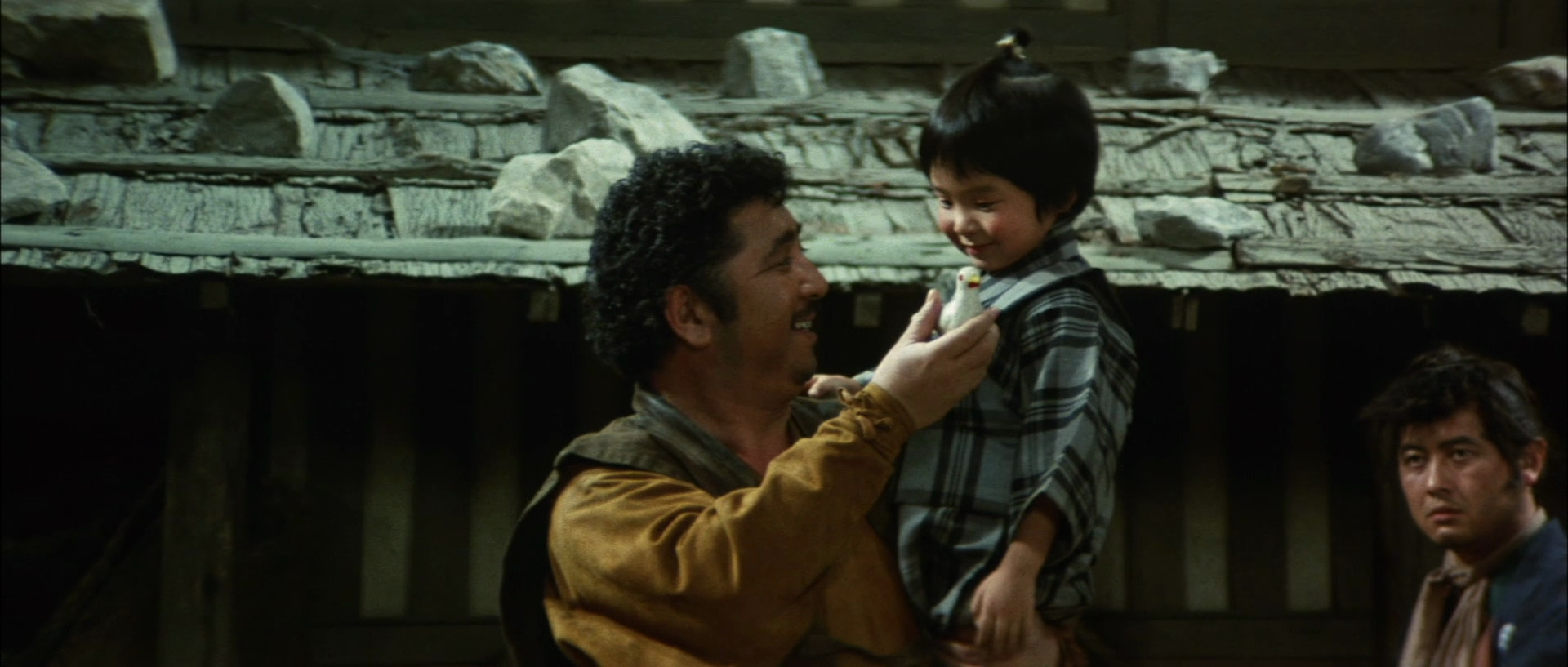
All around him, Ichibei discovers only omnipresent greed. A geisha he comes across is working with the mine owner to steal the cash, but simultaneously seducing Ichibei and the apparently won over by his bedroom prowess though it’s difficult to know which is an act, her fondness for Ichibei or pledges to sell him out to Kanoke. Meanwhile, Kanoke vacillates when presented with a binary choice by Yajuro, his adorable three-year-old son, or the gold. As always, it’s the innocent who suffer while personal greed and governmental indifference leave ordinary people little room to manoeuvre. 

This time around, the righteous Ichibei cuts a solitary figure. He no longer has a posse and is supported only by an older gentleman who is mute. As a result of his mission, he even ends up on a wanted poster himself with the shogunate, presumably unwilling recognise him, yet eventually congratulating him on a job well done, much to his shame and embarrassment having witnessed shogunate soldiers committing an atrocity. Very much in the western vein, Ozawa lends the dusty old mining town a sense of dread and decay as it rots from the inside out thanks to the corrupt authority of a weakened shogunate seeking only ways to cement its own power. The red-tinted final taking place during a solar eclipse seems to emphasise the hellishness of the situation even as Ichibei announces that they can all go to hell but he’s sending the money to heaven where it can be put to better use. 


The Fort of Death (五人の賞金稼ぎ, Eiichi Kudo, 1969)

Shikoro Ichibei (Tomisaburo Wakayama) returns yet this time seemingly on the opposite side in the second in the Bounty Hunter series, The Fort of Death (五人の賞金稼ぎ, Gonin no Shokin Kasegi) this time directed by Eiichi Kudo. If the first film had been an Edo-era take on James Bond, the second is very much Spaghetti Western and feudal tragedy as Ichibei finds himself coming to, if not quite the rescue of the oppressed farmers, then at least moral support in taking stand against corrupt and self-interested lords.

This might be surprising in that in the first film Ichibei had been a shogunate spy and seemingly close friend of the man himself, yet this time around he’s working as a doctor while taking bounty hunter jobs to earn extra money to support the poor people who come to him for help. Like a true western hero, he has a small posse which includes the ninja lady, Kagero (Tomoko Mayama), from the first film only she’s being played by the actress who previously starred as his other love interest. In any case, he’s approached by a young man from a small village which is making a last-ditch appeal to the local lord to lower their tax burdens so they don’t all starve, though so far the lord’s response has been to add additional taxes and kill people for not paying them. 

On his arrival, Ichibei soon realises that the man who recommended him was actually the leader of the government forces during a previous peasant uprising at which Ichibei had also tried to help the farmers. In that case, Bessho (Shin Tokudaiji) had won, but it didn’t do him any good. His clan was dissolved and he became a wanderer, taken in by the village and now indebted to them, hoping Ichibei can help but fully aware of the brutality with which such challenges to the feudal order are put down. 

The lord later suggests it’s not really his fault. He has to curry favour with Edo to protect the domain, which is why he agreed to participate in a construction project that led him to confiscate all of his farmers’ rice and wheat. But then it’s also true that he is vain, and cruel. On realising the village has hired a man like Ichibei, some of the retainers suggest reopening negotiations but others complain that they must now crush the farmers or face ruin themselves while trying to ensure the strife in their domain does not come to the attention of the government in Edo. 

Part of their problem is that Ichibei simply has better technology in the form of gatling guns. Tying into the western themes, Ichibei is well versed in the use of firearms, while the samurai are mostly reliant on traditional weaponry such as arrows and swords. The lord later insists on using some canons, but is oblivious to the risk as the shogun has banned the use of gunpowder and using them may end up bringing him to his attention and thereby landing him in a lot of possible fatal trouble. 

In any case, it’s the villagers who suffer. Ichibei encounters a woman who has lost her mind, refusing to give up her baby who has died of malnutrition while her husband was executed for non payment of taxes. Meanwhile, some of the other ronin they hired attempt to rape a villager, and a young couple are prevented from marrying because the headman is worried that it would send the wrong message in a time so much strife. Then again, a woman basically attempts to rape Ichibei, descending on him while he’s still asleep which otherwise leads into a fairly comic sequence in which Ichibei must fight of a bunch of ninjas intent on stealing the gatling gun while dressed only his underwear.

Darkly comic it may be, but also surprisingly violent with a ninja at one point using a dead body as a Molotov cocktail not to mention the severed heads and limbs of the battle scenes. Ichibei is fully aware that the battle is a forlorn hope, but also that the villagers have no choice and perhaps this is better for them than simply accepting their fate and starving to death. Even so, he reserves his final words for the Edo inspector who arrives only when the battle is done to survey the scene, berating him that he ought to know what happened here from looking at the battlefield and deducing that this domain has not been run particularly well. It’s a tragedy of feudalism that provokes a tearful rage from the compassionate bounty hunter trying his best to heal the sickness in his society, though perhaps like the patient who visits him with a venereal complaint concluding the best solution is to cut it right off.


Ninja’s Mark (忍びの卍, Norifumi Suzuki, 1968)

Many have tried to end the Tokugawa line. Few have done so by covering a courtesan’s legs in fish scales to put the Shogun off his stride. Based on a book by Futaro Yamada, Norifumi Suzuki’s Ninja’s Mark (忍びの卍, Shinobi no Manji) is at heart a romantic tale in which love is “part of the game” but also apparently the one trick a ninja can’t escape. Perhaps that’s why Shogun Iemitsu at the comparatively late age of 30 has failed to produce an heir with any of the beautiful yet emotionally distant courtesans of the inner palace many of whom also seem to be ninjas, therefore provoking a constitutional crisis.

Aside from that, it seems the ninja plot is a kind of revenge against the Tokugawa carried out by the last remnants of a house that was dissolved by the Toyotomi. There are in fact three ninja clans all clustering around the palace, Iga, Koga, and Negoro, each of whom have different kinds of skills. Technically, some of them are in the employ of the Shogun’s disinherited younger brother Tadanaga (Shingo Yamashiro), but others of them are working strictly for themselves and their revenge. In any case, their plan is to prevent Iemitsu from fathering an heir by putting him off sex essentially by making it freaky (in a bad way). Thus one of the ninjas uses his ability to transform objects so that the courtesan’s legs are covered in fish scales. Another plan sees a ninja body swap with one of the women so that Iemitsu’s sperm ends up inside him where it obviously has nowhere to go. Meanwhile others hatch a plan to steal some of Tadanaga’s seed to use on the women in the inner palace to cover up Iemitsu’s potential infertility seeing as it is after just as good being of the Tokugawa line. 

This particular ruse is suggested by Toma (Isao Natsuyagi), the disenfranchised former member of the Yagyu school turned ninja ronin they bring in to solve the problem. He quickly homes in on Kageroi (Hiroko Sakuramachi), a female ninja, as the villainess whose special power is poisoning men with love and desire by means of the spider lily plant. But as Toma points out to her, she is also a prisoner of her skill in that if she were to fall in love she would inevitably kill her lover. Of course, he survives her first attempt to kill him, leading her to fall in love with Toma and become conflicted in her mission while he plays on her emotions to escape but eventually realises they may be more genuine than he first realised. 

In this, Suzuki brings some of his trademark romanticism particularly in the colourful art nouveau aesthetics and frequent use of rose imagery. Though the film is clearly designed to lean into the erotic with frequent use of nudity and salacious scenes including a brief moment of lesbian seduction, it eventually heads towards romantic tragedy in which the debauched and nihilistic Toma and the wronged Kageroi discover a love made impossible by their ninja code and the times in which they live. Having been ordered to kill her, Toma declares that he will marry Kageroi in the next life and returns to her the Buddhist Manji that is the “ninja mark” of the title. 

Nevertheless, the dialogue is often suggestive as in Kageroi’s curse that Toma’s “sword” will rot, while it’s also Toma’s “sword” that alerts him to the danger she presents. Toma too claims to derive his ninja powers from his “sword” having apparently concentrated them by repressing his sexual desire and swearing off women. He says that he seals all his “distracting” thoughts into a virgin, closing off all her senses and placing her into a coma until he breaks the spell. Even so, he admits that without his “sword” he is just a man, and as a man claims to love Kageroi, but as long as he has his “sword”, and she her “lily”, their love is impossible. 

But this repressed love seems to pose less threat to the social order than the lack of it in Iemitsu who is bored with his courtesans and cannot conceive an heir. Constitutional crisis is averted only through a little ninja trickery and a convenient ruse to overcome Iemitsu’s infertility so that in time he produces five sons and a daughter, which honestly seems like it might just present another set of problems in about 30 years’ time. Like similarly themed ninja pictures, Suzuki makes good use of surrealist imagery and colour play alongside the kind of onscreen text later used in jitsuroku yakuza films to name each of the ninja’s key skills and which clan they belong to. What he always returns to, however, is the sense of romantic tragedy in a world seemingly poisoned by ambition in which love itself is rendered an impossibility. 


*Norifumi Suzuki’s name is actually “Noribumi” but he has become known as “Norifumi” to English-speaking audiences.

Castle of Owls (忍者秘帖 梟の城, Eiichi Kudo, 1963)

A surviving member of the Iga clan swears vengeance on Toyotomi Hideyoshi only to slowly come to the realisation that the best revenge is living well in Eiichi Kudo’s ninja drama, Castle of Owls (忍者秘帖 梟の城, Ninja Hicho: Fukuro no Shiro). Adapted from the novel by Ryotaro Shiba, the film is somewhat unusual in its positivity in allowing its hero to first reject the codes by which he was raised and then those of the prevailing times in eventually choosing love and happiness over the internecine obligation to gain vengeance against a corrupt social order.

Hoping to solidify his grip on power, Oda Nobunaga has his right-hand man Toyotomi Hideyoshi massacre the Iga clan of ninjas who are then almost entirely wiped out. Juzo (Ryutaro Otomo) and his friend Gohei (Minoru Oki) both survive, but Juzo’s entire family is brutally murdered while his sister takes her own life after being gang raped by Hideyoshi’s soldiers, using her final breath to tell her brother to avenge her. Overwhelmed by grief, Juzo is chastised by veteran ninja Jiroza (Kensaku Hara) for his show of emotion. He reminds him that a ninja should be as unbreakable as stone and that he should abandon all human sentiment. Juzo, however, insists that he may be a ninja but is also human and refuses to apologise for his feelings. 

This is it seems the major conflict. Jiroza has already signalled his own heartlessness and practicality when he advised the surviving ninja to flee, for escape is less dishonourable than death. Those who refuse are welcome to surrender, and those who cannot run must be left behind to their fate. For Jiroza, all that matters is survival for both himself and his small daughter Kizaru (Chiyoko Honma) who is currently tied to his back (no mention is made of her mother, perhaps she had already passed away). Now that his family are dead, Juzo has a new mission and reason for survival insisting that what the living can do for the dead is vengeance, though in his case it is personal rather than principled for he mostly wanted revenge for his sister rather than the Iga clan as a whole or anything it represents which he otherwise seems to be at odds with. 

10 years later, Oda Nobunaga has already been bumped off in an act of betrayal by one of his own men leaving Toyotomi Hideyoshi in charge and now the target for Juzo’s revenge. Around this time, Hideyoshi is planning an invasion of Korea against the advice of most of his courtiers in order to legitimise his rule through imperial ambition and military dominance. Juzo has been trying to assassinate him, and has apparently failed five times already. A surprise visit from Jiroza and his now teenage daughter involves a job opportunity promising a monetary reward should he succeed, but Juzo is wary. The merchant who hires him says he wants Hideyoshi out of the way because a war in Korea will damage his business prospects, but as Juzo points out Hideyoshi’s death will leave a power vacuum resulting in another civil war. The merchant, however, giggles childishly and remarks that domestic wars are good for business, leading Juzo to suspect he’s here on behalf of Tokugawa Ieyasu, the most likely to assume power in the event of Hideyoshi’s death.

The irony is though Juzo very definitely wants Hideyoshi dead, when someone else suggests it he becomes conflicted because he knows it will lead to another period of chaos in which even more people will die. Meanwhile, a ninja’s allegiance should belong to his client, who is always the highest bidder, so this is both a win-win situation and a mild conflict of interest. Conversely, Gohei (Minoru Oki), who was betrothed to Kizaru, has apparently betrayed the clan and taken a position as a retainer for one of Hideyoshi’s lords. He agrees to betray the Iga, inform on the plan to assassinate Hideyoshi, and even bring in Juzo in return for a 300-koku stipend and a shot of advancement under the new regime.

Now, on one level this might be understandable. Japan has emerged from a couple of hundred years of constant warfare, there’s no place for ninja in a world of peace as former Iga man Mimi (Tokue Hanasawa) remarks revealing that he’s survived the last 10 years through begging. It’s also understandable given that a ninja is expected to be duplicitous and act in self-interest. Even Juzo applaud’s Jiroza’s ninjutsu on realising that he’s teamed up with Gohei to betray him in order to take out the leader of the Koga ninjas. In essence, he’s only really done what Juzo later does but also the opposite in choosing his individual happiness through betraying those around him to throw his lot in with the person who murdered his entire clan. 

Juzo meanwhile is shaken by his unexpected attraction to female ninja Kohagi (Hizuru Takachiho), a daughter of the Koga,  who like him finds herself conflicted in her mission because of her growing affection for Juzo. Kohagi asks him if they really have to live on hate when they could live happily together instead, but even while conflicted Juzo can’t bring himself to let go of the idea of vengeance and is haunted by images of his friends and family dying. Even so, having decided to give up on a happy future and risk his life to kill Hideyoshi he finds that it ceases to matter. Confronting him, his hatred melts away. He begins to recognise the futility of revenge and that it would be silly to cause a war and make a merchant rich to prove a point. Gohei, meanwhile, pays a heavy price for his choices when his lord disowns him. Even when Juzo comes to rescue him from jail, he laughs that he’s caught him at last. Having escaped from the Iga life to live in the sun, he finds himself in darkness once again. Juzo, however, rides off into the sunshine with Kohagi to live in peace that’s divorced from the wider world. They choose to exile themselves from this world of darkness and duplicity, to live freely in the sunlight rather than be consumed by the internecine codes by which they were raised. Kudo films his ninja battles in near total silence with an almost balletic intensity and paints this world as one of infinite mistrust and uncertainty but equally affirms that it is possible to simply walk away and choose happiness over duty or hate.


Wicked Priest 3: A Killer’s Pilgrimage (極悪坊主 念仏人斬り旅, Takashi Harada, 1969)

Three years on from his arrest at the end of the previous film, Shinkai (Tomisaburo Wakayama) returns for more lecherous adventures across Japan in Wicked Priest 3: Killer’s Pilgrimage (極悪坊主 念仏人斬り旅, Gokuaku Bozu: Nenbutsu Hitokiri Tabi). This time he finds himself mixed up with revolutionary pirates planning to overthrow the government with weapons smuggled in from Singapore, but it isn’t so much politics that bothers Shinkai as injustice as he tries to help the townspeople defend themselves against politicised bandits and a weird new religion while dealing with the fallout from the last time he found himself enacting justice. 

As usual however the film opens with an odd prologue in which a randy Shinkai is invited to the home of a man who tells him there’s a strange local custom in which women soon to be married think it good luck to be deflowered by a passing stranger and even better if he’s a monk. Of course, Shinkai nearly gets a little more than he bargained for before heading off towards the central fishing village which is at this time of the year home to only women and old men with all the husbands and sons off chasing tuna for the foreseeable future. Taking a liking to a widow named Omine (Hiroko Sakuramachi), Shinkai’s plans are scuppered when she realises that he’s the man who killed her admittedly no good, violent drunk of a gambling husband. Being the charmer that he is, Shinkai manages to talk her round only her brother-in-law Ryuji (Tatsuo Terashima), who’s supposed to marry her sister Otae (Eiko Ito), is hellbent on revenge. Meanwhile, the town is invaded by cruel pirates who commandeer the local well and keep the villagers prisoner. 

“Helping people is my duty,” Shinkai had told the man who weirdly wanted him to sleep with his daughter and true enough he’s never been one to turn away from those in need even if he’s not all that keen on taking responsibility for them. He feels bad for Omine that he ended up killing her husband even if he thinks her husband brought it on himself because of his behaviour, and even after encountering Ryuji tries to talk him down from his revenge rather than simply fighting him even though Ryuji still refuses to forgive him even after Shinkai is nearly fed to sharks in his place by the cruel leader of the pirates. He is later saved by Yamanami (Minoru Oki), a fugitive on the run for killing a politician in Tokyo presumably as part of his revolutionary activities but has become disillusioned with the gang whom he thinks have lost sight of their cause and are now no better than bandits. Shinkai had claimed he could see Yamanami was a good man because of his all-seeing monk eyes, and later praises him as someone who held fast to his beliefs while bravely standing up to his sociopathic gang boss. It isn’t so much that Shinkai has much opinion on their political stance and desire to overthrow the government, only about the way they conduct themselves, callously throwing dynamite around and hassling the local women. Yamanami asks his boss what the point of winning is if everyone resents you, but his boss simply tells him to think about winning first and ideological purity later. 

In a bizarre subplot, meanwhile, Shinkai also finds himself squaring off against a weird sex cult/fake religion on an island connected with the pirates who are also planning to sell off the village women as payment for their Singaporean weapons. Once again, the randy monk becomes a staunch defender of women, saving Otae from becoming the weird priest’s sex slave and shutting down the trafficking plot by indulging his strange love of eye gouging. Meanwhile he’s still being pursued by Ryotatsu (Bunta Sugawara), the blind monk from the previous two films. Blow for blow, there may not be as much action for the warrior monk despite his heroic attempt to reach the well while under fire and eventual descent on the bandit hideout in a single-handed bid for justice, but there is something in Shinkai’s demands for a just world despite his lasciviousness that overcomes his fixation on women even if this time it seems as if the sun may have set on his travels. 


The Kamikaze Guy (カミカゼ野郎 真昼の決斗, Kinji Fukasaku, 1966)

The hero of Kinji Fukasaku’s Kamikaze Guy (カミカゼ野郎 真昼の決斗, Kamikaze Yaro: Mahiru no Ketto) is described as cheerful and with a spirited personality though unfortunately not very bright. A vehicle for rising star Chiba, the film was intended as the first in a series starring its bumbling hero, Ken Mitarai, though no other instalments were ever produced. In any case, it seems to echo the lighter side of Nikkatsu’s borderless action line along with Toho’s spy spoofs in its wrong man tale of wartime legacy and corporate duplicity. 

Often called “Mr. Toilet” because of the way his name is pronounced, Ken (Sonny Chiba) is a slightly sleazy private plane pilot who has pinups on the roof of the cockpit. According to the voiceover, there is no bottom to the depths of his crassness which is a sentiment later borne out by his attempt to pick up a woman on a ski slope by uttering the immortal lines “please don’t think I’m a creep, just hear me out.” However, events take a turn for the strange when the pair of them are witness to a murder. Ken valiantly tries to help, but is later brought in as a suspect himself, partly as the police are annoyed by his smugness. The woman, Koran (Bai Lan), turns out to be from Taiwan which is where Ken ends up flying only to discover that his cargo is the body of an old man he also encountered at the slopes. 

In keeping wth the growing internationalism of mid-1960s Japanese cinema, the film travels to Taiwan but does so in a rather complicated way as Ken is drawn into a plot concerning three men responsible for the death of a Japanese official shortly after the war killed because he wanted to return 200 billion yen’s worth of diamonds stolen from the local population. While on his travels, Ken runs into a woman who was trafficked to the island at the age of 15 and later cheated out of the money she’s saved to return. The film almost flirts with the awkward relationship between the two nations and Japan’s imperialist past but in the end does not quite engage with it save for the brief appearance of the indigenous community which seems to stand in for layers of historical and contemporary colonialism.

In any case, the murdered man was Japanese as were the two of the three currently being targeted in the assassination plot Ken is being framed for. Ken’s defining characteristic is his bumbling earnestness in which his determination to get to the bottom of the mystery only lands him in further trouble. At one point he even tries to stop the villain escaping by standing in front of the plane with his arms wide open as if it hadn’t really occurred to him that a man who has already killed a number of people is unlikely to be deterred by the thought of killing one more. Nevertheless, it provides the film with one of its more memorable and quite incredible sequences as Ken grabs on to the wing support as the plane is taking off and eventually climbs his way inside.

Chiba reportedly designed the action sequences himself and his martial arts skills are very definitely on display in the unusually well accomplished fight scenes while the film also contains a lengthy and expertly choreographed car chase albeit one occasionally interrupted by random bison and an indigenous parade. Perhaps because of this manly tone, there is an unfortunate strain of semi-ironic misogyny that runs through the film with frequent exclamations that women are too quick to jump to conclusions while Ken later seems slightly put out that Koran is “using her feminine wiles” to combat the bad guys. 

By the same token, there is something a little ironic and subversive in the film’s use of the term kamikaze, self-adopted by Ken to emblematise his devil may care nature while otherwise setting the action in a nation once colonised by Japan that holds a celebratory gala in Ken’s honour for his assistance in retrieving the gold and returning it to the Taiwanese people. Perhaps in another sense, it echoes a new willingness to make restitution with the past even if Ken bumbles his way into it and does so by accident taking on both the new and destructive capitalism of the post-war society and the toxic wartime legacy and freeing himself from them, literally a body flying in midair with no direction but his own.

Original trailer (no subtitles)

The Desperate (どろ犬, Takaharu Saeki, 1964)

A bruiser cop railing against the system is pulled towards the dark side in Takaharu Saeki’s icy noir, The Desperate (どろ犬, Doro Inu). Adapted from a novel by Shoji Yuki, the film is one of only two Saeki directed in an otherwise lengthy career mainly spent in television and captures an eerie sense of existential dread as its detective hero sinks to even greater depths in a quest for self preservation while kicking back against the hypocrisies of the post-war society. 

As one officer puts it, Sugai (Minoru Oki) is one of many veteran officers who can’t adjust to new codes of justice in the democratic era. In the film’s opening sequence, he’s pulled aside and warned about using excessive force on a suspect only to counter that he knows the guy’s guilty so he doesn’t see what the problem is. Sugai had been particularly motivated about this case as the victim was an 18-year-old girl raped after accepting a lift from a stranger. She was so traumatised that she could hardly speak but did remember the registration plate of the car. She’d only been working because her father lost his factory job though he appears to have begun drinking and is abusive towards his daughter for her silence, later coming to the station to drop the charges after being paid off by the suspect’s lawyer. The legal definition of rape in this era is founded not on an idea of consent but whether violence was involved and the victim can be proved to have resisted physically. The guilty party, Tomita (Hideo Murota) claims that nothing illegal transpired in his car and then walks away with a smirk when his lawyer gets him off the hook. It’s all too much for Sugai to bear, resentful that the rich and powerful are now effectively above the law thanks to legislation he feels ties his hands as a police officer. 

It’s at this point he runs into petty yakuza Yamaguchi (Ko Nishimura) whom he’s been trying to turn as an informant, unwisely mouthing off about his dissatisfaction with contemporary law enforcement only for Yamaguchi to turn the tables and effectively blackmail him having discovered that Sugai has begun a relationship with the estranged wife of an imprisoned gangster. In an act of petty revenge and desperation, Sugai leaks info on “guilty” suspects who weren’t charged to Yamaguchi who exacts financial justice by extorting them for money while threatening to expose their immorality. 

Disappointed in him, the gangster’s wife, Chiyo (Chisako Hara), exclaims that Sugai’s no different from her husband and in truth he isn’t. Part of Sugai’s resentment lies in the fact his wife left him for another man while he was on a stakeout, frightened by his violence and insisting that she hated detectives. His old-fashioned police tactics include taking suspects to the dojo where beats the living daylights out of them. Later he tells another, more earnest officer, he reminds him of himself when he was younger implying that he has become corrupted by the times and the impossibility of justice, particularly for young women whom he feels an urge to protect, in a world ruled by money and status. He may feel some pangs of guilt for a rookie who is unfairly fingered as the mole on the grounds that he and Yamaguchi were originally from the same area and had a past acquaintance, but in the end is happy enough to scapegoat him for his wrongdoing while he continues trying to dig himself out a hole but falling still further into the abyss. 

Sugai is merely trying to save his own skin, but those around him are desperate too. His opposite number, Toku (Hisashi Igawa) is desperate to clear his name, while Chiyo is desperate for what she describes as a proper marriage to a proper man while seemingly kept captive in the apartment Sugai rents for her on his meagre police salary but does not live in himself. She wants to work and has an innocent desire to buy him some better shoes that he otherwise resents in its implied challenge to his masculinity that he evidently cannot afford all this additional expense coupled with the strain of keeping his problematic relationship with a gangster’s wife secret from his employers. In the end he claims that the problem was he couldn’t escape from being a detective, pushed into desperate acts of destruction as a man now exiled from his times unable to move on from post-war chaos into a newly democratic, consumerist Japan. Saeki ends his fatalistic vision with an image of a train reeling backwards, echoing the degree to which Sugai has lost control of his life and himself no longer a detective but only a man without a moral compass whose path can only lead in one direction. 


Father of the Kamikaze (ゝ決戦航空隊, Kosaku Yamashita, 1974)

By the mid-1970s, Japanese cinema at least had become much more comfortable with critiquing the wartime past, considering it from a greater distance than the often raw depictions of war in the films from the previous two decades. 1974’s Father of the Kamikaze (ゝ決戦航空隊, A Kessen Kokutai), however, is among the few to skew towards the nationalist rather than the ambivalence or simple anti-war messages of other similarly themed films of its era. 

Starring ninkyo icon Koji Tsuruta who served in the air force himself, the film is a kind of biopic dedicated to Admiral Onishi who oversaw the kamikaze operations at the end of the war. As is pointed out, Onishi had been against the war in general terms even before its inception and is originally against the philosophy behind the kamikaze squadrons but as Japan’s fortunes continue to decline he becomes its biggest advocate citing a kind of sunk cost fallacy that it would be in someway unfair to the men that have already died to surrender while insisting that suicide missions are the only feasible way to turn the tide because one kamikaze could take out a hundred men by destroying battleships singlehandedly. 

The film in part attributes this extreme solution to the prevailing with your shield or on it philosophy of the contemporary society which placed extreme shame on the act of being taken prisoner. In the prologue that opens the film, a squadron of downed pilots whose heroic deaths have already been recorded is discovered alive in an American prisoner of war camp but as being a prisoner of war is so shameful and would reflect badly on the military, the decision is taken to fix the books by sending the men on a mission from which they are not intended to return. Onishi is opposed to the plan, he asks why they can’t find a way for the men to live, but the decision is already made. In any case, he describes the action of a suicide mission as a “beautiful ideal” even when insisting that a war cannot be fought in that way not least for purely practical reasons in that they do not have the resources to be wilfully sacrificing skilled pilots and their planes. 

Having come round to the idea, however, Onishi is a crazed zealot who cannot accept the idea of surrender and even goes so far as to barge into a cabinet meeting to urge ministers against a truce even though the war is clearly lost. To his mind, the only way to honour the sacrifices of those who’ve died is to fight to the last man. Kozono (Bunta Sugawara), another officer opposed to the kamikaze, eventually meets a similar fate in refusing to obey the order to lay down his arms and ending up in a psychiatric hospital. His objection had partly been that it’s wrong to turn men into ammunition, but also that the kamikaze project is itself defeatist and self-defeating when there are men such as himself who are committed to fighting on.  

In this the film leans into the image of militarism as a death cult in which dying for the emperor is the only noble goal of the whole imperial expansion. In its eventual lionising of Onishi’s image, his bloody suicide atop a white cloth resembling the flag of Japan while his parting words scroll across the screen in text, it does not shy away from his more problematic aspects in which he fails to object to a request from a junior officer that soldiers should be allowed to test their swords on American prisoners of war, roundly telling a subordinate who breaks protocol to insist that such a thing is not only morally wrong but will ruin their international reputation that he has no need to think of consequences because Japan will win this war. He claims to want to find a way of defeat that will satisfy the living and the dead, but in reality cannot accept it not least in that it would entail admitting that he sent 2600 young men to their deaths for nothing. 

Tsuruta brings the same level of pathos to his performance as he did in playing conflicted yakuza stoically committed to a destructive code, but there’s no getting away from the fact that the film focuses mainly on Onishi’s personal suffering as a man who sent other men to die for a mistaken ideal and then could not admit his mistake offering an apology only in his death in which he urged the young people of Japan to work to rebuild the nation in the name of peace. In switching to the present day and showing us Onishi’s dilapidated former residence and in fact the room in which he died with its tattered shoji and peeling paintwork, he veers towards the nationalistic in uncomfortably reinforcing the nobility of his death rather than the folly of war or absurdist tragedy of the kamikaze programme. Adopting a quasi-jitsuroku approach with frequent use of onscreen text, a narratorial voiceover, and stock footage of kamikaze in action Yamashita may portray war as madness in Onishi’s crazed devotion but cannot help depicting it as a “beautiful ideal” even in the undignified violence of Onishi’s ritual suicide. 


The Last Kamikaze (最後の特攻隊, Junya Sato, 1970)

Junya Sato’s The Last Kamikaze (最後の特攻隊, Saigo no Tokkotai) opens with a title card explaining that it has nothing to do with the life of Matome Ugaki, which seems disingenuous at best given that the narrative has tremendous similarities with his life. In any case, 25 years after the war in a very different Japan which is perhaps becoming more willing to reexamine its wartime history, Sato’s film nevertheless walks an ambivalent line clearly rejecting the idea of the kamikaze special attack squadrons as absurd and inhuman yet simultaneously glorifying the deaths of the men who willingly took part in them. 

For sympathetic Captain Munakata (Koji Tsuruta) the issue is one of consent and willingness more than it is of essential immorality. Placed in charge of the very first suicide attack, he elects to go himself rather than ask someone else but is first overruled before deciding to go anyway after appealing for volunteers and coming up one short. His general, Yashiro (Bontaro Miake), who had voiced his opposition to the policy in the opening sequence reminding his own commander than even when men were given impossible missions in previous wars they were always ordered to return home if possible, takes the unprecedented step of climbing into an aircraft himself in an act of protest insisting that this be the last and final time that men were ordered to their deaths. The mission, however, does not succeed. All of the pilots bar Yashiro are shot down before reaching their targets while Munakata, injured and having lost sight of the general, aborts his mission and returns to base only to face censure from his superior officers. 

Sent back to Japan, he wrestles with himself over whether his decision was one of cowardice and he turned back because he was afraid to die rather than, as he justifies, because he did not want to die in vain and did what he thought was right. Far from cowardice, it may have taken more courage for him to ignore his orders and choose to live yet there must also be a part of him that believes dying to be heroic if not to do so is to be a coward. As the situation continues to decline and suicide attacks become the only real strategy, Munakata is recalled for an ironic mission of heading the escort squad designed to protect the pilots from enemy attack so they can reach their targets. He first turns this down too not wanting to be an angel of death but is finally convinced to accept on the grounds that the men will die anyway and at least this way their deaths will have meaning. 

Munakata was greeted on his return to Japan by the sight of his father (Chishu Ryu) being carted off by the military police for expressing anti-war views, stopping only to tell him that people should be true to their own beliefs. Nevertheless, even if Munataka objects to the tokkotai strategy he does not oppose it only emphasise that the men should should be willing and resolved rather than forced or bullied. There is indeed a shade of toxic masculinity in the constant cries of cowardice along with a shaming culture that insists a man who refuses to give his life for his country is not a real man. Munakata comes to the rescue of a young recruit, Yoshikawa (Atsushi Watanabe), who twice returns from a tokkotai mission claiming engine trouble but does not try to save him only to petition his superiors that he be given ground duty until such time as he gets used to the idea of dying. Because of Munakata’s kindness in saving him from a suicide attempt after being rejected by the mother he worried for if he were to die, Yoshikawa is pushed towards a “hero’s death” that does at least help to change the mind of Yashiro’s zealot son (Ken Takakura) who knew nothing of the reasons behind his father’s suicide and believed wholeheartedly in the necessity of the special attack squadrons. 

The younger Yashiro’s rationale had been that to show compassion to a man like Yoshikawa was to shame the memories of the men who had already died, yet even in realising the futility of the gesture he still resolves to proceed towards his own death as do others like him such as a student who had been against the war and ironically consents to the suicide mission in order to end it more quickly. “There’s nowhere to run to” Yoshikawa’s mother (Shizuko Kasagi) had said on his attempted desertion, echoing the words of another that there was no escape from this war, while poignantly crying over her son’s ashes that she wishes she had raised him to be a coward. The human cost is brought fully home as the families storm the airfield fence in an attempt to wave goodbye to their loved ones as they prepare for their glorious deaths, another pilot reflecting on the fact that each of these men is someone’s precious son rendered little more than cannon fodder in an unwinnable war. Even with the escort squads, only 30% of the special attacks succeed. Most of the pilots are so young and inexperienced that even assuming they survive the anti-aircraft fire they are incapable of hitting their targets. 

To add insult to injury, Munakata returns from his final mission to an empty airfield where a drunken engineer (Tomisaburo Wakayama) explains to him that the war is over and the generals knew it 10 days earlier but still sent these men to their deaths anyway. Overcome with remorse, Munakata posits his own suicide mission but is instructed to live on behalf of all those who died only to take off and fly into a technicolor sunset as Sato switches from the period appropriate black and white to vibrant colour elegising Munakata’s death while lending it an otherwise uncomfortable heroism. Casting ninkyo eiga icons Koji Tsuruta and Ken Takakura as the infinitely noble yet conflicted pilots and employing jitsuroku-esque narratorial voice to offer historical context the majority of the audience probably does not strictly need, Sato rams home the righteousness of these men while casting them as victims of their times trying their best to be true to what they believe but finding little prospect of escape from the absurdity of war.