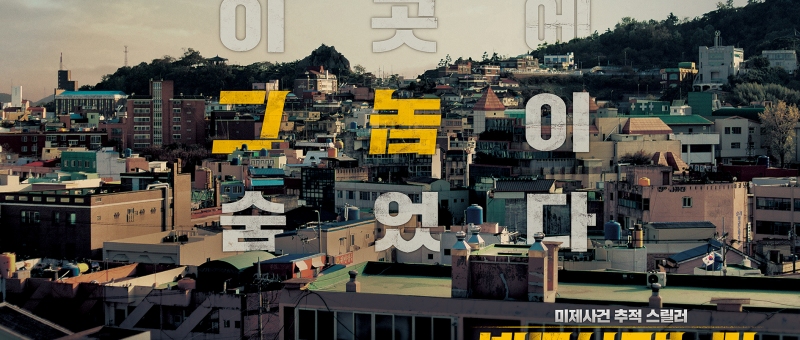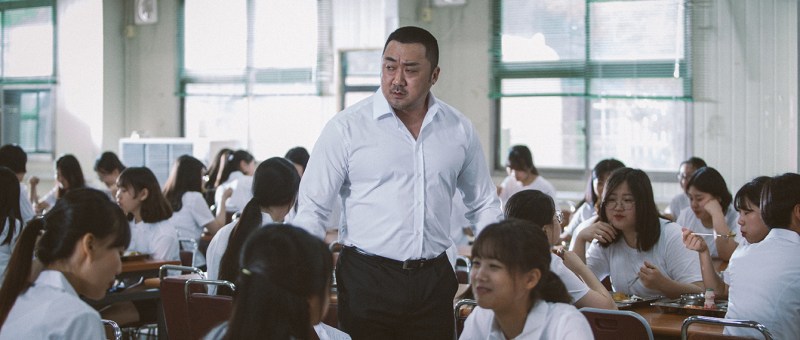
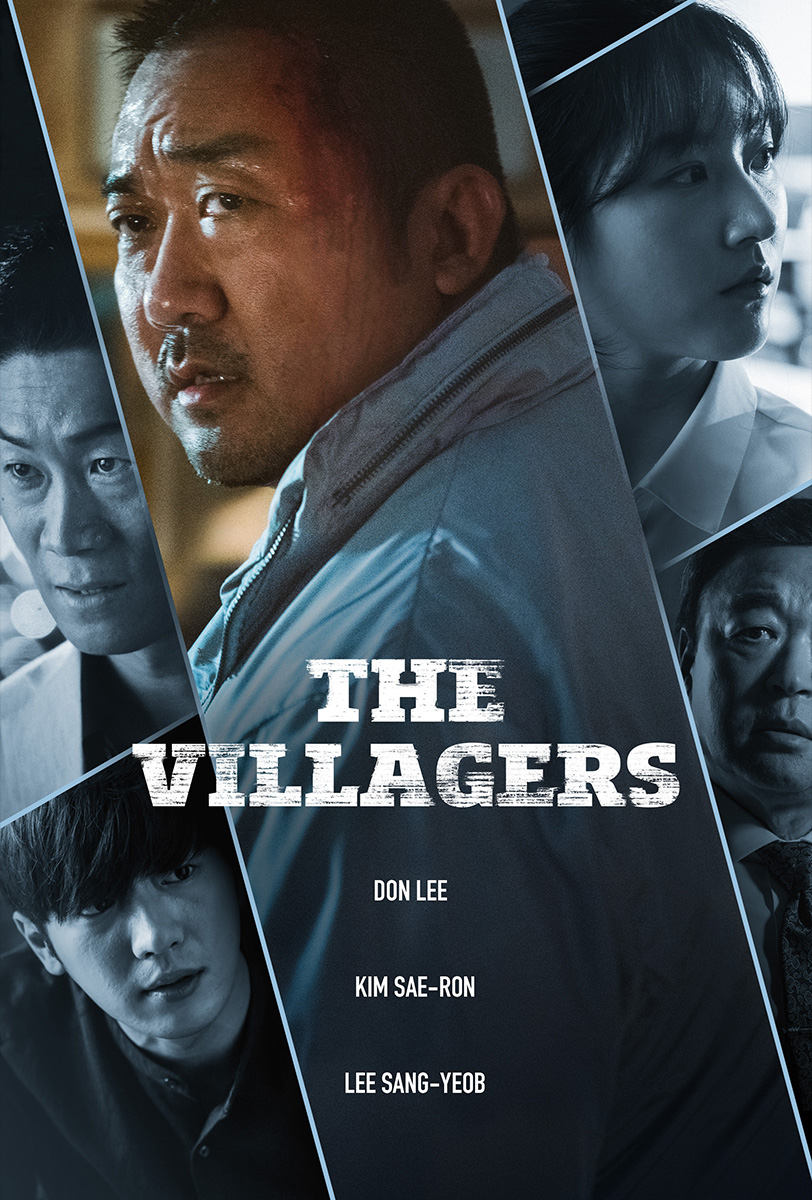
The Villagers (동네사람들, Im Jin-soon, 2018)

Trying to make a fresh start after being fired as a boxing coach in Seoul for challenging match fixing practices, a rookie teacher finds himself embroiled in small-town conspiracy in Im Jin-soon’s Ma Dong-seok vehicle, The Villagers (동네사람들, Dongnesaramdeul, AKA Ordinary People). Unlike the big bad city, this rural backwater is mired in feudalism and corruption as if it were stuck in the authoritarian past in which everyone keeps their head down and minds their own business rather than challenging injustice or trying to improve the lives of those around them.

What Ki-chul (Ma Dong-seok) and high schooler Yu-jin (Kim Sae-ron) have in common is that they’re both outsiders. Yu-jin transferred to the high school from Seoul and has been branded a troublemaker by the judgmental teachers. But despite the school’s seeming authoritarianism, the pupils have little respect for the school system and openly flout the rules by smoking on school premises and being rude to the staff. It transpires that Ki-chul has basically been hired as a kind of muscle, charged with getting students who haven’t paid their fees or dinner money to cough up ahead of an upcoming audit of the school’s finances. Many of the students he approaches brush him off as if they simply don’t intent to pay, but the school doesn’t seem to be interested in finding out why they might not be able to or if there are problems at home. Yu-jin too rolls her eyes he asks her, but in her case she’s unwilling to finance an institution that’s not doing anything for her even if as Ki-chul advises her they won’t let her graduate if she doesn’t.

Ki-chul seems uncomfortable with his new role and tries to do what he can to help, but encounters resistance from the teachers who tell him there’s no point worrying about kids like these. If they skip school, they’re branded runaways and no attempt is made to look for them. The teaching staff lowkey threaten Ki-chul by reminding him his job’s to get the money and he doesn’t want to make trouble for himself when he was lucky to be employed here in the first place. And so he finds himself conflicted when he spots Yu-jin in town getting herself into dangerous situations trying to find out what’s happened to her friend Su-yeon (Shin Se-hwi) who’s been missing for days but the police won’t seem to do anything. Yu-jin tells him that adults can’t be trusted, especially not the police, but he thinks it’s teenage alienation before trying to report the case again himself through a friend on the force and having it rejected.

The fierce resistance to even mentioning Su-yeon ought to tip them off that’s something bigger’s going on, but everyone is focussed on the upcoming election in which the headmaster of the school is standing for governor that nothing’s getting done at all. Ki-chul tries to report another teacher for harmful behaviour towards students, but is yelled at for exposing the school’s business by going to the police “over some runaway”. He’s reminded to keep his head down and mind his own business, even while Yu-jin continues to be in danger and Su-yeon is still missing. An orphan whose parents had massive debts to loansharks, Su-yeon was forced to work in a bar to support herself and her grandmother. She dreamed of being beautiful and free as an adult, but was badly let down by many of those around her including the school who decided that girls like her weren’t worth helping.

Of course, Ki-chul can’t help standing up for justice through the medium of his fists and smashing his way to the truth while trying to keep Yu-jin safe. If someone disappeared Su-yeon, they won’t think twice about doing the same to Yu-jin, though she of course thinks she’s invincible and is too young to think sensibly about her own safety while desperate to find out what’s happened to her friend. They are both, however, trapped by the legacy of an authoritarian era in which the police works only for the powerful and dirty local politics taints everything around it as everyone desperately tries to ingratiate themselves with the new regime while avoiding stepping out of line and endangering themselves. Ki-chul, however, has not much interest in that and is determined to smack some sense into gangsters and law enforcement alike in an effort to show that the world doesn’t necessarily need to be this way if only more people were willing to stand up to cronyism and exploitation.


The Villagers is released Digitally in the US Oct. 7 courtesy of Well Go USA.

Trailer (English subtitles)

INGtoogi: The Battle of Internet Trolls (잉투기, Um Tae-hwa, 2013)

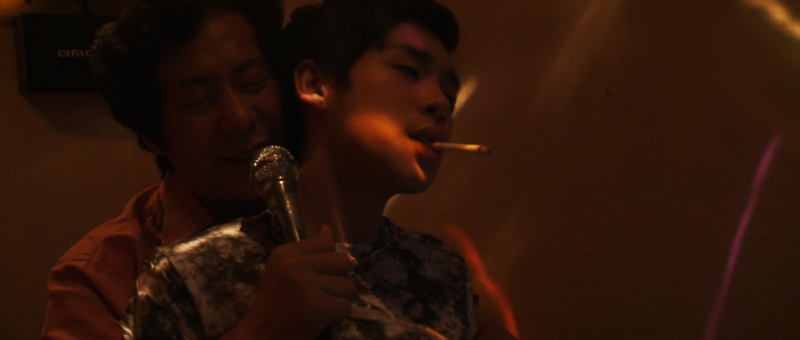
A keyboard warrior enters a masculinity crisis after being ambushed in real life and taking a beating from an online rival in Um Tae-hwa’s graduation film, Ingtoogi: The Battle of the Internet Trolls (잉투기, Ingtoogi). Though the title may promise something more like a slacker comedy, Um subtly hints at the loserville of the contemporary Korean society which is, as the hero’s mother suggests, “only for the select few” leaving men like Tae-sik (Uhm Tae-goo), in contrast to the film’s title, losing the will to fight.

20-something and unemployed, Tae-sik still lives at home with his mother and fills his life with online fighting games. Lured to a park on the pretext of selling an online game item, Tae-sik is unexpectedly attacked by fellow gamer ManBoobs and becomes a laughing stock for getting beaten up in the street. Vowing revenge, Tae-sik makes his way to a mixed martial arts gym named Ingtoogi which as the coach explains means “we’re still fighting” and begins training in preparation to publicly call out Man Boobs for a fair fight on safer ground.

But Tae-sik is now traumatised and has become frightened of everything, hallucinating being punched in the face and in fact afraid of getting hit. It’s this sense of fear along with his wounded masculinity that he’s trying to avenge through violence and male dominance, but in order to do so has to resort to carrying around a kitchen knife as rather phallic replacement for his fractured manhood while otherwise trained by an equally disaffected teenage girl herself a former mixed martial arts champion.

Young-ja’s (Ryu Hye-young) high school class is perhaps surprisingly asked to debate capitalism in broadly positive terms only for her best friend to shock her by giving a detailed, text book answer about the loss of individuality later explaining that her nagging mother bribed the teacher to get the topic in advance so she could prepare. Young-ja is an orphan living alone though watched over by her martial arts expert uncle, Wook, but Tae-sik too has a nagging mother who is particularly disappointed in him for embarrassing himself by getting beaten up and going viral online. She wants to emigrate to Costa Rica vowing that it’s too hard to live in Korean society which is only for the elites. Tae-sik has no desire to move and in a pointed criticism states that though he and his mother live in the same space he does not feel as if they “live together” suggesting that the demands of contemporary capitalism and her job as an estate agent have placed a divide between them.

Indeed, when she suggests that Tae-sik learn the trade from her she in fact ends up in a physical altercation with a homeowner that is observed by the entire neighbourhood just standing and watching much as they’d watched Tae-sik getting beaten up online. The film seems keen to present his generation as one already beaten into submission and retreating behind the shield of their computer screens rather than taking risks in real life while those like Man Boobs who is later revealed to have been suffering with poor mental health are perhaps looking for something more “real” offline but have few ways to express themselves outside of violence. Even Man Boobs’ friend who set up the attack and filmed it is revealed to be a failed boy band star whose bid for fame in a capitalist society has crashed and burned leaving him with nothing. 

Yet for all that Tae-sik and his friend Hee-jun (Kwon Yul) who learns to take his knocks faster are fairly skeevy each attempting to ask out the teenage Young-ja despite being in their 20s, Hee-jun following up on a tip off from one of the other “loser” fighters about how to set up a date to take advantage of girl. Far from overcoming his powerlessness, what Tae-sik has to get used to is being beaten and effectively accept his “loserdom” if continuing a futile attempt to fight his dismal circumstances by less than productive means in simply not giving in and grinning through the blood no matter how many knocks he takes. The inane insults of online commenters present themselves as a kind of Greek chorus enshrouding Tae-sik in his self-loathing and powerlessness but do so only as a means of masking their own, ranting against the darkness from the comparative safety of their anonymous online personas. Though underlined by a quiet irony, Um paints a bleak picture of the contemporary city in which masochistic violence has become the only escape from an oppressive society.


INGtoogi: The Battle of Internet Trolls screened as part of this year’s London Korean Film Festival.

Trailer (English subtitles)
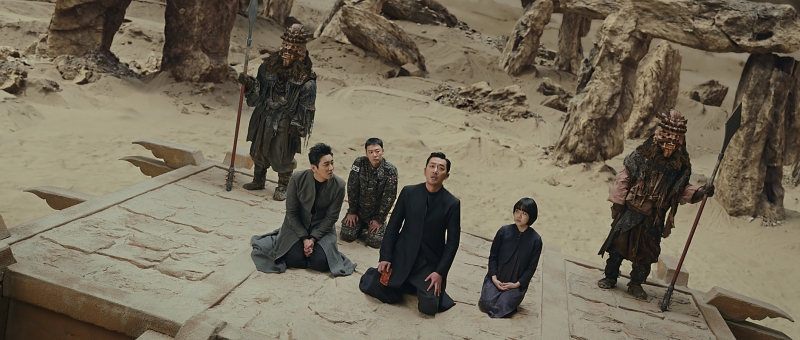
Stateless Things (줄탁동시, Kim Kyung-Mook, 2011)

“We looked everywhere for a place for us to stay, but we could not find it anywhere” one of the twin heroes of Kim Kyung-mook’s indie drama Stateless Things (줄탁동시, Jooltak Dongshi) confesses. As the title suggests, Kim’s eventually surrealist drama follows those who no longer have a home and are instead condemned to wander the margins of an unforgiving city. Finding only loneliness and exploitation they long for an escape and perhaps find one if only in a moment of eclipse. 

Shooting in a more naturalistic, documentary style, Kim first focusses on the figure of Jun (Paul Lee), a young North Korean refugee who lost his mother in the crossing and his father to another woman in Busan. He works in a petrol station but is treated with disdain by his boss who has his eye on his female colleague, Soon-hee (Kim Sae-Byuk), who is a member of the Korean minority in China where most of her family reside. Though originally hostile towards each other, each wary of their mutual isolation and concurrent vulnerability, the pair later bond in a shared resentment of their boss who exploits Jun physically for his labour and seeks to exploit Soon-hee sexually. After each saving the other from the nefarious boss, the pair have no choice but to go on the run taking in a series of tourist spots while looking for another place to settle. 

Meanwhile, across town, a young gay man, Hyun (Yeom Hyun-Joon), is a virtual prisoner in the home of his wealthy, married and closeted lover. He looks out across the midnight city and dances sadly alone in a luxury apartment in the sky while occasionally venturing out to meet other men, mostly older, who similarly only intend to exploit his body. “You have nowhere to go.” the exasperated Sung-woo/Sung-hoon (Lim Hyung-Guk) insists, thrown into jealous anxiety on visiting the flat and finding Hyun absent, yet he cannot really offer him a “home” and is all too aware of the transactional nature of their relationship. Though Hyun is also in a sense “stateless”, he has a power over Sung-woo and is able to wield his youth and beauty like a weapon if one he may not fully be able to control. In any case, he too is excluded from the mainstream society by virtue of his sexuality and socio-economic background. 

When Soon-hee and Jun visit a temple, he remarks on the incongruity of seeing a painting that features both a sun and a moon. She explains a folktale to him in which sun and moon are embodiments of siblings who climbed a rope into the sky to escape a hungry tiger. In his diary, Hyun also envisages a pair of twins one opening a door with his right hand as the other closes it with his left. In the surrealist sequence which closes the film, after a title card that appears 90 minutes in, the two men blur into one another as if they shared the same soul in an almost literal eclipse of the self. Kim nevertheless characterises them as sun and moon who cannot ordinarily share the same space. Jun occupies a world of street level sunniness until the light finally begins to dim leaving him alone in a dusky, rain-soaked city. Hyun meanwhile lives by night in his high rise apartment, a prisoner of luxury who flirts with danger for a sense of escape. 

Then again we might ask if Jun and Hyun are two sides of one whole, a sun and moon protecting the king who finds himself an exile. Kim shifts to scenes of emptiness, rooms without presence and streets without life as if the two men were ghosts of themselves hovering above a rootless Seoul, the sense of eeriness only deepened by Kim’s lengthy takes as he follows Jun walking a lonely path towards nowhere in particular because in the end he too has nowhere to go. Departing from the realism with which the film opened, the final sequence gives way to a kind of rebirth if only one of wandering that leaves its heroes at the mercy of a society continually unwilling to recognise their personhood. 


Stateless Things screened as part of this year’s Queer East .

Trailer (English subtitles)
Money (돈, Park Noo-ri, 2019) [Fantasia 2019]

money poster 1“Could you ask him something for me,” the beleaguered yet victorious protagonist of Park Noo-ri’s Money (돈, Don) eventually asks, “what was he going to use the money for?”. Wealth is, quite literally it seems, a numbers game for the villainous Ticket (Yoo Ji-tae) whose favourite hobby is destabilising the global stock market just for kicks. As for Cho Il-hyun (Ryu Jun-yeol), well, he just wanted to get rich, but where does getting rich get you in the end? There’s only so much money you can spend and being rich can make you lonely in ways you might not expect.

Unlike most of his fellow brokers, Cho Il-hyun is an ordinary lad from the country. His parents own a small raspberry farm and he didn’t graduate from an elite university or benefit from good connections, yet somehow he’s here and determined to make a success of himself. In fact, his only selling point is that he’s committed the registration numbers of all the firms on the company books to memory, and his ongoing nervousness and inferiority complex is making it hard for him to pick up the job. A semi-serious rookie mistake lands the team in a hole and costs everyone their bonuses, which is when veteran broker Yoon (Kim Min-Jae) steps in to offer Il-hyun a way out through connecting him with a shady middle-man named “The Ticket” who can set him up with some killer deals to get him back on the board.

Il-hyun isn’t stupid and he knows this isn’t quite on the level, but he’s desperate to get into the elite financial world and willing to cheat to make it happen. As might be expected his new found “success” quickly goes to his head as he “invests” in swanky apartments and luxury accessories, while his sweet and humble teacher girlfriend eventually dumps him after he starts showering her with expensive gifts and acting like an entitled elitist. It’s not until some of his fellow brokers who also seem to have ties to Ticket start dying in mysterious circumstances that Il-hyun begins to wonder if he might be in over his head.

Unlike other similarly themed financial thrillers, it’s not the effects of stock market manipulation on ordinary people which eventually wake Il-hyun up from his ultra capitalist dream (those are are never even referenced save a brief reflective shot at the end), but cold hard self-interest as he finally realises he is just a patsy Ticket can easily stub out when he’s done with him. Yoon only hooked him up in the first place because he knew he’d be desperate to take the bait in order to avoid repeated workplace humiliation and probably being let go at the end of his probationary period. What he’s chasing isn’t just “money” but esteem and access to the elite high life that a poor boy from a raspberry farm might have assumed entirely out of his reach.

It’s difficult to escape the note of class-based resentment in Il-hyun’s sneering instruction to his mother that she should “stop living in poverty” when she has the audacity to try and offer him some homemade chicken soup from ancient Tupperware, and it’s largely a sense of inferiority which drives him when he eventually decides to take his revenge on the omnipotent Ticket. Yet there’s a strangely co-dependent bond between the two men which becomes increasingly difficult pin down as they wilfully dance around each other.

The world of high finance is, unfortunately, a very male and homosocial one in which business is often conducted in night-clubs and massage parlours surrounded by pretty women. There is only one female broker on Il-hyun’s team. The guys refer to her as “Barbie” and gossip about how exactly she might have got to her position while she also becomes a kind of trophy conquest for Il-hyun as he climbs the corporate ladder. Meanwhile, there is also an inescapably homoerotic component to Il-hyun’s business dealings which sees him flirt and then enjoy a holiday (b)romance with a Korean-American hedge fund manager (Daniel Henney) he meets at a bar in the Bahamas, and wilfully strip off in front of Ticket ostensibly to prove he isn’t wearing a wire while dogged financial crimes investigator Ji-cheol (Jo Woo-jin) stalks him with the fury of a jilted lover.

Obsessed with “winning” in one sense or another, Il-hyun does not so much redeem himself as simply emerge victorious (though possibly at great cost). Even his late in the game make up with Chaebol best friend Woo-sung (Kim Jae-young), who actually turns out to be thoroughly decent and principled (perhaps because unlike Il-hyun he was born with wealth, status, and a good name and so does not need to care about acquiring them), is mostly self-interest rather than born of genuine feeling. In answer to some of Il-hyun’s early qualms, Ticket tells him that in finance the border between legal and illegal is murky at best and it may in fact be “immoral” not to exploit it. What Il-hyun wanted wasn’t so much “money” but what it represents – freedom, the freedom from “labour” and from from the anxiety of poverty. Life is long and there are plenty of things to enjoy, he exclaims at the height of his superficial success, but the party can only last so long. What was the money for? Who knows. Really, it’s beside the point.


Money was screened as part of the 2019 Fantasia International Film Festival.

International trailer (English subtitles)

The Gangster, The Cop, The Devil (악인전, Lee Won-tae, 2019) [Fantasia 2019]

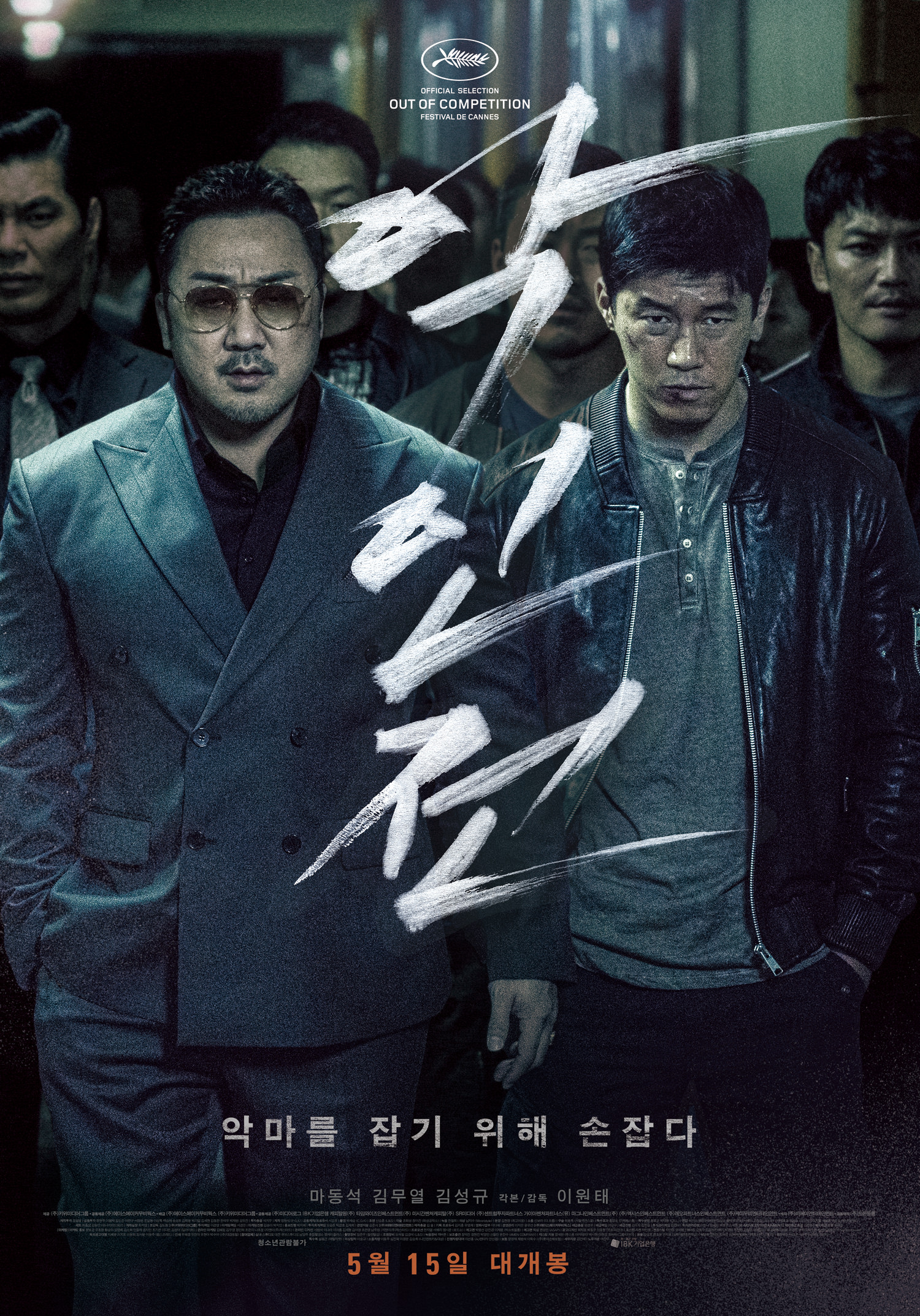
81745_1000“Two bad guys will catch the worst man” according to irritated gangster Jang Dong-su (Ma Dong-seok) in Lee Won-tae’s The Gangster, The Cop, The Devil (악인전, Akinjeon). He doesn’t quite know how right he is, even as he forms an unlikely alliance with a maverick cop himself highly irritated because his lazy colleagues won’t listen to his theory that a spate of unsolved murders are the work of a serial killer. More alike than they’d care to admit, the two “bad guys” team up to do what they have to do in order to make the killing stop but at what price?

A vicious killer (Kim Sung-kyu) has developed a habit of rear-ending solo drivers on lonely roads, stabbing them repeatedly and then leaving them for dead. Maverick cop Tae-seok (Kim Mu-yeol) has become convinced that the killings were carried out by the same perpetrator and that they have not yet been identified as a “serial killer” partly because the crimes took place in different districts and there is insufficient co-operation between precincts, and partly because his colleagues think serial killers are something you see in American movies. His superiors just want to close cases, they aren’t particularly concerned with upholding justice or protecting the innocent and so Tae-seok starts thinking outside of the box when he hears that the killer’s latest target was none other than top mob boss Jang Dong-su.

Dong-su got rear-ended after running an errand to have a word with a wayward underling, Hur (Yoo Jae-myung), who has forgotten his place. The killer made a serious mistake going after Dong-su who is a big, handy kind of guy and therefore manages to fend him off, even wounding him in the shoulder despite being badly injured himself. Though the obvious conclusion is that Hur sent someone after him, Dong-su is unconvinced seeing as he had never seen his assailant before and is pretty sure he’s not a member of the gangster underworld. Still, he’s very annoying because a gangster only has power in being respected and right now Dong-su looks a fool. If he wants to get his “professional” life back on track, he needs to get his revenge but to do that he’ll have to cross the floor and work with law enforcement, temporarily teaming up with rogue cop Tae-seok whose heart is in the right place even if he’s not averse to bending the rules.

One of the things which most bothers Tae-seok about amoral killer “K” is that, unlike most serial killers, he kills indiscriminately and purely for pleasure. He has no “type” and generally goes up against those most likely to fight back, unlike your average pattern killer who targets the vulnerable. Like Tae-seok and Dong-su, he is however quite annoyed – this time because someone has “framed” him for a murder he didn’t commit in order to further their own ends. Hugely overconfident and cooly psychopathic, he sits in the dock and asks what makes his crimes different than the state’s if the state is fixing to execute him without proper evidence. Pointedly looking at law enforcement, he affirms that the real villains are those who commit crime with kind faces (say what you like, but at least K looks the part).

When it comes to Tae-seok he might have a point. Conspiring with Dong-su to “kill him with law”, Tae-seok gleefully manipulates the system while giving Dong-su tacit permission to take his revenge as long as “justice” has been properly served. K doesn’t believe in anything, Tae-seok believes in a particular kind of “justice” if not quite in the law, while Dong-su mourns the sense of self-belief that allows you to rule the roost as an all powerful gangster. The three men are a perfect storm, each angry, each resentful, each vowing a particular kind of revenge against the forces which constrain them be they corrupt and lazy superiors, gangsterland disrespect, or the “injustice” of being accused of a crime you did not commit but not being properly credited for the ones you did. Bathed in a garish neon, Lee’s anti-buddy-cop drama embraces its noirish sense of fractured morality with barely suppressed glee as its similarly conflicted heroes pursue their violent destinies, true to their own but dragged to hell all the same.


The Gangster, The Cop, The Devil was screened as part of the 2019 Fantasia International Film Festival.

International trailer (English subtitles)
Maggie (메기, Yi Ok-seop, 2018)

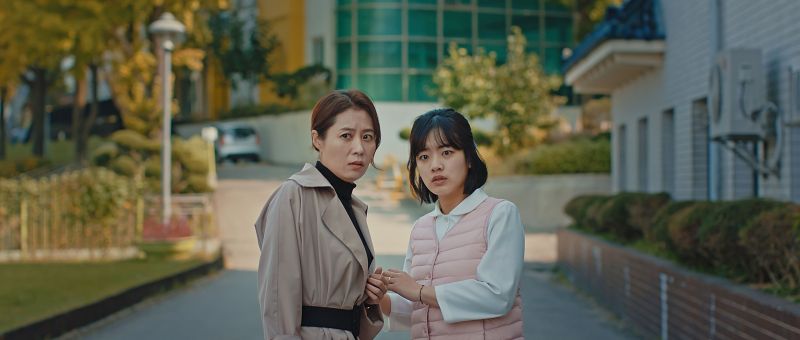
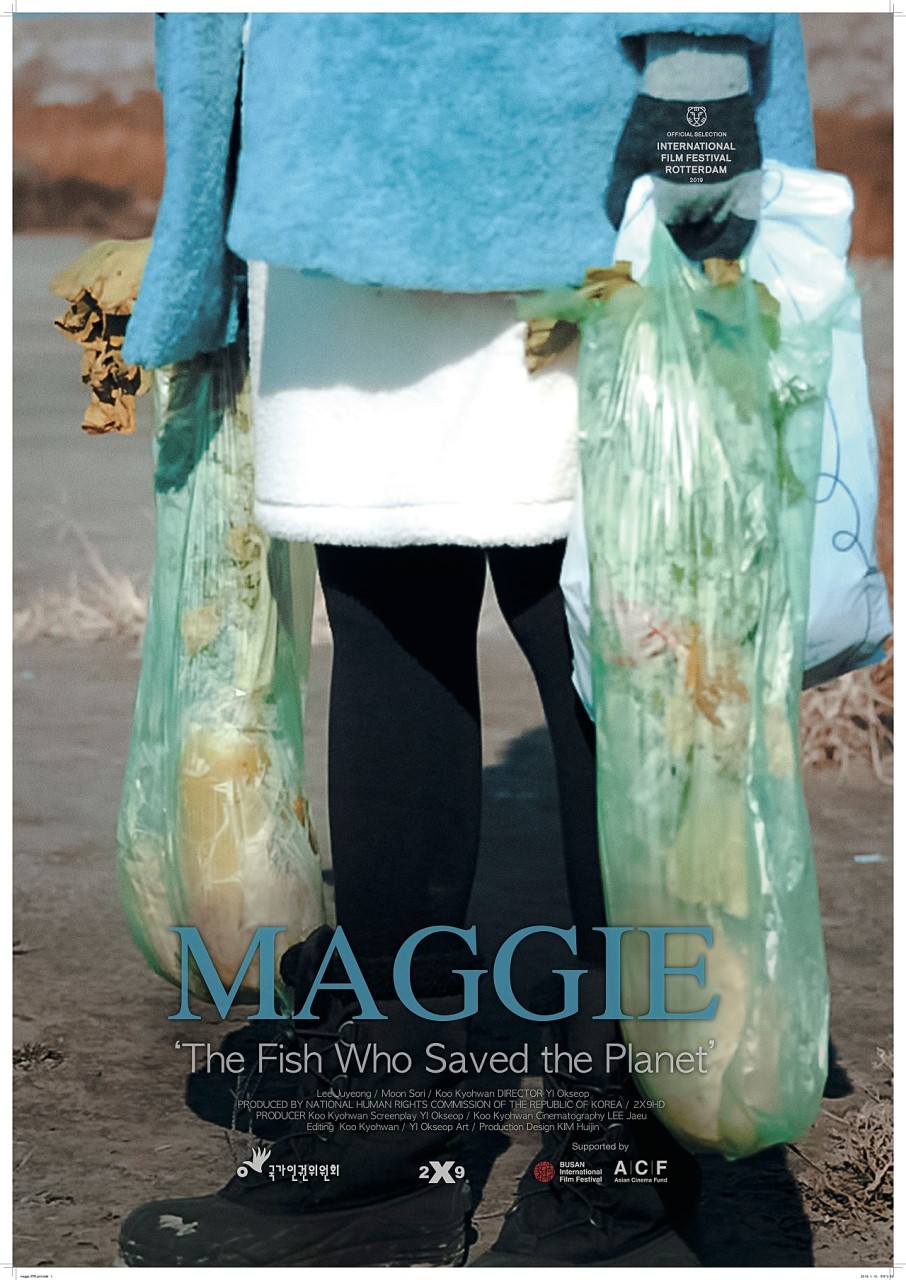
Maggie poster 1“When we fall into a pit, what we need to do, is not dig any further but quickly climb out” according to a mysterious post-it discovered by a nurse when picking up the laundry (apparently inexpertly performed by her preferred cleaning service). The aphorism turns out to belong to Doctor Lee (Moon So-ri), the head physician at Love of Maria hospital where the titular Maggie (메기), a catfish, lives in a small tank observing the life around her and sometimes predicting earthquakes and other earth shattering events. A surrealist odyssey across the “pitfalls” of modern society, Yi Ok-seop’s quirky debut feature ponders the ramifications of distance as her various heroes weigh up the nature of “truth” as an absolutist concept.

Narrated by Maggie, the drama begins when the radiographer and her boyfriend are unexpectedly snapped during an intimate moment in the X-Ray room. The picture is then stolen and held up for everyone to see, at which point nurse Yoon-young (Lee Joo-young) worries that she and her boyfriend Sung-won (Koo Kyo-hwan) have been caught out using the privacy of the X-ray booth for unintended purposes. As Maggie says, no one pays much attention to who took the photo only to who might be in it, which is why the entire hospital, except Doctor Lee, ring in sick the next day with only Yoon-young turning up in the morning with the intention to resign. Figuring out what must have happened (and seeing as she’s the only one not embarrassed we can guess who took the photo), Doctor Lee is very upset to realise that the entirety of her staff has probably lied to her. With her intense belief in humanity shaken, Doctor Lee decides to engage in a trust game with her new best friend, Nurse Yoon-young, and simply choose to believe what they’re told, testing their hypothesis by visiting a random employee to verify if they really are “sick”.

Meanwhile, as a result of the earthquakes Maggie intermittently predicts,  mysterious sinkholes have begun appearing all over the nation. This is good news in one sense because it provides lots of extra work for otherwise unoccupied young men like Sung-won who have lost out in Korea’s insanely competitive economy. Like Sung-won, the other men on his team are also well-educated types who otherwise wouldn’t be considering manual work and are hoping for something better once the sinkhole business finally clears up. Mistrust, however, also works its way into their relationship when Sung-won loses a precious white gold ring given to him by Yoon-young, later becoming convinced that one of his colleagues has swiped it.

The loss of the ring leads to an increasing unease between Yoon-young and her boyfriend which is deepened by a visit from Sung-won’s ex who suggests there may have been problems in their relationship which she feels Yoon-young ought to be aware of. Though Sung-won seems sweet natured and laidback, never having acted in any way that would have given Yoon-young cause for concern, she begins to doubt him – suddenly worried by his overly violent crushing of a can out in the street. Doctor Lee’s advice is to simply ask Sung-won directly if the accusations are true, but Yoon-young can’t seem to do it and continues living along side him somewhat resentfully as she eventually comes to the decision to “believe” her friend at face value without investigating further.

“The truth cannot exist wholesomely”, according to Maggie’s “father” (Kwon Hae-hyo). It will always be polluted by self-interest and personal bias. As Doctor Lee says, there will always be people who believe you and people who don’t, so perhaps a healthy level of cynicism is something you need to accept in order to go on living in the world. Even Love of Maria Hospital is not immune to the disease of misrepresentation – a former convent given over as a place of healing it was later bought by an arch capitalist and is now run as a private hospital business (not that it appears to have many “customers”), despite Doctor Lee’s rather amusing ad which proclaims it “of the patients, by the patients, for the patients”.

Finally Yoon-young concedes she’ll need to simply ask Sung-won about his past and gets an honest response, but his honesty only seems to see him falling into a deep pit of despair, calling out from the bottom in the hope of being understood. A surreal exploration of contemporary social woes from the rabidly capitalist society to the growing distance between people in an increasingly interconnected age, Maggie attempts to find the emotional honesty sweet spot but discovers that trust, like everything else, is a complicated business.


Maggie screens on 13th July as part of the 2019 New York Asian Film Festival. It will also be screening as part of the 2019 Fantasia International Film Festival on 17th/18th July.

Interview with director Yi Ok-seop from the Busan International Film Festival

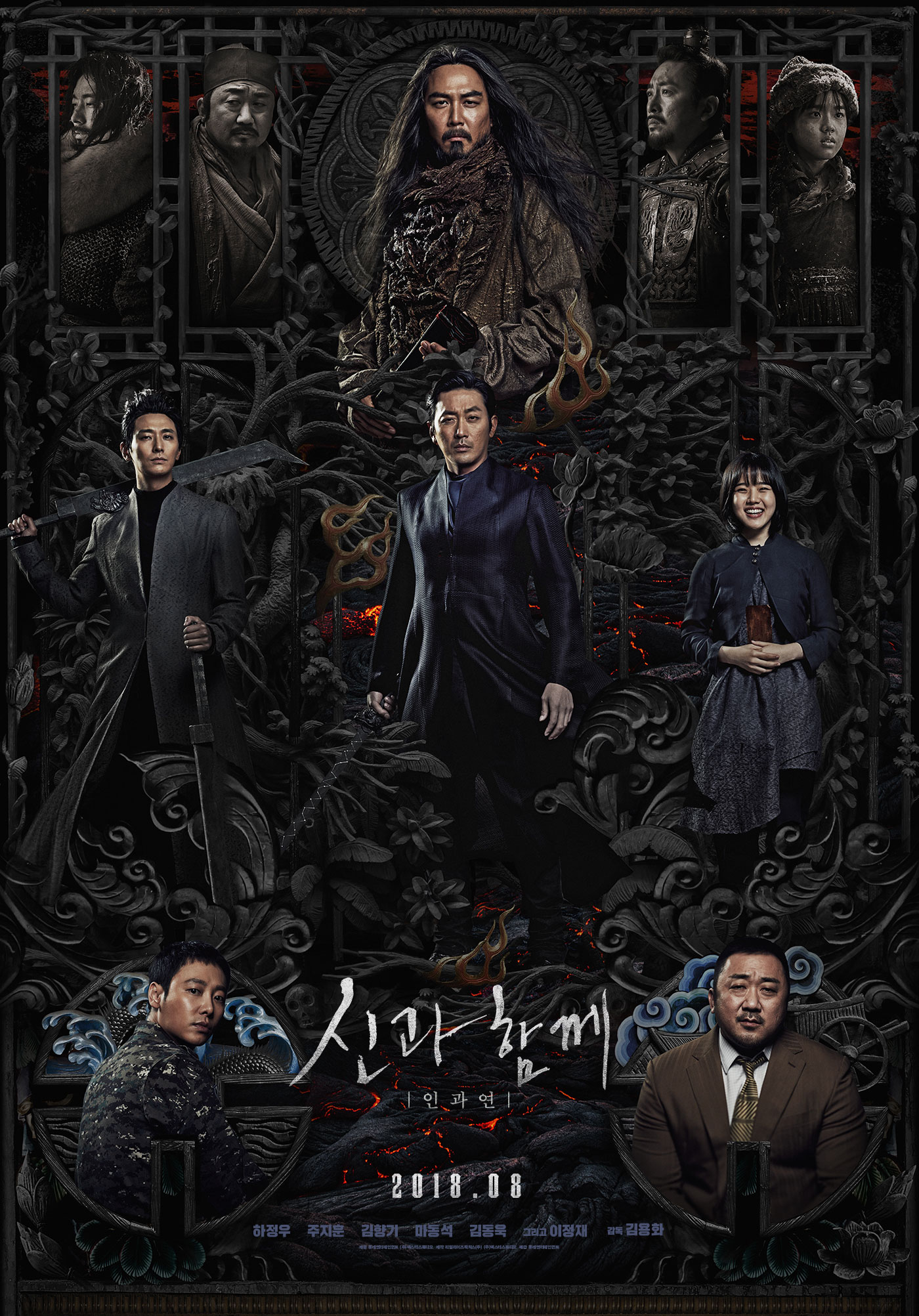
Along With the Gods: The Last 49 Days (신과함께-인과 연,Kim Yong-hwa, 2018)

Along with the gods 2 posterKarma is a bitch, and Korean hell is apparently full of it. You don’t have to be guilty to work here, but it certainly seems to help. Picking up straight after the conclusion of the first film, Kim Yong-hwa’s Along with the Gods sequel, The Last 49 Days (신과함께-인과 연, Singwa Hamgge: Ingwa Yeon) sees stern grim reaper/celestial defence lawyer Gang-lim (Ha Jung-woo) make good on his promise to clear the name of a once vengeful spirit now cheerfully deceased, but willingly or otherwise it’s himself he’s putting on trial as the facts of his client’s case veer eerily close to his own. King Yeomra (Lee Jung-jae) is up to his old tricks once again.

Brother of the first film’s “paragon” Ja-hong, Kim Su-hong (Kim Dong-wook) is headed nowhere good – after being accidentally shot by one friend and then buried alive by another to cover it up, Su-hong became a vengeful spirit creating havoc in the mortal and underworlds. Gang-lim, however, is convinced that Su-hong’s death was “wrongful”, that he died as a deliberate act of murder rather than simply by a tragic accident, and commits himself to clearing Su-hong’s name so that he can be reincarnated immediately. He manages to win King Yeomra over, but there is one condition – an old man, Hur Choon-sam (Nam Il-Woo), is an overstayer in the mortal world and should have been “ascended” long ago but his household god, Sung-ju (Ma Dong-Seok), keeps despatching the Guardians to keep the old man safe. If Gang-lim and his assistants Hewonmak (Ju Ji-Hoon) and Deok-choon (Kim Hyang-Gi) can clear Su-hong’s name and ascend Choon-sam within 49 Days King Yeomra will at last set them free and allow them to be reincarnated.

Having dealt so thoroughly with the mechanics of hell in The Two Worlds, Kim expands and deepens his canvas to delve into the lives of our various Guardians. As it turns out Sung-ju was once a Guardian himself and so he knows a thing or two about our two underlings – Hewonmak and Deok-choon, whose memories were wiped when they became employees of King Yeomra. As Sung-ju spins a yarn, it becomes clear that the fates of the three Guardians were closely linked in life and death, bound by a series of traumatic events over a thousand years ago during the Goryeo dynasty.

As in the Two Worlds it all comes down to family. Gang-lim’s memories are fractured and confused, he’s convinced himself he’s a righteous man and wilfully misremembered his death (or at least misrepresented it to his cohorts). Stiff and lacking in compassion, Gang-lim was at odds with his gentle hearted father who, he thought, had found a better son in a boy orphaned by the cruelty of his own troops. These broken familial connections become a karmic circle of resentment and betrayal, enduring across millennia in the knowledge that even to ask for forgiveness may itself be another cruel and selfish act of violence. The circle cannot be closed without cosmic justice, but justice requires process and process requires a victim.

Gang-lim plays a bait and switch, he walks the strangely cheerful Su-hong through the various trials but it’s himself he’s testing, working towards a resolution of his own centuries old burdens of guilt and regret. There are, however, unintended victims in everything and the fate of orphans becomes a persistent theme from the orphaned foster brother Gang-lim feared so much, to those who lost their families in the wars of Goryeo, and a little boy who will be left all alone if Hewonmak and Deok-choon decide to ascend Choon-sam. Choon-sam’s adorable grandson is only young but he’s already been badly let down – his mother sadly passed away, but his father ran up gambling debts and then ran off to the Philippines never to be seen again. He didn’t ask for any of this, but there’s no cosmic justice waiting for him, only “uncle” Sang-ju who has taken the bold step of assuming human form to help the boy and his granddad out while trying to come up with a more permanent solution.

Nevertheless, compassion and forgiveness eventually triumph over the rigid business of the law, finally closing the circle through force of will. Kim doubles down on The Two Worlds’ carefully crafted aesthetic but perhaps indulges himself with a series of random digressions involving psychic dinosaur attacks and lengthy laments about stock market fluctuations and failing investments. Along With the Gods: The Last 49 Days may lack the narrative focus of its predecessor but is undoubtedly lighter in tone and filled with the sense of fun the first film lacked, which is just as well because it seems as if hell is not done with our three Guardians just yet.


Along with the Gods: The Last 49 Days is currently on limited release in UK cinemas.

Original trailer (English subtitles)
The Chase (반드시 잡는다, Kim Hong-sun, 2017)

The Chase posterKorea may not quite be facing such an ageing population crisis as neighbouring nations, but old age has become a persistent cinematic preoccupation. We’ve seen old women still engaging in acts of prostitution to support themselves in the absence of family (and indeed the state), serial killers becoming dangerously confused, and ageing grandmother’s attempt to see the beauty in a world that seems to be descending into chaos. What The Chase (반드시 잡는다 Bandeusi Jabneunda) shows us is that the elderly do at least have time on their hands that could well be used for fighting crime and protecting the vulnerable.

If you were appointing elderly street guardians, you probably wouldn’t pick Deok-soo (Baek Yoon-sik). A curmudgeonly landlord with a conviction that everyone is out to diddle him on their rent, Deok-soo complains loudly when a body is found in a nearby area because it’s going to damage property prices. People who are supposed to die should just die, he exclaims, that’s patriotism! You can bet your bottom dollar Deok-soo voted for Park Geun-hye, but despite his grumpy exterior he has a soft heart as one of his young charges reveals when she reminds him that he’s never thrown anyone out just because they didn’t pay up. Deok-soo has taken quite a (paternal) liking to Ji-eun (Kim Hye-in), a young woman living alone away from family in one of his horrible little apartments. Aside from her rent arrears and tendency to let her mixed up friend stay over so often that she virtually lives there, Ji-eun is one of Deok-soo’s favourite tenants.

Which is perhaps why he gets himself so involved when she suddenly goes missing after a shock discovery is made in her flat. Other than the first body which got Deok-soo so worked up, a few other elderly people have been passing away in lonely deaths which, sadly, isn’t particularly suspicious save that the pattern matches that from an unsolved serial murder case from 30 years ago which began with the killing of old people and then progressed to sexually aggravated murder of young women with long dark hair – just like Ji-eun.

Aside from the ongoing serial killer plot, director Kim Hong-sun makes space for depicting the various problems faced by the elderly in contemporary Korea. The first problems are loneliness and dislocation caused by separation from family members – many of the older people Deok-soo is familiar with have children overseas whom they have all but lost touch with. The second problem is economic – Deok-soo’s flats are dirt cheap for a reason and mostly inhabited by the very young and the very old, i.e. people without a lot of “disposable” income. Being elderly, they often can’t find jobs and don’t have access to a proper pension leading many to take to the streets protesting for rights for the aged including that to work or to be given state support. Deok-soo is lucky with income from renting the apartments, but he also works as a locksmith which brings in a few extra pennies. Being Deok-soo he isn’t particularly worried about other people less lucky than himself, so he rolls his eyes at the protests but is worried enough by the lonely deaths to ask one of his tenants to look in on him every now and then to avoid becoming one.

Meanwhile, Deok-soo has become “friends” with a retired police detective who’s convinced the serial killer he failed to catch 30 years ago is back. Worried that Ji-eun may end up among his victims, Deok-soo begins investigating, unwittingly getting himself mixed up in a dark and confusing world of old school hardboiled only Pyeong-dal (Sung Dong-il) is not quite as worthy a guide as he seemed. Walking around like a maverick cop from a violent ‘70s action movie, Pyeong-dal is convinced he knows who the killer is but he is old and unsteady and his mind is not perhaps reliable.

Then again a persistent subplot seems to argue that the young have no respect for age, are selfish and corrupt, thinking only of short term pleasures and forgetting that they too will one day be old with no one around to look after them. No one takes Deok-soo and Pyeong-dal seriously, they are after all just grumpy old men that everyone wants to get rid of as quickly as possible. They do, however, (paradoxically) have time to indulge in “silly” ideas that the young do not have and are, therefore, perfectly positioned to take down a serial killer who preys on the weak and vulnerable including old men like them and pretty young girls like Ji-eun. Old guys have still got it, at least according to The Chase, though they might have got there faster if only they’d cut the young whippersnappers some slack.


Screened at the 20th Udine Far East Film Festival.

Also available to stream on Netflix.

International trailer (English subtitles)

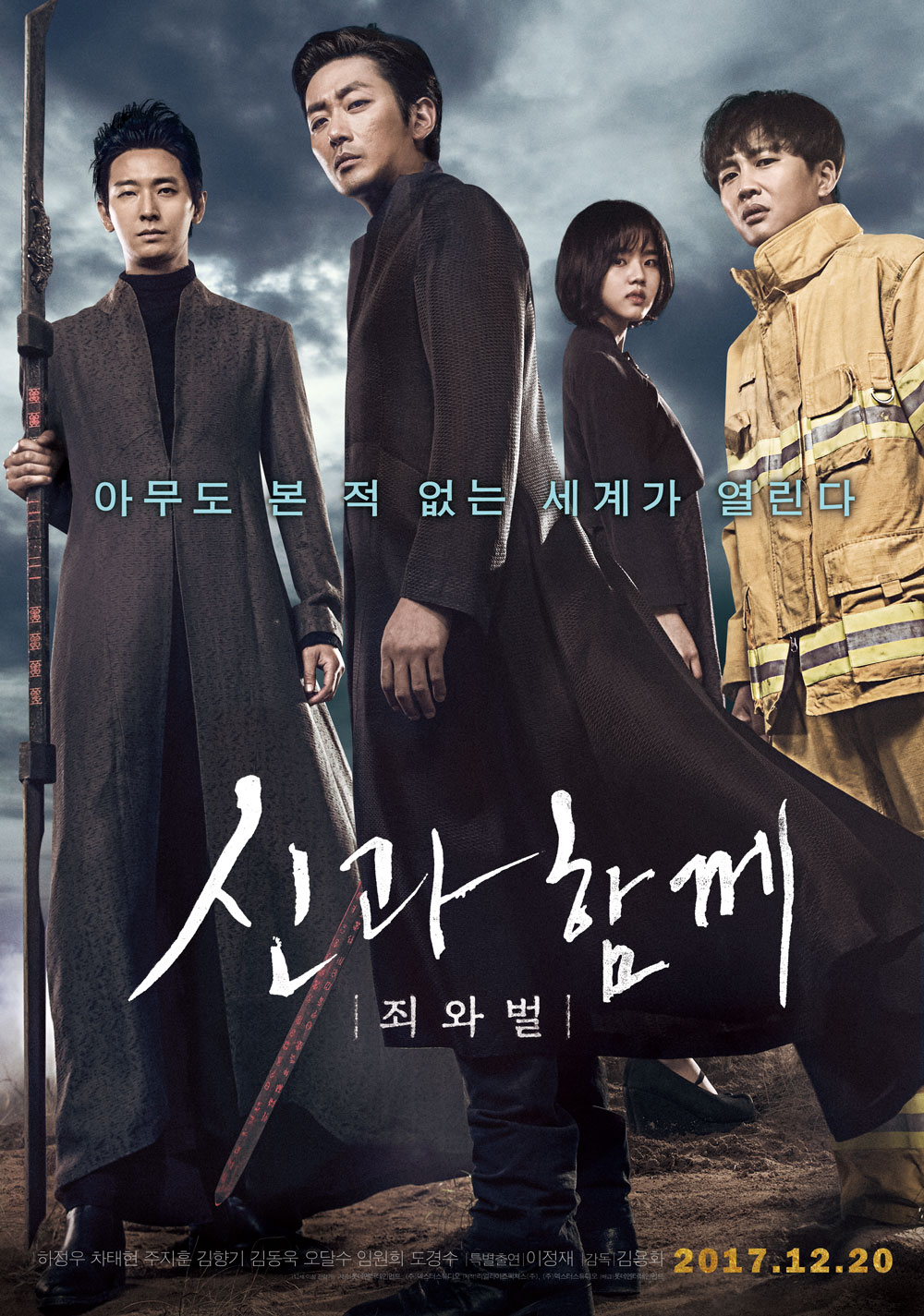
Along With the Gods: The Two Worlds (신과함께-죄와 벌, Kim Yong-hwa, 2017)

Along With the Gods- The Two Worlds posterThere’s nothing like death to give life perspective. If life is a series of tests, death is the finals but if you pass you get to come back and do it all again, otherwise you’ll have to spend some time in the afterlife thinking hard about what you’ve done and presumably studying for some kind of resits. At least, that’s how it seems to work in the complicated Buddhist hell of Kim Yong-hwa’s fantasy epic Along With the Gods: The Two Worlds (신과함께-죄와 벌, Sin gwa Hamkke – Joe wa Beol). The first in a two part series, The Two Worlds takes a saintly man and tries to pull him down only to build him back up again as a potent symbol of filial piety and wounded selflessness.

Firefighter Kim Ja-hong (Cha Tae-hyun) is killed leaping heroically from a burning building with a little girl wrapped in his arms. He doesn’t realise he’s dead until he’s greeted by two neatly suited, official looking types who explain to him that they are his “Guardians” and will be looking after him on his journey through the afterlife. It turns out that Ja-hong’s heroic death has earned him a “Paragon” badge – a rare occurrence, and he has a good chance of reincarnation before the 49th day if he can successfully pass each of the seven trials which mark passage through Buddhist Hell.

As the Guardians point out, it would be extremely difficult for a “normal” person to pass these seven trials and achieve reincarnation but as a Paragon Ja-hong should have an easier ride. Ja-hong is, however, an ordinary person with an ordinary person’s failings even if his faults are comparatively small. Ja-hong is literally on trial seven times – represented by his team of defence lawyers, the Guardians, he is charged with various sins each “judged” by a god presiding over a custom courtroom. Murder Hell is fiery chaos, indolence is assessed by a stern older lady (Kim Hae-sook), and deceit by (who else) a small child (Kim Soo-ahn) licking a large lollipop.

Ja-hong is indeed a “good person” but he has also been to dark places, wilfully deciding to turn and walk away from them in order to repurpose his rage and resentment into a determination to care for his seriously ill mother (Ye Soo-jung) and younger brother (Kim Dong-wook). Working tirelessly, Ja-hong has been selfless in the extreme, saving lives and saving money for his family whilst sacrificing his own life and prospect of happiness in order to provide for others. That’s not to say, however, that there isn’t a degree of “sin” in the selfishness of Ja-hong’s selflessness or that he hasn’t also been cowardly in making a symbolic recompense for a guilty secret rather than a personal apology.

Kim Yong-hwa weaves in a series of subplots including a lengthy shift into the life of Ja-hong’s brother Su-hong, a possibly gay soldier with an intense attachment to a comrade which eventually has tragic results. Su-hong’s mild resentment towards his brother becomes a key element in his trial, eventually developing into a more literal kind of spectre haunting the proceedings while perhaps creating even more turmoil and confusion in the living world thanks to a moustache twirling villain whose desire to “help” is probably more about saving face – the kind of “betrayal” which is not “beautiful” enough to get a pass from the Goddess.

In the end the court seems to bend towards Ja-hong’s moral philosophy, excusing his human failings through moral justification even when that justification remains flimsy as in the case of his “fake” letters intended to make people feel better through the comfort of lies. The essence of the judgement, however, looks for forgiveness – if a sin is forgiven in the mortal world, it is inadmissible in a celestial court. The message seems clear, face your problems head on and sort out your emotional difficulties properly while there’s time else you’ll end up with “unfinished business” and get bogged down in Buddhist Hell being attacked by fish with teeth and having old ladies asking you why you spent so much time watching movies about death rather than living life to the fullest.

Ambitious in its use of CGI, Along With the Gods: The Two Worlds acquits itself well enough in its carefully drawn (if lifeless) backgrounds and frequent flights of fancy which allow Ha Jung-woo’s enigmatic Gang-lim ample opportunity to whip out his fiery sword of justice. Narratively, however, it’s comparatively clumsy and content to revel in the melodrama of its tearjerking premise. A post-credits teaser linking part one and part two through the recurring figure of an old man who can see the Guardians presents a familiar face in an extremely unfamiliar light and hints at a great deal of fun to be had next time around – appropriate enough for a film about reincarnation, but then again it’s as well to have some fun in this life too, something The Two Worlds could have used a little more of.


Currently on limited UK cinema release courtesy of China Lion.

Original trailer (English subtitles)