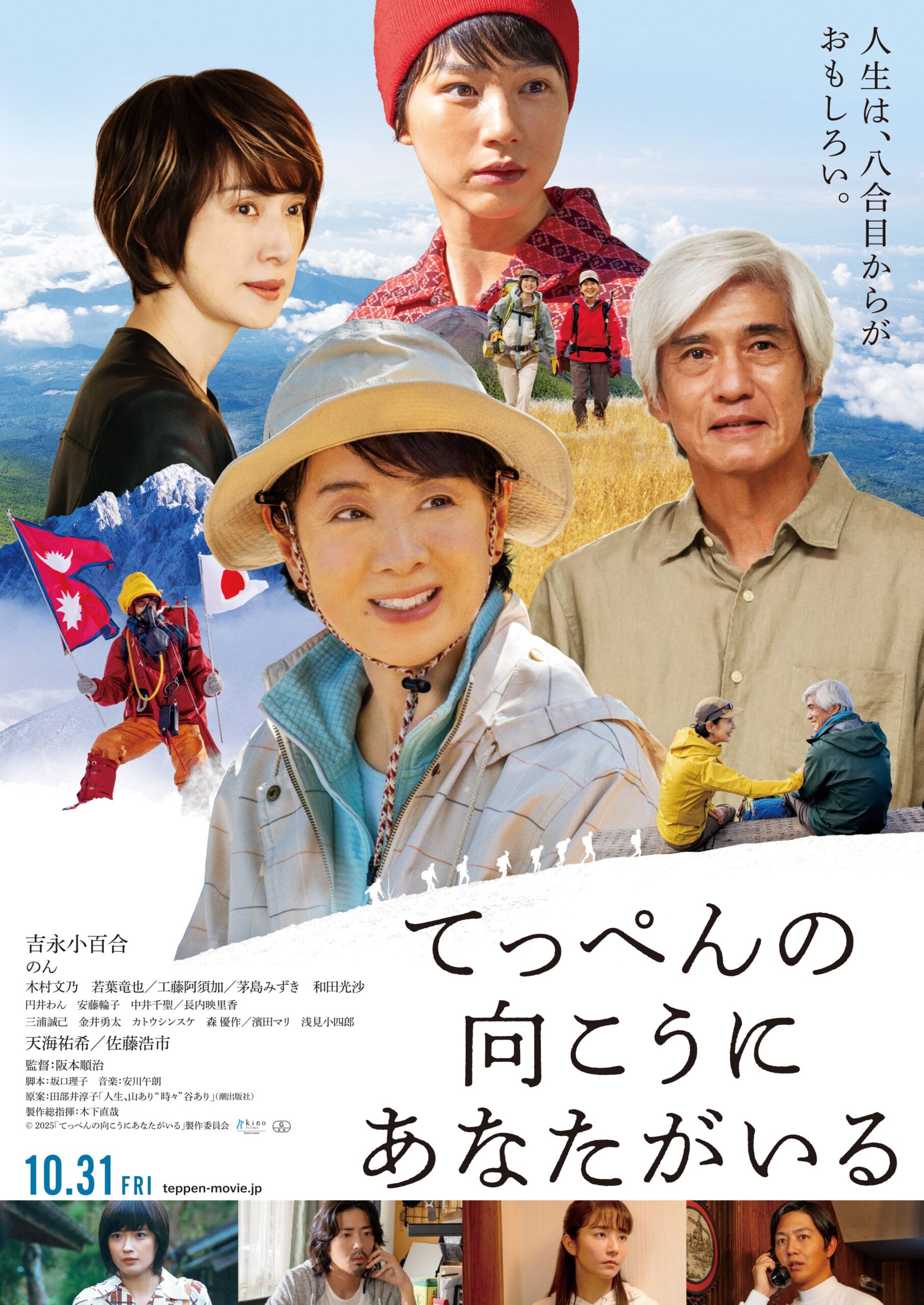
A world-famous, record-breaking mountain climber faces the final ascent in Junji Sakamoto’s fictionalised biopic of Junko Tabei, the first Japanese woman to reach the summit of Everest. Here named Tabe, the highest mountain Junko (Sayuri Yoshinaga / Non) has to climb seems to be the patriarchal nature of Japanese society in the 1970s. The film does, however, mistakenly imply that sexism is an issue that has now been solved in the film’s contemporary setting of 2010-16 in which women hold positions of authority and are free to fulfil themselves outside the home on an equal footing with men.
Of course, this is not really the reality even if, in some ways, the situation may be much better than during the high prosperity era during which Junko was a trailblazer in more ways than one. When she decides to mount an all-female expedition team to conquer Everest, she’s mainly met with derision and scorn. While she and female reporter Etsuko (Yuki Amami / Mizuki Kayashima) do the rounds of various companies looking for sponsorship, the elderly male CEOs are incredibly confused and accuse them of being traitors to their sex. They questions whether it’s safe for women to do something like this without any men around (though in the interests of clarity, all the Sherpas appear to me male), and also what wonder what their husbands are supposed to do for the six months they’ll be away shirking their domestic responsibilities. Even when they encounter a man who is closer to their own generation and sounds supportive, stating that the era of gender equality has arrived, it turns out to be all talk. He does not take their proposal seriously and even asks which part of it he should read as if it wasn’t really important. In the end, his “support” doesn’t transfer into any investment.
In the present day, Etsuko remarks that there were a lot of useless men around back then, as if men are universally different now. She herself has become a senior reporter and is in a position of authority over younger male reporters in the newsroom. Likewise, Junko’s main physician in the later stages of her treatment following a cancer diagnosis is also female and makes a point of listening to her patient’s wishes and concerns. It does not appear that Etsuko ever married or had children, but no one of is critical of them for “abandoning” their domestic responsibilities to pursue a career in the way they were of Junko when she left her daughter behind to climb Everest. To that extent the film paints a rosier picture of the contemporary society than might actually be the case given the still persistent levels of sexism and gender bias that still present barriers to woman’s ability to find fulfilment whether within the domestic environment or outside of it.
Nevertheless, Junko’s husband Masaaki (Kôichi Sato) is depicted as a shining example of confident masculinity in his support for his wife’s endeavours. A sister-in-law looks after daughter Noriko during the day with Masaaki on parental duties outside of his shifts as a mechanic. Even so, Junko’s success is seen to have a negative effect on her children who do feel a degree of resentment towards her. Noriko has largely taken it in her stride, but also feels a sense of regret that Junko is not just her mother but someone she has to share with the world. When this spurs her on to deepen their relationship in adulthood, younger son Shintaro (Ryuya Wakaba) who was born after Everest is hugely resentful and struggles to emerge from his mother’s shadow or the pressure of being the child of a famous person. He doesn’t like it that people have expectations of him because of who his mother is and feels as if he is held to a different standard because of it, causing him to become rebellious at school. The situation becomes so bad that he eventually moves in with relatives and transfers to the relatively more anonymous Fukushima where his teacher gives him some harsh lessons in humility, reminding him that he is not “Junko’s Tabe’s son”, but that Junko Tabe just happens to be his mother.
Shintaro’s views also seem to be more patriarchal than those of his father whom he verbally attacks insisting that he must also be resentful of Junko and that if it were not for losing his big toes to frostbite it would have been him conquering Everest, not her. While Shintaro appears to feel emasculated by his mother and looks down on his father for what he sees as weakness, Shintaro is able to put his personal frustrations aside and devote himself wholeheartedly to supporting Junko. It’s not until Junko’s illness becomes serious that Shintaro is able to reconcile with her and find a more stable path in life through helping with her programme to bring high school students displaced by the 2011 earthquake to climb Mount Fuji.
Mountains take on an almost sacred presence for Junko with Mount Fuji in particular becoming a constant motif. The film depicts her final battle with cancer as being yet another mountain to climb, though knowing your limitations is also part of the art of climbing and so when she comes to the realisation that she can no longer reach the summit, she decides to plan her descent. The poignant closing moments have her looking at a photo of the women’s team and insisting they will all go together, expressing a degree of sadness that the group fell apart after Everest with some resentful that Junko had progressed to the summit alone rather than postpone to regroup to call off the ascent to try again another time. All of the press attention fell on her alone forgetting the efforts of those who’d stayed at base camp and without whom Junko’s success would not have been possible. Female solidarity is also vulnerable to these kinds of pressures, the film implies, though Junko’s friendship with Etsuko endures right to the end. Though the conclusion is bittersweet, the closing moments at least focus more on a life well lived amid the majesty of the mountains rather than dwelling on its inevitable tragedy.
Climbing for Life screens as part of this year’s Toronto Japanese Film Festival.
Trailer (English subtitles)


