Homunculus (ホムンクルス, Takashi Shimizu, 2021)

Is the world we see merely a self-created illusion, or do we each share a concrete, objective “reality”? It’s a question which seems to obsess the antagonist of Takashi Shimizu’s manga adaptation Homunculus (ホムンクルス), though in the end he’ll perhaps find the answer is less clear cut than he’d been willing to believe. “When you look at the other person you can create the world” is the lesson he’s eventually given by his test subject, echoing the film’s somewhat trite message that it’s connection which gives life meaning, a willingness to see and be seen having moved past unresolved trauma in pursuit of the true self. 

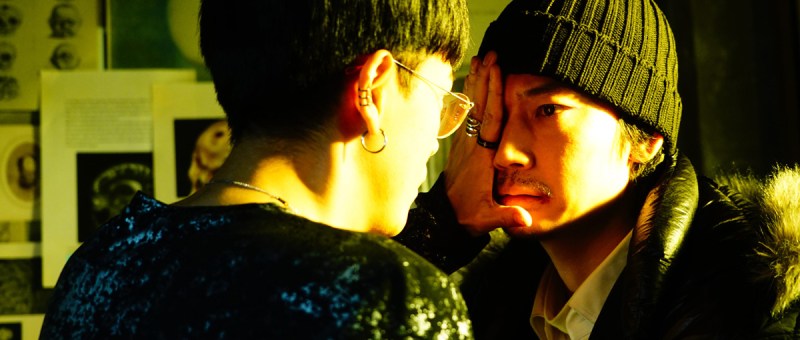
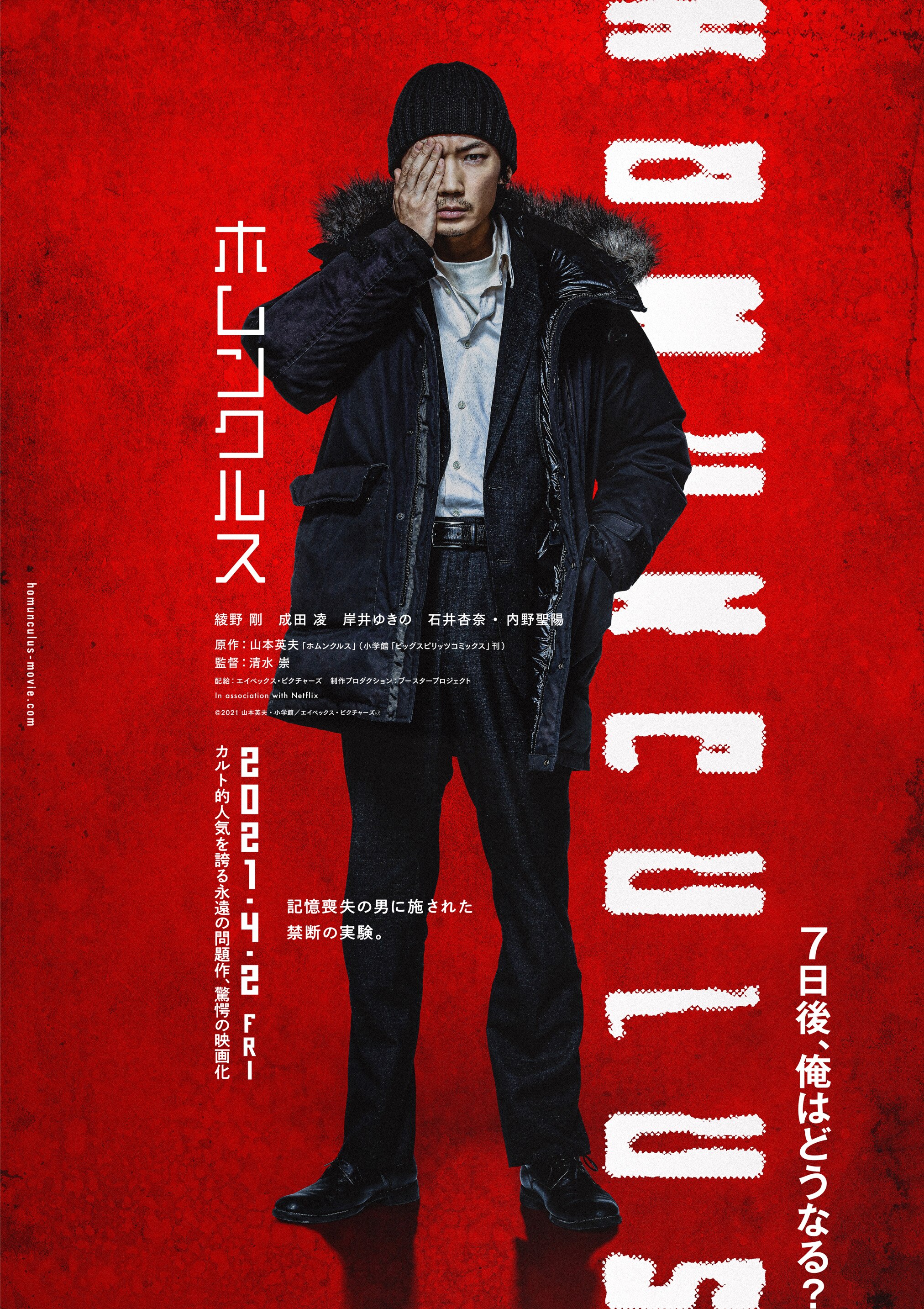
This is something the hero, Susumu Nokoshi (Go Ayano), has apparently been unwilling to do. Formerly a high flying actuary peddling life insurance, literally putting a price on the lives of others, Susumu now claims to have lost his memory and is living in his car next to a park which is home to the local homeless population. One night, a weird young man with strange, staring, goldfish-like eyes knocks on his window and makes him a bizarre job offer. For whatever reason, Susumu allows himself to be convinced by this decidedly odd young man he’s only just met to let him drill a hole in his head which he claims will unlock untold abilities and perhaps even return some of his missing memories. 

Manabu Ito (Ryo Narita), a medical student and the wealthy son of a successful doctor, claims he wants to use the trepanation experiment in order to prove that the world does not exist but is merely a self-created illusion of the human brain. As a result of the operation, Susumu does indeed develop special powers in that he suddenly starts seeing strange things in the middle of Kabukicho. According to Manabu, he’s developed the ability to see the “homunculus” of others, seeing their inner self-image as a reflection of their deeply buried trauma. 

Despite himself, Susumu begins attempting heal the various traumas of the troubled souls he sees but at the same time perhaps oversteps his right to intervene, acting in instinct and compulsion never considering whether not not they actually want their traumas resolved. His first case is that of a violent yakuza whose inner self is a wounded child encased in robot armour, the implication being that he has buried himself in a life of merciless violence in an attempt to mask unresolved childhood guilt. Yet his eventual “freedom” in having faced his younger self entirely ignores the weight of his later years of violent cruelty, as if all of his subsequent “stress” were wiped out in an instant. Susumu’s second case, however, is still more worrying in that is sees him apparently “fix” a young woman’s control and self-esteem issues effectively by raping her while in some kind of trance. 

His own issues meanwhile lead back into his refusal to deal with the painful past, implying his unusual lifestyle is in fact a fugue state born of trauma response. We learn that he was once wealthy and successful but also deeply empty inside, apparently saved from the soul destroying delusion of consumerist fulfilment by a young woman who saw him for what he really was. He resents his new abilities because he is still unwilling to extend the same courtesy to others, trapped in self obsession desperately wanting to be seen but all the while refusing look even as the hole in his head takes the lid off his emotional repression. 

Nevertheless, there’s a curiously homoerotic subtext between the patient and his mad scientist friend whose eventual descent into machiavellian levels of manipulation is never quite convincing even if it perhaps comes from a place of spurned hurt. Manabu’s unresolved traumas are indeed given short shrift and perhaps in themselves fairly banal, failing to live up to his air of strangeness or prove equal to the darkness inherent in his odd obsession with the art of trepanation coupled with his doubts as to the nature of reality. Neither outlandish enough in its surreality nor, ironically enough, willing to engage with its own unpleasantness in its latent misogyny, Homunculus’ central messages of the essentiality of mutual recognition ring somewhat hollow while its heroes remain mired in their own quests for true selfhood in looking for themselves reflected in the eyes of others. 


Trailer (English subtitles)

The Cornered Mouse Dreams of Cheese (窮鼠はチーズの夢を見る, Isao Yukisada, 2020)

It’s quite a potent image somehow, a mouse caught in a trap unable to reach out and touch the cheese they’ve risked their life for yet continuing to dream of it as if nothing else really existed. Perhaps love is much the same, at least according to a young woman who warns against falling in love too deeply worrying that in the end you won’t be able to keep it together and so will fall apart. Adapted from a popular Boys Love manga by Setona Mizushiro, Isao Yukisada’s The Cornered Mouse Dreams of Cheese (窮鼠はチーズの夢を見る, Kyuso Wa Chizu No Yume Wo Miru) is in someways in dialogue with his earlier tale of triangulated love between two women Luxurious Bone, if sharing some of that film’s perhaps outdated attitudes towards sexuality. 

The titular mouse is office worker Kyoichi (Tadayoshi Ohkura) who is halfheartedly having an affair with a colleague seemingly just because he can. Unbeknownst to him, his wife has hired a private detective who just happens to be an old friend from university, Wataru (Ryo Narita). Wataru warns him that he’s got pictures of him and his mistress but agrees not to tell his wife, if Kyoichi agrees to accompany him to a hotel for some low level intimacy. The abruptness of the overture seems to hint that the two men had some kind of history in university but this appears not to be the case and Kyoichi continues to struggle with his sexuality partly it seems out of a degree of self-loathing that convinces him he’s not the sort of person anyone should love.

In Luxurious Bone, the problem had been that the two women could not quite accept the validity of their desire for each other and instead ended up having vicarious sex with the same guy. Something similar occurs between Kyoichi and Wataru each in their own way unable to accept the way they feel. Kyoichi repeatedly states that he doesn’t want to cause someone else pain but in fact hurts everyone around him because of his own inability to reckon with his feelings. He continues to womanise, but eventually asks Wataru to move into the grey industrial bachelor pad he gets when his marriage breaks down while keeping him at arm’s length. Wataru is jealous in a direct sense, resenting Kyoichi’s various girlfriends, but also on deeper level lacking faith in his homosexuality or at least ability to accept it fearing he will always in the end choose to be with a woman. 

Both men are imprisoned by an internalised homophobia, Kyoichi most obviously in rejecting his desire for Wataru. “A straight guy can’t handle it” he tells him in an ironic choice of words, earlier having told him that guys like him belonged “in another world”. The film seems to present Kyoichi’s sexuality as a binary choice, men or women, precluding the idea that he might simply be bisexual while inviting the inference that his womanising is an attempt to mask his latent homosexuality and that he is in fact living a lie in betrayal of himself in denying his desire for Wataru. But then Wataru is consumed by insecurity, as if on some level believing he is inherently inferior to a woman and that Kyoichi will always “choose” to be straight while simultaneously certain that he does in fact return his feelings. He tells him that his problem is that he passively accepts love from others but in the end doesn’t trust it and continues to look for it in the next person who shows any interest in him, but it seems Wataru doesn’t have much faith in love either pulling away just as Kyoichi draws closer and unable to accept the validity of his love for him. 

The film maintains some of the more frustrating aspects of BL literature in that it never really considers why Kyoichi rejects his same sex desire nor does it address what the potential complications of his life maybe if he were fully to accept his sexuality and attempt to live openly with Wataru. On the other hand, it perhaps lessons the impact of the darker elements of the interplay between the two men in which Wataru effectively stalks Kyoichi and then blackmails and bullies him into sex which the film justifies on the basis that Kyoichi must on some level want to be liberated from his repressed desire while Kyoichi in turn manipulates and tortures Wataru through his womanising and reluctance to enter a full sexual relationship even while living together. The film’s ambiguous closing scene in which Kyoichi sits on Wataru’s stool and places his yellow ashtray, looking oddly like a wedge of cheese, on his grey coffee table the only splash of colour in his exquisitely decorated yet desolate grey room may also uncomfortably hint that their love is always impossible because it is a love between two men rather than accepting that the only barriers to it lie in internalised homophobia and emotional vulnerability. Even so it is a fairly touching love story of a man learning to accept his sexuality even if in the end it leads to a re-imprisonment rather than a liberation. 


Original trailer (English subtitles)

Convenience Story (コンビニエンス・ストーリー, Satoshi Miki, 2022) [Fantasia 2022]

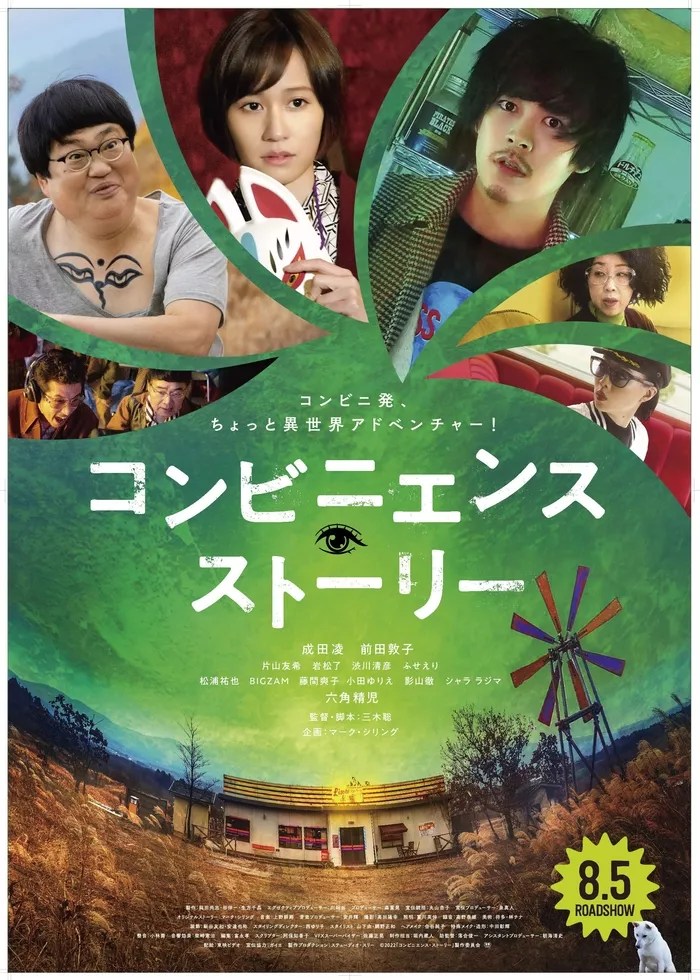
“This is unreal, but it’s real” a blocked screenwriter exclaims in finding himself in an uncanny world only slightly divorced from his previous reality but perhaps excellent fodder for his art. Quite clearly influenced by David Lynch in its Twin Peaks-esque setting, jaunty jazz score, and overt references to Mulholland Drive, Fire Walk with Me, and Blue Velvet, Convenience Story draws inspiration from a short story by veteran Japan Times critic Mark Schilling to spin an elliptical tale of otherworldly adventure and inexorable fate. 

Down on his luck screenwriter Kato (Ryo Narita) can’t seem to get an idea off the ground and is in an increasingly volatile relationship with aspiring actress Zigag (Yuki Katayama) whose dog Cerberus he barely tolerates. When he has to venture out in search of Cerberus’ favourite brand of dog food, Weredog, the adorable pooch accidentally deletes the screenplay Kato has been working on leading him to decide to abandon him in the remote countryside. However, after damaging a Buddhist statue, he stops at a random petrol station convenience store which looks like it hasn’t been touched since the 1980s. Sucked through some kind of portal, he finds himself in an alternate combini reality in the company of pretty damsel in distress Keiko (Atsuko Maeda) and her decidedly weird husband Nagumo (Seiji Rokkaku). 

As the film begins to head into The Postman Always Rings Twice territory, Kato begins to rejuvenate his creative mojo while Zigzag, who is about to get her big break working with an incredibly insecure director (Kiyohiko Shibukawa) and sleazy producer, wonders what’s happened to her dog and takes drastic steps to find out. “Life’s big chances come in an instant” the director insists, though for Kato time seems to have stopped while he contemplates the combini existence. After all, it’s called a convenience store for a reason. They have everything you’ll ever need so there’s no real reason to leave. Smarting from his creative block, Kato asks if convenience stores sell interesting stories and in a way they do, or at least this one and the one in his neighbourhood which may or may not be connected by some kind of cosmic combini network, conspire to feed his imagination so he can deliver a promising script to his eccentric editor (Eri Fuse). 

Then again, Keiko asks him if he writes about an ideal world or his personal reality and it’s a question that he can’t quite answer hinting that this strange alternate universe may be some kind of fever dream conjured up by his latent imagination. “A screenwriter’s job is to fantasise”, Keiko seductively tells him, though his editor and a producer with whom he had also exchanged a flirtatious email had previously giggled over his non-starter of a screenplay which they described as an embarrassingly chauvinistic male fantasy. That’s certainly one way you could describe his otherworldly combini adventure in the foxy damsel in distress characterisation of Keiko who quite obviously just wants him to take her away from all this, sick of the oppressive convenience of the combini life and of her incredibly strange, seemingly controlling husband. 

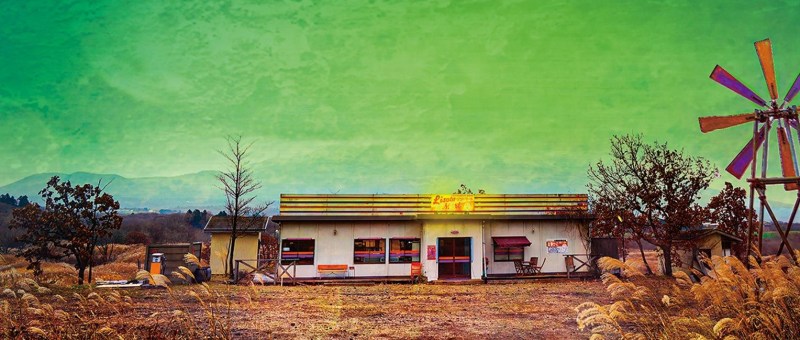
Then again on their attempt to escape, the couple end up in an endless three-day ceremony of eternity during which the souls of the dead are supposed to journey to the afterlife. Everyone is keen on travelling to another world, except perhaps for Kato who is already in one, yet struggles to escape the uncanny uniformity of the combini society. “Another world exists in here” Kato is creepily told on a visit to his local, much more contemporary though not all that different, convenience store beginning to realise that perhaps there is no real escape from this maddening world of convenience at least not for him. Shades of Orpheus and Eurydice guide him out of his purgatorial existence yet ironically only into more of the same until the inevitable, karmic conclusion. Fantastic production design adds to the sense of retro absurdity strongly recalling Twin Peaks in its use of ‘50s-style diners and the frozen in time petrol station road stop existing for some reason the middle of nowhere with no road in sight, while casting a note of fatalistic dread over the life of a blocked screenwriter who eventually comes to realise that convenience isn’t always quite what it’s cracked up to be.


Convenience Story screened as part of this year’s Fantasia International Film Festival.

Original trailer (English subtitles)

You’re Not Normal, Either! (まともじゃないのは君も一緒, Koji Maeda, 2021)

What’s so great about being “normal” anyway? As the title of Koji Maeda’s quirky screwball comedy You’re Not Normal, Either! (まともじゃないのは君も一緒, Matomo Janai no wa Kimi mo Issho) suggests neither of its heroes is quite in tune with the world around them but then again, is there really such a thing as “normal” or is it more that most people are making themselves unhappy by settling for less simply because they think that’s just how things are and resistance only makes you seem awkward? 

Nerdy cram school maths teacher Yasuomi (Ryo Narita) thought he was OK with being a little different, but just recently he’s begun to feel lonely and fears the possibility of being alone for the rest of his life. Perhaps inappropriately, he looks to one of his students, forthright high schooler Kasumi (Kaya Kiyohara), for romantic and life advice hoping that she will teach him how to be, or at least present as, more “normal”. Unbeknownst to him, however, Kasumi is not quite “normal” herself and is in fact obsessed with a tech entrepreneur, Isao (Kotaro Koizumi), who is all about a new and freer future in which humanity is freed from the burden of labour. Finding out that her crush is already engaged to Minako (Rika Izumi) the daughter of a hotel magnate, Kasumi hatches a plan to break them up while training Yasuomi in the art of seduction. 

Kasumi’s insecurities seem to be down to her failure in her middle school exams, attracted to Isao’s philosophies because they offer a possibility of freedom outside the rigid demands of academic success in Japan. She tells Isao in a not quite by chance meeting that she wants to become a teacher in order to expand children’s minds rather than force them into a fixed perspective as the rather authoritarian, rote learning system of education often does. Yet she also feels out of place among her peers whom she sees as vacuous always gossiping about part-time jobs and boys. She frowns at Yasuomi when he accidentally cuts the conversation dead with an awkward comment while attempting to chat up a pair of bubbly office workers in a bar, but often does the same thing herself while sitting with her high school girl friends who fall silent and then change the subject after she injects a little realism into their mindless chatter. 

Yasuomi had viewed himself as “normal” and never understood why others didn’t, noticing that people often stopped associating with him but not knowing the reason why. Obsessed with pure mathematics, over literal, and overstimulated by the complications of life he takes refuge in the forest and the sensory overload of its nocturnal creatures speaking quite eloquently about the beauty of numbers and actually fairly emotionally intelligent in his understanding of the two women. Resolutely failing at Kasumi’s Cyrano act, he comes into himself only when speaking more honesty much to Kasumi’s annoyance actually hitting it off with Minako who is herself just as lonely and alienated but perhaps wilfully trapped. 

Predictably enough, Isao isn’t exactly “normal” either or perhaps he is but only in the most depressing of ways, his rosy vision of the future delivered with more than a little snake oil and just as much sleaze. Minako may know what sort of man Isao is, that her marriage is largely a dynastic affair set up by her overbearing, authoritarian father, but she too may think this is “normal” and might have preferred not to have to confront her sense of existential disappointment while attempting to fulfil the role of a “normal” woman content with creating a comfortable space in which her husband can thrive.  

Romantically naive, Kasumi wonders how people come to fall in love informed by two relatively mature classmates that for them at least falling in love is a gradual process of increasing intimacy generated through casual conversation. This turns out to be pretty much true for Kasumi too, though in ways she didn’t quite expect watching as Yasuomi opens up to Minako and finding herself unexpectedly jealous while reluctant to let go of the idealised vision she had of Isao as some kind of messiah for a better Japan. There is something a little uncomfortable in the potentially inappropriate relationship between a student and her teacher even as the roles are, on one level at least, reversed but there’s also a kind of innocence in their childish friendship and later determination to start small and let things grow while abandoning the idea of the “normal” altogether to embrace their true selves in a freer future of their own creation. 


You’re Not Normal, Either! screens in Chicago on Oct. 7 as part of the 13th season of Asian Pop-Up Cinema 

Original trailer (English subtitles)
Remain In Twilight (くれなずめ, Daigo Matsui, 2021) [Fantasia 2021]

“So what? We just live on.” remarks a bereaved young man learning to let go of his grief in Daigo Matsui’s melancholy ensemble drama Remain in Twilight (くれなずめ, Kurenazume). Matsui sets the scene at a wedding which is also in some ways a funeral during which the ghost at the feast will eventually be laid to rest but his study in loss is also a reflection of its eternal arrest as a group of high school friends learn to accept a sense of absence where their friend used to stand while processing the various ways their lives have and will continue to diverge where as his obviously will not. 

As the film opens a group of six men is surveying a wedding hall where they intend to recreate a dance they first performed at a high school culture festival. The wedding co-ordinator comes out to confirm that everything is in order and seating has been arranged for the five of them only to be reminded that actually they are six. Factory worker Nej (Rikki Metsugi) wants to hang out longer, but most of the other guys have other commitments from work to family but at a rambunctious karaoke session the next day during which they regress to their high school selves it becomes clear that one of their number, Yoshio (Ryo Narita), passed away five years previously but is quite literally there in spirit. 

In addition to Yoshio’s absence, it’s clear that the group has become distant since their high school days the wedding reunion highlighting the class differences between them with some going on to regular salaryman jobs, others working in fringe theatre, and Nej at the factory the uniform of which he is ubiquitously wearing at every occasion other than the wedding during which the guys’ black suits are identical to those they wore for the funeral save the substitution of a jauntier bow tie. The previously nicknamed “Sauce” is now Mr. Sogawa (Kenta Hamano) and a married father of one. They aren’t 17 anymore. 

Nevertheless, the guys can’t let go of the memory of Yoshio who remains among them as if he were still alive. Triggered by a seemingly trivial act such as eating a biscuit or hearing a particular turn of phrase each of the men is called back into the past towards a private memory of Yoshio some directly related to the performance at the cultural festival which seems to have marked their lives and others from later. They collectively meditate on the last time they saw each other, reliving the event, trying to prevent Yoshio from leaving but of course failing. Actor Akashi (Ryuya Wakaba) regrets not picking up his phone, little knowing it would be the last time he would see his friend because you can’t get away from the fact every time might be the last you just can’t know. 

“You’re only dead when it’s convenient” Yoshio’s high school crush Mikie (Atsuko Maeda) barks, seemingly unperturbed to see him in the flesh but also angry and resentful asking him to finally cancel his social media accounts so she won’t keep getting birthday reminders or see something about him popup on her feed, remember, and be sad. But softening she shows him a picture of her daughter, signalling that she’s moved on while he obviously cannot though he wishes her only happiness glad perhaps to have shared something he lacked the courage to confess while alive. 

So corporeal does Yoshio seem to be that he even receives a goodie bag from the wedding, again signalling his absence as the guys find themselves literally carrying extra baggage which they eventually decide to try burying leading to a rather surreal incident which confronts them directly with Yoshio’s liminal status and survival in their hearts. Travelling to the other side they begin to learn to let him go, poignantly once again considering calling a taxi though this time for five. Adapting stage play, Matsui’s sweeping handheld camera shifts effortlessly from one time period to another and finally into another realm with a giddy ethereality as the men, now approaching middle-age, meditate on the sense of loss in grieving teenage friendship along with its unlived future. It’s less the ghost than those who are left behind who must finally learn to “move on”, rewriting the past as they see fit in order to walk into a freer future. 


Remain In Twilight streams in Canada until Aug. 25 as part of this year’s Fantasia International Film Festival.

International trailer (English subtitles)

Over the Town (街の上で, Rikiya Imaizumi, 2019)

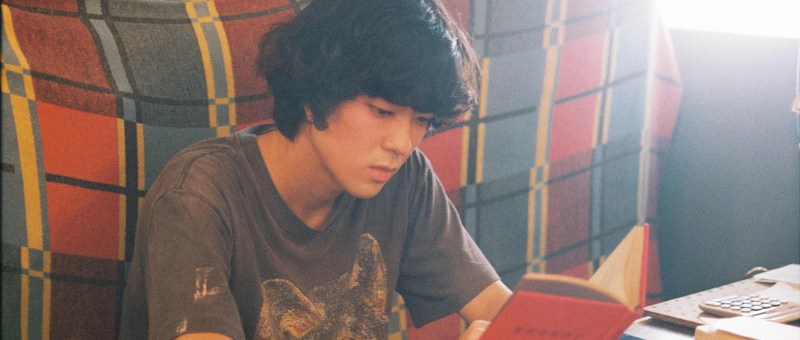
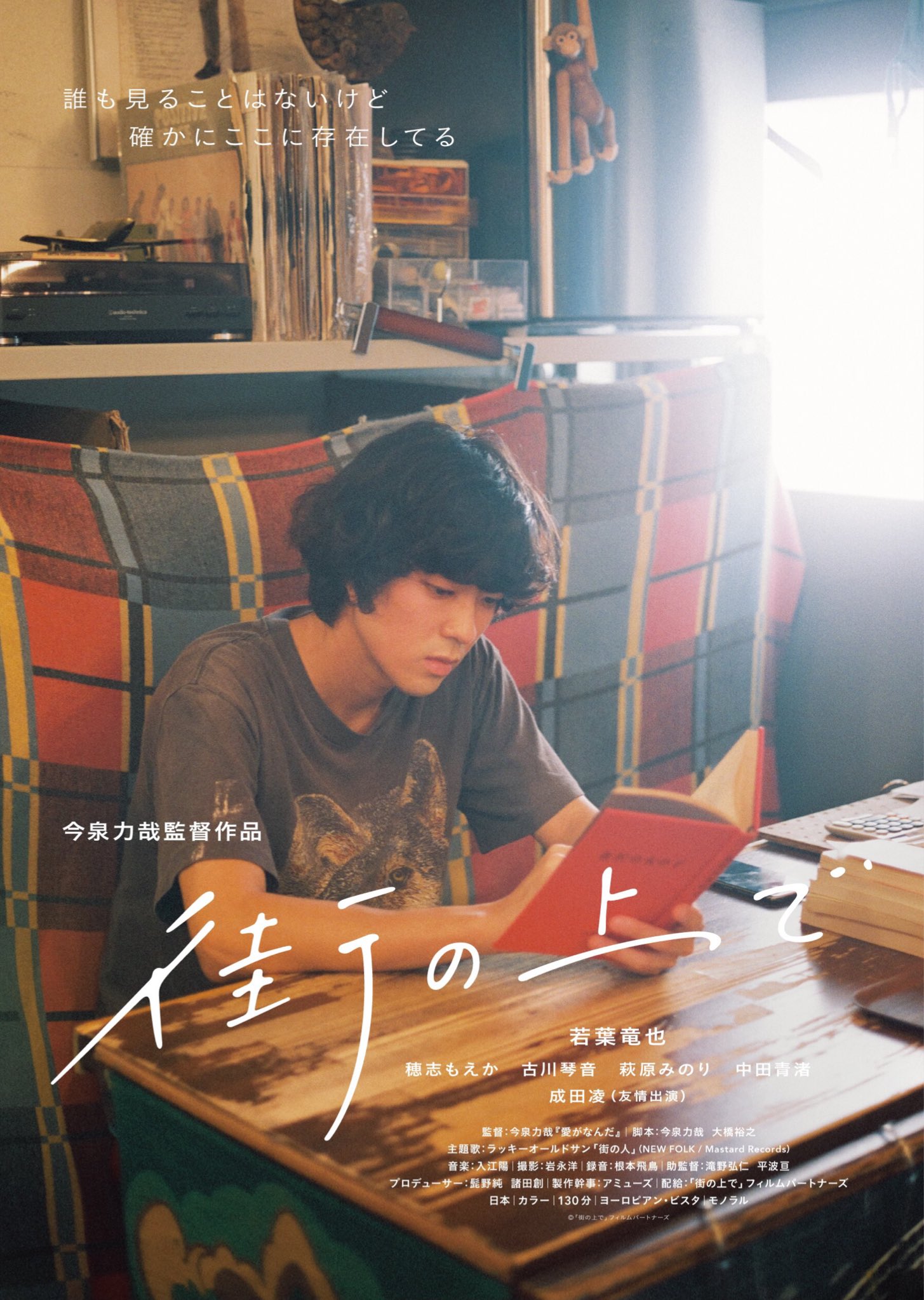
Frustrated youngsters chase an unrealisable dream of idealised romance in Rikiya Imaizumi’s ode to Shimokitazawa, Over the Town (街の上で, Machi no Uede). For the moment at least known as the bohemian, avant-garde artists quarter of the contemporary capital beloved for its slightly retro quality replete as it is with narrow lanes and period buildings, Shimokitazawa is also a place of constant change but as the hero later points out even if “parts change and disappear that doesn’t mean they never existed”. Nevertheless, he seems to be marked by a particular anxiety, as do many of his age struggling to make meaningful connections in an ever shifting world. 

Ao’s (Ryuya Wakaba) world begins to crumble when he’s unexpectedly dumped by his beloved girlfriend, Yuki (Moeka Hoshi), on her birthday. Unceremoniously telling him that she’s met someone else, Yuki rationalises that breaking up is the only option but Ao tries to resist only for her to tell him that he can go on deluding himself that he still has a girlfriend but from now on she’ll be hanging out with someone new. From then on, Ao seems to be surrounded by frustrated couples and worryingly outdated ideas of romantic politics such as those of the students who drop into the vintage clothing shop where he works. Ao assumes they’re a couple, but a row slowly brews as the girl, Asako, declares herself bored with helping the guy, Shigeru, try on clothes that turn out to be for the purpose of impressing a different girl altogether despite knowing that Asako fancies him. Eventually Shigeru makes a highly inappropriate suggestion, almost akin to a bet, that if the woman he has a crush on rejects him he’ll deign to dating her even though Asako is “a distant second” in his heart. The shocking thing is that Asako agrees, a slightly mournful look in her eyes as she finally reaffirms that she really hopes it works out with the other girl. 

Throughout the exchange during which Ao looks on as an awkward bystander, it becomes increasingly difficult to see what’s so great about Shigeru. Meanwhile, not even Ao comes off particularly well, struggling to deal with his breakup and refusing to accept Yuki has moved on. So hung up on her is he that she eventually ends up contacting the barman at his favourite haunt to ask him to have a word, explaining that it’s inappropriate to go on texting your ex even if she doesn’t reply. Meanwhile, he finds himself at the centre of romantic missed connection, captivated by a sad woman at a concert who gives him a menthol cigarette he keeps in his ashtray as a kind of talisman for the rest of the picture. Infinitely awkward, he talks himself out a potential date with the cute girl at his favourite used bookstore (Kotone Furukawa) by asking an inappropriate question, later doing something similar to a woman (Seina Nakata) with whom he makes a more platonic connection as they each reflect that for some strange reason it’s much easier to open up to someone you have no romantic interest in. 

Perhaps that’s why a melancholy policeman keeps stopping random people in the street to ask their advice on his peculiar romantic dilemma in having inconveniently fallen in love with his “niece” (by marriage and the same age as he is, so maybe it’s “OK”, he’d like to think). Shimokitazawa, which Ao rarely leaves, is indeed a small world, the various strands of his romantic entanglements strangely connected from a young woman’s unrequited longing for her sumo wrestler childhood sweetheart to a TV actor’s (Ryo Narita) troubled love life and a young film director’s (Minori Hagiwara) attempt to deflect her own sense of romantic disaffection. Just as Yuki used another man as an excuse to break up with Ao, Ao finds himself recruited as a fake boyfriend to help a young woman shake off a controlling ex whose refusal to accept the relationship is over in the absence of another man skews even darker than his own signalling perhaps like that first vintage shop exchange the dangerously outdated sexual politics which continue to underpin modern dating. Perhaps boring love is the real kind of fun, comfortable and balanced marked by true connection and mutual vulnerability rather than a giddy anxiety. A stubborn holdout where everything’s secondhand in a continual circulatory process of exchange and return, Shimokitazawa is the kind of place where love finds you even if it takes a while to wander on its way. A charming ode to this timeless yet ever-changing district, Imaizumi’s quirky dramedy keeps the neurosis of young love on the horizon but suggests that romance, like a well baked cake, keeps much better than you’d think when cooled.


Over the Town screened as part of the 2021 Osaka Asian Film Festival.

Original trailer (no subtitles)

Talking the Pictures (カツベン!, Masayuki Suo, 2019)

Famously, silent cinema was never really “silent” in Japan. As the quote from director Hiroshi Inagaki which appears after the end credits of Masayuki Suo’s ode to the early days of the movies Talking the Pictures (カツベン!, Katsuben!) reminds us, audiences always had the benshi to guide them. These narrators of film were often more of a draw than the pictures themselves, cinemagoers keener to see their favourite storyteller perform than the story up on screen. A relic of a bygone age, the benshi has often been blamed for holding Japanese cinema back as studios continued to craft their films around audience appetites for live performance, but as we’ll see even the benshi themselves could sense their obsolescence lingering on the horizon. 

Beginning in 1915, the film opens with a retro mockup of a Toei logo from the silent era though the studio was only founded in 1938 and therefore produced only sound movies. Shot as a silent picture the opening sequence follows a gang of kids as they make their way towards an active film set where a classic jidaigeki is in production, confused on passing what appears to be a woman peeing standing up against a tree, a reminder that early cinema was largely inspired by kabuki and therefore featured male actors playing female roles. This is a disappointment to young Umeko, the daughter of an itinerant sex worker, who dreams of becoming an actress. Shuntaro, a little boy obsessed with the movies and dreaming of becoming a benshi like his idol the marquee draw Shusei Yamaoka (Masatoshi Nagase), reassures her that plenty of films from other countries feature female actors as the pair bond sneaking into the local picture house together but as in any good melodrama they are separated by time and circumstance only to be reunited 10 years later when neither of them is quite living their best life. 

While Umeko (Yuina Kuroshima) is a struggling actress trying to make it in motion pictures, Shuntaro (Ryo Narita) is living as a “fake benshi” impersonating Yamaoka and others for clueless provincial audiences while the gang he’s running with rob local houses using the movies as a cover. Escaping with some of the loot, he rebrands himself as “Kunisada” after a favourite character from the silver screen and fetches up in his old stomping ground, getting a backstage job at the troubled picture house which finds itself at the mercy of the new outfit in town, a purpose built modern cinema run by local yakuza Tachibana (Fumiyo Kohinata) and his movie-loving modern gal daughter Kotoe (Mao Inoue). Like the film itself, the town is at the nexus of changing times. The Aoki cinema is housed in a former kabuki theatre with the staff dressing in kimono even if Shuntaro and his divaish rival Mogi (Kengo Kora) don suits to talk the pictures. The palatial Tachibana meanwhile boasts modern seating and has the habit of poaching the Aoki’s staff partly because they pay more and partly because no one wants to work with Mogi who is, in his own way, an exemplification of the ways the benshi can interfere with cinematic development in that he forces the projectionist to undercrank the movies to ensure they follow the rhythm of his narration and not vice versa. 

The handsome Mogi is still pulling in the crowds, but the ageing Yamaoka has become a melancholy drunk now convinced that his own art is an act of destruction, actively unhelpful in becoming a barrier between the audience and the movies rather than a bridge. After all, cinema is a visual medium, it shouldn’t need “explaining” in words. He’s actively standing in the way, imposing his own narrative over someone else’s vision just as Shuntaro is a “fake” benshi in that he merely copies the routines of others, adopting a “fake” persona while hiding out in the movie house from the gang he ran away from and the movie-loving cop (Yutaka Takenouchi) who’s chasing them. Yamaoka may have a point, the days of the benshi are numbered though there were those who argued the advent of the talkies was also a regression, the advances of the silent era squandered on the spectacle of sound. Nevertheless, filled as it is with silent-era slapstick, silly farce, melodrama, and romance, Talking the Pictures is a warm and nostalgic tribute to a bygone age of cinema and the men and women who guided us through it. 


Original trailer (no subtitles)

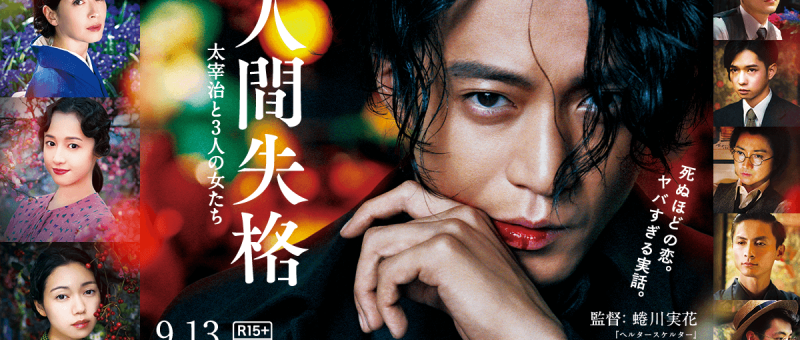
No Longer Human (人間失格 太宰治と3人の女たち, Mika Ninagawa, 2019)

Like a character from one of his novels, Osamu Dazai is remembered as a figure of intense romanticism, an image fuelled by his love suicide with a woman who was neither his wife nor the mistress with whom he had conceived a child. A proponent of the “I novel”, Dazai lived as he wrote, but crucially gives the hero of his final book, No Longer Human, a less destructive ending than he eventually gave himself in that he finally accepts his toxicity and chooses self-exile in the belief that he has fallen so far as to lose the right to regard himself as “human”. Mika Ninagawa’s biographical treatment of Dazai borrows the title from his most famous novel (人間失格 太宰治と3人の女たち, Ningen Shikkaku: Dazai Osamu to 3-nin no Onnatachi), but gives it a subtitle which pulls focus from the author himself towards the three women who each in their own way made him what he was. 

Yet what he was, in Ninagawa’s characterisation at least, was hollow. Late into the film, she includes a famous literary anecdote in which a young Yukio Mishima (Kengo Kora) turns up to a party where Dazai (Shun Oguri) is holding court following the publication of The Setting Sun and accuses him of being a poseur, a coward who writes endlessly about death but has no real intention of following through. That’s something of which he was often accused, having already failed to die as we see in the film’s opening in a love suicide in which the woman died calling out another man’s name. Intensely insecure, he carps on about being disrespected by the literary establishment, in fact using his final days and one of his last chances to pen an embittered screed against the famous authors who read but apparently did not care for his work. His editor despairs of him, resenting him not only for the debauched lifestyle which interferes with his writing but his essential caddishness that sees him both mistreat his loyal wife and use countless women as fuel for his art never quite caring about what happens to them afterwards. 

Dazai claims that Michiko (Rie Miyazawa), his legal wife and mother of his children, is OK with his affairs because it is “love in the service of art”. There is some truth in that, though as Michiko points out, Dazai himself would have no interest in a woman so passively self-sacrificing as that of Villon’s Wife. When the children catch sight of their father embracing another woman at a festival, she calmly tells them that he is “working” before pulling them on in embarrassment, putting up with it perhaps more because she has no other option than in respect for Dazai the great artist. 

Yet as his new lover Shizuko (Erika Sawajiri) claims, beautiful art comes from broken people, an idea which perhaps enables Dazai’s grandiose vision of himself as an unjustly dismissed literary genius. Just as Villon’s Wife was “inspired” by his relationship with Michiko, The Setting Sun is about Shizuko, only this time Shizuko is more collaborator than muse. He plunders her diaries and the most famous line from his novel, “Men are made for love and revolution” was in fact not written by him but stolen from her (she eventually asks for a co-writing credit but evidently did not get one, penning her own book instead). What she asks him for in return is a child, a strangely common request also made of him by Tomie (Fumi Nikaido), the woman with whom he eventually dies largely, the film suggests, because despite the longing for life that birth represents she pulled him towards death and he was too indifferent to resist. Dazai’s resistance, if you can call it that, is listlessness in which he has no desire to live but equally perhaps no real desire to die. 

Despite the foregrounding of the title, the three women are perhaps three paths he could take – the conventional as a husband and father, the radical as man standing equal with a woman who is not a wife with whom he births “a new art”, and finally the nihilistic “death” which is the route he eventually takes. With or perhaps for Tomie he writes the work he knows will destroy him in which he excoriates himself rather than her but, unlike in life, receives the gift of self-awareness and then lets himself (partially) off the hook. In Ninagawa’s visual complexity he is perhaps to an extent already dead, collapsing in the snow after haemorrhaging blood in the later stages of TB next to a red circle looking oddly like the flag of Japan only for white petals to begin raining down on him as if he were already in his coffin. We see repeated shots of shimmering water reminding us of his death by drowning, and for all of Ninagawa’s characteristically colourful compositions it’s the women who are surrounded by the vibrancy of flowers in full bloom never Dazai himself. On her husband’s death, Michiko can exclaim only (and ironically) that the sun has finally come out as she gets on with her life putting out the washing. Shizuko affirms that Dazai was the love of her life while asserting her own artistic identity in pushing her book which is an inversion of his. Meanwhile, Dazai has consumed himself, a cad to the last, overdosing on romanticism as an artist who fears he has nothing else to say.


Hong Kong trailer (English/Traditional Chinese subtitles)

Farewell Song (さよならくちびる, Akihiko Shiota, 2019)

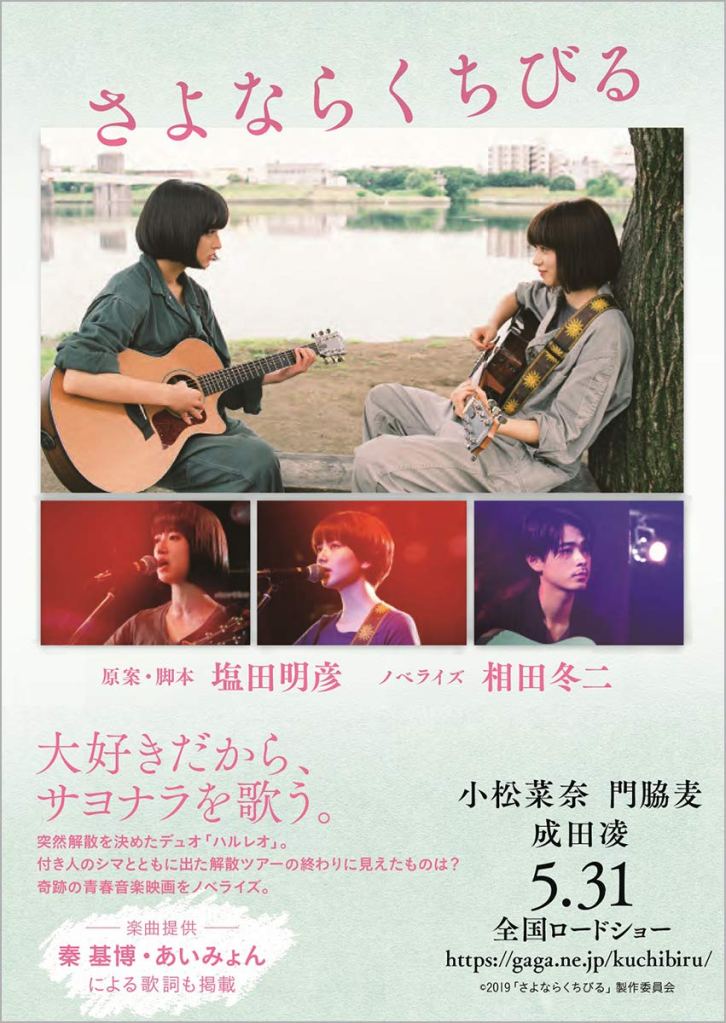
Repressed desire and toxic resentment conspire against a trio of melancholy musicians in Akihiko Shiota’s delicate indie drama, Farewell Song (さよならくちびる, Sayonara Kuchibiru). As the title implies, this is a tale of learning to let go, but then again perhaps not. As an over earnest interviewer suggests there are many ways to interpret the title song, but it also carries with it an unmistakable hint of defeatism as the singer songwriter heroine finds herself perpetually preparing to say goodbye, no longer believing in a positive future and unwittingly sabotaging its existence in an intense desire for protective distance. 

As the film opens in the summer of 2018, folk duo Haruleo is about to set off on a “farewell tour” though it’s not been advertised as such. The atmosphere is extremely awkward and emotionally volatile. Something has obviously gone very wrong in the previously close relationship between bandmates Haru (Mugi Kadowaki) and Leo (Nana Komatsu), while roadie Shima (Ryo Narita) seems to be doing his best to stay out of it and keep the peace if only until after they’ve played their final show in Hakodate way up in Hokkaido. 

That might be difficult however because Leo’s self-destructive streak is out in full force, wandering off with a rough-looking man from the petrol station where they stopped to use the facilities. “Aren’t you going to stop her?” Haru asks of Shima, entirely mistaken in the nature of their relationship, “What would be the point?” he replies, open mouthed in exasperation. Sure enough Leo turns up late to the gig and sporting a nasty bruise on her face after another encounter with a dark and violent man. “I don’t want to watch you fall apart”, Haru had told her on a previous occasion in an awkward attempt at comfort that finally backfired, Leo firing back that hearing that from her only made her feel even worse. Haru echoes those words herself when Shima tries something similar with her, only charged with a somewhat inappropriate fervour driven by misplaced desire. 

Desire is indeed circulating, but in an emotionally difficult and seemingly irresolvable love triangle between three people with extremely low self esteem. Struggling to accept love, they act on self-destructive impulse and only wound where they mean to console. Haru strikes up a conversation with Leo because she says that her “eyes wanted to sing”, seemingly captivated and taking the young woman in but still somehow maintaining a distance. Leo, who seems to have no family and is incapable of looking after herself, quickly bonds with Haru but is frustrated by her resistance to connection. When Haru interviews Shima for a position as their roadie, she’s quick to tell him that romance is prohibited, but later claims that she always expected he and Leo to run off together while silently pining for her in a mistaken belief that her love is hopeless. 

Filled with internalised shame, Haru takes Shima home as a beard to show off to her mother at her father’s memorial service, unable to disclose her sexuality and trying not to look hurt when her mother whips out a postcard from her first love who has since married abroad and had a child. Shima, strangely perhaps the most emotionally astute, is drawn to Haru even after learning that she is gay and realising that all of her songs are really about her unrealisable longing for Leo, who claims to be in love with him though it’s not exactly clear if that, like her tendency to disappear with dangerous men, isn’t a misdirected way of connecting with Haru.

Shima may have failed once and resolved to do better in avoiding making the same old mistakes, but is still an awkward third wheel in this increasingly difficult relationship despite his attempts to mitigate the effects of his presence while perhaps biased towards preserving Haru’s happiness in trying to “save” Leo. Learning that a close friend and former bandmate has passed away forces him, and perhaps the girls too, to reflect on what’s lost if you let important relationships fall by the wayside out of pettiness or pride. Shima’s friend apparently told his young son never to become a musician because it will rob you of the things that are most important. Still, Shima, echoing the words of Haruleo’s signature song, affirms that he regrets nothing. If it all ends in tears, Haru’s lyrics imply that she’s happy to live with the thorn in her side as a reminder of past love. The jury’s out on whether the Farewell Song leads to a new beginning or merely more of the same, perpetually trapped in an inescapable cycle of emotional frustration, but Haruleo seems resigned to weathering the storm whatever it is that might emerge on the other side. 


Original trailer (English subtitles)

Farewell Song music video

Code Blue: The Movie (劇場版コード・ブルー –ドクターヘリ緊急救命–, Masaki Nishiura, 2018)

Code Blue posterThe common complaint plaguing popular Japanese cinema is that it’s increasingly dependent on existing source material, not in only the prevalence of manga adaptations, but the continuing influence of TV drama. Ever since the massive success of the Bayside Shakedown franchise, big screen outings for popular series have been a mainstay of the Japanese film industry, the problem of course being, from a certain point of view, that their nature as an extension of an already existing narrative universe makes them not only impossible for export but also a potential audience turn off to those not already invested.

Code Blue is itself comparatively unusual in being one of the few Japanese TV dramas to head into multiple series. That being so, a movie was something of an inevitability, but like many medical shows which generally adopt a case of the week formula, Code Blue thrives on finely crafted characterisation. Rather than jump this obvious hurdle, director Masaki Nishiura opts for the time-honoured solution of a brief flashback highlighting the key events of the previous three seasons and otherwise tries to avoid too many references to past events. It remains true however that viewers already acquainted with the Doctor Heli team will be best placed to navigate the complex interpersonal relationships informing the rest of the action.

Those would be, chiefly, the unexpected return of aloof doctor Aizawa (Tomohisa Yamashita) who is about to take up a research position in Toronto, while Dr. Hiyama (Erika Toda) is also preparing to follow her dream by moving on to head up the perinatal department at a nearby hospital. As is stressed in the opening sequence for those who might not be aware, the Doctor Heli program does not airlift passengers by helicopter but drops doctors into emergency situations where they are most urgently needed. Aizawa’s arrival coincides with the forced return of a flight originally heading to Vietnam which experienced heavy turbulence with multiple casualties needing evacuation from the plane or treatment on the ground. One such patient turns out to be an especially difficult case seeing as she has not only sustained serious injuries, but is also suffering from stage 4 stomach cancer and was trying to take a last vacation in her final days.

The Doctor Heli team are deeply touched by Tomizawa’s (Kasumi Yamaya) plight, knowing that though her injuries would otherwise not be regarded as serious, she may well end up spending her remaining time in their ICU rather than doing the things she wanted while she could. A talk with her parents reveals a painful breakup and canceled wedding, neatly echoing a conflicted nurse desperately trying to get out of the, in her view unnecessary, wedding ceremony her fiancé has organised. Tomizawa’s former boyfriend (Mackenyu) eventually returns and apologises, hoping to make up for lost time, but she isn’t sure she should let him, not only because he let her down by running away, but because she fears that if she does she might prevent him moving on with his life after the inevitable occurs.

Despite being skilled at fixing the human body, the doctors confess they are often at a loss when it comes to the human heart. They struggle to communicate their true feelings to each other, keeping their minds on the job with well practiced practicality, but are all too aware of the precariousness of being alive. What they all advise is that it’s best to let the people you love know your true feelings because you never really know if there will be another opportunity. Dependable leader Shiraishi (Yui Aragaki) can’t quite find the words to express her feelings for her soon to be departed best friend Hiyama, while she struggles with her essential “awkwardness” yet has a knack for the good kind of “direct”, always knowing the right words to help people feel better.

Aizawa, who had no family of his own, is stoical and patient with those of others, comforting a young man who’s gotten into a car accident with the abusive father he’d tried to reconnect with, letting him know that there was nothing wrong in his rage or resentment but also nothing wrong in his desire to tell him that he has become a fine man on his own and that his father’s violence has not destroyed him. Likewise, a young nurse, Futaba (Fumika Baba), gets an unexpected shock when her older sister brings their alcoholic mother (Rino Katase), from whom she’d become wilfully estranged, into the hospital after she fell and got a kitchen knife stuck in her head. Aizawa tells her that she did what she needed to do and shouldn’t feel guilty about “abandoning” her mother, but also gives her the space to reconnect with her as she begins to understand a little of her mother’s suffering.

You can’t deny that Code Blue: The Movie (劇場版コード・ブルー –ドクターヘリ緊急救命–, Gekijoban Code Blue Doctor Heli Kinkyu Kyumei) is basically a two hour TV special, shot exactly like the TV series with seemingly no increase in budget or production values, but it topped the Japanese box office and obviously provided fans with exactly what they were looking for. A little less melodramatic than might be feared, the series’ big screen finale (?) is unabashedly emotional but celebrates as much the close bonds between the Doctor Heli team as those with their patients as they face the unthinkable time and again but get through it together.


Teaser trailer (no subtitles)

https://www.youtube.com/watch?v=nhbuZpcdHTo