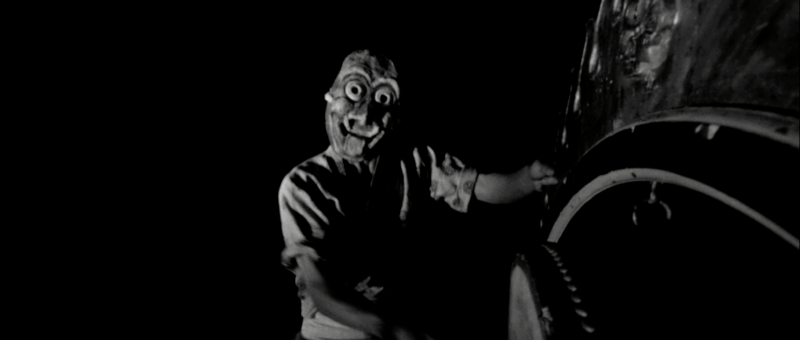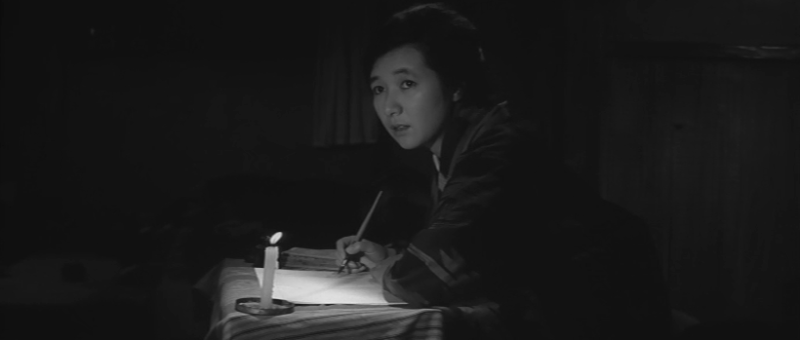
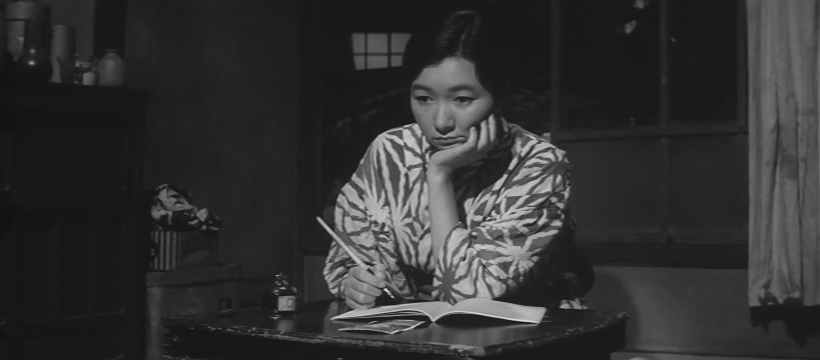
A Wanderer’s Notebook (放浪記, Mikio Naruse, 1962)

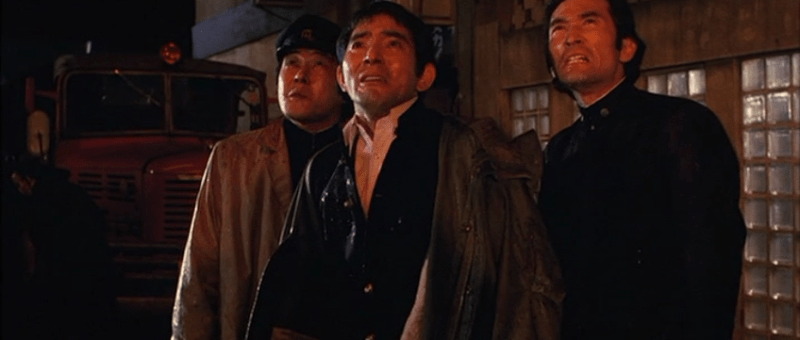
Many of Mikio Naruse’s most famous films are adapted from the work of Fumiko Hayashi, a pioneering female author who chronicled the life of a working class woman with startling frankness. Yet his dramatisation of her life, A Wanderer’s Notebook (放浪記, Horo-ki), is both a little more reactionary than one might have expected and surprisingly unflattering even in the heroine’s eventual triumph in escaping her poverty through artistry. Even so if perhaps sentimentalising the economically difficult society of the 1920s in emphasising the suffering which gave rise to Hayashi’s art, the film does lay bare the divisions of class and gender that she did to some extent transgress in pursuit of her literary destiny. 

Naruse and his screenwriters Toshiro Ide and Sumie Tanaka bookend the the film with a literal “lonely lane” which the young Fumiko walks with her itinerant salespeople parents. As a small child, she sees her father arrested for a snake oil scam peddling some kind of wondrous lotion, setting up both her disdain for men in general and her determination not to be deceived by them at least unwittingly. She has no formal education but is a voracious reader well versed in the literary culture of the time and intensely resentful of if resigned to her poverty. In the frequent sections of text which litter the screen taken directly from her novels, she details her purchases, wages, and longing for the small luxuries she can in no way afford. 

As an uneducated woman in the 1920s her working opportunities are few. She exasperatedly relates standing in a queue with hundreds of other women waiting for an interview for a company job only to be told they’ll let her know, while her other opportunity involves meeting a theatre director at a station who later takes her to his hotel/office and makes it plain he’s not really interested in her CV. She gets a job at the office of a stockbroker, but lies about being able to do accounts and is flummoxed by double entry bookkeeping getting herself fired on day one. After a brief stint in factory painting toys, she leaves with a friend to become a hostess but is also fired on her first day for getting drunk and being unwilling to ingratiate herself with the boorish men who frequent such establishments. 

Despite her animosity, she is drawn towards men who are callous and self-involved, firstly taking up with a poet and actor who praises her work but turns out to have several “wives” on the go, and then begins living with a broody writer, Fukuchi, who is insecure and violent, resentful at her success in wake of his failure. Perhaps because of her experiences, she seems to resent any hint of kindness though sometimes kind herself, lending money to her friend whose mother is in need and often ready to stand up for others whom she feels are being mistreated. A kindly widower in the boarding house where she lives with her mother, Yasuoka, falls in love with her but she repeatedly rejects him partly as someone suggests because he is not handsome, but mainly because of his goodness and kindness towards her. Nevertheless, he continues to support always ready in her time of need though having accepted that she will never return his feelings or accept his proposal. 

Perhaps her might have liked to have been kinder, but was too wounded by her experiences to permit herself. In any case at the film’s conclusion in which she has achieved success and in fact become wealthy it appears to have made her cold and judgemental. She instructs her maid to send a man away believing he is from a charity set up to help the poor, insisting that the poor must work for industry is the only path out of poverty implying that as she managed it herself those who cannot are simply not applying themselves when she of all people should know how fallacious the sentiment is. As if to bear out the chip on her shoulder, she forces her mother to wear a ridiculous kimono from a bygone era that is heavy for an old woman and makes her feel foolish because of her own mental image of the finery she dreamed of providing her on escaping the persistent hardship of their lives. 

As she says, she’s no interest in the socialist politics espoused by the literary circles in which she later comes to move, pointing out that the poor have no time for waving flags. One of her greatest supporters is himself from a noble family despite his progressive politics and in truth can never really understand the lives of women like Fumiko. He describes her work as like upending a rubbish bin and poking through it with a stick, at once fascinated and repulsed by a frankness he may see as vulgar. At one point he accuses her of writing poverty porn, playing on her humble origins for copy and becoming something of a one note writer. 

In truth, the film is not really based on the novel from which it takes its title but on the play that was adapted from it, while the novel itself was apparently reworked and republished several times in response to reader taste giving rise to a series of questions both about its essential authenticity and what it was that it was attempting to convey. In the film at least, moments after her literary success, Fumiko is challenged by a fellow female writer, Kyoko, who was once her love rival, that she cheated in a contest by failing to submit Kyoko’s entry until after the deadline had passed, though as it seems she would have won anyway. She is occasionally underhanded, perhaps because she feels she has no other choice, but then as we can see there is no particular solidarity between women save the kindly landladies who often let her delay her rent payments. Fumiko feels herself to be alone and her quest is not really for literary success but simply for her next meal, though she feels the slights of the bitchy women and arrogant men who mock her commonness while simultaneously exploiting it as entertainment. 

On the one hand, her success seems to signal a triumph of independence having freed herself from the need to depend on terrible men though she also she seems to have met and married a warmhearted painter who cares for her and supports her work while she has also been able to give her mother the level of comfort they both once dreamed of. Even so, the unavoidable fact that she dies at such a young age implies she’s worked herself into an early grave in a sense punishing her for her rejection of contemporary social norms undercutting her achievements with some regressive moralising while the one thing she still desires, rest, is given to her only in death. In Takamine’s highly stylised performance, as some have implied perhaps intended to mimic the silent screen, Fumiko is at once a carefree young woman who dances and sings and a melancholy fatalist with a self-destructive talent for choosing insecure and self-involved men, but above all else a woman walking a lonely road towards her own fulfilment while searching for a way out of poverty that need not transgress her particular sense of righteousness. 


Original trailer (no subtitles)
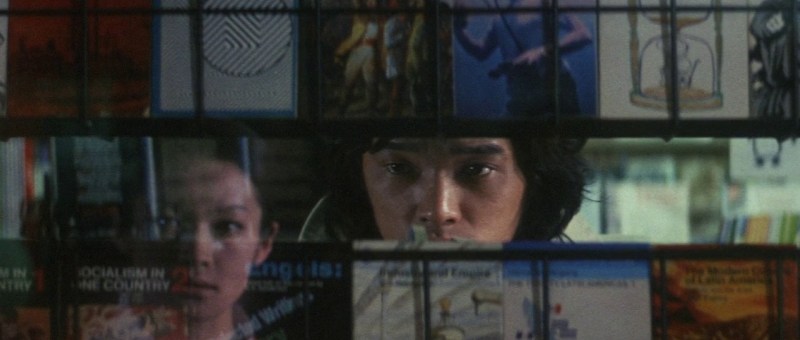
The Petrified Forest (化石の森, Masahiro Shinoda, 1973)

An angst-ridden medical student wrestles with truth and responsibility while drawn into a toxic relationship with a childhood friend and trying to avoid the estranged mother he resents in Masahiro Shinoda’s dread-laden melodrama The Petrified Forest (化石の森, Kaseki no Mori). Based on a novel by Shintaro Ishihara who later became a very conservative mayor of Tokyo and made his name with a series of “Sun Tribe” novels centring on the nihilistic hedonism of wealthy post-war youth, Shinoda’s noirish drama paints contemporary Tokyo as a duplicitous place in which hate is the only possible emotion and self-delusion the only path out of existential loneliness. 

Haruo’s (Kenichi Hagiwara) first conflict, however, is with the medical profession. He objects to the old-fashioned methods of his professor, Miyaji (Torahiko Hamada), who adopts the position of the physician as god only giving his patients the information he thinks they should have rather than the truth. A young boy, Kazuhiko (Masami Horiuchi ), is brought in with an aggressive brain tumour. Given how how quickly it regrows, there is a possibility that the boy cannot be cured while operating will likely mean he will lose his hearing. Though Miyaji knows all of this, he continues to give false reassurance to the boy’s mother, Kikue (Masako Yagi), even after making a snap decision on the table to excise the tumour knowing it will leave him deaf telling her that her son’s hearing might come back in time. Pressed for an answer, Haruo gives her the more honest prognosis that it “might”, “if he’s lucky”, but resents himself for “lying” knowing that Kazuhiko will be deaf all his life and the tumour may still recur. One of the reasons he wants Miyaji to tell the truth is so that the family can accept the situation and start working on the best ways to help Kazuhiko adjust, but Miyaji refuses to explain and in fact threatens to fire him if he won’t do as he’s told.

This resistance to a male authority figure might explain why he identifies so closely with childhood friend Eiko (Sayoko Ninomiya) now in Tokyo working at a barber’s offering male beauty treatments. Eiko is being sexually harassed by her middle-aged boss who is jealous and possessive. At one point she claims that he beat her and locked her up in a cupboard for two days after she told him she had slept with Haruo. The pair agree that he boss needs to die, rebelling against his corrupt and patriarchal authority. ”When you hate you must hate all the way” Haruo insists, explaining that the human race is “petrified”. They can only hate and loathe and lie to themselves in order to bear it. Haruo suggests they’ll eventually come to hate each other, but Eiko is certain that he’s her one exception though as will be revealed hate is eventually where they will end up. 

Fascinated by a high tech pesticide supposedly discovered by the Germans while they were testing poisonous gases but perfected by Japan Pharma, Haruo decides to use it poison to Eiko’s boss suggesting she put it in nail varnish and offer him a manicure. But once the deed is done he finds himself conflicted, unable to live with himself as a murderer which he now is seeing as he was present and applied the gauze soaked in the poison to the boss’ face while “treating” him after he had been “taken ill”. He distances himself from Eiko who irritates him by bringing over her hoover, somehow confused by her intention to move in now that they are married not least by their crime. Eiko, however, allies herself with his estranged mother Tatsuko (Haruko Sugimura) who is desperate to live with Haruo as it turns out by any means possible. 

There is an undeniable whiff of misogyny in the depiction of the two women, Eiko less damsel in distress than wilful manipulator and Tatsuko a classic overbearing mother though one apparently indifferent to her other two children including an apparently doting younger son. Haruo is caught between the two while otherwise drawn to Kikue in part because of her relationship with her son laying bare the apparent mother complex which defines his life as Eiko eventually points out calling him a coward who secretly craves his mother’s approval. Haruo’s resentment towards Tatsuko stems from having caught her with another man, his reaction both sexual jealously and puritanism unable to forgive for the transgression of adultery. Yet history later repeats itself, Kazuhiko who is at that point deaf walking in on Haruo and his mother. Haruo hugs him and covers his eyes only for the boy to later lose his sight and Kikue to go out of her mind wailing that she has destroyed her son through her sexual transgressions. 

Kikue had taken Haruo to a strange cult where she hoped Kazuhiko would be cured though he wouldn’t enter the church and later got into a conversation with the monk who is a former doctor but now believes medicine is a con because it cannot offer you salvation tacitly agreeing with Haruo’s assertion that doctors too are dishonest. This tendency to hate has rendered everyone lonely, Tatsuko’s daughter reminding her that she is lonely too even with her husband and children while Tatsuko later cruelly uses Eiko’s loneliness against her as a tool of manipulation. “Eiko trusted me too much” she explains, her attempt at female solidarity and forging a bond through their shared desire to possess Haruo obviously failing to overcome Tatsuko’s matriarchal machinations. The eerie blue colour of the poison vial, mirrored in the nebuliser forever used by Tatsuko, seems to loom behind them as a reminder of human loathing while mother and son are frequently caught in multiple mirrors in an echo of their duplicity yet in the end as Tatsuko says they share the same sin and it seems Haruo will never really be able to escape the matriarchal net.


Dead Angle (白昼の死角, Toru Murakawa, 1979)

The jitsuroku yakuza movie which had become dominant in the mid-70s had often told of the rise and fall of the petty street gangster from the chaos of the immediate post-war era to the economically comfortable present day. The jitsuroku films didn’t attempt to glamourise organised crime and often presented their heroes as men born of their times who had been changed by their wartime experiences and were ultimately unable to adjust themselves to life in the new post-war society. Adapted from a serialised novel by Akimitsu Takagi which ran from 1959 to 1960, Toru Murakawa’s Dead Angle (白昼の死角, Hakuchu no Shikaku) by contrast speaks directly to the contemporary era in following a narcissistic conman who has no need to live a life of crime but as he says does evil things for evil reasons. 

Prior to the film’s opening in 1949, the hero Tsuruoka (Isao Natsuyagi) had been a law student at a prestigious Tokyo university where he nevertheless became involved in the Sun Club, a student financial organisation launched by mastermind Sumida (Shin Kishida) who eventually commits suicide by self-immolation when the organisation collapses after being accused of black market trading. An unrepentant Tsuruoka resolves to start again, rebuilding in the ashes as a means of kicking back against hypocritical social institutions and rising corporate power by utilising his legal knowledge to run a series of cons through the use of promissory notes to prove that the law is not justice but power. 

In this Tsuruoka has an ironic point. He doesn’t pretend what he’s doing is legal, only that he’s safeguarded himself against prosecution. When a pair of yakuza thugs break into his office and threaten him in retaliation for a con he ran on a shipping company, he reminds them that as they’ve had him open the safe it would make the charge of killing him robbery plus murder which means automatic life imprisonment rather than the few years they might get for simply killing him without taking any money. He always has some reason why the law can’t touch him, while implicitly placing the blame on his victims who were often too greedy or desperate to read the small print and therefore deserve whatever’s coming to them. In at least one case, Tsuruoka’s victimless crimes end up resulting in death with one old man whom he’d double conned, pretending to give him the money he was owed but getting him drunk and talking him into “re-investing” the money with him, takes his own life by seppuku in the depths of his shame not only in the humiliation of having been swindled but losing his company, who had trusted him, so much money. 

You could never call Tsuruoka’s rebellion an anti-capitalist act, but it is perhaps this sense of corporate tribalism symbolised by the old man’s extremely feudalistic gesture that Tsuruoka is targeting. As his wife Takako (Mitsuko Oka) tells him, Tsuruoka should have no problem making an honest living. After all he graduated in law from a top university, it’s not as if he wouldn’t have been financially comfortable and it doesn’t seem that the money is his primary motive. While Takako continues to insist that he’s a good person who wouldn’t do anything “illegal”, his longterm geisha mistress Ayaka (Yoko Shimada) knows that he’s an evil man who does evil things for evil’s sake and that’s what she likes about him. Elderly businessmen are always harping on about the “irresponsible youth” of the day but all are too quick to fall for Tsuruoka’s patter while he is essentially nothing more than a narcissist who gets off on a sense of superiority laughing at the law, the police, and the corporate landscape while constantly outsmarting them. 

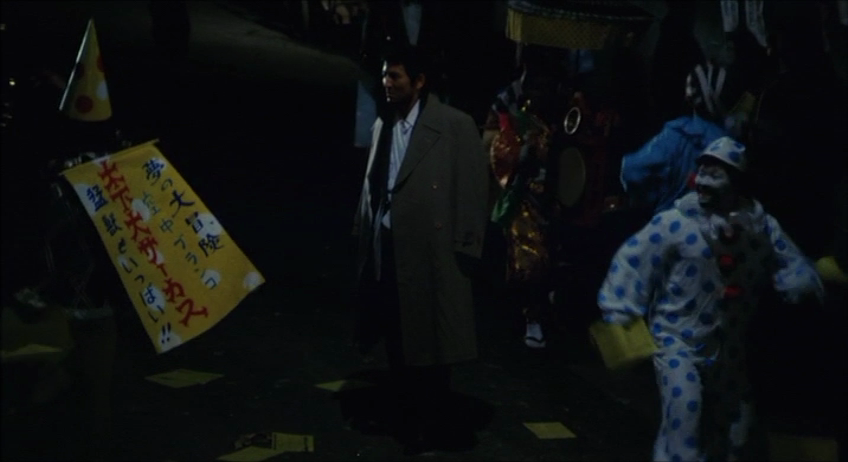
In this, the film seems to be talking to the untapped capitalism of the 1970s. Like Tsuruoka, the nation now has no need to get its hands dirty and should know when enough is enough but is in danger of losing sight of conventional morality in the relentless consumerist dash of the economic miracle. That might explain why unlike the jitsuroku gangster pictures, Murakawa scores the film mainly with an anachronistic contemporary soundtrack along with the ironic use of saloon music in the bar where Tsuruoka’s associates hook an early target, and the circus tunes which envelope him at the film’s opening and closing hinting that this is all in some ways a farce even as Tsuruoka is haunted by the ghosts his narcissistic greed has birthed. Then again perhaps he too is merely a product of his times, cynical, mistrustful of authority, and seeking independence from a hypocritical social order but discovering only failure and exile in his unfeeling hubris. 


Original trailer (no subtitles)
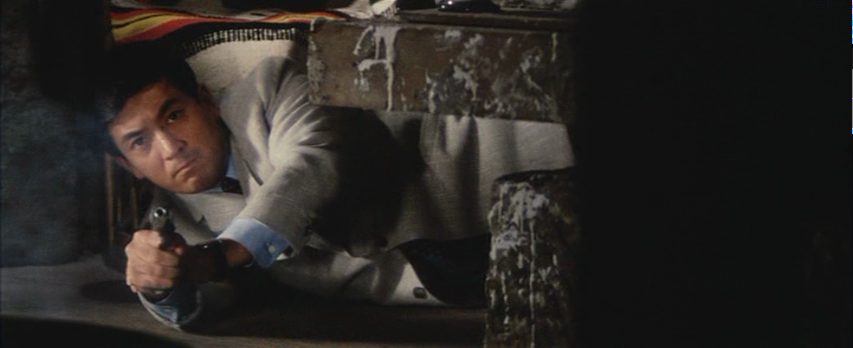
Bullet Wound (弾痕, Shiro Moritani, 1969)

“Your love for your country can’t change anything now” the conflicted hero of Shiro Moritani’s conspiracy thriller Bullet Wound (弾痕, Dankon) is advised as a villainous chaos agent attempts to convince him to switch sides. Like many of Toho’s gunman dramas of the late ‘60s, Bullet Wound anticipates the cinema of paranoia which would take hold in the following decade set against the constant anxiety of the ANPO protests while the Japanese-American CIA agent hero struggles with his uncertain place in a world of geopolitical instability. 

Takimura (Yuzo Kayama) is a man with two countries, born in the US to Japanese parents but later orphaned, now working for the CIA in Japan. Perhaps tellingly, we can’t initially tell what side he’s on even as he tries to prevent an assignation attempt on some kind of dignitary connected to the US. The main crisis occurs when Takamura helps a Chinese man, Yang (Shin Kishida), escape a trade summit in order to defect and chase freedom in America. The Americans, however, then torture him until he finally admits that he’s a stooge, the defection was merely a means of getting him into the US as a spy while the trade delegation is only a front for an upcoming arms deal with a international smuggler known as “Tony Rose” (Andy Seams). Takimura and his team are obviously keen the transaction not take place, but are unable to take Rose out because as Takimura’s boss points out they’ve used him too and he’s too well connected. If they move against him, someone will move against them. 

The Chinese arms deal is linked back to a sense of cold war paranoia which spreads to the young students protesting the ANPO treaty. Takimura’s boss calls them “terrorists” unable to understand how there can be Japanese people who could do this to their own country seemingly unaware of the minor irony in his statement. Meanwhile, he prepares to sacrifice Takimura as need be, callously remarking that a man with two countries who can’t choose between them can be dangerous while admitting that his services have been useful to the Americans but they may not always be so. The Americans meanwhile make crass racist remarks while chasing down the Chinese spies, taking altogether too much pleasure in eradicating them while the hitherto stoical Takimura looks on with disapproval mixed with hurt and shame beginning to wonder if he’s really on the right side. “You and the US will never defeat us” his rivals insist, revealing a mind-blowing piece of info that sets Takimura on a collision course with fate. 

Meanwhile, a strange young artist crafts horrifying statues displaying the “agony of loneliness” and longs to escape Japan for South America where they apparently have the best stone. But as someone later tells her, the desire to go to a new land is not born of hope, and expectations are almost always betrayed. Only love can change everything into hope he tells her, as she pins hers on running away with Takimura while he tries to tie up a few loose ends. Yet there’s also a kind of fatalism that defines their relationship, Takimura reflecting on watching a man die up close and haunted by the searching look in his eyes as if he were trying to understand the meaning not of life but of death. An ironic street singer sings a sad song about those who die and what they leave behind, the soldier apparently leaving not a trace of peace. 

The implication is perhaps that Takimura’s dual nationalities are not viable, that a man with two countries cannot escape by choosing a third nor can he survive without sacrificing one or the other. Meanwhile, Moritani slides into anti-Americanism painting the CIA as duplicitous and exploitative as they simultaneously demonise the Japanese and position men like Tony Rose as international chaos agents destabilising the global order. Handheld photography adds to the sense of anxious immediacy and confusion as Takimura attempts to define his own identity only to discover perhaps that he no longer has one caught as he is between two nations as two selves at the heart of a silent war. 


Kill! (斬る, Kihachi Okamoto, 1968)

“Samurai aren’t as great as you might think” according to a jaded retainer in Kihachi Okamoto’s Kill! (斬る, Kiru) but it’s a message that the ambitious farmer at the film’s centre struggles to take in. Having been a victim of samurai violence he resolves to become a samurai while a former samurai turned yakuza drifter attempts to show him the hypocritical realities of the samurai life as they find themselves swept into local intrigue when a band of young revolutionaries arrive to cut down a corrupt and oppressive lord. 

Corrupt and oppressive is perhaps the defining image of the samurai in post-war cinema, but like the film’s title that cuts both ways. Farmer Tabata (Etsushi Takahashi) sold his lands to buy a sword after witnessing peasants cut down during an uprising but he’s decided the best way out of oppression is to become an oppressor and is dead set on achieving samurai glory through the time-honoured method of distinguishing himself in battle. That may prove a little difficult given that his new boss, Ayuzawa (Shigeru Koyama), immediately mocks him for swinging his sword as if it were a scythe. Then again as former samurai Genta (Tatsuya Nakadai) explains to him, if you don’t know what you’re doing you can always just stab people which at the end of the day does rather undermine the idea of samurai elegance in the art of killing. 

Genta keeps trying to tell Tabata that “samurai are no good” but Tabata still wants to be one anyway even after learning that Ayuzawa means to double cross them, hiring ronin to take out the young samurai whose sense of honour he manipulated to eliminate the admittedly corrupt (but aren’t they all?) lord for his own political gain while planning to send in his retainers to finish off the job to ensure there are no witnesses. Genta gave up his samurai status because he was “disgusted” by just this sort of duplicity along with the meaningless codes of loyalty that govern samurai society and caused him to betray a friend who was acting only in the interests of justice. Leader of the ronin Jurota (Shin Kishida) did something similar though in his case for love when his fiancée’s father was condemned on false charges and she and her mother exiled. He wants not land or status but only money in order to redeem the woman he loves from a geisha house and like Genta is under no illusions about the nature of samurai life having figured out most of what’s going on but hoping to emerge with the means to liberate both himself and his wife from samurai oppression. 

Even the elderly chamberlain later rescued by Genta tries to warn Tabata that the samurai life isn’t all it’s cracked up to be, hinting at the ways they are also oppressed by their own code while clearly gleeful to have had the opportunity of stepping into a teahouse for the first time responding to Genta’s request to stay put that if he could he’d like to stay put for the rest of his days. Both former samurai, neither Genta nor Jurota are minded to draw their swords knowing that whatever the outcome it would be unhappy while the young who thought it was their duty to change the world by removing one who brought shame on their names are faced with the realisation that they have been used and their resistance will count for nothing. Even their bond as brothers banding together to achieve a common goal is eventually disrupted by alcohol and petty jealousy.

Genta acts as a kind of chorus, touched by the naivety of the seven samurai holed up in a mountain lodge because they believed in justice, while knowing that the society itself is innately unjust and already beyond redemption. Tabata eventually comes to a similar conclusion having gained samurai status but found it quite literally uncomfortable deciding to shake off his newfound nobility and rejoin Genta as a cynical yet pure hearted wanderer because the only way to escape samurai oppression is to actively live outside it. The final irony is that it’s the elderly chamberlain who eventually sets him, and all they women trapped in indentured servitude at the geisha house, free using samurai gold to enable them to escape a system he himself cannot escape but does not exactly support while Genta enlists the help of local peasants to hold a festival of rebellion to cover the final assault. Marked by Okamoto’s characteristically absurd humour and cartoonish composition along with the eerily gothic emptiness of the deserted ghost town where not even yakuza can survive the film takes on a quasi-spiritual dimension in which Genta and the gang eventually walk out of hell if only into a purgatorial freedom. 


Kill! screens at Japan Society New York on Sept. 2 as part of the Monthly Classics series.

Original trailer (no subtitles)
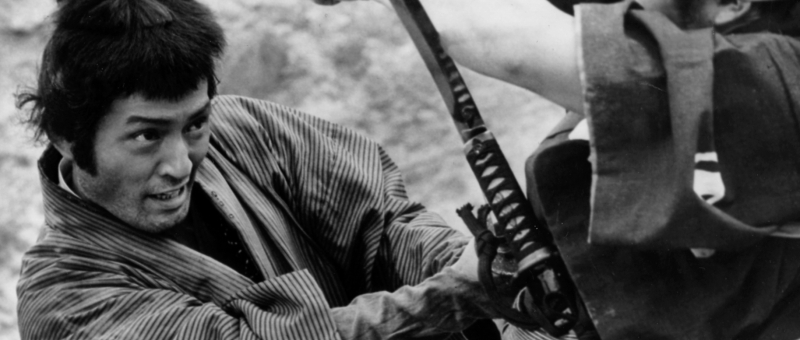
Sun Above, Death Below (狙撃, Hiromichi Horikawa, 1968)

“Fighting is the only way I have to live my life” according to a hitman battling existential ennui in Hiromichi Horikawa’s Toho action B-movie, Sun Above, Death Below (狙撃, Sogeki). A starrier affair than the studio’s other forays into moody crime, Horikawa’s psychedelic exploration of a killer drawn to death nevertheless situates itself very much in the world of 1968 in which the hero’s attempt to escape his sense of emptiness through killing is directly linked to an increasing economic prosperity and its concurrent costs in the nation’s current geopolitical positioning. 

As if to signal this sense of societal anxiety, the first target Matsushita (Yuzo Kayama) knocks off is sitting in the back row of the last carriage on the Shinkansen out of Tokyo. His next job, however, will apparently be more complicated. A criminal gang want him to take out “five or six” targets at a specific location in order to intercept a fortune in gold smuggled by, as later becomes clear, an international Chinese gangster, though the men at the waterside greet each other in Arabic. The hit does not go entirely to plan but Matsushita is later able to bring the situation under control allowing the gang to get their hands on the gold. The smugglers, meanwhile, are obviously unhappy with this turn of events and send in their best hitman (Masayuki Mori), who permanently travels with a blonde companion, to take back what’s theirs. 

Matsushita is a killer for hire so he doesn’t really care very much about the gold and is even annoyed when the gang try to pay him with it, correctly surmising they didn’t really expect him to succeed so haven’t bothered bringing any cash. As he explains to love interest Shoko (Ruriko Asaoka), he doesn’t really care about anything. He simply shoots at the best target, man, with his favourite gun. He kills to feel alive, explaining that the intense concentration in which he becomes one with the gun as if it were an extension of his own body allows him to overcome his sense of existential dread which is why he’s so ice cool all the time. 

A fashion model obsessed with rare butterflies and the paradise to be found New Guinea Shoko dreams of a time in which they can become one under the sun, envisioning a future in which Matsushita has become friends with all the creatures of the forest. Yet as Matsushita tells an old friend, Fukazawa (Shin Kishida), running a secondhand gun shop near a US army base as a front for his revolutionary activities, he has no dream or ideal and knows nothing other than killing. Whereas as his friend is apparently working for some kind of never quite explained but seemingly left-wing/anarchist cause, Matsushita simply lives out his days of emptiness on some level knowing he’ll probably never make it to Shoko’s New Guinean utopia. 

Fukazawa nevertheless hints at the political instability all around them, firstly agreeing to pawn a gun for a pair of Americans after beer money, and then by handing Matsushita an AK47 apparently smuggled back from Vietnam via the American base. Matsushita’s sense of ennui is born of this growing unease with empty capitalistic consumerism and a concurrent sense of powerless in Japan’s ongoing complicity with American foreign policy in Asia. Displaying a sense of Sinophobia familiar from many similar films of this era, the big boss turns out to be Chinese while many that surround him are also from outside of Japan even if Matsushita’s rival is just a slightly older, crueller version of himself. 

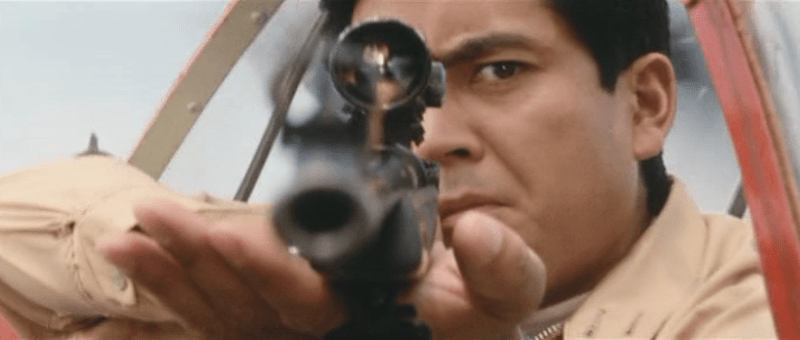
One of Toho’s more serious crime dramas, Horikawa often veers into experimental territory with his psychedelic butterfly imagery Matsushita apparently having some kind of vision while experiencing carnal ecstasy that equates climax with literal gunshot, while his usage of stock footage featuring the New Guinean indigenous community along with an out of place blackface tribal dance performed in a hotel room clearly display some outdated attitudes otherwise unacceptable and potentially offensive in the present day. Nevertheless, Sun Above, Death Below largely lives up to its hardboiled title, the Japanese “Sniping” perhaps also hinting at the various ways Matsushita eventually strays into the crosshairs of his own inevitable destiny. 


Original trailer (no subtitles)
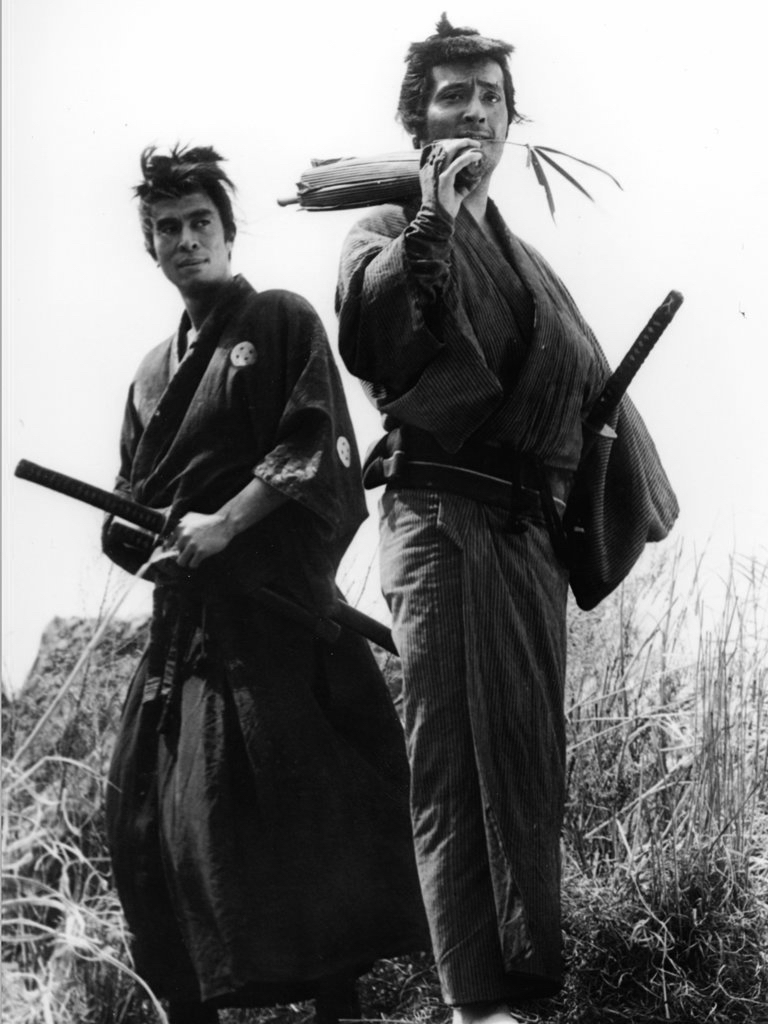
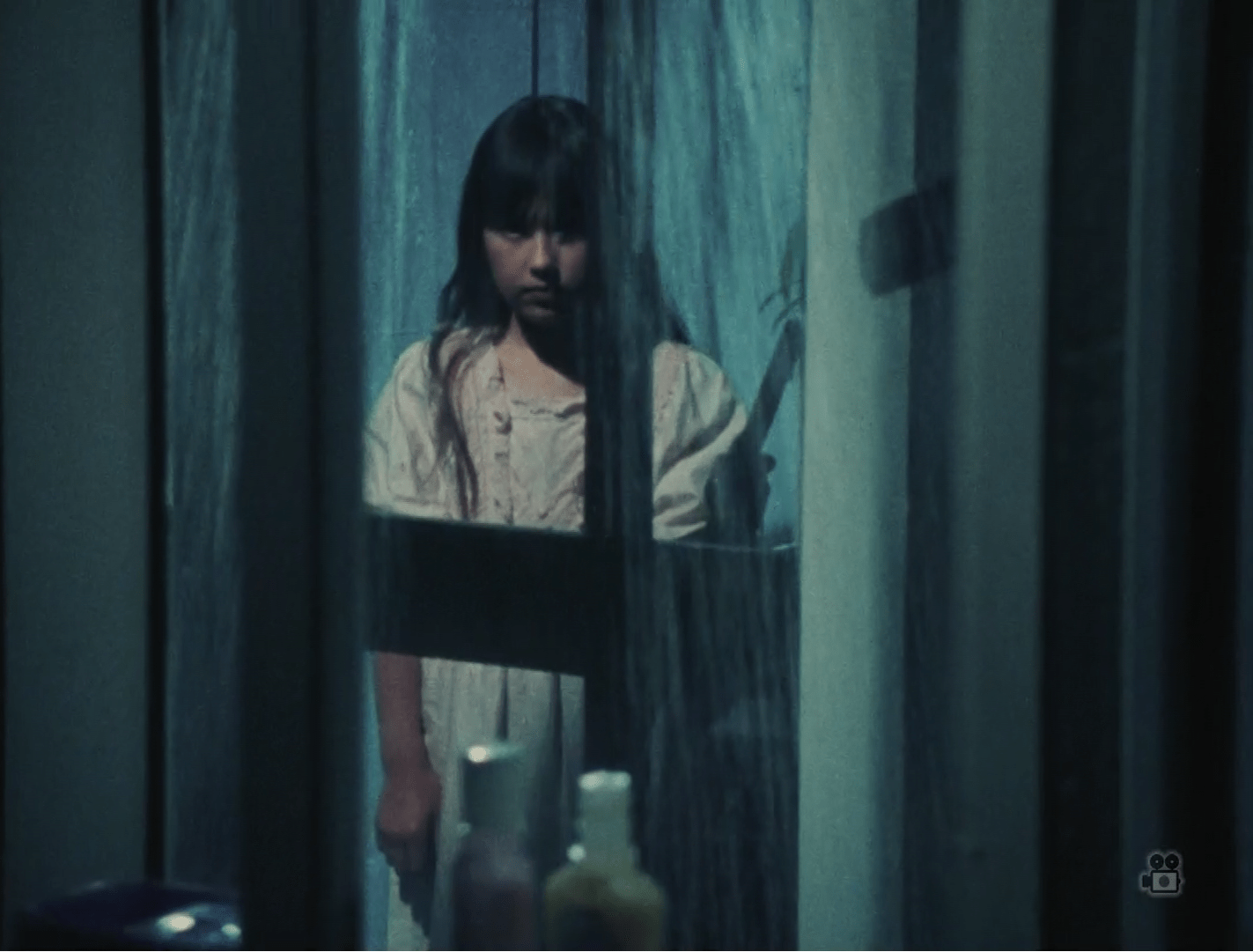
Lovely Devils (可愛い悪魔, Nobuhiko Obayashi, 1982)

Until fairly recently, the work of Nobuhiko Obayashi had been largely unappreciated in the Anglosphere where he is associated most closely with his debut film House which was itself somewhat grudgingly respected as a “crazy” midnight movie. He was however surprisingly prolific and especially so for a director working through the difficult 1980s in a 60-year career which ended only with his death after a protracted illness itself ironically announced on the day his final film, Labyrinth of Cinema, should have opened in Japanese cinemas had it not been postponed in light of the coronavirus pandemic. Produced for television in the same year as I am You You Are Me, Lovely Devils (可愛い悪魔, Kawaii Akuma) is among those which Obayashi did not script for himself but is penned by Machiko Nasu and apparently inspired by The Bad Seed though Obayashi later revised the script to remove traces of the original work unwilling to create a simple homage. 

Similar in tone to Obayashi’s later The Deserted City, Lovely Devils is at heart a twisted gothic romance cautioning against the dangers of an excessive thirst for love. In ‘70s Japan, a wedding takes place at small church during which 5-year-old Alice, niece to Koji (Hiroyuki Watanabe) the groom, becomes overly attached to the veil of the bride, Fuyuko (Nao Asuka), and in the manner of entitled small children everywhere demands to be given it. Fuyuko tries to explain that she plans to hang on to the veil for the rest of her life as a keepsake and is sure that Alice will have an even prettier one of her own someday, but Alice creepily asks if that means she can have it when Fuyuko dies and, wanting to bring an end to the matter, she unwisely agrees. While everyone is busy assembling for the wedding photos in the garden, Fuyuko violently tumbles out of an upstairs window, her broken body landing on the patio below only to be met by Alice excited about collecting her veil. 

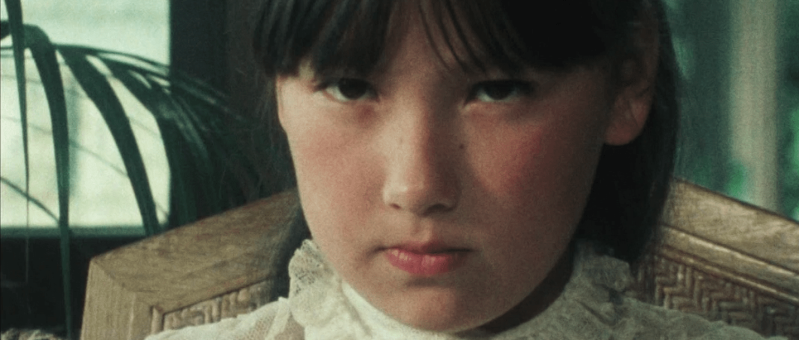
Meanwhile, at the same time in Vienna, Fuyuko’s exchange student sister Ryoko (Kumiko Akiyoshi) is in the middle of a difficult breakup with her local boyfriend Johann in which she, perhaps understandably, tells him to go die only to see him get hit by a car on his way out of her apartment. Overcome with guilt and grief in believing that she somehow killed Johann by wishing for his death, Ryoko goes quietly mad until her landlady contacts Koji who comes to bring her home and places her into a mental institution run by a convent in which the resident psychologist, Dr. Tsukahara (Toru Minegishi), is also a priest. After three years, Ryoko seems to be sufficiently recovered and so Koji asks his sister Keiko (Miyoko Akaza) to take her in as a governess to the now eight-year-old Alice (Tina Jackson). 

The central irony is that Ryoko is almost certainly not guilty of psychically killing Johann just someone who bitterly regrets saying something unkind in anger and having fate ironically follow through, where as Alice is definitely “demonic” and, as is later pointed out, a child who cannot discern right from wrong. In the liner notes for a later release for the film, Obayashi likened the figure of Alice who commits a series of murders with no conceptual understanding that it’s morally wrong to kill to that of himself as a thoroughly militarist boy in wartime who thought that Japan was just and everything outside Japan “bad”. Alice sees something she wants and has to have it. If someone else has it and won’t give it to her, they have to go (sometimes in quite elaborate ways). Ryoko’s battle is against the commonly held belief that eight-year-old girls are innocent angels, no one in their right mind (Ryoko has just been released from a psychiatric institution following a breakdown after all) would believe Alice capable of violent murder and especially not on the grounds that she simply wanted something trivial like a veil or a doll and was unable to accept that she could not have it. 

Later, Alice’s fragile, chain-smoking, dipsomaniac mother Keiko who always suspected there was something not quite right with her little girl attributes this extreme possessiveness to having discovered the body of her father after he unexpectedly hanged himself in their family home (it does not seem to occur to Keiko that perhaps he is merely the first victim, his ornate quill pen one of Alice’s favourite trophies). She thinks that lack of paternal love has made her seek attachment and permanence in objects but also dangerously in her uncle Koji whom she sees both as a surrogate paternal figure and as an incestuous love interest. It is also somewhat unfortunate that the actress playing Alice and the character herself is half-Japanese playing into an uncomfortable stereotype in gothic horror that posits these demonic qualities and romantic perversions as essentially an extension of foreignness, but in any case Obayashi leans in deep with the wedding imagery as Koji returns to rescue Ryoko in the white suit from his wedding firstly on her release from the hospital on which she too wears a white lace dress, and then subsequently with the still eight-year-old Alice who is dressed much the same only with the addition of an Edwardian-style sun hat to complete the look.  

It’s this final juxtaposition which pushes Ryoko towards accepting her imprisonment as a “criminal of love”, seeing herself and Alice as two of the same as if she really had caused Johann’s death through an excessive desire for a love he had but refused to give her in the same way Alice kills “out of a longing and thirst for love” sublimated into the acquisition of objects. Conjuring an intense and heady atmosphere of gothic unease with the remote country mansion and wandering ghostly brides, Obayashi once again plays with psychedelic surrealism with his romantic painted backdrops and characteristic use of colourplay particularly in flashback as Keiko recalls a sepia-tinged memory of the time they were “almost too happy”. Boasting high production values despite its TV movie genesis, Lovely Devils is defiantly an Obayashi production filled with his wistful sense of loss and nostalgia but also a deep darkness in its mildly disturbing, unconventional conclusion. 


It Was a Faint Dream (あさき夢みし, Akio Jissoji, 1974)

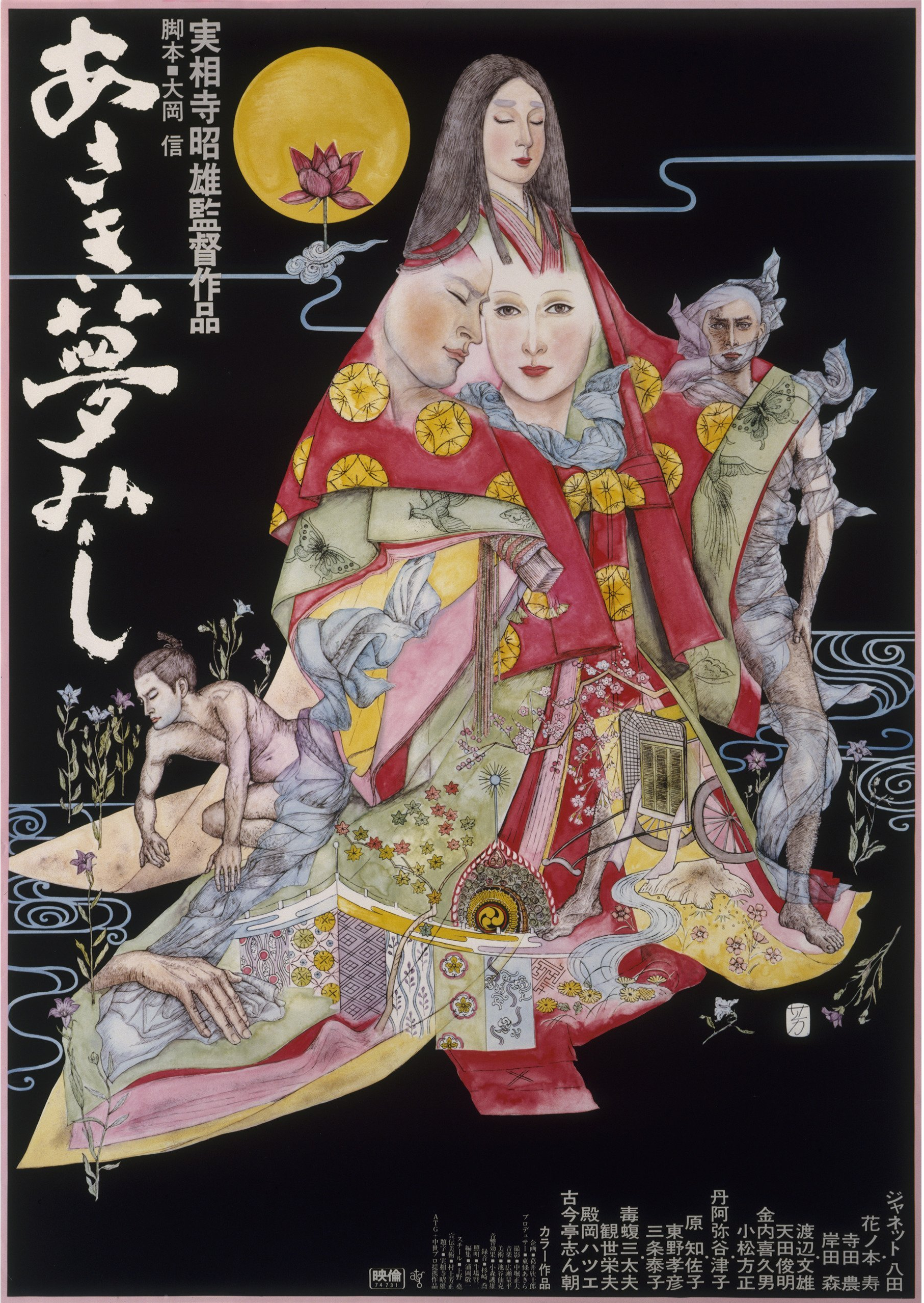
It was a faint dream posterFollowing his ultramodern Buddhist Trilogy, Akio Jissoji casts himself back to the Kamakura era for a tale of desire and misuse in It Was a Faint Dream (あさき夢みし, Asaki Yumemishi, AKA Life of a Court Lady). Taking its name from a Heian era Buddist ode to transience, Faint Dream follows its melancholy heroine on a fleeting path of love, loss, romantic disappointment, and finally spiritual rebirth while the nation faces the external threat of putative invasion by warlike imperialists hellbent on domination and conquest.

Shijo (Janet Hatta), an orphaned young woman taken as a concubine by the lord Tameie (Kotobuki Hananomoto), has returned home to await the birth of her child. The baby she is carrying, however, is not Tameie’s but that of another young noblemen, Saionji (Minori Terada), with whom Shijo had fallen in love before being taken by the lord. Hoping to pass the baby off as merely premature, Shijo has been deceiving Tameie and remains fearful she will be found out. Meanwhile, Saionji’s wife is also pregnant. When Saionji’s legitimate child is stillborn, an obvious solution presents itself and Shijo loses the first of her children.

A young woman without means or protectors, Shijo finds herself forced to indulge the whims of men in order to survive. Yet Tameie, falling ill, apparently thinks only of her when he pushes Shijo towards sleeping with other men in order to keep the peace, so that their resentment doesn’t become an all consuming evil. Thus it is that Tameie’s own brother, the high priest Ajari (Shin Kishida), falls for Shijo with a burning passion which Tameie fears could drag her down to hell with its implacable intensity. Reluctant and half disgusted, Shijo follows her lord’s advice, falling for the priest as she goes, and becoming pregnant with another child she must also lose.

Ajari’s radical Buddhist philosophy insists that chanting sutras is enough for salvation. It doesn’t matter if you’re high born or low or whether you believe or not, simply saying the words gets you into paradise. It’s a philosophy that appeals to Shijo for obvious reasons, but still she finds it near impossible to reconcile herself to her position of powerlessness within the court. A figure of desire, she is “courted” by just about every man she meets but has little right to refuse their attentions, especially as they often hold financial as well as social power over her. Tameie’s warning, ironic as it is in insisting that hell hath no fury like a man scorned, has its merit in bearing out the intensely destabilising properties of romantic love in a highly regimented society.

For all of that, however, Tameie is a romantic man, himself embittered by the disappointments of his life. Born to be a king, he prefers music and poetry to the sword but still laments his “betrayal” at the hands of the older generation who crowned him at three only to depose him at 16 and hand power to his 10-year-old brother with only a promise, apparently now broken, that his son would inherit the throne. Abandoned as a child, he has little sympathy for Shijo’s maternal pain on repeatedly having her children taken from her because of social propriety, merely reminding her that children and parents walk different paths and hers is evidently here, with him, at court.

Even so, men are content to have it both ways. Romance is a transient thing, Shijo is told, a flower which blooms in an instant of truth but then scatters. Attachment is the enemy of love, the wise man admires the flower as its falls but does not mourn its loss forever. Shijo finds this hard to understand, but continues to live her life as an object of desire rather than an active participant until she finally stops and makes a firm decision of her own in choosing to reject it. She becomes a nun and wanders the land looking for serenity despite being told that no woman can become a Buddha because of the five obstacles in her way no matter how nobly she might seek it.

Ironically enough, Shijo’s life is in itself a “faint dream”. She chooses to reject her desires, but admires other women for embracing theirs, and remains seemingly ageless while the fleeting loves of her youth grow old and fade. The lords sit around perfecting their poetry while boys are pulled off their farms to combat a Mongol invasion, and a deadly disease ravages the country. Shijo turns to ask her former lover about the child they conceived together, but it’s as if she were asking about someone else in another time. Having received her answer, she walks off into the distance, a nameless nun, free of the cares of the world and no longer burdened by desire.


It Was a Faint Dream is the fourth of four films included in Arrow’s Akio Jissoji: The Buddhist Trilogy box set.

Original trailer (no subtitles)
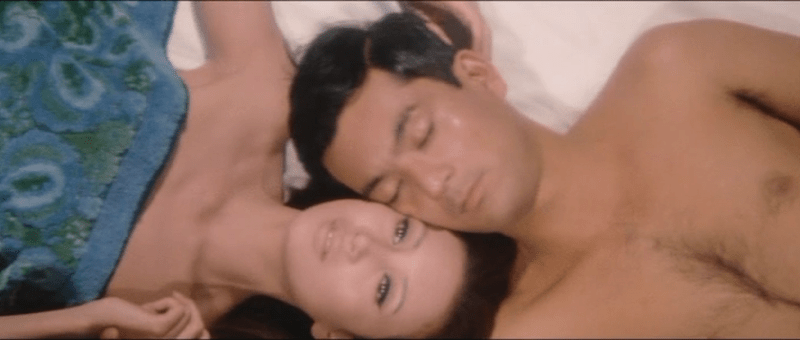
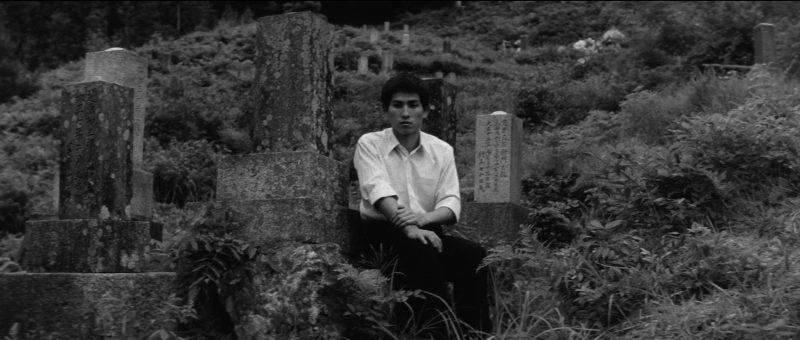
Poem (哥, Akio Jissoji, 1972)

Poem dvd coverThere might be a temptation to view Akio Jissoji’s “Buddhist Trilogy” as an intensely Japanese affair given its obvious preoccupation with Eastern religious thought and background dialogue with the political confusion of the day, but like fellow New Wave outsider Kiju Yoshida, Jissoji had studied French literature and there is something classically European about his nihilistic ennui in the midst of a decaying social order. Poem (, Uta), the trilogy’s final instalment, bears this out most of all as the servant boy of a noble house, secretly its spiritual heir, alone attempts to resist the march of time to save the natural essence of a culture about to eclipse itself in consumerist emptiness.

Jun (Saburo Shinoda), a strange young man, is a servant/legal clerk to a lawyer, Yasushi (Shin Kishida), who is the oldest son of the Moriyama family. Though he has inherited stewardship of the house and mountains, Yasushi and his wife Natsuko (Eiko Yanami) long to break free of its traditionalist constraints by ripping it apart and replacing tatami mat comfort with Western modernity. They can’t do that, however, because old Moriyama (Kanjuro Arashi), Yasushi’s father, is still alive and Yasushi doesn’t particularly want to have to talk to him. Meanwhile, the spacious mansion is also shared by a legal student, Wada (Ryo Tamura), who is kind of interning with Yasushi while repeatedly failing the bar exam, and the family’s maid Fujino (Hiroko Sakurai).   

Unlike Yasushi, Jun sees his life’s purpose as serving the Moriyama family. Intensely worried that a fire may engulf this fine house built with only the best Japanese cedar, Jun gets up every night at midnight and patrols with an electric torch, looking for loose sparks. One night he finds some, though not the kind he was expecting, on accidentally witnessing Wada make love to Fujino. Apparently uninterested, Jun looks it over and moves on while the lady of the house, Natsuko, starved of affection by her impotent husband, finds herself stirred by such unexpected eroticism.

Yasushi’s physical impotence is perhaps merely a manifestation emasculated powerlessness as the oldest son of a noble house who, nevertheless, wields no real power and is entirely unable to make decisions for himself. Yet his big case at work is thrown into confusion when his social climbing client suddenly tries to have his partner, Arita (Haruhiko Okamura), removed days before the court hearing because it might look nicer to have someone of Moriyama’s standing representing him. Even so, Yasushi is so clueless with the modern world that he needs Jun, a calligraphy enthusiast and advocate for the old, to operate the photocopier because he doesn’t know how (and neither does Wada). Only Jun, in another contradiction, insists on working to rule and leaving at 5pm because his “main job” is protecting the house and serving the Moriyama family, not Yasushi. Jun allows himself to be seduced by Natusko on the grounds that if she does not receive sexual satisfaction inside the house she will need to look for it outside which could bring shame on the Moriyama name. Finding out his wife is sleeping with another man, the weird servant boy no less, Yasushi doesn’t even care (besides being mildly turned on), as long as she doesn’t do anything which might arouse “rumours”.

The dirty secret that neither Yasushi or his debauched brother Toru (Eishin Tono) know is that Jun, whose name means “pure”, is their illegitimate half-brother that their father had with a maid. As we later discover, old Moriyama plans to divide his estate not in two but three, believing that it hardly matters anyway because division, in a break with the system of traditional succession by the oldest son, will be the end of the Moriyama family. He may well have a point as neither Yasushi, who eventually abandons the house to Toru and escapes to Kyoto, or his brother are interested in legacy. Once Moriyama passes, they plan to sell the entire plot, mountains and trees and all, to developers. In fact, the house already technically belongs to someone else because as soon as he moved in Toru started taking out exorbitant loans to fund his wastrel playboy lifestyle and has already figured out the jig is up and they’re all broke. Only Jun, who hears the voice of the mountains as if it were the voice of existence itself, is desperate to save the family name though he is at this point almost beyond saving himself.

Looking for the “absolute” in tombstones, Jun is told that only darkness exists inside. Yet he is certain that as long as form survives, content can return. He sees the Moriyamas’ forests as the essence of an older Japan and their untouched natural beauty the rock on which their souls are anchored. Yet his half-brothers oppose him. For them, Japan, even the world, is already ruined and nothing worth protecting remains. Existence itself is nothing more than a dream, and suicide no different. They no longer feel they can live “in such an age”.

Yet Jun, his father’s spiritual heir even if he doesn’t know it, keeps reaching, perhaps not quite hoping but demanding even in his powerlessness which may, in a sense result in a kind of transcendence in its purity. Unlike the ambiguously hopeful ending of This Transient Life, or the urgent ominousness of that of Mandala, Poem ends in defeat and futility, suggesting that time cannot be stopped or progress arrested even by those who seek the eternity of enlightenment. And so Jissoji brings us full circle by showing us a world in entropy unsalvageable in the cruelty of its contradictions.


Poem is the third of four films included in Arrow’s Akio Jissoji: The Buddhist Trilogy box set which also features an introduction and selected scene commentaries by scholar of the Japanese New Wave David Desser plus a 60-page booklet with new writing by Tom Mes and Anton Bitel.

Original trailer (English subtitles)

Mandala (曼陀羅, Akio Jissoji, 1971)

Mandala jissoji poster 2Politically speaking, the Japan of 1971 was trapped in a kind of limbo. The student movement had been dealt a serious blow with widespread supressionary measures in the run-up to the renewal of the ANPO treaty in 1970, which was finally signed despite opposition. It was not, however, yet dead and would stumble on, losing its way, until the climactic events of Asama-Sanso in 1972. Following hot on the heels of his radical This Transient Life, Akio Jissoji’s second film for ATG Mandala (曼陀羅) finds him exploring just this conflict as two young men look for “utopia” in an escape from the tyranny of time.

Kyoto uni students Shinichi (Koji Shimizu) and Hiroshi (Ryo Tamura) have taken their girlfriends to a strange little beachside inn for a spot of wife swapping. Where Shinichi’s girlfriend Yukiko (Akiko Mori) is only too happy to oblige her boyfriend’s whims, Hiroshi’s squeeze Yasuko (Ryo Tamura) goes along with it but instantly regrets her decision. Meanwhile, unbeknownst to them, the couples are being spied on by weird ultra-Buddhist cult leader Maki (Shin Kishida) who comes to the conclusion that Shinichi and Yukiko are good candidates to add to their commune which is built around the concepts of agriculture and eroticism. Maki’s violent recruitment method is knocking out the guys and then subduing the women so they can be raped by cult members and thereby inducted.

Maki’s strange philosophy which posits a new “utopian” future born of a return to a more primitive way of life in which love does not exist and sex is a free and natural act whose only purpose is reproduction, wins an acolyte of Shinichi because of its key offering – the ability to stall time. Always looking for a way to be dead yet alive, Shinichi is obsessed with the idea of stillness. Movement is the image of time passing. Coming to and finding the comatose, naked body of Yukiko lying on the beach after being raped by Maki’s minions, Shinichi cannot resist the urge to have sex with her “lifeless” body (which she apparently consents to, playing dead even after regaining consciousness part way through). Yukiko too confesses her own fantasy of being ravished as a corpse, a body outside of conscious time.

Shinichi, proclaiming he no longer believes in the future or in that a classless anti-State will ever arise, leaves the struggle and joins Maki’s atavistic utopia to which only those who “deny time and history” are permitted. Hiroshi, meanwhile, berates him for betraying the “continuous revolution” while he himself is on the run having left university after a disagreement with his Trotskyist protest group. The two men are each fleeing the centre and heading in different directions if perhaps ultimately bound for a similar destination. A hyper individualist, Hiroshi declares that there is no such thing as mankind, only a confluence of individuals, with the exception perhaps of those who have dedicated themselves to religion. He doesn’t want the child that Yasuko is carrying, not because he fears it may be Shinichi’s, but because he does not see the point in contributing to “the multiplication of mankind”, which is a key tenet of of Maki’s primitivist manifesto.

Unlike Hiroshi, Yasuko is not seeking revolution but conventionality. She wants the baby, and perhaps a marriage. At the end of her tether, having suffered horribly at the hands of Maki’s minions, she draws a small cottage with a friendly bird flying above as if to symbolise the simple dream that has been destroyed by the cruelty of men. Too late, Hiroshi realises that his irritation with Yasuko was simply a reaction against the shadow of himself he saw reflected in her, and he cannot forgive those who have caused her harm.

Harm there is plenty. Maki’s vile philosophy, overseen by his shaman wife (Yoshihiro Wakabayashi), supposedly the embodiment of many gods, strips women of their right to autonomy, insisting that “love” is an unwelcome modern sophistication which should be replaced by “benevolence” in an egalitarian affection for all mankind. In “ancient times”, he says, a woman would willingly submit to a man and, therefore, there was no such thing as “rape”. “A woman’s silence and resistance make a man a rapist” he tells his minions while Shinichi is busy raping the latest kidnap victim in a room equipped with CCTV for Maki to watch from behind a screen. His tenet of fecundity, both in terms of agriculture and human reproduction, comes at the cost of basic human decency and reduces the role of women to mere vessels for men’s desires.

Throughout the history of Japanese cinema, “love” has indeed been the destabilising, individualising force which threatens the social fabric, but for Maki it serves as a palpable evil. Like Hiroshi, he too believes that men exist as individuals, but also that “benevolence” could raise them to become a “community”. Hiroshi wants to live in a world of revolution, free of charisma and religion, but Shinichi seems to have found peace in atavistic simplicity. Faced with the choice, Hiroshi again chooses individualism, declaring that he would rather die alone than go mad along with everyone else. Yet his frustration may perhaps take him to a dark and unexpected place that sees him pick up a sword and a copy of the Manyoshu as if on some sort of nationalistic mission of revenge against an intransigent government and society. Revolutions fail, and then they start again. Hiroshi has perhaps picked a side, even if that side is merely opposition, but what he’s chosen is movement, action, maybe even life however fleeting, over the cold meaninglessness of Maki’s grand plan for a primitivist utopia.


Mandala is the second of four films included in Arrow’s Akio Jissoji: The Buddhist Trilogy box set which also features an introduction and selected scene commentaries by scholar of the Japanese New Wave David Desser plus a 60-page booklet with new writing by Tom Mes and Anton Bitel.

Original trailer (English subtitles, NSFW)