Ninja’s Mark (忍びの卍, Norifumi Suzuki, 1968)

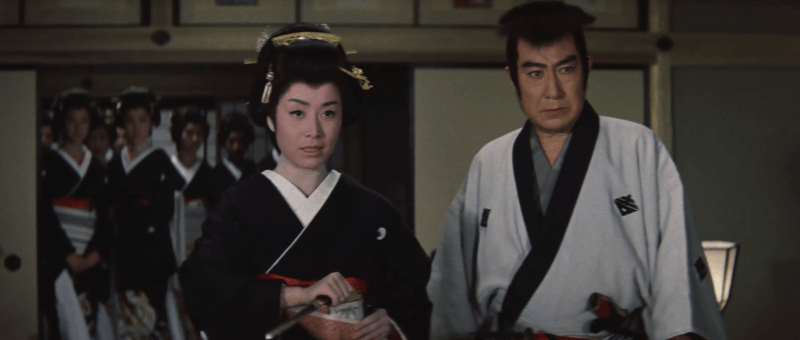
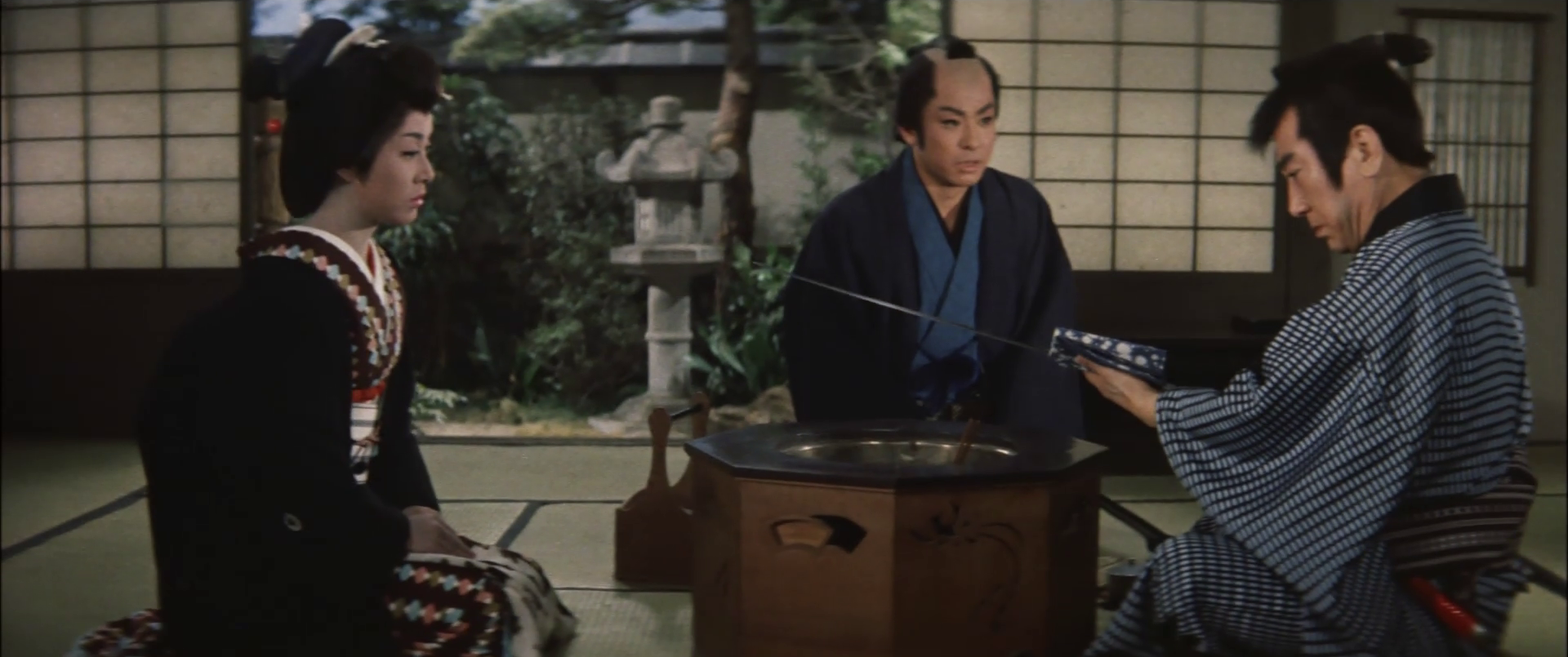
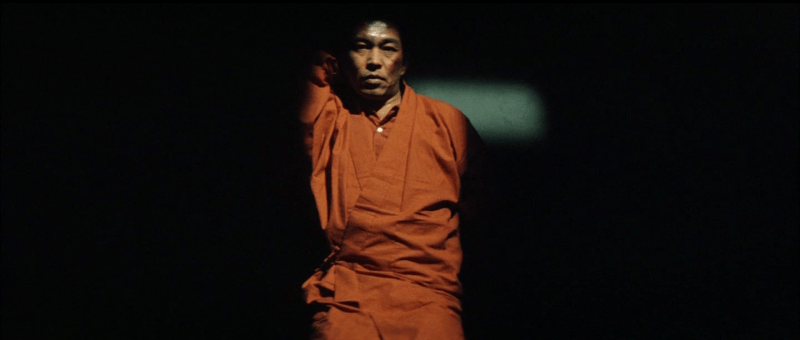
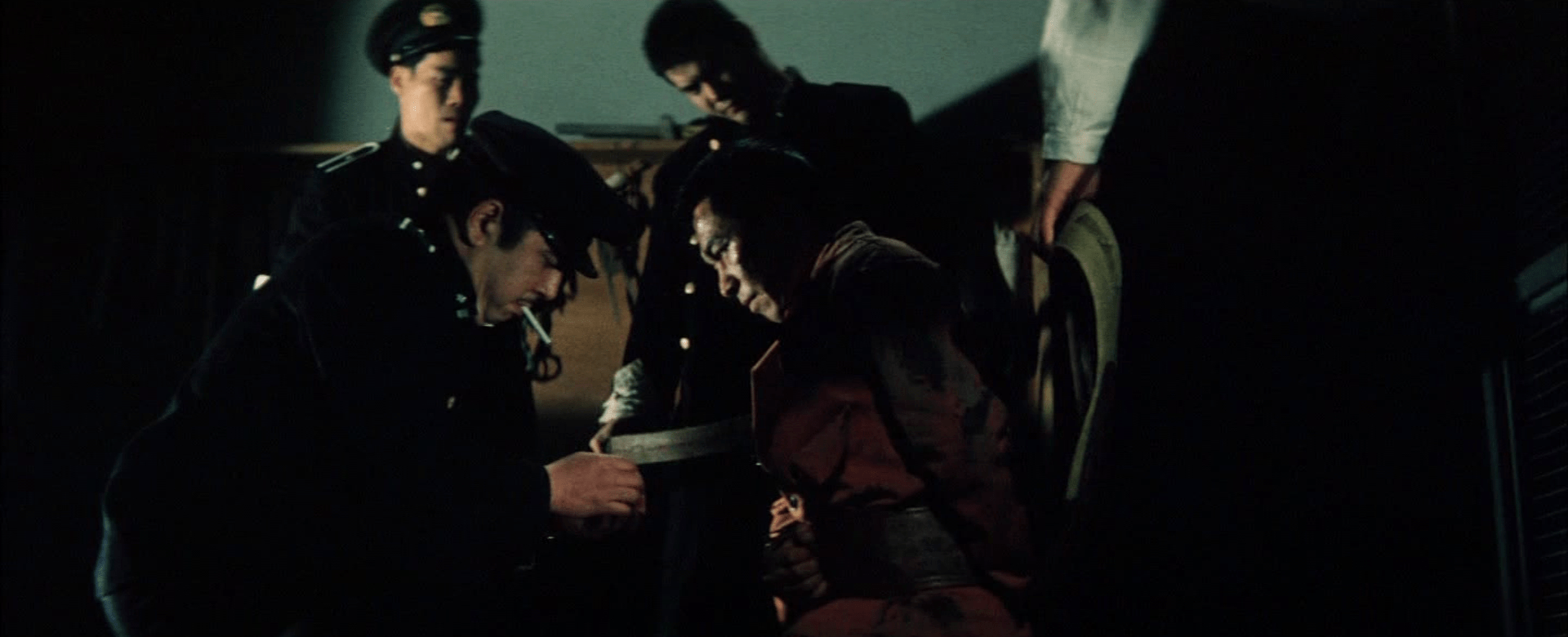
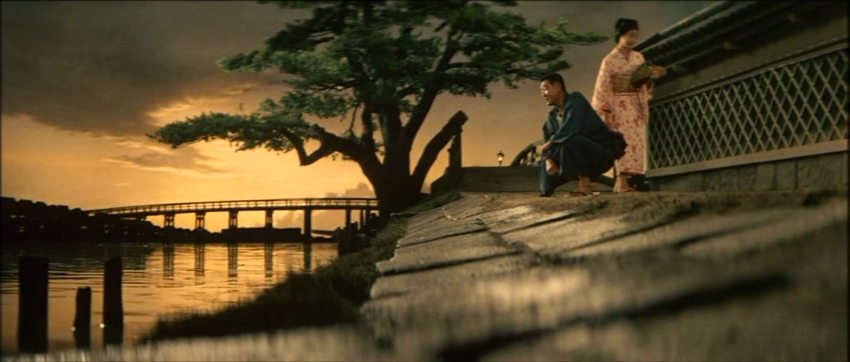
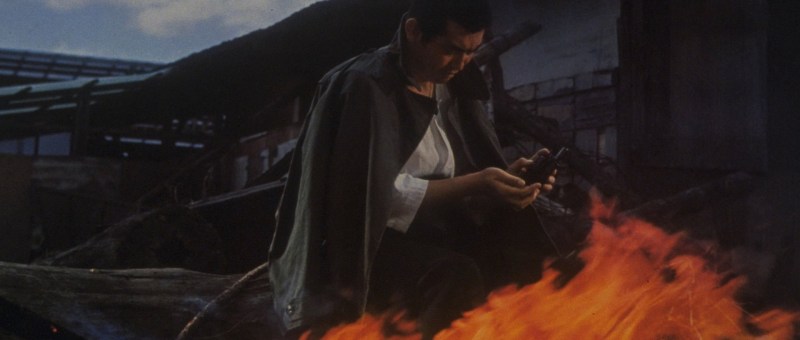
Many have tried to end the Tokugawa line. Few have done so by covering a courtesan’s legs in fish scales to put the Shogun off his stride. Based on a book by Futaro Yamada, Norifumi Suzuki’s Ninja’s Mark (忍びの卍, Shinobi no Manji) is at heart a romantic tale in which love is “part of the game” but also apparently the one trick a ninja can’t escape. Perhaps that’s why Shogun Iemitsu at the comparatively late age of 30 has failed to produce an heir with any of the beautiful yet emotionally distant courtesans of the inner palace many of whom also seem to be ninjas, therefore provoking a constitutional crisis.

Aside from that, it seems the ninja plot is a kind of revenge against the Tokugawa carried out by the last remnants of a house that was dissolved by the Toyotomi. There are in fact three ninja clans all clustering around the palace, Iga, Koga, and Negoro, each of whom have different kinds of skills. Technically, some of them are in the employ of the Shogun’s disinherited younger brother Tadanaga (Shingo Yamashiro), but others of them are working strictly for themselves and their revenge. In any case, their plan is to prevent Iemitsu from fathering an heir by putting him off sex essentially by making it freaky (in a bad way). Thus one of the ninjas uses his ability to transform objects so that the courtesan’s legs are covered in fish scales. Another plan sees a ninja body swap with one of the women so that Iemitsu’s sperm ends up inside him where it obviously has nowhere to go. Meanwhile others hatch a plan to steal some of Tadanaga’s seed to use on the women in the inner palace to cover up Iemitsu’s potential infertility seeing as it is after just as good being of the Tokugawa line. 

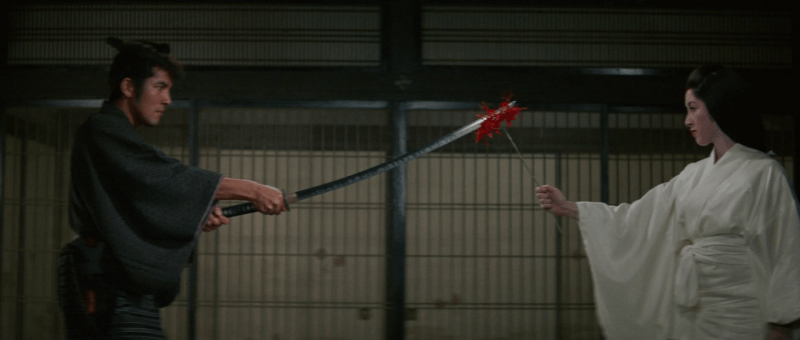
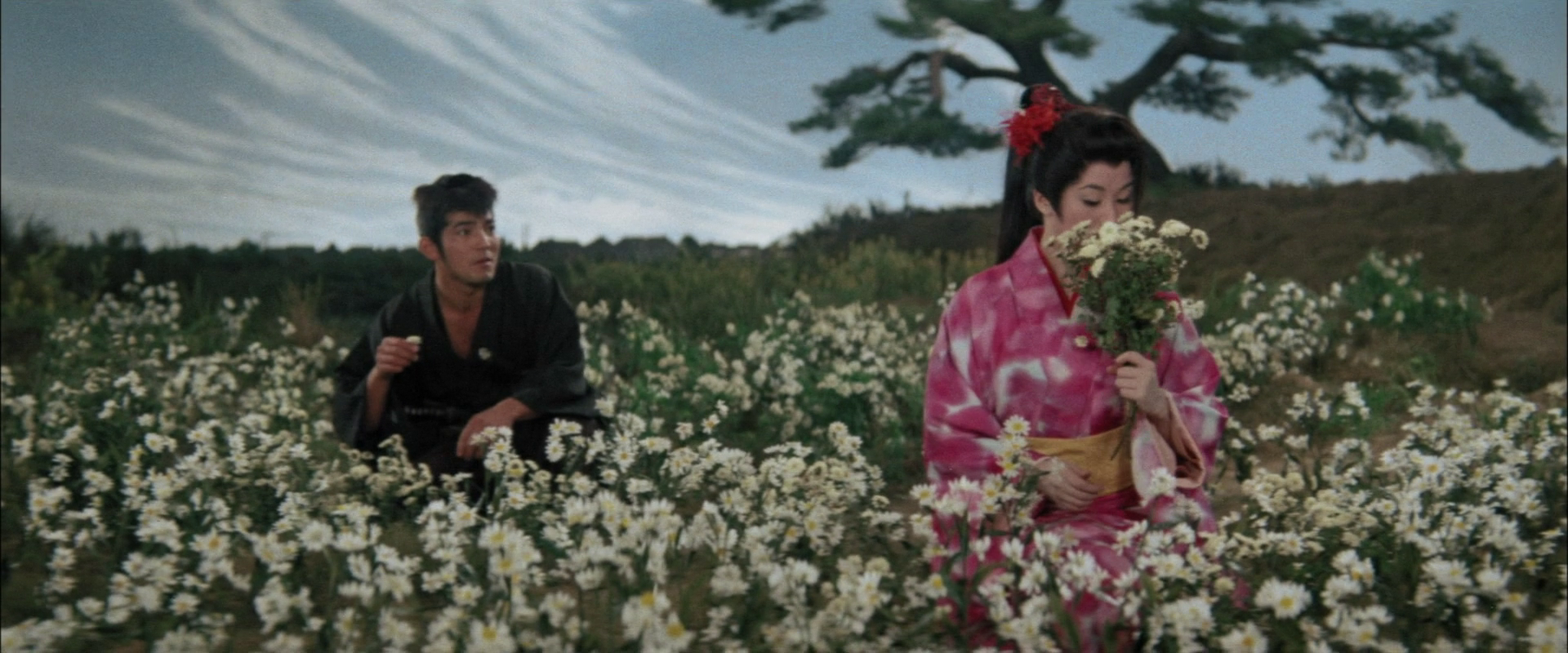
This particular ruse is suggested by Toma (Isao Natsuyagi), the disenfranchised former member of the Yagyu school turned ninja ronin they bring in to solve the problem. He quickly homes in on Kageroi (Hiroko Sakuramachi), a female ninja, as the villainess whose special power is poisoning men with love and desire by means of the spider lily plant. But as Toma points out to her, she is also a prisoner of her skill in that if she were to fall in love she would inevitably kill her lover. Of course, he survives her first attempt to kill him, leading her to fall in love with Toma and become conflicted in her mission while he plays on her emotions to escape but eventually realises they may be more genuine than he first realised. 

In this, Suzuki brings some of his trademark romanticism particularly in the colourful art nouveau aesthetics and frequent use of rose imagery. Though the film is clearly designed to lean into the erotic with frequent use of nudity and salacious scenes including a brief moment of lesbian seduction, it eventually heads towards romantic tragedy in which the debauched and nihilistic Toma and the wronged Kageroi discover a love made impossible by their ninja code and the times in which they live. Having been ordered to kill her, Toma declares that he will marry Kageroi in the next life and returns to her the Buddhist Manji that is the “ninja mark” of the title. 

Nevertheless, the dialogue is often suggestive as in Kageroi’s curse that Toma’s “sword” will rot, while it’s also Toma’s “sword” that alerts him to the danger she presents. Toma too claims to derive his ninja powers from his “sword” having apparently concentrated them by repressing his sexual desire and swearing off women. He says that he seals all his “distracting” thoughts into a virgin, closing off all her senses and placing her into a coma until he breaks the spell. Even so, he admits that without his “sword” he is just a man, and as a man claims to love Kageroi, but as long as he has his “sword”, and she her “lily”, their love is impossible. 

But this repressed love seems to pose less threat to the social order than the lack of it in Iemitsu who is bored with his courtesans and cannot conceive an heir. Constitutional crisis is averted only through a little ninja trickery and a convenient ruse to overcome Iemitsu’s infertility so that in time he produces five sons and a daughter, which honestly seems like it might just present another set of problems in about 30 years’ time. Like similarly themed ninja pictures, Suzuki makes good use of surrealist imagery and colour play alongside the kind of onscreen text later used in jitsuroku yakuza films to name each of the ninja’s key skills and which clan they belong to. What he always returns to, however, is the sense of romantic tragedy in a world seemingly poisoned by ambition in which love itself is rendered an impossibility. 


*Norifumi Suzuki’s name is actually “Noribumi” but he has become known as “Norifumi” to English-speaking audiences.
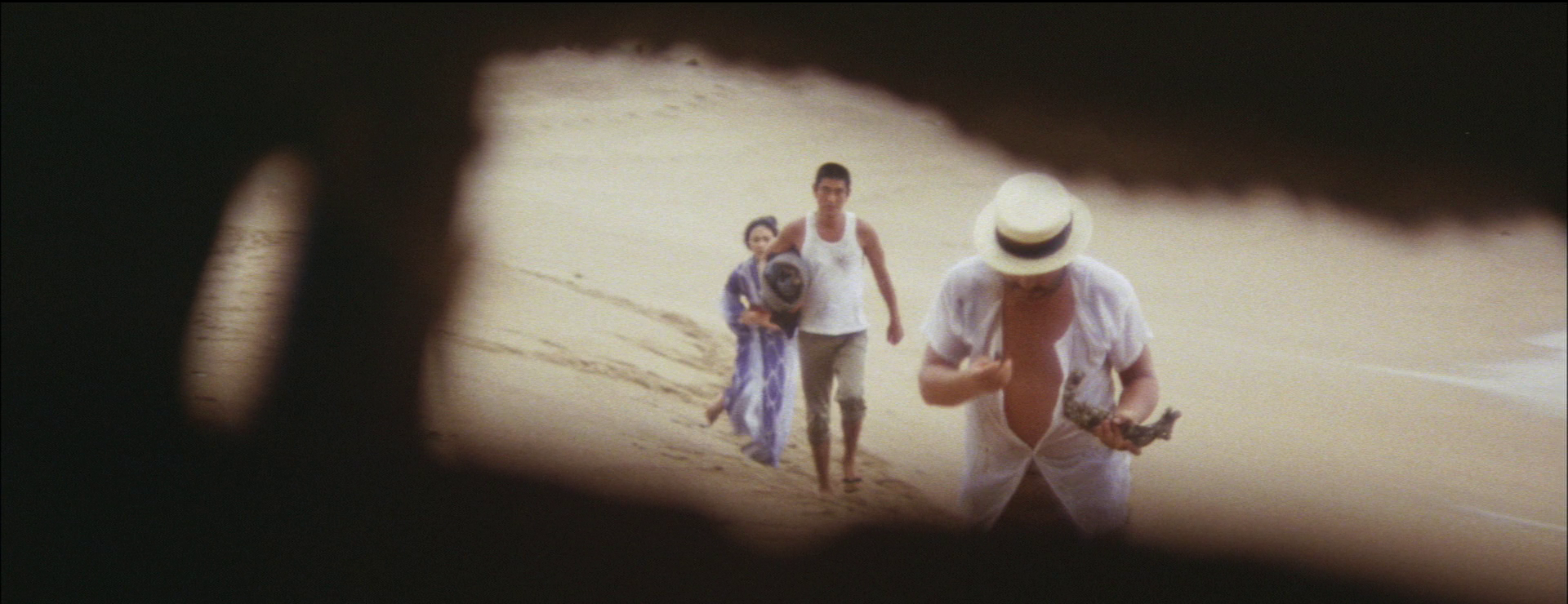
The Homeless (無宿 やどなし, Koichi Saito, 1974)

Two men are released from prison on the same day. One, dressed in a 1920s-style white suit and straw hat, tries to befriend the other, in black kimono and geta, but he ignores him. Soon, they arrive at a fork in the road. The man in the kimono walks down a well worn grass path cut between the fields while the man in white, looking back and a little disappointed, continues along the modern roadway making his way towards civilisation.

In some ways, the heroes of Koichi Saito’s The Homeless (無宿 やどなし, Yadonashi) are embodiments of past and future. Jokichi (Ken Takakura), the kimonoed man in black, chooses the path of vengeance. On his release from prison, he learns that his gang leader older brother has been killed while his sister was sold to a brothel. He goes there to find her, but is told that she is already dead. The madam says she died of a chronic illness and that she did for her what she could but treating such a cruel disease is only throwing good money after bad. Sakie (Meiko Kaji), a sex worker who appears to have a childlike quality and possibly impaired mental state, tells a different story claiming the madam had Jokichi’s sister killed for reasons she doesn’t explain but may have more to do with the drama going on with Jokichi’s gang than a desire to cut costs and her losses. 

Gen (Shintaro Katsu), meanwhile, seemingly chooses the path of prosperity. He returns to his wife, Ume (Murasaki Fujima), who is a member of a moribund theatrical troupe, and asks her to return to him what he believes is a treasure map marking the location where his father saw a ship sink during the Russo-Japanese war that may be filled with gold. On finding out Jokichi used to be a diver, Gen becomes determined to bring him onto his mission but Jokichi is set on revenge firstly on a man called Senzo (Noboru Ando) he thinks killed his sister and then on whoever ordered the hit on his brother. This bad news for Gen who realises that if he achieves his vengeance, Jokichi won’t be available to help retrieve the gold because he’ll be in prison so he starts by warning Senzo that his past’s about to catch up with him. 

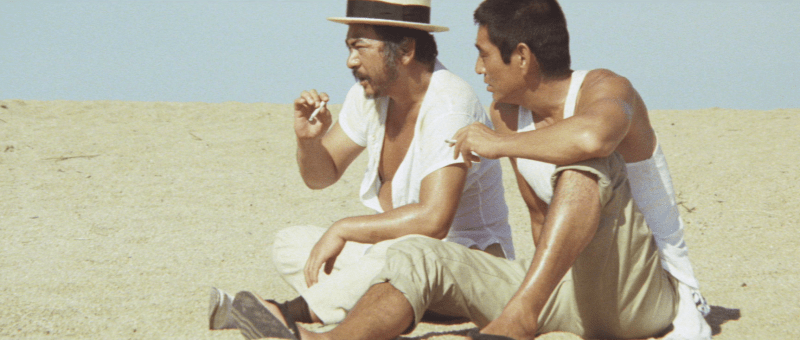
But it’s also Gen that helps Jokichi escape from the rival gang by suggesting he help rescue Sakie from her indentured servitude as sex worker. Childlike and ethereal, Sakie claims not to remember where she was from and has a simple desire to see the sea which represents to her a kind of freedom while for each of the men it may in fact form a kind of border they will eventually be backed up against and unable to escape. Though Sakie develops a fondness for Jokichi, and then begins to love Gen after he ends up taking care of her along the road, the three form a relationship that seems more fraternal or perhaps even forged on the homoerotic tension between the two men who light their cigarettes one from the other and finally find a home on an idyllic beach where they devote themselves to the search for buried treasure.

Sakie may say that the real treasure is her new life of freedom and warmth, but the hint of riches the two men find is itself rooted in warfare and imperialism which are the same forces by which they were each displaced amid the rising militarism of the 1930s. The three of them remain homeless in this environment, unable to fit into the changing society and by degrees exiled from it. An early title of the film was apparently Jingi no Okite (仁義の掟) which means “the law of honour and humanity” and that is in a way what Jokichi is bound by in his desire for vengeance, while Gen is clearly an anarchistic force unable to submit himself to authority and lusting after a more prosperous modernity. Sakie meanwhile is powerless as a woman with few rights, sold into sex work and technically a fugitive from the gang-backed brothel that owned her contract.

As beautiful as the beach is, we have the feeling that in some senses the three of them are already dead and living in their temporary paradise. Indeed, the past eventually catches up with them as if these three homeless fugitives cannot be allowed to survive in resistance to an authoritarian culture. Their existence is elegised by the beautifully composed cinematography along with the childlike rapport between the two men and the sense of domesticity which arises between the trio before reality bites and even their beachside idyll is invaded by the forces of darkness.


Original trailer (no subtitles)

Tengu Priest (お坊主天狗, Yasushi Sasaki, 1962)

Disparate denizens of Edo are united in one thing in Yasushi Sasaki’s light hearted jidaigeki, Tengu Priest (お坊主天狗, Obozu tengu), revenge. Like many jidaigeki, what they really want is revenge against the evils of feudalism to which they have each fallen victim, but also acknowledge that they have found something better in being outside it in the solidarity that exists between them as outsiders free from the obligations of samurai society if also with loose ends waiting to be tied.

Once a hatamoto with a 1000 Koku stipend, Obo Kichiza (Chiezo Kataoka) is now a much feared figure keeping order in Edo. When some yakuza toughs are hassling the geisha Kozome (Hibari Misora) at the theatre, insisting that she serve them sake even as she reminds them she’s off the clock, one look from him stops them dead though Kichizo is also impressed with Kozome’s nerve. Like him, Kozome is also in Edo for revenge. Formerly a samurai’s daughter, she became a geisha to look for the man who killed her father in a stupid quarrel over a fencing duel. Kichiza, meanwhile, seeks revenge against the local lord, Honda Etsu (Masao Mishima), who killed his father in a fit of temper when he ordered him to commit seppuku for causing his son-in-law to fall off his horse but he refused. 

Loyal retainer Kinpei (Ryutaro Otomo) had begged for his forgiveness and insisted that he could get Etsu to reform but three years have passed and not only has he bribed his way to head office but his behaviour has declined still further. We see him cruelly cut down a maid seemingly for no reason, simply ordering his men to get rid of the body. Etsu has a reputation for random violence while drunk, but as he is the lord, there are no real consequences for him. His retainers cover up his crimes, and Kinpei’s sole attempt to talk some sense into him goes nowhere, meanwhile his chief adviser Shichinosuke (Sentaro Fushimi) is basically running the show telling others the lord is not in his right mind and cannot make decisions so he must make them for him.

They are all, including Etsu himself, victims of the feudal order in which the systems of power are necessarily corrupt. In his yakuza persona, Kichiza has struck up a friendship with another geisha, Kozuru (Naoko Kubo), who was actually a lady in waiting working as a maid at his estate. She has long been in love with him, but the class difference would have made any union impossible. Ironically, she remarks to Kozome that even in their present state they are still a Hatamoto and a lady in waiting so she dare not express her love for him. Only once his revenge is concluded and he’s fully abandoned his samurai status can Kichiza truly be free to embrace a relationship with Kozuru while conversely Kozome regains her life as a samurai’s daughter by avenging the death of her father.

Kozome asks for Kichiza’s help to track down the target of her revenge, but he also respects her wishes and understands that it’s something she must do herself as does eccentric sword sharpener Shinzaburo (Hashizo Okawa ) who actively stands back so she, another wronged woman, can stick the knife in. Hibari Misora’s role in the film is smaller than one might expect as her revenge subplot is secondary to Kichiza’s and she has relatively little screen time with only a brief musical sequence during a naginata dance though she does participate in the high octane final showdown in which all grievances are exorcised and a kind of order returned to the samurai realm even if it must be destroyed to so as Kinpei resolves to protect both the lives and livelihoods of their many retainers and the integrity of Kichiza, going so far as to congratulate Kozome on the successful completion of her revenge. 

Yet what made the whole thing possible was Kichiza’s own band of outlaw drifters whom he allowed to live in his home he later says just so that they would have a place to come and be together so that they might more easily reintegrate into mainstream society. He might have lost his domain and samurai status but has discovered something better in this accidental community. They may be in a sense almost like retainers to him, but if so they stay by choice rather than obligation and help out of a genuine sense of loyalty and affection. In essence, in taking his revenge, he frees himself from the oppressive nature of the samurai code and is able to live like an ordinary man lamenting that if only he and Kinpei had both been ronin they could have enjoyed their time together for longer. Lighthearted and cheerful despite its dark themes, the film is nevertheless a condemnation of the hypocrisies and abuses of a feudal society in which freedom is to be found only among those who live outside it.


Father of the Kamikaze (ゝ決戦航空隊, Kosaku Yamashita, 1974)

By the mid-1970s, Japanese cinema at least had become much more comfortable with critiquing the wartime past, considering it from a greater distance than the often raw depictions of war in the films from the previous two decades. 1974’s Father of the Kamikaze (ゝ決戦航空隊, A Kessen Kokutai), however, is among the few to skew towards the nationalist rather than the ambivalence or simple anti-war messages of other similarly themed films of its era. 

Starring ninkyo icon Koji Tsuruta who served in the air force himself, the film is a kind of biopic dedicated to Admiral Onishi who oversaw the kamikaze operations at the end of the war. As is pointed out, Onishi had been against the war in general terms even before its inception and is originally against the philosophy behind the kamikaze squadrons but as Japan’s fortunes continue to decline he becomes its biggest advocate citing a kind of sunk cost fallacy that it would be in someway unfair to the men that have already died to surrender while insisting that suicide missions are the only feasible way to turn the tide because one kamikaze could take out a hundred men by destroying battleships singlehandedly. 

The film in part attributes this extreme solution to the prevailing with your shield or on it philosophy of the contemporary society which placed extreme shame on the act of being taken prisoner. In the prologue that opens the film, a squadron of downed pilots whose heroic deaths have already been recorded is discovered alive in an American prisoner of war camp but as being a prisoner of war is so shameful and would reflect badly on the military, the decision is taken to fix the books by sending the men on a mission from which they are not intended to return. Onishi is opposed to the plan, he asks why they can’t find a way for the men to live, but the decision is already made. In any case, he describes the action of a suicide mission as a “beautiful ideal” even when insisting that a war cannot be fought in that way not least for purely practical reasons in that they do not have the resources to be wilfully sacrificing skilled pilots and their planes. 

Having come round to the idea, however, Onishi is a crazed zealot who cannot accept the idea of surrender and even goes so far as to barge into a cabinet meeting to urge ministers against a truce even though the war is clearly lost. To his mind, the only way to honour the sacrifices of those who’ve died is to fight to the last man. Kozono (Bunta Sugawara), another officer opposed to the kamikaze, eventually meets a similar fate in refusing to obey the order to lay down his arms and ending up in a psychiatric hospital. His objection had partly been that it’s wrong to turn men into ammunition, but also that the kamikaze project is itself defeatist and self-defeating when there are men such as himself who are committed to fighting on.  

In this the film leans into the image of militarism as a death cult in which dying for the emperor is the only noble goal of the whole imperial expansion. In its eventual lionising of Onishi’s image, his bloody suicide atop a white cloth resembling the flag of Japan while his parting words scroll across the screen in text, it does not shy away from his more problematic aspects in which he fails to object to a request from a junior officer that soldiers should be allowed to test their swords on American prisoners of war, roundly telling a subordinate who breaks protocol to insist that such a thing is not only morally wrong but will ruin their international reputation that he has no need to think of consequences because Japan will win this war. He claims to want to find a way of defeat that will satisfy the living and the dead, but in reality cannot accept it not least in that it would entail admitting that he sent 2600 young men to their deaths for nothing. 

Tsuruta brings the same level of pathos to his performance as he did in playing conflicted yakuza stoically committed to a destructive code, but there’s no getting away from the fact that the film focuses mainly on Onishi’s personal suffering as a man who sent other men to die for a mistaken ideal and then could not admit his mistake offering an apology only in his death in which he urged the young people of Japan to work to rebuild the nation in the name of peace. In switching to the present day and showing us Onishi’s dilapidated former residence and in fact the room in which he died with its tattered shoji and peeling paintwork, he veers towards the nationalistic in uncomfortably reinforcing the nobility of his death rather than the folly of war or absurdist tragedy of the kamikaze programme. Adopting a quasi-jitsuroku approach with frequent use of onscreen text, a narratorial voiceover, and stock footage of kamikaze in action Yamashita may portray war as madness in Onishi’s crazed devotion but cannot help depicting it as a “beautiful ideal” even in the undignified violence of Onishi’s ritual suicide. 


Eighteen Years in Prison (懲役十八年, Tai Kato, 1967)

Genre star Noburu Ando had a certain cachet in that he had been a yakuza prior to becoming an actor. He had in fact been the head of his own gang which at its high point had over 300 members and controlled much of the lucrative Shibuya nightlife scene. His first onscreen appearance was in a gangster movie in which he played himself. Rather than the jitsuroku epics he would later become associated with, Tai Kato’s Eighteen Years in Prison (懲役十八年, Choueki Juhachi Nen) essentially casts him in a ninkyo role as a noble if compromised former captain of the kamikaze squad who finds himself caught between the contradictions of post-war Japan and the American occupation. 

Indeed, in this as in many other yakuza movies set during the immediate post-war era, the Americans are really just the biggest gang. Suffering with survivor’s guilt, Captain Kawada (Noboru Ando) has set up an association together with former comrade Tsukada (Asao Koike) to look after he dependent relatives of men who fell in war. To do this, he has to resort to criminality raiding American boats for supplies such as sugar and rice which he redistributes to war widows and their families. His ultimate goal is amassing enough money to buy a patch of land in the town centre and do away with the black market which exploits the vulnerable replacing it with a legitimate market so the surviving family members can set up businesses to support themselves. 

Around this time, the association manages to track down the younger sister of one of their men who died as a kamikaze, Hisako (Hiroko Sakuramachi ), and discovers she is living in desperation having lost the family home to aerial bombing. As her mother is seriously ill and she needs money for food and medical treatment, Hisako contemplates turning to sex work and is almost assaulted by a gang of drunk and abusive American servicemen from whom she is rescued by a passing Kawada. This incident makes plain his resentment towards the occupation and sense that it is the American influence that is wilfully suppressing the efforts of the Japanese people to rebuild their society. It’s this resentment that lends a note of justification to Kawada’s decision to rob a nearby factory of valuable copper wire to get the money to save Hisako’s mother thereby saving her from falling into sex work and thereafter helping to achieve their ultimate goal of building the market. The raid, however, goes wrong. Kawada sends an injured Tsukada back to the association and is arrested.

In prison he discovers only more corrupt authority in which guards beat and torture prisoners, just another bigger gang. He finds out that block warden Hanya (Tomisaburo Wakayama) is actively accepting bribes and in cahoots with some of the inmates that attempt to terrorise newbies to the point that one attempts suicide by swallowing glass though Hanya refuses to call for help forcing Kawada and some of the other men to pull the alarm themselves. The sources of moral authority lie in the new college-educated deputy warden recently returned from five years as a POW in Manila, and a veteran yakuza with a grudge against Hanya who apparently had his girlfriend raped leading to her suicide. 

Though the film is titled eighteen years in prison, Kawada becomes eligible for parole in 1952 which is of course the year the occupation ends. By this point he discovers that Tsukada has abandoned their idealistic mission and turned full yakuza, building an immense red-light district on the land they bought for the market and making himself rich through the violent trafficking and exploitation of women. Eventually confronted, he tries to convince Kawada that the world has changed, that the post-war years of privation are over and that he sees only “the ghost of a nation that lost the war” rather than burgeoning new economy stimulated by the Korean War and an ironically a repositioned America now no longer occupiers but still somehow influential if leaving a vacuum a man like Tsukada may step into. It’s no coincidence that he threatens Hisako with deportation to a brothel in Okinawa he’s set up to service American servicemen in a place where the conditions of occupation are still largely in place. 

Tsukada clearly feels that he need have no more responsibility for his wartime conduct, roundly telling Kawada that the families of the fallen are not his responsibility and should “stop leeching off other people and start working for a living”. Hisako’s long lost younger brother Kenichi (Masaomi Kondo) who ended up alone on the streets after being conscripted as a student factory worker and returning to find his home in ashes, turns the blame back on the authorities reminding them that it’s their fault, they started the war the cost him his home and family and turned him into the half-crazed man of violence who immediately introduces himself as “King” on moving up from a juvie prison. Much of Kawada’s prison life is then given over to saving Kenichi, a representative of the next generation, from becoming mired in a life of nihilistic crime. 

In many ways, he remains a squad leader trying to atone for having sent so many young men to die by accepting the responsibility for their families while trying to protect those left behind from the vagaries of the post-war era including the amoral capitalism represented by the infinitely corrupt Tsukada. Dressed in a military uniform ironically pinched from an American soldier he goes on the rampage knowing that he has to deal with Tsukada himself in order to defend the post-war future from those like him who’ve apparently learned nothing much at all even from such recent history. Shooting from his characteristically low angles, Kato explores the seedy underbelly of the beginnings of the economic miracle while his noble hero does his best to offer a course correction to those who have already forgotten their responsibility not just to others but to those they left behind.


Blood of Revenge (明治侠客伝 三代目襲名, Tai Kato, 1965)

An earnest yakuza trying to walk a more legitimate path faces off against a thuggish businessman in Tai Kato’s late-Meiji ninkyo eiga, Blood of Revenge (明治侠客伝 三代目襲名, Meiji kyokyakuden – Sandaime Shumei). Though set in the confusing world of 1907, Kato’s tale is in some ways not so different from contemporary gangster dramas in its suggestion that even in the early days of the 20th century the yakuza were already somewhat out of date while the fancy capitalist who calls them so is not so far off from the corporatised gangsters of the high prosperity era. 

Kato opens with a tense scene at a festival in which local boss Kiyatatsu is knifed by an impassive assailant who later claims to have been acting alone and that he did it to make a name for himself by stabbing a big time yakuza boss. Kiyatasu’s hot-headed son Haruo (Masahiko Tsugawa) suspects that rival businessman Hoshino (Minoru Oki) is somehow behind the attack but is talked out of a self-destructive bid for revenge as his father reminds him that they are “not a mob” but “honest businessmen” and acts of violence would impact their business negatively. 

Kiyatatsu may once have been a big time yakuza boss but it’s clear he’s made an attempt to go straight by founding a legitimate business that began trading lumber and now sells construction supplies that are helping to expand the rapidly modernising late-Meiji economy. He is closely involved with a construction project to introduce a modern water distribution system for the good of the people of Osaka organised by another former yakuza, Nomura (Tetsuro Tamba). Hoshino, who was indeed behind the attack and is secretly backed by his own band of mercenary yakuza, had Kiyatatsu knifed in the hope of getting his hands on the contract, later stooping to other dirty tricks such as ruining their cement supply so that he can swoop in with a special deal on his own.  

Just like yakuza, businessmen appear to have a code and letting personal feelings interfere with business is just as bad as letting ninjo get in the way of your giri. Hoshino is a bad yakuza in a business suit, his Western clothing just another symbol of his villainy. Kiyotatsu’s guys including noble retainer Asajiro (Koji Tsuruta) all wear kimono with the young son Haruo later shifting to a suit after taking over the business in a bid to appear less like a yakuza and more like a serious young professional. Though Hoshino sneers at Asajiro that yakuza are already out of date and that he hates their tendency to solve every problem through violence he is little more than a thug himself keeping a small band of yakuza onside to do his dirty work.

Yet there is something in what he says that the yakuza belong to an earlier age and are unable to travel into the new post-Meiji society men like Normura are building. Insiting that Japan must embrace international trade, Nomura builds piers as a kind of outreach to a new world and does so for the good of the people rather than himself, living up to an old yazkua ideal in trying to ensure prosperity for all. Kiyotatsu is already distancing himself from the gangster way of life, explaining to a travelling gambler to whom he grants hospitality that he does not allow gambling in his home and believes that modern gangsters should find new ways to live, but is constantly tarred by the yakuza brush unable to fully escape the legacy of his tattoos. When Asajiro is appointed the new head of the clan it comes as quite a shock to the young Haruo who is outraged having believed it was his birthright to succeed his father. Ever noble, Asajiro suggests that he succeed as the head of the clan and Haruo as the heir to the legitimate business saving him from a sordid yakuza existence. 

Even this cannot save the clan from destruction in the light of Hoshino’s avaricious greed forcing Asajiro on a bloody path of revenge while forced to give up the woman he loves because of his code of duty. Asajiro’s kindness is signalled by his decision to buy a geisha for three days so she can visit her dying father in the countryside but Hatsue (Junko Fuji) remains otherwise entirely trapped. Her contract is bought out by boorish assassin Karasawa (Toru Abe) who treats her cruelty and buys her complicity in insisting that should she disobey he will turn on Asajiro. Asajiro’s eventual arrest makes it clear that he is not a man who can survive in the new times because his brand of nobility is clearly out of fashion even as he takes revenge on an increasingly corrupt society by standing up against the duplicitous Hoshino ironically taking a leaf out of Haruo’s book that by appeasing men like Hoshino they only enable their own oppression. Kato’s characteristic low level photography reflects the anxiety of the times dwarfing these old-fashioned men with an awkward modernity they are ill-equipped to survive.


Sweet Home (スウィートホーム, Kiyoshi Kurosawa, 1989)

A documentary film crew hoping to discover long-hidden frescos by an artist with a tragic history find themselves on a quest to resurrect the traditional family in unlikely horror comedy Sweet Home (スウィートホーム). Written and directed by Kiyoshi Kurosawa, the film shares many of the hallmarks of his later career in his preoccupation with what lurks in the shadows, yet produced by Juzo Itami who also stars and apparently reshot some scenes himself it also mines a deep seam of ironic humour harking back to classic serials and contemporary kids adventures in the same way as Hiruko the Goblin among others would do just a few years later. 

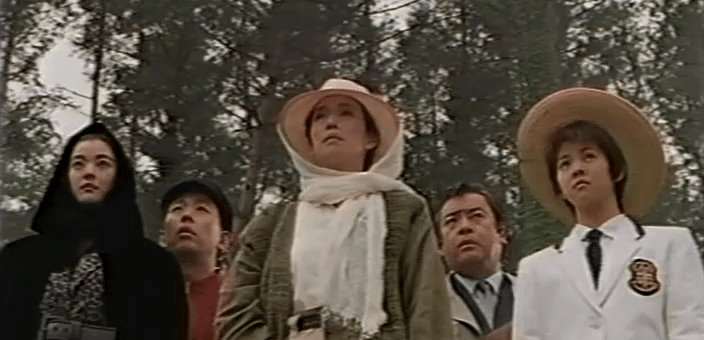
This strain of irony is perceptible in the opening scenes in which producer Akiko (Nobuko Miyamoto) appears in an elegant ’40s-style outfit more in keeping with an archeological dig than a haunted house adventure, her later attire strongly recalling that seen in Indiana Jones. The gang are waiting by their military-style jeep seemingly in the middle of a sandstorm while chief producer Kazuo (Shingo Yamashiro) is busy at the municipal office trying to get permission to enter the Mamiya Mansion which has been shut up for the last 30 years since the death of legendary artist Ichiro Mamiya who is the subject of their documentary. A diffident man as his daughter jokes, Kazuo finds it difficult to make headway until a slightly more cynical employee takes over the negotiations and hands over the key with the rationale that they’ll either find out the house isn’t haunted after all in which case they can turn it into a museum, or that they’ll get some tidy publicity out of the horrifying deaths of all concerned. 

A western-style gothic mansion, the house is itself as imposing as it is ominous even without swirling mists or hovering gloom. Once inside the crew find what they’re looking for, a beautiful fresco with the title “home sweet home” painted in a corner. All we’re told about Ichiro is that he died in the house, but when all is said and done he, like Kazuo, is not terribly important and it is not his death which has cursed the mansion but that of his wife. The sweet home the couple had dreamed of was coming to fruition with the long-awaited birth of a child whose life was to inspire frescos on the remaining walls only tragedy struck. As a toddler the child somehow climbed into the furnace and was burnt alive when his unknowing mother ignited it. She then went mad, kidnapping other children and apparently burning them so her child would not be lonely before eventually throwing herself in too.

Perhaps uncomfortably, Sweet Home leans in to the kind of maternal questioning common to the genre as it considers the formation of a new family in the awkward romance between the shy widower Kazuo who has brought his teenage daughter Emi (Nokko) along on the job, and capable producer Akiko who is repeatedly questioned about marriage, children, and the reasons she currently has neither of them. Keying in to the terror of the house, Emi reveals that as she grows older the memories of her birth mother begin to fade to the extent that she can barely make out her outline, envisioning her merely as an indistinct light. She is prepared to accept Akiko as second mother, offering her the dress which her own mother used to wear only for Akiko to diffidently refuse on the grounds that the dress should be worn by Emi as her mother would have wanted perhaps hinting at the way Emi often treats her father as a clueless child in need of mothering himself. 

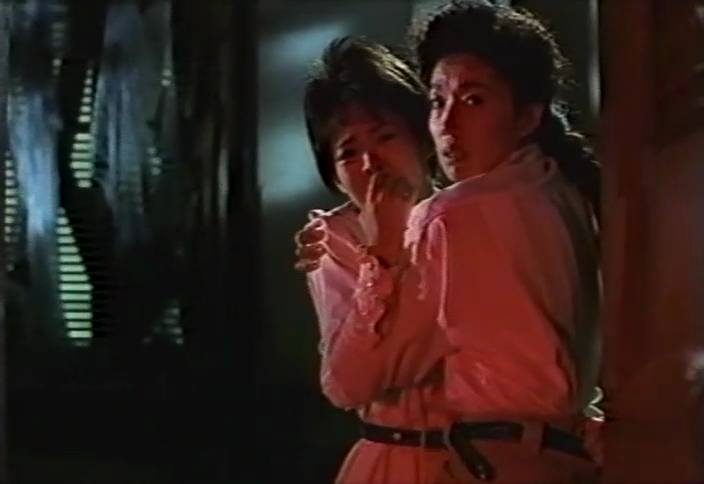
Nevertheless, it’s the dress of maternity that Akiko must finally put on in order to claim the maternal space in venturing back into the haunted house in order to save Emi from becoming another playmate for Mrs Mamiya’s child. Rather than Kazuo, who proves rather ineffectual, she is guided by a weird old man, Yamamura (Juzo Itami), from the petrol station who apparently knows all about fighting ghosts but bluntly tells her she has no chance of success because she is not a mother herself and cannot understand the pain of a mother who has lost a child nor the magnetic pull between a childless mother and motherless child. In order to defeat the vengeful spirit, Akiko must fully embrace the role of the mother, easing the spirit’s pain with maternal compassion in returning to her what was lost. Her child restored to her, the spirit takes on the appearance of the Holy Mother ascending to Heaven bathed in golden light lifting the shadowy gloom that cursed the house. 

Even so there is something insidious in the fact that as Yamamura says if you attempt to fight shadow with light all you get is more of the same, the crew trapped in the house with no means of defence against the encroaching darkness. This unknown, shadowy sense of threat, of being swallowed by darkness, is a key harbinger of a Kurosawa’s signature style as well as a clear evocation of the gothic dread focused on the house with the ironic failure of the “sweet home” dream which is in essence what Akiko, Kazuo, and an Emi are chasing as they try to escape the haunted mansion. Ironically enough, Sweet Home has become best remembered for fathering a video game which eventually led to the Resident Evil series while Kurosawa himself has all but rejected the film claiming Itami’s later interventions undercut his directorial vision. Featuring effects work by Dick Smith, the horror is visceral and disturbing at one point a man’s face melting, his skin slipping from his bones, while the score is cheerfully whimsical in keeping with the absurd lightness of tone that recalls classic teen adventures before heading into the fable-like conclusion in which Akiko must wrest her surrogate child from a vengeful spirit through maternal exchange. Having served its purpose the mansion implodes, freeing not only the spirits trapped inside but the new family now freed of the weight of traditional mores to embrace their new connection founded on love and empathy rather than duty or convention.


Original trailer (no subtitles)

Rub Out the Past (日本暗黒街, Masaharu Segawa, 1966)

A former yakuza’s attempts to shed his old identity and start again as an upscale restaurateur are disrupted by the unwelcome appearance of an old acquaintance in Masaharu Segawa’s noirish drama, Rub Out the Past (日本暗黒街, Nihon Ankokugai). Another “akokugai” or “underworld” film, Segawa’s surprisingly subversive Toei crime story involves not only the drugs trade but hints of Manchurian transgression as the hero tries to forget his past while unable to realise his love for the daughter of a man he killed on the order of his boss. 

Now calling himself Yashiro, Kageyama (Koji Tsuruta) runs a swanky bar in Kobe and is in love with his pianist Yoko (Eiko Muramatsu) who is also, though she doesn’t know it, the daughter of a former associate back in his yakuza days whom he apparently killed for otherwise unclear reasons leaving Yoko and her mother alone and defenceless in Manchuria during the evacuation at the end of the war. When a mysterious man arrives and explains he’s from “Hayami Industries”, Kageyama is reluctant to listen but eventually forced to accompany him to Tokyo where he is led into Hayami’s rather swanky new office complete with electronic displays and workers positioned in tiny booths. Since the end of the war, Hayami has become a “respectable” businessman running some of Asia’s most prestigious hotels in addition to a chain of casinos. Yet his real business is of course in drug smuggling, which is a problem because the guy he put in charge of the Hong Kong route has drawn the attention of the police. He makes Kageyama an offer he can’t refuse ,much as he tries, to take it over. He accepts on the condition it’ll just be a one time thing. 

In any case, Kageyama’s involvement with Hayami soon costs him his relationship with Yoko, who is aware of Kageyama’s criminal past but blames Hayami for her father’s death, and with it a potential for redemption. Details are few, but there are constant references to the gang’s illegal and immoral dealings in Manchuria, a time that Kageyama is keen to leave in the past having made a new more honest life for himself in the post-war society while Hayami has shifted into the increasingly corporatised realms of contemporary organised crime. Yet despite himself Kageyama is good at being a gangster, effortlessly subduing the bumbling head of “Sekiya Industries” and realising that part of the problem is that too many of his men are getting high on their own supply. To streamline the business he lays off drug users telling them to come back when they’re clean and temporarily pauses the business while he reorganises it at street level. This however leaves a small vacuum in the underworld economy which is soon filled by “alternative” suppliers. 

More akin to one of Toho’s spy spoofs, Hayami Industries seems to be incredibly keen on zany gadgets like cigarette lighters that double as secret radios and guns which shoot listening devices not to mention the panel wall which hides Hayami’s secret control room or the knuckle dusters and belt swords sported by the Sekiya guys. All of which is slightly at odds with the seriousness of the constant reminders of abuses in Manchuria and on the Mainland, and the frankness with which drugs are treated onscreen with frequent shots of syringes and powder. As usual in these films, the main villain is from Hong Kong, an unhinged maniac who kidnaps Yoko and gets her hooked on drugs partly at the instigation of Hayami who seems to be making something of a strategic blunder in his attempts to manipulate Kageyama. Yet Kageyama can only get his redemption through reassuming his wartime persona to face Hayami if indirectly in trying to engineer a gang war between middlemen with Hong Konger Tei caught in the middle. 

Segawa adds to the noir feel through the melancholy jazz score reinforcing the fatalism and futility that seems to define Kageyama’s life as he tries but fails to escape from his violent past. A product of wartime misuse he finds himself at odds with the contemporary society, inconveniently falling in love with the daughter of a man he killed and therefore unable to move on from the shadow of his life of crime only granted a second chance after losing everything and paying his debt to society by destroying the system he himself helped to create. 


Graveyard of Honor (新・仁義の墓場, Takashi Miike, 2002)

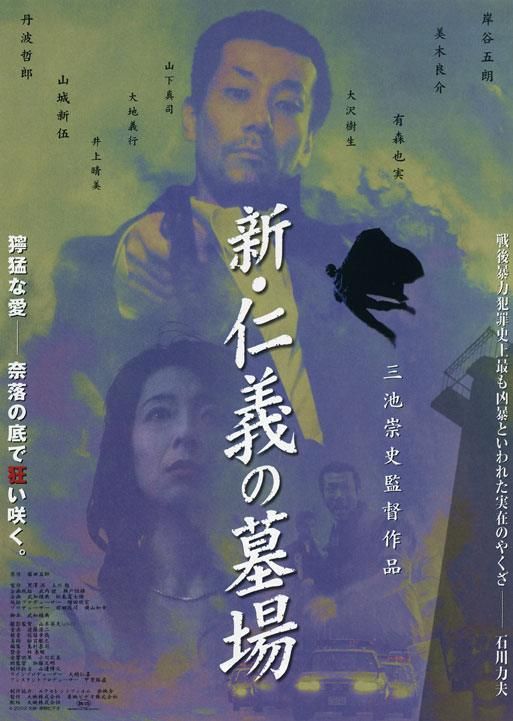
In Kinji Fukasaku’s 1975 jitsuroku eiga Graveyard of Honor, a collection of voices open the film musing on whether the hero was corrupted by the times in which he lived or merely born crazy. Like most jitsuroku or true account gangster movies of the ‘70s, Fukasaku’s Graveyard of Honor is a post-war story about a man who failed to adapt himself to the rules of his society which was of course in constant flux though the rules of the yakuza are perhaps as fixed and timeless as any. Inspired by the same source material Takashi Miike’s comparatively subdued, contemplative Graveyard of Honor (新・仁義の墓場, Shin Jingi no Hakaba) maintains the moody, noirish feel of the ‘70s gangster drama complete with melancholy jazz score but updates the legend of Rikio Ishikawa to late 20th century Japan which again finds itself in crisis, floundering for direction and filled with despair. The bubble has burst in more ways than one as the young in particular awaken to the fact they have been deceived by the false promise that the good times of the Bubble years were cost free and would last forever leaving them abandoned in a world they no longer recognise as their own. 

Unlike Rikio Ishikawa who, we are told, always wanted to be a gangster, Rikuo Ishimatsu (Goro Kishitani) falls into the gokudo world by chance, his life thereafter one long fall until the bloody suicide with which the film opens. A bleach blonde dishwasher at a Chinese restaurant, he gets an offer he can’t refuse when he calmly defuses a would be assassin by hitting him on the head with a chair, earning the eternal gratitude of boss Sawada (Shingo Yamashiro) who takes him on and makes him his protege. This meteoric rise in the yakuza ranks, however, is not without its drawbacks especially in that it destabilises the internal politics of the Sawada gang with old retainers instantly resentful that this young upstart has leap frogged them to sit at the boss’ side while they’ve patiently put the work in only to be sidelined. 

A stretch in prison for avenging the boss’ honour brings him into contact with Imamura (Ryosuke Miki), later his sworn brother but also his opposing number, possibly the last honourable yakuza. “A yakuza without honour isn’t worth shit” Imamura’s boss later remarks, instructing him that Rikuo is a liability he’ll have to take responsibility for, but in this graveyard of honour that kind of responsibility is the one that will get you killed. Honourable yakuza can no longer survive in the world of corporatised thuggery that is the modern gokudo existence. Later we realise that the tale is being narrated by Rikuo’s former underling, Kikkawa, who reminds us that “even yakuza are human beings” existing within a social structure with clearly defined rules which must be followed, yet the rules themselves are largely superficial and Kikkawa survives because he subverts them, abandoning the reckless Rikuo for the certainty of Sawada and setting himself on the traditional gokudo path of sucking up to the boss in the constant hope of advancement. 

Kikkawa is, in a sense, the grovelling salaryman to Rikuo’s frenzied maverick, one as much they symptom of the age as another. Rikuo’s rise occurs against the economic boomtown of Japan in the ‘80s which is as much a paradise for gangsters as for anyone else but also a kind of twilight, the yakuza as an institution relegated to the Showa era and the post-war past. Gangsters forced out of their families like the desperate ronin of the feudal era further destabilise an already chaotic environment which, like that of the post-war years, is filled with despair and disillusionment only to be further disrupted by the advent of natural disaster and economic collapse. 

Like the yakuza of the jitsuroku, those of Miike’s Graveyard of Honor struggle to reorient themselves in a changing society, no more equipped to deal with economic stagnation than their forbears were for the end of occupation and the increasing irrelevance of gangsterdom in a world of economic prosperity. Increasingly paranoid and anxious, Rikuo sees betrayal in all quarters and remains essentially powerless, eventually imprisoned in what appears to have been previously used as a child’s bedroom. He seeks escape in drugs which he finds by chance, and then in romance with an equally powerless woman who bizarrely seems to have fallen in love with him after he brutally raped her though their strange, drug-fuelled quasi-wedding ceremony is the tenderest, most vulnerable we ever see them. Yet as the opening scene implied, all there is is futility. Knowing what he knows, Kikkawa meditates on his memories of happier days when he was just a minion at Rikuo’s side. In this graveyard of honour only the slippery survive and the only way to be free is to fall, and fall hard. 


Original trailer (English subtitles)

Graveyard of Honor (仁義の墓場, Kinji Fukasaku, 1975)

“Like hell you’re free” the “hero” of Kinji Fukasaku’s Graveyard of Honor (仁義の墓場, Jingi no Hakaba) coolly snaps back in squaring off against a rival gang in a crowded marketplace. Perhaps a familiar scene in the jitsuroku eiga, a genre Fukasaku had helped usher into being and later solidified in the hugely influential Battles Without Honour and Humanity series. A reaction against the increasingly outdated ninkyo eiga and their tales of noble pre-war gangsterdom, the jitsuroku or “true account” movie claimed a higher level of authenticity, inspired by the real lives of notorious gangsters and depicting the chaotic post-war period as it really was, a Graveyard of Honor. 

Based on another true crime novel by Battles Without Honour and Humanity’s Goro Fujita, Graveyard of Honour charts the slow self-implosion of reckless gangster Rikio Ishikawa (Tetsuya Watari). In keeping with the jitsuroku mould, Fukasaku opens in documentary mode, onscreen text giving us Rikio’s pregnant birthdate of 6th August, 1924 before giving way to the voices of, we assume, real people who actually knew him when he was child. They describe him alternately as shy, an oversensitive crybaby, and an evil genius in waiting who was always different from the others and had a lifelong ambition to become a yakuza. They wonder if it was the chaos of the post-war world which turned him into a “rabid dog” but note that he was in fact just as crazy before the war and after.

A cellmate during his time in juvenile detention recalls that Rikio would often liken himself to a balloon, intending to rise and rise until he burst but his trajectory will be quite the opposite. A mess of contradictions, he repeatedly tells his remarkably understanding boss Kawada (Hajime Hana) that whatever it is he’s done this time it was all for the gang but all he ever does is cause trouble, picking fights with the rival area gangs in an obsessive need for masculine dominance over his surroundings. His trip to juvie was apparently down to getting into a fight defending Kawada’s honour, implying that he was “the sort of kid who genuinely respected his godfather”, yet it’s in transgressing this most important of unwritten yakuza rules that he damns himself. Beaten up as punishment for setting fire to the car of a gang boss he felt slighted him, Rikio is asked for his finger but gets so drunk psyching himself up that he eventually turns on his own side and is exiled from the capital for a decade. 

That gang boss, meanwhile, Nozu (Noboru Ando), is currently running for political office in Japan’s new push towards democracy. He eventually loses but only by a small margin, bearing out that in this extremely difficult post-war environment, the yakuza is still a respected, if perhaps also feared, force providing services which ordinary people are sometimes grateful for in that they provide a buffer against other kinds of threat. Meanwhile, the first of Rikio’s gang raids is undertaken against so called “third country nationals” a dogwhistle euphemism for Zainichi Koreans, Chinese, Taiwanese, and other citizens from nations colonised by Japan during in its imperialist expansion who entered the country as Japanese citizens but have now been “liberated” only to face further oppression while those like Rikio accuse them of looking down on and taking revenge against the Japanese for the abuse they suffered as imperial subjects. When both sides are arrested a racist policeman allows the yakuza to escape, thanking them for helping him round up all the Chinese businessmen who will now go to jail for illegal gambling allowing the local gangs to seize their turf. 

The greatest irony is, however, that the American occupation forces may be the biggest gang of all, willingly collaborating with Kawada in peddling blackmarket whiskey (amongst other things) from the local base. The yakuza is also in collaboration with the local sex workers who use their connections with American servicemen to facilitate yakuza business. When Rikio starts a fight with a rival gang in a local bar that threatens to spark a war, it’s the Americans who are called in as neutral third party mediator, Nozu being unable to fulfil that role in having an affiliation with Kawada. The Americans, however, merely issue a loudspeaker announcement for the gang members to disperse or face possible arrest, keeping the peace if somewhat hypocritically. 

Rikio, meanwhile, continues to flounder. Exiled from his gang, he becomes addicted to hard drugs and gets a problematic minion of his own, Ozaki (Kunie Tanaka), not to mention contracting tuberculosis. In a particularly morbid moment, he has his own gravestone carved, perhaps detecting that the end is near or at least that an ending is coming for him. In another somewhat inexplicable turn of his life, though a common trope in jitsuroku, he eventually marries the sex worker who fell in love with him after he raped her, presumably touched by his concern after he burned a hole in her tatami mat floor. Wearied by grief and already out of his mind, a final act of nihilistic craziness sees him approach his former boss for the turf and capital to form his own gang, crunching his late wife’s bones as hardened gang members look on in utter disbelief. 

Rikio’s desire for freedom, to be his own boss, is elusive as the red balloon we often see floating away away from him, free in a way he’ll never be. “Don’t these young people respect the code anymore?” Kawada exasperatedly asks on hearing that Rikio has broken the terms of his exile and returned only a year into his sentence. But Rikio’s tragedy may in a sense be that he understood the code too well. On the side of his tombstone he writes the word “jingi”, honour and humanity, full in the knowledge that such concepts in which he seems to have believed no longer exist in the cruel and chaotic post-war world which forces even true believers to betray themselves in a desperate bid for survival. “We all live by a code” his friend echoes, “there’s just no way around the rules”. 

A case of printing the legend, Fukasaku’s take on the life of Rikio Ishikawa may not quite be the “true account” it claims but is in its own strange way a tale of frustrated gangster nobility, a cry baby’s failure to become the man he wanted to be in the complicated post-war landscape. Capturing the confusion of the era through frantic, handheld camera Fukasaku nevertheless takes a turn for the melancholy and mediative in his shifts to sepia, the listless vacant look of a drugged up Rikio somehow standing in for the nihilistic emptiness of a life lived in honour’s graveyard. 


Original trailer (English subtitles)