Bonds of Love (愛のきずな, Takashi Tsuboshima, 1969)

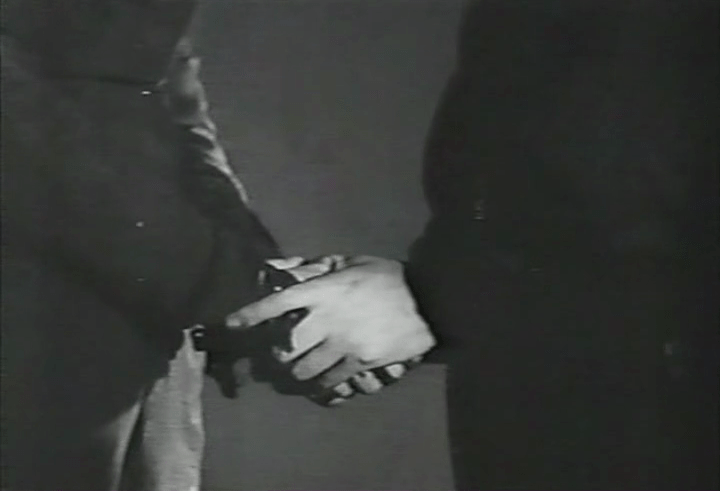
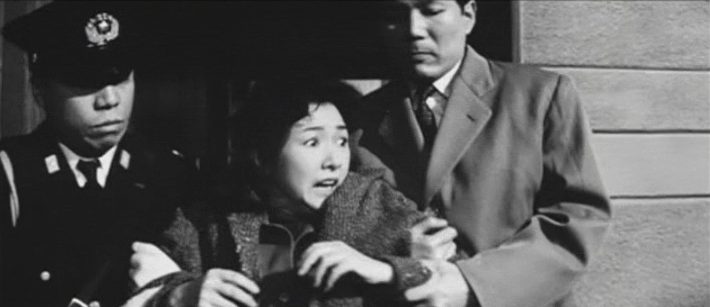
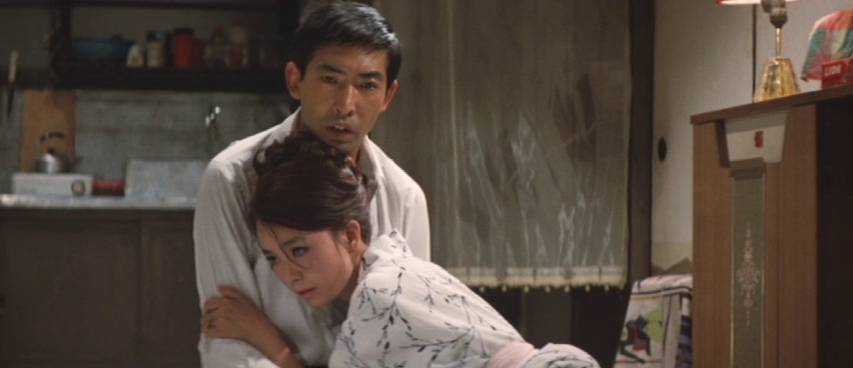
On a rainy night, a salaryman trapped in a loveless marriage and unsatisfying career chances on a beautiful woman dressed in kimono waiting by the side of the road. He decides to double back and offer her a lift, which she ill-advisedly accepts, but as it turns out he is actually the one in danger. Adapted from the Seicho Matsumoto short story Tazutazushi, The Bonds of Love (愛のきずな, Ai no Kizuna) has underlying misogyny that paints the woman at its centre as a sort of elemental spirit who bewitches men and leads them to their doom even while the hero himself is selfish and insecure, mired in an inferiority complex and incapacitated by wounded male pride.

The fact that Ryohei (Makoto Fujita) is already married comes as a bit of a shock, abruptly revealed as it is by the nameplate on the suburban home he returns to after a date with Yukiko (singer Mari Sono) having told her that he lives alone at the company dorm. It seems obvious that he’s dissatisfied with his domestic life and fed up with his overly materialist wife Sanae (Chisako Hara) whose constant gripes only seem to needle at his sense of inadequacy. Today, she’s misplaced an expensive ring he’d used his annual bonus to buy her and when he notices it simply sitting next to the sink, she remarks that it’s not all that nice anyway. Ryohei at least feels that she resents him for not being more successful and having the financial power to buy her the frivolous gifts and status symbols she clearly desires. The power dynamic is in any case unbalanced because Sanae is the daughter of his boss which means she in effect has total control over his career. One word to her father, and he’s toast, but at the same time she can only help him so far with his advancement despite nagging him constantly about his future prospects. Meanwhile, the other men at the office make fun of him. They describe Ryohei as an idiot who’s only in his position by virtue of being the boss’ son-in-law. 

This of course further needles at his wounded male pride, but dating Yukiko, who adores him completely, on the side restores his sense of masculinity. After he claims to have been staying out late playing mahjong, Sanae cautions him that one of his colleagues is being transferred because of his gambling and womanising habits. At his leaving do, Miyata (Sachio Sakai) lays into Ryohei and says he’s the one who taught him how to pick up women and pretend to be single as if this is the way they overcome their sense of impotence while under the company’s thumb. Ryohei appears not to like him, perhaps because he reflects the qualities in himself he is least proud of. The news of his transfer therefore spooks Ryohei knowing that the same fate may befall him if his affair with Yukiko is exposed. 

But when Sanae does eventually suspect he’s cheating on her and complains to her mother, the boss rings Ryohei and basically tells him not to worry about it because a man’s not a man if he doesn’t play around. The conflict that Ryohei has is essentially one of conflicting masculinities, the one in which he is effectively emasculated but defines his status through a hierarchical relationship with other men within the corporate structure, and the other in which he defines it through romantic conquest which also represents a kind of freedom. But being a fairly conventional man, in the end Ryohei cannot bear to have his salaryman persona ripped away from him and will do whatever it takes to maintain his relationship with his wife and by proxy his boss to preserve his career.

Realising Yukiko poses a threat to that, he decides the only solution is to kill her but it’s also true that he’s confronted by a much more robust vision of masculinity in the form of her estranged husband Kenji (Makoto Sato) who went to prison after stabbing another man in a jealous rage. It’s clear that Ryohei is afraid of Kenji and definitely doesn’t want to end up getting stabbed. His “love” for Yukiko does not stand up to that kind of scrutiny and it’s her assertion that she’s going to tell Kenji all about their affair and ask for a divorce that shifts him into crisis mode. After all, he’s in flight from domesticity. Leaving Sanae, and with it destroying his career might not solve his problems even if what he eventually chooses is just that, to be free of the burden of the salaryman dream and move to a small town to open a shop with a woman who is in thrall to him and therefore continually submissive and loving in contrast to Sanae who only ever makes him feel small.

Yet, we can’t actually be sure how much of what happens later is actually real or just Ryohei imagining things because of his guilty conscience and continuing sense of inadequacy. Essentially, he gets a second chance to make better choices and finally gains the courage to abandon his salaryman persona only to be immediately confronted by both his transgressions and violent masculinity. Tsuboshima crafts an atmosphere of malevolence and noirish dread coupled with a spiritual sense of retribution born of the constant rains and gothic thunderstorm that heralds the final confrontation in which Yukiko is herself a harbinger of death leading weak willed men towards their doom to which they go all too willingly. 

Policeman (警察官, Tomu Uchida, 1933)

“No one knows what will happen to us in this world of illusion” muses a conflicted villain in Tomu Uchida’s seminal proto-procedural, Policeman (警察官, Keisatsukan, AKA Police Officer). Forever an enigma, Uchida had made his name through a series of broadly progressive, left-wing films featuring strong social critique, yet he also made this mildly authoritarian, overtly pro-police piece of militarist propaganda long before it became necessary to do so. But then, look a little closer and you’ll find him subtly undercutting the messaging, reconfiguring his tale of a courageous policeman who sets aside his personal feelings in the pursuit of justice as one of tragedy in which a man ultimately imprisons himself by doing so. 

The hero, earnest policeman Itami (Isamu Kosugi), was once as he later reveals a wayward young man. “The world was against me, I thought. I was young then” he sighs, explaining that he owes his life to his boss and mentor, Sgt. Miyabe (Taisuke Matsumoto), who became a second father and set him on the right path which he now of course follows. His long lost childhood friend Tetsuo (Eiji Nakano), with whom he reconnects during a routine vehicle check, apparently experienced something similar having fallen out with his wealthy industrialist father but claims that he’s become an elite layabout spending all his time at the golf course and asking his dad for money every time he runs out which seems nothing if not contradictory but then familial relationships can be complex. In any case, a repeated motif sees the two men taking diverging paths, literally, the implication being that they’ve each chosen different directions in response in to the same adolescent crisis when in a sense “orphaned” through parental disconnection. 

On hearing Tetsuo’s story, Itami asks him with thinly veiled horror if he hasn’t become a communist, that being a fairly common and fashionable way for a young man from a wealthy family to fall out with his father. Tetsuo laughs it off, wishing it were political but claiming somewhat vaguely that it was a matter of feeling. The exchange is revealing in that screenwriter Eizo Yamauchi had apparently been instructed to portray the criminal gang at the film’s centre, of which Tetsuo is later revealed to be a member, as “communist” though no political ideology or identity is ever directly stated. Nevertheless, the central drama is clearly inspired by the Omori Bank Robbery (1932) in which a three members of the Communist Party robbed the Kawasaki Daiichi Bank without the knowledge or authority of party officials in order to gain funding for the movement. The incident backfired, badly discrediting the Communist Party (illegal at the time) and thereby imploding the most viable source of opposition to rising militarism. Armed bank robbery not being a common occurrence in Japan, most viewers would necessarily associate this brand of criminality with “communism”, killing two birds with one stone as the film does its intended job of making the world seem more dangerous than it is while reinforcing an authoritarian message that the police will protect. 

Yet, on the other hand, perhaps it really was “feeling” after all. The relationship between the two men has an intensely homoerotic quality with frequent flashbacks to their carefree high school days during which they read each other romantic German poetry, played rugby, and frolicked on a beach in the company of a very large dog. Itami largely ignores his potential love interest in Miyabe’s pretty daughter, save for briefly thinking about her while on a three-day stakeout of the robbers’ den, while constantly chasing Tetsuo after becoming suspicious that he may be the man responsible for shooting Miyabe and fleeing the scene after a robbery. His inner torment lies partly in the conflict between his responsibilities to friendship and the law, but also perhaps in his unresolved feelings for Tetsuo. Driven half out of his mind, his final epiphany crying out “I am a policeman” is as much a rejection of an identity as a claiming of one, entirely sublimating himself within the image of the role that he has chosen to play in society shedding his personal feeling and desires as he does so. In “saving” Tetsuo, shooting him in the hand to prevent his suicide, tenderly cuffing and then embracing him, he evokes both a sense of return and forgiveness and another of goodbye further enhanced by the abruptness of the transition which follows. 

Taken in this light, the late and extremely jarring slide into overt propaganda through a series of title cards loudly proclaiming the virtue of the police takes on a differing kind of anxiety in its authoritarian dimensions as a force which destroys rather than protects in its capacity to erase individual identity. Nevertheless, Uchida also includes numerous shots of heroic policemen in their dashing uniforms as they assemble for drill or show up en masse on their bikes ready to fight crime. Tetsuo’s final appearance, meanwhile, is extremely sinister dressed as he is in an outfit which would later become associated with fascism, his meticulous uniformity in strong contrast to the then crazed and dishevelled Itami still in his crumpled kimono with messy hair and three days’ worth of beard growth from his stakeout. Yet there’s nothing but pain and fear in his eyes as he realises that his friend has seen through him, Itami rather ostentatiously bundling Tetsuo’s lighter into a handkerchief almost as if he meant to him let know. 

Shooting mainly on location, Uchida’s camera is rarely at rest even employing a series of complicated vehicle tracking shots one of which eventually resolves itself into a first person perspective while the final sequence is tense in the extreme with its gunfire, search lights, and complex choreography. His use of flashback is precise and unusual, far ahead of its time in its acuity as if we actually see Itami’s thought process on screen jumping from one idea to another, while the meeting of the two men on the desolate docks seems to be drenched in loneliness and a sense of futility even while free of the oppressive shadows from the buildings which seemed to dwarf them in the city. Somehow desperately sad despite the catharsis of its final scene, Policeman subtly implies there might not be much difference between hero and villain, or between communist and militarist, save walking one way and not another as two men find their friendship frustrated by time and circumstance coming together only to be driven apart. 


Hit and Run (ひき逃げ, Mikio Naruse, 1966)

The contradictions of the contemporary society drive two women out of their minds in Mikio Naruse’s dark psychological drama, Hit and Run (ひき逃げ, Hikinige, AKA A Moment of Terror). Scripted by Zenzo Matsuyama and starring his wife Hideko Takamine in her final collaboration with the director, Naruse’s penultimate film takes aim at the persistent unfairness of a post-war society already corrupted by increasing corporatisation while caught at a moment of transition that leaves neither woman free to escape the outdated patriarchal social codes of the feudal era. 

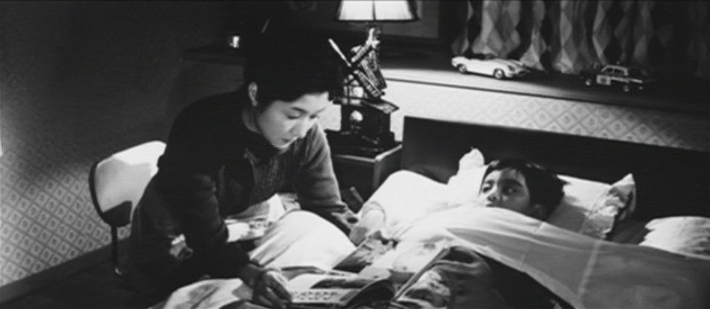
The two women, both mothers to five-year-old boys, are mirror images of each other. Kuniko (Hideko Takamine), the heroine, is a widow working in a noodle bar and continually exasperated by her energetic son Takeshi who keeps escaping kindergarten to play pachinko which is not a suitable environment for a small child. Kinuko (Yoko Tsukasa), meanwhile, is mother to Kenichi and married to a high ranking executive at Yamano Motors, Kakinuma (Eitaro Ozawa). These two worlds quite literally collide when Kinuko, emotionally distressed and driving a little too fast, knocks over little Takeshi while he is out playing with some of the other neighbourhood boys. As she is with her lover, Susumu (Jin Nakayama), she decides to drive on abandoning Takeshi to his fate but discovers blood on the bumper of her shiny white convertible on returning home and thereafter decides to tell her husband everything aside from revealing her affair. Kakinuma covers the whole thing up by forcing their driver to take the rap to protect not his wife but the company along with his own status and success fearing that a scandal concerning his wife driving carelessly may have adverse consequences seeing as Yamano Motors is about to launch a new super fast engine that will make them worldwide industry leaders. 

Perhaps in a way the true villain, Kakinuma cares about nothing other than his corporate success. Kinuko states as much in complaining that he’s never once considered her feelings only his own and that their marriage was a failure from the start, little more than an act of exploitation in which she was traded by her father for money in return for political connections. For these reasons she seeks escape through her extra-marital affair but is unable to leave partly in the psychological conflict of breaking with tradition and partly because she has a son whom she would likely not be permitted to take with her even if it were practical to do so. Another woman says something similar in disparaging Kuniko, implying that her life is in some ways over as few men would be interested in marrying a widow with a child. 

Takeshi’s loss is therefore additionally devastating in severing Kuniko’s only lifeline. A brief flashback reveals that Kuniko was once a post-war sex worker, she and her yakuza brother Koji war orphans who lost their parents in the aerial bombing. When she married and had a child she thought the gods had smiled on her but in true Narusean fashion they gave only to take away leaving her a widow and finally robbing her even of her child. To add insult to injury, they try to put a price on her son’s life, a mere 500,000 yen for a boy of five hit by a car. When the driver stands in the dock, he gets off with only a 30,000 yen fine for the death of a child. Then again on visiting his home, there appears to be a boy of around five there too, perhaps you can’t blame him for taking the money having been robbed of his youth in wartime service. 

Still, on hearing from an eye witness that it was a woman who was driving, Kuniko quickly realises that Kinuko must have been responsible. Quitting her job she joins a maid agency in order to infiltrate the house and gain revenge later settling on the idea of killing little Kenichi, who takes an instant liking to her, to hurt his mother in the way she has been hurt only to be torn by her unexpected maternal connection with the boy. The conflict between the two women is emotional, but also tinged with class resentment that a wealthy woman like Kinuko should be allowed to escape justice with so little thought to those around her while Kuniko is tormented not only by her grief but the persistent injustice of the cover up. 

As in all things, it’s the lie that does the most damage in ironically exposing the truth of all it touches. Kinuko’s escape route is closed when her lover reveals that he’s lost faith in her, unable to trust a woman who’d run away from the scene of a crime and allow someone else to take the blame, while Kakinuma’s emotional abandonment of his social family for the corporate is thrown into stark relief by his immediate decision to further exploit their driver just as he will later their maid. Driven out of her mind, Kuniko has white hot flashes of lustful vengeance as she imagines herself engineering an accident for Kenichi, throwing him off a rollercoaster or coaxing him into traffic, only to regain her senses unable to go through with it so pushed to the brink of madness is she that no other action makes sense. 

Even so the conclusion is brutally ironic, Kuniko accused of a crime she did not commit but half believing that she must have done it because she wanted to so very much. Kakinuma gets a minor comeuppance, encouraged by his servant to make clear what actually happened and exonerate Kuniko thereby walking back his total commitment to the corporate (then again it seems his dream project was itself under threat from a potential plagiarism scandal) though the damage may already have been done. This societal violence of an unequal, increasingly corporatised and unfeeling society, eventually comes full circle bringing with it only death and madness as the two women seek escape from their internal torment. Naruse experiments with handheld camera and canted angles to emphasise the destabilisation of the women’s sense of reality along with blow out and solarisation in the visions that plague them, but curiously ends with a set of motor vehicle accident stats as if this had been a roundabout public information film to encourage careful driving. Then again perhaps in a way it is, a cautionary tale about the dangerous curves of untapped modernity and the cruelties of the nakedly consumerist era.  


The Bad Sleep Well (悪い奴ほどよく眠る, Akira Kurosawa, 1960)

Bad Sleep Well posterThere’s something rotten in the state of Japan – The Bad Sleep Well (悪い奴ほどよく眠る, Warui Yatsu Hodo Yoku Nemuru), Akira Kurosawa’s take on Hamlet, unlike his previous two Shakespearean adaptations, is set firmly in the murky post-war society which, it becomes clear, is so mired in systems of corruption as to be entirely built on top of them. Our hero, like Hamlet himself, is a conflicted revenger. He intends to hold a mirror up to society, reflecting the ugly picture back to the yet unknowing world in the hope that something will really change. Change, however, comes slow – especially when it comes at the disadvantage of those who currently hold all the cards.

We open at a wedding. A small number of attendants lineup around a lift waiting for the arrival of the married couple only for a carriage full of reporters to pour out, apparently in hope of scandal though this is no gossip worthy society function but the wedding of a CEO’s daughter to his secretary. The press is in attendance because the police are – they believe there will be arrests today in connection with the ongoing corruption scandal engulfing the company in which a number of employees are suspected of engaging in kickbacks on government funded projects.

The rather strange wedding proceeds with the top brass sweating buckets while the bride’s brother (Tatsuya Mihashi), already drunk on champagne, takes to the mic with a bizarre speech “refuting” the claims that the groom, Nishi (Toshiro Mifune), has only married the bride, Yoshiko (Kyoko Kagawa), for financial gain before avowing that he will kill his new brother-in-law if he makes his little sister sad. Nishi, as we later discover, has indeed married with an ulterior motive which is anticipated by the arrival of a second wedding cake in the shape of a building at the centre of a previous corruption scandal with one black rose sticking out of the seventh floor window from which an employee, Furuya, committed suicide five years previously.

The police are keen to interview their suspects, the press are keen to report on scandal, but somehow or other the system of corruption perpetuates itself. The top guys cover for each other, and when they can’t they “commit suicide” rather than embarrass their “superiors” by submitting themselves to justice. The system of loyalty and reward, of misplaced “honour” mixed with personal greed, ensures its own survival through homosocial bonding with backroom deals done in hostess bars and the lingering threat of scandal and personal ruin for all should one rogue whistleblower dare to threaten the governing principle of an entire economy.

Nishi chooses to threaten it, partly as an act of revolution but mainly as an act of filial piety in avenging the wrongful death of his father who had, in a sense, cast him aside for financial gain and societal success. Wanting to get on, Nishi’s father refused to marry his mother and instead married the woman his “superiors” told him to. Later, his father threw himself out of a seventh floor window because his “superiors” made him understand this was what was expected of him. Furuya wasn’t the last, each time a man’s transgressions progress too far his “superiors” sacrifice him to ensure the survival of the system. Strangely no one seems to rebel, the men go to their deaths willingly, accepting their fate without question rather than submitting themselves to the law and taking their co-conspirators down with them though should someone refuse to do the “decent” thing, there are other ways to ensure their continuing silence.

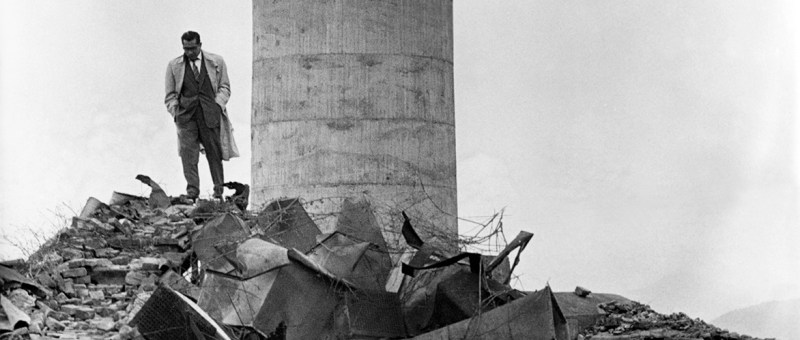
Reinforcing the post-war message, Nishi chooses a disused munitions factory for his secret base. Both he and his co-conspirator, a war orphan, had been high school conscripts until the factory was destroyed by firebombing and thereafter were forced to live by their wits alone on the streets. Nishi swears that he wants to take revenge on those who manipulate the vulnerable, but finds himself becoming ever more like his prey and worse, hardly caring, wanting only to steel himself for the difficult task ahead.

In any revolution there will be casualties, but these casualties will often be those whom Nishi claims to represent. Chief among them his new wife, Yoshiko, who has been largely cushioned from the harshness of the outside world thanks to her father’s wealth and seeming care. She loves her husband and wants to believe in her father or more particularly that the moral arc of her society points towards goodness. Nishi, tragically falling for his mark, married his wife to destroy her family but ironically finds himself torn between genuine love for Yoshiko, a desire for revenge, and a mission of social justice. Can he, and should he, be prepared to “sacrifice” an innocent in the same way the “superiors” of the world sacrifice their underlings in order to end a system of oppression or should he abandon his plan and save his wife the pain of learning the truth about her husband, her father, and the world in which she lives?

In the end, Nishi will waver. Yoshiko’s father, Iwabuchi (Masayuki Mori), will not. Goodness becomes a weakness – Iwabuchi turns his daughter’s love and faith against her, subverting her innocence for his own evil. He makes a sacrifice of her in service of his own “superiors” who may be about to declare that they “have complete faith” in him at any given moment. The only thing that remains clear is that Iwabuchi will not be forgiven, the wronged children of the post-war era will not be so quick to bow to injustice. Let the great axe fall? One can only hope.


Original trailer (English subtitles)

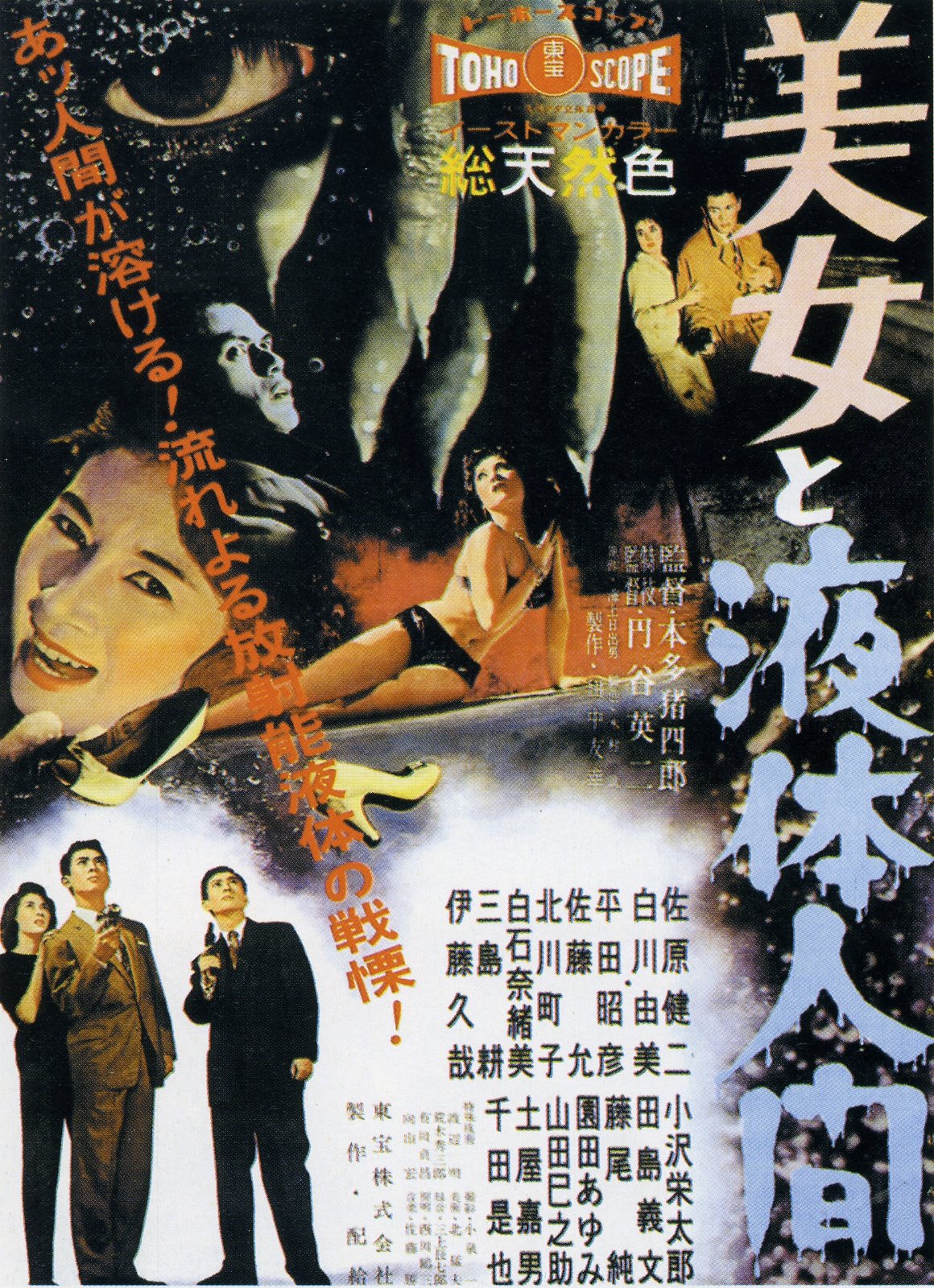
The H-Man (美女と液体人間, Ishiro Honda, 1958)

H-man
Toho produced a steady stream of science fiction movies in the ‘50s, each with some harsh words directed at irresponsible scientists whose discoveries place the whole world in peril. The H-man (美女と液体人間, Bijo to Ekitainingen), arriving in 1958, finds the genre at something of an interesting juncture but once again casts nuclear technology as the great evil, corrupting and eroding humanity with a barely understood power. Science may have conjured up the child which will one day destroy us, robbing mankind of its place as the dominant species. Still, we’ve never particularly needed science to destroy ourselves and so this particularly creepy mystery takes on a procedural bent infused with classic noir tropes and filled with the seedier elements of city life from gangsters and the drugs trade to put upon show girls with lousy boyfriends who land them in unexpected trouble.

Misaki (Hisaya Itou) is not a man who would likely have been remembered. A petty gangster on the fringes of the criminal underworld, just trying to get by in the gradually improving post-war economy, he’s one of many who might have found himself on the wrong side of a gangland battle and wound up just another name in a file. However, Misaki gets himself noticed by disappearing in the middle of a drugs heist leaving all of his clothes behind. The police immediatetely start hassling his cabaret singer girlfriend, Chikako (Yumi Shirakawa), who knows absolutely nothing but is deeply worried about what may have happened to her no good boyfriend. The police are still working on the assumption Misaki has skipped town, but a rogue professor, Masada (Kenji Sahara), thinks the disappearance may be linked to a strange nuclear incident…..

Perhaps lacking in hard science, the H-Man posits that radiation poisoning can fundamentally change the molecular structure of a living being, rendering it a kind of sentient sludge. This particular hypothesis is effectively demonstrated by doing some very unpleasant looking things to a frog but it seems humans too can be broken down into their component parts to become an all powerful liquid being. The original outbreak is thought to have occurred on a boat out at sea and the scientists still haven’t figured out why the creature has come back to Tokyo though their worst fear is that the H-man, as they’re calling him, retains some of his original memories and has tried to return “home” for whatever reason.

The sludge monster seeps and crawls, working its way in where it isn’t wanted but finally rematerialises in humanoid form to do its deadly business. Once again handled by Eiji Tsuburaya, the effects work is extraordinary as the genuinely creepy slime makes its slow motion assault before fire breaks out on water in an attempt to eradicate the flickering figures of the newly reformed H-men. The scientists think they’ve come up with a way to stop the monstrous threat, but they can’t guarantee there will never be another – think what might happen in a world covered in radioactivity! The H-man may just be another stop in human evolution.

Despite the scientists’ passionate attempts to convince them, the police remain reluctant to consider such an outlandish solution, preferring to work the gangland angle in the hopes of taking out the local drug dealers. The drug lord subplot is just that, but Misaki most definitely inhabited the seamier side of the post-war world with its seedy bars and petty crooks lurking in the shadows, pistols at the ready under their mud splattered macs. Chikako never quite becomes the generic “woman in peril” despite being directly referenced in the Japanese title, though she is eventually kidnapped by very human villains, finding herself at the mercy of violent criminality rather than rogue science. Science wants to save her, Masada has fallen in love, but their relationship is a subtle and mostly one sided one as Chikako remains preoccupied over the fate of the still missing Misaki.

Even amidst the fear and chaos, Honda finds room for a little song and dance with Chikako allowed to sing a few numbers at the bar while the other girls dance around in risqué outfits. The H-man may be another post-war anti-nuke picture from the studio which brought you Godzilla but its target is wider. Nuclear technology is not only dangerous and unpredictable, it has already changed us, corrupting body and soul. The H-men may very well be that which comes after us, but if that is the case it is we ourselves who have sown the seeds of our destruction in allowing our fiery children to break free of our control.


Original trailer (no subtitles)

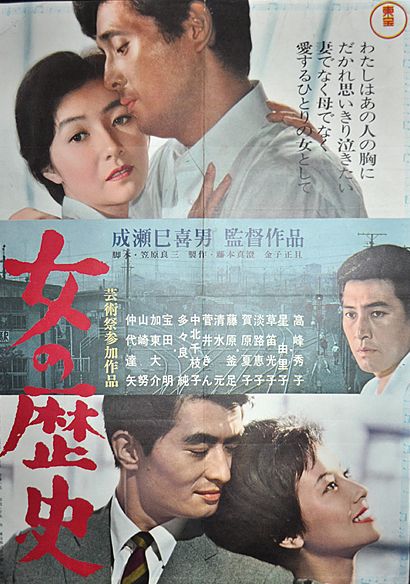
A Woman’s Story (女の歴史, Mikio Naruse, 1963)

woman's storyMikio Naruse made the lives of everyday women the central focus of his entire body of work but his 1963 film, A Woman’s Story (女の歴史, Onna no Rekishi), proves one of his less subtle attempts to chart the trials and tribulations of post-war generation. Told largely through extended flashbacks and voice over from Naruse’s frequent leading actress, Hideko Takamine, the film paints a bleak vision of the endless suffering inherent in being a woman at this point in history but does at least offer a glimmer of hope and understanding as the curtains falls.

We meet Nobuko Shimizu (Hideko Takamine) in the contemporary era where she is a successful proprietor of a beauty salon in bustling ‘60s Tokyo. She has a grown up son who works as a car salesman though he’s often kept out late entertaining clients and has less and less time for the mother who gave up so much on his behalf. Her life is about to change when Kohei (Tsutomu Yamazaki) suddenly announces that he wants to get married – his lady love is a bar hostess to whom he’s become a knight in shining armour after saving her from a violent and persistent stalker. Needless to say, Nobuko does not approve both for the selfish reason that she isn’t ready to “lose” her son, and because of the social stigma of adding a woman who’s been employed in that line of work to the family.

All of this is about to become (almost) irrelevant as tragedy strikes leaving Nobuko to reflect on all the long years of suffering she’s endured up to this point only to have been struck by such a cruel and unexpected blow. An arranged marriage, her husband’s infidelity, the war which cost her home, possessions and also the entirely of her family, and finally the inescapable pain of lost love as the man who offers her salvation is quickly removed from her life only to resurface years later with the kind of pleasantries one might offer a casual acquaintance made at party some years ago. Life has dealt Nobuko a series of hard knocks and now she’s become hard too, but perhaps if she allows herself to soften there might be something worth living for after all.

Women of a similar age in 1963 would doubtless find a lot to identify with in Nobuko’s all too common set of personal tragedies. They too were expected to consent to an arranged marriage with its awkward wedding night and sudden plunge into an unfamiliar household. Nobuko has been lucky in that her husband is a nice enough man who actually had quite a crush on her though there is discord within the household and Nobuko also has to put up with the unwelcome attentions of her father-in-law. This familial tension later implodes though fails to resolve itself just as Japan’s military endeavours mount up and Nobuko gives birth to her little boy, Kohei. Husband Kouichi becomes increasingly cold towards her before being drafted into the army leaving her all alone with a young child.

All these troubles only get worse when the war ends. Though Kouichi’s former company had been paying his salary while he was at the front, they care little for his widow now. Left with nothing to do but traffic rice, Nobuko comes back into contact with her husband’s old friend, Akimoto (Tatsuya Nakadai), who wants to help her but is himself involved in a series of illegal enterprises. Nobuko is molested twice by a loud and drunken man who accosts her firstly on a crowded train (no one even tries to help her) and then again at a cafe where she is only saved by the intervention of Akimoto, arriving just in the nick of time. Nobuko sacrifices her chances at happiness to care for Kohei, caring about nothing else except his survival and eventual success.

Of course, Kohei isn’t particularly grateful and feels trapped by his mother’s overwhelming love for him. Nobuko’s sacrifices have also made her a little bit selfish and afraid of being eclipsed in the life of her son. It’s easy to understand the way that she later behaves towards Kohei’s new bride, but if she wants to maintain any kind of connection to the son that’s become her entire world, she will need to learn to allow another woman to share it with her.

Naruse is a master at capturing the deep seated, hidden longings that women of his era were often incapable of realising but A Woman’s Story flirts with melodrama whilst refusing to engage. The awkward flashback structure lends the film a degree of incoherence which frustrates any attempt to build investment in Nobuko’s mounting sorrows, and the voiceover also adds an additional layer of bitterness which makes it doubly hard to swallow. This is in no way helped by the frequently melodramatic music which conspires to ruin any attempts at subtlety in favour of maudlin sentimentality. The endless suffering of mid-twentieth century women is all too well drawn as grief gives way to heartbreak and self sacrifice, though Naruse does at least offer the chance to begin again with the hope of a brighter and warmer future of three women and a baby building the world of tomorrow free of bombs and war and sorrow.