The Woman in the Rumour (噂の女, Kenji Mizoguchi, 1954)

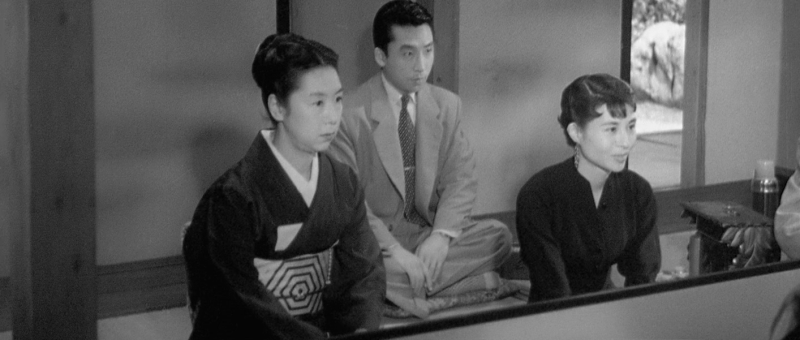
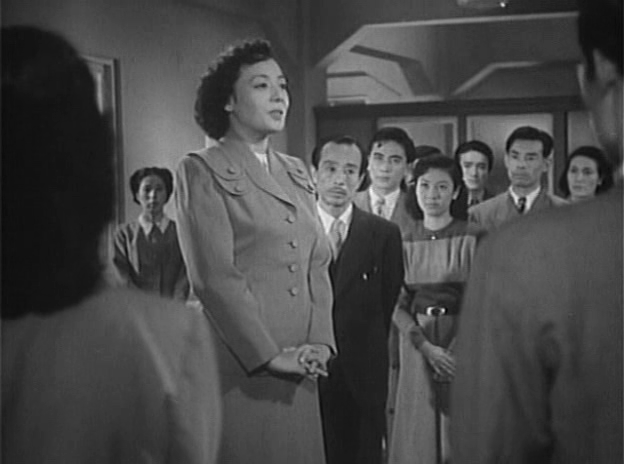
A mother and daughter find themselves deceived by the same man, each hemmed in by realities which cannot be altered but eventually coming to a place of mutual understanding that allows them to restore their relationship not only as parent and child but as women in Kenji Mizoguchi’s 1954 melodrama, The Woman in the Rumour (噂の女, Uwasa no Onna). The first question we might ask ourselves is to which of the women the title refers, or indeed to which rumour, though in a sense rumours matter little for either of them when the problem is the constraints which each of them feel as women in the contemporary society. 

Even so, the sense of shame is evident when Yukiko (Yoshiko Kuga) is brought back to the geisha house run by her mother Hatsuko (Kinuyo Tanaka) after having attempted to take her own life in Tokyo. As we learn, the reason for her despair is in part heartbreak. She had been engaged but her fiancé’s family convinced him to end their relationship when they discovered that her mother ran a geisha house. Thus the suicide attempt is also a reflection of her sense of futility. She will always be the daughter of a woman who earned her living in the sex trade. This is a fact that cannot be changed and may lead her to think that her situation is hopeless because the same thing is likely to happen again leaving her unable to marry in a society in which there are few options for a single woman to make a life for herself not to mention the loneliness of living without romantic love. 

Hatsuko, meanwhile, is uncertain how seriously she should take the situation in part believing that it’s a product of youthful naivety in her daughter’s first romantic heartbreak. When a young doctor with whom she is close, Matoba (Tomoemon Otani), explains to her that Yukiko is depressed because she feels deep shame, self-loathing, and hopelessness due to her mother’s occupation, Hatsuko struggles to understand it and does not fully believe him. Nevertheless, she took care to bring her daughter up largely outside of the geisha world, sending Yukiko to Tokyo to study music implying that she herself to some degree sees her work as improper. The other girls view Yukiko with a degree of disdain, realising that her refinement was bought with their exploitation and noticing her animosity towards them. 

Hatsuko is mother both to Yukiko and the young women under her care who are always quick to point out that this is one of the better geisha houses because they are well looked after. When one of the women, Usugumo (Kimiko Tachibana), is taken ill, Hatusko calls in the doctor and allows her time off to rest which likely would not be granted at another house. She is reluctant to send her to hospital, but would if the situation called for it. In a sense it’s this solicitation that eventually allows Yukiko to find accommodation with her mother’s profession as she grows closer to the other women while nursing Usugumo herself and comes to understand their particular circumstances that have left them no choice but to live as geisha. Usugumo is reluctant to go to hospital because she is worried about the money she’d usually send to her sister Chiyoko (Sachiko Mine) who works the family farm and cares for their sickly father, but when she dies Chiyoko herself is left with little option other than to petition the geisha house to take her sister’s place. 

On seeing Chiyoko sitting on the step and pleading to be taken on, another of the women laments as she’s leaving that she wonders when there will be no more need for women like them. The geisha world is perhaps an unchangeable reality, just like Yukiko’s birth and her mother’s age. The rumours that surround Hatsuko are to do with her closeness with Matoba with whom she has clearly been in an intimate relationship, dreaming of becoming his wife and even considering selling the geisha house to buy a large property where they could live together as a couple while he runs a private clinic. Matoba predictably decides he prefers the younger Yukiko, Hatsuko increasingly desperate after overhearing their conversation about leaving her behind to move to Tokyo together where Matoba ponders finishing his education. The play they’ve gone to see almost feels like a personal attack as an actor intones that feelings of love at 20 are fine but at 60 it’s merely shameful. “Even carp know better than to fall in love at this age”, he adds, the old woman a figure of ridicule in her romantic delusion leaving Hatsuko feeling both humiliated and resentful.

When Hatsuko finally confronts Matoba, she does it as a scorned woman rather than as a mother, while Yukiko in turn first turns on her rather than Matoba even as she begins to realise the reality of the situation that the man who seduced her had been using her mother for his own gain in total disregard of her feelings. In short, even if Hatsuko were not her mother which certainly makes this a very complicated situation, he is not the sort of man she’d want to make a life with. Acutely aware of her own experiences of heartbreak, she fears for her mother’s wellbeing and comes to an understanding of her as a woman while accepting that “men are all alike” and in that at least perhaps her mother’s profession is the most honest of all. Mutually betrayed, mother and daughter are able to repair their familial bonds while Yukiko finds herself taking refuge in the geisha house as a space of female solidarity and bulwark against a cruel and patriarchal society. 


The Blind Menace (不知火検校, Kazuo Mori, 1960)

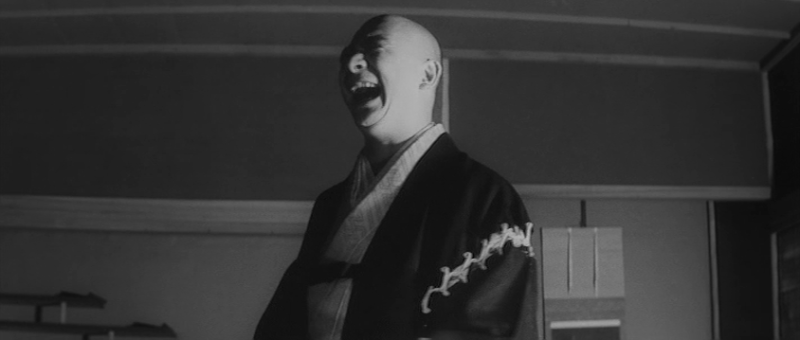
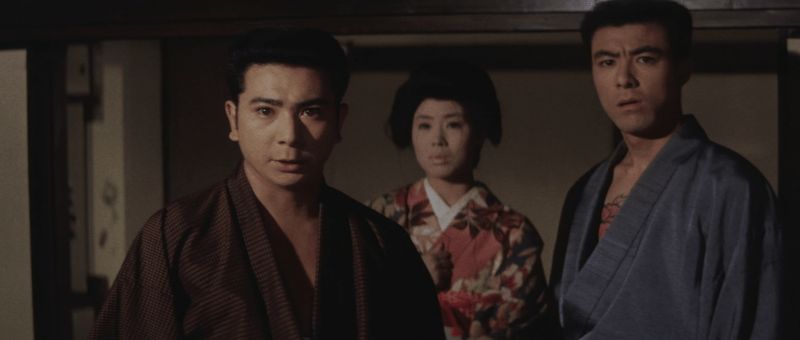
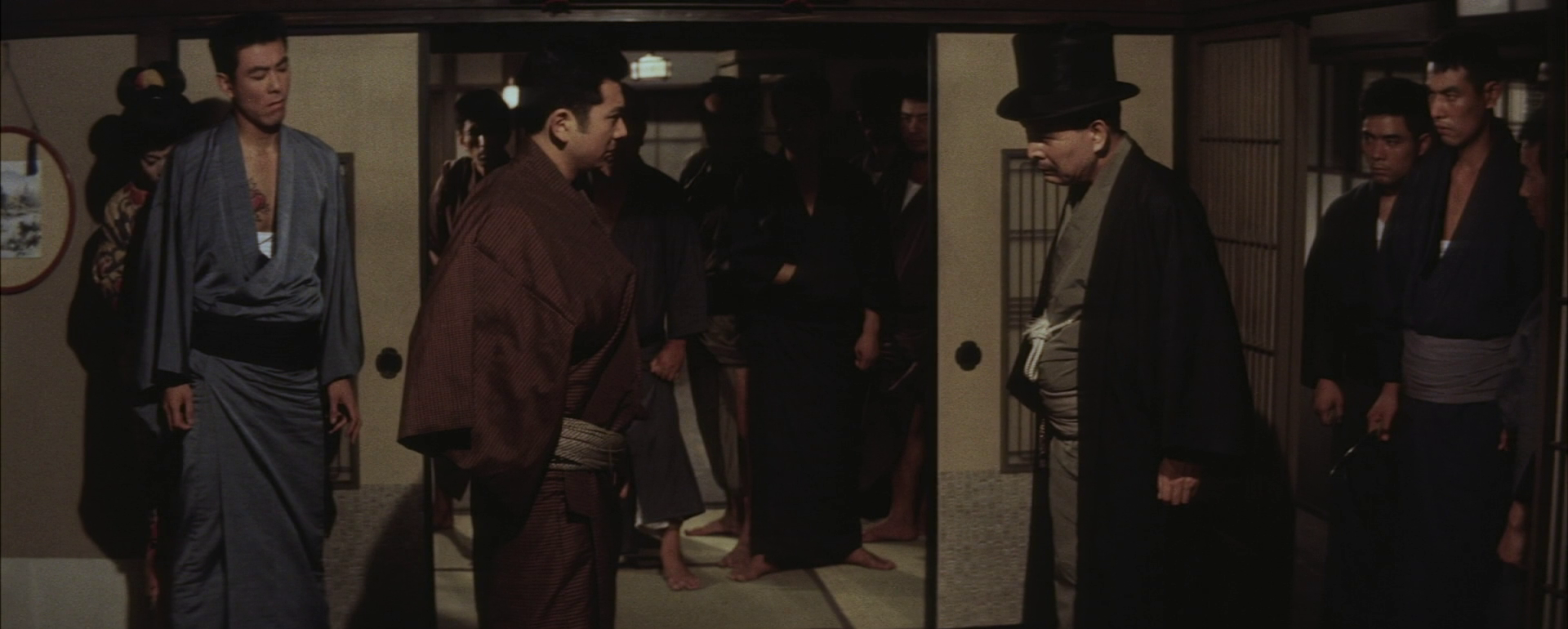
Two years before finding fame as Zatoichi, Shintaro Katsu starred as his mirror image in a tale of pure villainy, The Blind Menace (不知火検校, Shiranui Kengyo). As the title suggests, the film follows the upward trajectory and eventual downfall of an unsighted man who gleefully rapes and pillages his way to becoming the leader of his community aided and abetted by the ills of the feudal era which allow him to profit from his crimes until the past finally catches up with him.

After all as he later says, “as long you as you keep rising in the world, past misdeeds don’t matter.” In any case, even as a child the man who would later be known as Suginoichi (Shintaro Katsu) is incredibly unpleasant. In the opening festival sequence he picks his nose and flicks it in a barrel of sake so that the men drinking will abandon it. The only sign of possible goodness in him is that he takes the sake home for his mother to enjoy, though he seems to relish the idea of her unwittingly drinking his snot so perhaps that was the real purpose. Other hobbies of his include conning wealthy passersby out of a ryo with a well worn scam in which he asks them to read a letter from his uncle which mentions that it should include one ryo only what’s in there is a stone. When the reader explains the situation, he accuses them of trying to take advantage of his blindness and makes a fuss about it until they’re embarrassed into coughing up a ryo of their own (not a small sum for the time period). 

In some ways his poverty and disability might explain his behaviour. His family set up is subverted with his mother much like him money hungry and willing to do anything to get it while his saintly, henpecked father is gentle and honest. This might have taught him the wrong lessons about masculinity that lead him to see his father as weak in allowing the world to trample him while taking his mother’s advice to heart that if they only had a 1000 ryo they could get him trained up properly so that he might one day become a Kengyo which is a little bit like a community leader for the blind with social status and political influence. 

It’s this kind of social affirmation he seems to crave, but is essentially a narcissistic sociopath who takes advantage a stereotype that in some ways infantilises the blind and those with other disabilities who are believed to be pure-hearted and incapable of intrigue or evil. He seems to come to the rescue of a noblewoman who asked his boss, the Kengyo, to lend her money secretly because her brother has been caught embezzling but then rapes her, asks for the money back, and blackmails her into further acts of sexual exploitation offering her only 5 ryo a time knowing she needs 50. He thinks nothing of using his acupuncture skills to kill a man who was carrying 200 ryo to buy a “boneless girl” for a freak show and then framing a man who saw him do it but agreed to say nothing for a 50% cut for the crime. Suginoichi later teams up with “Severed Head” Kurakichi (Fujio Suga) to commit a series of burglaries including that of the Kengyo master who he also has killed to usurp his postion. 

But as he said, once his recognition is in sight with an invitation from the shogun everything begins to fall apart as all his wrongdoing starts to catch up with him. The feudal world had allowed him to prosper partly because of other people’s greed but also the social codes that favour shame and secrecy along with people’s unwillingness to accept that a blind man can also be selfish and evil despite a lot of evidence to the contrary. Elegantly lensed by Kazuo Mori who brings a sense of realism to the hardbitten backstreets of the feudal poor, the film may suggest that the wealthy only get that way by trickery and exploitation and the only way to rise to the loftiest place is to be like Suginoichi and not care what you do to get there but is clear that once you arrive you won’t stay very long because one day the past will really will come back to bite you. 


4K restoration trailer (no subtitles)

Freelance Samurai (桃太郎侍, Kenji Misumi, 1957)

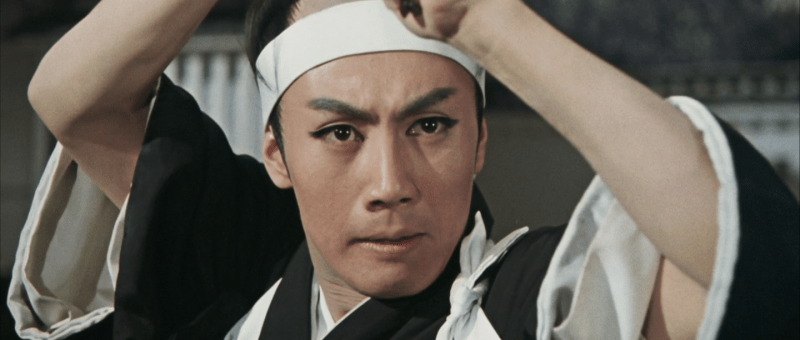
An abandoned son resolves to wander Japan killing the “demons” of Edo-era society in Kenji Misumi’s adaptation of the popular novel by Kiichiro Yamate, Freelance Samurai (桃太郎侍, Momotaro-Zamurai, AKA The Demon Crusader). Starring a young Raizo Ichikawa in dual roles as twins separated at birth, a familiar jidaigeki plot device, Misumi’s drama is among his most conventional but still finds the demon-hunting hero of the title resolutely rejecting the “silly rules of the samurai” in refusing to serve or be served while resisting the persistent corruptions of the feudal society. 

First spotted returning a paper balloon to some children playing in the street, the hero (Raizo Ichikawa) later gives his name as “Momotaro”, the legendary folklore champion who was born from a peach and then went on to befriend various forest creatures travelling with them to fight the cruel demons who had been oppressing the peasants of the farmland where his adoptive parents lived. The name is a sense ironic in that it reflects his own fatherless existence having discovered that he is actually Shinjiro, the younger brother of the heir to a nearby clan, Shinnosuke (also Raizo Ichikawa). At this particular cultural moment, twins were thought inauspicious with one usually cast out, Momotaro in someways more fortunate than most in that he was sent away and raised by his mother to whom he was apparently devoted. In fact, as he says, he only delayed his demon-killing mission out of consideration for her but that now that she has sadly passed away he is free to pursue justice as a wandering ronin determined to serve no master but himself. 

This insistence on justice and opposition to samurai oppression is made plain in the opening scene in which he rescues pickpocket Kosuzu (Michiyo Kogure) from two samurai she’d robbed who were hassling her. She of course falls in love with him, but is also party to the central conspiracy engineered by high ranking retainer Shuzen (Shosaku Sugiyama) who is plotting to unseat Shinnosuke in favour of the lord’s illegitimate young son Mantaro (Junta Yamamoto) with the help of ambitious underling Iga (Seizaburo Kawazu). Momotaro is swept into the intrigue when he rescues the beautiful daughter of loyal retainer Iori (Gen Shimizu), Yuri (Yoko Uraji), from an attempted kidnapping. Both sides want to recruit him for his bravery and sword skill, but Momotaro is reluctant to help either of them especially on discovering the ironic coincidence that he finds himself caught up in a succession struggle in the very clan which previously cast him out. 

Deciding to help when hearing that Shinnosuke has been poisoned, Momotaro demonstrates his strategic abilities in coming up with a ruse to trick the conspirators but remains somewhat conflicted remembering his mother’s dying words that he should hold no grudges even as a part of him continues to resent his abandonment. That may in part explain his defiant rejection of the hierarchal society, ignoring the “silly” rules of the samurai while insisting on equality in refusing to serve or be served by anyone else. In a nod to the folktale, his greatest friend is a humble peddler, Inosuke “the monkey man” (Shunji Sakai) who gives him a place to stay in the rundown tenement where he lives affectionately known as “ghost apartments”. Even so, Inosuke as much servant as sidekick, and while he is in a sense torn between the earthy pickpocket Kosuzu who is later redeemed through her loyalty to him and the beautiful samurai daughter Yuri it seems fairly clear that he will eventually opt for his class-appropriate match the only surprising thing being that it is she who transgressively breaks with convention in abandoning her samurai home in order to follow Momotaro out on the road as he hunts other “demons” corrupting the social order all over Japan. 

Shot in colour academy ratio, Freelance Samurai features little of Misumi’s trademark natural vistas save for the poignant pillow shots of flowers growing in the compound though it does reflect his preoccupation with absent fathers and perpetual wandering. In the many dualities in play, it is also interesting that Momotaro is depicted as the more capable of the brothers, Ichikawa’s characterisation of the cosseted Shinnosuke as a kind and compassionate, effete young man rather than the strapping warrior the heir to a clan is expected to be hinting perhaps at the perceived weakness that allowed the conspirators to assume they could usurp him. Similarly, it’s Michiyo Kogure’s tragic pickpocket undone by her love for the noble samurai that makes the deeper impression rather than the rather insipid Yuri who makes her mark only in her final decision to follow Momotaro unbidden. Momotaro’s quest may in a sense be ironic in that he outwardly rejects the superiority of the samurai but effectively preserves it even as he determines to clean out the oppressive “demons” intent on corrupting the land just as his folkloric namesake had done, but in its own way has its defiant nobility in his fierce love of justice and equality. 


Battle of Roses (薔薇合戦, Mikio Naruse, 1950)

Mikio Naruse was famously unhappy with most of his ’40s work, believing that his career did not begin to revive until the release of Ginza Cosmetics in 1951. The late ‘40s were indeed a difficult time in terms of the industry as Naruse’s home studio, Toho, became entrenched in a series of labour disputes which eventually led to the creation of new studio “Shin Toho” (lit. “new Toho”). Naruse meanwhile though sympathetic to the cause kept a low profile working in theatre and thereafter with other studios such as Shochiku which is where he made 1950’s Battle of Roses (薔薇合戦, Bara Kassen) .

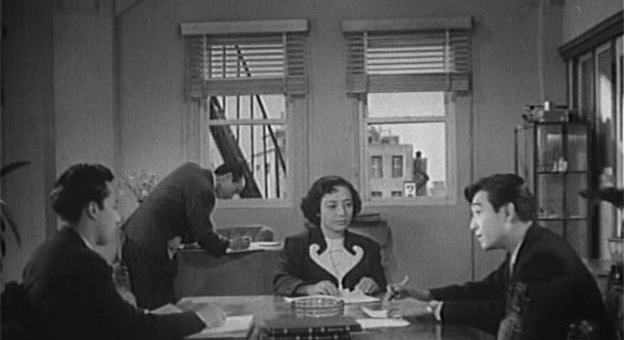
Perhaps because of its turbulent production genesis, Battle of Roses is a distinctly unpolished and surprisingly reactionary take on female liberation adapted from a newspaper serial following the lives of three sisters pursuing different paths in the complicated post-war society. The action opens with the death of the husband of the eldest sister, Masago (Kuniko Miyake), who had been the head of cosmetics studio White Lily but is currently under-investigation for large-scale embezzlement of which it appears he is almost certainly guilty. After he dies, Masago inherits the company but is pursued by massive debts to the film’s villain, Mogi (Toru Abe), who is also after the most pure hearted of the sisters, Hinako (Setsuko Wakayama). Masago makes some kind of shady arrangement with her husband’s former associate Kasahara (Eitaro Shindo), pays off the debt, and starts her own rival company Nigera where she is the CEO. Youngest sister Chisuzu (Yoko Katsuragi), meanwhile, also works at Nigera but is a fully modern woman who wants “to be free and know everything about life”, resentful of her sister’s authority and planning to move out into her own apartment where she later begins a “trial” marriage with Ejima (Shiro Osaka), a journalist from Fashion and Films magazine who turns out to be no good at all.

The sisters are each, in a sense, punished for a perceived naivety in the way they pursue their goals, the implication being that they are mere women thrown unprepared into a male world they lack the skills to navigate. This is most obviously true of Masago who is shown to be a surprisingly astute business woman but a bad judge of character while also criticised for wielding her femininity by leveraging her business affairs through Kasahara who nevertheless declares that he wants to keep their business and personal relationships separate which is why the original loan comes with interest. Masago then gives an accountancy job to her inexperienced boyfriend who proves up to it, but also creates tension in the office seeing as she is unwilling to go public about their relationship even after they agree to marry while he remains resentful of Kasahara.

After spotting her with Mogi who continues to pursue her despite her obvious dislike of him, Masago contrives to have Hinako marry a trusted assistant, Hinatsu (Mitsuo Nagata), pushing her into a marriage against her will to prove her sisterly loyalty while Hinako herself has taken a liking to divorced advertising executive Sonoike (Koji Tsuruta) who is the film’s only real “good” man. Hinatsu, however, turns out to be less reliable than Masago thought, resentful that his marriage to Hinako while guaranteeing continued employment has actually adversely affected his career prospects with Masago unwilling to promote him for fear of claims of nepotism. To avoid “ending up like Hinako”, Chisuzu agrees to a weird quasi-marriage with Ejima in which she insists that they live separately so that he won’t “meddle” in her life because “men only want to stay in a superior position”.

Chisuzu is later taken to task for attempting a take a “male” role in terms of her sexual agency, Ejima’s wife (Noriko Sengoku) suddenly turning up with a child on her back to refer to her husband as a “male mistress” and demand money from Chisuzu who has already been guilted into handing over vast sums to Ejima to prove her love. Ejima later threatens to blackmail the whole family with a tell all book detailing what he’s learned about the “immoral” lives of the three sisters behind Nigera cosmetics. Meanwhile, Hinako’s marriage has also gone south the extent that Hinatsu eventually tries to steam her to death by locking her in the bathroom and stoking up the fire only to think better of it in the nick of time, causing her a miscarriage and landing her in the hospital for three months during which Sonoike continues to send her flowers while Hinatsu struggles to understand why she might not want to accompany him on the job transfer he is forced to accept after he’s discovered to have committed fraud while having an affair with a woman from sales.

Hinako is punished, essentially, for excessive womanliness in trying to make everyone happy by suppressing her own feelings, rejecting her agency in deference to her sister who is punished for being too “manly” in business while Chisuzu is punished for being sexually liberated and behaving “like a man” in terms of her desire to maintain romantic independence. Sonoike’s ex-wife is seemingly punished for the same thing, desperately trying to win her husband back after cheating on him but is rejected for her transgression in her foolishness at being taken in by a faithless man. The sisters are forced to acknowledge the mistakes they’ve made, making a fresh start with more humble ambitions pushed back towards the feminine norms, e.g. a “small shop” for Masago rather than a big company while Chisuzu returns “home”. Only Hinako is given the possibility of a more positive future in seizing her own agency to follow her heart’s desire, ending her marriage to the adulterous Hinatsu and perhaps finally entering a romance with the patient Sonoike. Somewhat different in style from typical Naruse with its shorter scenes echoing fast paced city life, inelegant cuts and abrupt scene transitions, Battle of Roses lands less as a condemnation of male manipulation and duplicity than a subtle implication that women aren’t equipped for independence and are best defended by “good” men, Sonoike on hand to sort out each of the women’s problems with rational calm, even while offering the sisters the possibility of starting over once the storm has passed.