The Black Tavern (黑店, Teddy Yip Wing-Cho, 1972)

One of the reasons that martial arts films are so popular is that it’s often easy to tell who is good and who is bad. In general, the just hero vanquishes the source of evil and corruption, thereby restoring a sense of moral order to a world that may in other ways be chaotic. But chaotic is probably the best way to describe the world of The Black Tavern (黑店) in which the titular inn becomes a nexus of greed and villainy where it is impossible to tell who, if anyone, is good, while almost everyone is actually bad and the heroine only really intervenes in the closing scenes.

One way you can tell that something is very rotten at the Gao Family Inn is that the cook suddenly emerges from a pit underground carrying someone’s leg, which he then chops up and uses to make buns. No one ever mentions this again. It’s a just symbol of how corrupt and hellish this world has become. The inn is apparently the only staging post on this route, which is presumably how they continue to get custom despite bumping off their guests, taking all their stuff, and then chopping them up to put in buns to serve to the next unfortunate person who arrives in search of a bed for the night. 

But the reason so many venal bandits are drawn here is that a beggar monk (Dean Shek) tells them he saw vast riches fall out of a chest belonging to Hai Gangfeng, a former official returning to his home province with all his ill-gotten gains from accepting bribes. Assuming Gangfeng will be stopping at the inn, everyone who heard the monk is on their way there. Only, as it turns out, the man we thought was Hai Gangfeng is actually a bandit, “Whipmaster” Zheng Shoushan (Ku Feng), who cunningly pretended to be him to take over the inn and wait for the real Gangfeng’s arrival. He does not, however, seem to have anticipated so many other bandit gangs each more outlandish than the last having the same idea.

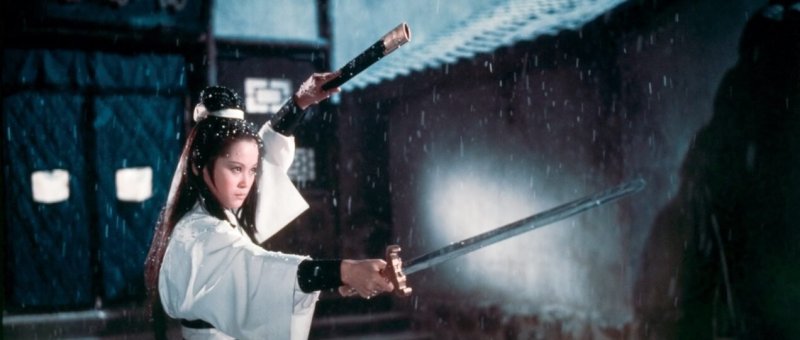
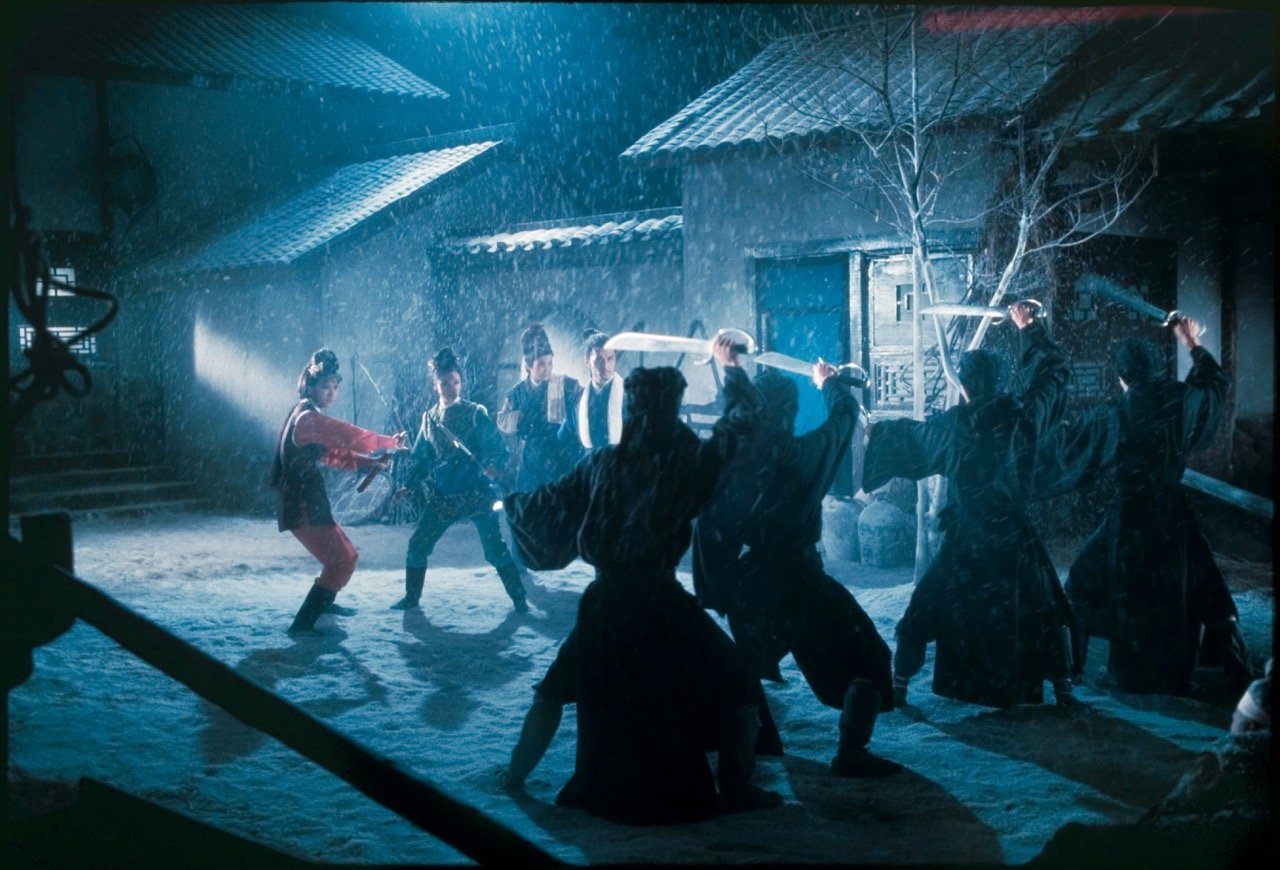
One turns up with a band of hopping vampires who turn out to be crooks in disguise, while another is wearing a horned helmet that gets stuck in things when he’s trying to fight. Of course, they’re all trying to kill each other so they can be the ones in control when Gangfeng finally arrives. What they don’t realise is that the whole thing’s a honeytrap designed to lure them all to the inn for just this purpose, so that they’ll all kill each other and spare the forces of justice some trouble. Those would be Zhang Caibing (Shih Szu), a disciple of the Lady Hermit making this a kind of extended universe film of the Cheng Pei-Pei classic. Continuing her mentor’s mission, she’s out to skim off the “scum of the martial arts world,” explaining to Shoushan that if he doesn’t like it, he should have thought of that before committing so many “evil deeds”. 

On the other hand, Caibing does seem to be enjoying this quite a lot so perhaps she’s not quite so entitled to the moral high ground as she’d like to think. While taking a leaf out of King Hu’s book, Yip adds an edge of slapstick absurdity in setting up elaborate action sequences with well-deserved pay offs and indulging in goreless yet extreme kills such as a series of surprise decapitations. Shoushan’s bladed whip becomes a versatile weapon but also an extension of his character in his cowardliness and lack of morality. It’s only really any good at long range, which means that he keeps his opponents at arms’ length rather than confront them directly as in the typical tests of skill that define a martial arts battle. He coils it around their necks, snake-like, then either pops their heads off or strangles them to death. Just like the innkeeper he killed off at the start, he seems to have genuine affection for his female companions but eventually meets a similar fate as his trademark whip is ironically turned against him. 

There’s also a genuine, if underplayed, sense of ambiguity in the attraction between the mysterious swordsman (Tung Li ) and Shoushan’s daughter that prevents him from killing her while suggesting that he too was on some level attracted to banditry. Even if he rides off in the end with Caibing, it does not appear that their relationship is romantic. Nor is he allowed to claim victory by swooping in when all seemed lost for Caibing during the final fight, immediately encountering difficulty with Shoushan who puts up a good fight that again seems contrary to his moral character in the amount of skill and effort needed to beat him. Indeed, it often seems as if he will win after all. This world will fall to men like him and turn into one giant Black Tavern. In the end, it’s a team effort that takes him down, including the strange intrusion of the beggar monk who was after all the person who started all this by repeating the rumour in the last rest stop and may or may not actually be working with Caibing. In any case, the incredibly fast-paced action sequences and the dark humour that accompanies them lend the film an epic quality despite its tight duration along with an ironic kind of cynicism that insists this world is simply too silly to be evil but that the scum of the martial arts world will pay all the same.


The Black Tavern screened as part of this year’s Focus Hong Kong.
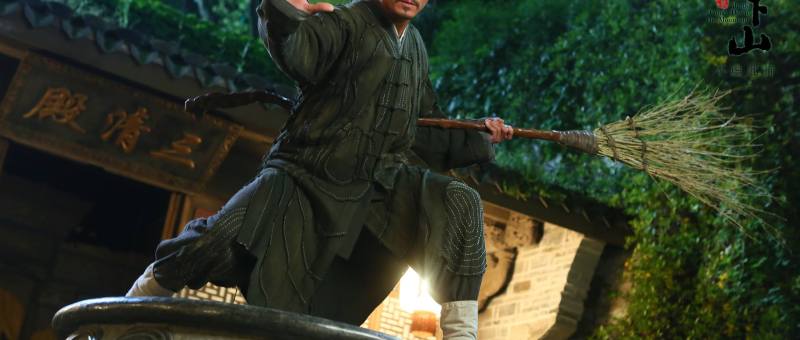
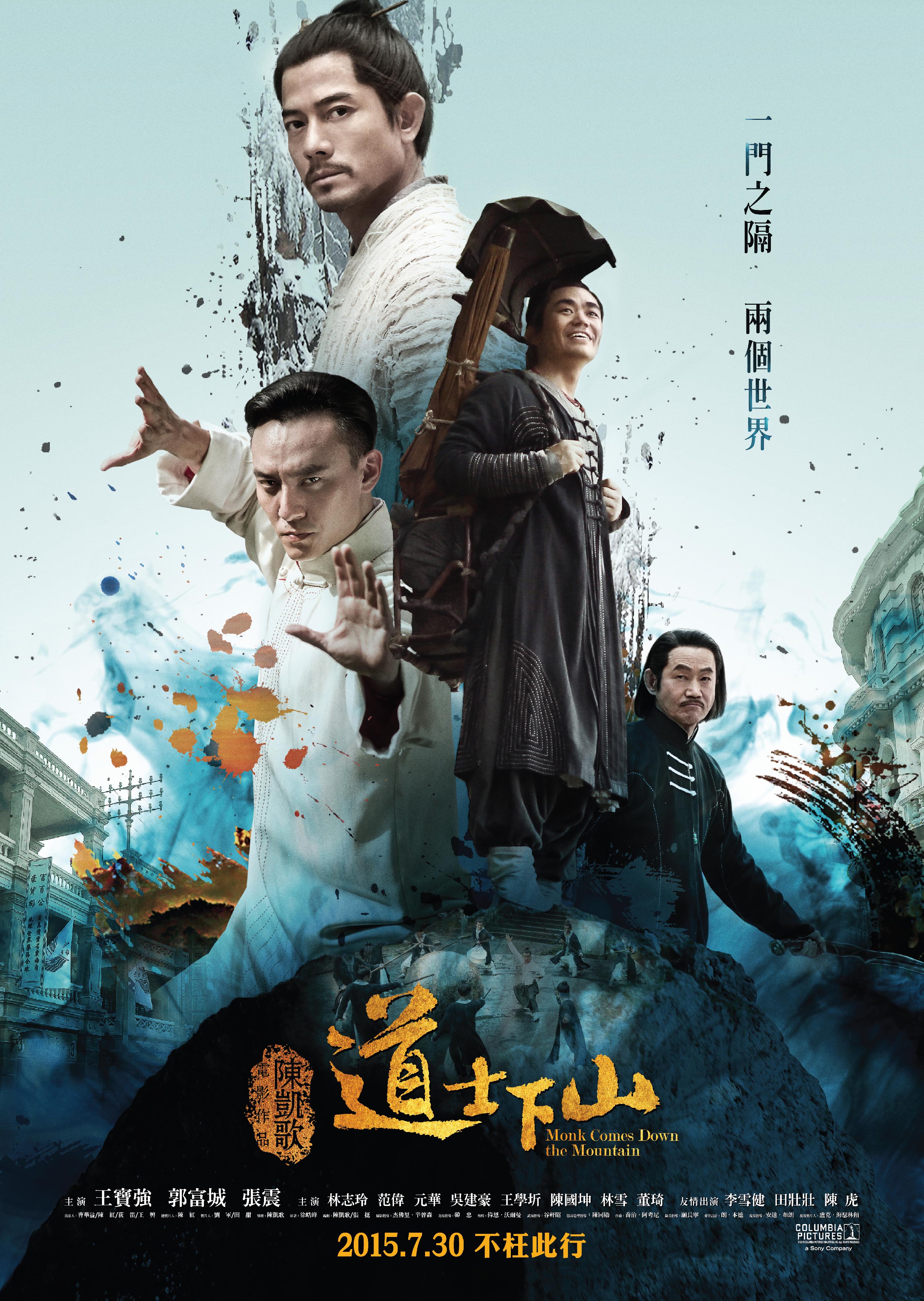
Monk Comes Down the Mountain (道士下山, Chen Kaige, 2015)

A wandering monk is forced to consider a series of dualities presented by his traditional upbringing and burgeoning modernity in Chen Kaige’s ‘30s wuxia Monk Comes Down the Mountain (道士下山, dàoshì xiàshān), inspired by the work of novelist Xu Haofeng. Essentially a picaresque, Chen sets orphan He Anxia (Wang Baoqiang) adrift in the secular world where he learns to see good and bad and perhaps the murky overlap between the two while simultaneously telling a rather subversive tale of frustrated same sex love and corrupt authorities. 

When the temple at which he was abandoned as a baby falls into financial difficulty, He Anxia enters a kung fu fighting competition he believes will put him first in line for food only in cryptic monk fashion the “prize” turns out to be exile as the winner is obviously the most capable of looking after themselves alone in the world. He Anxia is however something of an innocent and despite the monk’s warning to stay true to himself soon falls into difficultly yet ends up discovering a new father figure in monk turned pharmacist Tsui while trying to steal his fish. For all of Tsui’s goodness, however, there is discord in his house as his pretty young wife Yuzhen (Lin Chi-ling) prefers his dandyish brother, Daorong (Vanness Wu), who has abandoned the filial piety of the past to chase modern consumerist pleasures in selling the shop he inherited for a fancy ring. When the situation escalates, Anxia finds himself taking drastic action only to wonder if he did the right thing. 

Head of a local temple Rusong (Wang Xueqi) encourages him to think beyond dualities, wondering if he did the right thing for the wrong reasons or the wrong for right. This temple is famous for helping women have male children through praying to goddess of mercy Guan Yin, yet under Rusong’s predecessor they adopted a much less spiritual solution to the problem in simply providing a place where other men could father their sons. Rusong again asks him if the men who took part were sinners or saints while laying bare the paradoxes of the monastic life in the contemporary society. A petitioner goes so far as to ask Anxia if he might be her saviour, pointing out that if she cannot provide a male heir even though the problem may lie with her husband she may be cast out of her family, thereby disgraced not to mention financially ruined. Having lived all his life in the temple surrounded by men, gender inequality is not something Anxia had been very aware of. He tells her that though he had no family he was able to find one only to lose it, little understanding why she might not be able to do the same. 

On the other hand, he appears to show surprising perspicacity in the touching moments in which he must say goodbye to his second father figure, reclusive kung fu master Xiyu (Aaron Kwok), in realising the depth of his feelings for army buddy Boss Zha (Chang Chen) who then becomes his final master. Ironically, the obviously homoerotic relationship between Xiyu and Boss Zha was perhaps less controversial in 2015 than it might be in the present day but its inclusion is nevertheless surprising if also poignant as Xiyu tells Boss Zha that he should resume his stage career, marry and have children, while he will live a quiet and lonely life perfecting his kung fu though he will always keep him in his heart. Fiercely loyal to his mentors, Anxia accepts this relationship totally and appears to fully understand its import to Boss Zha to whom he subsequently transfers his allegiance as they band together to face off against big bad Peng. 

Playing into the good fathers and bad motif, Peng’s problem is his sense of paternal rejection in being passed over by his biological father in favour of Xiyu whose skills are stronger. After having ousted his rival, Peng fears the same thing will happen to his own son who is not only lacking in aptitude for martial arts but also appears to have a drug problem. To win they resort to cheating in picking up a pistol signalling both their own lack of jianghu honour and the nature of the changing times in which the very nature of kung fu has perhaps become obsolete. Meanwhile, Anxin and Zha are targeted by the police commissioner, Chao, who happens to be a former triad and also points his gun at them if less successfully while in cahoots with the amoral Peng and son.

Only through each of these subsequent encounters does Anxia begin to realise why he was cast down from mountain, understanding that he had to witness the good and bad of the secular world in order to understand his Buddhist teachings and finally find his place. With sumptuous production values perfectly recreating the 1930s setting, Chen’s quietly subversive 20th century wuxia takes aim at the ills of the contemporary society in its tales of corrupt authorities and amoral greed, but eventually finds solace in simple human goodness and genuine relationships as Anxin continues on his long strange journey to find his way home. 


International trailer (English subtitles)

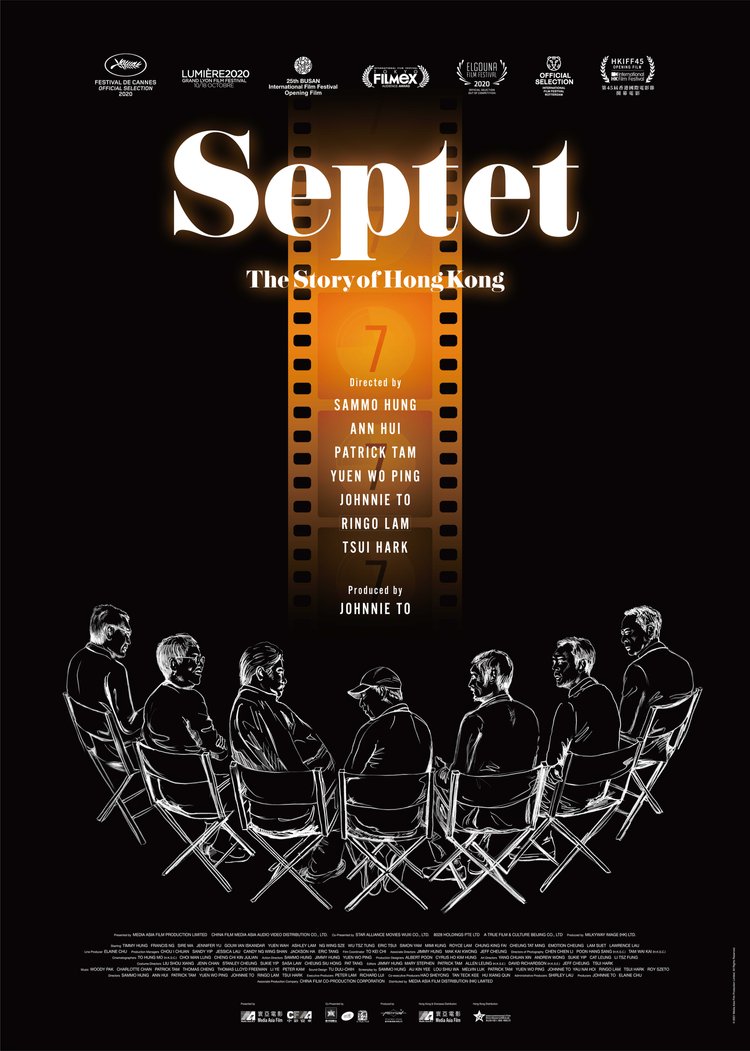
Septet: The Story of Hong Kong (七人樂隊, Sammo Hung, Ann Hui, Patrick Tam, Yuen Wo Ping, Johnnie To, the late Ringo Lam, Tsui Hark, 2022)

Seven of Hong Kong’s most prominent directors come together for a collection of personal tales of Hong Kong past and present in the seven-part anthology film, Septet: The Story of Hong Kong (七人樂隊). Produced by Johnnie To’s Milky Way, the film was first announced several years ago and originally titled Eight & a Half though director John Woo sadly had to leave the project due to his wife’s ill health which explains why there is no short set in the 1970s.

Each of the segments reflects the director’s personal nostalgia for a particular moment in time and there is certainly a divide between the 1950s and 60s sequences directed by Sammo Hung and Ann Hui respectively and those of the 80s and 90s which are imbued with a sense of Handover anxiety along with the closing meditation on the various ways the city has or has not changed. In any case, Sammo Hung’s opener Exercise is a slice of personal nostalgia which looks back to the heyday of Hong Kong kung fu as the young Sammo learns to buckle down and train with discipline under the guidance of his authoritarian teacher played by his own son, Timmy Hung. Similarly education-themed, Hui’s Headmaster echoes the documentary aesthetic seen in the later stages of Our Time Will Come in her naturalistic capture of a primary school reunion taking place in 2001 before flashing back to the early ‘60s as the headmaster and the children reminisce about a kind and idealistic young teacher who sadly passed away at 39 from a longterm illness exacerbated by misapplied traditional medicine. Essentially a tale of old-fashioned reserve in the unrealised desires of the headmaster and the teacher who elected not to marry because of her illness in the knowledge she would die young, Hui’s gentle melodrama harks back to a subtler age. 

Patrick Tam’s 80s segment, Tender is the Night, perhaps does the opposite in its incredibly theatrical tale of love thwarted by political realities as a lovelorn middle-aged man looks back on the failure of his first, and last, love for the teenage girlfriend who like so many of that time emigrated with her parents to escape Handover anxiety. Rich in period detail and imbued with the overwhelming quality of adolescent emotion, Tam’s maximalist romance is a tale of love in the age of excess but also of middle-aged nostalgia and personal myth making which nevertheless positions the looming Handover as a point of youthful transition. 

The 1997 sequence itself, Homecoming directed by Yuen Wo-ping, is in someways subversive in again presenting a young woman who firmly believes her future lies abroad rather than in post-Handover Hong Kong and placing her at playful odds with her traditionalist grandfather, a former martial arts champion who spends his days watching old Wong Fei-Hung movies. The eventual resolution that the girl, who insists on going by her Western name Samantha, returns to Hong Kong a few years later to care for the grandfather who has aged quite rapidly undercuts the sense of anxiety, yet there is something in the cultural and generational conflict that exists between them eased by mutual exchange as she teaches him basic English and he teaches her kungfu that hints less that the traditional is better than the modern than that there’s room for both hamburgers and rice rolls. 

Moving into the 2000s, Johnnie To’s Bonanza then takes aim at the increasingly consumerist mindset of the contemporary society in picking up a theme from Life Without Principle as three young Hong Konger’s become obsessed with getting rich quick through financial investment beginning with the dot-com bubble and shifting into property profiteering during the SARS epidemic. The trio fail every time before hitting the jackpot with some shares they bought by mistake during the 2008 financial crisis suggesting that it all just luck after all. One of the guys comically switches business opportunities in line with each of the crises/opportunities, firstly getting into mobile phones, then peddling healthcare products, and finally investing in self-storage in an echo of his society’s scrappy entrepreneurial spirit. 

The final film from Ringo Lam who completed his segment Astray shortly before passing away 2018 continues the theme in meditating on the modern city as its hero is literally killed by a sense of cultural dislocation after getting lost in a very changed Hong Kong having emigrated to the UK and returned with his family for a New Year holiday. While ironically remembering his own father complaining that times had changed, he finds himself bewildered by the absence of familiar landmarks and adrift in his home city. He dreams another life for himself in the countryside in which his son decides to emigrate to America while his wife would prefer he find a job in Hong Kong but his final message to him that it’s not difficult to live happily perhaps frees him of the sense of nostalgia which has led to his father’s death.

The best and final episode, however, Tsui Hark’s Conversation is set at no particular time and my in fact take place in the future as a mental patient, who might actually be a doctor pretending to be a mental patient, suddenly gives his name as Ann Hui followed by Maggie Cheung and a string of Hong Kong directors from Ringo Lan to Jonnie To and John Woo and challenges the doctor, who might be a mental patient, as he struggles to keep up with him. Tsui and Hui make reflective cameo’s at the segment’s conclusion perhaps hinting that this has been a deep conversation with the history not only of Hong Kong but its cinema through the eyes of those who helped to make it what it is.


Septet: The Story of Hong Kong screens in Chicago on Nov.6 as part of the 15th season of Asian Pop-Up Cinema.

Original trailer (English subtitles)

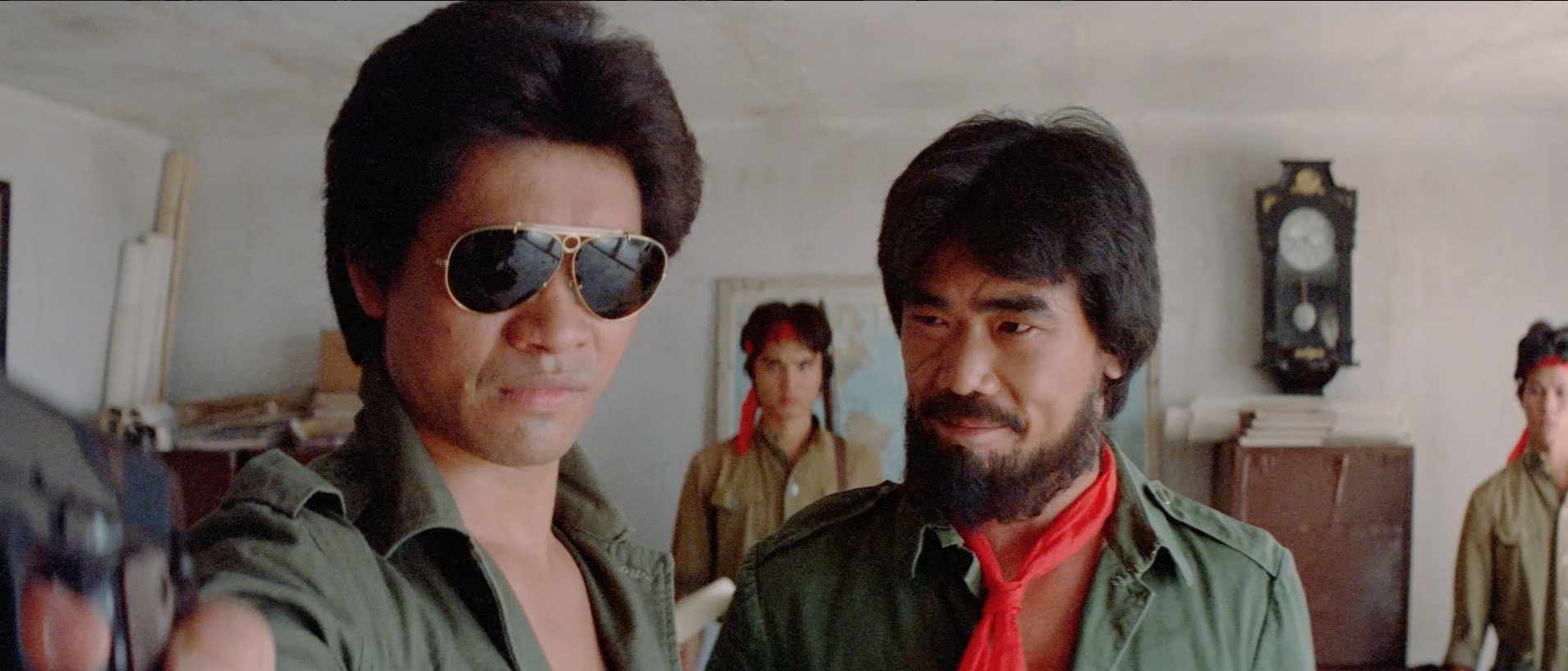
Mercenaries from Hong Kong (獵魔者, Wong Jing, 1982) [Fantasia 2022]

A former mercenary’s bid for revenge having failed in his responsibilities soon goes awry in Wong Jing’s third directorial feature Mercenaries from Hong Kong (獵魔者). As is constantly pointed out to the hero, perhaps he’s not so different from his target with his very selective brand of justice and morality. After all maybe the difference between medicine smuggler and drug trafficker is largely semantic and taking revenge after the fact hardly makes up for the failure to protect the innocent from a world you’ve helped create. 

Li Lok (Ti Lung) is a pretty big figure on the underworld scene and as the ultra macho title sequence reveals a former mercenary who served in Vietnam. In the daring opening scene he sneaks into a gang hideout disguised as a telephone repairman and takes out a gangster in the middle of drugging a young woman whom he and his friend intend to rape and then murder. But Li Lok isn’t here to save the girl and in fact he doesn’t. He’s there because the gangster has done this kind of thing before and the previous victim was his 15-year-old niece whose care he had been entrusted with by his late brother before he passed away. Later one of his comrades will make a similar request of him and he will fail again apparently taking little stock of his responsibilities. 

Nevertheless, having knocked off the gangster annoys local big boss Shen who intends to have Li Lok eliminated but Hong Kong’s richest woman Ho Ying (Candice Yu On-On) convinces him not to because she has a job for Lok assassinating a top Thai assassin who killed her father and is now apparently blackmailing her with a cassette tape full of corporate secrets. All Lok needs to do is round up a posse and head to Cambodia where “the devil” Naiman (Ching Miao) is hiding out, kidnap him, and retrieve the tape to receive a massive life-changing payout while permanently getting Shen off his back. It all sounds like a pretty good deal to Lok along with the former buddies he recruits to join him who are all trapped in desperate poverty one with a sick little girl who desperately needs a kidney transplant. 

This is a Wong Jing film and perhaps there’s no need to dig too deeply into it, but there is something in the power Ying wields over Lok and his team by virtue of her wealth and privilege that speaks to the city’s growing inequality though it’s also true that perhaps the guys have all fallen low through their mercenary choices and are now unable to get a foothold in the contemporary society without resorting to crime. Yet perversely, Ying leverages Lok’s chivalrous sense of honour as part of her plan playing damsel in distress rather than dangerous femme fatale while he assumes he’s on a righteous mission planning to turn Naiman over to the authorities rather than just killing him while little caring that his actions threaten to destabilise an already chaotic situation in Cambodia. 

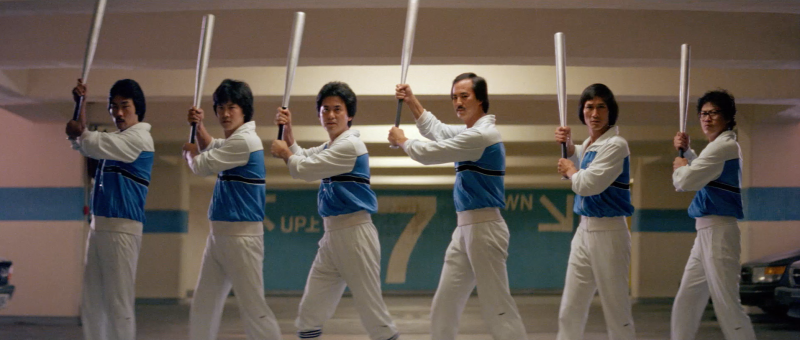
When one of the sworn brothers of the gangster that Lok killed in revenge is killed coming after him even after the truce, Lok is irritated that he died unnecessarily as if it offends his sense of justice that this man was not protected better by Shen. Yet as Naiman keeps pointing out to him, he’s no saint and perhaps no different. He could have saved the girl in the gang hideout but chose not to, escaping by jumping out of a window onto a van waiting below and riding off on a motorcycle (which is admittedly impressive). He claims to hate drug dealers but profited off war and misery in smuggling medicines across the border from Thailand into Cambodia even if he could tell himself he was running a kind of humanitarian service. Meanwhile Ying who is obviously involved in something shady if she’s dealing with people like Lok and his team, paying for their weapons and equipment which presumably includes the series of identical outfits the guys sport like some violent middle-aged boy band, wins an Outstanding Woman award and ironically pledges to use some of her wealth to fund community-based anti-drug programs. 

Li Lok may in a sense emerge victorious but also exactly where he started in failing to protect an innocent girl from a mercenary world. The Cantonese title might more literally be something like Devil Hunters, but Lok and his guys are certainly a mercenary bunch desperate to escape their poverty and hopelessness even if they may stand for a kind of justice and honour in brotherhood. This being a Wong Jing film there is plenty of crass humour including some that is very of its time along with gratuitous sex and female nudity but also a series of incredibly impressive action scenes and a bleaker than bleak conclusion which may suggest that the Loks of the world will be unable to protect the next generation from the violence they themselves have unleashed. 


Mercenaries from Hong Kong screened as part of this year’s Fantasia International Film Festival.

Original trailer (English subtitles)

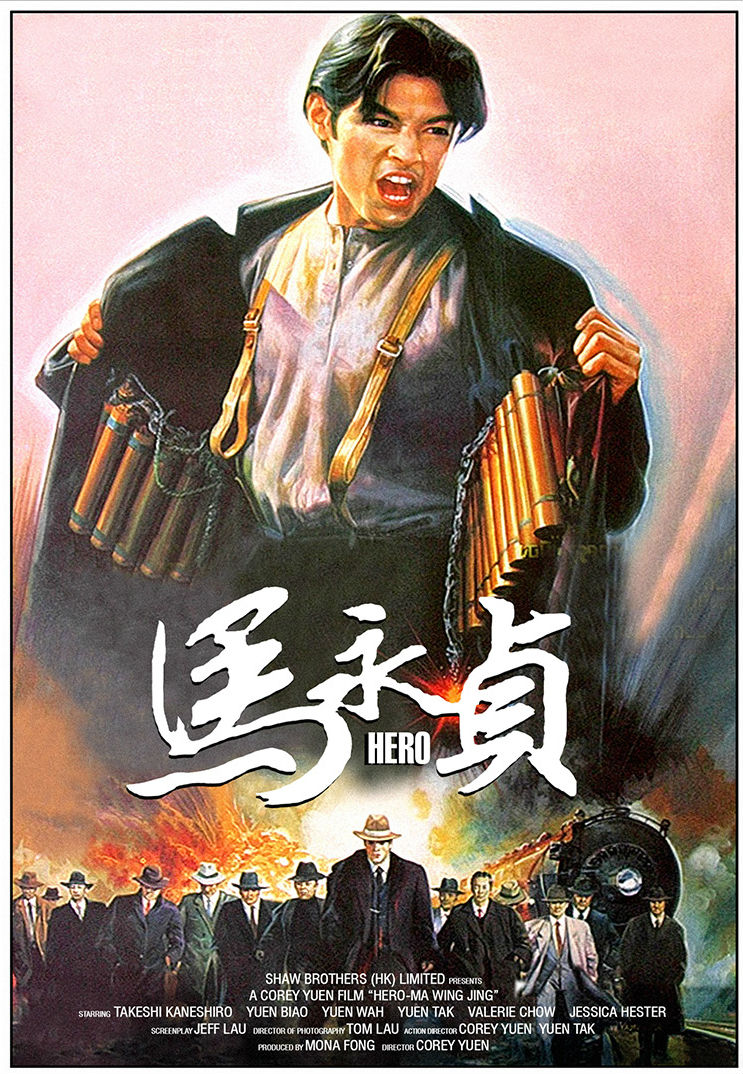
Hero (馬永貞, Corey Yuen, 1997)

hero 1997 posterIt’s an old ‘un but a good un. Young gun from the country hits the city, decides to do things his own way, becomes the top dog but loses himself in the process and is then faced with a choice between his better nature and potential gains. Corey Yuen’s remake of the Shaw Brothers classic Boxer from Shantung, Hero (馬永貞, Ma Wing Jing), stars Taiwanese heartthrob Takeshi Kaneshiro in his first big action lead as the titular good guy who nevertheless finds himself wavering under the oppressive skies of turn of the century Shanghai.

Ma Wing Jing (Takeshi Kaneshiro) and his brother Tai Cheung (Yuen Wah) have left their old country home to seek their fortunes in the city following a devastating drought. The Shanghai International Settlement, nominally under the control of the British, was a bustling, international port city but also lawless place where gangsters ruled – Tam Sei (Yuen Biao), who is supported by the Brits, controls half the territory with his rival Yang Shuang (Yuen Ta), backed by the local police, taking the rest. The Ma brothers hoped to make something of themselves in the brave new world of Shanghai but are simply two of thousands of refugees fleeing famine and can only find dock work where they are exploited and treated poorly.

Their fortunes pick up, however, when Wing Jing gets an early opportunity to show off his hero qualifications by saving Tam from certain death during an ambush. Tam, grateful, somewhat humiliates Wing Jing by forcing him to bend for a silver dollar before berating him for doing it but the pair eventually bond in a good old fashioned fist fight. Tam offers him a job, but Wing Jing has learned his lesson – he’ll be his own man and make his own name.

A melancholy love story plays in the background behind the otherwise macho dynamics. Arriving at Tam’s saloon, Wing Jing falls in love at first sight with the beautiful singer, Ling-tze (Jessica Hsuan), but is unable to pursue his romance with her thanks to his brotherly debt to Tam, who is in love with the bar’s landlady, Yam (Valerie Chow), but has broken things off because the of precariousness of his gangster lifestyle. Tam disappears for a bit, leaving the bar and his territory to Wing Jing, but doesn’t bank on Yam’s machinations as she gets rid of Ling-tze and takes up with Wing Jing while working with Yang on an evil plan that turns out to be a weird way of protecting her one true love.

Nevertheless, Wing Jing takes centre stage as he quickly climbs the local tree and becomes the big guy in town, little realising that his bravado has irked just about everyone in sight – he’s not only made himself a target for Yang but for the local Chinese police while Tam’s old associations with the British can’t be counted on forever. Yang, ironically enough, is playing divide and conquer but Wing Jing is too naive to see and too hotheaded to listen to Tam’s advice even when he returns to offer it.

Then again, a hero is a hero through and through and so it’s not long before Wing Jing’s moral goodness begins to resurface and he realises where his loyalties really lie. Given that Hero is a Hong Kong production released in 1997, perhaps it’s less surprising that the good guys are the ones backed by the British rather than local law enforcement which is, of course, deeply corrupt and and immersed in Yang’s world of internecine scheming. Still, this Shanghai is one of scrapping poor boys fighting for freedom from oppression (if accidentally veering into the role of oppressor in the process) much more than it is about international politics or the or the increasingly global milieu of the late 19th century city and its position as the gateway to the East for an avaricious Europe.

Mixing classic Shaw Brothers style with a modern New Wave edge, Yuen gives Kaneshiro his time to shine as an ultra cool action hero complete with a series of hugely impressive action sequences culminating in a fantastically satisfying final shoot out where blood and brotherhood take centre stage. But there can be no winners in this world of betrayals and counter betrayals, and so our Hero may have to leave it behind for pastures new as he takes his heroism with him into a hopefully better future.


Currently available to stream on Netflix in the UK and possibly other territories.

Original trailer (no subtitles)

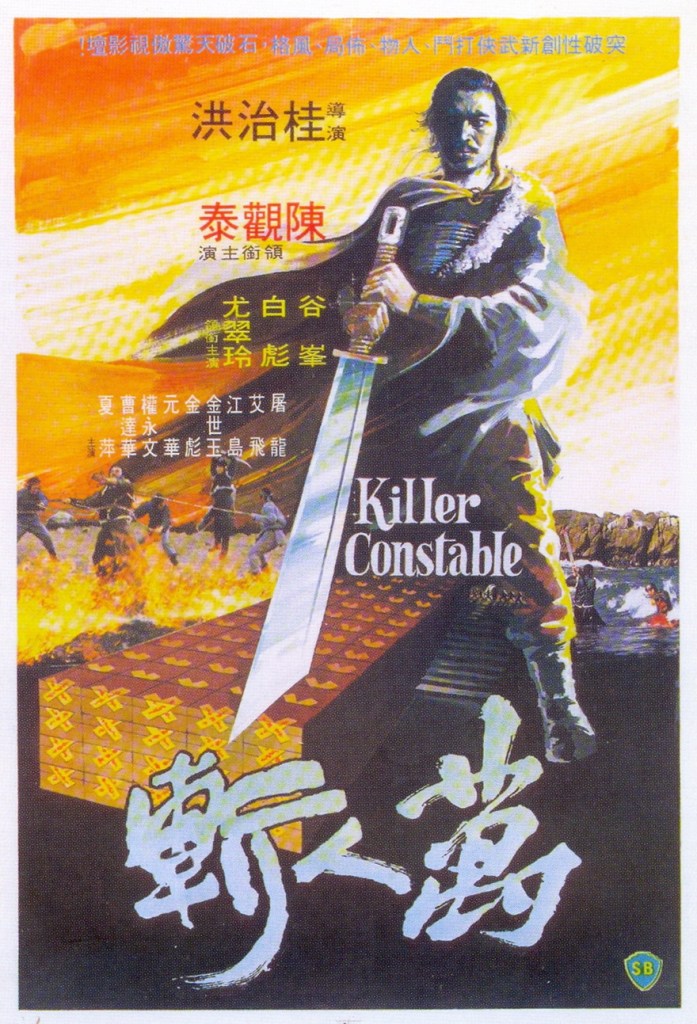
Killer Constable (萬人斬, Kuei Chih-Hung, 1980)

KillerConstable+1980-19-bEvery sovereign needs that one ultra reliable and supremely talented servant who can be called upon in desperate times. For the Dowager Empress of the Qing Empire, that man is Leng Tien-Ying – otherwise known as the Killer Constable. When a sizeable amount of gold goes missing from the Imperial Vaults, it’s Leng they call to try and get it back. However, what Leng doesn’t know is that there’s far more going on here than he could possibly have imagined and he’s about to wade into a trap so deep that you never even see the bottom.

At several points, the giant broadsword style weapon that Leng carries catches the light and appears to shine out with some kind of ethereal righteousness, yet if Leng wields the shining sword of justice he does so with a heart of ice. Early on one of his most trusted subordinates argues with him and says he intends to leave because he thinks Leng is more killer than policeman. He doesn’t take prisoners, where there’s reasonable proof of guilt he cuts the perpetrator down on the spot. At one point he tortures a suspect for information by mock drowning him in a lake while his wife and terrified children look on. When the wife complains, he hits her causing the husband to make the mistake of going for Leng which earns him the prize of getting his head cut off right in front of his family who are now left without any means of supporting themselves.

Leng cares only about the letter of the law. As the squad of policemen ride through the barren landscape, they pass through ruined towns filled with the starving and the desperate. One of the more compassionate men asks what’s happened here and if they, as policemen, shouldn’t be trying to help, but is reminded that these poor people are Hans and the policemen are Manchurians, so it’s just none of their business whether they live or die.

However, here is where Kuei’s film deviates from the accepted path. Leng’s generally bleak attitude to life is the one the film most closely identifies with. Any attempt at compassion is met with by betrayal, each act of kindness only earns retribution and being softhearted is almost another word for dying young. That is not to say the film is completely behind Leng as a hero or even as an anti-hero, he too will pay for the way he lives his life starting with realising that he alone is responsible for the deaths of the men that blindly followed him on a fruitless quest.

Killer Constable is more of a swordplay film than a kung-fu one and is filled with plenty of energetic and expertly choreographed fight sequences. The men fight in blazing heat (at one time literally), pouring rain and mud filled swamps against a suspiciously well trained gang of opponents who always seem to be lying in wait for them. The Killer Constable also seems to have something of a fetish for chopping off people’s legs which carries on right into the bloody finale with limbs flying off with oddly gleeful abandon.

As it turns out, the Killer Constable is not completely heartless, he’s just lived in this harsh world long enough to come to the opinion that the “bad” cannot be redeemed and need to be cut down like weeds so that the flowers can once again bloom. However, he, in his quest, has crossed the line and become that which he most hates. To nearly everyone else in the picture, Leng is a bad guy – the uncompromising face of the law and the knock at the door you most fear coming. In the film’s surprisingly downbeat ending he too will get what’s coming to him.

Bleak beyond measure, the only good and true thing in the cruel wold of Killer Constable is the blind daughter of one of the criminals. Kind and cheerful, she tries to help Leng as he lies wounded and is entrusted to him should her father die, yet she pays the heaviest price of all, left standing all alone in the rain waiting for the return of those who will never come home again. Far from heroic, Killer Constable is a critique of blind justice dealt out by self righteous egoists who will always discover the error of their ways far too late.


Seen as part of HOME’s CRIME: Hong Kong Style touring season.