 Written by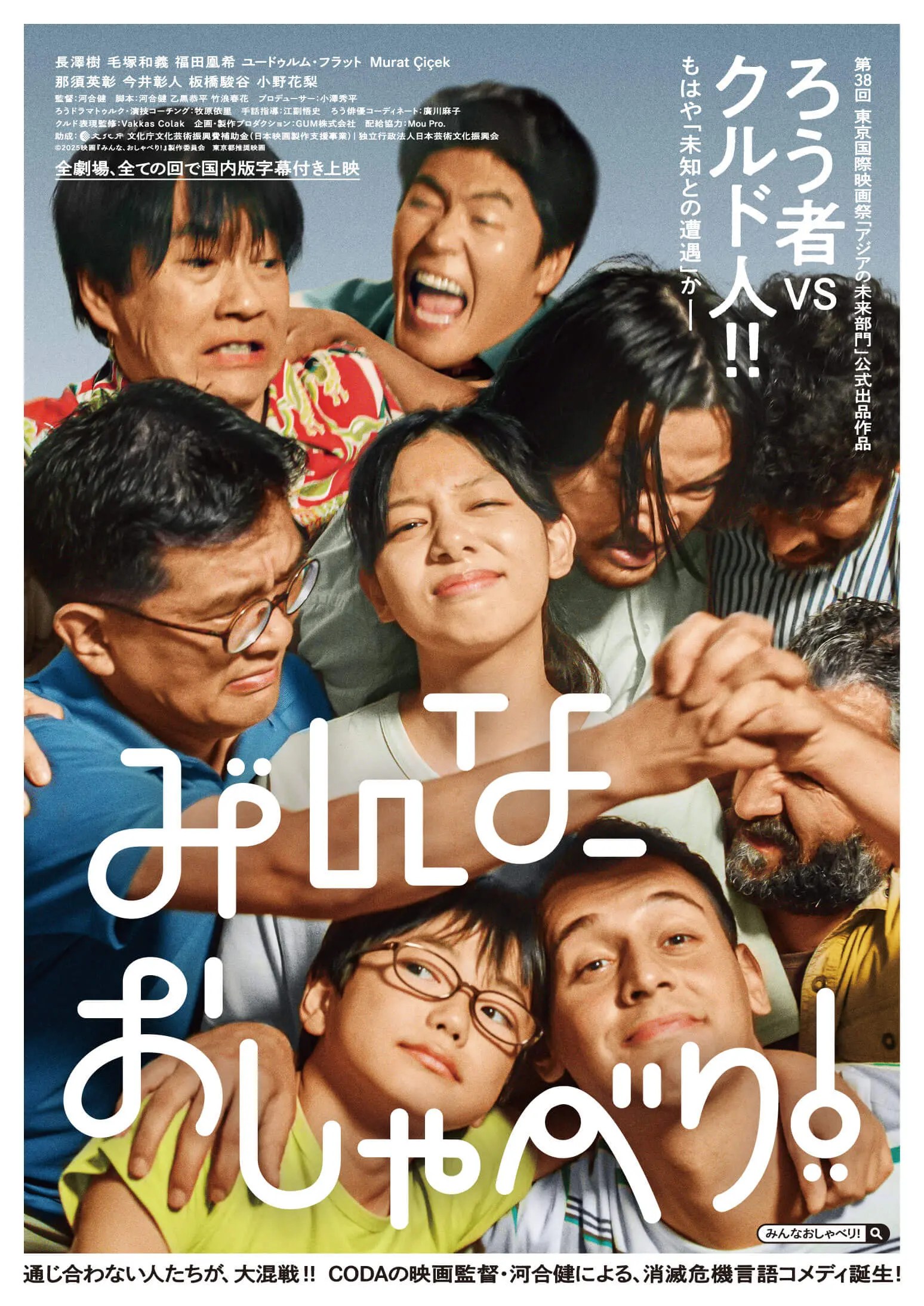
Kazuhiko (Kazuyoshi Kezuka) has been running his electrical appliance shop successfully for many years, but finds his business frustrated by the local council’s attempts to rejuvenate the area and a subsequent feud born of a minor misunderstanding with the owner of the kebab shop that opens across the way. Ken Kawai’s down to earth comedy The Chatterboxes (みんな、おしゃべり!, Minna, Oshaberi!) examines the radiating effects of occasionally wilful miscommunication in an atmosphere that sometimes encourages fear and suspicion rather than acceptance or understanding.
At least, there’s no real reason why Kazuhiko should immediately take against the Rifat (Murat Çiçek) and the Kurdish community who open a kebab shop nearby, but jumps to conclusions on noticing broken glass in his entranceway with Rifat standing over it. It was actually a little girl who broke a bulb on her way out and was too afraid to say anything, but Kazuhiko almost assumes Rifat has come in and broken something deliberately as an act of war. Kazuhiko’s reaction echoes that of the wider society which is not always accepting of difference, but is also ironic as Kazuhiko also feels himself to be an outsider not accepted by those around him because he is deaf. His shop has a sign saying that it caters to both hearing and non-hearing people, but it seems most don’t notice it and hearing people can sometimes behave insensitively at what they see as inconvenient service. One couple leave the store when Kazuhiko doesn’t respond to their question before he’s even had time to get out his sign out.
He has many things in common with the Kurdish community, but at the moment cannot see common ground only danger. The Kurds have moved into the community through a local government initiative run by the well-meaning Okita who seems like he’s trying to do a good thing, but going about it in the clumsiest way possible. He turns up unannounced to film a PR spot with Kazuhiko as the poster boy of his campaign, but badly botches the transmission by ignoring his wishes about how he wishes to be identified. Though Kazuhiko identifies himself as “deaf”, the subtitles have “hearing impaired”, which he finds offensive because he does consider himself to have an impairment. As his hearing daughter Natsumi (Itsuki Nagasawa) points out, there’s nothing difficult about communicating through sign language in their home because it’s simply their normal.
At a meditation meeting, the Kurdish community have a similar problem in that Okita repeatedly refers to them as “Turkish” and has only hired a Turkish to Japanese interpreter who cannot speak Kurdish. Rifat is particularly attached to the Kurdish language and for a number reasons prefers not to speak Turkish even if he can understand it, though other members of the community prefer to speak other languages such as Arabic. Part of the problem is caused by Okita’s assumptions, something which to his credit he does try to rectify by listening to the concerns of each community, but still to an extent looks down on them while his plan to use minorities to rejuvenate the town economically while making the council look compassionate is also a little exploitative if not patronising. Meanwhile, by having all the shops in this area run by minorities, he may be excluding rather than including them by effectively segregating them away from the more prosperous part of town.
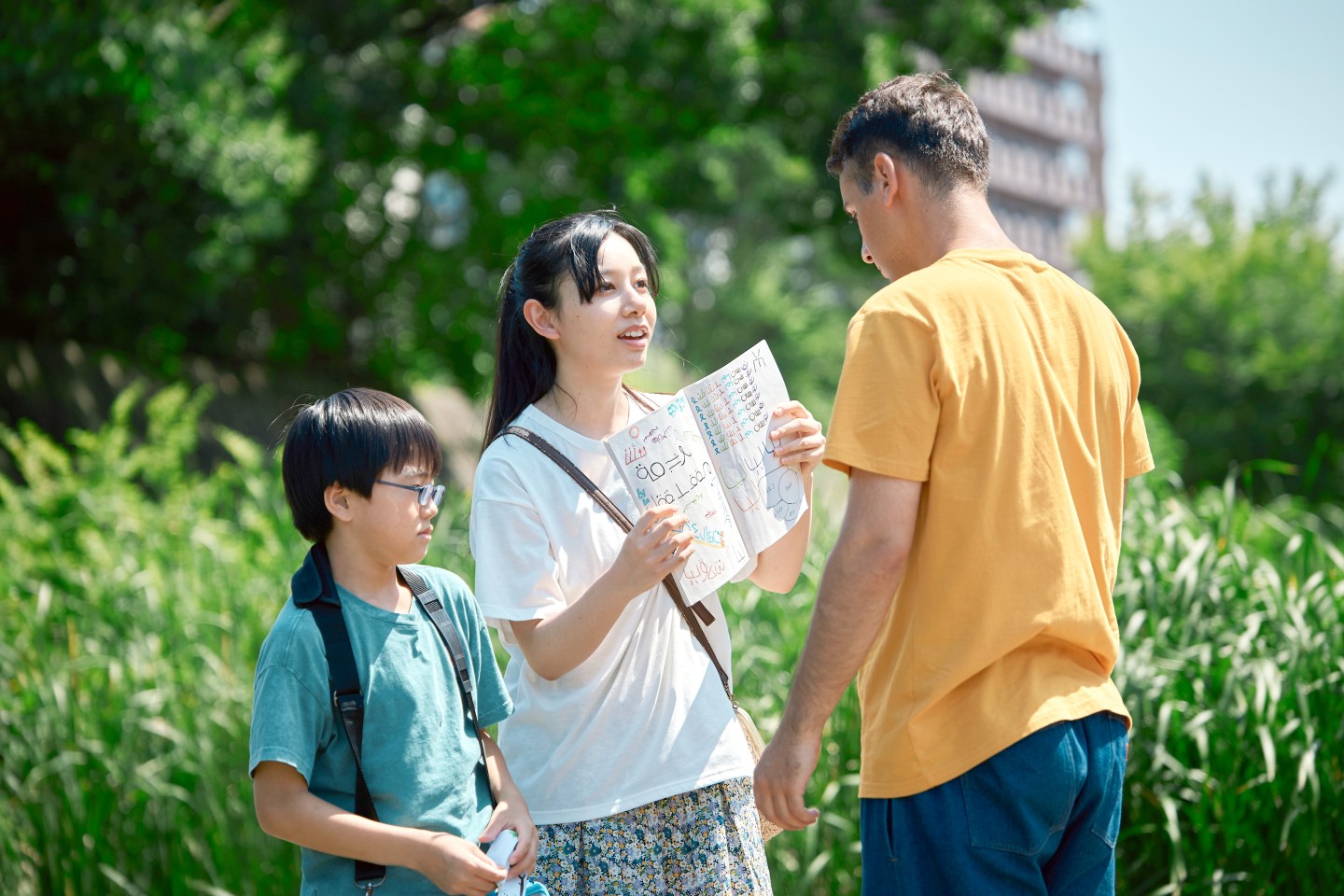
Kazuhiko’s daughter Natsumi and Rifat’s son Hiwa (Yildirm Firat), who was born and raised in Japan, end up caught in the crossfire while quicker to realise that they have a lot more in common than might first be thought. They have each been forced into the role of interpreter for their parents who cannot communicate with the wider society due to a language barrier, but also have differing views on their role with Hiwa thinking he should translate his father’s Kurdish as accurately as possible even if it causes a problem, and Natsumi deliberately softening what her father signs to avoid creating additional conflict. They nevertheless became interested in learning each other’s languages and culture and grow closer through a process of cultural exchange.
Something similar happens to her younger brother, Shun (Ohki Fukuda), who may also be neurodivergent as his teacher complains that he pays no attention in lessons, preferring to doodle instead, and makes no attempt to communicate with the other children at his deaf school. Fascinated by picking up a note in Arabic dropped by one of the Kurdish men, he begins to develop his own language which he then shares with the other children who begin to contribute to it too. The way the teacher reacts is emblematic of the fear associated with the inability to understand what another community is saying as she clearly views the children’s secret language as a challenge to her authority. Kazuhiko also jumps to the conclusion that the Kurds have been putting funny ideas in his son’s head, but equally he and some of the other parents don’t fully trust the teacher because she’s a hearing woman. They worry she’s forcing the values of the hearing society on their children rather than allowing them to embrace their deafness. Just as Rifat is fiercely protective of Kurdish, so Kazuhiko worries sign language may die out with all the new implants and apps that are being developed.
He also complains about the discrimination he’s faced and that hearing people often justify their decision to exclude him as “consideration” when it’s really just that they find communicating in a different way inconvenient so prefer not to bother. Of course, his late wife was a hearing woman and so is Natsumi so some of his comments are hurtful to her while reflecting an us and them mentality Natsumi would like to reject, especially considering her growing friendship with Hiwa. Nevertheless, words are often unnecessary for basic communication. You don’t need words to make someone understand you want them to come quickly because you need their help, and Kazuhiko is eventually able to make a sale just through gestures to an old man who is no longer able to speak and cannot write either. Kazuhiko only starts to rethink his views when Okita tells him he’s leaving the Kurds out of the project to avoid controversy, uncomfortably echoing the various ways in which he’s been excluded.
Once misunderstandings have been cleared up, the communities find a source of friendship and solidarity embracing cultural exchange that leaves them feeling less afraid of each other and more welcoming towards others. Kawai deliberately leaves some of the Kurdish dialogue untranslated, simply transliterating it in the subtitles to make it clear that what is being said is not being understood outside of the community, leaving the audience in the same position as Kazuhiko and hearing monolingual Japanese people like Okita, but equally proving that not understanding fully isn’t really that much of problem, while being ignored and excluded is. Warm, funny, and venturing into absurdity in its final stretches, Kawai’s film is a much needed counter to the growing animosity of our recent times and a reminder of how much better life can be when you open yourself up to world beyond that you already know.
The Chatterboxes screened as part of this year’s Camera Japan.
Trailer (English subtitles)

