Tracey (翠絲, Jun Li, 2018)

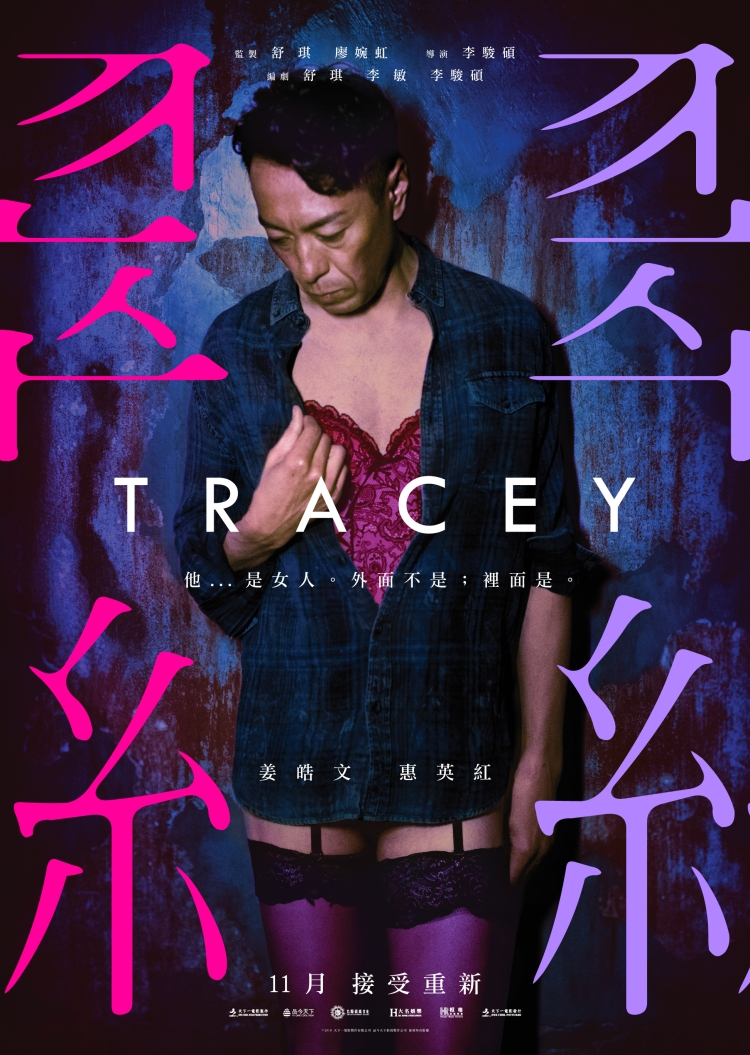
Tracey PosterHong Kong has often sought to present itself through its cinema as an ultramodern, cosmopolitan city, claiming a kind of cultural freedom from Mainland oppression. In truth, however, there are areas in which it may disappoint itself. Jun Li’s debut feature, Tracey (翠絲), is in many ways an empathetic attempt to redress the balance in making plain the destabilising effect emotional repression can exert across an entire society, causing nothing other than the mutual unhappiness which provokes one person to oppress another in service of nothing more than conventionality.

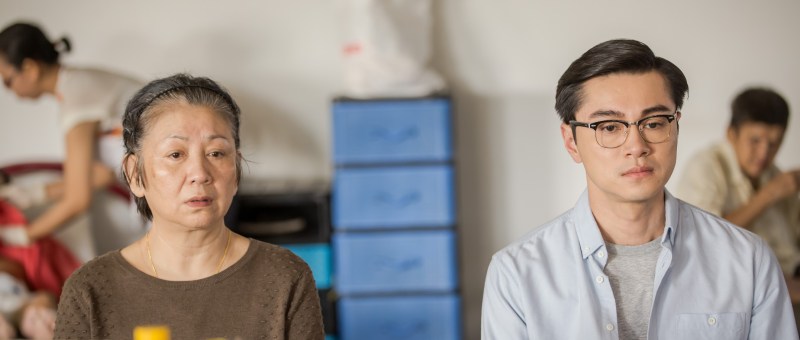
A married, 50-something father of two grown up children, Tai-hung’s (Philip Keung) conventional, ordered life is disrupted when he receives a phone call telling him that a treasured childhood friend, Ching, has been killed while working in Syria as a war photographer. Unbeknownst to anyone, and not quite admitted even to himself, Ching had been the love of Tai-hung’s life and his death finally forces him into a reconsideration of the feelings which are now, perhaps, a lost opportunity. The sense of loss is doubly brought home when he collects Ching’s partner, Bond (River Huang), from the airport and discovers that he had been legally married to another man in the UK though the pair’s marriage certificate is not valid in Hong Kong which presents a problem in trying to repatriate Ching’s ashes.

Bond, himself from Singapore where homosexuality is at least technically still illegal, knew of Ching’s love for Tai-hung and Tai-hung’s unrealised attraction to Ching but struggles with Tai-hung’s decision to not to embrace his sexuality, preferring to marry and have children in pursuit of a conventional life. Despite having grown up in an arguably even more oppressive society, Bond is 20 years younger and has perhaps benefitted from an increasingly liberal world in which greater awareness has afforded him the vocabulary to process Tai-hung’s complex identity with a delicacy that was not available to Tai-hung in his youth, nor to his quasi-mentor Brother Darling (Ben Yuen) – a performer of Chinese Opera who specialised in female roles and confided to Tai-hung that he identified as a woman but is unlikely to have ever come across the term “transgender” let alone claim it as an identity.

Nevertheless, Bond’s arrival begins to push Tai-hung’s long repressed longing to the surface even if his first attempt to explain to Bond that he too identifies as a woman is met with mild derision as Bond misunderstands him in assuming his claiming of a female identity is an attempt to reject his homosexuality. What Tai-hung tries to explain to him is that he does not see himself as a gay man but a straight woman and therefore felt that pursuing his love for Ching, a man who loved men, would never have been a possibility. Fearing his gender identity would never be accepted by anyone, Tai-hung kept his true self hidden even from his closest friends and unwittingly placed a wedge between himself and the man he loved.

Bond pushes him still further with the perhaps unfair charge that his entire life has been essentially selfish and founded on the continued deception of his wife and children. Despite its seeming conventionality, Tai-hung’s family life is not altogether happy. His wife, Anne (Kara Hui), is a fiercely conservative sort who prizes nothing so highly as respectability as she proves by rifling through the maid’s room in search of evidence of sexual indiscretion which she later uses as grounds to suggest firing her. As the couple’s son Vincent (Ng Siu-hin) points out, there is also an unpleasant racial component to her puritanical morality which objects to her Indonesian maid having a right to a private life, fearing that she will bring “disease” into the house by sleeping with another “foreigner”. This is perhaps why she objects to her pregnant daughter’s (Jennifer Yu) desire to divorce her highflying lawyer husband when she discovers that his serial philandering has resulted in a sexually transmitted disease which he has passed to her and which has thankfully been detected early enough to avoid harming the baby.

Despite Anne’s pleas with her daughter that you don’t reject someone for turning out to be different than you assumed them to be, she is obviously not ready to accept Tai-hung’s authentic self despite having been aware that there was always something slightly amiss within their marriage which prevented it from being a true and total union. It is perhaps this sense of nagging incompleteness and unhappiness which has pushed Anne’s need for respectable conventionality into overdrive, as if a superficially successful adherence to the rules could be a substitute for emotional fulfilment. Her own suffering then seeks to push her daughter into the same space as a self-sacrificing housewife who has exchanged personal happiness for the cold comfort of social respectability. 

Thanks to reuniting with a now elderly Brother Darling and finding himself accepted by the younger Bond, Tai-hung begins to find the courage to embrace his true self and discovers that many of his friends and relatives are more supportive than he might have assumed even if some of them may need time to get over the initial shock. As his mother tells him, the important thing in life is learning to find one’s peace of mind – something which could only be helped by abandoning the outdated Confucian ideas which continue to define the social order in favour of something warmer, freer, and fairer built on mutual acceptance and compassion.


Tracey screens as the closing night gala of the eighth season of Chicago’s Asian Pop-Up Cinema on April 24, 7pm, at AMC River East 21. It will also be screened in London as the closing night of this year’s Chinese Visual Festival on 9th May, 6pm, at BFI Southbank where members of the cast and crew will be attendance for a Q&A.

 Original trailer (English subtitles)

The Crossing (过春天, Bai Xue, 2018)

The Crossing posterReally, when it comes right down to it, a border is not much more than an imaginary line drawn across a piece of paper intended to bring order to a formless world. People have fought and died over the positioning of such lines for centuries, but then when all is said and done the boundaries which matter most are the internal ones and everybody has their lines they will not cross. An internal war over the nature of that line is very much at the centre of Bai Xue’s melancholy coming of age drama The Crossing (过春天, Guò Chūntiānin which a young girl living a life on top of borders geographical, emotional, and legal, begins to discover herself only through transgression.

It’s Peipei’s (Huang Yao) 16th birthday, but the most important fact about that for her is that she is now of legal working age and can get a part-time job. Peipei’s parents split up some time ago and now she lives with her flighty mother (Ni Hongjie) in Shenzhen while attending a posh high school in Hong Kong where she doesn’t quite fit in considering her comparatively humble background. This is brought home to her by her insensitive best friend Jo (Carmen Soup) who wants the pair to go on holiday together to Japan at Christmas while full-well knowing that there is no way Peipei can get the money together in time. Desperate to go, Peipei has been selling cellphone cases at school and now has her part-time job but it’s all very slow going. When Jo convinces her to bunk off and party with a bunch of ne’er-do-wells she ends up getting herself involved in a cellphone smuggling operation thanks to Jo’s no good boyfriend Hao (Sunny Sun). 

Peipei’s problem is the time old one of falling in with the wrong crowd, but then we most often catch her alone and it’s a lonely figure she cuts through the busy streets of her bifurcated world. Young but tough and angry, Peipei thinks she knows what she’s doing but is caught on the difficult dividing line between adolescence and adulthood and her attempts to claim her independence are filled with determined naivety. Resentful of her mother’s seeming indifference and parade of useless boyfriends, she wants to grow up as soon as possible but it’s not so much the daring and adventure that draws her into the orbit of Sister Hua’s (Elena Kong may-yee) gang of thieves as the camaraderie. Peipei likes being part of a “family”, she likes the maternal attentions of the spiky Sister Hua, and she likes being valuable even if on some level she realises that her usefulness will fade and that her growing loyalty to the gang is largely one sided.

“The big fish eat the little fish. Never trust men” Sister Hua later advises her, and it is indeed good advice if offered a little too late. Peipei knows she’s a little a fish, which is perhaps why she sympathises so strongly with the miniature shark trapped in a tank at the palatial mansion owned by Jo’s absentee aunt. Nevertheless, she tries to swim free only to find herself sinking ever deeper into a murky underworld she is ill-equipped to understand. Her first anxious crossing with a handful of iPhones in her backpack is a fraught affair, but carrying it off without a hitch an oddly empowering experience. Even so, when Sister Hua considers swapping the phones for a gun Peipei hesitates. In essence it’s the same – perhaps it doesn’t really matter what the cargo is, and Sister Hua’s “love” is indeed dependent on a job well done, but the stakes here are sky high. It’s not such a fun game anymore, as Peipei realises spotting a badly wounded gang member hovering outside having apparently received punishment for some kind of transgression.

Meanwhile she finds herself in another kind of interstitial space altogether when caught between best friend Jo and bad boy Hao. Jo, spoilt and self-centred, assumes her family will send her abroad to study and is later shocked by the realisation that her sexist dad thinks she’s not worth it, expects her to marry young in Hong Kong, and intends to invest all the money in her brother instead. Jo didn’t care much for Hao before and even jokingly offered to bequeath him to Peipei when she left, but now all her dreams are crumbling and she suspects he’s losing interest it’s a different story. Playing with fire, Peipei finds herself drawn to Hao who becomes something between white knight and big brother figure in the confusing world of crime until his protective instincts begin to bubble into something else. The pair bicker flirtatiously but also shift into a shared space born of their mutual dissatisfaction and desire to gain access to the Hong Kong inhabited by the likes of Jo whose vast wealth has left her blind to her own privilege.

Peipei crosses lines with giddy excitement, but only through burning her bridges does she begin to discover her own identity caught as she is between Hong Kong and China, between rich and poor, between the going somewheres and not, and between innocence and experience as her exciting adventure in the world of crime eventually blows up in her face. A rather strange title card informing us that efforts to limit smuggling at the border have been redoubled (seemingly ripped right out of the Mainland censor’s notebook) finally gives way to something calmer and more meditative as Peipei awakens to a new understanding of herself and the world in which she lives, looking out instead of up and ahead rather than behind as she resolves to keep moving forward as if there were no more lines to be crossed.


Currently on limited release in UK cinemas.

International trailer (English subtitles)

Show Me Your Love (大手牽小手, Ryon Lee, 2016)

Show Me Your Love posterIs it ever really too late to make up for lost time? Malaysian-born director Ryon Lee explores dislocations familial and geographical between a conflicted son and the guilt ridden mother who left him behind. Show Me Your Love (大手牽小手) shifts from frenetic, ambitious Hong Kong to sleepy, laidback Malaysia and from the ‘80s to the present day as two generations reprocess the idea of family in the wake of their own fears and disappointments both afraid and eager to put the past behind them while there is still time to make amends.

In the Hong Kong of 2016, Nin (Raymond Wong Ho-yin) is a successful teacher with a high-flying estate agent wife Sau-lan (Ivana Wongwho’s trying to convince him to give up his teaching job and movie to Guangzhou to invest in property. Home life is somewhat strained with Sau-lan working overtime and Nin worrying about a move he doesn’t really want to make, all of which means it’s the worst possible time to get an unexpected long-distance phone call informing him that the aunt that helped to bring him up when he lived in Malaysia has passed away. Travelling alone to the funeral, Nin is encouraged to reconnect with his estranged mother Sze-nga (Nina Paw Hee-ching) who has apparently started to behave strangely much to the consternation of Nin’s cousin who had been looking after her but is due to move to Australia to be close to her own children. Sze-nga angrily insists that she doesn’t want to return to Hong Kong with Nin and so he has little choice other than to place her in an old persons home at least until he can sort things out.

Nin’s melancholy voice over relates to us the various reasons he chose not to stay in contact with his mother. After abruptly moving them from Hong Kong to Malaysia when he was a boy, Sze-nga was continually evasive about her personal life and frequently told him minor lies which left him with longstanding trust issues and a lingering fear that she would soon abandon him. Sze-nga eventually did just that, depositing him with her sister while she went abroad again to work only to resurface 10 years later when her son was almost a man, taking him back and accidentally ripping him away from the surrogate family he’d formed with his aunt.

Truth be told, Nin never quite felt as if he belonged in his aunt’s family either despite her best efforts. A nosy a relative made sure he was pulled out of the family wedding photos in case someone thought he’d been officially adopted, somehow signalling his liminal status like a stray cat given temporary refuge. Perhaps for that reason he never managed to keep in contact with his aunt, either, forgetting to send her a New Year card as he’d promised he would. Broken promises become something of a theme from Sze-nga’s constant attempts to smooth things over with a comforting lie to the guilt and resentment that stands between mother and son.

Failure to communicate honestly continues to cause problems for the pair as well as for Nin individually whose longstanding fear of confrontation has led him to avoid telling his wife he’d rather not move to Guangzhou or to explain what’s going on in Malaysia. Eventually joined by his wife and daughter, Nin begins to repair his familial wounds by coming to understand a little about his “difficult” mother in that she always wanted the best for him but had a funny way of (not) showing it. Before it’s too late, he decides to make up for lost time by making good on some of those long forgotten promises as seen on a cute homework assignment he made as a 10 year old in which he was tasked with figuring out his mother’s hopes and dreams.

Despite the fierce sentimentality, Lee makes space for some typically Hong Kong verbal humour to lighten the mood while Nin’s melancholy childhood reminisces take on a rosy, whimsical tone even as he relates his own heartbreak in feeling abandoned and rejected by his often absent mother. Show Me Your Love is a warm and funny tale of putting the past to rest before it’s too late, making the most of the time you have left with the people that you love before it runs out with too much left unsaid.


Show Me Your Love screens as part of the eighth season of Chicago’s Asian Pop-up Cinema on 26th March, 2019 at AMC River East 21, 7pm where actress Nina Paw Hee-ching will be present for an introduction and Q&A.

Original trailer (English subtitles)

Canadian-Hong-Kong actress and Cantopop star Ivana Wong also sings the same titled main titles theme

Prince Charming (青蛙王子, Wong Jing, 1984)

Prince charming 84 poster“This isn’t a film from the 1930s!” a confused sidekick exclaims part way through Wong Jing’s zany ‘80s comedy Prince Charming (青蛙王子). He’s right, it isn’t, but it might as well be for all the farcical goings on in Wong’s hugely populist, unabashedly zeitgeisty romp through a rapidly modernising society. Starring popstar Kenny Bee, Prince Charming also marks the feature film debut of the later legendary Maggie Cheung who would find herself making a fair few disposable comedies in the early part of her career. All the Wong trademarks are very much in evidence from the sometimes crude humour to the random narrative developments and deliberate theatricality but it has its charms, even if perhaps despite itself.

Signalling the “aspirational” atmosphere right away, Wong opens in “Hawaii” with Kenny Bee performing one of the many musical numbers which will be heard throughout the film (which is also a kind of idol movie as well as a populist Shaw Brothers Comedy). Chen Li Pen (Kenny Bee) is the son of an oil magnate and hotel chain manager but unlike his father, is a sensitive, nerdy young man who gets the hiccups around attractive women and has never had any luck with the opposite sex. Nevertheless, his mother wants to set him up with an arranged marriage – something which he vehemently opposes but understands will become harder for him fend off if he can’t find himself a love match in good time. Enter his old friend Lolanto (Nat Chan Pak-Cheung) who is a self-styled ladies man if a bit “common”. Lolanto has come to Hawaii on holiday and to hang out with Li Pen, but like any young guy he also wants to meet some girls.

The guys end up in a kind of sparring match with the two ladies staying in an adjacent room at the hotel, May (Cherie Chung Cho-Hung) and Kitty, (Maggie Cheung Man-Yuk) following a series of misunderstandings. When the girls drug them and then somehow leave them on a rock in the middle of the ocean, the boys are humiliated but don’t have too long to nurse their wounds because Li Pen’s dad sends them back to Hong Kong to investigate suspected embezzlement at head office. As luck would have it, both May and Kitty work for Li Pen’s family firm (which was perhaps why they were staying in the hotel). Another misunderstanding sees May assume Li Pen is a former triad looking for a new start, so she “bribes” the hiring department to get him a job as a chauffeur, while Lolanto ends up in the boss’ office posing as Li Pen. Hilarity ensues.

Aiming a squarely for the populist, Wong’s defiantly aspirational vision revolves around the fabulously wealthy and internationalised Li Pen who went to college in the US and lives most of his life in Hawaii, perhaps not quite understanding Hong Kong in the same way Lolanto does, both because of his outsider status and because of the freedom his wealth gives him. When the two swap roles they each get a kind of education, but their real quest (while halfheartedly investigating the embezzlement scandal) is winning over Kitty and May who think they’re dating a CEO and a chauffeur respectively. Despite their irritation when they realise their mistake, both May and Kitty perhaps come to realise that the deception is a part of what eventually drew them to the guys and they’re a better match than they might otherwise have imagined.

Meanwhile, Wong finally remembers the embezzlement plot and introduces a third woman, Puipui (Rosamund Kwan Chi-Lam), who is secretly a plant set up to seduce the pure hearted Li Pen and marry him because this will in some way prevent the embezzlement scam from coming to light. Puipui’s scheme eventually kicks off the ridiculous finale in which the gang find themselves chased by goons and having to play pool for their lives with hostages hooked up to electric chairs which will be triggered when a certain number of points are scored. Wong adds a host of cutesy touches from cartoon hearts around our lovelorn heroes and adorable doodles popping up as on screen graphics while Kenny Bee and Cherie Chung also get a completely bizarre musical number at the midway point where they pretend to be happy frogs marooned on a private lily pad. It doesn’t make any sense, but it really doesn’t matter. Completely throw away, but strangely fun.


Currently streaming on Netflix UK (and perhaps other territories)

Celestial Pictures trailer (English subtitles)

Integrity (廉政風雲 煙幕, Alan Mak, 2019)

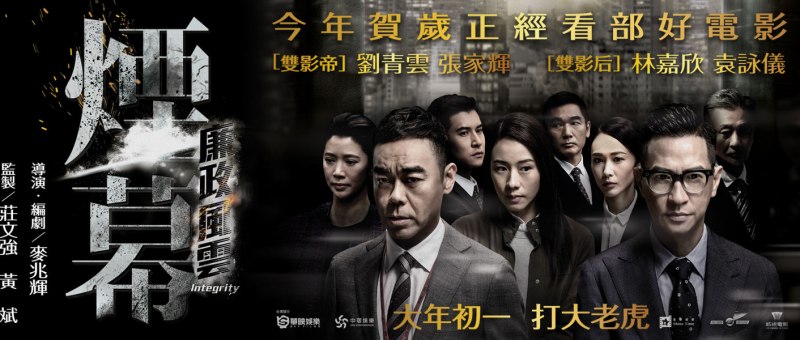
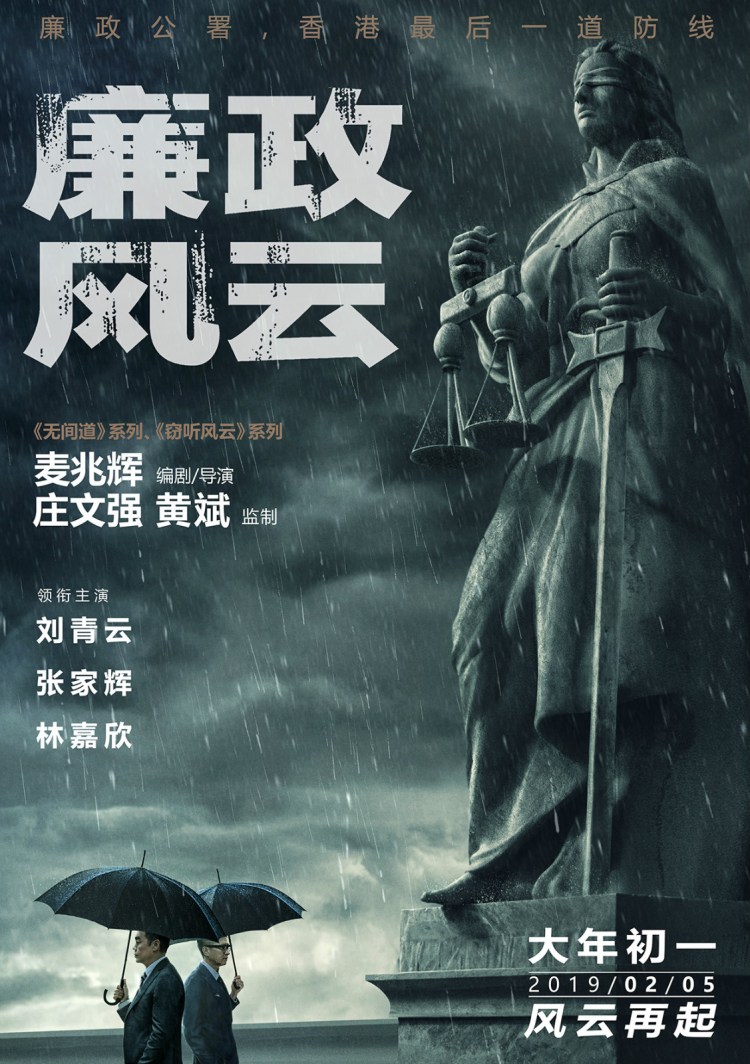
Integrity poster 1Alan Mak made his name with the phenomenally successful Infernal Affairs (co-directing with Andrew Lau) which later blossomed into a trilogy – a pattern he repeated with the Overheard series, making time for a few standalones in between. 2019’s Integrity (廉政風雲 煙幕), released as gritty alternative to the saccharine and silly fare usually on offer for Lunar New Year, finds him in similar territory and is once again touted as the first in a projected trilogy this time revolving around the ICAC who have become a Hong Kong movie favourite as of late. Drawing inspiration from classic ‘70s thrillers and American New Cinema, Integrity has a few questions to ask about the nature of corruption and the limits of control.

The drama begins with ICAC officer King (Sean Lau Ching-wan) briefing star witness Jack Hui (Nick Cheung Ka-fai) on their upcoming court case. Shortly after Jack has handed over a USB stick containing new evidence, he slips his protective detail and disappears leaving King’s case with a giant hole in the middle, especially considering one of the two defendants has also skipped town. Given a seven day recess, King reluctantly allows his wife, fellow ICAC officer Shirley (Karena Lam), to travel to Sydney to chase Jack while pressing his available leads in the form of defendant two and the rest of the USB stick.

Eschewing action in favour of intricately plotted conspiracy, Mak keeps the tension high as he slowly reveals the ambiguities of the case, reminding us that no one is quite as innocent as we might assume. We find out the relationship between Jack and King (pregnant names indeed) may not have been as straightforward as we first assumed while we’re also made aware of the extremely lucrative trade in black market cigarettes and the backhanders to the customs bureau that make it possible. Then again we have to ask ourselves why it is a top accountant like Jack might suddenly decide to turn whistleblower when he’s been perfectly content with his complicity in corruption for the last 20 years.

King is intent on catching “The Puppet Master” by following their financial trail, convinced that taking down the middlemen in the tobacco smuggling scam will eventually flush them out. He thinks he holds all the cards but isn’t quite aware what game it is he’s playing. Desperate to catch his quarry, King is in danger of crossing the line as he convinces defendant two to tell all by (falsely) promising her immunity as a prosecution witness. She eventually spills the beans, but warns him that people will die – something that tragically comes to pass when the Puppet Master starts taking care of loose ends.

Obsessed as he is, King isn’t quite sure he cares who might get hurt in his quest for justice. Then again, King’s need to catch the bad guy, as his boss (Alex Fong) tries to point out as kindly as possible, is a kind of displacement activity designed to get his mojo back so he can patch things up with his put-upon wife. Despite talk of divorce, the pair are still wearing their wedding rings and have romantic photos as their smartphone wallpaper while they continue to bicker (somewhat) affectionately via text message. The awkward romantic subplot is most likely intended to set up a series motif though it seems wholly out of place with Mak’s more serious themes, especially when tipping into unwelcome clichés such as Shirley’s impromptu shopping trips paid for with King’s card when she gets fed up with his persistent sexism.

The central theme of King’s own fracturing “integrity” gets lost in the shuffle but is dealt a killer blow by the extremely unwise ‘90s flashback and its eventual ‘80s counterpart which undercut almost everything that’s gone before, creating a series of inconvenient plot holes in the process. Mak isn’t quite sure where he wants to go and presents us with a series of trick endings, the final of which is a step too far even if it perhaps plays into his themes of karmic justice and the costs of betrayal (not to mention making it 100% clear for the mainland censors’ board that crime never pays). Though managing to nail the the tense ‘70s conspiracy thriller vibe in its early stretches Integrity’s ridiculous third act plot twists ruin an otherwise promising tale of greed and suspicion while perhaps reinforcing the idea that no one can be trusted and all connections are, to a point at least, mercenary.


Currently on limited release in UK cinemas.

Original trailer (English subtitles)
Project Gutenberg (無雙, Felix Chong, 2018)

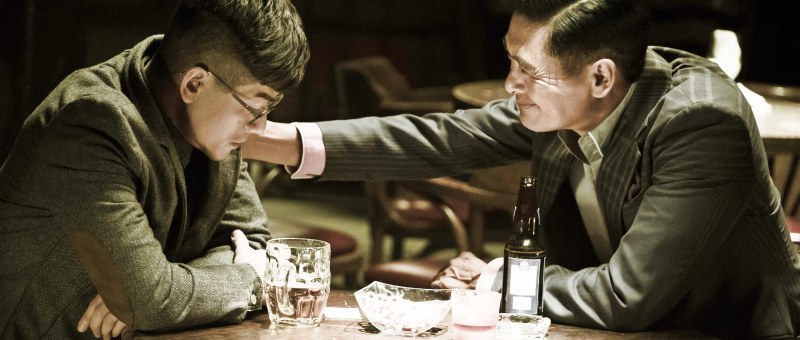
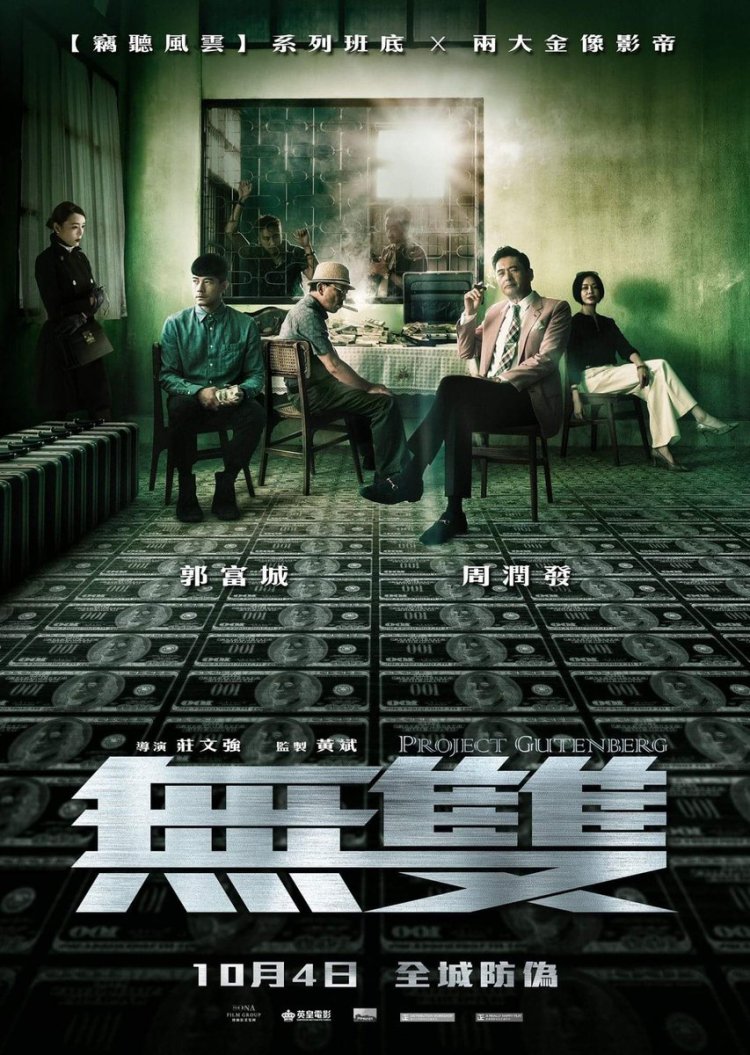
Project Gutenburg poster“Sometimes a fake can be better than the real thing” intones mild mannered counterfeiter Lee Man in Felix Chong’s cineliterate thriller Project Gutenberg (無雙) . At first glance, Project Gutenberg would seem to have nothing at all in common with the archival programme from which it takes its name but perhaps there is something in its continual questioning of whether a facsimile can replace an original. Chong plays with perception, narrative, and a human need for authenticity but most of all with the legacy of heroic bloodshed as a melancholy young man attempts to rewrite his own history with himself in the lead.

In the late ‘90s, Lee Man (Aaron Kwok) is languishing in a Thai jail from which he manages to get himself rescued by scraping blue powder off the walls and creating an expert forgery of a postage stamp to send a letter of help. Soon after he gets himself picked up by the Hong Kong police who want his help tracking down a notorious counterfeit currency trafficker known only as “Painter” (Chow Yun-fat). Lee is scared witless because Painter has a habit of ruthlessly hunting down associates who talk – something which is well known to HK police inspector Ho (Catherine Chau) who is after him because he killed her Canadian policeman boyfriend. Painter also murdered the fiancé of Lee’s old flame Yuen (Zhang Jingchu) who is the woman he sent the letter to and who has come to his rescue. Which is to say, the situation is much more emotionally complicated than one might expect.

Through flashback, Lee elaborates on how he came to get mixed up with crime. He and Yuen were living on love in 80s Vancouver trying to make it in the art world. While Yuen’s work began to gain traction, Lee’s was going nowhere. Technically proficient, his paintings were thought soulless and derivative but his talent for mimicry soon brings him to the attention of master forgers and thence to Painter who needs someone with expert skills for his next project – forging the US $100 bill.

Lee tells his tale with melancholy relish, dwelling on his days of youthful abandon with Yuen to the extent that Ho interrupts to declare herself disinterested, advising he skip the prologue and get to the bit where Painter shows up. Painter, a suave yet unpredictable criminal type, determines to help Lee become “the leading man” he knows he can be, but to be fair all anyone is ever interested in is the intensely charismatic Painter. As it turns out, there are more reasons for that than it might at first seem, but in the end Lee’s internalised feelings of inadequacy are still the fuel to his fire. Unable to find artistic success, forgery offers Lee the life of a skilful craftsman and he feels himself to have found his niche but in betraying his artistic integrity he also risks forever losing the woman he loves.

Painter has a weird obsession with Lee’s love life, assuring him that once the deal is done he will help him win back Yuen. “A man who gives up on love is destined to fail at everything” Painter tells him. Lee, however, repeatedly gives up on love. He refuses to fight, embraces his own sense of inferiority, and resolves to live on in misery falling ever deeper into Painter’s world of surrealist crime. Leaving aside Painter’s strangely homoerotic relationship with his protege, Lee’s life gets still more complicated when he becomes involved with a woman, Sau-ching (Joyce Feng), who falls in love with him in Thailand and, for complicated reasons, ends up with Yuen’s face thanks to plastic surgery and name thanks to a fake passport. Painter taunts him with a facsimile of his love but berates him for settling for a substitute while Sau-ching resents getting the Vertigo treatment from a man who refuses to let a failed love fade.

Almost offended by her betrayal of true love, Inspector Ho probes Yuen about her fiancé, asking if he was merely a “substitute” for Lee. Yuen asks if the next man Ho will fall in love with will merely be a “substitute” for her fallen colleague to which Ho fires back that there will never be anyone else because her love is “irreplaceable”. Yuen scoffs at her strangely naive romanticism and Ho does indeed appear to meet an echo of her former love in someone new carried once again on noirish cigarette smoke. If you can’t be with the one you love, love the one you’re with the old adage goes but it turns out that inauthentic romance is the hardest kind to bear.

Chong lets Lee’s retelling of his history play out like a heroic bloodshed movie in which Chow re-inhabits the classic characters of his youth. An unreliable narrator, the movie in Lee’s mind is one of honour and glory in which he still cannot allow himself to take the lead. Chong over eggs the pudding with a series of twists and reversals, undercutting all that’s gone before and muddying his message in the process but there’s no arguing with his high stakes style as he turns a simple crime story into an interrogation of authenticity and the power of personal myth making.


Screened as part of the 2018 London East Asia Film Festival.

Original trailer (English subtitles)

Concerto of the Bully (大樂師.為愛配樂, Fung Chih-chiang, 2018)

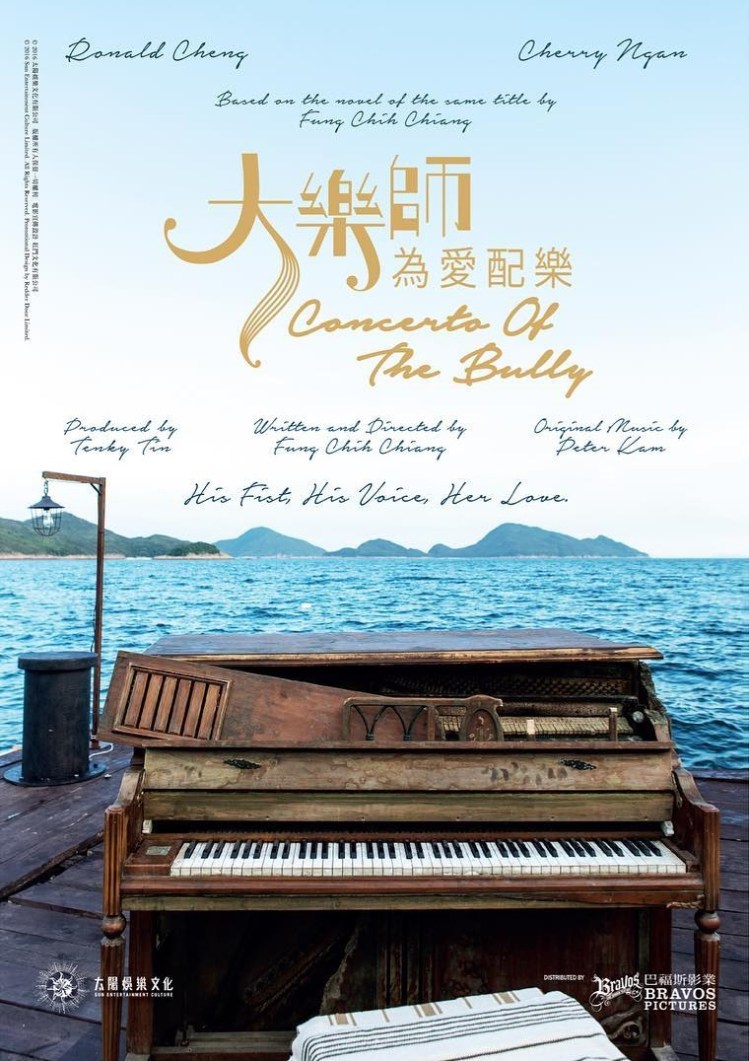
Concerto of the Bully posterRemember the heady heydays of the Hong Kong rom-com in which a series of zany, often entirely random adventures eventually led to true love? Director Fung Chih-chiang evidently does judging by the innocent charms of Concerto of the Bully (大樂師.為愛配樂) – a beautifully pitched soulmates thrown together romance with a kidnapping at its centre. For many things to work, they need to be in sync, as an unexpected utterance from the vacuous pop star boyfriend of the female lead points out, but sometimes you have to turn the volume down in order to hear the harmony.

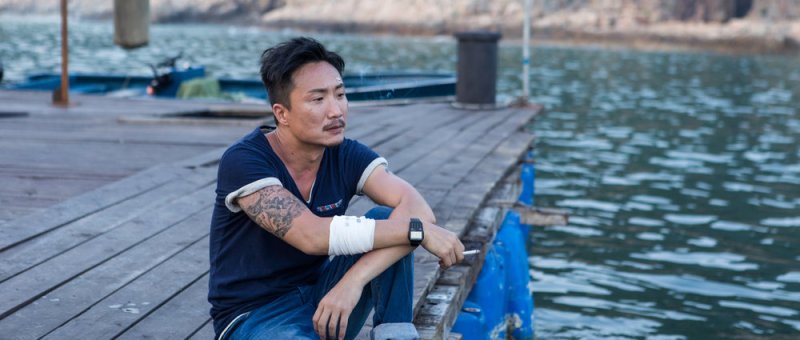
Yung (Ronald Cheng Chung-kei) is a petty thug with a difference. Unable to cope with the noisiness of modern life which often pushes him into fits of erratic violence when overwhelmed, he lives out on a remote fishing raft and carries around with him a soothing track he discovered on the internet by an artist known as “Hit Girl”. His life becomes a lot more complicated when he returns home one evening to find a mysterious sack lying in the middle of the floor with a note reading “please feed” right above it. Yung’s no good gangster friend has kidnapped a young woman, Jamie (Cherry Ngan Cheuk-ling), after recognising her as the girlfriend of a famous pop star from whom he hopes to arrange a ransom. Yung is not very keen on this plan for several reasons but finds himself going along with it. Meanwhile Jamie, who is secretly “Hit Girl”, attempts to plan her escape by ingratiating herself with the guys while thinking about her unfinished composition to keep her mind off the potential danger of her predicament.

The central irony is that Jamie is a girl who loves noise – all the sounds of the world, natural and manmade, are music to her ears and part of the great song of the universe. Yung, however, prefers things quiet save for Hit Girl’s calming song. Forced to babysit Jamie, Yung begins to fall under her spell which is partly weaved solely to lower his guard so that she can escape, but soon enough both begin to get a glimpse of what it is that might be missing in each of their lives.

All the standard romantic comedy tropes are out in force – the boyfriend is a no good heel who isn’t keen on paying the ransom and already has someone else, while Yung is a noble and good man who has been brought low by his no good buddies who have once again gotten him into a lot of trouble. Yung’s inability to process sound turns out to be a life limiting condition which has forced him into a career of violence but Jamie’s musical philosophy eventually allows him to see “another world” – literally, as he re-imagines a crowd of street thugs performing an epic dance routine to Mozart’s Seranade No. 13 in G Major. Unmasked as “Little Fairy”, Hit Girl’s only fan, the shy and under confident Yung gets a new lease on life thanks to Jamie’s less than patient tutelage as she tries to convince him to help her complete her masterwork in time for the big concert finale.

Like her boyfriend said, sometimes it’s no good if it’s not in sync. Many things in the relationship of Yung and Jamie are fake – Jamie has been kidnapped and is taking care to be “nice” and “useful” to her captors, while the pair begin with playacting music through a series of homemade mock up instruments until the arrival of a beaten up tinny piano which might be just the sound Jamie has been looking for. Gradually, the melody begins to come together, working towards a graceful harmony even while the distant drums of trouble in the city continue to threaten their quietly growing romance just as it begins to hit a more authentic key. A strangely sweet love story with a kernel of darkness at its centre, Concerto of the Bully is a hopelessly innocent fairy tale about an unwitting musical genius who never learned to hear his own voice, and a melancholy songstress who finally finds the key to her musical dreams in an unexpected place, as they meet on a floating musical stage which is both silent and somehow alive with all the quiet joys of a melodious life.


Concerto of the Bully is screening in Chicago as part of the seventh season of Asian Pop-up Cinema on 2nd October, 7pm, at AMC River East 21 where Director Fung Chih-chiang and Art Director Chet Chan will be present for an intro and Q&A. Tickets on sale now!

Original trailer (English subtitles)

Swordsman II (笑傲江湖之東方不敗, AKA The Legend of the Swordsman, Tony Ching Siu-tung, 1992)

Swordsman II still 1In a world filled with chaos, is the answer to all life’s problems retreat or attack? After the unexpected success of Swordsman which survived the withdrawal of legendary director King Hu to go on to be a box office hit, a sequel was quickly set in motion to be directed by action choreographer Tony Ching Siu-tung. Swordsman II (笑傲江湖之東方不敗) would be the second in a trilogy inspired by Louis Cha’s novel The Smiling, Proud Wanderer and largely dispenses with the cast of the original film for a virtual reboot led by action star Jet Li and actress Brigitte Lin as an extraordinarily sympathetic villain.

Picking up soon after the end of the first film, Ling (Jet Li) and his female comrade nicknamed “Kiddo” (Michelle Reis) are on the run with the intention of retiring from the world of martial arts to live simply among honest people. However, they are about to ride straight into the heart of conflict. At this particular point in history, the “Highlanders” feel themselves oppressed by the ruling “Mainlanders” and would be set on rebellion if they weren’t so busy fighting amongst themselves. Meanwhile, a number of Japanese troops are also holing up in China to wait out political strife in Japan. “Invincible” Dawn (Brigitte Lin), a Highlander, appears to have gotten a hand on the first film’s MacGuffin – the “Sacred Volume” which holds the key to untold martial arts power. Teaming up with the displaced Japanese, Dawn plans to use the powers of the Sacred Volume to dominate the Highlanders and then eventually take over the entire nation.

Dawn happens to be the uncle of a woman, Ying (Rosamund Kwan), with whom Ling began something like a romance back in the first film. Ying’s father, Wu (Lau Shun), the chief of Highlander tribe Sun Moon Sect, has gone missing – presumed taken prisoner by Dawn as a prelude to seizing power. Despite his desire to escape the duplicitous world of martial arts, Ling finds himself on a quest to save Ying’s father and with it the Sun Moon Sect if not the entire nation from the tyrant that Dawn seems primed to become.

Ling, as heroes go, is very much of the wine, women, and song, school. Indeed, he’s not much for anything without a good cup of booze – something that provokes an instant connection with the unusual figure of Dawn when he spots her bathing in a local pool and she offers him some of her upscale alcohol in a pretty bottle. The powers of the Sacred Volume come with a price – in order to embrace them, Dawn must transform herself into a woman (or in the less poetic rendering of the text, simply cut off her penis). Dawn’s transformation is a gradual process and she continues to play her male role as the head her clan, even parading her mistress in front of her captives in a noticeably salacious manner. However, Dawn is also caught off guard by an unexpected attraction to the cheerfully tipsy Ling and the transformation seems to accelerate – she begins wearing makeup, her voice changes into a more feminine register, and her sexual relationship with her mistress appears to be definitively over.

Meanwhile, Ling is fighting a romantic war on three fronts – he’s captivated by the mysterious woman who avoided speaking to him never knowing she is really his enemy, but is still half in love with Ying, and the subject of Kiddo’s unrequited crush. While Dawn wrestles with a deeper transformation, Kiddo is also trying to process her place as a woman among men in attempting to shed her tomboyish image by styling her hair in more classically female fashions and wearing makeup – something which can’t help but arouse mild hilarity among her comrades who collectively think of her as a tough little sister. Trying to explain her new persona to her mistress, Dawn insists that she will never forget her and that essentially nothing has changed, while the guys partially mock Kiddo’s new desire to embrace her femininity by avowing that male/female/non-binary gender is an irrelevance. Even so, on realising Dawn is the person he’d been looking for and was once Ying’s uncle, Ling’s parting questions are all about whether he might have accidentally slept with a man which he seems to find embarrassing. Nevertheless, it’s “femininity” which finally does for Dawn as she finds herself weakened by love and eventually pushed towards a “heroic” act of romantic sacrifice.

Having defeated one tyrant, Ling finds himself threatened by another as Wu’s maniacal need for revenge provokes a wide scale purge of those who had “betrayed” him. Ling’s desire to remove himself from this world of betrayals, violence, and complex moralities seems ever more understandable but cannot be his answer even as he finds himself unwillingly exiled. If you turn your back on trouble, it will eventually engulf you and everything you love – as will a failure to resist a trusted ally’s descent into darkness. Strangely affecting in its hero/villain symmetries and air of tragic romance, Swordsman II’s beautifully choreographed action sequences are only surpassed by its fierce commitment to fantasy.


Swordsman II was screened as part of An Evening with Tony Ching Siu-tung presented by the Chinese Visual Festival.

Men on the Dragon (逆流大叔, Sunny Chan, 2018)

Men on the dragon posterLife is tough for the middle-aged man in contemporary Hong Kong, at least according to the directorial debut from screenwriter Sunny Chan, Men on the Dragon (逆流大叔). Economic woes, a precarious employment environment, familial strife, and elusive Andy Lau tickets all conspire to make our guys feel powerless in a society that seems primed to crush their spirits. Can dragon boating really help put their fire back in their bellies? Conventional wisdom would say no, but then there is something about physically demanding team sports that is particularly good at inflaming individual desires.

Pegasus Broadband is about to announce another round of mass layoffs which has each of our heroes worried. Participating in a mini protest strike puts them straight in the firing line (even if they were clever enough not to write their real names on the petition forms), but when they’re seemingly lucky enough to escape the axe for now at least they think they can breathe easy. An unexpected call from the boss instructing them to appear at a mysterious location with swimming trunks in hand even has them wondering if they’re being given some kind of bribe to play nice but as it turns out the reverse is true. Pegasus Broadband wants to improve its public image and has decided to do that by entering a team in the upcoming dragon boat races. The race, which they fully expect to win, will be streamed live online to demonstrate the company’s infrastructural superiority. Fearing they’ll be bumped up the redundancy list if they refuse, our guys resign themselves to becoming unlikely dragon boat champions but end up discovering unexpected sides of their potential which prove essential in solving their individual crises.

Suk-yi (Poon Chan Leung), bespectacled and mild-mannered, is the least athletic of the Pegasus Broadband employees but is half grateful for the dragon boating opportunity because it gets him out of the house where his wife and mother constantly bicker while his small daughters can’t stop fighting. Feeling pushed out and unwelcome in his house full of angry women, Suk-yi is desperately looking for some kind of escape or possibility of reasserting his authority which he begins to find while training for the dragon boat races and nursing a small crush on the pretty coach, Dorothy (Jennifer Yu). Meanwhile, Lung (Francis Ng) is unmarried but has found himself in an awkward non-relationship with the woman next-door for whom he cooks and cleans, even taking care of her moody teenage daughter. He dreams of making a real family but lacks both the courage and financial resources to make a move. The youngest of the gang, William (Tony Wu), has the opposite problem in that he’s given up his dream of being a top Ping Pong player to build a future with his girlfriend but begins to realise that he hasn’t given up on his athletic hopes while boss Tai (Kenny Wang) is secretly torn apart by the worry that his wife is having an affair with a sleazy real estate agent.

All four guys have found themselves swept along by the current of modern Hong Kong, coasting without aim or purpose but filled with middle-aged anxiety as they wonder where the river is taking them and if it’s already too late to change the destination. Suk-yi’s dilemma is perhaps the most cliched of the three as he contemplates swapping his disharmonious household for the unattainable charms of an idealised younger woman while Lung chases easy familial bliss, Tai tries to repair a relationship corrupted by modern social pressures, and William wonders if it’s worth giving up a part of yourself to make a relationship work knowing that kernel of resentment will only grow with time. Men on the Dragon is, in this sense, a very “male” story in which four put upon men feel themselves emasculated by oppressive social forces yet learn to rediscover their “manhood” through the intensely physical act of dragon boating.

They are however guided along by an austere young woman who bangs the drum to which they must all march. This is not Dorothy’s story and she gets short shrift among all the guys but there’s something interesting in the fact that she had to hire a “male foreigner” to pretend to be the “real” coach because no one would hire a female dragon boater despite her impressive list of qualifications and credentials. Gently rebuffing Suk-yi’s interest, she nevertheless guides him towards a confrontation he’d long been avoiding in reasserting himself in his own household, restoring his standing in his wife’s eyes and brokering piece with his feisty mother who can’t seem to get on with her Mainland daughter-in-law. It’s the rhythm of life that’s important, Dorothy reminds the guys – you don’t get anywhere unless you’re all pulling together. That might sound like we’re back where we started, being swept along in a mass current without control or direction but it’s individual will which drives the communal enterprise and there can be no progress without agency. Not all dreams work out, but you won’t know unless you try and at least if you crash and burn there are plenty of guys waiting to pull you out of the water.


Men on the Dragon made its world premiere at the New York Asian Film Festival 2018.

Original trailer (English subtitles)

Tomorrow is Another Day (黃金花, Chan Tai-lee, 2017)

tomorrow is another day posterMiddle-aged malaise is fast becoming a dominant theme in Chinese language cinema, but the pressures faced by the heroine of the debut feature from Ip Man screenwriter Chan Tai-lee are compounded by a series of additional responsibilities and the relative lack of support available to help her cope with them. Tomorrow is Another Day (黃金花) is, in many ways, a family drama with a sympathetic depiction of the demands of caring for a child with special needs at its centre, but it’s also the story of a marriage and of the essential bonds between a mother and a son as the family struggles to survive in a sometimes hostile environment.

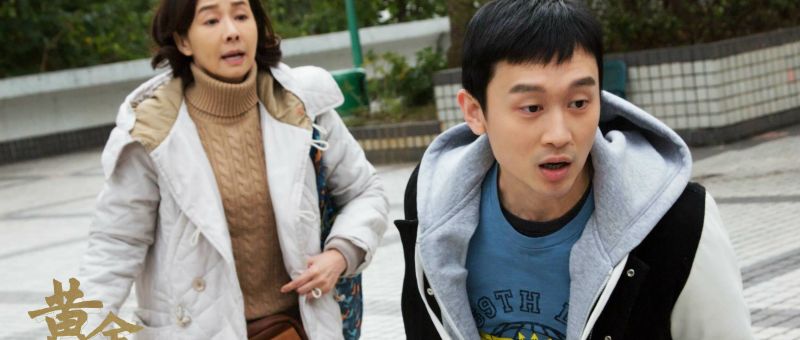
Mrs. Wong (Teresa Mo), interviewed at a community centre, relates the routines of her daily life to a camera crew. Describing herself as a “regular housewife”, Mrs. Wong’s existence revolves around caring for her husband (Ray Lui) – a driving instructor, and her 20-year-old autistic son, Kwong (Ling Man-lung). She tells the film crew she is happy with her life and on one level she is, but she also fears her philandering husband is up to his old tricks again. Mr. Wong is indeed having an affair with one of his pupils, a much younger nurse called Daisy (Bonnie Xian Seli) who seems to have well and truly got her hooks into him. Knowing of her husband’s string of extra-marital affairs which has spanned the entirety of the marriage, Mrs. Wong has made a decision to turn a blind eye for the sake of her son but this latest dalliance has proved difficult for her to bear. After Daisy randomly invites herself into the family home when Mrs. Wong is shopping, the couple argue and Mr. Wong walks out leaving Mrs. Wong to care for Kwong all alone.

Kwong, usually cheerful and well behaved, experiences occasional meltdowns when told he can’t have something that he wants, often resorting to frustrated acts of self harm including bashing his head against nearby solid objects. Though Kwong is not violent towards others, he is now a grown man and much stronger than his mother who finds it difficult to help him calm down on her own. Mr. Wong’s forearms are a mess of scars and bruises received whilst trying to restrain his son from hurting himself, and the physical strain of caring him has often weighed heavy on his conflicted father’s mind.

Though Mrs. Wong and Kwong experience frequent discrimination from those who are unaware of his needs – other mothers pull their children out of the playground when Kwong comes to play, and Mrs. Wong finds it difficult to get a part-time job when her prospective employers spot Kwong standing beside her, the other neighbourhood housewives have become used to Kwong’s way of being and are keen to help out where they can. Like Mrs. Wong, many of the other women have their own problems whether worrying about the (lack of) academic progress of their sons, or trying to combat the potential loneliness of early widowhood through friendship and community. Hearing of Mrs. Wong’s marital problems via the neighbourhood grapevine (another source of humiliation for Mrs. Wong), everyone has taken her side against the villainous Daisy but they’re also worried Mrs. Wong may consider harming herself while faced with so many conflicting pressures.

Mrs. Wong however, has half her mind on revenge and has taken to watching crime documentaries which give her the idea that she could get herself a convenient alibi by going to the Mainland by official means and then smuggling herself back in to off Daisy in the hope that her husband might finally remember his responsibilities. Daisy, it has to be said, is a one note villain and it’s difficult to see why she is so intent on pursuing a dead end romance with a middle-aged, married, driving instructor without coming to the conclusion that she must love causing trouble, especially as Mr. Wong seems to find her quite irritating even once he’s taken the “decision” to leave his family for her. Mr. Wong himself is also a bundle of contradictions but emerges as a weak willed man who has never been able to fully commit to his marriage and struggles with the responsibility involved in being the father of a child with special needs. Though he eventually seems to reconcile himself to his role as his son’s father and his wife’s husband, there is something conceited in his belief that his family will simply take him back when he has caused them so much pain and suffering by his hastily taken decision to abandon them.

Kwong is more perceptive than his mother gives him credit for, and Mrs. Wong too is eventually forced to consider the effect her darkening mindset has had on his emotional wellbeing. Tomorrow is Another Day offers no easy answers in its sympathetic portrayal of a middle-aged woman driven to extremes by a series of conflicting pressures but eventually finds finds comfort in living in the now as the family begins to find its way home, cutting through the noise of a high pressure city to rediscover what it is that’s really important.


Tomorrow is Another Day receives its US premiere as the closing night film of the sixth season of Chicago’s Asian Pop-Up Cinema programme on 16th May, 2018. The screening begins at 7pm, AMC River East 21 and tickets are already on sale via the official website.

Asian Pop-Up Cinema will return for the seventh season in the autumn – make sure you’re up to date with all the latest information by following the festival on Twitter, Facebook, Instagram, and Vimeo.

Original trailer (Cantonese with English/Traditional Chinese subtitles)