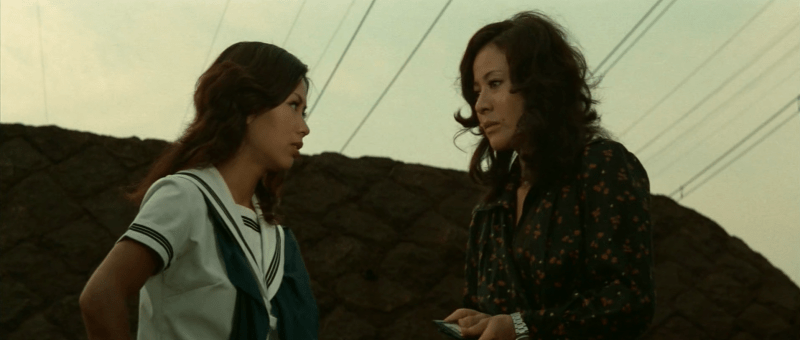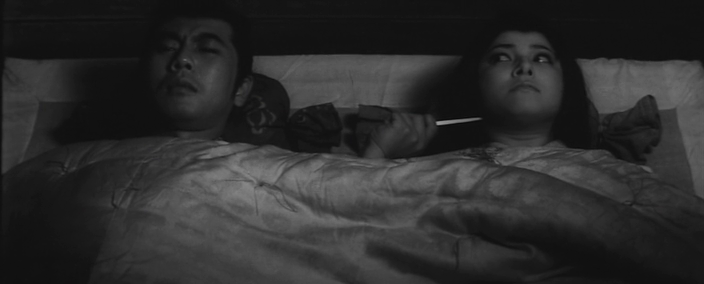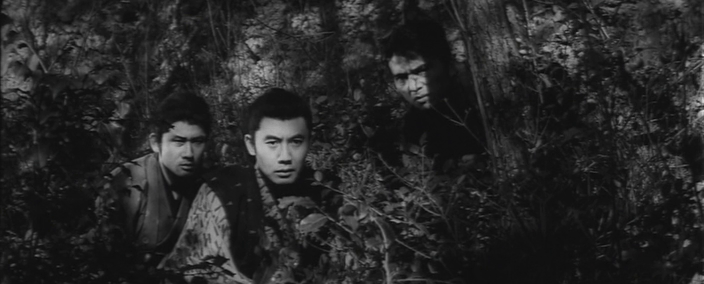
Honeko Akabane’s Bodyguards (赤羽骨子のボディガード, Junichi Ishikawa, 2024) [Fantasia 2025]

Unbeknownst to her, a high school girl’s entire class is actually made up of bodyguards hired by her distant father, whom she doesn’t know either, to keep her safe because his work makes her an easy target for international criminals. Adapted from the manga by Masamitsu Nigatsu, Junichi Ishikawa’s Honeko Akabane’s Bodyguards (赤羽骨子のボディガード, Akabane Honeko no Bodyguard) is in some ways fairly typical of the genre in its parade of unrealistic hairstyles and over-the-top humour, but also anchors itself in a genuine sense of friendship and youth solidarity as the class come together under a charismatic leader not only to protect Akabane but each other too.

That charismatic leader would be Ibuki, a cocksure delinquent and childhood friend of Akabane’s who’s also been carrying a torch for her all these years. Nevertheless, it comes as quite a surprise when he’s officially hired by Jingu (Kenichi Endo), a man who claims to be the head of Japan’s Security Services. After his wife died, he decided to place Akabane for adoption to keep her safe from the duplicitous world in which he lived. But now there’s a 10 million yen bounty on her head and every criminal enterprise he’s ever been after is desperate to get their hands on her. What Ibuki doesn’t know is that he’s hired the rest of the class too who all have various skills from rhythmic gymnastics to torture. It’s imperative that Akabane never find out that she’s a target, nor that Jingu is her biological father, and continues to live a “normal” carefree life.

She certainly appears to have no skills of her own other than her ability to quote legal infractions in her desire to become a lawyer like her adopted parents. While this may on some level remove her agency in making her dependent on her classmates for protection, it’s also Akabane that takes the initiative in romance by making overtures to the otherwise diffident Ibuki. Other the other hand, she’s painted as the mirror image of her sister, Masachika (Tao Tsuchiya), who has been raised as a boy and taught to be an assassin but craves the kind of love and affection Jingu pours on Akabane. 

This is one reason that she is eventually able to find unexpected common ground as she and Akabane are obviously both firmly on team Ibuki with Akabane thankful that someone else can see Ibuki’s good side even if most people mistake him for being a scary and dangerous person. Like his father, the late policeman, he believes that to protect someone you must protect everything they love which is why he’s desperate to protect the whole of the class too so that Akabane’s world remains consistent. Most of the other students aren’t too invested in their jobs and are only doing this for the paycheque, but eventually end up coming together thanks to Ibuki’s insistence that he won’t leave them behind. Not only does he need their help to protect Akabane, but genuinely respects their friendship and wants to save them too.

Then again, we’re presented with a series of images of paternal and hierarchal failure. Ibuki’s own father was killed in the line of duty and while alive had little time for his son, if like Jingu trying to keep his child out of the dangerous world in which he lives. Jingu gave up one daughter to keep her safe, but has a strained relationship with the second who feels like a failure and is desperate for a chance. Even the head of the class is compromised as he first proves himself willing to sacrifice the lives of his men in achieving their goal of protecting Akabane and then seems to commit several blunders including being unable to unmask a mole. Ibuki becomes a de facto leader, but at the same time what emerges under him is a relationship of equals and solidarity between those in a similar situation. They are no longer working for Jingu or following their leader’s orders but thinking for themselves and actively protecting each other. 

Ishikawa puts together some excellent action sequences that demonstrate what a well-oiled machine the students can be in standing up against criminality while maintaining the zany humour and making Ibuki an oddly pure figure of warmth and integrity as he resolves to protect all of those around him if most especially Akabane to whom he is unable to voice his real feelings. She meanwhile, admittedly a damsel in distress, is at least taking the lead when it comes to their romance even if she continues to needle him about his rough and uncouth behaviour. Honeko Akabane is it seems very well protected from any threats that come her way save perhaps that of her hidden past.                                                                                                                                    


Honeko Akabane’s Bodyguards screened as part of this year’s Fantasia International Film Festival.

Original trailer (no subtitles)

Babanbabanban Vampire (ババンババンバンバンパイア, Shinji Hamasaki, 2025)

It turns out immortality’s not all it’s cracked up to be in Shinji Hamasaki’s adaptation of the manga by Hiromasa Okujima, Baban Baban Ban Vampire (ババンババンバンバンパイア). At 450 years old, Mori Ranmaru (Ryo Yoshizawa), one-time lover of Oda Nobunaga (Shinichi Tsutsumi), is working as an attendant in a bathhouse in an attempt to, as he says, “live an ordinary life earnestly,” while staving off the darkness of an existence free of the spectre of death. 

Yet, there is an uncomfortable darkness at the centre of this otherwise humorous and ironic tale in that what Mori Ran is actually doing is grooming a child so that he can enjoy him when he judges that he is “ready.” There’s an obviously unpalatable reading of the film that renders it as an allegory for paedophilia, while there’s also an undeniable poignancy in likening the figure of the vampire of that of a gay man in an oppressive society. Mori Ran accosts his victims in dark alleyways and his assignations with other men are necessarily short and secretive. They also result in death, while Mori Ran describes most of his victims as tainted and disgusting as if echoing an internalised sense of self-loathing. He continues to hold up Rihito (Rihito Itagaki) as a figure of innocence and purity because he once saved his life when he was baking in the heat of an usually hot spring when the boy was only five years old. 

Mori Ran’s internalised homophobia is somewhat mirrored in that of the teacher Sakamoto (Shinnosuke Mitsushima) who is also a vampire hunter but bewitched by Mori Ran and longing to be initiated by him, though Mori Ran declines to give him what he sees as a curse. Imbued with a gothic sensibility, Mori Ran believes that humans are beautiful because they die, while vampirism is debased and ugly. He refuses to condemn someone he admires to his own fate which he describes as a kind of inescapable hell in which he is unable to die. He no longer believes in love, though is haunted by his loss of Nobunaga, and sees humans merely as food. 

Nevertheless, it seems he has found purpose in his present life of living with Rihito’s family and working in their bathhouse despite convincing himself that he’s only biding his time until Rihito is ripe for the picking. According to Mori Ran, the sweetest blood belongs to that of 18-year-old male virgins which is why his goal of ensuring that Rihito remains virginal and pure is becoming more difficult now that he has entered adolescence. Much of the comedy derives from Mori Ran’s emotional cluelessness and paranoia on discovering that Rihito has fallen for a girl, Aoi (Nanoka Hara), with whom he had a stereotypical meet cute on his way to his high school entrance ceremony. Knowing that he has to nip this in the bud as soon as possible, he pays a visit to Aoi to warn her off but fails to realise that not only did she barely notice Rihito let alone fall in love with him, but that she is actually obsessed with vampires and is keener on him. 

But then again, there’s something additionally troubling about Rihito’s immediate classification of Mori Ran as a “love rival” in the mistaken belief he’s after Aoi too rather than as someone who should probably be reported to some kind of authority. After all, even if he were not 450 years old but the 25 he claims to be, hanging around exclusively with high schoolers is odd and bordering on inappropriate in itself. Having misunderstood his intentions, Aoi also believes that Mori Ran is waiting for her to be “ready,” in a partial recognition that this is wrong because she’s a child but also prepared to wait for the mysterious vampire without considering the implications of his being interested in a 15-year-old girl if that actually were the case. 

Nevertheless, what Mori Ran discovers is really a different kind of love in his gradual integration into the human world and the the friendships he forms not only with Rihito, but Aoi, her muscular brother Franken (Mandy Sekiguchi) who also has a crush on Mori Ran, and the lovelorn teacher Sakamoto, even if he’s still focused on his mission of keeping Rihito pure so he can drink his blood on his 18th birthday. His attempts to prevent a relationship forming between Rihito and Aoi are all countrerprodcuteive and would like end up bringing them together if it were not for the fact of Aoi’s crush on him of which he remains oblivious. The inherently zany humour of the situation with its series of concentric love triangles along with the warmheartedness of Rihito’s homelife when contrasted with the “mysterious” serial killings on the news cannot completely overcome the unpalatable undercurrent of Mori Ran’s pederastic quest, if glossing over it with admittedly delicious irony and absurdism.


Babanbabanban Vampire screens 27th July as part of this year’s New York Asian Film Festival.

Rewrite (リライト, Daigo Matsui, 2025) [Fantasia 2025]

A mysterious transfer student arrives from the future. You have 20 wonderful days with him, but then he must return to his own time. He tells you that he came back to meet you and experience your time because of a book you will write, and your future self also shows you the book, tells you you did indeed write it, and that everything’s going to be okay. But in 10 years’ time, when you’re your “future self”, you from the past does not show up to get any of this information. Did something go wrong? Is the timeline crumbling? Or did you just imagine all this as a manifestation of “youth”?

When this happened to her, Miyuki (Elaiza Ikeda) believed that she was “the heroine of that summer,” but the truth is of course that she was always the heroine of her own life and had the right and power to make her own choices. Adapted from the novel by Haruka Honjo, Daigo Matsui’s Rewrite (リライト) is, like Obayashi’s The Little Girl Who Conquered Time, about the dangers of nostalgia and the over romanticisation of youth. What Miyuki gradually comes to realise is that one of the formative experiences of her teenage years may not have been unique or special but happened to literally everyone and changed them too in ways that were not always good. Because she met Yasuhiko (Kei Adachi) from 300 years in the future, she became a writer. But it remains true that her first few books weren’t about him at all. She always had the talent and the inclination. The impetus of destiny was only what gave her the confidence to pursue it. She knew she could, because she already had.

Yet, she’s in her hometown to close a loop on this unresolved romance of her youth despite having built a good life for herself as a successful author with a nice husband she met during the course of her work who is caring and supportive of her career. At the high school reunion she’s cajoled into going to, her former classmates sing the song they were practising for choir, “Cherry” by Spitz, which is also about “rediscovering each other, some day, same place,” echoing Yasuhiko’s cryptic claim that they’d meet again “in the future” (whose he doesn’t say) hinting at the way these feelings have been left hanging with only a yearning for the past and a painful nostalgia in their place. What Miyuki really has to ask herself is if she’s the person she wants to be in the present and is who she is because of the choices she made independently rather than solely because she was trying to fulfil the destiny given to her Yasuhiko.

To do so, she must face the fallacy of the “chosen one” mentality. The film rams this home in the parallel story of one of Miyuki’s classmates who tells her that she wasn’t chosen but actively chose to accept a kind of destiny rather than simply going along with it and that Miyuki too could “rewrite” the past if she wanted. In effect, this is what she’s already done as her husband implies when he repeatedly asks her if the book is “fiction”. Of course, it is, though she believed it not to be because it’s rooted in nostalgia and the personal myth making of the idealised romance of her youth. Matsui too plays with this sense of nostalgia in moving the setting of the story to Onomichi to mimic that of Obayashi’s The Little Girl Who Conquered Time and making frequent visual references to the 1983 film along with casting Toshinori Omi, the original boy who leapt through time, as the class teacher at the 10 years later reunion.

But the truth remains that Miyuki must learn to let go of the past, or else take mastery over it by rewriting her own story to accept that, as her husband says, the past and present are all hers. She can write anything and can finally leave her own time loop by writing her way out of youthful nostalgia and accepting something more like an objective reality along with the life she has now which appears to be happy and successful. Scripted by Makoto Ueda who has a long history of time-travel themed movies from Summer Time Machine Blues to River, Matsui’s poignant drama is shot through with irony and in constant dialogue with pop culture touchstones from the Obayashi film to Shunji Iwai’s Love Letter, while at the same time insisting that while you are the main character in your own life, you’re not the only one and a hundred stories are going on at the same time as yours. What really matters is not hanging on to the memories of an idealised past, but to live the life you want in the present for as long as this particular loop lasts.


Rewrite screened as part of this year’s Fantasia International Film Festival.

Original trailer (English subtitles)

How Dare You? (ふつうの子ども, Mipo O, 2025)

“I told you to shut up about that,” Kokoa’s mother (Kumi Takiuchi) tells her after she gets caught with two other children trying to start an environmental revolution by releasing cows from their paddock. It’s not difficult to see why Kokoa (Ruri) feels so strongly about global warming even if it’s probably her home environment that she most wants to change given adult indifference to climate issues, though Mipo O’s charming family dramedy How Dare You? (ふつうの子ども, Futsu no Kodomo) is less about the issues themselves than the relationships between the children and the adults around them.

The point being that Kokoa hates adults for trashing the world and creating an environment in which she feels it’s impossible to live. Fellow student Yuishi (Tetta Shimada) is drawn to her Greta Thunberg-style speech in class having just embarrassed himself with an essay about his toilet habits and suddenly develops an interest in the environment as a means of getting close to her. Which isn’t to say that he didn’t really care before. In this semi-rural area, he and his friends still go outside every day to catch woodlice to feed his friend Soma’s lizards, and Yuishi is also very keen on animals in general. He’s sympathetic to the cause, but on the other hand, is only really into this because of Kokoa who pretty much ignores him in favour of class bad boy Haruto (Yota Mimoto) who tells her that they need to take “action” to wake the adults up or no one’s going to listen to a bunch of kids whining about methane emissions. 

There is something pleasantly old-fashioned about their tactics which include cutting letters out of magazines to make protest signs they hang up all over town telling people not buy so much stuff, eat meat, or drive cars. But while the other two are increasingly emboldened their actions and their revolutionary activities begin to get out of hand, Yuishi finds himself conflicted. When they spot similar signs springing up made by other kids they don’t know, Kokoa and Haruto are annoyed rather than pleased that more people are joining the cause. Yuishi agrees with a sign saying people should catch the bus because it’s better than driving a car even if buses also pollute while Haruto opposes it. But he also points out that the firework rockets Haruto has bought for another action give off CO2, so perhaps they shouldn’t use them. He tries to deescalate and avoids becoming radicalised, but is eventually bullied into going along with the other two and suggests releasing the local farmer’s cows as their next protest assuming it’s a “nice” thing to do and less aggressive than some of Haruto’s ideas.

But they’re still just children and don’t really understand the consequences of their actions. After all, what’s a wild cow supposed to do? It doesn’t occur to them that the cows could get hurt or end up causing accidents and damage, let alone that they may alienate the local community who are already fed up with their stunts because it’s affecting their livelihoods. Of course, this is also part of the problem. The adults ignore the children because what they’re saying is inconvenient for the way they live their lives under capitalism which isn’t something they think they could change even if they wanted to which they likely don’t. Yuishi’s sympathetic mother is forever reading books about how to raise children well, and so she tries to listen to Yuishi but also “corrects” him in subtle ways like hiding meat in his spring roll after he tells he wants to give up eating it for the environment. Though she may have correctly assumed that he’s not really serious about it and tells him what she’s done after his first bite of the spring roll, there’s no getting around the fact that just as Kokoa said she’s not really listening. Nor does she sort her rubbish and recycling responsibly. When Yuishi looks up global warming on his tablet, his mother remembers being told about this at school too, which just goes to show how long this has been going on and how easily everyone forgot about the ozone layer panic of 1980s and 90s.

Nevertheless, the gradual escalation of the children’s activities towards something akin to ecoterrorism echoing the student protest movement on the 1960s satirises the dangers of radicalisation especially as neither of the boys are really invested in the cause and are only there because they’re each drawn to Kokoa who remains intense and implacable. Their true natures are exposed when they’re caught with only Yuishi stoic and remorseful, admitting it was his idea to release the cows and that he did it because he liked Kokoa and wanted her to like him back, while Haruto spends the entire time crying in his mother’s arms and Kokoa glares at everyone while reciting environmental statistics. Maybe she isn’t overly invested either so much as trying to regain control over her life and using cold hard facts as an escape from her overbearing mother who liked her better when she was “sweet” and ‘cute” and never asked any inconvenient questions. Even so, there is something very charming about the children’s earnestness that’s largely lost on the well-meaning adults around them who may be trying their best in lots of other ways but have already given in to the idea that the world can’t be changed and nothing they do makes a difference so there’s no point doing anything. Yuishi at least has learned some valuable lessons, if only that things go better when you’re straightforward and honest your feelings even if it might be embarrassing in the moment.


How Dare You? screens 20th July as part of this year’s New York Asian Film Festival.

Original trailer (English subtitles)

Still the Water (2つ目の窓, Naomi Kawase, 2014)

“Why is it that people are born and die?” asks the heroine of Naomi Kawase’s existential odyssey Still the Water (2つ目の窓, Futatsume no Mado). It’s a question with which the director has long been wrestling, though this time more directly as her adolescent protagonists ponder life’s big questions as they prepare to come of age. Moving away from the verdant forests of Nara Prefecture with which her work is most closely associated, Kawase shifts to the tropical beaches of Amami Oshima, a small island somewhere between Kyushu and Okinawa as two youngsters discover life and death on the shore while contemplating what lies beneath the sea. 

Opening with rolling waves and the graphic death of a goat, Kawase’s trademark visions of nature soon give way to night and the discovery of a tattooed man washed up on the shore made by moody teen Kaito (Nijiro Murakami) who leaves abruptly, walking past the confused figure of his tentative love interest Kyoko (Jun Yoshinaga) with whom he was supposed to meet. The next morning the townspeople are all aflutter with news of the body, confused by the sight seeing as there are few crimes in this community but admittedly many accidents. The cause of death however is an irrelevance, the import is in the body and what it represents. 

First and foremost, it turns the ocean into an active “crime” scene, placed off limits to the locals but Kyoko, a bold and precocious young woman, dives right in in her school uniform and all merely laughing as Kaito remains on the jetty asking her if she isn’t afraid. Raised in they city, Kaito finds the sea disquieting, apparently squeamish of its “stickiness”, describing it as something “alive” only for the bemused Kyoko to point out that she is a living thing too, exposing his essential fear of her as she kisses him and he freezes. On the brink of adulthood, Kaito is afraid to live, afraid of the “death” that change represents, and most of all afraid of the sea inside in the infinite confusion of human feeling. 

That confusion spills over into animosity towards his mother, Misaki (Makiko Watanabe), who, obviously at a different stage of life, exists in a world inaccessible to him. He’s at school during the day while she works evenings at a restaurant so they are rarely together and he’s quietly resentful on coming to the realisation that his mother is also a woman, berating her for daring to have a sex life and flying to Tokyo to attempt a man-to-man conversation with his absent father to figure out why their marriage failed. His dad, however, spins him some poetic lines about fate and romance which don’t really explain anything, paradoxically affirming that he feels more connected to Misaki now that they’re apart while admitting that age has shown him “fate” is less soaring emotion and more an expression of something which endures. 

Kyoko meanwhile is considering something much the same as she tries to come to terms with her shaman mother’s terminal illness, reassured by another priest that although her mother’s body will leave this world her warmth will survive. She and Kaito are treated to a lesson in nature red in tooth and claw as an old man slits the throat of a goat while the pair of them watch something die. “How long will it take?” Kaito asks in irritation, while Kyoko looks on intently until finally exclaiming that “the spirit has left”. Later she is forced to watch as her mother dies but even on her deathbed is painfully full of life, listening to plaintive traditional folksongs and moving her arms in motion with the music as the others dance. 

The old man, Kame, tells the youngsters that as young people they should live life to the full without regret, do what they want to do, say what they want to say, cry when they want to cry, and leave it to the old folks to pick up the pieces. But he also admonishes them for not yet understanding what lies in the sea. It’s Toru, Kyoko’s equally new age father, who eventually talks Kaito out of his fear which is in reality a fear of life, explaining that the ocean is great and terrible swallowing many things but that when he surfs it’s akin to becoming one with that energy and achieving finally a moment of complete stillness. Kaito needs to learn to “still the water”, to bear the “stickiness” of being alive to enjoy its transient rewards while the far more active Kyoko finds solace in her mother’s words that they are each part of a great chain of womanhood which is in itself endless, something Kame also hints at in mistaking the figure of Kyoko walking on the sand for that of her long departed great grandmother. 

Nature eventually takes its course and in the most beautiful of ways as the young lovers learn to swim in the sea in spite of whatever it is that might be lurking under the surface. Death and life, joy and fear and misery, the sea holds all of these and more but they roll in and out like waves hitting the shore and the key it seems is learning to find the stillness amid the chaos in which there lies its own kind of eternity.


Trailer (English subtitles)

See You Tomorrow (ほなまた明日, Saki Michimoto, 2024)

On witnessing her take photos in the street, a shopkeeper remarks that Nao (Makoto Tanaka) must be happy, but Nao doesn’t seem so sure and suddenly there’s a kind of gloom that descends over her. Something similar happens later when she asks a pair of women in town on holiday to pose for her photos, but looks on sadly while the women begin to feel uncomfortable. Eventually they leave, complaining that Nao was too weird it was it was creeping them out.

Saki Michimoto’ Saki’s See You Tomorrow (ほなまた明日, Hona Mata Ashita) is in part about Nao’s isolation, but it’s an isolation born of being different by virtue of her talent and the bright future that exists ahead her. Her small group of friends have no such certainty and in Nao’s shadow are only increasingly sure that they don’t really have what it takes to become star photographers. On some level, they may resent her, but not seriously and are mostly supportive of her success. Nao, meanwhile, is a displaced soul. She seems to have become estranged from her mother who does not answer the door when she visits leading her to get a friend to ring the bell instead, and has been continually couch surfing among her friends before settling on Yamada (Ryota Matsuda) as a more permanent point of refuge. Nao asks him out, but when he asks if she loves him only replies that she has some affection for him.

In some ways, this speaks to Nao’s headstrong nature. She speaks the truth and forges ahead chasing what she wants without really giving that much thought to those around her.  The others have all lined up positions working with professional photographers for when they graduate, but Nao honestly tells them that she’s not cut out to be someone’s assistant and has no choice but to become a pro photographer right away. One of the other girls says that she finds Nao “scary,” while even Yamada describers her as “merciless” if in a more positive way that it sounds. For her, photographs are a martial art and in setting her sights on art school in Berlin she plans to use her camera to take down the opposition,

Yet there’s a part of her that wants to stay part of the group and remain close to her friends even while knowing that her talent sets her apart from them. Sayo (Risa Shigematsu), whose apartment Nao had described as to tidy to feel comfortable in, seems to be the most conflicted even if as others remark she rarely expresses anger and keeps her feelings to herself. She is painfully aware that her talent isn’t on the same level, while frustrated by the cryptic comments of their teacher, Kitano, and additionally irritated by Nao’s treatment of Yamada whom she may also have a secret crush on herself. Cowed by Nao’s abilities, Yamada ulmitaly decides to give up taking photos altogether and look for work in a more supportive role such as an assistant or an editor. 

When the others reunite in Tokyo four years later, Yamada has dropped out of touch and perhaps out of life while mired in feelings of loneliness and inadequacy. One of the cryptic notes Nao had got on her work had been that she should walk more, which confused her because all she ever does is walk and take photos though mostly alone and often wandering off losing sight of everyone else while carried along by the rhythms of the city. But on reuniting, the gang resolve to keep walking and see where it leads them, much as Nao always has but this time together as they move towards the city. They’ve all changed, grown, drifted apart to an extent and come back together with a little nostalgia and melancholy disappointment, but in other ways settled and more at home with themselves save perhaps for Yamada who seems to be in hiding from the world while Nao still seems to have nebulous feelings for him along with unfinished business. Delicate and gentle, Saki’s etherial camera captures the fragile bonds between them and the steeliness that underlines Nao’s independence but also sets her adrift, a perpetual outsider living life through a lens snatching momentary connections with strangers in the street while continually on her own, solitary, path.


See You Tomorrow screens in New York 15th July as part of this year’s JAPAN CUTS.

Trailer (no subtitles)

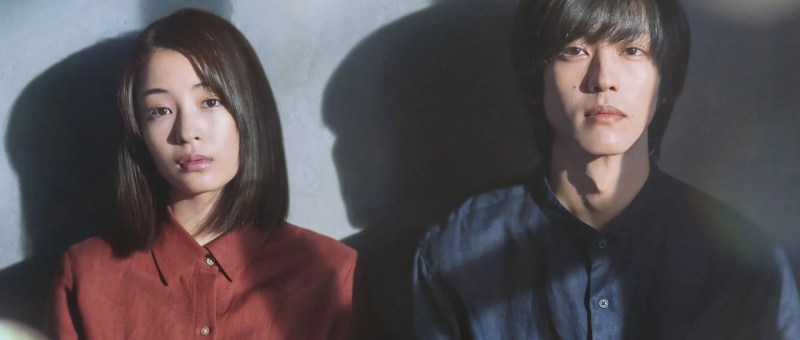
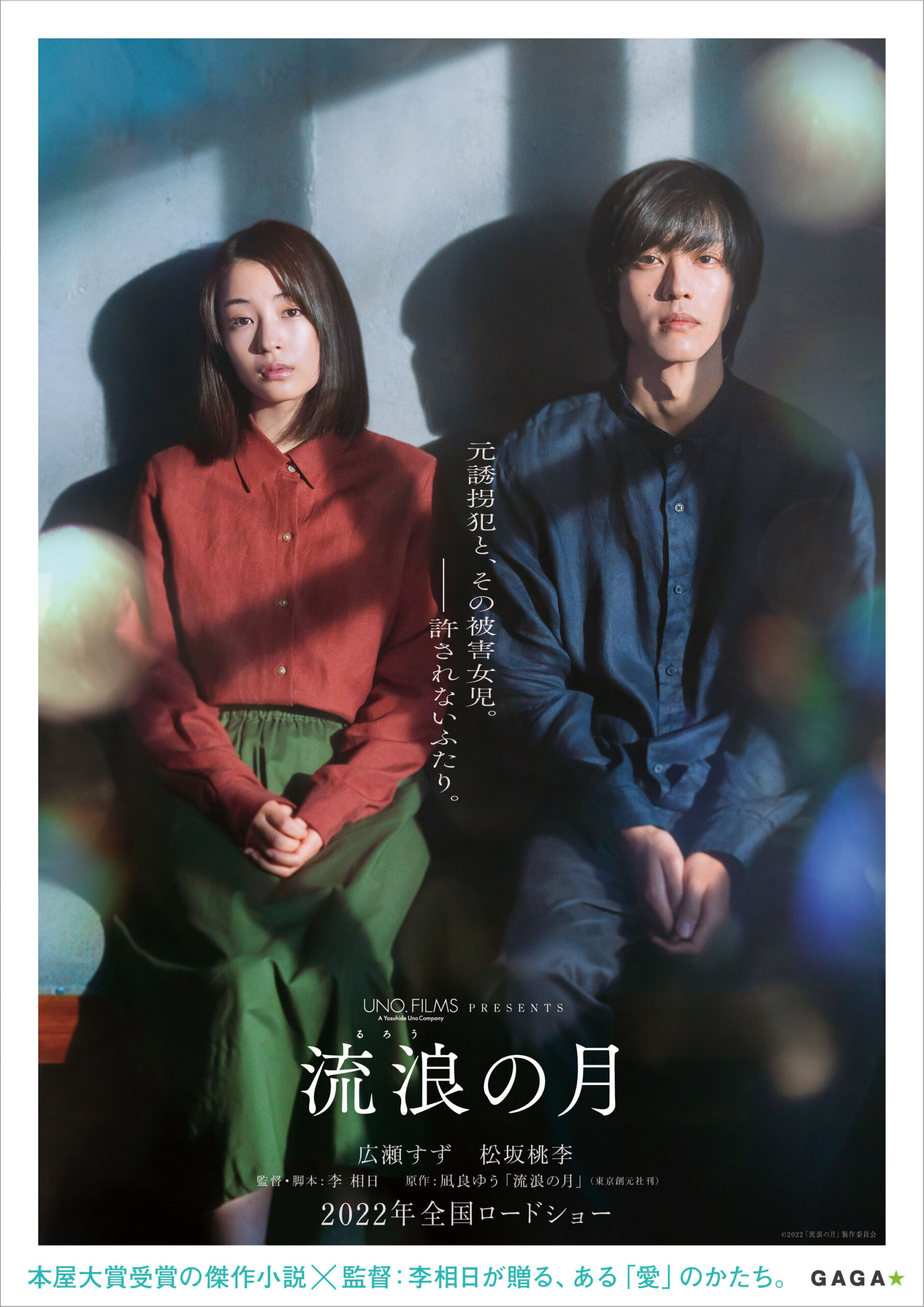
The World of You (麻希のいる世界, Akihiko Shiota, 2021)

A girl with a chronic illness becomes fixated on a traumatised classmate in Akihiko Shiota’s meditation on the self-destructive effects of obsessive love, The World of You (麻希のいる世界, Maki no iru Sekai) . It is not, however, the heroine that primarily experiences them, as her own romantic obsession is in one sense a purer love, but in another is a way of making her mark on the world before her short life comes to an end. 

Yuki (Yuzumi Shintani) spots Maki (Marin Hidaka) leaving a local shack and locking the door behind her preceded by a shady-looking young man. She later recounts that she once stayed in this same shack for three days after running away from home following her parents’ divorce which she thinks her illness may partly have been responsible for her. The shack represents different things for each of them, but is also a space of their otherness and isolation from which neither of the girls is able to escape. It’s clear that Yuki’s growing obsession with Maki who is ostracised at school and resented by all is romantic, yet Maki appears to reject her attentions and reminds her she’s the type of girl who sleeps with guys.

Yuki sighs and she says knows as if she’s already resigned herself to the impossibility of her romantic desires being fulfilled, but Yuki continues to behave flirtatiously and otherwise uses the desire she knows Yuki feels for her as a means to manipulate her. Even so, on some level, she too has genuine feelings for Yuki and repeatedly tries to push her away in fear that she will only cause her trouble and pain. She tells her that her father is a convicted paedophile, which is why she is shunned by the local community. Though people are sympathetic at first, they often come to reject and resent her which is why she alternately responds to and then refuses Yuki’s insistence on connection. Though she never says so, her behaviour hints her father may have abused her too or at least that was she sexualised at an early age now and has a self-destructive attitude to sex in which she engages in potentially dangerous relationships with older men and uses her desirability to manipulate her male classmates.

Among them is Yusuke (Airu Kubozuka), who has a one-sided crush on Yuki that she continually rejects but he seemingly cannot take no for an answer. The situation between them is further complicated in that Yusuke’s father is also Yuki’s doctor. After her parents’ divorce, Yusuke’s father entered an affair with Yuki’s mother and eventually left his wife for her, breaking up their family. It’s already a messy situation, though Yusuke’s obsessive love is seemingly more possessive, whereas Yuki’s has taken on a passive quality. She does not really expect that Maki will ever return her feelings and seems to be aware that she uses them to manipulate her, but makes it her remaining life’s purpose to ensure that Maki’s musical talent is appreciated by the wider world. 

In some senses it’s a classic tale of an incredibly toxic love triangle in which Maki plays off both Yusuke and Yuki though may not actually care for either them as all romantic desires are effectively processed through her. Each of the teens is unfairly made to pay for the sins of their parents and effectively left without proper guidance or more positive examples of healthy romantic relationships. Though they all lose something, Yuki’s loss of her voice is especially ironic given that she’d barely talked to begin with but had bared her soul to Yuki who is then in fact reborn, possibly as the “even more wonderful Maki” that Yuki hoped she be though she no longer remembers her. Nevertheless is there is something that seems more hopeful in Yuki’s insistence that they will meet again when pitted against Yusuke’s repeated claims that he knows Yuki will come to love him eventually, especially considering the destructive actions they ultimately lead him to. Yuki’s love, meanwhile, is only self-destructive or in its way life giving in allowing her to sacrifice herself for the world that has Maki in it but that she may never see.


Trailer (no subtitles)

Give It All (がんばっていきまっしょい, Yuhei Sakuragi, 2024)

The last year of high school is a little premature to be defeated by life, but this seems to be what has happened to Etsuko. It’s fitting in a way, because her problem is that she simply gives up too early and is incapable of seeing anything through because she’s already convinced herself that there’s no point in trying. Yuhei Sakuragi’s anime adaptation of the book by Yoshiko Shikimura, Give It All (がんばっていきまっしょい, Ganbatte Ikimasshoi) is indeed all about how there’s no point giving up before the end and no matter the result there’s satisfaction to be gained just knowing that you gave it all you could.

But Etsuko can’t see that to begin with because she peaked too early. Back in primary school, she won all the races because she was tall for her age. But the other children eventually started catching up with her, and she started to fall behind. It didn’t really occur to her train or to try to compete with them because she was used to just winning and the realisation that she wasn’t “special” after all made her feel like a failure at life. To save herself similar pain, she started giving up before she even started believing that there wasn’t any point in trying. Even so, she’s sullen and miserable, not to mention resentful of those who do put in the effort and start to see results. 

That’s one reason she’s reluctant to get involved with the rowing club again despite the encouragement of her best friend Hime. Badgered into it by transfer student Riina, she does the bare minimum and lets the others down, at one point just letting her oars drop while asking herself what it is she’s even doing here. But it’s also being part of a team that gives her a new sense of purpose as she realises that she’s the one who’s the weak link because she doesn’t have the stamina to keep up with the other girls. 

Meanwhile, they all have their problems too. Riina is struggling to make new friends after moving to the town following her mother’s marriage and is also nervous around boys because she’s always attended single-sex schools. Taeko and Mayumi only joined the club to get back at each other because their families are supposedly feuding, though there’s a little bit more to their relationship drama than a buinsseness dispute between their parents. Hime is really just trying to keep the peace and get Etsuko back to being the confident and outgoing person she used be rather a sullen figure of defeat who is aloof to the point of rudeness and refuses to try at anything. 

Ironically, it’s an encounter with the awkward team captain of a rival high school’s team that begins to open her eyes. Based on her earlier experiences, Etsuko assumes that the other team must just be innately talented and will win the upcoming race easily, but the other girl tells her that she’s mistaken. They didn’t win easily and they don’t have room for complacency. Though she seems jealous of the fun Etsuko and the others seem to be having and the genuine friendships that have arisen between them in contrast to the frosty determination and rigorous training that defines her relationship with her teammates, she reminds Etsuko that they work hard and that Etsuko’s team has potential if only they gave it their all.

While the 3D animation sometimes appears uncanny and distracts from the overall aesthetic, the beautifully designed backdrops add to the sense of peace and serenity in the town and echo Etsuko’s own unfolding sense of joy as the world around her brightens thanks to her new friends. What she learns is that it’s foolish to give up too soon without even trying, while not doing anything will leave her stuck in the middle of the water like a boat with no one rowing for the rest of her life. The thing about rowing is that it requires unity and the team to think as one, which means that she has to engage and bond with her teammates while finding fulfilment in her individual contribution through resolving to give it her all no matter what and knowing that’s worth it no matter the result.


Give It All screened as part of this year’s Toronto Japanese Film Festival.

Trailer (no subtitles)

The Real You (本心, Yuya Ishii, 2024)

“Putting it into words makes it sound like a lie,” according to a young woman struggling to “be real” and express a truth without any of the awkwardness that interferes with emotional intimacy, but there are ways in which lies can be true and truth can be lies. Based on a novel by Keiichiro Hirano, author of A Man which also deals with similar themes, Yuya Ishii’s The Real You (本心, Honshin) probes at the nature of the human soul and asks if there really is such a thing as the “real” you or if authenticity is really possible in human interaction. 

Both Ayaka (Ayaka Miyoshi) and the avatar of his mother Akiko (Yuko Tanaka) describe Sakuya (Sosuke Ikematsu) as being too pure for this world and to an extent they’re right even if many of his present problems are directly linked to having committed a “crime” in his youth. As the film opens in the summer of 2025, Sakuya is a factory worker watching helplessly as robots take over his work. After all, they don’t care about the heat, or being able to breathe under a heavy welding mask, nor do they get tired and they can get this job done much faster than he can. In any case, he ignores an ominous phone call from his mother, who appears to be showing signs of dementia, despite her telling him that she has something thing important to say and stays out with a friend after work only to spot her by the river in a storm on his way home. When she abruptly disappears, he assumes she entered the water and jumps in to save her but is injured himself and wakes up in hospital about a year later.

Of course, we don’t really know that he wakes up at all and it’s possible that all of this is really just a dream or an attempt to make contact with his authentic self through his relationships with two women, his mother and a young woman who also disappeared abruptly back in high school. Even though it’s only been a year, the AI revolution has marched on a pace and the entire world is now run by robots and avatars. Sakuya’s factory is no more, and the only job he can get is that of “Real Avatar” in which he rents out his physical body on behalf of clients who for whatever reason are unable to complete an action in person. Many of his early customers are elderly people who have opted for “elective death” and are trying to relive a precious memory vicariously through the VR headset before they go.

“Elective death” is one of the things that most bothers Sakuya in that he’s told it’s what his mother had chosen and that he’s getting a tax break and sizeable condolence payment so he can continue living in the family home. This eerie proposition that elderly people are being encouraged to decide that “this is enough” frightens Sakuya and hints at the eugenicist aims of an AI society in which those who are judged to be “weak” or cannot “contribute” in the way expected of them are forced to end their lives as if they didn’t deserve to live. He can’t understand why his mother would have chosen to die, but moreover, why she would have done it without even telling him. He can’t decide if the important thing she wanted to say was just about the elective death or if there was some greater truth he’ll now never know because he ignored her when she tried to tell him.

That’s one reason that he decides to use all his savings plus the condolence money to have an AI Avatar of his mother made in hope discovering what she wanted to say. Later he says that he wanted to know “Akiko Ishikawa,” rather just his mother, but is put off at first when confronted by the gap between the image of the mother he remembered and the objective reality. The creator, Nozaki, suggests incorporating memories from a young woman who was apparently his mother’s only real friend to get a fuller picture, but Sakuya resists insisting that he and his mother had no secrets from each other so she had no “hidden side”. Nozaki (Satoshi Tsumabuki) merely smirks and tells him that everyone has different sides to themselves that they don’t share with others, which Sakuya ought to know because there are things he’s not exactly hiding but doesn’t really want to talk about either.

His friend, Kishitani (Koshi Mizukami), wonders if there isn’t something a little incestuous about Sakuya’s desire to build a VF of his mother rather than his first love as he’d assumed he would, and he might be right in a way. Ayaka Miyoshi, played by the actress of the same name, shares a striking resemblance with the high school girl who exited the young Sakuya’s life, Yuki, and has a similar life story, though it’s not clear if they are actually the same person or not even if the AI version of his mother tells Sakuya that they are. Yet Ayaka is his only way of verifying that what the VF Akiko says is actually “true” rather than some random hallucination cooked up by the machine based on the incomplete information it’s been fed. Through the VF he finds out things about his mother’s past that shock him, not that he necessarily disapproves, just that they conflict so strongly with the image of his mother he’d always had. Additionally, there’s a degree of hurt that though he believed he and his mother shared everything, she kept this actually quite significant part of herself secret from him in much the same way he admits he didn’t tell Ayaka about his “crime” because he feared she might pull away from him if he did.

Ayaka also avoids talking about her past as a sex worker which has left her with PTSD and fear of being touched for much the same reason even if she suspects that Sakuya already knows and that his mother may have told him before she died. There’s an obvious parallel being drawn between them when Ayako insists that she made a clear choice to do sex work out of economic necessity and refuses to apologise for it, while Sakuya has also been selling his body as a Real Avatar. While some of his clients merely need help accomplishing things physically, others hire him for amusement. They send him on pointless errands running all over the city and then give him a bad review for smelling of sweat, or deliberately make him do degrading tasks. They also ask for things that are clearly illegal, such as another RA’s client requesting to see a man die. But Sakuya continues to wilfully degrade himself carrying out each of the tasks faithfully despite the pitying looks of those around him. When he’s unexpectedly employed by a wealthy avatar designer (Taiga Nakano) who uses a wheelchair, Sakuya again sheds his own identity and finds himself playing reverse Cyrano forced to make Ifi’s declaration of love on his behalf only to the consternation of Ayaka who isn’t sure who it’s coming from and is disappointed in both men for the obvious cruelty of the situation.

Thus this new technology becomes just another means of class-based oppression in which the wealthy use their riches to abuse those without economic means who have no choice but to submit themselves or rebel through criminality while the rich look on with amusement. Sakuya says he isn’t in love with Ayaka, but it’s unclear if he says it because he thinks she’s better off living in material comfort with Ifi, if he really means it, or he’s realised that he was more in love with the image of the girl who disappeared and the missing side of his mother than he really was with her. It seems that Sakuya is really looking for the hidden half of himself through refracted images of the way others see him, while essentially engaging in an internalised dialogue with his own thoughts and memories. He can’t really be sure of the truth behind anything the VF says, a fact brought home by the implication that the great truth he was seeking is a banal platitude and what he undoubtedly wanted to hear yet knew all along. Nevertheless, it’s not until hearing it that he can regain his real self, let go of the past, and be in a position to connect with Ayaka which is also a kind of waking up. Disquieting in its implications for a new AI-based society in which the line between the real and virtual has all but disappeared, there is nevertheless something quite poignant in Sakuya’s gradual path towards saying goodbye but also hello to a new life of greater self-awareness and independence.


The Real You screens in New York July 11 as part of this year’s Japan Cuts.

International trailer (English subtitles)
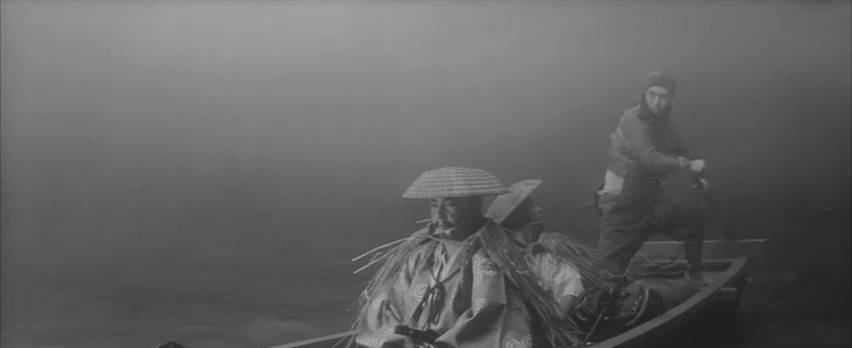
Floating Weeds (浮草, Yasujiro Ozu, 1959)

An oft-repeated criticism of the work of Yasujiro Ozu is that it is all the same. The similarity of the English-language titles with their ubiquitous seasonality doesn’t help, but you have to admit there is some truth in it. On closer inspection, however, it becomes clear that Ozu was not so interested in uniformity or repetition as he was in dialogue with himself. Thus Late Spring becomes Late Autumn and the abandoned father a conflicted mother, the two boys of I Was Born But… who rejected their father’s descent into corporate lackydom become arch consumerists seceding from society until their parents give them a TV set in Good Morning. Ozu refrained from remarking on the repurposing of old plots for new dramas, but did expressly regard his 1959 Floating Weeds as a “remake” of the 1934 A Story of Floating Weeds updated to the present day and filmed in the, by then, classic Ozu style. 

As in the 1934 version, the action centres on the arrival of a theatrical troupe to a small town which they have not visited in some years, in this case 12. This time around, the troupe is a little more exulted, performing kabuki-style narrative theatre rather than rustic entertainment, but is subject to many of the same problems. Kihachi is now Komajuro (Ganjiro Nakamura), a much older man though cheerful and energetic. He has chosen this town because it is home to an old flame, Oyoshi (Haruko Sugimura), who is the mother of his adolescent son, Kiyoshi (Hiroshi Kawaguchi). Kiyoshi thinks that Komajuro is his mother’s brother and that his father is long dead. He recognises Komajuro right away and is pleased to see him, though they evidently have not met in many years. 

The 1934 version had revolved around Kihachi’s corrupted paternity in his shame regarding the stigma of being a travelling player. By 1959 that is simply no longer so much of an issue, but whereas the financial difficulties Kihachi’s troupe faced were partly a symptom of the depression and partly of their misfortunes, those of Komajuro take on a more melancholy quality because it is obvious that this is a way of life which is coming to an end. When Kihachi says he’s going to start over, it seems futile but he is still young enough to have a credible chance. Komajuro is already “old” and it’s clear that he will struggle to support himself as a travelling actor simply because it is no longer a viable occupation. 

Thus Komajuro’s story is less one of frustrated fatherhood than of melancholy resignation to the vagaries of a lifetime. “Life is an unknown course”, he tells Oyoshi, “the only constant is change”. Like Kihachi he doesn’t want his son to see the show, though perhaps more out of embarrassment. Kiyoshi complains that the character in his play is “unrealistic” because he doesn’t relate to the modern world. Komajuro objects but explains that he is “a character from another era”, making it plain that he is talking as much about himself. Komajuro is a man left behind by time and incapable of understanding the world in which he now lives which may be one reason he seems to hang on to an intense desire to save Kiyoshi from being affected by the stigma of being the son of a travelling actor even though that is no longer something he would need saving from. 

This slight disconnect, along with Gajiro Nakamura’s cheekily comical performance, adds to the genial comedy which characterised the majority of Ozu’s colour films though this one is admittedly slightly less colourful owing to being produced by Daiei as one of a handful of films made outside Ozu’s home studio of Shochiku. Komajuro becomes a tragicomic rather than purely tragic figure, a man suddenly realising he has become old and facing the decline of his patriarchal authority. Like Kihachi he turns violence on both his mistress, Sumiko (Machiko Kyo), and the young actress Kayo (Ayako Wakao) who has fallen for his son, but it’s futile and born of desperation. A more sympathetic figure than 1934’s Otaka, Sumiko seems to genuinely like Komajuro and is hurt as well as jealous and threatened by the existence of his “secret” family. Her petty revenge is taken in response to Komajuro’s bitter claim that his son “belongs to a higher race” moments after bringing up her past as a sex worker. Rather than a simple desire for chaos and upset, she intends to pull Kiyoshi down to her level through getting him to sleep with Kayo, but Kayo falls for him for real only to worry she is perhaps ruining his bright future. 

“One can’t suddenly show up out of nowhere and assert one’s parental authority,” Komajuro eventually realises. His hopes are dashed by Kiyoshi’s relationship with Kayo not because of her proximity to the world of the travelling actor, but because he fears it means that Kiyoshi is just like him, an irresponsible womaniser. He wanted to save Kiyoshi as a means of saving himself, pushing his son into a more respectable world he had been unable to enter. Kiyoshi, however, rejects his sacrifice, describing his parents as “selfish” for keeping the secret all this time only to drop a bombshell now. He complains he’s been fine these 20 years and does not want or need a father beyond the one he already thought to be dead. Rather than the nobility Komajuro’s of paternal sacrifice, the focus is pulled back towards the son and his filial responsibility to live up to it by becoming a fine and upstanding young man while Komajuro is once again exiled back to the moribund world of the travelling actor. 

Of course, the world of 1959 was very different to that of 1934. The economy was at last improving and consumerist pleasures were very much on the horizon, meaning that for many life was comfortable at last. Japan was at peace if not completely free of political strife which removes the constant anxiety felt by those trying to survive the mid-1930s. But Ozu himself was also 25 years older and had perhaps reached that sense of resignation with the world that allowed him to sigh and laugh where before he may have trembled with fear or rage. Komajuro is as he always was, a floating weed, a man without a home, but now perhaps one of many rootless wanderers off the post-war landscape.