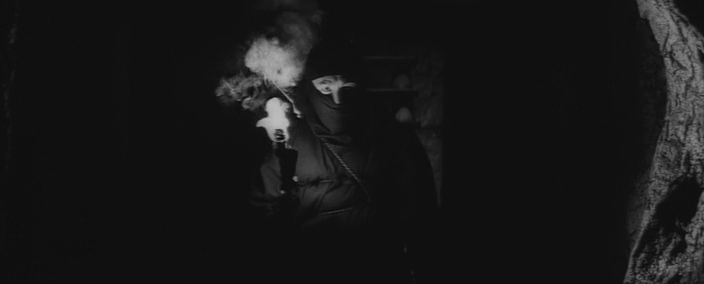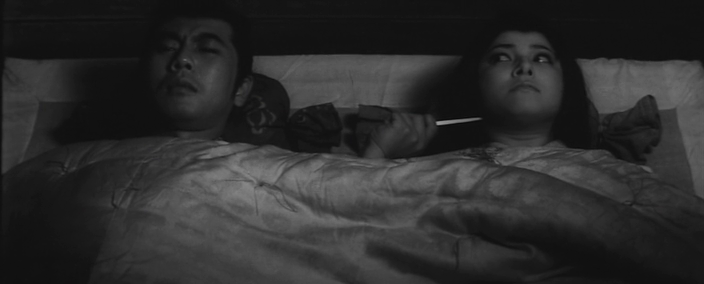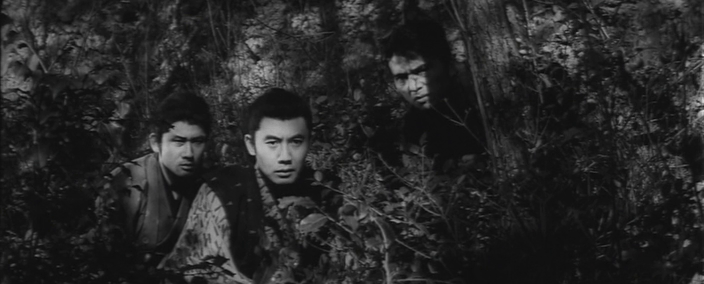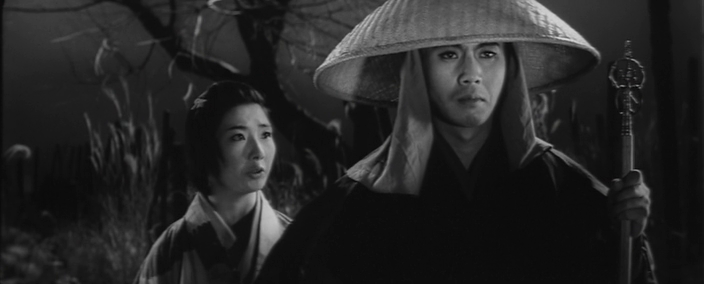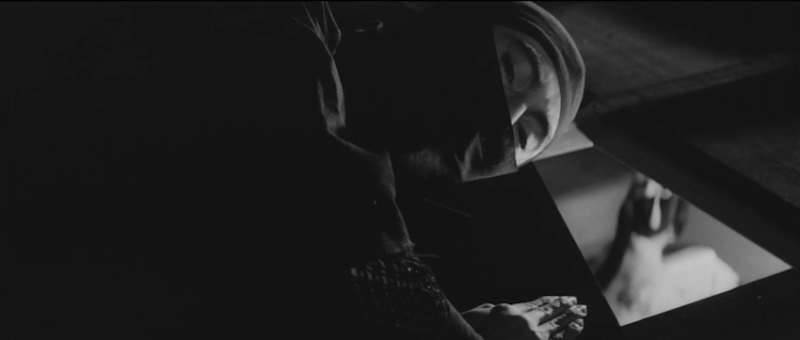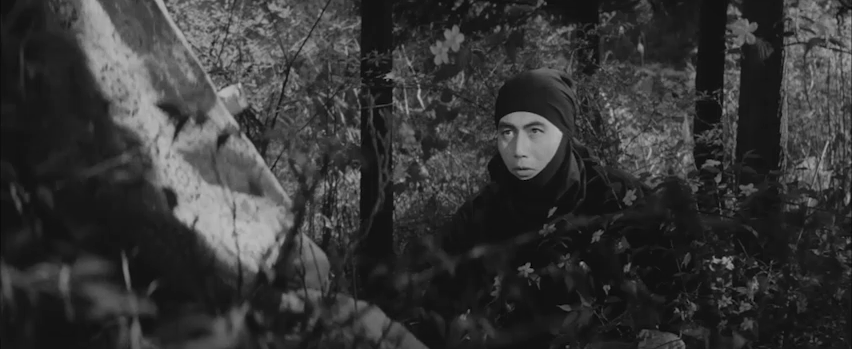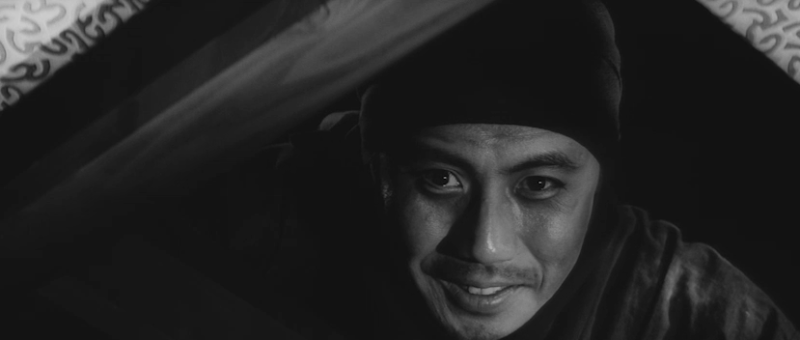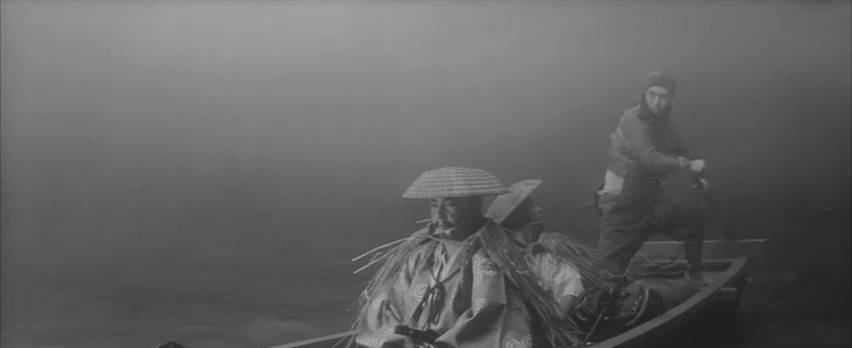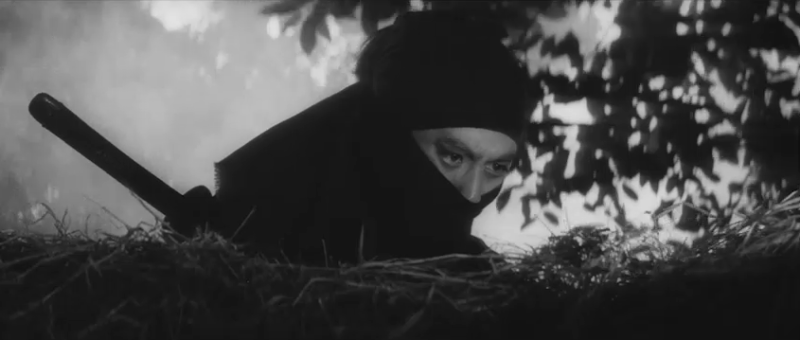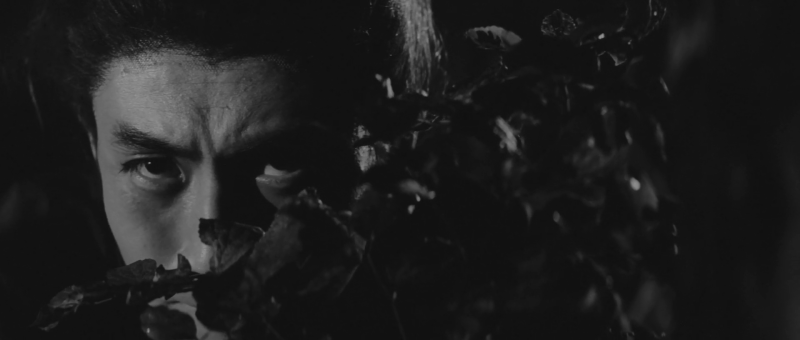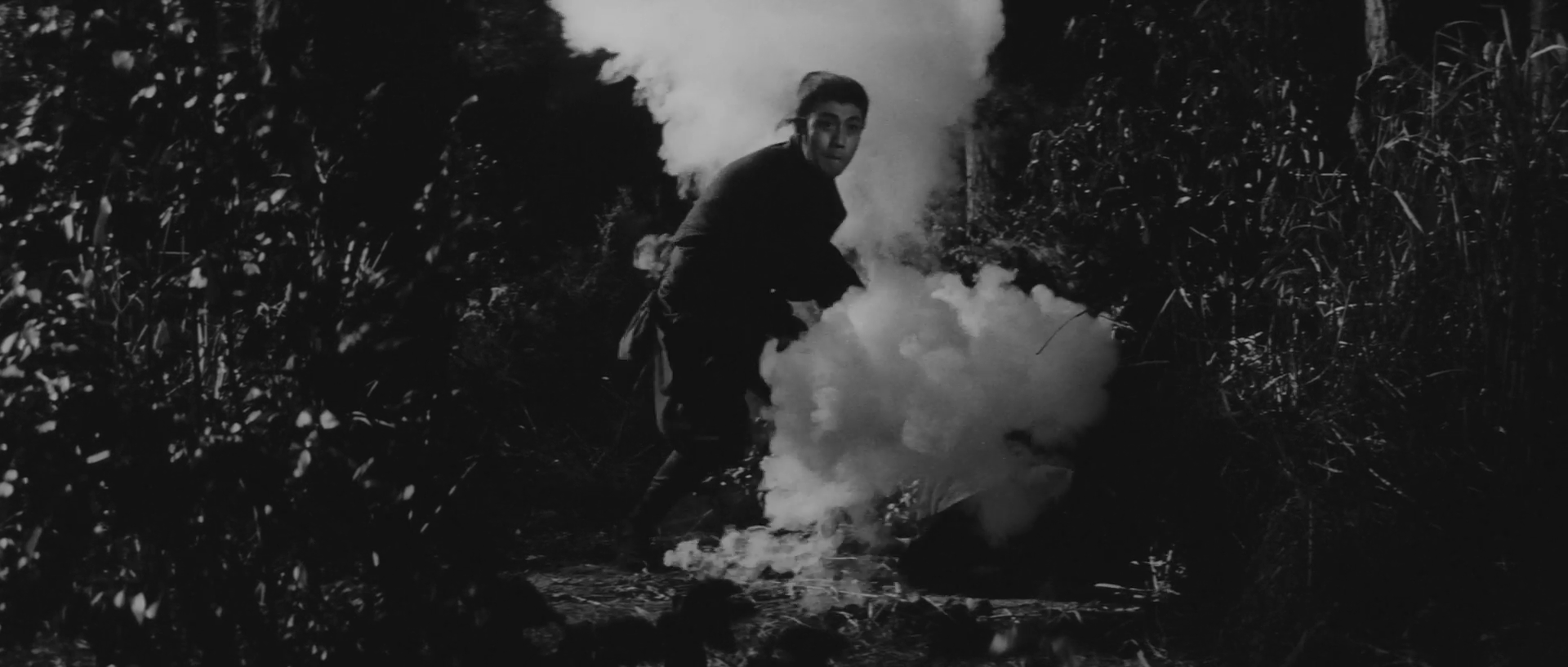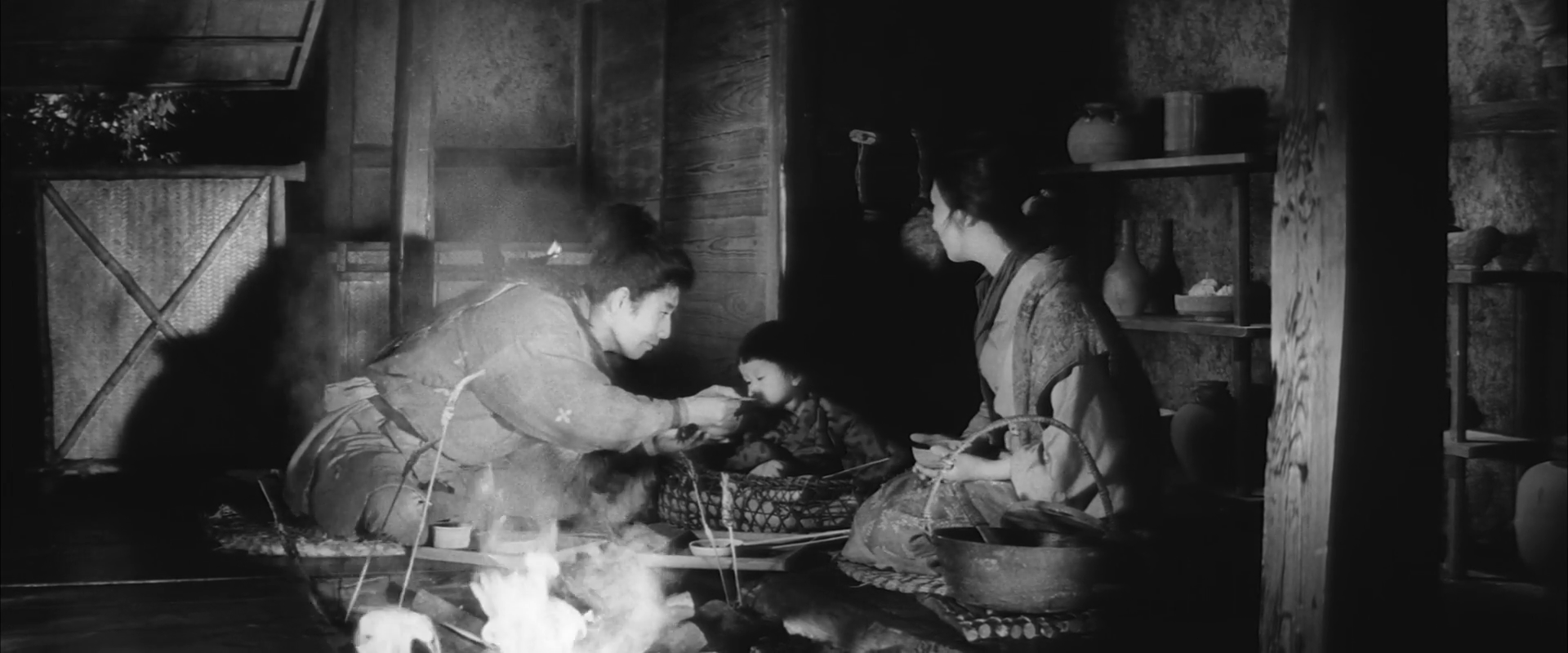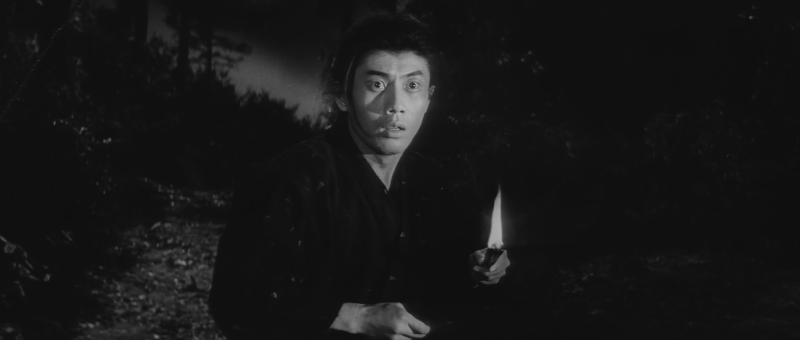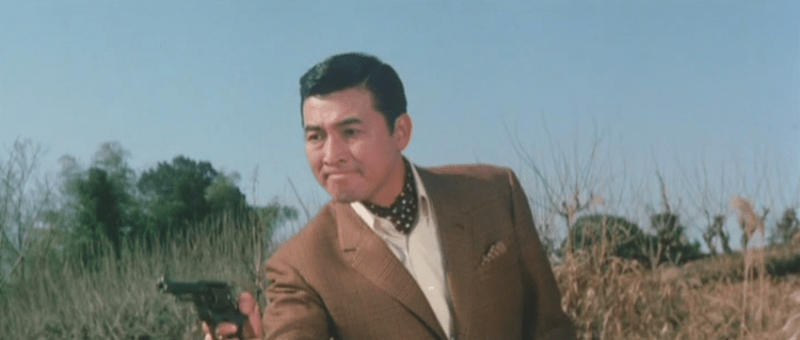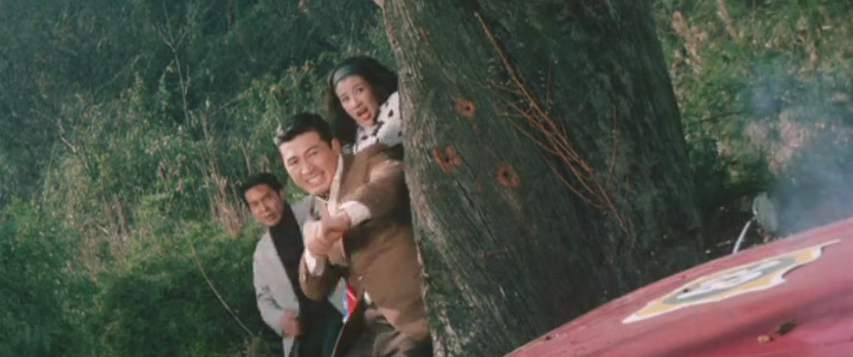
The Ball at the Anjo House (安城家の舞踏会, Kozaburo Yoshimura, 1947)

“Old things die out so new things can be born,” according to the ruined patriarch of a once noble house in Kozaburo Yoshimura’s Chekhovian drama Ball at the Anjo House (安城家の舞踏会, Anjo-ke no butokai), though he might as well be speaking to the post-war society. The Anjos are like the declining aristocracy of the earlier 20th century mourning the disappearance of their world of privilege and gaiety and reflecting that they too must now, as younger daughter Atsuko (Setsuko Hara) says, learn to serve others.

Atsuko is really the only one who accepts the age of the aristocracy has passed and that it is only right and proper that they should join this newly egalitarian, democratic society. Her sister Akiko (Yumeko Aizome) has recently returned home after 12 years having left her husband because of his adultery, but cannot now face it that she no longer has a place here. Approached by their former chauffeur Toyama (Takashi Kanda) who has long carried a torch for her, Akiko snaps that she will always be a noblewoman in heart, unable to let go of outdated customs of class and propriety. She seems to have feelings for the chauffeur too, but won’t let herself embrace them, calling him “dirty” and resenting herself for her attraction to a man who is not her social equal. 

But times are very different now and the aristocracy has been abolished which has in all other senses dissolved the class barrier between them. The tables have turned and Toyama is now a wealthy man having done well for himself in business through honest hard work. Akiko asks him for help as a kind of symbolic gesture as if she were making recompense by handing the house to its rightful owner in their former servant. He insensitively tells patriarch Tadahiko (Osamu Takizawa) that he can easily spare a few thousand to throw away on the house as a sentimental gesture, but does so largely without malice. Only after Akiko has turned him down at the ball and he begins to drink does he start to crow, if a little sadly, that now this base and ugly servant has bought the master’s house. On his way out, he knocks over the suit of armour that had stood in the hall as if literally bringing down the feudalistic military legacy of this once great family and sending it crashing to the floor. The camera suddenly tilts to emphasise that this world is now out of kilter and has been destabilised beyond repair. It’s only this action that frees Akiko from her self-imposed repression as she skips over the armour and chases Toyama out the door. Tumbling down a sand dune she literally descends to his level leaving her pearls and shoes behind. 

The class barrier has been fully dissolved, and Tadahiko too permits himself to marry his long-term mistress, the geisha Chiyo (Chieko Murata), who declares that she doesn’t care about his loss of status and invites him to live with her if he has to sell his house. But it seems as if Tadahiko can’t let go of his ancestral legacy nor his childhood home. In truth, this Western-style country house by the sea can only have been built after the Meiji Restoration which means it’s under a hundred years old and most likely built by Tadahiko’s father, the gentleman in European-style military dress in the portrait. As such, it was likely constructed to look forward to a new era as the samurai class rebranded itself into a European-style aristocracy. Tadahiko’s older sister, married to a lord who’s faring better in this new world, tells an enraptured collection of younger women of the time she danced with a prince a year after the Russo-Japanese war when she was only 19. But this will be the last ball at the Anjo House, in memory of a “beautiful way of life” that has been now been eclipsed.  

Tadahiko had faith that they would be saved essentially through the good chap system in his relationship with a nouveau riche upstart named Shinkawa (Masao Shimizu). Shinkawa holds the mortgage on the house, and there are all sorts of rumours about his shady business. He made most of his money on the black market. Shinkawa had arranged a marriage between his daughter Yoko (Keiko Tsushima) and Tadahiko’s son Masahiko, which gave him even more confidence. But as Atsuko says, Shinkawa was only friendly with him because of his aristocratic title and now it’s gone he has nothing to offer. In marrying Yoko to Masahiko (Masayuki Mori), Shinkawa would have gained the legitimacy of a connection with nobility while Tadahiko would have gained an injection of cash that would save his social status. But none of that matters any more now that the aristocracy has been abolished under the post-war reforms that have also seen Tadahiko’s lands confiscated and estate broken up. It seems that Tadahiko let Shinkawa use his name for a munitions factory during the war, which might not play so well now, just as Akiko’s decision to part with her adulterous husband may also have been influenced by the fact that he was a general who is presumably little in demand in the wake of defeat. Still, Tadahiko prefers Shinkawa to letting the house go to a former servant like Toyama who must himself be enamoured enough with that old world to want to become master of it rather than tear it down.

For Masahiko’s part, he has little interest in marrying Yoko but on learning the engagement has been unilaterally called off and Shinkawa is little more than crook decides to rape Yoko to get back at him. His cruelty is a symptom of post-war nihilism, and we soon discover he’s been sleeping with a maid, Kiku (Akemi Sora), to whom he made promises of marriage he had no intention of keeping. But Like Akiko it seems as if he does care for her after all, only he won’t let himself feel anything in the numbness of his loss of privilege preferring instead to laugh too loudly with his boorish friends. Only on seeing the class barrier dissolve when his father marries Chiyo and his sister Akiko takes off after Toyama does he allow himself to embrace Kiku and express genuine emotion.

Masahiko is played by a young Masayuki Mori who was the son of the novelist Takeo Arishima. Arishima was also a member of the aristocracy but one who became a socialist and dissolved his estate which was something of a fashion in the 1920s. The situation is however complicated by the fact that the Anjos’ servants remain loyal and don’t want to leave them. After all, this is as much their home too and they don’t have anywhere to go either because a world with no masters has no need for servants. We too are encouraged to mourn this world, but its end is also presented as a kind of liberation in which the family are finally permitted to embrace their own desires only after casting off the shackles of the aristocracy and preparing to forge new futures in a changing world leaving the feudal past behind and waltzing into a new and brighter future.


Classmates (あゝ同期の桜, Sadao Nakajima, 1967)

There had been films that dealt with the war before, but it was really with the generational shift that occurred among filmmakers in the mid-1960s that there was a greater willingness to reckon with the wartime past. Sadao Nakajima’s Classmates (あゝ同期の桜, Aa Doki no Sakura) was the first in a planned trilogy of war films at Toei, which was in other ways a studio that often leaned towards the right with its steady output of yakuza films, and most likely for that reason struggled to gain approval from studio heads. Taking its name from the military academy song, the film was inspired by a collection of essays put together from the letters and diaries kamikaze pilots had left behind. Nakajima had seen some of the letters sent back by the brother of a school friend, and reading them again on publication was determined to turn them into the film.

Nevertheless, only 25 years on from the end of the war it remained a sensitive topic. The film follows the men of the 14th class of reserve students who had previously had their draft notices deferred until they finished university but were now called up early because the war was going so badly. The majority of these men were allocated to kamikaze units and subsequently died in suicide attacks on US warships, though they received little in the way of training and mostly failed to hit their targets due to having limited fight experience. 

What might seem most surprising is that several of the men voice their opposition to the war along with the realisation that Japan is going to lose. Early on in training, one man deserts but the others are reminded that to do so amounts to treason and once caught, deserters will be executed by firing squad. This turns out not quite to be the case. Shiratori (Hiroki Matsukata), the resigned hero, encounters Taki (Mitsuki Kanemitsu) in Okinawa. where he’s working as ground staff. He’s insensible and appears to have lost his mind. The man working with him suggests that he was tortured so badly that it’s left him in a vacant state, though he’s still deployed for mindless tasks because they just don’t have the manpower.

Part of the reason for that is that they keep ordering people to die in a validation of the death cult that is militarism. On their arrival, the instructor tells the men he will have them all die, because dying for the emperor is their duty and destiny. The top brass insist this is the only way to win the war even though it’s counterproductive in that they’re running out of aircraft and skilled pilots even if one officer callously remarks that they have an endless supply of bodies. There’s also no real reason to send the planes up with two pilots as opposed to one, but they leave fully manned. The suicide missions are supposedly “voluntary”, but the men can’t really refuse due to a combination of peer pressure and military order.

When one pilot, Nanjo (Isao Natsuyagi), returns to base having been unable to reach his target, he’s immediately set upon by the others as a coward and a traitor. They accuse him of being afraid to die, leaving him feeling ashamed and frustrated by a sense of injustice while admitting that he didn’t want to die like a dog. He knows that he would not be able to go on living afterwards if he simply didn’t go through with it because the stigma of being a coward who let other men die so he could live would always be upon him. Eventually, he becomes so determined to prove himself that he insists on getting right back in his plane once it’s repaired and then blows himself up on the runway to prove a point.

Nanjo’s case is all the more poignant because he was a new father whose son was born after he was called up. He appears to have married quickly against his parents’ wishes and is now anxious that his family won’t accept his wife and child who will be left alone when he dies. His wife (Yoshiko Sakuma) desperately tries to see him to show him the baby, but manages only a few seconds before he’s forced to return to the barracks. Given a little more time, she brings a wedding dress for the impromptu ceremony they presumably skipped before, but ends up tearing it and giving Nanjo a strip as a kind of good-luck charm though like everything else it’s a gesture filled with futility.

It’s this sense of futility and resignation that seems to overtake Shiratori who knows he cannot escape his fate. To desert to is be killed anyway or to experience a spiritual death like Taki. He had introduced a friend, Hanzawa (Shinichi Chiba), to his sister and the two had become close, but he is forced to abruptly break up with her because he knows it’s unfair to string her along when he’s been sentenced to death. Reiko (Sumiko Fuji) will lose her brother and her boyfriend on the same day. Hanzawa and the other men visit a brothel on the night before their mission where they are treated as “gods”, though he sees only irony in the situation in which they are more like human sacrifices offered in prayer for an impossible victory. Their deaths will have no real meaning and are really only intended to instil fear in the enemy and weaken their morale rather than cause actual material damage to their fighting capability. Making use of stock footage, Nakajima freeze frames a plane in flight and points out at that point the men inside were still alive before cutting to a title card confirming the war ended just four months later. The title card at the beginning dedicated the film to the souls of those who died in the Pacific War, though it’s perhaps as quietly angry as it was permitted to be in 1967 in the senseless sacrifice of these men’s lives who were shamed, tricked, or forced at gunpoint into their cockpits and told they were disposable while those who stayed on the ground cheered and whooped at the grim spectacle of death.


Brand New Landscape (見はらし世代, Yuiga Danzuka, 2025)

Do we inhabit spaces, or do the spaces inhabit us? Yuiga Danzuka’s autobiographically inspired Brand New Landscape (見はらし世代, Miwarashi Sedai) situates itself in a haunted Tokyo which is forever remaking itself around its inhabitants like a constantly retreating cliff edge that leaves them all rootless and in search of a home that no longer exists. Some long for a return to the past and wander endlessly, while others defiantly refuse to look back and are content to let history eclipse itself in a journey towards an ineffable “new”.

These imprinted spaces come to represent the disintegration of a family torn apart by their shifting foundations. Ten years previously, Ren (Kodai Kurosaki) and Emi’s (Mai Kiryu) mother, Yumi (Haruka Igawa), took her own life during a family holiday after their father Hajime (Kenichi Endo) told her that, despite his promises, he would be returning to Tokyo to pursue a work opportunity. “It’s pointless to go back and forth like this,” he remarks with exasperation, making it clear that he’ll be going no matter what she says. Rather than simply being a workaholic, Hajime is a deeply selfish person who doesn’t much care how other people are affected by the decisions that he makes. He wants this opportunity to prove himself and acts out of a mixture of vanity and a desire for external validation through professional acclaim rather than the love of his family. He claims he’s doing this for them, that the opportunity will provide additional financial security and a better quality of life for his children, but Yumi replies that they don’t need any more money. All she wanted was family time, albeit within this artificial domestic space of a rented holiday villa by the sea.

Three years after their mother’s death, Hajime left the children to chase opportunities abroad and they haven’t seen him in years. Younger son Ren is now working as a floral delivery driver for a company selling expensive moth orchids. It’s on a job that he first learns that Hajime has returned and is holding an exbitiion of his work that includes the controversial Miyashita Park redevelopment project designed to fuse the natural space of the park with a commercial centre the exhibition’s copy describes as a symbol of the “new” Tokyo. It also, however, required the displacement of a number of unhoused people who were living in the park in order to provide space for upscale outlets such as Louis Vuitton and Gucci. When Hajime accepts the opportunity to work on another such project, a young woman on his team voices her concern. She asks him where these unhoused people are supposed to go, but Hajime says it’s not his problem. It’s for the authorities to decide. She asks him if he’s considered the effect taking on such a large project will have on their team when the company is already working beyond its limit, but he gives her all the same excuses he gave Yumi that make it clear he’s not interested in the needs and well-being of his employees just as he wasn’t interested in those of his family. “It’s pointless going back and forth,” he tells her while trying to sound sympathetic but really emphasising that his decision is made and nothing she could say would sway him from his course.

Maybe, to that extent, oldest daughter Emi is much the same in that she’s decided she doesn’t want to see her father and resents Ren’s attempts to force her into doing so. She’s about to move in with her boyfriend and looking ahead towards marriage, but also prone to “low energy” days like her mother and anxious in her relationships, fearful that like that of her parents’ they can only end in failure. Ren, meanwhile, struggles with authority figures like his ridiculous boss who tries to assert dominance by giving him a public telling off about the non-standard colour of his hip pack, and then yells at him that he’s fired only to chase him out of the building throwing punches when Ren calmly replies that shouting only makes him look silly. In the midst of the drama, another young woman states her own intention to quit, politely bowing to everyone except one particular man before walking out the other door towards freedom as if to remind us that there are countlessly other stories going on in this city at the same time.

There’s a moment when Ren is delivery the orchids that he just stands there holding them, like he doesn’t know where to go or what to do. He’s lost within this space and is unable to find his way back within a Tokyo that’s always changing. In an attempt to find some sort of resolution, he drives Emi back to the service station where they had their final meal as a family, only their mother’s chair remains painfully empty. A perpetually falling ceiling light hints at the unreliability of these spaces. It isn’t and can’t ever be the same place it was before and has taken on new meanings for all concerned. Ren stares up at the Miyashita Park development as if caught between admiring his father’s achievement, wondering if it was worth it, and mourning the loss of everything it eclipsed in building over the past with a “new” that will quickly become the “old” and then be rebuilt and replaced. Nevertheless, he has perhaps begun a process of moving on even if for him moving forward lies in looking back.


Brand New Landscape screens as part of this year’s San Diego Asian Film Festival.

Original trailer (no subtitles)

Kokuho (国宝, Lee Sang-il, 2025)

What does it mean to commit yourself so entirely to your art that you become it and effectively cease to exist? Playing the role of Ohatsu in Chikamatsu Monzaemon’s Love Suicides at Sonezaki, Kikuo (Ryo Yoshizawa) asks if Ohatsu’s lover Tokubei is really resolved to die for their love. The scene is intercut with his brother and rival Shunsuke leaving the theatre, led away by Kikuo’s girlfriend Harue (Mitsuki Takahata), just as Ohatsu leads Tokubei towards their mutual fate, as if Shunsuke were agreeing that he is not resolved to give his all to art in the way Kikuo evidently feels himself to be, at least in this moment.

The roles between them are reversed several times before they eventually perform the play again, but each of them are, in effect, in a love suicide with the art of kabuki, though kabuki itself is destined to live on. In any case, the “kokuho” of the title is a living national treasure and one who has indeed embodied their art. We’re introduced to one early on, Mangiku (Min Tanaka), an ageless onnagata, or player of female roles, who has a quasi-spiritual quality and warns the young Kikuo that though his face maybe beautiful, it could also be a barrier to his art and, in the end, consume him. It is said of Mangiku that all he will leave behind him is his art. The words are spoken with pity, but this is really what it means to be a kokuho and the highest compliment that might be paid to an artist. Mangiku himself would likely approve, casting an eye around his spartan room and declaring himself unburdened. 

But Kikuo is only half-joking when he says he cut a deal with the devil to make him the best kabuki actor in Japan. As a woman he abandoned later scolds him, all his sacrifices were made by others. Actors are greedy, another laments, and it’s true enough that Kikuo feared little in his need for success. The irony is that he too was an heir, only to a yakuza dynasty to which he could not succeed. His was father was gunned down in front of him while preparing to draw his sword, while Kikuo’s rebound tattoo does him no favours in the end and his attempt to avenge his father’s death apparently fails. Nevertheless, he vies for the approval of his surrogate father and kabuki master Hanjiro (Ken Watanabe) who values his skills above those of his biological son Shunsuke (Ryusei Yokohama) who alternately resents having his birthright stolen from under from him and acknowledges that Kiku has an innate talent with which his bloodline can’t compete.

Nevertheless, there’s a genuine and enduring brotherhood between the two men that never quite slips into hate or acrimony even as circumstances conspire against them. They both want what the other has. In the kabuki world, bloodline is everything and Kikuo is viewed as a interloper usurping Shunsuke’s rightful position, while Shunsuke wants the raw talent he knows he lacks and no amount of training and commitment can buy. Yet it is in a way about resolve, or at least the willingness to give your life to the stage and die in the pursuit of art. Kikuo’s signature piece is the Heron Maiden, in which a heron falls in love with a young man and becomes a young woman. But her love is unrequited. She goes mad, and can only show her love for him by dancing until she dies. This is, in effect, Kikuo’s dance with kabuki, a waltz to the death as he yearns for the “scenery” he as been searching for and eventually finds the apotheosis of his art in the moment of the heron’s demise.

Like Lee Sang-il’s previous films Villain and Rage based on a novel by Shuichi Yoshida, the film is a poetic meditation on the price of the pursuit of art that revels in its sumptuous production design and the intricacies of the kabuki world. With shades of Farewell, My Concubine, it frames its central dynamic not quite one of straightforward rivalry but a brotherhood between two halves of one whole who each know that neither of them can really win, while becoming a kokuho is an endless pursuit of artistic perfection in which one must be resolved to kill the self and die on stage in a lover’s suicide with a forever elusive kabuki.


Kokuho screened as part of this year’s LEAFF.

Trailer (English subtitles)

Yakushima’s Illusion (たしかにあった幻, Naomi Kawase, 2025)

When is it that you can say someone is really dead? Grief-stricken paediatric organ transplant co-ordinator Corry (Vicky Krieps) finds herself pondering just this question while in Japan exploring differing attitudes to transplant surgery in Naomi Kawase’s latest, Yakushima’s Illusion (たしかにあった幻, Tashika ni Atta Maboroshi). Returning to her roots, Kawase includes several documentary-style sequences in which Japanese medical staff discuss traditional notions of life and death along with those relating to organ transplantation which remains taboo even in an otherwise advanced medical society.

One doctor relates that his own child had a transplant and they were plagued with harassment for “stealing” people’s organs. There’s a kind of ghoulishness in play, as if this practice were unholy in some way or were taking on a debt that can never be repaid. But from the perspective of the parents of children waiting for matches, there is indeed an undeniable sense of guilt involved given the knowledge that for their child to survive, another must have died and another parent just like them has suffered a loss. When a match finally comes up for one little boy, his mother feels conflicted knowing that a little girl that was ahead of them in the queue didn’t make it  and now it’s like they’ve taken her slot. Meanwhile the parents of the child that died battle their grief and confusion but decide to allow his organs to be made made available so that he will in some sense at least on. 

In this case, it was a heart transplant which presents the most complicated of existential questions given that traditionally death is marked by the cessation of the heart beating. Even when brain death has occurred, the body is considered to be living which obviously makes something like organ harvesting difficult if the patient is still considered to be “alive”. But on the other hand, it also means that death is infinitely postponed when the cessation of the heartbeat cannot be confirmed. Corry is haunted by the memory of an lover who disappeared without a trace and later discovers his family are trying to have him declared dead to smooth over an inheritance issue, though she objects because to her Jin is still alive even he’s not around.

It’s on Yakushima that Corry first meets Jin (Kanichiro), and one could say that he’s the illusion of the title. Indeed the Japanese title hints at his ethereal quality in translating as something like “the apparition that was really there”. He has an otherworldly quality and seems to exist outside of time with his old-fashioned camera and impish personality. Part of the film is set around Tanabata which is rooted in the tale of the Cowherd and the Weaver, Orihime and Hikiboshi, who were separated by a river and permitted to meet only on one day a year. This mythical quality adds to the sense that perhaps Jin was more ghost than man, a figment of Corry’s memory or a manifestation of her desires who was nevertheless himself consumed by loneliness. In a phenomenon known as “johatsu” in which people suddenly disappear without warning, Jin leaves her life as abruptly as he entered it leaving her with a series of regrets and lingering questions. 

It’s this shifting sense of dislocation with which the film plays in moving, as Jin describes it, through the shifting moments of the heart exchanging linear time for emotional chronology. Having lost her mother in childbirth, Corry is consumed by a fear of abandonment and incurable loneliness that is compounded by the fact that people really do disappear from her life with alarming frequency which is perhaps why she is so invested in saving the lives of these young children. Bonding with a couple who lost their son to illness and now operate a bento stand supporting other parents, she searches for a way to let go without letting go which she perhaps finds in the serenity of nature now captured with sweeping drone shots such as that which takes us inside a tree in search of the self. Frequent cameos from former Kawase collaborators such as Machiko Ono and Masatoshi Nagase in small roles add to the elegiac feeling even if the final message seems to be that life goes on in the image of a still beating heart giving new life and new hope even in the midst of death and loss.


Yakushima’s Illusion screened as part of this year’s LEAFF.

The Shock Labyrinth (戦慄迷宮3D, Takashi Shimizu, 2009)

Is it a good idea to advertise your haunted a house attraction by making a movie in which people get trapped inside haunted house? Whether or not Shock Labyrinth (戦慄迷宮3D, Senritsu Meikyu 3D) had the desired effect of luring more guests to Fuji-Q Highland’s Labyrinth of Horrors is probably lost to time, though Takashi Shimizu’s 2009 ghostly drama is also a strange curio produced during the short-lived resurgence of 3D in the late 2000s though this, of course, also means that it was shot with the flattened aesthetics of early digital technology.

In essence, the film casts traumatic memory as a haunted space of the brain in which the protagonist is plagued by the disappearance of a friend inside the fairground attraction he and his friends snuck into as children. Yuki (Misako Renbutsu) makes a sudden reappearance when Ken returns to his hometown. She claims to have been trapped for a very long time, but has grown along with the others and her clothes have somehow grown with her so that she has the appearance of a ghostly adult woman who behaves like a child. When the gang try to take her to a hospital, they unwittingly end up back at the fake one from the fairground attraction and are forced to face their unresolved guilt and trauma.

Indeed, it seems most of them had completely forgotten about Yuki and got on with their lives. Gradually recovering his memories, Ken (Yuya Yagira) blames himself for Yuki’s death while Motoki, who denies all responsibility, becomes convinced that Yuki’s vengeful ghost brought them back here deliberately to get her revenge for them leaving her there. It’s true enough that the others all ran off after becoming frightened without thinking about Yuki and made no attempt to rescue her, and that they went into the haunted house while knowing they weren’t supposed to, but, on the other hand, they were all children and acted in ways children do. Then again, there were already ructions and petty jealousies dividing the group as it appears Ken was the more popular member liked by both Rin and Yuki, provoking a series of jealousies and resentment from Motoki who declares that he’s not going to bother save Rin because she didn’t love him anyway. Ironically, she’s just told Ken that Motoki was the only one who really cared about her when Ken only helped her out of a sense of pity because she is blind. Miyu, Yuki’s younger sister, had also been jealous of her for being so “perfect and nice” when she was always the “bad” one who got into trouble. 

This shock labyrinth is really the space of repressed memories that Ken talks about. What it seems Yuki wants, like many similar ghosts, is company and to trap her friends with her within this space, or at least as much as she’s a manifestation of Ken’s buried guilt, to prevent him from ever really forgetting her and going on with his life. Ken and the others desperately search for an exit, but are ultimately unable to overcome their traumatic memories. Yuki comes for them as soon as they remember what they did to her, as if they were really being stalked by their own repressed guilt and shame. Still never having dealt with the death of his mother, Ken dreams of her telling him not to go into the haunted hospital or Yuki will him as if she wanted to protect him from this harmful memory though repressing it is evidently as damaging as confronting the truth of the past.

The detectives meanwhile adopt the more rational view that Ken is responsible for everything having taken revenge on his friends for abandoning Yuki when they were children. Perhaps this is all really going on in the shock corridors of Ken’s mind as his traumatic memories have begun to leak out and distort his sense of reality. Then again, perhaps Yuki has found a way to come back for deadly game of hide and seek to keep her occupied in the between space of the fake haunted hospital with its creepy, decomposing mannequins and the unexpectedly gruesome plush rabbit backpack the young Yuki was forever carrying around and refused to let others touch. Either way, it seems Yuki will not let them go but will always be there in the dark corners of their minds to remind them what they’ve done.


Trailer (English subtitles)

Sister Street Fighter: Fifth Level Fist (女必殺五段拳, Shigehiro Ozawa, 1976)

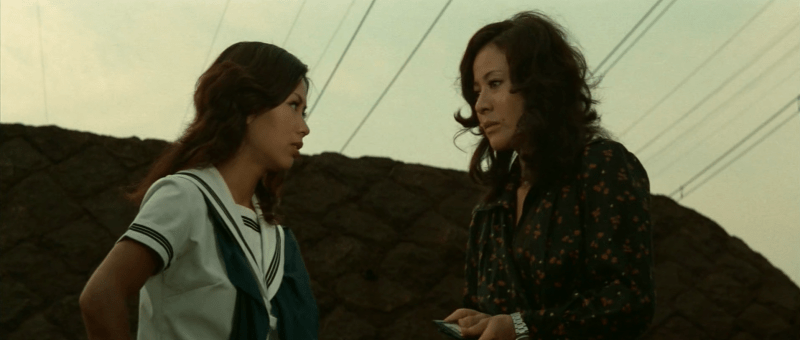
Though it’s tacked on to the Sister Street Fighter series, Level Five Fist (女必殺五段拳, Onna hissatsu godan ken) actually has nothing to do with it save borrowing a part of the title which is intended to signal the presence of its star. Thus, this is not really a martial arts movie but a much more conventional Toei action film in which the leading role is technically split between Etsuko Shihomi’s posh girl karate champ and Tsunehiko Watase’s sexist cop. It does however continue the smuggling theme with the drugs this time first being packed inside fish and then encased in Buddha statues to be exported to America.

Like many Toei films of the time, there is an underlying theme of anti-Americanism as the “Far East” big boss, posing as a Hollywood movie exec, is supposedly from there but has a strong accent suggesting otherwise. Meanwhile, the brother and sister at the film’s centre are a pair of children who were fathered by American servicemen at the bases in Okinawa who presumably took no responsibility for their upbringing. The brother’s father was black, while the sister’s was white, and though they have both suffered prejudice and discrimination because of their mixed ethnicity, it’s clear that Jim (Ken Wallace) has had it worse. Michi (Mitchi Love) makes good use of her native-level English abilities and martial arts skills to work as a bodyguard / interpreter for visiting dignitaries, but Jim seems to struggle to find employment and subsequently ends up working for a Korean gang run out of a local nightclub. 

The pair have a dream of saving up enough money to return to Okinawa, which was returned to Japan in 1971 after an extended period of US occupation, and opening a restaurant which the film positions as a desire to escape from the racism they experience on the mainland. When Jim says that Kiku (Etsuko Shihomi) is their only friend, he half implies that the discrimination they face is down to being Okinawan rather than their mixed ethnicity which would continue to be an issue even on the islands as it was in their childhood even if there may be more understanding given the continuing presence of the American military and larger numbers of mixed-ethnicity people. In any case, it’s true enough that even those from Okinawa do also experience discrimination on the mainland and are not always accepted as “Japanese” while their Okinawan identity is not respected either. 

Kiku is trying to protect her friends, but finds herself hamstrung by rigid cop Takagi (Tsunehiko Watase) who also happens to be the son of a friend of her father’s. Kiku’s father is apparently a self-made man and successful kimono merchant married to a more conservative woman with higher social ambitions. As the film opens, Kiku is dressed in a kimono and being subject to a formal omiai meeting for an arranged marriage with an admittedly promising candidate who graduated from an elite university and works for a prominent bank. But Kiku looks bored throughout and defiantly flouts social convention by suddenly claiming to have an appointment and walking out, much to her mother’s embarrassment. Her father lets her go and is apparently less bothered about this sort of propriety though later trying to put his foot down when she leaves the house dressed like a hippy rather than in a fine kimono which is not, after all, a very good advert for the family business. 

Her father also tries to set Kiku up with Takagi, but like her mother, Takagi also tells her to keep her nose out of the case and “try trusting a man for once”. He criticises her for saying that she doesn’t want to lose to a man and explains that men are attracted to women because of their “gentleness.” He adds that cooking and raising children are what make women happy, with the clear implication that Kiku is in the wrong for flouting conventional gender roles and should quickly conform by getting married and becoming a wife. Kiku appears to give him the benefit of the doubt and this confusion over gender roles is compounded when she poses as a boy and takes a job as a extra on the jidaigeki film set at the studio which turns out to be a front for drug runners. A queer-coded actor who is later told off for “stalking people again” tries to hit on her in a clear allusion to her masculinity. But unlike in the Sister Street Fighter films, she is ultimately defeated and tied to a log with a buzz saw coming at her only to be saved by the intervention of Takagi while the final scenes see her supporting him after he is (possibly fatally) injured defeating the bad guys.

All in all, it’s some rather confusing messaging but seems to come out on the side of male authority as represented by the police rather than Kiku’s father who is depicted as a weakened figure of masculinity owing to being henpecked by his wife and hoodwinked by his feisty daughter. Even the grinning sap from the gym who tried to put Chanel No. 5 on Kiku’s karate outfit, much to her annoyance, is later revealed to be an undercover cop. Which is all to say, that Kiku’s martial arts ability is almost a kind of joke and something that places her outside of conventional gender norms which should otherwise be “corrected” rather than praised, as it was in the Sister Streetfighter series which placed more emphasis on martial arts philosophy. Then again, the original trilogy ended on a similarly sour note in reaffirming Koyu’s maternity. It seems it’s less sisters doing it for themselves, than sisters doing as they’re told, which aside from anything else is a disappointing conclusion to one of the few female–led action franchises of the 1970s.


Original trailer (English subtitles)

The Return of Sister Street Fighter (帰って来た女必殺拳, Kazuhiko Yamaguchi, 1975)

First it was drugs, then diamonds. This time, it’s gold. Even by this third and final, in the official trilogy at least, instalment in the Sister Street Fighter series, Return of the Sister Street Fighter (帰って来た女必殺拳, Kaette kita onna hissatsu ken) the gangsters still haven’t come up with a good way of smuggling. These ones have hit on the bright idea of dissolving gold in acid and importing it as if it were Chinese liquor. 

In any case, following the same pattern as the other two films, Return begins in Hong Kong with a friend of Koryu’s (Etsuko Shihomi) being murdered by thugs right after asking her to go to Japan and look for her cousin Shurei (Akane Kawasaki) who has gone missing leaving her little girl Rika (Chieko Onuki) behind. Hoping to track down her sister Reika in Yokohama, Koryu once again heads to Japan with Rika in tow only to discover that Shurei has been forced to become the mistress of the shadow boss of the Yokohama China Town, Oh Ryumei (Rinichi Yamamoto). 

Though the film maybe following a pattern, it’s also, in a sense, diverging in that it, perhaps uncomfortably, attempts shift Koryu into a more maternal space in essentially leaving her responsible for Rika because of all of her other relatives are for one reason or another unavailable. This is, after all, the implication of the closing scenes, that Koryu will be giving up her life of martial arts and fighting crime to look Rika. Even so, as we’ve seen throughout the trilogy, Koryu is not much good at protecting those around her. All of her friends and relatives generally end up dead, leaving the screenwriters having to make up more for the next instalment. Family is a liability for the sisters too, as Shuri and Reika try to save each other from the clutches of Oh, who once again tries to control them with drugs and familial bonds, but ultimately fail.

But then Oh is on a different level even to the admittedly eccentric villains of the first two films. He appears to use a wheelchair and dresses in a stereotypically Chinese outfit (as does Koryu, to be fair). Even his name is obviously Chinese even if uses the Japanese readings of the kanji which literally mean “King Dragon Bright”. Yet when he’s eventually unmasked, it seems that he was actually a member of the Kempeitai, or military police, in Manchuria during the war, where he committed atrocities against the Chinese people and finally stole bunch of gold bullion which has fuelled his post-war Chinatown empire. It’s likely also what sparked his obsession with all things gold. Even his prosthetic hand turns out to be made of it, ironically moulded into a grasping motion. 

Oh behaves like some kind of Roman Emperor, sitting on his Dias and holding gladiatorial contests to find new henchmen. He declares he that neither capitalism nor communism can beat gold and he’s hedging his bets on both in an ultimate bid for behind-the-scenes power. Embodying the toxic legacy of militarism, he mistakenly underestimates Koryu declaring that that’s what happens to people who depend too much on their physical abilities, thinking her to be dead. His weird henchmen include a man with a lewd-looking and infinitely symbolic snaking sword, but, of course, they’re no match for Koryu who once again discovers an unexpected ally at a critical moment. 

Even so, the film’s approach to it’s Chinese themes is very much of its time. Once again, it uses some offensively stereotypical music to introduce the Hong Kong setting, and the friend who went to Japan with Shurei is actually called “Suzie Wong”, as in “The World of”. The world surrounding Oh ought to be quite dark what with the constant presence of acid, the people trafficking, and the weird henchmen but somehow the film maintains its cheerful tone, no doubt bolstered by Koryu’s ability to take the gangsters down, even if her way of doing it isn’t all that efficient and more often than not gets all her friends killed. Nevertheless, this time around it seems she’s fighting for the sisterhood against the evil gangsters who control and abuse women, but even so, her final transition to mother-in-waiting feels a little like a rebuke, as if even little dragons have to cool their fire one day just as her brother in the first instalment had wanted her to settle down and live a “normal life” doing typically feminine things rather than mastering martial arts and shutting down the warped and amoral gangsters currently smuggling their greed and weirdness into a changing Japan.


Trailer (English subtitles)

Sister Street Fighter: Hanging by a Thread (女必殺拳 危機一, Kazuhiko Yamaguchi, 1974)

Li Koryu (Etsuko Shihomi) returns to fight crime in Japan in the second in the Sister Street Fighter series, Hanging by a Thread (女必殺拳 危機一, Onna hissatsu ken: Kiki ippatsu). The first film apparently tested so well so that studio execs ordered a second one right away to fill a big New Year slot. That might in one sense explain why the film is pretty much the same in terms of narrative, yet this one does go a little further while swapping the drugs subplot for diamonds.

Koryu comes to the aid of a man being attacked by thugs in a Hong Kong marketplace and is somehow completely unfazed when he plucks out his false eye with instructions to give it to Professor Enmei (Hideaki Nagai) who is also known to Koryu because he’s the father of her old school friend, Birei (Hisako Tanaka). Unfortunately, the false eye contains microfilm that suggests Birei has been kidnapped by vicious Japanese gangsters. The professor therefore sends her to Tokyo on a rescue mission and we discover that she also has an older sister, Byakuren (Kanya Tsukasa), who was never mentioned in the earlier film, who is living in Japan having chased her dream of becoming a jewellery designer.

This time around, it’s diamonds not drugs, but the gangsters still haven’t cracked this smuggling business and have come up with the very weird idea of hiding them in the bum cheeks of attractive young women. Meanwhile, they also force the women into sex work. Osone’s (Hideo Murota) female business partner Mayumi, played by Madam Joy, a drag queen who starred in several Toei films in the mid-70s, films them from a distant window to get material for blackmail. Nevertheless, she only cares about the diamonds, unlike the boss and several of the gang which once again includes a rival martial arts outfit who have in it for the Shorinji temple. 

Shinichi Chiba does not appear in the film, but Koryu does gain a kind of sidekick in the form of Tsubaki (Yasuaki Kurata), a sleazy-looking guy whose intentions are permanently unclear. The film goes a little bit further with its awkward orientalism opening in a Hong Kong marketplace with some offensively stereotypical music and a bunch of fire crackers, even if once again in trends in the opposite direction from most films of the time in that the crooks are all Japanese and it’s a half-Chinese woman who’s coming to sort them all out. The gangsters have apparently been trafficking the women abroad for sex work, then bringing them back with the diamonds in their bums which seems like a plan with a lot of potential problems even if they hadn’t made the huge mistake of kidnapping a friend of Koryu and then later her sister. 

But then again, Koryu’s cases seem to be fairly isolated. Once she takes out these bad guys, that’s it. There’s no wider conspiracy save a general sense that the world itself is corrupt and indifferent to human suffering. Osone has a strange love of taking people’s eyes, which might be a way to stop them seeing who he really is. He has, after all, already taken the stars from Byakuren’s along with her dreams of a new life in Japan finally becoming the jewellery designer she always dreamed of being. Despite her determination to save her sister, Byakuren soon realises that Osone is most definitely not a man of his word. His curiously old-fashioned outfits and demeanour suggest he’s seeking a place with the elites of an earlier time while indulging in some fairly odd behaviour. 

Once again, Koryu squares off against his equally weird henchmen who start attacking her the moment she lands in Japan, and eventually ends up stabbing someone with the severed arm of another enemy still holding his knife. Still, the tone is generally cheerful and upbeat despite the strangeness of the tale and series of losses Koryu experiences including a challenge to her pride when she’s bested by one of the martial arts goons. In this continually uncertain and increasingly surreal world, Koryu’s fists, it seems, are one of the few things that can absolutely be relied upon along with evil smugglers and their bizarre new plans for circumventing the law of the land out of nothing other than lust and greed.


Original trailer (English subtitles)

Sister Street Fighter (女必殺拳, Kazuhiko Yamaguchi, 1974)

As the Japanese cinema industry continued to decline in the face of competition from television, there was perhaps paradoxically more space available for small-scale genre films. Shinichi Chiba had ushered in a new age of unarmed combat with his Bodyguard Kiba karate movies. The Street Fighter series followed hot on its heels and was enough of a hit for the studio to take notice. They suggested a new spin-off line that would feature a female action star with Chiba appearing in a supporting role and so Sister Street Fighter (女必殺拳, Onna hissatsu ken) was born.

Producers apparently first wanted Taiwanese-born Hong Kong actress Angela Mao who had starred with Bruce Lee in Enter the Dragon by which the film is clearly influenced. Angela Mao was, however, unavailable, which is what led them to take a chance on Chiba’s then 18-year-old protégé Etsuko Shihomi. Shihomi had joined his Japan Action Club out of high school to study stunts, martial arts, and gymnastics and had only limited acting experience but soon proved up to the challenge of carrying a movie as a female action lead. 

Koryu is the sister of a martial arts champion who has gone missing in Japan. She then finds out from his boss that he was actually an undercover narcotics agent trying to break a Japanese drug ring. As Koryu’s mother was Japanese and she still has family in Yokohama, the police inspector thinks she’d be a perfect fit to head out there, find out what’s happened to her brother Mansei (Hiroshi Miyauchi), and maybe take out the drug dealers too. 

In some ways, it’s an interesting subversion of the Sinophobia often found in Japanese films of this era that this time it’s a half-Chinese woman squaring off against Japanese drug dealers. Her brother was apparently so upset about not being able to stop the drugs flooding Japan that he decided to do something reckless that directly led to his disappearance. The Hong Kong police also have a second operative, a woman, working inside the gang but have lost contact with her. In contrast to Koryu, Fang Shing (Xie Xiu-rong) has been sent in as a classic honey trap to use her femininity as a weapon by becoming the boss’ mistress to get the lowdown on the gang. But as a consequence, Fang Shing has also become addicted to drugs which the boss uses as a means to control her. 

Koryu, by contrast, immediately stands up against male patriarchal control by beating up a bunch of guys that were trying to hassle her in a bar. Nevertheless, Mansei’s martial arts master says that her brother was hoping she’d get married and have a “normal life”, which does seem like quite a chauvinistic thing to say and especially to the martial arts-obsessed Koryu. Even so, he introduces her to another young woman, Emi, who got into Shorinji Kempo when Mansei saved her from being raped. These skills do after all give them the means to defend themselves against an often hostile and violent society along with granting them a greater independence than they might otherwise have.

Still, there are a selection of strange villains on show with death by blowgun and ex-priests along with the Amazon Seven team of Thai kickboxers and “Eva Parrish”, apparently the karate champion of the Southern Hemisphere. The action is quite obviously influenced by Hong Kong kung fu films and most particularly Enter the Dragon, though to a lesser extent Shaw Brothers in the warring schools subplot that sees the Shorinji Kempo love is power philosophy challenged by the gang’s very own martial artist, who feels he must wipe them out to overcome his humiliation in being defeated. Nevertheless, Koryu effortlessly takes out the bad guys as she battles her way towards saving her brother, whom the gang have started experimenting on in an effort to acquire more complex data about tolerance and safe levels for consumption of drugs. The bad guys have a full on lab in their basement where they’ve come up with an innovative solution to the smuggling issue by using wigs! It’s all quite surreal and cartoonish even when it starts getting grim, but rest assured Koryu is here to sort it all out, and sort it out she will.


Original trailer (English subtitles)