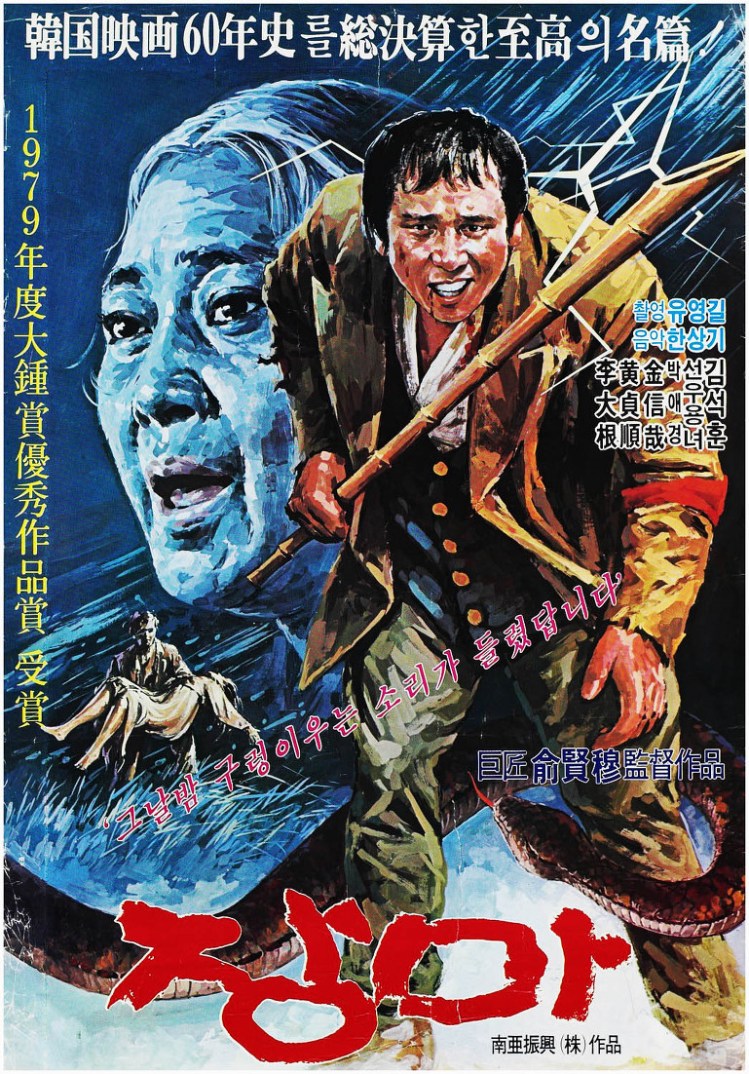
Rainy Days (장마, Yu Hyun-mok, 1979)

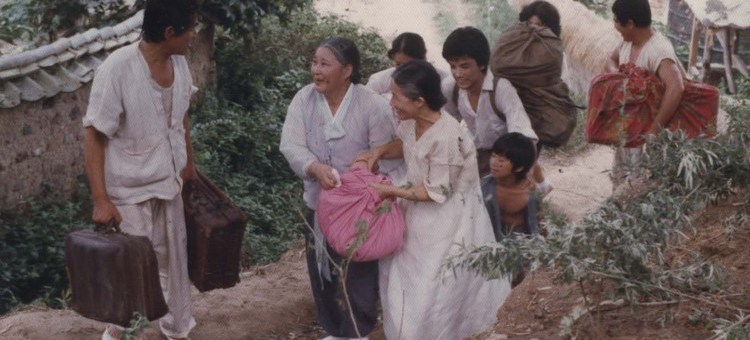
Rainy Season posterOften regarded as an “intellectual” filmmaker, Aimless Bullet’s Yu Hyun-mok returns to one of his central preoccupations in 1979’s Rainy Days (장마, Jangma). Released close to what would be an abrupt end to the oppressive and authoritarian rule of Park Chung-hee (which would be followed by another repressive military regime), Yu’s literary film falls into the anti-communist subgenre though Yu is careful to reframe his tale not as one of left versus right but of right versus wrong and of the dangerous gulf in-between. As it would in 1979, the political wind shifts without warning and then reverses itself leaving few untouched by the chaos and confusion of a government in flux. Rainy Days is a season of silence and tension, waiting for the sun but weathering a storm which may never end.

In the early 1950s, a family moves from Seoul to stay with relatives including Dongman (Choi Yong-weon) – the grandson of the older woman who is coming to live with her daughter’s family along with her university educated son Giljun (Kang Seuk-woo) and student daughter Gilja (Ju Hae-kyeong). Towards the end of the war, Maternal Grandmother (Hwang Jung-seun) has a prophetic and traumatic dream of trying to pull her own tooth which she interprets as a warning that Giljun, a serving soldier fighting for the South, has been killed in action. Sure enough, the next day a telegram arrives carrying the dreadful news back to the family. Maternal Grandmother tries to comfort herself as best she can, pretending to have grown used to the news thanks to her dream but in reality heartbroken and distraught by the loss of her only son.

Meanwhile, Dongman’s other uncle, the son of Paternal Grandmother (Kim Shin-jae), is off fighting for the North as a communist partisan hiding in the mountains. Suncheol (Lee Dae-geun) was once so kind hearted that as a boy he released the fish he caught in the local river, but when the communists took his village he was quickly seduced by their recently acquired power. While Giljun was forced to hide in a makeshift hollow covered by leaves in the woods, Suncheol was busy getting in with communists and though he claims to want to protect his family eventually informs on his brother-in-law only to find it blowing back on him when they doubt his commitment to the cause in not having turned the “Southern Sympathiser” in sooner. A simple man, Suncheol joins the communists and turns on Giljun as a reaction against his feelings of inferiority in the face of urban sophistication. Suncheol is cheerful and goodhearted, broadly liked by those around him, but he is also like a child who acts on impulse and takes things too far without considering the consequences of his actions just as he does when instigating a little “mob justice” against a villager who had tried to crack down on the trafficking of illegal moonshine much to the consternation of his neighbours.

The central conflict is dramatised by the sparky relationship between the two grandmas who have each passed into the age in which it becomes appropriate to voice one’s concerns openly without particularly caring how those views will be received. Paternal Grandmother, having opened her house to Maternal Grandmother and her children, feels herself to be in a position of superiority and is often wilfully unkind to her guests, offering a series of truly unforgivable words to the bereaved Maternal Grandmother who has, quite reasonably, cursed all the communists who are responsible for the death of her son. Seeing as Paternal Grandmother’s son Suncheol is a communist partisan she takes exception to this which provokes a fierce, accidentally political family row which may be eternally irreparable.

The North is, however, beaten back and the village retaken by the South. Suncheol is now a fugitive hiding in the mountains who has killed many men and fears he will not be forgiven even if he gives himself up to the authorities in the hope of rejoining his family. Proud Paternal Grandmother remains proud of her brave son, refusing to believe what they say about the partisans and secretly hoping for a resurgence of the North though like Maternal Grandmother before her she cannot say these words plainly for fear of getting into trouble with the authorities. When Suncheol makes a brief visit back to the family home, broken and desperate, to float the idea of turning himself in, it has grave consequences for little Dongman who is tricked into to informing on his uncle and earns the wrath of Paternal Grandmother in the process. Maternal Grandmother, however, has had more time to come to terms with her grief and is sympathetic to her grandson’s plight, knowing that he is just a child and did not understand the consequences of his actions.

Played by the wonderful Hwang Jung-seun, Maternal Grandmother becomes the heart of the drama. Having lost everything – her only son, her life in Seoul, her hopes for the future, she remains stoic, repeating the mantra that everything is fine because she knew all along how it would be. Following her painful outpouring of grief and war of words with Paternal Grandmother she comes to terms with her situation and tries to carry on as best she can with warmth in her heart. She even tries to forgive Paternal Grandmother and expresses sympathy for her as another mother losing a son in a stupid and senseless war. Paternal Grandmother cruelly pointed out that Maternal Grandmother would have no son to perform her funeral rites, but it is Maternal Grandmother who eventually performs the shamanistic ritual at the film’s conclusion in place of Paternal Grandmother, provoking a reconciliation of the two women and a banishment of the rancour which had existed between them.

Focussing tightly on the realistic emotions of the contemporary villagers who hold no particular political views but are caught in the middle of a war and simply trying to survive, Yu dramatises the tragedy of division not in a question of “good” Southerners, and bad “Communists”, but of bereaved grandmothers and broken families, ruined futures and fractured pasts. Yet once again he departs from the tragic ending of the novel for one which allows hope for the future. Little Dongman, put on house arrest by his irritated father, is finally allowed to go out to play with the other village children, rejoicing in the sunny skies and beautiful forrest scenery, returning to a childhood idyll now free of wartime confusion.


Available on DVD as part of the Korean Film Archive’s Yu Hyun-mok boxset. Also available to stream via the Korean Film Archive’s official YouTube Channel.

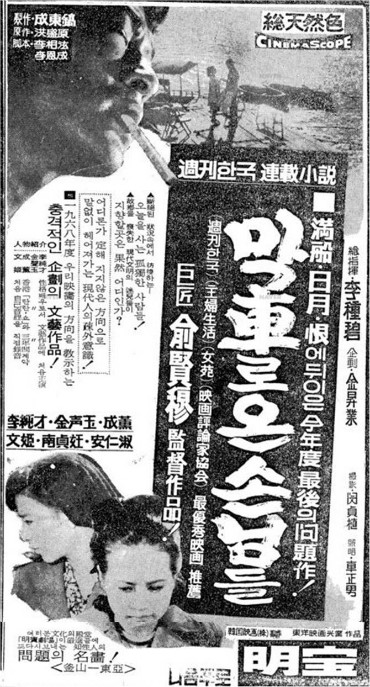
The Guests of the Last Train (막차로 온 손님들 / 막車로 온 손님들, Yu Hyun-mok, 1967)

guests who came by train 2Despite ongoing social and political oppression, the Korea of the 1960s was an upwardly mobile world in which increasing economic prosperity and global ambition was beginning to offer the promise of financial stability and a life of comfort to millions of young men and women, albeit at a price. Yu Hyun-mok, often thought of as among the most intellectual of “golden age” film directors, was a relatively infrequent visitor to the “literary film” but Guests of the Last Train (막차로 온 손님들 / 막車로 온 손님들, Makcharo on Sonnimdeul, AKA Guests Who Arrived on the Last Train), adapted from a novel by Hong Seong-won, is perhaps comfortably in line with his career long concerns in its focus on those who for one reason or another have been running to catch the rapidly departing train of modernity, pulling themselves on board just it prepares to pull away. A disparate tale of three men and their respective love interests, Yu’s film once again rejects the consumerism of the modern society in its cold and lonely search for soulless acquisition and finds comfort only in the fragile connections between the lost and hopeless.

The film opens behind a train station where a young woman, Bo-yong (Bo-yong), staggers and stumbles, grasping for something to hold on to but hardly able to stand. Eventually a man, Dong-min (Lee Soon-jae), turns up and tries to hail a taxi. Noticing the distressed woman, he manages to get her into a car and when she tells him she has nowhere to go, takes her home with him. Dong-min is currently off work with an illness which turns out to be terminal lung cancer and has only a few months left to live as a second opinion from his doctor friend, Kyeong-Seok (Seong Hoon), makes clear. Kyeong-seok is also facing a problem with a female patient, Se-jeong (Nam Jeong-im), suffering a nervous complaint after losing her wealthy husband and subsequently being hounded by her relatives over the inheritance. When Se-jeong leaves the hospital the pair end up having an affair but the money continues to present a problem – neither of them want the hassle of dealing with it. Meanwhile, Dong-min and Kyeong-seok reunite with another old friend, Choong-hyeon (Kim Seong-ok), who has just returned from Japan apparently having become fabulously wealthy. Choong-hyeon has pretensions of becoming an avant-garde artist, but is unable to get over his ex-wife who has left him to become a famous actress.

Each of the three men is in someway arrested, unable to move past something towards the future rapidly rolling away from them like a train leaving the station. Dong-min’s depression and listlessness is understandable given that he’s facing a terminal illness and knows that he has already reached the end of the line. Yet his ennui began long before. Kyeong-seok, describing his friend to a colleague, disapprovingly remarks that he used to be a mild-mannered bank teller but left to become a freelance translator and journalist. Unable to put up with the stringent, high pressure world of work Dong-min removed himself from it to try and grasp his freedom only to remain dissatisfied and eventually defeated by a cruel and arbitrary illness. Even so he retains his human feeling as demonstrated by his decision to help Bo-yong rather than leave a vulnerable woman alone to suffer on the streets. Staring blankly at the calendar on his wall, avoiding tearing off the sheets which serve as an all too obvious symbol of his limited time, he falls slowly in love with the woman who remains at his side whilst knowing that his existence is futile and doomed only to tragedy.

Kyeong-seok, by contrast, is merely disaffected. Dragged into a relationship with Se-jeong originally unwillingly, what he resists is responsibility. He wants to help her, but he does not want to get involved with her complicated familial and financial problems. As so often in Yu’s films, money is the root of all evil, presenting barriers between people where there should be none. Neither Kyeong-seok or Se-jeong are very interested in the money for its own sake, they want only simple lives of adequate comfort and emotional fulfilment – something which the hassle of dealing with other people’s money hungry machinations will actively destroy.

Money has also, in a sense, destroyed Choong-hyeon’s hopes though more through his misplaced faith in its ability to buy him back what he’s lost. His relationship with his wife is clearly over, she has chosen something else which is her right and privilege, but Choong-hyeon can not accept it and continues to look for her in all he does. Attempting to become an “artist” himself, he uses his money to get himself a show featuring his avant-garde pop art creations but neither of his friends rate his work or is careful enough about his feelings to avoid criticising it. Choong-hyeon spirals out of control, becoming dangerously obsessed with a schoolgirl he somehow wants to imagine as his wife. Dong-min and Kyeong-seok suspect that he will kill himself, but by this point they aren’t sure if they should care. What would they be saving him for? There is no possible salvation – no one can save anyone else, and no one can save themselves. Each is an individual and can offer no excuses. Love and friendship are but scant comfort in a cold and lonely world.

Meanwhile, the women continue to suffer in silence. Yu chooses to focus on his trio of male misfits rather than the pair of unlucky women whose story lies at the centre of the narrative. Se-jeong married an older man for apparently legitimate reasons but the marriage was unsuccessful and also ruined her friendship with her husband’s daughter who, unsurprisingly, turns out to be Bo-yong. Looking for love and not money, Se-jeong is only holding on to her inheritance in the hope of someday reconciling with Bo-yong and handing it all to her. Meanwhile, Bo-yong has been on the run from her former life. Once an air stewardess, Bo-yong dropped off the radar when a former fiancé planted drugs in her suitcase and got her sent to prison. Like Se-jeong she is looking for support and companionship and finds it in the kind if melancholy Dong-min, vowing to stay by his side even if she knows their time it limited. The two women are eventually “reunited” at a wedding, but the crowd keeps them apart, breaking into factions fighting over the inheritance that neither Se-jeon or Bo-yong actually want.

Yu declines to tell us whether the women are eventually able to meet and repair their friendship, but he does make clear that both have rejected the superficial comforts of wealth in asking for a small and simple life with their respective partners. In this he offers both hope and despair. The couples are rejecting the new future their nation has planned for them, yearning for small comforts and an end to their loneliness and struggling to find it in an increasingly alienated world. Bo-yong, at least, steps forward to grasp her chance at happiness however small it maybe, waiting for the train and seeing red lights change to green only when her gesture of sincerity is finally accepted.


Available on DVD as part of the Korean Film Archive’s Yu Hyun-mok boxset. Not currently available to stream online.

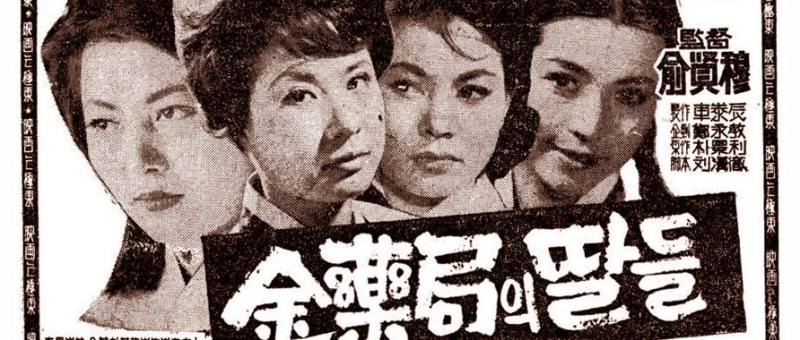
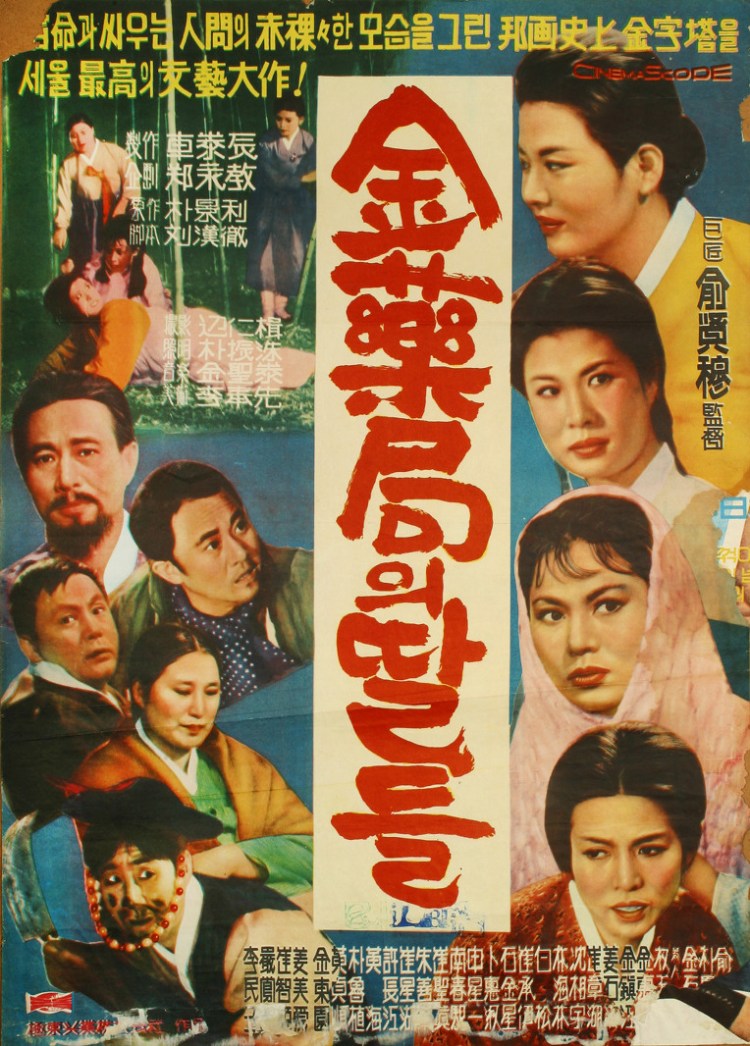
The Daughters of Kim’s Pharmacy (김약국의 딸들 / 金薬局의딸들, Yu Hyun-mok, 1963)

Daughters of Kim's Pharmacy poster“Literary Film” had become a kind of genre of its own in Korean cinema, both embracing and rejecting the nation’s taste for melodrama with differing degrees of artiness. Director Yu Hyun-mok, however, was not generally associated with the kind of affectation coupled intense sentimentality that sometimes marked the worst examples of the genre but with a unique brand of cinematic realism which attempted to address the social issues of the day whilst still getting past the censors who were hot on politics but increasingly lax on sex and violence. Nevertheless, The Daughters of Kim’s Pharmacy (김약국의 딸들, Kim yakgukjib daldeul) is a “literary film” adapted from a novel by Park Gyoung-li and set firmly in the recent past. Yu eventually gives in to the inherent melodrama of a small family battling a legacy of pain and destruction, but tellingly subverts it by discarding the tragic ending of the original novel for something that offers a degree of hope albeit in an all but hopeless world.

The film begins at the close of the Joseon Dynasty as a young man runs into another man’s house and desperately reaffirms his love for a woman who is now married to someone else while he is also married to woman from his village. The woman refuses to see him while he pleads with her, sobbing, but when her husband returns home unexpectedly he doubts his wife’s virtue. Threatening her and then chasing off the lover, the husband kills him by accident and is forced to flee while the woman takes poison and kills herself in her misery leaving her son, who will later become Kim the pharmacist, orphaned and alone, and the family forever “cursed” by her unquiet spirit.

18 years later Kim himself is forced into an arranged marriage which he wanders away from on the wedding day, leaving his aunts to wonder if he hasn’t been “possessed” by the vengeful spirit of his late mother. Despite the “curse” the marriage is successful in that it is not particularly unhappy and produces four daughters who are each of age when the story begins thirty years after Kim’s wedding.

The central heroine, Yong-bin (Um Aing-ran), is a “modern woman” of the colonial era, taking advantage of a shift forward into a progressive new world by leaving her tiny home village for university in Seoul. Though she longs to be free of the primitivism of her origins with its shamanistic rituals and patriarchal traditions, she is also of an elegant, conservative disposition and loves her parents deeply – something that provokes conflict in her desire for the comforts of home and the promise of away.

Of the other three daughters, each represents a particular kind of trap of the age. The oldest, Yong-sook (Lee Min-ja), has given birth to a child out of wedlock and lives alone independently raising her son in penury. Meanwhile third sister Yong-ran (Choi Ji-hee) is no longer a child but continues to loll around the house showing off her legs and posing provocatively. Her father is thinking of marrying her off to a local fisherman who has taken a liking to her, but the plan is scuppered when it is revealed that Yong-ran has been taking frequent nighttime excursions to the graveyard in the forest for secret trysts with one of the servants. When they are discovered, Kim chases the man away leaving Yong-ran publicly shamed and heartbroken. Eventually she is married off to someone befitting her social class only to discover that her new husband is impotent thanks to an opium addiction. She is routinely beaten and abused but can do nothing to escape her life of violence and terror. Yong-oak (Kang Mi-ae), the youngest sister, will eventually suffer a similar fate if one more usual, when she marries Yong-ran’s fisherman suitor only to find him rough and resentful as the fishing industry continues to fluctuate.

When Yong-bin’s mother (Hwang Jung-seun) meets her at the harbour on her return from Seoul she mentions the family curse by way of bemoaning their increasing ill fortunes. Yong-bin dismisses her mother’s concerns, preferring to think that its one’s own deeds that determine one’s future, but her mother sadly shakes her head and repeats that it’s all fated. Yong-bin’s modern way of thinking will increasingly come into conflict with her superstitious upbringing, but there’s no denying her family has had a run of bad luck – one which is only set to intensify as time moves on.

This is the central tragedy – the Kim family, trapped in the past, is unable to move beyond its “curse” and whether fated or not is set to destroy itself through outdated thinking. Though it is undoubtedly not the message the film is intended to convey, it’s impossible to ignore the degree of unhappiness which has been caused by the system of arranged marriages and the convention that true feelings must be suppressed in order to maintain ancient social codes. The Kims’ “curse” comes from the death of a woman scorned in love and betrayed by a prideful husband. If only she had been allowed to marry the man she chose, there would be no curse, no violence, no fear. As long as personal happiness is undervalued, there will be only suffering and misery for all but most particularly for the young women of Korea.

Yong-bin, an urban sophisticate, knows this more than most. Her father thinks he ought to marry her off first so he can marry off Yong-ran whose precociousness is beginning to alarm him. Yong-bin, however, wants to finish her education before submitting herself to a lifetime of servitude as someone’s wife and later mother. Her father has his eye on a match – the son of a usurious loanshark who is also a Japanese collaborator. Luckily, Yong-bin likes the man her father has chosen and sees only a romantic fantasy in marrying a childhood friend despite a warning from another mutual acquaintance that Hong-sub is a timid yet ambitious man – a dangerous combination which is unlikely to yield much happiness. She is going to get her heartbroken in more ways than one, her illusions of innocent romantic destiny shattered and her heart wounded by a spiritual as well as physical betrayal by the feckless Hong-sub who turns out to be not the man she thought he was but the one she was warned about.

Yet there is something in Yong-bin’s modernism that cannot be denied. This being the colonial era, the influence of the Japanese is felt even in this tiny village. Kim has sold the family pharmacy because of the influx of Western medicine coming in through Japan. He invested heavily in fishing, but the Japanese are ruining that too through invading local waters and overfishing them. Yet Kim still thinks of himself as a feudal lord with a real duty towards the people of his village. When his boat is ruined in a shipwreck and many sailors killed, he feels he must compensate the victims’ families who are now without the means to support themselves. This leaves him open to exploitation by Hong-sub’s usurious father who is in big with the Japanese who are, to an extent, the route cause of all these problems. Hong-sub’s father laughs when Kim declares his need of extra cash to support those who’ve suffered because of his failed fishing venture, thinking his sense of duty merely stupid but also seeing that it’s another hook for him to exploit that brings him closer to his goal of harnessing Kim’s ancestral estate with its large amount of farmland and property.

The Japanese play into a small sub-plot in which Yong-bin’s cousin (Shin Seong-il) is engaged in the resistance movement and eventually leaves for a covert mission in Japan. Before he leaves he introduces Yong-bin to a friend, Kang-geuk, who has been arrested and is being carted off to Japan for trial but has apparently fallen in love with her based only on his friend’s stories and a photograph. She’s back to a romantic fantasy once again and gravitating towards the spectre of arranged marriage which the film has already done such a great job of discrediting. It is, however, the perfect symbiosis of the film’s themes allowing Yong-bin to embrace both sides of herself. Meeting again after the liberation and a succession of terrible tragedies for the Kim family, Kang-geuk responds to Yong-bin’s intention to leave her hometown forever by asking her to name a place which is not tinged by loss and tragedy, and of course she can’t. Suddenly, her village doesn’t seem so bad anymore.

The “curse” is broken in being acknowledged and Yong-bin exercises her freedom to choose, consenting to a marriage, and making a decision to stay rather than being forced to leave. Yu’s comparatively hopeful ending in which Yong-bin nevertheless places herself back within a patriarchal value system stands in sharp contrast to that of the novel in which the Kim family’s failure to reconcile themselves to modernity provokes their downfall, but there is only so much hope in this hopeless world and Yong-bin, like her surviving sisters, will continue to suffer in an existence which offers little else to Korea’s oppressed women, remaining complicit in her own misery.   


Available on DVD as part of the Korean Film Archive’s Yu Hyun-mok boxset. Also available to stream via the Korean Film Archive’s official YouTube Channel.

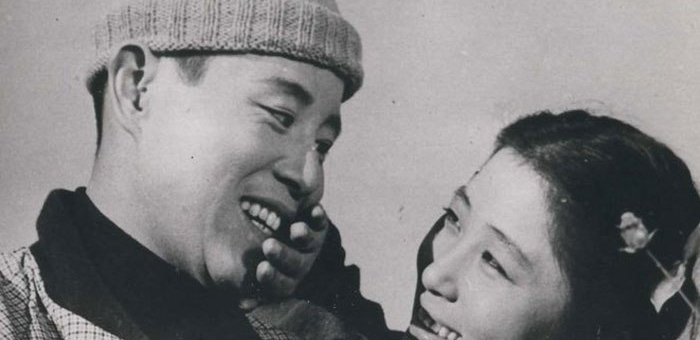
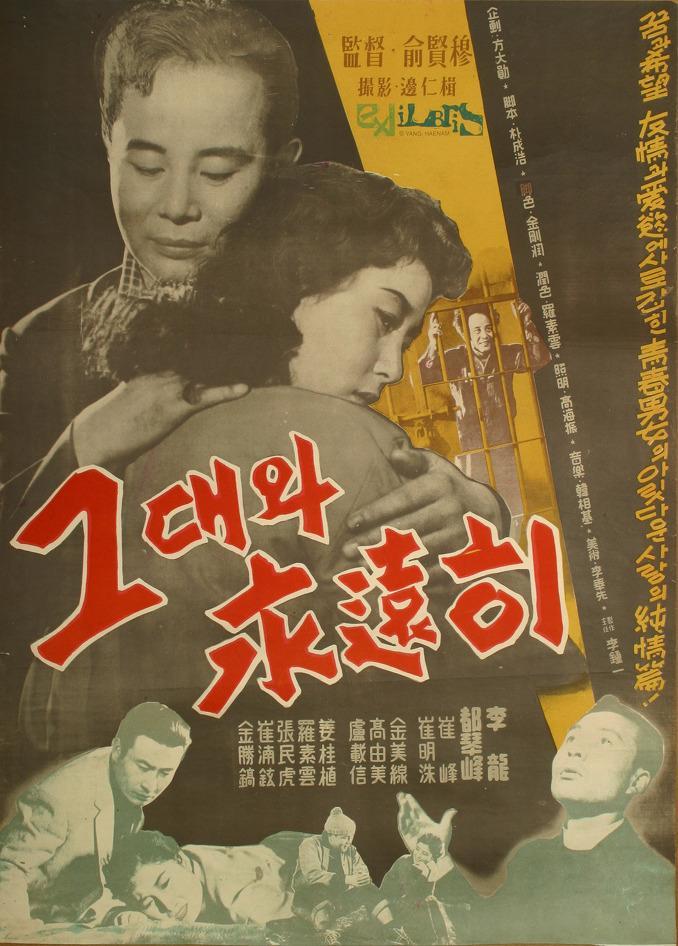
Forever With You (그대와 영원히 / 그대와永遠히, Yu Hyun-mok,1958)

Forever with you posterBest remembered for his 1961 feat of neorealist social drama Aimless Bullet, Yu Hyun-mok was one of the early masters of Korea’s golden age who sought to bring a degree of intellectual rigour and formal experimentation to a medium which often favoured the populist or propagandist. He did, however, have to start somewhere and the earliest surviving film in Yu’s filmography is indeed a melodrama though one perhaps a little to the side of the norm and with an axe to grind as regarding economic equalities and the demands of spiritual morality, even if he is forced to retreat to entrenched social codes in the closing moments.

The camera pans over a city filled with rooftops and eventually lingers on a group of children playing quietly by a wall. Panning over the wall which is exceedingly high, Yu reveals the children to have been playing on the other side of a prison where Gwang-pil (Lee Ryong), an inmate, is about to be released after 10 years inside. All things considered, Gwang-pil does not seem to be a hardened criminal and is optimistic for the future, intending to go straight and hoping to reconnect with the childhood sweetheart he believes is still waiting for him in the outside world though they have not seen each other since Gwang-pil made an ill-advised escape attempt and got his sentence increased a number of years. He recounts all of this to another inmate who is happy for him, broadly, but not quite convinced Gwang-pil is going to make it in the regular world.

Switching to a lengthily flashback, Yu allows Gwang-pil to recount the circumstances which landed him in jail, which also gives the director a chance to engage with his socio-political concerns. 10 years previously, Gwang-pil was a happy young man from an exceptionally poor village who was best friends with Ae-ran (Do Kum-bong). Ae-ran works in a bakery to help support her family, and often walks home with Gwang-pil which is one of the few times they have to be together. A happy day at the beach sees them building sandcastles and dreaming of the life they will one day live with a house and children of their own, only to see all their dreams washed away by a sudden outbreak of rain. In desperate need of money both to support himself and his bedridden mother and to impress Ae-ran, Gwang-pil starts hanging round with delinquents and picking pockets. Though Gwang-pil wants to give back some of the money they stole fearing the woman they took it from is also poor and cannot spare it, he goes along with the delinquents’ plan to rob a nearby US army depot. The others get away but Gwang-pil is arrested and sent to prison.

The first and foremost motivator for Gwang-pil’s descent into criminality is poverty and familial breakdown. His father was a gambler who left his mother flat, while she has become bedridden and is dependent on her teenage son for financial support. With no real jobs available in the town and no prospect of a way out through education, Gwang-pil is seduced by crime despite having no real aptitude for it. The other motivator, if indirectly is Ae-ran or, more specifically, jealous insecurity related to the harmonica playing delinquent Dal-soo (Choi Nam-hyun). Too poor to afford a harmonica of his own, Gwang-pil fears losing Ae-ran to a flashier guy and so he picks pockets to buy her fancy treats little realising all she wants is his time – something he will rob her of by getting himself sent to prison.

The war between Gwang-pil and Dal-soo over possession of Ae-ran will occupy the rest of the film though Ae-ran, like many women in the golden age of Korean cinema, is left with little choice of her own other than to continue suffering. When Gwang-pil gets out of jail it’s one of the other delinquents who meets him – Sang-moon (Choi Myung-soo) has become a priest, in part out of remorse for what happened to Gwang-pil and regret over his criminal past. Sang-moon is determined to help Gwang-pil repair his life but knows finding out what happened to Ae-ran is going to break his heart and send him spiralling into a nihilistic whirlpool of despair. Ae-ran has married Dal-soo who chose the path of crime and still operates a dodgy hostess bar as a front for his gangster activities.

Gwang-pil is just as upset and angry as Sang-moon feared. So much so that he completely misses how miserable Ae-ran is in her marriage and that her daughter, Eun-joo, is nine years old meaning she was conceived before he went to prison. Obsessed with his own pain, anger, and self loathing he fails to see anything other than his ruined hopes and commits himself only to further ruination through drink and the attentions of the manager at Dal-soo’s bar which are not altogether as one might assume them to be.  Only too late does he begin to grasp the real situation but is still too wounded to process it fully. Dal-soo, knowing Ae-ran has never loved him and wondering if her decision to become his wife has been a long form act of revenge, sets a plan in motion to remove his rival from the scene while Gwang-pil also longs for revenge against the man who has stolen everything from him.

Dal-soo and Gwang-pil square off, leaving Ae-ran whose health is so poor and nerves so fragile that she has virtually lived in hospital for the last few years, to suffer alone with only the austere comfort of Sang-moon’s priestly ministrations. Wanting to be “a good wife” she stands by Dal-soo but fears for Gwang-pil, not only for his life but also for his soul lest he fall back into criminality in the shock and hopelessness of her betrayal. Her situation is impossible and the strain of it difficult to bear. She hates her husband and blames herself for the fate of her one true love but has no recourse other than to continue suffering or die. In keeping with the story’s melodrama origins, Ae-ran pays a heavy price for her “weakness”, as does Dal-soo, leaving only the priest and the wronged man behind, strengthened by the need to care for the daughter he never knew he had.

Far from the rigour and furious intent of Aimless Bullet, Forever with You (그대와 영원히 / 그대와永遠히, Geudaewa yeongwonhi) is a much more modest effort even among studio pictures from 1950s. Largely filmed on set with low production values, Forever With You does allow Yu a degree of formal experimentation as he makes frequent use of pans and zooms more commonly seen in the films of 20 years later and occasionally gives in to ostentation as in his expressionist spinning shot of Gwang-pil and a bar girl dancing as he attempts to lose himself in abandon, or an overhead view of a gangster meeting. In the end Gwang-pil comes to himself too late, only realising his foolishness just as he loses everything that mattered to him but Yu changes track, gives him hope again in the prospect of a new beginning, learning to live for others in purehearted sincerity whilst walking away proudly into the harshness of the post-war world.


Available on DVD as part of the Korean Film Archive’s Yu Hyun-mok boxset. Also available to stream via the Korean Film Archive’s official YouTube Channel.

Along With the Gods: The Two Worlds (신과함께-죄와 벌, Kim Yong-hwa, 2017)

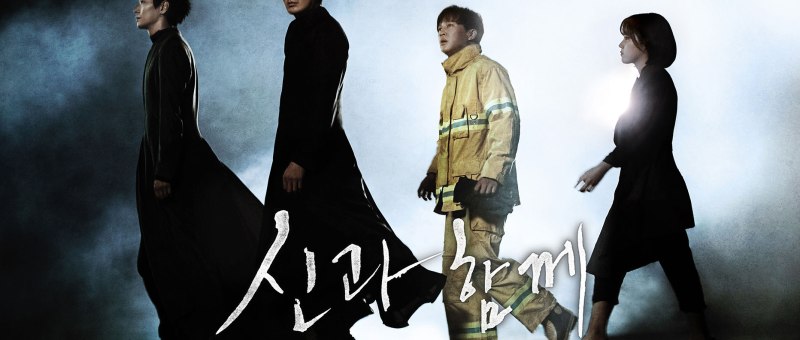
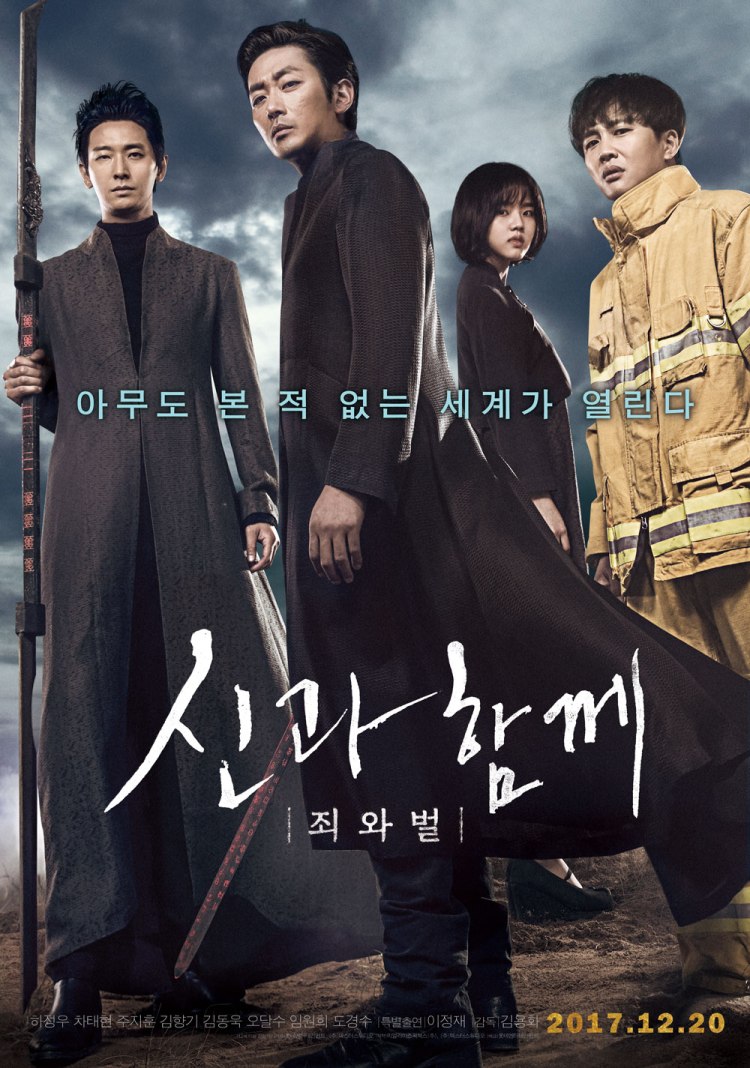
Along With the Gods- The Two Worlds posterThere’s nothing like death to give life perspective. If life is a series of tests, death is the finals but if you pass you get to come back and do it all again, otherwise you’ll have to spend some time in the afterlife thinking hard about what you’ve done and presumably studying for some kind of resits. At least, that’s how it seems to work in the complicated Buddhist hell of Kim Yong-hwa’s fantasy epic Along With the Gods: The Two Worlds (신과함께-죄와 벌, Sin gwa Hamkke – Joe wa Beol). The first in a two part series, The Two Worlds takes a saintly man and tries to pull him down only to build him back up again as a potent symbol of filial piety and wounded selflessness.

Firefighter Kim Ja-hong (Cha Tae-hyun) is killed leaping heroically from a burning building with a little girl wrapped in his arms. He doesn’t realise he’s dead until he’s greeted by two neatly suited, official looking types who explain to him that they are his “Guardians” and will be looking after him on his journey through the afterlife. It turns out that Ja-hong’s heroic death has earned him a “Paragon” badge – a rare occurrence, and he has a good chance of reincarnation before the 49th day if he can successfully pass each of the seven trials which mark passage through Buddhist Hell.

As the Guardians point out, it would be extremely difficult for a “normal” person to pass these seven trials and achieve reincarnation but as a Paragon Ja-hong should have an easier ride. Ja-hong is, however, an ordinary person with an ordinary person’s failings even if his faults are comparatively small. Ja-hong is literally on trial seven times – represented by his team of defence lawyers, the Guardians, he is charged with various sins each “judged” by a god presiding over a custom courtroom. Murder Hell is fiery chaos, indolence is assessed by a stern older lady (Kim Hae-sook), and deceit by (who else) a small child (Kim Soo-ahn) licking a large lollipop.

Ja-hong is indeed a “good person” but he has also been to dark places, wilfully deciding to turn and walk away from them in order to repurpose his rage and resentment into a determination to care for his seriously ill mother (Ye Soo-jung) and younger brother (Kim Dong-wook). Working tirelessly, Ja-hong has been selfless in the extreme, saving lives and saving money for his family whilst sacrificing his own life and prospect of happiness in order to provide for others. That’s not to say, however, that there isn’t a degree of “sin” in the selfishness of Ja-hong’s selflessness or that he hasn’t also been cowardly in making a symbolic recompense for a guilty secret rather than a personal apology.

Kim Yong-hwa weaves in a series of subplots including a lengthy shift into the life of Ja-hong’s brother Su-hong, a possibly gay soldier with an intense attachment to a comrade which eventually has tragic results. Su-hong’s mild resentment towards his brother becomes a key element in his trial, eventually developing into a more literal kind of spectre haunting the proceedings while perhaps creating even more turmoil and confusion in the living world thanks to a moustache twirling villain whose desire to “help” is probably more about saving face – the kind of “betrayal” which is not “beautiful” enough to get a pass from the Goddess.

In the end the court seems to bend towards Ja-hong’s moral philosophy, excusing his human failings through moral justification even when that justification remains flimsy as in the case of his “fake” letters intended to make people feel better through the comfort of lies. The essence of the judgement, however, looks for forgiveness – if a sin is forgiven in the mortal world, it is inadmissible in a celestial court. The message seems clear, face your problems head on and sort out your emotional difficulties properly while there’s time else you’ll end up with “unfinished business” and get bogged down in Buddhist Hell being attacked by fish with teeth and having old ladies asking you why you spent so much time watching movies about death rather than living life to the fullest.

Ambitious in its use of CGI, Along With the Gods: The Two Worlds acquits itself well enough in its carefully drawn (if lifeless) backgrounds and frequent flights of fancy which allow Ha Jung-woo’s enigmatic Gang-lim ample opportunity to whip out his fiery sword of justice. Narratively, however, it’s comparatively clumsy and content to revel in the melodrama of its tearjerking premise. A post-credits teaser linking part one and part two through the recurring figure of an old man who can see the Guardians presents a familiar face in an extremely unfamiliar light and hints at a great deal of fun to be had next time around – appropriate enough for a film about reincarnation, but then again it’s as well to have some fun in this life too, something The Two Worlds could have used a little more of.


Currently on limited UK cinema release courtesy of China Lion.

Original trailer (English subtitles)


Night Journey (야행 / 夜行, Kim Soo-yong, 1977)

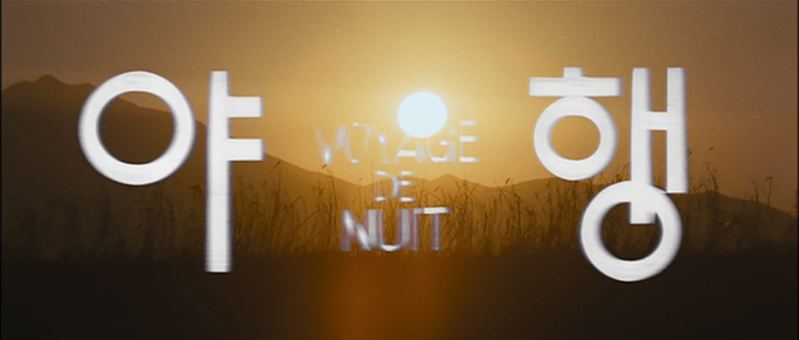
Night Journey posterIncreasing economic prosperity dangles tantalising rewards for the young and ambitious, but for women trapped by outdated social codes the pleasures of success are largely off limits. Director Kim Soo-yong was well known for literary adaptations and Night Journey (야행 / 夜行, Yahaeng) is, like Mist, inspired by a Kim Seung-ok novel but Kim makes a point of shifting the focus, telling the story not just of a jaded bank clerk but also of the effects of living under an authoritarian regime which demands (superficial) conformity, insists on productivity, and slowly destroys the souls of all those caught in its perilous march forwards into the corporate future.

Lee Hyeon-ju (Yoon Jeong-hee) is a woman of a certain age, unmarried, and working as a teller in a bank in Seoul. One of two “old maids” in the office, Hyeon-ju is shocked to find out that her fellow bachelorette from the adjacent desk is about to marry Mr. Choi – the couple had kept their relationship a secret but now that the engagement is public, Miss Oh will be quitting her job the day before the wedding. Alongside the joy such news surely brings, everyone seems to be making a point of being “sensitive” around Hyeon-ju, worried she will be hurt or embarrassed to learn of another woman getting married while she remains single and alone. Hyeon-ju seems more annoyed by the attempts at sympathy than anything else, but accepts her boss’ offer of a few days vacation even if she seems aware it’s mostly to get her out of the way and avoid any potential awkwardness.

Awkwardness is not something that’s going to go away though because Hyeon-ju is leading a double life in which she is actually living with bank clerk Mr. Park (Shin Seong-il) who manages the desk behind her but doesn’t want anyone at work to know about their relationship. Hyeon-ju goes home early to make dinner, but Park plays the after work drinking game, rolling in drunk and collecting the sleeping Hyeon-ju off the couch to deposit on the bed where he climbs on top of her and sates himself before rolling over in a drunken snooze. The relationship between the pair is, effectively, that of a bored middle-aged couple only they do not have the security of a marriage certificate and live in constant uncertainty.

When Hyeon-ju returns home from her brief trip back to the town where she grew up, Park does not say that he missed her, just that things have been very “inconvenient” with her away. “Convenient” is something Hyeon-ju worries defines Park’s feelings towards her, that he regards her as a part of the furniture, as something merely to serve his own desires. A rare evening at home together finds them enjoying a boxing match on TV which later leads to an amorous moment on the floor but just as he did before, Park gives up half way through to go back to the boxing, almost forgetting Hyeon-ju is even there. The other marriage at work prompts Hyeon-ju to wonder if it isn’t time they too made things official, but Park lazily brushes the question off, claiming to find marriage and all that sort of thing very boring. Spying on her partner at work, Hyeon-ju perhaps worries he plans to dump her for a match more advantageous to his career while she remains trapped in her dead-end bank teller job with a marriage her only realistic path to a successful middle age.

Hyeon-ju craves satisfaction – some real connection with Park that makes her feel alive, needed, wanted, and seen as a distinct individual. Returning to her hometown she reverts to her teenage self – putting on her high school uniform and taking her little sister down to the beach to ride her bike just as she had done. It is however not all happy memories – Hyeon-ju was drummed out of town as a hussy, the entire community know and remember her sordid past and if she were to consider an arranged marriage back home she could not expect to marry very well. Nevertheless, a now widowed son of a wealthy family takes an interest but Hyeon-ju is disappointed to realise that despite his bad boy exterior and fancy motorbike, her suitor is a small-town boy after all with a bashful attitude to love and sex which stands in contrast to Heyon-ju’s own passionate, seemingly free nature.

Freedom, however, is something she seems to have little of. We catch her catching sight of a man being handcuffed as she stands atop a busy bridge and we assume she recognises it as a echo of her own oppression but in actuality she fetishes the act of being manacled, almost compelled to place herself in a position of relative powerlessness. Later, on the same bridge, she’s dragged off by a rough man who apparently takes her to a nearby hotel and assaults her while her attempts to resist read more like playing along. Later she goes back to the same bridge, perhaps hoping to see the man again, violent acts of passion seemingly the only ones that wake her from her restlessness.

Fed up with Park, she roams the city streets alone – something respectable women rarely do as she proves when an attempt to enjoy a solo drink arouses the interest of an entire room filled with drunk salarymen in which she is the only female. Drunk men in the street attempt to pick her up and again she seems to enjoy deflecting them, often with little more than a glare though she is mildly surprised when one of them turns out to be the recently married Choi who reveals to her that he is disappointed with married life after discovering Miss Oh was not a virgin during their honeymoon.

The separation of the sexes seems to dictate that men spend the majority of their lives in the deliberately homosocial world of work with its frequent after-hours drinking sessions, while women (excluded) are left with little to occupy their time outside of becoming wives and mothers. Hyeon-ju seems to want something more, but her nighttime catwalk affords her only the mild sensation of pleasure in attracting attention solely so she can exercise the power to reject it.

Yet her attitude to men and sex is perhaps also due to having experienced betrayal and manipulation at a young age. The reason for her expulsion from her hometown was an illicit affair with her middle-aged teacher whose deflowering of her on that same beach on which she rode her bike seems to have occurred with a degree of violence which she continues to crave in all her subsequent couplings. The teacher, with whom she seems to have shared some kind of wedding ritual, was killed in Vietnam, ruining both her reputation and her future prospects through a relationship that was certainly unethical but she alone has payed the price for. He lies in the military cemetery opposite her apartment where she makes awkward, flirtatious eye contact with the soldier on guard each time she walks past.

Hyeon-ju’s hometown ruminations and odyssey through nighttime Seoul only serve to ram home to her how impotent she has been in her dull yet ordinary city life. Seoul may seem like a bustling metropolis of burgeoning modernity but it’s still full of the same tired old ideas where men are men and women are not much of anything. She fantasises about going on a crime spree with a rough looking guy from a cafe but ends up paying for his coffee before becoming the only grownup in an arcade among a group of kids in an attempt to dissolve some of her frustration. Eventually getting what she thought it was she wanted, Hyeon-ju has come too far not realise she doesn’t want it anymore. Literally railroaded into conventionality, she makes the staggering decision to just get off the train altogether, leaving her lover only the cryptic message that the holiday is now over.


Available on DVD as part of the Korean Film Archive’s Kim Soo-yong box set. Also available to stream for free via the Korean Film Archive’s YouTube Channel.

Mist (안개, Kim Soo-yong, 1967)

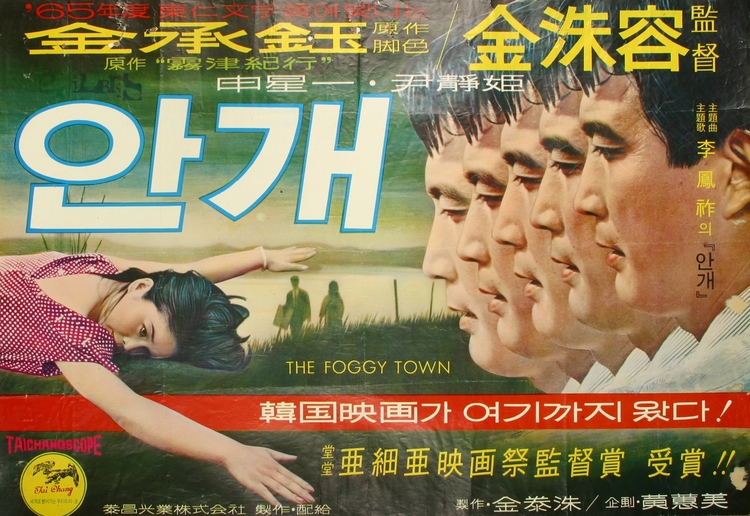
Mist 1967 posterBy 1967 Korea’s fortunes were beginning to expand. For the young, the future held promise but the nature of that promise was still indistinct. Often considered his masterpiece, 1967’s Mist (안개, Angae, AKA The Foggy Town) was another in the series of literary adaptations for which director Kim Soo-yong had become well known but its avant-garde mise-en-scène and gloomy outlook stand in stark contrast to the heartrending melodramas with which the genre was synonymous. Economic prosperity and superficial success have provoked only emptiness and despair, but a return to source provides little clarity for one harried salaryman lost in the expanding landscape of Korea’s global ambitions.

A poor boy from a remote coastal village, Gi-joon (Shin Seong-il) is now a successful salaryman in the capital where the constant clacking of typewriters, ringing of telephones, and racing of traffic rub at his tired mind. The fact of the matter is Gi-joon is not all that successful – he owes his position to having married the widowed daughter of the CEO. His wife and father-in-law, however, have relatively little faith in his business acumen and so, with the annual shareholders meeting on the horizon, they suggest he get out of the way by paying a visit to his hometown. Gi-joon is not all that happy to be going back, he hated Mujin with its unrelenting fog and general air of existential malaise, but he’s spineless and so he goes, despite himself.

Taking the train, Gi-joon has plenty of time to dwell on his past, literally seeing reflections of his younger self and entering extended flashbacks of memory. Mimicking the stream of consciousness approach of the novel, Gi-joon provides frequent voiceover, introducing his hometown in a less than favourable light as a place which traps its young who yearn to be free of its oppressive boredom. According to the irritated dialogue of two passengers on the bus (which Gi-joon has to take after his lengthy train journey), Mujin is a nothing sort of town where the sea is too shallow for fishing and the fields to narrow for farming, yet the population is large and largely survives on desperation alone, isolated by the oppressive fog that envelops the landscape each and every morning.

Gi-joon characterises the residents of Mujin as petty and materialistic. Having longed to escape, he thought he’d achieved his dreams in Seoul but a trip home forces him to reconsider what it is he’s become. In truth he’s no different from the petty and materialistic villagers he looked down on in their need to look down on each other. Powerlessness has defined his life. As a young man, he resorted to hiding in a cupboard to escape the draft on the orders of his terrified mother and later suffered from weak lungs which made him something of a local laughing stock. Now he’s set for a big promotion in the city but, as his wife reminds him, he wouldn’t even be there if it weren’t for her. Gi-joon’s marriage is one of convenience but it’s clear his wife holds all the cards – a wealthy widow with ambition needs a husband to act as a foil, and a weak willed man like Gi-joon is just the sort to submit himself to her authority in return for the obvious benefits she can offer him. Gi-joon has gained everything he ever dreamed of, but he feels only despair, oppressed by the very system he longed to be a part of.

Back in Mujin his various self delusions are rammed home to him. Trapped once again by the unrelenting fog, he longs to escape from his Seoul life and free himself from the yoke of his marriage and career. Whilst in town he meets up with old friends who introduce him to recent arrival Ha In-sook ( Yoon Jeong-hee) – an opera student turned music teacher who has joined the local school. In-sook is by far the most exciting thing in the extremely boring town, but Gi-joon is worried he’s stepped into the middle of something when he realises his old friend, Park, now a teacher, has a crush on In-sook while another old friend, Cho, now a status obsessed tax inspector, may also have marital designs.

Gi-joon didn’t need to worry about the tax inspector – as it turns out, he thinks he can do better than a mere music teacher and plans to marry up, much like Gi-joon has. Gi-joon bristles slightly at this, as he does to Cho’s lewd story about how he trapped In-sook on an overnight trip and planned to have a fling with her but she managed to get away (much to Gi-joon’s relief). Back home Gi-joon sees reflections of himself everywhere and particularly doesn’t like this alignment of himself with the ugly ambition of men like Cho who only want to lord it over their former friends. More flatteringly he sees his younger self in the depressed, conflicted In-sook who is already going half mad in the stultifying rural town and longs to go back to Seoul. Despite mild qualms about his friends’ feelings, Gi-joon finds himself bonding with the melancholy young woman who again forces him to see himself the way he really is rather than as the idealised personality he’d constructed for himself as a successful Seoul salaryman.

Bonding in their existential loneliness, the two eventually embark on a tender if melancholy affair which, despite their protestations to the contrary, is built on self delusions if not exactly on lies. Gi-joon intends to take In-sook to Seoul, but he won’t, and In-sook knows she won’t leave even if she wants to believe in the possibility of rescue. The world for them is as foggy and indistinct as the mists around the beaches of Mujin. Filled with emptiness and despair, they remain adrift in the post-war society unable to accept the soulless compromises of conventionality but finding no escape from their self imposed prisons.


Available on DVD as part of the Korean Film Archive’s Kim Soo-yong box set. Also available to stream for free via the Korean Film Archive’s YouTube Channel.

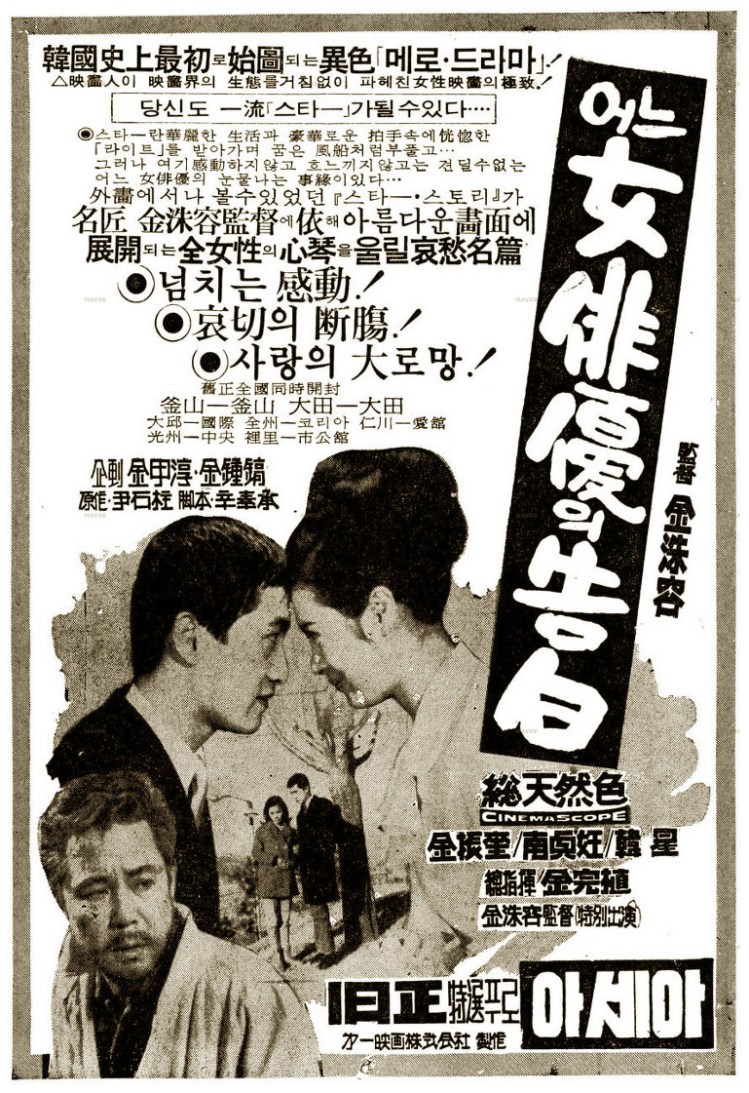
Confession of an Actress (어느 여배우의 고백 / 어느女俳優의告白, Kim Soo-yong, 1967)

Confession of an actress posterKorean filmmaking of the 1960s is sometimes referred to as a “golden age”, but the reality is that films were often churned out at a rapid pace for immediate distribution. Producers got an advance from local distributors, picked a scenario, assigned a suitable director and slotted in big name stars they already had under contract. For this reason production values are often low, but performance standard high despite the fact that many stars are bouncing around from one film to another shooting a scene here and a scene there. Director Kim Soo-yong filmed 10 features in 1967 – including his masterpiece Mist. Confessions of an Actress (어느 여배우의 고백 / 어느女俳優의告白, Eoneu Yeobaeu-ui Gobaek), inspired by a novel by Yun Seok-ju, is the kind of straightforward melodrama that was going out of style – a virtual remake of Chaplin’s Limelight with a little Phantom of the Opera thrown in, but Kim neatly repurposes it as a meta take on the Korean film industry of the day.

Kim Jin-kyu (played by the actor of the same name) was once a famous movie star, but heartbreaking tragedy ruined his career and now he’s a washed up drunk dreaming of the past. Hearing the dreaded “hey mister, didn’t you used to be somebody?”, Jin-kyu wanders into a film shoot and is thrown back to a happier time when he starred in prestige pictures with his regular co-star who was also his lover. Sadly, Miyong died of an illness leaving their last picture unfinished. The studio producers wanted to replace her and complete the movie, but Jin-kyu wouldn’t have it. They sued him for obstruction and his career was ruined. Jin-kyu was told that the child Miyong was carrying had died, but unbeknownst to him, a daughter was born and Miyong asked her friend Hwang Jung-seun to give the baby up for adoption and save it from the stigma of being illegitimate. Running into Jung-Seung at the shoot, Jin-kyu finds out his daughter is alive and determines to turn her into a great star – the only thing he can do for her as her father now that he is in such a sorry state.

Almost all of the characters in the film are named for their actors, though they are obviously not playing themselves in any biographical sense. Nevertheless, there is an intentional reflexivity in Kim’s decision to shift away from his literary source to towards one more immediately cinematic. Much as in Chaplin’s Limelight which does seem to provide a blueprint for the narrative, the arc is one of tragedy and redemption as Jin-kyu attempts to make up for lost time by imparting all his professional knowledge to the daughter he never knew and ensuring her success even at the cost of his own. Ashamed to introduce himself to her as a father given that long years of lonely drinking have reduced him to a broken old man, Jin-kyu gives his advice via letter and avoids seeing Jeong-im, longing to embrace her but afraid he’ll bring shame on her growing fortunes.

When Jin-kyu gets Jeong-im into show business, Kim gets a chance to put the Korean film industry on screen. He starts with a mildly sleazy producer and the established star who’s getting too old for ingenue roles but is desperate to hang on to her leading lady status. Nevertheless, she does have the option, as she points out, of a dignified escape through marriage should her career fail – something that is not an option for her male co-stars. As a young hopeful with no experience and nothing to recommend her beyond a pretty face, Jeong-im’s entry into the world of film is a baptism of fire. Rushed through makeup with its uncomfortable fake eyelashes and into an unfamiliar costume, Jeong-im’s rabbit in the headlights performance does not endear her to the director or more particularly the producer who is looking on from the wings in exasperation quietly calculating how much all of these extra takes are costing in wasted film. Nevertheless, the film is a success and, thanks to Jin-kyu’s careful tutoring, Jeong-im is on track for stardom.

Kim fetishises the camera, the process of filming with its bright artificial lights, tricks and techniques from the ice cold studio shoots to the difficult trips out on location. He makes full use of the relatively rare colour format utilising frequent superimpositions and montages, overlaying the bright neon lights of Seoul with the interior journey of our leading lady as she begins to find her voice. Making a final self cameo, Kim gives in to the inherently melodramatic quality of the underlying narrative but he does so somewhat ironically, rolling his eyes at the need for overly dramatic emotionality while actively embracing it, and lamenting the hardships of filmmaking while churning out his third picture in as many months. Confession of an Actress is not the salacious exposé promised by the title, but it is an illicit look at the decidedly unglamorous side of film production a world away from the bright lights and glossy magazines. 


Available on DVD as part of the Korean Film Archive’s Kim Soo-yong box set. Not currently available to stream online.

The Seashore Village (갯마을, Kim Soo-yong, 1965)

The Seashore village posterKorean cinema of the 1960s was a tightly controlled affair. The authoritarian government of Park Chung-hee had instituted the Motion Picture Law of 1962 which insisted on a studio system with stars under contract and a turnover of at least 15 films a year. The law intended to increase the amount of films produced for mass consumption, giving free reign to the melodrama and thereby accidentally undermining its more censorious aims. Nevertheless, The Seashore Village (갯마을, Gaenma-eul), adapted from a novel by Oh Yeong-su and part of the “literature film” genre for which director Kim Soo-yong would remain famous, goes much further than one would reasonably expect given the conservative nature of Korean filmmaking across the ages. A story of village life with all of its various superstitions and primitive practices, Kim’s film is a daring exploration of female sexuality and the collective power of women away from men.

An opening voice over introduces us to a melancholy fishing village where the life is hard and the people resigned to loss. The boats depart to great fanfare, but just as they are leaving someone remarks that he’s had a bad dream – bad dreams are one of many bad omens for sailors. New wife Hae-sun (Ko Eun-ah) doesn’t wait to watch her husband disappear over the horizon, she takes to the clifftop shrine of the Dragon King and prays for his safe return.

Her prayers are unanswered. A typhoon strikes and Hae-sun’s husband, along with another sailor, is killed. So young a widow, Hae-sun becomes an awkward problem for the villagers. Sang-su (Shin Young-kyun), a shady drifter, begins making subtle overtures which eventually turn into outright harassment and attempted rape. Hae-sun likes the family she married into and wants to stay true to her husband’s memory, but the forces of nature conspire against her.

While Hae-sun is a classically “good” woman who rejects the advances of Sang-su, the other village wives feel rather differently. Everyone except Hae-sun’s widowed mother-in-law (Hwang Jung-seun) knows about Sang-su’s obvious desire for Hae-sun but they see nothing wrong in it. Rather than the conservative atmosphere of the middle-class urban melodrama in which bodies of surrounding middle-aged women act as enforcers of moral discipline, these literal fishwives are of an earthier disposition. Many of them have been widowed with husbands lost at sea – the way they see it, you’d best take your pleasures where you can and there’s nothing wrong with a quick roll in the hay if it eases frustration and aids productivity. They laugh at Hae-sun’s prudery and marvel at her ability to carry on as normal after losing her husband not because of the grief, but because of the lack of intimacy.

It might be 1965 outside of the village, but the old ways still rule here even if they’re on their way out. In the old days, women did not remarry – a serious problem in a small village with few men around to replace those lost at sea. Hence, women have learned to live alone, supporting each other in place of men and often forced to do without them. In a surprising development, Kim flirts with the taboo of lesbianism – something which is addressed half-jokingly by the gossipy widows but eventually gives way to a literal roll in the hay with half the village women looking on in hilarity rather than horror. The women joke about living together but lesbianism does seem to be presented as an imperfect solution to their present problem in the lack of satisfaction available to them due to the absence of men. Far from a taboo, sexual desire is a normal part of life in the village – something ranked alongside eating and sleeping and no more or less embarrassing than any other bodily function. The widows crave men and are unafraid to say so even if some of them are content to make do with each other in resignation to their awkward status as older single women.

Hae-sun is in a slightly better position given that remarriage is apparently no longer so much of a taboo. Unfortunately that presents a problem for her as all she wants to do is stay with her family just as she is. She doesn’t like Sang-su and his increasingly aggressive behaviour towards her is unlikely to change that but nevertheless she eventually finds herself given to him almost against her will. Despite becoming a wife once again, Hae-sun’s beauty continues to curse her by causing problems between men wherever she sets foot. The problems, however, are definitively on the male side – men long to possess her, with violence if necessary, and ruin themselves in their immoral pursuit of a “pure” woman. The village widows rejoice in their earthy pleasures, finding comfort and release in each other but the male impulse, by contrast, is always towards conquest and control, domination rather than mutual support.

Life in the village is hard and often sad, but the women are happy and optimistic. They live the lives that are given to them, and do the best they can with what they have. The very antithesis of the lurch towards modernity, the simple life of the villagers harks back to something purer and more honest without the pretension of urban civility and apparently free from the political concerns of the day. Bold in its outlook, The Seashore Village is a surprisingly progressive effort from the Korea of 1965, subverting its “primitive” setting to present a positive picture of female power and sexuality.


Available on DVD as part of the Korean Film Archive’s Kim Soo-yong box set. Also available to stream for free via the Korean Film Archive’s YouTube Channel.

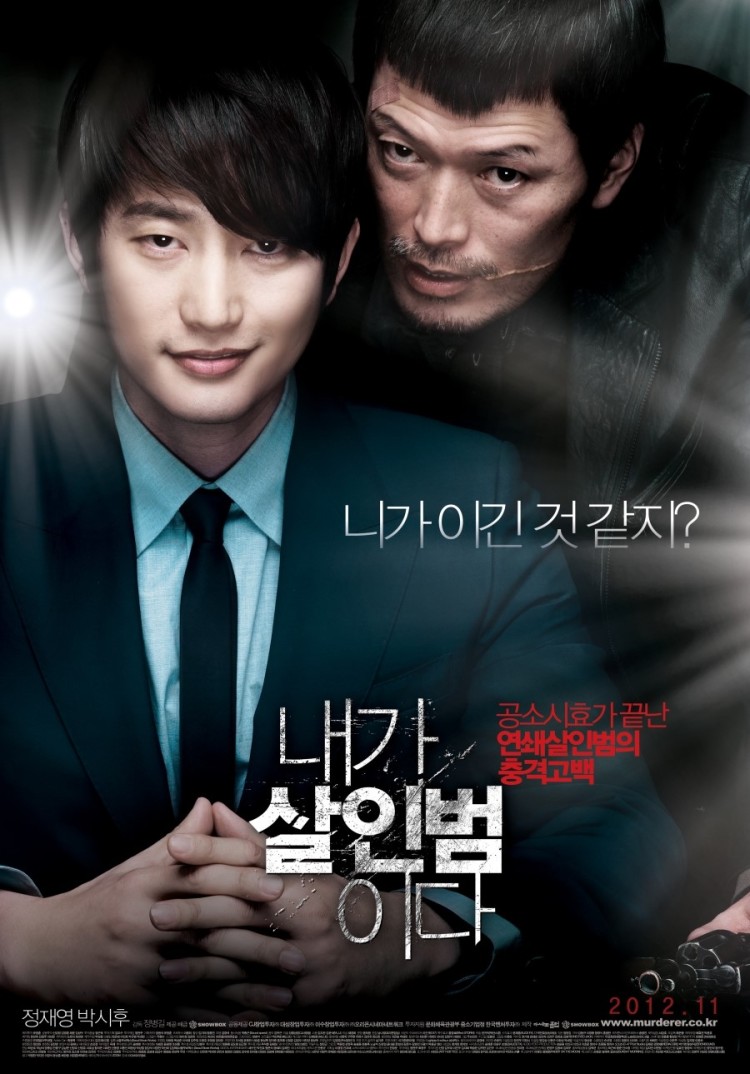
Confession of Murder (내가 살인범이다, Jung Byung-gil, 2012)

Confession of murder posterThe UK does not have a statute of limitations for criminal cases, only for civil ones, so if you want to be certain you’ve got away with murder you’ll need to wait until the very end and offer only a deathbed confession. In Korea, however, the statute of limitations on murder is (or was, at least, in 2012) 15 years so after that time you can even go on TV and tell everyone you’re a serial killer and all that will happen is that you’ll suddenly become a media darling beloved by a hundred giddy schools. Such is the premise behind Jung Byung-gil’s complicated mystery thriller Confession of Murder (내가 살인범이다, Naega Salinbeomida) in which a grizzled detective and the bereaved relatives try to cope with their guilt and desire for revenge by enacting their own kind of justice on a self-confessed serial killer.

15 years ago, Detective Choi (Jung Jae-young) let a serial killer get away with only a scar on his cheek and the killer’s promise of reunion to show for it. 10 women are dead and Choi’s own fiancée missing presumed among the victims, and with the statute of limitations about to expire it appears that the killer will get away with his heinous crimes having successfully outlived justice. On the day the killer is officially off the hook, one of the victim’s sons commits suicide, further adding to Choi’s sense of inadequacy in being unable to bring the killer to justice within the time limit.

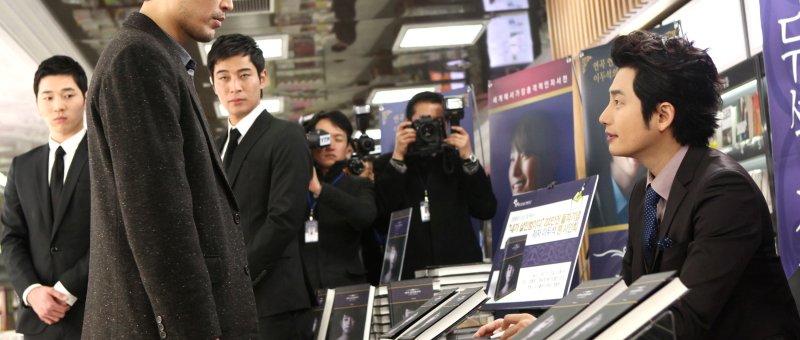
Two years on from the limitation passing, a handsome young man steps into the limelight with a book called “Confession of Murder” which claims to be an exposé on his reign of killing. Lee (Park Si-hoo) with his pop idol good looks and suave manner quickly becomes a media sensation despite the discomfort of some that he is profiting from the deaths of his innocent victims whom he has also robbed of justice even if he claims to be remorseful and to have reformed. Detective Choi has his doubts about the killer’s account and particularly about the possible 11th victim whose body has never been found.

Aside from the intrigue surrounding the true identity of the killer (or killers), Confession of Murder has a few difficult questions to ask about the nature of fame and the cult of celebrity. Lee has just confessed to a brutal series of unsolved killings of women, but thanks to his boy band good looks and impressive media marketing campaign he’s already amassed a fan club of adoring young girls including three rowdy high schoolers we first meet in Choi’s prison cells. Having escaped justice, Lee feels secure enough in his legal protections to crow not only about his crimes but in having gotten away with them so skilfully. His book becomes a best seller and his TV appearances hotly anticipated even if the fascination behind them maybe more ghoulish than intellectual or steeped in admiration.

What Lee exposes is a set of judicial double standards in which a man who has not paid for crimes he freely admits committing can be allowed to remain free and even use those same crimes to build a new life for himself by exploiting them for financial and social gains. The families of the bereaved, denied justice, seek their own – as does Choi even if he does it as a serving law enforcement officer. The lines between justice and revenge become ever blurred as the killer subverts the protections of the law as weapons against those who would seek to see that his crimes are properly served by it.

Meanwhile, Jung veers wildly between taught psychological thriller and absurd action drama in which an attempt to kidnap the killer is made by throwing poisonous snakes at him and then stealing him away in a fake ambulance which soon gives way to a lengthy motorway chase. The action sequences, often unexpected, are brilliantly choreographed set pieces of frenzied attack and retreat in which the outcome is perpetually uncertain. Uncertainty is certainly something Jung is adept at using as his narrative becomes ever more convoluted and intentions increasingly cloudy.

As much fun as it all is, Confession of Murder also has its degrees of poignancy in insisting on a need to deal with the unresolved past head on. Buried truths begin to fester and no amount of wilful forgetting will cure them, only the truth will do. Detective Choi faces a serious dilemma when faced with the limitations of a system to which he has devoted his life and which has already taken so much from him. If he transgresses, he will be judged by that same system but the judgement itself will also be a kind of affirmation that justice has finally been done and the case firmly closed.


Original trailer (English subtitles)