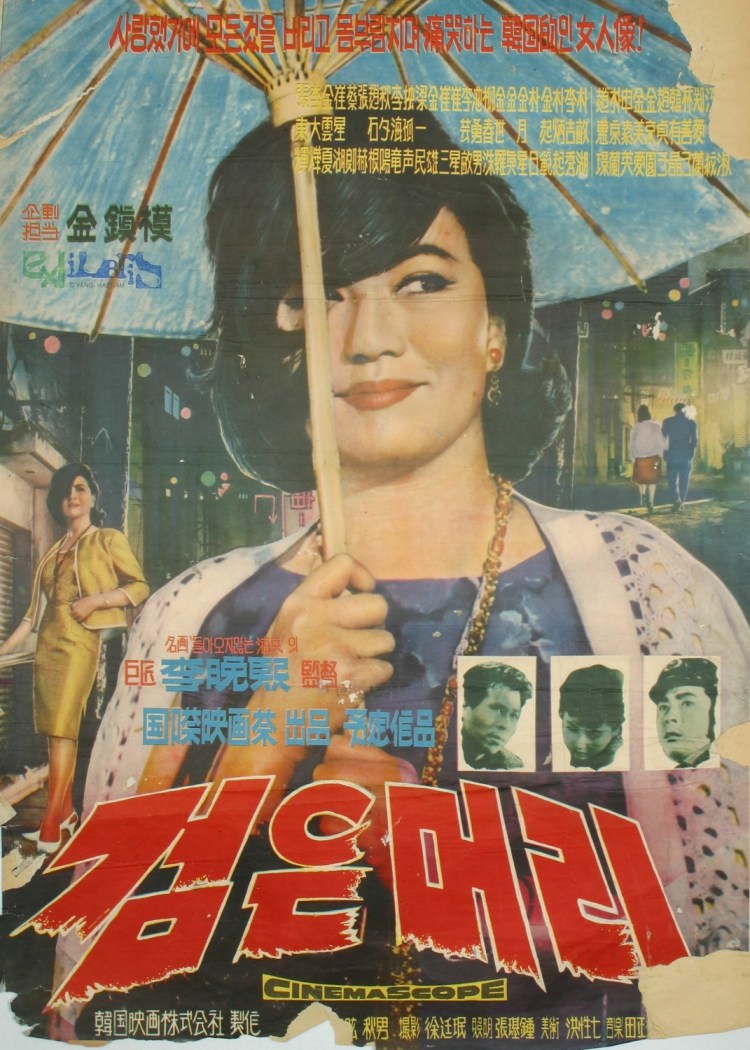
Black Hair (검은 머리, Lee Man-hee, 1964)

Black Hair 1964 posterFilm noir can be the most contradictory of genres. A moralistic world filled with immortality, fatalism mixed with existential angst, and a rage against society which is always tinged with a resignation to living on its margins. Genre in Korean cinema has always been a little more fluid than elsewhere and Lee Man-hee’s seminal crime thriller Black Hair (검은 머리, Geomeun Meori) is also a melodrama – the story of a self loathing man committed to his own arbitrary codes, and a woman he expects to pay the price for them.

In a brief prologue that has little to do with the ongoing narrative, ruthless gangster Dong-il (Jang Dong-hui) extorts a corrupt CEO by blackmailing him over some illicit smuggling. Meanwhile, across town, the gangster’s wife, Yeon-sil (Moon Jeong-suk), meets with a man, Man-ho (Chae Rang), in a hotel room. She’s come to pay him off, hoping it will be for the last time but Manh-ho, an opium addict, knows he’s onto an endless cash cow and refuses to put an end to their “arrangement”. Sometime ago, Man-ho raped Yeon-sil and has been blackmailing her for money and sexual favours ever since. Yeon-sil threatens to tell her husband and the police and suffer the consequences, but Man-ho knows she won’t. Dong-il’s gang have a strict rule about adultery and if Yeon-sil trusted him enough to believe he would believe her about the rape, she would have told him already.

Another goon hides behind a screen, snapping photos of Yeon-sil and Man-ho which he later passes on to Dong-il. The boss is shocked and shaken. He knows he has to enforce the rules he himself set down for the gang, but he never expected them to cost him his wife. Eventually Dong-il orders an underling to slash Yeon-sil’s face with a broken bottle, after which she is exiled from the gang. Anyone who tries to repair her scars or help her in any other way will be treated as an enemy.

At this point the narrative splits as Yeon-sil is cast down into a sleazy underworld, living with her blackmailer who pimps her out as a common streetwalker and then steals all her money to spend on drugs and booze. She pines for her husband whom she has been prevented from seeing, longing to at least explain why she did what she did and ensure he knows that her heart has always been with him. Dong-il, by contrast, is going to pieces – his gang no longer respect him, he feels guilty about the way he treated his wife, and he has no idea where to go from here.

Unlike other films of the era or film noir in general, Lee’s world view is non-judgemental in its treatment of the respective paths of Yeon-sil and Dong-il. Yeon-sil is left with no choice than to enter into a life of casual prostitution and the film forgives her for this – the fault is that of Dong-il and Man-ho rather than her own. Having been horribly scarred, she wears her hair longer on one side to hide her disfigurement but is constantly reminded of her emotional damage through its physical manifestation and the reactions it often elicits. Picking up a client in the street, she’s threatened with violence and cruel words for having “deceived” him when he catches sight of her disfigured face. A passing taxi driver witnesses the attack and challenges the man so Yeon-sil can escape. The cabbie then hires her and they spend the night together in a nearby brothel. He surprises Yeon-sil by being entirely unfazed about her facial scarring, offering to help her get it treated if that’s what she wants, and making it clear he would like to spend more time with her off the clock.

Yeon-sil’s life is completely controlled by her triangular relationship to the three men – her unforgiving husband Dong-il, the cruel and venal Man-ho, and the good and decent cab driver. After meeting the cabbie, Yeon-sil tries to see Dong-il again but his boys stop her. They say they’ll take her to see him, but really they’re planning quite another destination. Luckily, in a staggering coincidence, they’re spotted by the taxi driver who once again saves Yeon-sil, taking her home to stay with him and proposing they embark on a more formal relationship.

This is more of a problem than it seems for Dong-il’s guys who now fear their boss will find out they tried to kill his wife in an effort to wake him up from his ongoing existential malaise. The rules of the gang are tough and clear – adultery is not permissible, no woman is allowed to leave, no exceptions are to be made. Dong-il, however, is beginning to rethink the code he himself designed. A conversation with his childhood nanny throws up a number of interesting questions. She blames herself for giving Dong-il “evil” milk which has led to his spiritual corruption, though Dong-il later tells Yeon-sil that he did not choose evil so much evil chose him. He created these “evil” gang rules, but failed to live up to them in continuing to feel attached to Yeon-sil – he feels he must punish himself for the “sin” of being unable to forget her and abide by his own honour system which he now feels to be pointless and arbitrary. Effectively issuing himself a death sentence, Dong-il changes tack confirming that he has, in a sense, chosen evil even if it was a “choice” of refusing to resist the path set down for him. Suddenly realising the emotion he felt for Yeon-sil was love, he is struck by a terrible feeling of loneliness. 

As in much of Lee’s work, Yeon-sil and Dong-il are trapped by their own society and belief systems and finally perhaps by feeling. Yeong-sil is frequently captured behind bars or caught in a window, imprisoned within the frame as she tries to reconcile herself to her precarious position, daring to hope for a new, decent life with the good hearted taxi driver while also mourning her love for Dong-il and living with the humiliation caused to her by Man-ho. Lee’s structure is sometimes unclear as he introduces a fairly pointless subplot about the taxi driver’s modern woman little sister who has moved out to be independent but works in a hostess bar, inhabiting the same sleazy world as Yeon-sil and Dong-il, only more innocently, but never does much with it beyond contrasting the lives of the two women who occupy slightly different generations and have very different options open to them. There’s a fatalism and inevitability in the way Yeong-sil and Dong-il live their lives to which the taxi driver and his sister do not quite subscribe but Lee breaks with the genre’s trademark pessimism to offer the glimmer of a bittersweet ending and the chance of a new beginning for the much abused Yeon-sil now freed of her dark associations.


Black Hair is the second in The Korean Film Archive’s Lee Man-hee box set which comes with English subtitles on all four films as well as a bilingual booklet. (Not currently available to stream online)
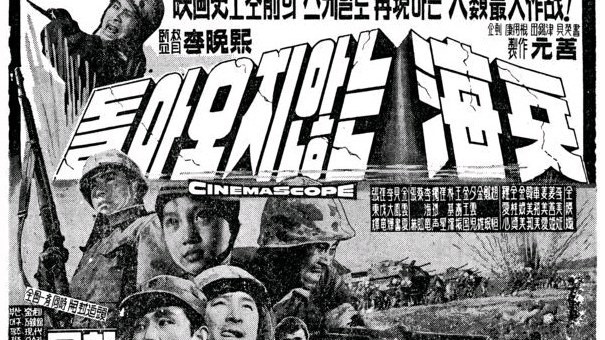
The Marines Who Never Returned (돌아오지 않는 해병, Lee Man-hee, 1963)

Marines Who Never ReturnedLee Man-hee was among the most prolific of Korean directors until his untimely death at the age of just 43 in 1975, but even among so many well regarded works The Marines Who Never Returned (돌아오지 않는 해병, 돌아오지 않는 해병, Doraoji Anneun Haebyong) has taken on an especial place in Korean film culture. Lee had himself served in the Korean War and brought his own ambivalent attitudes to the piece, expressing both an abject rejection of the senseless loss of life but also a warmth and nostalgia for the camaraderie born only out of such immediate danger. The film’s title, as melancholy as it is, points to this same ambivalence by signalling the eventually unhappy fates of these ordinary men but also according them a ghostly, unresolved future.

In the midst of the Korean War, a squad of South Korean soldiers is on patrol and taking fire from the Chinese in an urban environment. While they bide their time in a trench, a young girl and her pregnant mother run out of a nearby building. The girl runs clear but the mother is shot and killed in the crossfire. One of the soldiers is deeply struck by the scene and insists they at least make sure the little girl is safe. Pushing deeper into the building, the soldiers come upon a truly horrifying, hellish scene of men trussed up and hanging from the ceilings while bodies of the townspeople lie piled along the floor. The same soldier who wanted to save the little girl finds his own sister among the dead, just one face among so many.

From this point on the tale is narrated by the little girl, Young-hui (Jeon Young-sun), who is adopted by the troop of marines and smuggled around inside an old army kit bag so that the superiors do not find out about her presence. Young-hui proves a resilient little girl who obviously misses her parents but begins to care deeply for the soldiers who have taken her in. Giving each of her new uncles nicknames, Young-hui becomes the squad’s mascot and a symbol of everything it is they’re fighting for. Yet this makeshift family also has its share of difficulties. A problem arises when Young-hui recognises a new recruit, Choi (Choi Moo-ryong), as a man from her village. Choi is the brother of the man who joined the other side, took Young-hui’s father away and killed the sister of Private Goo, discovered so casually among the many dead in Young-hui’s village alone.

The conflict between Choi and Goo is emblematic of many ordinary families throughout Korea as fathers and sons, brothers and sisters, decided on different paths and found themselves on opposing sides of a war. Choi, as is pointed out, is not responsible for his brother’s actions – he clearly does not condone or agree with them, but still he feels responsible enough to understand Goo’s anger and resentment. Goo in turn realises his anger is pointless and misdirected but is powerless to change the way he feels. This situation is no one’s fault, but they’ll all pay the price anyway.

Lee spares no expense in recreating the hellish battles scenes more akin to the first war than the second with its outdated tanks, dugouts, and trenches. The easy, familial life of the camp soon gives way to action and danger as the squad meet their ends one by one. Away from the battlefield the men feel displaced within their own country – caught in the midst of a civil war yet also subjugated by foreign forces, barred from UN only bars and referred to as “tuppenny Koreans” by the “hostesses” in comparison to their big spending compatriots. Making his goodbye speech, the commanding officer instructs his comrade to return home and ask if anybody really needs to go to war, but rising from the trenches their thoughts are all for their fallen friends who will never see home again. These men remain “lost” on the battlefield, a lingering memory of loss and sacrifice which is impossible to resolve even so many years later.


The Marines Who Never Returned is the first in The Korean Film Archive’s Lee Man-hee box set which comes with English subtitles on all four films as well as a bilingual booklet but the film is also currently available to stream via the Korean Film Archive’s YouTube channel.


M (엠, Lee Myung-se, 2007)

“More specific, less poetic” the distressed author hero of Lee Myung-se’s M (엠) repeatedly types after a difficult conversation with his editor. Almost a meta comment on Lee’s process, it’s just as well that it’s advice he didn’t take – M is a noir poem, a metaphor for an artist’s torture, and a living ghost story in which a man shifts between worlds of memory, haunted and hunted by unidentifiable pain. Reality, dream, and madness mingle and merge as a single kernel of confusion causes widespread panic in a desperate writer’s already strained mind.

A young woman haunts the screen, pleading with us to remember her and be sad. She is a dream, a visitation into the mind of blocked writer Han Min-woo (Gang Dong-Won) whose publishers are eagerly awaiting the completion of his next manuscript. Back in the real world, the same young woman appears around Min-woo but seems to be in an entirely different plane of existence, completely invisible to the man she claims to love. Eventually Min-woo enters a mysterious back alley bar and finally engages with the girl, Mimi (Lee Yeon-Hee), before blacking out and forgetting all about the whole thing.

Reality resets once again and we realise Min-woo is about to be married to Eun-hye (Kong Hyo-Jin) – the daughter of a wealthy man who seems to approve of the marriage if not, exactly, Min-woo’s literary career. Min-woo should be happy – he’s getting married to a woman he appears to care for, has been successful in his career, and has everything pretty much set for life at only 29. Min-woo is not happy. Persistent writer’s block means he’s written almost nothing with a deadline approaching, he’s worrying about money, and somehow or other he can’t quite commit to Eun-hye – there is something nagging at his mind, but try as he might he cannot say what.

Min-woo is worried enough to visit a psychiatrist but the doctor offers little more than a bottle of prozac and an instruction to call back in the morning. His mental state is clearly fracturing but even objectively his manner is strange, suddenly shouting or issuing orders in a shocking break from his generally mild mannered exterior. As if the mounting pressure of his overdue manuscript weren’t enough, Min-woo is extremely insecure in his literary talents. He views himself as a successful hack, berating those who dare to praise his work as fans of cheap trash.

Yet his internal world seems to be defined by potboiler hardboiled with its rain drenched streets, foggy avenues, and smokey bars peopled by miserable whiskey drinking men and omniscient bartenders. Describing the process of piecing his fractured mind back together as re-editing a film in which several frames are missing, Min-woo quickly becomes lost inside his own internal landscape, trying to locate the wound to stem the bleed but finding it ever elusive. Mimi is more than a spectral figment of his imagination. A living personification of the living past, her presence haunts him with the power of mystery, like something unforgettable which has long been forgotten.

In the end, Min-woo’s creative madness is a salve for an internal scar but its final resolution may be its own undoing. A love story and a ghost story, Min-woo’s crisis is every man’s obsession with lost love. Guilt mingles with pain and regret but also with existential confusion and unresolvable loss. As he later puts it, you lose things, often the things which are most important to you – it is a part (and a privilege, in someone else’s words) of being alive. You try to bury your pain in oblivion but eventually the things you’ve lost will be returned in unclear or unexpected ways. Min-woo may have made peace with himself (or this aspect of himself), allowed a ghost to bid him goodbye, but then again, perhaps he only dreamed himself free and is forever condemned to remember and be sad.


Original trailer (no subtitles)

Lucid Dream (루시드 드림, Kim Joon-sung, 2017)

lucid dream posterA relatively rare phenomenon, a lucid dream is one in which the dreamer is aware they are asleep and “awake” enough to influence the outcome. Rather than using the ability to probe some kind of existential question, Korean science fiction thriller Lucid Dream (루시드 드림) focusses on the evidence gathering possibilities, going one step further than hypnotic regression to revisit old memories and zoom in on previously missed details.

Dae-ho (Ko Soo) is an investigative reporter currently in hot water over a controversial story. He’s also a doting single father to a little boy, Min-woo (Kim Kang-Hoon), who resolves to put his work aside for a day to take his son to an amusement park. Tragedy strikes as Dae-ho is busy having words with a paparazzo and then notices Min-woo has disappeared from his horse on the carousel. Catching sight of Min-woo walking off with another man, Dae-ho collapses, a tranquilliser dart sticking out of his leg. Dae-ho searches for his son with no concrete leads until, three years later, he hears about the possibilities of lucid dreaming and attempts to figure out exactly what happened that day by reliving it in his sleep.

Lucid Dream begins in true conspiracy thriller mode by introducing Dae-ho’s past as a controversial journalist responsible for ruining prominent businessmen by exposing their corruptions and manipulations of the laws everyone else is expected to abide by, but this potentially rich seam of social commentary is cut off in full flow as paternal concerns take centrestage.

Dae-ho is a single dad raising Min-woo alone with the help of a friendly nanny. Although he tells Min-woo his mother is “in America” no concrete information is given regarding her whereabouts though the fact that she is never heard from after Min-woo’s disappearance suggests she may be somewhere further away. Apparently a devoted and good father from the very beginning, Dae-ho will stop at nothing to find out what’s happened to his son. Three years on he remains distraught and desperate, willing to try anything that might help him uncover the truth. He finds an ally in the policeman handling his case who is in a similar predicament as his own daughter lies in a hospital bed, born with serious medical abnormalities. The true paternal love, determination, and sacrifice of men who are already good and devoted fathers raising pleasant, uncomplicated children define the drama as others attempt to subvert that same love in choosing to sacrifice one child in favour of another.

Though Dae-ho originally assumes the plot is directed at him alone, possibly revenge for his exposés, the truth is darker and moves towards child trafficking and the trade in illicitly harvested organs though this too is mostly glossed over in favour of competing parental needs. The men who’ve taken Min-woo veer between amoral gangsters and those who can’t stomach the outcome of their actions ultimately deciding to rebel against their own side, and even if the real perpetrator turns out to be someone not so different from Dae-ho, there can be little justification in this dark flip side to Dae-ho’s all encompassing paternal love.

The central premise of dreams and memory is an interesting one, but largely squandered by the increasingly dull narrative progression in which Dae-ho moves from clue to clue in linear fashion and along predictable genre lines. Most viewers even remotely familiar with similarly themed films will have correctly identified the villain right away thanks to the heavily signposted script, and will necessarily be disappointed by the rather predictable yet action packed finale.

Dae-ho travels through dream states, eventually learning to invade the dreams of others thanks to the guidance of a mysterious shared dreamer but the application is inconsistent and relegated to plot device only. The finale takes place within a dream and with the stakes heightened as it becomes clear death inside someone else’s mind results in death outside it, but the imagery remains clichéd as Dae-ho battles the villain inside a rapidly disintegrating building before being forced into a literal leap of faith. Despite the surface level grimness of the story, Lucid Dream remains firmly in mainstream thriller territory with under developed characters, dead end sub plots, and a satisfying if not entirely earned moment of final closure. It is, however, also a rare example of a broadly happy ending in a Korean procedural, in which a father’s love can and does save the day, if not the film.


Original trailer (English subtitles)

It’s Not Her Sin (그 여자의 죄가 아니다 , Shin Sang-ok, 1959)

it's not her sinIt’s Not Her Sin (그 여자의 죄가 아니다, Geu yeoja-ui joega anida) is, in contrast to its title, nowhere near as dark or salacious as the harsher end of female melodramas coming out of Hollywood in the 1950s. It’s not exactly clear to which of the central heroines the title refers, nor is it clear which “sin” it seeks to deny, but neither of the two women in question are “bad” even if they have each transgressed in some way. Drawing inspiration from the murkiness of a film noir world, Shin Sang-ok adapts the popular novel by Austrian author Gina Kaus by way of a previous French adaptation, Conflit. Shin sets his tale in contemporary Korea, caught in a moment of transition as the nation, still rebuilding after a prolonged period of war and instability, prepares to move onto the global stage while social attitudes are also in shift, but only up to a point.
Two women argue on the steps of the Office of Foreign Affairs. One dresses in traditional Hanbok and the other Western clothing. The traditionally dressed woman, Seong-hi (Ju Jeung-ryu), is desperate to stop the other woman, Yeong-suk (Choi Eun-hee) from going inside and doing something that will apparently “ruin” her. Yeong-suk does not listen. She turns her back on Seong-hi and climbs the stairs. They argue argue again and a gun falls out of Seong-hi’s bag. Losing her mind in panic, Seong-hi shoots Yeong-suk, thinking only of stopping her getting any further with her mysterious mission.

A conversation with the prosecutor reveals that Seong-hi is married to a respected diplomat and so the case is of national, rather than just personal, interest. The case will hit the papers, and it will run because it’s also very messy. Yeong-suk is Seong-hi’s adopted sister. So, what has happened between these three people – Yeong-suk, Seong-hi, and the respected diplomat Baek? The prosecutor thinks he’s got it all worked out though his theory really is the stuff of cheap melodrama. He thinks Seong-hi has probably been having an affair with Yeong-suk’s boyfriend, Yeong-suk found out and planned to tell her husband, Seong-hi panics and shoots. That does not, however, explain why the recovering Yeong-suk has forgiven Seong-hi unconditionally and does not want to pursue prosecution, or why the two women embrace each other warmly when the prosecutor engineers a meeting.

The relationship between the two women is close and filled with mutual respect and affection – there really is only one thing which could come between them and it isn’t a man. The secret, such as it is, is an obvious one and a frequent theme of maternal melodramas. The prosecutor, who seems to regard evidence as an optional extra, accidentally stumbles over a clue when he probes Baek about the status of his marriage. The couple have been married eight years and have only one son, which the prosecutor finds odd even given that Baek has spent much of the marriage living abroad. He imagines this as a possible indication that the marriage is unhappy, that Seong-hi is lonely, and that she might, then, have been engaging in illicit affairs which may result in blackmail and eventually murder.

All very fanciful, but the truth is more ordinary. Both Seong-hi and Yeong-suk are prisoners and victims of their social standing and responsibilities. Seong-hi is constrained in her marriage, her difficulty conceiving a child has affected her self esteem and faith in her husband. Yeong-suk, by contrast finds herself in a difficult position after being betrayed in love, misused and let down by an unscrupulous man. Her “muddy” past leads her to fear that she may not deserve a happy life with her new love, and that he too may leave if she reveals her own secret to him. The two women are left with no one else to rely on but each other and are then bound by the additional burden of a secret which they must protect at all costs, only to see their relationship placed under greater strain by its result.

Unlike many a Korean melodrama, It’s not Her Sin has a broadly happy, if bittersweet, conclusion in which the friendship between the two women is restored but also broken as one is forever exiled from her own family. In keeping with the title Shin refuses to condemn either woman, sympathising with their plight as they’re manipulated by circumstances beyond their control and oppressed by a very male world which forces them into making their illicit bargain in the first place. Beautifully played by leads Choi Eun-hee and Ju Jeung-ryu, It’s not Her Sin is, like all good melodramas, a chronicle of its times in its depiction of female friendship as the last bastion of defence against an unfair world.


Screened at the Korean Cultural Centre London. Also available to stream via the Korean Film Archive’s YouTube Channel.

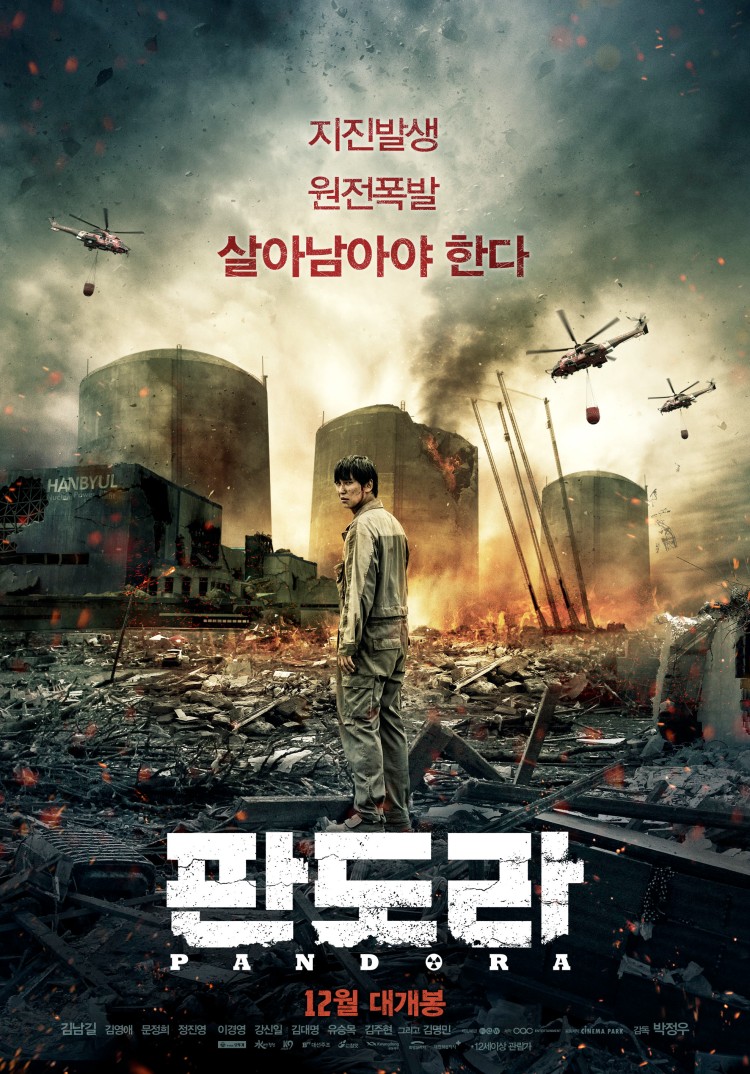
Pandora (판도라, Park Jung-woo, 2016)

pandora (korean) posterIn a time of crisis, the populace looks to the government to take action and save the innocent from danger. A government, however, is often forced to consider the problem from a different angle – not simply saving lives but how their success or failure, decision-making process, and ability to handle the situation will be viewed by the electorate the next time they are asked who best deserves their faith and respect. Pandora (판도라) arrives at a time of particularly strained relations between the state and its people during which faith in the ruling elite is at an all time low following a tragic disaster badly mishandled and seemingly aided by the government’s failure to ensure public safety. Faced with an encroaching nuclear disaster to which their own failure to heed the warnings has played no small part, Pandora’s officials are left in a difficult position tasked with the dilemma of sacrificing a small town to save a nation or accepting their responsibility to their citizens as named individuals. Unsurprisingly, they are far from united in their final decision.

As the film opens, a group of children marvel at the towers of the new nuclear plant which has just been completed in their previously run down rural town. Not quite understanding what the plant is, they repeat snippets they’ve heard in their parents’ conversations – that the plant is a “rice cooker” that’s going to make them all rich, or it’s a “Pandora’s box” which may unleash untold horrors. Still, they seem excited about this new and futuristic arrival in their dull little village.

Flashforward fifteen years or so and one way or another all the kids now work at the plant, like it or not, because there are no other jobs available. Kang Jae-hyuk (Kim Nam-Gil) is one such conflicted soul who doesn’t disapprove of the plant in itself but has good reason to fear that the powers that be are not taking good enough care seeing that both his father and older brother were killed during a previous incident at the plant some years previously. Jae-hyuk lives with his widowed mother (Kim Young-ae), sister-in-law (Moon Jeong-Hee), and nephew (Bae Gang-Yoo) but is reluctant to marry his long-term girlfriend Yeon-ju (Kim Joo-Hyun) due to his lack of financial stability and growing disillusionment with small town life.

Meanwhile, the wife of the Korean president has been passed a file by a whistle-blower hoping to bypass the corrupt bureaucracy and go directly to the top. The file, compiled by a worried engineer, details all of the many failings at the recently reconfigured plant which has been recklessly rushed into completion without the proper safety checks and required maintenance procedures. Unfortunately the president does not have time to read the report before a 6.1 magnitude earthquake strikes and destabilises the plant to the extent that it edges towards meltdown.

Unusually, in a sense, the president is a good man who genuinely wants to do the best for his people even if he sometimes ignores sensible advice out of a desire to protect those on the ground. Unfortunately, he is at the mercy of a corrupt cabinet headed by a scheming prime minister intent on withholding information in order to push the president into cynical decision-making models predicated on the idea of the needs of the many outweighing the needs of the few but which mainly relate to the needs of the prime minister and his cronies in the nuclear industry.

The man in charge of the plant has only been there a few weeks and has no nuclear industry experience. His second in command is a company man and his loyalty lies with his employers – he needs to keep everything functioning and ensure the plant will not be decommissioned. The only voice of reason is coming from the chief engineer who wrote the whistle blowing report and nobly remains on site throughout the disaster putting himself at grave personal risk trying to ensure the plant does not pose a greater danger to those in the immediate vicinity.

Claiming a desire to avoid mass panic, the government attempts to order a media blackout, giving little or no information to civilians stranded in the town and fitting communications jammers to prevent the spread of information. The town is eventually given an evacuation order and orderly transportation to a shelter but once there the townspeople are kept entirely in the dark. When they become aware of the full implications of the disaster and try to leave independently, they are locked in while officials flee and leave them behind.

Conversely, the emergency services are hemmed in by regulations which state they cannot act because they would be putting themselves at unacceptable risk. Kang Jae-hyuk, despite his earlier irritation with his place of work, abandons his own cynicism to walk back into the disaster zone to help his friends still trapped inside. The president nobly refuses to order anyone to tackle the disaster directly knowing that it would mean certain death but opts to appeal for volunteers willing to sacrifice themselves for the greater good. Unexpectedly, he finds them. The president is well-meaning but ineffectual, the government is corrupt, and the emergency services apparently overburdened with regulation while under-regulated commercial enterprises put lives in danger. The only force which will save the Korean people is the Korean people and its willingness to sacrifice itself for the common good even in the face of such cynical, self-interested greed.

Despite the scale of the disaster, Pandora takes its time, eschewing the kind of black humour which typifies Korean cinema disaster or otherwise. Serious rigour, however, goes out of the window in favour of overwrought melodrama, undermining the underlying messages of widespread societal corruption from corporations cutting corners with no regard for the consequences to politicians playing games with people’s lives. The powers that be have opened Pandora’s Box, but the only thing still trapped inside is men like Kang Jae-hyuk whose disillusioned malaise soon gives way to untempered altruism and eventually offers the only source of hope for his betrayed people.


Original trailer (English subtitles available from menu)

The Suspect (용의자, Won Shin-yeon, 2013)

suspect posterNorth Koreans have become the go to bad guys recently, and so North Korean spies have become the instigators of fear and paranoia in many a contemporary political thriller. The Suspect (용의자, Yonguija), however, is quick to point the finger at a larger evil – personal greed, dodgy morals, and the all powerful reach of global corporations. Opting for a high octane action fest rather than a convoluted plot structure, Won’s approach is (mostly) an uncomplicated one as a wronged man pursues his revenge or redemption with no thought for his own future, only to be presented with the unexpected offering of one anyway alongside the equally unexpected bonus of exposing an international conspiracy.
Ji Dong-cheol (Gong Yoo) is former top North Korean asset now defected to the South and working as a driver for an important CEO. His boss thinks he ought to just go home, but Ji has a mission – he’s looking for a former friend, also defected, who was responsible for the deaths of his wife and daughter as part of a wide ranging purge following the accession of Kim Jong-un. Taking pity on him, the CEO eventually gives him the address of his target, adding that he hopes Ji can learn to forgive him (which seems unlikely), but is assassinated by other agents that same night. Arriving at the scene too late, Ji finds himself framed for the killing and charged with taking care of a secret message also in the CEO’s possession at the time of his death. Teaming up with a documentary filmmaker, Ji is now on the run and determined to find his former friend turned mortal enemy before the authorities catch up with him whilst also trying to work out what to do with his boss’ coded message.

Family, debts of honour, and bonds between men are at the centre of this fast paced thriller as Ji attempts to navigate this ever changing conspiracy torn between friends turned enemies and enemies who may become friends. His main adversary is a government agent, Min (Park Hee-Soon), whom he previously encountered during a mission in Hong Kong during which he made the decision to spare Min’s life after catching sight of a photo of his wife and son in his wallet. Min, however, is less than grateful as the failed mission greatly damaged his career prospects and so he has a personal grudge with Ji which he hopes to exorcise through arresting him. On the other side, Ji is also on the hunt for his former training buddy, Lee (Kim Sung-Kyun), whom he believes to have been responsible for the death of his own wife and child though later discovers that perhaps they have all merely been pawns in a much larger game.

The larger game appears to include worldwide arms sales by turns frustrated and conducted by North Korean agents. The conspiracy, however, is very much home grown in terms of its South Korean genesis but makes clear the complicated relationship between the two territories which is very much open to abuse by those who have access to both sides. The big bad turns out not to be the totalitarian regime with its constant purges and rigid enforcement of its political power, but the greedy and venal, power hungry petty officials of the democratic regime working in concert with big business.

Won has obviously drawn inspiration from the first Bourne film, offering several blatant homages including a long car chase referencing The Italian Job by proxy. His shaky cam aesthetic is perhaps overworked, but the fight scenes are undoubtedly impressive, anchored by the astounding performance of unlikely action star Gong Yoo – hitherto known as a sensitive leading man and frequent romantic lead. Having piled on the pounds, Gong is a credible vengeful presence apparently providing many of his own stunts including a strangely overblown sequence which sees him rock climbing bare chested only to emerge panting and glistening next to the flapping North Korean flag. Nevertheless, his near silent performance is a masterclass of physical acting, adding a much needed emotional dimension to the otherwise straightforward script which leaves little time for character development in between its admittedly impressive set pieces. Overlong yet moving at a rip roaring pace, The Suspect is a surprisingly well photographed action fest which manages to add a degree of pathos to its closing scenes even if failing to completely earn it whilst engaging in a series of subtle political allegories.


International trailer (English subtitles)

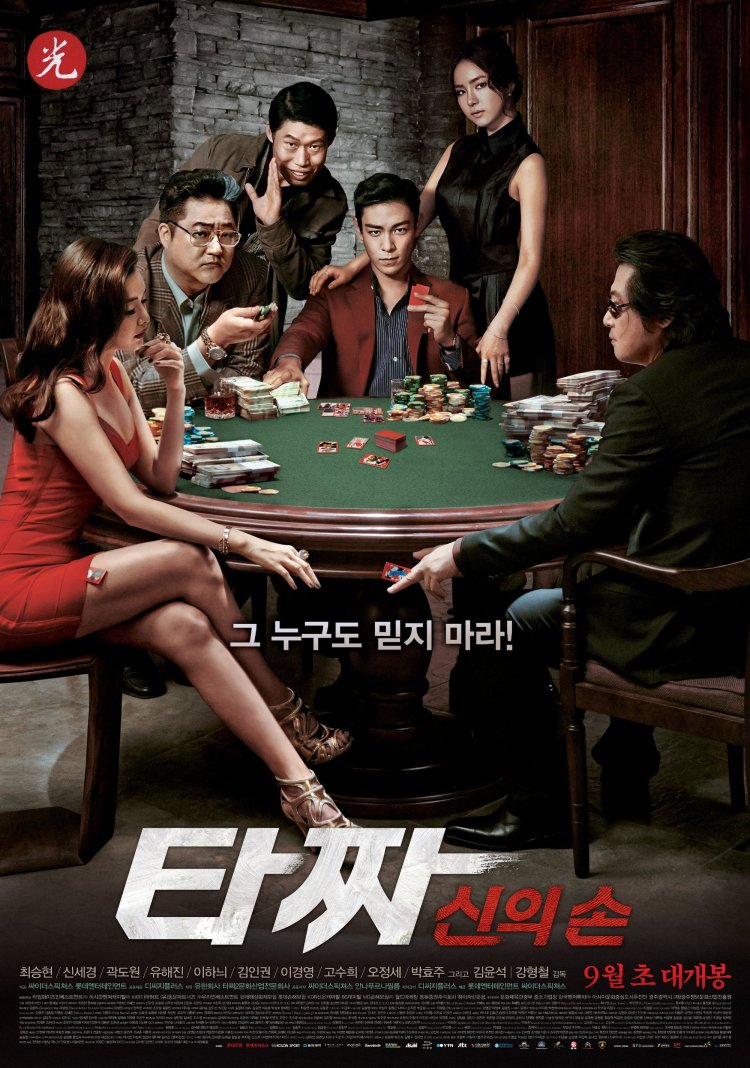
Tazza: The Hidden Card (타짜-신의 손, Kang Hyung-Chul, 2014)

tazza posterYou gotta know how to hold ‘em, know when to fold ‘em, know when to walk away and know when to run. Apparently these rules of the table are just as important in the cutthroat world of the Korean card game Hwatu as they are in the rootinest tootinest saloon bar. Like most card games, having the winning hand is less important than the ability to play your opponent and so it’s more a question of who can cheat the best (without actually breaking the rules, or at least being caught doing so) than it is of skill or luck. A second generation sequel to 2006’s Tazza: The High Rollers, The Hidden Card (타짜-신의 손, Tajja: Shinui Son) is a slick, if overlong, journey into the dark, underground world of gambling addicted card players which turns out to be much more shady than the shiny suits and cheesy grins would suggest.
Wisecracking kid Dae-gil (T.O.P) comes into contact with the first film’s fast talking hustler Go (Yu Hae-Jin) and realises he has a talent for trickery. As a young man he gets himself into trouble trying to save a family member from a gangster whom he winds up stabbing meaning he has to go on the run and leave the girl he’s fallen head over heels for, Mina (Shin Se-Kyung), far behind him with only the promise to come back for her when he’s made something of himself. With nothing to fall back on Dae-gil ends up working for cardsharping gangsters in what is really a series of high level con operations. His first problem occurs when he temporarily forsakes the memory of Mina for the attentions of the alluring Mrs. Woo (Lee Honey) who becomes both his secret girlfriend and the gang’s latest mark.

Things do not go to plan and Dae-gil is left carrying the can for the gang’s heavy losses. Getting into trouble with another mark who turns out to be a high level gangster himself, Dae-gil finds out Mina has been sold into prostitution as payment for a family debt but also winds up losing a kidney as recompense for his mounting gambling debts. Now Dae-gil is out for revenge against pretty much everyone, hoping to rescue Mina and win her heart in the process but his adversaries are old hands at this sort of thing and it’s going to take more than a rigged deck to beat them at their own game.

Taking over from the first film’s Choi Dong-hoon, Kang Hyung-chul opts for a slick and charming Oceans 11 inspired aesthetic full of quirky humour and tricky slight of hand photography. With retro musical choices from a smooth cover of Spooky to the ‘80s synth pop kicking in for an exciting car chase, Kang piles on the nostalgia as Dae-gil rides high as a wisecracking conflicted member of this underhanded outfit. Taking inspiration from its manwha roots, The Hidden Card maintains its breezy tone even whilst the atmosphere darkens as Dae-gil taps out with this gangster credit, beaten up, drugged and waking up in a filthy room with a bandaged hand and a crude scar across his abdomen where his kidney used to be. Apparently making a quick recovery from serious surgery, Dae-gil’s discovery of Mina’s fate is likewise another addition to his quest narrative rather than more evidence of the savagery of this trick or be tricked world.

The Hidden Card’s biggest problem is an unavoidable one given its genre – the sheer structural repetitiveness of moving from one card game to another. Lack of familiarity with Hwatu itself is not exactly a problem even if mildly frustrating, but the nature of the way the game is played means that a great deal of screen time is occupied with watching people watching each other, moodily, only to be left unsure of what’s going on or who’s won at the end of it. This is all the more true of the film’s final showdown which brings back a major player from the first instalment in which the stakes have been raised supposedly to “prevent” cheating, but only really aim to make it more “challenging”. Still, away from the gaming table there are enough high octane fist fights and a lengthy car chase to break up the more cerebral thrills.

Undeniably slick and filled with a host of likeable characters offering snappy dialogue and silly humour, Tazza: The Hidden Card is far too long at two and a half hours. Uneven pacing does not help the feeling of scale and a similarly unbalanced plot structure produces a misleading sense of progression. Still, keeping one step ahead of the card sharks is fun in itself and even if the action drags here and there, there is enough character driven drama and ironic comedy to keep things moving right up until the consciously cool finale.


International trailer (English subtitles)

The Exclusive: Beat The Devil’s Tattoo (특종: 량첸살인기, Roh Deok, 2015)

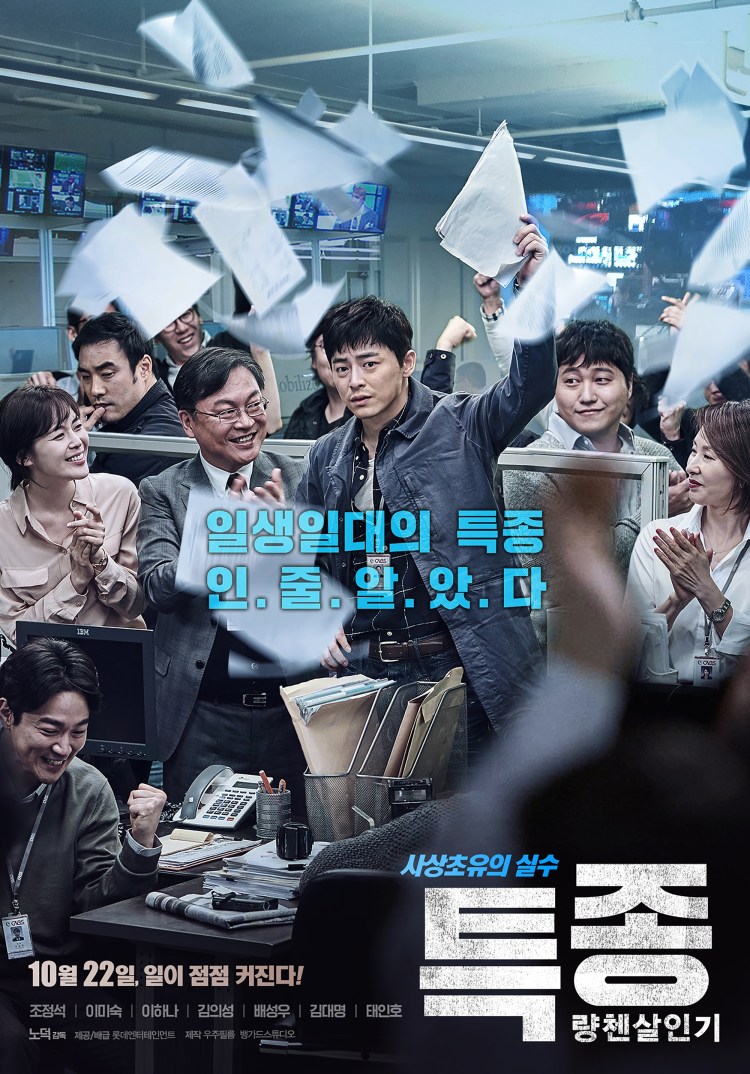
The Exclusive Beat the DevilSome people just can’t keep themselves out of trouble. The down on his luck reporter at the centre of Roh Deok’s The Exclusive: Beat the Devil’s Tattoo (특종: 량첸살인기, Teukjong: Ryangchensalingi) is something of a trouble magnet as he makes mistake after mistake, requiring lie after lie to try and put him back on the straight and narrow. Unfortunately for him the deeper he gets the closer he turns out to be to the “real” truth. Only by that stage everyone has lost interest in “the truth” anyway – who cares about little things like facts against the overwhelming power of a constructed narrative.
Lazy, self obsessed reporter Heo (Cho Jung-Seok) is about to be fired from his job as a TV news reporter after publishing some inaccurate material that causes problems for the station’s sponsors. He also has a bigger problem at home in that his heavily pregnant wife has thrown him out and seems intent on a divorce. When he gets a shady sounding tip from a dubious source regarding a series of murders, Heo decides to check it out alone. Coming to the conclusion that he really has caught a killer, Heo rips a strange handwritten note down from the walls and takes it straight to his boss in the hopes of getting back in her good books. The note goes viral and Heo finds himself reading it out on prime time news but he has a real problem on his hands when he realises the guy from the basement is an actor in a play and has nothing to do with the killings at all.

Attempting to kill the story, Heo forges a second note designed to deflect press attention but it has the opposite effect and only creates more hysteria surrounding the case. Trying to play both sides by exposing the real killer whilst keeping his own involvement a secret, Heo is in way over his head and risks losing far more than just his career if he can’t find a way to smooth all of this out.

The problem here is, everything’s a PR hook. With one eye on the ratings, every reporter is a marketeer, spinning every string of facts into an easily sellable ball of fluff intended to draw in viewers who only read the headline anyway. Heo was never the kind of crusading journalist who has a serious dedication to the craft or an attachment to idealistic notions of holding the nation to account, but even so his self-serving actions begin to create a conflict in his heart as the true nature of his profession is thrown into stark relief. Even whilst lying through his teeth in attempt to save his own skin, Heo is astonished by the cold and cynical actions of his boss who simply does not care if the information is accurate so long as it sells. Far from getting him fired, Heo’s web of duplicity gets him a series of promotions and a not inconsiderable pay bump which is quite something considering a minor mistake was about to end his journalistic career before all of this started.

While all of this is going on, Heo is also busy with the problem of his failing marriage. Fairly dense when it comes to matters of the heart, Heo thinks he can win his wife back now that he’s sort of famous and doing really well at work, which is ignoring the fact that his wife seems to have left him because of his self obsessed and controlling behaviour. Drunk and lurking outside of their previously shared home, Heo doesn’t do himself any favours by jealously attacking an artist his wife had been working with at the gallery she has now opened with a friend (and which Heo had tried to prevent, apparently uncomfortable with the idea of a working wife). His wife’s relationship with her artist will also have an unexpected effect on the serial killer case as it leads her to make a dangerous decision trying to work out what exactly her husband is up to (worried in case he’s secretly been investigating her, but no, Heo is still too self focussed to have even thought about worrying over his wife’s “affairs”).

Roh adopts a quirky, satirical tone backed up by the goofy comedy music which often seems at odds with the grizzly serial killer goings on, but then that’s sort of the point. No one, not even the police who are painted as incompetent idiots both ignorant of and completely dependent on the media, really cares very much about the seven people who have already died or the countless others that might be at risk if the killer is not caught. The only thing that matters is the spin, so long as everything can be massaged into a believable narrative the case will have been solved, facts be hanged (literally). When it comes down to it, Heo solves the case by accident and then can’t say anything about it for fear of incriminating himself, allowing the killer to look like a hero with the frightened public led to believe the threat is still out there. Heo then faces a choice between exposing a truth which might destroy him or continuing to live with the heavy burden of a painful secret but in the end the choice is not even his. No one is listening. The only choices left are raving like a mad man in the face of indifference, or accepting his boss’ aphorism that truth is a relative construct and that “the truth” is whatever you choose to believe. The path of blissful ignorance suddenly seems much more attractive.


International trailer (English subtitles)

Manhole (맨홀, Shin Jae-young, 2014)

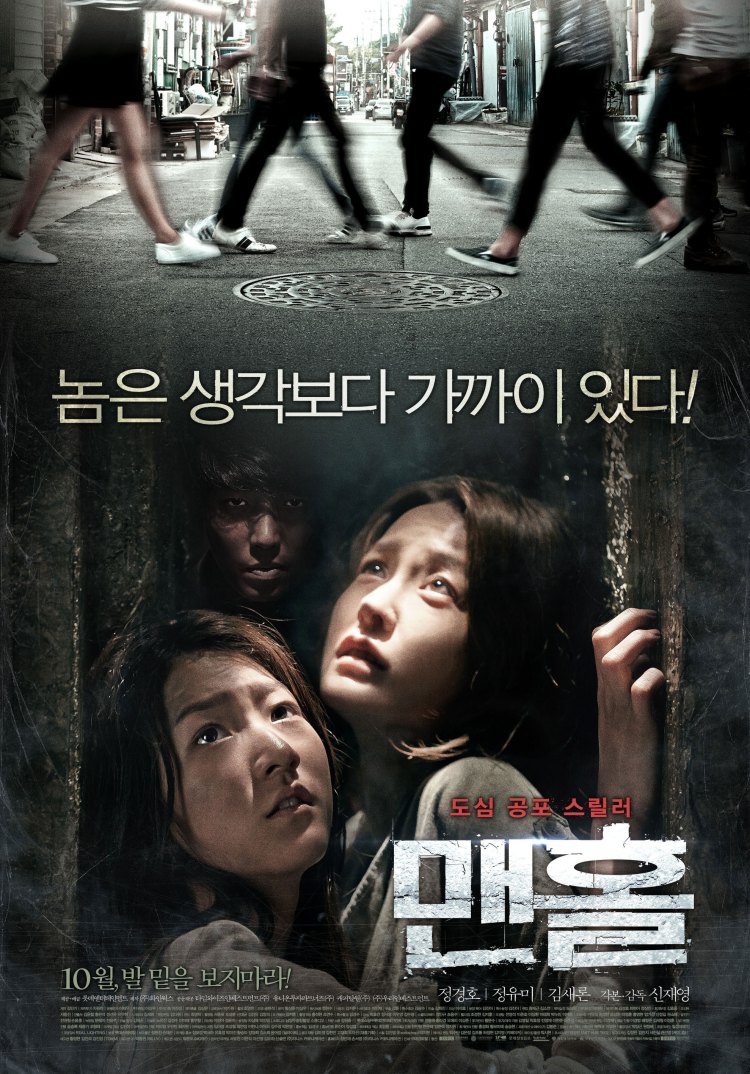
manhole posterFinding the sinister in the commonplace is the key to creating a chilling horror experience, but “finding” it is the key. Attempting to graft something untoward onto a place it can’t take hold is more likely to raise eyebrows than hair or goosebumps. The creators of Korean horror exercise Manhole (맨홀) have decided to make those ubiquitous round discs the subject of their enquiries. They are kind of worrying really aren’t they? Where do they go, what are they for? Only the municipal authorities really know. In this case they go to the lair of a weird serial killer who lives in the shadows and occasionally pulls in pretty girls from above like one of those itazura bank cats after your loose change.

Of course, it’s sort of our first victim’s fault because she’s dared to go out late at night on her own and committed the cardinal sin of shouting at her over protective father on the phone shortly before realising she’s wandered into a horror movie by mistake. The lights start flickering, everything goes wavy and then you’re being pulled down a manhole. Not cool.

Anyway, the real story is about two sisters. Yeon-seo (Jung Yu-Mi) is now the sole guardian of Soo-jeong (Kim Sae-Ron) following the death of their parents and also seems to be harbouring some kind of guilt over an accident that left Soo-jeong permanently deaf. Perhaps a little over protective as a consequence, Yeon-seo instructs Soo-jeong to stay in their apartment and wait for her to get back. Soo-jeong, however, is old enough to push the boundaries and ventures out alone to meet her sister on her way home with an umbrella. Unfortunately, she catches sight of the killer along the way and is soon trapped in the sewer like everyone else, apparently. Yeon-soo tries to call the police but they aren’t interested so she has little choice but to track her sister’s phone and journey underground herself. She’s joined (well, they’re there at the same time) by the father of the first victim (Choi Duk-Moon) who happens to be a former policeman, now in possession of a gun stolen from a friend also set to make a fateful descent at a later point.

Manhole is a very confused film. Unable to decide who its protagonist(s) is (are), it meanders freely between its disparate plot strands without ever managing to build coherent connections between them. Though the sisters are posited as the main element of the story, they take quite a long time to arrive and are then frequently sidelined in favour of other ongoing developments. Their story is undoubtedly the most interesting as it presents an unusual plot device in which they remain unable to communicate verbally during their attempts to escape from the sewers and it’s nice to see sign language used so ordinarily in a genre film, yet even their meagre backstory is painted in broad strokes and through flashbacks once again making it difficult to fully connect with them as they battle the threat in the shadows.

The role of the killer, Soo-chul (Jung Kyoung-Ho), is also a difficult one as he is neither protagonist nor generic threat but given a small amount of flashback backstory delivered in monologue to his victims which only serves to make him a frustrating presence. Manhole seems as if it has a point to make about families in that Soo-chul is a damaged child of a broken home, both trying to avenge himself and regain what he’s lost by, in a sense, “recreating” a family through his kidnappings. Frequent glances towards the prominently displayed portrait of the ideal family contrast with the other relationships in the film – Jong-ho and his hunt for his missing daughter, and the bond between the two sisters. Both of these family units are also missing elements – the sisters who’ve lost their parents and Jong-ho as a lone father. Neither of the parental figures in the film is fully able to protect their charges despite appearing controlling and over protective prior to the incident though no particular reason seems to be offered for this other than praising parental sacrifice in allowing both to fight all out to protect those closest to them.

What Manhole tries to be is a chase film, confining itself to the sewer environment as its crazed killer crawls around it like the literal beast in the shadows, cocooning victims in clingfilm and wearing bug-like bright red night vision goggles. Though exciting enough the frequent cutaways and over reliance on shaky cam disrupt the claustrophobic atmosphere as do the stereotypical jump scares and framing which feel as predictable as the final sequence of a video game in which the idea is to dodge the falling axes. Muddled and inexpertly photographed, Manhole is a disappointing genre exercise which even the generally strong performances of its cast can’t mask. Still, hardcore genre fans may find more to admire in the gore stained darkness of the oddly accessible sewer network and its lizard-like psycho killer.


International trailer (English subtitles)