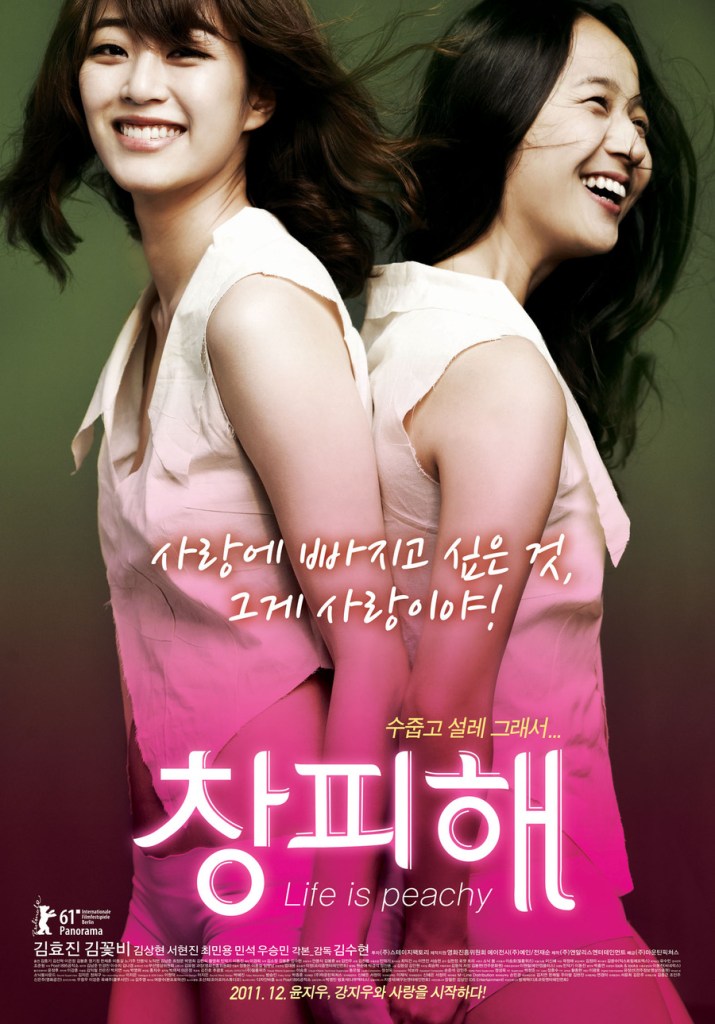
Ashamed (창피해, AKA Life is Peachy, Kim Soo-hyun, 2011)

ashamedOne of the very earliest films to address female same sex love in Korea, Ashamed (yes, really, but not quite – we’ll get to this later, 창피해, Changpihae, retitled Life is Peachy for US release) had a lot riding on it. Perhaps too much, but does at least manage to outline a convincing, refreshingly ordinary failed love romance even if hampered by a heavy handed structuring device and a lack of chemistry between its leading ladies.

Beginning in the film’s “present”, embittered art professor Jung Ji-woo (Kim Sang-hyeon) is auditioning models for an art project, whereupon she bonds with two students currently undergoing some kind of unresolved drama of their own. Hee-jin (Seo Hyun-jin), Jung’s pupil, has roped in her friend also coincidentally named (Youn) Ji-woo (Kim Hyo-jin) who, as she recounts in a lengthy flashback, she met in odd circumstances whilst drinking with layabouts in an alley. Eventually, Youn Ji-woo confessed to her that she’s attracted to people of the same sex, which has left Hee-jin feeling kind of awkward.

Trying to console her student, Jung encourages the younger woman to recount the story of her own great yet failed romance with a pickpocket named, yes, again (Kang) Ji-woo (Kim Kkobbi). Youn had been leading a dull and unfulfilling life as a shopgirl in a department store, baby sitting middle aged housewives. Disillusioned with her disappointing boyfriends, Yoon has entered a dark place where the thing she’s most sorry about in life is that she won’t be able to witness her own suicide. Accordingly she dresses up one of the department store mannequins in her clothes and pushes it off a roof, only it hits a car below and causes an accident.

Not exactly a traditional “meet-cute”, Youn and Kang first encounter each other surrounded by broken glass and are then handcuffed together by the investigating policeman (Choi Min-Yong) who was also just stabbed by one of Kang’s gang members after he spotted her pickpocketing on the metro. The policeman then randomly takes them to his friend’s Chinese restaurant which affords them an opportunity to escape even if they’re still chained at the wrists.

Though this very improbable situation points to a cute and quirky romance, Ashamed takes a non committal stance as regards to tone, throwing in odd details like strange priests living in the woods and Kang’s constantly unreliable self narratives but then retreating to something more straightforwardly melancholy. Love falls slowly as Youn recounts her lack of satisfaction with men only to find herself strangely attracted to her new handcuffs buddy while she, somewhat rudely, has sex with an ex-boyfriend she invited over for help with Youn lying mortified beside them. Suddenly realising why none of her boyfriends ever worked out, Youn feels, understandably, awkward alone with Kang and her ex and but is encouraged by Kang’s tentative but ultimately decisive grasping of her hand during the taxi journey onwards.

Kim’s attempt to avoid prurience whilst also pushing boundaries for sexual content unavoidably feels tame, hampered by the lack of chemistry between the leading actresses and lingering sense of embarrassment in his choice of camera angles. Though painted as a grand and heartbreaking love affair of a lifetime in the opening sequences, Youn and Kang’s romance never takes on the weight of tragedy or moves much beyond the very ordinary tale of two people who couldn’t make it work. This indeed may be the point, but given the melancholy atmosphere of the the three women discussing lost love on a lonely beach, Youn and Kang’s missed opportunity can’t help but feel slighting underwhelming.

Rather than the strongly negative “ashamed” the meaning of the original Korean might be more generously translated as “shy” or “embarrassed”, at any rate the film does not imply any of its characters have reason to feel shame. The title word surfaces a handful of times, most notably when the loosened up professor declares she has no need for it anymore, and in the final showdown with Kang as Youn attempts to challenge her on her problems with intimacy and commitment but fails to push her into a more honest space. Kang’s sense of “shame”, if that would be the right word, seems to be unconnected to sexuality but has deeper roots in the past which she remains unwilling to reveal. This sense of personal inadequacy fuels Kang’s drifting life as she feels the need to move on each time someone gets too close, afraid or perhaps on some level “ashamed” to commit herself fully.

Kim’s multi layered flashback structure mixed with imagined sequences and expressionist scenes inspired by Jung’s artwork proves an unwieldy concept which often detracts more than it gives. With a running time of over two hours and a romance which doesn’t start until many indie films have already ended, Ashamed bites off much more than it can chew but at the same time never fully engages with the most interesting elements of its subject matter. Flawed, if interesting, Ashamed is a bold and worthy effort yet one which falls far short of its target despite the committed performances of its central trio.


Original trailer (English subtitles)

Our Love Story (연애담, Lee Hyun-ju, 2016)

cyaykwjucaav5frThe history of LGBT cinema in Korea is admittedly thin though recent years have seen an increase in big screen representation with an interest in exploring the reality rather than indulging in stereotypes. The debut feature from Lee Hyun-ju, Our Love Story (연애담, Yeonaedam), is among the first to chart the course of an ordinary romance between two women with all of the everyday drama that modern love entails. A beautiful, bittersweet tale of frustrated connection, Our Love Story is a realistic look at messy first love taking place under the snowy skies of Seoul.
Yoon-ju (Lee Sang-hee) is a busy fine arts graduate student working on her final project. Busy as she is, none of Yoon-ju’s friends can get their heads around her lack of interest in dating, but Yoon-ju is happy enough on her own and doesn’t get what all the fuss is about. Whilst perusing a local junk yard looking for interesting things for her art project, something unexpected catches her eye in the form of a young woman delivering magazines but after the woman completes her business she leaves Yoon-ju’s slightly stunned field of vision, presumably forever.

Because these things happen in a city, Yoon-ju runs into the same woman again in a convenience store where she is having trouble buying cigarettes because she’s forgotten her ID and the cashier is being pedantic about the rules. Coming to the rescue, Yoon-ju buys the cigarettes for her with her ID, which leads to the opportunity of sharing one outside. The mysterious woman is named Ji-soo (Ryu Sun-young) and works part-time at a nearby bar to which she invites Yoon-ju if she happens to fancy a drink of an evening. Yoon-ju doesn’t drink, particularly, but convinces some friends to accompany her to to Ji-soo’s bar – a plan which backfires when they drink too much and argue with each other causing a scene. The two women don’t get much of an opportunity to chat and it all seems like it might end there with Yoon-ju heading home to bed only to receive an unexpected phone call from Ji-soo inviting her over for a late night drinking session.

So begins Yoon-ju’s first romance, and Ji-soo’s 78th as she later jokes. The first night slips into the first day and before long the pair have established a happy domesticity but their original euphoria is short lived as Ji-soo is due to be moving back to her hometown to live with her recently widowed father for a while. The relationship also has adverse effects on Yoon-ju’s life as she begins to neglect her art project and lets her colleagues down by forgetting important meetings, while other events leave her questioning if Ji-soo is really as committed to Yoon-ju as Yoon-ju is to her.

After Ji-soo moves back home, the pair make sure to meet up every so often either in Ji-soo’s hometown of Incheon or in Seoul but there’s an undeniable change in their relationship aside from the distance. In the city, Ji-soo had been outgoing and unafraid but in Incheon she’s a completely different person, closed off and permanently anxious. Ji-soo’s father is a more conservative and religious type who has no idea that his daughter is gay and still expecting her to get married, preferably as soon as possible. Worried that Ji-soo “does not date” he sets her up with a family friend and she has little choice but to play along even if she’s not intending to let it get anywhere. Yoon-ju’s first visit occurs while Ji-soo’s father is away, but even so Ji-soo is uncomfortable with having her in the house. When her father turns up unexpectedly one day while Yoon-ju is there, Ji-soo describes her as “a friend” and makes a point of answering all of Yoon-ju’s questions for her in case she lets something slip.

Hurt and confused, spending time in Incheon becomes a painful experience for Yoon-ju considering the permanently jumpy Ji-soo doesn’t even want her father to know she smokes, let alone anything else he might not approve of. Earlier on the relationship, Yoon-ju made the decision to confide in an old friend from her hometown and found him broadly supportive, once he got over the surprise. Ji-soo, more experienced, warns Yoon-ju that she’ll lose friends if she isn’t careful. This Yoon-ju finds out to her cost when she decides to try talking to her roommate about her troubles with Ji-soo as even someone she felt close to and had trusted suddenly rejects her. Realising you’ve placed your trust in someone who wasn’t worthy of it is a terrible feeling, but it isn’t just familial opposition the two women will be facing if they decide to make a go of things together, even in the big city.

Post Incheon, awkwardness grows and the distance deepens prompting one to fight back and the other to retreat but eventually Ji-soo appears to make her choice in way which seems cuttingly final in its coldness. Later trying to fix what she broke, Ji-soo again goes about things in an inadvisable way, still only superficially committed and unable to fully connect on a deeper level. Ending on an ambiguous, bittersweet note which seems to offer either hope or the despairing vision of an ever repeating cycle of pain, Our Love Story is a beautifully nuanced and interestingly composed addition to the Korean indie scene finally bringing a very ordinary romance to the cinema screen in all of its everyday melodrama.


Reviewed at the 2016 London Korean Film Festival.

Clip from halfway through the film (English subtitles)

La Maison de Himiko (メゾン・ド・ヒミコ, Isshin Inudo, 2005)

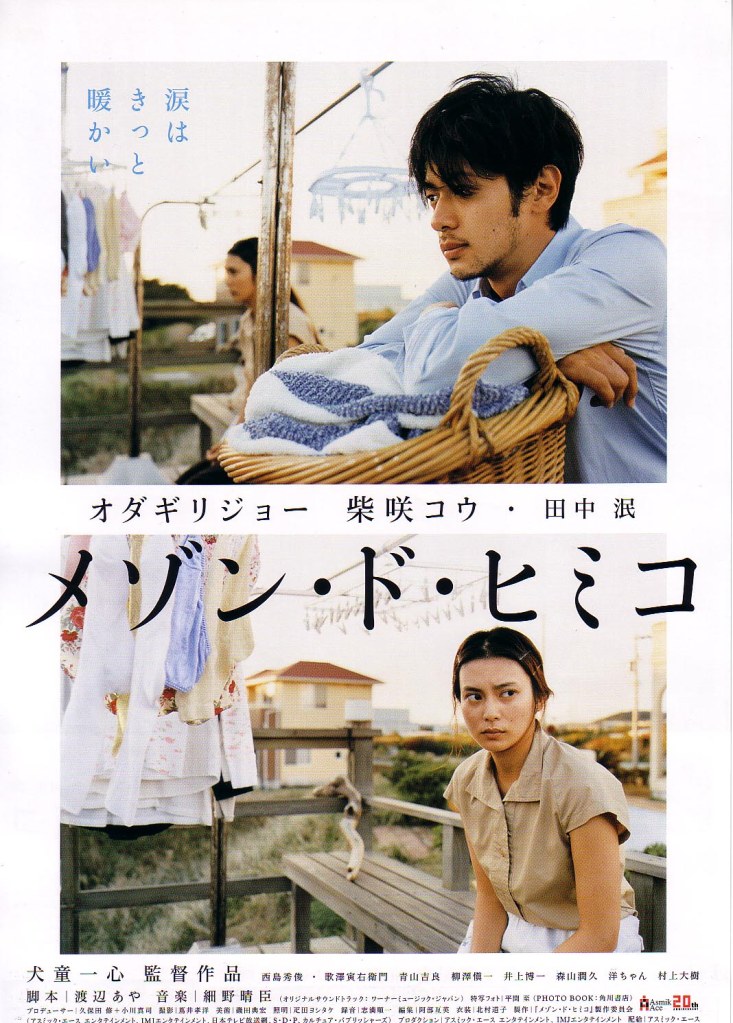
la-maison-de-himikoIn Japan’s rapidly ageing society, there are many older people who find themselves left alone without the safety net traditionally provided by the extended family. This problem is compounded for those who’ve lived their lives outside of the mainstream which is so deeply rooted in the “traditional” familial system. La Maison de Himiko (メゾン・ド・ヒミコ) is the name of an old people’s home with a difference – it caters exclusively to older gay men who have often become estranged from their families because of their sexuality. The proprietoress, Himiko (Min Tanaka), formerly ran an upscale gay bar in Ginza before retiring to open the home but the future of the Maison is threatened now that Himiko has contracted a terminal illness and their long term patron seems set to withdraw his support.
Haruhiko (Joe Odagiri), Himiko’s much younger lover and the manager of the home, is determined to reunite his boss with his estranged daughter, Saori (Kou Shibasaki), before it’s too late. Saori is a rather sour faced and sullen woman carrying a decades long grudge against the father who abandoned her as a child and consigned her mother to a life of misery and heartbreak, so Haruhiko’s invitations are not warmly received. Haruhiko is not the giving up type and manages to sweet talk Saori’s colleague into revealing her desperate financial situation which has her already working two jobs with a part-time stint in a combini on top of her regular work during which she finds herself looking at lucrative ads for work on sex lines. When Haruhiko offers her a well paying gig helping out at the home, she has no choice but to put her pride aside.

The exclusively male residents of La Maison de Himiko lived their lives during a time when it was almost impossible to be openly gay. Consequently many of them have been married and had children but later left their families to live a more authentic life. Unfortunately, times being what they were, this often meant that they lost contact with their sons or daughters, even if they were able to keep in touch with their ex-wives or other family members for updates. For these reasons, La Maison de Himiko provides an invaluable refuge for older men who have nowhere else to go as they enter the later stages of their lives. The home provides not only a safe space where everybody is free to be themselves but also a sense of community and interdependence.

Though the situation is much improved, it is still imperfect as the home and its residents continue to face prejudice from the outside world. Saori, still carrying the pain of her father’s rejection, views his choice as a selfish one which placed his own desires above the duty he should have felt towards his wife and child. Partly driven by her resentment, Saori has a somewhat negative view of homosexuality on arriving at the home, offering up a selection of homophobic slurs, and is slow to warm to the residents. Gradually getting to know her father again and through her experiences at the home, her attitude slowly changes until she finds herself physically defending her new found friend when he’s set upon by a drunken former colleague who publicly shames him in a nightclub.

The home is also plagued by a gang of bratty kids who often leave homophobic graffiti scrawled across the front wall. One of their early tricks involves throwing a bunch of firecrackers under a parked car to stun Saori so they can hold her captive for a bit because they have really a lot of questions about lesbians and they wondered if she was one, though one wonders what they’d do if someone answered them seriously. Predictably, the leader of the bratty kids may be engaging in these kinds of behaviours because he’s confused himself. Thankfully La Maison de Himiko is an open and forgiving place, welcoming the boy inside to offer support to a young man still trying to figure himself out.

This is not a coming out story, but it is a plea for tolerance and acceptance through which Saori herself begins to blossom, easing her anger and resentment and sending her trademark scowl away with them. One of her closest friends at the home is a shy man who lived most of his life in the closet but makes the most beautiful embroidered clothes and elegant dresses. Sadly, the most lovely of them is reserved for his funeral – he’s too ashamed to wear it alive because he doesn’t like the way he looks in the mirror. Eventually he and Saori end up having an unconventional fancy dress party in which they both break out of their self imposed prisons culminating in a joyous group dance routine in a local nightclub.

Joe Odagiri turns in another nuanced, conflicted performance as the increasingly confused Haruhiko who finds himself oddly drawn to Saori’s sullen charms though the film thankfully avoids “turning” its male lead for an uncomfortable romantic conclusion. A young man among old ones, Haruhiko is somewhat out of place but has his own empty spaces. Revealing to Saori that he lives only for desire he betrays a nagging fear of his own emptiness and journey into a possibly lonely old age. Nevertheless, La Maison de Himiko is generally bright and cheerful despite some of the pain and sadness which also reside there. A warm and friendly tribute to the power of community, La Maison de Himiko is a hymn in praise of tolerance and inclusivity which, as it makes plain, bloom from the inside out.


Original trailer (no subtitles)

And the fantastic dance sequence from the film

Plus the original version of the song (Mata Au Hi Made) by Kiyohiko Ozaki

A Bride for Rip Van Winkle (リップヴァンウィンクルの花嫁, Shunji Iwai, 2016)

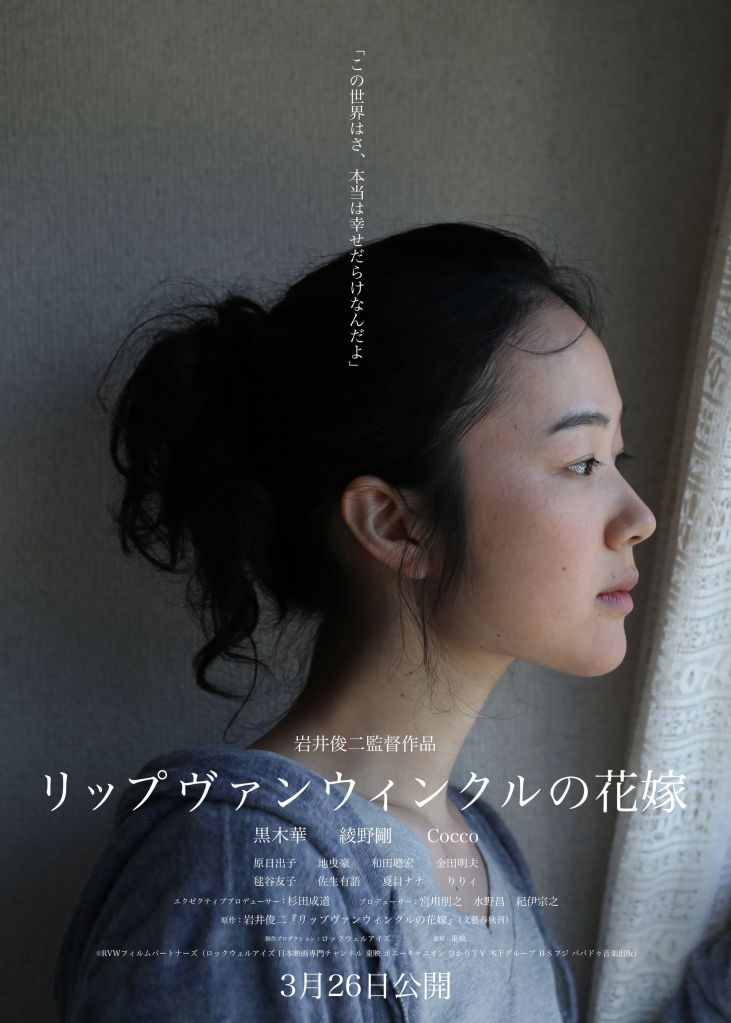
the_bride_of_rip_van_winkle“Being naked in front of people is embarrassing” says the drunken mother of a recently deceased major character in a bizarre yet pivotal scene towards the end of Shunji Iwai’s aptly titled A Bride for Rip Van Winkle (リップヴァンウィンクルの花嫁, Rip Van Winkle no Hanayome) in which the director himself wakes up from an extended cinematic slumber to discover that much is changed. This sequence, in a sense, makes plain one of the film’s essential themes – truth, and the appearance of truth, as mediated by human connection. The film’s timid heroine, Nanami (Haru Kuroki), bares all of herself online, recording each ugly thought and despairing notion before an audience of anonymous strangers, yet can barely look even those she knows well in the eye. Though Namami’s fear and insecurity are painfully obvious to all, not least to herself, she’s not alone in her fear of emotional nakedness as she discovers throughout her strange odyssey in which nothing is quite as it seems.
We first meet Nanami on an internet blind date with the man who will later become her husband. Looking lost and alone, she passively waits for her online suitor to find her in the busy city streets. Tetsuya (Go Jibiki) does indeed turn up and assume control of the situation, to which Nanami submits just as she has to everything else. Bonding over little more than their shared vocation of teaching the pair drift into a relationship and then later into a marriage, as is the natural order of things.

Though she seems happy enough, Nanami vents her frustrations in her caustic online blog. Isn’t this all just too easy? She asks herself. It’s almost like online shopping, she simply added a boyfriend to her basket and now she’s about to check out. A failure to win over Tetsuya’s mother adds to her sense of unease as does the fact she has no close friends or relatives (aside from her soon to be divorced parents) to invite to the wedding. Her decision to take the advice of an online friend and employ the shady fixer Amuro (Go Ayano) to hire a selection of professional party goers to bulk out her side of the hall will prove to be a disastrous one (though perhaps more in the short term), turning her entire life inside out.

Nanami’s essential personality trait is her passivity. Like Rip Van Winkle, she is largely asleep while things happen all around her. Though she dreamed of being a teacher, Nanami has only been able to find temporary supply roles with an agency but even this seems unlikely to last thanks to her softly spoken nature which makes classroom teaching a poor fit for her shy, attention avoidant personality. Discovered at her part time combini job by an old university friend, Nanami is embarrassed and has even been wearing a (useless but endearing) disguise in case any of her students come by despite the fact she chose a store far away from the school. Her friend now works at a hostess bar which Nanami finds a little bit shocking. That kind of unconventional way of living is not something she would contemplate, and so when offered the extremely dull but comfortable life alongside the dull but comforting Tetsuya, Nanami settles.

After Amuro spectacularly derails her non-happiness, Nanami is cast adrift which eventually leads her straight back into Amuro’s web of morally dubious activities. Taking a job as a maid at the cheap hotel she ends up in after leaving Tetsuya, Nanami also works part time as another of Amuro’s professional guests which is where she meets motivator no. 2 – Mashiro (Cocco), “actress” and all round live wire. Bonding over sad karaoke, Nanami and Mashiro later wind up working together as live in maids in a creepy, isolated mansion filled with poisonous animals. Enforced proximity leads to genuine friendship and then to more than that, but, ironically enough, Mashiro has not been entirely honest about her intentions and Nanami is soon adrift once again.

Undergoing a “fake” wedding that’s sort of real (in contrast with the “real” wedding which was sort of “fake”), at least in sentiment, Nanami looks much happier than in the extremely bizarre ceremony which bound her to Tetsuya. Nanami and Mashiro’s union was “engineered” yet mutually beneficial and ultimately genuine despite its artificial genesis. Making a last, heartbreaking speech, Mashiro attempts to explain herself and her life philosophy in a final act of nakedness. She prefers to pay for connection because, she says, the world is too full of kindness. There is so much happiness out there that it’s completely overwhelming. Sometimes there’s more truth in the lie than there is in the reality.

The resurfaced Iwai is both more cynical and more romantic than he has ever been before. He has serious things to say about constructed identities and disconnectedness, that the increasingly open nature of the anonymous online world only makes the real one seem less reliable and harder to navigate. We’ve all been wearing masks but we turned them round when we went online, and now perhaps we’re forgetting that we made them in the first place. Nanami may be adrift again at the film’s conclusion but she finds herself in a world of infinite possibilities. Emerging with more certainty and firmer sense of self, Nanami has retaken control and even if she doesn’t know where she’s going, the choice is entirely her own. Another beautifully nuanced, endlessly affecting character study from Iwai, A Bride for Rip van Winkle is a gloriously rich experience, filled with both hope and despair, but told with all the ethereal warmth and strangeness of the best of dreams.


This review refers to the 180 minute director’s cut, rather than the shorter international or four hour TV version.

Original trailer (English subtitles)

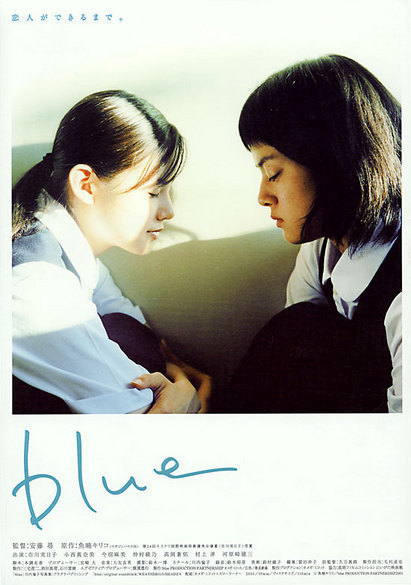
Blue (ブルー, Hiroshi Ando, 2003)

blue03Growing up is hard to do. So it is for the teenage protagonists of Hiroshi Ando’s debut mainstream feature, Blue (ブルー), adapted from the manga by Kiriko Nananan. Like Nananan’s original comic, the cinematic adaptation of Blue is refreshingly angst free in its examination of first love and the burgeoning sexuality of two lonely high school girls. Shot with a chilly stillness which echoes the emptiness of this small town existence, Blue is no nostalgic retreat into cosy teenage dreams but a cold hard look at the messiness and pain of adolescent love.
Kayako’s (Mikako Ichikawa) life changes one day as she sees a fellow pupil at her all girls school being carried into an ambulance and spirited away. Curious yet unknowing, Kayako continues with her day to day existence until she happens to catch sight of another girl from her school, Masami (Manami Konishi), on the local bus. The two become friends after Masami expresses sympathy for Kayako when their teacher humiliates her in class. Masami is repeating the year after completing a long term suspension and has been ostracised by the other girls though no one quite seems to know exactly what happened. Before long Kayako’s feelings for her new acquaintance have transcended friendship but confused and jealous of Masami’s other friends, Kayako is at a loss. Eventually revealing her true feelings she discovers they aren’t unrequited after all, but Masami’s past contains its share of troubles which threaten to place a barrier between the two girls and destroy their growing romance.

Kayako is quiet and a bit of a dreamer. She eats lunch everyday with the same three girls on the rooftop but seems to feel isolated and listless in her small town existence. Masami, by contrast, is chattier and more outgoing but much of the persona she presents to the world is a way of coping with the circumstances which led to her leaving school. Kayako is drawn to Masami because of her outward sophistication – smoking, drinking, listening to foreign music, and reading books about impressionist artists. Later it transpires that at least some of these tastes were acquired from an older man with whom Masami had had an inappropriate relationship and are both a symptom of her desire to import personality traits from others because her own identity is so ill defined, and of wanting to seem much more mature than she really is.

Whilst Kayako is introverted yet solid and growing to be confident in who she really is, Masami, by contrast, appears only half formed but making up for her lack of self esteem with bravado and cheerfulness. It is this lack of certainty which eventually threatens to drive a wedge between the pair as Masami is unable to accept the kind of intimacy that Kayako wants to offer her. Repeating that she is “nothing”, has no future, and is an entirely passive presence simply floating along on the breeze, Masami is unable to make the kind of active choice which Kayako has already made, and may never be in a position to make it entirely of her own volition. Masami is always looking to run away, talking of moving to somewhere like Tokyo with a city’s anonymity, but when it comes down to it she lacks the courage to act.

Ando shoots at a stately pace mostly using static shots and distance takes though his slow pans across empty corridors help to bring out the utter loneliness and emptiness of the girls’ lives. Similarly a mild POV effect takes over panning around school windows as Masami looks for Kayako hoping to make a mends but finds her hurt, conflicted, and unwilling to engage. The two leads each give fantastically nuanced performances despite the plainness of the script and share an intense chemistry lending weight to the emotional resonance of the film. Ando creates a melancholy atmosphere of longing punctuated by fleeting glances and accidental touches, allowing the space and time for the physical performances to come to fruition. A subtly affecting tale of a difficult, yet mutually rewarding, teenage romance Blue has its share of early feature jitters, but makes up for them with an unusual dose of realism perfectly anchored by the strong performances of its leading ladies.


The Handmaiden (아가씨, Park Chan-wook, 2016)

handmaiden.jpgPark Chan-wook has something of a track record when it comes to bending literary sources in unexpected ways – who else would have thought of adding vampires to Thérèse Raquin and actually managed to make it work? In The Handmaiden (아가씨, Agasshi), his first return to Korean filmmaking after Stoker’s foray into American Gothic, Park adapts Sarah Waters’ Fingersmith – a Dickensian tale of love and the multilayered con, and relocates it to 1930s Korea under Japanese rule.

Ambivalent attitudes to the Japanese is a key element exploited by a ruthless conman posing as “Count Fujiwara” (Ha Jung-woo) in order to seduce a lonely heiress. To complete his elaborate plan, he needs the help of pickpocket extraordinaire, Sook-hee (Kim Tae-Ri), whom he will install as a maid in the household so she can subtly sell the virtues of the dashing nobleman to the innocent flower trapped in a well of opulence.

On arriving at the curiously constructed mansion which is an elegant architectural mix of Korean, Japanese, and English country estate, Sook-hee is quite literally out of place in the upperclass environment a world away from her home in a den of petty of thieves doubling as a baby farm. Another thing she had not quite banked on was that her new mistress, Hideko (Kim Min-hee), would be quite so pretty. A serious spanner is thrown in the works as a mutual attraction builds up between the two women who, for reasons which become apparent, are being pulled in separate directions by other desires.

Park retains Waters’ tripartite structure even if he jettisons the final plot reveal for a less intricate tale of liberation and escape. Beginning with Sook-hee’s narrative he introduces us to the first layer of the con but also to Sook-hee and her down and dirty home in the criminal underworld. Chosen by the Count for her supposed lack of intellect and innocent naivety, Sook-hee is not quite at home among her family either. Both believing the promise that the babies they collect and sell in Japan will be going on to better lives and lamenting the cruelty of the whole business in wanting to mother the lot of them, Sook-hee is soft presence yet she also wants to prove herself as adept at criminality as her legendary, now deceased, mother.

It’s this essential warmth which eventually attracts Hideko’s attention. The much talked about tooth filing scene in which Sook-hee takes out a thimble to soften a lacerating sharpness in her mistress’ mouth is not just notable for the oddly erotic quality born of the obvious suggestive motion, unavoidable intimacy created by the closeness of bodies, and the growing desire of fleeting, furtive glances, but for its essential kindness. Moving into Hideko’s perspective for the second chapter, more is learned about her damaged past filled with cruelty and abuse. Orphaned and brought to Japan as a small child by her pornography obsessed uncle so that he might train her to entertain him with readings of erotic literature before he eventually marries her to inherit the family fortune, Hideko has never known anything as simple as unguarded goodness.

Caught up in a long con, the choice remains whether to blow cover and declare one’s hand or play the thing through to the end, however painful it may be. Park takes a different route than in the original novel which makes both of its heroines the victims of someone else’s avaricious plot of revenge against the cruelty of an unequal world, eventually reinforcing their bond by a shared rejection of their victimhood, but even when their passions eventually erupt the lovemaking begins as a another “con” where Sook-hee takes on the role of the Count, “educating” the assumedly “innocent” Hideko in the ways of desire.

Trapped within an oppressive gilded cage of a prison, Hideko has become the embodiment of desire for her cruel and eccentric uncle and the groups of men he invites to listen to her read erotic literature as if reciting a classical play. Complete with sideshows of sex dolls and theatrical scenery, Hideko is forced to act out the scenes from the books as an actress on the stage for an audience rapt in silence. Unable to escape alone, Hideko is offered new hope by Sook-hee’s straightforward outrage which allows the pair to destroy or repurpose the instruments of their oppression for their own pleasure. This is, in essence, their form of revenge in which they simply remove themselves from an abusive environment leaving the men behind to wonder at what’s gone wrong and later to destroy themselves without any additional help.

Filled with a gothic sense of impossible desires and uncertain judgements, The Handmaiden is unafraid of the genre’s melodramatic roots but is all the better for it. Beautifully photographed, this opulent world of swishing ball gowns and gloved hands is undercut by the ugliness of quisling collaborator Kouzuki and his basement of horrors. Erotically charged but ultimately driven by love, The Handmaiden is another unconventionally romantic effort from Park albeit one coloured by his characteristic sense of gothic darkness.


Reviewed at 2016 London East Asia Film Festival.

Original trailer (English subtitles)

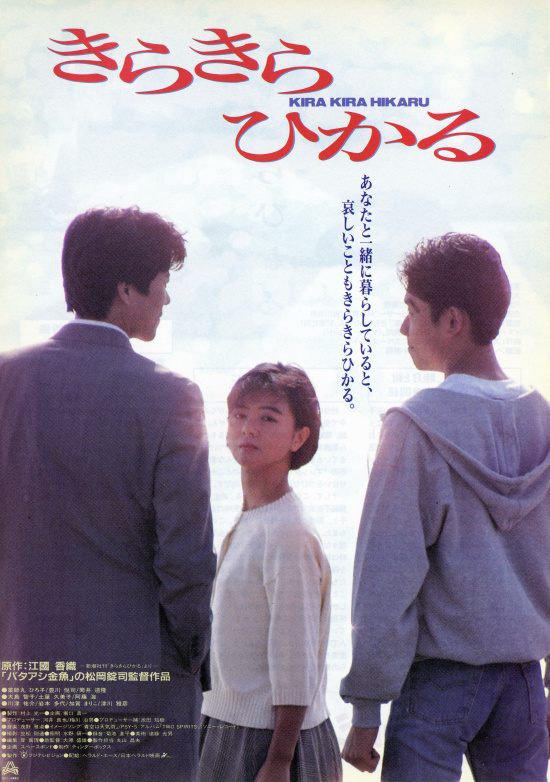
Twinkle (きらきらひかる, Joji Matsuoka, 1992)

TwinkleThe end of the Bubble Economy created a profound sense of national confusion in Japan, leading to what become known as a “lost generation” left behind in the difficult ‘90s. Yet for all of the cultural trauma it also presented an opportunity and a willingness to investigate hitherto taboo subject matters. In the early ‘90s homosexuality finally began to become mainstream as the “gay boom” saw media embracing homosexual storylines with even ultra independent movies such as A Touch of Fever becoming unexpected box office hits. Based on the book by Kaori Ekuni, Joji Matsuoka’s Twinkle (きらきらひかる, Kira Kira Hikaru) tackles this subject head on in examining the changing nature of the modern family as personal freedom and greater social liberalism conflict with familial duty and centuries old tradition.
We first meet Shoko (Hiroko Yakushimaru) in the office of a doctor who assures her that her “problems” are nothing to worry about and the best thing to do is find “a nice man” and get married after which she’s sure to feel much better. On the taxi ride home, her mother suddenly pulls out an omiai photo she’s apparently been carrying in her bag the whole time and proposes Shoko try meeting this particular prospect just as the doctor suggested.

Her “date” is Mitsuki (Etsushi Toyokawa) – an unmarried middled aged doctor who doesn’t seem very interested in the omiai business either. After a brief period of bickering, Shoko and Mitsuki get some time to themselves at which point Mitsuki reveals that the reason he isn’t married is because he has a boyfriend. Despite this, the pair come to an understanding and decide to get married to finally get their relatives off their backs. However, if they thought the pressure would go away after the wedding, they were mistaken. Though both sets of parents know about their children’s reasons for originally avoiding marriage, they don’t know about those of the spouses and when they find out it’s just going to get even more complicated.

We don’t find out exactly what “problems” Shoko may have had in the past. On the morning of the omiai her family dog dies meaning she has an obvious reason to appear visibly upset, yet she also displays symptoms of ongoing depression right the way through the film, flitting between upbeat cheerfulness to impulsive behaviour and crying fits. She also has a long standing drink problem which can result in dangerous accidents such as an incident where Mitsuki returns home to find her passed out on the floor with the iron in one hand and an empty glass of whiskey apparently fallen out of the other.

Mitsuki is in a relationship with a much younger college student and, though they don’t seem to go out of their way to hide their relationship, they can’t exactly be open about it either. Kon did not approve of Mitsuki’s decision to get married and has been avoiding him but Shoko is keen for the two men’s relationship to continue, eventually befriending the young man and bringing him home as fully fledged member of their family. Mitsuki finds this arrangement quite confusing, trapped between two spouses and feeling a responsibility to both of them. In one notable exchange he’s asked to make the relatively simple choice between strawberry and vanilla ice-cream, but the question has taken on a much wider implication than just tonight’s dessert.

The arrangement starts out well enough, except that the growing affection between the married couple eventually begins to place a wedge between them, each knowing that they can never truly satisfy the demands of the other. Not satisfied with a marriage, the parents also expect children which is going to require medical assistance given the circumstances, but Mitsuki is still unsure about taking this next step. Shoko, though experiencing a intensification of her emotional volatility, now suggests a truly radical solution for the early ‘90s – that she undergo artificial insemination using the mixed sperm of both Mitsuki and Kon to essentially have “their” baby.

Shoko and Mitsuki are both trapped, in a sense, by their societal obligations – particularly that of producing children. Mitsuki’s parents know he’s gay, though they tolerate more than accept, yet they still pressure him into fathering a child for appearance’s sake alone. His father had come to terms with his son’s sexuality, even if Mitsuki refers to himself as a son who has “betrayed” his father, but he was against the marriage viewing it as cruel and irresponsible. Once Shoko’s parents discover the real reasoning they try to take over, ignoring Shoko’s views (and even her first clear stating of her problems with alcohol), acting as if they were the injured party.

Though slightly older, Shoko and Mitsuki have found themselves at the centre of a generational conflict as they fight to free themselves from parental control even in adulthood. The future they propose for themselves is an unusual one and unlikely to be accepted by society, yet it is finally their own decision and only by unshackling themselves from the same social pressures which brought them together can they learn to forge a new future. Ten years later, Ryosuke Hashiguchi’s Hush! would suggest a similar scenario which, though still not universally accepted, is greeted with much less resistance than the entirely radical arrangement of Shoko, Mitsuki, and Kon. An interesting look at the changing nature of  social bonds in the immediate post-bubble era, Twinkle is a melancholic though ultimately hopeful tale of three individuals who might be able to provide the stability each needs if only they can learn to withstand the overwhelming external pressures.


Original trailer (no subtitles)

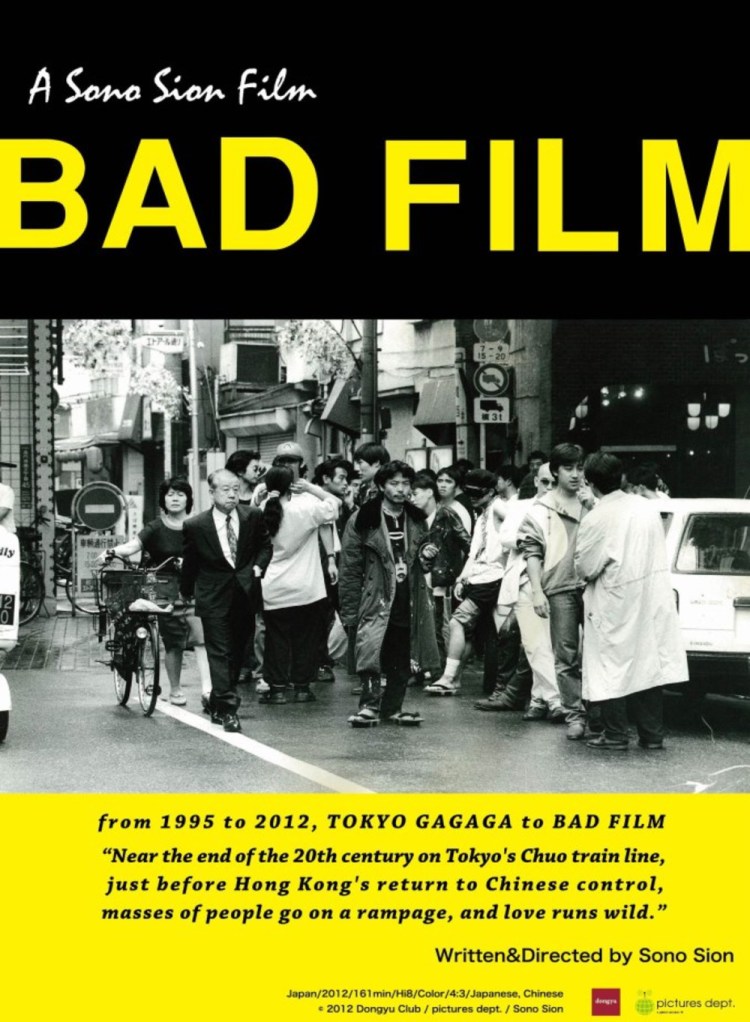
Bad Film (Sion Sono, 1995/2012)

Bad_FilmThe recently prolific Sion Sono actually has a more sporadic film career dating back to the early 1980s though most would judge his real breakthrough to 2001’s Suicide Club. Back in the ‘90s Sono was most active as the leader of anarchic performance art troupe Tokyo Gagaga. Taking inspiration from the avant-garde theatre scene of the 1960s, Tokyo Gagaga took to the streets for flag waving protests and impressive, guerrilla stunts. Bad Film is the result of one of their projects – shot intermittently over a year using the then newly accessible Hi8 video rather the traditionally underground 8 or 16mm, Bad Film is near future set street story centring on gang warfare between the Chinese community and xenophobic Japanese petty gangsters with a side line in shifiting sexual politics.

Momentous things were at play in 1997, not least amongst them the looming handover of Hong Kong when it would cease to operate under British rule and embark upon the “one country, two systems” era with ultimate authority passing to Beijing. Fascism has bloomed in Tokyo with intense anti-foreigner activity targeting all non-Japanese including those from other areas of Asia. By 1997, the yakuza have infiltrated the fascist infrastructure and amped up gang violence between the Chinese community and the ultra-nationalist Japanese.

Fast forward a little and the Chinese and Japanese groups have managed to iron out some of their differences largely thanks to a different kind of divide which ultimately proves a unifying factor – many of the men and women on either side are gay and are sick of the prevailing “hetero hegemony”. Eventually the gay contingent manages to assume control of their respective factions and enact the gay alliance. This is very successful and brings peace and love to the city but unfortunately two members of opposing factions just can’t get over their cultural differences and are prepared to go to great lengths to restart the Japan/China gang war.

Sono shot the entirety of the movie back in 1995 ending up with around 150 hours before abandoning the project for financial reasons. In 2012 Sono re-edited his existing footage into something resembling a feature length film. The project was designed to make use of the entire Tokyo Gagaga company (over 2000 people took part) and was shot guerrilla style with no permits or warnings (you can see at least one face blurred out during their city centre protests). This goes someway to explaining why the narrative diverges unexpectedly at random junctures and the voiceover is there largely to corral the footage into some kind of coherent structure aided by the occasional on screen text. It’s a “Bad Film” in that it’s not quite a film at all but an activist’s poetic documentation of his artistic street warfare even including going so far as to include a justification for the visibility of the cameraman.

Hi8 was what it was – a convenient low-res format for the domestic market. Bad Film is not a pretty film, it looks rough and low rent though that often works in its favour and the film takes on a considered aesthetic that is never concerned with trying to be more than it is. Consequently, it makes the most of its roughness to bring out the grungy, time capsule-esque atmosphere that it’s looking looking for. Sono also experiments with fish eye lenses, odd angles and hand held multi-camera chaos to bring the streets to life. His world is weird, and it’s filmed weird, but it always makes sense in terms of its own particular look.

The action turns on the unexpected love story between two women – one Japanese, and one Chinese, and despite all of the resulting chaos and carnage, the final image we’re left with is one of love. The forces of destruction are those who cannot abandon their hate to live in harmony, subverting this very force for peace and using it to wreak vengeance. Sono launches into absurd mode at full throttle and, as per usual, it’s hard to tell when he’s in earnest and when just being facetious. Bad Film is, loosely speaking, an anti-prejudice themed performance art piece documenting the passion and commitment of the Tokyo Gagaga collective. An interesting case of a belated “director’s cut” Bad Film is necessarily an imperfect beast, but perhaps all the more interesting for it.


Opening sequence (no subtitles)

Hush! (ハッシュ!, Ryosuke Hashiguchi, 2001)

hushThe family drama is a mainstay of Japanese cinema, true, but, it’s a far wider genre than might be assumed. The rays fracture out from Ozu through to The Family Game and Crazy Family which sought to ask a few questions about where the idea of “family” was headed in a society of rapidly increasing materialism. Ryosuke Hashiguchi comes at the idea from a different angle in 2001’s Hush! (ハッシュ!) as he once again takes the perspective of the gay community and asks if the “traditional family” is about to change – what could, or should, survive if the old, rigid ideas can be remade into something lasting created out of love and acceptance rather than obligation?

As the film begins, Naoya (Kazuya Takahashi) wakes up to find his one night stand already fully dressed and heading out the door, awkwardly, without even stopping to say goodbye. Eventually he hooks up with the kindly Katsuhiro (Seiichi Tanabe) and the two quickly become fairly serious but then a damaged woman, Asako (Reiko Kataoka), enters their lives hoping to use Katsuhiro as a sperm donor, forcing the men to reassess a number of important desires and beliefs, putting strain on their still fledgling relationship. If that weren’t enough drama, a girl at Katsuhiro’s place of work has also developed a crush on him and is prepared to take her unreturned love to some extremely dark places.

The first level of mini stresses Naoya and Katsuhiro have to contend with is their conflicting (if complementary) personalities and attitudes to their sexuality. Naoya is an easy going type with a job at a pet grooming salon. He’s a fully out gay man and a frequenter of city’s gay scene. Katsuhiro, by contrast, is much more mild mannered and innately kind. He works at a scientific research station and is more or less closeted – that is, he doesn’t particularly go out of his way to hide his sexuality from his work mates and family but he doesn’t volunteer the information either. This attitude seems to bother Naoya at various points but being the easy going type he’s apt to let it go most of the time.

However, when Katsuhiro reveals Asako’s offer, Naoya is actively against it. His idea of gay life suggests that relationships are generally short, he prefers the relative freedom of his life as an essentially “single” man rather a husband shackled to a family. Katsuhiro on the other hand perhaps would have liked children, or to be a father figure to someone else’s. Though Naoya has previously expressed boredom and disillusionment with his life spent in clubs and gay bars, he’s still resistant to the idea of settling down, or at least to the belief that a single relationship really can stay the course.

All three of the central characters have, in a sense, been let down by the “traditional” family. Naoya’s father left when he was small, leaving him with a single mother which is something that wasn’t so common when he was a child resulting in a fair amount of social stigma from other people in the community. These days his brassy mother knows about his sexuality and seems OK with it (aside from getting the random idea that Naoya will be wanting a pair of breasts at some point). Katsuhiro’s father was an alcoholic who died when he was just a small boy, his relationship with his brother and his family seems good but he’s afraid to reveal his sexuality to them for fear of disapproval. His brother had an arranged marriage, which doesn’t seem to have worked out so well at least from the sister-in-law’s perspective. Asako has also had a troubled life looking for affection in all the wrong places, feeling that if she had not been neglected as a child perhaps she’d have been a steadier adult. Naoya was running away from the idea of family ties, but Katsuhiro and Asako are actively seeking to repair the ones which never grew into the kind of roots one needs to anchor onself in a society entirely built around familial bonds.

After receiving some surprising medical news, Asako perversely decides that her own salvation lies in becoming a mother. She’s had enough of casual relationships and decided to go a different route so when she spots the kind look Katshiro gives a small child at a restaurant, she decides he must be the one to father her baby. Asako knew that Naoya and Katsuhiro were a couple, but that works out pretty well for her plan so she approaches him and makes her left field offer right off the bat. It will take some figuring out but this literal third way is a neat solution to a series of problems and, being completely new, is safe from the pettiness and misery often found within the traditional family unit. Contrasted with the bitterness displayed by Katsuhiro’s sister-in-law, the unusual arrangement of these three would be parents and their unborn child(ren) is one filled with love, forgiveness and mutual support rather than cold obligation or a simple fulfilment of societal expectations.

Once again Hashiguchi proves himself adept at creating a series of complex, flawed human beings who are nevertheless relatable and often endearing. Hashiguchi’s films tend to run long but he also ensures that even his supporting characters are well enough drawn to maintain interest in the many subplots from Naoya’s abrasive gay bar buddy to Katsuhiro’s unhinged stalker. An interesting sideways look at the state of the modern family, Hush! seems to advocate that just shutting up and going with the flow is not the answer but there are quieter solutions to be found if everyone is willing to listen to the silence.


Original trailer (no subtitles)

Like Grains of Sand (渚のシンドバッド, Ryosuke Hashiguchi, 1995)

Like grains of sand posterAdolescent romance is complicated enough at the best of times but the barriers are ever higher if you happen to be gay in a less than tolerant society. Ryosuke Hashiguchi’s second feature Like Grains of Sand (渚のシンドバッド, Nagisa no Sinbad) takes a slight step back in time from A Touch of Fever but retains its very ordinary world as a collection of boys and girls embark on a process of self discovery whilst also locked into the unbreakable straightjacket of the high school world.

Ito (Yoshinori Okada) is an ordinary high school boy with a crush on his oblivious best friend, Yoshida (Kouta Kusano). Though Yoshida defends him from the homophobic bullies in his class, he seems confused about his true feelings, at once stating that what he feels for Ito is more that friendship but also unwilling to address what that “more” may mean. After Ito’s father intercepts a reply to a personal ad he placed hoping to meet older men, Ito ends up at a psychiatrist’s office where his father hopes he might be “cured” though the doctor is quick to point out that they no longer view homosexuality as a medical matter.

Whilst at the clinic, Ito strikes a up a friendship with another girl from his class, Aihara (Ayumi Hamasaki) – a recent transfer student, who, we learn, has experienced a traumatic event which is also the reason she had to leave her previous place of education. Aihara is the only person with whom Ito can discuss his sexuality honestly though he’s also sure to “protect” Yoshida by claiming he rejected his advances outright rather than explaining the confusing series of events as they actually occurred. When Aihara and Ito accidentally end up on an awkward double date with Yoshida and his girlfriend Shimizu (Kumi Takada), Yoshida also begins to develop an (unreturned) attraction to Aihara which only further complicates the delicate nature of the growing emotional ties among this small group of young people.

A real step up from the promising yet flawed A Touch of Fever, Like Grains of Sand proves Hashiguchi’s skill in building an extremely natural environment filled with believable well rounded characters. The high school world is a cruel one populated by unsteady teenagers, each by times rebellious and insecure. Aihara, as a recent transfer student, is already an outsider but finds herself excluded even further thanks to her direct and aloof character. Early on in the film two of the other girls, evidently the popular set, begin running a bizarre extortion scam in which they claim a friend of theirs has fallen pregnant and needs to get an abortion right away so they’re collecting money to help her. Shimizu doesn’t seem to buy their explanation but is bamboozled into paying up to not cause offence. Aihara, however, brands the pair “sympathy fascists” and abruptly walks away.

Ito is also an outsider, though partially a self-exile, longing yet fearful. At the beginning of the film he’s overwhelmed watching the unexpectedly sensual action of Yoshida pouring a bag of sand into a container destined for the sports field. After they’ve finished, Ito faints right in front of his fellow schoolmates, though at least the convenient hot weather might prove his ally. When the other boys draw a lewd drawing on the blackboard and start teasing Ito, Yoshida comes to his rescue even though he knows that’s likely to cause trouble for himself. Reassuring his friend that it would be OK even if it was true, Yoshida continues to act in a non committal manner. Ito confesses, Yoshida accepts the confession but at the same time is uncertain permitting both a kiss and an embrace before pushing his friend away and leaving as if nothing out of the ordinary had happened.

After an impromptu hug on a rooftop, Shimizu makes attempt to ask Aihara is she’s gay with no particular judgement attached except a slight reticence in terms of language. Aihara seems slightly confused, replying only that Shimizu is preoccupied with the wrong questions. Later, Ito ends up escorting the smitten Yoshida to Aihara’s childhood home where things come to a climax during an intense finale on a secluded beach. Night is falling and Ito has put on Aihara’s white dress and hat while she goes for a swim just as Yoshida returns for a second stab at confessions. Hiding behind a rock while Yoshida thinks Ito is her, Aihara continues to conduct a philosophically based dissection of Yoshida’s approach to sexuality. She asks him, would you still love me if I were a man, and if not, is it more that what you want is a woman and not really “me” at all, along with other questions designed to prompt a response as to the importance of gender when it comes to love. That all this happens as a kind of Cyrano de Bergerac-like three way sequence with Ito dressed as Aihara, and Yoshida talking to Aihara through someone else only lends to the surreal, increasingly symbolic atmosphere.

Gentle and softly nuanced, Like Grains of Sand is a delicate exploration of ordinary young people caught in a confusing storm of emotions as they each address their burgeoning sexuality. Rich with complexity yet also effortlessly straightforward, Hashiguchi has created a beautifully naturalistic portrait of adolescence in flux which is filled with empathy and acceptance for each of its angst ridden teens and even for their less forgiving friends and relatives. A noticeable progression from Touch of Fever, Like Grains of Sand further proves Hashiguchi’s skill for character drama and marks him as one of the most incisive writer/directors working today.


Original trailer (no subtitles)

The Japanese title of the film, Nagisa no Sinbad, is also the title of a hit single by 1970s super duo Pink Lady! (Beware – extremely catchy)