Shitamachi no Taiyo (下町の太陽, Yoji Yamada, 1963)

(C) Shochiku 1963

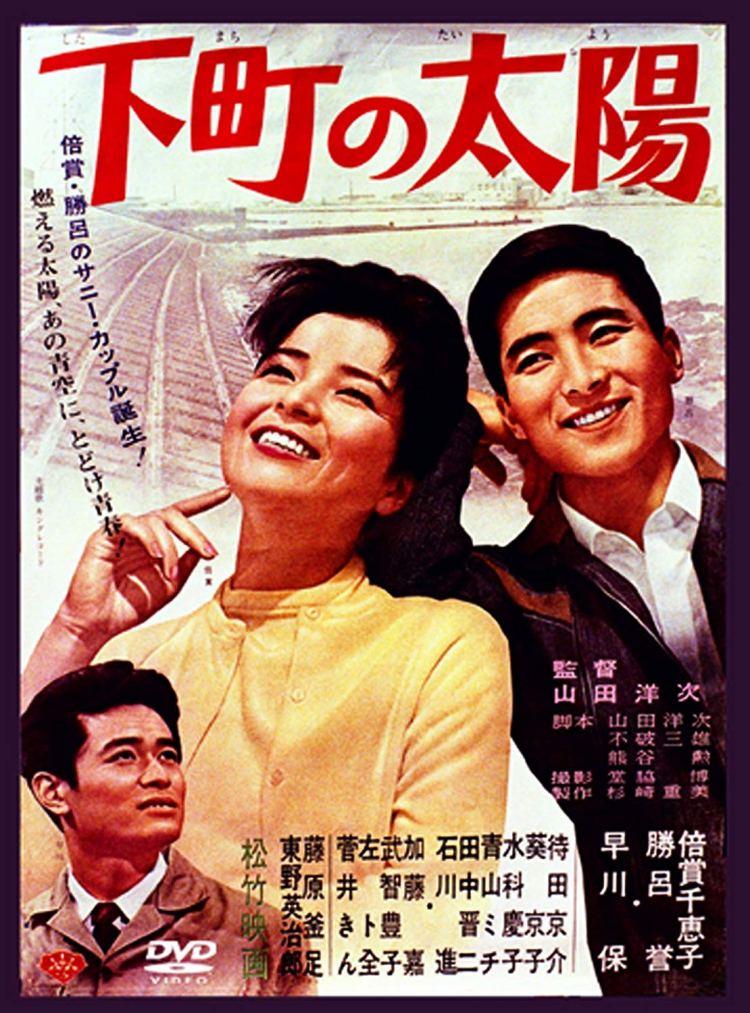
Shitamachi no Taiyou DVD coverYoji Yamada’s debut feature, The Strangers Upstairs, was very much of its time as it attempted to capture the aspirational fighting spirit of the post-war era through the struggles of a nice young couple who are trying to “get on” and escape their humble origins for the salaryman dream through achieving the goal of home ownership as quickly as possible. His second film, Shitamachi no Taiyo (下町の太陽, also known as The Sunshine Girl / Sunshine in the Old Neighbourhood), takes a slightly different look at a similar issue as a young woman from Shitamachi – a working class industrial area on the outskirts of Tokyo, agonises over her future prospects as she considers a marriage to her longterm boyfriend who has ambitions to join the salaryman revolution.

Yamada opens with shots of Shitamachi and its prominent smokestacks while the now famous song plays in an instrumental version over the credits, before abruptly shifting to visions of the upscale Ginza where Machiko (Chieko Baisho) and her boyfriend Michio (Tamotsu Hayakawa) are enjoying a demonstration of an extraordinarily expensive, state of the art radio before retreating to a cafe where they agree that sometimes its more fun to “aspire” to things than actually obtain them. After all, there’s no way they could ever afford the diamond rings they walked past on their way out of the department store unless they decided to rob the place. Both Machiko and Michio are residents of Shitamachi and work in a local soap factory. Michio, however, has his sights firmly set on the path to a middle-class life and is planning to take the exam for a promotion to head office – though he lacks qualifications, Michio is confident because he’s studying hard (though more so because his dad and his section chief served together in the war so Michio is sure a good word will be put in for him).

Despite her fondness for Michio, Machiko has her doubts about his overriding ambition to get out of Shitamachi. Since her mother died, Machiko has been the lady of the house and primary caregiver for her naughty little brother Kenji (Joji Yanagisawa) while her older brother Kunio (Toshio Suzuki) is the family brainbox and also planning to bust out only through the path of education rather than advancement. Having left education behind, Machiko is happily contributing to the family finances with her job on the packing line at the soap factory which is, all things considered, not too bad – the work may be dull and methodical but also relatively quiet and stress free, not to mention sweet smelling. Nevertheless, Machiko does not necessarily want to work on the shop floor all her life but knows her opportunities are limited.

This fact is one cruelly brought home to her by a moody Michio when descends into a major sulk on learning that he hasn’t passed the test for head office because another of his colleagues outdid him – both in terms of his study ranking and in one upping him in having a direct connection to the director. While Machiko tries her best to sympathise and put up with his moody petulance, Michio chooses to throw her sympathy back in her face by abruptly announcing that she can’t understand the pain he’s going through because careers are irrelevant to women who only use them as a stopgap until they get married. Thoroughly annoyed, Machiko leaves Michio to his wallowing before things get any worse but she can’t argue with the fact that he’s only said what most people think.

Still, Machiko isn’t even sure she wants to get married. One of her friends, Kazuko (Kyoko Aoi), recently won the jackpot – she married a nice man who did get a promotion to head office and won the housing lottery for a home on one of the shiny new “danchi” – brand new apartment complexes for upwardly mobile young couples and the very embodiment of post-war aspiration. However, when Machiko and a friend visit the new bride they find that she is not quite as happy as one might expect. Though married life is peaceful enough and she and her husband evidently get on, Kazuko is also intensely lonely. With her husband away at work all day and often out playing golf with colleagues on Sundays too (not to mention after hours drinking and miscellaneous get togethers), there’s precious little for Kazuko to do, stuck at home all day cooking and cleaning while waiting for her husband to return. Having moved to the danchi she’s also lost her community and is no longer close enough to her friends to see them very often.

Meanwhile, Machiko is also somewhat disturbed by Kazuko’s collection of expensive cosmetics which her husband has instructed her to buy because he’s “very particular” about her appearance. Kazuko makes sure her makeup is on point before her husband gets home because that’s apparently what he likes. Machiko, however, does not like this – to start with, she thinks Kazuko looks better without. Not that there’s anything wrong with wearing makeup because you want to wear it, but the idea of wearing it because someone told you to and you’re worried they’ll “get bored” with your face doesn’t strike her as a particularly healthy relationship dynamic. If this is what a love marriage is like, perhaps Machiko would rather do without.

Despite her otherwise close relationship with Michio, it quickly becomes obvious that she does not love him and if she decides to marry him it will be because it’s the “sensible” decision rather than any great romantic desire. Annoyingly enough, Michio hasn’t really even asked her, he just assumes they will marry once he gets his promotion. He also assumes that Machiko, like him, will want to shake the dust of Shitamachi off her feet for good for the bright lights of Tokyo. Machiko, however is not so sure. “Getting on” is one thing and there’s nothing wrong with “aspiration”, but that doesn’t mean you need to look down on the people who come from the same place as you – after all, the sun still shines even in Shitamachi and there’s nothing wrong in choosing to be happy here rather than always chasing an unattainable dream of conventional success.

Another possibility presents itself when Machiko meets an unrefined boy who has an ordinary job in the steelworks. Though their first meeting did not make a good impression – he creepily chased her off a train and then made a mess of trying to explain why, they later bond when she realises he has befriended her troubled little brother and the pair then end up spending a pleasant evening together which is far more romantic than any of her dull and conventional outings with Michio. Then again the choice she faces isn’t between two men but whether or not to embrace her own ability to make a definitive choice about her future. What she rejects is cold and selfish path of men like Michio who only want to get ahead and are willing to step on anyone who gets in their way to make it happen. Machiko doesn’t want fancy radios and diamond rings, she just wants to not have to worry too much about money and for someone to actually listen to what she’s saying. She doesn’t want to end up like Kazuko, all alone in a sparkling apartment with nothing to do but knit. When Michio tells her to shut up and do as he says because he’ll definitely make her happy, the choice seems clear. Hard work, community, and maybe the fiery boy who seems determined to get a yes rather than assuming he already has one. Who wouldn’t want to live here?


Original trailer (no subtitles)

Famous title song performed by Chieko Baisho
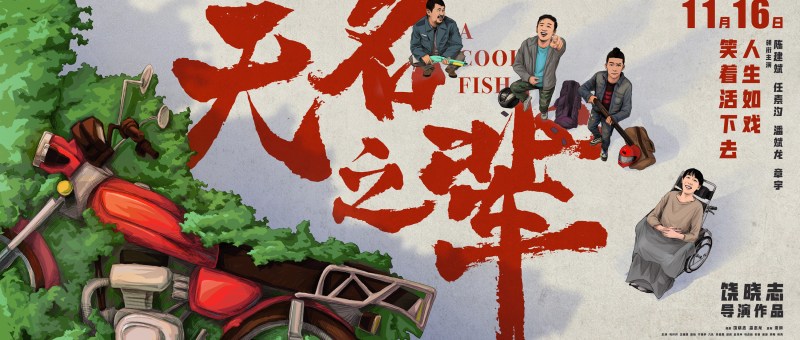
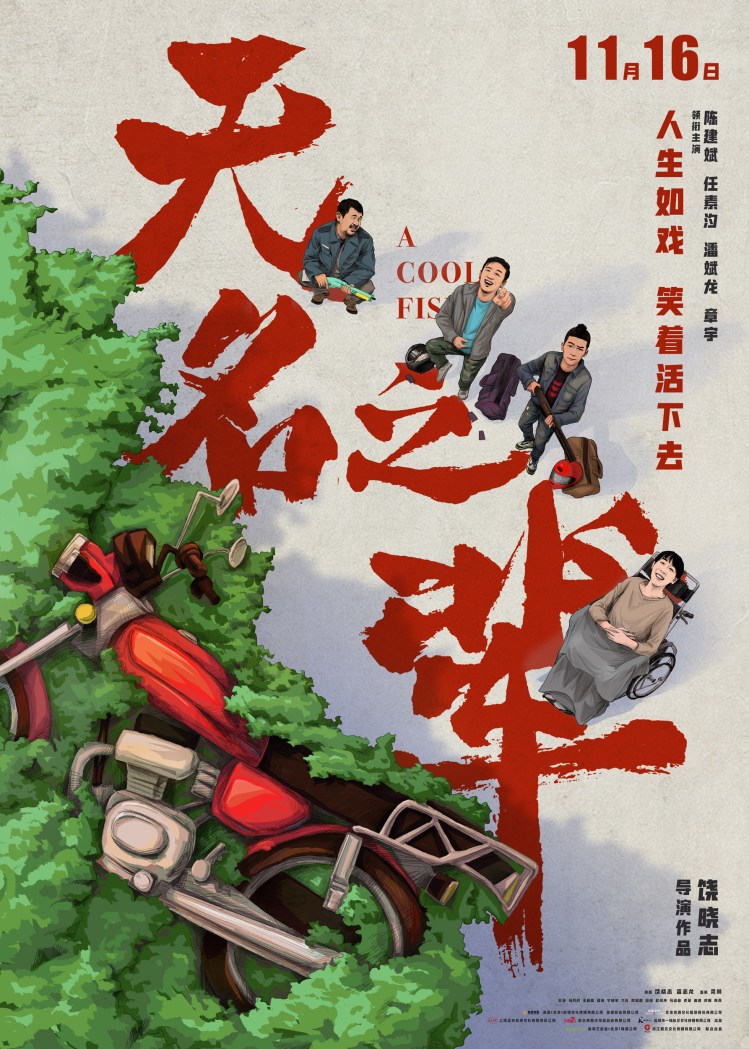
A Cool Fish (无名之辈, Rao Xiaozhi, 2018)

A Cool Fish posterThe genial loser is fast becoming a staple of contemporary Chinese cinema. Rao Xiaozhi’s second feature A Cool Fish (无名之辈, Wúmíng zhī Bèi) is the latest in a long line of comedies to make the “diaosi” world its home as a collection of disappointed and increasingly desperate failures become embroiled in a complex web of cosmological coincidence. China’s famously draconian censorship regulations ensure that the ending of this caper will be bittersweet at best, but even so a brief brush with violent crime does at least allow a bouncing back if only through hitting rock bottom and emerging with greater clarity.

Small town hicks “Bra” (Zhang Yu), short for “Cobra”, and Big Head (Pan Binlong) have talked themselves into a gangland future, planning a big city heist after getting their hands on a stolen gun and motorbike. Unfortunately, not everything goes to plan and they end up robbing a mobile phone shop next door to the bank rather than the bank itself because the security guard was too intimidating. Not only that, they manage to send their getaway bike into a tree while trying to escape by muddling the clutch with the accelerator meaning they have to escape on foot. Crawling in through an open window, they find themselves in the home of the spiky Jiaqi (Ren Suxi) who is paralysed from the neck down and completely unafraid to make use of her one remaining weapon – an extremely loud and imperious voice. Jiaqi is also the sister of widowed security guard Ma Xianyong (Chen Jianbin) who was once an auxiliary police officer and harbours a desire to get back on the force which he feels he could fulfil through investigating the robbery and retrieving the gun on his own initiative. Meanwhile, Xianyong’s boss, financially troubled property developer with a complicated family set up Gao Ming (Wang Yanhui), is on the run from gangsters to whom he has massive debts.

Like the cool fish of the title, Bra and Big Head are young men with impossible futures who find themselves cast out from mainstream society with no real way back in. No education, no connections, no job prospects or family – their futures look bleak. Bra sees himself as a gang boss in waiting even if Big Head is his only henchman, but the guys are no master criminals and despite their claims of working their way up in the crime world it’s clear they aren’t cut out for such cutthroat antics. Xianyong, by contrast, had opportunities but squandered them and then lost everything in a tragic turn of events for which he must bear some of the responsibility. Despised by his teenage daughter, humiliated by the gangsters chasing Gao Ming, and burdened by the guilt of having caused the accident that ruined his sister’s life, all Xianyong wants is to hit back and prove himself a someone, which means he’s coming for another pair of losers not so different from himself.

Rao Xiaozhi rolls the familial in with the political through rooting all of Xianyong’s various problems in his very male failures as a compromised father figure. Having lost his wife in a tragedy of his own making, Xianyong is resented by his daughter who has reverted to her mother’s maiden name out of shame while he engages in underhanded scams to bolster his fragile sense of self worth. Meanwhile, all Big Head dreams of is a small house in his hometown and to marry his childhood sweetheart, Xia (Ma Yinyin), who has come to the city in search of money. Big Head thinks she doesn’t want to marry him because he isn’t rich, but Xia’s reluctance turns out to be misplaced shame in having engaged in sex work and no longer seeing herself as good enough for the small town wholesomeness of a man like Big Head, never guessing he might go to such extreme lengths just to prove himself worthy of her.

Trapped by the crushing impossibility of life in a rapidly developing, relentlessly unfair, patriarchal, and conservative society each of our heroes takes desperate measures to enact their escape but quickly discovers that escape is a spiritual more than material matter and cannot be bought through transgression. This being China, crime cannot pay and so our guys cannot hope to emerge heroically from their less than heroic foray into gun toting criminality but even so you’d have to admit that their futures are brighter for having hit rock bottom and woken up with a better sense of self and a degree of forward motion. Rao’s ramshackle world of lovelorn little guys daring to dream of a (modestly) brighter future perfectly captures the bleak romanticism of the “diaosi” phenomenon and proves strangely difficult to resist save for its crushingly “necessary” finale.


Currently on limited release in UK Cinemas courtesy of China Lion.

International trailer (English subtitles)

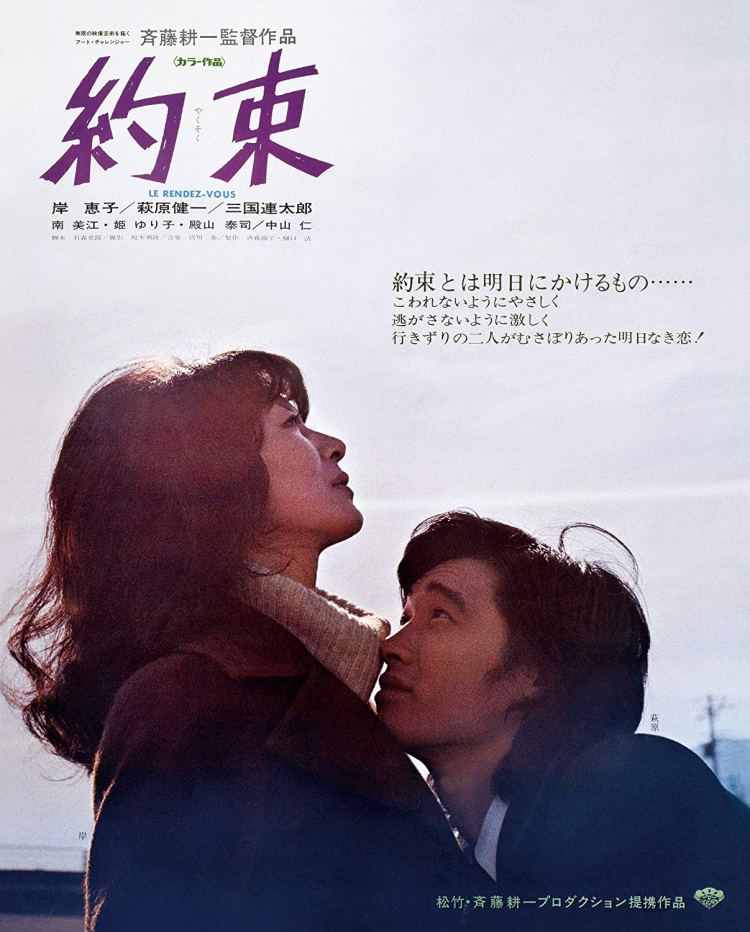
The Rendezvous (約束, Koichi Saito, 1972)

The Rendezvous poster“If human’s don’t trust each other, it’ll be the end of the world” – so says the cheerful hero at the heart of Koichi Saito’s The Rendezvous (約束, Yakusoku). Saito’s film is, somewhat unusually, a rare example of a Korean film remade in Japan. Inspired by Lee Man-hee’s Late Autumn (now sadly thought lost), The Rendezvous has been remade three times in Korea by such esteemed directors as Kim Ki-young (1975), Kim Soo-yong (1982) and most recently Kim Tae-young in 2010. There is indeed something particularly timeless in its tale of fate frustrating a fated love as each of our protagonists struggles to find the energy to rebel against their own sense of impossibility.

A brief framing sequence begins with a nervous, melancholy woman, Keiko (Keiko Kishi), sitting alone on a park bench, surrounded by the cheerful activity of athletes training, women pushing prams, and families enjoying the crisp sunshine. As she thinks back to what brought her here we travel back with her to a fateful train journey some years previously.

Keiko sits sadly by the window, impassively watching the sea stretch out as the train whizzes by. An older woman (Yoshie Minami) is sitting next to her, though they appear at least not to be on particularly friendly terms. At the first stop a younger man, Akira (Kenichi Hagiwara), gets on and sits down opposite Keiko, throwing a newspaper over his face, presumably to help him get some sleep (or, as we later wonder, perhaps just to better disappear). Intrigued, Keiko nevertheless shivers on catching sight of the paper’s headline – “Drunken Husband Stabbed to Death”. Knocking the paper off his head as she gets up to go to the bathroom, Keiko clips it back on for him with her hairpin – something that later gives him an excuse to talk to her when he eventually wakes up.

Akira, it turns out, is the chatty sort of person who enjoys making conversation with strangers. He makes a nuisance of himself trying to chat to Keiko and the old woman who ignore him, whilst accidentally frightening the bored little girl opposite by trying to entertain her. The ice finally thaws when Akira decides to buy everyone lunch – Keiko accepts and speaks to him if only to insist on paying him back (which the old lady then also feels compelled to do). Though very little actual conversation takes place on this first train journey, Akira is also travelling to the same small town as Keiko and continues to make a nuisance of himself by following her around. Nevertheless a connection begins to form between the pair, such perfect opposites in every way but one, though the time is always ticking and the encounter is one coloured by its impending end.

Keiko’s mysterious behaviour is later revealed to be more than just shyness or existential angst. Akira repeatedly asks for her trust, but she claims herself incapable of trusting anyone because in a sense she is already dead. Indeed, her entire aura is one of deliberate stillness, rarely speaking, and often leaning sadly against a more solid structure as if lacking the energy to fully support herself. Ironically enough, Keiko’s name is written with the character for “firefly” – a creature that burns out bright and then fades away. Keiko not only believes that her light has gone out, but that there are no more fireflies left. Akira, whose name is written not with the character for “bright” but with one for “cheerful”, begins to show her that there could be fireflies still, jokingly pointing to the lights from a nearby boat bobbing on the water.

We’re later told that the root of all Keiko’s suffering is “an absence of love”, that as passion cooled there was only emptiness in its place. “Emptiness” seems to be the force which defines Keiko’s existence, the reason her fire is out and her life apparently over. Though she feels a passionate attraction to Akira, she cannot bring herself to submit to it, both distrusting herself and afraid to face the possibility that it too will end. Both Keiko and Akira are fugitives from themselves, literally railroaded towards an inevitable conclusion they lack the courage to oppose. Akira wants to run, but Keiko knows she belongs on the train, incapable of escaping her self-imposed imprisonment and unwilling to step away from her unchanging destiny.

Fate follows them everywhere – violent headlines, prisoners being escorted, flashes of handcuffs, all reminding them that they are trapped, powerless in the face of an oncoming reckoning. Akira repeatedly asks Keiko to trust him, insisting that as long as she believes in him everything will be alright. Yet Akira is a flustered young man always in a hurry, running as if already late for the future. He makes Keiko a promise of a meeting and even gives her his watch to help her keep it, yet fails to appear. Akira’s heart may be trustworthy, but his body less so and even if he really wanted to come fate may have other plans. Love, it seems, is not enough. Saito returns to Keiko, sitting alone on the bench, waiting as the park empties and all the kids go home for tea. There’s no way to know if Akira can keep his promise even if he meant to, but perhaps there is something even so in the continued faith that he might simply bound in, hours late but as earnest as ever.

The central narrative seems to retain the Korean of sensibility of Lee’s original in its sense of dread and inevitability, and of passion repressed. Saito’s approach leans more towards misty European arthouse than your average Shochiku romance, making the most of its mystery as the time continues to run down for Keiko and Akira before they must prepare to meet their respective fates. Fate, at least, will wait for you and will always be there in the end. Impossibility defines the world of the defeated Keiko and the childlike Akira, but perhaps the most painful thing is hope itself, and the lingering faith that a promise will be kept despite the overwhelming odds.


Original trailer (no subtitles)

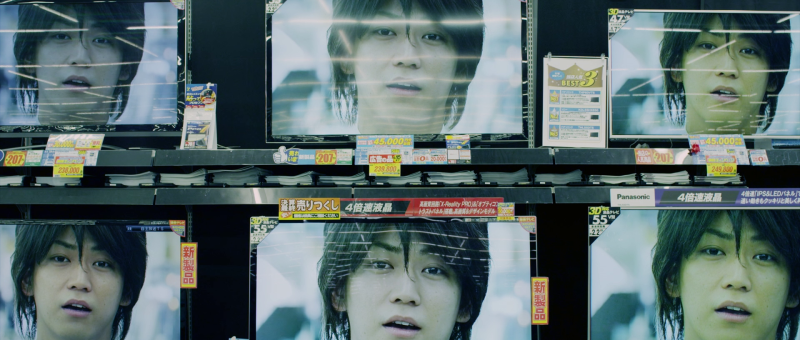
It’s Me, It’s Me (俺俺, Satoshi Miki, 2013)

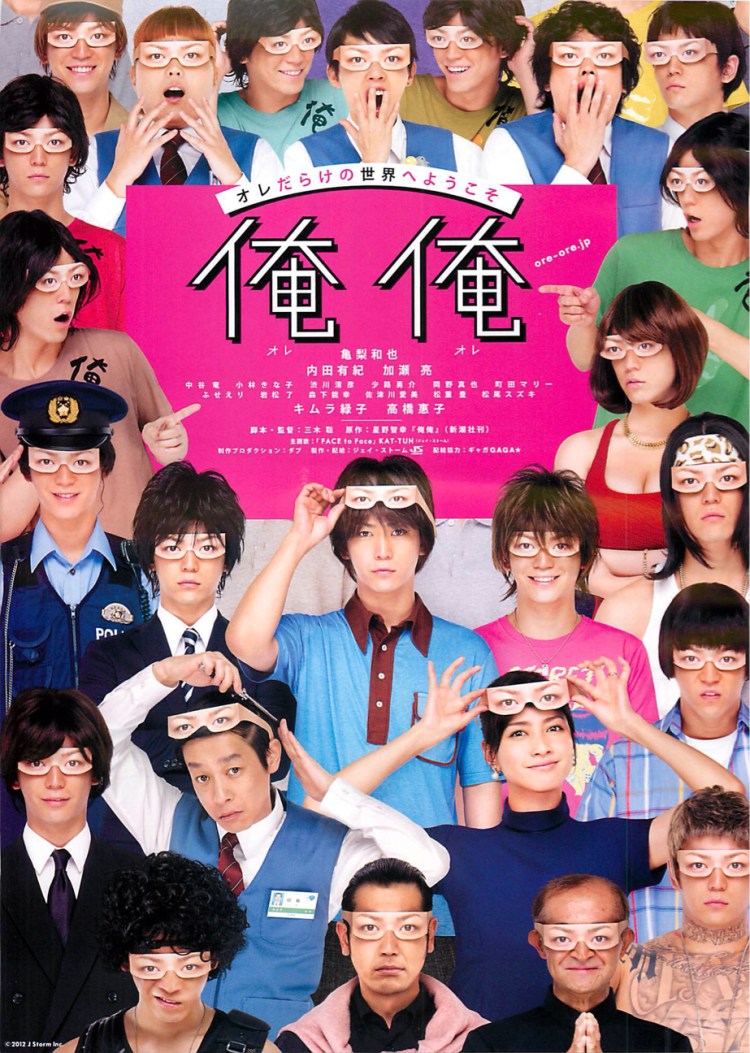
It's Me It's Me posterSome say it’s good to be your own best friend, but then again perhaps too much of your own company isn’t so good for you after all. The hero of Satoshi Miki’s adaptation of the Tomoyuki Hoshino novel, It’s Me, It’s Me (俺俺, Ore Ore), is about to put this hypothesis to the test as his identity literally splinters, overwriting the source code of strangers and replacing it with its own. How can you save your identity when you aren’t sure who you are? Perhaps getting to know yourself isn’t as straightforward a process as most would believe.

Hitoshi (Kazuya Kamenashi), an aimless 20-something, had dreams of becoming a photographer but they’ve fallen by the wayside while he supports himself with a dead end job on the camera counter in a local electronics superstore. Virtually invisible to all around him and so anonymous the woman in the fast food restaurant almost wouldn’t give him the fries he’d ordered, Hitoshi is irritated when two salaryman-types gossiping about how one of them plans to quit the company to pursue his dreams rudely invade his space. Perhaps for this reason, he finds himself taking off with the irritating stranger’s phone after he carelessly allows it to fall onto Hitoshi’s tray.

Emboldened, Hitoshi decides to use the phone to commit an “Ore Ore” scam – a well known telephone fraud in which a stranger rings an elderly person and shouts “it’s me, it’s me!” in a panic so they won’t twig it’s not really their grandson who is ringing them and claiming to be in some kind of terrible trouble which can only be relieved with cold hard cash. Not the sharpest knife in the drawer, Hitoshi gets the money wired to his account and then tries to dispose of the phone but it’s already too late. When he gets home, a strange woman (Keiko Takahashi) is in his apartment and she keeps calling him “Daiki”. What’s more, when he tries to go and see his mum (Midoriko Kimura), another guy is there who looks just like him and his mum won’t let him in.

Hitoshi eventually becomes friends with “Daiki” who introduces him to another “Me”, Nao – a cheerful student slacker. Each in their own way slightly disconnected, the trio build up an easy friendship – they do after all have quite a lot in common, and begin jokingly referring to their shared apartment as “Me Island”. Hitoshi, remarking that he’s never felt so carefree among others, begins to see the upsides of his strange new situation which obviously include the ability to be in two places at once, but too much of himself eventually begins to grate when Nao begins tracking down and bringing home all the other Mes he can find with the intention of launching a Me Empire.

A member of a lost generation, Hitoshi is a perfect example of modern urban malaise. Though he once had dreams, they’ve been steadily killed off by an oppressive society leaving him alone and adrift, unable to connect with others as the light slowly dies in his eyes. Perhaps, however, there is the odd flicker of resistance in his intense resentment towards those who have defiantly not given up – the chatty salaryman talking about his individualist dreams and later his work colleague who has been secretly taking accountancy classes in an effort to escape casual employment hell for a steady, if dull, regular job.

Hitoshi has always regarded relationships as “troublesome” but begins to feel differently through bonding with himself. As Daiki puts it, accepting others means that you’ll be accepted – something Hitoshi unconsciously longs for but is too insecure to believe is possible. His actualisation receives another stimulus when he meets the beautiful and mysterious Sayaka (Yuki Uchida) who again encourages him to accept the one who accepts you and is the only other person who seems to be able to see the “real” him as distinct from all the other Mes. Yet Hitoshi struggles – he can accept parts of but not all of himself, eventually leading to a disastrous turn of events in which the parts of himself he does not like begin being “deleted” as one Me decides to make war on all the others.

Only by ridding his psyche of imperfections can Hitoshi reformat his personality and once again resume full autonomy as the one and only Me. Yet can we be so sure final Hitoshi is the “true” Hitoshi? Who can say – only Hitoshi himself can know the answer to that (or not), the rest of us will just have to accept him as he is in the hope that he will also be able to accept us so that we can in turn accept ourselves.


Original trailer (no subtitles)

Farewell to Spring (惜春鳥, Keisuke Kinoshita, 1959)

(C) Shochiku 1959

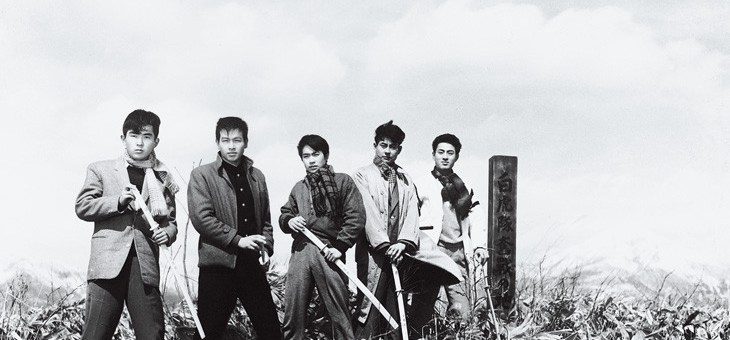
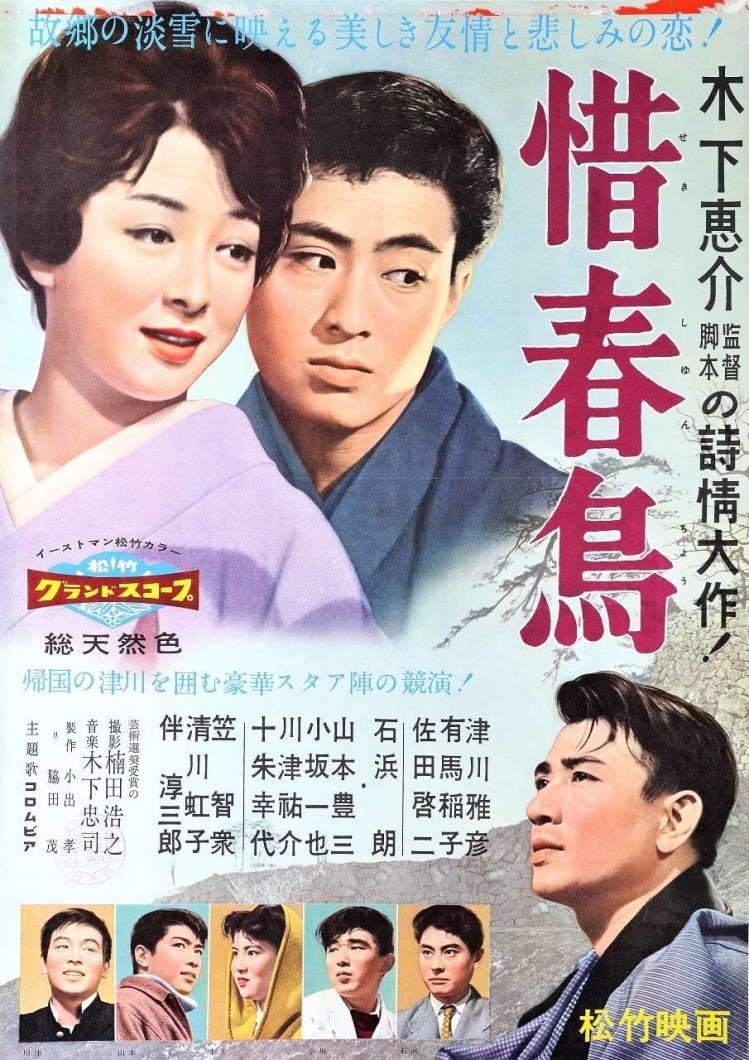
Farewell to Spring posterFor Keisuke Kinoshita, people are basically good even if the world around them often isn’t. Even so, there are limits to goodness. Can friendship survive if an intimate trust is abused, or will betrayal cut the cord once and for all? Unlike many of his contemporaries, “youth” was not a theme in which Kinoshita was particularly interested – or, at least, not quite in the same way. Farewell to Spring (惜春鳥, Sekishuncho) is in some senses an awkward fit for his usual concerns but then the concerns here are perhaps closer to the personal in examining the changing fortunes of a group of five male childhood friends who find themselves scattered in the complicated post-war landscape, facing their mutual troubles in solitary, manly fashion while their friendship withers under the weight of their individual sorrows.

The drama begins when Iwagaki (Yusuke Kawazu) returns to his Aizu mountain village after being away at university for the previous two years. As Iwagaki’s parents have died and his half-brother moved to Hokkaido with his family, Iwagaki has no “home” in his hometown as he sadly tells a familiar face spotted on the train. Nevertheless, his friends are very excited to see him and have all rallied round without even being asked. Iwagaki will be staying at an inn owned by the family of his friend, Minemura (Kazuya Kosaka). The other boys all stayed in the village – Makita (Masahiko Tsugawa), the illegitimate son of a bar owner is being primed to take over the family business while sort of dating the step-daughter of his estranged father; Teshirogi (Akira Ishihama), the younger son of an impoverished former samurai family, is working at a local factory and heavily involved in the labour movement; while Masugi (Toyozo Yamamoto), who is disabled with a lame leg thanks to a childhood accident, works alongside his parents in a traditional lacquerwork shop but finds his livelihood threatened by political troubles with China.

Once a tight group of small-town friends, none of the boys quite wants to acknowledge how far they have drifted apart – not just from each other, but from the young men they once were even though comparatively little time has actually passed. Nevertheless, the shadow of their old bond still exists – it is obvious to all the boys that Iwagaki has returned in some kind of disgrace. A favourite of their teacher, Iwagaki had been given a valuable opportunity to better himself by going to university in Tokyo but has apparently fallen out with his sponsor and into hard times. The story he tells his friends is dark – they’d heard it had to do with a “dalliance” with a maid which annoyed his patron but the way he describes it sounds more like a rape revenge followed by an unwanted romance which he eventually ran away from. Iwagaki is not making himself look good which might suggest that he trusts his friends enough to tell them the truth, or perhaps just doesn’t quite see the various ways in which his conduct discredits him, but either way there is deepening gulf between each of the men in which none is quite being honest with the other.

Iwagaki’s arrival doesn’t so much stir up old troubles as occur alongside them. The central drama revolves around a squaring off between Makita and Teshirogi over a girl, Yoko (Yukiyo Toake), who is the niece of Makita’s biological father – a nouveau riche pawnbroker with a steely wife, Tane (Teruko Kishi), who hates Makita’s mother for obvious reasons. The mistress and the wife are locked into an internecine battle of wills and resentments and so both are opposed to a marriage between Makita and Yoko even though they have fallen in love independently. As there is no son in the family, Makita’s father needs someone to marry in through marrying Yoko – it would obviously be ideal for him if his “real” son could inherit his estate, but Makita’s mother wants him to take over her bar and Tane is directly opposed to suffering the humiliation of a mistress’ son living under her roof and so they are at an impasse. Meanwhile, Tane has been trying to arrange a socially beneficial marriage and has settled on Teshirogi – the impoverished son of an aristocratic family.

A confluence of post-war problems, the first question pits the traditional arranged marriage against the youngster’s right to choose. Yoko doesn’t want the arranged marriage – she’s doing everything she can to fight it even if she ends up alone, but Makita has already given up believing the situation is futile. Teshirogi tries to ask him if it’s OK to pursue Yoko, but Makita doesn’t really answer. What he says is does as you see fit, but Teshirogi hears only what he wants to hear and fails to notice that Makita minds quite a lot and has only said that out of a sense of despondency and a possible romanticisation of his emotional suffering. Yoko is living in the post-war reality – she rejects the idea of arranged marriage and of her adoptive parents’ right to control her future, but she is unable to fully resist alone – she needs Makita to stand with her, but he doesn’t have her courage. Meanwhile, Makita is also consumed by thoughts of romantic impossibility thanks to the sad story of his melancholy uncle (Keiji Sada) who tried to run off with a geisha (Ineko Arima) only for her to be dragged back by her madam because of an outstanding debt.

Debt bondage is something else that’s thankfully on its way out in the post-war world thanks to the prostitution laws which are contributing to a decline in the fortunes of Minemura’s inn. Feudalism, however, is doing its best to cling on – especially in tiny mountain backwaters. Teshirogi may now be a proletarian factory worker flying the red flag and taking an active part in the labour movement as a striker protesting for better pay and conditions, but at heart he’s still a nobleman and has a natural sense of entitlement and superiority towards his friends which is only deepened by his resentment over his comparative financial inferiority. Yoko asks him to turn down the marriage proposal because she’s in love with Makita and fears her family won’t listen to her alone, but Teshirogi roughly tells her he doesn’t care much for her feelings and will make his own decision. Later he insists on giving his answer “the proper way” by going through his father, and submits himself entirely to the processes of the pre-war society. Making a half-hearted justification to Makita, Teshirogi confesses that his decision to push for the marriage was motivated by his poverty and a desire to regain his status if also partly because he too is attracted to Yoko and admires her spiky spirit even if it otherwise seems to contradict his conservative views.

Teshirogi breaks the bro code in favour of self interest, not actually caring very much if it costs him friendships which he appears not to value. As openly gay as it was possible to be in the late 1950s, Kinoshita creates an intensely homosocial world of male honour-based bonding, but makes a tragic hero of the innocent Masugi who is in a sense feminised by his disability which prevents him from participating in the manly rituals of the other boys – most notably in the coming of age sword dance in which he becomes narrator rather than sword bearer. Teshirogi, in an early instance of smug insensitivity, throws a mildly barbed comment at Masugi in tersely suggesting that his affection for Iwagaki runs beyond friendship – something which the group seems to be aware of but does not want to go into, or at least not really like this. Masugi and Minemura emerge as the most pure hearted and the most hurt among the friends, clinging on to the idea of their friendship even as they are betrayed by those closest to them while Makita wonders if betrayal is an essential component of connection or merely its inevitable end.

Despite the central betrayal, the boys eventually manage to salvage something of their friendships, leaving the field of battle together and alive if also wounded and sorrowful. Unlike the tragic White Tigers in the song which recurs throughout the film who elected mass suicide on believing their battle was lost, the boys move forward – Makita, at least, spurred on by his uncle’s tragic romance decides that love is worth fighting for after all and that he doesn’t have to blindly accept the profound inertia of small-town Aizu life or the natural authority if the hypocritical Teshirogi who shouts socialist slogans but insists on his social superiority. Friendship may not survive the compromises of adulthood, but perhaps the bonds between people aren’t so easily broken after all even if they consistently break your heart.


Original trailer (no subtitles)

Seven People in the Cellar (지하실의 7인 / 地下室의 七人, Lee Seong-gu, 1969)

Seven People in the Cellar poster

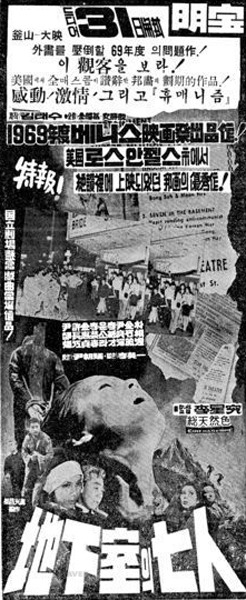
The “literary film” was beginning to fall out of favour by 1969. The collapse of the quota system introduced under the 1962 Motion Picture Law, the exclusion of literary film from the “Domestic Films of Excellence” programme (which encouraged producers to produce high quality Korean films to qualify for distributing more lucrative foreign ones), and the rise of television all conspired to produce a shift towards the populist. Lee Seong-gu had made his name with a series of literary adaptations which enabled him to experiment with form in the comparatively more elevated “arthouse” arena but with horizons shrinking even he found himself with nowhere left turn. Seven People in the Cellar (지하실의 7인 / 地下室의 七人 *, Jihasil-ui Chil-in) is Lee’s last “literary film” and is adapted from a stage play by Yun Jo-byeong who was apparently unhappy with Lee’s adaptation in its abandonment of his carefully constructed ideological balance in favour of adhering to the typical rhetoric of the “anti-communist” film.

Set towards the end of the Korean War, Seven in People in the Cellar presents itself as a conflict between the godless and hypocritical forces of communism and the good and righteous Catholic Church. Accordingly, our hero is a priest, Father Ahn (Heo Jang-gang), who has just returned to his church after being forced to flee by the encroaching “puppet army”. Accompanied by a nun, Lucia (Yun So-ra), and a new curate, Brother Jeong (Lee Soon-jae), Father Ahn is glad to be reunited with his flock but there are dark spectres even here – Maria (Yoon Jeong-hee), a young woman Ahn was forced to leave behind when he fled, runs away from the priest on catching sight of him, apparently out of shame. Meanwhile, while Ahn was away, three rogue Communists began squatting in his cellar waiting for the “reinforcements” which are supposedly going to retake the town. Taking Sister Lucia hostage, the Communists force Ahn to feed them while keeping their existence a secret. To Jeong’s consternation, Ahn agrees but out of Christian virtues rather than fear – he feels the Communists too are lost children of God and have been sent to him so that he may guide them back towards the light.

Not a natural fit for the world of the anti-communist film, Lee does his best to undermine the prevalent ideology even if he must in the end come down hard with Ahn’s essential moral goodness. Thus, Communists aside, the conflict becomes one of age and youth, male and female, as much as between “right” and “wrong” or “North” and “South”. Jeong, youthful and hotheaded, lacks Ahn’s Christian compassion – he bristles when Ahn immediately sets about feeding the starving villagers with their own rations, and disagrees with his decision to harbour the Communists even while knowing that Lucia’s life is at stake if they refuse. Twice he tries to kill the communist “enemy”, threatened by their ideological opposition to his own cause – once when he enters the cellar and misinterprets an altercation between Lucia and sympathetic soldier Park (Park Geun-hyeong), and secondly when the troop’s female commander, Ok (Kim Hye-jeong), attempts to seduce him.

Sexuality becomes spiritual battleground with Christian chastity winning out over Communist free love. Ok, as unsympathetic a communist as it’s possible to be, is sexually liberated and provocative. She suggestively loosens her shirt and fondles her breast in front of a confused junior officer, later taking him into the forest and more or less ordering him to make love to her (which he, eventually, does). However, it is to her simply a matter of a need satisfied. Ok describes the moment she has just shared with her comrade as no different than sharing a meal. She was “hungry”, she ate. When she’s hungry again she will eat again but there’s no more to it than that and there is no emotional or spiritual component in her act of “lovemaking”, only the elimination of a nagging hunger. 

Ok’s transgressive and “amoral” sexuality is contrasted with that of the abused Maria who was tortured and later raped by the Communists’ commanding officer. Forced to betray a nun, she was robbed not only of her innocence but also of her faith. Maria is the “pure woman” corrupted by Communist cruelty. Her chastity was removed from her by force, and she sees no other option than to continue to ruin herself in atonement for her “sin”. Unable to live with the consequences of her actions, she sees no way out other than madness or martyrdom.

The fact that Maria’s torturer is another woman, and such an atypical woman at that, is another facet of the Communist’s animalistic inhumanity. As in The General’s Mustache, the Communists are seen to use innocent children as bargaining chips when ordinary torture fails, even this time killing one to prevent him telling the village about their hiding place. Yet the height of their cruelty is perhaps in their indifference to each other – Park, touched by Sister Lucia’s refusal to leave when he tried to let her go fearing that he would face reprisals, announces his intention to defect to the South and is shot dead by his commander in cold and brutal fashion. Park’s defection is a minor “win” for Ahn who sought restore the Communists’ sense of humanity and bring their souls to God, but it’s also born of misogynistic pique in his intense resentment of the “bossy” Ok who turns out to be an undercover officer from HQ on a special mission to spy against him.

With the one redeemed Communist dead, all that remains is for the others is to slowly destroy themselves. Ahn, cool and composed in absolute faith, waits patiently certain that the friendly South Korean soldiers will shortly liberate them. A hero priest, Ahn is the saintly opposite of the Communists’ cruelty in his compassionate determination to save them even at the risk of his own life. Lee keeps the tension high, creating siege drama that feels real and human in contrast with the often didactic and heavily stylised narrative of the “anti-communist” film, subtly muddying the essential messages but allowing Ahn’s compassion (rather than his “faith”) to shine through as the best weapon against oppressive inhumanity.


Seven People in the Cellar is the fourth and final film included in the Korean Film Archive’s Lee Seong-gu box set. Not currently available to stream online.

* In rendering the Hanja title, the landscape poster uses the arabic numeral 7 while the portrait version uses the Chinese character 七.

The General’s Mustache (장군의 수염 / 將軍의 수염, Lee Seong-gu, 1968)

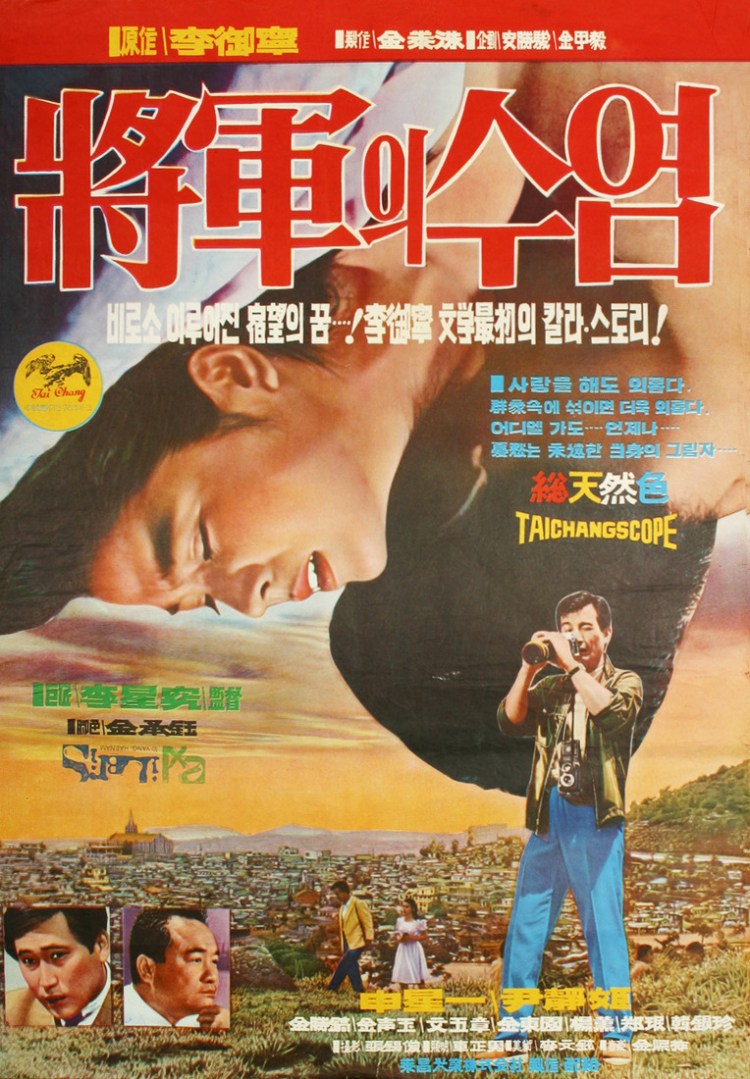
General's Mustache posterBroken dreams of the post-war society prove too much for one man to bear in Lee Seong-gu’s masterpiece of Korean Modernism – The General’s Mustache (장군의 수염 / 將軍의 수염, Janggun-ui Suyeom). Adapted from the novel by Lee O-young, Lee’s film co-opts the procedural but subtly subverts it, taking a cue from the film noir to turn it in on itself and ask if we can truly ever know another person, or if we simply conjure an image of everyone we know based on a collection of external observations gathered by ourselves and others. Our hero, Cheol-hun (Shin Seong-il), is a melancholy man who has chosen to live in a world of his own creation but when his shield of artifice is pierced by a spear of reality he can endure it no longer. Cheol-hun is dead, but who, if anyone, killed him and can we ever really understand why he died without his words to guide us?

Lee opens with a scream as Cheol-hun’s landlady discovers his body, draped half naked over his bed next to a stove with the safety cover removed. Concluding that carbon monoxide poisoning is likely the cause of death, the police find the panicked landlady suspicious but leave with three clues – a ladies’ stocking, a missing camera, and the scar on Cheol-hun’s forehead. The stocking takes them to Cheol-hun’s ex, who tells them that Cheol-hun gave his camera to a “nude model” which was perhaps a point of tension between the two, but not apparently the reason they decided to separate. The scar, ruining the detective’s (Kim Seung-ho) theory, turns out to be an old one – received in infancy when his exhausted mother (Han Eun-jin) dropped an iron on his head after a long day at the press.

After the testimony from Cheol-hun’s mother, the scar seems incidental but turns out to be anything but. Cheol-hun’s mother blames herself for his childhood injury (as any mother would) and has spent her life worrying about him, believing that the scar itself has been the cause of all his misfortune and sent him off on an unlucky path. From Cheol-hun’s sister (Kim Sin-jae) we learn that the family was once wealthy – local landowners who valued their “aristocratic” blood. After the war all that ended. The land was given back to the people, and Cheol-hun’s family were stripped of not only of their prestige but of their means of living. Nevertheless, Cheol-hun’s austere father refused to let his children play with the “commoners”, and so little Cheol-hun’s loneliness was born.

The testimony of Cheol-hun’s former boss reinforces the view that Cheol-hun was an eccentric loner, ill equipped for life in the “real” world. A former photojournalist, Cheol-hun lost his job as a result of a disastrous interview with a recently returned scholar who had enjoyed some minor success in America. The scholar, having been abroad five years, peppers his speech with random English and puts up a pretence of having forgotten his Korean. He complains that Korean kimchee is too spicy, and suggests that the key to improving the “backward” nation lies in “reforming” the cuisine. Cheol-hun, becoming ever more irritated, offers a few barbed comments but cannot contain himself when the kids, “John” and “Mary” who do not speak any Korean, arrive. American names, he points out, are usually associated with dogs and sex workers – why would you give them to your children if you plan to live in Korea? Needless to say, the interview is over.

Cheol-hun has now been characterised as a man who cannot read the air, but it’s time to hear from him too though it will have to be second hand. Shin-hye (Yoon Jeong-hee), the girlfriend, radically changing under testimony broadly agrees with this view of the man she loved but could no longer live with. Cheol-hun told her that he’d never been good with people and had no real friends save one in the army – interestingly enough a man descended from royalty, but that he died leaving Cheol-hun alone again with the lingering guilt that he was unable to save his only friend. His tragedy is that he yearns for true connection, to truly become one with another person, but he cannot achieve it. His life with Shin-hye crumbles not because of “reality” but because Shin-hye craves the real – to live in the real world where people bleed and hurt. She cannot live with Cheol-hun in his escapist paradise, but he cannot bear to leave it.

The title of the film comes from the book that Cheol-hun wanted to write. In the story, a victorious general fighting for “independence” returns to his “liberated” country. The general is dashing and brave and he has on his face the most magnificent mustache. A weedy reporter giddily asks him if he too might dare to grow such a wonderful mustache to which the general cooly assents. Before long a mustache craze sweeps the nation. Even those who cannot grow a mustache of their own have taken to wearing wigs, but our protagonist says no. He doesn’t want a moustache and refuses to wear one. He loses his job, but it remains open whether the fact of his not having a mustache (which no one forces him to have) or his melancholy loneliness in not wanting to have one and not understanding why everyone else does is the cause of all his suffering. 

The quote at the film’s beginning, painted on Cheol-hun’s maddeningly crowded walls, reads “I refuse to, That’s why I’m alive”. Yet it isn’t quite a refusal so much as a lack of capacity. Cheol-hun’s boss had a point when he said that Cheol-hun was fundamentally unsuited to living in human society, as did Shin-hye when she described him as a lonely child in need of a guardian. If anything killed Cheol-hun, it was loneliness – a revelation which profoundly shakes the conviction of the veteran detective. After all, you can’t put handcuffs on spiritual isolation. The detective thinks of his family, and decides to take a watermelon home to share with them as means of reinforcing his own shallow connections but it’s clear that his conception of the world, of his abilities as a detective and the entire framework of his existence have been irreparably compromised by his investigation into the life and death of Kim Cheol-hun.

Partly a satirical swipe at post-war conformity, Lee’s film also subtly subverts a popular trope from the anti-communist genre in its apparent sympathy for landlords. Cheol-hun’s loneliness is posited as a direct result of his “fall” from his rightful position – the only friend he ever makes is also a fallen nobleman, and he struggles to adapt himself to the “classless” society of the “democratic” era. Yet it’s precisely these outdated ideas of “class” that have ruined his life in his father’s refusal to let him play with the other children. Cheol-hun retreats to a fantasy childhood world to avoid the harshness of modern life, but cannot escape his loneliness or his longing and when he realises Shin-hye is not the soulmate with whom he thought he could forge a new, perfectly isolated paradise, his entire existence becomes impossible.

Lee conjures a mosaic of Cheol-hun composed of the memories of those around him, gradually thickening in texture and finally coming into focus but always only a simulacrum of a man and not the man himself. Adopting a standard procedural narrative, Lee adds in extensive flashback and hypothetical dramatisations as the police investigate, switching to black and white for raw hypotheses and even breaking into elegantly drawn animation to recreate the surreal world of Cheol-hun’s putative novel. Dark and sad, The General’s Mustache seems to imply that there is no answer for solitude, that you can never really know another person fully, and that the loneliest man of all is the one born without a “mustache”, already naked of face in having no final mask to expose but finding that no one wants to see his true self only the one which is demanded he wear to appear just like everyone else.


The General’s Mustache is the third film included in the Korean Film Archive’s Lee Seong-gu box set. Also available to stream via the Korean Film Archive’s YouTube Channel.

When the Buckwheat Blooms (메밀꽃 필 무렵, Lee Seong-gu, 1967)

When the Buckwheat Flowers Bloom posterLife’s little ironies conspire against an ordinary pedlar in Lee Seong-gu’s adaptation of the Lee Hyo-seok short story When the Buckwheat Blooms (메밀꽃 필 무렵, Memilkkot Pil Muryeop). Set in the colonial period, the film tracks the long sad story of an unlucky man and his impossible love as he finds himself continually pushed to the edges of a world which is already disappearing. Yet as bad as things are for the heartbroken pedlar, they’re far worse for his long lost lady who finds herself continually handed from one man to another, abused, and exploited with no possibility of escape.

The story begins with three pedlars – Heo (Park No-sik) who hawks fabric, Jo (Kim Hee-gab) who sells paper, and Yun (Heo Jang-gang) who peddles “medicine”. Heo gets into an altercation with another, younger man, Dong-i (Lee Soon-jae), who he accuses of cutting in on his business. Unable to let the matter drop, Heo starts arguing with Dong-i again at an inn at which point he departs and leaves the old men to it. Heading back on the road, Heo entertains his friends with a familiar story – the one about his night in the buckwheat fields with his one true love.

Flashing back almost 20 years, the pedlars are all young men and only Jo is already married with a pregnant wife (Do Geum-bong) he takes with him on the road. In the marketplace one day, Heo catches sight of Bun-i (Kim Ji-mi), a noblewoman fallen on hard times whose father apparently plans to sell her to pay for his gambling debts. Crestfallen, Heo goes back to his business but catches sight of Bun-i once again and “enjoys” a spot of not exactly consensual sex in the middle of a beautiful buckwheat field. Heo asks Bun-i to wait for him, insisting that he will find the money to buy her from her father before he sells her to someone less nice. After trying several madcap schemes to get the requisite funds (including wrestling to win a bull), Heo sells his beloved donkey but is too late – Bun-i’s dad left in a hurry and sold her off somewhere or other but no one knows where. Heo sets off on a five year quest to find her but remains perpetually too late, only a little way behind but always arriving just after Bun-i and the son which is presumably Heo’s have been sold on to their next “owners.”

When the Buckwheat Blooms is very much Heo’s “depressing” (as he later describes it) life story. We see Bun-i on the periphery of his flashback, but he never finds her and so does not know of all she’s suffered since they parted, nor even that she has a child. Much of his melancholia is born of being old and of being poor. It is clear that his life has been ruined through poverty and lack of prospects – no one chooses to be a pedlar (as the pedlars keep pointing out), it’s what you do when you can’t do anything else. An itinerant existence has deprived each of them of a traditional family life. Jo had a wife in the flashback, but she and her children now live in a permanent home which Jo only rarely visits. Meanwhile Yun’s wife left him after the first time he took off for the road, unable to bear the loneliness and lack of stability involved in being a pedlar’s wife. Heo had remained single because of his lack of financial stability, but meeting Bun-i gave him hope for a different kind of life. He planned to give up peddling and set up as a farmer but, of course, it was not to be.

If that weren’t all the times are changing. The pedlars’ business is disrupted by the arrival of a band of fiddlers, but they haven’t just come to make merry – they’re advertising the “future”. They come to sing the virtues of the newfangled “department store” which is apparently a “foreign” invention and stocks “everything” – it has everything the market has and more, only cheaper and better quality. Dong-i, a young man, plans to give up peddling and try his luck in the gold mine, but there’s precious little hope for old men like Heo who have spent their lives living hand to mouth day by day and are now ill-equipped for anything else.

Heo is, at least, an “honest” man – he drinks but not to excess, and is frugal rather than throwing his money away on sex or gambling. Nevertheless, it’s hard to get away from his quasi-rape of Bun-i as she tries to run from him in the forest. The violence of the initial encounter undermines the romance of Heo’s ongoing tale as he hunts down his missing woman, apparently wanting to save her by buying her back from whoever it is “owns” her at the current time.

Told from Heo’s perspective, Bun-i’s feelings do not much factor in to his narrative but her life has been just as miserable as his, if not more so. A once noble lady, she suffers the humiliation of being “sold” by her father, and then sold on numerous times to other men each of whom abuse and mistreat her. By this time she also has a young son on whose behalf she resolves to suffer, even as her various “husbands” threaten to separate them. Bun-i has no freedom or possibility of escape. She is as chained as Heo’s donkey and treated with far less kindness.

Yet it is Heo to whom the central tragedy to ascribed – he yearns, searches, is frustrated and then forced to give up on his dreams while continuing to harbour enough of a spark of hope as to prevent him from moving forward with his life. He is condemned to grow old walking in circles burdened by an unrealisable dream. Once again shooting entirely on location, Lee aims for a more “sophisticated” aesthetic than many of his contemporaries, co-opting a shooting style much closer to European or Japanese film than is usual in ‘60s Korean cinema. A melancholy tale with an ironic, perhaps “happy” ending, Lee’s sad story of missed opportunities and ruined hopes is an oddly apt one for the post-war world but one which finds its share of cheerfulness even in abject misery.


When the Buckwheat Blooms is the second film included in the Korean Film Archive’s Lee Seong-gu box set. Also available to stream via the Korean Film Archive’s YouTube Channel.

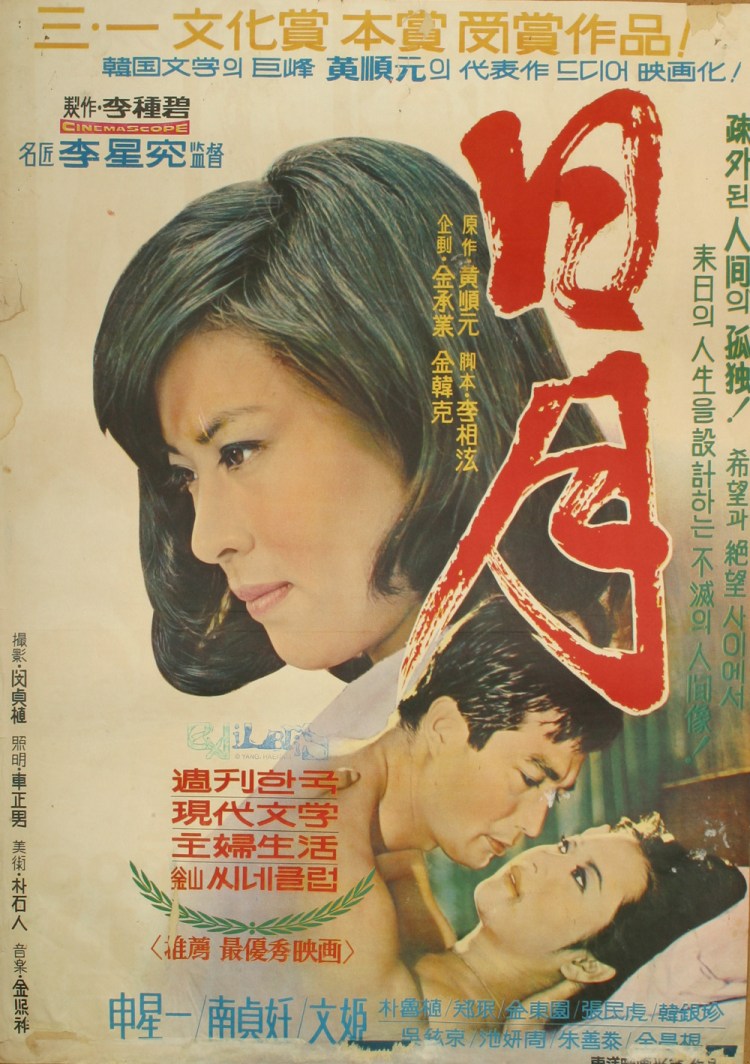
Ilwol: The Sun and the Moon (일월 / 日月, Lee Seong-gu, 1967)

Sun and Moon posterOld habits die hard in Lee Seong-gu’s Ilwol: The Sun and the Moon (일월 / 日月). The feudal past refuses to ease its icy grip even in the new “democratic” era in which freedom and prosperity are promised to all. Lee Seong-gu, closely associated with the Western Modernist movement, flexes his Literary Film muscles with an adaptation of Hwang Sun-won’s novel. Mixing a standard melodrama narrative with an exploration of “outdated” social prejudices and the gradually fracturing psyche of a man who learns a “dark secret” regarding his personal family history, Lee isolates the individual within a changing society as an ordinary man finds himself unable to move forward despite his own desire to be free of the superstitious past.

Lee opens with a scene more in keeping with a romantic comedy. Aspiring architect In-cheol (Shin Seong-il) meets drama student Na-mi (Nam Jeong-im) at an upscale ski resort and is instantly smitten. After spending time with her, In-cheol goes home and visits a childhood friend, Da-hye (Moon Hee). Da-hye is quite obviously in love with In-cheol – a fact of which he is obviously unaware or just completely insensitive since his purpose in coming is to tell her about Na-mi. Despite her personal pain, Da-hye is a good friend and gives In-cheol the appropriate advice regarding his romantic endeavour, reminding him that many of his previous relationships have failed because he was too diffident and he let them drift away.

Meanwhile, In-cheol is called into his father’s study to meet his dad’s new business contact who, it happens, wants a house designed. In a piece of near dynastic finagling, In-cheol gets a new job and, surprise surprise, the house turns out to be for Na-mi who is the daughter of the bank manager In-cheol’s dad wants a loan from. Everything is working out just fine, but then In-cheol’s brother – the Mayor of Gwanju (Jang Min-ho), turns up in a state of agitation and tells them he’s being blackmailed. Someone has discovered their dark family secret – In-cheol’s dad ran away from his family because they were butchers, a near “untouchable” class even in the Korean society of 1967. In-cheol thinks this is all very silly, who cares about things like that anymore? But on another level the discovery profoundly disturbs him in what it says about him as a person and about the society in which he lives.

It does seem ridiculous to stigmatise such commonplace occupation in a supposedly modern society, but In-cheol can’t seem to move past it. He pays a visit to a slaughter house which is just as awful as he’d expected it to be as he watches a once powerful cow twitching helplessly on the floor while other workers dismember the corpses of animals, pulling out entrails and severing heads ready for keener butchery. Still, In-cheol reminds himself it’s just a job and resolves to meet his cousin, but his cousin, insisting that he has no relatives, won’t talk to him. In-cheol takes this for rudeness or rejection, but really his cousin is attempting to protect him. In having internalised the constant abuse he suffers – even once being arrested by the police when a murder took place nearby solely because he is a butcher and had no alibi, In-cheol’s cousin avoids contact with those outside of his group and does not want to taint him with the butcher brush. Yet In-cheol keeps pushing, only for his cousin to roundly tell him to leave it alone unless he has the courage to accept his butcher blood fully for all it is.

The problems are manifold. In-cheol’s father’s first engagement was broken when the bride found out he came from a butcher family, while his wife (who married him without knowing) became a religious obsessive after learning of her husband’s origins. In-cheol’s marriage prospects are almost certainly off the table if anyone finds out, but even if someone agrees to marry him knowing the truth should he really invite them to do so knowing that they (and their children) will share his shame?

Unable to speak, unable to move forward or back, In-cheol spirals into a depressive cycle of inertia and suffering. Da-hye tries to talk to Na-mi to get him to wake up, but Na-mi tells her she’s not much bothered about In-cheol’s mental state and has only been messing around. Nevertheless, she finally draws closer to him as means both of assuming the leading role in her relationship, and as a way of annoying her father whilst potentially getting herself involved in a small scale scandal. Meanwhile, Da-hye who had pointed out that In-cheol’s problem was his passivity, ironically reveals that she too has been waiting for him to wake up and realise her feelings for him, only now realising she has probably missed her chance. The melodramatic device of the love triangle becomes a symbol of In-cheol’s ongoing psychological fracturing as he finds himself caught between two women and realising he can choose neither of them because his “ancestral curse” has effectively disqualified him from living in the modern world.

Using innovative editing techniques, Lee dramatises the tragedy of an isolated generation, supposedly living in a “modern” society but unable to escape the outdated social codes of the past. Rather than attempt to free themselves from irrational and superstitious ways of thinking, they choose self-exile and willingly accept their unhappiness in an otherwise altruistic intention of preventing the spread of a contagion. Melancholy yet urgent, Ilwol: The Sun and the Moon uses the ridiculous survival of an ancient prejudice to lay bare a dark secret at the centre of its own society but finds only tragedy without sense of an escape.


Ilwol: The Sun and the Moon is the first film included in the Korean Film Archive’s Lee Seong-gu box set. (Not currently available to stream via the Korean Film Archive’s YouTube Channel).

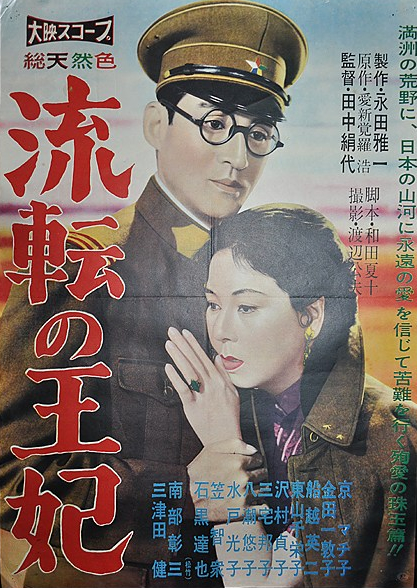
The Wandering Princess (流転の王妃, Kinuyo Tanaka, 1960)

Wandering Princess posterAs in her third film, The Eternal Breasts, Kinuyo Tanaka’s fourth directorial feature, The Wandering Princess (流転の王妃, Ruten no Ouhi), finds her working with extremely recent material – in this case the memoirs of Japanese noblewoman Hiro Saga which had become a bestseller immediately after publication in 1959. Tanaka’s filmic adaptation arrived mere months later in January 1960 which was, in an ironic twist, a year before the real life tale would meet something like the conventional romantic ending familiar from classic melodrama. Nevertheless, working with Daiei’s top talent including Kon Ichikawa’s regular screenwriter (and wife) Natto Wada, Tanaka attempts to reframe the darkness of the preceding 20 years as the defeat of compassionate idealism at the hands of rigid austerity and unstoppable oppression.

Tanaka opens with a scene taking place in 1957 which in fact depicts a somewhat notorious incident already known to the contemporary audience and otherwise unexplained on-screen in which the older Ryuko (Machiko Kyo) tenderly bends over the body of lifeless schoolgirl. The camera then pulls back to find another girl in school uniform, Ryuko, twenty years earlier. A young woman with innocent dreams, Ryuko’s life encounters the usual kind of unwelcome disruption in the unexpected arrival of a marriage proposal but this is no ordinary wedding. Ryuko, as the oldest daughter of a prominent noble family, has been selected as a possible bride for the younger brother of the former Qing emperor now installed as the symbolic leader of the Japanese puppet state of Manchuria. Against the odds, Ryuko and her new husband Futetsu (Eiji Funakoshi) are well matched and endeavour to build a happy home together just as they intend to commit themselves to the creation of a new nation born from the twin legacies of the fallen Chinese empire and the resurgent Japan.

Foregrounding Ryuko’s experience, the film does its best to set “politics” aside but the inescapable truth is that each of our protagonists is a prisoner of the times in which they live. The second scene finds Ryuko in 1937 as an innocent schoolgirl gazing at the young men in uniform as they march past her. She remains out of step with them, walking idly and at her own uneven rhythm while they keep rigorous and seemingly unstoppable time. The family are understandably wary of the implications of the marriage proposal, especially as it comes with a military escort, with Ryuko’s beloved grandmother the only one brave enough to ask to see whoever’s in charge of this outrage only to be told that their fates are in the hands of the nebulous concept known as “army” which knows no individual will.

Assured by her family that the decision rests with her, Ryuko consents – not only to becoming a stranger’s wife (which would have been her fate in any case) but to being a kind of ambassador, the presentable face of imperial ambition. On her marriage she’s presented with a deep red cheongsam and continues to dress in Chinese fashion for remainder of her life in Manchuria where she learns to speak Mandarin and devotes herself to becoming as Chinese as it’s possible to be. Meanwhile, her husband Futetsu busies himself with a complementary desire to become Japanese, intensely worried that the sometimes degrading treatment he and his family receive is exclusively caused by his problematic nationality. When their daughter, Eisei, is born, the couple determine to raise her as the child of a new world, the embodiment of idealised cultural integration.

The world, however, is not so kind and the blunt force of militarism continues to present a barrier to familial harmony. Futetsu is prevented from seeing his brother by the officious forces of the military police while the lonely, paranoid “emperor” suspects that Ryuko is nothing more than a Japanese spy sent to undermine his rule. Ryuko was sent to Manchuria to be the bridge between two cultures. Her, in a sense, feminine energy which attempts to build connection through compassion and understanding is consistently contrasted with the prevailing male energy of the age which prizes only destruction and dominance. Filled with the naivety of idealism, she truly believes in the goodness of the Manchurian project and is entirely blind to the less altruistic actions of her countrymen engaged in the same endeavour.

Confronted by some children in a park while pushing the infant Eisei in a pram, Ryuko is identified as a Japanese woman by her accent while conversing in Mandarin. She assures the children that Eisei is Manchurian like them, and that seeing as she married a Manchurian she is now too despite her Japanese birth. The kids are satisfied, so much so that they warn her that some Manchurians were killed recently in this park by Japanese soldiers, adding a mild complaint that it upsets their parents when Japanese people come to their restaurant and leave without paying. Mortified, Ryuko decides to use some of her (meagre) resources to buy all of the kids and everyone else in the park some sweets from a nearby stand, fulfilling her role as a Japanese ambassador even while insisting that she is a proud citizen of the newly born state of Manchuria.

Nevertheless the Manchurian project is doomed to fail, the kind of idealism fought for by Ryuko and Futetsu crushed under the boot of militarism. Despite everything, Ryuko still wants to be the bridge if only to prevent a catastrophe of this kind happening again (while perhaps refusing to engage with some of the reasons it happened in the first place) but in Eisei’s eventual death, foreshadowed in the melancholy opening, a deeply uncomfortable implication is made that the kind of cross-cultural harmony that Ryuko dreams of may not be viable. In contrast to the salaciously reported real life events (somewhat alluded to by presence of a schoolboy’s cap next to the body) which hinted at a suicide pact or murder, Ryuko attributes Eisei’s decision to end her life to an inability to reconcile her twin heritage coupled with the heavy burden of being the last descendent of the Qing Dynasty. Despite this minor misstep of tying the fate of Eisei to the failure of the Manchurian dream and the loss of its misplaced idealism, Ryuko ends her account on a hopeful note in admiring the flowers she planted finally in bloom and looking forward to a more hopeful age governed by warmth and compassion rather than violence and austerity.


The Wandering Princess was presented by Japan Foundation London as part of a series of events marking the publication of Tanaka Kinuyo: Nation, Stardom and Female Subjectivity.