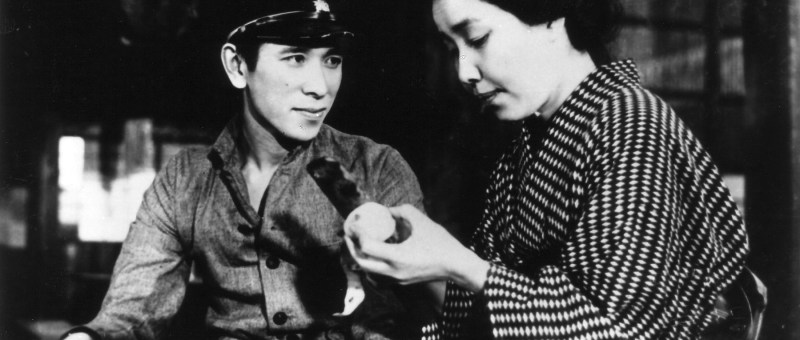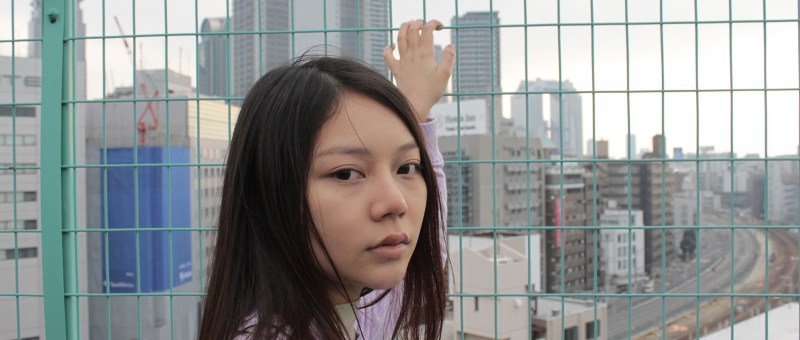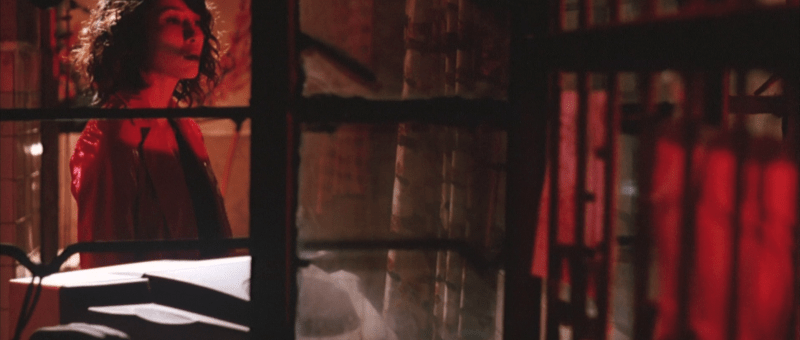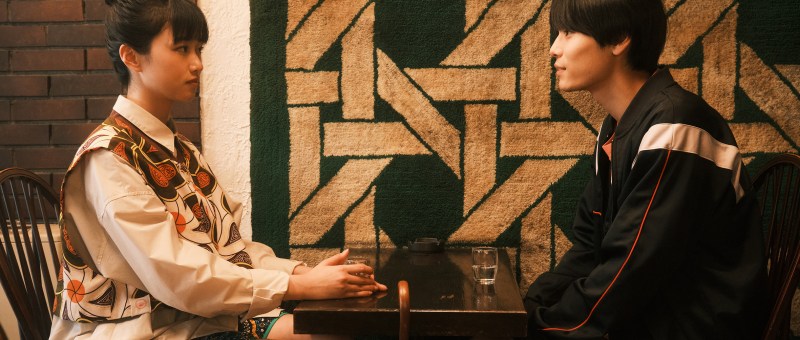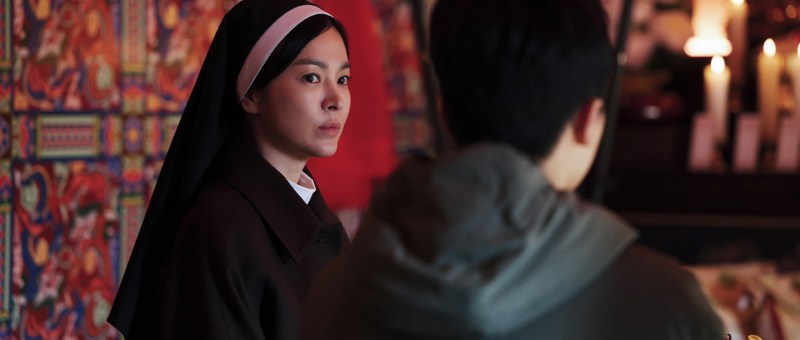
Out of the Blue (小爸爸的天空, Chen Kun-Hou, 1984)

A young man begins to dream after discovering he has become a father in Chen Kun-Hou’s poignant coming of age drama Out of the Blue (小爸爸的天空, xiǎo bàba de tiānkōng). Though it could perhaps be argued that the heroine suffers unduly, the film is remarkably unjudgemental about unplanned teenage pregnancy and at heart is rooting for the young couple. But the real world is not so kind, and it seems impossible that their love could survive in the liberalising but still oppressive late martial law society.

Long is a boy from an ordinary family with a crush on a wealthy young who goes to his school, Mi. Mi gets picked up by a chauffeured car every day, while Long watches her afar from his bicycle. Eventually, the pair get together and bond over their shared sense of dissatisfaction with their families by whom they are each trapped in opposing ways. Long complains that his former policeman father beats and berates him for not living up to his expectations, while Mi alternately implies her parents don’t really care about her because they’re always working and let her do as she pleases, and that she has no free will because she’s duty-bound by the expectations of filiality.

Perhaps bearing this out, Mi rarely speaks during her courtship with Long and only later is able to talk plainly to her mother, though her mother doesn’t listen. When she becomes pregnant after sleeping with Long when he stays out all night after a beating from his father, Mi can’t bring herself to tell anyone but stays at home alone while her parents head to LA. For unstated reasons, she can’t bring herself to tell Long, either. She ignores his calls and drops out of school, instructing the servants not to answer the phone when he calls. But when her mother finally finds out, she’s unexpectedly supportive. At least, she doesn’t disown her, force her to give up the child, to marry someone else or to stop seeing Long (though she does so anyway), all of which adds an additional layer to Mi’s sense of filial obligation feeling as if she cannot disobey her mother because she has been so kind and understanding of her “scandalous” behaviour.

When Mi abruptly disappears and he’s told she’s gone abroad, Long tries to talk to his father but in the end he doesn’t say anything. He simply refills his father’s ink pot while he continues to practice calligraphy. The only really time that Long’s father actually speaks to him is on hearing that he’s got the grades to get into his chosen university. It’s at this point that his father considers him “a man,” having his first drink with him and treating him as an adult rather than a naughty boy he can beat with a belt. In a sense, Long has conformed with his father’s authoritarianism in following the conventional path and is no longer trying to resist it, but on being unexpectedly reunited with his own son, Weiwei, is a more compassionate and empathetic presence, in love with the idea of having a family, though it is currently out of his reach. When he runs into Mi and realises the toddler she’s got in a pushchair is his, he’s still a student financially unable to support a wife and child let alone keep them in comfort.

As such, Long might be the unexpectedly good man who would have married and taken care of Mi if he knew but as they each say several times, everything’s different now. After their separation, both describe themselves as having grown up. Though he didn’t know he had become a father, Long feels as if he’s now older than his friends. He’s no longer interested in playing pool with them and is bored by their teenage pastimes. It’s ironically this sense of growing up that sets him on a more conventional path by knuckling down to study. But Mi perhaps feels trapped. Her parents have accepted her, but they have also more or less adopted Weiwei as their own and refuse to see her as a grown woman. When she tries to stand up to her mother about going to LA, her mother refuses to allow her to stay behind with Weiwei because she doesn’t believe she can look after herself let alone a child. Mi snaps back that could marry Long, but her mother doesn’t take it seriously. In the end, Mi is unable to break free of her filial obligations and defy her mother by leaving to make a new family with Long.

Mi’s mother stands in the way of progress, though she is in other ways a good and compassionate person who never tries to punish her daughter for her sexual transgression and only wanted to care for her and the baby. The baby has, however, now become part of her family to which Mi is merely an accessory, so he cannot now form a new family with Long. Long is unable to assume his paternity because of his financial status, but is otherwise good with the boy and in some ways better than Mi who becomes frustrated when he fails to settle in an unfamiliar environment. She admits that her mother usually tucks him in and is otherwise lost for what to do, leaving Long quite literally holding the baby.

But on the other hand, perhaps he’s only experiencing an idealised vision of fatherhood while spared the really difficult things like the anxiety of keeping food on the table and roof over his head. His friend at university is married with a child and is constantly late because of childcare issues. He recounts having to stay up all night because his son got enteritis from eating something he shouldn’t have when he wasn’t looking and now has a serious case of the runs. Long appears to want all of this too, but is prevented from having it as the older generation won’t surrender it to him or give Mi and Long the chance to figure it out. The closing scenes have a genuine sense of tragedy as Long watches his family ride away from him while Mi looks back with sadness and an expression that suggests she knows she will likely never see Long again. With minimal dialogue and elegant, expressive composition, Chen charts the course of a love too innocent to survive in a world of oppression and conformity but has only infinite sympathy for the young couple whose simple dreams are denied by generational authoritarianism.


Out of the Blue screened as part of the BFI’s Myriad Voices: Reframing Taiwan New Cinema.

Trailer (Traditional Chinese / English subtitles)

Rainy Blue (レイニー ブルー, Asuna Yanagi, 2025)

“You never know when it will end,” Aoi mutters to a concerned teacher. “The streaming period, and my life.” Asuna Yanagi’s Rainy Blue (レイニー ブルー) is a semi-autobiographical tale of a young woman figuring out how to live in the world while immersed in cinema. Her father may insist that she look at the reality, but Aoi’s world is already quite surreal even as she pours all her efforts into writing screenplays and watching films but otherwise floundering for direction.

To begin with, Aoi isn’t interested in cinema She just gets sent to see a film as punishment after getting caught setting off fireworks on the school roof because a local cinema has a special retrospective dedicated to actor Chishu Ryu who attended the same high school though probably 100 years previously. Despite scoffing at the idea and chuckling that everyone in the cinema is “old” while even the usher double checks to make sure she’s in the right place, Aoi is captivated by Ozu’s filmmaking and becomes a true convert to cinema to the extent that it completely takes over her life. She becomes the only member of the school’s film club, or as she’s find of reminding people “society”, and regularly turns up late after staying up all night watching movies. 

To that extent, Aoi’s film obsession may not quite be healthy in that it leads her to make some questionable decisions with unintended consequences, such as getting arrested for “stalking” people after following them around as research for her screenplays. She also finds out that one of her old friends, who is also her father’s favourite example of a “good” daughter, is into compensated dating and in reality perhaps just as lost as she is. Aoi’s father no longer understands her and has become authoritarian and unforgiving. He regularly berates and shouts at her while making no real attempt at communication. He simply asks why she can’t be “normal” and concentrate on going to uni like the other girls while complaining about how “embarrassed” he would be if she doesn’t go because it would reflect badly on him as a parent. 

Perhaps it’s not surprising that Aoi retreats into cinema to escape, but it’s also true that she finds a more supportive paternal presence in the guy at the cinema who turns out to have been a classmate of her mother’s. There’s a kind of poignancy in Aoi and her sister’s moment of confusion on realising that their mother was interested in films but they rarely watch them at home because her father doesn’t like them, while her mother rarely has time to go alone. Aoi’s love of cinemas as mediated by an old script she finds in the club room is also a way of connecting with her mother as a potentially more supportive parental figure in contrast to her father’s hardline authoritarianism.

But then, in her love of cinema Aoi is absolutely certain and she’s no reason why she should hide it from anyone else. Her best friend at school is rather bafflingly played by 43-year-old film director Hirobume Watanabe who dresses in a pre-war school uniform complete with student’s cap and little round glasses that make him look strangely like a Studio Ghibli character. Usami is an otaku with a love of anime he thinks he’s kept hidden despite having several anime badges on his backpack and is too afraid to be out and proud about it because he knows he’ll be bullied, which he eventually is when Aoi enters a deeper moment of crisis and more or less abandons him and the school. Watanabe also appears as a weirdly inspirational film director who has a go at an audience member at a q&a who asks him why his film is so nihilistic only for him to turn the question back on her and angrily insist that film can illuminate the way forward for those like Aoi who feel themselves to be lost. 

Thanks to all these strange adventures, her various friendships, and even her father’s animosity, Aoi eventually figures out what she wants to do with her life and gains the courage to go after it no matter what anyone else might say. Set in the picturesque environment of rural Kumamoto, the film’s gentle, laid-back aesthetic belies the storm at its centre and the rainy blue that surrounds the heroine until she too finally finds her way through the labyrinths of cinema.


Rainy Blue (レイニー ブルー, Asuna Yanagi, 2025) screened as part of this year’s Osaka Asian Film Festival.

Original trailer (no subtitles)

Brush of the God (カミノフデ ~怪獣たちのいる島~, Keizo Murase, 2024)

High schooler Akari (Rio Suzuki) couldn’t care less about something as “uncool” as tokusatsu movies and the fact her recently deceased grandfather once made them makes it even worse. Though they had once been close, Akari harbours a degree of resentment towards her grandfather, Kenzo (Shiro Sano), whose behaviour even in earlier years could be somewhat intimidating. Holding Kenzo responsible for the scar on her mother’s arm, Akari wonders out loud why a public memorial event is even necessary when they’ve already had a funeral, and why her mother isn’t just throwing all this useless rubbish out rather than hold an exhibition honouring a man she believes harmed her.

“Useless rubbish” is largely what Akari thinks of Kenzo’s legacy, embarrassed by his connection to otaku culture which has a social stigma attached to it that a teenage girl in particular would find embarrassing. Sullen and grumpy, she looks on with sadness mixed with irritation when some of her classmates charge off without her to go look at make-up and is rude to a young man from her class who’s come to attend her grandfather’s memorial event because she wouldn’t be caught dead talking to a nerd. In a way, it’s some of these social attitudes that Keizo Murase’s Brush of the God (カミノフデ ~怪獣たちのいる島~, Kami no Fude ~Kaijutachi no iru Shima) wants to deconstruct, recovering a memory of the classics of the genre as a world of boundless creativity and goodness that was as much about overcoming obstacles as it was creating visions of marauding dragons wreaking havoc on the modern world. 

This is Murase’s first, and sadly only film as he passed away at the age of 89 in 2024 and was already in his late 80s when the film was made. Prior to that, he’d been a legendary figure in the tokusatsu industry working as a suit sculptor, prop maker, and stunt man. His self-cameo laying flowers at his own stand-in’s memorial service echoes the meta-quality of the film which he’d first come up with while working on Mighty Peking Man (in the movie Revenge of the Might Primate) in Hong Kong and subsequently reworked to take place in Japan just as Kenzo does in the film. At heart, it’s a tribute to classic kids special effects adventure movies in which Akari must reclaim the fond memories of her grandfather in order to save his interior universe and legacy which is now in danger of being forgotten while even she herself wanted to junk the whole thing. 

She does so in the company of Takuya (Takeru Narahara), the classmate she’d hardly even noticed because of his nerdiness but is also primed to be another kind of inheritor of Kenzo’s mantle as represented by the Brush of the God, a magical paintbrush that allows the wielder to create in reality anything that they can imagine much as Kenzo and Murase had done when they created their monsters and the means to beat them. Reminiscent of that of Nobuhiko Obayashi, Keizo’s world has a retro aesthetic that is at once both artificial and fantastical making it clear that the children have been sucked into a world of imagination on the invitation of the mysterious Mr Hozumi (Takumi Saito) who offers them a copy of Keizo’s unproduced script and asks them to save his universe from destruction at the jaws of a mystical dragon. 

There is real love and affection for this era which has now all but passed that valued practical effects and rejoiced in finding unexpected solutions to practical problems and creating a world which was often simpler than expected in which there were monsters who were bad but could be beaten or otherwise were good and could never be vanquished. Along with recovering more positive memories of her grandfather whom she realises to have misunderstood, a tortured artist who loved them in his own way, she regains a sense joy and creativity that had otherwise been lost to her with Takuya remarking that she seems much more lively in the midst of their adventure than she ever had at school. He meanwhile is very much in his element, but though he’d dreamed of becoming a tokusatu hero is effectively reduced to a damsel in distress whom Akari must then save by reawakening her imagination. Warmhearted and wholesome, the film is an advocation for this world of lost charm and childhood adventures powered by egg boxes, garden hoses, and the boundless potential of creativity. 


Brush of the God screens in Chicago 13th April as part of the 19th edition of Asian Pop-Up Cinema.

Trailer (English subtitles)
Revolver (리볼버, Oh Seung-uk, 2024)

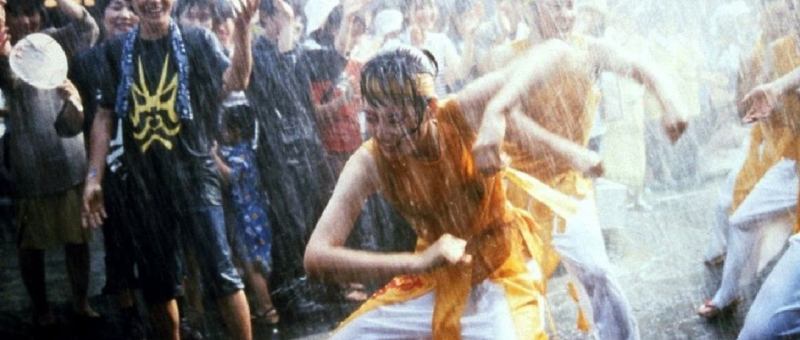
Everyone is always making promises to Su-yeong, but promises don’t count for very much in this world of infinite duplicity. Reuniting director Oh Seung-uk with The Shameless star Jeon Do-yeon, Revolver (리볼버) takes place in a world of corrupt cops and criminal gangs where no one can be trusted and every relationship is transactional. Like the barrel of a revolver, allegiances shift and rotate as Su-yeong attempts to navigate these turbulent waters while well aware that she is completely alone and has only her quest for vengeance and justice to sustain.

It’s by a broken promise that’s she’s been betrayed. After having become lowkey involved in police corruption to help her lover Captain Lim (Lee Jung-jae), former policewoman Su-yeong agreed to take the fall for the squad. They promised her that she’d only lose her job rather than go to prison and that she’d be allowed to keep the apartment she’d just bought, get a 700,000-dollar payout, and a new job working for Eastern Promises security division. Only in the police station does she realise she’s been tricked as they slap a drug trafficking charge on her and hand down a two-year sentence. Predictably, once she gets out, no one’s there to meet her except a gloating prosecutor and a random woman she’s never met before, Yoon-sun (Lim Ji-yeon), who says she was a friend of Lim’s. He’s since been found dead in a suspected suicide, though that matters less to Su-yeong than the fact he gifted her apartment to someone else and has since died in mysterious circumstances. 

The funny thing is that Yoon-sun, who is working both with corrupt cop Dong-ho (Kim Jun-han) and the gang led by Grace (Jeon Hye-jin), actually has some sympathy with Su-yeong and disproves of the way she’s been treated. After all, they could have just paid her her money like they said they would. Well used to navigating these waters, Yoon-sun appears to be playing her own game and keeping her options open yet it seems genuine when she tries to help Su-yeong which isn’t to say she wouldn’t betray her if she absolutely had to but right now she doesn’t. There is something quite poignant about the sense of female solidarity that arises between them, even though they are romantic rivals, as women who’ve both been let down by this patriarchal society. Su-yeong is rightly fed up with it and she’s going to get her money and her apartment no matter what if only to make sure they don’t win. Yoon-sun has chosen complicity as her chosen means of survival, but may be silently rooting for Su-yeon to break the both of them out of this repressive system.

To that extent it’s ironic that the former detective’s main weapon is a retractable baton, as if she were trying to enact justice though she herself is a compromised figure having at least been on the fringes of the corruption if perhaps not at the heart of it. Then again, all of the police appear to be corrupt so perhaps it’s more that she’s no better than the world that surrounds her and well aware that promises mean nothing and no one can be trusted. Lim seemingly broke a number of promises to her but may have tried to make it right in the end, while she’s also the victim of a vendetta by grudge-bearing cop Dong-ho (Kim Jun-han) whose romantic overtures she once turned down leaving him with a desire to destroy her completely. Top bad guy Andy (Andy) also appears to be a figure of compromised masculinity, playing the rabid dog but having no other backing than his ambiguous relationship with Grace who may have offed a female rival to solidify her grasp over the criminal enterprise. Violently beaten by Su-yeong, he too vows revenge to reclaim his masculinity but is ill equipped to achieve it. 

Despite being disregarded as not a proper detective, Su-yeong patiently follows all the clues and plays a long game to track down the source of all her misery while really her dreams had been small, owning a nice apartment and sharing it with Lim. On her release from prison, she tells the guard that her parents are dead and she has no friends or relatives signalling her aloneness in a vast world of betrayal but also her resilience and refusal to back down in her ironic fight for “justice” which is simply making sure those who’ve wronged her honour their promises and she gets what she’s owed. The occasional bouts of dark humour such as the absurdity of the final confrontation scene lend a touch of surreality to Oh’s purgatorial world of constant mistrust. “Live as if you were already dead,” a defeated Andy ineffectually screams as he vows vengeance and insists Su-yeong hasn’t heard the last of this. But Su-yeong has been living like she’s dead all along and now, finally, might be alive once again. 


Revolver is available digitally in the US courtesy of Well Go USA.

International trailer (English subtitles)

The Uniform (夜校女生, Chuang Ching-Shen, 2024)

The problem for Ai (Buffy Chen Yan-fei) is that a minor difference in her uniform causes her to be treated differently. Set in the late ‘90s, Chuang Ching-Shen’s The Uniform (夜校女生, yèxiào nǚshēng) uses the school to examine the stratified nature of the contemporary Taiwanese society and the elitism that governs it. Having failed the main exam, Ai has won a place at a prestigious girls academy but been relegated to the “night school”. To maximise its efficiency, the school operates on a shift system with day pupils attending classes until 4.30pm and the night students taking over until 9. Though there isn’t supposed to be any difference between the two, the night students are treated as a kind of overflow intake and looked down on by the day pupils while some complain that they’re unfairly using up resources which should be theirs by right. 

Despite the differences between them, Ai strikes up an unexpected friendship with a day student with whom she shares a desk, Min (Chloe Xiang Jie-ru). Shy and somewhat timid, Ai is taken by Min’s free spiritedness and often skips out on her classes to do fun things with her like going to a club to see Mayday before they were famous. Min, obviously, never misses out on her education and though she later reveals her own sense of insecurity in not feeling that she fits in at the school nor really deserves to be there, does not really understand Ai’s situation nor her own feelings of frustration and futility. Ai, meanwhile, is attracted by the upper-middle class atmosphere of the day pupils and increasingly embarrassed by her own more humble home life.

Ai’s father died in an accident and her mother runs a cram school out of their home. Ai’s mother (Chi Chin) is always trying to save money and picking up mismatched furniture for free, much to Ai’s annoyance, while Ai also does a series of part-time jobs including working at a ping pong club at the weekend though her mother doesn’t really want her doing sports because they’re unladylike and not all that useful for landing a place at a top university. The reason she sent her to the academy was to give her a leg up into what she sees as a conventionally successful life by getting a degree and finding a man with a professional job to marry. Ai’s resentment is partly provoked by this sense of being railroaded towards a future she might not want while at the same time facing tremendous pressure and afraid that in the end she won’t be able to measure up to her mother’s expectations. 

It’s at the ping pong club that she first meets Luke (Chiu Yi-tai), a handsome student from the elite boys’ school, and begins to strike up a relationship with him before Min tells her she likes him too. This ordinary teenage love triangle is coloured be class conflict in which Ai doubts she has the right to go after Luke because he is from a wealthy family, lying to him to cover up the fact that she and Min skip school by swapping their shirts which are embroidered in different colours for day and night students by claiming to be a pupil in the elite advanced class while hiding from him that she’s actually a night pupil. After beginning to suspect that Luke might actually like Ai, Min too begins to look down on her as if she thought that Ai were forgetting her place and has no right to date him because, unlike her, she is not his social equal. 

As for Luke himself, he’s actually rather bland and in part because his own life seems so easy because of his family’s wealth though he too later lets slip that he feels embarrassed by his parent’s apparently secret divorce and has only just begun to let go of the idea of them getting back together. For much of the film, it seems like he’s merely in the way of the relationship between the two girls which more successfully overcomes the barrier of class. After vicariously enjoying living Min’s lifestyle, Ai eventually comes to realisation that she and Luke are “not the same” and come from different worlds. He doesn’t really care about that, and seems to have become aware of his privilege abandoning a plan to get into university by competing in the maths olympiad and take the exam instead in the interests of “equality,” which is a well-meaning gesture but not really the bold act of egalitarianism he thinks it is even if also emphases his commitment to Ai in his willingness to break down class barriers that might otherwise work to his advantage.

As a means of denying her reality, Ai escapes through writing letters to Nicole Kidman with the help of a young man who speaks English and works in her aunt’s video store but is eventually jolted into adulthood by a more literal earthquake that reminds her how precious each of her relationships is and fragile the world around her. Through her various friendships, Ai comes to understand that almost everyone she knows also suffers with feelings of inferiority or a lack of confidence, weighed down by the pressure to achieve social success which might not be what they want anyway, but that they can overcome them together through understanding and mutual support that crosses class boundaries. Charmingly nostalgic, the film has a sense of hope for the future that it is indeed possible to achieve success on your own terms while prioritising your friendships and taking care of those around you.


The Uniform screens in Chicago 12th April as part of the 19th edition of Asian Pop-Up Cinema.

Trailer (English subtitles)
Teki Cometh (敵, Daihachi Yoshida, 2024)

“So, reality or literature, which is more important?” an unexpected guest asks a retired professor in Daihachi Yoshida’s Teki Cometh (敵, Teki). Adapted from the novel by Yasutaka Tsutsui, the film is not exactly about encroaching dementia but rather the gradual embrace of fantasy as the hero finds himself inhabiting the shifting realities of age in which his carefully curated persona of the refined professor begins to crack under the weight of its impending end.

Then again, objective “reality” is clearly a strain for Gisuke Watanabe (Kyozo Nagatsuka). It’s probably not a coincidence that Gisuke shares his surname with the hero of Kurosawa’s Ikiru as he too begins to ponder the meaning of his life along with the apparently meaninglessness of his twilight years. He reveals to his friend that he’s well aware his pension won’t cover his expenses for the rest of his projected lifespan and that he’s already calculated what he calls “X-Day” which will be the day the money (and implicitly his life) will simply run out. This day is continually postponed as Gisuke acquires extra money through giving lectures on French literature or writing articles for magazines, but the early part of the film at least is all about money and its relative values. Gisuke says that he does not really contemplate the price of the newspaper because the newspaper is something he wants so he simply buys it while taking out half the amount he’d usually charge for a lecture from an ATM machine. His friend advises him to drop his fees and get more work, but Gisuke explains that his 100,000 yen boundary is carefully maintained as a kind of bulwark against a sense of obsolescence as in he thinks they’ll keep haggling him down until he’s grateful just to get anything at all.

But obsolescence is clearly something he already feels given that interest in his chosen field has already declined and perhaps there no longer is much of an audience for his views on Racine and the development of the French language. Like the professor at the centre of Kurosawa’s Madadayo, Gisuke is surrounded by former students most of whom do not work in fields related to their studies but continue to hold him up as great scholar and influential figure in their lives. Yet as the film goes on and realities begin to blur, we might begin to wonder if any of these visitors are actually real or merely spectres leaking out from Gisuke’s fracturing memory to express his own anxieties about past and present. Former student Yasuko (Kumi Takiuchi) appears to be flirting with him, but on the other perhaps she’s merely reflecting the buried desires for which he continues to feel guilt and shame. He recalls times in which they attended the theatre together and then went for meals and drinks as if they were quasi-paternal or at least platonic, but Yasuko asks him if it wasn’t sexual harassment while at the same time directly stating that the desire is mutual (and there’s 15 minutes left before her train leaves). 

From this point on, Gisuke begins having strange dreams perhaps inspired by weird messages he’s receiving about an “enemy” that’s “coming from the north”. The “north” in a Japanese context would most likely be Russia and the messages reflecting a fear of invasion but also perhaps implying that in Gisuke’s case, the enemy lies within and it’s his own brain that is attacking itself. The illicit desires that he hints at to another former student while discussing his brief foray into and eventual boredom with voyeurism begin to come to the fore in his surreal dreams including one where he is subjected to a colonoscopy that is heavily influenced by BDSM imagery. His surprise visitor asks him if he remembers the war and Gisuke says that he’s told he experienced it in the womb, implying that he carries a degree of trauma from a time before he was even born. The ghost of the grandfather he never met haunts his well-appointed Japanese-style home that speaks of his traditionalism, while Gisuke himself tenderly takes out his late wife’s old coat and deeply breathes in her scent before hanging the coat up in his office so that it too floats like a ghost.

Yoshida structures the film through a series of vignettes ordered by season, yet there’s nothing necessarily to say that the seasons are consecutive or occur within the same year. Time is becoming abstract to Gisuke, even as he’s pursued by his invisible “enemy” that attacks his respectable facade and the very image of himself as he too embraces fantasy as a means of liberation from an otherwise monotonous if also serene life of awaiting the inevitable. The monochrome photography and static composition add to the air of deadpan humour in Gisuke’s increasingly surreal world. Teki cometh for us all, but in the end teki is us and we are teki. Our own fears, regrets, and insecurities will indeed return to torment us and show us who we are. Likely as not will not like what we see.


Teki Cometh screens in Chicago 11th April as part of the 19th edition of Asian Pop-Up Cinema.

Original trailer (English subtitles)
Ne Zha 2 (哪吒之魔童闹海, Jiaozi, 2025)

By the end of 2019’s smash hit animation Ne Zha, the titular hero (Lü Yanting) and his opposite number Ao Bing (Han Mo) had figured out that they were two halves of the same whole and were much better off fighting alongside instead of against each other, but even after getting their physical forms reconstituted with the help of a little lotus flour, they discover that the evil Shen Gongbao (Yang Wei) isn’t done yet. The first film may have been in its way subversive in the hero’s bold assertion that he will defy his fate and define his own identity, but Ne Zha 2 (哪吒之魔童闹海, Nézhā zhī Mó tóng nào hǎi) takes things a step further as Ne Zha comes to discover that not even the Heavens are free of corruption or prejudice.

Indeed, it’s this idea of prejudice which lies at the heart of the film for even if Ne Zha had won the hearts of the townspeople by saving Chentang Pass in the first film, he realises that there are some among the immortals who wish to erase all demon kind. The conclusion he eventually comes to is that demon and immortal are arbitrary terms used to control those who are different. He’s sick of hiding his demon nature and thinks it’s time he reveal himself to the world while fighting the injustice that’s taken over the Heavens in the Master’s absence. 

Meanwhile, his desire to break free of oppressive authoritarianism is symbolised in his breaking Wuliang’s (Wang Deshun) cauldron and freeing those inside who were otherwise to be turned into pills of immortality and fuel the heavenly economy. While he and Ao Bing resolve that the real enemies are those who bully the weak and bring evil to the world, the villains insist that siding with the strong is the only way. Ne Zha and Ao Bing’s response to this is to insist that if there is no place for them, they will create it for themselves and if they are not accepted they will change people’s minds. As they later say, they are young and have nothing to fear echoing a spirit of resistance among contemporary youth confronting an oppressive and authoritarian society.

Then again, a key feature of Ne Zha’s goodness is his love for his parents and desire to be a “good son” by traditional standards. It’s clear that even Ao Bing’s father the Dragon King of the East, Ao Guang (Li Nan / Yu Chen), acted only in the best interests of his son and has otherwise been framed by ambitious forces around him who decided they were better off entering a more active partnership with a corrupt authority rather than appease them by accepting their oppression. Even so, both sets of parents eventually tell their sons that they should now follow their own paths and do what they think is right. The world is no longer as was is when they were young, and they are not well equipped to understand these problems nor to solve them. If the Heavens are to be purified once again, it will be up to Ne Zha and Ao Bing to do it.

Aside from this more series and potentially subversive message about asserting one’s identity and challenging authoritarianism, the film has a lot of fun with its anachronistic worldview as drunken Taiyi Zhenren (Zhang Jiaming) struggles to remember the password to open the lotus before remembering he can use a fingerprint instead, while another villain later runs into a problem trying to open a door that works by face recognition because he’s sporting so many bruises and swellings after getting a beating from Ne Zha. He then realises he’ll have to wait another 10 years to try again because he cursed the technician for laughing at his ridiculously battered face. The film’s action sequences are also tremendously well animated and exciting as Ne Zha’s parents try to fight off the demon hordes which mainly consist of the “Monsters of the Abyss,” various sea creatures such as octopuses and sharks that were previously held in check by the Loongs but have now been set loose because of a dragon queen’s ambition. In any case, improving on the original the sequel maintains its quirky humour and charming worldview while doubling down on its surprising messages of acceptance and diversity as Ne Zha and Ao Bing prepare to forge their own paths and fight for justice to clear the Heavens of their corruption.


Ne Zha is in UK cinemas now courtesy of CineAsia.

UK trailer (English subtitles)
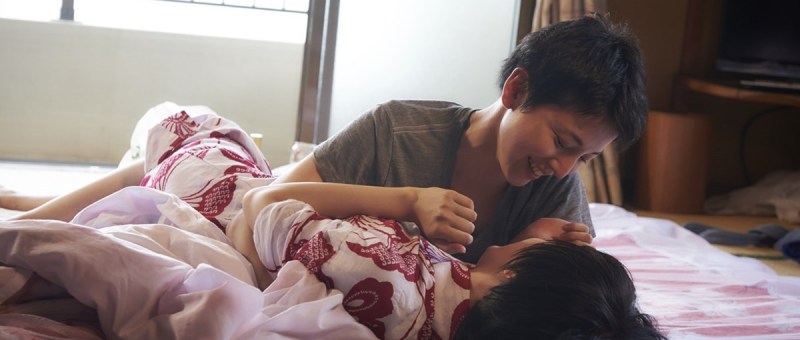
Homestay (ฮมสเตย์, Parkpoom Wongpoom, 2018)

“You got a prize!” the hero of Parkpoom Wongpoom’s spiritually-tinged existential drama Homestay (ฮมสเตย์) is told, though he won’t really realise the kind of gift he’s been given or that in reality he had it all along until the end of the picture. Based on a Japanese novel, the film is part mystery, part psychodrama as the hero is charged with finding out who caused the young man whose body he’s taken over to take his own life and why. If he manages to figure out the answer within the 100-day time limit, he can extend this “homestay” indefinitely and win the chance at a new life. If he fails, he’ll die and won’t even be reborn.

Taken another way, this Min (Teeradon Supapunpinyo) trying to understand why he did what he did having apparently lost his memories after his traumatic experience of being clinically dead for an entire day. In any case, he’s helped and hindered by a collection of “guardians” who appear to taunt him and issue reminders about his time running out. Though no one suspects Min is not Min, they all remark that seems like a different person from his new ability to eat durian fruit to his outward cheerfulness. As for why he hasn’t been attending school and even missed a set of important exams, they’ve been told he had “the flu” and seem to believe it. But even as this fresh soul seems to ease into Min’s life and originally finds it not bad enough to want to die to escape, he soon begins to discover fracture points in Min’s reality.

The biggest of those would be friction with unsympathetic brother Menn (Natthasit Kotimanuswanich) along with animosity towards his father who apparently gave up a steady job as a teacher to join a multi-level marketing scam peddling vitamins. The other Min was apparently embarrassed by him, as is new Min when he turns up at school and tries to recruit his classmates while giving him a bag of samples for one of the teacher’s which turns out to be a trick to get him to see a child psychologist. Old Min also resented him for the way he treated his mother who works at a factory in another city while he reduces the family to financial ruin even going so far as to sell her wedding ring. 

But as much as he wants to know about Old Min, New Min is also determined to start again. He gets a fancy haircut and starts dressing in a snappier fashion in part in hope of getting together with Pi (Cherprang Areekul), his crush before and after, while less than kind to old friend Li (Saruda Kiatwarawut) who also seems to have a crush on him. The more he finds out about how Old Min lived, the more his world darkens. He begins to understand why he might have wanted to end his own life and feels as if it’s everyone else’s fault or the essential corruption of the world. But what he gradually comes to understand is that it was a choice he made himself. Having turned too far inward, old Min lost the ability to see that others around him were also suffering. He couldn’t see how unhappy his mother was in her marriage, nor his father’s humiliation, or how hard and lonely it must also have been for his brother who dreamed of studying abroad solely to escape. “Stop thinking that no one loves you,” Menn eventually tells him in admonishment of his tendency to take it all on himself.

To that extent, life itself is the prize and that was something Min already had though his vision had been clouded by his intense pain and sense of futility. Guided by his post-death experiences, Min awakens to the suffering all around him and in an odd way feels both less alone and a greater responsibility not to cure it but simply to be present and more compassionate towards others. Parkpoom Wongpoom reflects his dilemma in the ever present tonal incongruity. New Min’s school life is shot like a typical rom-com complete with jaunty score only for him to suddenly find himself confronted by one of his Guardians and reminded his time is running out, as it is for us all. Strangely uplifting even in its touches of existential horror, the film has a genuine empathy for its embattled hero in his moments of selfishness and self-obsession as he begins to find his way back towards a less bleak existence through discovering the power of mutual compassion and forgiveness.


International trailer (English subtitles)
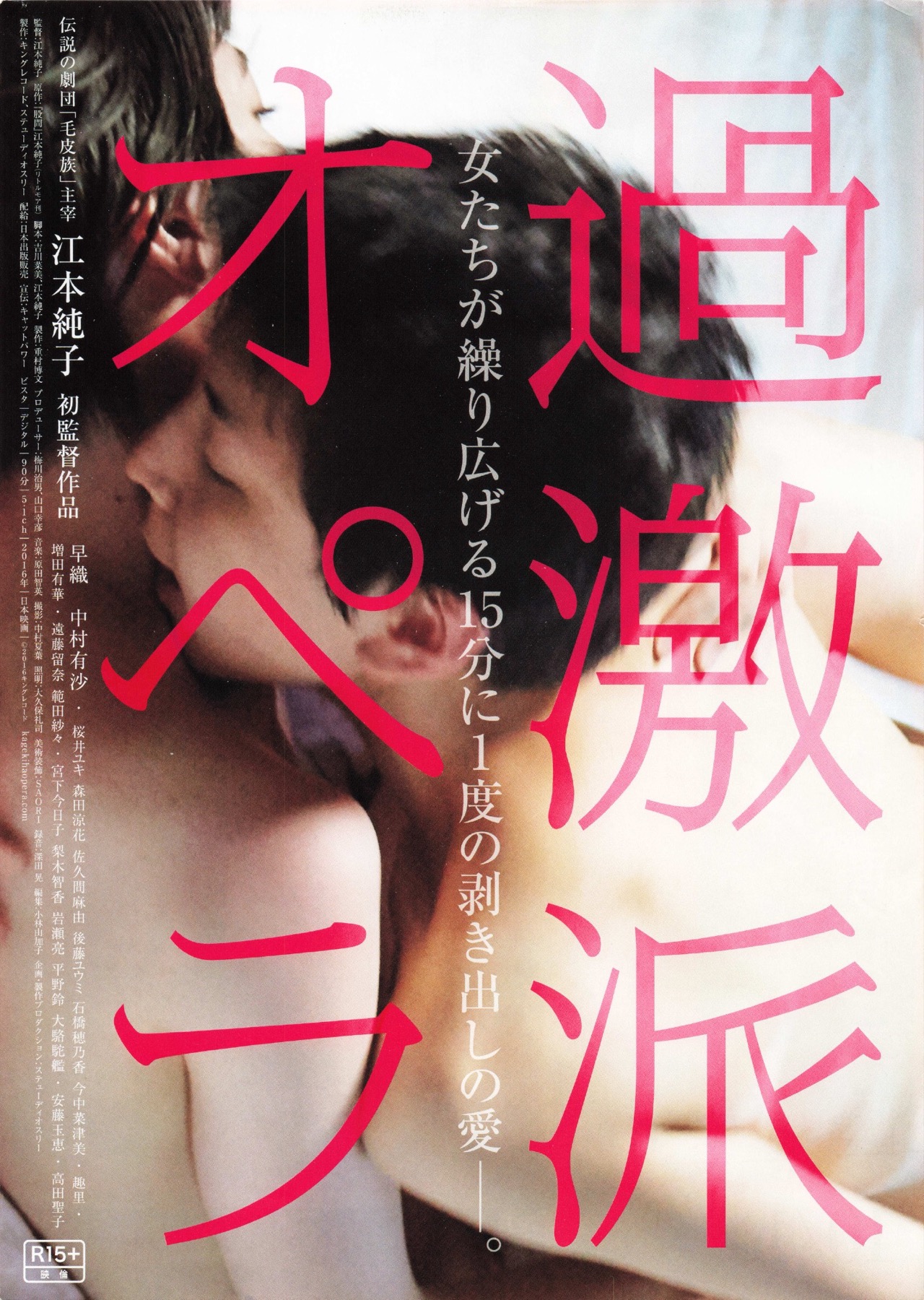
Chigasaki Story (3泊4日、5時の鐘, Takuya Misawa, 2014)

Desire and desperation bubble to the surface at a small hotel making preparations for a wedding in Takuya Misawa’s Chigasaki Story (3泊4日、5時の鐘, 3-paku 4-ka, 5-ji no kane). Though the English-language title may recall Ozu who wrote several of his most highly regarded films while staying at the inn, Misawa pays him only cheerful homage with a series of pillow shots apparently added only as an afterthought while his true inspiration seems to lie in the breezy Rohmerism that has come to dominate a certain strain of Japanese indie cinema over the last decade or so. 

Accordingly the tale is set in the small seaside town of Chigasaki and most particularly at the 115-year-old Chigasaki Inn to which former airline ground crew Risa has recently returned following her marriage to a filmmaker named George whom she met in the course of her work. The couple have already held the ceremony and enjoyed a honeymoon in Hawaii but are now holding a celebratory party for their friends and family in Japan. Meanwhile the inn is also host to a contingent of university students from the same department in which local boy and part-time worker Tomoharu is studying archeology. 

Somewhat meek and mild-mannered, Tomoharu takes his job incredibly seriously and is generally found running around on errands for guests or else cleaning up but his presence becomes a disruptive factor caught between the two groups of visitors instantly captivated as he is on the arrival of Karin, a young and pretty former co-worker of Risa’s who has arrived with the comparatively uptight Miki who has missed nothing in this exchange and is already frustrated by her friend’s wanton behaviour. Miki undeniably has a point when she criticises Karin for putting Tomoharu in an awkward position by inappropriately flirting with him at his job especially as he seems shy and easily embarrassed, but in turn is perhaps also jealous on a personal level intensely irritated when she blows off a plan to visit an aquarium to hang out on the beach with Tomoharu at stupid o’clock in the morning. 

The row only highlights the differences between the mismatched friends though the tables are turned when Miki realises that the students are from her old university and in fact led by her former professor with whom she begins to grow close much to Karin’s consternation. Reverting to her student persona, “workaholic” Miki becomes carefree and uninhibited at once doling out pieces of sisterly advice to the younger women and imposing her company on the students by joining in on their field trip. Her behaviour may in a sense reflect her dissatisfaction with her life as she contends with overbearing bosses having taken over Risa’s role while complaining about Karin’s fecklessness at work and otherwise seemingly jealous of their ill-defined friendship. Risa meanwhile may also be harbouring a degree of doubt in her decision to quit her job, get married, and return to run the family inn especially as her new husband is off working until the day of the party and like everyone else there isn’t really anyone with whom she can share those feelings honestly leading to an unwise if possibility long-term act of rebellion against a potentially stultifying existence that places her at further odds with the already on edge Miki. 

Caught between the women Tomoharu also has a more age-appropriate suitor in an earnest young woman from his class, Ayako, who likes him because of his tendency to care for others while getting on quietly with his work. Attempts to communicate culminate in a lengthy game of ping pong as the angry little balls of truth are batted back and fore across the table until a third player enters the scene and disrupts the flow. Tomoharu had said that his work of piecing ancient bowls back together was different from a jigsaw puzzle because you don’t know what shape it’s supposed to be until it’s finished, which might in a way explain these intersecting relationships as they run through and across each other but ultimately ending up in the place that they’re supposed to be culminating in a wedding party which is either the calm after the storm, an intense act of hypocrisy, or something between the two. 


Trailer (no subtitles)

Harbin (하얼빈, Woo Min-ho, 2024)

Ahn Jung-geun is one of the most well-known figures of modern Korean history and his story has indeed been dramatised several times before, but what’s unusual about Woo Min-ho’s espionage thriller Harbin (하얼빈) is the way it tries to sublimate Jung-geun the individual in favour of making him an emblem of the common man. As such, the film is more egalitarian than might be assumed and ultimately praises the integrity and resilience of the Korean people who save their country and their culture in a more spiritual than literal sense.

Indeed, Ito Hirobumi (played by Japanese actor Lily Franky), former prime minister of Japan and the first Resident General of Korea after it became a Japanese protectorate, remarks that he has always been sceptical of the annexation because though they have been ruled by “foolish kings and corrupt officials” the Korean people will continue to be a thorn in his side. Toyotomi Hideyoshi’s attempt to invade Korea was defeated by a volunteer army and a charismatic admiral, Yi Sun-sin. Then again, a Japanese soldier remarks that it will be difficult to find such a hero in the Korea of today, a pointed comment that implies Ahn Jung-geun is just such a hero through the film skirts around the fact his assassination of Ito did not in the end prevent Korea’s annexation which was completed in 1910, while the Independence Movement did not succeed in liberating in Korea which regained its independence when the Japanese Empire collapsed at the end of the war and even then was subjected to a period of occupation by US forces before its sovereignty was restored. 

What Jung-geun becomes is a kind of torch bearer for another Korea serving as a moral compass and preventing those around him from becoming just as bad as the Japanese whose cruelty they resist. As the film opens, Jung-geun’s comrades are awaiting his return after going missing following a disastrous encounter with Japanese forces. Despite having won the initial battle while heavily outnumbered, Jung-geun’s decision to release the Japanese commander, Mori (Park Hoon), as a prisoner of war results in a counterstrike in which his forces are all but wiped out. His comrades had been against the decision and now doubt his abilities and judgement along with a new suspicion that should he return he may have been captured and turned by the Japanese to spy on them. But Jung-geun’s decision signals his righteousness and refusal to give in to the cruelties of war. He releases Mori because it is the right thing to do. Executing prisoners of war is immoral by commonly held standards of war, and he pities Mori as a husband and father. He perhaps also hopes that it is a gesture of good will that shows him the Independence fighters are just and reasonable. 

But just and reasonable the Japanese are not, and so Mori betrays his trust. Deluded by the death cult of militarism, Mori is humiliated by Jung-geun’s magnanimity which is after all a show of power and that he has overturned the dynamics by granting Mori his life. Mori asks to die as as loyal soldier of Japan by committing ritual suicide but is denied in this both by Jung-geun who tells him he must live and by Chang-sup (Lee Dong-wook) who wants to execute him. This deep sense of humiliation and shame in remaining alive after defeat spurs Mori into a personal vendetta against Jung-geun to reclaim his honour and that of Japan which leaves him almost indifferent to Ito’s fate though nominally in charge of preventing his assassination at the hands of Jung-geun. Jung-geun is also trying to redeem himself for the loss of his men’s lives and has in a sense declared himself already dead in that he lives only for the souls of dead men and has embarked on what is in effect a suicide mission to kill “the old wolf” as a means of atonement and the eventual liberation of his country. 

But then his comrades are already weary and some are already beginning to ask themselves if it’s really worth it. How many more men will have to die before they win their freedom? Sang-hyun (Lee Dong-wook) laments that if the Japanese write their history, his name will be forgotten and he will have left no mark upon the world. They are grieving what they’ve lost in more personal terms aside from their lost nation. In order to get the dynamite to blow up Ito as a backup plan, the gang have to make contact with a former comrade who has since abandoned the cause to become a bandit (Jung Woo-sung). Having lost his eye and his brother, who was also the husband of another committed revolutionary Ms. Gong (Jeon Yeo-been), he decided it wasn’t worth it anymore and chose a different kind of freedom. “If we all die like dogs, no one will remember us,” Sang-hyun later laments. But Jung-geun, who will be remembered, is less concerned with his legacy insisting that even those who may have betrayed them should be given a second chance for they will eventually see the light. Like Ito, he believes in the Korean people and that they will come together to carry the light into the darkness. 

What he does is light the way, and as the closing scenes imply pass the torch to others who will each keep it alight until the dawn of liberation. Nevertheless, Jung-geun does have an unfortunate habit of getting those around him killed while the horror of the battle scenes, the grimness of decapitated and limbless bodies along with the constant sense of loss and defeat seem to imply that perhaps it isn’t worth fighting in this way lending further justification to Jung-geun’s conviction that taking out the leadership is the only way to turn the tide of this war of attrition. In sacrificing his own life, he becomes a kind of martyr, wearing traditional Korean white clothing as he goes to his death knowing that others will come after him. Rich with period detail and tense in its sense of intrigue, the film ultimately argues for a more compassionate sense of revolution governed by righteousness in opposition to the rather cynical justifications made by Ito for the cruelties of Japanese imperialism.


Harbin is released in the US on on 4K Ultra HD, Blu-ray™ and DVD courtesy of Well Go USA.

International trailer (English subtitles)