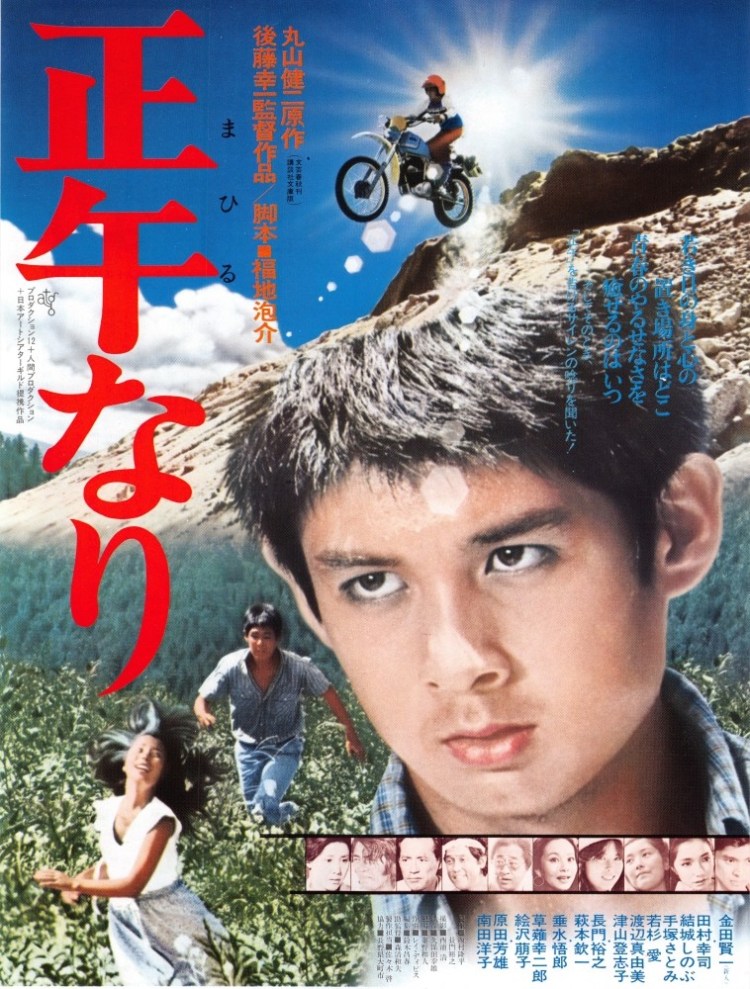
At Noon (正午なり, Koichi Goto, 1978)

at noonKoichi Goto’s Art Theatre Guild adaptation of Kenji Maruyama’s 1968 novel At Noon (正午なり, Mahiru Nari) begins with a young man on a train. Forlornly looking out of the window, he remains aboard until reaching his rural hometown where he makes a late entry to his parents’ house and is greeted a little less than warmly by his mother. The boy, Tadao, refuses to say why he’s left the big city so abruptly to return to the beautiful, if dull, rural backwater where he grew up.

There’s little work here for a young man, which is why Tadao left in the first place. After using some family connections to try and find a job, he finally decides to make use of his abilities by fixing radios and TV sets for a local electronics store. To begin with he doesn’t want to see his old friend, Tetsuji, perhaps out of a sense of shame at having returned home but the pair later strike up their old friendship – that is, until Tetsuji suddenly announces his plans to run away with a local bar hostess.

It’s never quite revealed what happened to Tadao in Tokyo but it seems to have been something serious enough to change the course of his entire life and send him reeling back home depressed and angry. In many ways he’s a typical young man, if slightly sullen, but he’s developed a serious number of sexual hangups which have turned him into some kind of repressed, misogynistic, pervert. He appears to have made a deliberate decision to dislike the idea of women, or at least the idea of women with sexual appeal. He thinks women are trouble, that no good comes of love, but can’t stop himself from spying on the female tourists staying in an upper room. He’s always looking, staring invasively, but resolved not to touch.

Tadao has already been to the city and evidently found it not quite to his liking but his friend, Tetsuji, feels bored in the village and trapped by his parents who need his help in their orchards. When Tadao realises Tetsuji is taking the hostess with him when he skips town, he asks for the money he just agreed to lend him back and tells him to forget about running away and just to go home. Unfortunately for Tetsuji, Tadao’s advice proves sound as his city dreams don’t work out the way he planned either. To end his frequent attempts to escape, Tetsuji’s family float the idea of an arranged marriage which originally horrifies both boys but after meeting his prospective bride, Tetsuji changes his mind. Tadao doesn’t approve, but after meeting the girl in question and seeing that she is quite lovely changes his mind too and is happy for his friend – that is, until he realises Tetsuji has only introduced him to her as a pretext of getting her on her own to enact his marital rights a little ahead of schedule. This breach of morality proves the final straw for Tadao who does not like the idea of his wayward friend deceiving and then ruining this innocent young flower who’s far too good for him anyway.

Tadao’s fascination with another damaged bar girl, Akemi, continues as the two find themselves both looking at the sad figure of a tethered eagle imprisoned at the local zoo. Akemi says she likes to look at the bird as she feels perhaps somehow that helps him escape. She feels like a caged bird too – trapped in a bad relationship with a useless boyfriend who has a vague plan of turning manure into an energy source while she supports them both by working at a hostess bar and hating every second of it. Tadao feels trapped in a hundred different ways, by his town, by his parents, by whatever happened in Tokyo, and by his own pent-up frustrations. By this point, he’s a one man powder keg ready to explode and after blowing his final safety caps, tragedy is the only possible outcome.

At Noon begins with its epilogue, but uncomfortably frames its protagonist’s despicable final actions with an odd kind of heroism as his head eclipses the sun leaving him with a radiant halo. He may have satisfied himself in some way, put to rest some of that inner turmoil, but what he’s done is something truly dreadful and driven by an intensely animalistic instinct. At Noon may have something to say about the dangers of frustrated young men with no work to go to, no ambition to follow, and no luck with the ladies but displays an oddly ambivalent attitude to its deranged protagonist that makes for often uncomfortable viewing.


By the way, After Noon has music by Ray Davis of The Kinks!

Unsubbed Trailer:
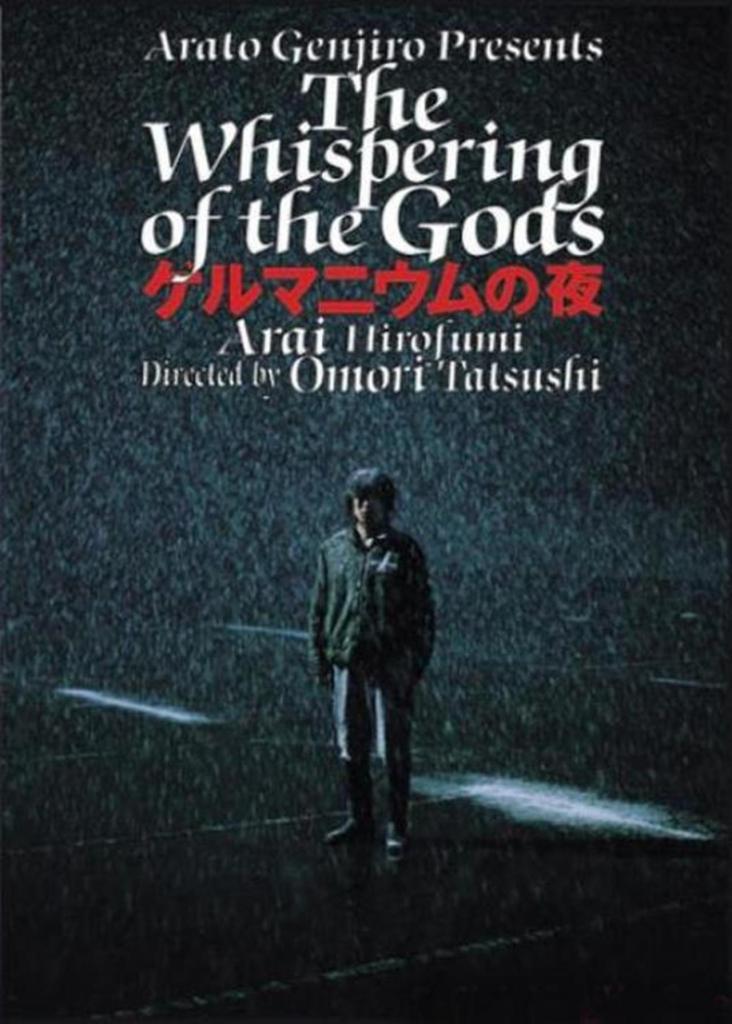
The Whispering of the Gods (ゲルマニウムの夜, Tatsushi Omori, 2005)

whispering of the godsIf you’ve ever wondered what it’s like to live in hell, you could enjoy this fascinating promotional video which recounts events set in an isolated rural monastery somewhere in snow covered Japan. A debut feature from Tatsushi Omori (younger brother of actor Nao Omori who also plays a small part in the film), The Whispering of the Gods (ゲルマニウムの夜, Germanium no Yoru) adapted from the 1998 novel by Mangetsu Hanamura, paints an increasingly bleak picture of human nature as the lines between man and beast become hopelessly blurred in world filled with existential despair.

Rou (Hirofumi Arai) has returned to the religious community where he was raised but his reasons for this seem to have everything and nothing to do with God. He claims that he “kind of killed some people” and also says he’s a rapist, but there’s no way to tell how much of what he says is actually the truth. After opening with a sequence of bulls trudging through snow, we see Rou listening to a priest read from the bible, but we also see that Rou is giving the priest a hand job whilst looking resolutely vacant. Later, after expending some pent-up anger by thrashing around some with junk and kicking a dog, Rou has a heart to heart with a novice nun, Kyoko, which quickly results in a forbidden sexual relationship. Forbidden sexual relationships, well – “relationships” isn’t quite the right word here, perhaps transactions or just actions might be more appropriate, are very much the name of the game in this extremely strange community of runaways and reprobates each keen to pass their own suffering down to another through a complex network of abuse and violence.

An early scene sees Rou throw a metal pipe across his shoulders in an oddly Christ-like pose. He’s certainly no Messiah, he wants to take revenge on these people by being the very worst of them, but ultimately he does come carrying a message. Using the same tools against them as they’ve used against him all his life, he exploits the loopholes of religiosity to expose its inherent hypocrisy. He confesses sins he may or may not have committed as well as those he plans to commit. In giving him unconditional absolution for an uncommitted sin, has the priest just given him a free pass to balance the celestial books by going ahead and violating a random nun? As well as well and truly messing with the resident priest’s head, Rou’s rampant sexuality also exposes the latent longings present within the nuns themselves who are supposed to control their sexual urges, brides of Christ as they are, yet they too covertly indulge themselves in receiving satisfaction from the various kinds of strange sexual behaviour currently on offer.

Life on the farm is nature red in tooth and claw as one particularly brutal scene sees a male pig castrated with a pair of garden shears during a failed act of copulation. Later a pig will lie in neatly dissected pieces, dripping with blood and fluid. There’s no romance here, just flesh and impulse. Forming a kind of friendship with a younger boy, Toru, who is also being abused by the priests at the compound, Rou offers to take revenge for him but it seems the boy just wanted to confide in someone, to begin with. Later, Rou will take a kind of action and Toru offers to repay him by continuing the behaviours he has learned through a system of perpetual manipulation, unwittingly drawing Rou even more deeply into the spiral of abuse and hypocrisy that he set out to destroy.

Omori opts for a straightforward arthouse aesthetic which matches the bleakness of the environment and barrenness of spirituality found in this supposedly Christian commune. In fact, Omori had to go a roundabout route to get this film shown given its controversial nature which saw him set up a temporary marquee theatre to avoid having the film cut to get an Eirin certificate before getting it into more mainstream cinemas in his desired version. What it has to say about the base essence of humanity is extremely hard to take, though no less valid, and its picture of a hellish world filled with nothing but despair punctuated by guilt filled sexual episodes and violence in which there is nothing left to do but continue shovelling shit until you die is an uncomfortably apt metaphor for contemporary society.


Mangetsu Hanamura’s source novel does not appear to be available in English but actually seems to be even more disturbing than this extremely depressing film – more info over at Books From Japan.

Unsubbed trailer:

The Deserted City (廃市, Haishi, Nobuhiko Obayashi, 1984)

haishiNobuhiko Obayashi might be most closely associated with his debut, Hausu, which takes the form of a surreal, totally psychedelic haunted house movie, but in many ways his first feature is not particularly indicative of the rest of Obayashi’s output. 1984’s The Deserted City (AKA Haishi, 廃市), is a much better reflection of the director’s most prominent preoccupations as it once again sees the protagonist taking a journey of memory back to a distant youth which is both forgotten in name yet ever present like an anonymous ghost haunting the narrator with long held regrets and recriminations.
Based on a novel by Takehiko Fukunaga, The Deserted City is a European influenced, nostalgic, coming of age tale in which university student Eguchi travels to a small Japanese backwater famous for its canals. Though not as sophisticated as Venice itself, the town shares something of the atmosphere of that city as it has often been evoked in literature in its slightly claustrophobic, decaying grandeur. Eguchi has come to the town on an invitation from his uncle and with the intention of spending the summer there to finish his undergraduate dissertation which concerns the work of Edgar Allen Poe.

However, Tokyoite Eguchi immediately finds the town strange, if mostly charming, with its old fashioned rhythms and almost silent soundscape in which only the lapping of the village’s many rivers is audible. Staying in a guest house run by 19 year old Yasuko and her grandmother, Eguchi begins to hear gentle sobbing at night and jumps to the conclusion it must belong to Yasuko’s married older sister, Ikuyo, whom he has yet to meet. Younger brother Saburo also lurks silently in the background with the brother-in-law, Naoyuki, making infrequent appearances. Eguchi had apparently almost forgotten about this single summer in his youth, but was reminded of it after reading a newspaper report that the town had been destroyed in a fire. His memories are coloured by the tragedy which occurred towards the end of his stay and which his youthful soul was not fully able to understand.

The Deserted City revisits many of the themes which came to define Obayashi’s career from the nostalgia for youth and the power of memory to a vaguely supernatural tone which prefigures the final traumatic event that will continue to haunt the protagonist, even if unconsciously, for the rest of his life. Fukunaga was himself very much influenced by European literature and The Deserted City has a distinctly Western feeling with its death ridden canal town and once grand family in decline. Eguchi’s thesis is on the work of Edgar Allen Poe and it wouldn’t be a stretch to say that he is reading his studies into the story of his own life with the mysterious crying and hidden sister not to mention family secrets and the frequent allusions to the sorry state of the moribund city.

Eguchi describes Yasuko as “cheerful” yet she herself offers the most melancholic commentary of her life. She says she hates the town and can’t stand the constant sound of the waters which she likens the death wail of her city – a slothful sound without energy or purpose. She can see all the other young people leaving with only the elderly remaining behind to decay along with the town, but when Eguchi asks why she doesn’t leave too she replies that she can’t, she’s bound to this place in life and death. Similarly when making a visit to her mother’s grave at a nearby temple she remarks that in this place of stillness, she can no longer discern a difference between the living and the dead. Finally, after all the tragedies that have befallen her, Yasuko declares herself to be “nothing at all” and in bidding Eguchi goodbye as he leaves, corrects him when he promises to visit – she knows she’ll never see him again, he will return to the world of the living. He’ll forget all of this, as if it happened in a dream.

Like many of these stories, The Deserted City is filled with the detached melancholy of the older man looking back at the young one. Eguchi says this incident taught him to expect tragedy from the very beginning of things though he also claimed to have forgotten all about the town and its sad stories of longing and misunderstandings, romantic and otherwise. Working with ATG here Obayashi opts for a nostalgic 4:3 frame and a moderately warm colour palate which echoes both the slightly idealised atmosphere of the idyllic waterside village and its nature as a place which exists solely in memory, shaded in tones of nostalgia but also of regret. Much more conventional than some of Obayashi’s other work, The Deserted City is a perfect blend of European romanticism, melodrama and slight gothic undertones which, though a little low on impact, is a perfect synthesis of his themes up to this point.


Unsubbed trailer:

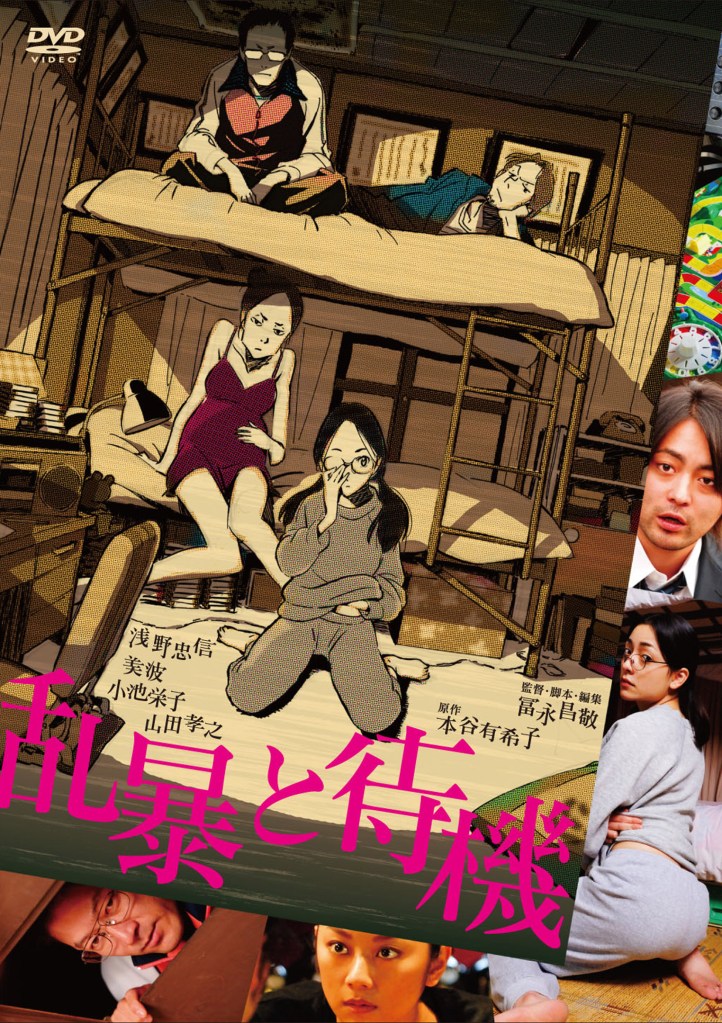
Vengeance Can Wait (乱暴と待機, Masanori Tominaga, 2010)

MFBDm_Tallcase_sell_CS3Vengeance is a dish best served cold, but then if you’re going to wait a while perhaps you should make sure to add plenty of salt and spice to the mix to disguise its rather rancid odour. Adapted from a play by Yukiko Motoya, Masanori Tominaga’s Vengeance Can Wait (乱暴と待機, Ranbou to Taiki) is the strange tale of four interconnected people who each become ensnared in a bizarre circle of violent revenge!
Asuka (Eiko Koike) and Banjo (Takayuki Yamada) are currently expecting a baby and have moved back to Azusa’s hometown where she is working in a bar and he is currently seeking employment (somewhat half heartedly). Whilst Azusa heads off to work, Banjo goes to introduce himself to the neighbours and surprises Nanase (Minami) during a lengthy sutra reading session. Nanase is a very strange woman indeed – dressed in a grey tracksuit, glasses, and generally looking odd, she immediately jumps to the conclusion that she’s annoyed Banjo with her weirdness and tries to give him money to make up for it, such is her intense fear of being disliked. Things get even weirder when Azusa realises Nanase is an old high school classmate towards whom she’s still nursing an ancient grudge. This also means that Azusa knows the man Nanase is living with and addresses as “big brother” is not her actual brother at all…..

Nanase becomes the plot’s essential “object” in a sense with Azusa acting as its subject and the two men more or less relegated to the status of adverbs. Azusa’s personality changes dramatically in the presence of Nanase – seemingly perfectly pleasant and ordinary in other circumstances, her tone takes on an extremely harsh quality, almost yanki-ish in its coarseness. However, Nanase’s need to be liked, or at least not disliked, has her immediately acquiesce to whatever it is she thinks other people want of her. She’s completely incapable of saying what she might actually think or doing what she would like to do but only thinks about how others are viewing her which is both extraordinarily masochistic and actually a little bit selfish.

The relationship between Nanase and her “big brother” Mr. Yamane (Tadanobu Asano) is the perfect culmination of this strange dynamic. Nanase philosophises at one point about the certainty of hate and the mysterious quality of love – that it’s impossible to say exactly why you love someone but you can usually point to a concrete reason for hating them. She and Yamane are bound by a common event in their pasts and, she reasons, perhaps this is enough of a reason for fate to keep them together. Yamane keeps her around because he’s plotting an elaborate revenge plot for a grudge he holds against her but at five years and counting he still hasn’t figured it out yet. During this time, he’s also started pretending to go out “marathon running” but has really been crawling into the attic space to spy on Nanase while she gets on with normal household tasks throughout the day.

Things come to a head when the feckless Banjo develops an attraction for Nanase despite her deliberately slovenly appearance which she affects for the express purpose of avoiding male interest. Using her inability to say no against her, he convinces her to start an affair with him whilst also blackmailing her that if she doesn’t he’ll mistreat his wife, Azusa, whom Nananse is still keen on making up with despite the long held high school era hurt which continues to come between them.

It’s a fairly light and absurd if darkly comic set up which is more about the pointlessness of grudges, violence, and lying about yourself to please others, than it is about a grander mediation on the fruitlessness of revenge – the desire for which, strangely, does end up building an otherwise elusive connection between two people who seem to have been unable to form one in any other way. Tominaga opts for a fairly simple and straightforward approach but does a great job of avoiding the often overly theatrical feeling of many stage to screen adaptations. However, it has to be said that perhaps some of the more unusual elements play better in the enclosed, less “realistic” theatre environment than they do on screen.

That is to say, Vengeance Can Wait has the feeling of slightly throwaway fringe theatre which is partly based on the frisson of mocking supposedly bourgeois values with a series of comically absurd episodes. This approach feels much more fun over a claustrophobic 90 minutes trapped in a tiny performance space which ends up covered in the physical manifestation of a deteriorating situation, but fares a little less well when you open it up into a larger filmic world. However, the film’s odd comments on accidentally sado-masochistic relationships and its absurd black comedy provide enough quirky diversion to build an appropriately amusing atmosphere.


Interestingly enough, Vengeance Can Wait is one of the few Japanese plays which has been translated and performed in English (it’s also unusual because it seems to be a direct translation whereas most English adaptations of foreign plays are “rewritten” by an established playwright from a literal translation) – performance rights with Samuel French. There’s also a review of the run of the play in New York in 2008 from Village Voice.

unsubtitled trailer:

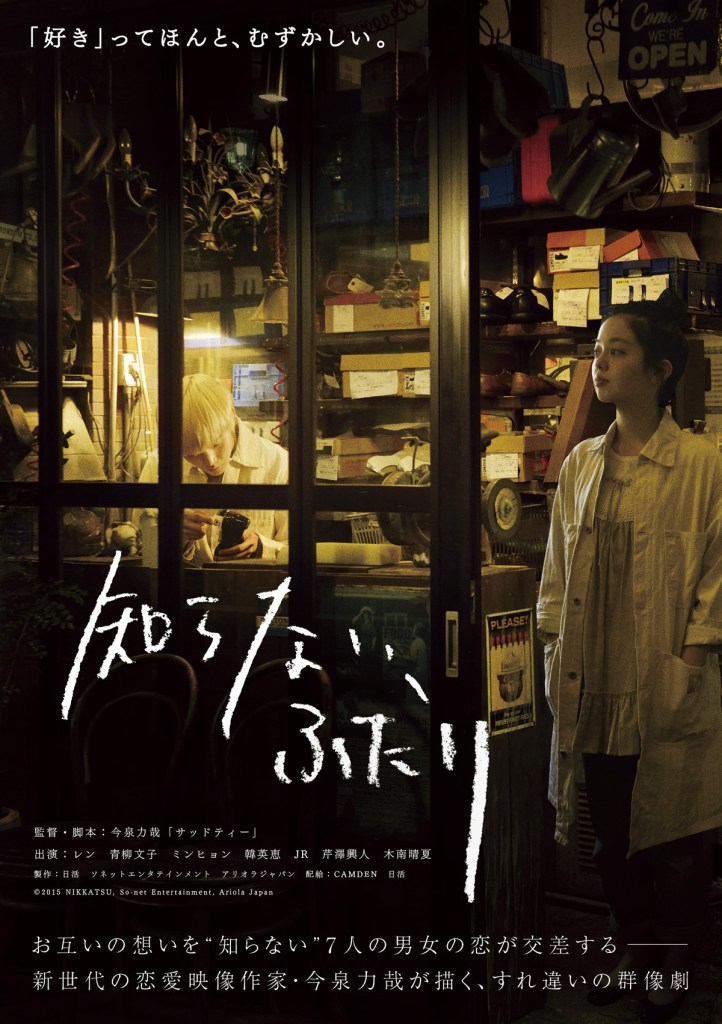
Their Distance (知らない、ふたり, Rikiya Imaizumi, 2015)

Their DistanceAh young love! So beautiful, so complicated, so retrospectively trivial. Intrigue engulfs a group of young Koreans living in Japan, their co-workers, and even their English teacher and her fiancee in Rikiya Imaizumi’s indie youth meets boyband quirky romance movie, Their Distance (知らない、ふたり, Shiranai Futari). The aptly named picture paints a vista of misdirected love, miscommunication and misjudged honesty to show how messy romance can be even when it’s intent on being cute.

The hub of the story is a small shoe repair store where Korean migrant Leon (Ren) is an apprentice. Having been involved in a traumatic incident two years previously which has left him with a huge amount of personal guilt, he’s entirely cut himself off from human interaction of any kind, leaving the store each lunchtime to eat alone and miserably on a solitary bench surrounded by concrete. Despite this, one of his Japanese colleagues, Kokaze (Fumiko Aoyagi) has developed a crush on him and is patiently waiting for him to decide it’s OK to be happy again.

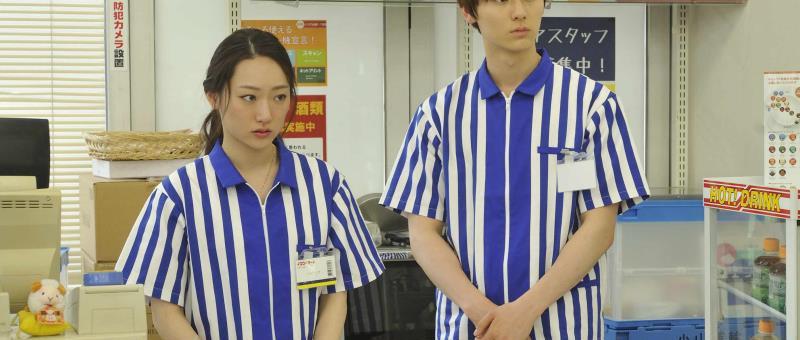
Events are set in motion when he finds fellow Korean Suna (Hanae Kan) asleep on his favourite bench after a night of binge drinking to forget her troubles with boyfriend Ji-woo (JR) who’s developed a thing for his English teacher, Kanako (Haruka Kinami). Kanako, as well as being a little older, has a fiancé already, Awakawa (Tateto Serizawa), who happens to be in a wheelchair following an accident, before which he had also been cheating on her. The two Koreans are also joined by a third who works with Suna at her part-time job at a convenience store, Sangsoo (Min-hyun). Sangsoo ends up in the shoe repair store where he falls for Kokaze, completing our love…heptagon?

This is all very complicated already. Ji-woo decides to unburden himself by revealing his feelings for his teacher to Suna even though he doesn’t actually want to break up with her and the teacher turns him down for a number of very sensible reasons. His case of (probably selfish) extreme honesty sends Suna into a bout of drunken confusion during which she meets Leon and becomes semi-attached to him despite not being able to remember much about him because she was pretty much out of it the whole time.

Flitting between the innocence of a hand written love letter to quasi-stalking, and even a third layer of stalking the stalker, Their Distance has an oddly schizophrenic tone which darts between quirky comedy and serious drama without much consistency. The most interesting plot thread concerns Kanako and her fiance´ who are both a little older and ought to know what they’re doing but only seem to confuse and mislead each other even when they’re making a point of mutual honesty. Neither can be sure of why the other is still in the relationship and if the true love partner is the wheelchair itself – did she stay because she didn’t want to leave a disabled man (even though he’d been cheating on her before the accident), or did he stay with her because now he’s in the wheelchair he thinks he won’t find anyone else? Arawaka gives Kanako an out by offering to separate so she can pursue her dreams of living abroad and travelling the world but refuses to say one way or the other what his true feelings about the marriage are causing more than a little emotional confusion for the put-upon Kanako who is also getting drawn into the maelstrom of her students’ romantic problems.

Ji-woo treats Suna in a similar way by revealing his growing feelings for Kanako yet leaving all the decisions entirely in her hands. He claims he’s doing the right thing by being “honest” but actually he’s being a coward by refusing to choose (and anyway, seeing as the teacher turned him down there’s no real reason to tell her). This kind of childishness is almost forgivable in the younger guys who, after all, are still inexperienced, but in a man of Arakawa’s age, diffidence is far from an attractive quality.

Imaizumi has three members of top Korean boy band NU’EST as his gang of Korean émigrés and has half an eye on cute idol drama with the other half pointed firmly at the indie/arthouse scene. Though the performances are strong across the board, Imaizumi never quite manages to reconcile these two distinct forms and his detached, almost ironic tone may not hit home with an audience primed for pop star drama. Ultimately, Their Distance has relatively little to say, its message is very slight indeed, and it takes an awful long time to deliver. However, Imaizumi’s observations about romance through the ages have a universal and timeless quality which along with the mild humour and generosity of spirit on show make Their Distance worth the journey, though not perhaps the fare.


Their Distance is actually available now in the UK and other regions from Nikkatsu via iTunes either as an enhanced iOS app or as a regular video from the store (where it has subtitles in English, French, Spanish, and Portuguese).  You can apparently rent it on Nikkatsu’s YouTube channel as well as Google Play and Vimeo (click the link to the YouTube page in the video below for a full collection of subtitle/territory specific links for each of the platforms).

Cesium and a Tokyo Girl (セシウムと少女, Ryo Saitani, 2015)

CesiumCaesium is a chemical element which has the distinction of being one of the very few metals which remains liquid at room temperature. These days you’re most likely to hear about one of its isotopes which is produced as a result of nuclear fission and can pose a serious environmental problem following a nuclear related disaster. Caesium comes to be something of an obsessive concern for the 17 year old heroine of Ryo Saitani’s debut film, Cesium and a Tokyo Girl (セシウムと少女, Cesium to Shojo), as Mimi comes to connect the presence of caesium in the water with the constant soreness she’s been experiencing with her tongue since the disaster hit.

A fairly normal teenager, Mimi is a precocious student, obviously bright but undoubtedly forthright and unafraid to correct her teachers should they make a mistake (she is also entirely unaware of the way her direct manner may make other people feel). She lives a comfortable life with her successful father and cheerful nursery school teacher mother and even makes sure to visit her grandmother who is ill in the hospital.

One day, she runs into a strange man during a thunderstorm who claims to be the god of thunder and also knows lots of other supposed deities currently living out their immortal existences in the modern Japan. When grandma’s beloved mynah bird, named Hakushu after the famous poet Hakushu Kitahara, suddenly ups and flies away, Mimi hits on the idea of trying to get some of her new found omnipotent friends to help her though the quest to track down one missing bird ends up leading her on a strange odyssey through time and geography as she follows a meandering path through Japan’s modern history.

Like many people following the Great East Japan Earthquake and the accompanying tsunami, Mimi has been left with deep seated existential doubts which prompt her into a deliberate consideration of the way she’s living her life and what might happen to her in the future. Using the unique powers of the gods, she travels back in time to 1940 and experiences the life her grandmother led at her own age but in very different circumstances. These wartime episodes don’t shy away from uncomfortable historical truths as her grandmother loudly and proudly extols the virtue of the nation’s “ally” Adolf Hitler whilst singing a patriotic song penned by her favourite poet, Hakushu Kitahara, who, at this point has lost his sight due to complications from diabetes and will eventually pass away in 1942 never knowing the outcome of the war.

Joining the seven gods as a kind of Snow White figure, Mimi’s life takes a surreal turn filled with cheerful musical sequences which run the gamut from a cute kids song to an oddly ‘80s inspired dance sequence as her grandmother meets sailor granddad to be. Saitani also ropes in another few top animators to come up with some impressively designed scroll painting inspired set pieces to give us a suitably ancient backstory on our gods as well as adding some humorous stop motion and brief pop-art inspired moments to make what could be a fairly heavy condemnation of recent history and the rise of nuclear technology into a fun and quirky comedy.

That said, there is a tendency at certain points to fall into an educationalist mood leaving things feeling like an entertaining for schools programme rather than a comedy with an ingrained streak of social commentary. Saitani began his career working with the similarly ironic Kihachi Okamoto and you can definitely see a lot of Okamoto influence in Saitani’s approach to his material as he adds in layer upon layer of surreal playfulness but always anchors his flights of fancy in a serious concern. Bright and cheerful it may be, but the ideas are anything but trivial.

The gods are not angry, exactly, just disappointed. We’ve been given this beautiful gift of bountiful green forests and flowing rivers and yet we’ve shown so little interest in taking care of it that much of it is withering before us like a forgotten houseplant after an extended holiday. However, the final piece of advice given to Mimi is that perhaps we need to stop harping on the past and concentrate on making the most of what we have right now, only that way can we begin to undo some of the damage that we’ve done in our relatively brief time as the dominant species and finally face up to our responsibilities as caretakers of our planet.


Reviewed as part of the SCI-FI London Film Festival 2016.

Unsubbed trailer:

Dual City (デュアル・シティ, Yokna Hasegawa, 2015)

dual cityCyberpunk and Japan are a match made in heaven though, it has to be said, it’s often been much more an inherited influence in international pop culture than something which has originated directly in Japan. Yokna Hasegawa’s Dual City (デュアル・シティ) puts this to rights a little with a politically infused tale of Japan in 2034 – a nation divided and engaged in a wider information war with the little guy at the mercy of evil corporate giants.
The year is 2034, following a civil war Japan has been divided in two with a north/south border located at the feet of Mount Fuji. Our protagonist, Yoriko, is a nurse and mother working in the North sector which is definitely thought of as the least advantageous place to be. When her hospital is raided by guerrilla soldiers, Yoriko finds herself in the relatively lucky position of last survivor but is then charged with assisting this “resistance movement” by taking over from the soon to be dead insurgent, Gou, and completing his mission of carting a mysterious suitcase across the border.

Once in the south, we’re introduced to the rest of the band including the dynamic Ayumi who can’t seem to forgive Yoriko for the loss of Gou. The gang’s ultimate goal is to expose the shady Nephe corporation who, aside from their business interests of arms dealing and android production, have begun building a virtual world known as “information life” which is constructed through harvesting the memories of Northern corpses. Yoriko lost her daughter to terrorist aggression and the idea that she might be able to see her again, albeit in virtual form, is one which she is unable to pass up.

Adding to the intrigue is the love story between a resistance member and an android which may or may not come to be a liability and the hacker group’s involvement with the steady stream of illegal migrants somehow making the dangerous cross border journey into the relative safe haven of the South. Many of these people have injuries or ailments that would be best served by a doctor, but having no proper papers they can’t risk a hospital and so the care that Yoriko can provide becomes another useful asset for the group.

Drawing parallels with other “divided” nations, Dual City looks at a multitude of contemporary social and philosophical problems from dealing with refugees fleeing an oppressive regime to the power of multinational corporations and the eternal quality of a mother’s love. Nephe (represented in a futuristic ad campaign starring Third Window Films’ Adam Torel as its heinous CEO) commits the very worst kind of identity theft as it steals and repurposes the very soul of those that it has killed by sucking out their memories and using them to create artificial counterparts in their online world. Are these ghosts in the machine any less “real” than their flesh counterparts were? A standard question of the cyberpunk world and one which still has no clear answer, but Dual City continues to explore it in a mature and nuanced manner.

Though an undoubtedly low budget, indie movie Dual City makes a decent job of creating its realistically grimy cyberpunk world with its interactive video screens and invisible techno warfare. Special effects, though sparse, are effectively achieved and never call attention to themselves. Dual City is actually the second part of a projected trilogy with the overarching title of Japan Year Zero (following the 2014 short Illuminations) but is perfectly intelligible even without knowledge of the previous film and manages to create a sense of a bleak, oppressive society which travels along with Yoriko from the totalitarian North to the supposedly freer South. Eventually Yoriko’s love for her daughter transforms and becomes something larger, an eternal and infinite love for all mankind that represents our last, best hope for peace. It only remains to be seen if the troubled society of 2034 can can learn to follow a similar road.


Reviewed as part of the SCI-FI London Film Festival 2016.

On a side note, Illuminations seems to be the film Hoshi Ishida was talking about when I interviewed him (for UK Anime Network) a couple of years ago. Small world! I would like to see the movie but it doesn’t seem to be available anywhere, maybe one day. Here is a trailer for Illuminations:

You can also keep up with director Yonka Hasegawa’s work via her website and twitter feed!

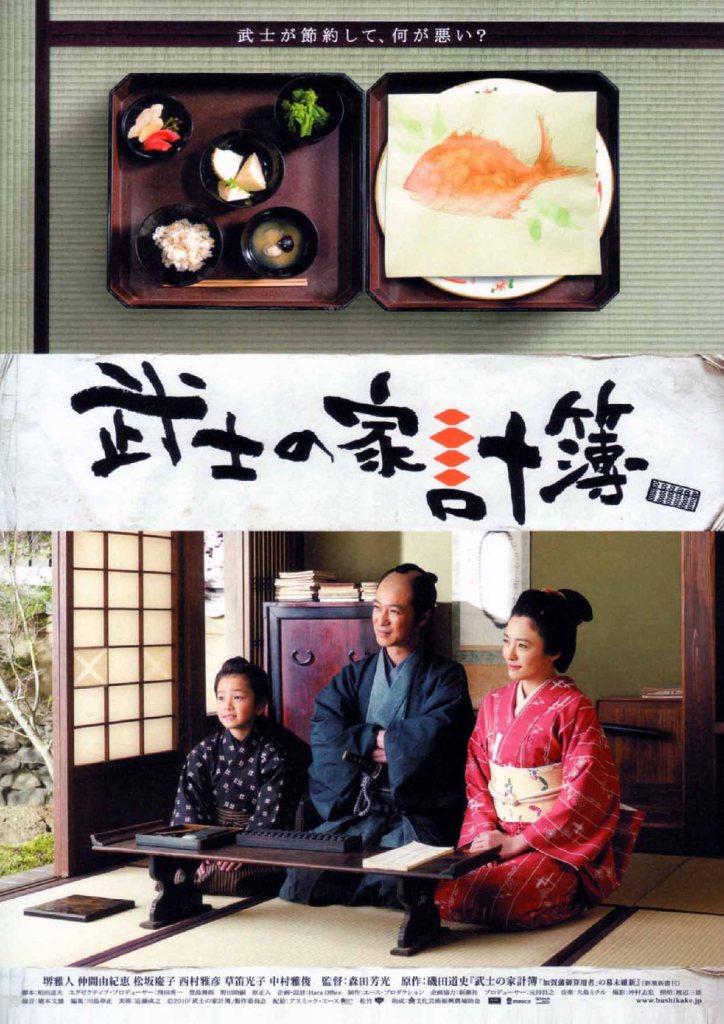
Abacus and Sword (武士の家計簿, Yoshimitsu Morita, 2010)

•Žm‚̉ƌv•ë•The stories of samurai whose soul is placed not in the sword but in another tool are quickly becoming a genre all of their own. Coming from the same screen writer as A Tale of Samurai Cooking: A True Love Story, Abacus and Sword is a similarly structured tale of penny pinching samurai accountants and a pean to the undersung heroes of the admin department without whom everything would fall apart.
Abacus and Sword (武士の家計簿, Bushi no Kakeibo) could almost be titled “a story of my father” as it begins with a voice over by the youngest adult generation seen in the film, Nariyuki Inoyama, who is at the time of speaking a naval accountant in the new post restoration world. As good an account as he is (and he must be, given his position), he feels he pales in comparison to his father, Naoyuki, whose skills with the abacus were somewhat legendary even if his people skills were often not on the same level.

Dubbed an abacus fanatic by his colleagues, Naoyuki’s top maths abilities get him into trouble right away when he notices an extreme discrepancy in the accounts details for the imperial rice dole. Around this time there are riots from farmers who are being squeezed to deliver more grain to the authorities during a time of famine but not seeing enough returned to them as well as starving people petitioning for food in the streets, so when Naoyuki asks why around a third of the rice is disappearing from the accounts or listed as “reserved” his superiors start getting nervous. As a mini underling, Naoyuki is not in a position to stop his bosses from exploiting their authority in the most devious of ways – creating a food panic and then profiting on the side through black market trading, and is simply instructed to “ensure the final accounts balance”. Unwilling to falsify his precious calculations, Naoyuki finds himself facing the possibility of exile from the imperial centre but eventually finds his persistence rewarded when the scam is finally uncovered by a higher level.

Accountants are often not respected in this era of samurai warriors who place an almost religious faith in the power of the sword. Their pay is low, hours long and taxing, and they have little prospects of advancement. After hearing the story of Naoyuki’s career Nariyuki returns to the subject of himself a little more as the conflict between austere father and wayward son takes centre stage. Naoyuki is a pragmatic man, he sees their family debts are unsustainable and embarks of prolonged plan of austerity in which he forces the entire extended family to sell all their non essential possessions and live as cheaply as possible until the debts reach a more manageable level so they can at least keep the social position their larger family home affords them rather than being moved to something less prestigious. This is an unusual move in status driven samurai circles and proves embarrassing for the rest of the family such as in one episode where Naoyuki can’t afford to buy fish for his son’s coming of age ceremony so simply puts a painting of a fish at each place setting. Creative accounting at its finest!

Nariyuki, however, can’t quite give up on the idea of the sword and goes off to fight in the various civil wars which erupt during the Meiji Restoration causing great worry to his parents, wife and children. He too becomes an accountant and is at first disappointed that it’s his skills with an abacus that can best serve the country rather than those needed on the frontlines but later comes to understand the tactical importance of maintaining the smooth financial functioning of an army.

A late career effort from the prolific Yoshimitsu Morita, Abacus and Sword is an uneven experience which is more or less devoid of the director’s usual attempts at experimentation pushing for a more general, sometimes even televisual approach to storytelling. At heart the film praises the virtues of living a thrifty, honest, and balanced life in which hard work is always fairly rewarded in the end and even when not provides its own set of rewards. However, virtuous as it is to live honestly and simply in tune with the clack of an abacus, it can prove fairly dull which is unfortunately also true of Abacus and Sword which despite brief episodes of light humour never quite engages with its twin dynamics of father son conflict which echoes that of the changing world as it emerges into the new Meiji era, and of shining a light on the forgotten admin workers who keep the world turning when everything else is falling apart. Morita’s anti-consumerist, transparency in government sympathies come to the fore and are once again timely, but like Naoyuki he fails to make his complaints sufficiently engaging to ensure his messages are received by those with the ability to take action.


English subtitled trailer:

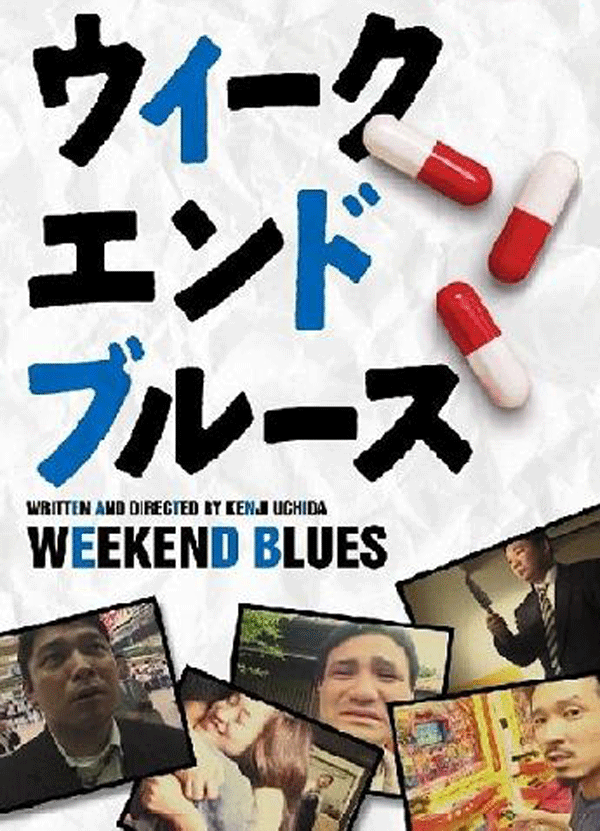
Weekend Blues (ウィーク エンド ブルース, Kenji Uchida, 2001)

weekend bluesKenji Uchida travelled to America’s San Fransisco State University to study filmmaking before returning to Japan and making this, his debut film, Weekend Blues (ウィーク エンド ブルース) which later went on to claim two awards at the prestigious Pia Film Festival for independent films earning him the scholarship which enabled his next film, A Stranger of Mine. However, Uchida’s film, though resolutely his own, individual creation, plays much more like the Japanese indie movies of the time and particularly those of the similarly considered, if drier, Nobuhiro Yamashita than it does to late 20th century American indie or the mumble core movement.
As in his later work, Uchida builds around a finely constructed farce only this time the central conceit is a bout of amnesia suffered by the central character, Kensuke, who is a depressed salaryman still reeling from his ex-fiancé’s sudden exit from his life. He takes solace in his one solid relationship – that with his committed slacker friend, the similarly named Kenji. However, on visiting Kenji’s apartment one Friday night he discovers Kenji has gone and got himself a girlfriend. Kensuke gets extremely drunk and also tries some of the weird drugs that Kenji has got from somewhere or other before accompanying Kenji’s new squeeze, Ayumi, on her way home.

That’s the last thing Kensuke remembers before waking up in a faraway town. On returning to Kenji’s flat he’s shocked to learn it’s actually Sunday already and he has absolutely no idea what’s been going on for the past 48 hours.

Jumping to the natural conclusion that the drugs are to blame, the two Kens descend on the dealer who seems to be some kind of man scientist researching a formula to give the “wimpy” men of today some of their caveman swagger back. Ironically named “samurai” the drugs themselves are more of a Mcguffin but provide a key into this world of nervous, unambitious, soon to be middle-aged men who’ve each had their girlfriends poached from under their noses by the more socially successful. A parade of jilted lovers passes by until we reach the more psychotic set who’ve decided to embrace some decidedly dodgy methods in order to ensure they won’t be humiliated and run out on ever again.

Uchida also adds another level to the amnesia based shenanigans with a sideline in internet dating where everybody is lying to everyone and presenting version of themselves that’s very much idealised. Kenji has told his prospective girlfriend that he’s a successful high earner despite the fact he doesn’t actually have a job at all, but at least his interest in the new woman has persuaded him to try and get back into the employment market so his full scale frauds can be demoted to gentle half-truths before things (hopefully) start to get more serious. In turn, his new lady love, Ayumi, may not be all she seems either.

Kensuke’s larger philosophy lies in a need to be needed. Now that his fiancée has left him, discovers he was no longer necessary to her anymore, Kenji feels himself a man without purpose and the prospect of simply continuing like this for another fifty years is beginning to frighten him. Again there’s a wider question here about interconnectedness (which is also the heart of any farce) in the supposedly “connected” world in which you can pick up a true love fantasy by lying about yourself on the internet – even if the mutual misrepresentations end up spinning their own pretty web of deceit in their own sweet time

Uchida’s first film is a necessarily low budget, indie effort but makes no apologies for itself or claims of being anything more than it is. That said, the performances are universally strong and the direction often interesting even given the obvious budgetary constraints. A very modern kind of farce which also looks back the salaryman comedies of the ‘60s, Weekend Blues is a good indication of Uchida’s future direction whilst also succeeding as an enjoyably off the wall comedy in its own right.


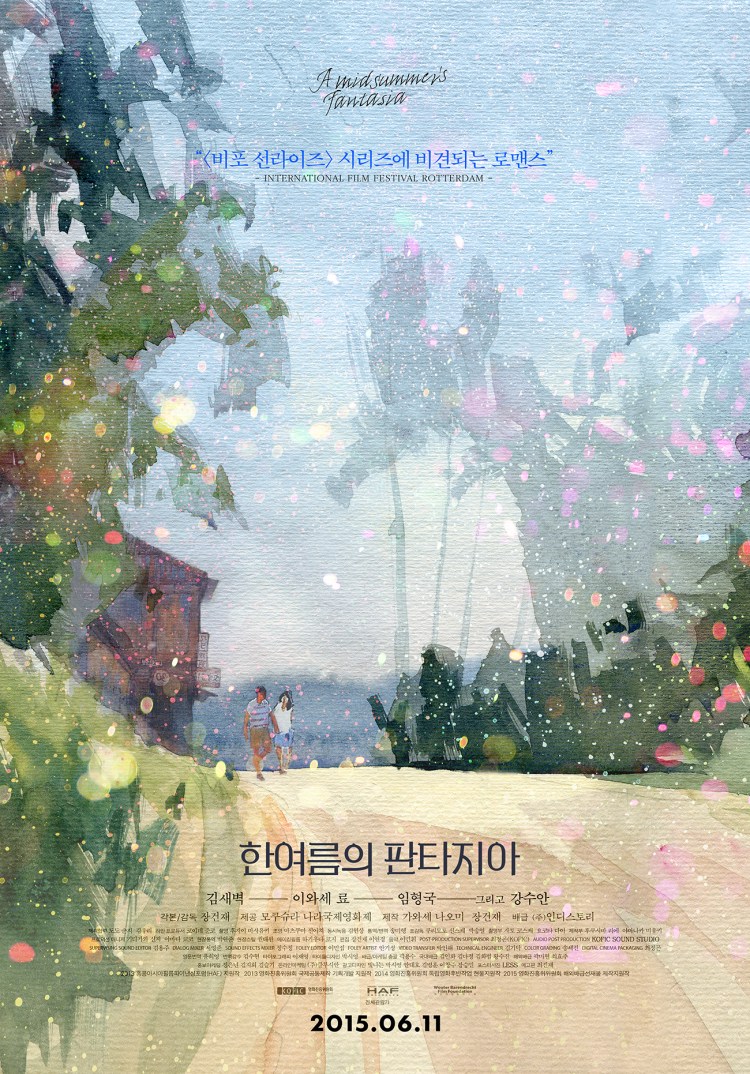
A Midsummer’s Fantasia (한여름의 판타지아, Jang Kun-jae, 2014)

Midsummer FantasiaFollowing his “sleeper” hit, Sleepless Night, Korean indie director Jang Kun-jae gets a touch of the Hong Sang-soos in the bifurcated tale of artistic inspiration found in a foreign land with the Korean/Japanese co-production A Midsummer’s Fantasia (한여름의 판타지아, Hanyeoreumui Pantajia). Mixing naturalism with hyperreality, Jang’s exploration of cross cultural pollination is one which offers both fireworks and quiet contemplation.

Neatly split into two parts, the film begins with a black and white sequence titled First Love in which a Korean director travels to a tiny Japanese town on a location shoot accompanied only by his assistant playing the role of interpreter. A beautiful country idyll, the village is also dying as the population ages leaving the local school abandoned for over 25 years with only the elderly left behind by their children who’ve fled to the cities. After talking with some of the residents, the director is captivated by the romantic tales of a local civil servant who acted as a guide for a young Korean girl some years previously and that of a slightly older man who once worked in the big city of Osaka and took a liking to a Korean bargirl who reminded him of his first love but tragically lost touch with her after deciding to return home.

Inspired by these twin tales of frustrated cross cultural romance, part two switches to colour for a story titled The Well of Sakura in which a Korean woman pays a visit to the same small town before heading home. A local man from the tourist office helps her out by showing her around a little and is, in truth, disappointed that she will be leaving soon never to be seen again.

The first half is shot entirely in black and white with a documentary style approach filled with ugly jump cuts and direct to camera speeches from the local residents about their daily lives in the town. Wandering around the picturesque settlement and listening to the stories of its lonely older population, what the director is most taken with is the wistfulness of the place – the sense of unresolved longing, faded promise and missed opportunities the abandoned village seems to evoke.

Part two is his response, a constructed tale of unresolved romantic connection between a Japanese man and a Korean tourist who’s ventured somewhat off the beaten path both physically and spiritually in visiting this quiet backwater before returning to the various problems which seem to be proving disruptive in her everyday life in Korea. Picking up elements from part one such as the abandoned school and its mysterious photograph, it weaves an ordinary tale of love as two people begin a dialogue they may never have the opportunity to end.

However, part one is not quite as naturalistic as it first seems with its wandering ghosts and strange symbolism. Even if the bright colours of the film’s second half are intended to feel more “cinematic” and therefore less “real” than the black and white, talking heads doc meets indie movie feel of part one it’s clear that both segments are involved in a dialogue, or perhaps even a romance, with each other – a case of call and response which begins and ends with fireworks.

It’s difficult to unsee Hong Sang-soo in Jang’s dual structure and straightforward if occasionally whimsical approach, yet he’s a little less flippant than Hong’s often ironic tone and is content to let even his imagined tale of a failure to launch romance say something more meaningful if only through simple conversation. Filled with cross cultural detail, A Midsummer’s Fantasia is both about place and not as it, like the director of the first half, is keen to point us to the who and not the where – people rather than place are the name of the day. Filled with an oddly melancholy warmth, A Midsummer’s Fantasia is another excellently produced character piece from Jang which explores larger themes with a poetic economy and heart filled with “romance” in much a larger sense.


A Midsummer’s Fantasia is available on English subtitled Region 3 DVD from Korea.