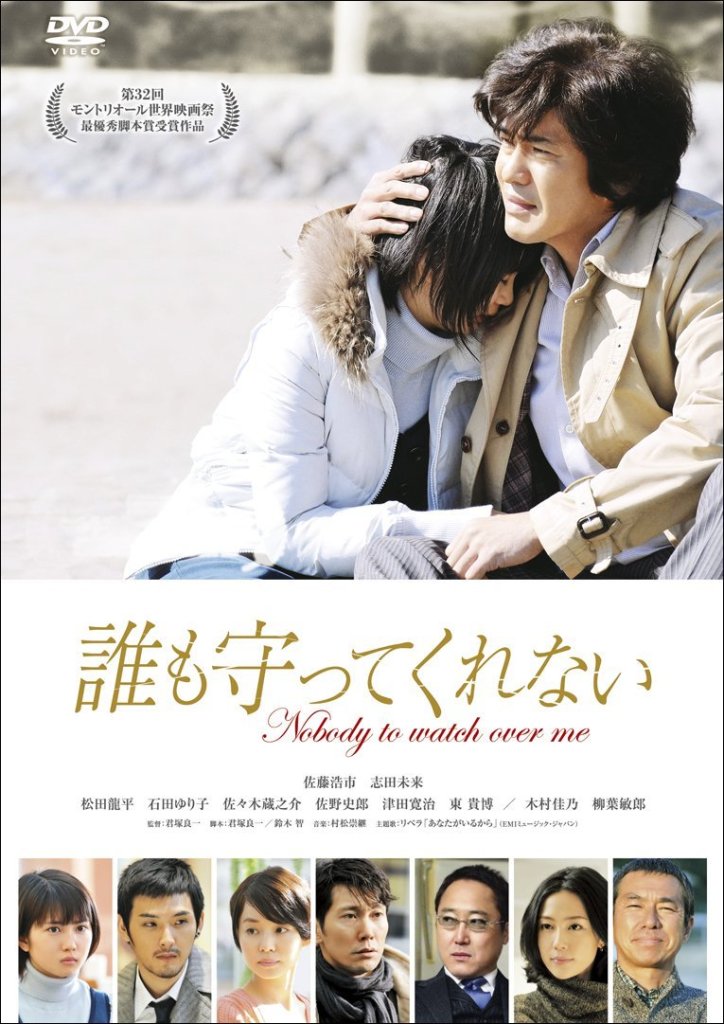
Nobody to Watch Over Me (誰も守ってくれない, Ryoichi Kimizuka, 2009)

Nobody to Watch Over MeWhen a crime has been committed, it’s important to remember that there may be secondary victims whose lives will be destroyed even if they themselves had no direct involvement in the case itself. This is even more true in the tragic case that person who is responsible is themselves a child with parents and siblings still intent on looking forward to a life that their son or daughter will now never lead. This isn’t to place them on the same level as bereaved relatives, but simply to point out the killer’s family have also lost a child who they have every right to grieve for, though their grief will also be tinged with guilt and shame.

Nobody to Watch Over Me (誰も守ってくれない, Dare mo Mamotte Kurenai) takes the example of one particular case in which an 18 year old boy has brutally stabbed two little girls in a park and then returned home as if nothing out of the ordinary had happened. After the boy is arrested, his family is caught up in a firestorm of police and press interest, barely able pause and come to terms with the surreal events that are taking place. No sooner has their son been dragged off in handcuffs than a troupe from the family court arrives with pre-printed documents which will arrange for a divorce and remarriage between the parents so that they can revert to the wife’s maiden name in an attempt to avoid the stigma of being related to a child killer. After being bamboozled into signing a number of papers with barely any explanation the family is then split up for questioning and taken to separate locations to try and throw off the press.

Grizzled detective Katsuura (Koichi Sato) is charged with looking after the murderer’s younger sister, Saori (Mirai Shida) – a 15 year old high school student. Katsuura is enduring some familial conflict of his own and was due to be taking a family holiday to try and work things out, so he’s a little distracted and put out about needing to shield this quite uncooperative teenager from the baying masses. He’s also suffering a degree of PTSD from a traumatic incident some years previously in which a case he was involved in went horribly wrong resulting in the death of a small boy. Understandably, Saori is in a state of shock, left alone with strangers to try and cope with this extremely stressful situation and unwilling to betray her brother by submitting to the police’s constant demands for information.

The police themselves aren’t always the benign and and comforting presence one might hope for on such an occasion as Katsuura’s superior has one eye on a possible promotion if he can exploit this high profile case for all its worth and is intent on pressing this innocent teenage girl as if she were some kind of war criminal. The family are treated with a degree of suspicion and contempt, as if they were directly or indirectly complicit in the violence created by their son or brother.

In actuality, there may be a grain of truth in this as the film also begins to offer some social critique of the modern family and the pressures placed on young people in the contemporary world. When questioned about their son, the mother remains more or less silent but the father angrily replies that he raised his son “strictly”. The family had high expectations and didn’t take academic failure lightly. From middle school onwards, they kept their son at home to study allowing him little outlet for anything else and, it seems, he was sometimes physically disciplined for a lack of progress.

Katsuura’s family is under threat too, perhaps placed under pressure following Katsuura’s personal disintegration over having been prevented in his attempts to save the life of the small boy some years previously or just from the constant insecurities involved being the family of a policeman whose working schedule is necessarily unpredictable. Though originally becoming fed up with Saori’s lack of cooperation, Katsuura eventually develops a protective relationship with her perhaps because she reminds him of his own teenage daughter. Given that the police are to some degree her enemy as they are the ones that have taken away her brother and separated her from her parents, it’s not surprising that she doesn’t immediately warm to Katsuura but after being betrayed by someone she believed was a true ally, she finally understands that he is firmly on her side and trying to protect her from a very real series of threats.

The modern world is shown up for all of its voyeuristic obsession with the horrifying and the taboo. The family are swarmed by press but it’s the internet that becomes the major aggressor as it publishes not only the boy’s real name, but even his parents’ address and the addresses of other people involved with the case. Self proclaimed social justice crusaders react like parasites glued to bulletin boards trading information on notorious crimes for a kind of internet fame, not caring about the facts of the case or that there are real people involved here who are already grieving. Taking the “I blame the parents” mentality to its extreme, even more distant members of the killer’s family are expected to trot out an apology for the cameras even though it’s really nothing to do with them and isn’t going to do anyone any good anyway.

Kimizuka shoots the first part of the action with a breathless intensity, mimicking hand held, on the ground news reporting to convey just how frightening and disorientating this must be for anyone unlucky enough to be caught up in a media storm. The use of choral music and occasional melodramatic touches near the end perhaps undermine the film’s emotional power which never quite coalesces in the way it seems to want to. However, Nobody to Watch Over Me is a fascinating and rich exploration of the public’s obsession with true crime stories coupled with an extreme tendency towards victim blaming and the need to hold to account those close to the perpetrator of a crime even if they had little to do with it themselves. Frightening yet hopeful in equal measure, Nobody to Watch Over Me offers scant comfort but does at least begin to ask the question.


The region 3 Hong Kong DVD release of Nobody to Watch Over Me includes English subtitles.

English subtitled teaser trailer:

Detective Story (探偵物語, Kichitaro Negishi, 1983)

Dective Story 1983Yusaku Matsuda became a household name and all round cool guy hero thanks to his role as a maverick private eye in the hit TV show Detective Story, however despite sharing the same name, Kichitaro Negishi’s Detective Story movie from 1983 (探偵物語, Tantei Monogatari) has absolutely nothing to with the identically titled drama series. In fact, Matsuda is not even the star attraction here as the film is clearly built around top idol of the day Hiroko Yakushimaru as it adapts a novel which is also published by the agency that represents her and even works some of her music into the soundtrack.
As far as plot goes, Detective Story is the kind of good natured, innocent crime thriller that has all but disappeared since the 1980s. Yakushimaru plays teenage student Naomi who is due to move to America to be with her father in the very near future. However, Naomi is an inquisitive, mildly rebellious sort with a habit of sneaking out of her room through the window despite the fact that no one is preventing her simply leaving through the front door. Consequently someone or other has hired a detective, Tsujiyama (Matsuda), to keep an eye on her. This he does pretty well until he puts a stop to Hiroko making a huge mistake with a fellow student in a love hotel. Though Naomi is very not happy about a creepy old guy following her about everywhere, she gradually gets used to it and when Tsujiyama’s ex-wife gets caught up in a hotel room murder case, Naomi gets the inspiration to embark on some detective work of her own.

Despite the shadiness of the world that rich girl Naomi is about to get embroiled in, the film maintains a bright and cheerful tone – perhaps because of Naomi’s own straightforward innocence. Even if she very nearly falls for the advances of an obvious creep (seriously, the guy actually borrows money from his “girlfriend” ? right in front of Naomi to take her out on a date, after which he tries to persuade her to join him in a love hotel), Naomi’s teenage spunkiness largely keeps her out of trouble for the rest of the movie which sees her getting mixed up with nightclubs, showgirls and yakuza. Somehow there is very little feeling of actual danger in the film leaving this all feeling like the kind of thing that happens to Naomi all the time and is simply just one last adventure before she heads off to America.

It must have been something of a coup to get arguably the biggest movie star of the day, Yusaku Matsuda, to play second fiddle in a mainstream teen idol movie especially as his other film choices of the time seem to indicate a desire to get away from his tough guy persona into more dramatic roles. Tsujiyama is cool presence in his stylish brown suit, smoking away in the shadows content to simply keep watch. He’s the omniscient type who always seem to have a plan in motion yet it’s Naomi herself who takes the lead here, solving the case whilst saving Tsuijiyama and his damaged show girl of an ex-wife in the process.

As is common with these kinds of stories there is a light romantic subplot which is a little unseemly when you consider Yakushimaru was only 19 at the time and her character around the same age whereas Matsuda was already in his 30s. This plot strand is played a little strangely throughout the film with a tacked on airport gate conclusion which dissolves itself almost straightway but does play into the film’s coming of age themes as Naomi develops greater sense of herself as an adult woman rather than a reckless teenager.

Detective Story is no lost classic, it’s very much of its time and has perhaps faded a little as has the fame of its tentpole star. That said it’s a perfectly enjoyable cute teen idol detective story which overall succeeds in doing exactly what it sets out to do even if it proves a little dull in the execution. An interesting watch for fans of its two stars Hiroko Yakushimaru and Yusaku Matsuda and even for its director Kichitaro Negishi who has gone on to win some later critical acclaim particularly with the prestige drama Villon’s Wife in 2009, Detective Story is perhaps not worth an all night stakeout but at least warrants a cursory investigation.


Unsubtitled trailer:

and here’s a video of Hiroko Yakushimaru singing the (very catchy) title song at a concert celebrating the 35th anniversay of her film debut (video has a bit about the concert at the beginning, fastfoward to 1:13 for the song only)


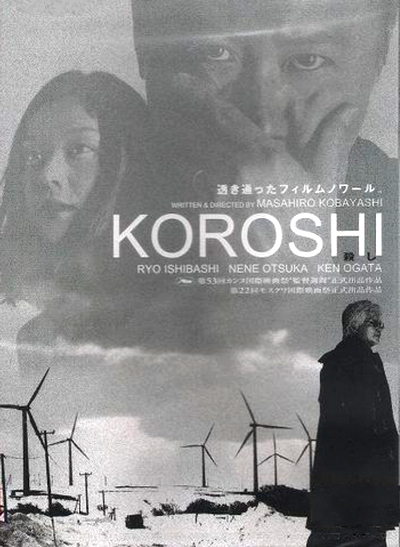
Film Noir (殺し, Masahiro Kobayashi, 2000)

Koroshi-2000Existential tales of hitmen and their observations from the shadows have hardly been absent from Japanese cinema yet Masahiro Kobayashi’s Film Noir (AKA Koroshi, 殺し) perhaps owes as much to Fargo as it does to Le Samouraï. Taking place in the frozen, snow covered expanses of Northern Japan, Kobayashi’s story is an absurdist one filled with dispossessed salarymen leading empty, meaningless lives in the wake of late middle age redundancy.
Hamazaki starts us off with a very Film Noir style voice over in which he likens being alive to be trapped on a long coach tour with strangers. You may fight and scream and argue with them right the way through, but in the end you will crave their understanding. Like many men of the era following the recent economic turbulence, he’s lost his job and, being a cowardly if kindly soul, he’s too afraid to tell his wife about it. Consequently he leaves for work everyday as normal but drives to a near by strip mall and wastes the day away playing pachinko. That is until one fateful morning when he finds the entire area deserted only for a mysterious man to climb uninvited into his car.

This unnamed man has a business proposition for Hamazaki – kill a guy, get a lot of money. As anyone would be, Hamazaki is a little shocked, confused and uncertain but eventually accepts. His first hit (like all of his subsequent hits) is on a man just like him – a middle aged loser who’s lost his job and is hiding out in the pachinko parlour hoping to figure something out before he runs out of money. Hamazaki likes his new line of work, it makes him feel like a man again and even helps him rebuild a bond with his wife (or so he thinks) but when he discovers one of his targets is someone he knows it all starts to go wrong.

Amusingly, the mysterious man gives Hamazaki a number of videos to watch as a kind of instructional guide to killing which includes a fair few from Melville including Army of Shadows and other classics of shady French cinema. This is a well worn tale and we know it isn’t going to end well for Hamazaki but we can also see from his voiceover that he’s consistently at odds with the situation as it is almost as if he’s constructing a film noir-esque reality all of his own.

Hamazaki is an unlikely fit for this kind of work – all the way through he’s berated for being “too nice”, notably in an argument with his former boss towards the end and then again by his wife who, it seems, cares more for her social standing and middle class lifestyle than she does for her kindhearted husband. The couple have a teenage daughter whom they’ve sent abroad to study in America (presumably at great expense) and only seems to contact them to ask for more money. Though she’s apparently only in high school, they seem to treat their daughter with a high level of adulthood – sending the money for her to budget with by herself (the implication is that she runs through quite a bit) and her mother even takes care to remind her of the importance of using a condom (not just the pill – America is the AIDS hub of the world, apparently) which is obviously good advice from an enlightened parent but perhaps a surprisingly frank way of talking to a teenage girl.

In many ways Hamazaki is a man without a place. Now he’s lost his job he’s become quite useless to just about everyone. As the mysterious man tells him, everyone is playing a role, in that case “killer” and “prey” but as it transpires Hamazaki was playing a role all along – that of salaryman husband and father. The couple seem happy, but in having sent their daughter overseas the Hamazakis have already broken their happy family in favour of increasing their social status. Kazuko is perhaps only playing the role of the middle class housewife and may have little use for a man who proves too soft hearted to get ahead. After Hamazaki tragically declares he wants to give up the life of a contract killer because he’s realised the importance of family, he may find that “family” had long ago abandoned him.

In this deserted, snow covered town the hearts of men are as cold as the wind that blows through the depressingly empty expanses. A man’s worth is measured by the money he makes and status he can claim, a man with no job is worth nothing at all. No love, no family, no morality – this is the archetypal film noir world filled with nothing but eternal darkness despite the bright sunshine which bounces lightly off the crisp white snow. As much about the death of the spirit as it is about the taking of life, Film Noir paints an eerily bleak picture of modern society with its rigid social codes which prize only the acquisition of money and status rather than the contents of a man’s soul.


Unsubtitled trailer:

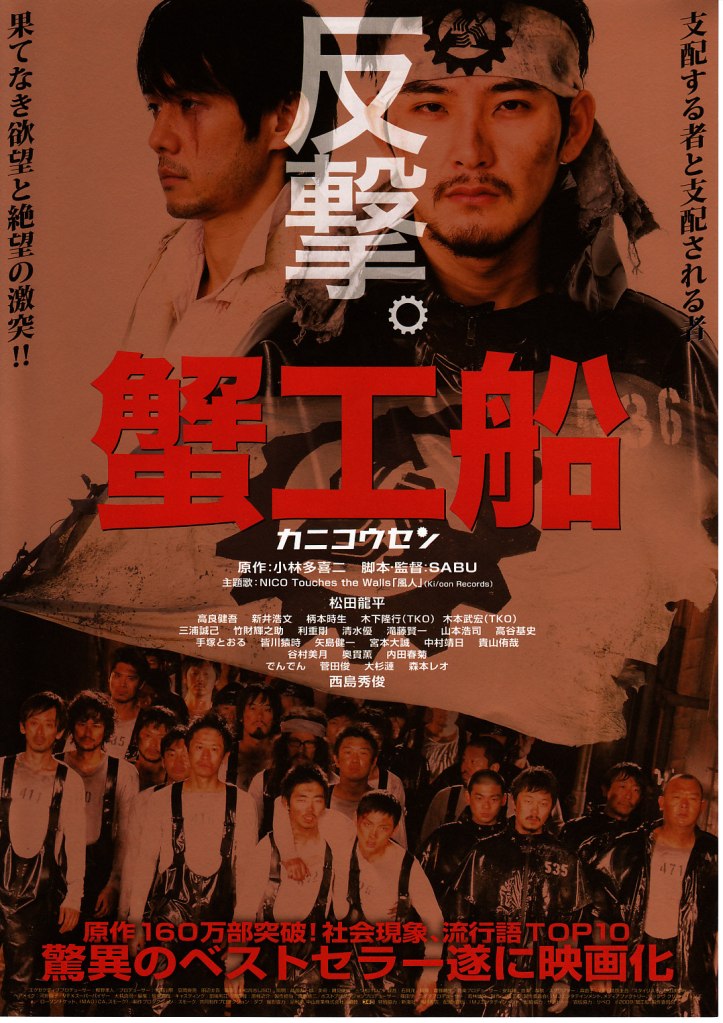
Kanikosen (蟹工船, SABU, 2009)

kanikosenBack in 2008 as the financial crisis took hold, a left leaning early Showa novel from Takiji Kobayashi, Kanikosen (蟹工船), became a surprise best seller following an advertising campaign which linked the struggles of its historical proletarian workers with the put upon working classes of the day. The book had previously been adapted for the screen in 1953 in a version directed by So Yamamura but bolstered by its unexpected resurgence, another adaptation directed by SABU arrived in 2009.
As in the book the film follows the lives of a group of men virtually imprisoned on a crab canning ship anchored near Russian seas in the 1920s. The men on the boat are of various ages and come from various different backgrounds but each is here out of necessity – nothing other than extreme poverty and lack of other options would ever persuade anyone to take on this arduous and often unpleasant line of work. Technically speaking the boat has a captain but it’s the foreman who’s in charge – dressed like a European officer in a white frock coat and riding boots and with a vicious looking scar across his left eye, Asakawa rules the waves, barking out orders and backing them up with a walking stick.

SABU films the workers’ struggles through the filter of absurdist theatre beginning with a darkly comic segment in which each of the men recount their poverty riddled circumstances and dreams for social advancement before one, Shoji, emerges and posits another idea. They will make a bid for everlasting freedom by committing mass suicide in protest to poor working conditions and consistent exploitation of their class by those above. Predictably, this fails when everyone realises they didn’t actually want to die in the first place. Later Shoji and another man are picked up by a Russian boat after being stranded at sea and after seeing how happy the Russian sailors seem to be, they return determined to enact the revolution at home.

Conveying the workers’ plight through production design, SABU opts for a packing room which is both oversized yet claustrophobic, filled with giant cogs and gears of the capitalist system in motion. The men are little more than fleshy gears themselves, just another piece of the production line to be thrown out and replaced once worn through. Gradually the workers start to realise that this system is only sustainable because of their own complicity. The foreman is, after all, only one man and the workers have made a decision to obey him – they also have the ability to decide not to. That said, the spanner in the works is that the foreman also represents the larger mechanism at play which is the imperial state itself and can call on its resources to defend himself against a potential mutiny.

Having decided to rebel and seen their revolution fail, the workers come to another realisation – that the only true path to social change is a movement for the people lead by the people as one, i.e. with no leaders and therefore no head which can be cut off to disrupt all their efforts. Hand in hand and with the bloody flag raised high do they march into battle to put an end to unfair exploitation of those without means by those that have. Ever since they’ve been on this boat, they’ve been told that they’re at war, that their services are necessary for the survival of the Imperialist state – and now so they are, engaged in the class war to end the imperialist hegemony.

In the end, SABU’s message is a little confused – he advocates collective action, but not the collective, as his revolution is born of individual choice rather than the workers linking hands behind a faceless banner. It works as a semi-effective call to arms, but more often than not undermines itself and has a tendency to pull its punches when it really counts. That said, even if it wasn’t perhaps quite what Kobayashi meant, the more general message that the revolution begins in the heart of the individual and that one has the possibility to choose to live in hell (as a slave of the state) or create a heaven for one’s self (as a free person) is one that has universal merit and appeal.


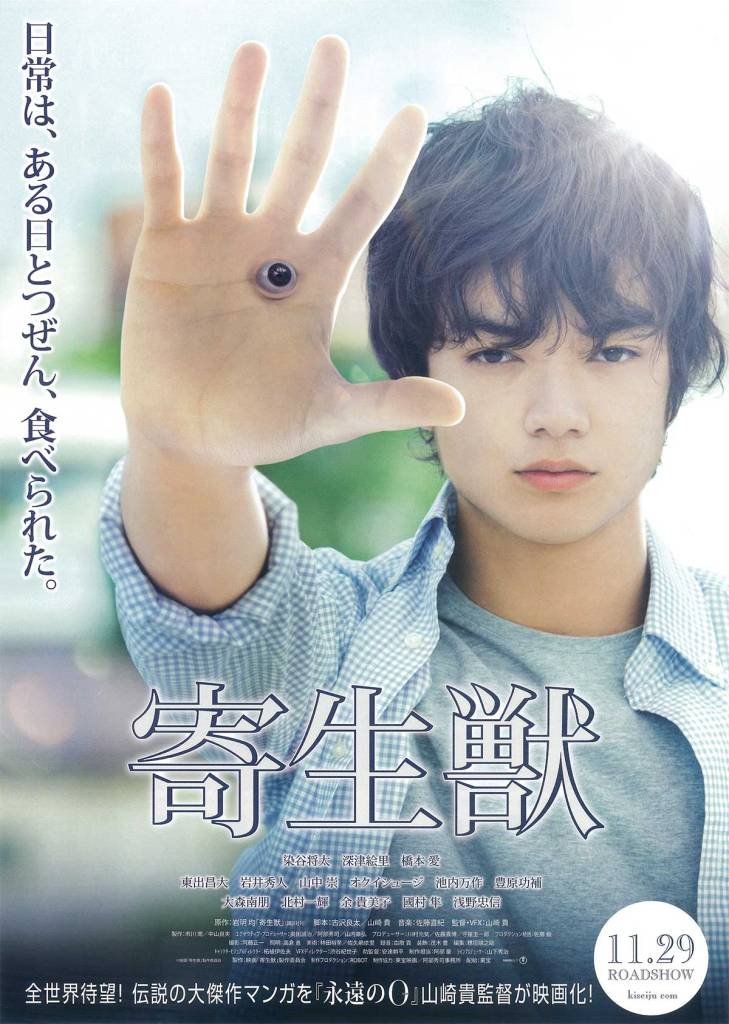
Parasyte The Movie Part 1 (寄生獣, Takashi Yamazaki, 2014)

parasyte part oneReview of Takashi Yamazaki’s adaptation of Hitoshi Iwaaki’s manga Parasyte – Parasyte: The Movie Part 1 (寄生獣, Kiseiju) first published by UK Anime Network.


Humans – are we the biggest threat to our planet and ultimately our own survival? If the world population were halved, would we also halve the number of forests that are burned and the damage that we’re doing to our natural environment? These thoughts run as a voice over beginning the full scale blockbuster adaptation of Hitoshi Iwaaki’s classic manga which was also recently adapted into a critically acclaimed anime. The Parasyte of title most obviously refers to the extraterrestrial microbes which are climbing into the driving seat of an unsuspecting host’s brain with nothing less than the colonisation of our entire species on their “minds”, yet, is it we ourselves who are the real parasites feasting on the corpse of our dying planet? Parasyte is that rare blockbuster treat that is content to give us man-eating, shapeshifting, monsters and gore filled destruction but also wants us to dig a little deeper into our own souls at the same time.

Shinichi Izumi’s (Shota Sometani) mum (Kimiko Yo) probably told him not to sleep with his headphones on but luckily they’re about to save his life as a weird little bug tries to crawl into his ears but finding them blocked opts for the arm instead. Wrapping the cord around his elbow tourniquet style, Shinichi is able to stop the bug’s progress but the parasite has taken root and Shinichi is horrified to find his right hand is no longer his own but is now controlled by a dispassionate alien that eventually names himself “Migi”.

Shinichi and Migi develop an odd kind of partnership born of their mutual dependency which is threatened only by the presence of other Parasytes who have successfully infiltrated a human brain and can blend in with the general populace (aside from their cold and robotic natures). To his horror, Shinichi discovers a new teacher at his school is actually a Parasyte stooge who recognises the “research” potential of a hybrid team like Shinichi and Migi. Becoming very keen on “experiments” Ryoko Tamiya (Eri Fukatsu) has also mated with one of her fellow Parasytes in the hopes of exploring what will happen with the birth – will it be purely a human child seeing as it’s born of two human bodies or will something of the Parasyte get through? However, Ryoko’s “network” of Parasytes aren’t all as committed to scientific research as she is and Shinichi and Migi quickly find themselves becoming humanity’s last line of defence against the invading creatures.

Shinichi is the teenage lead of the picture but in this first part at least it seems to be Ryoko leading the show. She gives us the original voice over and it’s her burgeoning motherhood that gives the film its clearest ideological standpoint. As the dispassionate Ryoko comes to develop the beginnings of maternal pangs and a desire to ensure the survival of her child (or perhaps just her “experiment”), so Shinichi finds his humanity being erased by the parasitical “child” he is gestating in the form of Migi. At the same time Migi begins to take on a protective mentality towards his host which may be more than simple self preservation particularly after a traumatic near death experience bonds the two even tighter together, in a biological sense at least.

Though the film obviously references former genre classics, in particular Invasion of the Bodysnatchers with its difficult to detect pod people, it steers clear of the “red scare” inspired sense of paranoia and the feeling of intense mistrust that exists even between supposedly good friends. Migi is able to sense (to a degree) his own kind making the presence of potentially dangerous Parasytes easier to detect but the fact that the Parasytes are able to colonise and use the form of someone all too familiar to confuse their enemies restores something of their power to lurk unsuspected in the shadows.

All this seems to suggest that the big screen live action adaptation of Parasyte would be a fairly serious affair yet the tone is often lighthearted, maintaining the darkly humorous buddy comedy side of the relationship between normal teenager Shinichi and the almost omniscient yet strange Migi. Migi, as played by veteran actor Sadao Abe who is perhaps most closely associated with comedic roles, has a thirst for a different kind of “brains” than his fellow Parasytes and quickly devours any and all knowledge he can get his “hand” on though he lacks the emotional intelligence to make sense of everything he learns and thus is dependent on his host Shinichi to get a fuller understanding of the human world.

Like the blockbuster mainstream films of recent times Parasyte boasts generally high production values on a par with any Hollywood movie though it has to be said that the film is often undermined by unconvincing CGI. However, this is mainly a problem with the action scenes and Migi himself is generally well integrated into the action and oddly adorable to boot. In some ways it might have been interesting to see a fully “in camera” take on the effects ala Cronenberg whose spirit is most definitely evoked throughout the film which also harks back to ‘80s body horror with its synth score highlights and generally gruesome scenes of carnage. Though it’s hard to judge the overall effect from just this first instalment of a two part film which drops a decent number of threads to be picked up in part two, part one at least serves as a tantalising appetiser which only heightens expectations for its final conclusion.


Parasyte: The Movie Part 1 is currently available on DVD and blu-ray in the UK from Animatsu Entertainment with Part 2 to follow in June 2016.

Death Powder (デスパウダー, Shigeru Izumiya, 1986)

death powderCyberpunk, for many people, is a movement which came to define the 1980s and continues to enjoy various kinds of resurgences and rebirths even into the new century. Beginning the the ‘60s and ’70s in dystopian science fiction afraid of the impact of advancing technologies in society, it’s not surprising that the genre began to actively embrace influences from the East and especially that of the more technologically advanced and economically superior Japan. However, when Japan made its own cyberunk cinema, the “punk” element is the one that’s important. These movies sprang from the punk music scene and often star punk bands and musicians as well as featuring high energy punk rock inspired scores.
Death Powder (デスパウダー) is among the first of these tech themed experimental films and is the only feature to be directed by folk singer and poet Shigeru Izumiya who had also starred in Sogo Ishii’s massively influential Burst City in 1982. Hugely indebted to Blade Runner, it takes that film’s noir stylings and terminology to create an experimental surrealist film loosely themed around two bounty hunters in search of a “replicant”.

After beginning with a chase sequence past neon signs and through a contemporary Tokyo where the faces of passersby have been pixelated out, the story focuses in on the pair of street punk robot hunters, Kiyoshi and Noris, who have been charged with investigating a gang hideout which used to belong to an artist who keeps trying to come back. However, when the duo arrive they find that the reason the artist, Harima (played by Izumiya himself), keeps trying to attack the place is that they’ve been holding his girlfriend, Guernica – an android, in the basement. After Guernica is killed in the resultant fighting, her body turns into a kind of powder which Kiyoshi later snorts. This “Death Powder” allows Guernica to colonise his body producing changes in both his mind and physiology.

This is what passes for a plot summary, though in keeping with the best of cyberpunk film making from Japan the narrative is irrelevant. One character even says to another “Like life itself, this makes no sense” – that being the point in a sense, creating meaning from the meaningless. Though it starts off with a Blade Runner-esque aesthetic bearing all of the hall marks which would come to be associated with cyberpunk from the neon signs, darkened streets and noir tinged atmosphere right down to the shades and trilbies costuming, the film quickly moves into the experimental realm with strange robotic sperm flying across the screen and melting vistas of city scenes and memories.

Kiyoshi begins to merge with Guernica’s consciousness, inheriting her memories and what may or may not be android fears and emotions. He “remembers” a flashback sequence featuring the very strange figure of Dr. Loo – a rock god mad scientistic who built Guernica for some undisclosed reason and then passed her on to Harima on whom it, apparently, depends whether not not she can become human which requires showing her love that transcends human love and will become “memories”. Like the replicants in Blade Runner she has a limited four year lifespan but when she dies her body will become a powder which gives life to other things.

Guernica is a created being, devoid of human flesh, but can she become human through experiencing human emotions and can she overcome death by downloading her experiences into another being’s consciousness? All fundamental questions found in cyberpunk explorations of what in means to be human in a world of advancing technology but once again Death Powder offers no clear answers so much as a surrealist and experimental exploration of the individual changes undergone by the individual rather than the society in the face of increasing mechanisation.

The borders between life and death, consciousness and unconsciousness, man and machine have all become so hopelessly blurred that concept of reality itself has become corrupted and no longer carries any kind of currency. While it may not have the raw and sophisticated artistic power of Tsukamoto’s later Tetsuo the Iron Man which has come to define the genre, Death Powder is a surprisingly accomplished low budget cyberpunk body horror extravaganza which places sensory experience ahead of narrative. Undoubtedly hugely influential yet now little seen or remembered, Death Powder is an essential addition to the cyberpunk canon and one which deserves to be as widely distributed as the classics which later followed it.


Opening sequence of the film (very trippy but dialague free until right near the end. Fast forward to around four minutes in for the nighttime chase through Tokyo!):

The Monster Chronicles: Tiktik (Erik Matti, 2012)

Tik tik posterReview of Erik Matti’s Philippine folklore/comic book inspired horror movie The Monster Chronicles: Tiktik (also known as Tiktik: The Aswang Chronicles) up at UK Anime Network.


An “aswang” is a supernatural monster from Philippine folklore which is basically a vampire, zombie and were-creature all rolled into one. Appearing just like everyone else in everyday life, the aswangs can disguise themselves as various animals in order to trick unsuspecting people into letting their guard down so they can feast on their hearts and livers. Aswangs are particularly fond of the flesh of unborn babies and will even attempt to sneak into the homes of unsuspecting expectant mothers to suck the child from their very wombs as they lie peacefully asleep.

All of this is very bad news for metropolitan city slicker Makoy who’s managed to trek all the way out to a remote village backwater hoping to win back his heavily pregnant girlfriend who has left him after finally becoming fed up with his total uselessness. However, his efforts seem to have been in vain as Sonia, the possibly ex-girlfriend, doesn’t even want to see him and her domineering mother Feley is dead against this dead beat city boy who’s got her daughter pregnant coming anywhere near her family ever again. Luckily, Sonia’s father, Nestor, is a little more open to the idea of a reconciliation with his grandchild’s father and eventually invites him to stay for Sonia’s birthday celebrations.

At this point Makoy decides to make himself useful by haggling down the price of a pig for roasting at the party, only after managing to pay a whole lot less he ends up with a whole lot more than he bargained for. The local villagers all turn out to be a colony of aswang and now they know about Sonia’s unborn baby it’s not long before all hell breaks out at the prospective parents-in-law of the previously feckless Makoy!

Director Erik Matti (perhaps best known for his urban crime thriller On the Job) opts for a comic book inspired aesthetic by emphasising the artificiality of his studio bound film through noticeably fake CGI backgrounds. Playing out like a Philippine From Dusk Till Dawn, the film has an ironic, pop-culture filled humorous tone and further brings out its comic book trappings through the frequent use of split screens which divide the frame almost like panels do a comic book page. The slightly old fashioned appearance of the split screens coupled with the heightened colour scheme and CGI graphics also add a retro appeal which helps to create the crazy, almost cartoon-like universe in which the film takes place.

However, even if Tiktik has a Saturday morning toon aesthetic, it’s very much an adult affair filled with blood, guts and viscera. An old lady sitting next to Makoy on the cart into town ominously seems to be carrying a large bag of intestines which only seems to foreshadow events to come which will see Makoy wielding a large pitchfork with the guts of an aswang coiled around it like the messiest spaghetti you’ve ever seen.

The aswang might be known for their transforming powers but the real transformation we’re being asked to witness of that of Makoy himself as he plays the classic “stranger in town” role whose arrival is the catalyst for everything going to hell. In the beginning Makoy is an arrogant townie who can’t quite believe the backwardness of this tiny village with no cellphone signal or transport options. He arrogantly assumes he can haggle and barter with the locals by treating them with a superior attitude and the distain of a recent visitor from “civilisation”. This only earns him the additional ire of the aswang who are now, quite literally, out for blood. Sonia may have left him because of his laid back, slacker ways but if he wants to save her and their baby from being devoured by slavering, ugly monsters that no one quite believes in anymore, he’ll finally have to man up.

Makoy manages a little better than Sonia’s father, Nestor – a mild mannered and kind man who loves his fierce wife very much but still can’t quite find the necessary strength within himself to protect his family. If Makoy is to succeed he’ll have to jump into the shoes of a father with both feet, taking charge of a situation which he is not fully equipped to understand.

The film neatly divides itself into two halves with the set-up economically established early on giving way to the aswang assault. Though the action scenes are often exciting and inventive with a fair bit of humour thrown in, Tiktik loses momentum when it switches from the CGI enhanced actors to the completely CGI creatures which are never quite convincing. A genre affair throughout, Tiktik will undoubtedly play better to the Midnight Movie crowd (as it is intended to do) but uninitiated viewers may find themselves tiring of the gore tinged action long before the last aswang is split in twain.


The Monster Chronicles: Tiktik is out now in the UK from Terracotta Distribution following its appearance at the Terracotta Festival in 2014.


The Drifting Classroom (漂流教室, Nobuhiko Obayashi, 1987)

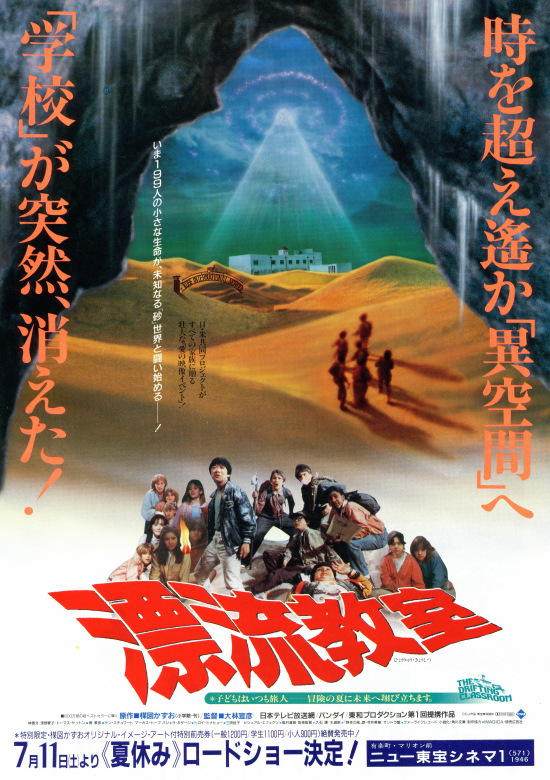
Drifting ClassroomNobuhiko Obayashi may have started out as an experimental filmmaker and progressed to a lengthy narrative film career but he remains best known for his “what the hell am I watching?” cult classic Hausu. Aside from his 1983 take on The Girl Who Leapt Through Time, very little of his other work has travelled outside of Japan. In the case of 1987’s The Drifting Classroom (漂流教室, Hyoryu Kyoshitsu), this is doubly surprising firstly because it’s based on a hugely popular manga by the godfather of horror comics Kazuo Umezu and secondly because it’s set in an international school so around 80% of the dialogue is in English.
Obayashi jettisons most of Umezu’s original plot which involves an ordinary Japanese school being suddenly and mysteriously uprooted from its city centre location leaving only a gaping hole to mark its place. This time our hero is Shou – a teenage boy who has recently returned from living in LA and is attending Kobe International School until his Japanese improves enough to get into a normal establishment. Having lived abroad for so long, Shou is a totally Americanised boy with a rebellious, individualistic streak and just wants to hang out with his cool American pals rather than study like his parents want him to do so he can get a foot on the all important ladder of the Japanese educational system. Consequently he argues with his mother and says some very harsh things which leads to her telling him to get out and not to bother coming back – sentiments which both are about to spend the rest of their lives regretting.

Right before taking the register some weird shit goes down and there’s an intense storm which fills most of the school building with sand. Looking out of the windows, everything seems to have become desert. The kids and the two remaining teachers think about what to do and settle on practical things like rationing the food and water left in the school canteen. Back in Kobe, there’s just a giant hole in the ground and a whole lot of confusion….

For some reason, Obayashi decided to set the story in an international school which means that most of the dialogue is in English (though judging by the accents and languages there are some Europeans and students from other parts of Asia around too). This is the single worst decision of the adaptation as the dialogue, which is overly silly to begin with, is offered in stilted, halting tones by its disappointing child actors with the native English speakers not doing very much better than the Japanese kids who are at least trying their best. Perhaps for these reasons (or just out of operational necessities) the film is entirely shot in non-sync sound and the dubbing never quite links up either.

It almost seems as if Obayashi is targeting an overseas audience as his tone is very much indebted to ‘80s kids’ movies with its cast of slightly plucky (sometimes irritatingly so) youngsters trying to solve the mystery of their own disappearance. However, it doesn’t seem as if the film was ever released outside of Japan (where it has never even been released on DVD) despite the presence of one time American star Troy Donohue leaving the strange Americanisms as a sort of exotic plot element with no real resolution.

Though the story seems to be aimed at older children with the usual themes of perseverance in times of adversity and the importance of teamwork and friendship, there are a few scary moments including a psycho style gag where a teacher’s head spins round before dissolving into sand. However, the majority of the special effects are extremely unconvincing resembling an ‘80s kids TV programme with a host of matte paintings, bad green screen, early digital effects and even some tokusatsu style people in rubber suits playing strange cockroach-like monsters. Arguably the best of these is the friendly creature who hangs round with the kids from school and most closely resembles a disgruntled potato with legs (but may actually be giving the most accomplished performance in the entire film).

All of this could have added to the film’s kitsch, “bad movie” vibe but Obabyashi opts to get serious every now and then and ruins everyone’s fun in the process. Weirdly, everyone just seems to accept the “timeslip” argument right away as if that’s a perfectly normal thing that happens every now and then like sinkholes or spontaneous human combustion – there’s even a geologist (?) being interviewed on the news who just says “yes – it is probably a timeslip” when asked to provide some “scientific commentary” on the disappearance of the school children. Completely bizarre but not in a very interesting way, The Drifting Classroom is a misfire on all levels neither making a good adaptation of its source material or an entertaining movie in its own right. Camp classics enthusiasts or Obayashi fanatics only.


The Drifting Classroom was also adapted into a TV drama in 2002 under the title of Long Love Letter which is much better than this movie.

A short scene from the film starring its best character whom I have decided to name “Spuddy” (English dialogue):

The Snake Girl and the Silver-Haired Witch (蛇娘と白髪魔, Noriaki Yuasa, 1968)

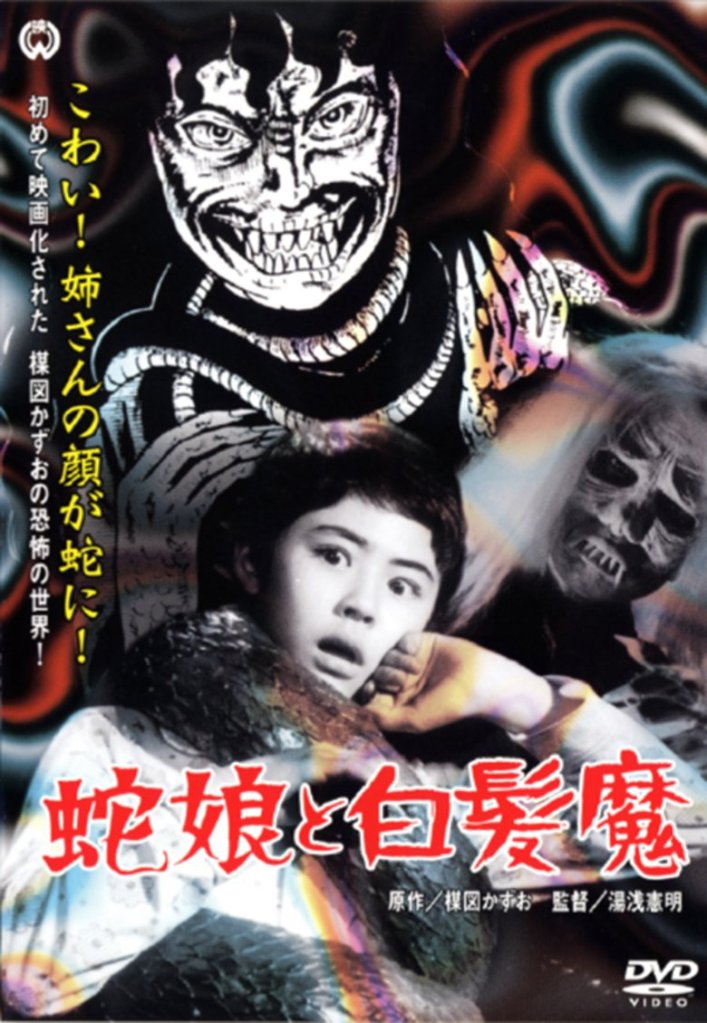
snake girl and the white haired witchLittle Sayuri has had it pretty tough up to now growing up in an orphanage run by Catholic nuns, but her long lost father has finally managed to track her down and she’s going to able to live with her birth family at last! However, on the car ride to her new home her father explains a few things to her to the effect that her mother was involved in some kind of accident and isn’t quite right in the head. Things get weirder when they arrive at the house only to be greated by the guys from the morgue who’ve just arrived to take charge of a maid who’s apparently dropped dead!

If that weren’t enough her “mother” calls her by the wrong name and then dad gets a sudden telegram about needing to go to Africa for “several weeks” to study a new kind of snake! On her tour of the house, Sayuri finds a room full of snakes, reptiles and insects (and also for some reason a large vat of acid?!) as well as a room with a buddhist altar where the food seems to disappear just as if Buddha himself were really eating it. Eventually, Sayuri is introduced to her secret sister, Tamami, who has slight facial disfigurement and a wicked disposition which has seen her locked away from view for quite some time…..

Based on the manga by Kazuo Umezu, Snake Girl and the Silver-Haired Witch (蛇娘と白髪魔, Hebi Musume to Hakuhatsuma) is, apparently, aimed at a younger audience which explains its child’s eye view of events but the film makes no concessions to the supposed softness of little minds. With a host of surreal imagery including dream sequences full of creepy, hypnotic spirals, and moments of shocking violence such as a large frog being suddenly ripped in half right in front of Sayuri’s eyes the film certainly doesn’t stint on blood, horror and general freakiness.

Sayuri herself seems largely unperturbed by these strange goings on outside of her nightmarish serpentine visions. She seems to have been well cared for at the orphanage and is happy to have found her family rather than just to be escaping the institution. On getting “home” she does her best to fit in right away, acting politely and trying to bond with her mother even in her confused state. She even tries to get on well with her mysterious sister despite the ominous warning to keep her very existence a secret from her father. Tamami, however, is a nightmare child with homicidal tendencies who isn’t interested in playing happy families with the girl who’s come to usurp her place in the household.

There’s a little more to the set up than just snake based horror (the clue being the Silver-Haired Witch of the title) but the secondary message seems to be one of remembering that the true beauty of a person lies not in their external appearance but in the goodness of their soul. The previously deformed Tamami is later said to be looking sweeter after having “redeemed” herself and Sayuri pledges to honour Tamami’s sisterly sacrifice by always remembering to hold fast and true to the beautiful things in her own soul without being swayed by worldly charms.

Snake Girl and the Silver-Haired Witch is more of a psychological horror tale than some of the effects laden efforts of the period. However, there are a fair few practical effects on show most notably during the dream sequences – one of which sees Sayuri actually fighting a giant snake with a sword, as well as the creepy spirals and the appearance of weird vampire-like snake women, dancing oni masks and the Silver-Haired Witch herself.

A children’s film that no one in their right mind would actually show to a child, Snake Girl and the Silver-Haired Witch is a freakishly psychological horror show seen through the eyes of a little girl. Part dreamscape and part terrifying reality, the film mixes the real and the imagined with a fiendish intensity and it just goes to show that sometimes you really do need to pay attention to the strange fancies of intrepid young ladies.


This trailer doesn’t have any subtitles but it is actually quite scary…..

My Little Sweet Pea (麦子さんと, Keisuke Yoshida, 2013)

My Little Sweet PeaHow many times were you told as a child, someday you will understand this? There are so many things you don’t see until it’s too late, and children being as they are, are almost programmed to see things from a self directed tunnel vision. Such is the case for Mugiko – a young woman with dreams of becoming an anime voice actress who is suddenly reunited with her estranged mother of whom she has almost no memory.

Mugiko (Maki Horikita) has a part time job in a manga store and is saving money to go to voice actress school. Raised by her father who has since passed on, she lives in a small flat with her older brother Norio (Ryuhei Matsuda) who also has a low wage job in a pachinko parlour. The pair’s lives change entirely when their long absent mother, Saiko (Kimiko Yo), arrives on their doorstep one day and begs to live in with them. Norio is dead against it but eventually Mugiko is persuaded and Saiko moves in. However, right after, Norio moves out to live with his girlfriend leaving Mugiko alone with the virtual stranger who is also her mother. Mugiko has a difficult time adjusting to living with a maternal figure and harsh words follow frequent misunderstandings until Saiko suddenly dies. Mugiko then travels back to Saiko’s hometown to inter her ashes and begins to forge a connection with the mother she barely knew.

The “haha mono” or “mother movie” is a subset of Japanese melodrama which focuses on the pain and heartbreak inherent in being a mother. Making countless sacrifices, the often saintly mothers do everything they can to ensure the best for their children even if their efforts cause nothing but suffering for themselves. My Little Sweet Pea (麦子さんと, Mugiko-san to) turns the genre on its side to look at things from the point of view of one of the “ungrateful” children, Mugiko, who is filled with resentment over having been “abandoned” only to have her mother suddenly return as if expecting to forget all the years of absence with one home cooked meal.

On journeying back to her mother’s remote rural town, Mugiko begins realise they weren’t so different from each other after all. Everyone in the village is stunned by Mugiko’s appearance which turns out to be the spitting image of her mother at around the same age. Saiko had also been something of a local celebrity thanks to her beauty, charm and popular presence. She left the town for the city with dreams of becoming a famous singer just like Seiko Matsuda and her rendition of the singer’s famous song Akai Sweet Pea is fondly remembered by the older generation.

Saiko’s dreams of hitting it big in the music business were never fulfilled though we know almost nothing about what happened to her between the end of her marriage and reappearance in her children’s lives save that she obviously had enough financial security to be able to send them money every month. Through meeting her mother’s old friends (and more than a few admirers), Mugiko comes to see something of herself in the distant figure of her mother as a young woman. Even if she couldn’t be there for reasons which are never fully explained, it wasn’t because she didn’t want to be or because she’d forgotten about or rejected her children, she suffered everyday thinking of and missing them and was tragically unable to rebuild that connection even at the very end.

Mugiko has been a little unsettled in her life, floating from one dream to the next and who really knows if voice acting is really the thing that she was meant to do. Saiko may have been more certain in her objective but whatever happened later it seems she found fulfilment in being a mother even if her dream of becoming a singer didn’t work out. Having been able to meet her mother even if vicariously, Mugiko is able to understand something about herself and perhaps repair a relationship that never quite took place. Striding out boldly with her mother in spirit beside her, Mugiko is finally able to step into the adult world and everything that is waiting out there for her with a new found confidence that comes with embracing the beauty of a distant scar.


Trailer (with English subtitles)

and here is the hit song from Seiko Matsuda – Akai Sweet Pea (1982)