
Be My Baby review up at Uk-anime.net
Be My Baby review up at Uk-anime.net
Review of Judge! on UK-anime.net
Review of Bleak Night published on UK-anime.net

 As we’ve seen lately, there are certainly no shortage of films looking at the complicated and often harsh world of high school in Korea. Pluto (명왕성, Myungwangsung) takes a sideways look at the darker side of academic excellence when the praise and prestige of being one of the top students becomes almost like a drug and makes otherwise bright young people do things even a heroin addict in serious need of a fix might at least feel bad about afterwards with an all encompassing sense of entitlement that gives them a lifetime free pass for even the worst transgression.
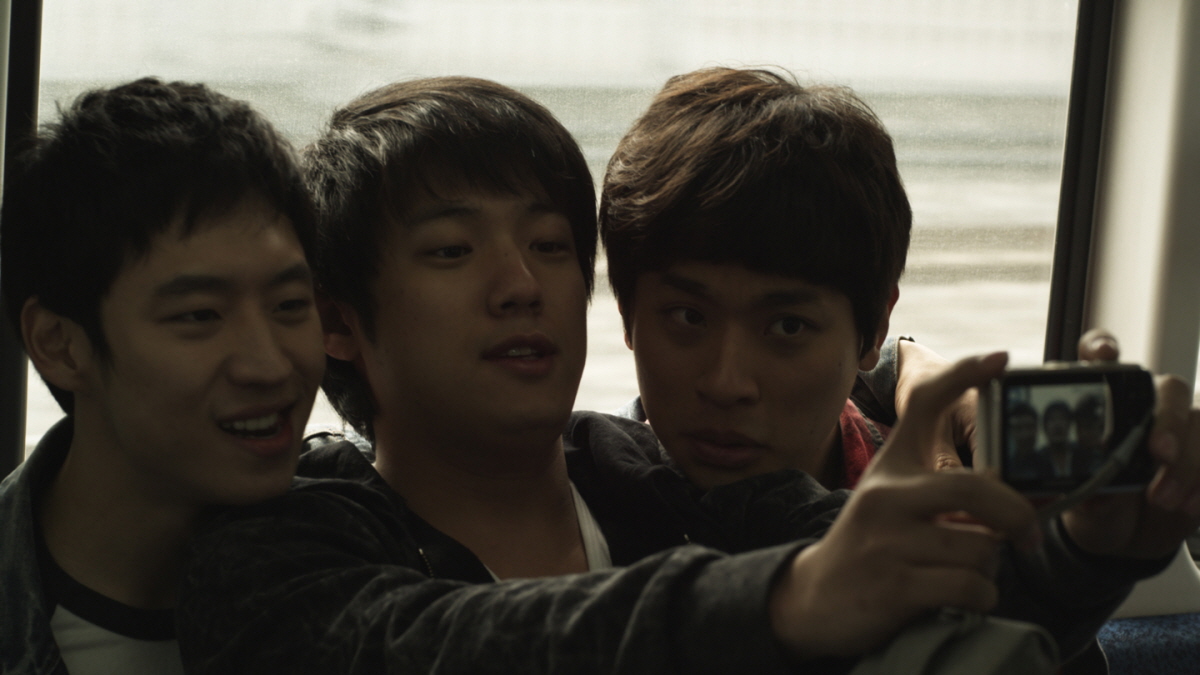
June (David Lee) is a bright young boy from a regular high school who’s just transferred into an elite boarding school educating the country’s next great hopes. He may have been a top student at his old school, but here he’s merely average as the school hotshots are pretty quick to point out. Here, the top ten students are treated like princelings – a special computerised teaching room, no curfew, better rooms, better resources and they can more or less do what they like so long as they keep their grades up. Occasionally someone manages to bump one of the top ten from the list but they quickly get kicked out again. The top ten operate like some kind of swatters mafia – they all stick rigidly together, swapping hot tips for the upcoming exams that they refuse to share with the others and engaging in a series of increasingly cruel “pranks” they term rabbit hunts.
The film opens with the police finding the body of the previously number one student Yu-jin (Sung Joon) in a wood with June’s phone lying next him having been used to film the entire grisly affair. June is arrested for the murder but is released after his alibi checks out. Sick of all the struggle and unfairness, June puts his particular talents to use to try and teach the world a lesson about the sort of people this system is producing.
The picture Pluto paints of the Korean schools system is a frankly frightening one in which academic success is virtually bought and paid for or guaranteed by class credentials. Yes, the top students obviously must have ability – some of their activities may come close to cheating but interestingly nobody seems to want to try actual deception to get ahead. However, that natural ability has clearly been bolstered by their parents’ wealth. Attending an elite school and spending more than some people earn on private tutors geared towards knowing how to get into the best universities undoubtedly gives them advantages which are out of reach for others no matter how smart they may be. Perhaps that’s fair enough in a capitalist society, they didn’t ask to be born to rich parents and who would turn that sort of help down if offered it? However, though they may possess the virtues of discipline, hard work and a desire to succeed what they lack is any sort of empathy or even common human decency. Engaging in a series of manipulative hazing exercises, the elite group will stop at nothing to protect their status specialising in thuggery, blackmail, rape and even murder. The sort of people this system is advancing are not the sort of people you want running your schools and hospitals, they are morally bankrupt and only care about their own standing in the eyes of others.
Perhaps it’s fitting that this elite boarding school is housed inside a former compound of the Korean secret police, including a subterranean layer of prison-like tunnels once used as a torture chamber. Aside from the obvious school as torture analogies, much of them film seems to be about what people choose to ‘unsee’. The headmaster of the high school is aware of the ‘untoward’ behaviour of some of his pupils but refuses to do anything in case it upsets their well connected parents, damages the reputation of his school or has an adverse effect on those all important test results. The ‘Pluto’ of the title is referenced in June’s university application essay on the demotion of Pluto from the accepted list of planets. He argues that this is unfair and a fallacy as it’s illogical to measure anything by its proximity to the sun which is, after all, just another star which will eventually die like all the others. Just because it’s a little different looking, you shouldn’t necessarily categorise it as being in some way ‘inferior’ based on a set of fairly flimsy criteria. June, like Pluto, hovers in uncertain orbit on the periphery – always wanting in but perpetually locked out. Naturally gifted but from an ‘ordinary’ background where his single mother sells insurance for OK money, June can’t hope to compete with these elite kids even if his capabilities may be greater. A lot of decisions have already been made as to what people choose to see, have chosen to regard as an ideal, even if the reality is painfully obvious.
Though oddly funny in places for such a hard hitting film, Pluto is a difficult watch at times and paints a depressing picture of the high pressured nature of the Korean educational system and of human nature in general. The elite group are universally awful people who run the gamut from arrogant, entitled prigs to snivelling cowards which makes it difficult to feel any sort of sympathy and you start to long for bad things to happen to them which somewhat undermines the film’s premise. Perhaps the problem is just that they were awful people who were enabled by a system rather than people who started out good and were corrupted by it. Stylishly shot and supported by well grounded performances from its young cast, Pluto is a welcome addition to this perhaps overcrowded genre which brings more than a few new thought provoking ideas to the table.
Review of first Pluto published by UK Anime Network.
 Review of The Snow White Murder Case (白ゆき姫殺人事件, Shiro Yuki Hime Satsujin Jiken) published on UK-anime.net
The sensationalisation of crime has been mainstay of the tabloid press ever since its inception and a much loved subject for gossips and curtain twitchers since time immemorial. When social media arrived, it brought with it hundreds more avenues for every interested reader to have their say and make their own hideously uniformed opinions public contributing to this ever growing sandstorm of misinformation. Occasionally, or perhaps more often than we’d like to admit, these unfounded rumours have the power to ruin lives or push the accused person to a place of unbearable despair. So when the shy and put upon office worker Miki Shirono (Mao Inoue) becomes the prime suspect in the brutal murder of a colleague thanks some fairly convincing circumstantial evidence and the work of one would-be microblogging detective, the resulting trial by Twitter has a profound effect on her already shaky sense of self worth.
The body of Miki Noriko (Nanao) has been found in a wood burned to a crisp after being viciously stabbed multiple times. Beautiful, intelligent and well connected, Noriko seems to have been well loved by her colleagues who are falling over themselves to praise her kind and generous nature, proclaiming disbelief that anyone would do such a thing to so good a person. One of these co-workers, Risako (Misako Renbutsu), happens to have gone to school with TV researcher, Akahoshi (Go Ayano) who’s a total twitter addict and can’t keep anything to himself, and decides to give him the lowdown on the goings on in her office. Apparently the offices of the popular beauty product Snow White Soap was a hotbed of office pilfering filled with interpersonal intrigue of boy friend stealing and complicated romantic entanglements. Working alongside Noriko and Risako was another ‘Miki’, Shirono (Mao Inoe), who tends to be overshadowed by the beautiful and confident Noriko who shares her surname. Shy and isolated, Shirono seems the archetypal office loner and the picture Risako paints of her suggests she’s the sort of repressed, bitter woman who would engage in a bit of revenge theft and possibly even unhinged enough to go on a stabbing spree. Of course, once you start to put something like that on the internet, every last little thing you’ve ever done becomes evidence against you and Shirono finds herself the subject of an internet wide manhunt.
In some ways, the actual truth of who killed Noriko and why is almost irrelevant. In truth, the solution to the mystery itself is a little obvious and many people will probably have encountered similar situations albeit with a less fatal outcome. Safe to say Noriko isn’t quite as white as she’s painted and the film is trying to wrong foot you from the start by providing a series of necessarily unreliable witnesses but in many ways that is the point. There are as many versions of ‘the truth’ as there are people and once an accusation has been made people start to temper their recollections to fit with the new narrative they’ve been given. People who once went to school with Shirono instantly start to recall how she was a little bit creepy and even using evidence of a childhood fire to imply she was some kind of witch obsessed with occult rituals to get revenge on school bullies. Only one university friend stands up for Shirono but, crucially, she is the first one to publicly name her and goes on to give a lot of embarrassing and unnecessary personal details which although they help her case are probably not very relevant. Even this act of seeming loyalty is exposed as a bid for Twitter fame as someone on the periphery of events tries to catapult themselves into the centre by saying “I knew her – I have the real story”.
Of course, things like this have always happened long before the internet and social media took their primary place in modern life. There have always been those things that ‘everybody knows’ that quickly become ‘evidence’ as soon as someone is accused of something. Some people (usually bad people) can cope with these accusations fairly well and carry on with their lives regardless. Other people, like Shirono, are brought down in many ways by their own goodness. What Risako paints as creepy isolation is really mostly crippling shyness. Shirono is one of those innately good people who often puts herself last and tries to look after others – like bringing a handmade bento everyday for a nutritionally troubled colleague or coming up with a way for a childhood friend to feel better about herself. These sorts of people are inherently more vulnerable to these kinds of attacks because they already have an underlying sense of inferiority. As so often happens, this whole thing started because Shirono tried to do something she already thought was wrong and of course it turned into a catastrophe which resulted in her being accused of a terrible crime. The person who manipulated her into this situation likely knew she would react this way and that’s why meek people like Shirono are the ultimate fall guy material.
Like Yoshihiro Nakamura’s previous films (Fish Story, The Foreign Duck, The Native Duck and God in a Coin Locker – both available from Third Window Films), The Snow White Murder Case is full of intersecting plot lines and quirky characters and manages to imbue a certain sense of cosmic irony and black humour into what could be quite a bleak situation. The Twitter antics are neatly displayed through some innovative on screen graphics and the twin themes of ‘the internet reveals the truth’ and ‘the internet accuses falsely’ are never far from the viewer’s mind. It’s testimony to the strength of the characterisation (and of the performances) that Shirono can still say despite everything she’s been through ‘good things will happen’ in attempt to cheer up someone who unbeknownst to her is the author of all her troubles, and have the audience believe it too. A skilful crime thriller in which the crime is the least important thing, The Snow White Murder Case might quite not have the emotional pull of some of the director’s other work but it’s certainly a timely examination of the power of rumour in the internet age.
Original trailer (English subtitles)
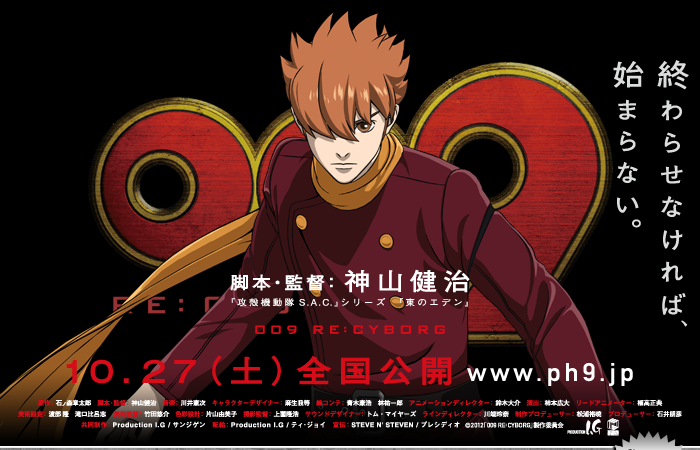
Cyborg 009 by Shotaro Ishinomori is one of the most widely read and well regarded manga series in Japan. It has been adapted as an anime movie and TV series several times, most recently in 2001 where it ran for fifty-one episodes. Although the manga dealt with some complex themes, most of these adaptations had leant decidedly to the family friendly with the team of nine cyborgs squaring off against various deadly enemies and saving the world week after week. For this new adaptation, however, director Kenji Kamiyama – the creator of Ghost in the Shell: Stand Alone Complex, Eden of the East and Moribito, famed for his willingness to engage mature, topical subject matter has decided to take the film back to the manga’s darker heart.
This is a world of mass destruction, sky scrapers fall, buildings explode, people run and scream yet it is normalised – this is the way of the world. Joe Shimamura is a bored high school student who feels as if he’s living his life in repetition. Recently he’s begun to hear a voice – His Voice that’s offering him a new purpose and a new path if he will only follow it. Follow it he must though what His Voice is asking him to do is something truly abhorrent. Thankfully, before he can accomplish the task he’s been charged with, a large Native American turns up and begins to beat the stuffing out of him seemingly with the guidance of a French woman giving instructions from an aircraft hovering above. Luckily for all concerned, Shimamura’s survival instincts kick back in and he remembers his true identity just in time to catch said French woman after she’s rather riskily jumped out of her plane. Shimamura isn’t a high school student at all, he’s the head of a nine cyborg crime fighting team and there’s something very wrong in the world. His Voice is reaching more and more people and convincing them to do awful things in His name – who is He, what does He want and how are they going to stop him?
It’s a truly international cast with each of the cyborgs representing a different nation – 001 Ivan (Russia), 002 Jet (America), 003 François (France), 004 Heinrich (Germany), 005 Geronimo (Native American), 006 Changku (China) 007 Great Britain (British), 008 Pyunma (Africa), 009 Joe Shimamura (Japan). Tellingly, Jet and Shimamura have had some kind of bust up prior to the action of the film and tension still lingers – is America behind these attacks? Why are the NSA so suspiciously present and why does it seem they’re so keen to scapegoat the cyborgs as a terrorist group? Can Jet still be trusted or has he become involved with this dark plot? If the team are going to succeed in figuring out just what is going on its going to need an awful lot of international cooperation.
A familiarity with the source material doesn’t feel a necessity whilst watching the film, however though those cognisant of Kamiyama’s typically complex themes may feel a lack of depth in some of the imagery used. Christian religious allusions abound with fossilised angels and biblical sounding pronouncements from our unknown assailant but the overarching mythology is never really addressed or explained in any significantly explicit manner. Despite this the dialogue sometimes leans towards clunkyness overloaded with the weight of complicated exposition. The lack of clarity in the cosmology at play may leave some scratching their heads as the film ends in its rather ambiguous fashion, few would deny though that it’s been fun getting there.
Alongside its cerebral offerings 009 Re: Cyborg also serves up its fair share of pedal to the floor action sequences. Making the most of its 3D production and accompanied by Kenji Kawai’s energetic score the film succeeds in providing some genuinely thrilling set pieces. The use of 3D here is truly inspired and provides a welcome level of depth and inclusivity which showcases the best use of the medium. Though it wears its 3D badge proudly, the animation has been rendered with a 2D, cel shaded look much favoured by Production I.G. in the past. It may look hand drawn but it has of course been created with computer technology – this has its benefits but more than a few costs. Though the look of the piece is striking, the computerisation is at times overly obvious and detracts from the otherwise traditional aesthetic. Characters sometimes move oddly or lack expression – which might be accounted for when concerning the cyborgs themselves but is less easy to explain away when it occurs with characters intended to appear 100% human. Still, these are minor problems and if one is able to adjust to the stylisation of the film they shouldn’t overly effect the enjoyment of it.
009 Re: Cyborg is not without its faults but it is still a very enjoyable experience. Its use of 3D, unusual visual style and innovative technology mark it out as essential viewing for anyone interested in the future of anime film making. Fans of Kamiyama’s previous work may feel short changed that the confined format of a feature film hasn’t allowed him free reign to fully explore his complex ideas yet what 009 has provided is the opportunity to showcase his talents as a director whilst crafting an entertaining and intelligent action extravaganza.

As the film begins, a bewildered young woman is being shown to her room by a strangely attentive hotel staff in what seems to be luxury Thai resort. She is there to visit her Thai boyfriend, recently returned from study abroad in America and now it seems the star of an upcoming motion picture. Ananda, born and bred in Thailand but brought up in an affluent, bilingual family converses with his girlfriend in English but with everyone else in Thai. He is obviously busy with film work and his girlfriend is largely left to her own devices in the otherwise entirely empty hotel. As time moves on the geographical shift seems to have exposed the cracks in the couple’s relationship – the crew complain about Americanisms creeping into Ananda’s on screen performance and his girlfriend soon gets bored of all the attention that goes with dating a film star. It soon becomes obvious that she’s in the way, a distraction and unwelcome intrusion of the outside into Ananda’s life in Thailand.
Soon after she returns home the film seems to jump on a few months and Ananda is now living in an apartment in Bangkok with a woman from the PR company. Although the couple seem happy, or at least happier, Ananda still seems restless – perhaps more so now that his film work is finished leaving him with little else to do. Evidently Ananda’s family were fairly wealthy – the apartment the two share is one of many in a previously luxury but ‘under renovation’ apartment block owned by Ananda’s often absent mother.
In telling episodes of symmetry, Ananda never really seems to fit in anywhere. Constantly at odds with himself he seems to be a Thai in Thailand and an American in America. Whilst filming he rejects his American girlfriend leaving her forced to alleviate her isolation by inviting herself to a hotel employee’s birthday party where she can’t communicate because she doesn’t speak Thai and the hotel employees only have basic English skills. Moving forward, where it seems Ananda might have become reconciled to his life in Thailand with May, a visit from his American university friends leaves May equally isolated and sidelined as Ananda parties American style with his college buddies. Whilst in ‘Thai’ mode, Ananda seems like a quiet, respectable and respectful young man but with his American friends he’s loud and energetic, youthful and extroverted.
It’s very clear there are two Anandas each in constant struggle with the other. A privileged upbringing rich in overseas influence and an extended period abroad have led to an intense feeling of disconnection with his native culture, yet once abroad Ananda is Thai and forever a foreigner. His inability to be more than one thing at once, to be a complete person at any one moment seems to be tearing his life apart. In unwatched moments he appears intensely melancholic, frustrated and more than a little lost. He drifts from one thing to another, not really doing anything or taking anything seriously enough to fully commit to it.
Hi-So, short for High Society – the slightly aimless world in which Ananda and many others like him are living, is a very interesting film about the crushing ennui of the modern, monied man. Though it touches briefly on the collective trauma of the tsunami and the country’s rapid economic growth, this is very much a film about one man’s cultural confusion and ultimately how it’s left him feeling even as an outsider to himself. Undoubtedly this is one of those films where some will say that nothing really happens and others will reply that’s because everything is happening but for those willing to look deep enough Hi-So is certainly worthy of attention.
 First of the Japan Foundation Touring Film Programme for this year up on UK-Anime.net. I’m going to do a general round-up later in the week but this was the best of the (impressive) bunch.
Kiwako has been having an affair with a married man who swears he’s going to leave his wife (just not right now) but now things have come to a head as she finds out she’s carrying his child. Despite her being desperately happy and excited about it – planning to call the child Kaoru and designing visions of the a domestic bliss, Kiwako’s married lover is decidedly less enthusiastic and persuades her to opt for a termination. However, complications from the procedure leave her unable to have any more children and she also begins being harassed by her lover’s wife who finally turns up on her doorstep one day, heavily pregnant, to taunt her – going so far as to remark that her ‘barren womb’ is a direct result of her immoral relations with her husband. One day Kiwako just snaps and in an act of madness abducts her lover’s newborn baby and raises the child as her own for four years until she is finally caught.
In the present day, Erina – who was Kaoru, raised by Kiwako for the first four years of her life, has grown up and is in college. She is deeply scarred by the traumatic events of her early childhood and seems to have difficulty with forming relationships with people, not that she seems to want to make any. After being returned to her birth parents she struggled to adapt to her new life and her birth parents struggled to come terms with everything that had happened. Now, as a young woman, Erina finds history begin to repeat itself in more ways than one and she’s forced to consider who she really is and what she wants out of life. In order to do that, she’ll finally have to confront her traumatic past and all of the complex questions and emotions that will inevitably arise.
In a Chalk Circle-esque way, Rebirth wants to ask a lot of questions about motherhood. Who is the mother of this child really? The woman who gave birth to it or the one who has cared for it all its life and who the child regards as its parent? It is obviously a terrible situation for all involved – the birth parents have lost their child, something truly awful, but the child now believes her abductor to be her mother and ‘returning’ her to a pair of ‘strangers’ she has no recollection of is beyond cruel. Being cruelly ripped away from everything she knew would be traumatic enough, let alone being dragged away from her ‘mother’ in a car park late at night and bundled into car by a harsh woman who tells her she’s being taken to her ‘mummy’ when her total understanding of that word is being handcuffed and taken away.
At only four years old you might think she’d be young enough to gradually ease back into her birth family, and you might be right had her natural parents been better equipt themselves to cope with the situation. Erina’s mother is very definitely of the ‘carry on as if nothing happened’ school so any allusion to the first four years of the girl’s life provokes a hysterical fit that only further exacerbates the confusion already ripping apart the poor child’s soul. So jealous is she that she’s effectively projecting all her resentment and bitterness towards Kiwako’s actions onto the child itself – as if she can’t forgive her for the crime of growing older or having spent so much time with the other woman. The child is a reminder of the trauma of its disappearance, of her husband’s infidelity, and subsequently of her own fear of not measuring up as a mother.
Izuru Narushima has crafted an intense and deeply layered character study that neatly sidesteps the risk of becoming as overblown or melodramatic as the plot description might sound. He approaches the subject matter with great sensitivity and with as even a hand as is humanly possible. His camera is incredibly non-judgemental and treats each of the characters with the same level of sympathy and understanding. Surprisingly, it is the birth parents that become the most difficult to sympathise with but even they are presented with a great deal of compassion.
Rebirth is certainly a very complex film that raises all sorts of uncomfortable moral questions from the nature of motherhood to the treatment of the women of society. If I had one criticism it would be that the male characters don’t come out of this well at all – which may be slightly unfair given the deliberate similarity between the two prominent male characters, but certainly the portrait it paints of masculinity is far from flattering. The performances are astounding, particularly those of Mao Inoue (probably still best known for Hana Yori Dango) as the damaged Erina and Hiromi Nagasaku as the desperately maternal Kiwako. Excellently shot and fantastically well conceived Rebirth is one of the best Japanese films of recent times.

Review up over at UK-A for the latest Kore-eda to fetch up on out shores. Well, actually, I reviewed this at the LFF in 2011 as well but I like to think I’ve come on as a writer since then (maybe not though, oh well, I still have a ways to go). If this is playing anywhere near you I very much urge you to go and see it even if just to show there is still an audience out there for seeing Asian films in the cinema. It’s a great movie though!
Mixed thoughts – it is a little long and has a few other problems here and there but I enjoyed it a lot.
Not as good as I’d been led to believe but an OK crime caper with TV production values. The subtitles were pretty awful but it encouraged me to turn them off for better Italian practice 🙂
Would have liked this a lot more if it hadn’t been for the ever present John Williams score. Excellent script, excellent performances and excellent filmmaking but somehow it falls on the slightly trite side for me.
Eureka’s new Blu Ray edition of the first collaboration between Von Sternberg and Dietrich. I’ve only watched the German version so far but this is an excellent transfer and of course the film is essential viewing. Tony Rayns’ commentary track is worth the price of admission alone!
Being a lover of screwball comedies and not having heard of this one I dutifully went down to the BFI during their screwball comedy season to give this a go. There was a reason I’d never heard of it – IT IS AWFUL. At one point the leads get sent to a concentration camp by mistake which is every bit as funny as it sounds. Accidentally offensive, totally not funny and with the least interesting romance ever committed to celluloid I feel it is my duty to strongly recommend you DO NOT EVER WATCH THIS FILM!
Watch Bringing Up Baby instead. It’s the funniest film ever made – that’s how you make a screwball comedy!
Another choice offering from Mubi, BFI’s recent restoration of the 1929 silent film. The credits included those for the new score but there was no sound at all when I streamed it so I watched totally silent. Excellent cinematography and an almost proto-noir atmosphere make this a very interesting late silent feature.
Weird film about a woman who gives birth to the clone of her recently deceased boyfriend and then continues to feel conflicted about it forever. Weird, just weird. Doesn’t really engage with any of the issues you might expect it to raise so obsessed is it with its own weirdness! It’s quite forgettable as a consequence.
 Windows on Worlds