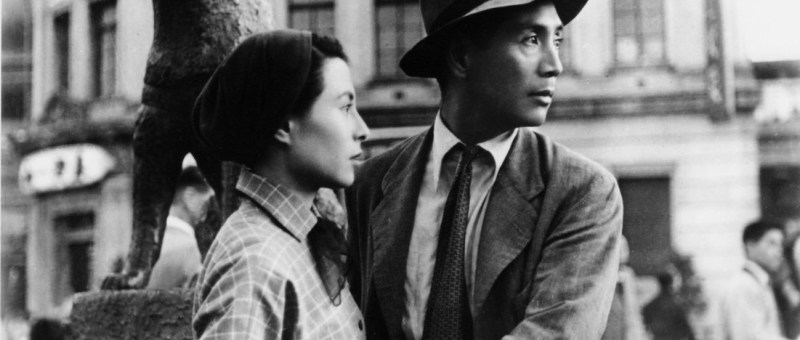
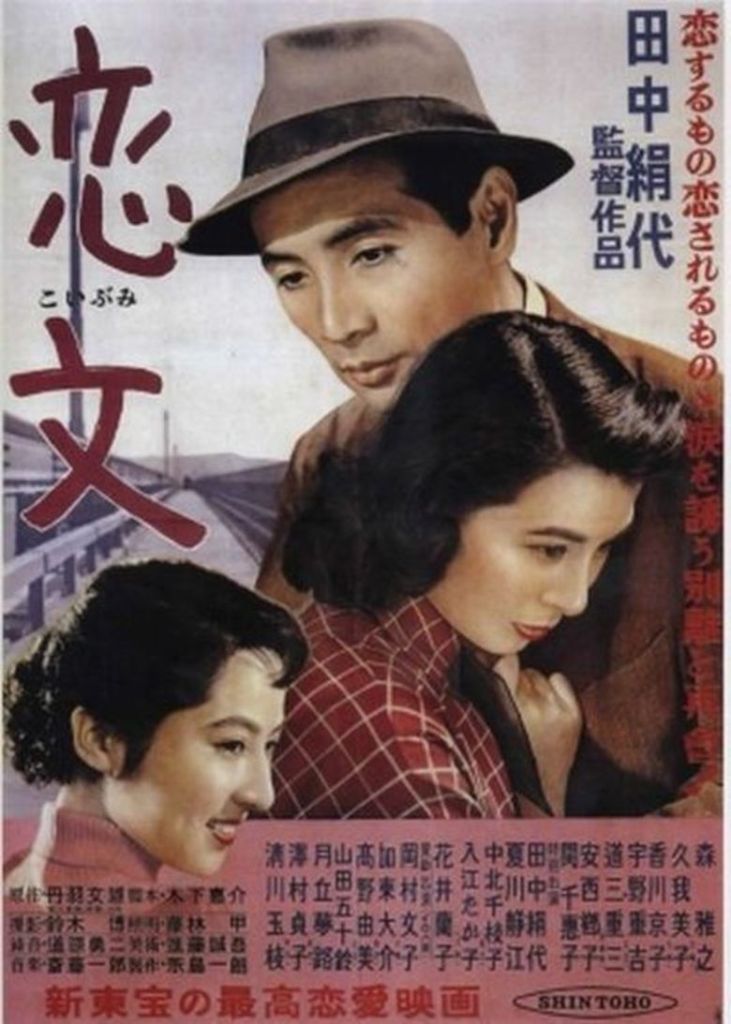
 Kinuyo Tanaka was one of the most successful actresses of the pre-war years well known for her work with celebrated director Kenji Mizoguchi including several of his most critically acclaimed works such as Sansho the Bailiff, Ugetsu, and The Life of Oharu. However, post-war Japan was a very different place and Tanaka had a different kind of ambition. With 1953’s Love Letter (恋文, Koibumi) she became Japan’s second ever female feature film director, though her working and personal relationship with Mizoguchi ended when he attempted to block her access to the Director’s Guild of Japan. No one quite knows why he did this and he tried to go back on it later but the damage was done, Tanaka never forgave him for this very public betrayal. Whatever Mizoguchi may have been thinking, he was very wrong indeed – Tanaka’s first venture behind the camera is an extraordinarily interesting one which is not only a technically solid production but actively seeks a new kind of Japanese cinema.
Based on the novel by Fumio Niwa and scripted by another of Tanaka’s frequent collaborators Keisuke Kinoshita, Love Letter takes place around 1950 just as the post-war chaos was beginning to settle down allowing individual trauma to come to the surface for the very first time. Our “hero” is Reikichi Mayumi (Masayuki Mori) – a melancholy naval veteran living with his brother Hiroshi (Juzo Dosan) and eking out a living as a translator of French literature. He spends his days hanging round train stations looking for a familiar face and constantly rereading a letter from his childhood sweetheart which informs him that, against her own wishes, she is shortly to be married to someone else. Michiko is apparently now a war widow, but despite his best efforts Reikichi has not been able to find her since being repatriated.
One day he runs into an old naval friend, Yamaji (Jukichi Uno), who has an interesting job. He drafts love letters in English and French from Japanese girls to the faithless foreigners who have abandoned them and returned home. Yamaji has developed an affection for some of these desperate women and tries to help them as much as he can with fatherly advice as he writes heartrending messages designed to get that guilt cash rolling back to Japan. Reikichi is not as well disposed the girls who he feels have sold themselves to the enemy but soon begins working there too. One fateful day, he hears a familiar voice.
Whereas you might expect this to be the end of a conventional movie, it’s only really the beginning. After a desperate chase to the train station Reikichi catches up with Michiko (Yoshiko Kuga) in a beautifully filmed, emotionally powerful scene which frames them both in a closing train door, momentarily eclipsed as it moves away. However, the elation soon fades as Reikichi’s rather backward thinking kicks in and he dwells on the reason Michiko was in the shop in the first place. After having longed for her, searching endlessly for five years, he can’t bring himself to accept this Michiko who he sees as “polluted” by her relations with an American soldier. He says some extremely cruel, and in fact unforgivable, things which Michiko accepts with a deeply internalised sense of guilt and shame. It looks as if the long awaited romantic reunion is not to take place after all.
Tanaka’s point of view is about as progressive as it was possible to be, but there is an ongoing conflict in the film in regards to its portrayal of the post-war “pan-pan” phenomenon. Great pains are taken to separate Michiko from the ranks of other desperate women who found themselves reliant on the occupying forces for their survival. Michiko became the mistress of an American man, bearing and losing his child, and though she wonders herself if it makes a difference that it was one American man and not several, the film definitely thinks it does. Later on she meets a group of women who are more obviously prostitutes and former friends whom she tries to avoid but the attitude to these women is far less sympathetic. At once we’re told that we shouldn’t judge Michiko for having done what she needed to do to survive, but we are being invited to judge these other women, all the while being reminded that Michiko is not like them.
Reikichi, however, is firmly painted as being in the wrong especially when compared to his cheerfully pragmatic brother and down to earth friend. Everybody tells him he’s being unreasonable and attempting to punish himself by also punishing Michiko for a series of things that are no one’s fault, but Reikichi persists in his oddly romanticised, absolutist way of thinking. It is he who will need to change, become less rigid and more empathetic but there is still the idea that Michiko’s past is something to be “forgiven”, and therefore a pre-determined view that she has acted in a morally incorrect way and is paying for it now.
Interestingly, Tanaka undermines the film’s inherently melodramatic quality by choosing to end on a note of ambiguous anxiety. A decision seems to have been reached, yet it is a tentative one and there will be difficulties along the way. This is new and different world, filled with broken and damaged people. A better one is possible but won’t happen with a heartfelt apology over a hospital bed, it will require a long process of mutual understanding and empathy though the wounds themselves may never be entirely healed. Tanaka’s debut is a daring wonder filmed with true visual flair and an unusual degree of assuredness. A sympathetic look at the bubbling trauma of the post-war environment, Love Letter approaches its subjects with extreme sensitivity and the hope that love and forgiveness are possible, but they will require hard work and a willingness to embrace them.
The first Japanese feature film to be directed by a woman was completed by Tazuko Sakane in 1936. Mizoguchi actually gave her a start in the industry and she was able to keep working during in the war by making documentaries as part of the Manchurian Film Association. Once the war ended she was barred from further directorial opportunites because she didn’t have a university degree and returned to continuity and editing roles at Shochiku until she retired in 1962, never making another feature film. Kinuyo Tanaka was a little luckier in this regard and was able to make a few more features becoming the first woman able to have a career in film directing through she also continued acting in other people’s films and on television until the 1970s.
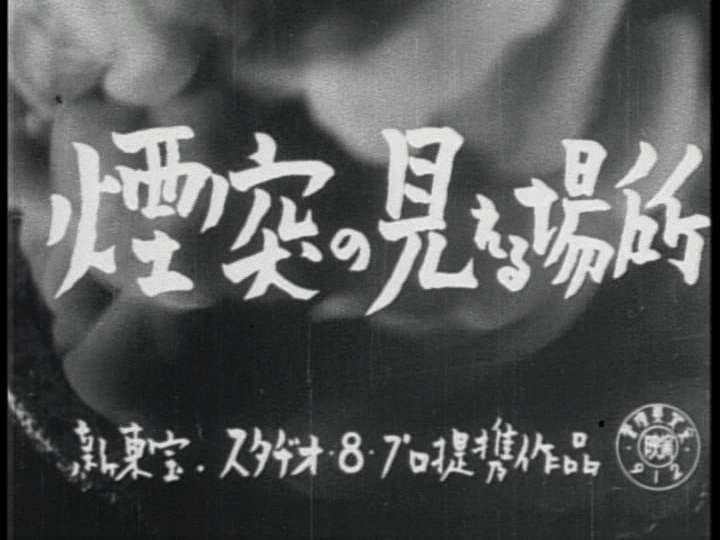 Where Chimneys are Seen (煙突の見える場所, Entotsu no Mieru Basho) is widely regarded as on of the most important films of the immediate post-war era, yet it remains little seen outside of Japan and very little of the work of its director, Heinosuke Gosho, has ever been released in English speaking territories. Like much of Gosho’s filmography, Where Chimneys are Seen devotes itself to exploring the everyday lives of ordinary people, in this case a married couple and their two upstairs lodgers each trying to survive in precarious economic circumstances whilst also coming to terms with the traumatic recent past.
 A Japanese tragedy, or the tragedy of Japan? In Kinoshita’s mind, there was no greater tragedy than the war itself though perhaps what came after was little better. Made only eight years after Japan’s defeat, Keisuke Kinoshita’s 1953 film A Japanese Tragedy (日本の悲劇, Nihon no Higeki) is the story of a woman who sacrificed everything it was possible to sacrifice to keep her children safe, well fed and to invest some kind of hope in a better future for them. However, when you’ve had to go to such lengths to merely to stay alive, you may find that afterwards there’s only shame and recrimination from those who ought to be most grateful.
