Ghost Man (幽霊男, Motoyoshi Oda, 1954)

Employees at a small nude modelling agency find themselves in the firing line when a “bloodsucking painter” escapes from a psychiatric institution in Motoyoshi Oda’s adaptation of Seishi Yokomizo’s Ghost Man (幽霊男, Yurei Otoko). Though produced by Toho and helmed by the director of The Invisible Man, the film does not particularly make use of special effects and as it turns out, Ghost Man is just a creepy name for a weird villain rather than an accurate description of a supernatural threat. 

Even so, you’d expect someone who runs a modelling agency to be on high alert after hearing that a crazed painter who is a danger to women is on the loose, but the manager of the Mutual Art Club simply assumes it must be an eccentric artist thing when he’s presented with a business card from “Ghost Man” Sugawa. Ghost Man is dressed in an unsettling outfit and is immediately rough with the model he picks out, Keiko, all of which you would think would have the manager thinking twice about allowing her to go with him. Some of the other girls urge her to turn the job down, but Keiko is the breadwinner for her family and work has been thin on the ground so she agrees to take it only to realise Ghost Man does indeed intend to kill her on arrival at an abandoned house way out in the country. 

“What a single woman has to do to earn a living, it’s both thrilling…and terrifying,” one of the other women, Ayuko, tells her boyfriend Ken (Yu Fujiki) after she quits the agency to become a stripper and decides to take to the stage despite knowing that Ghost Man may try to kill her during the show. Her words hint at a transgressive frisson of danger which she at least has chosen to embrace, an icy glint in her eye as she encourages Ken to pay close attention to her performance which she claims will be “wonderful”. Nevertheless, it also makes clear that the work the women do at the agency is necessarily unsafe given that it involves travelling to the home of a man they don’t know where they will be expected to undress. 

For reasons the film doesn’t quite explain, the models are also members of the “Bizarro Enthusiast Club” led by Dr. Kano (Joji Oka) who is the head doctor at the psychiatric hospital from which the bloodsucking painter, Tsumura (Ren Yamamoto), escaped. Meanwhile, Dr. Kano also seems to have a sideline in taking the girls to remote locations for nude photoshoot parties. In all honesty, he’s quite suspicious especially seeing as he seems to instinctively know how to open the tricky door at the abandoned house where Keiko’s body is found. Then again, we’re also told that Tsumura was once a member of the club with at least some suggesting that he ended up getting too into the bizarre and going out of his mind to the extent that he began committing weird acts of crime of his own. 

The lesson might be that getting overly obsessed with the occult and esoteric is unhealthy, only it turns there’s something else going on entirely that isn’t really about anything “weird” but caused by completely banal negative human emotions resulting from spurned romantic interest and the fear of parental disappointment. This being a Kindaichi mystery, the famous detective soon makes his appearance (played by a hardboiled Seizaburo Kawazu) only in a less eccentric guise and accompanied by a more efficient Todoroki who assists him as he begins to put the pieces together to solve the mystery. 

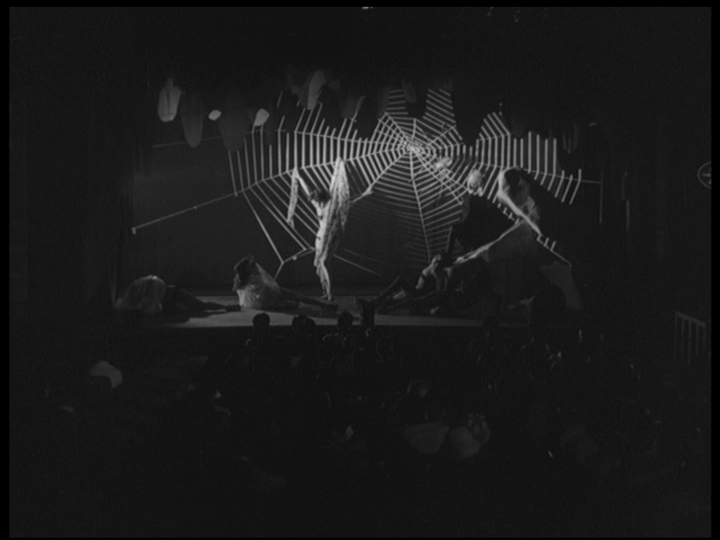
The villain may be taking advantage of a historical moment in allowing others to think his face is bandaged to disguise a disfigurement like those of many men wounded in the war, as was the case in another Kindaichi case The Inugami Family, but is also harking back to the Invisible Man while his accomplice adopts a much more “monstrous” appearance with buck teeth and the two missing fingers on his hand along with the insectile movements that play into the spider-themed finale. Oda has a lot of fun with the villain’s Phantom of the Opera-esque antics which include recording a tape to taunt the police along with a public announcement of “Act 3” of his ongoing drama to be staged at the “Reijin Theatre” which literally means “the beautiful lady show” but is also a minor pun that makes it sound a little “Ghost Man Theatre” in true B-movie villain fashion. Even so, there’s an underlying darkness in the serial killer drama most particularly in the scrapbook the villain makes with photos of the dead women posed and titled as works of art as if they were never any more alive than the mannequins he often substitutes for them. Striking in its set pieces and unsettling design, Oda’s strange drama is surprisingly nasty and actually quite cynical even as it unmasks its villain as little more than a ghost of man who hid behind the spectre of unease to mask his cowardice and insecurity.


Late Chrysanthemums (晩菊, Mikio Naruse, 1954)

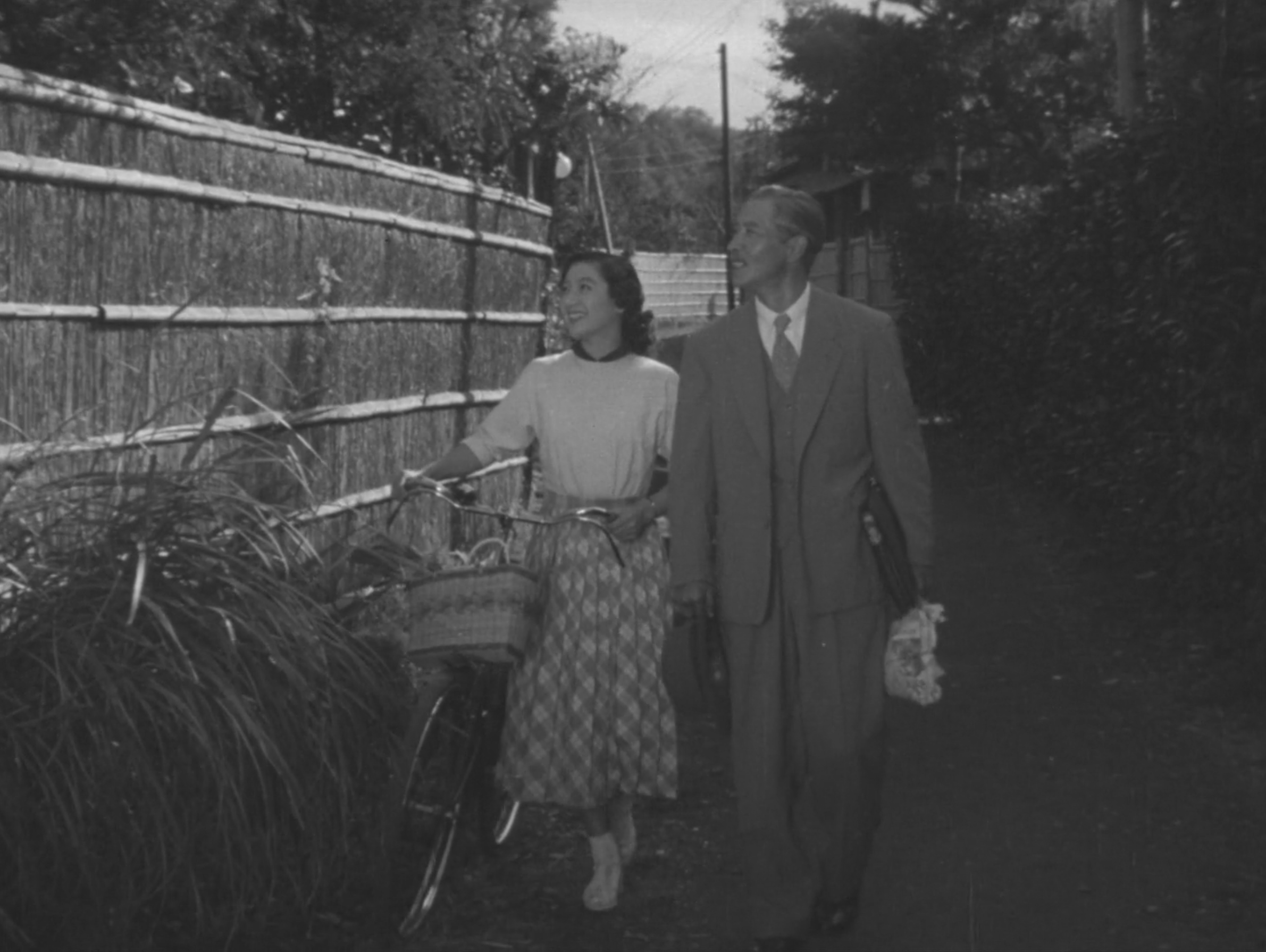
The post-war economy was difficult for most, though by the mid-1950s the situation was perhaps improving. The four former geishas at the centre of Naruse’s Late Chrysanthemums (晩菊, Bangiku) , adapted once again from a series of stories by Fumiko Hayashi, are all in their way attempting to find a way through to the modern society but are nevertheless stuck in the past, unable to move forward as women more or less left behind by a changing idea of “modernity” which no longer has a place for them. 

The most successful of the women, Kin (Haruko Sugimura), has become a ruthless moneylender engaging in real estate speculation. As the film opens she’s waiting for the arrival of a business associate for a meeting about a house she’s trying to flip, clear that they’ll need to kick out the desperate widow who is currently living there. Kin has lent money to her old “friends” with whom she spent her youth as a geisha before the war. Otamae (Chikako Hosokawa) and Otomi (Yuko Mochizuki) are widows with unfilial children, Otamae now working as a maid in a love hotel while her son Kiyoshi (Hiroshi Koizumi) struggles to find a job, and Otomi a washerwoman selling blackmarket cigarettes as a sideline while her daughter Sachiko (Ineko Arima) is a forthright modern woman who refuses to enable her mother’s irresponsible vices. Nobu (Sadako Sawamura), meanwhile, married late to a man from outside of Japan and has opened a small bar where she hopes to start a family, brushing off Kin’s insensitive insistence that she is already too old to bear a child. 

Kin has prospered and become wealthy, but she’s done so largely at the sacrifice of maternity. She disparages the other women, telling them she’s grateful not to have had children because not even they can be depended upon, but is also embittered that she’s missed out on life and love, substituting material wealth for emotional fulfilment. Otomi and Otamae have problems with their children and regrets about their lives, but they both resent Kin for her heartless rationality. Kin is in a sense supporting them with her money, even if she wants it back with interest, and continues to see herself as doing a favour for women she considers friends, hurt that they often run or hide when they see her coming but insisting that she is only trying to survive while implying that the other women have failed to achieve the self-sufficiency she has achieved because they’ve lived irresponsibly by placing their trust in men and frittering their money away on the temporary pleasures of drink and gambling. 

Otomi’s thoroughly modern daughter Sachiko thinks something much the same. When Otomi approaches her for a loan, she says no, fearing that her mother has another lover she will end up subsidising or that she will spend it all on drink and pachinko. Sachiko does, however, offer to buy her mother dinner which at least ensures she will get a good meal. Sachiko’s shock news is that she plans to marry an older man, though he seems not to be particularly wealthy seeing as she later sarcastically asks Kin to buy her a house because they’ll be living with other tenants in a small flat. Otomi objects, not only because Sachiko hasn’t mentioned any of this to her before, but because she thinks Sachiko is being overly practical and gives her some surprisingly transgressive advice to the effect that she should have her fun with various men while she’s young so she’ll be able to figure out which is the best to spend a life with. Sachiko quite reasonably asks how that worked out for her, to which Otomi obviously has no answer and leaves the restaurant feeling dejected enough to ask Kin for the money she was after instead. 

Otamae’s problem is of the opposite order. Her son Kiyoshi cheerfully rolls home in the morning after staying out all night and tells her he’s become a kind of gigalo, dating a slightly older woman who is technically the kept mistress of another man. The situation is ironic in the extreme, but despite her own past as a geisha, Otamae doesn’t like it that her son is engaging in a compensated relationship, while he suggests that perhaps she messed him up by making him refer to her as his sister in public. Eventually Kiyoshi is offered a job in a mine in Hokkaido, salmoning the post-war migratory movement and leaving his mother (as well as the mistress) behind to fuel the economic recovery from the provinces. 

Otomi and Otamae have only each other to rely on, men and children have all proved undependable. Kin, the most fiercely independent, is literally haunted by the spectre of failed romance. Nobu, snaps that Kin made her money by swindling her clients, which might be why she takes the side of Seki (Bontaro Miake), a man who tried to commit double suicide with Kin but survived and was ruined. Kin sees it differently. Seki tried to kill her when she refused to die with him, so understandably she is not keen to reconnect. Nobu advises him to visit her and ask for money as “compensation”, which whichever way you look at it is crass and troubling, that Kin is expected to compensate a man for his ruined prospects caused by his obsessive romantic violence towards her which she claims has put her off men for life. Nevertheless, she continues to meditate on the memory of Tabe (Ken Uehara) whom she loved when he was a student, even visiting him in his Hiroshima barracks after he was drafted. She is thrilled to receive a letter from her first love, but declares herself disappointed minutes after he arrives for a visit. Tabe is just another failed salaryman who thinks women like her have it easy and harps on about how looking at his “old” wife makes him nostalgic for the women he loved in his youth. Like everyone else, he’s after her money. Kin burns the photo of him in uniform and gives up any lingering dream she might have had of romantic fulfilment. 

The women find themselves trapped by conflicting visions of “modernity” which are wildly different from those of their youth. They miss their “carefree” lives as geishas, now perhaps somewhat romanticised, along with the misplaced idealism of their time of Manchuria, while lamenting that as single older women they cannot be anything other than dependent. Only Kin is able to achieve self-sufficiency, but does so effectively as the film suggests at the cost of her “femininity”, becoming hard and cold, ruthlessly practical but not perhaps uncaring even as she continues to subsidise the only “friends” she has perhaps in the knowledge that they fiercely resent her. Yet their lives continue. Nobu runs her bar, Otomi and Otamae send their children off with grudging respect while vowing to follow their examples, and Kin, after a moment of crisis, ventures off towards new prospects. For good or ill they shift towards the modern world, more understanding of its rhythms and their place within it than before, but perhaps no more secure.


Sound of the Mountain (山の音, Mikio Naruse, 1954)

“All I can do for you now is set you free”, a failed father laments. Mikio Naruse is renowned as a pessimist according to whom we are always betrayed by the world in which we live, yet bleak as it sometimes is 1954’s Sound of the Mountain (山の音, Yama no Oto) offers us what in Narusean terms at least might be considered a happy ending. Adapting a novel by Yasunari Kawabata, Naruse and his screenwriter Yoko Mizuki stop their story a little before the original’s conclusion offering an “open prospect” in which the chastened patriarch is forced into retreat, setting the young ones free while reflecting on paternal failures both national and personal. 

Now in late middle age, CEO Shingo (So Yamamura) is beginning to notice things he perhaps hadn’t before or had merely brushed aside such as the various ways the women around him continue to suffer because of inherently unfair patriarchal social codes. He dotes on his cheerful daughter-in-law Kikuko (Setsuko Hara) but is also aware his son/employee Shuichi (Ken Uehara) is having an affair. Confronted, Shuichi pledges to end the relationship but asks his father if he has honestly remained faithful all his life. Shingo doesn’t exactly deny anything, but remarks that it justifies nothing and his son ought to know better. 

According to Shingo, a man’s success is affirmed if he lives out his life unharmed but one’s success as a parent depends solely on that of the marriages of one’s children and on that front at least Shingo appears to be a failure. Shuichi offers barbed comments about his wife that sound like jokes but clearly aren’t, responding to query as to why they have no children with an excuse that his wife is a child herself, Kikuko’s face contorting momentarily in pain and shame at her husband’s cutting remark yet the only sign of childishness that we see in her is oft remarked cheerfulness. The Ogata household is currently down a maid and it’s Kikuko who’s been picking up the slack as perhaps a daughter-in-law is expected to do, taking care of the household and ensuring her in-laws are well cared for. Ironically enough, the Ogatas love her like a daughter, in part because of her ability to conform to what is expected of a wife despite their son’s indifference, though Shingo is perhaps learning to see past Kikuko’s placid expression, so like the impassive noh mask passed to him by a deceased friend, in the brief flickers of her discomfort. The old couple discuss a double suicide of a couple their age who have decided to leave quietly of their own volition with bleak humour, a look of such total and abject despair passing over Kikuko’s face as she replies to Shingo’s question if she too would write a note if she planned to die with her husband that she might leave one for him. 

The ill-defined relationship between Kikuko and her father-in-law is in essence paternal but profoundly felt, founded on a shared sense of connection and a deep respect. It stands in contrast, however, to that with his own daughter, Fusako (Chieko Nakakita), who returns home to her parents having discovered that her husband is also having an affair. In a sense, this reaction is a facet of post-war freedom, Shingo’s wife Yasuko (Teruko Nagaoka) may suspect her husband had other women but would have pretended not to and in any case would never leave an otherwise successful marriage over such a “trivial” matter. Fusako, meanwhile, has the freedom to demand better and to leave if she doesn’t get it but continues to hesitate blaming her father’s indifference towards her for her husband’s lack of respect something which she believes also fed into his poor choice of match. 

Cheerful, stoical Kikuko meanwhile finds herself caught between tradition and modernity unhappy in her marriage but uncertain if she has the right to escape it. Despite his parents’ niceness, Shuichi has grown into a cruel and selfish man, running down his wife and neglecting his work to romance his father’s secretary, who is not the mistress (not that she wouldn’t like to be), and apparently a violent drunk who routinely beats his girlfriend, a war widow and independent woman who sees nothing wrong in dating a married man because his wife is only waiting for one certain to return. Mirroring Kikuko, Kinuko (Rieko Sumi) is also pregnant but transgressively plans to have the child and raise it alone (supported by her friend and roommate). Telling no one, Kikuko learns that she is expecting but unilaterally opts for an abortion telling her husband that she cannot in good conscience give birth to his child knowing the kind of man he is. Confronting Shuichi, Shingo describes it as a kind of suicide and he is at least right in that she kills the image of herself as the good wife but does so by choosing her own integrity, seizing her agency in rejecting a dissatisfying present to seek a happier future. 

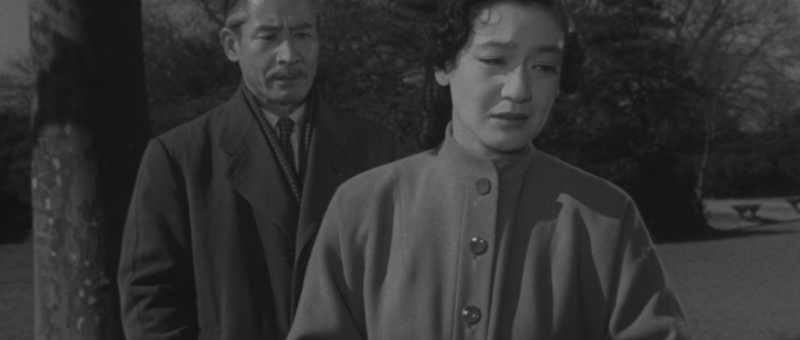
By contrast, we get the impression that Fusako, who has two children already, will likely return to her husband. Shuichi has the talk with his brother-in-law his mother hoped he would, but bonds with him in male solidarity, excusing his affair while advancing that Fusako doesn’t understand that he is merely working hard for their family laying bare a fundamental disconnect in the thinking of men and women further borne out by Yasuko’s assertion that men and women deal with sorrow differently. It’s this series of disconnects, between men and women, parents and children, that Shingo is beginning to bridge only to be confronted with his own patriarchal failures. While he and his wife are seemingly happy enough, he brushing off her self-deprecating remark that he was “unlucky” in marrying her only because her prettier sister died, his children’s marriages have each failed. His failure stands in for that of his generation, realising that he all he can do for them now is set them free. Meeting Kikuko in a park with wide open vistas, oddly like the final meeting of doomed lovers aware they must now part, Shingo vows retreat, planning to retire and move to the country with his wife as if liberating the youth of Japan from the oppressive social codes of the past in ceding the “open prospects” of the post-war society to his surrogate daughter in order that she might at least seize her freedom to chase her own happiness. 


Seven Samurai (七人の侍, Akira Kurosawa, 1954)

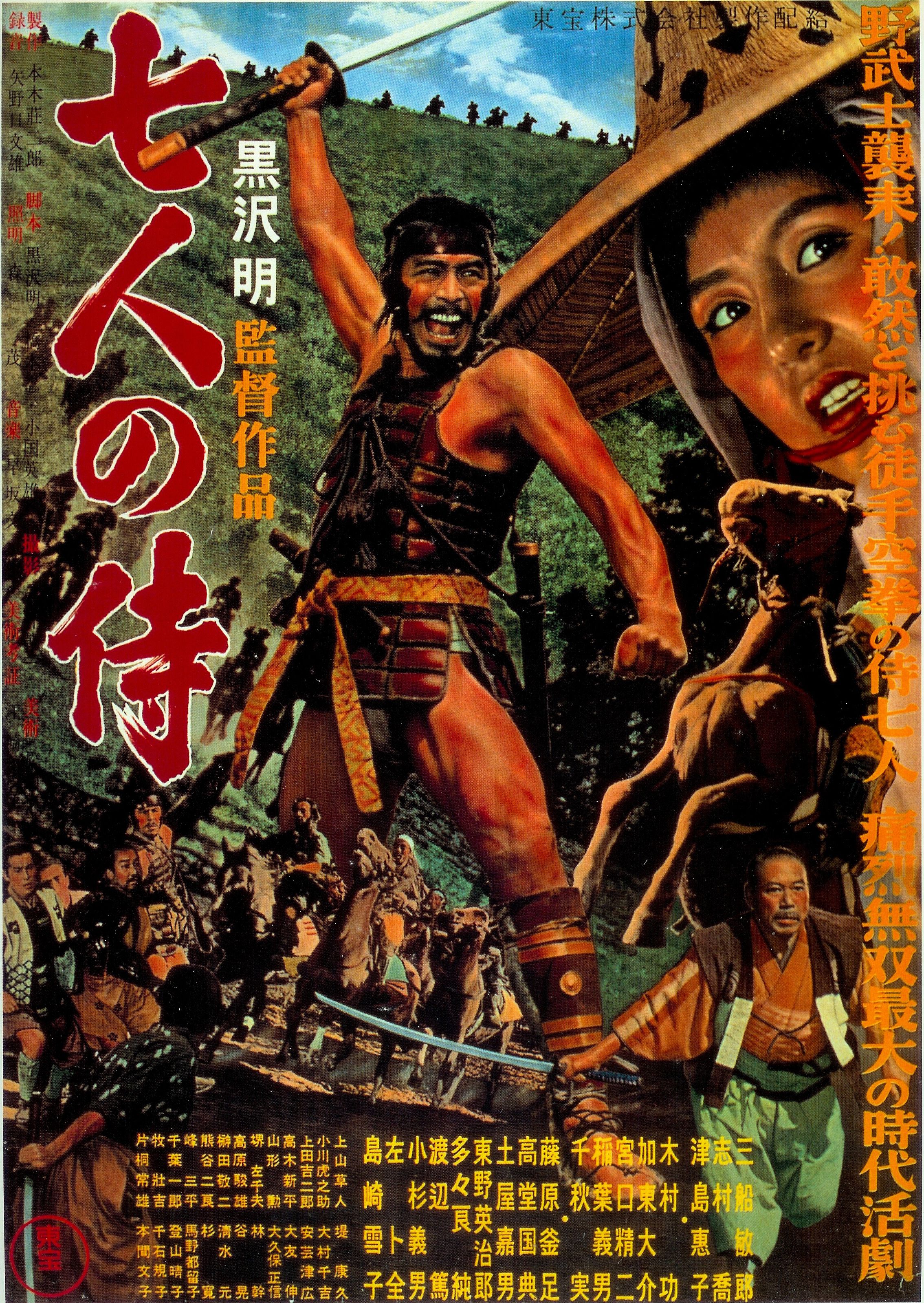
An eclipse of the accepted order allows a temporary truce in the ongoing class conflict that defines feudal society in Akira Kurosawa’s seminal post-war historical epic, Seven Samurai (七人の侍, Shichinin no Samurai). Set in the late 16th century, the action takes place in a world on the brink of collapse. The Sengoku era is drawing to a close but is also in a moment of intense crisis which has left large numbers of highly skilled warriors essentially orphaned, wandering the land torn between their basic needs for food and shelter and their dignity as members of a theoretic aristocracy. 

Plagued by bandits, many of whom may be these orphaned swordsmen, a small village contemplates the unthinkable in hiring samurai, otherwise their oppressors and uniquely responsible for the chaos which surrounds them, for protection. “Land tax, forced labour, drought…and now bandits!” one woman exclaims shortly before suggesting they simply surrender all their grain and then hang themselves. As they can offer only expenses in the form of rice, the only samurai they can hope to recruit are already desperate, so hungry that they may be willing to deign to defending their social inferiors with whom they would not usually mix unwilling to accept that they are both victims of the inherently corrupt social order. This explains why the villagers’ early entreaties are met with such scorn and cynicism, either rudely rejected out of hand or ending only in deception. 

In this there is an echo of the world of 1954 which was beginning edge away from the chaos and privation of the immediate post-war society, bandits standing in for thieves and profiteers themselves a product of intense food insecurity. Yet here it’s desperation that allows a temporary merging of the world of lord and peasant, brokered finally by unexpected compassion on the part of a noble samurai who, in an act of extreme transgression, symbolically erases his elite status by shaving his head in order to save a child taken as a hostage by another desperate man. Kambei (Takashi Shimura) may be somewhat reduced in circumstances but refuses to give in to the immorality of the world around him, finally agreeing to help the villagers essentially out of a sense of pity willing to accept only the gift of sustenance moved by the villagers’ sacrifice in discovering that they give him the last of their white rice while subsisting only on millet. 

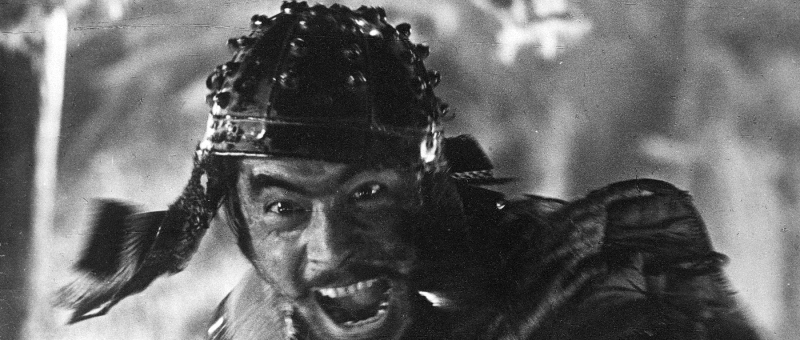
Yet having taken this step, the villagers remain uncertain they can really trust the men they’ve hired to protect them who are after all each trained in death. Later we discover that they have, like many of the time, occasionally finished off the odd lone samurai fleeing the battlefield in order to loot the bodies as a large stockpile of samurai armour later discovered by the samurai-pretender Kikuchiyo (Toshiro Mifune) testifies. On being confronted with this uncomfortable reality, the samurai fall silent knowing this armour was stripped from men much like themselves, but can ultimately offer little by way of defence when presented with an angry rant from Kikuchiyo who points out that they are themselves responsible in having created this world of chaos through their internecine quests for power. “In war you burn their villages, trample their fields, steal their food, work them like slaves, rape their women, and kill ‘em if they resist. What to you expect ‘em to do?”

When Kambei and the others first arrive in the village, there is no welcoming committee. The villagers all hide, frightened to leave their homes partly because of paranoia spread by widowed father Manzo (Kamatari Fujiwara) convinced that randy samurai are going ravish all of their daughters who will, doubtless, be overcome with awe by these sophisticated men of the elite. In an echo of Kambei’s transgression, Manzo forces something similar on his teenage daughter Shino (Keiko Tsushima), roughly cutting her hair while she cries and resists before dressing her up as a boy so that she’ll be safe from lusty samurai. The plan, however, backfires in that she later engages in a doomed romance with the young Katsuhiro (Isao Kimura). Their eventual union is the symbolic merging of the two worlds, a moment of eclipse in the usual hierarchy, but it’s born of the same impulses than brought Kambei and the others to the village. In fear and desperation, they behave as if there’s no tomorrow, only tomorrow must come and just as sun and moon must eventually move apart and resume their regular orbits so the relationship between Katsuhiro and Shino is an impossibility. 

Like Kambei, Katsuhiro had occupied a slightly liminal position because of his relative youth, neither boy nor man. He first encounters Shino while marvelling at the natural beauty of the forest, only to berate her for doing the same. “Is this any time for an able-bodied man to be picking flowers?”, he ironically asks her, yet he is repeatedly forced back towards conventional masculinity as marker of adulthood virtually ignoring her when tasked with carrying a dummy to the ridge, while she later returns the same gesture reassuming her femininity in joining the rice planting, a peasant woman once again. “What’s wrong with two people in love?” the wounded Rikichi (Yoshio Tsuchiya) asks Manzo, trying to smooth over this moment of cross-class crisis, only for Monzo to ask what he’s supposed to now his only daughter has become “damaged goods”, unfit for marriage in a fiercely patriarchal society in which it is impossible to survive without a husband. 

Katsuhiro cannot marry her, this sense of solidarity if not quite equality can be only temporary. Kambei himself admits as much as he reflects that the battle has been won but the victory belongs not to them but to the peasants, anticipating his a sense his own obsolescence the end of the Sengoku era bringing about a change in the nature of the samurai that two centuries later will lead to its abolition. Our sympathies might shift, witnessing Kambei’s obvious disapproval of the peasants’ relish in taking revenge on the bandits who have caused them so much misery in their own way perhaps perpetuating the cycle of violence and resentment that drives the feudal engine. One cannot help but pity him, displaced once again returning to a life of ceaseless wandering, his presence in the village now no longer necessary and in fact inappropriate. 

Returning to the world of 1954, there might be something a little uncomfortable in this lament for the death of the samurai who can have no place either in the modern society or in a peasant village in 1587, as there may be in the implication that the peasants are savage and vindictive while Kambei alone is good and kind even if the roots of his compassion lie in his willingness to literally sever himself from his elite status. The roles had in a sense been reversed, the samurai hired hands to peasant bosses, but the inversion can be only temporary. In insisting that only by protecting others can one hope to protect oneself, Kambei may be advocating for a more compassionate society but as much as he has attempted to remove himself from the class system he can not in the end overcome it. Nevertheless, in the gruelling battle scene that closes the film, all rain, mud, death and misery, Kurosawa himself deals the final blow to the samurai in the nihilistic futility of violence manifesting itself once again in the lingering feudalism of the mid-century society. 


Seven Samurai is re-released in UK cinemas in its recent 4K restoration as part of BFI Japan on 29th October.

BFI re-release trailer (English subtitles)

An Inn at Osaka (大阪の宿, Heinosuke Gosho, 1954)

inn at osaka cap 2Heinosuke Gosho may be most closely associated with the Chekhovian interplay between laughter and tears, but what are you to do when life is so unutterably miserable that levity seems almost offensive? By 1954, many might have assumed that society was on the way to recovery, that the promises of the new democracy so proudly affirmed in the post-war constitution would be available to all paving the way for a freer and fairer society. Of course, that wasn’t quite the case and many found themselves trapped on the periphery of the burgeoning economic miracle in which unemployment was high and the bitterness of the times had led many to believe that human decency was a luxury they couldn’t afford.

Made a year after his renowned masterpiece Where Chimneys are Seen, An Inn at Osaka (大阪の宿, Osaka no Yado) is a much less cheerful affair in which suicide and degradation linger permanently on the horizon. The hero, Mita (Shuji Sano), has been exiled from Tokyo, demoted to the Osaka office after slapping his boss in argument over immoral business practices. Much reduced in circumstances, he has been unable to find a lodging house that suits his budget, the local barman lamenting that these days most of the hotels in the area have been co-opted by sex workers. Just at that moment, a dishevelled old man pops up and says he knows of a good place where the rent is reasonable and the innkeeper kind. As you might expect, it turns out that he works there. The innkeeper is his sister and though she is not particularly nice, the place is warm and friendly with three kindly maids – Orika (Mitsuko Mito) who is constantly pressed for money by her no-good husband, Otsugi (Hiroko Kawasaki) who is forced to live apart from her son, and “modern girl” Oyone (Sachiko Hidari) who is much younger and having a fling with the inn’s other longterm resident, Noro (Jun Tatara), a sleazy gentleman who likes to throw his weight around because he co-signed the loan on the hotel.

In one sense, the city of Osaka itself is being painted as a “fall” from sophisticated Tokyo, an earthier place where people do what they have to to survive. This Mita learns to his cost when drunken geisha Uwabami (Nobuko Otowa) picks up his “luxury English-made blanket” and peels off a thread which she burns to expose its smell. Wilier than the innocent Mita she tells him he’s been had, lamenting that it’s “Osaka’s shame” that they wilfully trick people from Tokyo. Mita is irritated, slightly hurt and embarrassed to have been deceived, but affirms that it hasn’t damaged his views on Osaka because in the present society everyone is being cheated by someone somewhere. In any case, he allows himself to be bamboozled by the innkeeper’s brother (Kamatari Fujiwara) into tracking down the teenage girl who sold it to him, Omitsu (Kyoko Anzai), who seems upset, explaining that she bought the blanket in good faith and has been tricked herself. During their visit, Mita notices that they’re in the middle of some sort of shamanistic ritual over the sickbed of her ailing father and feels pity for her but stops short of cancelling the debt there and then.

Not cancelling the debt even though he can see Omitsu never meant to trick him and cannot afford to pay him back, is part of his rather sanctimonious rebellion against the immoralities of the post-war society. He feels wronged and thinks that getting the money back for the blanket will somehow put things right, but like many of his attempts to help those in need it eventually backfires. Mita is a good man, compassionate and honest, but he’s also disappointingly conservative in ways he hasn’t quite realised. Uwabami, who has fallen in love with him, later chides Mita that he is like a star looking down on everything from above. He doesn’t quite understand what she means, failing to grasp that what she’s telling him is that though she can see that he cares, he has a tendency to view himself as somehow “better” than the world around him and lives in silent judgement of those he believes to be fundamentally different from himself.

After a brief argument, Uwabami confesses that she feels trapped and miserable in her impossible geisha existence, just trying to make enough money to survive when too old to ply her trade. She can’t quit because she’s responsible for her whole family – her younger brother has just been laid off from his railway job and his children will go hungry without her money. She provokes Mita a little, chastising him for not caring about her on a human level only for Mita to counter that he likes her but they live in “different worlds”. Disappointed, she laments that she thought they were the same, realising that Mita’s conception of the world is defined by ideas of middle-class respectability and that he views her as occupying a lower order, forever walled off from “decent” people like himself. Though he treats her warmly and regards her as a friend, there can never be anything more between them than that.

Omitsu later shows him something similar. Having scraped together some of the money to pay him back, she arrives at the inn only for Mita to try to refuse it. Otsugi offers her some sewing work for Noro who later takes advantage of her, gossiping with the maids that she was a “bargain”. To make matters worse, Omitsu gets caught on the way out and is berated by the innkeeper for bringing the hotel into disrepute. Mita starts to feel guilty. This is, after all, largely his fault – he pushed her about the blanket out of pettiness and brought her to the inn where she has debased herself to get back the money he took from her. He tries to return it but it’s already too late. “Why do you always insist on being good?” she asks him, partly offended that he won’t take her money because he now thinks it’s tainted by immorality. “I just want to trust in people” he tells her, beginning to realise that his well-meaning gesture is both patronising and futile because if he’d really cared about helping Omitsu, he could have done it before.

Mita is good person, but like everyone else he’s flawed and human. He genuinely wants to help, for the world to be better than it is, but in his goodness allows himself to be self-involved and insensitive. The reason he didn’t get fired from his job even for so great a transgression as slapping the boss, is that his grandfather founded the company. In an effort to break with the past, he decides to sell his grandfather’s expensive French pocket watch, but retains the chain as if unable to definitively sever the connection to his privilege. To prove that he’s done it for symbolic and not financial reasons, he spends the money taking Otsugi and Orika on a day trip to Osaka castle after Orika declines his offer of money of which she is in desperate need.

“Money’s everything, what happened to humanity?” Mita asks himself, still not quite aware of his position within the system. Mita refuses to conform to the demands of the post-war era as exemplified by his boorish boss who sneeringly asks if he’s a “socialist” while dismissing him as an “intellectual” and doing illicit backroom deals to get ahead, but he does so largely passively and with little more than resentment. At his farewell dinner, he reflects that had he not come to Osaka he might have quit his job but now he’s determined to stay and try to make things better. There might be something a little sanctimonious in his new found fire born of living among the poor now he’s on his way back to Tokyo, but he has perhaps awakened to his failings and is resolving to do better.

Meanwhile, the innkeeper finds the strength to break with the odious Noro, but unlike Mita decides to throw herself into the abyss of modernity by turning the hotel in a rent by the hour kind of place complete with Western beds and tacky decor. She too feels there are two kinds of people, refusing Otsugi time off to see her son, barking that “a dog doesn’t forget what it owes its master”, while Otsugi remains powerless, aware she’s entirely out of options as a young widow in the cruel post-war economy. Orika too gives up on changing her life after finding herself unable to separate from her no-good, drunken, violent, husband, while Oyone alone seems excited by the new job possibilities at the inn, and Omitsu, despite having coldly exclaimed that she’d do whatever it takes to survive, throws herself into “honest” work, unable to attend Mita’s leaving do because now her life is one of ceaseless industry which provides her no opportunity for rest. “None of us can say we’re really happy”, Mita laments, “let’s have the dignity to laugh in the face of unhappiness”. Everybody’s tired, everybody’s disappointed and afraid, but they haven’t lost their humanity and when there’s really nothing else, all you can do is laugh. 


Short clip (no subtitles)

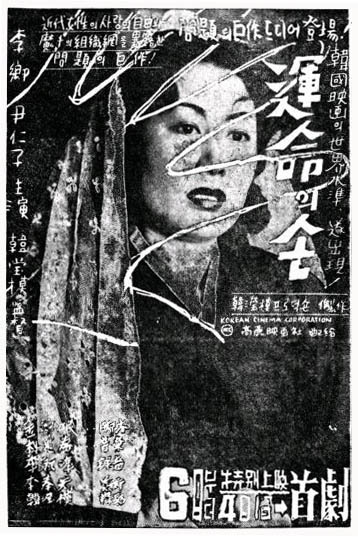
The Hand of Fate (運命의 손 / 운명의 손, Han Hyung-mo, 1954)

Hand of fate poster 2

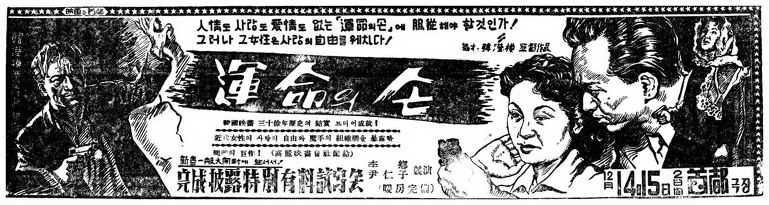
The kinds of directors who tend to garner retrospectives and reappraisals are perhaps those who lean closer to our own ideological biases. Even in the tightening censorship of the 1960s, Korean directors like Kim Soo-yong and Lee Man-hee were able to subtly undercut the prevailing conservatism of their times. Director Han Hyung-mo, by contrast, was a committed rightist whose films express a distinct intolerance towards liberalism, women’s rights, and the Communist North. Han, like many directors of his generation, studied filmmaking in Japan near the end of the Colonial era and began his career as a cinematographer. His first film, Breaking the Wall released in 1949, is sometimes described as the first Korean anti-communist film. Returning to narrative filmmaking after serving as a documentarian during the Korean War, Han’s Hand of Fate (運命의 손 / 운명의 손, Unmyeong-ui Son, AKA Hand of Destiny) released in 1954 is not perhaps as rabidly anti-communist as might be expected but makes clear that there can be no redemption for an ideologically compromised woman.

Jung-ae (Yu In-ja), a North Korean spy posing as a bar girl in the South, enjoys a life of comparative freedom and luxury but remains committed to her mission. When the police bring a wounded student, Yong-chul (Lee Hyang), to her door one day as a possible suspect in a robbery she’d previously reported to them, she takes pity on the man and tells the police to let him go. She brings him into her apartment, treats his wounds, and feeds him. For some reason she develops an attraction for the melancholy student and so when she spots Yong-chul working on a construction site, Jung-ae takes him out on the town, buys him a new suit and shoes, and eventually begins a relationship with him. Professional habits die hard, however, and so when she rifles through his wallet she is disturbed to find his military intelligence ID card and discover he is really a spy catcher.

Released in 1954, Hand of Fate is a product of the immediate post-war era and is in fact one of the very few surviving films from that year. Nevertheless, it takes its cues very much from international cinema and particularly from American and European noir and spy films in its fatalistic trajectories and uncharacteristically murky worldview. Though Han includes mild anti-communist sentiment in Jung-ae’s eventual disillusionment with the “Communist Party’s hackneyed methods”, the fact that she is a spy for the North is almost incidental for much of the film, the conflict being not that she is a Communist and therefore evil but on a much simpler level that she is required to straddle a difficult ideological divide. Of course, the force that shakes her loyalty is love and in this Han reaffirms her womanliness in simultaneously making emotion both her weakness and the best weapon against the rigidity of Communism. Then again, rightists aren’t so keen on emotion either and so romance must fail.

Both Jung-ae and Yong-chul come to the conclusion that their only mistake was falling in love – not so much with an “enemy” but across an impossible border presented by the 38th Parallel. The futility of the love is laid firmly at the feet of a destructive division imposed by outside powers which painfully separates two parts of one whole. “We love each other, why can’t we be together?” Yong-chul asks, still unaware that Jung-ae is the female spy he’s been looking for. “You’re so close to me now”, Jung-ae adds later, “Why have we been so far apart?”, lamenting that the wall which has kept them at a distance from one another has been largely illusionary and has now been destroyed if only in terms of personal ideology. Rather than the demonisation of the North which would define the anti-communist film, it is the pain of the division which is the real enemy though in contrast to other similarly themed films, Han suggests a clean break might be the best solution rather than holding out hope for reunification.

Meanwhile, the pair work at cross purposes in misattributing the suffering of the other to culturally defined, gender-specific stigmas. Yong-chul assumes Jung-ae’s misery is down to being a “fallen woman”, that as a sex worker she worries she has lost the right to love him (he is keen to assure her that she hasn’t and there’s nothing wrong her life choices – a liberality that stands in contrast to the film’s subtle condemnation of Jung-ae on just this fact as a woman who uses her body as a tool of war), when really she is caught in an impossible position in having fallen in love with a man she will probably have to kill. Before discovering his real occupation, Jung-ae assumed Yong-chul’s misery was down to his poverty. She feels the manual job he takes to support himself through college is beneath him, indulging in a stigma towards blue collar workers which seems odd for a committed communist, and wants to “save” him by restoring him to his rightful social class with her money which she earned in a way she fears he may think immoral.

Despite Han’s fierce conservatism, Hand of Fate features the first on screen kiss in Korean cinema history but where it is undoubtedly romantic, it is also dark and fatalist. In keeping with the title and the noirish atmosphere, the narrative trajectory leads only to tragedy in which the division will be maintained with the South in the ascendent. Jung-ae’s ideological fracturing leaves her with nowhere to turn, while Han’s overly conservative viewpoint will not allow her to find peace or resolution not only because of her Communist roots but because of being an “immoral” and “vulgar” woman as she describes herself early on. Described as “An epoch-marking, ambitious work in the history of Korean Cinema”, Hand of Fate is indeed a bold experiment, opening with a tense, dialogue free sequence of spy craft and danger even if it later overdoes the expressionism with climactic thunderstorms and overly literal bombs (not to mention the constant hand imagery), offering a dark and noirish vision of a divided future in which the pain and suffering caused by the division will continue with the only “hope” that the wall will eventually become a fading scar.


The Hand of Fate is available on English subtitled DVD courtesy of the Korean Film Archive which also includes a special documentary, a video essay by film scholar Kim Jong-won, and an interview with art director Non In-taek, as well as a bilingual booklet featuring a brief commentary on the film and an essay by the Korean Film Archive’s Jo Jun-hyung. Also available to view via the Korean Film Archive’s YouTube Channel.

Brief clip (dialogue free)

The Garden of Women (女の園, Keisuke Kinoshita, 1954)

garden of women still 1Things changed after the war, but not as much as some might have hoped. Sadly still topical, Keisuke Kinoshita’s Garden of Women (女の園, Onna no Sono) takes aim both at persistent and oppressive patriarchal social structures and at a compromised educational system which, intentionally or otherwise, systematically stifles attempts at progressive social change. A short few years before student protests would plunge education into crisis, Kinoshita’s film asks why it is that the establishment finds itself in conflict with the prevailing moods of the time and discovers that youth intends to have its brighter future even if it has to fight for it all the way.

The setting is an exclusive private woman’s university in the elegant historical city of Kyoto. The ladies who attend this establishment are mostly from very wealthy families who have decided to educate their daughters at the college precisely because of its image of properness. As one student will later put it, there are two kinds of girls at the school – those who genuinely want to study in order to make an independent life for themselves and intend to look for work after graduation, and those who are merely adding to their accomplishments in order to hook a better class of husband. Everyone, however, is subject to a stringent set of rules which revolves around the formation of the ideal Japanese woman through strictly enforced “moral education” which runs to opening the girls’ private letters and informing their families of any “untoward” content, and requiring that permission be sought should the girls wish to attend “dances” or anything of that nature.

As might be expected, not all of the girls are fully compliant even if they superficially conform to the school’s rigid social code. Scolded for her “gaudy” hair ribbon on the first day of school, Tomiko (Keiko Kishi) rolls her eyes at the over the top regulations and enlists the aid of the other girls to cover for her when she stays out late with friends but her resistance is only passive and she has no real ideological objection towards the ethos of the school other than annoyance in being inconvenienced. Tomiko is therefore mildly irritated by the presence of the melancholy Yoshie (Hideko Takamine). Three years older, she’s come to college late and is struggling to keep up with classes but is, ironically enough, prevented from studying by the same school rules which insist she go to bed early.

Meanwhile, dorm mate Akiko (Yoshiko Kuga), from an extraordinarily wealthy and well connected family, is becoming increasingly opposed to the oppressive atmosphere at the school. However, as another already politically active student points out, Akiko’s background means there are absolutely no stakes for her in this fight. She has never suffered, and likely never will, because she always has been and always will be protected by her privilege. Fumie (Kazuko Yamamoto), a hardline socialist, doubts Akiko’s commitment to the cause, worrying that in the end she is only staging a minor protest against her family and will eventually drift away back to her world of ski lodges and summer houses. Despite her ardour, Akiko finds it hard to entirely dispute Fumie’s reasoning and is at constant battle with herself over her true feelings about the state of the modern world as it relates to herself individually and for women in general.

This is certainly a fiercely patriarchal society. Even though these women are in higher education, they are mostly there to perfect the feminine arts which are, in the main, domestic. They are not being prepared for the world of work or to become influential people in their own right, but merely to support husbands and sons as pillars of the rapidly declining social order that those who sent them there are desperate to preserve. For many of the girls, however, times are changing though more for some than others. Tomiko rolls her eyes and does as she pleases, within reason, and even if she eventually wants to see things change at the school it is mostly for her own benefit. She sees no sense in Akiko’s desire for reform as a stepping stone to wider social change, and perhaps even fears the kinds of changes that Akiko and Fumie are seeking.

Akiko and Fumie, and to an extent, Tomiko, seem to have a degree of agency that others do not as seen in the tragic story of Yoshie whose life has been largely ruined thanks to the selfish and heartless actions of her father. From a comparatively less wealthy family, Yoshie worked in a bank for three years during which time she met and fell in love with an earnest young man named Shimoda (Takahiro Tamura). However, her father, having become moderately successful, developed an appetite for social climbing and is determined she marry “well” to increase his own sense of superiority as a fully fledged member of the middle classes. He sees his daughter as nothing more than a tool or extension of himself and cares nothing for her thoughts or feelings. In order to resist his demands for an arranged marriage, Yoshie enrolled in school and is desperate to stay long enough for Shimoda to finish his education so they can marry.

Yoshie is trapped at every turn – she cannot rely on her family, she cannot simply leave them, she cannot yet marry, if she leaves the school she will be reliant on a man who effectively intends to sell her, but her life here is miserable and there is no one who can help her. All she receives from the educational establishment is censure and the instruction to buck up or get kicked out. She feels herself a burden to the other girls who regard her as dim and out of place thanks to their relatively minor age gap and cannot fully comprehend her sense of anxiety and frustration.

Finally standing up to the uncomfortably fascistic school board the girls band together to demand freedoms both academic and social, insisting that there can be no education without liberty, but the old ways die hard as they discover most care only for appearances, neatly shifting the blame onto others in order to support their cause. “Why must we suffer so?” Yoshie decries at a particularly low point as she laments her impossible circumstances. Why indeed. The oppressive stricture of the old regime may eventually cause its demise but it intends to fight back by doubling down and the fight for freedom will be a long one even if youth intends to stand firm.


Titles and opening scene (no subtitles)

Farewell Rabaul (さらばラバウル, Ishiro Honda, 1954)

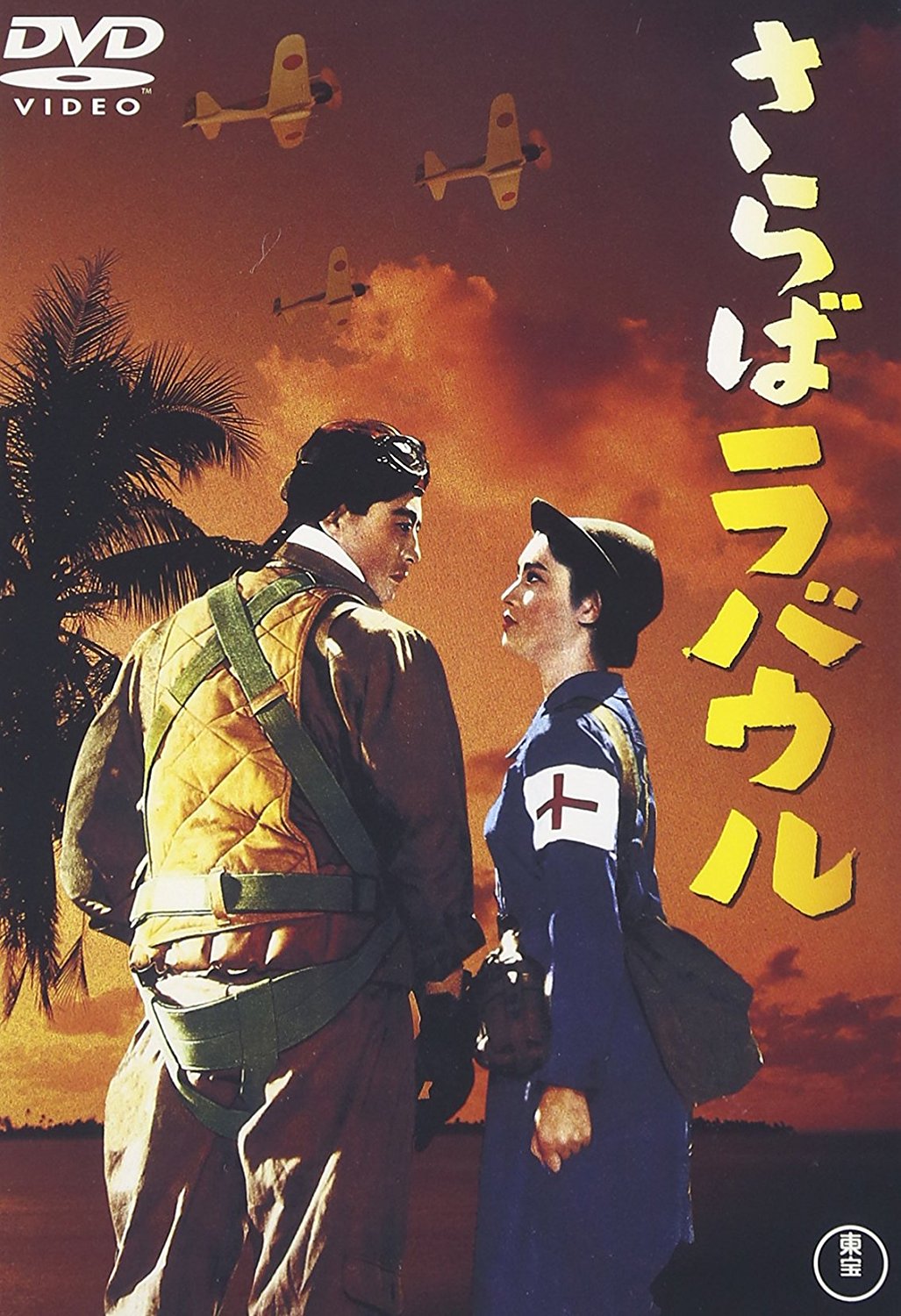
Farewell Rabaul dvd coverReleased in 1954, Farewell Rabaul (さらばラバウル, Saraba Rabaul) was the last in a string of war films directed by Ishiro Honda for Toho immediately before the mega hit Godzilla redefined his career and turned him into a director of science fiction and special effects movies. Like the later tokusatsu classics, Honda worked alongside Eiji Tsuburaya to craft the film’s effects which are largely used to recreate the epic dogfights taking place over the island as the airmen and ground crew come to terms with the imminent arrival of American forces. Though he takes care to show the bravery and determination of the Japanese pilots, Honda’s attitudes to the war and the government who waged it are not so kind.

Late into the conflict, at an outpost in the Papa New Guinean city of Rabaul, ace pilot Captain Wakabayashi (Ryo Ikebe) leads a rapidly depleting squad of airmen trying to defend Japanese forces from American air attacks. Known as “Devil” Wakabayashi, he rules with an iron fist – taking issue with men who spend their time in local bars and pointedly refusing to send rescue craft for crashed pilots. Ruthless and cold as he seems, the war is starting to get to Wakabayashi and his resolve crumbles when faced with a gracious American POW and the attentions of a kindly nurse, Komatsu (Mariko Okada).

Honda keeps the action to a minimum, preferring to focus on the life within the military base. Though the effects on the local population are not much addressed, the opening scenes take place in a bar in which Papa New Guinean women dance to tribal drums while Japanese military personnel drink and watch. The waitresses are largely Japanese women dressed in kimono, though it seems the exoticism of local girl Kim (Akemi Negishi), dancing barefoot with flowers in her hair, is the main draw. Eventually Kim falls in love with a Japanese soldier and the two plan to flee but fate always gets in the way.

Wakabayashi, rechristened the “Devil” by Kim – a nickname which seems to stick, objects to his men blowing off steam in the bar for purely practical reasons – he needs them at top form for an upcoming mission and a hungover pilot could be a risk to the entire squad. Walking around looking sullen and refusing to explain himself, it’s no wonder Wakabayashi is unpopular with some of the men even if his skills are widely recognised. Asked to send a rescue squad for a lost pilot, Wakabayashi’s reply is a flat no with no further details offered. Only when a junior officer interjects during a briefing does he offer his reasoning – the crash site is in enemy territory and it’s too risky to send more men in to fetch one pilot who is probably already dead. His reasoning is sound and probably the correct command decision but the cutting coldness with which he delivers his judgement does little to assuage his reputation as a heartless misanthrope.

This is, however, not quite the case. When an extremely young member of his squad is shot down Wakabayashi shouts out to him, trying to advise the rookie on ways to control the aircraft but all to no avail. The pilot cannot bail out as Japanese pilots, particularly those flying the featherweight 0 fighters, are not equipped with parachutes. This is brought up again when a downed American pilot is brought in as a POW. The journalist attached to the unit is able to speak fluent English and interprets for Wakabayashi and the others as the American gives them an improbably frank analysis of Japanese airborne warfare. He tells them that the Americans were once afraid of the 0s and their high speed manoeuvring but have figured out their weaknesses. In the hands of a skilled pilot, the 0 is a powerful weapon but in unskilled hands it’s a liability – its lightweight form makes it easy pickings when the pilot does not know how to fly defensively. If it weren’t for this fighter they call “Devil” they’d be picking them off with ease. The lack of parachutes came as a surprise to the Americans. The 0s need to be as light as possible, but no one could believe that the Japanese government valued life so cheaply that they’d send a man up there with no way down. That’s why, the American says, they will win – no government so unwilling to look after its own could ever expect to.

The senselessness of it all eventually gets to Wakabayshi, even leading him to reverse his original stance and proceed into enemy territory to rescue a fallen comrade himself. He is, however, wounded, his plane damaged, and his friend doesn’t make it. Rabaul falls, and its hero falls with it in a turn which is both melancholy and defiant. Honda refuses to glorify the destruction but ends on a note of sadness, reprising the titular song sung by the women aboard a boat they hope will take them home but that, like everything else, remains so hopelessly uncertain.


Invisible Man (透明人間, Motoyoshi Oda, 1954)

invisible man 1954 posterThe Invisible Man is a frightening presence precisely because he isn’t there. The living manifestation of the fear of the unknown, he stalks and spies, lurking in our imaginations instilling terror of evil deeds we are powerless to stop. Daiei made Japan’s first Invisible Man movie back in 1949 – a fun crime romp with the underlying message that scientific research is important but not as important as ensuring knowledge is placed in the right hands. Toho brought Eiji Tsuburaya back for another go at the same material in 1954 as part of their burgeoning tokusaku industry fathered by Godzilla. The 1954 Invisible Man (透明人間, Toumei Ningen), directed by Motoyoshi Oda, is once again a criticism of Japan’s wartime past but also perhaps of its future. This Invisible Man is an invisible hero but one whose heroism is only recognised once the mask is removed.

Opening in grand style, the film gets off to a mysterious start when a speeding car hits “something” in the road. The “something” turns out to be a previously invisible man whose appearance is returned to him as blood leaks out from under the now stopped car. In his pocket, the man has a suicide note explaining that living life invisible is just too depressing and he can’t go on. Seeing as the note is addressed to a “friend” who is also apparently an Invisible Man that means there are more out there. Despite there being no real threat involved in any of this, the newscasters are alarmed and the public frightened.

This is quite useful for some – a shady gang quickly starts putting on Invisible Man suits including wrapping their heads in bandages just like in the movies, and robbing banks. Admittedly this makes no practical sense but adds to the ongoing fear of an “invisible” threat. An intrepid reporter, Komatsu (Yoshio Tsuchiya), links the crimes to a nightclub where the head of the gang is also trying to pressure the headline star, Michiyo (Miki Sanjo), into a career as a drug mule. Besides violence, their leverage is the little girl who lives across from Michiyo and is blind – the money they would be paying her could also be used to pay for the girl’s eye surgery. Mariko is waiting patiently for her grandfather to make the money, unaware that he has also fallen under the spell of the criminal gang.

The real “Invisible Man” is doing a good job of hiding in plain sight by proudly standing out in a traditional clown outfit complete with makeup and a fluffy nose. Nanjo (Seizaburo Kawazu) works as a promoter for the club and is also good friends with little Mariko who is unable to see him either with or without his clown suit. Unlike other Invisible Men, Nanjo is good and kind – the curse of his condition has not ruined soul.

He is, however, afraid of being exposed. Aside from social ostracism (perhaps someone who wears a clown suit 24/7 isn’t particularly bothered about that), Nanjo fears what his government would do to him if they discovered he was still alive. Like his friend who later committed suicide, Nanjo was a member of an experimental army squad recruited towards the end of the war as Japan sought to create the ultimate warriors to turn the tide in the battle against the Americans. The Invisible Men were born but the war lost, and it was assumed that they had all fallen. Nanjo, surviving, has been abandoned by the land that he fought for. His existence is a secret, an embarrassing relic of Japan’s attempt at scientific warfare, and something which no one wants to deal with. Nando’s friend could no longer cope with his non-existence. Unable to return home, unable to work, unable to marry, there was no “visible” future which presented itself to him.

In this sense, Nanjo represents a point of view many might have identified with in 1954. These men fought and risked their lives for a god they now say is only a man, to come home to a land ruled by the “enemy” in which they can neither criticise the occupation or the former authorities. These men may well feel “invisible” in the new post-war order in which the younger generation are beginning to break free while they suffer the continuing effects of their wartime service even if not quite as literally as Nanjo.

Yet there’s a kind of internalised resentment within Nanjo who describes himself as a “monster created by militarism”. Disguising himself as a clown he attempts to live a “normal” life though one segregated from mainstream society. A half-hearted romance with club girl Michiyo and a well meaning paternalism for the orphaned little blind girl point to Nanjo’s altruistic heroism but also to a reluctance to fully engage with either of them due to a lingering sense of guilt and shame.

The Invisible Man is the hero here while the bad guys subvert and misuse his name to do their evil deeds, terrorising women and threatening to burn the city down rather than surrender to authority. Even more than others in Toho’s expanding universe of tokusatsu heroes, Invisible Man is a defence of the other as not only valid but morally good even in the face of extreme prejudice and violence. It is, however, also one of their less well considered efforts and Tsuburaya’s effects remain few and far between, rarely moving beyond his work on Daiei’s Invisible Man five years previously. Bulked out with musical numbers and dance sequences, Toho’s Invisible Man is a less satisfying affair than Daei’s puply sci-fi adventure but is nevertheless interesting in its defence of the sad clown who all alone has decided to shoulder the burdens of his world.


Three Loves (三つの愛, Masaki Kobayashi, 1954)

three-lovesMasaki Kobayashi had a relatively short career of only 22 films. Politically uncompromising and displaying an unflinching eye towards Japan’s recent history, his work was not always welcomed by studio bosses (or, at times, audiences). Beginning his post-war career as an assistant to Keisuke Kinoshita, Kobayashi’s first few films are perhaps closer to the veteran director’s trademark melodrama but in 1953 Kobayashi struck out with a more personal project in the form of The Thick-Walled Room which dealt with the fates of lower class war criminals. Based on a novel by Kobo Abe, the film was sympathetic to the men who had only been “following orders” but was careful not to let them off the hook. Still far too controversial, The Thick-Walled Room could not be released until 1957 and Kobayashi went back to more conventional fare such as this Christianity infused tale of three kinds of frustrated loves – romantic, spiritual, and familial, Three Loves (三つの愛, Mittsu no Ai).

Ikujiro is riding into town on a donkey cart, playing his flute which attracts the attention of a strange boy who exclaims that he is a butterfly. Following the death of his father, Ikujiro’s mother has apprenticed him to a man who owns a sake brewery but is also a member of the school board and has promised that he will get his education. Riding the same cart in is a down on his luck artist, Nobuyuki (Ko Mishima) – the lover of the town’s new music teacher, Michiko (Keiko Kishi), who has travelled to this remote country spot both for the benefit of her health and to help provide for her struggling artist boyfriend. This slightly unusual town is also home to a humble church whose Holy Father, Yasugi (Yunosuke Ito), came to the town as an evacuee alongside the now professor father of the little boy with a pigeon obsession, Heita.

Somewhat unusually, Three Loves opens with a choral rendition of a Christian hymn followed by a brief voice over and intertitle-style caption bearing the message that only those who live sincerely and seriously will be granted true joy but that this same joy is born from the bitterness and sadness of life. There are certainly an array of bitter circumstances on offer but Kobayashi choses to focus on them as filtered through three very different stories of love as children are separated from their parents, lovers are kept apart by cruel twists of fate and the love of God is both keenly and invisibly felt by those who take refuge at the underused church.

Ikujiro has been “sent away” by his mother who has been convinced to allow her oldest child to be raised by foster parents given that it will now be difficult for her to support all of the children in the absence of her husband. Feeling alone and unloved though missing his family, Ikujiro does not quite fit in at the local school but faces even more problems at his new home where it transpires that his foster father is not quite as altruistic as he originally claimed. Forming an odd friendship with Heita, Ikujiro begins to find some comfort in the place but nevertheless continues to suffer.

Heita, is, in many ways the heart of the film though his status as a kind of holy fool is perhaps uncomfortable from a modern standpoint. Yasugi, who has developed the closest relationship with the boy outside of his mother, describes him as beautifully sensitive and someone who requires especial care. Yet, his mother found it difficult to connect with him until he was allowed to return to nature, and his scholarly father mostly ignores him, describing his work as a kind of “atonement” for the way his son has turned out. Even given Heita’s unorthodox relationship to his environment in which he feels himself more bird or butterfly than human, he experiences only warmth and occasional exasperation from those around him rather than outright hostility.

These kinds of frustrated familial or social loves feed back into the intertwined romantic melodrama as tortured artist Nobuyuki has an attack of male pride in partially rejecting Michiko over her decision to become the major breadwinner despite her failing health. Professing love but remaining unwilling to marry because of his lack of financial security, he only wounds the woman he loves who wants nothing other than for him to go on painting and thinks of what he regards as a “sacrifice” of herself in working to support them both as part of their shared struggle. Becoming gloomy and depressed, Nobuyuki posits giving up on love, but eventually comes around, realising some things are more important than pride though old fashioned ideas about illness still pose a problem.

This in turn drives the central spiritual dilemma as Father Yasugi is forced to face his own emotional pain which he has long been trying to sublimate with service to something higher. Ten years previously, his wife left him for another man but his continuing love for her is the very reason he cannot bring himself to do what his own religion requires and forgive her for the pain and suffering which now cloud his heart. God is love, but love is pain and suffering without end. Thus he councils the romantically troubled couple against a marriage which may end suddenly creating even more heartbreak and everlasting sadness, which seems at odds with his own, and the film’s, insistence on the joy that life brings even whilst filled with sorrow and regret.

An early effort from Kobayashi, Three Loves is not as successful as his other work from the period offering none of the rawness or innovation of The Thick-walled Room, falling back on established melodrama techniques though making interesting use of montages and dissolves even if coupled with familiar horizontal wipes. The tone is more forgiving than Kobayashi’s later angry social tirades, but the muddled structure and strange use of religious themes make for a frustrating experience which ends in a traditionally melodramatic way offered abruptly and without further comment. A death of innocence may be Kobayashi’s concession to his own bleaker world view but feels like a standard Shochiku tearjerker ending, an afterthought tacked on as a concession to studio requirements. Still, an interesting meditation on the nature of love in all its different forms, Three Loves is an unusually contemplative piece even if frustrated by a slight clumsiness of execution.