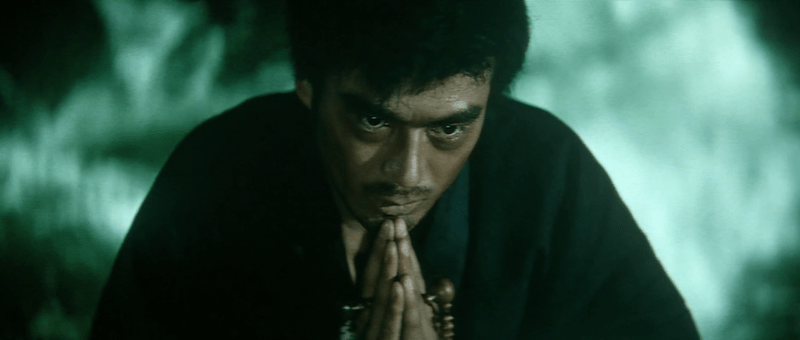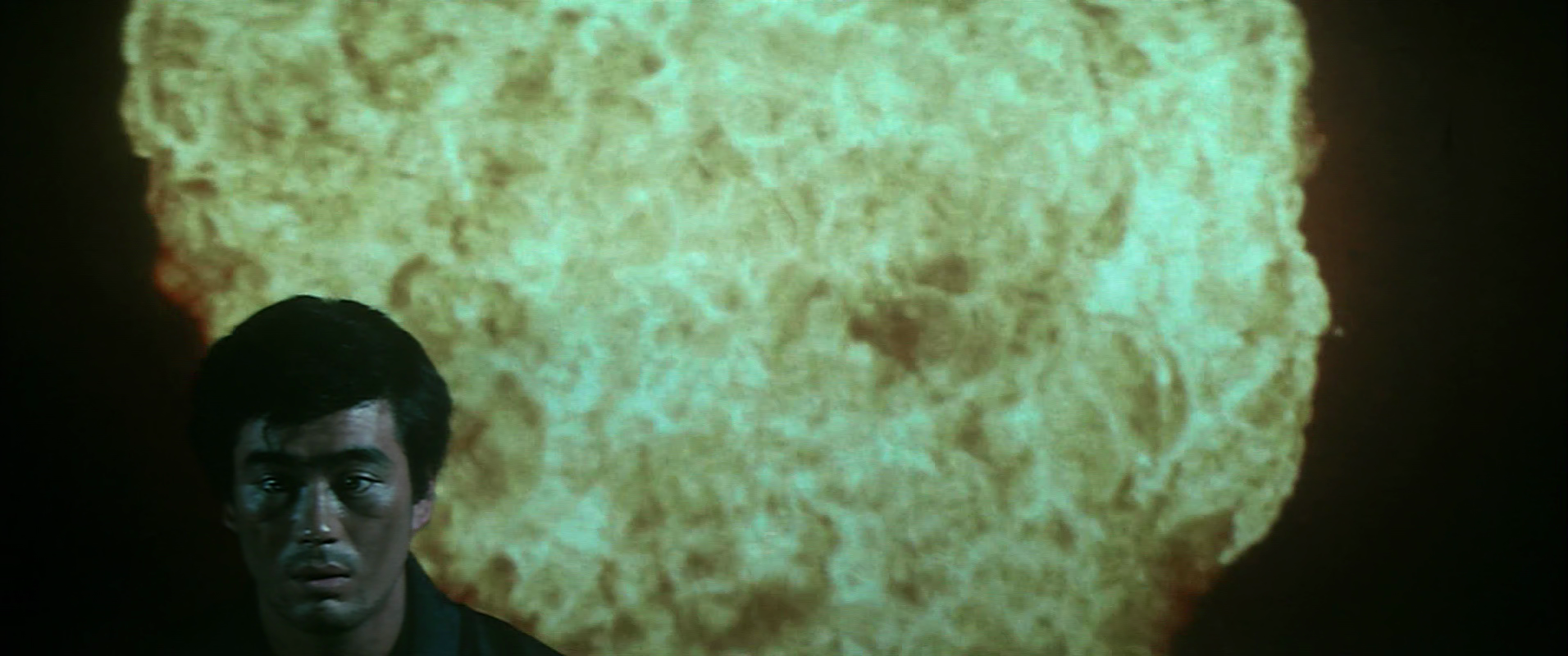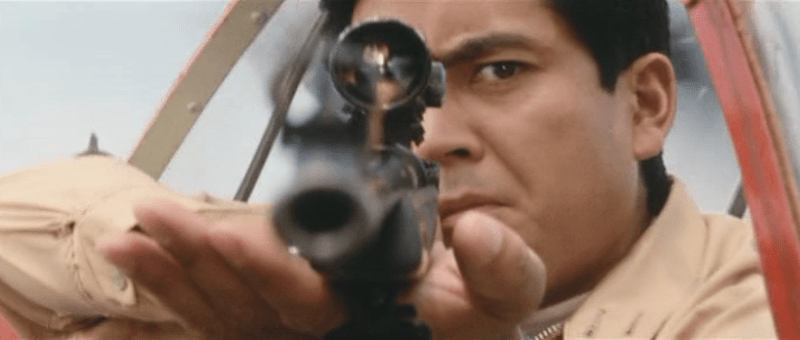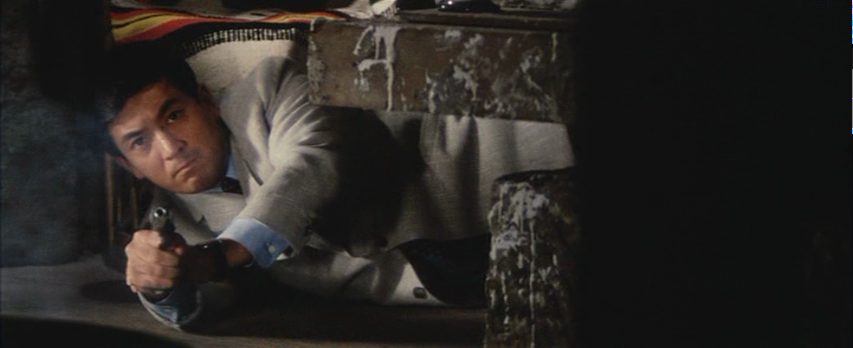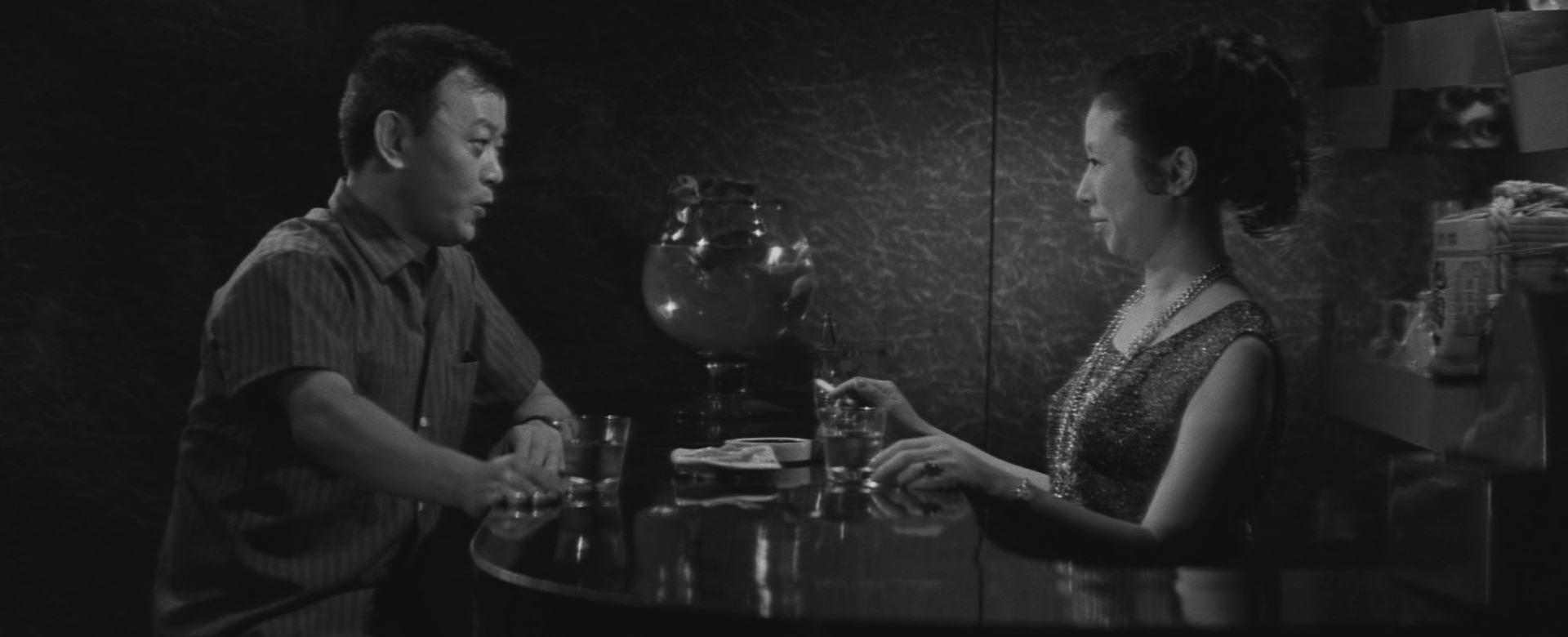
Memoir of Japanese Assassinations (日本暗殺秘録, Sadao Nakajima, 1969)

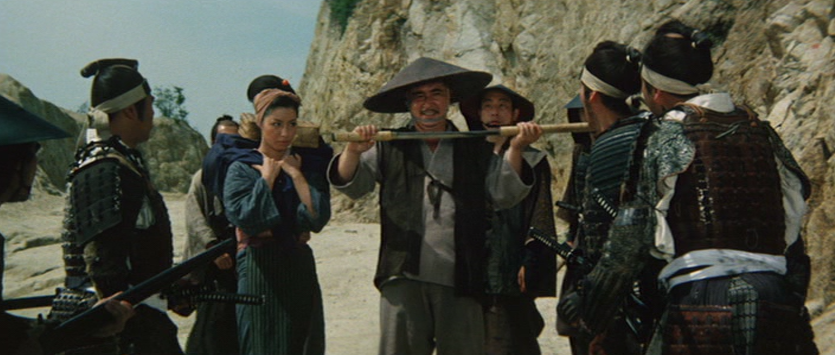
According to the narrator of Sadao Nakajima’s artistically daring Memoir of Japanese Assassins (日本暗殺秘録, Nihon ansatsu hiroku) the practice of assassination had got so out of hand in the early years of Meiji that the emperor was forced to institute a law banning it while accepting responsibility for the lawlessness his imperfect governance had produced. But by opening with the Sakurada Gate Indecent from 1860, the film seems to be asking what went wrong in Meiji and why the assassinations have still not stopped with the implication that more may be on their way in rather febrile political atmosphere of the late 1960s in the run up to the renewal of the Anpo security treaty with Asama Sanso still a few years away.

The answer to the question that it presents, is that oppression has still not ended in Japan and that most of these assassinations took place because people had enough of difficult social conditions those in power little did to address. However, the first few pre-20th century  assassinations which are presented in the form of short vignettes, are largely a product of the confusion of the bakumatsu era as reactionaries attempt to halt Japan’s increasing openness to the wider world and what they see as a loss of national identity and sovereignty. The implication is that this sense of ideological conflict is a direct cause of the nationalism that defined the first half of the 20th century. 

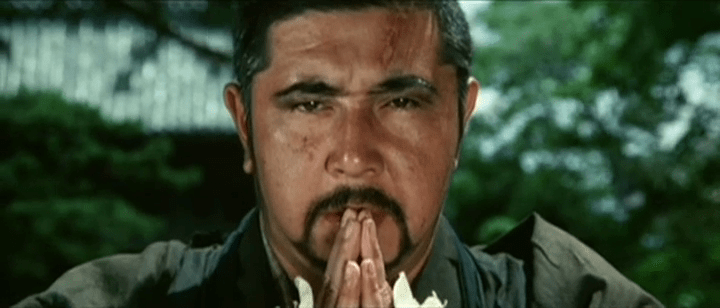
It’s not until we reach the early 1920s that the secondary cause of Japan’s dire economic situation rears its head as the right-wing nationalist leader of Righteousness Corps of the Divine Land (Bunta Sugawara), a society dedicated to workers’ rights, assassinates the head of a family-run conglomerate he accuses of feeding on the blood on the common man. From this incident we can see that it is not as easy to draw a line between left and right in terms of political ideology as it might be at other times or in other nations as otherwise nationalist forces share ideas that might lean more towards socialist ideals. Ikki Kita whose philosophy informed the February 26th Incident that ends the film described himself as socialist, but is also regarded by some as the architect of Japanese fascism. With the so-called “Showa Restoration”, he advocated for the elimination of private property and a doctrine of socialism from above in which the emperor would assist in the reorganisation of society. Which is to say, the clarification of the Meiji Restoration actually meant.

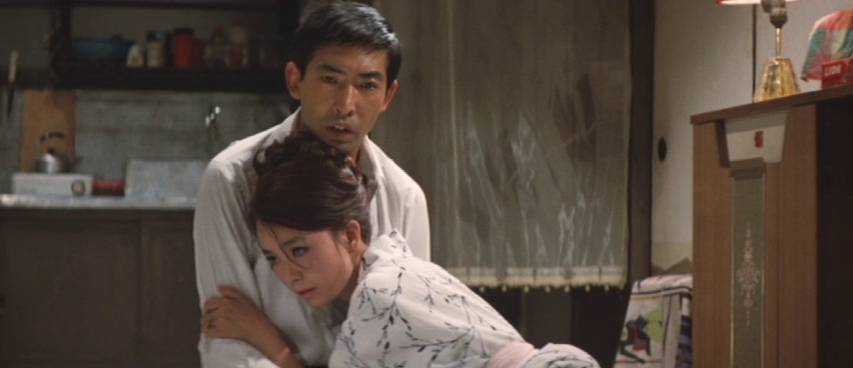
In any case, it’s easy to see the reasons that these ideas caught hold and that concepts such as “revolution” were a counter to the persistent hopelessness of the depression and the extreme poverty of Japanese society while the large conglomerates prospered through trading with the United States. The bulk of the film focuses on Onuma who assassinated Junnosuke Inoue in 1932 as part of an intended reign of terror known as the League of Blood instituted by the far right Nichizen Buddhism cult led by Nissho Inoue (Chiezo Kataoka),. Onuma was still alive at the time the film was made and apparently acted as a consultant. Played by a fresh-faced Shinichi Chiba, he’s depicted as an earnest young man who is driven into the ground by the increasingly capitalist mentality of the 1920s, a time of high unemployment and frequent labour disputes only exacerbated by the Great Depression. 

Though he had been a bright and attentive student, Onuma was forced to leave education because of his father’s early death and thereafter worked a series of causal jobs before leaving a position at a kimono dyers because of their callous treatment of another employee who was forced to embezzle money because his mother was ill and he was denied a loan by the boss who justifies his position by stating that he’s already given the man several advances on his salary. Onuma’s brother also resigned from his job to take responsibility for failing to spot someone else’s embezzlement, leading Onuma to conclude that being honest gets you nowhere in this morally corrupt society. This is rammed home for him at his next job at a cake baker’s where he becomes almost part of the family and draws closer to the maid, Takako (Junko Fuji). The boss intends to rapidly expand the business by building a bigger factory hoping to capitalise on the coronation of the new emperor. Staking everything on the factory, he takes out loans from loan sharks but fails to get a business permit from the police later remarking that he was naive thinking he could do business honestly not realising that the police expected a bribe.

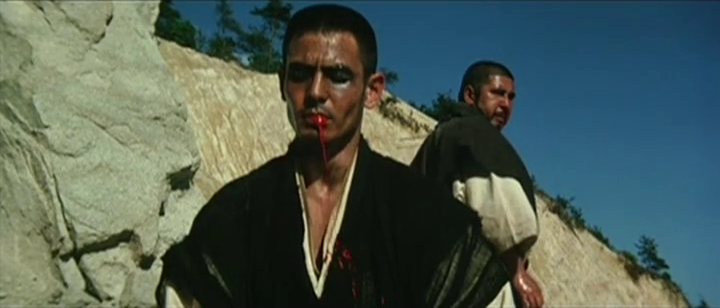
Tuberculosis and the death of a girl who like him could not afford medical treatment further leave Onuma feeling resentful and hopeless leading to a suicide attempt after which he is born again in Nichiren Buddhism and becomes a servant to Nissho. It’s easy to see how Nichiren could offer an escape to young men like him who burn with rage and a desire to change society, though in essence it’s no different from the militarism that was growing in parallel being rooted in nationalist ideology and for the early part at least centred in the military. The May 15 Incident saw the military and members of the League of Blood assassinate the prime minister to enact the Showa Restoration and reorganise society. The revolution failed, but the 11 young officers who took part in received little punishment, furthering cause of the militarism, while directly contributing to the February 26th Incident which though it also achieved little further cemented the power of the military over the government. 

Though imperialism is subtly presented as another form of injustice as the nation spends money on warmongering while the people starve, the film straddles an awkward line in struggling to avoid glorifying the actions of the far right in painting Onuma and leader of the February 26th Incident Isobe (Koji Tsuruta) as dashing, idealistic heroes whose only wish was to save Japan and remake it in a way they believed to be better. This was pretty much the antithesis of what Nakajima intended, though it was picked up by some as a piece of right-wing propaganda. The film courted controversy both with Toei studio bosses and the government who ordered Nakajima to soften the excerpts from Isobe’s diary fearing they were too incendiary, though Nakajima had already shot the footage and was forced to find a compromise. Toei as a studio did rather lean towards the conservative and especially in its yakuza films which is perhaps unavoidable given that yakuza organisation did often have strongly nationalistic sensibilities. Accordingly, the film stars almost their entire roster of Toei’s yakuza and ninkyo eiga stars from Tomisaburo Wakayama to Ken Takakura and Koji Tsuruta along with Junko Fuji as as Onuma’s love interest who is eventually forced into sex work because of the economic conditions of the 1920s, and perhaps comes with some of that baggage. Its closing question, however, given the fact that all these assignations achieved almost nothing of what they were intended to, seems to be posited at the current society mired in the Anpo protests and the declining student movement to ask how else society might be changed and revolution enacted to create a fairer society for all through an ideology that could end this cycle of political violence.


The Fort of Death (五人の賞金稼ぎ, Eiichi Kudo, 1969)

Shikoro Ichibei (Tomisaburo Wakayama) returns yet this time seemingly on the opposite side in the second in the Bounty Hunter series, The Fort of Death (五人の賞金稼ぎ, Gonin no Shokin Kasegi) this time directed by Eiichi Kudo. If the first film had been an Edo-era take on James Bond, the second is very much Spaghetti Western and feudal tragedy as Ichibei finds himself coming to, if not quite the rescue of the oppressed farmers, then at least moral support in taking stand against corrupt and self-interested lords.

This might be surprising in that in the first film Ichibei had been a shogunate spy and seemingly close friend of the man himself, yet this time around he’s working as a doctor while taking bounty hunter jobs to earn extra money to support the poor people who come to him for help. Like a true western hero, he has a small posse which includes the ninja lady, Kagero (Tomoko Mayama), from the first film only she’s being played by the actress who previously starred as his other love interest. In any case, he’s approached by a young man from a small village which is making a last-ditch appeal to the local lord to lower their tax burdens so they don’t all starve, though so far the lord’s response has been to add additional taxes and kill people for not paying them. 

On his arrival, Ichibei soon realises that the man who recommended him was actually the leader of the government forces during a previous peasant uprising at which Ichibei had also tried to help the farmers. In that case, Bessho (Shin Tokudaiji) had won, but it didn’t do him any good. His clan was dissolved and he became a wanderer, taken in by the village and now indebted to them, hoping Ichibei can help but fully aware of the brutality with which such challenges to the feudal order are put down. 

The lord later suggests it’s not really his fault. He has to curry favour with Edo to protect the domain, which is why he agreed to participate in a construction project that led him to confiscate all of his farmers’ rice and wheat. But then it’s also true that he is vain, and cruel. On realising the village has hired a man like Ichibei, some of the retainers suggest reopening negotiations but others complain that they must now crush the farmers or face ruin themselves while trying to ensure the strife in their domain does not come to the attention of the government in Edo. 

Part of their problem is that Ichibei simply has better technology in the form of gatling guns. Tying into the western themes, Ichibei is well versed in the use of firearms, while the samurai are mostly reliant on traditional weaponry such as arrows and swords. The lord later insists on using some canons, but is oblivious to the risk as the shogun has banned the use of gunpowder and using them may end up bringing him to his attention and thereby landing him in a lot of possible fatal trouble. 

In any case, it’s the villagers who suffer. Ichibei encounters a woman who has lost her mind, refusing to give up her baby who has died of malnutrition while her husband was executed for non payment of taxes. Meanwhile, some of the other ronin they hired attempt to rape a villager, and a young couple are prevented from marrying because the headman is worried that it would send the wrong message in a time so much strife. Then again, a woman basically attempts to rape Ichibei, descending on him while he’s still asleep which otherwise leads into a fairly comic sequence in which Ichibei must fight of a bunch of ninjas intent on stealing the gatling gun while dressed only his underwear.

Darkly comic it may be, but also surprisingly violent with a ninja at one point using a dead body as a Molotov cocktail not to mention the severed heads and limbs of the battle scenes. Ichibei is fully aware that the battle is a forlorn hope, but also that the villagers have no choice and perhaps this is better for them than simply accepting their fate and starving to death. Even so, he reserves his final words for the Edo inspector who arrives only when the battle is done to survey the scene, berating him that he ought to know what happened here from looking at the battlefield and deducing that this domain has not been run particularly well. It’s a tragedy of feudalism that provokes a tearful rage from the compassionate bounty hunter trying his best to heal the sickness in his society, though perhaps like the patient who visits him with a venereal complaint concluding the best solution is to cut it right off.


Killer’s Mission (賞金稼ぎ, Shigehiro Ozawa, 1969)

According to the title card at the beginning of Shigehiro Ozawa’s Killer’s Mission (賞金稼ぎ, Shokin Kasegi), none of the events it depicts have been recorded in history because the shogunate decided to erase them all in fear of the effect they may have on the nation’s geopolitical stability. Nevertheless, it gives some very concrete dates for its historical action, even if they may not make complete sense while foreshadowing the political turbulence of the following century. 

What it essentially attempts to do is tell a James Bond-style tale of political intrigue in a feudal Japan in which perpetual peace has begun to create its own problems. Here played in a cameo appearance from Koji Tsuruta, the Shogun Ieshige was weak in part because he was in poor health and had a speech impediment which led him to be rejected by his retainers. The problem here, however, is with Satsuma which has been on bad terms with the Tokugawa shogunate since the Battle of Sekigahara after which they took power. Satsuma will in fact be at the centre of the conspiracy to overthrow the government in the following century, but for the purposes of the film have fallen foul of a rumour that the plan to do an arms deal with some Dutch sailors who sailed South to Kyushu after being rebuffed in Edo. 

A civil war is feared and in the interests of maintaining peace, Ieshige sends his trusted spy Ichibei (Tomisaburo Wakayama) to protect Satsuma official Ijuin Ukiyo (Chiezo Kataoka) in the hope that he will be able to talk his young and naive lord out of doing the deal. Ostensibly a doctor by trade, Ichibei has a series of spy gadgets such as hidden blades and collapsible guns stored in a secret room at his surgery which he then carries in a black leather utility belt. He keeps the nature of his mission close to his chest, but often double bluffs by simply telling people he is a shogunate spy or otherwise adopting a disguise as he does in a moment of meta comedy impersonating the signature role of his brother Shintaro Katsu by posing as a Zatoichi-style blind masseur. 

As if to signal the cruelty of the feudal world, Ichibei comes across the corpses of suspected spies abandoned outside Satsuma territory while his enemies meditate on their ancient slight and consider taking the deal in the hope of avenging their defeat and overthrowing the Tokugawa. They are warned that creating unrest and sowing division may be exactly what foreign powers like the Dutch crave, but aren’t particularly bothered, preferring to take their chances with them rather than curry favour with the Shogun and possibly destabilising the entire society along with it. 

Of course, much of this is anachronistic with the Dutch sailors appearing in a distinctly 19th century fashion carrying weapons which are also too advanced for the era as are Ichibei’s folding pistols. Through his travels, he runs into a female Iga spy who too can do some nifty ninja tricks and has a gadget of her own in a comb which can shoot poison darts, though luckily it’s one of the poisons Ichibei has already developed an immunity to. Ichibei is fond of crying that you kill him he’ll simply come back to life, barrelling through the air with feats of improbable human agility and generally behaving like some kind of supernatural entity with a secondary talent for violent seduction. 

Though ironic and often darkly comic, there is an unavoidable poignancy in the inner conflict of Ijuin who knows his clan is about to do something very foolish but is torn between his duty to obey them and that to act in their best interests, eventually backed into a corner and left with no real way out of his predicament. As Ichibei points out, it’s difficult to keep the peace, especially when restless young samurai spot opportunities to cause chaos and the outside world knocks on the door of a closed community. Even so, Ozawa ends on a romantic image of a beach at sunset somehow undercutting the violence and tragedy with the restoration of an order that might itself be imperfect in its peacefulness.


Bonds of Love (愛のきずな, Takashi Tsuboshima, 1969)

On a rainy night, a salaryman trapped in a loveless marriage and unsatisfying career chances on a beautiful woman dressed in kimono waiting by the side of the road. He decides to double back and offer her a lift, which she ill-advisedly accepts, but as it turns out he is actually the one in danger. Adapted from the Seicho Matsumoto short story Tazutazushi, The Bonds of Love (愛のきずな, Ai no Kizuna) has underlying misogyny that paints the woman at its centre as a sort of elemental spirit who bewitches men and leads them to their doom even while the hero himself is selfish and insecure, mired in an inferiority complex and incapacitated by wounded male pride.

The fact that Ryohei (Makoto Fujita) is already married comes as a bit of a shock, abruptly revealed as it is by the nameplate on the suburban home he returns to after a date with Yukiko (singer Mari Sono) having told her that he lives alone at the company dorm. It seems obvious that he’s dissatisfied with his domestic life and fed up with his overly materialist wife Sanae (Chisako Hara) whose constant gripes only seem to needle at his sense of inadequacy. Today, she’s misplaced an expensive ring he’d used his annual bonus to buy her and when he notices it simply sitting next to the sink, she remarks that it’s not all that nice anyway. Ryohei at least feels that she resents him for not being more successful and having the financial power to buy her the frivolous gifts and status symbols she clearly desires. The power dynamic is in any case unbalanced because Sanae is the daughter of his boss which means she in effect has total control over his career. One word to her father, and he’s toast, but at the same time she can only help him so far with his advancement despite nagging him constantly about his future prospects. Meanwhile, the other men at the office make fun of him. They describe Ryohei as an idiot who’s only in his position by virtue of being the boss’ son-in-law. 

This of course further needles at his wounded male pride, but dating Yukiko, who adores him completely, on the side restores his sense of masculinity. After he claims to have been staying out late playing mahjong, Sanae cautions him that one of his colleagues is being transferred because of his gambling and womanising habits. At his leaving do, Miyata (Sachio Sakai) lays into Ryohei and says he’s the one who taught him how to pick up women and pretend to be single as if this is the way they overcome their sense of impotence while under the company’s thumb. Ryohei appears not to like him, perhaps because he reflects the qualities in himself he is least proud of. The news of his transfer therefore spooks Ryohei knowing that the same fate may befall him if his affair with Yukiko is exposed. 

But when Sanae does eventually suspect he’s cheating on her and complains to her mother, the boss rings Ryohei and basically tells him not to worry about it because a man’s not a man if he doesn’t play around. The conflict that Ryohei has is essentially one of conflicting masculinities, the one in which he is effectively emasculated but defines his status through a hierarchical relationship with other men within the corporate structure, and the other in which he defines it through romantic conquest which also represents a kind of freedom. But being a fairly conventional man, in the end Ryohei cannot bear to have his salaryman persona ripped away from him and will do whatever it takes to maintain his relationship with his wife and by proxy his boss to preserve his career.

Realising Yukiko poses a threat to that, he decides the only solution is to kill her but it’s also true that he’s confronted by a much more robust vision of masculinity in the form of her estranged husband Kenji (Makoto Sato) who went to prison after stabbing another man in a jealous rage. It’s clear that Ryohei is afraid of Kenji and definitely doesn’t want to end up getting stabbed. His “love” for Yukiko does not stand up to that kind of scrutiny and it’s her assertion that she’s going to tell Kenji all about their affair and ask for a divorce that shifts him into crisis mode. After all, he’s in flight from domesticity. Leaving Sanae, and with it destroying his career might not solve his problems even if what he eventually chooses is just that, to be free of the burden of the salaryman dream and move to a small town to open a shop with a woman who is in thrall to him and therefore continually submissive and loving in contrast to Sanae who only ever makes him feel small.

Yet, we can’t actually be sure how much of what happens later is actually real or just Ryohei imagining things because of his guilty conscience and continuing sense of inadequacy. Essentially, he gets a second chance to make better choices and finally gains the courage to abandon his salaryman persona only to be immediately confronted by both his transgressions and violent masculinity. Tsuboshima crafts an atmosphere of malevolence and noirish dread coupled with a spiritual sense of retribution born of the constant rains and gothic thunderstorm that heralds the final confrontation in which Yukiko is herself a harbinger of death leading weak willed men towards their doom to which they go all too willingly. 


Wicked Priest 3: A Killer’s Pilgrimage (極悪坊主 念仏人斬り旅, Takashi Harada, 1969)

Three years on from his arrest at the end of the previous film, Shinkai (Tomisaburo Wakayama) returns for more lecherous adventures across Japan in Wicked Priest 3: Killer’s Pilgrimage (極悪坊主 念仏人斬り旅, Gokuaku Bozu: Nenbutsu Hitokiri Tabi). This time he finds himself mixed up with revolutionary pirates planning to overthrow the government with weapons smuggled in from Singapore, but it isn’t so much politics that bothers Shinkai as injustice as he tries to help the townspeople defend themselves against politicised bandits and a weird new religion while dealing with the fallout from the last time he found himself enacting justice. 

As usual however the film opens with an odd prologue in which a randy Shinkai is invited to the home of a man who tells him there’s a strange local custom in which women soon to be married think it good luck to be deflowered by a passing stranger and even better if he’s a monk. Of course, Shinkai nearly gets a little more than he bargained for before heading off towards the central fishing village which is at this time of the year home to only women and old men with all the husbands and sons off chasing tuna for the foreseeable future. Taking a liking to a widow named Omine (Hiroko Sakuramachi), Shinkai’s plans are scuppered when she realises that he’s the man who killed her admittedly no good, violent drunk of a gambling husband. Being the charmer that he is, Shinkai manages to talk her round only her brother-in-law Ryuji (Tatsuo Terashima), who’s supposed to marry her sister Otae (Eiko Ito), is hellbent on revenge. Meanwhile, the town is invaded by cruel pirates who commandeer the local well and keep the villagers prisoner. 

“Helping people is my duty,” Shinkai had told the man who weirdly wanted him to sleep with his daughter and true enough he’s never been one to turn away from those in need even if he’s not all that keen on taking responsibility for them. He feels bad for Omine that he ended up killing her husband even if he thinks her husband brought it on himself because of his behaviour, and even after encountering Ryuji tries to talk him down from his revenge rather than simply fighting him even though Ryuji still refuses to forgive him even after Shinkai is nearly fed to sharks in his place by the cruel leader of the pirates. He is later saved by Yamanami (Minoru Oki), a fugitive on the run for killing a politician in Tokyo presumably as part of his revolutionary activities but has become disillusioned with the gang whom he thinks have lost sight of their cause and are now no better than bandits. Shinkai had claimed he could see Yamanami was a good man because of his all-seeing monk eyes, and later praises him as someone who held fast to his beliefs while bravely standing up to his sociopathic gang boss. It isn’t so much that Shinkai has much opinion on their political stance and desire to overthrow the government, only about the way they conduct themselves, callously throwing dynamite around and hassling the local women. Yamanami asks his boss what the point of winning is if everyone resents you, but his boss simply tells him to think about winning first and ideological purity later. 

In a bizarre subplot, meanwhile, Shinkai also finds himself squaring off against a weird sex cult/fake religion on an island connected with the pirates who are also planning to sell off the village women as payment for their Singaporean weapons. Once again, the randy monk becomes a staunch defender of women, saving Otae from becoming the weird priest’s sex slave and shutting down the trafficking plot by indulging his strange love of eye gouging. Meanwhile he’s still being pursued by Ryotatsu (Bunta Sugawara), the blind monk from the previous two films. Blow for blow, there may not be as much action for the warrior monk despite his heroic attempt to reach the well while under fire and eventual descent on the bandit hideout in a single-handed bid for justice, but there is something in Shinkai’s demands for a just world despite his lasciviousness that overcomes his fixation on women even if this time it seems as if the sun may have set on his travels. 


Portrait of Hell (地獄変, Shiro Toyoda, 1969)

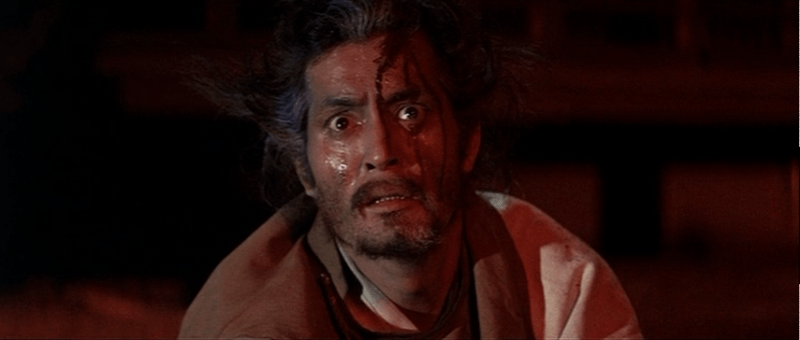
Asked to paint a vision of heaven, an artist replies that he cannot because he sees it nowhere in this present society. “Over my body and my life, you have absolute authority. But you can never command my artist’s soul,” he spits back at his corrupt lord, but in many ways the lord can command his soul as an artist for he creates the world he reflects for all that he attempts to manipulate him as a man and one he assumes to be far inferior to himself. 

Shiro Toyoda’s adaptation of the classic horror story by Ryunosuke Akutagawa, Portrait of Hell (地獄変, Jigokuhen) opens with a brief voiceover narration that explains that this story takes place almost 1000 years ago in the Heian era when the Fujiwara clan was at the height of its power. But after so long at the top of the tree, the Fujiwara have become both restless and indifferent in their complacency. “The common people live lives of hopeless despair,” the narrator explains outlining the Fujiwara’s inability to govern as even minor natural disasters give rise to famines and corpses litter the streets. Even nobles now live “lives of perpetual dread” having gained a sense of their own impermanence. 

Lord Horikawa (Yorozuya Kinnosuke) is however seemingly oblivious to the suffering of his people. Yoshihide (Tatsuya Nakadai), a Korean painter, tells him that his problem is everyone tells him what he wants to hear (because they fear for their lives) rather than what is actually happening. During the opening sequence, Horikawa had abruptly decided to leave a public celebration. An old man appeals to some of the guards for money, but they roughly beat him and he is later trampled to death by Horikawa’s frightened bull which had become loose during a storm. The old man dies cursing him, exclaiming that “he has treated us like slaves. I have become no better than an animal.” Horikawa had been told that the man used his last dying breath to remark on what an honour it was to be trampled by the lord’s bull. Yoshihide paints a picture that drives a court lady out of her mind featuring the corpse of the old man under a cherry tree that seems so vivid to her that it emanates a stench of death. Horikawa doesn’t like it much either, and its uncanny realism unsettles his mind. He thinks he sees the ghost lying in wait for him in his own bed and orders Yoshihide to dismantle the painting as if that would make the ghost disappear. 

Horikawa believes the “ghost” is a manifestation of Yoshihide’s rage rather than his own guilt or incompetence. Yoshihide certainly does not like the world the lord has made, replying that he has seen hell everywhere in the cities and the villages while there is no heaven to be had which is why he cannot paint it. Yet Yoshihide and the lord are almost perfect mirrors of each other. Yoshihide is also rigid and superior. He prides himself on being Korean, pointing out that the foundations of the court and of modern learning were all brought over by Korean scholars even if Horikawa claims to have “improved” upon them. Yet some of his fellow painters worry that the style their Korean ancestors worked so hard to perfect has been eclipsed by Japanese influence while secretly considering returning to Korea which has now become prosperous unlike the conditions in Japan. 

Horikawa later slips and calls Yoshihide a stupid “foreigner” making plain his contempt despite describing him as the greatest artist of his generation which is why he’s commissioned this piece of art in the first place even though he had described all of his previous pieces “ugly” while objecting to their attempt to show him how rotten his kingdom has become. Yet Horikawa is correct when he says that it’s Yoshihide’s “infernal arrogance” that has provoked his downfall. Having caught his daughter Yoshika (Yoko Naito) with one of his pupils, he locked her in a shed and exclaimed that no other man would have her. If he had not done so, she may never have come to the attentions of the lord and suffered her eventual degradation at his hand, nor would Yoshihide have been so easily manipulated into a obsessive desire to effectively depict the depths of hell. 

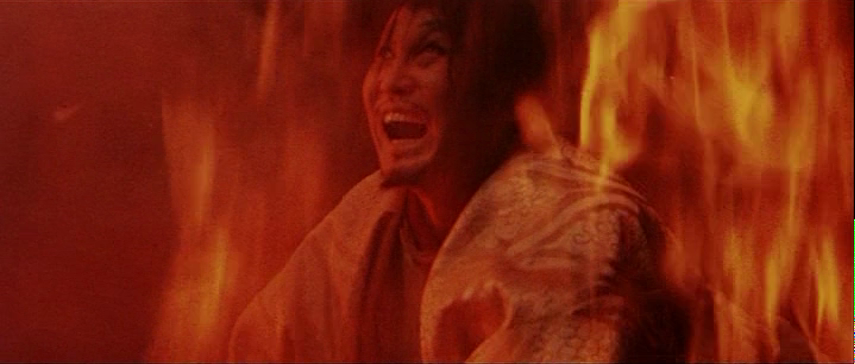
Yoshihide is some kind of method artist who insists he can only paint what he sees. Thus he goes to great lengths to observe hellish cruelty, tying up an apprentice boy in chains and torturing him with snakes, his eyes burning with a fiery intensity. His tragedy is that he comes to realise that the painting reflects not the world but himself. He is hell, hell is here. While his daughter burns, he looks on impassively only to be outdone by her pet monkey who in a gesture of selfless love leaps into the flames. Even so, Horikawa praises the finished painting as a masterpiece, “an impressive depiction of the hell that is our life,” commenting somewhat ironically on the current conditions within his fiefdom. Only latterly does he notice his own role within it, suddenly consumed by his hellishness as if dragged own into the flames despite himself. 

Toyoda shoots in the manner of a classic ghost story, making fantastic use of ghostly effects as Horikawa finds himself haunted by the spirits of those he’s wronged. At times, the screen fills with red light as if soaked in blood or baked in the hellish glow of slow burning flames. He flips between the icy blues of Horikawa’s estate, and the stifling ochre that seems to surround Yoshihide who does after all feed off all this strife rather than seeking to cure it. The two men end up in an impossible game of brinksmanship from which neither can back down, two “arrogant” rivals blindly creating a hell for those around them through their selfishness and vanity. “Life is more hellish than hell itself” runs a final quote from Akutagawa, laying bare the tale’s essential irony in our inability to recognise the hell we create for ourselves and others through our own arrogance and fear.


A Man and a Gisaeng (남자와 기생, Shim Wu-seob, 1969)

Under the authoritarian regime of Park Chung-hee, Korean Cinema was subject to increasingly stringent censorship and film was seen as an important means of moral instruction. The central message behind Shim Wu-seob’s raucous comedy A Man and a Gisaeng (남자와 기생, Namjawa Gisaeng) is that a man should be faithful to his family and avoid the double betrayal represented by drinking in the company of women which fritters away financial security and endangers his relationship with his wife. Yet the film is also subversive despite the underlying conservative message in making a mockery of so-called “traditional” gender roles.

Indeed, the film’s very thesis is that men are weak and women are strong. The men visit who gisaeng appear to have done so to reaffirm their dominant masculinity through their financial power in essentially paying women to be subservient towards them. Yet the gisaeng themselves are fully in control of the game they are playing as one makes clear when she tells a drunken businessman off after he gets handsy with her. She reminds him that a gisaeng is a person too, not a doll to be played with, and when he doesn’t listen she gets up and leaves proving who it is that has the upper hand in this situation. All the businessman can do is splutter and threaten the otherwise mild-mannered male manager. 

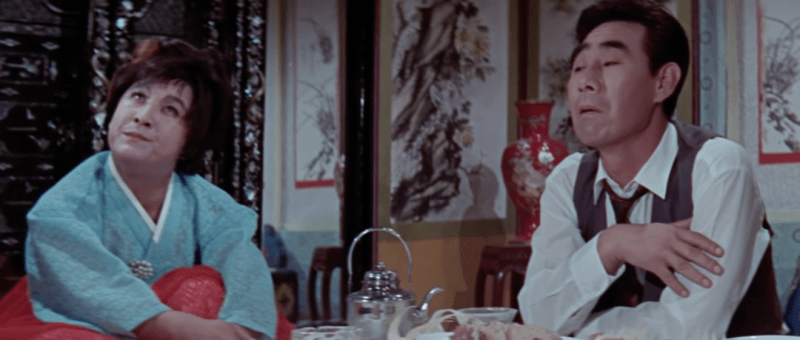
The hero’s boss, Heo (Heo Jang-gang), is a henpecked husband who visits gisaeng as a means of escape from his domineering wife (Do Kum-bong) who punishes him like a child. He asks Tae-ho (Gu Bong-Seo) to resign after catching him sitting at his desk darning socks to earn extra money and though it might be perfectly reasonable to fire an employee for brazenly doing another job on company time, Heo mainly lets him go because of his unmanliness. Tae-ho is a fully domesticated man who does work traditionally regarded as “feminine” in taking in sewing and looking after all of the domestic tasks such as cooking and cleaning as a “maternal” figure to his younger sister Tae-suk (Kim Chung-ja) who is then depicted as “manly” in her mastery of martial arts. 

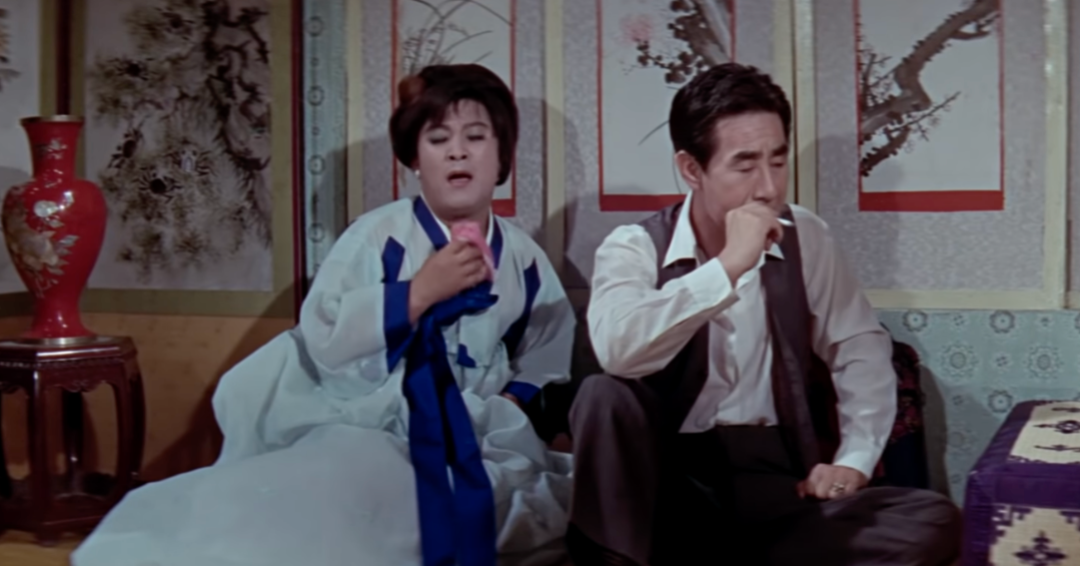
It quickly becomes clear that the “effeminate” man Tae-ho is the film’s strongest character and the only one largely in control of his circumstances. He agrees to become a gisaeng partly because he needs to earn money after being fired, but also he claims as a “joke” before committing himself to punishing men who neglect their duty to their families by shaming them into changing their behaviour as he largely does with Heo who, bizarrely, develops a fascination with Tae-ho’s gisaeng persona San-wol as she apparently reminds him of the first love he was prevented from marrying because of her family’s disapproval. 

The gender subversion is in essence the joke, but there are also constant hints that it might not be and Tae-ho’s female persona is also authentic, not least among them the music cues which are extremely ironic. For example, the melody of “Don’t Fence Me In” plays over Tae-ho at the house of gisaeng, as do the strains of “Nature Boy” which also hint at a validation of Tae-ho’s expression of femininity. Before being fired, Tae-ho tells Heo that he’s repressing himself and it isn’t good for him, and there is a (joking) suggestion in the final scenes that Heo’s attraction to San-wol is partly born of her seeming masculinity. He did indeed unwittingly appreciate a drag performance from Tae-ho’s queer-coded musician friend, after all.

It’s also possible to read Heo’s reunion with his wife as a new appreciation for her own “masculine” qualities in her capacity to dominate him even if the film simultaneously suggests that the role of a “good wife” is to offer “affection” to her husband and if the husband visits gisaeng it’s the wife’s fault for not giving it to him. Even so, what the film’s conclusion implies is closer to a rebalancing than might be expected in allowing Jeong-mi, the gisaeng with whom Tae-ho falls in love to counter any suggestion of queerness, to open her own shop as an independent woman pursuing a relationship with Tae-ho who is then a travelling salesmen selling cosmetics. Jeong-mi asks Tae-ho to give up “knitting” before they get married which would signal a remasculinisation, but Tae-suk, though dressing in a more feminine fashion to meet her in-laws, is not directly asked to give up Taekwondo and it seems that her fiancé appreciates her feistiness rather than seeking to soften it. Even Heo’s wife if seeming more cheerful has not given up control in their marriage despite her own drag experience in the gisaeng house yet their relationship is now considered “repaired”. “Traditional” gender roles have ostensibly been reaffirmed, Heo’s marriage is saved and both Tae-ho and his sister are about to marry, but they’ve also been subverted and redefined in unexpected ways. Some of this may only be possible because A Man and a Gisaeng is an absurd comedy of the kind Shim was known for, but it nevertheless hints at an underlying plea for greater social freedom in an authoritarian era. 


A Man and a Gisaeng screened as part of this year’s Queer East .

Japan Organized Crime Boss (日本暴力団 組長, Kinji Fukasaku, 1969)

A yakuza just out of jail emerges into a very different Japan in Kinji Fukasaku’s proto-jitsuroku gangster picture, Japan Organized Crime Boss (日本暴力団 組長, Nihon Boryoku-dan: Kumicho). A contemporary Oda Nobunaga is trying to unify the nation under his yakuza banner while fostering a nationalist agenda and colluding with corrupt politicians to prop up the 1970 renewal of the Anpo security treaty, but as it turns out some people aren’t very interested in revolutions of any kind save the opportunity to live a quiet life they once feared would elude them. 

As the film opens, a narratorial voice explains that the nation has now escaped from post-war chaos, but Japan’s increasing prosperity has led to a natural decline of the yakuza which has seen some try to ride the rising tides to find new ways to prosper. Exploiting its control of local harbours, the Danno group has quickly expanded though Osaka and on to the rest of the nation thanks largely to its strategist, Tsubaki (Ryohei Uchida), and his policy of convincing local outfits to ally with them and fight as proxies allowing Danno to escape all responsibility for public street violence. 

Perhaps strangely, the Danno group and others are acutely worried about optics and keen to present themselves as legitimate businessmen while using a prominent politician as a go-between to settle disputes between gangs. The yakuza already know they’re generally unpopular and fear that attracting too much attention will only bring them problems from the authorities. The politician needs Danno to look clean so that they can back them in opposing the protests against the Anpo treaty, while the yakuza organisation is later depicted as a militarised wing of the far right hoping to correct “misguided” post-war democracy while eradicating communism and instilling a sense of patriotic pride as they go. Of course, all of that will also likely be good for business while quite clearly marking these new conspiracy-minded yakuza as “bad”, hypocritical harbingers of a dangerous authoritarianism. 

Tsukamoto (Koji Tsuruta), the recently released lieutenant of the Hamanaka gang, is conversely the representative of the “good” yakuza who still care about the code and are genuinely standing up for the little guy against the oppressive forces now represented by bad yakuza. Hamanaka had allied with Danno while Tsukamoto was inside and was thereafter targeted by the local Sakurada group who have joined the Tokyo Alliance of yakuza clans opposed to Danno who continue to fight them by proxy. After his boss is killed and tells him that joining Danno was a mistake, Tsukamoto’s first thought is to rebuild the clan which he does by remaining neutral, refusing to engage in Danno’s proxy wars while protecting his men from their violence as mediated by the completely unhinged, drug-addled Miyahara (Tomisaburo Wakayama) and the anarchic Hokuryu gang. 

Miyahara comes round to Tsukamoto precisely because of his pacifist philosophy after he kidnaps one of his men and Tsukamoto stands up to him while making a point of not fighting back. As crazed as he is, Miyahara is a redeemable gangster who later also turns on Danno regretting having agreed to do their dirty work for relatively little reward. After a gentle romance with the sister of a fallen comrade, Tsukamoto, who lost his first wife to suicide while inside, begins to dream of leaving the life behind but as he and others discover there is no real out from the yakuza and the code must always be repaid. In failing to protect his clan he fails to save himself and becomes a kind of martyr for the ninkyo society taking on politicised yakuza and their lingering militarism. 

Fukasaku takes a typical ninkyo plot of a noble gangster standing up for what he believes is right against the forces of corruption and begins to undercut it with techniques such as voiceover narration and onscreen text that he’d later use in the jitsuroku films of the 1970s which firmly reject the idea of yakuza nobility seeing them instead as destructive forces born of post-war chaos and increasingly absurd in a Japan of rising economic prosperity. Men like Tsukamoto are it seems at odds with their times, unable to survive in the new society in which there is no longer any honour among thieves only hypocrisy and self-interest. 


Bullet Wound (弾痕, Shiro Moritani, 1969)

“Your love for your country can’t change anything now” the conflicted hero of Shiro Moritani’s conspiracy thriller Bullet Wound (弾痕, Dankon) is advised as a villainous chaos agent attempts to convince him to switch sides. Like many of Toho’s gunman dramas of the late ‘60s, Bullet Wound anticipates the cinema of paranoia which would take hold in the following decade set against the constant anxiety of the ANPO protests while the Japanese-American CIA agent hero struggles with his uncertain place in a world of geopolitical instability. 

Takimura (Yuzo Kayama) is a man with two countries, born in the US to Japanese parents but later orphaned, now working for the CIA in Japan. Perhaps tellingly, we can’t initially tell what side he’s on even as he tries to prevent an assignation attempt on some kind of dignitary connected to the US. The main crisis occurs when Takamura helps a Chinese man, Yang (Shin Kishida), escape a trade summit in order to defect and chase freedom in America. The Americans, however, then torture him until he finally admits that he’s a stooge, the defection was merely a means of getting him into the US as a spy while the trade delegation is only a front for an upcoming arms deal with a international smuggler known as “Tony Rose” (Andy Seams). Takimura and his team are obviously keen the transaction not take place, but are unable to take Rose out because as Takimura’s boss points out they’ve used him too and he’s too well connected. If they move against him, someone will move against them. 

The Chinese arms deal is linked back to a sense of cold war paranoia which spreads to the young students protesting the ANPO treaty. Takimura’s boss calls them “terrorists” unable to understand how there can be Japanese people who could do this to their own country seemingly unaware of the minor irony in his statement. Meanwhile, he prepares to sacrifice Takimura as need be, callously remarking that a man with two countries who can’t choose between them can be dangerous while admitting that his services have been useful to the Americans but they may not always be so. The Americans meanwhile make crass racist remarks while chasing down the Chinese spies, taking altogether too much pleasure in eradicating them while the hitherto stoical Takimura looks on with disapproval mixed with hurt and shame beginning to wonder if he’s really on the right side. “You and the US will never defeat us” his rivals insist, revealing a mind-blowing piece of info that sets Takimura on a collision course with fate. 

Meanwhile, a strange young artist crafts horrifying statues displaying the “agony of loneliness” and longs to escape Japan for South America where they apparently have the best stone. But as someone later tells her, the desire to go to a new land is not born of hope, and expectations are almost always betrayed. Only love can change everything into hope he tells her, as she pins hers on running away with Takimura while he tries to tie up a few loose ends. Yet there’s also a kind of fatalism that defines their relationship, Takimura reflecting on watching a man die up close and haunted by the searching look in his eyes as if he were trying to understand the meaning not of life but of death. An ironic street singer sings a sad song about those who die and what they leave behind, the soldier apparently leaving not a trace of peace. 

The implication is perhaps that Takimura’s dual nationalities are not viable, that a man with two countries cannot escape by choosing a third nor can he survive without sacrificing one or the other. Meanwhile, Moritani slides into anti-Americanism painting the CIA as duplicitous and exploitative as they simultaneously demonise the Japanese and position men like Tony Rose as international chaos agents destabilising the global order. Handheld photography adds to the sense of anxious immediacy and confusion as Takimura attempts to define his own identity only to discover perhaps that he no longer has one caught as he is between two nations as two selves at the heart of a silent war. 


Dangerous Youth (危險的青春, Hsin Chi, 1969)

Increasing consumerism has begun to corrupt the minds of the young in Hsin Chi’s ultra contemporary Taiwanese-language drama Dangerous Youth (危險的青春). Unlike similarly themed youth movies from elsewhere such as Kim Ki-duk’s Barefooted Youth (1964, inspired by Ko Nakahira’s Doro Darake no Junjo) or Nagisa Oshima’s Cruel Story of Youth (1960), Hsin’s film is nowhere near as nihilistic as its title might suggest nor are its heroes as delinquent merely morally compromised as they attempt to navigate the changing society around them while feeling as if the things they want have been deliberately placed out of reach. 

As the film opens, Khue-guan (Shih Ying) is cheerfully riding on his motorcycle with his current girlfriend on the back behind him, only the trip comes to an abrupt halt when the bike, a symbol of his freedom and independence, gets a flat tire. The pair pull over to a roadside garage to get it fixed and wait in a nearby cafe where they’re served by waitress Tsing-bi (Cheng Hsiao-Fen) who happens to be the owner’s daughter. While they’re waiting, Khue-guan’s girlfriend contemptuously dumps him, complaining that his bike is always breaking down and she’s decided to marry a financially secure engineer while attempting to palm Khue-guan off on Tsing-bi who ironically has a haircut quite like hers and is dressed almost identically. Khue-guan tries to change her mind, but she reminds him that marriage is “a woman’s meal ticket” so why would she or anyone else for that matter marry a poor delivery boy if a better offer came along? 

Khue-guan innocently insists that if they stay together and work hard they’ll be rich someday too, but his girlfriend has no desire to wait and no inclination to strive. It’s this ideology of working class aspiration that if you just buckle down and play by the rules you can one day have a comfortable life that is at the centre of the film’s ideological conflict, Khue-guan himself later hearing the same words from Tsing-bi when she refuses to become the mistress of the wealthy widower Mr. Tshi (Chen Tsai-Hsing) but having become so jaded that he no longer believes them only to be apparently converted when a work colleague gives him the same advice that he should give up on the boss’ sexually liberated daughter and find someone who loves him with whom he can work together to build a happy family home. 

The happy family home, a conventional middle-class success story, was Khue-guan’s small dream at the beginning of the film before his girlfriend’s slight caused him to lose his way. His crisis is also one of threatened masculinity, feeling himself inferior by virtue of a poverty he does not know how to escape lamenting to an old friend that only college men like him can find good jobs in the changing, increasingly white collar society. In a minor role reversal, it’s clear that women have gained increasing freedom and agency and in fact here hold the power as reflected in the masculinised figure of boss’ daughter Giok-Sian (Kao Hsing-Chih) who runs a hostess bar and refuses to get married instead living a sexually liberated life without romantic attachment. Part of Tsing-bi’s resentment towards her mother (Su Chu) stems from her sexually active love life in which it seems she too has the upper hand. In a repeated motif, we see Tsing-bi’s mother hand money to her lover so he can take time off work, something Tsing-bi later does to Khue-guan who without quite thinking about it has begun to live through her exploitation only objecting when offered money by Giok-Sian who rejects his romantic overtures interested only in bodily satisfaction. 

This gender imbalance is later “corrected” towards patriarchal norms as Giok-Sion is finally forced to accept that she is in love with Khue-guan just at the moment he receives his epiphany that the way he’s been living is wrong, love is more important than money, and he needs to get back on the straight and narrow to earn success by working hard rather than exploiting others. Nevertheless, there is plenty of toxic masculinity in the air, the friends of the ageing Mr. Tshi apparently mocking him for his literal impotence, his masculinity questioned in the absence of a female sexual partner. Though as we discover Mr. Tshi is simply lonely having lost his wife and seemingly having no children, asking Tsing-bi only for cuddles and companionship. There is something distinctly uncomfortable in the way that Tsing-bi is thrown at Mr. Tshi like a like live chicken into a pit of crocodiles by Giok-Sian, her father, and his friends each of whom are trying to curry favour for business advantage by exploiting her. With her short hair and tendency to wear pinafore dresses, not to mention often carrying around teddy bears and oversize dolls, the 20-year-old and extremely naive Tsing-bi seems even younger than she is, an innocent little girl misused by an increasingly corrupt society. 

Even so Tsing-bi remains the least corrupted of the youngsters, clinging to her love for Khue-guen never realising he too is just using her for easy money even as she ironically throws his own words back at him in suggesting they marry, work hard, and raise a happy family together. Though it was her consumerist desires that originally set her against her mother in her yearning for current fashions and sophisticated city life, she never really wanted the money only Khue-guan while ironically mimicking her mother’s behaviour in accidentally making him a kept man. The reset which occurs at the film’s conclusion at once restores traditional gender roles but also perhaps shifts them in stressing the need of the couple to work “together” even if that sentiment might imply a greater equality than is in reality in play. Nevertheless, perhaps for reasons of censorship (which might also explain why despite the film’s obvious Taiwan setting frequent references are made to Hong Kong landmarks) the conclusion is not as bleak as one might assume from the rather nihilistic, moral panic implications of the title as the young couple are finally placed back onto the “correct” path of honest hard work which is also in its own way a capitulation to their own exploitation at the centre of an expanding, increasingly capitalistic society. 


Dangerous Youth streams in the UK until 31st October as part of this year’s Taiwan Film Festival Edinburgh.

Trailer (Traditional Chinese / English subtitles)