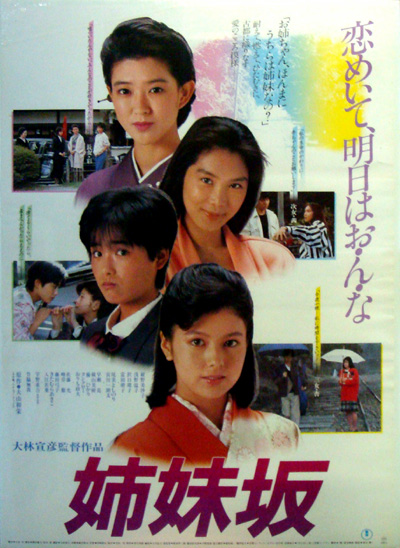
Four Sisters (姉妹坂, Nobuhiko Obayashi, 1985)

Four SistersNobuhiko Obayashi takes another trip into the idol movie world only this time for Toho with an adaptation of a popular shojo manga. That is to say, he employs a number of idols within the film led by Toho’s own Yasuko Sawaguchi, though the film does not fit the usual idol movie mould in that neither Sawaguchi or the other girls is linked with the title song. Following something of a sisterly trope which is not uncommon in Japanese film or literature, Four Sisters (姉妹坂, Shimaizaka) centres around four orphaned children who discover their pasts, and indeed futures, are not necessarily those they would have assumed them to be.

Yasuko Sawaguchi plays the third oldest sister and more or less protagonist of the story, Anzu, who is facing a very common teenage dilemma in that there are two boys (best friends) both interested in her and she can’t decide if she likes both, one, or either of them. Eventually, Yuzuki (Ichirota Miyakawa) wins out leaving his friend Oba (Toshinori Omi) depressed and on the sidelines. However, Yuzuki is from a wealthy family and it was intended he marry a cousin so his mother does some digging and discovers more about Anzu than Anzu knew about herself.

As it turns out, the four sisters are not actually related by blood as only one was the biological child of the goodhearted couple who raised them. Unfortunately, the children’s adoptive parents died in a car accident leaving their birth daughter, Aya (Misako Konno), as a kind of maternal figure to Akane (Atsuko Asano), Anzu, and Ai (Yasuko Tomita) though Akane was the only one old enough to remember their lives before coming to live with Aya and her family. The rediscovery of the truth knocks both younger girls for six, especially as Anzu’s birth mother has reappeared and presents an existential threat to their insular family of four.

Set once again set in a peaceful, countryside town, Four Sisters revisits many of Obayashi’s constant concerns in its evocation of memory, mislaid truth, and the need to come to terms with the past in order to go on living in the present. The four young women are each very different, but bound tightly together by their shared experience, including the recent loss of their parents. Anzu’s discovery threatens to destroy the family firstly through the exposure of a lie (or, what is really an omission of truth), and secondly to speed up the inevitable fracturing as she begins to seek a new life and eventually family of her own. Though Akane has been able to forge a career for herself (less pleasant part-time work aside), she rightly points out that in becoming their maternal figure, Aya has in a sense lost or rejected the opportunity to pursue her own happiness. The sisters’ bond is tight and near unbreakable, but it’s also, in a sense, constraining.

Obayashi begins the picture with in a polaroid-like frame in which the two boys declare their intentions to duel for Anzu’s affections. As the film moves on, Obayshi returns to these intertitle-like captions particularly in bookending the various seasons throughout which the film turns. Though not as radically as in some of his other work, Obayashi once again uses colour filtering as a highlighting tool which is most obvious towards the end as the edges of the screen start to blur, greying out everything other than our central heroines. However, other sequences take place in a noticeably expressionist environment with extreme colour contrasted backgrounds and unreal, star filled skies and Obayashi also allows the real world weather with its storms and raging rivers to dictate the mood.

Four Sisters is, at heart, a family drama though one seen through a slightly distorted mirror. The four girls are indeed a unit which would inevitably have to split or stagnate in the normal order of things but the bonds are strong enough to withstand the unusual amount of pressure placed on them, enabling the sisters to move on with their individual lives whilst remaining close. Obayashi keeps things relatively low key (by his own standards) but gently builds a melancholy, nostalgic tone filled with loss and regret yet also with hope for the future. Beautifully shot, with Obayashi’s characteristically unusual use of imagery and wistful, ethereal atmosphere Four Sisters may not be among the director’s most experimental efforts but does provide a warm tale of love lost and gained in the lives of four ordinary women.


The Little Girl Who Conquered Time (時をかける少女, Nobuhiko Obayashi, 1983)

Little Girl Who Conquered TImeThe Girl Who Leapt Through Time is a perennial favourite in its native Japan. Yasutaka Tsutsui’s original novel was first published back in 1967 giving rise to a host of multimedia incarnations right up to the present day with Mamoru Hosoda’s 2006 animated film of the same name which is actually a kind of sequel to Tsutsui’s story. Arguably among the best known, or at least the best loved to a generation of fans, is Hausu director Nobuhiko Obayashi’s 1983 movie The Little Girl Who Conquered Time (時をかける少女, Toki wo Kakeru Shoujo) which is, once again, a Kadokawa teen idol flick complete with a music video end credits sequence.
As in the novel, the story centres around regular high school girl Kazuko Yoshiyama (Tomoyo Harada). She has two extremely close male friends (generally a recipe for disaster, or at least for melodrama but this is not that kind of story) – Horikawa and Fukamachi, and one Saturday while all three are charged with cleaning up the schoolroom, Kazuko ventures into the science lab where she sees a beaker on the floor emitting thick white smoke which smells strongly of lavender causing her to pass out. Everyone seems to think it’s either hunger, anaemia, or that old favourite “woman’s troubles” but from this day on Kazuko’s life begins to change. The same day repeats itself over and over again with minor differences and Kazuko also begins to experience multilayered dreams in which her friends are in some kind of peril.

Tsutsui’s original novel was a Kadokawa Shoten property (though first published 15 years previously) which made it a natural fit for the Kadokawa effect so when legendary idol master Haruki Kadokawa found an idol he was particularly taken with in Tomoyo Harada the stars aligned. Obayashi set the story in his own hometown, the pleasantly old fashioned port village of Onomichi, which adds a nicely personal feel to his take on the original story. Although The Little Girl Who Conquered Time is an adaptation of a classic novel, many of Obayashi’s regular concerns are present from the wistful tone to the transience of emotion and the importance of memory.

Kazuko is another of Obayashi’s young women at a crossroads as she finds herself wondering what to do with the rest of her life. The original timeline seems to point to a romance and possibly a life of pleasant, if dull, domesticity with one of her best friends but with this time travelling intrusion everything diverges. Though assured that she will not remember most of the strange events that have been happening to her, something of her adventures seems to have stuck in Kazuko’s mind even if she couldn’t quite say why. Much to the consternation of her mother, Kazuko’s purpose in life begins to lean to towards the scientific rather than the romantic, almost as if she’s waiting for the return of someone whom she has no recollection of having met.

Obayashi once again uses conflicting colour schemes to anchor his story. Beginning with black and white as Kazuko has her first encounter with someone she’s known all her life under the brightly shining stars, he gradually re-introduces us to the “real” world through sporadically adding colour during her bus ride home to her small town which does have a noticeably more old fashioned aesthetic when compared to Tokyo set features of the era. The effects are highly stylised and very much of their time including the celebrated time travel sequence which has Kazuko framed by a neon blue halo. The most touching sequence occurs near the end of the film in which Kazuko crosses paths with a familiar face that she doesn’t quite recognise, the camera perspective actively changes physically pulling us away from the encounter until Kazuko turns around and walks away in the opposite direction and into yet another empty corridor.

Tomoyo Harada developed into a fine actress with a long standing and successful career in both television and feature films as well as releasing a number of full length albums. As is usual with this kind of film she also sings the theme tune which has the same title as the movie though in an unusual movie Obayashi includes a music video retelling of the events of the film over the end credits featuring all of the cast helping Harada to perform the song with silly grins on their faces all the way through. Harada proves herself much more adept at convincingly carrying a feature length movie than some of her fellow idols but the same cannot be said for many of her co-stars though she is well backed up by established adult cast members including Ittoku Kishibe as Kazuko’s romantically distressed teacher.

The Little Girl Who Conquered Time is first and foremost a Kadokawa idol movie and has all the hallmarks of this short lived though extremely successful genre. Necessarily very much of its time, the film has taken on an additional layer of nostalgic charm on top of that which has been deliberated injected into it. Nevertheless, in keeping with Obayashi’s other work The Little Girl Who Conquered Time has a melancholic, wistful tone which is sentimental at times but, crucially, always sincere.


Original trailer (no subtitles)

And here’s the famous music video for the title song (which is of course sung by Tomoyo Harada herself). English Subtitles!

W’s Tragedy (Wの悲劇, Shinichiro Sawai, 1984)

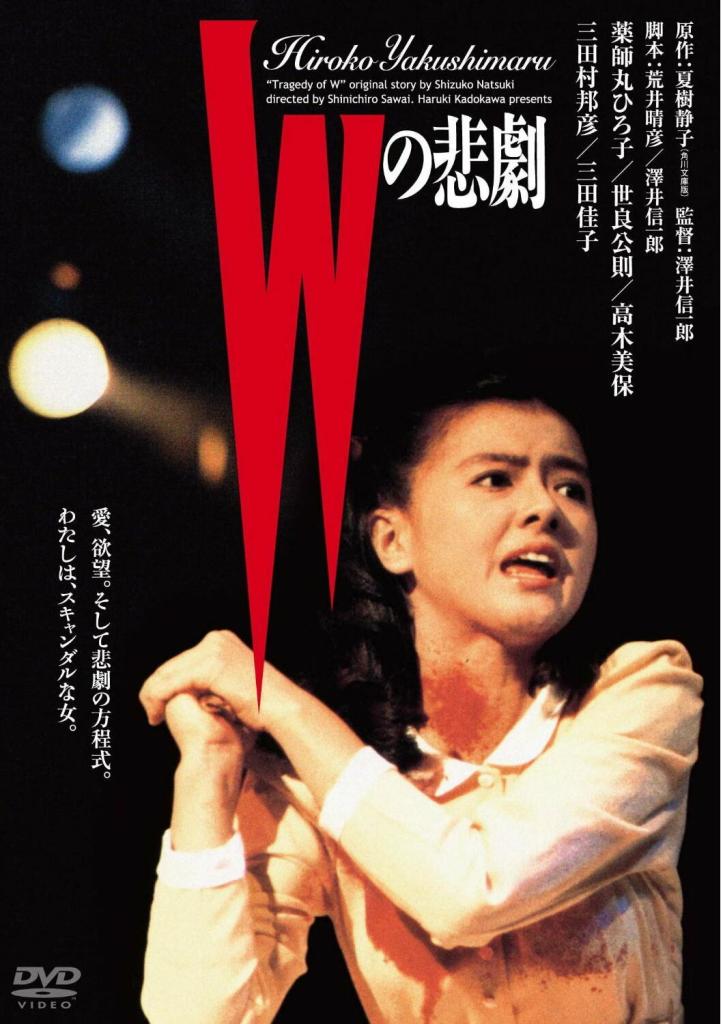
W's TragedyHiroko Yakushimaru was one of the biggest idols of the 1980s. After starring in Shinji Somai’s Sailor Suit and Machine Gun, she went on to become one of Kadokawa’s tentpole stars in vehicles such as Detective Story and Main Theme but she hit her artistic stride in 1984’s W’s Tragedy (Wの悲劇, W no Higeki) which earned her her first Blue Ribbon award for Best Actress. Inspired by the 1982 novel of the same name by Shizuko Natsuki (translated into English under the title Murder at Mt. Fuji), Sawai’s film radically diverges from its source material as the central murder mystery takes place on stage but eerily begins to mirror real life events.
Shizuka Mita (Hiroko Yakushimaru) is an aspiring young actress desperate to find her place in the spotlight. After spending the night with her teacher, she wanders home through a park and begins monologuing her life on the stage of an outdoor amphitheatre. Unbeknownst to her, a young man was sleeping on one of the rear benches and wakes up to applaud her performance. Despite her hostility towards him, Akio perseveres in getting Shizuka’s attention and the two eventually develop a tentative relationship.

Shizuka’s acting school offers its pupils the opportunity to star in a full scale production with established stars of the stage as part of their training and this year’s play is based on the recent novel, W’s Tragedy, which centres around a murder in an aristocratic family. Shikuza is desperate to win the leading role of Mako who claims to have murdered her grandfather after he tried to assault her. Losing out in the original auditions process but winning a small role which also comes with some backstage craft experience, Shizuka begins to lose heart. However, after building up a relationship with the star actress in the show, Shizuka is offered the opportunity to displace her rival through underhanded means but just how far is she willing to go for stardom and what will it all mean if and when she gets it?

Taking its cues from All About Eve, W’s Tragedy, reconfigured as a vehicle for Yakushimaru, becomes more about dualities as Shizuka effectively splits into two different “selves” – the young and innocent girl dreaming of a life on the stage, and the insecure, ambitious student willing to sacrifice anything to get there. Though clearly conflicted, Shizuka easily gives in to dubious suggestions that will earn her what she wants though not perhaps in the way that she wanted it. Her rival is shown to be a very competent actress who has also sacrificed parts of herself to attain the position that Shizuka so covets though it’s the older actress, Sho, who is the first to lament the fate of the displaced former leading lady even if she adopts a casualty of war ethos about the whole entrprise.

Shizuka gives the best performance of her life at a press conference held when she replaces the other actress in the show as she lies through her teeth to reinforce the fake story she and Sho have concocted together to their mutual benefit. Taking the brunt of a scandal just as Mako tries to take responsibility for a crime in the play, Shizuka becomes rather than performs an entirely different persona as she gives a heartfelt account of a passionate love affair with a married man that belongs to someone else entirely. Taken to task by Akio who doesn’t know the story is fake but has come to despise this manipulative side of the acting profession, Shizuka begins to wonder who she really is underneath all of the lies, scheming, and performance.

Though the directing style is generally straightforward and in keeping with Kadokawa’s mainstream idol movies of the time, Sawai adds in a few interesting flourishes which often pay homage to similarly themed Western movies such as an overtly All About Eve moment with Shizuoka taking to the stage and reciting the lead role when she thinks no one’s looking. A strange shot near the end takes place during the play but has been constructed entirely for our benefit as Shizuka looks at her reflection on a pane of glass. The audience would not be able to pick up on this ghostly effect of the two Shizukas – the stage persona and the shade of the innocent girl dreaming of the spotlight, but the effect itself is a perfect evocation of the ever present theme of duality.

Very much of its time and bearing most of the hallmarks of the classic Kadokawa idol movie, W’s Tragedy is, in many ways, the evocation of another era. However, it does provide a plum leading role for its star and an interesting meditation on the nature of acting as a profession as well as the double standards and hypocritical judgements inherent to the running of the entertainment industry.  Though less explosive than the later Perfect Blue with which it shares a few common themes, W’s Tragedy provides another set of mirrors into the nature of stardom, identity, and the price of success.


Unsubbed trailer (look out for a brief cameo from the late Yukio Ninagawa):

And here’s a clip of Hiroko Yakushimaru singing the title song at her 30 year anniversary concert back in 2013:

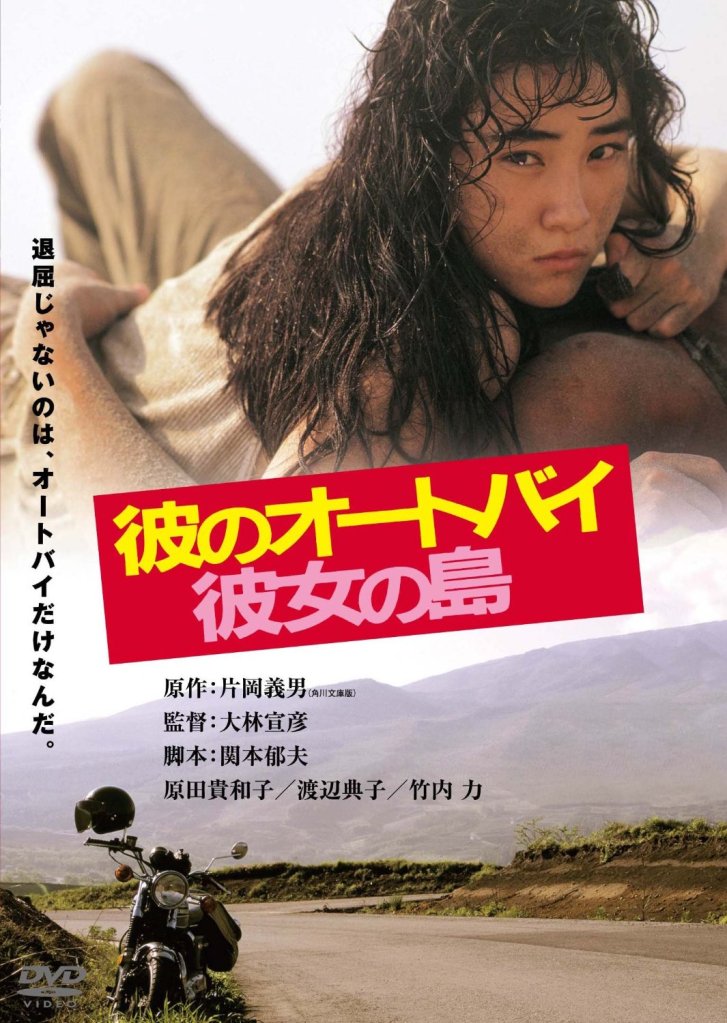
His Motorbike, Her Island (彼のオートバイ彼女の島, Nobuhiko Obayashi, 1986)

His Motorcycle Her IslandLike many directors during the 1980s, Nobuhiko Obayashi was unable to resist the lure of a Kadokawa teen movie but His Motorbike, Her Island (彼のオートバイ彼女の島, Kare no Ootobai, Kanojo no Shima) is a typically strange 1950s throwback with its tale of motorcycle loving youngsters and their ennui filled days. Switching between black and white and colour, Obayashi paints a picture of a young man trapped in an eternal summer from which he has no desire to escape.

Ko (Riki Takeuchi) tells us that he’s an unusual guy because most people dream in colour but all of his dreams are in monochrome. He’s a student and dispatch rider overly attached to his admittedly very handsome Kawasaki motorbike. After getting beaten up by his boss due to deflowering the guy’s sister and then breaking her heart, Ko skips town for the open road, just him and his bike. However, he repeatedly runs into the same mysterious girl who lives on an equally mysterious island and develops a deep seated need for her, secondary only to that for his bike. Miyo (Kiwako Harada) has also taken a liking to the Kawasaki and is intent on getting her full motorcycle license. Her growing obsession with the bike threatens to become an all consuming need driving a wedge between the two young lovers.

Obayashi begins in a black and white sequence window boxed in the centre of the screen before expanding to 4:3 when Ko has his fight with his boss and only hits 16:9 for the first colour scene which sees Ko taking off on his beloved bike. He told us that his dreams are in black and white but the film seems to disagree with him, segueing into various gradated colour schemes as Ko narrates his melancholy tale of tragic lost love. Ko is not necessarily a very reliable narrator in any case, but in each instance the on screen action is always coloured by the recollections of the older man who offers his voice over commentary.

Like many Obayashi films, the overriding feeling is one of melancholy mixed with a youthful apathy.  This is a story about modern young people, but refracted through rebellious ‘50s movies from Rebel Without a Cause to The Wild One and a hundred others inbetween. Ko is a university student (of what we don’t know) but seems to have no great ambitions. He takes things as he finds them and his only passion is the bike itself. When he first meets Miyo and she asks him where he’s going, he simply replies that he’s “looking for the wind” – a motif which recurs throughout the film.

Later on when he arrives at Miyo’s island, it takes on an opposing symbolism to his bike. Just as Miyo can’t get enough of the Kawasaki, Ko is originally attracted to the island much more than to the girl. It’s not quite a coincidence that each time he visits there it’s the Bon festival where the dead are temporarily allowed to return to the world of the living. Later he says that Miyo wasn’t just a girl but an island, and he wan’t just a boy but a bike, and together the two of them became the wind. They became one entity, inseparable one from the other. Finally the esoteric colour scheme begins to make sense, we’ve been watching a ghost story all along. This island is an unreal place, existing only inside Ko’s memory where Miyo waits for him with a full tank of gas.

Once again youth is seen as a brief yet unforgettable period filled with longing and regret. The older man is forever trapped by this one glorious summer, a place to which he can never return but neither can he escape. The nihilistic tone and voice over narration have an edge of the French New Wave but ‘50s American cinema of alienation seems closer to Obayashi’s intentions. An elliptical and strange tale of tragic love retold as a ghost story, filled with phantoms of memory and landscapes coloured by dream and emotion, His Motorbike, Her Island is another characteristically offbeat effort from Obayashi which once again embraces the aimlessness of youth and age’s regret.


Unsubtitled trailer – goes through to a video of Kiwako Harada singing the title song, in case you were in any doubt what this movie is for.

Or, here is the film’s opening (which also features the title song)

The Deserted City (廃市, Haishi, Nobuhiko Obayashi, 1984)

haishiNobuhiko Obayashi might be most closely associated with his debut, Hausu, which takes the form of a surreal, totally psychedelic haunted house movie, but in many ways his first feature is not particularly indicative of the rest of Obayashi’s output. 1984’s The Deserted City (AKA Haishi, 廃市), is a much better reflection of the director’s most prominent preoccupations as it once again sees the protagonist taking a journey of memory back to a distant youth which is both forgotten in name yet ever present like an anonymous ghost haunting the narrator with long held regrets and recriminations.
Based on a novel by Takehiko Fukunaga, The Deserted City is a European influenced, nostalgic, coming of age tale in which university student Eguchi travels to a small Japanese backwater famous for its canals. Though not as sophisticated as Venice itself, the town shares something of the atmosphere of that city as it has often been evoked in literature in its slightly claustrophobic, decaying grandeur. Eguchi has come to the town on an invitation from his uncle and with the intention of spending the summer there to finish his undergraduate dissertation which concerns the work of Edgar Allen Poe.

However, Tokyoite Eguchi immediately finds the town strange, if mostly charming, with its old fashioned rhythms and almost silent soundscape in which only the lapping of the village’s many rivers is audible. Staying in a guest house run by 19 year old Yasuko and her grandmother, Eguchi begins to hear gentle sobbing at night and jumps to the conclusion it must belong to Yasuko’s married older sister, Ikuyo, whom he has yet to meet. Younger brother Saburo also lurks silently in the background with the brother-in-law, Naoyuki, making infrequent appearances. Eguchi had apparently almost forgotten about this single summer in his youth, but was reminded of it after reading a newspaper report that the town had been destroyed in a fire. His memories are coloured by the tragedy which occurred towards the end of his stay and which his youthful soul was not fully able to understand.

The Deserted City revisits many of the themes which came to define Obayashi’s career from the nostalgia for youth and the power of memory to a vaguely supernatural tone which prefigures the final traumatic event that will continue to haunt the protagonist, even if unconsciously, for the rest of his life. Fukunaga was himself very much influenced by European literature and The Deserted City has a distinctly Western feeling with its death ridden canal town and once grand family in decline. Eguchi’s thesis is on the work of Edgar Allen Poe and it wouldn’t be a stretch to say that he is reading his studies into the story of his own life with the mysterious crying and hidden sister not to mention family secrets and the frequent allusions to the sorry state of the moribund city.

Eguchi describes Yasuko as “cheerful” yet she herself offers the most melancholic commentary of her life. She says she hates the town and can’t stand the constant sound of the waters which she likens the death wail of her city – a slothful sound without energy or purpose. She can see all the other young people leaving with only the elderly remaining behind to decay along with the town, but when Eguchi asks why she doesn’t leave too she replies that she can’t, she’s bound to this place in life and death. Similarly when making a visit to her mother’s grave at a nearby temple she remarks that in this place of stillness, she can no longer discern a difference between the living and the dead. Finally, after all the tragedies that have befallen her, Yasuko declares herself to be “nothing at all” and in bidding Eguchi goodbye as he leaves, corrects him when he promises to visit – she knows she’ll never see him again, he will return to the world of the living. He’ll forget all of this, as if it happened in a dream.

Like many of these stories, The Deserted City is filled with the detached melancholy of the older man looking back at the young one. Eguchi says this incident taught him to expect tragedy from the very beginning of things though he also claimed to have forgotten all about the town and its sad stories of longing and misunderstandings, romantic and otherwise. Working with ATG here Obayashi opts for a nostalgic 4:3 frame and a moderately warm colour palate which echoes both the slightly idealised atmosphere of the idyllic waterside village and its nature as a place which exists solely in memory, shaded in tones of nostalgia but also of regret. Much more conventional than some of Obayashi’s other work, The Deserted City is a perfect blend of European romanticism, melodrama and slight gothic undertones which, though a little low on impact, is a perfect synthesis of his themes up to this point.


Unsubbed trailer:

At This Late Date, the Charleston (近頃なぜかチャールストン, Kihachi Okamoto, 1981)

At this late date, the charlestonKihachi Okamoto first made his name with his samurai movies but his output was in fact far more varied in tone than the work most often screened outside of Japan might suggest. Marked by heavy irony and close to the bone social commentary, Okamoto’s movies are nothing if not playful even in the bleakest of circumstances. He first teamed up with Japan’s indie power the Art Theatre Guild for The Human Bullet in 1968 which recounted the absurd final days of the war in true Okamoto fashion and then bounced back to the Edo era for Battle Cry before deciding on the very contemporary satire At This Late Date, the Charleston (近頃なぜかチャールストン, Chikagoro Nazeka Charleston) in 1981.

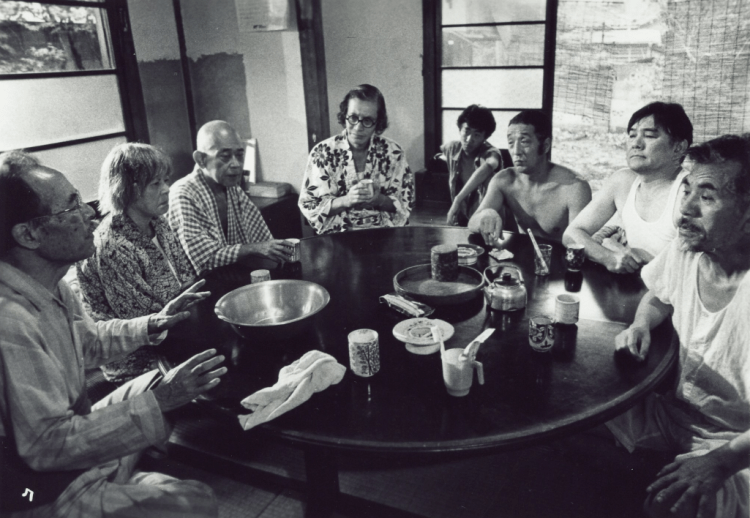
Shot in 4:3 and a stately looking black and white, At This Late Date, the Charleston begins when Jiro – a slightly strange younger son of a wealthy family, punches out a girl’s boyfriend whilst the pair are sitting on a bench and subsequently chases her through the park util he eventually gets himself arrested on a charge of “attempted rape”. He then gets thrown into a cell with a gang of crazy old guys who took the decision sometime ago to secede from the state of Japan and create their own independent nation known as the land of Yamatai. Consequently, they all refer to each other by their “cabinet titles” such as Foreign Minister and Army Minister etc each inspired by their former lives which is why they have a minister for mail (he used to be a postman). They’re in jail because they tried to make a “state visit” to the Diet building and whilst there enjoyed some of the canteen food but as this was an official event they didn’t see why they should pay for any of it (and their Finance Minister was busy at the races).

Soon enough everyone gets released – the old guys when the Finance Minister turns up to pay their bill and Jiro when he’s bailed out by his older brother and the family housemaid (who quickly realises the “victims” aren’t quite what they seem). However, in a fantastically weird coincidence it turns out that the government of Yamatai have commandeered a house on the estate of Jiro’s father for their sovereign territory. Jiro’s brother is desperate to evict them but there’s also the problem that their multimillionaire dad has been missing for months and no one’s quite sure what might have happened to him…

Crazy old guys (and gal) who’ve become so disillusioned with their nation that they’ve started a new one on their own, missing industrialists, a Lupin III-like policeman who’s so obsessed with looking cool that the suspects always run away while he’s left striking a pose – Okamoto really knows how to pile on the strangeness, but somehow it all seems to make perfect sense. Madcap doesn’t even begin to do justice to crazy cartoon world Okamoto has created but it’s all so effortlessly funny that it hardly matters what you’d call it.

After initially being captured and branded a spy when he marches on over to Yamatai to ask them about his father, Jiro finds himself defecting to become “Minister of Labour” (this seems to involve doing all of the old guys’ menial tasks). As the youngest member of the group, he becomes the repository for their stories which mostly date back to the days of their youth from the fun loving Charleston era to the rise of militarism and eventually the war itself. This comes to the fore even more as the events take place in August, meaning that there’s both the anniversary of the atomic bomb and of the end of the war raising painful memories for this group of older folks, even if not quite so relevant to the younger contingent. The gang are planning a special trip to a hot spring on the 15th, but first they have to defend their micro-country against the onslaught of gangsters and bailiffs who are trying to “invade” their sovereign territory.

The old folks are pacifists, more or less (they didn’t really want an “Army Minister” but it was argued that no one would take them seriously without means of defence) but are still determined to protect their ideal state of Yamatai all the while clamouring for a silent kind of diplomatic immunity. They have some very unusual ideas but they know what’s what and having made an unlikely ally in the form of an unhappily married and soon to be retired policeman, have even managed to expose a little corruption and evil corporate shenanigans in the process of defending their own freedom. A vote for dancing cheerfully over a military march, At This Late Date, The Charleston is a warm and funny tale of eccentric oldsters who’ve seen it all before and finally decided it’s all kind of ridiculous anyway which can’t help but get your own toes tapping, whatever age you are.


Several unsubtitled trailers for the price of one:

Detective Story (探偵物語, Kichitaro Negishi, 1983)

Dective Story 1983Yusaku Matsuda became a household name and all round cool guy hero thanks to his role as a maverick private eye in the hit TV show Detective Story, however despite sharing the same name, Kichitaro Negishi’s Detective Story movie from 1983 (探偵物語, Tantei Monogatari) has absolutely nothing to with the identically titled drama series. In fact, Matsuda is not even the star attraction here as the film is clearly built around top idol of the day Hiroko Yakushimaru as it adapts a novel which is also published by the agency that represents her and even works some of her music into the soundtrack.

As far as plot goes, Detective Story is the kind of good natured, innocent crime thriller that has all but disappeared since the 1980s. Yakushimaru plays teenage student Naomi who is due to move to America to be with her father in the very near future. However, Naomi is an inquisitive, mildly rebellious sort with a habit of sneaking out of her room through the window despite the fact that no one is preventing her simply leaving through the front door. Consequently someone or other has hired a detective, Tsujiyama (Matsuda), to keep an eye on her. This he does pretty well until he puts a stop to Hiroko making a huge mistake with a fellow student in a love hotel. Though Naomi is very not happy about a creepy old guy following her about everywhere, she gradually gets used to it and when Tsujiyama’s ex-wife gets caught up in a hotel room murder case, Naomi gets the inspiration to embark on some detective work of her own.

Despite the shadiness of the world that rich girl Naomi is about to get embroiled in, the film maintains a bright and cheerful tone – perhaps because of Naomi’s own straightforward innocence. Even if she very nearly falls for the advances of an obvious creep (seriously, the guy actually borrows money from his “girlfriend” ? right in front of Naomi to take her out on a date, after which he tries to persuade her to join him in a love hotel), Naomi’s teenage spunkiness largely keeps her out of trouble for the rest of the movie which sees her getting mixed up with nightclubs, showgirls and yakuza. Somehow there is very little feeling of actual danger in the film leaving this all feeling like the kind of thing that happens to Naomi all the time and is simply just one last adventure before she heads off to America.

It must have been something of a coup to get arguably the biggest movie star of the day, Yusaku Matsuda, to play second fiddle in a mainstream teen idol movie especially as his other film choices of the time seem to indicate a desire to get away from his tough guy persona into more dramatic roles. Tsujiyama is cool presence in his stylish brown suit, smoking away in the shadows content to simply keep watch. He’s the omniscient type who always seem to have a plan in motion yet it’s Naomi herself who takes the lead here, solving the case whilst saving Tsuijiyama and his damaged show girl of an ex-wife in the process.

As is common with these kinds of stories there is a light romantic subplot which is a little unseemly when you consider Yakushimaru was only 19 at the time and her character around the same age whereas Matsuda was already in his 30s. This plot strand is played a little strangely throughout the film with a tacked on airport gate conclusion which dissolves itself almost straightway but does play into the film’s coming of age themes as Naomi develops greater sense of herself as an adult woman rather than a reckless teenager.

Detective Story is no lost classic, it’s very much of its time and has perhaps faded a little as has the fame of its tentpole star. That said it’s a perfectly enjoyable cute teen idol detective story which overall succeeds in doing exactly what it sets out to do even if it proves a little dull in the execution. An interesting watch for fans of its two stars Hiroko Yakushimaru and Yusaku Matsuda and even for its director Kichitaro Negishi who has gone on to win some later critical acclaim particularly with the prestige drama Villon’s Wife in 2009, Detective Story is perhaps not worth an all night stakeout but at least warrants a cursory investigation.


Unsubtitled trailer:

and here’s a video of Hiroko Yakushimaru singing the (very catchy) title song at a concert celebrating the 35th anniversay of her film debut (video has a bit about the concert at the beginning, fastfoward to 1:13 for the song only)


Death Powder (デスパウダー, Shigeru Izumiya, 1986)

death powderCyberpunk, for many people, is a movement which came to define the 1980s and continues to enjoy various kinds of resurgences and rebirths even into the new century. Beginning the the ‘60s and ’70s in dystopian science fiction afraid of the impact of advancing technologies in society, it’s not surprising that the genre began to actively embrace influences from the East and especially that of the more technologically advanced and economically superior Japan. However, when Japan made its own cyberunk cinema, the “punk” element is the one that’s important. These movies sprang from the punk music scene and often star punk bands and musicians as well as featuring high energy punk rock inspired scores.

Death Powder (デスパウダー) is among the first of these tech themed experimental films and is the only feature to be directed by folk singer and poet Shigeru Izumiya who had also starred in Sogo Ishii’s massively influential Burst City in 1982. Hugely indebted to Blade Runner, it takes that film’s noir stylings and terminology to create an experimental surrealist film loosely themed around two bounty hunters in search of a “replicant”.

After beginning with a chase sequence past neon signs and through a contemporary Tokyo where the faces of passersby have been pixelated out, the story focuses in on the pair of street punk robot hunters, Kiyoshi and Noris, who have been charged with investigating a gang hideout which used to belong to an artist who keeps trying to come back. However, when the duo arrive they find that the reason the artist, Harima (played by Izumiya himself), keeps trying to attack the place is that they’ve been holding his girlfriend, Guernica – an android, in the basement. After Guernica is killed in the resultant fighting, her body turns into a kind of powder which Kiyoshi later snorts. This “Death Powder” allows Guernica to colonise his body producing changes in both his mind and physiology.

This is what passes for a plot summary, though in keeping with the best of cyberpunk film making from Japan the narrative is irrelevant. One character even says to another “Like life itself, this makes no sense” – that being the point in a sense, creating meaning from the meaningless. Though it starts off with a Blade Runner-esque aesthetic bearing all of the hall marks which would come to be associated with cyberpunk from the neon signs, darkened streets and noir tinged atmosphere right down to the shades and trilbies costuming, the film quickly moves into the experimental realm with strange robotic sperm flying across the screen and melting vistas of city scenes and memories.

Kiyoshi begins to merge with Guernica’s consciousness, inheriting her memories and what may or may not be android fears and emotions. He “remembers” a flashback sequence featuring the very strange figure of Dr. Loo – a rock god mad scientistic who built Guernica for some undisclosed reason and then passed her on to Harima on whom it, apparently, depends whether not not she can become human which requires showing her love that transcends human love and will become “memories”. Like the replicants in Blade Runner she has a limited four year lifespan but when she dies her body will become a powder which gives life to other things.

Guernica is a created being, devoid of human flesh, but can she become human through experiencing human emotions and can she overcome death by downloading her experiences into another being’s consciousness? All fundamental questions found in cyberpunk explorations of what in means to be human in a world of advancing technology but once again Death Powder offers no clear answers so much as a surrealist and experimental exploration of the individual changes undergone by the individual rather than the society in the face of increasing mechanisation.

The borders between life and death, consciousness and unconsciousness, man and machine have all become so hopelessly blurred that concept of reality itself has become corrupted and no longer carries any kind of currency. While it may not have the raw and sophisticated artistic power of Tsukamoto’s later Tetsuo the Iron Man which has come to define the genre, Death Powder is a surprisingly accomplished low budget cyberpunk body horror extravaganza which places sensory experience ahead of narrative. Undoubtedly hugely influential yet now little seen or remembered, Death Powder is an essential addition to the cyberpunk canon and one which deserves to be as widely distributed as the classics which later followed it.


Opening sequence of the film (very trippy but dialague free until right near the end. Fast forward to around four minutes in for the nighttime chase through Tokyo!):

The Drifting Classroom (漂流教室, Nobuhiko Obayashi, 1987)

Drifting ClassroomNobuhiko Obayashi may have started out as an experimental filmmaker and progressed to a lengthy narrative film career but he remains best known for his “what the hell am I watching?” cult classic Hausu. Aside from his 1983 take on The Girl Who Leapt Through Time, very little of his other work has travelled outside of Japan. In the case of 1987’s The Drifting Classroom (漂流教室, Hyoryu Kyoshitsu), this is doubly surprising firstly because it’s based on a hugely popular manga by the godfather of horror comics Kazuo Umezu and secondly because it’s set in an international school so around 80% of the dialogue is in English.

Obayashi jettisons most of Umezu’s original plot which involves an ordinary Japanese school being suddenly and mysteriously uprooted from its city centre location leaving only a gaping hole to mark its place. This time our hero is Shou – a teenage boy who has recently returned from living in LA and is attending Kobe International School until his Japanese improves enough to get into a normal establishment. Having lived abroad for so long, Shou is a totally Americanised boy with a rebellious, individualistic streak and just wants to hang out with his cool American pals rather than study like his parents want him to do so he can get a foot on the all important ladder of the Japanese educational system. Consequently he argues with his mother and says some very harsh things which leads to her telling him to get out and not to bother coming back – sentiments which both are about to spend the rest of their lives regretting.

Right before taking the register some weird shit goes down and there’s an intense storm which fills most of the school building with sand. Looking out of the windows, everything seems to have become desert. The kids and the two remaining teachers think about what to do and settle on practical things like rationing the food and water left in the school canteen. Back in Kobe, there’s just a giant hole in the ground and a whole lot of confusion….

For some reason, Obayashi decided to set the story in an international school which means that most of the dialogue is in English (though judging by the accents and languages there are some Europeans and students from other parts of Asia around too). This is the single worst decision of the adaptation as the dialogue, which is overly silly to begin with, is offered in stilted, halting tones by its disappointing child actors with the native English speakers not doing very much better than the Japanese kids who are at least trying their best. Perhaps for these reasons (or just out of operational necessities) the film is entirely shot in non-sync sound and the dubbing never quite links up either.

It almost seems as if Obayashi is targeting an overseas audience as his tone is very much indebted to ‘80s kids’ movies with its cast of slightly plucky (sometimes irritatingly so) youngsters trying to solve the mystery of their own disappearance. However, it doesn’t seem as if the film was ever released outside of Japan (where it has never even been released on DVD) despite the presence of one time American star Troy Donohue leaving the strange Americanisms as a sort of exotic plot element with no real resolution.

Though the story seems to be aimed at older children with the usual themes of perseverance in times of adversity and the importance of teamwork and friendship, there are a few scary moments including a psycho style gag where a teacher’s head spins round before dissolving into sand. However, the majority of the special effects are extremely unconvincing resembling an ‘80s kids TV programme with a host of matte paintings, bad green screen, early digital effects and even some tokusatsu style people in rubber suits playing strange cockroach-like monsters. Arguably the best of these is the friendly creature who hangs round with the kids from school and most closely resembles a disgruntled potato with legs (but may actually be giving the most accomplished performance in the entire film).

All of this could have added to the film’s kitsch, “bad movie” vibe but Obabyashi opts to get serious every now and then and ruins everyone’s fun in the process. Weirdly, everyone just seems to accept the “timeslip” argument right away as if that’s a perfectly normal thing that happens every now and then like sinkholes or spontaneous human combustion – there’s even a geologist (?) being interviewed on the news who just says “yes – it is probably a timeslip” when asked to provide some “scientific commentary” on the disappearance of the school children. Completely bizarre but not in a very interesting way, The Drifting Classroom is a misfire on all levels neither making a good adaptation of its source material or an entertaining movie in its own right. Camp classics enthusiasts or Obayashi fanatics only.


The Drifting Classroom was also adapted into a TV drama in 2002 under the title of Long Love Letter which is much better than this movie.

A short scene from the film starring its best character whom I have decided to name “Spuddy” (English dialogue):

Robinson on the Beach (砂の上のロビンソン, Junichi Suzuki, 1989)

Robinson on the Beach

“Family Drama” is often said to be the mainstay of Japanese film. From Ozu to Koreeda, drama in the basic social unit has often been exploited to create a wider dialogue about society at large. However, In the wake of Yoshimitsu Morita’s condemnation of modern family values in The Family Game the nature of the conversation shifted. As Japan eased into its bubble era, concerns began to grow about what exactly the rise of consumerism meant for traditional values. Robinson on the Beach (砂の上のロビンソン, Suna no Ue no Robinson, AKA A Sandcastle Model Family Home) takes things one step further than The Family Game in that it repackages the entire idea of “the ideal family” as something that can itself be bought and sold and therefore manipulated as the perfect marketing tool.

At the beginning of the film, the Kidos are a fairly ordinary lower middle class family of five all living a modest apartment. They’re a little cramped – in fact so much so that mum and dad have to sneak into the wardrobe to get some alone time together just watching movies on a tiny TV set and sharing a set of earphones between them. The kids are always at each other’s throats but broadly they’re happy. However, when both husband Shouhei and wife Ryoko spot an advert for a new scheme which promises a “free” house to a “model family” they decide that this is their best chance at a new life. The deal does have a few drawbacks – they all have to play the part of a perfect family for a whole year and let the public into their lives to prove it.

Things were a little more innocent back in 1989. Reality TV hadn’t yet kicked in and the Kido’s don’t quite understand what it is they’re letting themselves in for when they agree to this too good to be true offer. The house they’ve been given is a veritable mansion – a huge, sprawling Western style home with a bedroom each for the children, a dedicated study for Shouhei and as many walk-in closets as anyone could wish for. However, the cars in the garage are only for show and even if the house is in the same general area as their old flat, Shouei still has to cram himself inside the sardine tin of the morning commuter train every day just like before.

He does at least have the luxury of being allowed to leave the house, unlike Ryoko who becomes a bizarre “first lady” to this new show home empire expected to play a role somewhere between real estate agent and princess as she welcomes prospective buyers and allows them to poke and prod all over her nice new home spreading thinly veiled judgement wherever they go. Suddenly she has people going through her fridge and oggling her washing left hanging up to dry . The liaison lady from the company even has the gaul to criticise Ryoko’s nightwear as “frumpy” and orders her to buy something a little more glamorous which will match the “upmarket” appeal of the house.

After she gives in and does this she just has to listen as two visitors describe the new nightwear as “slutty” and wonder how a “respectable” wife could wear such a thing (it’s just a regular pink negligee nightdress, nothing unusual about it at all save for being a little more career woman than mumsy in appeal). In fact, the family’s new found circumstances only cause resentment in those around them and Ryoko in particular is plagued by nuisance callers who repeatedly accuse her of having prostituted herself to win the house.

In the economic reality of Tokyo at the time, there was just no feasible way a family like the Kidos would ever be able to afford to own their own house. They probably wouldn’t even be able to rent one or get anything bigger than the apartment they occupied at the beginning of the film. Shohei provokes the ire of his boss after moving into the show home because it’s already better than anything his boss could afford and he already owns a small home far out in the suburban commuter belt. Now everyone has it in for Shohei and he does get a kind of demotion as the company send him to demonstrate their “super slicer” kitchen gadget in a local department store. This is doubly worrying as Shohei is a very shy and nervous man who is not well suited to public speaking leaving the company’s excuse of making use of his new found celebrity as an ironic way of taking revenge on his jumping up the social order through unorthodox means.

All of these stresses gradually build up as even the children are subject to attacks from outside (and some of them very cruel and disturbing in nature). Before long this once happy family begins to buckle under the strain of pretending to be what they once really were. One particularly perverse episode sees them sitting down to a pre-scripted dinner while an audience of onlookers silently judge them as if they were engaged in some kind of performance art – which, of course, they are albeit almost unconsciously. Having gained everything they’d ever wanted, they discover that the costs far outweigh the benefits with Shohei hit hardest after he succumbs to a streak of selfish individualism that has dire consequences for everyone.

Eventually the value of the traditional family is reinforced as everyone starts to realise that the fancy house was never as important as the simple happiness they felt being crammed together in their tiny apartment. Though there is a hopeful resolution at the end, whether or not the damage can be repaired may be a matter for debate though the overriding message of caution about the corrupting influences of rampant consumerism including classism, petty jealousy and a growing tendency towards the voyeuristic is one which finds its way into many of the films from this period and is sadly still worth restating even today.


Scene from near the beginning of the film (with English subtitles):