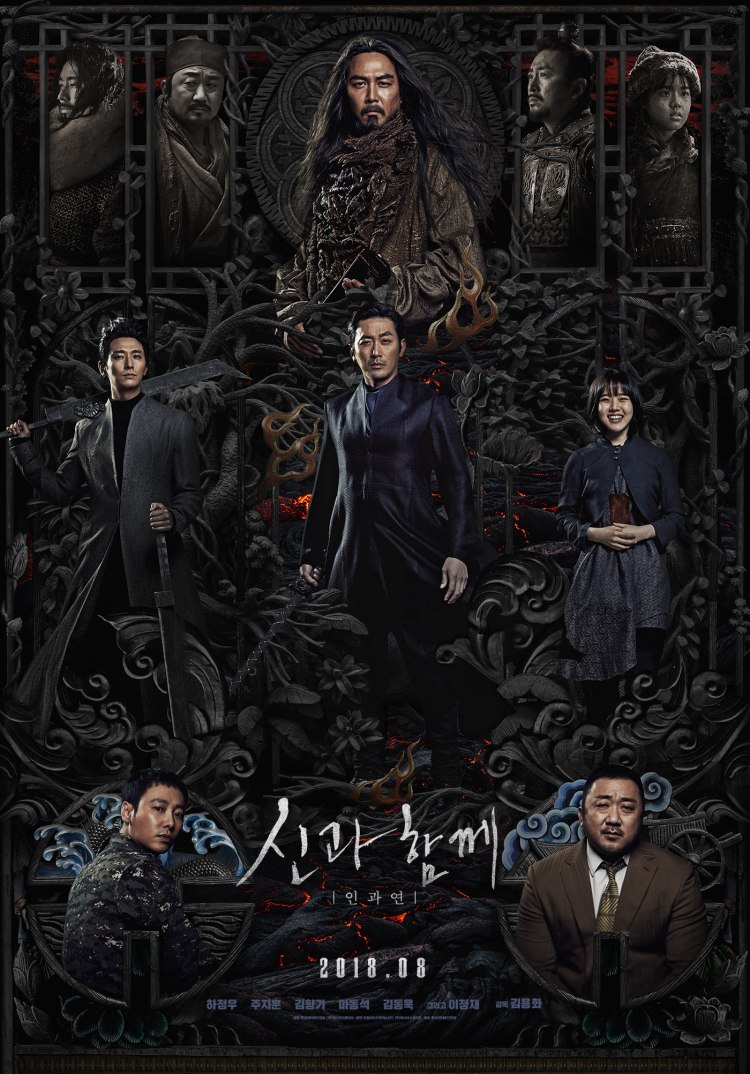
Along With the Gods: The Last 49 Days (신과함께-인과 연,Kim Yong-hwa, 2018)

Along with the gods 2 posterKarma is a bitch, and Korean hell is apparently full of it. You don’t have to be guilty to work here, but it certainly seems to help. Picking up straight after the conclusion of the first film, Kim Yong-hwa’s Along with the Gods sequel, The Last 49 Days (신과함께-인과 연, Singwa Hamgge: Ingwa Yeon) sees stern grim reaper/celestial defence lawyer Gang-lim (Ha Jung-woo) make good on his promise to clear the name of a once vengeful spirit now cheerfully deceased, but willingly or otherwise it’s himself he’s putting on trial as the facts of his client’s case veer eerily close to his own. King Yeomra (Lee Jung-jae) is up to his old tricks once again.

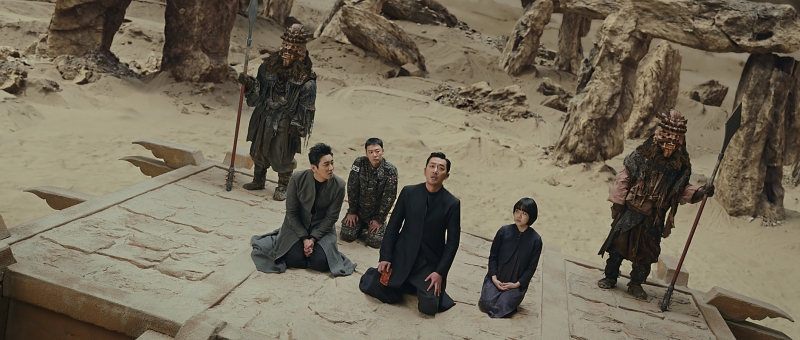
Brother of the first film’s “paragon” Ja-hong, Kim Su-hong (Kim Dong-wook) is headed nowhere good – after being accidentally shot by one friend and then buried alive by another to cover it up, Su-hong became a vengeful spirit creating havoc in the mortal and underworlds. Gang-lim, however, is convinced that Su-hong’s death was “wrongful”, that he died as a deliberate act of murder rather than simply by a tragic accident, and commits himself to clearing Su-hong’s name so that he can be reincarnated immediately. He manages to win King Yeomra over, but there is one condition – an old man, Hur Choon-sam (Nam Il-Woo), is an overstayer in the mortal world and should have been “ascended” long ago but his household god, Sung-ju (Ma Dong-Seok), keeps despatching the Guardians to keep the old man safe. If Gang-lim and his assistants Hewonmak (Ju Ji-Hoon) and Deok-choon (Kim Hyang-Gi) can clear Su-hong’s name and ascend Choon-sam within 49 Days King Yeomra will at last set them free and allow them to be reincarnated.

Having dealt so thoroughly with the mechanics of hell in The Two Worlds, Kim expands and deepens his canvas to delve into the lives of our various Guardians. As it turns out Sung-ju was once a Guardian himself and so he knows a thing or two about our two underlings – Hewonmak and Deok-choon, whose memories were wiped when they became employees of King Yeomra. As Sung-ju spins a yarn, it becomes clear that the fates of the three Guardians were closely linked in life and death, bound by a series of traumatic events over a thousand years ago during the Goryeo dynasty.

As in the Two Worlds it all comes down to family. Gang-lim’s memories are fractured and confused, he’s convinced himself he’s a righteous man and wilfully misremembered his death (or at least misrepresented it to his cohorts). Stiff and lacking in compassion, Gang-lim was at odds with his gentle hearted father who, he thought, had found a better son in a boy orphaned by the cruelty of his own troops. These broken familial connections become a karmic circle of resentment and betrayal, enduring across millennia in the knowledge that even to ask for forgiveness may itself be another cruel and selfish act of violence. The circle cannot be closed without cosmic justice, but justice requires process and process requires a victim.

Gang-lim plays a bait and switch, he walks the strangely cheerful Su-hong through the various trials but it’s himself he’s testing, working towards a resolution of his own centuries old burdens of guilt and regret. There are, however, unintended victims in everything and the fate of orphans becomes a persistent theme from the orphaned foster brother Gang-lim feared so much, to those who lost their families in the wars of Goryeo, and a little boy who will be left all alone if Hewonmak and Deok-choon decide to ascend Choon-sam. Choon-sam’s adorable grandson is only young but he’s already been badly let down – his mother sadly passed away, but his father ran up gambling debts and then ran off to the Philippines never to be seen again. He didn’t ask for any of this, but there’s no cosmic justice waiting for him, only “uncle” Sang-ju who has taken the bold step of assuming human form to help the boy and his granddad out while trying to come up with a more permanent solution.

Nevertheless, compassion and forgiveness eventually triumph over the rigid business of the law, finally closing the circle through force of will. Kim doubles down on The Two Worlds’ carefully crafted aesthetic but perhaps indulges himself with a series of random digressions involving psychic dinosaur attacks and lengthy laments about stock market fluctuations and failing investments. Along With the Gods: The Last 49 Days may lack the narrative focus of its predecessor but is undoubtedly lighter in tone and filled with the sense of fun the first film lacked, which is just as well because it seems as if hell is not done with our three Guardians just yet.


Along with the Gods: The Last 49 Days is currently on limited release in UK cinemas.

Original trailer (English subtitles)
Miracles of the Namiya General Store (ナミヤ雑貨店の奇蹟, Ryuichi Hiroki, 2017)

Miracles of the Namiya General Store posterKeigo Higashino is probably best known for his murder mysteries, most particularly the international best seller The Devotion of Suspect X. His literary output is however a little broader than one might assume and fantastical hypotheticals are very much a part of his work as in the bizarre The Secret in which a mother wakes up in her daughter’s body after a fatal accident. Miracles of the Namiya General Store (ナミヤ雑貨店の奇蹟, Namiya Zakkaten no Kiseki) is indeed one of his warmer stories even if it occasionally veers towards the author’s usual taste for moral conservatism in its yearning for a more innocent, pre-bubble Japan that is rapidly being forgotten.

Back in 1980, Mr. Namiya (Toshiyuki Nishida) runs the local store and is a much loved member of the community. As an older man with plenty of life experience, he also offers an agony uncle service. People with problems can simply write him a letter and drop it through his box. He’ll have a bit of a think about it and then either paste up a response on the village noticeboard outside or, if the question is a little more delicate, place his reply in an envelope in the milk box.

32 years later, a trio of delinquent boys end up taking refuge in the disused store after committing some kind of crime. While they’re poking around, what should pop through the letter box but a letter, direct from 1980. Freaked out the boys try to leave but find themselves trapped in some kind of timeslip town. Eventually they decide to answer the letter just to pass the time and then quickly find themselves conversing with an earlier generation by means of some strange magic.

At the end of his life, what Mr. Namiya is keen to know is if his advice really mattered, and if it did, did it help or hinder? His introspection is caused in part by a news report that someone he advised on a particularly tricky issue may have committed suicide. Mr. Namiya isn’t now so sure he gave them the right advice and worries what he told them may have contributed to the way they died. This itself is a difficult question and if it sounds like a moral justification to point out that no one was forced to follow Mr. Namiya’s “advice” and everyone is ultimately responsible for their own decisions, that’s because it is but then it doesn’t make it any less true. Then again, Mr. Namiya’s advice, by his own admission, was not really about telling people what to do – most have already made a decision, they just want someone to help them feel better about it. What he tries to do is read between the lines and then tell them what they want to hear – the decision was always theirs he just helped them find a way to accommodate it.

The boys have quite different attitudes. Kohei (Kanichiro), who takes the initial decision to write back, is compassionate but pragmatic. As we later find out, the three boys are all orphans and Kohei counsels a melancholy musician who wants to know if he should give up on his Tokyo music career and come home to run the family fish shop that he should count himself lucky to have a place to come back to and that if he was going to get anywhere in music he’d have got there already. Mr. Namiya’s philosophy proves apt – the musician writes back and argues his case, he wants to carry on with music but feels guilty and hopes Mr. Namiya will tell him it’s OK to follow his dreams. For the boys however, “dreams” are an unaffordable luxury and like a trio of cynical old men they tell the musician to grow up and get a real job. That is, until he decides to play them a tune and they realise it’s all too familiar.

Similarly, a conflicted young woman drops them a letter wanting advice on whether to become the mistress of a wealthy man who claims he will help her set up in business. The boys say no, do not debase yourself, work hard and be honest – that’s the best way to repay a debt to the people that raised you. Again she writes back, she wants her shot but it is a high price. That’s where hindsight comes in, as does advance knowledge about Japan’s impending economic boom and subsequent bust.

As expected, everything is connected. Higashino maybe romanticising an earlier time in which community still mattered and the wisest man you knew ran the corner store, but then there’s a mild inconsistency between the idealised picture of small town life and the orphanage which links it all together – these kids are after all removed, even perhaps exiled, from that same idea of “community” even if they are able to create their own familial bonds thanks to the place that has raised them. The most cynical of the boys once wanted to be a doctor, but as another boy points out it takes more than just brains to get there. While it’s a nice message to say that there are no limits and nothing is impossible, it is rather optimistic and perhaps glosses over many of the issues the kids face after “graduating” from the group home and having nowhere else to go. Nevertheless, seeing everything come together in the end through the power of human goodness and the resurgence of personal agency is an inspirational sight indeed. The world could use a few more miracles, but as long as there are kind hearted people with a desire for understanding, there will perhaps be hope.


Original trailer (English/simplified Chinese subtitles)

Let Me Eat Your Pancreas (君の膵臓をたべたい, Sho Tsukikawa, 2017)

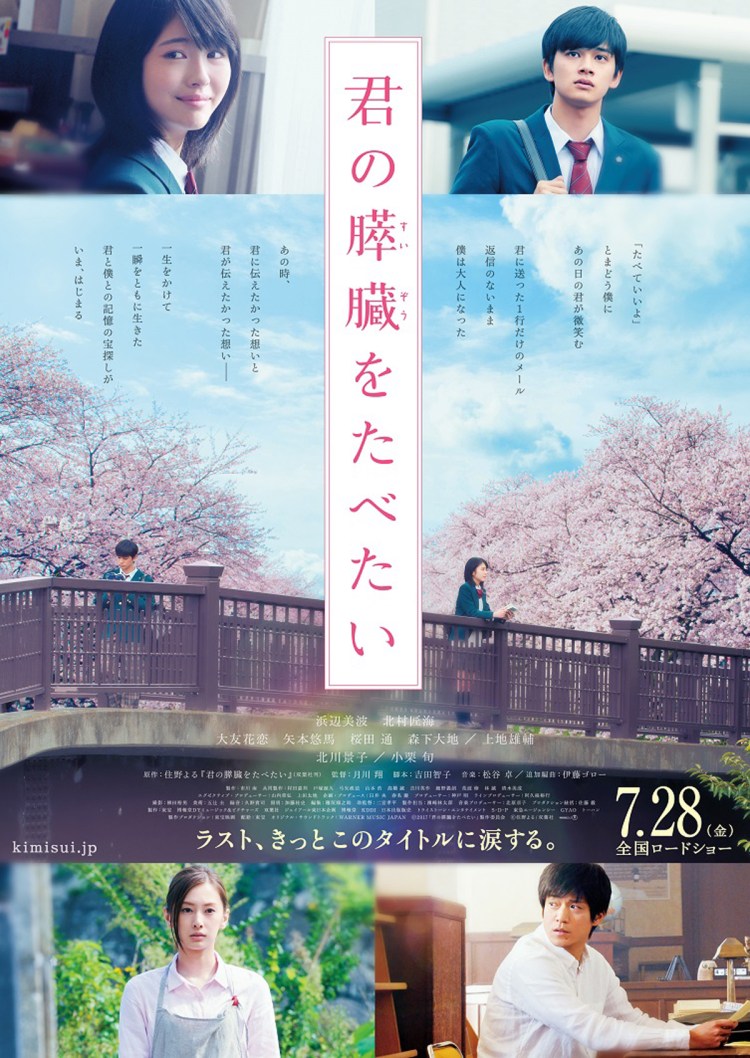
Let me eat your pancreas posterBack around the turn of the century, a new kind of melodrama was taking the Japanese box office by storm. “junai” or “pure love” was not exactly new in terms of genre but began to grow in popularity in the early 2000s thanks to growing interest in Korean television drama, finally hitting its zenith in 2004 with Crying Out Love in the Centre of the World. The junai boom lasted only a couple of years, but Japanese cinema has never been able to get enough of tragic stories of first love destroyed by cruel fate and, ironically enough, returns with the improbably titled Let Me Eat Your Pancreas (君の膵臓をたべたい, Kimi no Suizo wo Tabetai) which sets its fictional past in 2003 – exactly the same time as the contemporary presents of the junai classics.

In 2012, Haruki Shiga (Shun Oguri) is a melancholy high school teacher who can’t decide if teaching is really his vocation and has a resignation letter sitting in his desk. Meanwhile, he is handed a slightly upsetting task by his boss – the school library has become too rundown to consider renovating and so it’s going to have to close. When Shiga was a high school student at this very school, he also ran the library club (he now has a qualification in librarianship) and so he seems to be the perfect person to ensure everything gets packed up and dealt with in the proper fashion. The library, however, holds some painful memories for him – of a girl he grew close to for only a few months while she battled a terminal illness and changed his life forever.

12 years previously, Sakura (Minami Hamabe), a popular young woman, drops her sickness diary on leaving the hospital, whereupon Shiga picks it up and unwittingly becomes the only person outside of Sakura’s family to know that she is suffering from a degenerative pancreatic illness and has only a couple of years at most to live. She knows her case her is hopeless and the treatment she receives will only prolong her life temporarily while easing her symptoms, but is determined to live out the rest of her days to the fullest.

Unlike Sakura, Shiga (Takumi Kitamura) describes himself as a loner who isn’t good with people. He spends his days with a book in his hand and is thought of by most of his classmates (if they think of him at all) as the creepy silent boy. Thus his unexpected friendship with Sakura raises more than a few eyebrows with the other kids, especially Sakura’s best friend Kyoko (Karen Otomo) who is both jealous and confused as to why her friend has suddenly started hanging out with the loser boy. Then again it’s precisely because of this aloofness that Sakura first believes she can entrust her final days to Shiga – as virtual strangers it’s much easier to process the idea of an ending, if Sakura had tried to confide in Kyoko about her illness it would only have marred the end of their friendship. Shiga is detached, he doesn’t get emotionally involved, but despite himself still cares which makes him the ideal point of support for a girl longing to escape a carefully ordered life to get a taste of everything she knows she will miss.

Let Me Eat Your Pancreas may situate itself in the junai era of the early 2000s, but owes an undeniable debt to Shunji Iwai’s seminal 1995 romantic melodrama Love Letter and even borrows its central library conceit with a hidden message which eventually reaches its destination much later than intended. Like Love Letter, in which one of the heroines is perpetually worried about the possible repercussions of minor illnesses, Pancreas is keen to remind us that the truth is we are all dying and illness or not today might be our last day – it’s best to make the most of it without sitting around worrying about what the future might hold.

Sakura, dying yet so full of life and energy, is keen to impart her life philosophy to the introverted Shiga. For Sakura life is about connection, sharing experiences with others be they joy or pain. Shiga, though loathed to admit it, is in his own way desperately lonely but has resolved himself to surviving alone, believing that he lacks the ability connect meaningfully with other people. His nascent connection with Sakura is destined to end in tragedy but does at least begin to release something in him which had long been suppressed. Even so, as an adult he’s just as withdrawn and isolated as he’d been as a teen and it’s not until he’s forced to revisit this traumatic incident in his early life that he learns the full value of its lessons. Let Me Eat Your Pancreas, though wilfully embracing some of the genre’s more problematic elements, is a beautifully affecting return to the world of junai which manages to turn a story of death and tragedy into a celebration of life and love as its isolationist hero begins to find the strength to embrace the art of being alive no matter how painful it may turn out to be.


Original trailer (no subtitles)

A Slice Room (사람이 산다, Song Yun-hyeok, 2016)

slice room still 1It’s easy to view a city like Seoul as a shining example of economic prosperity in which even ordinary people enjoy a high standard of living and perhaps no longer need to worry about extreme poverty or hunger. Of course, this is not the case and despite the aspirational image the city likes to project for itself, a long and complex history of political instability, authoritarian government, and the legacy of the 1997 Asian financial crisis have ensured the survival of an oppressed underclass unable to escape the roots of their poverty due to entrenched social issues which will not allow them to free themselves from the Slice Room existence.

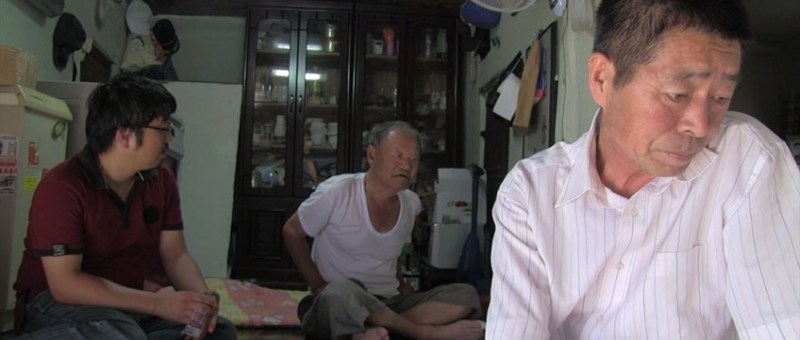
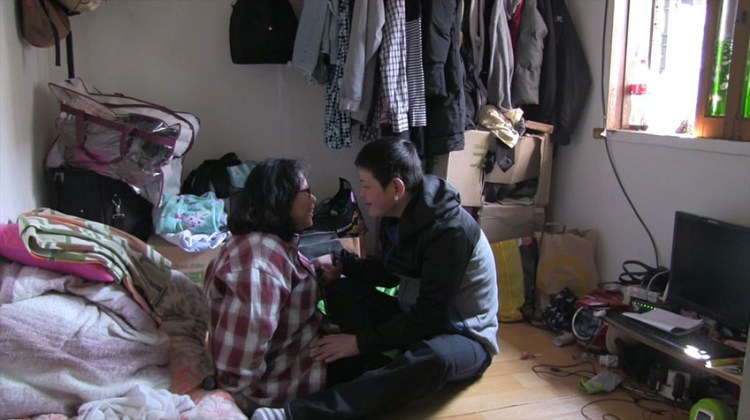
Director Song Yun-hyeok first learned of the “jjok bang” or “Slice Room” phenomenon while working with the homeless and himself lived in one of the tiny tenement rooms for a year in order to make the documentary. He follows three groups of impoverished people who have each found themselves trapped in the slums for different reasons. 27-year-old Il-so was born in the jjok bang and has lived in the community all his life. He lives with his girlfriend, Sun-hee, who uses a wheelchair and finds it difficult to get around the makeshift world of the jjok bang without him. Meanwhile, 60-something Nam-sung lost his job after the Asian financial crisis and has been drifting aimlessly ever since as has Chun-hyun whose mental health issues prevent him from gaining secure employment.

Bad luck can happen to anybody, but the forces which conspire to keep someone in the jjok bang are no accident only a result of deliberate governmental failures. The reason many are unable to get off benefits and return to mainstream society is down to a law which mandates familial support – i.e. if a son gets a job his father loses his benefits even if the prospective job is not enough to support them both or if there are other dependents involved. Thus Nam-sung, by most standards an old man, finds himself in the humiliating position of having to reconnect with his estranged parents in order to get them to sign a consent form so that he can have access to government subsidy and take up a job his social worker has found for him. The family, whom he has not seen for 40 years, are also aware of the support legislation and are worried they will at some point be required to support Nam-sung and so they disown him and refuse to sign. Nam-sung is back at square one with no other options because of the say so of his father even though he is old enough to be a grandfather himself.

Meanwhile, Il-so and Sun-hee want to get married and start a family, but once they become a couple they will also receive a substantial benefits cut and seeing as they are also unable to work because of health issues and the support law, they have no real possibility of being able to support themselves without government help. Nevertheless they decide to try and fulfil their dream of building a family only to face a further dilemma when Sun-hee becomes pregnant.

Medical costs are another constant worry. Il-so, who has spent his entire life in the jjok bang, has long standing health issues from high blood pressure and diabetes to recurrent TB. Disease is rife in the jjok bang and mysterious deaths not uncommon, but the secondary problems are spiritual malaise and creeping depression as the hopelessness of the jjok bang world begins to sap the strength of those who live there, convincing them there is no way out of this world of crushing of poverty. For those like Chun-hyun the situation is even more precarious as they attempt to manage their conditions while living in the impossible jjok bang society, forced into exploitative, low paid and illegal labour simply to get by all while worrying about being caught out, losing their benefits and their homes.

Nam-sung, having found temporary relief outside of the city, is forced to return to the jjok bang but has resigned himself to wanting nothing more than to be allowed to live there until he dies. The jjok bang, however, has been scheduled for demolition which might be a good thing in many ways save that no provision has been made for where these people are supposed to go – rents everywhere else are simply too high and many will have no other option than being forced back onto the streets. With no address they’ll have no access to welfare or possibility of finding work and so the whole vicious cycle starts over again. Make no mistake, these problems are not exclusive to Korea but are the result of an uncaring and authoritarian government which continues to abnegate its responsibilities towards its most vulnerable citizens while social stigma and a belief that the poor have only themselves to blame continues to perpetuate a myth of othering which thinks the problem will eventually solve itself in the cruellest of ways. Director Song Yun-hyeok explores the lives of the jjok bang residents with empathy and understanding, demonstrating the extent to which they are rendered powerless by a needlessly arcane social welfare system in the hope that something might finally change.


Screened as part of the London Korean Film Festival 2018: Documentary Fortnight.

Oshin (おしん, Shin Togashi, 2013)

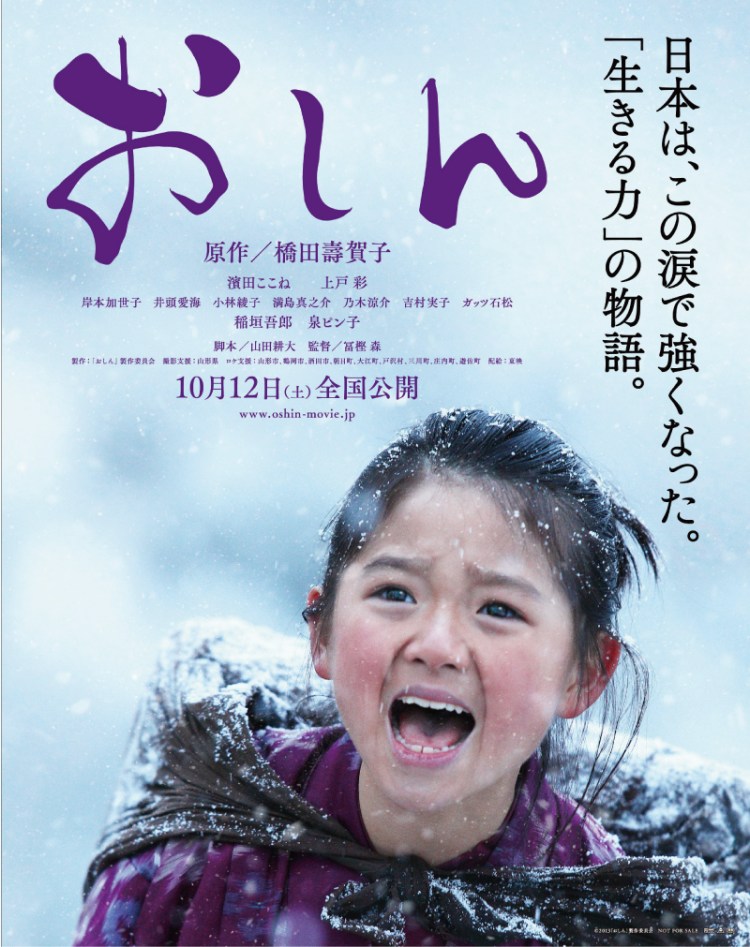
Oshin posterBack in the 1980s, an “asadora” named “Oshin” proved so popular with Japanese television viewers that its title became a byword for tenacity and perseverance, attached to any underdog who battled bravely against insurmountable odds. The “asadora”, as its name suggests, is a 15 minute drama serial broadcast in the mornings and therefore mainly targeted at housewives. As such it often focusses on the lives of women and particularly on women who work hard to triumph over adversity. Oshin is no different in this regard except that it also recounts the painful history of 20th century Japan through that of its stoical heroine who travels from a life of poverty in snowy Yamagata to becoming the owner of a supermarket chain in the bustling consumerist economy of 1983. In celebration of the 30th anniversary of the TV series, Oshin graduated to the big screen. Shin Togashi’s Oshin (おしん) movie focusses exclusively on Oshin’s childhood at the tail end of the Meiji era in which she suffered all the downsides of lingering feudalism and benefitted from few of the new freedoms of the age.

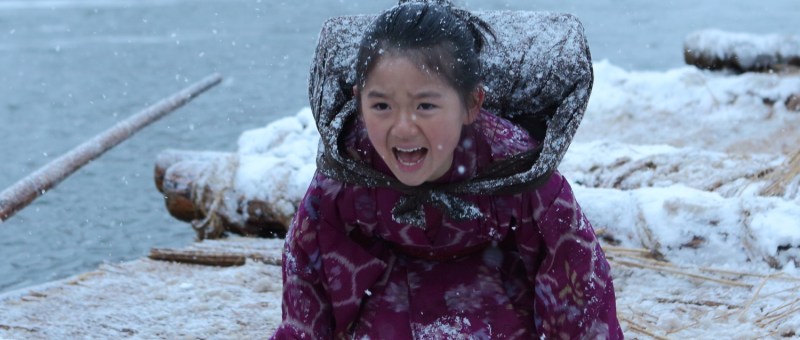
The winter of 1907, Yamagata – snow country. Oshin (Kokone Hamada) lives with her parents, grandmother, and siblings and looks forward to finally being allowed to go to school when spring arrives. Sadly, Oshin will not be going to school after all. Her father has arranged for her to work for another family who own a timber yard a few towns over for the period of one year. Only seven years old, Oshin pleads not to be sent away but her father will not back down. There is not enough food to feed the family and, unbeknownst to Oshin, her mother (Aya Ueto) is pregnant again.

Finally agreeing to go after her mother takes drastic action to try and reduce the burden on the family, Oshin arrives at the timber yard but is treated cruelly by the head housekeeper who refuses to recognise that Oshin is only a child and will of course lack basic knowledge as to how to run a household. Though Oshin bears the constant hardship for her family she eventually runs away when falsely accused of theft.

The world of 1907 is harsh and cruel. Women have few rights and almost no say in their lives or destinies. Oshin might count herself lucky that she’s merely been contracted as a household servant in an age where selling one’s daughter to a brothel to feed one’s sons was not an unusual event, but nevertheless her life at the timber yard is hard. Bright and curious, Oshin longs to learn to read and write but because of her lowly “peasant” birth, she is constrained into a life of drudgery where her labour will only ever be in service of her family and never herself.

A “peasant” background is, as a kinder mistress reminds Oshin, a burden in that she is always likely to be viewed with suspicion. This is doubly true when she runs away and is rescued by a fugitive deserter hiding in a mountain shack. Shunsaku (Shinnosuke Mitsushima), a sensitive young man marked by service in a war he no longer believes in, teaches Oshin how to read and write as well as giving her a grounding in humanitarian politics. He is, however, a problematic figure for going against the martial culture of the age and having “betrayed” his nation by deserting. Oshin is tainted by her association with such a radical young man, but boldly comes to Shunsaku’s defence when others seek to discredit his memory.

This boldness is a part of Oshin’s essential “goodness” in which she refuses to give in to injustice even whilst stoically bearing all of the troubles that come her way. Eventually she finds herself a servant in a much nicer house where the staff take pity on her and welcome her warmly into their extended family. Treated with such kindness, Oshin works even harder to repay it and impresses all with her earnestness and morally upright character. She does, however, clash with the spoilt daughter of the house, Kayo (Manami Igashira), who has her own share of troubles though hers are those of the privileged classes. Lonely and bored, Kayo resents the attention golden girl Oshin seems to get from the staff but the two eventually become friends when Kayo realises Oshin is the only person willing to treat her as an equal rather than the young mistress.

Though the overall arc of the TV series painted a more positive picture of female resilience and capability, the film’s focus on the late Meiji childhood era is unavoidably more conservative in its pointed message that a woman’s life is served in dedication to others with the unpleasant undertone that she must keep nothing back for herself and that she is not entitled to personal happiness but only that of repaying the sacrifices that have been made on her behalf by other women (and especially by mothers – biological and surrogate). Nevertheless, Oshin’s earnestness and deep love for her family are admirable qualities and when she trudges back out into the snow again, always waiting for the spring, she does so with hope and determination.


Oshin is screening in London on 18th August as part of the Japan Foundation London’s Summer Explorers season of free film screenings.

Original trailer (no subtitles)

Tokyo Vampire Hotel (東京ヴァンパイアホテル, Sion Sono, 2017) [Fantasia 2018]

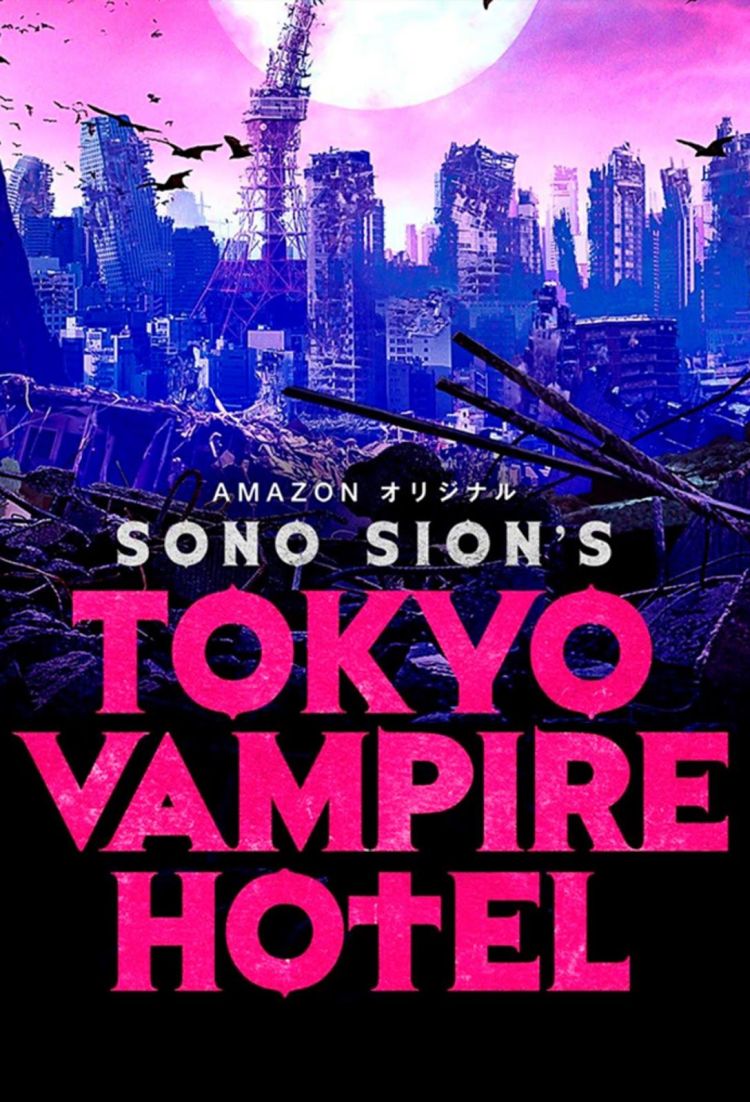
Tokyo Vampire Hotel PosterAbridging a work of fiction can be a taxing task. The job of a judicious abridger is the use their own judgement to reduce a larger work to its most essential elements either for those who, for one reason or another, need a more immediate digest or for those looking for greater accessibility. When it comes to a work of art, abridgement can be a dubious task and, unfortunately, the temptation is simply to excise the “best bits” shorn of all the “heavy stuff” and supporting material. Sion Sono who had been in a particularly prolific phase was given something of an unusual opportunity in creating Tokyo Vampire Hotel (東京ヴァンパイアホテル) – a chance to do as he pleased with a sizeable budget to create a television series for Amazon Prime, which is to say marrying mainstream commercial concerns with idiosyncratic artistry. The 6.5hr, eight episode, series was released via the streaming platform in June 2017 (initially in Japan only with international streaming available a few months later) but Sono also took the step of creating a 2hr22min feature length cut for film festival distribution.

The titular Tokyo hotel is the lair of a sect of modern day vampires. As a long prophesied war between rival clans – the Corvins in Japan and the ancient Draculas of Romania, brews, the Corvins have engineered a plan to lure lonely unsuspecting Tokyoites to an exclusive singles mixer where they will not only be given a sizeable fee for attending but also tempted with the possibility of meeting the love of their life, never suspecting that all this is too good to be true and they are really being recruited for a kind of blood farm to feed the various appetites of their bonkers captors.

Meanwhile, “the chosen one”, Manami (Ami Tomite), is about to come of age. Born during an “auspicious” alignment of the stars, Manami is one of three children given special vampire blood and thought to be all powerful, species saving hybrids. As such she is wanted by every side and is eventually “rescued” from a massacre at a restaurant by ice cool vampire K. (Kaho) – a Japanese vamp currently working for Dracula.

It has to be said that Sono’s original TV cut is extremely convoluted and initially confusing. The hotel, a Japanese vampire hub, is connected to the vampire capital in Romania by a magical tunnel with the narrative flowing freely between both spaces. What we lose in condensing to feature length is the entirety of the extensive back story with the consequence of shifting the focus from the protagonist of the TV series, Manami, to the more exciting figure of second lead K. whose gradual disillusionment with becoming a puppet in someone else’s revolution coupled with romantic heartbreak eventually reawakens her sense of “humanity” as she becomes committed to “saving” Manami from becoming yet another slave to the Dracula cause.

Meanwhile, Sono satirises modern Japan’s ambivalence towards romance as a collection of youngsters are forced into an extreme situation in order to successfully couple off and form a “traditional” family solely to satisfy the demands of a bunch of vampire overlords standing in for a bloodsucking state. Yamada (Shinnosuke Mitsushima), the conflicted hero of the Corvins who longs for escape from his unwanted immortality and an egotistical, individualist world harbours intense resentment towards his own “hypocritical” father who “sold” him to the vampires as a baby in return for various favours by which he has now become the “Romantic Party” Prime Minster of Japan preaching traditional family values and a “wholesome” future for the little children who otherwise face a difficult existence in a country which has “lost its way”.

Sono doubles down on his usual sense of romanticism as his flamboyant vampires adopt an oddly foppish, Regency era aesthetic whilst speaking in a deliberately theatrical manner filled with bold philosophical statements and a florid sense of repressed melodrama. Harking back to Bad Film – another attempt to reorder extensive footage into a narratively cohesive whole, the conflicts are often about love more than death with suffering and sorrow marking the lives of our gloomy immortals, oppressed by their own inability to transcend their natures and find the escape they so desperately crave.

Sono seems to reemphasise their unhappy fates by engineering an altogether different, infinitely abrupt ending which, in contrast to the TV drama, hands the victory back to the people but does so in historically uncomfortable fashion as the victorious hotel guests revel in acts of atrocity against their captors which are framed as a kind of genocide and accompanied by stills from violent classical paintings featuring scenes of unbridled carnage. A contrarian to the last, Sono mutilates his own endeavour and then frankensteins it into something else, twisting his own words and tying himself in knots in the process. Viewers seeking clarification would be well advised to invest their time in the 6.5hr experience rather than opting for the convenient shortcut of an edited version, but there is certainly plenty to ponder in Sono’s truncated tale of love and death in post-Olympic Tokyo.


This review refers to the theatrical cut of Tokyo Vampire Hotel which was screened as part of the Fantasia International Film Festival 2018. You can also stream the original TV drama in most territories via Amazon Prime.

Trailer for the TV drama (no subtitles)

Penguin Highway (ペンギン・ハイウェイ, Hiroyasu Ishida, 2018) [Fantasia 2018]

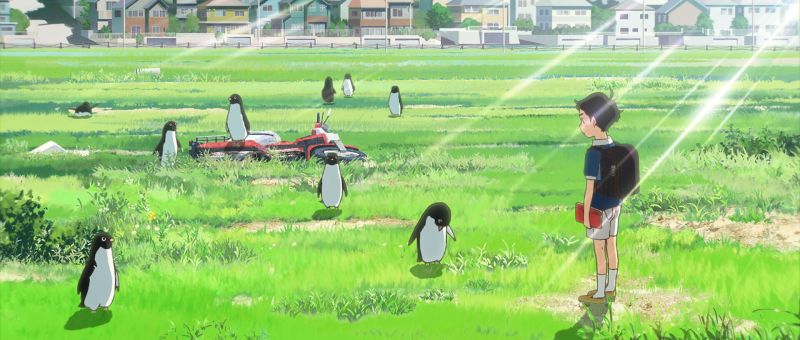
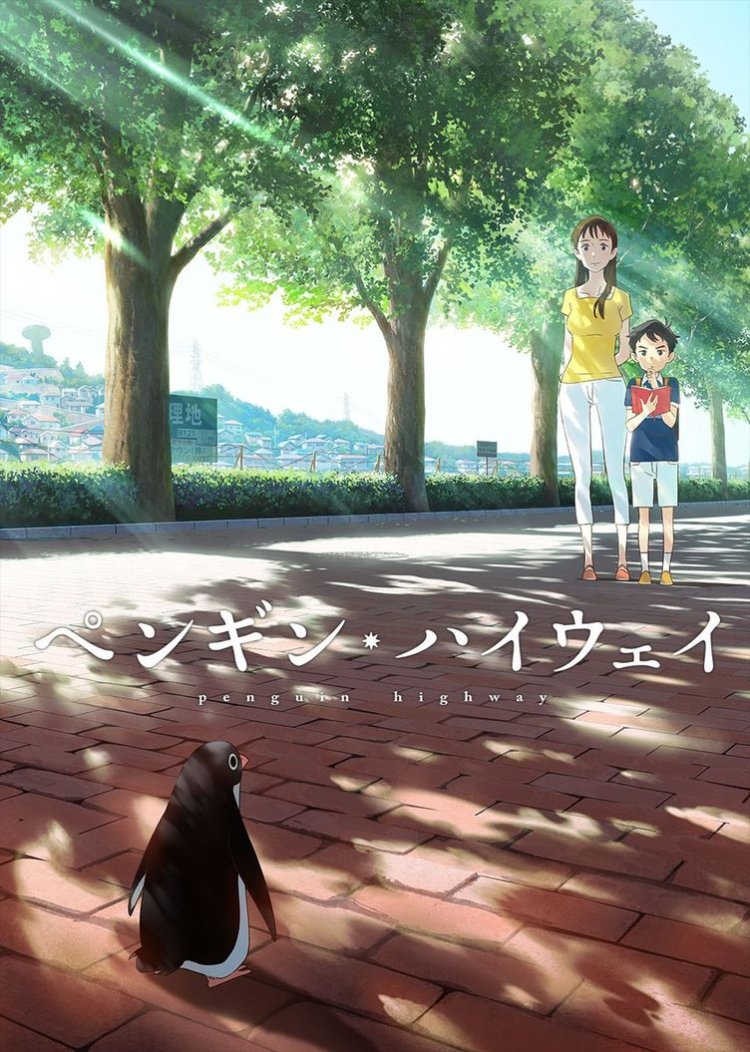
Penguin Highway posterRandom penguins might be the very opposite of a problem, but what exactly does it all mean? Tomihiko Morimi has provided the source material for some of the most interesting Japanese animation of recent times from Masaaki Yuasa’s wonderfully surreal Tatami Galaxy and Night is Short, Walk on Girl, to the comparatively calmer Eccentric Family. Hiroyasu Ishida’s adaptation of Morimi’s Penguin Highway (ペンギン・ハイウェイ) may be a far less abstract attempt to capture the author’s unique world view than Yuasa’s anarchic psychedelia, but preserves the author’s sense of every day strangeness as an ordinary primary school boy’s peaceful life is suddenly derailed by the appearance of random penguins in a small town way in land in the middle of a hot and humid Japanese summer.

Aoyama (Kana Kita) is, as he tells us, “very smart”. He thinks its OK to tell us this because unlike some of his classmates he isn’t conceited, which is what makes him so great. He’s absolutely positive that he’s going to become an important person in the future and can’t wait to find out just how amazing he’s going to be once he’s grown up. Aoyama is also sure that crowds of girls will be lining up to marry him, but they’re all out of luck because he already has a special someone in mind – the friendly young receptionist from the dentist’s (Yu Aoi) who has been coaching him at chess and just generally hanging out with him chatting about life.

Everything begins to change one day when random penguins start appearing all over town. Penguins are, after all, cold climate creatures and this is a glorious summer in Southern Japan so even if these are rogue penguins who’ve managed to escape from a zoo, it’s anyone’s guess how they’ve managed to survive. Being the scientifically minded young man he is, Aoyama becomes determined to solve the penguin mystery, especially as it seems to have something to do with the young lady from the dentist’s who he can’t seem to get out of his mind.

Aoyama is, despite his opening gambit, a fairly conceited young man who thinks himself much cleverer than those around him – not only his schoolmates but the adults too (possibly with the exception of the lady from the dentist’s who is after all teaching him how to be better at chess). With an intense superiority complex, Aoyama has few friends (not that that bothers him, particularly) and is often bullied by the class bruiser, Suzuki (Miki Fukui), and his minions, all of which he takes in his stride. He is, however, slightly thrown by the presence of an extremely bright girl in his class, Hamamoto (Megumi Han), who regularly beats him at chess and is interested in black holes among other areas of scientific endeavour Aoyama had earmarked as his own.

Despite suspecting that Hamamoto might be “even more amazing” than he is, Aoyama is not resentful or jealous but remains seemingly oblivious to her attempts to make friends with him. Aoyama, as an intensely “rational” person, is also sometimes insensitive and remains entirely unable to pick up on social cues unlike his more perceptive friend/assitant, Uchida (Rie Kugimiya), who is well aware of the reason Suzuki keeps picking on Hamamoto, but is unable to convey his instinctual understanding of human nature to the logical Aoyama. Armed with this new fragment of information from Uchida, Aoyama uses it in a predictably “rational” fashion by suddenly bringing it up in front of both Hamamoto and Suzuki in “advising” him that liking someone isn’t “embarrassing” and Suzuki should just say what he means rather than making passive aggressive attempts to get attention by being unpleasant. All of which is, ironically enough, quite awkward.

Through carrying out his investigation into the penguin phenomenon, Aoyama is forced to confront his less rational side, eventually affirming that he’ll live his life based on a “personal belief” rather than a scientific principle. Getting a glimpse of the edge of the world and coming to accept that not matter how much fun you’re having there will always come an end, Aoyama decides to live his life in haste anyway running fast towards an inevitable conclusion in the hope of a longed for reconciliation. Sadly, his discoveries don’t seem to have made him any less conceited but he is at least good hearted and eager to help even if he remains determined to walk his “Penguin Highway” all alone while concentrating on becoming a better person. Beautifully animated and tempering its inherent surrealism with gentle whimsy, Penguin Highway is a promising start for Studio Colorido, mixing Ghibli-esque charm with Morimi’s trademark surrealism for a moving coming of age tale in which a rigid young man learns to find the sweet spot between faith and rationality and pledges to live his life in earnest in expectation of its end.


Penguin Highway was screened as part of Fantasia International Film Festival 2018.

Original trailer (no subtitles)

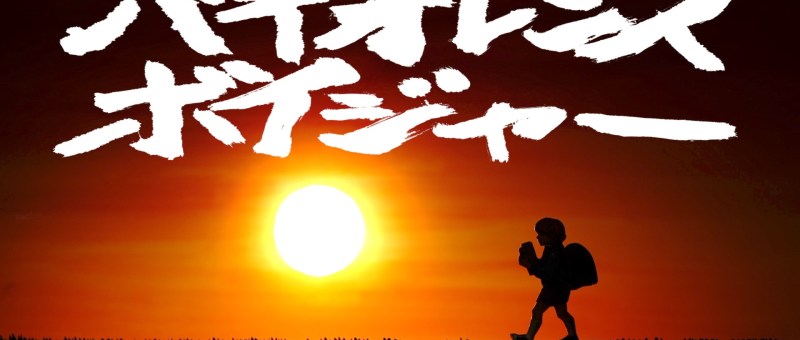
Violence Voyager (バイオレンス・ボイジャー, Ujicha, 2018) [Fantasia 2018]

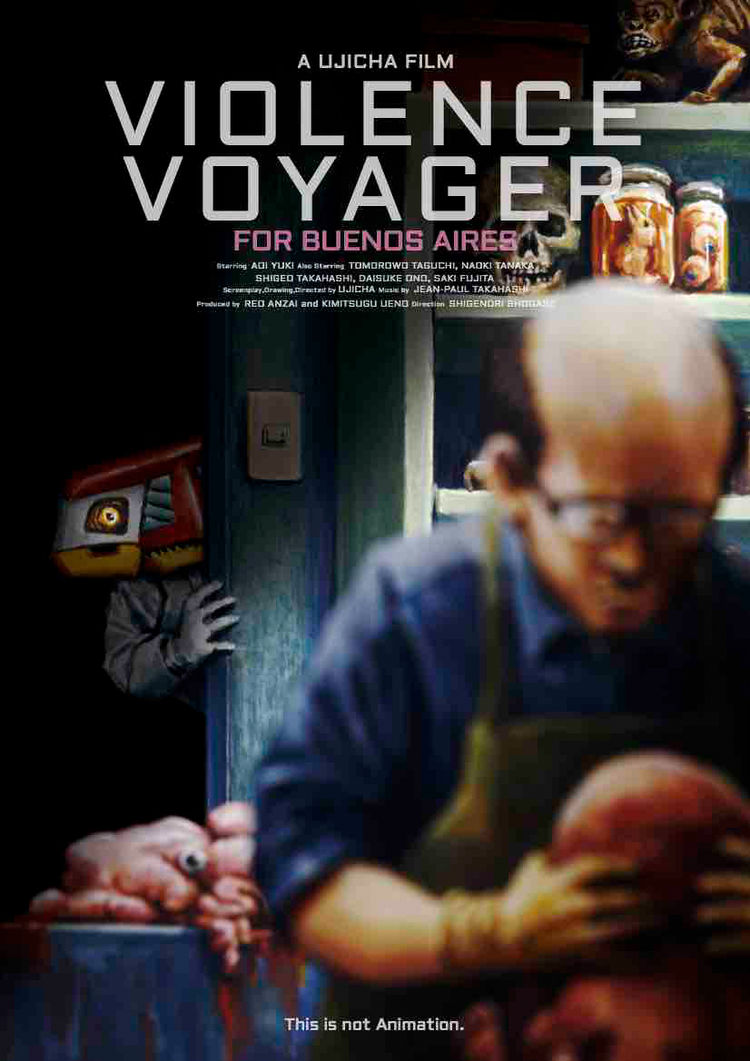
violence voyager posterWeird stuff happens out in the mountains, stuff you wouldn’t even believe. Ujicha’s Burning Buddha Man followup Violence Voyager (バイオレンス・ボイジャー) is a pleasantly retro treat, set sometime in the more innocent past when the landscape still held hidden mysteries for small boys to find and anything goes so long as you’re home in time for tea. There are some mysteries, however, that it’s better not to solve and if something seems too good to be true, that’s usually because it is. Little Bobby (Aoi Yuki) is about to become a hero, but his journey will be a one way trip of unwelcome transformations, losses, and betrayals.

Bobby, an American boy with a blond bowl cut living in a little rural town with his distant dad and bedridden mum for otherwise unexplained reasons, has impressed his best friend Akkun (Shigeo Takahashi) with his high-tech pinball baseball computer console he made for the science fair, even if it has put the strange monster toys Akkun and his brother Yakkun entered with the intention of masking a lack of skill with pure strangeness to shame. Ostracised by the other kids, Bobby and Akkun long to cross the mountain and find their other friend, Takaaki (Daisuke Ono), who moved away to the next village. Akkun has heard tell of a secret mountain path which would take them there for free and it’s only *slightly* dangerous even if it does take time. Luckily it’s the summer holidays so time is something the boys have plenty of.

Setting off despite the warnings of Old Man Lucky Monkey (who actually lives with a chimpanzee as a “friend”), the boys are sidetracked when Bobby spots a fallen sign for something called “Violence Voyager” which sounds like too good an opportunity to miss. Ending up at an abandoned theme park, the boys are surprised to find the proprietor (Tomorowo Taguchi) still hanging around and overjoyed when he offers to let them in for free seeing as he rarely gets any business owing to the rapidly declining number of children in the area (alarm bells should be ringing right about now). Handed a “voyager suit” (an anorak and pair of wellies), the boys are shown an informational video explaining that the world has been invaded by aliens in the form of robot soldiers who shoot alkaline from their plant-like hands. Choosing a “weapon” (water pistol) each (Bobby a rifle, Akkun a tiny little dolphin), the boys set off but it’s not long before they start to suspect something isn’t quite right. Discovering another little girl lying injured, Bobby and Akkun plan an escape only to find their bullying classmates also facing the same dilemma.

It will come as no surprise that there really is something not quite right going at Violence Voyager. Like a combination of Westworld and Soylent Green, the park exists to strip the young of their innocence by exploiting it. A mad scientist desperately trying to save his only family is literally eating his young – sacrificing the souls of innocent children and “remaking” them in his own image to feed his ruined son. Meanwhile, Bobby’s dad fights equally hard to track down and rescue his own errant boy from an obviously bad situation.

Bobby emerges scarred and fundamentally “changed” mentally and physically but with his humanity fully intact, carrying a pretty bunch of flowers to take to his mum to cheer up her sickbed (and presumably lessen the shock of seeing him as he now is). An extreme coming of age tale, Violence Voyager runs from exposing the cynicism of businesses aimed at children to the desperation faced by a parent prepared to protect their offspring at all costs (including their remaining family).

Ujicha’s trademark “geki-animation” is a perfect fit for the bizarre tale at hand, filled with beautiful hand painted backgrounds and accompanied by the sonorous narration of comedian Hitoshi Matsumoto (Symbol, Big Man Japan). The retro design from Bobby’s bowl cut to the ‘70s musical score and noticeably old-fashioned composition (one shot even seems to reference the poster for Fukasaku’s Virus) allows the warmth of nostalgia to mix with its less positive elements all while indulging in a surreal B-movie adventure which starts with “aliens” and ends with the horror that men do. Whether a metaphor for the conformist meat grinder which strips children of their individuality to trap them in the straight jacket of the salaryman world, the ravages of grief, or just a B-movie body horror adventure, Violence Voyager is a surreal fever dream of bodily corruption but undercut with its own sense of fantastical whimsy and an oddly innocent heart for so dark a tale.


Violence Voyager was screened as part of Fantasia International Film Festival 2018.

Original trailer (English subtitles)
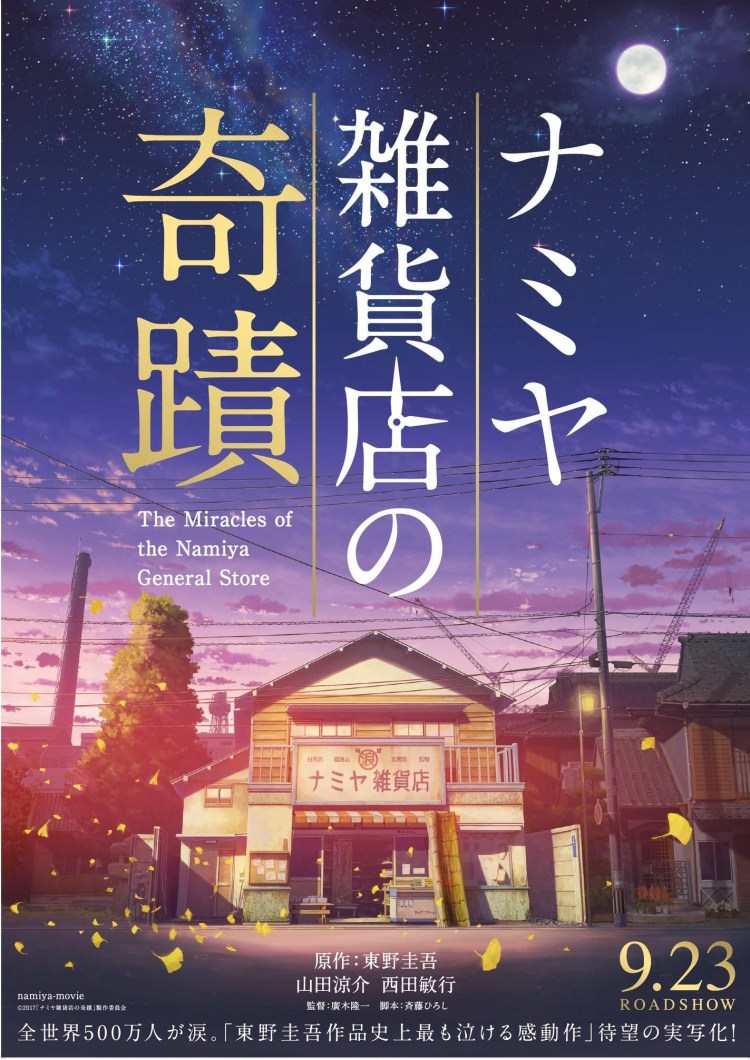
Detective Dee: The Four Heavenly Kings (狄仁杰之四大天王, Tsui Hark, 2018)

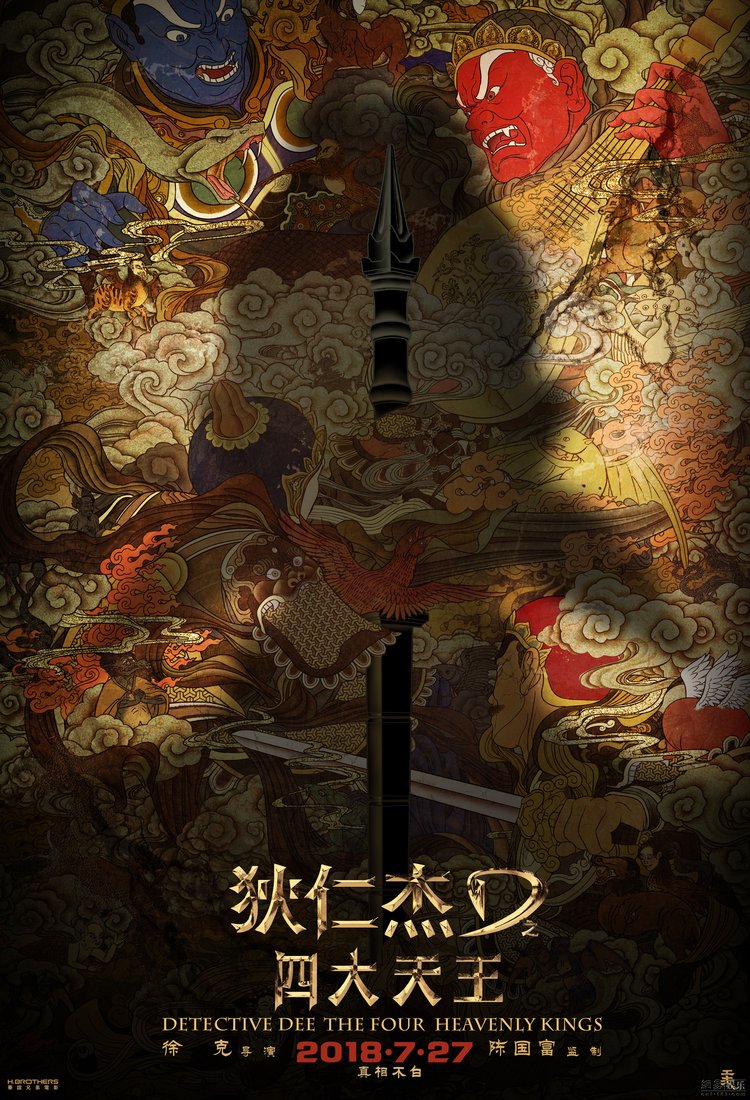
Detective Dee four heavenlu kings posterMaybe we could use a Detective Dee or two in this bold new age of fake news and powerful ideologies. Tsui Hark at least finds another case for the famed Tang Dynasty detective though this time one which sees him at the centre of a conspiracy, a bug in the system which must be squashed in order to pave the way for someone else’s revolution. The Four Heavenly Kings (狄仁杰之四大天王, Rénjié zhī Sìtiānwáng) of the title (no, sadly Andy Lau has not returned with a few of his friends in tow) refers to the four Buddhist deities which ought to tip us off to the kind of story this is as personal desires, of one sort or another, threaten to destabilise a state.

At the end of the previous film, Young Detective Dee: Rise of the Sea Dragon, Dee (Mark Chao) was “rewarded” with a place in the inspectorate and guardianship of the Dragon Taming Mace. However, scheming consort Wu Zetian (Carina Lau) is not particularly happy about her husband’s grand gesture and still has her doubts about Dee. Claiming that she fears such a powerful weapon/symbol being in the hands of someone who may betray the crown, Wu instructs Dee’s Sworn Brother and head of the Justice department Yuchi Zhenjin (Feng Shaofeng) to retrieve the Mace at any cost. Yuchi is reassured that Dee is not in danger and so agrees to work alongside Wu’s handpicked troop of “magical” crooks (who have actually been hired to take care of Dee to stop him messing up Wu’s grand plan). Needless to say all is not as it seems and Wu has fallen under the influence of nefarious forces who are merely using her lust for power as a convenient mechanism for facilitating their own agenda of revenge for a past era’s betrayal and oppression.

Dee’s methods are, more or less, inspired by Sherlock Holmes, granting him almost supernatural powers of foresight and observation though this time he is not occupied with one specific case so much as solving the mystery of the hidden insurrection within the Tang. The Mace may seem like a MacGuffin but its power is real and eventually holds the key to defeating the forces of chaos which threaten to bring down the state. Wu’s quartet of “Taoist” magical mercenaries are quickly exposed as expert wielders of tricks and trinkets rather than supernaturally charged avengers, but the state can’t help being captivated by the “magic” which finally puts paid to their ambition and is rocked by the power of the false images which continue to assault their senses.

Tellingly the big bad here is a foreign cult which makes extensive use of “hypnosis”, strange potions, and smokescreens in order to create the illusion of magic. Illusion, however, is as good as or perhaps better than the truth when it comes to political manipulation. The cult’s powers apparently aided the creation of the Tang state but once they were no longer needed, they found themselves cast out, tortured, and humiliated. Unsurprisingly they want their revenge and will settle for nothing less than the humiliating fall of the nation they helped to build.

Good old fashioned deduction and rationality are useless in the battle to free infected minds from the hypnotic power of fake news perfectly tailored to embrace one’s darker instincts. Wu, secretly or otherwise, lusts for power of her own and was easily manipulated by the promise of support in her campaign to seize the throne. Meanwhile, the leader of the Wind Warriors is infected with an intense desire for violence and killing to ease his deep seated rage over the misuse of his people. The answer is, of course, Buddhism. Life is too beautiful to be marred by hate while the act of forgiveness is the ultimate show of strength. Nevertheless, Tsui abandons Dee’s cool, analytical approach for a strangely spiritual final battle in which the fake news machines wielded by the Wind Warriors are pitted against the intense calm of a finely tuned mind (and the slightly moodier one of a giant white gorilla). Hell is full of suffering, Dee reminds the monk, enlightenment will have to wait. Perhaps “enlightenment” is merely another selfish desire won at the expense of blocking out the calls for help from those in need.

The Dragon Taming Mace is the ultimate symbol of justice, literally able to cut through the spell of illusion to expose the truth below. Wu had reason to fear it, even if she was not in the position to understand why. Dee is indeed a worthy guardian and unsullied soul, committed to the pursuit of compassionate justice wherever he goes even if he does so as a representative of the authority. Wu may have regained her senses, but that doesn’t mean she’s cured of the underlying causes of her possession as the large statue of Guan Yin which looks mysteriously like her seems to prove. Dee may have another mystery on his hands, but in any case his work is far from done in a land of intrigue and duplicity in which justice hangs by a slippery thread.


Detective Dee: The Four Heavenly Kings is currently on limited UK cinema release courtesy of Cine Asia. Find out where it’s playing near you via the official website.

Original trailer (English subtitles)
Lôi Báo (Victor Vu, 2017) [Fantasia 2018]

Lôi Báo posterThe world can be a strange place. Tam (Cuòng Seven) felt safe in his small town surrounded by his wife and son who were determined to support his artistic dream despite its long genesis, but a dark shadow is about to be cast over his otherwise pleasant existence that will threaten to destroy everything he has built. Victor Vu’s Lôi Báo is perhaps Vietnam’s first superhero movie but it’s also a familiar tale of a conflicted man entering middle-age learning to reaccept his responsibilities, both to his wife and son and to his society as he attempts to balance his desire to help others with that of protecting his family. With great power comes great responsibility as the saying goes and Tam is a responsible guy but the past is calling him and he’ll need to face it head on if he’s to put his fracturing family back together.

Six years after his critically acclaimed graphic novel Descendents of the Crossbow, comic book artist Tam has just come out of a period of writer’s block and is working on a new project – an American-style Superhero book about a pure hearted warrior for justice with intense fighting skills and extreme athletic ability. Not many people are convinced by Tam’s desire to create a Vietnamese superhero, but his family support him and that’s all that matters. In fact, they literally support him because his wife Linh’s (Tran Thi Nha Phuong) coffeeshop is the family’s sole source of income. Tam has a tendency to get lost in his work, which is one reason he’s been putting off seeing the doctor about a serious cough that just won’t go away. When he finally decides to get it checked out it’s already too late – he has terminal lung cancer and only a few months left to live. It’s at this point that his life starts to take a strange, unexpected turn. Uncle Ma (Huàng Son), an older man Tam thought was a farmer, is actually a secret mad scientist who has a hidden laboratory in his garden where he continues to research human head transplants. The obvious conclusion presents itself – Tam decides to undergo experimental surgery to abandon his cancer ridden body and move into a nice new model.

Lôi Báo is the latest in the long line of movies indulging in the thoroughly B-movie science of “Cellular Memory”. Illegal head transplantation is already somewhat unethical, but Tam and Ma acquired their donor body through less than ethical means by grabbing a guy who was mysteriously gunned down in a forest where Tam had just tried to commit suicide out of total despair. Of course, the dead “gangster” came with his own share of baggage which leaves Tam feeling much more impulsive had than he had done before and though he seems to have lost the ability to draw, Tam is thrilled that his new body seems to be a much stronger, faster model than his old one. Not quite able to leap tall buildings in a single bound, Tam can now scale them with little difficulty and lift heavy vehicles all alone. Now he no longer needs to draw superhero stories, he can be a hero for real fulfilling his lifelong dream of being able to save lives and protect the vulnerable from evil.

Only, his new body is not quite so altruistic as he once was, and Tam begins to get off on the fame his newfound heroism is bringing him even while it puts his family danger should anyone find out about all the illegal head transplantation action that’s been going down at uncle Ma’s. He also finds himself strangely drawn to a pretty young doctor who might have been something to the dead gangster, further distancing him from Linh and his son Bu. As expected, there was a little more to the gunfight in the woods than a gangster squabble and Tam will have to learn to put body and soul back together while also dealing with the ghosts of his past and a latent discomfort with the idea of being a husband and father which betrays a lack of faith in the idea of “family” itself.

With plenty of high octane action scenes, Lôi Báo more than does its home genre justice, creating a notably mature origin story for a new kind of superhero who accepts that perhaps he’s not the hero in this story after all. Justice is served, the family repaired, the past laid to rest and there might even be a new book in it too. It has been a busy a few months for Tam, but at least he’s learnt the true meaning of heroism – something which will place him in good stead during his eagerly awaited further adventures!


Lôi Báo was screened as part of Fantasia International Film Festival 2018.

Original trailer (English subtitles)