Monster Hunt (捉妖記, Raman Hui, 2015)

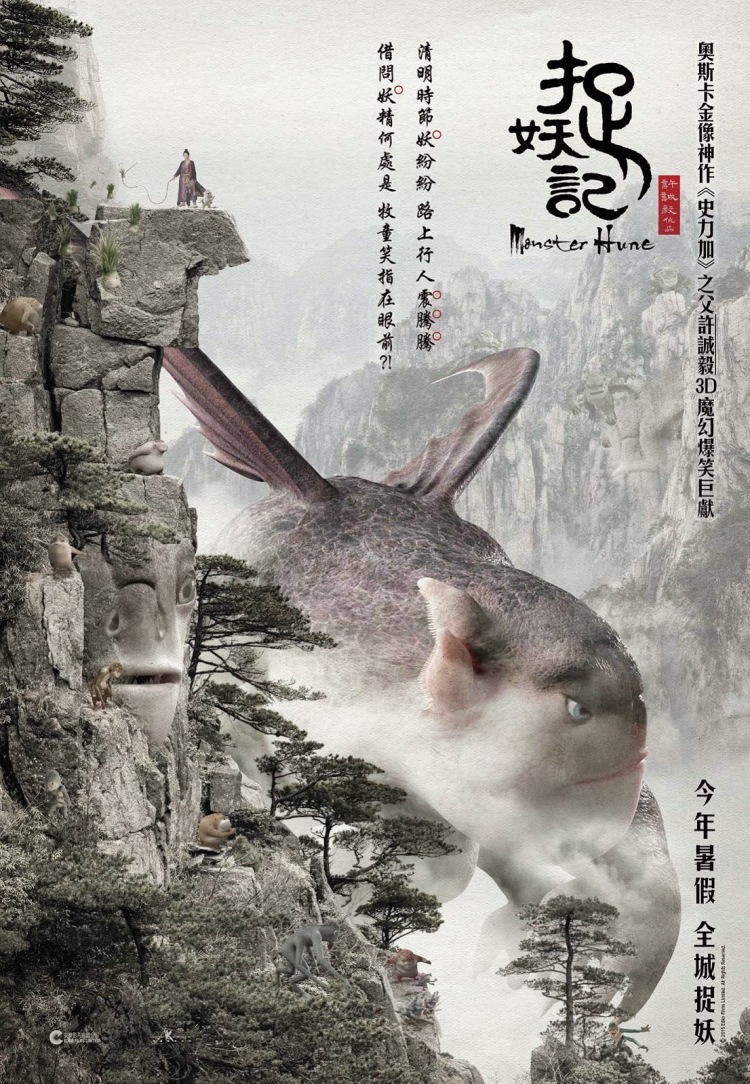
Monster Hunt posterA runaway box office hit and veritable pop culture phenomenon, you’d be forgiven for assuming that 2015’s Monster Hunt (捉妖記, Zhuō Yāo Jì) is nothing more than a slice of family friendly entertainment in the vein of a dozen other live-action/animation hybrid fantasy films. The monsters are cute, yes, and there is enough darkness here to rival Lord of the Rings, but there’s a little more going on under the surface of this otherwise heartwarming tale of a persecuted minority and its hidden princeling. A family drama of epic proportions, Monster Hunt speaks directly to China’s left behind children and to those who, perhaps, were worried their destiny had always been misplaced.

Set sometime in the distant fantasy past, Monster Hunt takes place in a universe in which men and Monsters co-exist but, owing to their defeat in a war, the Monsters have been forced back into the forests and mountains away from humankind many of whom no longer even believe they exist. However, there is fresh strife among the Monsters forcing a pregnant Queen to flee along with her retainers, straying into the human world in hope of saving her baby. Luckily she finds herself in a small village presided over by a kindly mayor with a limp, Tianyin (Jing Boran), who is also the son of a long missing Monster Hunter but much prefers domestic tasks such as cooking and sewing to hunting Monsters. The Queen manages to “transfer” her baby to Tianyin just before she dies, leaving him quite literally holding the baby assisted only by cynical bounty hunter Xiaolan (Bai Baihe).

Inspired by ancient folklore, Monster Hunt plays the chosen one trope to the max as Tianyin wrestles with his destiny while the baby, a true king displaced from his throne, awaits in ignorance. Like many contemporary fantasy tales, Monster Hunt also revels in subverting genre norms with its noticeably feminised hero. Tianyin is the son of a great warrior, but it’s his grandmother who practices kung fu and goes out looking for her long lost son, while Tianyin professes his love of domesticity, staying home cooking and sewing. His simplicity and softness is contrasted with the more masculine figure of the cynical Monster Hunter Xiaolan who becomes Tianyin’s casual love interest and the putative “father” in the loose family unit they form with the tiny baby radish-like figure they eventually christen Wuba.

The formation of a family unit in itself proves a problematic development for both Tianyin and Xiaolan who have both been abandoned by their own families and left to fend for themselves (with almost opposite results). Resentful at having been cast out by his apparently “heroic” father, Tianyin has definite views about the nature of fatherhood and the mistakes he does not wish to repeat with his own children while Xiaolan has grown wary of forming attachments altogether and strives to remind herself that she is only looking after Wuba until he’s big enough to sell on the Monster Hunter black market. Nevertheless, the pair cannot help becoming “accidental” parents even if they must first make a mistake they later need to rectify in trying to abandon their charge for financial gain. Tianyin “repeats” the “mistake” of his own father but finally comes to understand it for what it was – a father’s sacrifice of his paternal love to keep his child safe. Something that will certainly ring true for children who may be living apart from their own parents for reasons they don’t quite understand.

Yet a fairytale darkness is never far away as Tianyin and Xiaolan consider selling off little Wuba to a dodgy mahjong obsessed Monster fence (Tang Wei) who apparently knows how valuable he is but is planning to sell him to a local restaurant anyway. Despite the fact that everyone has forgotten Monsters exist, Monster meat is a delicacy reserved for the super rich (a subtle dig at China’s eat anything that can’t run faster than you philosophy ushered in by the sight of caged monkeys at the roadside) and little Wuba does look quite like a tasty daikon radish.

Cute monsters getting chopped up and eaten may be a horror too far for sensitive young children (if it weren’t for the fact the Monsters are all inspired by veggies Monster Hunt might be the greatest proselytising mechanism for vegetarianism the world has ever seen) but rest assured, little Wuba is quite the resourceful little tyke and he does after all have a grand destiny awaiting him. A tribute to unlikely heroes, gentle men, feisty women, and atypical families, Monster Hunt is an oddly subversive family friendly adventure and one which has clearly hit its mark in capturing the hearts of a whole generation who will doubtless be excited for the further adventures of Wuba as he moves closer towards his own Messianic destiny.


International trailer (English captions)
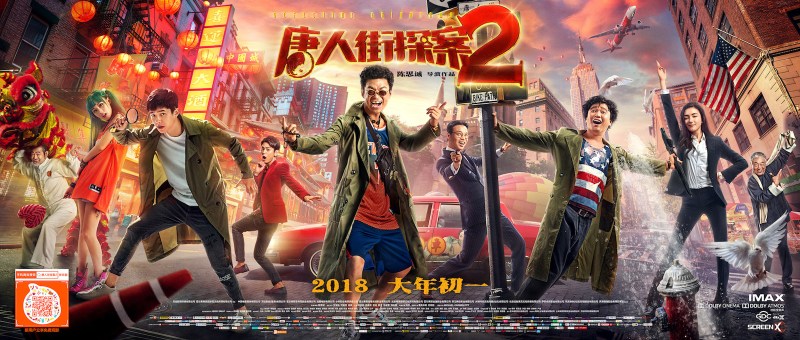
Detective Chinatown 2 (唐人街探案2, Chen Sicheng, 2018)

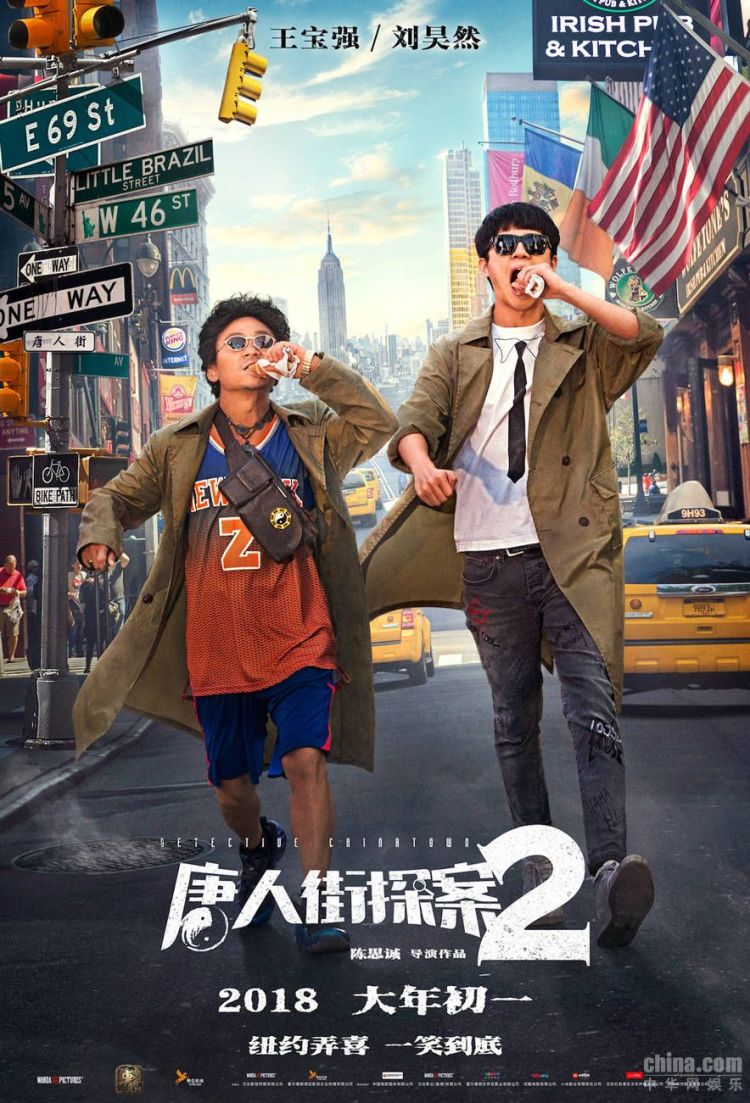
Detective Chinatown 2 posterBox office smash Detective Chinatown successfully pulled off the difficult feat of merging amusing buddy cop comedy with a holiday setting and intriguing cerebral mystery. Given the success of the first film it’s no surprise that the boys are back in town, or, as teased in the finale, in New York where another strange crime awaits their particular talents. Firmly a Chinese production taking place in an American city (though one using American crews), Detective Chinatown 2 (唐人街探案2, Tángrénj Tàn Àn 2) tries its best to maintain its unique character while shifting into American crime thriller territory, even if hampered by a stereotypical view of its target culture and some decidedly ropey English language dialogue.

Qin (Liu Haoran), now apparently a student at the police academy, has been tricked into coming to New York for Uncle Tang Ren’s (Wang Baoqiang) wedding to his love interest from the first film, Ah Xiang (Tong Liya). When he arrives, however, Qin quickly figures out that he’s in a room with some of the world’s best detectives – Ah Xiang left Tang Ren for someone with more money and so Tang Ren wants Qin to help him solve a mysterious New York murder for the reward promised by one of the victims’ grandfathers, a Chinatown gangster named Uncle Seven (Kenneth Tsang). Qin likes a good mystery so sticks around though the situation becomes decidedly more complicated after he finds and discounts the main suspect, Song Yi (Xiao Yang), leaving the trio on the run from the authorities, other detectives vying for the reward, and Uncle Seven’s guys some of whom have their own ulterior motives.

The most satisfying element of Detective Chinatown lay in the genuinely intricate nature of its locked room mystery and elegance of its resolution. Detective Chinatown 2 shifts away from the classical style of a European drawing room mystery for something altogether flashier and more American in keeping with its setting. It is, however, guilty of more than the faults of its genre in heavily signposting its solution from the midway point leaving any serious thriller fan twiddling their thumbs waiting for the penny to drop with ace detective Qin. Though a secondary twist offered after the killer has been unmasked helps to undercut the disappointment of such an anticlimax, it is not quite enough to compensate for the crushing obviousness of the central mystery.

Likewise, where Detective Chinatown existed firmly within a small Chinese enclave of Bangkok where everyone knew everyone, the move into the metropolis of Manhattan robs the film of its small-town charm. Despite the “Chinatown” tag, Chinatown itself is not a big player and as both of our guys are now full outsiders in another culture, we’re treated to a much less nuanced take on local stereotypes with several running gags likely to raise audience hackles with their tone-deaf approach to visualising the multicultural city. All of that aside, shooting in Central Manhattan with American crews also means much less creative freedom leaving the set pieces perhaps less impressive in terms of scale and ingenuity while the cinematography occasionally feels much more like standard American television than a big budget Chinese comedy.

Nevertheless the odd pairing of loudmouth Tang Ren and the comparatively subdued Qin, whose powers find even more impressive means of visualisation as he literally lifts buildings off a map and moves them round, remains the key selling point even though each half of the pair is also subjected to a bizarre round of sexual harassment from a biker boss with a tiny Chinaman fetish to a kung fu master with possible Alzheimer’s respectively. Though Chen generally relies on slapstick, the gags have a decidedly topical flavour – a police chief with terrible hair who makes off colour jokes and wants to build a wall to keep out all the annoying Chinese guys he can’t be bothered to deal with, for example, or the repeated references to immigration and the various dangers faced by those who’ve come from somewhere else and are trying to make a life for themselves. Yet the guys also keep running into people who unexpectedly speak Mandarin – perhaps a sign of the equally unexpected elevated status of Chinese visitors and their all important economic power. Detective Chinatown 2 is a mild disappointment after the duo’s impressive debut, but nevertheless does enough to spark interest in the teased Tokyo-set third instalment.


Currently on limited UK cinema release courtesy of Cine Asia. Screening details for UK, Germany, Australia, and New Zealand available via official website.

Original trailer (English subtitles)

Detective Chinatown (唐人街探案, Chen Sicheng, 2015)

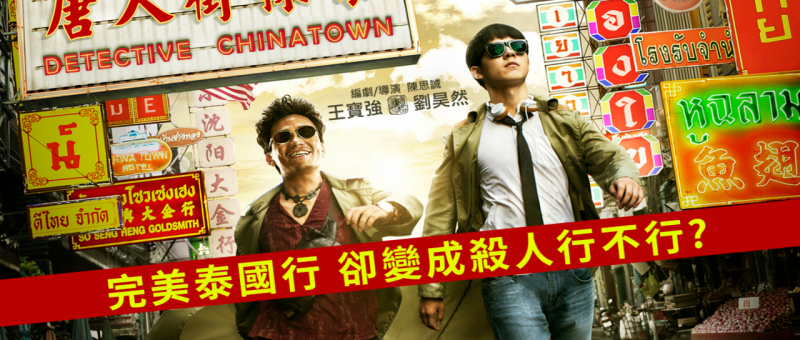
detective chinatown posterCrime exists everywhere, but so do detectives. When one young man fails his police exams because of an unfortunate impediment, he seeks refuge abroad only to find himself on a busman’s holiday when the relative he’s been sent to stay with turns out to be not quite so much of a big shot as he claimed and then gets himself named prime suspect in a murder. Detective Chinatown (唐人街探案, Tángrénj Tàn Àn) is one among many diaspora movies which find themselves shifting between a Chinese community existing to one side of mainland culture, and a mainland mentality. This time the setting is Bangkok but second time director Chen Sicheng is careful not to surrender to stereotype whilst also taking a subtle dig at men like uncle Tang Ren who can unironically refer to Thailand as a paradise while indulging in many of the aspects which might leave other residents with much more ambivalent emotions.

Qin (Liu Haoran), a young man with a fierce love of detective fiction, has his dreams shattered when his interview to get into the police academy is derailed by his stammer and an unwise tendency towards reckless honesty. His doting grandma who raised him suggests Qin take a holiday to take his mind off things by going to stay with his uncle who is, apparently, a hot shot detective in Bangkok – Qin might even get some valuable experience whilst thinking about a plan B. Sadly, uncle Tang Ren (Wang Baoqiang) has been sending big fish stories back home for years and though he claims to be the best PI in Chinatown, he’s really a petty marketplace fixer with a bad mahjong habit and a side hustle in “finding” lost dogs. When Tang Ren accepts an errand to transport a statue from a workshop, he accidentally finds himself the prime suspect in the murder of the sculptor who is himself the prime suspect in a heist of some now very missing gold. Qin, tainted by association, vows to use his awesome detective skills to find the real killer (and the gold) to clear his uncle’s name whilst generally serving justice and protecting the innocent.

Despite the fact his secret is clearly about to be exposed, Tang Ran greets his long lost relative with immense enthusiasm (which is, as it turns out, how he does everything). Wang Baoqiang commits absolutely to Tang Ren’s cynical good humour attacking his larger than life personality with gusto though one has to wonder why Qin’s poor unsuspecting grandma thought Tang Ren would be a good guardian for her teenage grandson, especially as his first act is to take him to a strip club and spike what might actually be the first real drink of his life. Qin, quiet (that stammer) and introspective, is not a good fit for the loud and brassy world of insincerity his uncle inhabits, but forced into some very challenging situations, the two men eventually manage to combine their respective strengths into a (hilariously) efficient crime fighting team.

Meanwhile, Qin and Tang Ren are also contending with some serious political shenanigans in the local police department. Two Chinese cops are currently vying for a promotion and the job has been promised to whichever of them manages to identify the murderer and locate the missing gold. Luckily or unluckily, cop 1 – Kuntai (Xiao Yang), is a good friend of Tang Ren’s and doesn’t want to believe he is secretly some kind of criminal genius (but could well believe he killed a guy by mistake). Cop 2 (Chen He) is a hard-nosed (!) type who, for some reason, dresses like a cowboy and has a crush on Tang Ren’s landlady (Tong Liya) with whom Tang Ren is also in love. What this all amounts to is that everyone is stuck running circles around each other, trapped inside the wheel of farce, while the gold and the killer remain ever elusive.

Qin, finally beginning to overcome his stammer, puts some of his hard won detective nouse to the test and eventually figures out what’s going on but, by that point, he’s also warmed to his uncle enough to let him do the big drawing room speech. Filled with slapstick and absurd humour as it is, Detective Chinatown is also a finely constructed mystery with an internally consistent solution that offers both poignancy and a degree of unexpected darkness when the final revelations roll around. It is, however, the odd couple partnership between the sullen Qin (secretly embittered) and larger than life Tang Ren (secretly melancholy) that gives the film its winning charm, ensuring there will surely be more overseas adventures for these Chinatown detectives in years in to come…


Currently available to stream in the UK & US via Amazon Prime Video.

Original trailer (English subtitles)

The Monkey King 3 (西遊記女兒國, Cheang Pou-soi, 2018)

the monkey king 3 posterSun Wu Kong and his band of merry scripture seekers will face many challenges on their journey to the West, but none so dangerous as the poison of love! Aaron Kwok reprises his role as the titular Monkey King in the third of the ongoing series directed by Cheang Pou-soi (here credited as Soi Cheang) but steps back a few paces into a supporting role while noble hearted monk Xuanzang (William Feng Shaofeng) takes centre stage to face the multifaceted dilemma of love and personal fulfilment vs the fulfilment of his quest to better the lives of all mankind. An age old problem, but one you can’t truly address until you have stake in the game.

Xuanzang, now returned and dressed in white, has a romantic destiny – something which makes him a little nervous as he happily sails along a picturesque river in the company of companions Wujing (Him Law) and Zhubajie (Xiaoshenyang) while Wu Kong (Aaron Kwok) flies along behind, apparently having mislaid his trousers somewhere along the way. All of a sudden the atmosphere darkens as the gang sail into a “demonic” area where they are attacked by a giant, whale-like river god and subsequently thrown into another dimension thanks to an intervention from the Goddess of Mercy (now played by Liu Tao in place of the series’ previous cameo from Kelly Chen).

The guys have inadvertently landed themselves in Womanland which is 100% man free. In fact men are illegal and to be executed on sight which is a bit of a problem seeing as it’s also impossible to leave. Not so much of a problem, however, as the strange moment which occurred between Xuanzang and the Queen of Womanland (Zhao Liying) as their eyes met during a near fatal fall from a cliff edge. Following the childish exuberance of the first film and the morbidly gothic horror of the second, it’s love which now threatens to derail our heroes’ quest and with it the possibility of salvation for all mankind.

Womanland was founded by a woman scorned who turned her back on faithless men forevermore, instructing her followers that men are selfish and duplicitous, that they lie to win the hearts of women which they later break in forsaking them for the next conquest. The holy scriptures of Womanland warn of the “poison of love” which is (usually, they say) spread from man to woman and leads to nothing but inescapable suffering. Foreswearing all romance (apparently there is no concept of romantic love in the all woman kingdom save the rumour that there was once a young woman who fell in love with a river she was never able to see) turns out not to be the best solution to the problem as we discover that all the ruckus in the world above is in someway caused by these repressed or denied emotions as well as by a failure to accept that sometimes feelings must be sacrificed in favour of greater responsibilities.

Whereas the second film pitted Wu Kong and Xuanzang against each other as advocates of compassion and rationality, this time Xuanzang must face a monk’s dilemma alone in deciding whether the love of one woman is equal to that of the whole of mankind. His choice is a forgone conclusion but serves to remind the monk that denying one’s true feelings is not the same as facing them and wilfully isolating oneself from possible suffering is not the same as overcoming it. The residents of Womanland discover something similar in the parallel journey of their embittered first minister (Gigi Leung) whose own unfulfilled romantic desires have made her cruel and vindictive only to be presented with another choice and find herself denying love for duty once again.

Duty, however, turns out to be warmer than it sounds – in Womanland, maternal love trumps the romantic, undercutting the otherwise progressive atmosphere of a society of women doing fine on their own with a return to maternity as central virtue of womanhood. Love is the force which threatens to undo carefully won civility (a “bourgeois affectation” as the more dogmatic definition would have it), but desire repressed rivals love scorned as a force to burn the world. Xuanzang has a choice to make, but the choice itself is not so important as the conscious act of choosing. Aside from a bizarre subplot featuring male pregnancy and forced abortion, Monkey King 3 makes a largely successful shift away from gung-ho adventuring into poignant romantic melodrama. With the gang en route to Fire Mountain, where will their journey take them next?


Currently on limited release in UK cinemas courtesy of China Lion Film.

International trailer (English subtitles)

The Monkey King 2 (西遊記之孫悟空三打白骨精, Cheang Pou-soi, 2016)

Monkey King 2 posterThe Monkey King returns! Again! This time it’s Aaron Kwok (who, confusingly enough, played the villain in the first film) picking up the staff of the titular hero for Cheang Pou-soi in place of martial arts star Donnie Yen but otherwise it’s business as usual for the mischievous Sun Wu Kong as he finally sets off on his journey to the west with the preliminaries already well sorted out. After 500 years trapped under a mountain, you’d think Wu Kong might have had some time to reflect on his behaviour but alas, there is still a very long journey ahead of him

So, 500 years after the end of the first film which saw Wu Kong imprisoned under Five Finger Mountain by the Goddess of Mercy, a young monk, Xuanzang (William Feng Shaofeng), gets himself into a sticky situation with a giant white tiger. Crawling into a crevice to hide, he finds himself face to face with Wu Kong who urges him to remove the magic tag which keeps him imprisoned. Xuanzang, little understanding what he’s letting himself in for, tugs on the tag. Wu Kong busts right out of his rocky cage and valiantly defeats the “evil demonic” tiger. Of course this is all in the grand plan envisioned by the Goddess (Kelly Chen) who has a mission for Wu Kong – escort Xuanzang to the West where he will find a set of scriptures which will unlock the truths of the world.

Monkey King 2 (西遊記之孫悟空三打白骨精) focusses on Wu Kong’s battle with the White Lady (AKA White Boned Demon, played by Gong Li) who has been nursing a deep and incurable grudge for even longer than Wu Kong was trapped under that mountain. Like Wu Kong, the White Lady was rejected by her own kind, blamed for something that wasn’t her fault and cast out as a demon to be pecked to death by vultures all alone on a rocky outcrop. You can understand why she’d be upset, but rather than an end to her suffering the White Lady wants only immortality to indulge her grudge still further. Unfortunately for Wu Kong, she has taken a fancy to Xuanzang who she thinks would make quite the tasty snack and help her live forever as a demon rather than die as a hated human – one of those who has so badly wronged her.

Wu Kong serves the Goddess of Mercy but his primary motivation in accompanying Xuanzang is to get the metal tiara he’s wearing taken off so he can misbehave again. Nevertheless, through their journey Wu Kong develops deep respect for the goodhearted monk even if they do not always see eye to eye. Wu Kong whose fiery eyes see one kind truth can recognise a “demon” when he sees one and his hardheartedness means he has no trouble killing them on sight. Xuanzang by contrast sees with his heart and is constantly troubled by Wu Kong’s desire for violence even if it’s in his name. Wu Kong sees Xuanzang’s philosophy of love and forgiveness as naive and prefers to be proactive in the face of danger (his fiery eyes do, after all, ensure he is “right” when comes to identifying demons), but Xuanzang worries that Wu Kong’s unforgiving heart creates only more suffering in a world already overflowing with negative emotions and their unfortunate effects.

It is, however, the Monkey King who is on a journey here – away from selfish mischief and towards a more responsible use of his vast powers. Wu Kong is tempted by the White Lady, seductively played by Gong Li with a strangely alluring quality of malevolence. Yet for all that (when all that sometimes means eating innocent monks and being suspected of drinking the blood children), the White Lady is not completely unsympathetic and Xuanzang’s desire to save her admirable in his commitment to lifting those in pain out of their dark places even if it comes at great personal cost to himself.

Kwok makes for a less cartoonish Monkey King than Yen, embracing the impulsivity of the unpredictable Wu Kong but also capturing something of his complicated emotional landscape as he finds himself drawing closer to Xuanzang’s way of thinking only to rebel against himself. Learning from the mistakes of the first film, Cheang ends the headache inducing sugar rush in favour of a more normal Chinese fantasy aesthetic while also ensuring the (still frequent use of) CGI is of a much better (if imperfect) quality. All in all, the second venture of the Monkey King can be counted a success which is fortunate indeed because his journey is far from over.


Original trailer (English subtitles)

The Mole Song: Undercover Agent Reiji (土竜の唄 潜入捜査官 REIJI, Takashi Miike, 2013)

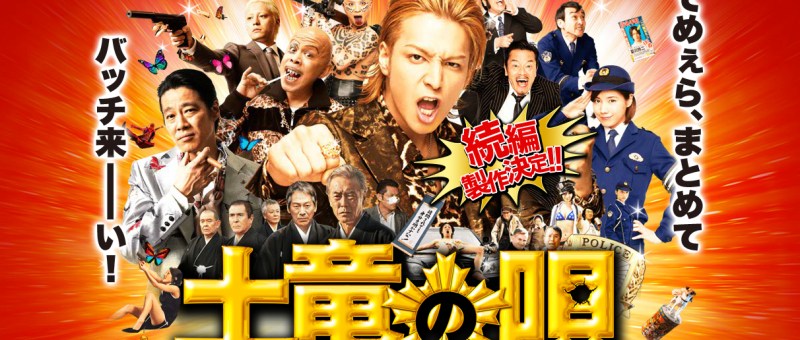
mole song under cover agent reiji poserYakuza aren’t supposed to be funny, are they? According to one particular lover of Lepidoptera, that’s all they ever need to be. Scripted by Kankuro Kudo and adapted from the manga by Noboru Takahashi, Takashi Miike’s The Mole Song: Undercover Agent Reiji (土竜の唄 潜入捜査官 REIJI, Mogura no Uta: Sennyu Sosakan Reiji) is the classic bad spy comedy in which a hapless beat cop is dragged out of his police box and into the field as a yakuza mole in the (rather ambitious) hope of ridding Japan of drugs. As might be assumed, Reiji’s quest does not quite go to plan but then in another sense it goes better than anyone might have hoped.

Reiji Kikukawa (Toma Ikuta) is, to put it bluntly, not the finest recruit the Japanese police force has ever received. He does, however, have a strong sense of justice even if it doesn’t quite tally with that laid down in law though his methods of application are sometimes questionable. A self-confessed “pervert” (but not a “twisted” one) Reiji is currently in trouble for pulling his gun on a store owner who was extracting sexual favours from high school girls he caught shop lifting (the accused is a city counsellor who has pulled a few strings to ask for Reiji’s badge). Seizing this opportunity, Reiji’s boss (Mitsuru Fukikoshi) has decided that he’s a perfect fit for a spell undercover in a local gang they suspect of colluding with Russian mafia to smuggle large amounts of MDMA into Japan.

Reiji hates drugs, but not as much as his new best buddy “Crazy Papillon” (Shinichi Tsutsumi) who is obsessed with butterflies and insists everything that happens around him be “funny”. Reiji, an idiot, is very funny indeed and so he instantly gets himself a leg up in the yakuza world whilst forming an unexpectedly genuine bond with his new buddy who also really hates drugs and only agreed to join this gang because they promised him they didn’t have anything to with them.

Sliding into his regular manga mode, Miike adopts his Crows Zero aesthetic but re-ups the camp as Reiji gets fired up on justice and takes down rooms full of punks powered only by righteousness and his giant yakuza hairdo. Like most yakuza movies, the emphasis is on the bonds between men and it is indeed the strange connection between Reiji and Papillon which takes centerstage as Miike milks the melodrama for all it’s worth.

Scripted by Kankuro Kudo (who previously worked with the director on the Zebra Man series), Reiji skews towards a slightly different breed of absurdity from Miike’s patented brand but retains the outrageous production design including the big hair, garish outfits, and carefully considered colour scheme. Mixing amusing semi-animated sequences with over the top action and the frequent reoccurrence of the “Mole Song”, Miike is in full-on sugar rush mode, barely pausing before moving on from one ridiculous set piece to the next.

Ridiculous set pieces are however the highlight of the film from Reiji’s early series of initiation tests to his attempts to win the affections of his lady love, Junna (Riisa Naka), and a lengthy sojourn at a mysterious yakuza ceremony which Reiji manages to completely derail through a series of misunderstandings. At 130 minutes however, it’s all wearing a bit thin even with the plot machinations suddenly kicking into gear two thirds of the way through. Nevertheless, there’s enough silly slapstick comedy and impressive design work at play to keep things interesting even if Reiji’s eventual triumph is all but guaranteed.


Screened as part of the Japan Foundation Touring Film Programme 2018.

Screening again:

  • Queen’s Film Theatre – 21 February 2018
  • Phoenix Leicester – 24 February 2018
  • Brewery Arts Centre – 16 March 2018
  • Broadway – 20 March 2018
  • Midlands Arts Centre – 27 March 2018
  • Showroom Cinema – 28 March 2018

Original trailer (English subtitles)

Memoirs of a Murderer (22年目の告白―私が殺人犯です―, Yu Irie, 2017)

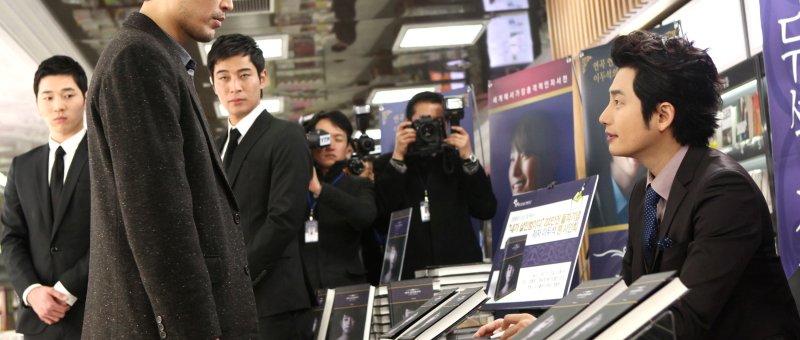
Memoirs of a MurdererJung Byung-gil’s Confession of Murder may have been a slightly ridiculous revenge drama, but it had at its heart the necessity of dealing with the traumatic past head on in order to bring an end to a cycle of pain and destruction. Yu Irie retools Jung’s tale of a haunted policeman for a wider examination of the legacy of internalised impotence in the face of unavoidable mass violence – in this case the traumatic year of 1995 marked not only by the devastating Kobe earthquake but also by Japan’s only exposure to an act of large scale terrorism. Persistent feelings of powerlessness and nihilistic despair conspire to push fragile minds towards violence as a misguided kind of revenge against their own sense of insignificance but when a killer, safe in the knowledge that they are immune from prosecution after surviving the statute of limitations for their crimes, attempts to profit from their unusual status, what should a society do?

22 years ago, in early 1995, a spate of mysterious stranglings rocked an already anxious Tokyo. In 2010, Japan removed the statute of limitations on capital crimes such as serial killings, mass killings, child killings, and acts of terror, which had previously stood at 15 years, leaving the perpetrator free of the threat of prosecution by only a matter of seconds. Then, all of a sudden, a book is published claiming to be written by the murderer himself as piece of confessional literature. Sonezaki (Tatsuya Fujiwara), revealing himself as the book’s author at a high profile media event, becomes a pop-culture phenomenon while the victims’ surviving families, and the detective who was in charge of the original case, Makimura (Hideaki Ito), incur only more suffering.

Unlike Jung’s version, Irie avoids action for tense cerebral drama though he maintains the outrageous nature of the original and even adds an additional layer of intrigue to the already loaded narrative. Whereas police in Korean films are universally corrupt, violent, or bumbling, Japanese cops are usually heroes even if occasionally frustrated by the bureaucracy of their organisation or by prevalent social taboos. Makimura falls into hero cop territory as he becomes a defender of the wronged whilst sticking steadfastly to the letter of the law in insisting that the killer be caught and brought to justice by the proper means rather than sinking to his level with a dose of mob justice.

Justice is, however, hard to come by now that, legally speaking, the killer’s crimes are an irrelevance. Sonezaki can literally go on TV and confess and nothing can be done. The media, however, have other ideas. The Japanese press has often been criticised for its toothlessness and tendency towards self-censorship, but maverick newscaster and former war correspondent Sendo (Toru Nakamura) is determined to make trial by media a more positive move than it sounds. He invites Sonezaki on live TV to discuss his book, claiming that it’s the opportunity to get to the truth rather than the viewing figures which has spurred his decision, but many of his colleagues remain skeptical of allowing a self-confessed murderer to peddle his macabre memoirs on what they would like to believe is a respectable news outlet.

The killer forces the loved ones of his victims to watch while he goes about his bloody business, making them feel as powerless as he once did while he remains ascendent and all powerful. It is these feelings of powerlessness and ever present unseen threats born of extensive personal or national traumas which are responsible for producing such heinous crimes and by turns leave behind them only more dark and destructive emotions in the desire for violence returned as revenge. Focussing in more tightly on the despair and survivors guilt which plagues those left behind, Irie opts for a different kind of darkness to his Korean counterpart but refuses to venture so far into it, avowing that the law deserves respect and will ultimately serve the justice all so desperately need. Irie’s artier approach, shifting to grainier 16:9 for the ‘90s sequences, mixing in soundscapes of confusing distortion and TV news stock footage, often works against the outrageous quality of the convoluted narrative and its increasingly over the top revelations, but nevertheless he manages to add something to the Korean original in his instance on violence as sickness spread by fear which can only be cured through the calm and dispassionate application of the law.


Screened as part of the Japan Foundation Touring Film Programme 2018.

Screening again:

  • Showroom Cinema – 22 March 2018
  • Broadway – 23 March 2018
  • Firstsite – 24 March 2018
  • Midlands Arts Centre – 24 March 2018
  • Queen’s Film Theatre – 25 March 2018

Original trailer (English subtitles)

Confession of Murder (내가 살인범이다, Jung Byung-gil, 2012)

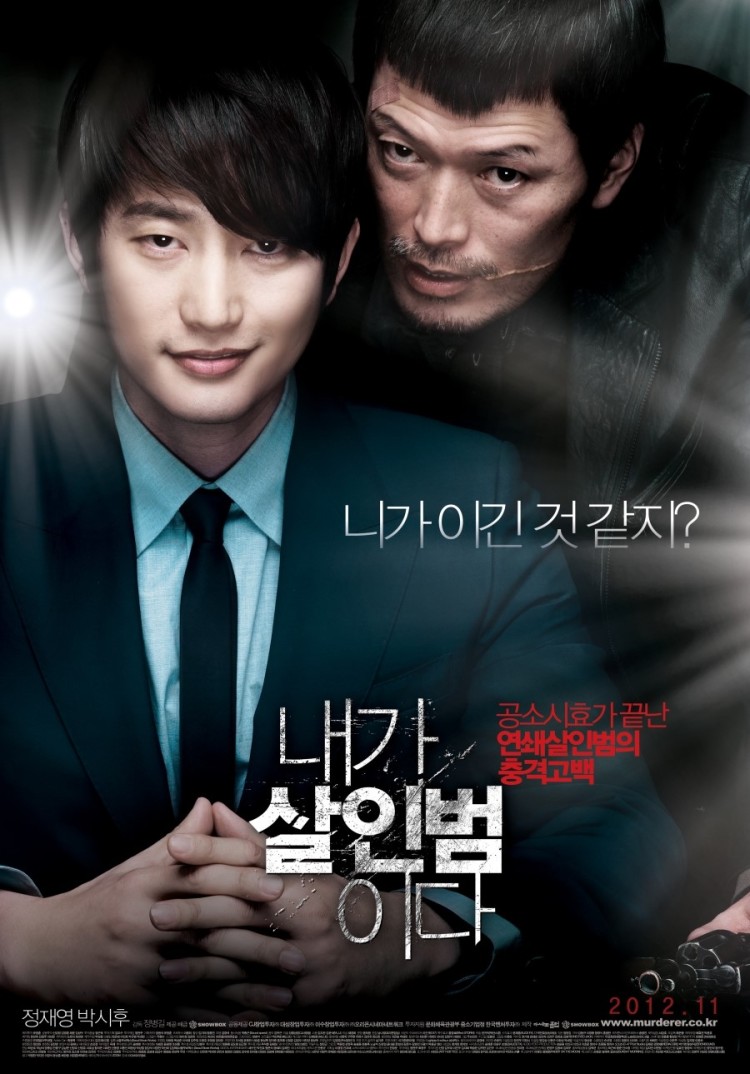
Confession of murder posterThe UK does not have a statute of limitations for criminal cases, only for civil ones, so if you want to be certain you’ve got away with murder you’ll need to wait until the very end and offer only a deathbed confession. In Korea, however, the statute of limitations on murder is (or was, at least, in 2012) 15 years so after that time you can even go on TV and tell everyone you’re a serial killer and all that will happen is that you’ll suddenly become a media darling beloved by a hundred giddy schools. Such is the premise behind Jung Byung-gil’s complicated mystery thriller Confession of Murder (내가 살인범이다, Naega Salinbeomida) in which a grizzled detective and the bereaved relatives try to cope with their guilt and desire for revenge by enacting their own kind of justice on a self-confessed serial killer.

15 years ago, Detective Choi (Jung Jae-young) let a serial killer get away with only a scar on his cheek and the killer’s promise of reunion to show for it. 10 women are dead and Choi’s own fiancée missing presumed among the victims, and with the statute of limitations about to expire it appears that the killer will get away with his heinous crimes having successfully outlived justice. On the day the killer is officially off the hook, one of the victim’s sons commits suicide, further adding to Choi’s sense of inadequacy in being unable to bring the killer to justice within the time limit.

Two years on from the limitation passing, a handsome young man steps into the limelight with a book called “Confession of Murder” which claims to be an exposé on his reign of killing. Lee (Park Si-hoo) with his pop idol good looks and suave manner quickly becomes a media sensation despite the discomfort of some that he is profiting from the deaths of his innocent victims whom he has also robbed of justice even if he claims to be remorseful and to have reformed. Detective Choi has his doubts about the killer’s account and particularly about the possible 11th victim whose body has never been found.

Aside from the intrigue surrounding the true identity of the killer (or killers), Confession of Murder has a few difficult questions to ask about the nature of fame and the cult of celebrity. Lee has just confessed to a brutal series of unsolved killings of women, but thanks to his boy band good looks and impressive media marketing campaign he’s already amassed a fan club of adoring young girls including three rowdy high schoolers we first meet in Choi’s prison cells. Having escaped justice, Lee feels secure enough in his legal protections to crow not only about his crimes but in having gotten away with them so skilfully. His book becomes a best seller and his TV appearances hotly anticipated even if the fascination behind them maybe more ghoulish than intellectual or steeped in admiration.

What Lee exposes is a set of judicial double standards in which a man who has not paid for crimes he freely admits committing can be allowed to remain free and even use those same crimes to build a new life for himself by exploiting them for financial and social gains. The families of the bereaved, denied justice, seek their own – as does Choi even if he does it as a serving law enforcement officer. The lines between justice and revenge become ever blurred as the killer subverts the protections of the law as weapons against those who would seek to see that his crimes are properly served by it.

Meanwhile, Jung veers wildly between taught psychological thriller and absurd action drama in which an attempt to kidnap the killer is made by throwing poisonous snakes at him and then stealing him away in a fake ambulance which soon gives way to a lengthy motorway chase. The action sequences, often unexpected, are brilliantly choreographed set pieces of frenzied attack and retreat in which the outcome is perpetually uncertain. Uncertainty is certainly something Jung is adept at using as his narrative becomes ever more convoluted and intentions increasingly cloudy.

As much fun as it all is, Confession of Murder also has its degrees of poignancy in insisting on a need to deal with the unresolved past head on. Buried truths begin to fester and no amount of wilful forgetting will cure them, only the truth will do. Detective Choi faces a serious dilemma when faced with the limitations of a system to which he has devoted his life and which has already taken so much from him. If he transgresses, he will be judged by that same system but the judgement itself will also be a kind of affirmation that justice has finally been done and the case firmly closed.


Original trailer (English subtitles)

The Dark Maidens (暗黒女子, Saiji Yakumo, 2017)

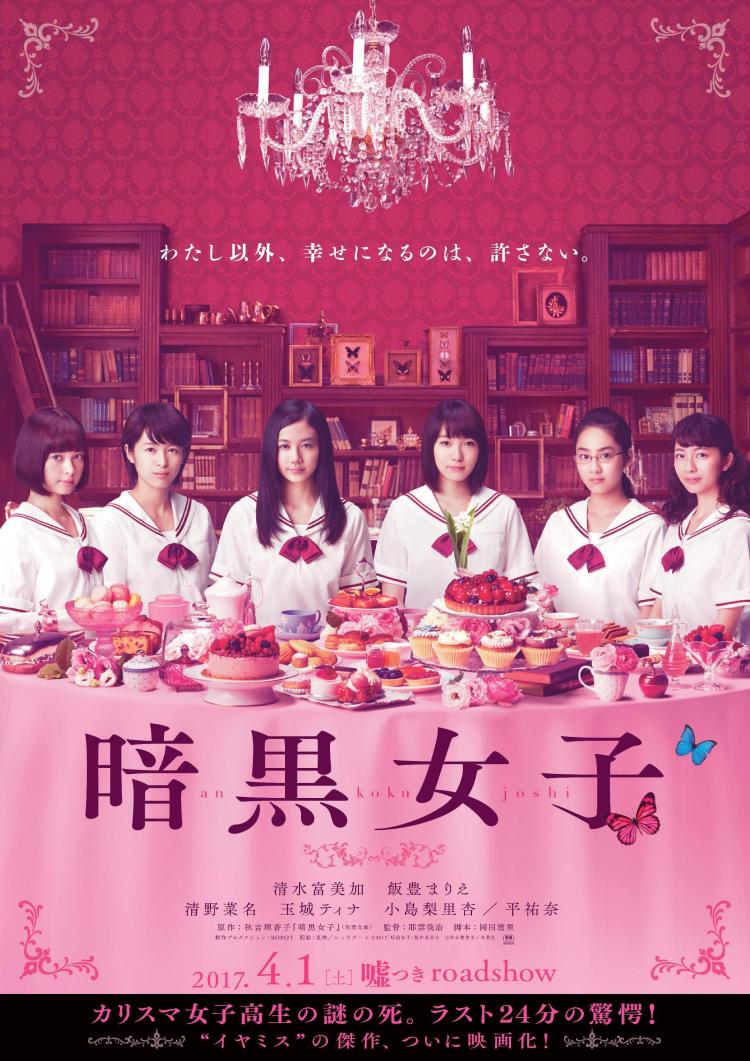
dark maidens posterThe world of teenage girls is often arcane and impenetrable to those outside of its extremely exclusive bubble, but The Dark Maidens (暗黒女子, Ankoku Joshi), Saiji Yakumo’s adaptation of the Rikako Akiyoshi novel, takes duplicity to new heights. When the school darling dies by falling (oh so beautifully) off a roof, speculation is rife and a rumour quickly spreads through the otherwise repressive educational environment that her very best friends are somehow to blame. Each implicates the others in turn, indulging their petty grudges and jealousies seemingly falling over themselves to express their closeness to the departed “sun”, but all is not quite as it seems and these collective acts of fantasy perhaps expose a little more than they were first intended to.

Itsumi Shiraishi (Marie Iitoyo) is dead. The daughter of the chairman at the elite all girls Catholic high school, Virgin Mary Academy, Itsumi was loved by all as the radiant sun whose innate goodness was the very embodiment of the school’s Christian aims. Immediately before the school holidays, the literature club – the most prestigious and exclusive of school associations of which Itsumi had been founder and president, are to meet one last time presided over by Itsumi’s best friend Sayuri (Fumika Shimizu). The girls will each read a story they have written “inspired” by Itsumi’s death, each of which attempts to tell her story from their perspective but ultimately paints themselves in a favourable light whilst casting doubt on the others. 

The sole clue to the mystery is the lily of the valley Itsumi clutched to her breast, Snow White-like, as she lay pale and wan amid the flowers, elegantly arranged as always despite an apparently violent death. Quickly the girls run through a series of possible motives each with a degree of internal consistency but veering off in their own particular directions. Three of the girls awkwardly hint at their (unrequited?) love for their dead friend, insisting on a kind of ownership of her memory and of their rightful place at her side while the fourth descends into a xenophobic horror story casting the half-Bulgarian girl as a “vampire” come to suck the life out of the previously warm and vivacious Itsumi.

Yakumo delights in sending up the ever present girls school trope of repressed lesbianism and passionate friendships, but it remains true enough that the love card was apparently not one which Itsumi was afraid to play. The stories are all, in part at least, fabrications intended to cover up the various skeletons each of the girls has in their closets, but what they reveal is the series of manipulative machinations which underpins this seemingly sweet and elegant collection of conservative young ladies indulging a love for literature and the Christian virtues. Affairs, blackmail, inappropriate sexual relationships, forced abortions (at a Catholic school!), arson, all of these precede the presumed murder of Itsumi in a vast web of deception and illicit activity.

Teenage girls are often desperate to fit in, to be accepted by the “elite”, at the best of times but especially in an environment as otherwise repressive and exacting as an all girls Catholic high school. Adolescence is a time for trying on different personalities, but there can be something inherently plastic about the identity of a high school girl wanting in to the popular club. Hiding their true feelings, their fears and jealousies, the girls play the parts of they’ve been assigned – supporting cast in the tragic history of Itsumi, a girl betrayed who remained beautiful even in death. Then again, there might be some push back from those growing to resent their peripheral status and beginning to wonder if the spotlight was not theirs for the taking all along. A sun, however, will always need its lesser stars to demonstrate how much brighter it can shine.

Adapted from the novel by Rikako Akiyoshi, The Dark Maidens is a perfect mix of European drawing room mystery and gothic melodrama. Yakumo ups the camp fantastically with the girls sitting round a mysterious pot of stew in a room lit only by candlelight while a storm rages outside and each revelation is accompanied by crashing thunder and flashes of light. The setting is oppressive and sinister, but the only horror in the room is entirely human as each of these young women eagerly submits themselves to someone else’s control in fear of being, in some way, exposed, while those who seek to play the lead have to stoop to underhanded methods just to make “friends” who are really just minions rather than true believers. A sad and sorry state of affairs – who knew teenage cliques could be so, well, dark?


Screened as part of the Japan Foundation Touring Film Programme 2018.

Screening again:

  • Brewery Arts Centre – 16 February 2018
  • Macrobert Arts Centre – 19 February 2018
  • Showroom Cinema – 1 March 2018

Original trailer (English subtitles)

Japanese Girls Never Die (アズミ・ハルコは行方不明, Daigo Matsui, 2016)

Japanese Girls Never DieJapanese Girls Never Die (アズミ・ハルコは行方不明, Azumi Haruko wa Yukuefumei) but, like old soldiers, only fade away in Daigo Matsui’s impassioned adaptation of the Mariko Yamauchi novel. Crushed by a misogynistic society, these are women who may well want to disappear if only as an alternative to finally being forced into submission to the predefined paths of womanhood – i.e. marriage and motherhood (and nothing else) that have been carved out for them. The young are, however, fighting back if in less than admirable ways. The best revenge on an oppressive society may be living well in one’s own way, but when that same society is at great pains to frustrate your goal the options are few.

As per the title, 28-year-old admin assistant Haruko Azuma (Yu Aoi) has gone missing. Her face, stolen from her missing poster, has been co-opted by a pair of petty punk idiots trying to come-up with a viral graffiti tag to rival Obey, but there’s no art or intention behind their minor act of social transgression so much as bravado and pithy rebellion. Nevertheless, Haruko’s image, plastered throughout the city, has become a hot topic on Japan’s social networking sites where a hundred trolls wade in with their prognostications and salacious fantasies of her violent death at the hands of a sex maniac.

Meanwhile, in an ironic subversion of the normalities of city life, young men have been urged to avoid walking alone at night following a spate of attacks by a gang of rabid school girls taking revenge on the male sex. No exact motive is given for their crusade save the missing poster that precedes Haruko’s and asks for information on a disappeared school girl, but goodness knows they have enough obvious reasons to have decided on a course of vigilante justice.

Haruko’s world is one defined by entrenched sexism. At 28 she finds herself embarrassed to be a still single woman at a wedding while a chance encounter with a school friend (Huwie Ishizaki) at a supermarket leads to more awkwardness when he pointedly remarks he assumed she’d be a housewife by now, and that she looks “old”. At work, Haruko’s colleague Yoshizawa (Maho Yamada), 37 and still unwed, is the butt of hundred jokes for the two middle-aged men who, for some reason, are their bosses though they hardly seem to do any work and automatically earn seven times Yoshizawa’s salary. The bosses urge Haruko to dress in more feminine fashions, asking invasive questions about her personal life while disparaging single women like Yoshizawa who they blame for Japan’s declining birthrate and a related raise in their taxes, avowing that women over 35 are essentially pointless seeing as their eggs are already “rotten”. Yoshizawa has developed a thick skin for their constant needling, realising that it amounts to an odd combination of sexual harassment and constructive dismissal campaign. Unwilling to pay a “higher” salary to an “older” woman, they are waiting for her to quit so they can hire a young and pretty new girl who will be naive enough to accept the pittance they intend to pay her.

It might be thought that the attitudes of Haruko’s bosses are a reflection of their generation, but the two young punks, Yukio (Taiga) and Manabu (Shono Hayama), are no different. 20-year-old Aina (Mitsuki Takahata), a bar girl with ambitions to enter the beauty business, gets swept into their unpleasant orbit after getting into a “relationship” with Yukio, but Yukio thinks of her only as a plaything, even going so far as to encourage the shy Manabu to try his luck because (he claims contemptuously) Aina is the kind of girl who’ll go with anyone. Later she becomes a key part of their mini graffiti movement, but once the pair start to get a little recognition they essentially erase Aina from the story taking all the credit for themselves. Aina, poignantly looking up at the poster advertising the boys’ big moment in the same way she had gazed at Haruko’s missing poster on the police station notice board, realises she’s finally had enough of all their lies and of being made to feel invisible in a society which refuses to recognise her as anything more than an object for exploitation.

Haruko’s face is literally plastered all over town, but she remains essentially faceless, her image stolen and stripped of its identity to be repackaged as a soulless symbol for two idiotic boys who not only do not care who she is or might have been but only seek to profit from claiming to be allies in a struggle while simultaneously propping up the opposing side. The image does, however, gain its own independent power, speaking for all the oppressed and belittled women who find themselves essentially disappeared in being forced to abandon their hopes and dreams in the face of extreme social pressure. The school girls are fighting back – the next generation will (perhaps) not be so keen to remain complicit in the social codes which restrict their prospects. Then again, as the image of Haruko tells one of her lost disciples, the best revenge is living well. Choosing to absent oneself from a system of social control, going missing in a more positive sense, may be the best option of all.


Screened as part of the Japan Foundation Touring Film Programme 2018.

Screening again:

  • Dundee Contemporary Arts – 26 February 2018
  • HOME – 27 February 2018
  • Phoenix Leicester – 1 March 2018
  • Filmhouse – 3 March 2018
  • Showroom Cinema – 6 March 2018
  • Firstsite – 9 March 2018
  • Exeter Phoenix – 13 March 2018
  • Queen’s Film Theatre – 18 March 2018

Original trailer (English subtitles)